PUBLISHER: MarketsandMarkets | PRODUCT CODE: 1974629
PUBLISHER: MarketsandMarkets | PRODUCT CODE: 1974629
Dry Shampoo Market by Product Form By Function, by Distribution Channel, End User And Region - Global Forecast to 2030
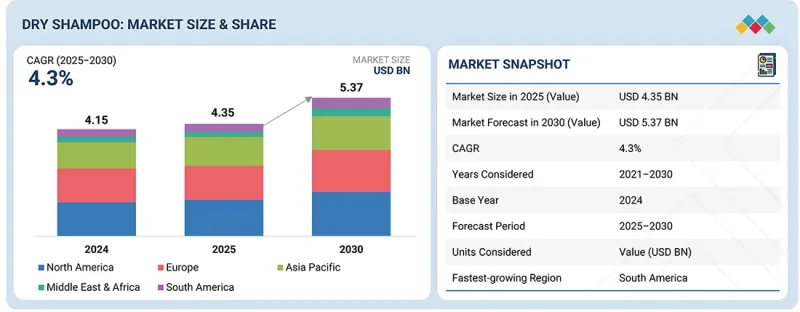
The dry shampoo market is projected to grow from USD 4.35 billion in 2025 to USD 5.37 billion by 2030, at a CAGR of 4.3% during the forecast period.
| Scope of the Report | |
|---|---|
| Years Considered for the Study | 2021-2030 |
| Base Year | 2024 |
| Forecast Period | 2025-2030 |
| Units Considered | Value (USD Million) |
| Segments | By product form, function, distribution channel, end user, and region |
| Regions covered | Europe, North America, Asia Pacific, Middle East & Africa, and South America |
The growth of the powder product form is driven by the demand for clean-label, eco-friendly, and affordable haircare products. Powder dry shampoos use non-aerosol packaging, which helps decrease the environmental impact created by propellants and packaging waste. The product draws deep interest from customers who care about sustainability as it provides natural formulations that contain no talc and use plant-based ingredients.
Customers prefer powder formats as they deliver better value through each use and maintain product quality for extended periods. It enables users to measure product amounts with greater precision. The market for dry shampoo will expand because of the increased popularity of DIY haircare routines, minimalist beauty trends, and travel-friendly products.
"Based on function, hair loss prevention is the second-fastest growing segment in the dry shampoo market during the forecast period."
The increasing consumer demand for scalp health solutions, hair thinning treatments, and stress-related hair fall solutions drives the market for the hair loss prevention segment. The combination of dermatologist recommendations, social media impact, and premium haircare branding has increased public awareness about the application of dry shampoos for hair loss prevention.
"Based on distribution channel, the store-based segment is projected to register the second-highest CAGR during the forecast period, in terms of value."
The dry shampoo market in the store-based segment is driven by customers' preference to evaluate products physically before making their purchases. Shoppers at supermarkets, hypermarkets, pharmacies, and specialty beauty stores can examine different brands, formulations, and price points simultaneously. In-store promotional activities with discounts and bundled product packages at store-based channels create opportunities for customers to make unplanned purchases, which result in increased shopping totals. The sales of dry shampoo products have increased in emerging markets as organized retail networks have expanded and premium and mass brands have gained more store space. Consumer trust for multifunctional dry shampoos and treatment-oriented dry shampoos increases when pharmacists and beauty advisors recommend these products.
"The Middle East & Africa is projected to be the second-fastest growing market during the forecast period."
The Middle East & Africa is projected to register the second-highest CAGR in the global dry shampoo market during the forecast period. The market in the region is driven by the climatic conditions, changing lifestyles, and increased grooming awareness. The region experiences hot and humid weather, which makes people require frequent hair refreshing. Urbanization, youth demographic growth, and women's workforce participation expansion lead to increased demand for products that save time during personal care routines. The Gulf countries experience rising disposable incomes, which enable better access to products through modern retail outlets and specialized beauty stores.
This study has been validated through primary interviews with industry experts globally. These primary sources have been divided into the following three categories:
- By Company Type- Tier 1- 60%, Tier 2- 20%, and Tier 3- 20%
- By Designation- C Level- 33%, Director Level- 33%, and Managers- 34%
- By Region- North America- 30%, Europe- 20%, Asia Pacific- 35%, Middle East & Africa- 5%, and South America- 10%
The report provides a comprehensive analysis of company profiles:
Prominent companies in the market include Unilever PLC (UK), Procter & Gamble (US), L'Oreal S.A. (France), Henkel AG & Co. KGaA (Germany), Church & Dwight Co., Inc. (US), Kao Corporation (Japan), The Estee Lauder Companies Inc. (US), Shiseido Company Limited (Japan), and Wella Company (Switzerland).
Research Coverage
This research report categorizes the dry shampoo market by product form (spray/aerosol, powder and other formats), function (daily care/refresh, anti-dandruff, color protection, hair loss prevention, multifunction), distribution channel (store-based, non-store based), end user (individual consumers, professional/salon use), and region (North America, Europe, Asia Pacific, Middle East & Africa, and South America). The scope of the report includes detailed information about the major factors influencing the growth of the dry shampoo market, such as drivers, restraints, challenges, and opportunities. A thorough examination of the key industry players has been conducted to provide insights into their business overview, solutions, and services, key strategies, contracts, partnerships, and agreements. Product launches, mergers & acquisitions, and recent developments in the dry shampoo market are all covered. This report includes a competitive analysis of upcoming startups in the dry shampoo market ecosystem.
Reasons to buy this report:
The report will help the market leaders/new entrants in this market with information on the closest approximations of the revenue numbers for the overall dry shampoo market and the subsegments. This report will help stakeholders understand the competitive landscape and gain more insights to position their businesses better and plan suitable go-to-market strategies. The report also helps stakeholders understand the pulse of the market and provides them with information on key market drivers, restraints, challenges, and opportunities.
The report provides insights on the following pointers:
- Analysis of key drivers (Rising demand for convenience and time-saving hair care solutions, Growing influence of social media, beauty influencers, and digital marketing), restraints (Concerns related to product safety and ingredient scrutiny, Preference for traditional wet shampoos in price-sensitive and rural markets), opportunities (Expansion of clean-label, natural, and sustainable product offerings, Growth of e-commerce and direct-to-consumer (DTC) channels), and challenges (Increasing regulatory pressure on aerosol formulations and cosmetic ingredients, Intense competition and brand proliferation)
- Product Development/Innovation: Detailed insights on upcoming technologies, research & development activities, and service launches in the dry shampoo market
- Market Development: Comprehensive information about lucrative markets - the report analyses the dry shampoo market across varied regions.
- Market Diversification: Exhaustive information about services, untapped geographies, recent developments, and investments in the dry shampoo market
- Competitive Assessment: In-depth assessment of market shares, growth strategies, and product offerings of leading players, such as Unilever PLC (UK), Procter & Gamble (US), L'Oreal S.A. (France), Henkel AG & Co. KGaA (Germany), Church & Dwight Co., Inc. (US), Kao Corporation (Japan), The Estee Lauder Companies Inc. (US), Shiseido Company Limited (Japan), and Wella Company (Switzerland), among others in the dry shampoo market
TABLE OF CONTENTS
1 INTRODUCTION
- 1.1 STUDY OBJECTIVES
- 1.2 MARKET DEFINITION
- 1.3 STUDY SCOPE
- 1.3.1 MARKET COVERED AND REGIONAL SCOPE
- 1.3.2 INCLUSIONS AND EXCLUSIONS
- 1.3.3 YEARS CONSIDERED
- 1.4 CURRENCY CONSIDERED
- 1.5 UNITS CONSIDERED
- 1.6 STAKEHOLDERS
2 EXECUTIVE SUMMARY
- 2.1 KEY INSIGHTS AND MARKET HIGHLIGHTS
- 2.2 KEY MARKET PARTICIPANTS: MAPPING OF STRATEGIC DEVELOPMENTS
- 2.3 DISRUPTIVE TRENDS IN DRY SHAMPOO MARKET
- 2.4 HIGH GROWTH SEGMENTS
- 2.5 REGIONAL SNAPSHOT: MARKET SIZE, GROWTH RATE, AND FORECAST
3 PREMIUM INSIGHTS
- 3.1 ATTRACTIVE OPPORTUNITIES FOR PLAYERS IN DRY SHAMPOO MARKET
- 3.2 DRY SHAMPOO MARKET, BY PRODUCT FORM AND REGION
- 3.3 DRY SHAMPOO MARKET, BY FUNCTION
- 3.4 DRY SHAMPOO MARKET, BY END USER
- 3.5 DRY SHAMPOO MARKET, BY COUNTRY
4 MARKET OVERVIEW
- 4.1 INTRODUCTION
- 4.2 MARKET DYNAMICS
- 4.2.1 DRIVERS
- 4.2.1.1 Accelerating demand for waterless and time-saving haircare
- 4.2.1.2 Growth of spray and aerosol-based cosmetics
- 4.2.1.3 E-commerce and influencer marketing reshaping demand patterns
- 4.2.1.4 Rising acceptance in men's grooming and gender-neutral beauty
- 4.2.2 RESTRAINTS
- 4.2.2.1 Regulatory scrutiny on aerosol formats and propellants
- 4.2.2.2 Cultural and functional limitations on daily use
- 4.2.3 OPPORTUNITIES
- 4.2.3.1 Clean label and non-aerosol reformulations
- 4.2.3.2 Growth in tier-2 cities and emerging markets
- 4.2.4 CHALLENGES
- 4.2.4.1 Brand commoditization in mass market segment
- 4.2.4.2 Performance gaps across hair textures and climate zones
- 4.2.1 DRIVERS
- 4.3 UNMET NEEDS AND WHITE SPACES
- 4.3.1 UNMET NEEDS IN DRY SHAMPOO MARKET
- 4.3.2 WHITE SPACE OPPORTUNITIES
- 4.4 INTERCONNECTED MARKETS AND CROSS-SECTOR OPPORTUNITIES
- 4.4.1 INTERCONNECTED MARKETS
- 4.4.2 CROSS-SECTOR OPPORTUNITIES
- 4.5 STRATEGIC MOVES BY TIER-1/2/3 PLAYERS
- 4.5.1 KEY MOVES AND STRATEGIC FOCUS
- 4.6 PORTER'S FIVE FORCES ANALYSIS
- 4.6.1 THREAT OF NEW ENTRANTS
- 4.6.2 THREAT OF SUBSTITUTES
- 4.6.3 BARGAINING POWER OF SUPPLIERS
- 4.6.4 BARGAINING POWER OF BUYERS
- 4.6.5 INTENSITY OF COMPETITIVE RIVALRY
- 4.7 VALUE CHAIN ANALYSIS
- 4.7.1 RAW MATERIAL SUPPLIERS
- 4.7.2 MANUFACTURERS
- 4.7.3 PACKAGING & FILLING
- 4.7.4 DISTRIBUTORS
- 4.7.5 END CONSUMERS
- 4.8 ECOSYSTEM
- 4.9 PRICING ANALYSIS
- 4.9.1 AVERAGE SELLING PRICE, BY REGION
- 4.9.2 AVERAGE SELLING PRICE, BY KEY PLAYERS
- 4.10 MACROECONOMIC INDICATORS
- 4.10.1 GLOBAL GDP TRENDS
- 4.10.2 GLOBAL DEMOGRAPHIC INDICATOR
- 4.11 IMPACT OF 2025 US TARIFFS ON DRY SHAMPOO MARKET
- 4.11.1 INTRODUCTION
- 4.11.2 KEY TARIFF RATES
- 4.11.3 PRICE IMPACT ANALYSIS
- 4.11.4 IMPACT ON COUNTRIES/REGIONS
- 4.11.4.1 US
- 4.11.4.2 Europe
- 4.11.4.3 Asia Pacific
- 4.11.5 IMPACT ON END-USE INDUSTRIES
- 4.12 TRADE ANALYSIS
- 4.12.1 IMPORT SCENARIO (HS CODE 330510)
- 4.12.2 EXPORT SCENARIO (HS CODE 330510)
- 4.13 TRENDS/DISRUPTIONS IMPACTING CUSTOMER BUSINESS
- 4.14 INVESTMENT AND FUNDING SCENARIO
- 4.15 CASE STUDIES
- 4.15.1 DRIVING MASS ADOPTION THROUGH PROFESSIONAL POSITIONING AND CONSUMER EDUCATION
- 4.15.2 ACCELERATING CATEGORY PENETRATION THROUGH EXPERIENTIAL MARKETING AND TRIAL
- 4.15.3 PREMIUMIZING DRY SHAMPOO THROUGH LUXURY FRAGRANCE COLLABORATION
- 4.16 KEY CONFERENCES & EVENTS
5 TECHNOLOGICAL ADVANCEMENTS, AI-DRIVEN IMPACT, PATENTS, INNOVATIONS, AND FUTURE APPLICATIONS
- 5.1 TECHNOLOGY ANALYSIS
- 5.1.1 KEY TECHNOLOGIES
- 5.1.1.1 Advanced starch micro-powderization & encapsulation
- 5.1.1.2 Non-aerosol delivery systems (pumps, foams, and bars)
- 5.1.2 COMPLEMENTARY TECHNOLOGIES
- 5.1.2.1 Bio-based and biodegradable packaging options
- 5.1.2.2 Scalp health integration via functional additives
- 5.1.3 ADJACENT TECHNOLOGIES
- 5.1.3.1 Personalized haircare apps and routine mapping
- 5.1.3.2 Fragrance microdiffusion and sensorial enhancement
- 5.1.1 KEY TECHNOLOGIES
- 5.2 TECHNOLOGY/PRODUCT ROADMAP
- 5.2.1 SHORT TERM (2025-2027) | FOUNDATION & EARLY COMMERCIALIZATION
- 5.2.2 MID-TERM (2027-2030) | EXPANSION & STANDARDIZATION
- 5.2.3 LONG TERM (2030-2030+) | MASS COMMERCIALIZATION & DISRUPTION
- 5.3 PATENT ANALYSIS
- 5.3.1 LEGAL STATUS OF PATENTS
- 5.3.2 JURISDICTION ANALYSIS
- 5.4 FUTURE APPLICATIONS
- 5.4.1 SCALP FIRST FUNCTIONAL CARE
- 5.4.2 STYLING AID AND FUNCTIONAL CARE
- 5.4.3 SCENT LAYERING AND MOOD ENHANCEMENT
- 5.4.4 ON THE GO HYGIENE AND EMERGENCY USE
- 5.5 IMPACT OF AI/GEN AI ON DRY SHAMPOO MARKET
- 5.5.1 TOP USE CASES AND MARKET POTENTIAL
- 5.5.2 BEST PRACTICES IN DRY SHAMPOO PROCESSING
- 5.5.3 CASE STUDIES OF AI IMPLEMENTATION IN DRY SHAMPOO MARKET
- 5.5.4 INTERCONNECTED ADJACENT ECOSYSTEM AND IMPACT ON MARKET PLAYERS
- 5.5.5 CLIENTS' READINESS TO ADOPT GENERATIVE AI IN DRY SHAMPOO MARKET
6 REGULATORY LANDSCAPE AND SUSTAINABILITY INITIATIVES
- 6.1 REGIONAL REGULATIONS AND COMPLIANCE
- 6.1.1 REGULATORY BODIES, GOVERNMENT AGENCIES, AND OTHER ORGANIZATIONS
- 6.1.2 INDUSTRY STANDARDS
- 6.2 SUSTAINABILITY INITIATIVES
- 6.3 IMPACT OF REGULATORY POLICIES AND SUSTAINABILITY INITIATIVES
- 6.4 CERTIFICATIONS, LABELING, AND ECO-STANDARDS
7 CUSTOMER LANDSCAPE & BUYER BEHAVIOR
- 7.1 INTRODUCTION
- 7.2 DECISION-MAKING PROCESS
- 7.3 KEY STAKEHOLDERS AND BUYING CRITERIA
- 7.3.1 KEY STAKEHOLDERS IN BUYING PROCESS
- 7.3.2 BUYING CRITERIA
- 7.4 ADOPTION BARRIERS & INTERNAL CHALLENGES
- 7.5 UNMET NEEDS IN VARIOUS END-USE INDUSTRIES
- 7.6 MARKET PROFITABILITY
- 7.6.1 REVENUE POTENTIAL
- 7.6.2 COST DYNAMICS
- 7.6.3 MARGIN OPPORTUNITIES IN KEY END-USE INDUSTRIES
8 DRY SHAMPOO MARKET, BY DISTRIBUTION CHANNEL
- 8.1 INTRODUCTION
- 8.2 STORE-BASED CHANNELS
- 8.2.1 SUPERMARKETS/HYPERMARKETS
- 8.2.1.1 Traditional markets evolving by introducing e-commerce platforms
- 8.2.2 SPECIALTY STORES (BEAUTY & DRUGSTORES)
- 8.2.2.1 Specialty stores' ability to educate and upscale driving market
- 8.2.3 CONVENIENCE STORES
- 8.2.3.1 Offers portability, visibility, and immediacy for dry shampoo
- 8.2.1 SUPERMARKETS/HYPERMARKETS
- 8.3 NON-STORE BASED
- 8.3.1 ONLINE RETAIL/E-COMMERCE
- 8.3.1.1 Suitability of e-commerce for non-liquid forms of dry shampoo to drive segmental growth
- 8.3.2 DIRECT SELLING/MLM CHANNELS
- 8.3.2.1 Integration of digital catalogs and mobile apps supporting market growth
- 8.3.3 SUBSCRIPTION SERVICES
- 8.3.3.1 Offers predictable reorders and brand loyalty
- 8.3.1 ONLINE RETAIL/E-COMMERCE
9 DRY SHAMPOO MARKET, BY PRODUCT FORM
- 9.1 INTRODUCTION
- 9.2 SPRAY/AEROSOL
- 9.2.1 RISING DEMAND FOR ON-THE-GO CONVENIENCE FUELING ADOPTION
- 9.3 POWDER
- 9.3.1 GROWING PREFERENCE FOR CLEAN-LABEL AND SUSTAINABLE BEAUTY TO DRIVE DEMAND
- 9.4 OTHER FORMATS (FOAM, PASTE & REFILLABLE/LOW-AEROSOL FORMATS)
- 9.4.1 INNOVATION IN SUSTAINABLE AND SENSORY-ENHANCED FORMATS ACCELERATING ADOPTION OF ALTERNATIVE FORMS
10 DRY SHAMPOO MARKET, BY FUNCTION
- 10.1 INTRODUCTION
- 10.2 DAILY CARE/REFRESH
- 10.2.1 FAST-PACED LIFESTYLES AND URBANIZATION DRIVING SEGMENTAL GROWTH
- 10.3 ANTI-DANDRUFF
- 10.3.1 RISING SCALP HEALTH AWARENESS FUELING DEMAND FOR ANTI-DANDRUFF DRY SHAMPOOS
- 10.4 COLOR PROTECTION
- 10.4.1 RISING POPULARITY OF HAIR COLORING TO FUEL MARKET GROWTH
- 10.5 HAIR LOSS PREVENTION
- 10.5.1 GROWING CONCERN OVER HAIR THINNING AND SHEDDING INCREASING ADOPTION
- 10.6 MULTI-FUNCTION
- 10.6.1 RISING DEMAND FOR ALL-IN-ONE BEAUTY SOLUTIONS TO DRIVE DEMAND
11 DRY SHAMPOO MARKET, BY END USER
- 11.1 INTRODUCTION
- 11.2 INDIVIDUAL CONSUMERS (B2C)
- 11.2.1 WOMEN
- 11.2.1.1 Preference for scent, packaging, and clean beauty to drive demand
- 11.2.2 MEN
- 11.2.2.1 Gender neutral packaging to support market growth
- 11.2.3 UNISEX/KIDS & TEENS
- 11.2.1 WOMEN
- 11.3 PROFESSIONAL/SALON USE
- 11.3.1 HAIR SALON & STYLISTS
- 11.3.1.1 Use as pre-styling or texturizing product to drive demand
- 11.3.2 SPAS & WELLNESS CENTER
- 11.3.2.1 Adoption as luxury experience to support market growth
- 11.3.3 HAIR CLINICS & TRICHOLOGY CENTERS
- 11.3.3.1 Brands' focus on transparency and dermatological testing to drive demand
- 11.3.1 HAIR SALON & STYLISTS
12 DRY SHAMPOO MARKET, BY REGION
- 12.1 INTRODUCTION
- 12.2 NORTH AMERICA
- 12.2.1 US
- 12.2.1.1 Low VOC policies to support market growth
- 12.2.2 CANADA
- 12.2.2.1 Long dry winter season influencing adoption of dry shampoo
- 12.2.3 MEXICO
- 12.2.3.1 Improving living conditions and cost affordability driving market
- 12.2.1 US
- 12.3 ASIA PACIFIC
- 12.3.1 CHINA
- 12.3.1.1 Growth of e-commerce accelerating market growth
- 12.3.2 INDIA
- 12.3.2.1 Availability of smaller package to increase adoption
- 12.3.3 JAPAN
- 12.3.3.1 Presence of premium brands supporting market growth
- 12.3.4 SOUTH KOREA
- 12.3.4.1 Presence of fashion-conscious and trend-oriented market to increase adoption
- 12.3.5 AUSTRALIA
- 12.3.5.1 Increasingly stringent VOC regulations driving demand for powder and non-aerosol formats
- 12.3.6 REST OF ASIA PACIFIC
- 12.3.1 CHINA
- 12.4 EUROPE
- 12.4.1 GERMANY
- 12.4.1.1 Strong retail network supporting market growth
- 12.4.2 FRANCE
- 12.4.2.1 Pharmacy-grade dry shampoo products influencing market demand
- 12.4.3 UK
- 12.4.3.1 E-commerce sales to drive market expansion
- 12.4.4 ITALY
- 12.4.4.1 Regulations related to packaging and VOC content to influence market
- 12.4.5 SPAIN
- 12.4.5.1 Country's climatic conditions supporting market growth
- 12.4.6 REST OF EUROPE
- 12.4.1 GERMANY
- 12.5 MIDDLE EAST & AFRICA
- 12.5.1 SAUDI ARABIA
- 12.5.1.1 Demographic shift to increase adoption
- 12.5.2 UAE
- 12.5.2.1 Increasing adoption among young population driving market growth
- 12.5.3 SOUTH AFRICA
- 12.5.3.1 Expanding urban middle class and modern retail access to drive market growth
- 12.5.4 REST OF MIDDLE EAST & AFRICA
- 12.5.1 SAUDI ARABIA
- 12.6 SOUTH AMERICA
- 12.6.1 BRAZIL
- 12.6.1.1 Demand in urban areas to drive market
- 12.6.2 ARGENTINA
- 12.6.2.1 Pharmacy-based hair care culture to support market growth
- 12.6.3 REST OF SOUTH AMERICA
- 12.6.1 BRAZIL
13 COMPETITIVE LANDSCAPE
- 13.1 OVERVIEW
- 13.2 KEY PLAYERS' STRATEGIES/RIGHT TO WIN
- 13.3 REVENUE ANALYSIS
- 13.4 MARKET SHARE ANALYSIS, 2024
- 13.5 COMPANY VALUATION AND FINANCIAL METRICS
- 13.6 BRAND/PRODUCT COMPARISON
- 13.6.1 DOVE
- 13.6.2 PANTENE
- 13.6.3 GARNIER
- 13.6.4 SYOSS
- 13.7 COMPANY EVALUATION MATRIX: KEY PLAYERS, 2024
- 13.7.1 STARS
- 13.7.2 EMERGING LEADERS
- 13.7.3 PERVASIVE PLAYERS
- 13.7.4 PARTICIPANTS
- 13.7.5 COMPANY FOOTPRINT: KEY PLAYERS, 2024
- 13.7.5.1 Company footprint
- 13.7.5.2 Region footprint
- 13.7.5.3 Product form footprint
- 13.7.5.4 Function footprint
- 13.7.5.5 Distribution channel footprint
- 13.7.5.6 End user footprint
- 13.8 COMPANY EVALUATION MATRIX: STARTUPS/SMES, 2024
- 13.8.1 PROGRESSIVE COMPANIES
- 13.8.2 RESPONSIVE COMPANIES
- 13.8.3 DYNAMIC COMPANIES
- 13.8.4 STARTING BLOCKS
- 13.8.5 COMPETITIVE BENCHMARKING: KEY STARTUPS/SMES, 2024
- 13.8.5.1 Detailed list of key startups/SMEs
- 13.8.5.2 Competitive benchmarking of startups/SMEs
- 13.9 COMPETITIVE SCENARIO
- 13.9.1 PRODUCT LAUNCHES
- 13.9.2 DEALS
- 13.9.3 EXPANSIONS
- 13.9.4 OTHERS
14 COMPANY PROFILES
- 14.1 KEY PLAYERS
- 14.1.1 UNILEVER PLC
- 14.1.1.1 Business overview
- 14.1.1.2 Products/Solutions/Services offered
- 14.1.1.3 Recent developments
- 14.1.1.3.1 Deals
- 14.1.1.3.2 Expansions
- 14.1.1.3.3 Others
- 14.1.1.4 MnM view
- 14.1.1.4.1 Key strengths
- 14.1.1.4.2 Strategic choices
- 14.1.1.4.3 Weaknesses and competitive threats
- 14.1.2 PROCTER & GAMBLE
- 14.1.2.1 Business overview
- 14.1.2.2 Products/Solutions/Services offered
- 14.1.2.3 Recent developments
- 14.1.2.3.1 Product launches
- 14.1.2.3.2 Others
- 14.1.2.4 MnM view
- 14.1.2.4.1 Key strengths
- 14.1.2.4.2 Strategic choices
- 14.1.2.4.3 Weaknesses and competitive threats
- 14.1.3 L'OREAL S.A.
- 14.1.3.1 Business overview
- 14.1.3.2 Products/Solutions/Services offered
- 14.1.3.3 MnM view
- 14.1.3.3.1 Key strengths
- 14.1.3.3.2 Strategic choices
- 14.1.3.3.3 Weaknesses and competitive threats
- 14.1.4 HENKEL AG & CO. KGAA
- 14.1.4.1 Business overview
- 14.1.4.2 Products/Solutions/Services offered
- 14.1.4.3 Recent developments
- 14.1.4.3.1 Deals
- 14.1.4.3.2 Product launches
- 14.1.4.3.3 Expansions
- 14.1.4.3.4 Others
- 14.1.4.4 MnM view
- 14.1.4.4.1 Key strengths
- 14.1.4.4.2 Strategic choices
- 14.1.4.4.3 Weaknesses and competitive threats
- 14.1.5 CHURCH & DWIGHT CO, INC.
- 14.1.5.1 Business overview
- 14.1.5.2 Products/Solutions/Services offered
- 14.1.5.3 Recent developments
- 14.1.5.3.1 Product launches
- 14.1.5.4 MnM view
- 14.1.5.4.1 Key strengths
- 14.1.5.4.2 Strategic choices
- 14.1.5.4.3 Weaknesses and competitive threats
- 14.1.6 KAO CORPORATION
- 14.1.6.1 Business overview
- 14.1.6.2 Products/Solutions/Services offered
- 14.1.6.3 Recent developments
- 14.1.6.3.1 Product launches
- 14.1.6.4 MnM view
- 14.1.6.4.1 Key strengths
- 14.1.6.4.2 Strategic choices
- 14.1.6.4.3 Weaknesses and competitive threats
- 14.1.7 THE ESTEE LAUDER COMPANIES INC.
- 14.1.7.1 Business overview
- 14.1.7.2 Products/Solutions/Services offered
- 14.1.7.3 Recent developments
- 14.1.7.3.1 Expansions
- 14.1.7.4 MnM view
- 14.1.8 SHISEIDO COMPANY, LIMITED
- 14.1.8.1 Business overview
- 14.1.8.2 Products/Solutions/Services offered
- 14.1.8.3 Recent developments
- 14.1.8.3.1 Others
- 14.1.8.4 MnM view
- 14.1.9 WELLA COMPANY
- 14.1.9.1 Business overview
- 14.1.9.2 Products/Solutions/Services offered
- 14.1.9.3 Recent developments
- 14.1.9.3.1 Others
- 14.1.9.4 MnM view
- 14.1.10 REVLON
- 14.1.10.1 Business overview
- 14.1.10.2 Products/Solutions/Services offered
- 14.1.10.3 MnM view
- 14.1.11 MONAT GLOBAL
- 14.1.11.1 Business overview
- 14.1.11.2 Products/Solutions/Services offered
- 14.1.11.3 MnM view
- 14.1.12 ORIFLAME
- 14.1.12.1 Business overview
- 14.1.12.2 Products/Solutions/Services offered
- 14.1.12.3 MnM view
- 14.1.13 AVON
- 14.1.13.1 Business overview
- 14.1.13.2 Products/Solutions/Services offered
- 14.1.13.3 MnM view
- 14.1.14 AMWAY
- 14.1.14.1 Business overview
- 14.1.14.2 Products/Solutions/Services offered
- 14.1.14.3 Recent developments
- 14.1.14.3.1 Product launches
- 14.1.14.4 MnM view
- 14.1.1 UNILEVER PLC
- 14.2 OTHER PLAYERS
- 14.2.1 AMIKA
- 14.2.2 MOROCCANOIL, INC.
- 14.2.3 BATH & BODY WORKS LLC
- 14.2.4 LUSH COSMETICS LTD.
- 14.2.5 LABORATOIRES PIERRE FABRE
- 14.2.6 JUICY CHEMISTRY PRIVATE LIMITED
- 14.2.7 DEMERT BRANDS, LLC
- 14.2.8 MAESA LLC
- 14.2.9 SLG BRANDS
15 RESEARCH METHODOLOGY
- 15.1 RESEARCH DATA
- 15.1.1 SECONDARY DATA
- 15.1.1.1 List of key secondary sources
- 15.1.1.2 Key data from secondary sources
- 15.1.2 PRIMARY DATA
- 15.1.2.1 Key data from primary sources
- 15.1.2.2 List of primary interview participants-demand and supply side
- 15.1.2.3 Key industry insights
- 15.1.2.4 Breakdown of interviews with experts
- 15.1.1 SECONDARY DATA
- 15.2 MARKET SIZE ESTIMATION
- 15.2.1 BOTTOM-UP APPROACH
- 15.2.2 TOP-DOWN APPROACH
- 15.3 FORECAST NUMBER CALCULATION
- 15.4 DATA TRIANGULATION
- 15.5 FACTOR ANALYSIS
- 15.6 ASSUMPTIONS
- 15.7 LIMITATIONS & RISKS
16 APPENDIX
- 16.1 DISCUSSION GUIDE
- 16.2 KNOWLEDGESTORE: MARKETSANDMARKETS' SUBSCRIPTION PORTAL
- 16.3 CUSTOMIZATION OPTIONS
- 16.4 RELATED REPORTS
- 16.5 AUTHOR DETAILS
List of Tables
- TABLE 1 DRY SHAMPOO MARKET: PORTER'S FIVE FORCES ANALYSIS
- TABLE 2 DRY SHAMPOO MARKET: ROLE OF COMPANIES IN ECOSYSTEM
- TABLE 3 AVERAGE SELLING PRICE OF DRY SHAMPOO, BY REGION, 2021-2024 (USD/PACK)
- TABLE 4 AVERAGE SELLING PRICE, BY KEY PLAYERS, 2024 (USD/PACK)
- TABLE 5 PROJECTED REAL GDP GROWTH (ANNUAL PERCENT CHANGE) OF KEY COUNTRIES, 2021-2030
- TABLE 6 GLOBAL DEMOGRAPHIC INDICATOR, JULY 2024
- TABLE 7 US-ADJUSTED RECIPROCAL TARIFF RATES
- TABLE 8 IMPORT DATA FOR HS CODE 330510-COMPLIANT PRODUCTS, 2021-2024 (USD THOUSAND)
- TABLE 9 EXPORT DATA FOR HS CODE 330510-COMPLIANT PRODUCTS, 2021-2024 (USD THOUSAND)
- TABLE 10 DRY SHAMPOO MARKET: CONFERENCES & EVENTS, 2026
- TABLE 11 TOP USE CASES AND MARKET POTENTIAL
- TABLE 12 BEST PRACTICES: NOTABLE INDUSTRY PRACTICES BY LEADING COMPANIES
- TABLE 13 DRY SHAMPOO MARKET: CASE STUDIES RELATED TO AI IMPLEMENTATION
- TABLE 14 INTERCONNECTED ADJACENT ECOSYSTEM AND IMPACT ON MARKET PLAYERS
- TABLE 15 DRY SHAMPOO MARKET: LIST OF REGULATORY BODIES, GOVERNMENT AGENCIES, AND OTHER ORGANIZATIONS
- TABLE 16 GLOBAL STANDARDS IN DRY SHAMPOO MARKET
- TABLE 17 CERTIFICATIONS, LABELING, AND ECO-STANDARDS IN DRY SHAMPOO MARKET
- TABLE 18 INFLUENCE OF STAKEHOLDERS ON BUYING PROCESS FOR KEY END USERS (%)
- TABLE 19 KEY BUYING CRITERIA FOR KEY END USERS
- TABLE 20 DRY SHAMPOO MARKET: UNMET NEEDS IN KEY END-USE INDUSTRIES
- TABLE 21 DRY SHAMPOO MARKET, BY DISTRIBUTION CHANNEL, 2021-2024 (USD BILLION)
- TABLE 22 DRY SHAMPOO MARKET, BY DISTRIBUTION CHANNEL, 2025-2030 (USD BILLION)
- TABLE 23 DRY SHAMPOO MARKET, BY PRODUCT FORM, 2021-2024 (USD BILLION)
- TABLE 24 DRY SHAMPOO MARKET, BY PRODUCT FORM, 2025-2030 (USD BILLION)
- TABLE 25 DRY SHAMPOO MARKET, BY FUNCTION, 2021-2024 (USD BILLION)
- TABLE 26 DRY SHAMPOO MARKET, BY FUNCTION, 2025-2030 (USD BILLION)
- TABLE 27 DRY SHAMPOO MARKET, BY END USER, 2021-2024 (USD BILLION)
- TABLE 28 DRY SHAMPOO MARKET, BY END USER, 2025-2030 (USD BILLION)
- TABLE 29 DRY SHAMPOO MARKET, BY REGION, 2021-2024 (USD BILLION)
- TABLE 30 DRY SHAMPOO MARKET, BY REGION, 2025-2030 (USD BILLION)
- TABLE 31 NORTH AMERICA: DRY SHAMPOO MARKET, BY COUNTRY, 2021-2024 (USD BILLION)
- TABLE 32 NORTH AMERICA: DRY SHAMPOO MARKET, BY COUNTRY, 2025-2030 (USD BILLION)
- TABLE 33 NORTH AMERICA: DRY SHAMPOO MARKET, BY PRODUCT FORM, 2021-2024 (USD BILLION)
- TABLE 34 NORTH AMERICA: DRY SHAMPOO MARKET, BY PRODUCT FORM, 2025-2030 (USD BILLION)
- TABLE 35 NORTH AMERICA: DRY SHAMPOO MARKET, BY FUNCTION, 2021-2024 (USD BILLION)
- TABLE 36 NORTH AMERICA: DRY SHAMPOO MARKET, BY FUNCTION, 2025-2030 (USD BILLION)
- TABLE 37 NORTH AMERICA: DRY SHAMPOO MARKET, BY DISTRIBUTION CHANNEL, 2021-2024 (USD BILLION)
- TABLE 38 NORTH AMERICA: DRY SHAMPOO MARKET, BY DISTRIBUTION CHANNEL, 2025-2030 (USD BILLION)
- TABLE 39 NORTH AMERICA: DRY SHAMPOO MARKET, BY END USER, 2021-2024 (USD BILLION)
- TABLE 40 NORTH AMERICA: DRY SHAMPOO MARKET, BY END USER, 2025-2030 (USD BILLION)
- TABLE 41 US: DRY SHAMPOO MARKET, BY DISTRIBUTION CHANNEL, 2021-2024 (USD BILLION)
- TABLE 42 US: DRY SHAMPOO MARKET, BY DISTRIBUTION CHANNEL, 2025-2030 (USD BILLION)
- TABLE 43 US: DRY SHAMPOO MARKET, BY PRODUCT FORM, 2021-2024 (USD BILLION)
- TABLE 44 US: DRY SHAMPOO MARKET, BY PRODUCT FORM, 2025-2030 (USD BILLION)
- TABLE 45 CANADA: DRY SHAMPOO MARKET, BY DISTRIBUTION CHANNEL, 2021-2024 (USD BILLION)
- TABLE 46 CANADA: DRY SHAMPOO MARKET, BY DISTRIBUTION CHANNEL, 2025-2030 (USD BILLION)
- TABLE 47 CANADA: DRY SHAMPOO MARKET, BY PRODUCT FORM, 2021-2024 (USD BILLION)
- TABLE 48 CANADA: DRY SHAMPOO MARKET, BY PRODUCT FORM, 2025-2030 (USD BILLION)
- TABLE 49 MEXICO: DRY SHAMPOO MARKET, BY DISTRIBUTION CHANNEL, 2021-2024 (USD BILLION)
- TABLE 50 MEXICO: DRY SHAMPOO MARKET, BY DISTRIBUTION CHANNEL, 2025-2030 (USD BILLION)
- TABLE 51 MEXICO: DRY SHAMPOO MARKET, BY PRODUCT FORM, 2021-2024 (USD BILLION)
- TABLE 52 MEXICO: DRY SHAMPOO MARKET, BY PRODUCT FORM, 2025-2030 (USD BILLION)
- TABLE 53 ASIA PACIFIC: DRY SHAMPOO MARKET, BY COUNTRY, 2021-2024 (USD BILLION)
- TABLE 54 ASIA PACIFIC: DRY SHAMPOO MARKET, BY COUNTRY, 2025-2030 (USD BILLION)
- TABLE 55 ASIA PACIFIC: DRY SHAMPOO MARKET, BY PRODUCT FORM, 2021-2024 (USD BILLION)
- TABLE 56 ASIA PACIFIC: DRY SHAMPOO MARKET, BY PRODUCT FORM, 2025-2030 (USD BILLION)
- TABLE 57 ASIA PACIFIC: DRY SHAMPOO MARKET, BY FUNCTION, 2021-2024 (USD BILLION)
- TABLE 58 ASIA PACIFIC: DRY SHAMPOO MARKET, BY FUNCTION, 2025-2030 (USD BILLION)
- TABLE 59 ASIA PACIFIC: DRY SHAMPOO MARKET, BY DISTRIBUTION CHANNEL, 2021-2024 (USD BILLION)
- TABLE 60 ASIA PACIFIC: DRY SHAMPOO MARKET, BY DISTRIBUTION CHANNEL, 2025-2030 (USD BILLION)
- TABLE 61 ASIA PACIFIC: DRY SHAMPOO MARKET, BY END USER, 2021-2024 (USD BILLION)
- TABLE 62 ASIA PACIFIC: DRY SHAMPOO MARKET, BY END USER, 2025-2030 (USD BILLION)
- TABLE 63 CHINA: DRY SHAMPOO MARKET, BY DISTRIBUTION CHANNEL, 2021-2024 (USD BILLION)
- TABLE 64 CHINA: DRY SHAMPOO MARKET, BY DISTRIBUTION CHANNEL, 2025-2030 (USD BILLION)
- TABLE 65 CHINA: DRY SHAMPOO MARKET, BY PRODUCT FORM, 2021-2024 (USD BILLION)
- TABLE 66 CHINA: DRY SHAMPOO MARKET, BY PRODUCT FORM, 2025-2030 (USD BILLION)
- TABLE 67 INDIA: DRY SHAMPOO MARKET, BY DISTRIBUTION CHANNEL, 2021-2024 (USD BILLION)
- TABLE 68 INDIA: DRY SHAMPOO MARKET, BY DISTRIBUTION CHANNEL, 2025-2030 (USD BILLION)
- TABLE 69 INDIA: DRY SHAMPOO MARKET, BY PRODUCT FORM, 2021-2024 (USD BILLION)
- TABLE 70 INDIA: DRY SHAMPOO MARKET, BY PRODUCT FORM, 2025-2030 (USD BILLION)
- TABLE 71 JAPAN: DRY SHAMPOO MARKET, BY DISTRIBUTION CHANNEL, 2021-2024 (USD BILLION)
- TABLE 72 JAPAN: DRY SHAMPOO MARKET, BY DISTRIBUTION CHANNEL, 2025-2030 (USD BILLION)
- TABLE 73 JAPAN: DRY SHAMPOO MARKET, BY PRODUCT FORM, 2021-2024 (USD BILLION)
- TABLE 74 JAPAN: DRY SHAMPOO MARKET, BY PRODUCT FORM, 2025-2030 (USD BILLION)
- TABLE 75 SOUTH KOREA: DRY SHAMPOO MARKET, BY DISTRIBUTION CHANNEL, 2021-2024 (USD BILLION)
- TABLE 76 SOUTH KOREA: DRY SHAMPOO MARKET, BY DISTRIBUTION CHANNEL, 2025-2030 (USD BILLION)
- TABLE 77 SOUTH KOREA: DRY SHAMPOO MARKET, BY PRODUCT FORM, 2021-2024 (USD BILLION)
- TABLE 78 SOUTH KOREA: DRY SHAMPOO MARKET, BY PRODUCT FORM, 2025-2030 (USD BILLION)
- TABLE 79 AUSTRALIA: DRY SHAMPOO MARKET, BY DISTRIBUTION CHANNEL, 2021-2024 (USD BILLION)
- TABLE 80 AUSTRALIA: DRY SHAMPOO MARKET, BY DISTRIBUTION CHANNEL, 2025-2030 (USD BILLION)
- TABLE 81 AUSTRALIA: DRY SHAMPOO MARKET, BY PRODUCT FORM, 2021-2024 (USD BILLION)
- TABLE 82 AUSTRALIA: DRY SHAMPOO MARKET, BY PRODUCT FORM, 2025-2030 (USD BILLION)
- TABLE 83 REST OF ASIA PACIFIC: DRY SHAMPOO MARKET, BY DISTRIBUTION CHANNEL, 2021-2024 (USD BILLION)
- TABLE 84 REST OF ASIA PACIFIC: DRY SHAMPOO MARKET, BY DISTRIBUTION CHANNEL, 2025-2030 (USD BILLION)
- TABLE 85 REST OF ASIA PACIFIC: DRY SHAMPOO MARKET, BY PRODUCT FORM, 2021-2024 (USD BILLION)
- TABLE 86 REST OF ASIA PACIFIC: DRY SHAMPOO MARKET, BY PRODUCT FORM, 2025-2030 (USD BILLION)
- TABLE 87 EUROPE: DRY SHAMPOO MARKET, BY COUNTRY, 2021-2024 (USD BILLION)
- TABLE 88 EUROPE: DRY SHAMPOO MARKET, BY COUNTRY, 2025-2030 (USD BILLION)
- TABLE 89 EUROPE: DRY SHAMPOO MARKET, BY PRODUCT FORM, 2021-2024 (USD BILLION)
- TABLE 90 EUROPE: DRY SHAMPOO MARKET, BY PRODUCT FORM, 2025-2030 (USD BILLION)
- TABLE 91 EUROPE: DRY SHAMPOO MARKET, BY FUNCTION, 2021-2024 (USD BILLION)
- TABLE 92 EUROPE: DRY SHAMPOO MARKET, BY FUNCTION, 2025-2030 (USD BILLION)
- TABLE 93 EUROPE: DRY SHAMPOO MARKET, BY DISTRIBUTION CHANNEL, 2021-2024 (USD BILLION)
- TABLE 94 EUROPE: DRY SHAMPOO MARKET, BY DISTRIBUTION CHANNEL, 2025-2030 (USD BILLION)
- TABLE 95 EUROPE: DRY SHAMPOO MARKET, BY END USER, 2021-2024 (USD BILLION)
- TABLE 96 EUROPE: DRY SHAMPOO MARKET, BY END USER, 2025-2030 (USD BILLION)
- TABLE 97 GERMANY: DRY SHAMPOO MARKET, BY DISTRIBUTION CHANNEL, 2021-2024 (USD BILLION)
- TABLE 98 GERMANY: DRY SHAMPOO MARKET, BY DISTRIBUTION CHANNEL, 2025-2030 (USD BILLION)
- TABLE 99 GERMANY: DRY SHAMPOO MARKET, BY PRODUCT FORM, 2021-2024 (USD BILLION)
- TABLE 100 GERMANY: DRY SHAMPOO MARKET, BY PRODUCT FORM, 2025-2030 (USD BILLION)
- TABLE 101 FRANCE: DRY SHAMPOO MARKET, BY DISTRIBUTION CHANNEL, 2021-2024 (USD BILLION)
- TABLE 102 FRANCE: DRY SHAMPOO MARKET, BY DISTRIBUTION CHANNEL, 2025-2030 (USD BILLION)
- TABLE 103 FRANCE: DRY SHAMPOO MARKET, BY PRODUCT FORM, 2021-2024 (USD BILLION)
- TABLE 104 FRANCE: DRY SHAMPOO MARKET, BY PRODUCT FORM, 2025-2030 (USD BILLION)
- TABLE 105 UK: DRY SHAMPOO MARKET, BY DISTRIBUTION CHANNEL, 2021-2024 (USD BILLION)
- TABLE 106 UK: DRY SHAMPOO MARKET, BY DISTRIBUTION CHANNEL, 2025-2030 (USD BILLION)
- TABLE 107 UK: DRY SHAMPOO MARKET, BY PRODUCT FORM, 2021-2024 (USD BILLION)
- TABLE 108 UK: DRY SHAMPOO MARKET, BY PRODUCT FORM, 2025-2030 (USD BILLION)
- TABLE 109 ITALY: DRY SHAMPOO MARKET, BY DISTRIBUTION CHANNEL, 2021-2024 (USD BILLION)
- TABLE 110 ITALY: DRY SHAMPOO MARKET, BY DISTRIBUTION CHANNEL, 2025-2030 (USD BILLION)
- TABLE 111 ITALY: DRY SHAMPOO MARKET, BY PRODUCT FORM, 2021-2024 (USD BILLION)
- TABLE 112 ITALY: DRY SHAMPOO MARKET, BY PRODUCT FORM, 2025-2030 (USD BILLION)
- TABLE 113 SPAIN: DRY SHAMPOO MARKET, BY DISTRIBUTION CHANNEL, 2021-2024 (USD BILLION)
- TABLE 114 SPAIN: DRY SHAMPOO MARKET, BY DISTRIBUTION CHANNEL, 2025-2030 (USD BILLION)
- TABLE 115 SPAIN: DRY SHAMPOO MARKET, BY PRODUCT FORM, 2021-2024 (USD BILLION)
- TABLE 116 SPAIN: DRY SHAMPOO MARKET, BY PRODUCT FORM, 2025-2030 (USD BILLION)
- TABLE 117 REST OF EUROPE: DRY SHAMPOO MARKET, BY DISTRIBUTION CHANNEL, 2021-2024 (USD BILLION)
- TABLE 118 REST OF EUROPE: DRY SHAMPOO MARKET, BY DISTRIBUTION CHANNEL, 2025-2030 (USD BILLION)
- TABLE 119 REST OF EUROPE: DRY SHAMPOO MARKET, BY PRODUCT FORM, 2021-2024 (USD BILLION)
- TABLE 120 REST OF EUROPE: DRY SHAMPOO MARKET, BY PRODUCT FORM, 2025-2030 (USD BILLION)
- TABLE 121 MIDDLE EAST & AFRICA: DRY SHAMPOO MARKET, BY COUNTRY, 2021-2024 (USD BILLION)
- TABLE 122 MIDDLE EAST & AFRICA: DRY SHAMPOO MARKET, BY COUNTRY, 2025-2030 (USD BILLION)
- TABLE 123 MIDDLE EAST & AFRICA: DRY SHAMPOO MARKET, BY PRODUCT FORM, 2021-2024 (USD BILLION)
- TABLE 124 MIDDLE EAST & AFRICA: DRY SHAMPOO MARKET, BY PRODUCT FORM, 2025-2030 (USD BILLION)
- TABLE 125 MIDDLE EAST & AFRICA: DRY SHAMPOO MARKET, BY FUNCTION, 2021-2024 (USD BILLION)
- TABLE 126 MIDDLE EAST & AFRICA: DRY SHAMPOO MARKET, BY FUNCTION, 2025-2030 (USD BILLION)
- TABLE 127 MIDDLE EAST & AFRICA: DRY SHAMPOO MARKET, BY DISTRIBUTION CHANNEL, 2021-2024 (USD BILLION)
- TABLE 128 MIDDLE EAST & AFRICA: DRY SHAMPOO MARKET, BY DISTRIBUTION CHANNEL, 2025-2030 (USD BILLION)
- TABLE 129 MIDDLE EAST & AFRICA: DRY SHAMPOO MARKET, BY END USER, 2021-2024 (USD BILLION)
- TABLE 130 MIDDLE EAST & AFRICA: DRY SHAMPOO MARKET, BY END USER, 2025-2030 (USD BILLION)
- TABLE 131 SAUDI ARABIA: DRY SHAMPOO MARKET, BY DISTRIBUTION CHANNEL, 2021-2024 (USD BILLION)
- TABLE 132 SAUDI ARABIA: DRY SHAMPOO MARKET, BY DISTRIBUTION CHANNEL, 2025-2030 (USD BILLION)
- TABLE 133 SAUDI ARABIA: DRY SHAMPOO MARKET, BY PRODUCT FORM, 2021-2024 (USD BILLION)
- TABLE 134 SAUDI ARABIA: DRY SHAMPOO MARKET, BY PRODUCT FORM, 2025-2030 (USD BILLION)
- TABLE 135 UAE: DRY SHAMPOO MARKET, BY DISTRIBUTION CHANNEL, 2021-2024 (USD BILLION)
- TABLE 136 UAE: DRY SHAMPOO MARKET, BY DISTRIBUTION CHANNEL, 2025-2030 (USD BILLION)
- TABLE 137 UAE: DRY SHAMPOO MARKET, BY PRODUCT FORM, 2021-2024 (USD BILLION)
- TABLE 138 UAE: DRY SHAMPOO MARKET, BY PRODUCT FORM, 2025-2030 (USD BILLION)
- TABLE 139 SOUTH AFRICA: DRY SHAMPOO MARKET, BY DISTRIBUTION CHANNEL, 2021-2024 (USD BILLION)
- TABLE 140 SOUTH AFRICA: DRY SHAMPOO MARKET, BY DISTRIBUTION CHANNEL, 2025-2030 (USD BILLION)
- TABLE 141 SOUTH AFRICA: DRY SHAMPOO MARKET, BY PRODUCT FORM, 2021-2024 (USD BILLION)
- TABLE 142 SOUTH AFRICA: DRY SHAMPOO MARKET, BY PRODUCT FORM, 2025-2030 (USD BILLION)
- TABLE 143 REST OF MIDDLE EAST & AFRICA: DRY SHAMPOO MARKET, BY DISTRIBUTION CHANNEL, 2021-2024 (USD BILLION)
- TABLE 144 REST OF MIDDLE EAST & AFRICA: DRY SHAMPOO MARKET, BY DISTRIBUTION CHANNEL, 2025-2030 (USD BILLION)
- TABLE 145 REST OF MIDDLE EAST & AFRICA: DRY SHAMPOO MARKET, BY PRODUCT FORM, 2021-2024 (USD BILLION)
- TABLE 146 REST OF MIDDLE EAST & AFRICA: DRY SHAMPOO MARKET, BY PRODUCT FORM, 2025-2030 (USD BILLION)
- TABLE 147 SOUTH AMERICA: DRY SHAMPOO MARKET, BY COUNTRY, 2021-2024 (USD BILLION)
- TABLE 148 SOUTH AMERICA: DRY SHAMPOO MARKET, BY COUNTRY, 2025-2030 (USD BILLION)
- TABLE 149 SOUTH AMERICA: DRY SHAMPOO MARKET, BY PRODUCT FORM, 2021-2024 (USD BILLION)
- TABLE 150 SOUTH AMERICA: DRY SHAMPOO MARKET, BY PRODUCT FORM, 2025-2030 (USD BILLION)
- TABLE 151 SOUTH AMERICA: DRY SHAMPOO MARKET, BY FUNCTION, 2021-2024 (USD BILLION)
- TABLE 152 SOUTH AMERICA: DRY SHAMPOO MARKET, BY FUNCTION, 2025-2030 (USD BILLION)
- TABLE 153 SOUTH AMERICA: DRY SHAMPOO MARKET, BY DISTRIBUTION CHANNEL, 2021-2024 (USD BILLION)
- TABLE 154 SOUTH AMERICA: DRY SHAMPOO MARKET, BY DISTRIBUTION CHANNEL, 2025-2030 (USD BILLION)
- TABLE 155 SOUTH AMERICA: DRY SHAMPOO MARKET, BY END USER, 2021-2024 (USD BILLION)
- TABLE 156 SOUTH AMERICA: DRY SHAMPOO MARKET, BY END USER, 2025-2030 (USD BILLION)
- TABLE 157 BRAZIL: DRY SHAMPOO MARKET, BY DISTRIBUTION CHANNEL, 2021-2024 (USD BILLION)
- TABLE 158 BRAZIL: DRY SHAMPOO MARKET, BY DISTRIBUTION CHANNEL, 2025-2030 (USD BILLION)
- TABLE 159 BRAZIL: DRY SHAMPOO MARKET, BY PRODUCT FORM, 2021-2024 (USD BILLION)
- TABLE 160 BRAZIL: DRY SHAMPOO MARKET, BY PRODUCT FORM, 2025-2030 (USD BILLION)
- TABLE 161 ARGENTINA: DRY SHAMPOO MARKET, BY DISTRIBUTION CHANNEL, 2021-2024 (USD BILLION)
- TABLE 162 ARGENTINA: DRY SHAMPOO MARKET, BY DISTRIBUTION CHANNEL, 2025-2030 (USD BILLION)
- TABLE 163 ARGENTINA: DRY SHAMPOO MARKET, BY PRODUCT FORM, 2021-2024 (USD BILLION)
- TABLE 164 ARGENTINA: DRY SHAMPOO MARKET, BY PRODUCT FORM, 2025-2030 (USD BILLION)
- TABLE 165 REST OF SOUTH AMERICA: DRY SHAMPOO MARKET, BY DISTRIBUTION CHANNEL, 2021-2024 (USD BILLION)
- TABLE 166 REST OF SOUTH AMERICA: DRY SHAMPOO MARKET, BY DISTRIBUTION CHANNEL, 2025-2030 (USD BILLION)
- TABLE 167 REST OF SOUTH AMERICA: DRY SHAMPOO MARKET, BY PRODUCT FORM, 2021-2024 (USD BILLION)
- TABLE 168 REST OF SOUTH AMERICA: DRY SHAMPOO MARKET, BY PRODUCT FORM, 2025-2030 (USD BILLION)
- TABLE 169 DRY SHAMPOO MARKET: OVERVIEW OF STRATEGIES ADOPTED BY KEY PLAYERS, JANUARY 2020-DECEMBER 2025
- TABLE 170 DRY SHAMPOO MARKET: DEGREE OF COMPETITION
- TABLE 171 DRY SHAMPOO MARKET: REGION FOOTPRINT
- TABLE 172 DRY SHAMPOO MARKET: PRODUCT FORM FOOTPRINT
- TABLE 173 DRY SHAMPOO MARKET: FUNCTION FOOTPRINT
- TABLE 174 DRY SHAMPOO MARKET: DISTRIBUTION CHANNEL FOOTPRINT
- TABLE 175 DRY SHAMPOO MARKET: END USER FOOTPRINT
- TABLE 176 DRY SHAMPOO MARKET: DETAILED LIST OF KEY STARTUPS/SMES
- TABLE 177 DRY SHAMPOO MARKET: COMPETITIVE BENCHMARKING OF STARTUPS/SMES
- TABLE 178 DRY SHAMPOO MARKET: PRODUCT LAUNCHES, JANUARY 2020-DECEMBER 2025
- TABLE 179 DRY SHAMPOO MARKET: DEALS, JANUARY 2020-DECEMBER 2025
- TABLE 180 DRY SHAMPOO MARKET: EXPANSIONS, JANUARY 2020-DECEMBER 2025
- TABLE 181 DRY SHAMPOO MARKET: OTHERS, JANUARY 2020-DECEMBER 2025
- TABLE 182 UNILEVER PLC: COMPANY OVERVIEW
- TABLE 183 UNILEVER PLC: PRODUCTS/SOLUTIONS/SERVICES OFFERED
- TABLE 184 UNILEVER PLC: DEALS
- TABLE 185 UNILEVER PLC: EXPANSIONS
- TABLE 186 UNILEVER PLC: OTHERS
- TABLE 187 PROCTER & GAMBLE: COMPANY OVERVIEW
- TABLE 188 PROCTER & GAMBLE: PRODUCTS/SOLUTIONS/SERVICES OFFERED
- TABLE 189 PROCTER & GAMBLE: PRODUCT LAUNCHES
- TABLE 190 PROCTER & GAMBLE: OTHERS
- TABLE 191 L'OREAL S.A.: COMPANY OVERVIEW
- TABLE 192 L'OREAL S.A.: PRODUCTS/SOLUTIONS/SERVICES OFFERED
- TABLE 193 HENKEL AG & CO. KGAA: COMPANY OVERVIEW
- TABLE 194 HENKEL AG & CO. KGAA: PRODUCTS/SOLUTIONS/SERVICES OFFERED
- TABLE 195 HENKEL AG & CO. KGAA: DEALS
- TABLE 196 HENKEL AG & CO. KGAA: PRODUCT LAUNCHES
- TABLE 197 HENKEL AG & CO. KGAA: EXPANSIONS
- TABLE 198 HENKEL AG & CO. KGAA: OTHERS
- TABLE 199 CHURCH & DWIGHT CO., INC.: COMPANY OVERVIEW
- TABLE 200 CHURCH & DWIGHT CO., INC.: PRODUCTS/SOLUTIONS/SERVICES OFFERED
- TABLE 201 CHURCH & DWIGHT CO., INC.: PRODUCT LAUNCHES
- TABLE 202 KAO CORPORATION: COMPANY OVERVIEW
- TABLE 203 KAO CORPORATION: PRODUCTS/SOLUTIONS/SERVICES OFFERED
- TABLE 204 KAO CORPORATION: PRODUCT LAUNCHES
- TABLE 205 ESTEE LAUDER COMPANIES INC.: COMPANY OVERVIEW
- TABLE 206 ESTEE LAUDER COMPANIES INC.: PRODUCTS/SOLUTIONS/SERVICES OFFERED
- TABLE 207 ESTEE LAUDER COMPANIES INC.: EXPANSIONS
- TABLE 208 SHISEIDO COMPANY, LIMITED: COMPANY OVERVIEW
- TABLE 209 SHISEIDO COMPANY, LIMITED: PRODUCTS/SOLUTIONS/SERVICES OFFERED
- TABLE 210 SHISEIDO COMPANY, LIMITED: OTHERS
- TABLE 211 WELLA COMPANY: COMPANY OVERVIEW
- TABLE 212 WELLA COMPANY: PRODUCTS/SOLUTIONS/SERVICES OFFERED
- TABLE 213 WELLA COMPANY: OTHERS
- TABLE 214 REVLON: COMPANY OVERVIEW
- TABLE 215 REVLON: PRODUCTS/SOLUTIONS/SERVICES OFFERED
- TABLE 216 MONAT GLOBAL: COMPANY OVERVIEW
- TABLE 217 MONAT GLOBAL: PRODUCTS/SOLUTIONS/SERVICES OFFERED
- TABLE 218 ORIFLAME: COMPANY OVERVIEW
- TABLE 219 ORIFLAME: PRODUCTS/SOLUTIONS/SERVICES OFFERED
- TABLE 220 AVON: COMPANY OVERVIEW
- TABLE 221 AVON: PRODUCTS/SOLUTIONS/SERVICES OFFERED
- TABLE 222 AMWAY: COMPANY OVERVIEW
- TABLE 223 AMWAY: PRODUCTS/SOLUTIONS/SERVICES OFFERED
- TABLE 224 AMWAY: PRODUCT LAUNCHES
- TABLE 225 AMIKA: COMPANY OVERVIEW
- TABLE 226 MOROCCANOIL, INC.: COMPANY OVERVIEW
- TABLE 227 BATH & BODY WORKS LLC: COMPANY OVERVIEW
- TABLE 228 LUSH COSMETICS LTD.: COMPANY OVERVIEW
- TABLE 229 LABORATOIRES PIERRE FABRE: COMPANY OVERVIEW
- TABLE 230 JUICY CHEMISTRY PRIVATE LIMITED: COMPANY OVERVIEW
- TABLE 231 DEMERT BRANDS, LLC: COMPANY OVERVIEW
- TABLE 232 MAESA LLC: COMPANY OVERVIEW
- TABLE 233 SLG BRANDS: COMPANY OVERVIEW
List of Figures
- FIGURE 1 DRY SHAMPOO MARKET SEGMENTATION AND REGIONAL SCOPE
- FIGURE 2 KEY INSIGHTS AND MARKET HIGHLIGHTS
- FIGURE 3 DRY SHAMPOO MARKET, 2025-2030
- FIGURE 4 MAJOR STRATEGIES ADOPTED BY KEY PLAYERS IN DRY SHAMPOO MARKET, 2020-2025
- FIGURE 5 DISRUPTIONS INFLUENCING GROWTH OF DRY SHAMPOO MARKET
- FIGURE 6 HIGH-GROWTH SEGMENTS IN DRY SHAMPOO MARKET, 2025-2030
- FIGURE 7 NORTH AMERICA TO ACCOUNT FOR LARGEST SHARE OF DRY SHAMPOO MARKET DURING FORECAST PERIOD
- FIGURE 8 ASIA PACIFIC TO OFFER LUCRATIVE OPPORTUNITIES IN DRY SHAMPOO MARKET DURING FORECAST PERIOD
- FIGURE 9 SPRAY/AEROSOL SEGMENT ACCOUNTED FOR LARGEST MARKET SHARE IN 2024
- FIGURE 10 DAILY CARE/REFRESH SEGMENT DOMINATED DRY SHAMPOO MARKET IN 2024
- FIGURE 11 WOMEN END USER SEGMENT ACCOUNTED FOR LARGEST MARKET SHARE IN 2024
- FIGURE 12 ARGENTINA TO REGISTER HIGHEST CAGR DURING FORECAST PERIOD
- FIGURE 13 DRIVERS, RESTRAINTS, OPPORTUNITIES, AND CHALLENGES IN DRY SHAMPOO MARKET
- FIGURE 14 DRY SHAMPOO MARKET: PORTER'S FIVE FORCES ANALYSIS
- FIGURE 15 DRY SHAMPOO MARKET: VALUE CHAIN ANALYSIS
- FIGURE 16 DRY SHAMPOO MARKET: ECOSYSTEM ANALYSIS
- FIGURE 17 AVERAGE SELLING PRICE TREND, BY REGION, 2022-2024
- FIGURE 18 IMPORT DATA FOR HS CODE 330510-COMPLIANT PRODUCTS, BY COUNTRY, 2021-2024
- FIGURE 19 EXPORT DATA FOR HS CODE 330510-COMPLIANT PRODUCTS, BY COUNTRY, 2021-2024
- FIGURE 20 TRENDS/DISRUPTIONS INFLUENCING CUSTOMER BUSINESS
- FIGURE 21 DRY SHAMPOO MARKET: INVESTMENT AND FUNDING SCENARIO, 2022-2026
- FIGURE 22 PATENTS APPLIED AND GRANTED, 2014-2024
- FIGURE 23 PATENT ANALYSIS, BY LEGAL STATUS
- FIGURE 24 TOP JURISDICTION, BY DOCUMENT
- FIGURE 25 DRY SHAMPOO MARKET: DECISION-MAKING FACTORS
- FIGURE 26 INFLUENCE OF STAKEHOLDERS ON BUYING PROCESS OF KEY END USERS
- FIGURE 27 KEY BUYING CRITERIA FOR TOP TWO END USERS
- FIGURE 28 ADOPTION BARRIERS & INTERNAL CHALLENGES
- FIGURE 29 SUPERMARKETS/HYPERMARKETS SEGMENT TO ACCOUNT FOR LARGEST MARKET SHARE IN 2025
- FIGURE 30 SPRAY/AEROSOL SEGMENT TO ACCOUNT FOR LARGEST MARKET SHARE IN 2025
- FIGURE 31 DAILY CARE/REFRESH SEGMENT TO ACCOUNT FOR LARGEST MARKET SHARE DURING FORECAST PERIOD
- FIGURE 32 WOMEN SEGMENT TO ACCOUNT FOR LARGEST MARKET SHARE DURING FORECAST PERIOD
- FIGURE 33 ARGENTINA TO REGISTER HIGHEST GROWTH IN DRY SHAMPOO MARKET DURING FORECAST PERIOD
- FIGURE 34 NORTH AMERICA: DRY SHAMPOO MARKET SNAPSHOT
- FIGURE 35 ASIA PACIFIC: DRY SHAMPOO MARKET SNAPSHOT
- FIGURE 36 EUROPE: DRY SHAMPOO MARKET SNAPSHOT
- FIGURE 37 REVENUE ANALYSIS OF KEY COMPANIES IN DRY SHAMPOO MARKET, 2022-2024
- FIGURE 38 DRY SHAMPOO MARKET SHARES ANALYSIS OF LEADING COMPANIES, 2024
- FIGURE 39 DRY SHAMPOO MARKET: COMPANY VALUATION, 2024
- FIGURE 40 DRY SHAMPOO MARKET: EV/EBITDA, 2024
- FIGURE 41 DRY SHAMPOO MARKET: BRAND/PRODUCT COMPARISON
- FIGURE 42 DRY SHAMPOO MARKET: COMPANY EVALUATION MATRIX (KEY PLAYERS), 2024
- FIGURE 43 DRY SHAMPOO MARKET: COMPANY FOOTPRINT
- FIGURE 44 DRY SHAMPOO MARKET: COMPANY EVALUATION MATRIX (STARTUPS/SMES), 2024
- FIGURE 45 UNILEVER PLC: COMPANY SNAPSHOT
- FIGURE 46 PROCTER & GAMBLE: COMPANY SNAPSHOT
- FIGURE 47 L'OREAL S.A.: COMPANY SNAPSHOT
- FIGURE 48 HENKEL AG & CO. KGAA: COMPANY SNAPSHOT
- FIGURE 49 CHURCH & DWIGHT CO., INC.: COMPANY SNAPSHOT
- FIGURE 50 KAO CORPORATION: COMPANY SNAPSHOT
- FIGURE 51 ESTEE LAUDER COMPANIES INC.: COMPANY SNAPSHOT
- FIGURE 52 ORIFLAME: COMPANY SNAPSHOT
- FIGURE 53 DRY SHAMPOO MARKET: RESEARCH DESIGN
- FIGURE 54 DRY SHAMPOO MARKET: BOTTOM-UP APPROACH
- FIGURE 55 DRY SHAMPOO MARKET: TOP-DOWN APPROACH -1
- FIGURE 56 DRY SHAMPOO MARKET: TOP-DOWN APPROACH - 2
- FIGURE 57 DRY SHAMPOO MARKET: DEMAND-SIDE FORECAST
- FIGURE 58 DRY SHAMPOO MARKET: DATA TRIANGULATION

