PUBLISHER: MarketsandMarkets | PRODUCT CODE: 2031741

PUBLISHER: MarketsandMarkets | PRODUCT CODE: 2031741
Industrial Process Heating Market by Gas Heating, Electric Heating - Global Forecast to 2032
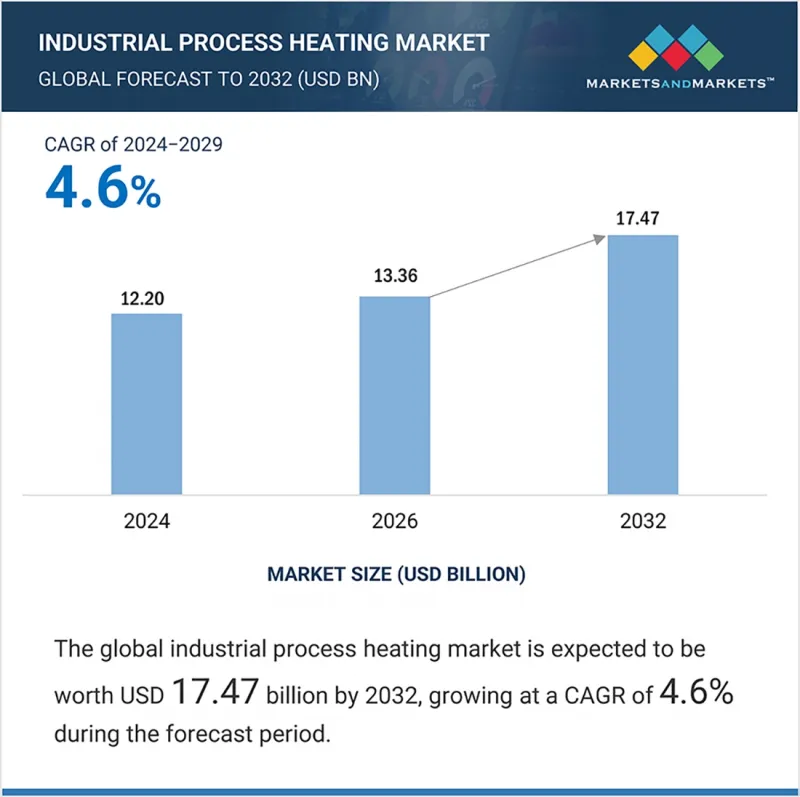
The global industrial process heating market is valued at USD 13.36 billion in 2026 and is projected to reach USD 17.47 billion by 2032, registering a CAGR of 4.6% during the forecast period. The market is advancing as demand for energy-efficient, low-emission heating systems across industries such as metals, chemicals, oil & gas, and food & beverage increases. These systems offer precise temperature control, improved thermal efficiency, and enhanced process reliability, supporting optimized industrial operations.
| Scope of the Report | |
|---|---|
| Years Considered for the Study | 2021-2032 |
| Base Year | 2025 |
| Forecast Period | 2026-2032 |
| Units Considered | Value (USD Billion) |
| Segments | By Gas Heating, Electric Heating and Region |
| Regions covered | North America, Europe, APAC, RoW |
The transition toward electric heating technologies and cleaner fuel alternatives is accelerating as industries aim to reduce carbon emissions and comply with stringent environmental regulations. Additionally, advancements in burner technologies, smart control systems, and digital monitoring are improving energy utilization and operational safety, while the replacement of conventional systems and growing industrialization in emerging economies continue to drive market growth.
"Burners are expected to grow at the highest CAGR of the gas-powered heating market during the forecast period."
Burners are expected to grow at the highest CAGR during the forecast period, driven by increasing demand for efficient, low-emission heating solutions across industries. Advanced burner technologies enable precise temperature control and improved combustion efficiency. Reduced fuel consumption supports cost optimization and sustainability goals. The adoption of low-NOx and high-efficiency burners helps industries comply with stringent environmental regulations. These systems ensure uniform heat distribution, improving process consistency and product quality. Modern burners also support integration with automation and control systems, enhancing operational reliability. Their compatibility with various fuels, including cleaner alternatives, supports flexibility in industrial applications. Growing investments in industrial upgrades and retrofitting further drive demand. These factors support large-scale adoption of advanced burner systems across industrial process heating applications.
"The chemical industry segment is expected to dominate the gas-powered heating market during the forecast period."
Demand from the chemical industry is rising due to its extensive reliance on continuous and high-temperature processing operations. Industrial process heating systems are essential for applications such as distillation, cracking, reforming, and drying. These systems support precise temperature control and uniform heat distribution, improving process efficiency and product quality. High energy demand in chemical manufacturing drives the need for efficient and reliable heating solutions. Advanced heating technologies enhance thermal efficiency and reduce fuel consumption. Integration with automation systems improves operational control and safety. The shift toward low-emission and electrified heating solutions aligns with sustainability goals. Process optimization reduces energy losses and operating costs. Additionally, large-scale production requirements and stringent regulatory standards further drive adoption. Overall, gas-powered heating systems play a critical role in improving efficiency and scalability in chemical manufacturing processes.
"Europe is expected to hold a significant share of the gas-powered process heating market in 2025."
Europe is expected to hold a significant share of the gas-powered process heating market in 2025, driven by its strong focus on energy efficiency, sustainability, and advanced industrial infrastructure. The region has a well-established base in industries such as chemicals, food & beverage, metals, and automotive, which require reliable and high-performance heating systems. Additionally, the presence of leading technology providers and continuous investments in industrial modernization support the adoption of innovative heating systems. Countries such as Germany, France, and the UK are emphasizing electrification and integration of smart control systems to improve operational efficiency and reduce carbon footprints. Retrofitting of existing infrastructure and increasing use of automation further enhance demand. These factors position Europe as a key region in the gas-powered process heating market, with strong growth driven by sustainability initiatives and technological advancements.
- By Company Type: Tier 1 (45%), Tier 2 (35%), and Tier 3 (20%)
- By Designation: Sales & Marketing Heads/Directors (35%), Regional & Global Business Unit Heads (30%), Market Intelligence & Strategy Leads (25%), and Others (10%)
- By Region: North America (37%), Europe (36%), Asia Pacific (22%), and RoW (5%)
The prominent players profiled in this report include Honeywell International Inc. (US), Siemens (Germany), Emerson (US), ANDRITZ AG (Austria), ABB Ltd. (Switzerland), Fives Group (France), Bloom Engineering Company, Inc. (US), Fireye, LLC (US), NOXMAT (Germany), SixCarbon Technology Co. Ltd. (China), and Watlow Electric Manufacturing Company (US).
Research Coverage:
The report defines, describes, and forecasts the industrial process heating market based on heating technology (gas-powered heating and electric-powered heating), industry (metals, chemicals, oil & gas, food & beverage, glass, ceramics, pulp & paper, textiles, and others), and regions (North America, Europe, Asia Pacific, and RoW). It provides detailed information regarding drivers, restraints, opportunities, and challenges influencing the market's growth. It also analyzes competitive developments, including acquisitions, product launches, expansions, and strategic initiatives undertaken by key players to strengthen their market positions.
Reasons to Buy This Report:
The report will help market leaders/new entrants with information on the closest approximations of the revenue for the overall industrial process heating market and its subsegments. The report will help stakeholders understand the competitive landscape and gain deeper insights to better position their business and plan effective go-to-market strategies. The report also helps stakeholders understand the market dynamics and provides information on key drivers, restraints, opportunities, and challenges.
The report will provide insights into the following points:
- Analysis of Key drivers (process throughput and temperature uniformity), restraints (process-specific performance requirements limit cross-technology substitution), opportunities (major industrial OEMs are actively expanding electric process heating portfolios), and challenges (high capital intensity and retrofit complexity limit pace of adoption) of the industrial process heating market.
- Product Development/Innovation: Detailed insights into emerging heating technologies, advancements in burner and electric heating systems, digital control solutions, and ongoing research & development activities in the industrial process heating market.
- Market Development: Comprehensive information about lucrative markets (the report analyzes the industrial process heating market across various regions).
- Market Diversification: Exhaustive information about new product developments, untapped application areas, recent industry developments, and investments in the Industrial process heating market.
- Competitive Assessment: In-depth assessment of market share, growth strategies, and offerings of leading players, including Honeywell International Inc. (US), Siemens (Germany), Emerson (US), ANDRITZ AG (Austria), ABB Ltd. (Switzerland), Fives Group (France), Bloom Engineering Company, Inc. (US), Fireye, LLC (US), NOXMAT GmbH (Germany), SixCarbon Technology Co., Ltd. (China), and Watlow Electric Manufacturing Company (US).
TABLE OF CONTENTS
1. PROJECT SCOPE
2. EXECUTIVE SUMMARY
3. MARKET OVERVIEW
- 3.1. MARKET DYNAMICS
- 3.1.1. DRIVERS
- 3.1.2. CHALLENGES
- 3.2. KEY CONFERENCES AND EVENTS
- 3.3. VALUE CHAIN ANALYSIS
- 3.4. PRICING ANALYSIS
- 3.5. REGULATORY LANDSCAPE
4. MARKET SIZING AND FORECAST
- 4.1. GAS-POWERED HEATING MARKET
- 4.1.1. BURNERS
- 4.1.1.1. Direct Fired Furnace Burners
- 4.1.1.2. Self-Recuperative Burners
- 4.1.1.3. Radiant Tube Burners
- 4.1.1.4. Line & Duct Burners
- 4.1.1.5. Glass & Oxygen Burners
- 4.1.1.6. Immersion Tube Burners
- 4.1.2. HEAT EXCHANGERS
- 4.1.3. AIR HEATERS
- 4.1.3.1. Indirect Air Heaters
- 4.1.3.2. Direct Air Heaters
- 4.1.4. BURNER MANAGEMENT SYSTEMS
- 4.1.4.1. BMS Controllers
- 4.1.4.2. Flame Detectors
- 4.1.5. FUEL & AIR DELIVERY SOLUTIONS
- 4.1.5.1. Valves & Pressure Control Hardware
- 4.1.5.2. Sensors & Safety Instrumentation
- 4.1.5.3. Air & Fuel Supply Equipment
- 4.1.5.4. Actuators
- 4.1.6. SERVICES
- 4.1.1. BURNERS
- 4.2. ELECTRIC-POWERED HEATING MARKET
- 4.2.1. ELECTRIC HEATING EQUIPMENT
- 4.2.1.1. Electric Air Heaters
- 4.2.1.2. Electric Immersion Heaters
- 4.2.1.3. Electric Line/Pre-Heaters
- 4.2.2. POWER & THERMAL CONTROL HARDWARE
- 4.2.2.1. SCR Power Controllers
- 4.2.2.2. Solid State Relays
- 4.2.2.3. Power Contractors
- 4.2.2.4. Electric Heater Control Panels
- 4.2.3. SENSORS & SAFETY PROTECTION COMPONENTS
- 4.2.3.1. Temperature Sensors
- 4.2.3.2. Current Sensors
- 4.2.3.3. Switches
- 4.2.4. SERVICES
- 4.2.1. ELECTRIC HEATING EQUIPMENT
- 4.3. DATA CENTER COOLING THERMAL INFRASTRUCTURE MARKET
5. COMPETITIVE LANDSCAPE
- 5.1. COMPETITIVE LANDSCAPE
- 5.2. COMPETITOR BENCHMARKING
- 5.2.1. GAS-POWERED HEATING
- 5.2.2. ELECTRIC-POWERED HEATING
6. INDUSTRIAL PROCESS HEATING MARKET, COMPANY PROFILES
- 6.1. KEY PLAYERS
- 6.1.1. HONEYWELL INTERNATIONAL INC.
- 6.1.2. SIEMENS
- 6.1.3. EMERSON
- 6.1.4. ANDRITZ
- 6.1.5. ABB
- 6.1.6. FIVES
- 6.1.7. BLOOM ENGINEERING COMPANY, INC.
- 6.1.8. FIREYE, LLC
- 6.1.9. NOXMAT
- 6.1.10. WATLOW ELECTRIC MANUFACTURING COMPANY
- 6.1.11. THERMON
- 6.1.12. WEISHAUPT GROUP
- 6.1.13. RIELLO S.P.A
- 6.1.14. SPIRAX SARCO LIMITED
- 6.1.15. ZEECO, INC.
- 6.1.16. COMBUSTION CONCEPT PVT. LTD.
- 6.1.17. DUNPHY COMBUSTION LTD.
- 6.1.18. DURAG GROUP
- 6.1.19. ESA S.P.A.
- 6.1.20. INDUSTRIAL COMBUSTION
- 6.1.21. JOHN ZINK
- 6.1.22. KANTHAL AB
- 6.1.23. KARL DUNGS GMBH & CO., KG
- 6.1.24. SAACKE GMBH
- 6.1.25. SELAS HEAT TECHNOLOGY COMPANY
- 6.1.26. TEMPCO ELECTRIC HEATER CORPORATION
7. STRATEGIC RECOMMENDATIONS
8. RESEARCH METHODOLOGY

