PUBLISHER: Global Market Insights Inc. | PRODUCT CODE: 2061449

PUBLISHER: Global Market Insights Inc. | PRODUCT CODE: 2061449
Asia Pacific Induction Heating System Market Opportunity, Growth Drivers, Industry Trend Analysis, and Forecast 2026 - 2035
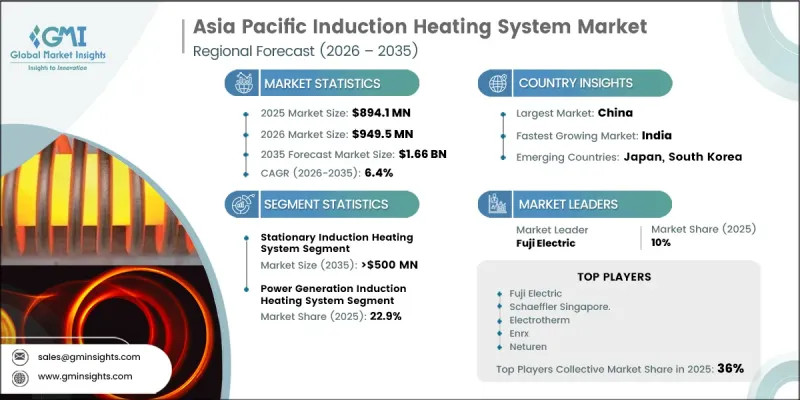
Asia Pacific Induction Heating System Market was valued at USD 894.1 million in 2025 and is estimated to grow at a CAGR of 6.4% to reach USD 1.66 billion by 2035.
The market is experiencing steady growth supported by rising industrial automation and expanding automotive production across the region. Increasing vehicle output and strong demand for precision heating processes in manufacturing are strengthening the adoption of induction heating technologies. In addition, supportive government measures such as tax incentives and capacity expansion programs are encouraging industrial upgrades and enhancing overall market growth prospects. The induction heating process is based on electromagnetic principles where conductive materials, primarily metals, are heated using induced electrical currents generated by alternating magnetic fields. When alternating current passes through a coil, it creates a fluctuating magnetic field that induces eddy currents within the workpiece, producing heat through electrical resistance. This method is increasingly favored due to its energy efficiency, precision, and reduced environmental impact compared to conventional heating systems. Growing global emphasis on decarbonization, coupled with stricter emission control regulations, is accelerating the shift toward energy-efficient industrial technologies. Additionally, declining costs of renewable energy sources such as wind and solar are encouraging broader industrial adoption of sustainable heating solutions.
| Market Scope | |
|---|---|
| Start Year | 2025 |
| Forecast Year | 2026-2035 |
| Start Value | $894.1 Million |
| Forecast Value | $1.66 Billion |
| CAGR | 6.4% |
The stationary induction heating system segment is expected to reach USD 500 million by 2035. Demand for these systems is rising due to their efficiency in processes such as annealing, tempering, and brazing. Their advantages include high operational reliability, quick start-up capability, long service life, low noise levels, and zero direct emissions, making them increasingly preferred over traditional heating systems in industrial applications.
The power generation induction heating system segment accounted for 22.9% share in 2025. These systems are widely used in power plants for applications such as turbine heating, generator maintenance, pipe heating, and brazing operations. Growing investment in upgrading aging infrastructure and improving energy efficiency in power generation facilities is driving consistent demand for induction heating solutions in this segment.
China Induction Heating System Market was valued at USD 232 million in 2025. Market growth in the country is supported by stringent environmental regulations aimed at reducing greenhouse gas emissions and promoting cleaner industrial technologies. Rising investment in the automotive sector and increasing demand for energy-efficient heating solutions are further strengthening adoption. Replacement of outdated industrial heating systems with modern, efficient alternatives is also contributing to sustained market expansion.
Key companies operating in the Asia Pacific Induction Heating System Market include Inductotherm Group, EFD Induction, Fuji Electric, Ambrell, Electrotherm, Ultraflex Power Technologies, ACME, Abhay Induction Tech, C-Tech Innovation, Da-ichi Kiden, Chengdu Jinkezhi Electronic, KBG Induction, Kitashiba Electric, Neturen, Rapid Heat Systems, Schaeffler Singapore, Solidheat Industries, ITW Welding Singapore, Lu-Chiuan Heating Elements, and Uchino. Companies in the Asia Pacific induction heating system market are focusing on enhancing energy efficiency and process precision through advanced power control technologies and automation integration. Investment in R&D is increasing to develop compact, high-performance systems suitable for diverse industrial applications. Strategic collaborations with automotive and manufacturing industries are helping strengthen application reach and improve customer integration. Manufacturers are also expanding product portfolios to include stationary and customized systems tailored for specific industrial needs.
Table of Contents
Chapter 1 Methodology & Scope
- 1.1 Research approach
- 1.2 Quality commitments
- 1.2.1 GMI AI policy & data integrity commitment
- 1.2.1.1 Source consistency protocol
- 1.2.1 GMI AI policy & data integrity commitment
- 1.3 Research trail & confidence scoring
- 1.3.1 Research trail components
- 1.3.2 Scoring components
- 1.4 Data collection
- 1.4.1 Partial list of primary sources
- 1.5 Data mining sources
- 1.5.1 Paid sources
- 1.5.1.1 Sources, by region
- 1.5.1 Paid sources
- 1.6 Base estimates and calculations
- 1.6.1 Base year calculation for any one approach
- 1.7 Market estimates & forecasts parameters
- 1.8 Forecast model
- 1.8.1 Quantified market impact analysis
- 1.8.1.1 Mathematical impact of growth parameters on forecast
- 1.8.1 Quantified market impact analysis
- 1.9 Research transparency addendum
- 1.9.1 Source attribution framework
- 1.9.2 Quality assurance metrics
- 1.9.3 Our commitment to trust
- 1.10 Market definitions
Chapter 2 Executive Summary
- 2.1 Industry synopsis, 2022 - 2035
- 2.1.1 Business trends
- 2.1.2 Product trends
- 2.1.3 End use trends
- 2.1.4 Country trends
Chapter 3 Industry Insights
- 3.1 Industry ecosystem analysis
- 3.1.1 Raw material availability & sourcing analysis
- 3.1.2 Manufacturing capacity assessment
- 3.1.3 Supply chain resilience & risk factors
- 3.1.4 Distribution network analysis
- 3.2 Industry impact forces
- 3.2.1 Growth drivers
- 3.2.2 Industry pitfalls & challenges
- 3.3 Regulatory landscape
- 3.4 Growth potential analysis
- 3.5 Porter's analysis
- 3.5.1 Bargaining power of suppliers
- 3.5.2 Bargaining power of buyers
- 3.5.3 Threat of new entrants
- 3.5.4 Threat of substitutes
- 3.6 PESTEL analysis
- 3.6.1 Political factors
- 3.6.2 Economic factors
- 3.6.3 Social factors
- 3.6.4 Technological factors
- 3.6.5 Legal factors
- 3.6.6 Environmental factors
- 3.7 Cost structure analysis of induction heating system
- 3.8 Emerging opportunities & trends
- 3.9 Digitalization & IoT integration
- 3.10 Growth in untapped markets & applications
- 3.11 Investment analysis & future prospects
- 3.12 Impact of AI & Generative AI on the market (Driven by Primary Research)
- 3.12.1 AI-Driven production optimization (Driven by Primary Research)
- 3.12.2 Predictive maintenance & fault detection (Driven by Primary Research)
Chapter 4 Competitive Landscape, 2026
- 4.1 Introduction
- 4.2 Company market share analysis, by country, 2025
- 4.2.1 China
- 4.2.2 Japan
- 4.2.3 India
- 4.2.4 Australia
- 4.2.5 South Korea
- 4.2.6 Thailand
- 4.2.7 Singapore
- 4.2.8 Malaysia
- 4.2.9 Philippines
- 4.2.10 Vietnam
- 4.2.11 Indonesia
- 4.3 Competitive positioning matrix
- 4.4 Key developments
- 4.4.1 Mergers & acquisitions
- 4.4.2 Partnerships & collaborations
- 4.4.3 New product launches
- 4.4.4 Expansion plans & funding
- 4.5 Company tier benchmarking
- 4.5.1 Tier classification criteria & qualifying thresholds
- 4.5.2 Tier positioning matrix by revenue, geography & innovation
Chapter 5 Market Size and Forecast, By Product, 2022 - 2035 (USD Million)
- 5.1 Key trends
- 5.2 Portable
- 5.3 Stationary
Chapter 6 Market Size and Forecast, By End Use, 2022 - 2035 (USD Million)
- 6.1 Key trends
- 6.2 Automotive
- 6.3 Aerospace
- 6.4 Power generation
- 6.5 Shipbuilding
- 6.6 Oil & gas
- 6.7 Others
Chapter 7 Market Size and Forecast, By Country, 2022 - 2035 (USD Million)
- 7.1 Key trends
- 7.2 China
- 7.3 Japan
- 7.4 India
- 7.5 Australia
- 7.6 South Korea
- 7.7 Thailand
- 7.8 Singapore
- 7.9 Malaysia
- 7.10 Philippines
- 7.11 Vietnam
- 7.12 Indonesia
Chapter 8 Company Profiles
- 8.1 Abhay Induction Tech
- 8.2 ACME
- 8.3 Ambrell
- 8.4 C-Tech Innovation
- 8.5 Chengdu Jinkezhi Electronic
- 8.6 Da-ichi Kiden
- 8.7 EFD Induction
- 8.8 Electrotherm
- 8.9 Fuji Electric
- 8.10 Inductotherm Group
- 8.11 ITW Welding Singapore
- 8.12 KBG Induction
- 8.13 Kitashiba Electric
- 8.14 Lu-Chiuan Heating Elements
- 8.15 Neturen
- 8.16 Rapid Heat Systems
- 8.17 Schaeffler Singapore
- 8.18 Solidheat Industries
- 8.19 Ultraflex Power Technologies
- 8.20 Uchino

