PUBLISHER: MarketsandMarkets | PRODUCT CODE: 2037094

PUBLISHER: MarketsandMarkets | PRODUCT CODE: 2037094
Climate Risk Management Market by Software, Offering - Global Forecast to 2031
The climate risk management market is projected to grow from USD 8.59 billion in 2026 to USD 19.08 billion by 2031, growing at a CAGR of 17.3% during the forecast period. Regulatory emphasis on climate disclosure, resilience planning, and enterprise-wide transparency is driving the adoption of advanced climate risk management platforms across financial services, infrastructure, energy, and asset-intensive industries. Organizations are increasingly required to evaluate and document exposure to physical hazards, transition pressures, and climate-related financial impacts in alignment with evolving frameworks such as ISSB, TCFD, and jurisdiction-specific sustainability mandates.
| Scope of the Report | |
|---|---|
| Years Considered for the Study | 2021-2031 |
| Base Year | 2025 |
| Forecast Period | 2026-2031 |
| Units Considered | Value (USD Billion) |
| Segments | Offering, technology, application, vertical, and region |
| Regions covered | North America, Asia Pacific, Europe, Middle East & Africa, Latin America |
Official guidance from regulatory bodies and advisory firms highlights that climate risk systems leverage geospatial intelligence, scenario-based modeling, and portfolio stress testing to continuously assess vulnerabilities and support strategic adaptation decisions. These platforms enable organizations to shift from reactive compliance processes toward forward-looking resilience strategies that strengthen operational continuity and investment readiness. As climate governance expectations expand, enterprises are implementing integrated climate intelligence solutions that enhance risk oversight, streamline reporting obligations, and improve decision-making across complex business environments.
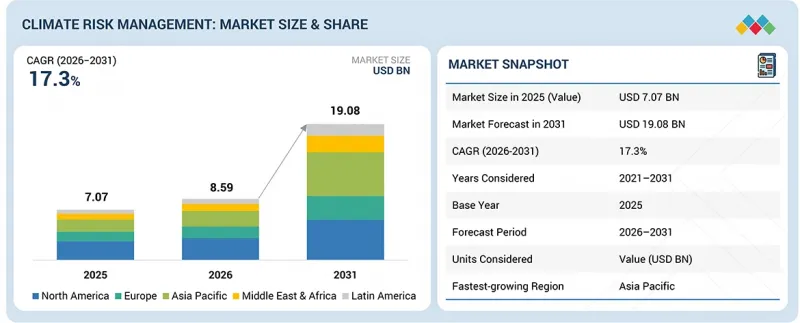
Vendors in the climate risk management market are expanding platform capabilities by integrating climate intelligence, geospatial hazard datasets, and advanced scenario analytics into unified enterprise resilience ecosystems. Leading providers combine machine learning models, asset-level exposure mapping, and transition-risk quantification frameworks to generate precise climate vulnerability insights and forward-looking adaptation strategies. These systems enable organizations to identify material risk concentrations, evaluate financial implications across multiple climate pathways, and coordinate mitigation initiatives across geographically dispersed operations and supply chains. By consolidating environmental intelligence within centralized climate analytics platforms, enterprises gain enhanced visibility into physical and transition exposures, improved disclosure readiness, and stronger resilience planning. As regulatory expectations and stakeholder scrutiny continue to intensify, climate risk management solutions are becoming essential for strengthening governance, safeguarding long-term asset value, and embedding climate-informed decision-making across modern business environments.
"By technology, the geospatial & remote sensing segment is expected to be the largest market during the forecast period."
Organizations are increasingly implementing geospatial intelligence and remote sensing technologies as climate risk management programs prioritize asset-level exposure mapping, hazard forecasting, and resilience planning across complex operating environments. By integrating satellite-derived observations, high-resolution spatial datasets, and climate scenario engines with enterprise risk platforms, institutions gain continuous visibility into flood susceptibility, wildfire corridors, coastal erosion, drought severity, and heat stress patterns across distributed assets and supply chains. These systems enable early identification of vulnerability hotspots, allowing risk teams to design adaptation measures before climate impacts disrupt operations or financial performance. This approach strengthens portfolio resilience, improves capital allocation decisions, and supports compliance with disclosure frameworks requiring location-specific climate assessments. Advanced geospatial analytics and remote sensing dashboards further enhance scenario planning, infrastructure prioritization, and strategic oversight. As enterprises accelerate climate governance initiatives and embed science-based adaptation into operational models, the adoption of geospatial and remote sensing solutions within climate risk management continues to expand rapidly as the foundational technology layer for enterprise resilience.
"By software, the climate risk management APIs segment is expected to grow at the highest CAGR during the forecast period."
Climate risk assessment APIs are gaining rapid traction as enterprises prioritize embedded climate intelligence, automated exposure analysis, and scalable resilience workflows across digital ecosystems. By leveraging application programming interfaces that connect hazard datasets, emissions inventories, geospatial layers, and scenario engines, organizations can integrate climate insights directly into underwriting systems, portfolio tools, supply chain platforms, and enterprise risk architectures. Additionally, companies are focusing on the growing importance of interoperable climate analytics that support real-time decision-making, financial materiality assessment, and transition-risk quantification within operational systems. These APIs enable automated retrieval of asset-level flood exposure, wildfire probability, heat stress projections, and carbon pathway assumptions without requiring standalone platforms. This convergence of climate data services with enterprise applications strengthens scenario modeling, accelerates regulatory reporting, and enhances adaptation planning across distributed business functions. As organizations modernize digital risk infrastructures, climate risk assessment APIs are emerging as the fastest-scaling software layer in the climate risk management market by enabling continuous, embedded, and actionable climate intelligence.
"North America is expected to account for the largest share in 2026, and Asia Pacific is expected to grow at the highest rate during the forecast period."
North America is expected to lead the climate risk management market during the forecast period due to mature regulatory ecosystems, advanced climate disclosure requirements, and strong enterprise adoption of resilience-focused analytics platforms across financial services, infrastructure, energy, and real estate sectors. Organizations across the US and Canada increasingly deploy climate intelligence systems to evaluate physical hazard exposure, transition risk, and portfolio-level vulnerability under multiple future scenarios. Enterprises are integrating geospatial datasets, catastrophe modeling, and financial stress-testing tools into enterprise risk frameworks to strengthen adaptation planning and reporting alignment with evolving standards. The region also benefits from the presence of major advisory firms, insurers, and technology providers delivering climate analytics, resilience dashboards, and governance solutions on a large scale. This established ecosystem continues to reinforce North America's leadership in enterprise-wide climate risk adoption and strategic resilience execution.
Asia Pacific represents the fastest-growing region in the climate risk management market, driven by accelerating urbanization, infrastructure expansion, and rising exposure to heat stress, flooding, typhoons, and water scarcity across high-growth economies. Countries including India, China, Japan, and Southeast Asian markets are scaling climate adaptation initiatives and adopting digital resilience tools to assess asset exposure and strengthen long-term planning. Organizations are increasingly implementing scenario analysis platforms, climate finance frameworks, and hazard-mapping technologies to support infrastructure resilience and regulatory preparedness. Growing investment in GreenTech ecosystems, enterprise sustainability programs, and climate-linked financial strategies is strengthening regional demand for integrated climate intelligence solutions. As adaptation becomes central to economic planning, the Asia Pacific is emerging as the most dynamic growth engine for climate risk management technologies and advisory services.
Breakdown of Primaries
In-depth interviews were conducted with chief executive officers (CEOs), innovation and technology directors, system integrators, and executives from various key organizations operating in the climate risk management market.
- By Company: Tier 1 - 35%, Tier 2 - 40%, and Tier 3 - 25%
- By Designation: C Level - 28%, Director Level - 50%, Others - 22%
- By Region: North America - 30%, Europe - 25%, Asia Pacific - 35%, Middle East & Africa - 5%, and Latin America - 5%
The report includes the study and in-depth company profiles of key players offering climate risk management software and services. Major players in the market include IBM (US), KPMG (Netherlands), Deloitte (UK), PwC (UK), Marsh McLennan (US), ESRI (US), Boston Consulting Group (BCG) (US), Ernst & Young (EY) (UK), Moody's (US), Willis Towers Watson (WTW) (UK), MSCI (US), CoreLogic (US), S&P Global (US), Anthesis (UK), Bain & Company (US), Sunairio (US), Watershed (US), ClimateAi (US), Climate X (UK), Correntics (Switzerland), XDI (Australia), Jupiter Intelligence (US), Sust Global (UK), Mitiga Solutions (Spain), Manifest Climate (Canada), Entelligent (US), Schneider Electric (France), ClearVUE.Business (UK), Climate Scale (Spain), Riskthinking.AI (Canada), Persefoni (US), and First Street (US).
Research Coverage
This research report covers the climate risk management market and is segmented by offering, technology, application, vertical, and region. By offering, the market is split into software and services. The software segment covers risk assessment & scenario analysis tools, climate risk modeling tools, climate data integration APIs, climate risk assessment APIs, climate data analytics platforms, compliance & reporting software, and other software types. The services segment covers professional services and managed services. The professional services subsegment covers training & consulting, system integration & deployment, and support & maintenance. By technology, the market is split into artificial intelligence and machine learning, geospatial & remote sensing, big data & advanced analytics, blockchain, and the internet of things. By application, the market is split into carbon accounting & emission management, disaster preparedness & early warning systems, ESG & sustainable investment risk analysis, weather & agriculture risk management, business & investment risk management, climate litigation & liability risk management, and other applications. By vertical, the market is segmented into BFSI, energy & utilities, agriculture & forestry, transportation & logistics, construction & real estate, government & public sector, manufacturing, and other verticals. The regional segmentation covers North America, Europe, Asia Pacific, the Middle East & Africa, and Latin America.
The report's scope encompasses detailed information on the major factors, including drivers, restraints, challenges, and opportunities, which influence the growth of the climate risk management market. A detailed analysis of key industry players has been conducted to provide insights into their business overview, software and services, key strategies, contracts, partnerships, agreements, product & service launches, mergers and acquisitions, and recent developments in the climate risk management market. Moreover, the report provides a competitive analysis of emerging startups in the climate risk management market ecosystem.
Key Benefits of Buying the Report
The report will provide market leaders and new entrants with information on the closest approximations of the revenue numbers for the overall climate risk management market and its subsegments. It would help stakeholders understand the competitive landscape and gain more insights to better their business and plan suitable go-to-market strategies. It also helps stakeholders understand the market pulse and provides information on key drivers, restraints, challenges, and opportunities.
The report provides insights into the following pointers:
Analysis of key drivers (Increasing frequency and intensity of extreme weather events, growing economic pressures to build climate-resilient infrastructure, mounting regulatory pressure and disclosure requirements, increasing influence of investors and financial institutions), challenges (Significant financial resources and technical expertise requirements, methodological Inconsistencies and lack of standardization), opportunities (Growing demand for climate risk solutions in global finance, growth in advanced software and AI-powered climate solutions, green infrastructure and resilient supply chains strengthen business resilience to climate risk), and restraints (Limited availability of high-quality, standardized climate data, organizational resistance to change).
Product Development/Innovation: Detailed insights into upcoming technologies, research & development activities, and product & service launches in the climate risk management market
Market Development: Comprehensive information about lucrative markets across varied regions
Market Diversification: Exhaustive information about new products & services, untapped geographies, recent developments, and investments in the climate risk management market
Competitive Assessment: In-depth assessment of market share and growth strategies and service offerings of IBM (US), KPMG (Netherlands), Deloitte (UK), PwC (UK), Marsh McLennan (US), ESRI (US), Boston Consulting Group (BCG) (US), Ernst & Young (EY) (UK), Moody's (US), Willis Towers Watson (WTW) (UK), MSCI (US), CoreLogic (US), S&P Global (US), Anthesis (UK), Bain & Company (US), Sunairio (US), Watershed (US), ClimateAI (US), Climate X (UK), Correntics (Switzerland), XDI (Australia), Jupiter Intelligence (US), Sust Global (UK), Mitiga Solutions (Spain), Manifest Climate (Canada), Entelligent (US), Schneider Electric (France), ClearVUE.Business (UK), Climate Scale (Spain), Riskthinking.AI (Canada), Persefoni (US), and First Street (US).
The report also helps stakeholders understand the pulse of the climate risk management market, providing insights into key drivers, restraints, challenges, and opportunities.
TABLE OF CONTENTS
1 INTRODUCTION
- 1.1 STUDY OBJECTIVES
- 1.2 MARKET DEFINITION
- 1.2.1 INCLUSIONS AND EXCLUSIONS
- 1.3 STUDY SCOPE
- 1.3.1 CLIMATE RISK MANAGEMENT MARKET SEGMENTATION
- 1.3.2 YEARS CONSIDERED
- 1.4 CURRENCY CONSIDERED
- 1.5 STAKEHOLDERS
2 EXECUTIVE SUMMARY
- 2.1 MARKET HIGHLIGHTS AND KEY INSIGHTS
- 2.2 KEY MARKET PARTICIPANTS: MAPPING OF STRATEGIC DEVELOPMENTS
- 2.3 DISRUPTIVE TRENDS IN CLIMATE RISK MANAGEMENT MARKET
- 2.4 HIGH-GROWTH SEGMENTS
- 2.5 REGIONAL SNAPSHOT: MARKET SIZE, GROWTH RATE, AND FORECAST
3 PREMIUM INSIGHTS
- 3.1 ATTRACTIVE OPPORTUNITIES IN CLIMATE RISK MANAGEMENT MARKET
- 3.2 CLIMATE RISK MANAGEMENT MARKET, BY REGION
- 3.3 CLIMATE RISK MANAGEMENT MARKET: TOP THREE APPLICATIONS
- 3.4 NORTH AMERICA: CLIMATE RISK MANAGEMENT MARKET, BY OFFERING AND TECHNOLOGY
- 3.5 CLIMATE RISK MANAGEMENT MARKET, BY REGION
4 MARKET OVERVIEW
- 4.1 INTRODUCTION
- 4.2 MARKET DYNAMICS
- 4.2.1 DRIVERS
- 4.2.1.1 Increasing frequency and intensity of extreme weather events
- 4.2.1.2 Growing economic pressures to build climate-resilient infrastructure
- 4.2.1.3 Mounting regulatory pressure and disclosure requirements
- 4.2.1.4 Increasing influence of investors and financial institutions
- 4.2.2 RESTRAINTS
- 4.2.2.1 Limited availability of high-quality, standardized climate data
- 4.2.2.2 Organizational resistance to change
- 4.2.3 OPPORTUNITIES
- 4.2.3.1 Growing demand for climate risk solutions in global finance
- 4.2.3.2 Growth in advanced software and AI-powered climate solutions
- 4.2.3.3 Green infrastructure and resilient supply chains - strengthen business resilience to climate risk
- 4.2.4 CHALLENGES
- 4.2.4.1 Significant financial resources and technical expertise requirements
- 4.2.4.2 Methodological inconsistencies and lack of standardization
- 4.2.1 DRIVERS
- 4.3 UNMET NEEDS AND WHITE SPACES
- 4.3.1 UNMET NEEDS IN CLIMATE RISK MANAGEMENT MARKET
- 4.3.2 WHITE SPACE OPPORTUNITIES
- 4.4 INTERCONNECTED MARKETS AND CROSS-SECTOR OPPORTUNITIES
- 4.4.1 INTERCONNECTED MARKETS
- 4.4.2 CROSS-SECTOR OPPORTUNITIES
- 4.5 STRATEGIC MOVES BY TIER-1/2/3 PLAYERS
5 INDUSTRY TRENDS
- 5.1 EVOLUTION OF CLIMATE RISK MANAGEMENT
- 5.2 PORTER'S FIVE FORCES ANALYSIS
- 5.2.1 THREAT OF NEW ENTRANTS
- 5.2.2 THREAT OF SUBSTITUTES
- 5.2.3 BARGAINING POWER OF SUPPLIERS
- 5.2.4 BARGAINING POWER OF BUYERS
- 5.2.5 INTENSITY OF COMPETITIVE RIVALRY
- 5.3 MACROECONOMIC OUTLOOK
- 5.3.1 INTRODUCTION
- 5.3.2 GDP TRENDS AND FORECAST
- 5.3.3 TRENDS IN GEOSPATIAL INTELLIGENCE INDUSTRY
- 5.3.4 TRENDS IN GREEN TECHNOLOGY AND SUSTAINABILITY INDUSTRY
- 5.4 ECOSYSTEM ANALYSIS
- 5.4.1 CLIMATE RISK MANAGEMENT MARKET, SOFTWARE TYPE
- 5.4.1.1 Risk Assessment & Scenario Analysis Tools
- 5.4.1.2 Climate Risk Modeling Tools
- 5.4.1.3 Climate Data Integration APIs
- 5.4.1.4 Climate Risk Assessment APIs
- 5.4.1.5 Climate Data Analytics Platforms
- 5.4.1.6 Compliance & Reporting Software
- 5.4.2 SERVICE PROVIDER
- 5.4.2.1 Professional Services
- 5.4.2.2 Managed Services
- 5.4.1 CLIMATE RISK MANAGEMENT MARKET, SOFTWARE TYPE
- 5.5 PRICING ANALYSIS
- 5.5.1 AVERAGE SELLING PRICE OF PRODUCT TYPE, BY KEY PLAYERS,2025
- 5.5.2 INDICATIVE PRICING ANALYSIS FOR KEY CLIMATE RISK MANAGEMENT, BY PRODUCT OFFERING
- 5.6 TRENDS/DISRUPTIONS IMPACTING CUSTOMER BUSINESS
- 5.7 INVESTMENT AND FUNDING SCENARIO
- 5.8 CASE STUDY ANALYSIS
- 5.8.1 NILFISK STRENGTHENED CLIMATE DISCLOSURE WITH CDP REPORTING
- 5.8.2 CLIMATEAI ENABLED AI-DRIVEN CLIMATE ADAPTATION FOR AGRICULTURE
- 5.8.3 DELIVERY HERO SCALED CLIMATE STRATEGY WITH DATA-DRIVEN PLATFORM
- 5.8.4 LIQUATS VEGETALS NAVIGATED EUDR WITH CLIMATE & NATURE STRATEGY
6 STRATEGIC DISRUPTION: PATENTS, DIGITAL, AND AI ADOPTION
- 6.1 KEY TECHNOLOGIES
- 6.1.1 ARTIFICIAL INTELLIGENCE (AI)
- 6.1.2 INTERNET OF THINGS (IOT)
- 6.1.3 EARTH OBSERVATION (EO) SATELLITES
- 6.1.4 CLIMATE MODELING SOFTWARE
- 6.1.5 PARAMETRIC INSURANCE PLATFORMS
- 6.2 COMPLEMENTARY TECHNOLOGIES
- 6.2.1 BLOCKCHAIN
- 6.2.2 SMART GRIDS
- 6.2.3 ADVANCED WATER MANAGEMENT SYSTEMS
- 6.2.4 CARBON CAPTURE AND STORAGE (CCS)
- 6.2.5 CLIMATE RESILIENT INFRASTRUCTURE TOOLS
- 6.3 ADJACENT TECHNOLOGIES
- 6.3.1 QUANTUM COMPUTING
- 6.3.2 5G CONNECTIVITY
- 6.3.2.1 Geospatial Information Systems (GIS)
- 6.3.3 ENERGY STORAGE SOLUTIONS
- 6.3.3.1 Vertical Farming Technologies
- 6.4 PATENT ANALYSIS
- 6.4.1 METHODOLOGY
- 6.4.2 PATENTS FILED, BY DOCUMENT TYPE, 2016-2026
- 6.4.3 INNOVATION AND PATENT APPLICATIONS
- 6.5 IMPACT OF AI ON CLIMATE RISK MANAGEMENT MARKET
- 6.5.1 BEST PRACTICES IN CLIMATE RISK MANAGEMENT MARKET
7 REGULATORY LANDSCAPE
- 7.1 REGULATORY LANDSCAPE
- 7.1.1 REGULATORY BODIES, GOVERNMENT AGENCIES, AND OTHER ORGANIZATIONS
- 7.1.1.1 Task Force on Climate-related Financial Disclosures (TCFD)
- 7.1.1.2 International Organization of Securities Commissions (IOSCO)
- 7.1.1.3 United Nations Environment Programme (UNEP)
- 7.1.2 KEY REGULATIONS
- 7.1.2.1 North America
- 7.1.2.1.1 US
- 7.1.2.2 Europe
- 7.1.2.2.1 UK
- 7.1.2.3 Asia Pacific
- 7.1.2.3.1 India
- 7.1.2.3.2 Japan
- 7.1.2.4 Middle East & Africa
- 7.1.2.4.1 Saudi Arabia
- 7.1.2.5 Latin America
- 7.1.2.5.1 Brazil
- 7.1.2.1 North America
- 7.1.3 INDUSTRY STANDARDS
- 7.1.1 REGULATORY BODIES, GOVERNMENT AGENCIES, AND OTHER ORGANIZATIONS
8 CUSTOMER LANDSCAPE & BUYER BEHAVIOR
- 8.1 KEY STAKEHOLDERS INVOLVED IN BUYING PROCESS AND THEIR EVALUATION CRITERIA
- 8.1.1 KEY STAKEHOLDERS IN BUYING PROCESS
- 8.1.2 BUYING CRITERIA
- 8.2 UNMET NEEDS FROM VARIOUS VERTICALS
9 CLIMATE RISK MANAGEMENT MARKET, BY OFFERING
- 9.1 INTRODUCTION
- 9.1.1 OFFERINGS: CLIMATE RISK MANAGEMENT MARKET DRIVERS
- 9.2 SOFTWARE
- 9.2.1 RISK ASSESSMENT & SCENARIO ANALYSIS TOOLS
- 9.2.1.1 Scenario modeling platforms enable enterprises to evaluate climate exposure & test future conditions
- 9.2.2 CLIMATE RISK MODELING TOOLS
- 9.2.2.1 Predictive climate modeling applications enable enterprises to interpret complex environmental data & estimate future disruptions
- 9.2.3 CLIMATE DATA INTEGRATION APIS
- 9.2.3.1 Climate data APIs streamline access to environmental intelligence for enterprise risk systems
- 9.2.4 CLIMATE RISK ASSESSMENT APIS
- 9.2.4.1 Risk assessment APIs enable automated climate exposure evaluation across digital enterprise systems
- 9.2.5 CLIMATE DATA ANALYTICS PLATFORMS
- 9.2.5.1 Analytics platforms transform large-scale climate data into strategic business intelligence
- 9.2.6 COMPLIANCE & REPORTING SOFTWARE
- 9.2.6.1 Reporting software strengthens climate disclosure accuracy and regulatory alignment
- 9.2.7 OTHER SOFTWARE
- 9.2.1 RISK ASSESSMENT & SCENARIO ANALYSIS TOOLS
- 9.3 SERVICES
- 9.3.1 PROFESSIONAL SERVICES
- 9.3.1.1 Training & consulting
- 9.3.1.1.1 Expert led advisory and capability building services help organizations embed climate risk strategies into long-term operations
- 9.3.1.2 System integration & deployment
- 9.3.1.2.1 Implementation services ensure climate risk solutions effectively embedded across enterprise digital ecosystems
- 9.3.1.3 Support & maintenance
- 9.3.1.3.1 Continuous service support sustains platform performance and long-term climate risk readiness
- 9.3.1.1 Training & consulting
- 9.3.2 MANAGED SERVICES
- 9.3.1 PROFESSIONAL SERVICES
10 CLIMATE RISK MANAGEMENT MARKET, BY TECHNOLOGY
- 10.1 INTRODUCTION
- 10.1.1 TECHNOLOGY: CLIMATE RISK MANAGEMENT MARKET DRIVERS
- 10.2 ARTIFICIAL INTELLIGENCE & MACHINE LEARNING
- 10.2.1 AI AND ML ACCELERATE PREDICTIVE INTELLIGENCE AND ADAPTIVE CLIMATE STRATEGIES ACROSS ENTERPRISE RISK ECOSYSTEMS
- 10.3 GEOSPATIAL & REMOTE SENSING
- 10.3.1 GEOSPATIAL AND REMOTE SENSING STRENGTHEN CLIMATE VISIBILITY THROUGH REAL-TIME EARTH OBSERVATION AND SPATIAL INTELLIGENCE
- 10.4 BIG DATA & ADVANCED ANALYTICS
- 10.4.1 BIG DATA AND ADVANCED ANALYTICS UNLOCK LARGE-SCALE CLIMATE INTELLIGENCE FOR STRATEGIC RISK DECISIONS
- 10.5 BLOCKCHAIN
- 10.5.1 BLOCKCHAIN ENHANCES TRANSPARENCY AND TRUST IN CLIMATE DATA EXCHANGE AND SUSTAINABILITY REPORTING
- 10.6 INTERNET OF THINGS (IOT)
- 10.6.1 INTERNET OF THINGS EXPANDS REAL-TIME ENVIRONMENTAL INTELLIGENCE ACROSS CLIMATE RISK MANAGEMENT SYSTEMS
11 CLIMATE RISK MANAGEMENT MARKET, BY APPLICATION
- 11.1 INTRODUCTION
- 11.1.1 APPLICATION: CLIMATE RISK MANAGEMENT MARKET DRIVERS
- 11.2 CARBON ACCOUNTING & EMISSIONS MANAGEMENT
- 11.2.1 TURNING EMISSIONS INTO FINANCIAL INTELLIGENCE FOR CLIMATE ACCOUNTABILITY
- 11.3 DISASTER PREPAREDNESS & EARLY WARNING SYSTEMS
- 11.3.1 EMBEDDING DISASTER PREPAREDNESS AND EARLY WARNING SYSTEMS AS REAL TIME INTELLIGENCE INFRASTRUCTURE FOR CLIMATE-DRIVEN RISK MITIGATION
- 11.4 ESG & SUSTAINABLE INVESTMENT RISK ANALYSIS
- 11.4.1 REFRAMING ESG INTELLIGENCE AS CORE MECHANISM FOR FINANCIAL RISK EVALUATION AND INVESTMENT STRATEGY DESIGN
- 11.5 WEATHER & AGRICULTURE RISK MANAGEMENT
- 11.5.1 CONVERGING CLIMATE INTELLIGENCE AND FARM-LEVEL ANALYTICS FOR PROACTIVE EXPOSURE REDUCTION AND YIELD STABILITY
- 11.6 BUSINESS & INVESTMENT RISK MANAGEMENT
- 11.6.1 INTEGRATING CLIMATE VARIABILITY INTO CORPORATE RISK, CAPITAL PLANNING, AND INVESTMENT GOVERNANCE FRAMEWORKS
- 11.7 CLIMATE LITIGATION & LIABILITY RISK MANAGEMENT
- 11.7.1 LINKING REGULATORY ENFORCEMENT, CORPORATE ACCOUNTABILITY, AND FINANCIAL LIABILITY INTO INTEGRATED RISK FORESIGHT SYSTEMS
- 11.8 OTHER APPLICATIONS
12 CLIMATE RISK MANAGEMENT MARKET, BY VERTICAL
- 12.1 INTRODUCTION
- 12.1.1 VERTICAL: CLIMATE RISK MANAGEMENT MARKET DRIVERS
- 12.2 BFSI
- 12.2.1 INSURANCE
- 12.2.1.1 Insurance models evolving from loss protection to climate intelligence leadership
- 12.2.2 REINSURANCE
- 12.2.2.1 Reinsurance strategies shifting toward predictive climate capital management
- 12.2.3 BANKING
- 12.2.3.1 Banks embedding climate intelligence into core lending and capital decisions
- 12.2.4 INVESTMENT BANKING
- 12.2.4.1 Investment banks redefining deal strategy through climate-driven financial insight
- 12.2.5 INSURANCE BROKERAGE
- 12.2.5.1 Insurance brokers transforming advisory models through climate risk intelligence
- 12.2.6 ASSET MANAGEMENT
- 12.2.6.1 Asset managers embedding climate analytics into portfolio construction and stewardship
- 12.2.7 CREDIT RATING AGENCIES
- 12.2.7.1 Credit rating agencies reframing creditworthiness through climate exposure assessment
- 12.2.1 INSURANCE
- 12.3 ENERGY & UTILITIES
- 12.3.1 INTEGRATED OIL COMPANIES
- 12.3.1.1 Embedding enterprise-wide climate intelligence into upstream to downstream operations redefining resilience for integrated oil companies
- 12.3.2 NATURAL GAS PROVIDERS
- 12.3.2.1 Advancing methane intelligence and infrastructure resilience becoming defining climate imperative for natural gas providers
- 12.3.3 RENEWABLE ENERGY COMPANIES (SOLAR, WIND)
- 12.3.3.1 Scaling climate adaptive asset strategies becoming essential for renewable energy companies operating solar and wind portfolios
- 12.3.4 POWER UTILITIES
- 12.3.4.1 Modernizing grid resilience through climate intelligence redefining operational strategy for power utilities
- 12.3.5 WATER MANAGEMENT ORGANIZATIONS
- 12.3.5.1 Climate adaptive infrastructure planning becoming mission-critical for water management organizations
- 12.3.1 INTEGRATED OIL COMPANIES
- 12.4 AGRICULTURE & FORESTRY
- 12.4.1 FOOD PRODUCTION COMPANIES
- 12.4.1.1 Building climate-adaptive food systems for long-term supply security
- 12.4.2 AGRO-TRADERS & COMMODITY TRADING
- 12.4.2.1 Strengthening climate visibility across agricultural trade networks
- 12.4.3 AGRITECH PLATFORMS
- 12.4.3.1 Digitalizing climate intelligence across agricultural production systems
- 12.4.4 FORESTRY MANAGEMENT ENTERPRISES
- 12.4.4.1 Scaling climate resilience through sustainable forest stewardship systems
- 12.4.1 FOOD PRODUCTION COMPANIES
- 12.5 TRANSPORTATION & LOGISTICS
- 12.5.1 SHIPPING & MARITIME
- 12.5.1.1 Navigating climate volatility as core operational risk driver in shipping and maritime logistics
- 12.5.2 AVIATION
- 12.5.2.1 Rebuilding aviation resilience through climate risk integration across fleet, fuel, and network systems
- 12.5.3 RAILWAYS
- 12.5.3.1 Global rail operators integrate climate risk analytics and infrastructure hardening strategies to mitigate heat flood and landslide impacts, ensuring continuous and resilient rail mobility across networks
- 12.5.4 ROAD TRANSPORT OPERATORS
- 12.5.4.1 Embedding climate intelligence into road transport operations for network continuity and disruption resilience
- 12.5.5 FREIGHT & LOGISTICS COMPANIES
- 12.5.5.1 Climate intelligence across freight and logistics networks for disruption-proof supply chains
- 12.5.1 SHIPPING & MARITIME
- 12.6 CONSTRUCTION & REAL ESTATE
- 12.6.1 REAL ESTATE INVESTMENT TRUSTS (REITS)
- 12.6.1.1 Resilience into long-term capital allocation and asset value preservation
- 12.6.2 REAL ESTATE DEVELOPERS
- 12.6.2.1 Real estate developers driving climate resilient urbanization through integrated risk embedded design and asset-level climate intelligence
- 12.6.3 COMMERCIAL & RESIDENTIAL REAL ESTATE
- 12.6.3.1 Embedding asset level resilience into valuation, design, and portfolio stability
- 12.6.4 B2C ONLINE PROPERTY PLATFORMS
- 12.6.4.1 Embedding climate risk intelligence into digital home discovery and transaction decisioning
- 12.6.1 REAL ESTATE INVESTMENT TRUSTS (REITS)
- 12.7 GOVERNMENT & PUBLIC SECTOR
- 12.7.1 CITY PLANNING DEPARTMENTS
- 12.7.1.1 Spatial intelligence to transform urban governance into climate-adaptive city systems
- 12.7.2 CLIMATE RESILIENCE OFFICES
- 12.7.2.1 Institutionalizing climate risk governance through dedicated resilience offices for proactive urban adaptation
- 12.7.3 DISASTER MANAGEMENT AUTHORITIES
- 12.7.3.1 Reengineering disaster governance into predictive command networks for climate-driven crisis response
- 12.7.4 NATIONAL CLIMATE AGENCIES
- 12.7.4.1 Strengthening national climate intelligence infrastructure as backbone of sovereign risk governance and early warning systems
- 12.7.1 CITY PLANNING DEPARTMENTS
- 12.8 MANUFACTURING
- 12.8.1 CLIMATE RISK INTELLIGENCE ANCHORING MANUFACTURING RESILIENCE ACROSS GLOBAL PRODUCTION NETWORKS
- 12.9 OTHER VERTICALS
13 CLIMATE RISK MANAGEMENT MARKET, BY REGION
- 13.1 INTRODUCTION
- 13.2 NORTH AMERICA
- 13.2.1 NORTH AMERICA: CLIMATE RISK MANAGEMENT MARKET DRIVERS
- 13.2.2 US
- 13.2.2.1 Embedding Climate Intelligence into Enterprise Risk Architecture
- 13.2.3 CANADA
- 13.2.3.1 Scaling Resilience Across Resource-driven and Climate-exposed Sectors
- 13.3 EUROPE
- 13.3.1 EUROPE: CLIMATE RISK MANAGEMENT MARKET DRIVERS
- 13.3.2 UK
- 13.3.2.1 Advancing Financial Sector Leadership in Climate Scenario Integration
- 13.3.3 GERMANY
- 13.3.3.1 Strengthening Industrial Resilience Through Climate-informed Operations
- 13.3.4 FRANCE
- 13.3.4.1 Linking Institutional Finance with Long-horizon Physical Risk Planning
- 13.3.5 ITALY
- 13.3.5.1 Translating Multi-hazard Exposure into Strategic Enterprise Action
- 13.3.6 SPAIN
- 13.3.6.1 Protecting Climate-sensitive Economic Engines Through Predictive Analytics
- 13.3.7 REST OF EUROPE
- 13.4 ASIA PACIFIC
- 13.4.1 ASIA PACIFIC: CLIMATE RISK MANAGEMENT MARKET DRIVERS
- 13.4.2 CHINA
- 13.4.2.1 Aligning Climate Analytics with Large-scale Infrastructure Transformation
- 13.4.3 JAPAN
- 13.4.3.1 Extending Advanced Risk Culture into Long-term Climate Adaptation
- 13.4.4 INDIA
- 13.4.4.1 Expanding Climate Risk Capabilities Across Agriculture and Infrastructure
- 13.4.5 AUSTRALIA & NEW ZEALAND
- 13.4.5.1 Advancing Climate Resilience Across High-exposure Developed Economies
- 13.4.6 SINGAPORE
- 13.4.6.1 Financial Hub Positions Climate Analytics as Regional Capital Market Infrastructure
- 13.4.7 SOUTH KOREA
- 13.4.7.1 Integrating Climate Resilience into Export-led Industrial Systems
- 13.4.8 REST OF ASIA PACIFIC
- 13.5 MIDDLE EAST & AFRICA
- 13.5.1 MIDDLE EAST & AFRICA: CLIMATE RISK MANAGEMENT MARKET DRIVERS
- 13.5.2 KINGDOM OF SAUDI ARABIA
- 13.5.2.1 Embedding Climate Resilience into National Transformation Projects
- 13.5.3 UNITED ARAB EMIRATES (UAE)
- 13.5.3.1 Positioning Climate Risk as Core to Future Economic Viability
- 13.5.4 SOUTH AFRICA
- 13.5.4.1 Balancing Resource Sector Demands with Long-term Climate Adaptation
- 13.5.5 REST OF MIDDLE EAST & AFRICA
- 13.6 LATIN AMERICA
- 13.6.1 LATIN AMERICA: CLIMATE RISK MANAGEMENT MARKET DRIVERS
- 13.6.2 BRAZIL
- 13.6.2.1 Building Climate Intelligence for Resource-dependent Growth Models
- 13.6.3 MEXICO
- 13.6.3.1 Managing Industrial Expansion Under Rising Climate Constraints
- 13.6.4 ARGENTINA
- 13.6.4.1 Securing Agricultural Stability Through Precision Climate Forecasting
- 13.6.5 REST OF LATIN AMERICA
14 COMPETITIVE LANDSCAPE
- 14.1 OVERVIEW
- 14.2 KEY PLAYER STRATEGIES, 2021-2025
- 14.3 REVENUE ANALYSIS, 2021-2025
- 14.4 MARKET SHARE ANALYSIS, 2025
- 14.4.1 MARKET RANKING ANALYSIS, 2025
- 14.5 PRODUCT COMPARATIVE ANALYSIS
- 14.5.1 PRODUCT COMPARATIVE ANALYSIS, BY SOFTWARE (CLIMATE RISK MANAGEMENT)
- 14.5.1.1 ClimateLens (Marsh McLennan)
- 14.5.1.2 ArcGIS Climate Resilience (ESRI)
- 14.5.1.3 Climate Risk Analytics (CoreLogic)
- 14.5.1.4 Activator (Anthesis)
- 14.5.1.5 Environmental Intelligence Suite (IBM)
- 14.5.2 PRODUCT COMPARATIVE ANALYSIS, BY SERVICE (CLIMATE RISK MANAGEMENT)
- 14.5.2.1 Climate Risk Advisory (EY)
- 14.5.2.2 Climate Strategy Consulting (BCG)
- 14.5.2.3 Climate Risk and Decarbonization Hub (KPMG)
- 14.5.2.4 Climate Risk Services (Deloitte)
- 14.5.2.5 TCFD & ESG Reporting Services (PwC)
- 14.5.3 PRODUCT COMPARATIVE ANALYSIS, BY API (CLIMATE RISK MANAGEMENT)
- 14.5.3.1 Climate Risk API (WTW)
- 14.5.3.2 Climate Data API (S&P Global)
- 14.5.3.3 Climate Value-at-Risk API (MSCI)
- 14.5.3.4 Climate Risk Metrics API (Moody's)
- 14.5.3.5 Climate Risk Intelligence API (First Street)
- 14.5.1 PRODUCT COMPARATIVE ANALYSIS, BY SOFTWARE (CLIMATE RISK MANAGEMENT)
- 14.6 COMPANY EVALUATION MATRIX: KEY PLAYERS, 2025
- 14.6.1 STARS
- 14.6.2 EMERGING LEADERS
- 14.6.3 PERVASIVE PLAYERS
- 14.6.4 PARTICIPANTS
- 14.6.5 COMPANY FOOTPRINT: KEY PLAYERS, 2025
- 14.6.5.1 Company footprint
- 14.6.5.2 Regional footprint
- 14.6.5.3 Offering footprint
- 14.6.5.4 Application footprint
- 14.6.5.5 Vertical footprint
- 14.7 COMPANY EVALUATION MATRIX: STARTUPS/SMES, 2025
- 14.7.1 PROGRESSIVE COMPANIES
- 14.7.2 RESPONSIVE COMPANIES
- 14.7.3 DYNAMIC COMPANIES
- 14.7.4 STARTING BLOCKS
- 14.7.5 COMPETITIVE BENCHMARKING: STARTUPS/SMES, 2025
- 14.7.5.1 Detailed list of key startups/SMEs
- 14.7.5.2 Competitive benchmarking of key startups/SMEs
- 14.8 COMPETITIVE SCENARIO
- 14.8.1 PRODUCT LAUNCHES AND ENHANCEMENTS
- 14.8.2 DEALS
15 COMPANY PROFILES
- 15.1 KEY PLAYERS
- 15.1.1 IBM
- 15.1.1.1 Business overview
- 15.1.1.2 Products/Solutions/Services offered
- 15.1.1.3 Recent developments
- 15.1.1.3.1 Product launches & enhancements
- 15.1.1.3.2 Deals
- 15.1.1.4 MnM view
- 15.1.1.4.1 Key strengths
- 15.1.1.4.2 Strategic choices
- 15.1.1.4.3 Weaknesses and competitive threats
- 15.1.2 KPMG
- 15.1.2.1 Business overview
- 15.1.2.2 Products/Solutions/Services offered
- 15.1.2.3 Recent developments
- 15.1.2.3.1 Product launches & enhancements
- 15.1.2.3.2 Deals
- 15.1.2.4 MnM view
- 15.1.2.4.1 Key strengths
- 15.1.2.4.2 Strategic choices
- 15.1.2.4.3 Weaknesses and competitive threats
- 15.1.3 DELOITTE
- 15.1.3.1 Business overview
- 15.1.3.2 Products/Solutions/Services offered
- 15.1.3.3 Recent developments
- 15.1.3.3.1 Product launches & enhancements
- 15.1.3.3.2 Deals
- 15.1.3.4 MnM view
- 15.1.3.4.1 Key strengths
- 15.1.3.4.2 Strategic choices
- 15.1.3.4.3 Weaknesses and competitive threats
- 15.1.4 PWC
- 15.1.4.1 Business overview
- 15.1.4.2 Products/Solutions/Services offered
- 15.1.4.3 Recent developments
- 15.1.4.3.1 Product launches & enhancements
- 15.1.4.3.2 Deals
- 15.1.4.4 MnM view
- 15.1.4.4.1 Key strengths
- 15.1.4.4.2 Strategic choices
- 15.1.4.4.3 Weaknesses and competitive threats
- 15.1.5 MARSH MCLENNAN
- 15.1.5.1 Business overview
- 15.1.5.2 Products/Solutions/Services offered
- 15.1.5.3 Recent developments
- 15.1.5.3.1 PRODUCT LAUNCHES & ENHANCEMENTS
- 15.1.5.3.2 Deals
- 15.1.5.4 MnM view
- 15.1.5.4.1 Key strengths
- 15.1.5.4.2 Strategic choices
- 15.1.5.4.3 Weaknesses and competitive threats
- 15.1.6 ESRI
- 15.1.6.1 Business overview
- 15.1.6.2 Products/Solutions/Services offered
- 15.1.6.3 Recent developments
- 15.1.6.3.1 Deals
- 15.1.7 BOSTON CONSULTING GROUP
- 15.1.7.1 Business overview
- 15.1.7.2 Products/Solutions/Services offered
- 15.1.7.3 Recent developments
- 15.1.7.3.1 Deals
- 15.1.8 ERNST & YOUNG (EY)
- 15.1.8.1 Business overview
- 15.1.8.2 Products/Solutions/Services offered
- 15.1.8.3 Recent developments
- 15.1.8.3.1 Product launches & enhancements
- 15.1.8.3.2 Deals
- 15.1.9 MOODY'S ANALYTICS
- 15.1.9.1 Business overview
- 15.1.9.2 Products/Solutions/Services offered
- 15.1.9.3 Recent developments
- 15.1.9.3.1 Deals
- 15.1.10 WILLIS TOWERS WATSON (WTW) PLC
- 15.1.10.1 Business overview
- 15.1.10.2 Products/Solutions/Services offered
- 15.1.10.3 Recent developments
- 15.1.10.3.1 Product launches & enhancements
- 15.1.10.3.2 Deals
- 15.1.11 MSCI
- 15.1.11.1 Products/Solutions/Services offered
- 15.1.11.2 Recent developments
- 15.1.11.2.1 Deals
- 15.1.12 CORELOGIC
- 15.1.12.1 Business overview
- 15.1.12.2 Products/Solutions/Services offered
- 15.1.12.3 Recent developments
- 15.1.12.3.1 Product launches
- 15.1.12.3.2 Deals
- 15.1.13 S&P GLOBAL
- 15.1.13.1 Business overview
- 15.1.13.2 Products/Solutions/Services offered
- 15.1.13.3 Recent developments
- 15.1.13.3.1 Product launches & enhancements
- 15.1.13.3.2 Deals
- 15.1.14 ANTHESIS
- 15.1.14.1 Business overview
- 15.1.14.2 Products/Solutions/Services offered
- 15.1.14.3 Recent developments
- 15.1.14.3.1 Deals
- 15.1.15 BAIN & COMPANY
- 15.1.15.1 Business overview
- 15.1.15.2 Products/Solutions/Services offered
- 15.1.15.3 Recent developments
- 15.1.15.3.1 Product launches & enhancements
- 15.1.15.3.2 Deals
- 15.1.1 IBM
- 15.2 OTHER KEY PLAYERS
- 15.2.1 SUNAIRIO
- 15.2.2 WATERSHED
- 15.2.3 CLIMATEAI
- 15.2.4 CLIMATE X
- 15.2.5 CORRENTICS
- 15.2.6 XDI
- 15.2.7 JUPITER INTELLIGENCE
- 15.2.8 SUST GLOBAL
- 15.2.9 MITIGA SOLUTIONS
- 15.2.10 MANIFEST CLIMATE
- 15.2.11 ENTELLIGENT
- 15.2.12 SE ADVISORY SERVICE
- 15.2.13 CLEARVUE.BUSINESS
- 15.2.14 CLIMATESCALE
- 15.2.15 RISKTHINKING.AI
- 15.2.16 PERSEFONI
- 15.2.17 FIRST STREET
16 RESEARCH METHODOLOGY
- 16.1 RESEARCH DATA
- 16.1.1 SECONDARY DATA
- 16.1.2 PRIMARY DATA
- 16.1.2.1 Breakup of primary profiles
- 16.1.2.2 Key industry insights
- 16.2 MARKET BREAKUP AND DATA TRIANGULATION
- 16.3 MARKET SIZE ESTIMATION
- 16.3.1 TOP-DOWN APPROACH
- 16.3.2 BOTTOM-UP APPROACH
- 16.4 MARKET FORECAST
- 16.5 RESEARCH ASSUMPTIONS
- 16.6 STUDY LIMITATIONS
17 APPENDIX
- 17.1 DISCUSSION GUIDE
- 17.2 KNOWLEDGESTORE: MARKETSANDMARKETS' SUBSCRIPTION PORTAL
- 17.3 CUSTOMIZATION OPTIONS
- 17.4 RELATED REPORTS
- 17.5 AUTHOR DETAILS
List of Tables
- TABLE 1 UNITED STATES DOLLAR EXCHANGE RATE, 2021-2025
- TABLE 2 STRATEGIC MOVES BY TIER-1/2/3 PLAYERS
- TABLE 3 IMPACT OF PORTER'S FIVE FORCES ON CLIMATE RISK MANAGEMENT MARKET
- TABLE 4 GDP PERCENTAGE CHANGE, BY KEY COUNTRY, 2021-2029
- TABLE 5 CLIMATE RISK MANAGEMENT MARKET: ECOSYSTEM
- TABLE 6 AVERAGE SELLING PRICE OF PRODUCT TYPES OF KEY PLAYERS (USD)
- TABLE 7 INDICATIVE PRICING ANALYSIS FOR KEY CLIMATE RISK MANAGEMENT, BY PRODUCT OFFERING
- TABLE 8 PATENTS FILED, 2016-2026
- TABLE 9 LIST OF TOP PATENTS IN CLIMATE RISK MANAGEMENT MARKET, 2025-2026
- TABLE 10 TOP USE CASES AND MARKET POTENTIAL
- TABLE 11 BEST PRACTICES: COMPANIES IMPLEMENTING USE CASES
- TABLE 12 NORTH AMERICA: LIST OF REGULATORY BODIES, GOVERNMENT AGENCIES, AND OTHER ORGANIZATIONS
- TABLE 13 EUROPE: LIST OF REGULATORY BODIES, GOVERNMENT AGENCIES, AND OTHER ORGANIZATIONS
- TABLE 14 ASIA PACIFIC: LIST OF REGULATORY BODIES, GOVERNMENT AGENCIES, AND OTHER ORGANIZATIONS
- TABLE 15 ROW: LIST OF REGULATORY BODIES, GOVERNMENT AGENCIES, AND OTHER ORGANIZATIONS
- TABLE 16 GLOBAL INDUSTRY STANDARDS FOR CLIMATE RISK MANAGEMENT MARKET
- TABLE 17 INFLUENCE OF STAKEHOLDERS ON BUYING PROCESS FOR TOP THREE VERTICALS
- TABLE 18 KEY BUYING CRITERIA FOR TOP THREE VERTICALS
- TABLE 19 UNMET NEEDS IN CLIMATE RISK MANAGEMENT MARKET, BY VERTICAL
- TABLE 20 CLIMATE RISK MANAGEMENT MARKET, BY OFFERING, 2021-2025 (USD MILLION)
- TABLE 21 CLIMATE RISK MANAGEMENT MARKET, BY OFFERING, 2026-2031 (USD MILLION)
- TABLE 22 CLIMATE RISK MANAGEMENT MARKET, BY SOFTWARE, 2021-2025 (USD MILLION)
- TABLE 23 CLIMATE RISK MANAGEMENT MARKET, BY SOFTWARE, 2026-2031 (USD MILLION)
- TABLE 24 RISK ASSESSMENT & SCENARIO ANALYSIS TOOLS: CLIMATE RISK MANAGEMENT MARKET, BY REGION, 2021-2025 (USD MILLION)
- TABLE 25 RISK ASSESSMENT & SCENARIO ANALYSIS TOOLS: CLIMATE RISK MANAGEMENT MARKET, BY REGION, 2026-2031 (USD MILLION)
- TABLE 26 CLIMATE RISK MODELING TOOLS: CLIMATE RISK MANAGEMENT MARKET, BY REGION, 2021-2025 (USD MILLION)
- TABLE 27 CLIMATE RISK MODELING TOOLS: CLIMATE RISK MANAGEMENT MARKET, BY REGION, 2026-2031 (USD MILLION)
- TABLE 28 CLIMATE DATA INTEGRATION APIS: CLIMATE RISK MANAGEMENT MARKET, BY REGION, 2021-2025 (USD MILLION)
- TABLE 29 CLIMATE DATA INTEGRATION APIS: CLIMATE RISK MANAGEMENT MARKET, BY REGION, 2026-2031 (USD MILLION)
- TABLE 30 CLIMATE RISK ASSESSMENT APIS: CLIMATE RISK MANAGEMENT MARKET, BY REGION, 2021-2025 (USD MILLION)
- TABLE 31 CLIMATE RISK ASSESSMENT APIS: CLIMATE RISK MANAGEMENT MARKET, BY REGION, 2026-2031 (USD MILLION)
- TABLE 32 CLIMATE DATA ANALYTICS PLATFORMS: CLIMATE RISK MANAGEMENT MARKET, BY REGION, 2021-2025 (USD MILLION)
- TABLE 33 CLIMATE DATA ANALYTICS PLATFORMS: CLIMATE RISK MANAGEMENT MARKET, BY REGION, 2026-2031 (USD MILLION)
- TABLE 34 COMPLIANCE & REPORTING SOFTWARE: CLIMATE RISK MANAGEMENT MARKET, BY REGION, 2021-2025 (USD MILLION)
- TABLE 35 COMPLIANCE & REPORTING SOFTWARE: CLIMATE RISK MANAGEMENT MARKET, BY REGION, 2026-2031 (USD MILLION)
- TABLE 36 OTHER SOFTWARE: CLIMATE RISK MANAGEMENT MARKET, BY REGION, 2021-2025 (USD MILLION)
- TABLE 37 OTHER SOFTWARE: CLIMATE RISK MANAGEMENT MARKET, BY REGION, 2026-2031 (USD MILLION)
- TABLE 38 CLIMATE RISK MANAGEMENT MARKET, BY SERVICE, 2021-2025 (USD MILLION)
- TABLE 39 CLIMATE RISK MANAGEMENT MARKET, BY SERVICE, 2026-2031 (USD MILLION)
- TABLE 40 CLIMATE RISK MANAGEMENT MARKET, BY PROFESSIONAL SERVICE, 2021-2025 (USD MILLION)
- TABLE 41 CLIMATE RISK MANAGEMENT MARKET, BY PROFESSIONAL SERVICE, 2026-2031 (USD MILLION)
- TABLE 42 TRAINING & CONSULTING: CLIMATE RISK MANAGEMENT MARKET, BY REGION, 2021-2025 (USD MILLION)
- TABLE 43 TRAINING & CONSULTING: CLIMATE RISK MANAGEMENT MARKET, BY REGION, 2026-2031 (USD MILLION)
- TABLE 44 SYSTEM INTEGRATION & DEPLOYMENT: CLIMATE RISK MANAGEMENT MARKET, BY REGION, 2021-2025 (USD MILLION)
- TABLE 45 SYSTEM INTEGRATION & DEPLOYMENT: CLIMATE RISK MANAGEMENT MARKET, BY REGION, 2026-2031 (USD MILLION)
- TABLE 46 SUPPORT & MAINTENANCE: CLIMATE RISK MANAGEMENT MARKET, BY REGION, 2021-2025 (USD MILLION)
- TABLE 47 SUPPORT & MAINTENANCE: CLIMATE RISK MANAGEMENT MARKET, BY REGION, 2026-2031 (USD MILLION)
- TABLE 48 MANAGED SERVICES: CLIMATE RISK MANAGEMENT MARKET, BY REGION, 2021-2025 (USD MILLION)
- TABLE 49 MANAGED SERVICES: CLIMATE RISK MANAGEMENT MARKET, BY REGION, 2026-2031 (USD MILLION)
- TABLE 50 CLIMATE RISK MANAGEMENT MARKET, BY TECHNOLOGY, 2021-2025 (USD MILLION)
- TABLE 51 CLIMATE RISK MANAGEMENT MARKET, BY TECHNOLOGY, 2026-2031 (USD MILLION)
- TABLE 52 ARTIFICIAL INTELLIGENCE & MACHINE LEARNING: CLIMATE RISK MANAGEMENT MARKET, BY REGION, 2021-2025 (USD MILLION)
- TABLE 53 ARTIFICIAL INTELLIGENCE & MACHINE LEARNING: CLIMATE RISK MANAGEMENT MARKET, BY REGION, 2026-2031 (USD MILLION)
- TABLE 54 GEOSPATIAL & REMOTE SENSING: CLIMATE RISK MANAGEMENT MARKET, BY REGION, 2021-2025 (USD MILLION)
- TABLE 55 GEOSPATIAL & REMOTE SENSING: CLIMATE RISK MANAGEMENT MARKET, BY REGION, 2026-2031 (USD MILLION)
- TABLE 56 BIG DATA & ADVANCED ANALYTICS: CLIMATE RISK MANAGEMENT MARKET, BY REGION, 2021-2025 (USD MILLION)
- TABLE 57 BIG DATA & ADVANCED ANALYTICS: CLIMATE RISK MANAGEMENT MARKET, BY REGION, 2026-2031 (USD MILLION)
- TABLE 58 BLOCKCHAIN: CLIMATE RISK MANAGEMENT MARKET, BY REGION, 2021-2025 (USD MILLION)
- TABLE 59 BLOCKCHAIN: CLIMATE RISK MANAGEMENT MARKET, BY REGION, 2026-2031 (USD MILLION)
- TABLE 60 INTERNET OF THINGS (IOT): CLIMATE RISK MANAGEMENT MARKET, BY REGION, 2021-2025 (USD MILLION)
- TABLE 61 INTERNET OF THINGS (IOT): CLIMATE RISK MANAGEMENT MARKET, BY REGION, 2026-2031 (USD MILLION)
- TABLE 62 CLIMATE RISK MANAGEMENT MARKET, BY APPLICATION, 2021-2025 (USD MILLION)
- TABLE 63 CLIMATE RISK MANAGEMENT MARKET, BY APPLICATION, 2026-2031 (USD MILLION)
- TABLE 64 CARBON ACCOUNTING & EMISSIONS MANAGEMENT: CLIMATE RISK MANAGEMENT MARKET, BY REGION, 2021-2025 (USD MILLION)
- TABLE 65 CARBON ACCOUNTING & EMISSIONS MANAGEMENT: CLIMATE RISK MANAGEMENT MARKET, BY REGION, 2026-2031 (USD MILLION)
- TABLE 66 DISASTER PREPAREDNESS & EARLY WARNING SYSTEMS: CLIMATE RISK MANAGEMENT MARKET, BY REGION, 2021-2025 (USD MILLION)
- TABLE 67 DISASTER PREPAREDNESS & EARLY WARNING SYSTEMS: CLIMATE RISK MANAGEMENT MARKET, BY REGION, 2026-2031 (USD MILLION)
- TABLE 68 ESG & SUSTAINABLE INVESTMENT RISK ANALYSIS: CLIMATE RISK MANAGEMENT MARKET, BY REGION, 2021-2025 (USD MILLION)
- TABLE 69 ESG & SUSTAINABLE INVESTMENT RISK ANALYSIS: CLIMATE RISK MANAGEMENT MARKET, BY REGION, 2026-2031 (USD MILLION)
- TABLE 70 WEATHER & AGRICULTURE RISK MANAGEMENT: CLIMATE RISK MANAGEMENT MARKET, BY REGION, 2021-2025 (USD MILLION)
- TABLE 71 WEATHER & AGRICULTURE RISK MANAGEMENT: CLIMATE RISK MANAGEMENT MARKET, BY REGION, 2026-2031 (USD MILLION)
- TABLE 72 BUSINESS & INVESTMENT RISK MANAGEMENT: CLIMATE RISK MANAGEMENT MARKET, BY REGION, 2021-2025 (USD MILLION)
- TABLE 73 BUSINESS & INVESTMENT RISK MANAGEMENT: CLIMATE RISK MANAGEMENT MARKET, BY REGION, 2026-2031 (USD MILLION)
- TABLE 74 CLIMATE LITIGATION & LIABILITY RISK MANAGEMENT: CLIMATE RISK MANAGEMENT MARKET, BY REGION, 2021-2025 (USD MILLION)
- TABLE 75 CLIMATE LITIGATION & LIABILITY RISK MANAGEMENT: CLIMATE RISK MANAGEMENT MARKET, BY REGION, 2026-2031 (USD MILLION)
- TABLE 76 OTHER APPLICATIONS: CLIMATE RISK MANAGEMENT MARKET, BY REGION, 2021-2025 (USD MILLION)
- TABLE 77 OTHER APPLICATIONS: CLIMATE RISK MANAGEMENT MARKET, BY REGION, 2026-2031 (USD MILLION)
- TABLE 78 CLIMATE RISK MANAGEMENT MARKET, BY VERTICAL, 2021-2025 (USD MILLION)
- TABLE 79 CLIMATE RISK MANAGEMENT MARKET, BY VERTICAL, 2026-2031 (USD MILLION)
- TABLE 80 BFSI: CLIMATE RISK MANAGEMENT MARKET, BY REGION, 2021-2025 (USD MILLION)
- TABLE 81 BFSI: CLIMATE RISK MANAGEMENT MARKET, BY REGION, 2026-2031 (USD MILLION)
- TABLE 82 ENERGY & UTILITIES: CLIMATE RISK MANAGEMENT MARKET, BY REGION, 2021-2025 (USD MILLION)
- TABLE 83 ENERGY & UTILITIES: CLIMATE RISK MANAGEMENT MARKET, BY REGION, 2026-2031 (USD MILLION)
- TABLE 84 AGRICULTURE & FORESTRY: CLIMATE RISK MANAGEMENT MARKET, BY REGION, 2021-2025 (USD MILLION)
- TABLE 85 AGRICULTURE & FORESTRY: CLIMATE RISK MANAGEMENT MARKET, BY REGION, 2026-2031 (USD MILLION)
- TABLE 86 TRANSPORTATION & LOGISTICS: CLIMATE RISK MANAGEMENT MARKET, BY REGION, 2021-2025 (USD MILLION)
- TABLE 87 TRANSPORTATION & LOGISTICS: CLIMATE RISK MANAGEMENT MARKET, BY REGION, 2026-2031 (USD MILLION)
- TABLE 88 CONSTRUCTION & REAL ESTATE: CLIMATE RISK MANAGEMENT MARKET, BY REGION, 2021-2025 (USD MILLION)
- TABLE 89 CONSTRUCTION & REAL ESTATE: CLIMATE RISK MANAGEMENT MARKET, BY REGION, 2026-2031 (USD MILLION)
- TABLE 90 GOVERNMENT & PUBLIC SECTOR: CLIMATE RISK MANAGEMENT MARKET, BY REGION, 2021-2025 (USD MILLION)
- TABLE 91 GOVERNMENT & PUBLIC SECTOR: CLIMATE RISK MANAGEMENT MARKET, BY REGION, 2026-2031 (USD MILLION)
- TABLE 92 MANUFACTURING: CLIMATE RISK MANAGEMENT MARKET, BY REGION, 2021-2025 (USD MILLION)
- TABLE 93 MANUFACTURING: CLIMATE RISK MANAGEMENT MARKET, BY REGION, 2026-2031 (USD MILLION)
- TABLE 94 OTHER VERTICALS: CLIMATE RISK MANAGEMENT MARKET, BY REGION, 2021-2025 (USD MILLION)
- TABLE 95 OTHER VERTICALS: CLIMATE RISK MANAGEMENT MARKET, BY REGION, 2026-2031 (USD MILLION)
- TABLE 96 CLIMATE RISK MANAGEMENT MARKET, BY REGION, 2021-2025 (USD MILLION)
- TABLE 97 CLIMATE RISK MANAGEMENT MARKET, BY REGION, 2026-2031 (USD MILLION)
- TABLE 98 NORTH AMERICA: CLIMATE RISK MANAGEMENT MARKET, BY OFFERING, 2021-2025 (USD MILLION)
- TABLE 99 NORTH AMERICA: CLIMATE RISK MANAGEMENT MARKET, BY OFFERING, 2026-2031 (USD MILLION)
- TABLE 100 NORTH AMERICA: CLIMATE RISK MANAGEMENT MARKET, BY SOFTWARE, 2021-2025 (USD MILLION)
- TABLE 101 NORTH AMERICA: CLIMATE RISK MANAGEMENT MARKET, BY SOFTWARE, 2026-2031 (USD MILLION)
- TABLE 102 NORTH AMERICA: CLIMATE RISK MANAGEMENT MARKET, BY SERVICE, 2021-2025 (USD MILLION)
- TABLE 103 NORTH AMERICA: CLIMATE RISK MANAGEMENT MARKET, BY SERVICE, 2026-2031 (USD MILLION)
- TABLE 104 NORTH AMERICA: CLIMATE RISK MANAGEMENT MARKET, BY PROFESSIONAL SERVICE, 2021-2025 (USD MILLION)
- TABLE 105 NORTH AMERICA: CLIMATE RISK MANAGEMENT MARKET, BY PROFESSIONAL SERVICE, 2026-2031 (USD MILLION)
- TABLE 106 NORTH AMERICA: CLIMATE RISK MANAGEMENT MARKET, BY TECHNOLOGY, 2021-2025 (USD MILLION)
- TABLE 107 NORTH AMERICA: CLIMATE RISK MANAGEMENT MARKET, BY TECHNOLOGY, 2026-2031 (USD MILLION)
- TABLE 108 NORTH AMERICA: CLIMATE RISK MANAGEMENT MARKET, BY APPLICATION, 2021-2025 (USD MILLION)
- TABLE 109 NORTH AMERICA: CLIMATE RISK MANAGEMENT MARKET, BY APPLICATION, 2026-2031 (USD MILLION)
- TABLE 110 NORTH AMERICA: CLIMATE RISK MANAGEMENT MARKET, BY VERTICAL, 2021-2025 (USD MILLION)
- TABLE 111 NORTH AMERICA: CLIMATE RISK MANAGEMENT MARKET, BY VERTICAL, 2026-2031 (USD MILLION)
- TABLE 112 NORTH AMERICA: CLIMATE RISK MANAGEMENT MARKET, BY COUNTRY, 2021-2025 (USD MILLION)
- TABLE 113 NORTH AMERICA: CLIMATE RISK MANAGEMENT MARKET, BY COUNTRY, 2026-2031 (USD MILLION)
- TABLE 114 US: CLIMATE RISK MANAGEMENT MARKET, BY OFFERING, 2021-2025 (USD MILLION)
- TABLE 115 US: CLIMATE RISK MANAGEMENT MARKET, BY OFFERING, 2026-2031 (USD MILLION)
- TABLE 116 CANADA: CLIMATE RISK MANAGEMENT MARKET, BY OFFERING, 2021-2025 (USD MILLION)
- TABLE 117 CANADA: CLIMATE RISK MANAGEMENT MARKET, BY OFFERING, 2026-2031 (USD MILLION)
- TABLE 118 EUROPE: CLIMATE RISK MANAGEMENT MARKET, BY OFFERING, 2021-2025 (USD MILLION)
- TABLE 119 EUROPE: CLIMATE RISK MANAGEMENT MARKET, BY OFFERING, 2026-2031 (USD MILLION)
- TABLE 120 EUROPE: CLIMATE RISK MANAGEMENT MARKET, BY SOFTWARE, 2021-2025 (USD MILLION)
- TABLE 121 EUROPE: CLIMATE RISK MANAGEMENT MARKET, BY SOFTWARE, 2026-2031 (USD MILLION)
- TABLE 122 EUROPE: CLIMATE RISK MANAGEMENT MARKET, BY SERVICE, 2021-2025 (USD MILLION)
- TABLE 123 EUROPE: CLIMATE RISK MANAGEMENT MARKET, BY SERVICE, 2026-2031 (USD MILLION)
- TABLE 124 EUROPE: CLIMATE RISK MANAGEMENT MARKET, BY PROFESSIONAL SERVICE, 2021-2025 (USD MILLION)
- TABLE 125 EUROPE: CLIMATE RISK MANAGEMENT MARKET, BY PROFESSIONAL SERVICE, 2026-2031 (USD MILLION)
- TABLE 126 EUROPE: CLIMATE RISK MANAGEMENT MARKET, BY TECHNOLOGY, 2021-2025 (USD MILLION)
- TABLE 127 EUROPE: CLIMATE RISK MANAGEMENT MARKET, BY TECHNOLOGY, 2026-2031 (USD MILLION)
- TABLE 128 EUROPE: CLIMATE RISK MANAGEMENT MARKET, BY APPLICATION, 2021-2025 (USD MILLION)
- TABLE 129 EUROPE: CLIMATE RISK MANAGEMENT MARKET, BY APPLICATION, 2026-2031 (USD MILLION)
- TABLE 130 EUROPE: CLIMATE RISK MANAGEMENT MARKET, BY VERTICAL, 2021-2025 (USD MILLION)
- TABLE 131 EUROPE: CLIMATE RISK MANAGEMENT MARKET, BY VERTICAL, 2026-2031 (USD MILLION)
- TABLE 132 EUROPE: CLIMATE RISK MANAGEMENT MARKET, BY COUNTRY, 2021-2025 (USD MILLION)
- TABLE 133 EUROPE: CLIMATE RISK MANAGEMENT MARKET, BY COUNTRY, 2026-2031 (USD MILLION)
- TABLE 134 UK: CLIMATE RISK MANAGEMENT MARKET, BY OFFERING, 2021-2025 (USD MILLION)
- TABLE 135 UK: CLIMATE RISK MANAGEMENT MARKET, BY OFFERING, 2026-2031 (USD MILLION)
- TABLE 136 GERMANY: CLIMATE RISK MANAGEMENT MARKET, BY OFFERING, 2021-2025 (USD MILLION)
- TABLE 137 GERMANY: CLIMATE RISK MANAGEMENT MARKET, BY OFFERING, 2026-2031 (USD MILLION)
- TABLE 138 FRANCE: CLIMATE RISK MANAGEMENT MARKET, BY OFFERING, 2021-2025 (USD MILLION)
- TABLE 139 FRANCE: CLIMATE RISK MANAGEMENT MARKET, BY OFFERING, 2026-2031 (USD MILLION)
- TABLE 140 ITALY: CLIMATE RISK MANAGEMENT MARKET, BY OFFERING, 2021-2025 (USD MILLION)
- TABLE 141 ITALY: CLIMATE RISK MANAGEMENT MARKET, BY OFFERING, 2026-2031 (USD MILLION)
- TABLE 142 SPAIN: CLIMATE RISK MANAGEMENT MARKET, BY OFFERING, 2021-2025 (USD MILLION)
- TABLE 143 SPAIN: CLIMATE RISK MANAGEMENT MARKET, BY OFFERING, 2026-2031 (USD MILLION)
- TABLE 144 REST OF EUROPE: CLIMATE RISK MANAGEMENT MARKET, BY OFFERING, 2021-2025 (USD MILLION)
- TABLE 145 REST OF EUROPE: CLIMATE RISK MANAGEMENT MARKET, BY OFFERING, 2026-2031 (USD MILLION)
- TABLE 146 ASIA PACIFIC: CLIMATE RISK MANAGEMENT MARKET, BY OFFERING, 2021-2025 (USD MILLION)
- TABLE 147 ASIA PACIFIC: CLIMATE RISK MANAGEMENT MARKET, BY OFFERING, 2026-2031 (USD MILLION)
- TABLE 148 ASIA PACIFIC: CLIMATE RISK MANAGEMENT MARKET, BY SOFTWARE, 2021-2025 (USD MILLION)
- TABLE 149 ASIA PACIFIC: CLIMATE RISK MANAGEMENT MARKET, BY SOFTWARE, 2026-2031 (USD MILLION)
- TABLE 150 ASIA PACIFIC: CLIMATE RISK MANAGEMENT MARKET, BY SERVICE, 2021-2025 (USD MILLION)
- TABLE 151 ASIA PACIFIC: CLIMATE RISK MANAGEMENT MARKET, BY SERVICE, 2026-2031 (USD MILLION)
- TABLE 152 ASIA PACIFIC: CLIMATE RISK MANAGEMENT MARKET, BY PROFESSIONAL SERVICE, 2021-2025 (USD MILLION)
- TABLE 153 ASIA PACIFIC: CLIMATE RISK MANAGEMENT MARKET, BY PROFESSIONAL SERVICE, 2026-2031 (USD MILLION)
- TABLE 154 ASIA PACIFIC: CLIMATE RISK MANAGEMENT MARKET, BY TECHNOLOGY, 2021-2025 (USD MILLION)
- TABLE 155 ASIA PACIFIC: CLIMATE RISK MANAGEMENT MARKET, BY TECHNOLOGY, 2026-2031 (USD MILLION)
- TABLE 156 ASIA PACIFIC: CLIMATE RISK MANAGEMENT MARKET, BY APPLICATION, 2021-2025 (USD MILLION)
- TABLE 157 ASIA PACIFIC: CLIMATE RISK MANAGEMENT MARKET, BY APPLICATION, 2026-2031 (USD MILLION)
- TABLE 158 ASIA PACIFIC: CLIMATE RISK MANAGEMENT MARKET, BY VERTICAL, 2021-2025 (USD MILLION)
- TABLE 159 ASIA PACIFIC: CLIMATE RISK MANAGEMENT MARKET, BY VERTICAL, 2026-2031 (USD MILLION)
- TABLE 160 ASIA PACIFIC: CLIMATE RISK MANAGEMENT MARKET, BY COUNTRY, 2021-2025 (USD MILLION)
- TABLE 161 ASIA PACIFIC: CLIMATE RISK MANAGEMENT MARKET, BY COUNTRY, 2026-2031 (USD MILLION)
- TABLE 162 CHINA: CLIMATE RISK MANAGEMENT MARKET, BY OFFERING, 2021-2025 (USD MILLION)
- TABLE 163 CHINA: CLIMATE RISK MANAGEMENT MARKET, BY OFFERING, 2026-2031 (USD MILLION)
- TABLE 164 JAPAN: CLIMATE RISK MANAGEMENT MARKET, BY OFFERING, 2021-2025 (USD MILLION)
- TABLE 165 JAPAN: CLIMATE RISK MANAGEMENT MARKET, BY OFFERING, 2026-2031 (USD MILLION)
- TABLE 166 INDIA: CLIMATE RISK MANAGEMENT MARKET, BY OFFERING, 2021-2025 (USD MILLION)
- TABLE 167 INDIA: CLIMATE RISK MANAGEMENT MARKET, BY OFFERING, 2026-2031 (USD MILLION)
- TABLE 168 AUSTRALIA & NEW ZEALAND: CLIMATE RISK MANAGEMENT MARKET, BY OFFERING, 2021-2025 (USD MILLION)
- TABLE 169 AUSTRALIA & NEW ZEALAND: CLIMATE RISK MANAGEMENT MARKET, BY OFFERING, 2026-2031 (USD MILLION)
- TABLE 170 SINGAPORE: CLIMATE RISK MANAGEMENT MARKET, BY OFFERING, 2021-2025 (USD MILLION)
- TABLE 171 SINGAPORE: CLIMATE RISK MANAGEMENT MARKET, BY OFFERING, 2026-2031 (USD MILLION)
- TABLE 172 SOUTH KOREA: CLIMATE RISK MANAGEMENT MARKET, BY OFFERING, 2021-2025 (USD MILLION)
- TABLE 173 SOUTH KOREA: CLIMATE RISK MANAGEMENT MARKET, BY OFFERING, 2026-2031 (USD MILLION)
- TABLE 174 REST OF ASIA PACIFIC: CLIMATE RISK MANAGEMENT MARKET, BY OFFERING, 2021-2025 (USD MILLION)
- TABLE 175 REST OF ASIA PACIFIC: CLIMATE RISK MANAGEMENT MARKET, BY OFFERING, 2026-2031 (USD MILLION)
- TABLE 176 MIDDLE EAST & AFRICA: CLIMATE RISK MANAGEMENT MARKET, BY OFFERING, 2021-2025 (USD MILLION)
- TABLE 177 MIDDLE EAST & AFRICA: CLIMATE RISK MANAGEMENT MARKET, BY OFFERING, 2026-2031 (USD MILLION)
- TABLE 178 MIDDLE EAST & AFRICA: CLIMATE RISK MANAGEMENT MARKET, BY SOFTWARE, 2021-2025 (USD MILLION)
- TABLE 179 MIDDLE EAST & AFRICA: CLIMATE RISK MANAGEMENT MARKET, BY SOFTWARE, 2026-2031 (USD MILLION)
- TABLE 180 MIDDLE EAST & AFRICA: CLIMATE RISK MANAGEMENT MARKET, BY SERVICE, 2021-2025 (USD MILLION)
- TABLE 181 MIDDLE EAST & AFRICA: CLIMATE RISK MANAGEMENT MARKET, BY SERVICE, 2026-2031 (USD MILLION)
- TABLE 182 MIDDLE EAST & AFRICA: CLIMATE RISK MANAGEMENT MARKET, BY PROFESSIONAL SERVICE, 2021-2025 (USD MILLION)
- TABLE 183 MIDDLE EAST & AFRICA: CLIMATE RISK MANAGEMENT MARKET, BY PROFESSIONAL SERVICE, 2026-2031 (USD MILLION)
- TABLE 184 MIDDLE EAST & AFRICA: CLIMATE RISK MANAGEMENT MARKET, BY TECHNOLOGY, 2021-2025 (USD MILLION)
- TABLE 185 MIDDLE EAST & AFRICA: CLIMATE RISK MANAGEMENT MARKET, BY TECHNOLOGY, 2026-2031 (USD MILLION)
- TABLE 186 MIDDLE EAST & AFRICA: CLIMATE RISK MANAGEMENT MARKET, BY APPLICATION, 2021-2025 (USD MILLION)
- TABLE 187 MIDDLE EAST & AFRICA: CLIMATE RISK MANAGEMENT MARKET, BY APPLICATION, 2026-2031 (USD MILLION)
- TABLE 188 MIDDLE EAST & AFRICA: CLIMATE RISK MANAGEMENT MARKET, BY VERTICAL, 2021-2025 (USD MILLION)
- TABLE 189 MIDDLE EAST & AFRICA: CLIMATE RISK MANAGEMENT MARKET, BY VERTICAL, 2026-2031 (USD MILLION)
- TABLE 190 MIDDLE EAST & AFRICA: CLIMATE RISK MANAGEMENT MARKET, BY COUNTRY, 2021-2025 (USD MILLION)
- TABLE 191 MIDDLE EAST & AFRICA: CLIMATE RISK MANAGEMENT MARKET, BY COUNTRY, 2026-2031 (USD MILLION)
- TABLE 192 KINGDOM OF SAUDI ARABIA: CLIMATE RISK MANAGEMENT MARKET, BY OFFERING, 2021-2025 (USD MILLION)
- TABLE 193 KINGDOM OF SAUDI ARABIA: CLIMATE RISK MANAGEMENT MARKET, BY OFFERING, 2026-2031 (USD MILLION)
- TABLE 194 UAE: CLIMATE RISK MANAGEMENT MARKET, BY OFFERING, 2021-2025 (USD MILLION)
- TABLE 195 UAE: CLIMATE RISK MANAGEMENT MARKET, BY OFFERING, 2026-2031 (USD MILLION)
- TABLE 196 SOUTH AFRICA: CLIMATE RISK MANAGEMENT MARKET, BY OFFERING, 2021-2025 (USD MILLION)
- TABLE 197 SOUTH AFRICA: CLIMATE RISK MANAGEMENT MARKET, BY OFFERING, 2026-2031 (USD MILLION)
- TABLE 198 REST OF MIDDLE EAST & AFRICA: CLIMATE RISK MANAGEMENT MARKET, BY OFFERING, 2021-2025 (USD MILLION)
- TABLE 199 REST OF MIDDLE EAST & AFRICA: CLIMATE RISK MANAGEMENT MARKET, BY OFFERING, 2026-2031 (USD MILLION)
- TABLE 200 LATIN AMERICA: CLIMATE RISK MANAGEMENT MARKET, BY OFFERING, 2021-2025 (USD MILLION)
- TABLE 201 LATIN AMERICA: CLIMATE RISK MANAGEMENT MARKET, BY OFFERING, 2026-2031 (USD MILLION)
- TABLE 202 LATIN AMERICA: CLIMATE RISK MANAGEMENT MARKET, BY SOFTWARE, 2021-2025 (USD MILLION)
- TABLE 203 LATIN AMERICA: CLIMATE RISK MANAGEMENT MARKET, BY SOFTWARE, 2026-2031 (USD MILLION)
- TABLE 204 LATIN AMERICA: CLIMATE RISK MANAGEMENT MARKET, BY SERVICE, 2021-2025 (USD MILLION)
- TABLE 205 LATIN AMERICA: CLIMATE RISK MANAGEMENT MARKET, BY SERVICE, 2026-2031 (USD MILLION)
- TABLE 206 LATIN AMERICA: CLIMATE RISK MANAGEMENT MARKET, BY PROFESSIONAL SERVICE, 2021-2025 (USD MILLION)
- TABLE 207 LATIN AMERICA: CLIMATE RISK MANAGEMENT MARKET, BY PROFESSIONAL SERVICE, 2026-2031 (USD MILLION)
- TABLE 208 LATIN AMERICA: CLIMATE RISK MANAGEMENT MARKET, BY TECHNOLOGY, 2021-2025 (USD MILLION)
- TABLE 209 LATIN AMERICA: CLIMATE RISK MANAGEMENT MARKET, BY TECHNOLOGY, 2026-2031 (USD MILLION)
- TABLE 210 LATIN AMERICA: CLIMATE RISK MANAGEMENT MARKET, BY APPLICATION, 2021-2025 (USD MILLION)
- TABLE 211 LATIN AMERICA: CLIMATE RISK MANAGEMENT MARKET, BY APPLICATION, 2026-2031 (USD MILLION)
- TABLE 212 LATIN AMERICA: CLIMATE RISK MANAGEMENT MARKET, BY VERTICAL, 2021-2025 (USD MILLION)
- TABLE 213 LATIN AMERICA: CLIMATE RISK MANAGEMENT MARKET, BY VERTICAL, 2026-2031 (USD MILLION)
- TABLE 214 LATIN AMERICA: CLIMATE RISK MANAGEMENT MARKET, BY COUNTRY, 2021-2025 (USD MILLION)
- TABLE 215 LATIN AMERICA: CLIMATE RISK MANAGEMENT MARKET, BY COUNTRY, 2026-2031 (USD MILLION)
- TABLE 216 BRAZIL: CLIMATE RISK MANAGEMENT MARKET, BY OFFERING, 2021-2025 (USD MILLION)
- TABLE 217 BRAZIL: CLIMATE RISK MANAGEMENT MARKET, BY OFFERING, 2026-2031 (USD MILLION)
- TABLE 218 MEXICO: CLIMATE RISK MANAGEMENT MARKET, BY OFFERING, 2021-2025 (USD MILLION)
- TABLE 219 MEXICO: CLIMATE RISK MANAGEMENT MARKET, BY OFFERING, 2026-2031 (USD MILLION)
- TABLE 220 ARGENTINA: CLIMATE RISK MANAGEMENT MARKET, BY OFFERING, 2021-2025 (USD MILLION)
- TABLE 221 ARGENTINA: CLIMATE RISK MANAGEMENT MARKET, BY OFFERING, 2026-2031 (USD MILLION)
- TABLE 222 REST OF LATIN AMERICA: CLIMATE RISK MANAGEMENT MARKET, BY OFFERING, 2021-2025 (USD MILLION)
- TABLE 223 REST OF LATIN AMERICA: CLIMATE RISK MANAGEMENT MARKET, BY OFFERING, 2026-2031 (USD MILLION)
- TABLE 224 OVERVIEW OF STRATEGIES ADOPTED BY KEY CLIMATE RISK MANAGEMENT VENDORS, 2022-2026
- TABLE 225 CLIMATE RISK MANAGEMENT MARKET: DEGREE OF COMPETITION
- TABLE 226 CLIMATE RISK MANAGEMENT MARKET: REGIONAL FOOTPRINT
- TABLE 227 CLIMATE RISK MANAGEMENT MARKET: OFFERING FOOTPRINT
- TABLE 228 CLIMATE RISK MANAGEMENT MARKET: APPLICATION FOOTPRINT
- TABLE 229 CLIMATE RISK MANAGEMENT MARKET: VERTICAL FOOTPRINT
- TABLE 230 CLIMATE RISK MANAGEMENT MARKET: KEY STARTUPS/SMES, 2025
- TABLE 231 CLIMATE RISK MANAGEMENT MARKET: COMPETITIVE BENCHMARKING OF KEY STARTUPS/SMES
- TABLE 232 CLIMATE RISK MANAGEMENT MARKET: PRODUCT LAUNCHES AND ENHANCEMENTS, 2022-2026
- TABLE 233 CLIMATE RISK MANAGEMENT MARKET: DEALS, 2022-2026
- TABLE 234 IBM: COMPANY OVERVIEW
- TABLE 235 IBM: PRODUCTS/SOLUTIONS/SERVICES OFFERED
- TABLE 236 IBM: PRODUCT LAUNCHES & ENHANCEMENTS
- TABLE 237 IBM: DEALS
- TABLE 238 KPMG: COMPANY OVERVIEW
- TABLE 239 KPMG: PRODUCTS/SOLUTIONS/SERVICES OFFERED
- TABLE 240 KPMG: PRODUCT LAUNCHES & ENHANCEMENTS
- TABLE 241 KPMG: DEALS
- TABLE 242 DELOITTE: COMPANY OVERVIEW
- TABLE 243 DELOITTE: PRODUCTS/SOLUTIONS/SERVICES OFFERED
- TABLE 244 DELOITTE: PRODUCT LAUNCHES & ENHANCEMENTS
- TABLE 245 DELOITTE: DEALS
- TABLE 246 PWC: COMPANY OVERVIEW
- TABLE 247 PWC: PRODUCTS/SOLUTIONS/SERVICES OFFERED
- TABLE 248 PWC: PRODUCT LAUNCHES & ENHANCEMENTS
- TABLE 249 PWC: DEALS
- TABLE 250 MARSH MCLENNAN: COMPANY OVERVIEW
- TABLE 251 MARSH MCLENNAN: PRODUCTS/SOLUTIONS/SERVICES OFFERED
- TABLE 252 MARSH MCLENNAN: PRODUCT LAUNCHES & ENHANCEMENTS
- TABLE 253 MARSH MCLENNAN: DEALS
- TABLE 254 ESRI: COMPANY OVERVIEW
- TABLE 255 ESRI: PRODUCTS/SOLUTIONS/SERVICES OFFERED
- TABLE 256 ESRI: PRODUCT LAUNCHES & ENHANCEMENTS
- TABLE 257 ESRI: DEALS
- TABLE 258 BCG: COMPANY OVERVIEW
- TABLE 259 BCG: PRODUCTS/SOLUTIONS/SERVICES OFFERED
- TABLE 260 BCG: PRODUCT LAUNCHES & ENHANCEMENTS
- TABLE 261 BCG: DEALS
- TABLE 262 ERNST & YOUNG: COMPANY OVERVIEW
- TABLE 263 ERNST & YOUNG: PRODUCTS/SOLUTIONS/SERVICES OFFERED
- TABLE 264 ERNST & YOUNG: PRODUCT LAUNCHES & ENHANCEMENTS
- TABLE 265 ERNST & YOUNG: DEALS
- TABLE 266 MOODY'S ANALYTICS: COMPANY OVERVIEW
- TABLE 267 MOODY'S ANALYTICS: PRODUCTS/SOLUTIONS/SERVICES OFFERED
- TABLE 268 MOODYS: PRODUCT LAUNCHES & ENHANCEMENTS
- TABLE 269 MOODY'S ANALYTICS: DEALS
- TABLE 270 WILLIS TOWERS WATSON: COMPANY OVERVIEW
- TABLE 271 WILLIS TOWERS WATSON: PRODUCTS/SOLUTIONS/SERVICES OFFERED
- TABLE 272 WILLIS TOWERS WATSON: PRODUCT LAUNCHES & ENHANCEMENTS
- TABLE 273 WILLIS TOWERS WATSON: DEALS
- TABLE 274 MSCI: COMPANY OVERVIEW
- TABLE 275 MSCI: PRODUCTS/SOLUTIONS/SERVICES OFFERED
- TABLE 276 MSCI: DEALS
- TABLE 277 CORELOGIC: COMPANY OVERVIEW
- TABLE 278 CORELOGIC: PRODUCTS/SOLUTIONS/SERVICES OFFERED
- TABLE 279 CORELOGIC: PRODUCT LAUNCHES
- TABLE 280 CORELOGIC: DEALS
- TABLE 281 S&P GLOBAL: COMPANY OVERVIEW
- TABLE 282 S&P GLOBAL: PRODUCTS/SOLUTIONS/SERVICES OFFERED
- TABLE 283 S&P GLOBAL: PRODUCT LAUNCHES & ENHANCEMENTS
- TABLE 284 S&P GLOBAL: DEALS
- TABLE 285 ANTHESIS: COMPANY OVERVIEW
- TABLE 286 ANTHESIS: PRODUCTS/SOLUTIONS/SERVICES OFFERED
- TABLE 287 ANTHESIS: DEALS
- TABLE 288 BAIN & C0MPANY: COMPANY OVERVIEW
- TABLE 289 BAIN & COMPANY: PRODUCTS/SOLUTIONS/SERVICES OFFERED
- TABLE 290 BAIN & COMPANY: PRODUCT LAUNCHES & ENHANCEMENTS
- TABLE 291 BAIN & COMPANY: DEALS
- TABLE 292 PRIMARY INTERVIEWS
- TABLE 293 FACTOR ANALYSIS
List of Figures
- FIGURE 1 MARKET SCENARIO
- FIGURE 2 GLOBAL CLIMATE RISK MANAGEMENT MARKET, 2021 - 2031
- FIGURE 3 MAJOR STRATEGIES ADOPTED BY KEY PLAYERS IN CLIMATE RISK MANAGEMENT MARKET, 2021-2026
- FIGURE 4 DISRUPTIONS INFLUENCING GROWTH OF CLIMATE RISK MANAGEMENT MARKET
- FIGURE 5 HIGH-GROWTH SEGMENTS IN CLIMATE RISK MANAGEMENT MARKET, 2026-2031
- FIGURE 6 ASIA PACIFIC TO REGISTER HIGHEST CAGR IN CLIMATE RISK MANAGEMENT MARKET DURING FORECAST PERIOD
- FIGURE 7 ACCELERATING ADOPTION OF CLIMATE RISK ANALYTICS AND INTEGRATED RISK MANAGEMENT SOLUTIONS POSITIONING MARKET AS CRITICAL ENABLER OF RESILIENCE, REGULATORY COMPLIANCE, AND SUSTAINABLE DECISION-MAKING
- FIGURE 8 ASIA PACIFIC TO DEPICT HIGHEST CAGR IN CLIMATE RISK MANAGEMENT MARKET DURING FORECAST PERIOD
- FIGURE 9 CARBON ACCOUNTING & EMISSIONS MANAGEMENT SEGMENT TO ACCOUNT FOR HIGHEST GROWTH RATE DURING FORECAST PERIOD
- FIGURE 10 SERVICES AND GEOSPATIAL & REMOTE SENSING TO BE LARGEST SHAREHOLDERS IN NORTH AMERICAN CLIMATE RISK MANAGEMENT MARKET IN 2026
- FIGURE 11 NORTH AMERICA TO HOLD LARGEST MARKET SHARE IN 2026
- FIGURE 12 CLIMATE RISK MANAGEMENT MARKET: DRIVERS, RESTRAINTS, OPPORTUNITIES, AND CHALLENGES
- FIGURE 13 CLIMATE RISK MANAGEMENT MARKET: PORTER'S FIVE FORCES ANALYSIS
- FIGURE 14 KEY PLAYERS IN CLIMATE RISK MANAGEMENT MARKET ECOSYSTEM
- FIGURE 15 AVERAGE SELLING PRICE OF PRODUCT TYPE, BY KEY PLAYER, 2025
- FIGURE 16 CLIMATE RISK MANAGEMENT: TRENDS/DISRUPTIONS IMPACTING CUSTOMER BUSINESS
- FIGURE 17 LEADING CLIMATE RISK MANAGEMENT VENDORS, BY FUNDING VALUE (MILLION) AND FUNDING ROUND, UNTIL 2026
- FIGURE 18 NUMBER OF PATENTS GRANTED, 2016-2026
- FIGURE 19 REGIONAL ANALYSIS OF PATENTS GRANTED, 2016-2025
- FIGURE 20 INFLUENCE OF STAKEHOLDERS ON BUYING PROCESS FOR TOP THREE VERTICALS
- FIGURE 21 KEY BUYING CRITERIA FOR TOP THREE VERTICALS
- FIGURE 22 SOFTWARE SEGMENT TO GROW AT HIGHER CAGR DURING FORECAST PERIOD
- FIGURE 23 CLIMATE RISK ASSESSMENT APIS SEGMENT TO GROW AT HIGHEST CAGR DURING FORECAST PERIOD
- FIGURE 24 MANAGED SERVICES TO GROW AT HIGHER CAGR DURING FORECAST PERIOD
- FIGURE 25 TRAINING & CONSULTING SEGMENT TO GROW AT HIGHEST CAGR DURING FORECAST PERIOD
- FIGURE 26 AI & ML TO GROW AT HIGHER CAGR DURING FORECAST PERIOD
- FIGURE 27 CARBON ACCOUNTING & EMISSIONS MANAGEMENT SEGMENT TO GROW AT HIGHEST CAGR DURING FORECAST PERIOD
- FIGURE 28 TRANSPORTATION & LOGISTICS SEGMENT TO GROW AT HIGHEST CAGR DURING FORECAST PERIOD
- FIGURE 29 NORTH AMERICA TO BE LARGEST REGIONAL MARKET DURING FORECAST PERIOD
- FIGURE 30 INDIA TO WITNESS FASTEST GROWTH DURING FORECAST PERIOD
- FIGURE 31 NORTH AMERICA: MARKET SNAPSHOT
- FIGURE 32 ASIA PACIFIC: MARKET SNAPSHOT
- FIGURE 33 TOP FIVE PUBLIC PLAYERS DOMINATING MARKET FOR LAST FIVE YEARS
- FIGURE 34 SHARE OF LEADING COMPANIES IN CLIMATE RISK MANAGEMENT MARKET, 2025
- FIGURE 35 PRODUCT COMPARATIVE ANALYSIS, BY SOFTWARE (CLIMATE RISK MANAGEMENT)
- FIGURE 36 PRODUCT COMPARATIVE ANALYSIS, BY SERVICE (CLIMATE RISK MANAGEMENT)
- FIGURE 37 PRODUCT COMPARATIVE ANALYSIS (CLIMATE RISK MANAGEMENT)
- FIGURE 38 CLIMATE RISK MANAGEMENT MARKET: COMPANY EVALUATION MATRIX (KEY PLAYERS), 2025
- FIGURE 39 CLIMATE RISK MANAGEMENT MARKET: COMPANY FOOTPRINT, 2025
- FIGURE 40 CLIMATE RISK MANAGEMENT MARKET: COMPANY EVALUATION MATRIX (STARTUPS/SMES), 2025
- FIGURE 41 IBM: COMPANY SNAPSHOT
- FIGURE 42 DELOITTE: COMPANY SNAPSHOT
- FIGURE 43 PWC: COMPANY SNAPSHOT
- FIGURE 44 MARSH MCLENNAN: COMPANY SNAPSHOT
- FIGURE 45 MOODY'S ANALYTICS: COMPANY SNAPSHOT
- FIGURE 46 WILLIS TOWERS WATSON: COMPANY SNAPSHOT
- FIGURE 47 MSCI: COMPANY SNAPSHOT
- FIGURE 48 S&P GLOBAL: COMPANY SNAPSHOT
- FIGURE 49 CLIMATE RISK MANAGEMENT MARKET: RESEARCH DESIGN
- FIGURE 50 DATA TRIANGULATION
- FIGURE 51 CLIMATE RISK MANAGEMENT MARKET: TOP-DOWN AND BOTTOM-UP APPROACHES
- FIGURE 52 MARKET SIZE ESTIMATION METHODOLOGY - APPROACH 1, BOTTOM-UP (SUPPLY-SIDE): REVENUE FROM SOLUTIONS & SERVICES OF CLIMATE RISK MANAGEMENT MARKET
- FIGURE 53 MARKET SIZE ESTIMATION METHODOLOGY - APPROACH 2, BOTTOM-UP (SUPPLY-SIDE): COLLECTIVE REVENUE FROM ALL OFFERINGS OF CLIMATE RISK MANAGEMENT MARKET
- FIGURE 54 MARKET SIZE ESTIMATION METHODOLOGY - APPROACH 3, BOTTOM-UP (SUPPLY-SIDE): COLLECTIVE REVENUE FROM ALL OFFERINGS OF CLIMATE RISK MANAGEMENT MARKET
- FIGURE 55 MARKET SIZE ESTIMATION METHODOLOGY - APPROACH 4, BOTTOM UP (DEMAND SIDE), SHARE OF CLIMATE RISK MANAGEMENT THROUGH OVERALL CLIMATE RISK MANAGEMENT SPENDING

