PUBLISHER: MarketsandMarkets | PRODUCT CODE: 2037096
PUBLISHER: MarketsandMarkets | PRODUCT CODE: 2037096
Environmental DNA Market by Type of Solution (Services, Products, Instruments & Platforms, Software & Data Analytics), Sample Type (Water, Soil, Sediment, Air, Biological Waste), Detection method, Application, and Region - Global Forecast to 2031
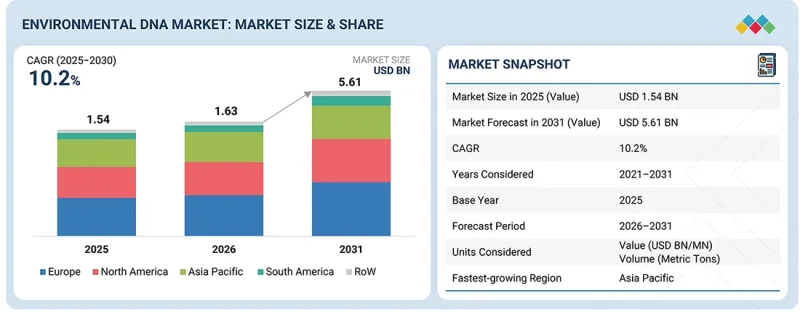
The environmental DNA market is projected to reach USD 5.61 billion by 2031, from USD 1.63 billion in 2026, with a CAGR of 10.2%. The market is growing as newer testing methods make it simpler to detect species without having to capture or directly observe them. These approaches rely on genetic material present in water, soil, and air, allowing teams to track biodiversity more quickly and with less disruption to natural habitats. This makes them practical for both research activities and regulatory monitoring. Demand is rising because organizations need reliable data to track ecosystem health and identify invasive species.
| Scope of the Report | |
|---|---|
| Years Considered for the Study | 2026-2031 |
| Base Year | 2025 |
| Forecast Period | 2026-2031 |
| Units Considered | Value (USD BN), Volume (Metric Tons) |
| Segments | By Type of Solution, Sample Type, Detection Method, Application, and Region |
| Regions covered | North America, Europe, Asia Pacific, South America, RoW |
Government regulations around environmental monitoring are also becoming stricter, which is supporting adoption. Many projects are backed by public funding and academic research, while private labs are helping scale testing. Technology is also improving; sequencing tools, testing accuracy, and data analysis are getting better, especially for samples with very low DNA levels. At the same time, efforts to standardize methods are increasing. As the process of standardization advances and collaborations with stakeholders increase, the environmental DNA market remains evolving as an innovative tool for contemporary environmental management.
"The climate change impact assessment segment within the application category is expected to record a notable CAGR."
The segment is gaining traction as organizations place more focus on measuring how climate change is affecting ecosystems over time. There is a growing need to track shifts in species presence, habitat conditions, and overall biodiversity in a consistent manner. This has increased the use of methods that allow repeat monitoring across locations. Environmental DNA is being used more frequently as it allows sample collection from water, soil, and sediment without intensive fieldwork. This makes it easier to run periodic studies and build comparable datasets over time. It is particularly useful in identifying gradual environmental changes that are not always visible through traditional methods. Government bodies, research institutions, and conservation groups are strengthening climate-related programs, where biodiversity tracking forms an important part of assessment. These efforts are expanding across regions, especially in sensitive ecosystems. As testing methods become more dependable and easier to deploy at scale, adoption is expected to increase.
"The air sample segment within the sample type category maintains strong growth."
Growth in this segment is driven by wider use of air sampling for biodiversity monitoring. The method is non-invasive and easier to deploy. Water and soil samples are still the standard approach, but air sampling is now drawing interest because it can collect DNA from plants, animals, and microorganisms at the same time. Air-based sampling is especially useful in areas where fieldwork is difficult or expensive. Fewer sampling points are needed to cover large areas. This makes the method practical for long-term and repeat monitoring projects. Both natural and urban locations are now part of ongoing trials. Universities, research centers, and environmental agencies are increasing pilot programs to test performance and repeatability. These studies focus on data quality and consistency. Early results have been promising and are encouraging further use and refinement of the approach. As operating procedures become clearer and test results improve, confidence in air-derived DNA data is expected to rise.
"North America is a lucrative market for eDNA."
North America represents a large portion of the environmental DNA market, driven by sustained research activity and early uptake of advanced testing techniques. The region also benefits from a mature laboratory base, which allows these methods to be applied at scale. Investment in environmental monitoring is well established, particularly among government agencies and research organizations that use environmental DNA for biodiversity studies, water quality analysis, and invasive species monitoring. In both the US and Canada, environmental DNA has moved beyond trial use and is now embedded in a range of conservation and monitoring programs. This shift is supported by defined regulatory structures and continued funding for ecological research. A strong presence of specialized service providers and technology firms further supports the market, helping ensure efficient processing and dependable analytical output. Ongoing collaboration between universities, environmental authorities, and private companies plays an important role in advancing the field. These partnerships contribute to method refinement and greater alignment in testing practices. As a result, project activity remains consistent across freshwater, marine, and terrestrial applications.
In-depth interviews were conducted with CEOs, directors, and other executives from various key organizations operating in the environmental DNA market:
- By Company Type: Tier 1 - 25%, Tier 2 - 45%, and Tier 3 - 30%
- By Designation: Directors - 20%, Managers - 50%, Executives - 30%
- By Region: North America - 25%, Europe - 30%, Asia Pacific - 20%, South America - 15%, and Rest of the World -10%
Prominent companies in the market include Thermo Fisher Scientific Inc. (US), QIAGEN (Netherlands), Illumina, Inc. (US), Eurofins Scientific (Luxembourg), SGS Societe Generale de Surveillance SA (Switzerland), NatureMetrics (UK), EnviroDNA (Australia), EDNAtec (Canada), SPYGEN (France), ID-GENE ecodiagnostics Ltd. (France), Takara Bio Inc. (Japan), Stantec (Canada), Applied Genomics (UK), AllGenetics (Spain), and Jonah Ventures (US).
Other players include Cramer Fish Sciences (US), StarSEQ (Germany), Sinsoma GmbH (Germany), eDNA Metagenomics Inc. (US), eDNANature Ltd. (UK), Wilderlab NZ Ltd. (New Zealand), SimplexDNA (US), Biome Makers Inc. (US), Metagen (US), and Biomeme (US).
Research Coverage:
This research report categorizes the environmental DNA market by Type of Solution {Services [Sample Collection & Field Services, Laboratory Analysis, Sequencing services, Bioinformatics & Data Interpretation, End-to-End Project Studies], Products [Sampling Kits, DNA Extraction Kits, PCR Reagents (qPCR, ddPCR), Library Preparation Kits], Instruments & Platforms [PCR Systems (qPCR, ddPCR), Sequencing Platforms (NGS), Sample Processing Instruments], Software & Data Analytics [Bioinformatics Pipelines, Species Identification Databases, Monitoring & Reporting Platforms]}, Sample Type (Water, Soil, Sediment, Air, Biological waste), Detection Method [qPCR (quantitative Polymerase Chain Reaction), ddPCR (digital droplet PCR), Metabarcoding, Metagenomics, CRISPR-based Detection, Hybrid Methods (e.g., qPCR + NGS)], Application (Biodiversity Monitoring, Invasive Species Detection, Conservation Biology, Aquaculture & Fisheries, Water Quality Assessment, Climate Change Impact Assessment, Forensics & Compliance), and Region (North America, Europe, Asia Pacific, South America, Rest of the World). The report's scope encompasses detailed information on the major factors, including drivers, restraints, challenges, and opportunities, that influence the growth of the environmental DNA market. A detailed analysis of key industry players has been conducted to provide insights into their business overview, solutions, and services; key strategies; contracts, partnerships, and agreements. New product & service launches, mergers & acquisitions, and recent developments associated with the environmental DNA market have been included. This report also covers the competitive analysis of upcoming start-ups in the environmental DNA ecosystem.
Reasons to buy this report:
The report will help market leaders/new entrants in this market with information on the closest approximations of the revenue numbers for the overall environmental DNA and subsegments. It will also help stakeholders understand the competitive landscape and gain more insights to better position their businesses and plan suitable go-to-market strategies. The report also helps stakeholders understand the pulse of the market and provides them with information on key market drivers, restraints, challenges, and opportunities.
The report provides insights into the following pointers:
1. In-depth Segmentation across Type of Solution, Sample Type, Detection method, and Application: This report offers an in-depth analysis of the environmental DNA market, categorizing by Type of Solution {Services [Sample Collection & Field Services, Laboratory Analysis, Sequencing services, Bioinformatics & Data Interpretation, End-to-End Project Studies], Products [Sampling Kits, DNA Extraction Kits, PCR Reagents (qPCR, ddPCR), Library Preparation Kits], Instruments & Platforms [PCR Systems (qPCR, ddPCR), Sequencing Platforms (NGS), Sample Processing Instruments], Software & Data Analytics [Bioinformatics Pipelines, Species Identification Databases, Monitoring & Reporting Platforms]}, Sample Type (Water, Soil, Sediment, Air, Biological waste), Detection Method [qPCR (quantitative Polymerase Chain Reaction), ddPCR (digital droplet PCR), Metabarcoding, Metagenomics, CRISPR-based Detection, Hybrid Methods (e.g., qPCR + NGS)], Application (Biodiversity Monitoring, Invasive Species Detection, Conservation Biology, Aquaculture & Fisheries, Water Quality Assessment, Climate Change Impact Assessment, Forensics & Compliance). Such detailed segmentation enables stakeholders to pinpoint high-growth areas, optimize product development, and strategically position offerings along the supply chain.
2. Region-specific Insights with Focus on Emerging Markets: The report provides country- and region-specific analysis, emphasizing opportunities in rapidly growing markets such as Asia Pacific, North America, Europe, and South America. It explores regional regulatory frameworks, key demand drivers, and investment trends, serving as a critical guide for companies pursuing expansion or localization strategies.
3. Competitive Intelligence and Innovation Landscape: Leading market participants, including Thermo Fisher Scientific Inc. (US), QIAGEN (Netherlands), Illumina, Inc. (US), Eurofins Scientific (Luxembourg), SGS Societe Generale de Surveillance SA (Switzerland), NatureMetrics (UK), EnviroDNA (Australia), EDNAtec (Canada), SPYGEN (France), ID-GENE ecodiagnostics Ltd. (France), Takara Bio Inc. (Japan), Stantec (Canada), Applied Genomics (UK), AllGenetics (Spain), and Jonah Ventures (US) are profiled in detail. The report covers recent developments such as new product launches, mergers & acquisitions, facility expansions, and R&D initiatives, helping users benchmark competitors and monitor emerging innovation trends.
4. Demand Forecasts Backed by Data-driven Methodologies: Market sizing and growth projections through 2031 are developed using a combination of top-down and bottom-up approaches, validated by industry experts, trade associations, and official government data. These insights provide reliable guidance for investment planning and market opportunity assessment in the environmental DNA sector.
TABLE OF CONTENTS
1 INTRODUCTION
- 1.1 STUDY OBJECTIVES
- 1.2 MARKET DEFINITION
- 1.3 STUDY SCOPE
- 1.3.1 INCLUSIONS AND EXCLUSIONS
- 1.4 YEARS CONSIDERED
- 1.5 CURRENCY CONSIDERED
- 1.6 VOLUME UNIT CONSIDERED
- 1.7 STAKEHOLDERS
2 EXECUTIVE SUMMARY
- 2.1 MARKET HIGHLIGHTS AND KEY INSIGHTS
- 2.2 KEY MARKET PARTICIPANTS: MAPPING OF STRATEGIC DEVELOPMENTS
- 2.3 DISRUPTIVE TRENDS IN ENVIRONMENTAL DNA MARKET
- 2.4 HIGH-GROWTH SEGMENTS
- 2.5 REGIONAL SNAPSHOT: MARKET SIZE, GROWTH RATE, AND FORECAST
3 PREMIUM INSIGHTS
- 3.1 ATTRACTIVE OPPORTUNITIES FOR PLAYERS IN ENVIRONMENTAL DNA MARKET
- 3.2 ENVIRONMENTAL DNA MARKET, BY SAMPLE TYPE AND REGION
- 3.3 ENVIRONMENTAL DNA MARKET, BY TYPE OF SOLUTION
- 3.4 ENVIRONMENTAL DNA MARKET, BY SAMPLE TYPE
- 3.5 ENVIRONMENTAL DNA MARKET, BY DETECTION METHOD
- 3.6 ENVIRONMENTAL DNA MARKET, BY APPLICATION
- 3.7 ENVIRONMENTAL DNA MARKET, BY COUNTRY
4 MARKET OVERVIEW
- 4.1 INTRODUCTION
- 4.2 MARKET DYNAMICS
- 4.2.1 DRIVERS
- 4.2.1.1 Rising Focus on Biodiversity Conservation
- 4.2.1.2 Growing Demand for Non-invasive Monitoring Techniques
- 4.2.1.3 Technological Advancements in Sequencing and Molecular Biology
- 4.2.2 RESTRAINTS
- 4.2.2.1 High Initial Cost and Infrastructure Requirements
- 4.2.2.2 Lack of Standardization and Protocol Variability
- 4.2.3 OPPORTUNITIES
- 4.2.3.1 Integration into Environmental Regulations and Compliance Frameworks
- 4.2.3.2 Adoption in Biodiversity Credits and Natural Capital Markets
- 4.2.4 CHALLENGES
- 4.2.4.1 Fragmented Regulatory and Data-governance Landscape
- 4.2.4.2 Limited Awareness and Technical Understanding Among End Users
- 4.2.1 DRIVERS
- 4.3 UNMET NEEDS AND WHITE SPACES
- 4.3.1 UNMET NEEDS IN ENVIRONMENTAL DNA MARKET
- 4.3.2 WHITE SPACE OPPORTUNITIES
- 4.4 INTERCONNECTED MARKETS AND CROSS-SECTOR OPPORTUNITIES
- 4.4.1 INTERCONNECTED MARKETS
- 4.4.2 CROSS-SECTOR OPPORTUNITIES
- 4.5 STRATEGIC MOVES BY TIER-1/2/3 PLAYERS
- 4.5.1 KEY MOVES AND STRATEGIC FOCUS
5 INDUSTRY TRENDS
- 5.1 INTRODUCTION
- 5.2 PORTER'S FIVE FORCES ANALYSIS
- 5.2.1 ENVIRONMENTAL DNA MARKET: PORTER'S FIVE FORCES ANALYSIS
- 5.2.2 THREAT OF NEW ENTRANTS
- 5.2.3 THREAT OF SUBSTITUTES
- 5.2.4 BARGAINING POWER OF SUPPLIERS
- 5.2.5 BARGAINING POWER OF BUYERS
- 5.2.6 INTENSITY OF COMPETITIVE RIVALRY
- 5.3 MACROECONOMIC INDICATORS
- 5.3.1 WATER STRESS & FRESHWATER AVAILABILITY
- 5.4 BIODIVERSITY LOSS & ECOSYSTEM DEGRADATION
- 5.5 SUPPLY CHAIN ANALYSIS
- 5.5.1 RESEARCH & ASSAY DEVELOPMENT
- 5.5.2 SOURCING & INPUT SUPPLY
- 5.5.3 SAMPLE COLLECTION & PRE-PROCESSING
- 5.5.4 LABORATORY PROCESSING & SEQUENCING
- 5.5.5 BIOINFORMATICS & DATA ANALYSIS
- 5.5.6 DISTRIBUTION & END CONSUMER
- 5.6 VALUE CHAIN ANALYSIS
- 5.6.1 RESEARCH & ASSAY DEVELOPMENT
- 5.6.2 SOURCING & INPUT SUPPLY
- 5.6.3 SAMPLE COLLECTION & PRE-PROCESSING
- 5.6.4 LABORATORY PROCESSING & SEQUENCING
- 5.6.5 BIOINFORMATICS & DATA ANALYSIS
- 5.6.6 DISTRIBUTION & END CONSUMER
- 5.7 ECOSYSTEM ANALYSIS
- 5.7.1 TECHNOLOGY PROVIDERS
- 5.7.2 EDNA SERVICE PROVIDERS
- 5.7.3 REGULATORY BODIES
- 5.7.4 END USERS
- 5.8 PRICING ANALYSIS
- 5.8.1 AVERAGE SELLING PRICE TREND OF KEY PLAYERS, BY TYPE OF SOLUTION (2022-2026)
- 5.8.2 AVERAGE SELLING PRICE TREND, BY TYPE
- 5.8.3 AVERAGE SELLING PRICE TREND, BY REGION
- 5.9 TRADE ANALYSIS
- 5.9.1 TRADE ANALYSIS OF HS CODE 382219: DIAGNOSTIC OR LABORATORY REAGENTS ON A BACKING, PREPARED DIAGNOSTIC OR LABORATORY REAGENTS, WHETHER OR NOT ON A BACKING, WHETHER OR NOT PUT UP IN THE FORM OF KITS (EXCLUDING CERTAIN SPECIFIED CATEGORIES)
- 5.9.1.1 Export Trends of Environmental DNA under HS Code 382219 (2022-2025)
- 5.9.1.2 Import Trends of Environmental DNA under HS Code 382219 (2022-2025)
- 5.9.1 TRADE ANALYSIS OF HS CODE 382219: DIAGNOSTIC OR LABORATORY REAGENTS ON A BACKING, PREPARED DIAGNOSTIC OR LABORATORY REAGENTS, WHETHER OR NOT ON A BACKING, WHETHER OR NOT PUT UP IN THE FORM OF KITS (EXCLUDING CERTAIN SPECIFIED CATEGORIES)
- 5.10 KEY CONFERENCES & EVENTS
- 5.11 TRENDS IMPACTING CUSTOMERS' BUSINESSES
- 5.12 INVESTMENT AND FUNDING SCENARIO
- 5.13 CASE STUDY ANALYSIS
- 5.13.1 REFORESTATION MONITORING USING EDNA (LAND LIFE X NATUREMETRICS, 2024)
- 5.13.2 EDNA SURFACE SAMPLING FOR FISHERIES MANAGEMENT (OCEAN DIAGNOSTICS X NWIFC, 2023-2024)
- 5.14 IMPACT OF 2025 US TARIFF - ENVIRONMENTAL DNA MARKET
- 5.14.1 INTRODUCTION
- 5.14.2 PRICE IMPACT ANALYSIS
- 5.14.3 IMPACT ON COUNTRY/REGION
- 5.14.3.1 North America (US, Canada, Mexico)
- 5.14.3.2 Europe
- 5.14.3.3 Asia Pacific
- 5.14.3.4 South America
- 5.14.3.5 Middle East & Africa
- 5.14.4 IMPACT ON END-USE INDUSTRIES
6 CUSTOMER LANDSCAPE AND BUYER BEHAVIOR
- 6.1 INTRODUCTION
- 6.2 DECISION-MAKING PROCESS
- 6.3 BUYER STAKEHOLDERS AND BUYING EVALUATION CRITERIA
- 6.3.1 KEY STAKEHOLDERS IN BUYING PROCESS
- 6.3.2 BUYING CRITERIA
- 6.4 ADOPTION BARRIERS AND INTERNAL CHALLENGES
- 6.5 UNMET NEEDS OF VARIOUS END-USE INDUSTRIES
- 6.6 MARKET PROFITABILITY
7 STRATEGIC DISRUPTION THROUGH TECHNOLOGY, PATENTS, DIGITAL, AND AI ADOPTION
- 7.1 INTRODUCTION
- 7.2 KEY EMERGING TECHNOLOGIES
- 7.2.1 NEXT-GENERATION SEQUENCING (NGS) & METABARCODING
- 7.2.2 QUANTITATIVE PCR (QPCR) AND DIGITAL PCR (DDPCR)
- 7.2.3 CRISPR-BASED DETECTION TECHNOLOGIES
- 7.3 COMPLEMENTARY TECHNOLOGIES
- 7.3.1 GEOGRAPHIC INFORMATION SYSTEMS (GIS) AND SPATIAL ANALYTICS
- 7.3.2 REMOTE SENSING TECHNOLOGIES
- 7.3.3 AUTOMATED SAMPLING AND FILTRATION SYSTEMS
- 7.3.4 IOT-ENABLED ENVIRONMENTAL SENSORS
- 7.3.5 CLOUD COMPUTING AND DATA MANAGEMENT PLATFORMS
- 7.4 TECHNOLOGY/PRODUCT ROADMAP
- 7.4.1 SHORT-TERM | WORKFLOW STANDARDIZATION AND DETECTION RELIABILITY
- 7.4.2 MID-TERM | AUTOMATION, INTEGRATION, AND FIELD-DEPLOYABLE SOLUTIONS
- 7.4.3 LONG-TERM | REAL-TIME MONITORING AND DATA-DRIVEN ECOSYSTEMS
- 7.5 PATENT ANALYSIS
- 7.5.1 LIST OF MAJOR PATENTS
- 7.6 FUTURE APPLICATIONS
- 7.6.1 ON-SITE, REAL-TIME ENVIRONMENTAL DNA MONITORING SYSTEMS
- 7.6.2 AIRBORNE ENVIRONMENTAL DNA FOR TERRESTRIAL BIODIVERSITY MONITORING
- 7.6.3 LONG-TERM ENVIRONMENTAL DNA-BASED ECOSYSTEM MONITORING SYSTEMS
- 7.6.4 GLOBAL ENVIRONMENTAL DNA DATA PLATFORMS FOR BIODIVERSITY GOVERNANCE AND POLICY INTEGRATION
- 7.6.5 INTELLIGENT ENVIRONMENTAL DNA ANALYTICS AND PREDICTIVE MONITORING SYSTEMS
- 7.7 IMPACT OF GENERATIVE AI ON ENVIRONMENTAL DNA MARKET
- 7.7.1 INTRODUCTION
- 7.7.2 USE OF GENERATIVE AI IN ENVIRONMENTAL DNA MARKET
- 7.7.3 TOP USE CASES AND MARKET POTENTIAL
- 7.7.4 BEST PRACTICES IN ENVIRONMENTAL DNA INDUSTRY
- 7.7.5 CASE STUDIES OF AI IMPLEMENTATION IN ENVIRONMENTAL DNA MARKET
- 7.7.6 INTERCONNECTED ADJACENT ECOSYSTEM AND IMPACT ON MARKET PLAYERS
- 7.7.7 CLIENTS' READINESS TO ADOPT GENERATIVE AI IN ENVIRONMENTAL DNA MARKET
- 7.8 SUCCESS STORIES AND REAL-WORLD APPLICATIONS
8 SUSTAINABILITY AND REGULATORY LANDSCAPE
- 8.1 INTRODUCTION
- 8.2 REGIONAL REGULATIONS AND COMPLIANCE
- 8.2.1 REGULATORY BODIES, GOVERNMENT AGENCIES, AND OTHER ORGANIZATIONS
- 8.2.2 INDUSTRY STANDARDS
- 8.2.3 LABELING REQUIREMENTS AND CLAIMS
- 8.2.4 ANTICIPATED REGULATORY CHANGES IN NEXT 5-10 YEARS
- 8.2.4.1 Standardization and Method Validation Regulations
- 8.2.4.2 Data Reporting, Transparency, and Digital Integration Requirements
- 8.2.4.3 Environmental Monitoring and Biodiversity Policy Integration
- 8.2.4.4 Sustainability and Laboratory Environmental Compliance
- 8.3 SUSTAINABILITY INITIATIVES
- 8.3.1 SUSTAINABLE SAMPLING AND FIELD PRACTICES
- 8.3.2 LABORATORY RESOURCE AND ENERGY EFFICIENCY
- 8.3.3 WASTE REDUCTION AND MATERIAL MANAGEMENT
- 8.3.4 DATA EFFICIENCY AND DIGITAL SUSTAINABILITY
- 8.3.5 SUPPORT FOR BIODIVERSITY AND CONSERVATION GOALS
- 8.4 SUSTAINABILITY IMPACT AND REGULATORY POLICY INITIATIVES
- 8.5 CERTIFICATIONS, LABELING, ECO-STANDARDS
9 ENVIRONMENTAL DNA MARKET, BY APPLICATION
- 9.1 INTRODUCTION
- 9.2 BIODIVERSITY MONITORING
- 9.2.1 INCREASING NEED FOR LARGE-SCALE BIODIVERSITY MONITORING AND ECOSYSTEM ASSESSMENT TO DRIVE EDNA MARKET
- 9.3 INVASIVE SPECIES DETECTION
- 9.3.1 NEED FOR EARLY DETECTION AND SCALABLE MONITORING OF INVASIVE SPECIES DRIVING EDNA ADOPTION
- 9.4 CONSERVATION BIOLOGY
- 9.4.1 INCREASING FOCUS ON SPECIES PROTECTION AND HABITAT CONSERVATION TO DRIVE MARKET
- 9.5 AQUACULTURE & FISHERIES
- 9.5.1 INCREASING FOCUS ON ACCURATE FISH STOCK ASSESSMENT AND SPECIES-LEVEL MONITORING TO DRIVE MARKET
- 9.6 WATER QUALITY ASSESSMENT
- 9.6.1 GROWING NEED FOR BIOLOGICAL AND ECOSYSTEM-LEVEL WATER QUALITY MONITORING TO DRIVE MARKET
- 9.7 CLIMATE CHANGE IMPACT ASSESSMENT
- 9.7.1 INCREASING NEED TO TRACK CLIMATE-DRIVEN CHANGES IN SPECIES DISTRIBUTION AND ECOSYSTEMS TO DRIVE MARKET
- 9.8 FORENSICS & COMPLIANCE
- 9.8.1 INCREASING DEMAND FOR VERIFIABLE SPECIES DETECTION IN ENVIRONMENTAL ENFORCEMENT AND COMPLIANCE TO DRIVE MARKET
10 ENVIRONMENTAL DNA MARKET, BY DETECTION METHOD
- 10.1 INTRODUCTION
- 10.2 QPCR (QUANTITATIVE POLYMERASE CHAIN REACTION)
- 10.2.1 HIGH SENSITIVITY IN DETECTING LOW-CONCENTRATION DNA FOR EARLY AND RELIABLE SPECIES DETECTION TO DRIVE MARKET
- 10.3 DDPCR (DIGITAL DROPLET PCR)
- 10.3.1 INCREASING NEED FOR HIGHLY RELIABLE DETECTION OF LOW-ABUNDANCE DNA USING DDPCR TO DRIVE MARKET
- 10.4 METABARCODING
- 10.4.1 INCREASING NEED FOR COMPREHENSIVE MULTI-SPECIES BIODIVERSITY DETECTION TO DRIVE MARKET
- 10.5 METAGENOMIC
- 10.5.1 NEED FOR HIGH RESOLUTION AND FUNCTIONAL BIODIVERSITY INSIGHTS TO DRIVE MARKET
- 10.6 CRISPR-BASED DETECTION
- 10.6.1 ABILITY TO ENABLE RAPID AND FIELD-BASED DNA DETECTION USING CRISPR TO DRIVE MARKET
- 10.7 HYBRID METHODS
- 10.7.1 NEED TO CAPTURE BOTH SPECIES-SPECIFIC AND BROAD BIODIVERSITY SIGNALS TO DRIVE MULTI-METHOD EDNA DETECTION
11 ENVIRONMENTAL DNA MARKET, BY SAMPLE TYPE
- 11.1 INTRODU3CTION
- 11.2 WATER
- 11.2.1 HIGH BIODIVERSITY CONCENTRATION IN AQUATIC ECOSYSTEMS REQUIRING SENSITIVE AND SCALABLE DETECTION TO DRIVE MARKET
- 11.3 SOIL
- 11.3.1 INCREASING NEED FOR SOIL BIODIVERSITY DETECTION TO DRIVE EDNA ADOPTION
- 11.4 SEDIMENT
- 11.4.1 ENHANCED BIODIVERSITY DETECTION AND BROADER TAXONOMIC COVERAGE IN SEDIMENT SAMPLES TO DRIVE EDNA ADOPTION
- 11.5 AIR
- 11.5.1 INCREASING NEED TO TRACK DISPERSED AND AIRBORNE SPECIES ACROSS OPEN ENVIRONMENTS TO DRIVE MARKET
- 11.6 BIOLOGICAL WASTE
- 11.6.1 ABILITY TO DETERMINE SPECIES DIET AND TROPHIC INTERACTIONS USING BIOLOGICAL WASTE SAMPLES TO DRIVE MARKET
12 ENVIRONMENTAL DNA MARKET, BY TYPE OF SOLUTION
- 12.1 INTRODUCTION
- 12.2 SERVICES
- 12.2.1 LIMITATIONS OF FRAGMENTED WORKFLOWS AND LACK OF IN-HOUSE EXPERTISE DRIVING RELIANCE ON END-TO-END ENVIRONMENTAL DNA SERVICE MODELS
- 12.2.2 SAMPLE COLLECTION & FIELD SERVICES
- 12.2.3 LABORATORY ANALYSIS SERVICES
- 12.2.4 SEQUENCING SERVICES
- 12.2.5 BIOINFORMATICS & DATA INTERPRETATION SERVICES
- 12.2.6 END-TO-END PROJECT STUDIES
- 12.3 CONSUMABLES & REAGENTS
- 12.3.1 RISING ADOPTION OF STANDARDIZED SAMPLING, EXTRACTION, AND AMPLIFICATION WORKFLOWS TO DRIVE ENVIRONMENTAL DNA MARKET
- 12.3.2 SAMPLING CONSUMABLES
- 12.3.3 DNA EXTRACTION & LIBRARY PREPARATION
- 12.3.4 PCR & DETECTION REAGENTS
- 12.4 INSTRUMENTS & HARDWARE
- 12.4.1 RISING DEMAND FOR HIGH-THROUGHPUT, AUTOMATED, AND REAL-TIME ENVIRONMENTAL DNA ANALYSIS WORKFLOWS TO DRIVE MARKET
- 12.4.2 SAMPLE PROCESSING EQUIPMENT
- 12.4.3 PCR SYSTEMS
- 12.4.4 SEQUENCING PLATFORMS
13 ENVIRONMENTAL DNA MARKET, BY REGION
- 13.1 INTRODUCTION
- 13.2 NORTH AMERICA
- 13.2.1 US
- 13.2.1.1 Expanding federal aquatic biodiversity surveillance programs and invasive species monitoring initiatives to drive market
- 13.2.2 CANADA
- 13.2.2.1 Expanding freshwater biodiversity monitoring and invasive aquatic species surveillance programs to drive environmental DNA adoption across Canada
- 13.2.3 MEXICO
- 13.2.3.1 Expanding marine biodiversity conservation and protected coastal ecosystem monitoring programs to drive environmental DNA adoption across Mexico
- 13.2.1 US
- 13.3 EUROPE
- 13.3.1 UK
- 13.3.1.1 Advancement of national-scale biodiversity surveillance and airborne environmental DNA monitoring to drive market growth in UK
- 13.3.2 GERMANY
- 13.3.2.1 Expansion of standardized biodiversity monitoring programs and high-frequency ecological surveillance initiatives to drive environmental DNA adoption across Germany
- 13.3.3 FRANCE
- 13.3.3.1 Standardization of aquatic biodiversity monitoring and species conservation programs to drive environmental DNA adoption across France
- 13.3.4 ITALY
- 13.3.4.1 Growing use of eDNA metabarcoding for Mediterranean marine biodiversity assessment and ecosystem monitoring to support market growth in Italy
- 13.3.5 SPAIN
- 13.3.5.1 Increasing integration of eDNA-based ecological assessment within estuarine monitoring and freshwater restoration programs to drive market growth in Spain
- 13.3.6 REST OF EUROPE
- 13.3.1 UK
- 13.4 ASIA PACIFIC
- 13.4.1 CHINA
- 13.4.1.1 China's growing adoption of eDNA for biodiversity monitoring driving environmental DNA market growth
- 13.4.2 INDIA
- 13.4.2.1 India's increasing adoption of eDNA technologies for biodiversity and wildlife monitoring driving growth in environmental DNA market
- 13.4.3 JAPAN
- 13.4.3.1 Japan Emerging as Key Hub for eDNA-based Aquatic Biodiversity Monitoring and Conservation
- 13.4.4 AUSTRALIA & NEW ZEALAND
- 13.4.4.1 Australia & New Zealand Accelerating eDNA Market Growth Through Advanced Biodiversity Conservation Initiatives
- 13.4.5 REST OF ASIA PACIFIC
- 13.4.1 CHINA
- 13.5 SOUTH AMERICA
- 13.5.1 BRAZIL
- 13.5.1.1 Use of eDNA for freshwater biodiversity surveillance to drive environmental DNA market growth in Brazil
- 13.5.2 ARGENTINA
- 13.5.2.1 Rising adoption of eDNA technologies for marine ecosystem assessment and conservation research to support environmental DNA market growth in Argentina
- 13.5.3 REST OF SOUTH AMERICA
- 13.5.1 BRAZIL
- 13.6 REST OF THE WORLD (ROW)
- 13.6.1 MIDDLE EAST
- 13.6.1.1 Water Sustainability & Marine Ecosystem Monitoring Growth
- 13.6.2 AFRICA
- 13.6.2.1 Biodiversity Conservation & Freshwater Monitoring Expansion
- 13.6.1 MIDDLE EAST
14 COMPETITIVE LANDSCAPE
- 14.1 OVERVIEW
- 14.2 KEY PLAYER STRATEGIES/RIGHT TO WIN, 2021-2026
- 14.3 BRAND/PRODUCT COMPARISON
- 14.3.1 THERMO FISHER SCIENTIFIC INC. (US)
- 14.3.2 ILLUMINA, INC. (US)
- 14.3.3 QIAGEN (NETHERLANDS)
- 14.3.4 SGS SOCIETE GENERALE DE SURVEILLANCE SA (SWITZERLAND)
- 14.3.5 EUROFINS SCIENTIFIC (LUXEMBOURG)
- 14.4 REVENUE ANALYSIS, 2023-2025
- 14.5 COMPANY VALUATION AND FINANCIAL METRICS
- 14.5.1 COMPANY VALUATION
- 14.5.2 EV/EBITDA
- 14.6 MARKET SHARE ANALYSIS, 2026
- 14.7 ENVIRONMENTAL DNA COMPANY EVALUATION MATRIX: KEY PLAYERS, 2025
- 14.7.1 STARS
- 14.7.2 EMERGING LEADERS
- 14.7.3 PERVASIVE PLAYERS
- 14.7.4 PARTICIPANTS
- 14.7.5 COMPANY FOOTPRINT: KEY PLAYERS, 2025
- 14.7.5.1 Company footprint
- 14.7.5.2 Region footprint
- 14.7.5.3 Type of solution footprint
- 14.7.5.4 Sample type footprint
- 14.7.5.5 Detection footprint
- 14.8 COMPANY EVALUATION MATRIX: STARTUPS/SMES, 2025
- 14.8.1 PROGRESSIVE COMPANIES
- 14.8.2 RESPONSIVE COMPANIES
- 14.8.3 DYNAMIC COMPANIES
- 14.8.4 STARTING BLOCKS
- 14.8.5 COMPETITIVE BENCHMARKING: STARTUPS/SMES, 2025
- 14.8.5.1 Key startups/SMEs
- 14.8.5.2 Competitive benchmarking of key startups/SMEs
- 14.9 COMPETITIVE SCENARIO
- 14.9.1 PRODUCT LAUNCHES
- 14.9.2 DEALS
- 14.9.3 EXPANSIONS
15 COMPANY PROFILES
- 15.1 KEY PLAYERS
- 15.1.1 THERMO FISHER SCIENTIFIC INC.
- 15.1.1.1 Business overview
- 15.1.1.2 Products offered
- 15.1.1.3 Recent developments
- 15.1.1.3.1 Product launches
- 15.1.1.3.2 Deals
- 15.1.1.4 MnM view
- 15.1.1.4.1 Right to win
- 15.1.1.4.2 Strategic choices
- 15.1.1.4.3 Weaknesses and competitive threats
- 15.1.2 ILLUMINA, INC.
- 15.1.2.1 Business overview
- 15.1.2.2 Products offered
- 15.1.2.3 Recent developments
- 15.1.2.3.1 Deals
- 15.1.2.3.2 Other developments
- 15.1.2.4 MnM view
- 15.1.2.4.1 Right to win
- 15.1.2.4.2 Strategic choices
- 15.1.2.4.3 Weaknesses and competitive threats
- 15.1.3 QIAGEN
- 15.1.3.1 Business overview
- 15.1.3.2 Products offered
- 15.1.3.3 Recent developments
- 15.1.3.3.1 Product launches
- 15.1.3.4 MnM view
- 15.1.3.4.1 Right to win
- 15.1.3.4.2 Strategic choices
- 15.1.3.4.3 Weaknesses and competitive threats
- 15.1.4 SGS SOCIETE GENERALE DE SURVEILLANCE SA
- 15.1.4.1 Business overview
- 15.1.4.2 Products offered
- 15.1.4.3 Recent developments
- 15.1.4.3.1 Expansions
- 15.1.4.4 MnM view
- 15.1.4.4.1 Right to win
- 15.1.4.4.2 Strategic choices
- 15.1.4.4.3 Weaknesses and competitive threats
- 15.1.5 EUROFINS SCIENTIFIC
- 15.1.5.1 Business overview
- 15.1.5.2 Products offered
- 15.1.5.3 Recent developments
- 15.1.5.3.1 Expansions
- 15.1.5.4 MnM view
- 15.1.5.4.1 Right to win
- 15.1.5.4.2 Strategic choices
- 15.1.5.4.3 Weaknesses and competitive threats
- 15.1.6 STANTEC
- 15.1.6.1 Business overview
- 15.1.6.2 Products offered
- 15.1.6.3 Recent developments
- 15.1.6.4 MnM view
- 15.1.6.4.1 Right to win
- 15.1.6.4.2 Strategic choices
- 15.1.6.4.3 Weaknesses and competitive threats
- 15.1.7 NATUREMETRICS
- 15.1.7.1 Business overview
- 15.1.7.2 Products offered
- 15.1.7.3 Recent developments
- 15.1.7.3.1 Product launches
- 15.1.7.3.2 Deals
- 15.1.7.3.3 Expansions
- 15.1.7.3.4 Other developments
- 15.1.7.4 MnM view
- 15.1.7.4.1 Right to win
- 15.1.7.4.2 Strategic choices
- 15.1.7.4.3 Weaknesses and competitive threats
- 15.1.8 ENVIRODNA
- 15.1.8.1 Business overview
- 15.1.8.2 Products offered
- 15.1.8.3 Recent developments
- 15.1.8.3.1 Product launches
- 15.1.8.3.2 Deals
- 15.1.8.3.3 Other developments
- 15.1.8.4 MnM view
- 15.1.8.4.1 Right to win
- 15.1.8.4.2 Strategic choices
- 15.1.8.4.3 Weaknesses and competitive threats
- 15.1.9 EDNATEC
- 15.1.9.1 Business overview
- 15.1.9.2 Products offered
- 15.1.9.3 Recent developments
- 15.1.9.3.1 Deals
- 15.1.9.4 MnM view
- 15.1.9.4.1 Right to win
- 15.1.9.4.2 Strategic choices
- 15.1.9.4.3 Weaknesses and competitive threats
- 15.1.10 SPYGEN
- 15.1.10.1 Business overview
- 15.1.10.2 Products offered
- 15.1.10.3 Recent developments
- 15.1.10.3.1 Deals
- 15.1.10.4 MnM view
- 15.1.10.4.1 Right to win
- 15.1.10.4.2 Strategic choices
- 15.1.10.4.3 Weaknesses and competitive threats
- 15.1.11 ID-GENE ECODIAGNOSTICS LTD.
- 15.1.11.1 Business overview
- 15.1.11.2 Products offered
- 15.1.11.3 Recent developments
- 15.1.11.4 MnM view
- 15.1.11.4.1 Right to win
- 15.1.11.4.2 Strategic choices
- 15.1.11.4.3 Weaknesses and competitive threats
- 15.1.12 TAKARA BIO INC.
- 15.1.12.1 Business overview
- 15.1.12.2 Products offered
- 15.1.12.3 Recent developments
- 15.1.12.4 MnM view
- 15.1.12.4.1 Right to win
- 15.1.12.4.2 Strategic choices
- 15.1.12.4.3 Weaknesses and competitive threats
- 15.1.13 APPLIED GENOMICS
- 15.1.13.1 Business overview
- 15.1.13.2 Products offered
- 15.1.13.3 Recent developments
- 15.1.13.3.1 Deals
- 15.1.13.3.2 Expansions
- 15.1.13.4 MnM view
- 15.1.13.4.1 Right to win
- 15.1.13.4.2 Strategic choices
- 15.1.13.4.3 Weaknesses and competitive threats
- 15.1.14 ALLGENETICS
- 15.1.14.1 Business overview
- 15.1.14.2 Products offered
- 15.1.14.3 Recent developments
- 15.1.14.4 MnM view
- 15.1.14.4.1 Right to win
- 15.1.14.4.2 Strategic choices
- 15.1.14.4.3 Weaknesses and competitive threats
- 15.1.15 JONAH VENTURES
- 15.1.15.1 Business overview
- 15.1.15.2 Products offered
- 15.1.15.3 Recent developments
- 15.1.15.3.1 Product launches
- 15.1.15.3.2 Deals
- 15.1.15.3.3 Other developments
- 15.1.15.4 MnM view
- 15.1.15.4.1 Right to win
- 15.1.15.4.2 Strategic choices
- 15.1.15.4.3 Weaknesses and competitive threats
- 15.1.1 THERMO FISHER SCIENTIFIC INC.
- 15.2 OTHER PLAYERS
- 15.2.1 CRAMER FISH SCIENCES
- 15.2.1.1 Business overview
- 15.2.1.2 Products offered
- 15.2.1.3 Recent developments
- 15.2.1.4 MnM view
- 15.2.2 STARSEQ
- 15.2.2.1 Business overview
- 15.2.2.2 Products offered
- 15.2.2.3 Recent developments
- 15.2.2.4 MnM view
- 15.2.3 SINSOMA GMBH
- 15.2.3.1 Business overview
- 15.2.3.2 Products offered
- 15.2.3.3 Recent developments
- 15.2.3.3.1 Deals
- 15.2.3.3.2 Other developments
- 15.2.3.4 MnM view
- 15.2.4 EDNA METAGENOMICS INC.
- 15.2.4.1 Business overview
- 15.2.4.2 Products offered
- 15.2.4.3 Recent developments
- 15.2.4.4 MnM view
- 15.2.5 EDNATURE LTD.
- 15.2.5.1 Business overview
- 15.2.5.2 Products offered
- 15.2.5.3 Recent developments
- 15.2.5.3.1 Other developments
- 15.2.5.4 MnM view
- 15.2.6 WILDERLAB NZ LTD.
- 15.2.7 SIMPLEXDNA
- 15.2.8 BIOME MAKERS INC.
- 15.2.9 METAGEN
- 15.2.10 BIOMEME
- 15.2.1 CRAMER FISH SCIENCES
16 RESEARCH METHODOLOGY
- 16.1 RESEARCH DATA
- 16.1.1 SECONDARY DATA
- 16.1.1.1 Key data from secondary sources
- 16.1.2 PRIMARY DATA
- 16.1.2.1 Key data from primary sources
- 16.1.2.2 Breakdown of primary profiles
- 16.1.2.3 Key insights from industry experts
- 16.1.1 SECONDARY DATA
- 16.2 MARKET SIZE ESTIMATION
- 16.2.1 TOP-DOWN APPROACH
- 16.2.2 SUPPLY-SIDE ANALYSIS
- 16.2.3 BOTTOM-UP APPROACH (DEMAND SIDE)
- 16.3 DATA TRIANGULATION AND MARKET BREAKUP
- 16.4 RESEARCH ASSUMPTIONS
- 16.5 RESEARCH LIMITATIONS AND RISK ASSESSMENT
17 ADJACENT & RELATED MARKETS
- 17.1 INTRODUCTION
- 17.2 LIMITATIONS
- 17.3 ENVIRONMENTAL MONITORING MARKET
- 17.3.1 MARKET DEFINITION
- 17.3.2 MARKET OVERVIEW
- 17.4 ENVIRONMENTAL TESTING MARKET
- 17.4.1 MARKET DEFINITION
- 17.4.2 MARKET OVERVIEW
18 APPENDIX
- 18.1 DISCUSSION GUIDE
- 18.2 KNOWLEDGESTORE: MARKETSANDMARKETS' SUBSCRIPTION PORTAL
- 18.3 CUSTOMIZATION OPTIONS
- 18.4 RELATED REPORTS
- 18.5 AUTHOR DETAILS
List of Tables
- TABLE 1 USD EXCHANGE RATES, 2021-2025
- TABLE 2 ENVIRONMENTAL DNA MARKET: SUPPLY CHAIN (ECOSYSTEM)
- TABLE 3 AVERAGE SELLING PRICE OF KEY PLAYERS IN ENVIRONMENTAL DNA MARKET, BY TYPE OF SOLUTION (USD/TESTS/UNITS)
- TABLE 4 AVERAGE SELLING PRICE (ASP), BY TYPE OF SOLUTION, 2022-2026 (USD/UNITS/TESTS)
- TABLE 5 AVERAGE SELLING PRICE (ASP), BY REGION, 2022-2026 (USD/UNITS)
- TABLE 6 TOP 10 EXPORTERS OF HS CODE 382219, 2022-2025 (USD THOUSAND)
- TABLE 7 TOP 10 EXPORTERS OF HS CODE 382219, 2022-2025 (TONS)
- TABLE 8 TOP 10 EXPORTERS OF HS CODE 382219, 2022-2025 (USD THOUSAND)
- TABLE 9 TOP 10 IMPORTERS OF HS CODE 382219, 2022-2025 (TONS)
- TABLE 10 ENVIRONMENTAL DNA MARKET: DETAILED LIST OF CONFERENCES & EVENTS, 2026-2027
- TABLE 11 IMPACT LEVEL ON TARGET PRODUCTS WITH RELEVANT HS CODES DUE TO TRUMP TARIFF (2025)
- TABLE 12 TARIFF IMPACT ON END-USE INDUSTRIES: ENVIRONMENTAL DNA MARKET
- TABLE 15 UNMET NEEDS IN ENVIRONMENTAL DNA MARKET, BY END USER
- TABLE 16 LIST OF MAJOR PATENTS ABOUT ENVIRONMENTAL DNA MARKET, 2021-2026
- TABLE 17 TOP USE CASES AND MARKET POTENTIAL
- TABLE 18 BEST PRACTICES: COMPANIES IMPLEMENTING USE CASES
- TABLE 19 ENVIRONMENTAL DNA MARKET: CASE STUDIES RELATED TO GEN AI IMPLEMENTATION
- TABLE 20 INTERCONNECTED ADJACENT ECOSYSTEM AND IMPACT ON MARKET PLAYERS
- TABLE 25 INTERNATIONAL: REGULATORY BODIES, GOVERNMENT AGENCIES, AND OTHER ORGANIZATIONS
- TABLE 26 GLOBAL INDUSTRY STANDARDS IN ENVIRONMENTAL DNA MARKET
- TABLE 27 LABELING REQUIREMENTS AND CLAIMS IN ENVIRONMENTAL DNA MARKET
- TABLE 28 SUSTAINABILITY INITIATIVES IN ENVIRONMENTAL DNA MARKET
- TABLE 29 CERTIFICATIONS, LABELING, AND ECO-STANDARDS IN ENVIRONMENTAL DNA MARKET
- TABLE 30 ENVIRONMENTAL DNA MARKET, BY APPLICATION, 2022-2025 (USD MILLION)
- TABLE 31 ENVIRONMENTAL DNA MARKET, BY APPLICATION, 2026-2031 (USD MILLION)
- TABLE 32 BIODIVERSITY MONITORING: ENVIRONMENTAL DNA MARKET, BY REGION, 2022-2025 (USD MILLION)
- TABLE 33 BIODIVERSITY MONITORING: ENVIRONMENTAL DNA MARKET, BY REGION, 2026-2031 (USD MILLION)
- TABLE 34 INVASIVE SPECIES DETECTION: ENVIRONMENTAL DNA MARKET, BY REGION, 2022-2025 (USD MILLION)
- TABLE 35 INVASIVE SPECIES DETECTION: ENVIRONMENTAL DNA MARKET, BY REGION, 2026-2031 (USD MILLION)
- TABLE 36 CONSERVATION BIOLOGY: ENVIRONMENTAL DNA MARKET, BY REGION, 2022-2025 (USD MILLION)
- TABLE 37 CONSERVATION BIOLOGY: ENVIRONMENTAL DNA MARKET, BY REGION, 2026-2031 (USD MILLION)
- TABLE 38 AQUACULTURE & FISHERIES: ENVIRONMENTAL DNA MARKET, BY REGION, 2022-2025 (USD MILLION)
- TABLE 39 AQUACULTURE & FISHERIES: ENVIRONMENTAL DNA MARKET, BY REGION, 2026-2031 (USD MILLION)
- TABLE 40 WATER QUALITY ASSESSMENT: ENVIRONMENTAL DNA MARKET, BY REGION, 2022-2025 (USD MILLION)
- TABLE 41 WATER QUALITY ASSESSMENT: ENVIRONMENTAL DNA MARKET, BY REGION, 2026-2031 (USD MILLION)
- TABLE 42 CLIMATE CHANGE IMPACT ASSESSMENT: ENVIRONMENTAL DNA MARKET, BY REGION, 2022-2025 (USD MILLION)
- TABLE 43 CLIMATE CHANGE IMPACT ASSESSMENT: ENVIRONMENTAL DNA MARKET, BY REGION, 2026-2031 (USD MILLION)
- TABLE 44 FORENSICS AND COMPLIANCE: ENVIRONMENTAL DNA MARKET, BY REGION, 2022-2025 (USD MILLION)
- TABLE 45 FORENSICS AND COMPLIANCE: ENVIRONMENTAL DNA MARKET, BY REGION, 2026-2031 (USD MILLION)
- TABLE 46 ENVIRONMENTAL DNA MARKET, BY DETECTION METHOD, 2022-2025 (USD MILLION)
- TABLE 47 ENVIRONMENTAL DNA MARKET, BY DETECTION METHOD, 2026-2031 (USD MILLION)
- TABLE 48 QUANTITATIVE POLYMERASE CHAIN REACTION (QPCR): ENVIRONMENTAL DNA MARKET, BY REGION, 2022-2025 (USD MILLION)
- TABLE 49 QUANTITATIVE POLYMERASE CHAIN REACTION (QPCR): ENVIRONMENTAL DNA MARKET, BY REGION, 2026-2031 (USD MILLION)
- TABLE 50 DROPLET DIGITAL PCR (DDPCR): ENVIRONMENTAL DNA MARKET, BY REGION, 2022-2025 (USD MILLION)
- TABLE 51 DROPLET DIGITAL PCR (DDPCR): ENVIRONMENTAL DNA MARKET, BY REGION, 2026-2031 (USD MILLION)
- TABLE 52 METABARCODING: ENVIRONMENTAL DNA MARKET, BY REGION, 2022-2025 (USD MILLION)
- TABLE 53 METABARCODING: ENVIRONMENTAL DNA MARKET, BY REGION, 2026-2031 (USD MILLION)
- TABLE 54 METAGENOMICS: ENVIRONMENTAL DNA MARKET, BY REGION, 2022-2025 (USD MILLION)
- TABLE 55 METAGENOMICS: ENVIRONMENTAL DNA MARKET, BY REGION, 2026-2031 (USD MILLION)
- TABLE 56 CRISPR-BASED DETECTION: ENVIRONMENTAL DNA MARKET, BY REGION, 2022-2025 (USD MILLION)
- TABLE 57 CRISPR-BASED DETECTION: ENVIRONMENTAL DNA MARKET, BY REGION, 2026-2031 (USD MILLION)
- TABLE 58 HYBRID METHODS (QPCR + NGS): ENVIRONMENTAL DNA MARKET, BY REGION, 2022-2025 (USD MILLION)
- TABLE 59 HYBRID METHODS (QPCR + NGS): ENVIRONMENTAL DNA MARKET, BY REGION, 2026-2031 (USD MILLION)
- TABLE 60 ENVIRONMENTAL DNA MARKET, BY SAMPLE TYPE, 2022-2025 (USD MILLION)
- TABLE 61 ENVIRONMENTAL DNA MARKET, BY SAMPLE TYPE, 2026-2031 (USD MILLION)
- TABLE 62 ENVIRONMENTAL DNA MARKET, BY SAMPLE TYPE, 2022-2025 (NUMBER OF TESTS)
- TABLE 63 ENVIRONMENTAL DNA MARKET, BY SAMPLE TYPE, 2026-2031 (NUMBER OF TESTS)
- TABLE 64 WATER: ENVIRONMENTAL DNA MARKET, BY REGION, 2022-2025 (USD MILLION)
- TABLE 65 WATER: ENVIRONMENTAL DNA MARKET, BY REGION, 2026-2031 (USD MILLION)
- TABLE 66 WATER: ENVIRONMENTAL DNA MARKET, BY REGION, 2022-2025 (NUMBER OF TESTS)
- TABLE 67 WATER: ENVIRONMENTAL DNA MARKET SIZE, BY REGION, 2026-2031 (NUMBER OF TESTS)
- TABLE 68 SOIL: ENVIRONMENTAL DNA MARKET, BY REGION, 2022-2025 (USD MILLION)
- TABLE 69 SOIL: ENVIRONMENTAL DNA MARKET, BY REGION, 2026-2031 (USD MILLION)
- TABLE 70 SOIL: ENVIRONMENTAL DNA MARKET, BY REGION, 2022-2025 (NUMBER OF TESTS)
- TABLE 71 SOIL: ENVIRONMENTAL DNA MARKET, BY REGION, 2026-2031 (NUMBER OF TESTS)
- TABLE 72 SEDIMENT: ENVIRONMENTAL DNA MARKET, BY REGION, 2022-2025 (USD MILLION)
- TABLE 73 SEDIMENT: ENVIRONMENTAL DNA MARKET, BY REGION, 2026-2031 (USD MILLION)
- TABLE 74 SEDIMENT: ENVIRONMENTAL DNA MARKET, BY REGION, 2022-2025 (NUMBER OF TESTS)
- TABLE 75 SEDIMENT: ENVIRONMENTAL DNA MARKET, BY REGION, 2026-2031 (NUMBER OF TESTS)
- TABLE 76 AIR: ENVIRONMENTAL DNA MARKET, BY REGION, 2022-2025 (USD MILLION)
- TABLE 77 AIR: ENVIRONMENTAL DNA MARKET, BY REGION, 2026-2031 (USD MILLION)
- TABLE 78 AIR: ENVIRONMENTAL DNA MARKET, BY REGION, 2022-2025 (NUMBER OF TESTS)
- TABLE 79 AIR: ENVIRONMENTAL DNA MARKET, BY REGION, 2026-2031 NUMBER OF TESTS)
- TABLE 80 BIOLOGICAL WASTE: ENVIRONMENTAL DNA MARKET, BY REGION, 2022-2025 (USD MILLION)
- TABLE 81 BIOLOGICAL WASTE: ENVIRONMENTAL DNA MARKET, BY REGION, 2026-2031 (USD MILLION)
- TABLE 82 BIOLOGICAL WASTE: ENVIRONMENTAL DNA MARKET, BY REGION, 2022-2025 (NUMBER OF TESTS)
- TABLE 83 BIOLOGICAL WASTE: ENVIRONMENTAL DNA MARKET, BY REGION, 2026-2031 (NUMBER OF TESTS)
- TABLE 84 ENVIRONMENTAL DNA MARKET, BY TYPE OF SOLUTION, 2022-2025 (USD MILLION)
- TABLE 85 ENVIRONMENTAL DNA MARKET, BY TYPE OF SOLUTION, 2026-2031 (USD MILLION)
- TABLE 86 ENVIRONMENTAL DNA MARKET, BY TYPE OF SOLUTION, 2022-2025 (UNITS/TESTS)
- TABLE 87 ENVIRONMENTAL DNA MARKET, BY TYPE OF SOLUTION, 2026-2031 (UNITS/TESTS)
- TABLE 88 ENVIRONMENTAL DNA MARKET, BY SERVICE, 2022-2025 (USD MILLION)
- TABLE 89 ENVIRONMENTAL DNA MARKET, BY SERVICE, 2026-2031 (USD MILLION)
- TABLE 90 SERVICES: ENVIRONMENTAL DNA MARKET, BY REGION, 2022-2025 (USD MILLION)
- TABLE 91 SERVICES: ENVIRONMENTAL DNA MARKET, BY REGION, 2026-2031 (USD MILLION)
- TABLE 92 SERVICES: ENVIRONMENTAL DNA MARKET, BY REGION, 2022-2025 (UNITS/TESTS)
- TABLE 93 SERVICES: ENVIRONMENTAL DNA MARKET, BY REGION, 2026-2031 (UNITS/TESTS)
- TABLE 94 SAMPLE COLLECTION & FIELD SERVICES: ENVIRONMENTAL DNA MARKET, BY REGION, 2022-2025 (USD MILLION)
- TABLE 95 SAMPLE COLLECTION & FIELD SERVICES: ENVIRONMENTAL DNA MARKET, BY REGION, 2026-2031 (USD MILLION)
- TABLE 96 LABORATORY ANALYSIS SERVICES: ENVIRONMENTAL DNA MARKET, BY REGION, 2022-2025 (USD MILLION)
- TABLE 97 LABORATORY ANALYSIS SERVICES: ENVIRONMENTAL DNA MARKET, BY REGION, 2026-2031 (USD MILLION)
- TABLE 98 SEQUENCING SERVICES: ENVIRONMENTAL DNA MARKET, BY REGION, 2022-2025 (USD MILLION)
- TABLE 99 SEQUENCING SERVICES: ENVIRONMENTAL DNA MARKET, BY REGION, 2026-2031 (USD MILLION)
- TABLE 100 BIOINFORMATICS & DATA INTERPRETATION SERVICES: ENVIRONMENTAL DNA MARKET, BY REGION, 2022-2025 (USD MILLION)
- TABLE 101 BIOINFORMATICS & DATA INTERPRETATION SERVICES: ENVIRONMENTAL DNA MARKET, BY REGION, 2026-2031 (USD MILLION)
- TABLE 102 END-TO-END PROJECT STUDIES: ENVIRONMENTAL DNA MARKET, BY REGION, 2022-2025 (USD MILLION)
- TABLE 103 END-TO-END PROJECT STUDIES: ENVIRONMENTAL DNA MARKET, BY REGION, 2026-2031 (USD MILLION)
- TABLE 104 CONSUMABLES & REAGENTS: ENVIRONMENTAL DNA MARKET, BY PRODUCT, 2022-2025 (USD MILLION)
- TABLE 105 CONSUMABLES & REAGENTS: ENVIRONMENTAL DNA MARKET, BY PRODUCT, 2026-2031 (USD MILLION)
- TABLE 106 CONSUMABLES & REAGENTS: ENVIRONMENTAL DNA MARKET, BY REGION, 2022-2025 (USD MILLION)
- TABLE 107 CONSUMABLES & REAGENTS: ENVIRONMENTAL DNA MARKET, BY REGION, 2026-2031 (USD MILLION)
- TABLE 108 CONSUMABLES & REAGENTS: ENVIRONMENTAL DNA MARKET, BY REGION, 2022-2025 (UNITS/TESTS)
- TABLE 109 CONSUMABLES & REAGENTS: ENVIRONMENTAL DNA MARKET, BY REGION, 2026-2031 (UNITS/TESTS)
- TABLE 110 SAMPLING CONSUMABLES: ENVIRONMENTAL DNA MARKET, BY REGION, 2022-2025 (USD MILLION)
- TABLE 111 SAMPLING CONSUMABLES: ENVIRONMENTAL DNA MARKET, BY REGION, 2026-2031 (USD MILLION)
- TABLE 112 DNA EXTRACTION & LIBRARY PREPARATION: ENVIRONMENTAL DNA MARKET, BY REGION, 2022-2025 (USD MILLION)
- TABLE 113 DNA EXTRACTION & LIBRARY PREPARATION: ENVIRONMENTAL DNA MARKET, BY REGION, 2026-2031 (USD MILLION)
- TABLE 114 PCR & DETECTION REAGENTS: ENVIRONMENTAL DNA MARKET, BY REGION, 2022-2025 (USD MILLION)
- TABLE 115 PCR & DETECTION REAGENTS: ENVIRONMENTAL DNA MARKET, BY REGION, 2026-2031 (USD MILLION)
- TABLE 116 ENVIRONMENTAL DNA MARKET, BY INSTRUMENT & HARDWARE, 2022-2025 (USD MILLION)
- TABLE 117 ENVIRONMENTAL DNA MARKET, BY INSTRUMENT & HARDWARE, 2026-2031 (USD MILLION)
- TABLE 118 INSTRUMENT & HARDWARE: ENVIRONMENTAL DNA MARKET, BY REGION, 2022-2025 (USD MILLION)
- TABLE 119 INSTRUMENTS & HARDWARE: ENVIRONMENTAL DNA MARKET, BY REGION, 2026-2031 (USD MILLION)
- TABLE 120 INSTRUMENTS & HARDWARE: ENVIRONMENTAL DNA MARKET, BY REGION, 2022-2025 (UNITS/TESTS)
- TABLE 121 INSTRUMENTS & HARDWARE: ENVIRONMENTAL DNA MARKET, BY REGION, 2026-2031 (UNITS/TESTS)
- TABLE 122 SAMPLE PROCESSING EQUIPMENT: ENVIRONMENTAL DNA MARKET, BY REGION, 2022-2025 (USD MILLION)
- TABLE 123 SAMPLE PROCESSING EQUIPMENT: ENVIRONMENTAL DNA MARKET, BY REGION, 2026-2031 (USD MILLION)
- TABLE 124 PCR SYSTEMS: ENVIRONMENTAL DNA MARKET, BY REGION, 2022-2025 (USD MILLION)
- TABLE 125 PCR SYSTEMS: ENVIRONMENTAL DNA MARKET, BY REGION, 2026-2031 (USD MILLION)
- TABLE 126 SEQUENCING PLATFORMS: ENVIRONMENTAL DNA MARKET, BY REGION, 2022-2025 (USD MILLION)
- TABLE 127 SEQUENCING PLATFORMS: ENVIRONMENTAL DNA MARKET, BY REGION, 2026-2031 (USD MILLION)
- TABLE 128 ENVIRONMENTAL DNA MARKET, BY REGION, 2022-2025 (USD MILLION)
- TABLE 129 ENVIRONMENTAL DNA MARKET, BY REGION, 2026-2031 (USD MILLION)
- TABLE 130 ENVIRONMENTAL DNA MARKET, BY REGION, 2022-2025 (TESTS/UNITS)
- TABLE 131 ENVIRONMENTAL DNA MARKET, BY REGION, 2026-2031 (TESTS/UNITS)
- TABLE 132 NORTH AMERICA: ENVIRONMENTAL DNA MARKET, BY COUNTRY, 2022-2025 (USD MILLION)
- TABLE 133 NORTH AMERICA: ENVIRONMENTAL DNA MARKET, BY COUNTRY, 2026-2031 (USD MILLION)
- TABLE 134 NORTH AMERICA: ENVIRONMENTAL DNA MARKET, BY COUNTRY, 2022-2025 (UNITS/TESTS)
- TABLE 135 NORTH AMERICA: ENVIRONMENTAL DNA MARKET, BY COUNTRY, 2026-2031 (UNITS/TESTS)
- TABLE 136 NORTH AMERICA: ENVIRONMENTAL DNA MARKET, BY TYPE OF SOLUTION, 2022-2025 (USD MILLION)
- TABLE 137 NORTH AMERICA: ENVIRONMENTAL DNA MARKET, BY TYPE OF SOLUTION, 2026-2031 (USD MILLION)
- TABLE 138 NORTH AMERICA: ENVIRONMENTAL DNA MARKET, BY TYPE OF SOLUTION, 2022-2025 (UNITS/TESTS)
- TABLE 139 NORTH AMERICA: ENVIRONMENTAL DNA MARKET, BY TYPE OF SOLUTION, 2026-2031 (UNITS/TESTS)
- TABLE 140 NORTH AMERICA: ENVIRONMENTAL DNA MARKET, BY SERVICE, 2022-2025 (USD MILLION)
- TABLE 141 NORTH AMERICA: ENVIRONMENTAL DNA MARKET, BY SERVICE, 2026-2031 (USD MILLION)
- TABLE 142 NORTH AMERICA: ENVIRONMENTAL DNA MARKET, BY CONSUMABLE & REAGENT, 2022-2025 (USD MILLION)
- TABLE 143 NORTH AMERICA: ENVIRONMENTAL DNA MARKET, BY CONSUMABLE & REAGENT, 2026-2031 (USD MILLION)
- TABLE 144 NORTH AMERICA: ENVIRONMENTAL DNA MARKET, BY INSTRUMENT & HARDWARE, 2022-2025 (USD MILLION)
- TABLE 145 NORTH AMERICA: ENVIRONMENTAL DNA MARKET, BY INSTRUMENT & HARDWARE, 2026-2031 (USD MILLION)
- TABLE 146 NORTH AMERICA: ENVIRONMENTAL DNA MARKET, BY SAMPLE TYPE, 2022-2025 (USD MILLION)
- TABLE 147 NORTH AMERICA: ENVIRONMENTAL DNA MARKET, BY SAMPLE TYPE, 2026-2031 (USD MILLION)
- TABLE 148 NORTH AMERICA: ENVIRONMENTAL DNA MARKET, BY SAMPLE TYPE, 2022-2025 (UNITS/TESTS)
- TABLE 149 NORTH AMERICA: ENVIRONMENTAL DNA MARKET, BY SAMPLE TYPE, 2026-2031 (UNITS/TESTS)
- TABLE 150 NORTH AMERICA: ENVIRONMENTAL DNA MARKET, BY DETECTION METHOD, 2022-2025 (USD MILLION)
- TABLE 151 NORTH AMERICA: ENVIRONMENTAL DNA MARKET, BY DETECTION METHOD, 2026-2031 (USD MILLION)
- TABLE 152 NORTH AMERICA: ENVIRONMENTAL DNA MARKET, BY APPLICATION, 2022-2025 (USD MILLION)
- TABLE 153 NORTH AMERICA: ENVIRONMENTAL DNA MARKET, BY APPLICATION, 2026-2031 (USD MILLION)
- TABLE 154 US: ENVIRONMENTAL DNA MARKET, BY TYPE OF SOLUTION, 2022-2025 (USD MILLION)
- TABLE 155 US: ENVIRONMENTAL DNA MARKET, BY TYPE OF SOLUTION, 2026-2031 (USD MILLION)
- TABLE 156 US: ENVIRONMENTAL DNA MARKET, BY SAMPLE TYPE, 2022-2025 (USD MILLION)
- TABLE 157 US: ENVIRONMENTAL DNA MARKET, BY SAMPLE TYPE, 2026-2031 (USD MILLION)
- TABLE 158 CANADA: ENVIRONMENTAL DNA MARKET, BY TYPE OF SOLUTION, 2022-2025 (USD MILLION)
- TABLE 159 CANADA: ENVIRONMENTAL DNA MARKET, BY TYPE OF SOLUTION, 2026-2031 (USD MILLION)
- TABLE 160 CANADA: ENVIRONMENTAL DNA MARKET, BY SAMPLE TYPE, 2022-2025 (USD MILLION)
- TABLE 161 CANADA: ENVIRONMENTAL DNA MARKET, BY SAMPLE TYPE, 2026-2031 (USD MILLION)
- TABLE 162 MEXICO: ENVIRONMENTAL DNA MARKET, BY TYPE OF SOLUTION, 2022-2025 (USD MILLION)
- TABLE 163 MEXICO: ENVIRONMENTAL DNA MARKET, BY TYPE OF SOLUTION, 2026-2031 (USD MILLION)
- TABLE 164 MEXICO: ENVIRONMENTAL DNA MARKET, BY SAMPLE TYPE, 2022-2025 (USD MILLION)
- TABLE 165 MEXICO: ENVIRONMENTAL DNA MARKET, BY SAMPLE TYPE, 2026-2031 (USD MILLION)
- TABLE 166 EUROPE: ENVIRONMENTAL DNA MARKET, BY COUNTRY, 2022-2025 (USD MILLION)
- TABLE 167 EUROPE: ENVIRONMENTAL DNA MARKET, BY COUNTRY, 2026-2031 (USD MILLION)
- TABLE 168 EUROPE: ENVIRONMENTAL DNA MARKET, BY COUNTRY, 2022-2025 (UNITS/TESTS)
- TABLE 169 EUROPE: ENVIRONMENTAL DNA MARKET, BY COUNTRY, 2026-2031 (UNITS/TESTS)
- TABLE 170 EUROPE: ENVIRONMENTAL DNA MARKET, BY TYPE OF SOLUTION, 2022-2025 (USD MILLION)
- TABLE 171 EUROPE: ENVIRONMENTAL DNA MARKET, BY TYPE OF SOLUTION, 2026-2031 (USD MILLION)
- TABLE 172 EUROPE: ENVIRONMENTAL DNA MARKET, BY TYPE OF SOLUTION, 2022-2025 (UNITS/TESTS)
- TABLE 173 EUROPE: ENVIRONMENTAL DNA MARKET, BY TYPE OF SOLUTION, 2026-2031 (UNITS/TESTS)
- TABLE 174 EUROPE: ENVIRONMENTAL DNA MARKET, BY SERVICE, 2022-2025 (USD MILLION)
- TABLE 175 EUROPE: ENVIRONMENTAL DNA MARKET, BY SERVICE, 2026-2031 (USD MILLION)
- TABLE 176 EUROPE: ENVIRONMENTAL DNA MARKET, BY CONSUMABLE & REAGENT, 2022-2025 (USD MILLION)
- TABLE 177 EUROPE: ENVIRONMENTAL DNA MARKET, BY CONSUMABLE & REAGENT, 2026-2031 (USD MILLION)
- TABLE 178 EUROPE: ENVIRONMENTAL DNA MARKET, BY INSTRUMENT & HARDWARE, 2022-2025 (USD MILLION)
- TABLE 179 EUROPE: ENVIRONMENTAL DNA MARKET, BY INSTRUMENT & HARDWARE, 2026-2031 (USD MILLION)
- TABLE 180 EUROPE: ENVIRONMENTAL DNA MARKET, BY SAMPLE TYPE, 2022-2025 (USD MILLION)
- TABLE 181 EUROPE: ENVIRONMENTAL DNA MARKET, BY SAMPLE TYPE, 026-2031 (USD MILLION)
- TABLE 182 EUROPE: ENVIRONMENTAL DNA MARKET, BY SAMPLE TYPE, 2022-2025 (UNITS/TESTS)
- TABLE 183 EUROPE: ENVIRONMENTAL DNA MARKET, BY SAMPLE TYPE, 2026-2031 (UNITS/TESTS)
- TABLE 184 EUROPE: ENVIRONMENTAL DNA MARKET, BY DETECTION METHOD, 2022-2025 (USD MILLION)
- TABLE 185 EUROPE: ENVIRONMENTAL DNA MARKET, BY DETECTION METHOD, 2026-2031 (USD MILLION)
- TABLE 186 EUROPE: ENVIRONMENTAL DNA MARKET, BY APPLICATION, 2022-2025 (USD MILLION)
- TABLE 187 EUROPE: ENVIRONMENTAL DNA MARKET, BY APPLICATION, 2026-2031 (USD MILLION)
- TABLE 188 UK: ENVIRONMENTAL DNA MARKET, BY TYPE OF SOLUTION, 2022-2025 (USD MILLION)
- TABLE 189 UK: ENVIRONMENTAL DNA MARKET, BY TYPE OF SOLUTION, 2026-2031 (USD MILLION)
- TABLE 190 UK: ENVIRONMENTAL DNA MARKET, BY SAMPLE TYPE, 2022-2025 (USD MILLION)
- TABLE 191 UK: ENVIRONMENTAL DNA MARKET, BY SAMPLE TYPE, 2026-2031 (USD MILLION)
- TABLE 192 GERMANY: ENVIRONMENTAL DNA MARKET, BY TYPE OF SOLUTION, 2022-2025 (USD MILLION)
- TABLE 193 GERMANY: ENVIRONMENTAL DNA MARKET, BY TYPE OF SOLUTION, 2026-2031 (USD MILLION)
- TABLE 194 GERMANY: ENVIRONMENTAL DNA MARKET, BY SAMPLE TYPE, 2022-2025 (USD MILLION)
- TABLE 195 GERMANY: ENVIRONMENTAL DNA MARKET, BY SAMPLE TYPE, 2026-2031 (USD MILLION)
- TABLE 196 FRANCE: ENVIRONMENTAL DNA MARKET, BY TYPE OF SOLUTION, 2022-2025 (USD MILLION)
- TABLE 197 FRANCE: ENVIRONMENTAL DNA MARKET, BY TYPE OF SOLUTION, 2026-2031 (USD MILLION)
- TABLE 198 FRANCE: ENVIRONMENTAL DNA MARKET, BY SAMPLE TYPE, 2022-2025 (USD MILLION)
- TABLE 199 FRANCE: ENVIRONMENTAL DNA MARKET, BY SAMPLE TYPE, 2026-2031 (USD MILLION)
- TABLE 200 ITALY: ENVIRONMENTAL DNA MARKET, BY TYPE OF SOLUTION, 2022-2025 (USD MILLION)
- TABLE 201 ITALY: ENVIRONMENTAL DNA MARKET, BY TYPE OF SOLUTION, 2026-2031 (USD MILLION)
- TABLE 202 ITALY: ENVIRONMENTAL DNA MARKET, BY SAMPLE TYPE, 2022-2025 (USD MILLION)
- TABLE 203 ITALY: ENVIRONMENTAL DNA MARKET, BY SAMPLE TYPE, 2026-2031 (USD MILLION)
- TABLE 204 SPAIN: ENVIRONMENTAL DNA MARKET, BY TYPE OF SOLUTION, 2022-2025 (USD MILLION)
- TABLE 205 SPAIN: ENVIRONMENTAL DNA MARKET, BY TYPE OF SOLUTION, 2026-2031 (USD MILLION)
- TABLE 206 SPAIN: ENVIRONMENTAL DNA MARKET, BY SAMPLE TYPE, 2022-2025 (USD MILLION)
- TABLE 207 SPAIN: ENVIRONMENTAL DNA MARKET, BY SAMPLE TYPE, 2026-2031 (USD MILLION)
- TABLE 208 REST OF EUROPE: ENVIRONMENTAL DNA MARKET, BY TYPE OF SOLUTION, 2022-2025 (USD MILLION)
- TABLE 209 REST OF EUROPE: ENVIRONMENTAL DNA MARKET, BY TYPE OF SOLUTION, 2026-2031 (USD MILLION)
- TABLE 210 REST OF EUROPE: ENVIRONMENTAL DNA MARKET, BY SAMPLE TYPE, 2022-2025 (USD MILLION)
- TABLE 211 REST OF EUROPE: ENVIRONMENTAL DNA MARKET, BY SAMPLE TYPE, 2026-2031 (USD MILLION)
- TABLE 212 ASIA PACIFIC: ENVIRONMENTAL DNA MARKET, BY COUNTRY, 2022-2025 (USD MILLION)
- TABLE 213 ASIA PACIFIC: ENVIRONMENTAL DNA MARKET, BY COUNTRY, 2026-2031 (USD MILLION)
- TABLE 214 ASIA PACIFIC: ENVIRONMENTAL DNA MARKET, BY COUNTRY, 2022-2025 (UNITS/TESTS)
- TABLE 215 ASIA PACIFIC: ENVIRONMENTAL DNA MARKET, BY COUNTRY, 2026-2031 (UNITS/TESTS)
- TABLE 216 ASIA PACIFIC: ENVIRONMENTAL DNA MARKET, BY TYPE OF SOLUTION, 2022-2025 (USD MILLION)
- TABLE 217 ASIA PACIFIC: ENVIRONMENTAL DNA MARKET, BY TYPE OF SOLUTION, 2026-2031 (USD MILLION)
- TABLE 218 ASIA PACIFIC: ENVIRONMENTAL DNA MARKET, BY TYPE OF SOLUTION, 2022-2025 (UNITS/TESTS)
- TABLE 219 ASIA PACIFIC: ENVIRONMENTAL DNA MARKET, BY TYPE OF SOLUTION, 2026-2031 (UNITS/TESTS)
- TABLE 220 ASIA PACIFIC: ENVIRONMENTAL DNA MARKET, BY SERVICE, 2022-2025 (USD MILLION)
- TABLE 221 ASIA PACIFIC: ENVIRONMENTAL DNA MARKET, BY SERVICE, 2026-2031 (USD MILLION)
- TABLE 222 ASIA PACIFIC: ENVIRONMENTAL DNA MARKET, BY CONSUMABLE & REAGENT, 2022-2025 (USD MILLION)
- TABLE 223 ASIA PACIFIC: ENVIRONMENTAL DNA MARKET, BY CONSUMABLE & REAGENT, 2026-2031 (USD MILLION)
- TABLE 224 ASIA PACIFIC: ENVIRONMENTAL DNA MARKET, BY INSTRUMENT & HARDWARE, 2022-2025 (USD MILLION)
- TABLE 225 ASIA PACIFIC: ENVIRONMENTAL DNA MARKET, BY INSTRUMENT & HARDWARE, 2026-2031 (USD MILLION)
- TABLE 226 ASIA PACIFIC: ENVIRONMENTAL DNA MARKET, BY SAMPLE TYPE, 2022-2025 (USD MILLION)
- TABLE 227 ASIA PACIFIC: ENVIRONMENTAL DNA MARKET, BY SAMPLE TYPE, 2026-2031 (USD MILLION)
- TABLE 228 ASIA PACIFIC: ENVIRONMENTAL DNA MARKET, BY SAMPLE TYPE, 2022-2025 (UNITS/TESTS)
- TABLE 229 ASIA PACIFIC: ENVIRONMENTAL DNA MARKET, BY SAMPLE TYPE, 2026-2031 (UNITS/TESTS)
- TABLE 230 ASIA PACIFIC: ENVIRONMENTAL DNA MARKET, BY DETECTION METHOD, 2022-2025 (USD MILLION)
- TABLE 231 ASIA PACIFIC: ENVIRONMENTAL DNA MARKET, BY DETECTION METHOD, 2026-2031 (USD MILLION)
- TABLE 232 ASIA PACIFIC: ENVIRONMENTAL DNA MARKET, BY APPLICATION, 2022-2025 (USD MILLION)
- TABLE 233 ASIA PACIFIC: ENVIRONMENTAL DNA MARKET, BY APPLICATION, 2026-2031 (USD MILLION)
- TABLE 234 CHINA: ENVIRONMENTAL DNA MARKET, BY TYPE OF SOLUTION, 2022-2025 (USD MILLION)
- TABLE 235 CHINA: ENVIRONMENTAL DNA MARKET, BY TYPE OF SOLUTION, 2026-2031 (USD MILLION)
- TABLE 236 CHINA: ENVIRONMENTAL DNA MARKET, BY SAMPLE TYPE, 2022-2025 (USD MILLION)
- TABLE 237 CHINA: ENVIRONMENTAL DNA MARKET, BY SAMPLE TYPE, 2026-2031 (USD MILLION)
- TABLE 238 INDIA: ENVIRONMENTAL DNA MARKET, BY TYPE OF SOLUTION, 2022-2025 (USD MILLION)
- TABLE 239 INDIA: ENVIRONMENTAL DNA MARKET, BY TYPE OF SOLUTION, 2026-2031 (USD MILLION)
- TABLE 240 INDIA: ENVIRONMENTAL DNA MARKET, BY SAMPLE TYPE, 2022-2025 (USD MILLION)
- TABLE 241 INDIA: ENVIRONMENTAL DNA MARKET, BY SAMPLE TYPE, 2026-2031 (USD MILLION)
- TABLE 242 JAPAN: ENVIRONMENTAL DNA MARKET, BY TYPE OF SOLUTION, 2022-2025 (USD MILLION)
- TABLE 243 JAPAN: ENVIRONMENTAL DNA MARKET, BY TYPE OF SOLUTION, 2026-2031 (USD MILLION)
- TABLE 244 JAPAN: ENVIRONMENTAL DNA MARKET, BY SAMPLE TYPE, 2022-2025 (USD MILLION)
- TABLE 245 JAPAN: ENVIRONMENTAL DNA MARKET, BY SAMPLE TYPE, 2026-2031 (USD MILLION)
- TABLE 246 AUSTRALIA & NEW ZEALAND: ENVIRONMENTAL DNA MARKET, BY TYPE OF SOLUTION, 2022-2025 (USD MILLION)
- TABLE 247 AUSTRALIA & NEW ZEALAND: ENVIRONMENTAL DNA MARKET, BY TYPE OF SOLUTION, 2026-2031 (USD MILLION)
- TABLE 248 AUSTRALIA & NEW ZEALAND: ENVIRONMENTAL DNA MARKET, BY SAMPLE TYPE, 2022-2025 (USD MILLION)
- TABLE 249 AUSTRALIA & NEW ZEALAND: ENVIRONMENTAL DNA MARKET, BY SAMPLE TYPE, 2026-2031 (USD MILLION)
- TABLE 250 REST OF ASIA PACIFIC: ENVIRONMENTAL DNA MARKET, BY TYPE OF SOLUTION, 2022-2025 (USD MILLION)
- TABLE 251 REST OF ASIA PACIFIC: ENVIRONMENTAL DNA MARKET, BY TYPE OF SOLUTION, 2026-2031 (USD MILLION)
- TABLE 252 REST OF ASIA PACIFIC: ENVIRONMENTAL DNA MARKET, BY SAMPLE TYPE, 2022-2025 (USD MILLION)
- TABLE 253 REST OF ASIA PACIFIC: ENVIRONMENTAL DNA MARKET, BY SAMPLE TYPE, 2026-2031 (USD MILLION)
- TABLE 254 SOUTH AMERICA: ENVIRONMENTAL DNA MARKET, BY COUNTRY, 2022-2025 (USD MILLION)
- TABLE 255 SOUTH AMERICA: ENVIRONMENTAL DNA MARKET, BY COUNTRY, 2026-2031 (USD MILLION)
- TABLE 256 SOUTH AMERICA: ENVIRONMENTAL DNA MARKET, BY COUNTRY, 2022-2025 (UNITS/TESTS)
- TABLE 257 SOUTH AMERICA: ENVIRONMENTAL DNA MARKET, BY COUNTRY, 2026-2031 (UNITS/TESTS)
- TABLE 258 SOUTH AMERICA: ENVIRONMENTAL DNA MARKET, BY TYPE OF SOLUTION, 2022-2025 (USD MILLION)
- TABLE 259 SOUTH AMERICA: ENVIRONMENTAL DNA MARKET, BY TYPE OF SOLUTION, 2026-2031 (USD MILLION)
- TABLE 260 SOUTH AMERICA: ENVIRONMENTAL DNA MARKET, BY TYPE OF SOLUTION, 2022-2025 (UNITS/TESTS)
- TABLE 261 SOUTH AMERICA: ENVIRONMENTAL DNA MARKET, BY TYPE OF SOLUTION, 2026-2031 (UNITS/TESTS)
- TABLE 262 SOUTH AMERICA: ENVIRONMENTAL DNA MARKET, BY SERVICE, 2022-2025 (USD MILLION)
- TABLE 263 SOUTH AMERICA: ENVIRONMENTAL DNA MARKET, BY SERVICE, 2026-2031 (USD MILLION)
- TABLE 264 SOUTH AMERICA: ENVIRONMENTAL DNA MARKET, BY CONSUMABLE & REAGENT, 2022-2025 (USD MILLION)
- TABLE 265 SOUTH AMERICA: ENVIRONMENTAL DNA MARKET, BY CONSUMABLE & REAGENT, 2026-2031 (USD MILLION)
- TABLE 266 SOUTH AMERICA: ENVIRONMENTAL DNA MARKET, BY INSTRUMENT & HARDWARE, 2022-2025 (USD MILLION)
- TABLE 267 SOUTH AMERICA: ENVIRONMENTAL DNA MARKET, BY INSTRUMENT & HARDWARE, 2026-2031 (USD MILLION)
- TABLE 268 SOUTH AMERICA: ENVIRONMENTAL DNA MARKET, BY SAMPLE TYPE, 2022-2025 (USD MILLION)
- TABLE 269 SOUTH AMERICA: ENVIRONMENTAL DNA MARKET, BY SAMPLE TYPE, 2026-2031 (USD MILLION)
- TABLE 270 SOUTH AMERICA: ENVIRONMENTAL DNA MARKET, BY SAMPLE TYPE, 2022-2025 (UNITS/TESTS)
- TABLE 271 SOUTH AMERICA: ENVIRONMENTAL DNA MARKET, BY SAMPLE TYPE, 2026-2031 (UNITS/TESTS)
- TABLE 272 SOUTH AMERICA: ENVIRONMENTAL DNA MARKET, BY DETECTION METHOD, 2022-2025 (USD MILLION)
- TABLE 273 SOUTH AMERICA: ENVIRONMENTAL DNA MARKET, BY DETECTION METHOD, 2026-2031 (USD MILLION)
- TABLE 274 SOUTH AMERICA: ENVIRONMENTAL DNA MARKET, BY APPLICATION, 2022-2025 (USD MILLION)
- TABLE 275 SOUTH AMERICA: ENVIRONMENTAL DNA MARKET, BY APPLICATION, 2026-2031 (USD MILLION)
- TABLE 276 BRAZIL: ENVIRONMENTAL DNA MARKET, BY TYPE OF SOLUTION, 2022-2025 (USD MILLION)
- TABLE 277 BRAZIL: ENVIRONMENTAL DNA MARKET, BY TYPE OF SOLUTION, 2026-2031 (USD MILLION)
- TABLE 278 BRAZIL: ENVIRONMENTAL DNA MARKET, BY SAMPLE TYPE, 2022-2025 (USD MILLION)
- TABLE 279 BRAZIL: ENVIRONMENTAL DNA MARKET, BY SAMPLE TYPE, 2026-2031 (USD MILLION)
- TABLE 280 ARGENTINA: ENVIRONMENTAL DNA MARKET, BY TYPE OF SOLUTION, 2022-2025 (USD MILLION)
- TABLE 281 ARGENTINA: ENVIRONMENTAL DNA MARKET, BY TYPE OF SOLUTION, 2026-2031 (USD MILLION)
- TABLE 282 ARGENTINA: ENVIRONMENTAL DNA MARKET, BY SAMPLE TYPE, 2022-2025 (USD MILLION)
- TABLE 283 ARGENTINA: ENVIRONMENTAL DNA MARKET, BY SAMPLE TYPE, 2026-2031 (USD MILLION)
- TABLE 284 REST OF SOUTH AMERICA: ENVIRONMENTAL DNA MARKET, BY TYPE OF SOLUTION, 2022-2025 (USD MILLION)
- TABLE 285 REST OF SOUTH AMERICA: ENVIRONMENTAL DNA MARKET, BY TYPE OF SOLUTION, 2026-2031 (USD MILLION)
- TABLE 286 REST OF SOUTH AMERICA: ENVIRONMENTAL DNA MARKET, BY SAMPLE TYPE, 2022-2025 (USD MILLION)
- TABLE 287 REST OF SOUTH AMERICA: ENVIRONMENTAL DNA MARKET, BY SAMPLE TYPE, 2026-2031 (USD MILLION)
- TABLE 288 REST OF THE WORLD: ENVIRONMENTAL DNA MARKET, BY REGION, 2022-2025 (USD MILLION)
- TABLE 289 REST OF THE WORLD: ENVIRONMENTAL DNA MARKET, BY REGION, 2026-2031 (USD MILLION)
- TABLE 290 REST OF THE WORLD: ENVIRONMENTAL DNA MARKET, BY REGION, 2022-2025 (UNITS/TESTS)
- TABLE 291 REST OF THE WORLD: ENVIRONMENTAL DNA MARKET, BY REGION, 2026-2031 (UNITS/TESTS)
- TABLE 292 REST OF THE WORLD: ENVIRONMENTAL DNA MARKET, BY TYPE OF SOLUTION, 2022-2025 (USD MILLION)
- TABLE 293 REST OF THE WORLD: ENVIRONMENTAL DNA MARKET, BY TYPE OF SOLUTION, 2026-2031 (USD MILLION)
- TABLE 294 REST OF THE WORLD: ENVIRONMENTAL DNA MARKET, BY TYPE OF SOLUTION, 2022-2025 (UNITS/TESTS)
- TABLE 295 REST OF THE WORLD: ENVIRONMENTAL DNA MARKET, BY TYPE OF SOLUTION, 2026-2031 (UNITS/TESTS)
- TABLE 296 REST OF THE WORLD: ENVIRONMENTAL DNA MARKET, BY SERVICE, 2022-2025 (USD MILLION)
- TABLE 297 REST OF THE WORLD: ENVIRONMENTAL DNA MARKET, BY SERVICE, 2026-2031 (USD MILLION)
- TABLE 298 REST OF THE WORLD: ENVIRONMENTAL DNA MARKET, BY CONSUMABLE & REAGENT, 2022-2025 (USD MILLION)
- TABLE 299 REST OF THE WORLD: ENVIRONMENTAL DNA MARKET, BY CONSUMABLE & REAGENT, 2026-2031 (USD MILLION)
- TABLE 300 REST OF THE WORLD: ENVIRONMENTAL DNA MARKET, BY INSTRUMENT & HARDWARE, 2022-2025 (USD MILLION)
- TABLE 301 REST OF THE WORLD: ENVIRONMENTAL DNA MARKET, BY INSTRUMENT & HARDWARE, 2026-2031 (USD MILLION)
- TABLE 302 REST OF THE WORLD: ENVIRONMENTAL DNA MARKET, BY SAMPLE TYPE, 2022-2025 (USD MILLION)
- TABLE 303 REST OF THE WORLD: ENVIRONMENTAL DNA MARKET, BY SAMPLE TYPE, 2026-2031 (USD MILLION)
- TABLE 304 REST OF THE WORLD: ENVIRONMENTAL DNA MARKET, BY SAMPLE TYPE, 2022-2025 (UNITS/TESTS)
- TABLE 305 REST OF THE WORLD: ENVIRONMENTAL DNA MARKET, BY SAMPLE TYPE, 2026-2031 (UNITS/TESTS)
- TABLE 306 REST OF THE WORLD: ENVIRONMENTAL DNA MARKET, BY DETECTION METHOD, 2022-2025 (USD MILLION)
- TABLE 307 REST OF THE WORLD: ENVIRONMENTAL DNA MARKET, BY DETECTION METHOD, 2026-2031 (USD MILLION)
- TABLE 308 REST OF THE WORLD: ENVIRONMENTAL DNA MARKET, BY APPLICATION, 2022-2025 (USD MILLION)
- TABLE 309 REST OF THE WORLD: ENVIRONMENTAL DNA MARKET, BY APPLICATION, 2026-2031 (USD MILLION)
- TABLE 310 MIDDLE EAST: ENVIRONMENTAL DNA MARKET, BY TYPE OF SOLUTION, 2022-2025 (USD MILLION)
- TABLE 311 MIDDLE EAST: ENVIRONMENTAL DNA MARKET, BY TYPE OF SOLUTION, 2026-2031 (USD MILLION)
- TABLE 312 MIDDLE EAST: ENVIRONMENTAL DNA MARKET, BY SAMPLE TYPE, 2022-2025 (USD MILLION)
- TABLE 313 MIDDLE EAST: ENVIRONMENTAL DNA MARKET, BY SAMPLE TYPE, 2026-2031 (USD MILLION)
- TABLE 314 AFRICA: ENVIRONMENTAL DNA MARKET, BY TYPE OF SOLUTION, 2022-2025 (USD MILLION)
- TABLE 315 AFRICA: ENVIRONMENTAL DNA MARKET, BY TYPE OF SOLUTION, 2026-2031 (USD MILLION)
- TABLE 316 AFRICA: ENVIRONMENTAL DNA MARKET, BY SAMPLE TYPE, 2022-2025 (USD MILLION)
- TABLE 317 AFRICA: ENVIRONMENTAL DNA MARKET, BY SAMPLE TYPE, 2026-2031 (USD MILLION)
- TABLE 318 COMPETITIVE STRATEGIES & INITIATIVES IN ENVIRONMENTAL DNA MARKET
- TABLE 319 ENVIRONMENTAL DNA MARKET: DEGREE OF COMPETITION
- TABLE 320 ENVIRONMENTAL DNA MARKET: REGION FOOTPRINT
- TABLE 321 ENVIRONMENTAL DNA MARKET: TYPE OF SOLUTION FOOTPRINT
- TABLE 322 ENVIRONMENTAL DNA MARKET: SAMPLE TYPE FOOTPRINT
- TABLE 323 ENVIRONMENTAL DNA MARKET: DETECTION FOOTPRINT
- TABLE 324 ENVIRONMENTAL DNA MARKET: KEY STARTUPS/SMES
- TABLE 325 ENVIRONMENTAL DNA MARKET: COMPETITIVE BENCHMARKING OF KEY STARTUPS/SMES, 2025
- TABLE 326 ENVIRONMENTAL DNA MARKET: PRODUCT LAUNCHES, 2020-APRIL 2026
- TABLE 327 ENVIRONMENTAL DNA MARKET: DEALS, 2020-APRIL 2026
- TABLE 328 ENVIRONMENTAL DNA MARKET: EXPANSIONS, 2020-APRIL 2026
- TABLE 329 THERMO FISHER SCIENTIFIC INC.: COMPANY OVERVIEW
- TABLE 330 THERMO FISHER SCIENTIFIC INC.: PRODUCTS/SERVICES OFFERED
- TABLE 331 THERMO FISHER SCIENTIFIC INC.: PRODUCT LAUNCHES
- TABLE 332 THERMO FISHER SCIENTIFIC INC.: DEALS
- TABLE 333 ILLUMINA, INC.: COMPANY OVERVIEW
- TABLE 334 ILLUMINA, INC.: PRODUCTS/SERVICES OFFERED
- TABLE 335 ILLUMINA, INC.: DEALS
- TABLE 336 ILLUMINA, INC.: OTHER DEVELOPMENTS
- TABLE 337 QIAGEN: COMPANY OVERVIEW
- TABLE 338 QIAGEN: PRODUCTS/SERVICES OFFERED
- TABLE 339 QIAGEN: PRODUCT LAUNCHES
- TABLE 340 SGS SOCIETE GENERALE DE SURVEILLANCE SA: COMPANY OVERVIEW
- TABLE 341 SGS SOCIETE GENERALE DE SURVEILLANCE SA: PRODUCTS/SERVICES OFFERED
- TABLE 342 SGS SOCIETE GENERALE DE SURVEILLANCE SA: EXPANSIONS
- TABLE 343 EUROFINS SCIENTIFIC: COMPANY OVERVIEW
- TABLE 344 EUROFINS SCIENTIFIC: PRODUCTS/SERVICES OFFERED
- TABLE 345 EUROFINS SCIENTIFIC: EXPANSIONS
- TABLE 346 STANTEC: COMPANY OVERVIEW
- TABLE 347 STANTEC: PRODUCTS/SERVICES OFFERED
- TABLE 348 NATUREMETRICS: COMPANY OVERVIEW
- TABLE 349 NATUREMETRICS: PRODUCTS/SERVICES OFFERED
- TABLE 350 NATUREMETRICS: PRODUCT LAUNCHES
- TABLE 351 NATUREMETRICS: DEALS
- TABLE 352 NATUREMETRICS: EXPANSIONS
- TABLE 353 NATUREMETRICS: OTHER DEVELOPMENTS
- TABLE 354 ENVIRODNA: COMPANY OVERVIEW
- TABLE 355 ENVIRODNA: PRODUCTS/SERVICES OFFERED
- TABLE 356 ENVIRODNA: PRODUCT LAUNCHES
- TABLE 357 ENVIRODNA: DEALS
- TABLE 358 ENVIRODNA: OTHER DEVELOPMENTS
- TABLE 359 EDNATEC: COMPANY OVERVIEW
- TABLE 360 EDNATEC: PRODUCTS/SERVICES OFFERED
- TABLE 361 EDNATEC: DEALS
- TABLE 362 SPYGEN: COMPANY OVERVIEW
- TABLE 363 SPYGEN: PRODUCTS/SERVICES OFFERED
- TABLE 364 SPYGEN: DEALS
- TABLE 365 ID-GENE ECODIAGNOSTICS LTD.: COMPANY OVERVIEW
- TABLE 366 ID-GENE ECODIAGNOSTICS LTD.: PRODUCTS/SERVICES OFFERED
- TABLE 367 TAKARA BIO INC.: COMPANY OVERVIEW
- TABLE 368 TAKARA BIO INC.: PRODUCTS/SERVICES OFFERED
- TABLE 369 APPLIED GENOMICS: COMPANY OVERVIEW
- TABLE 370 APPLIED GENOMICS: PRODUCTS/SERVICES OFFERED
- TABLE 371 APPLIED GENOMICS: DEALS
- TABLE 372 APPLIED GENOMICS: EXPANSIONS
- TABLE 373 ALLGENETICS COMPANY OVERVIEW
- TABLE 374 ALLGENETICS: PRODUCTS/SERVICES OFFERED
- TABLE 375 JONAH VENTURES: COMPANY OVERVIEW
- TABLE 376 JONAH VENTURES: PRODUCTS/SERVICES OFFERED
- TABLE 377 JONAH VENTURES: PRODUCT LAUNCHES
- TABLE 378 JONAH VENTURES: DEALS
- TABLE 379 JONAH VENTURES: OTHER DEVELOPMENTS
- TABLE 380 CRAMER FISH SCIENCES: COMPANY OVERVIEW
- TABLE 381 CRAMER FISH SCIENCES: PRODUCTS/SERVICES OFFERED
- TABLE 382 STARSEQ: COMPANY OVERVIEW
- TABLE 383 STARSEQ: PRODUCTS/SERVICES OFFERED
- TABLE 384 SINSOMA GMBH: COMPANY OVERVIEW
- TABLE 385 SINSOMA GMBH: PRODUCTS/SERVICES OFFERED
- TABLE 386 SINSOMA GMBH: DEALS
- TABLE 387 SINSOMA GMBH: OTHER DEVELOPMENTS
- TABLE 388 EDNA METAGENOMICS INC.: COMPANY OVERVIEW
- TABLE 389 EDNA METAGENOMICS INC.: PRODUCTS/SERVICES OFFERED
- TABLE 390 EDNATURE LTD.: COMPANY OVERVIEW
- TABLE 391 EDNATURE LTD.: PRODUCTS/SERVICES OFFERED
- TABLE 392 EDNATURE LTD.: OTHER DEVELOPMENTS
- TABLE 393 WILDERLAB NZ LTD.: COMPANY OVERVIEW
- TABLE 394 SIMPLEXDNA: COMPANY OVERVIEW
- TABLE 395 BIOME MAKERS INC.: COMPANY OVERVIEW
- TABLE 396 METAGEN: COMPANY OVERVIEW
- TABLE 397 BIOMEME: COMPANY OVERVIEW
- TABLE 398 ADJACENT MARKETS TO ENVIRONMENTAL DNA MARKET
- TABLE 399 ENVIRONMENTAL MONITORING MARKET, BY REGION, 2023-2030 (USD MILLION)
- TABLE 400 ENVIRONMENTAL TESTING MARKET, BY REGION, 2020-2024 (USD MILLION)
- TABLE 401 ENVIRONMENTAL TESTING MARKET, BY REGION, 2025-2030 (USD MILLION)
List of Figures
- FIGURE 1 MARKET SEGMENTATION
- FIGURE 2 MARKET SCENARIO
- FIGURE 3 ENVIRONMENTAL DNA MARKET, 2022-2031
- FIGURE 4 MAJOR STRATEGIES ADOPTED BY KEY PLAYERS IN ENVIRONMENTAL DNA MARKET, 2021-APRIL 2026
- FIGURE 5 DISRUPTIONS INFLUENCING GROWTH OF ENVIRONMENTAL DNA MARKET
- FIGURE 6 HIGH-GROWTH SEGMENTS IN ENVIRONMENTAL DNA MARKET
- FIGURE 7 ASIA PACIFIC TO REGISTER HIGHEST CAGR DURING FORECAST PERIOD
- FIGURE 8 INCREASING ADOPTION OF ADVANCED ENVIRONMENTAL DNA CREATES LUCRATIVE OPPORTUNITIES FOR MARKET PLAYERS
- FIGURE 9 WATER SEGMENT AND EUROPE TO ACCOUNT FOR LARGEST MARKET SHARES IN 2026
- FIGURE 10 SERVICES SEGMENT TO LEAD MARKET IN 2026
- FIGURE 11 WATER SEGMENT TO DOMINATE MARKET IN 2026
- FIGURE 12 QPCR SEGMENT TO DOMINATE MARKET IN 2026
- FIGURE 13 BIODIVERSITY MONITORING SEGMENT TO DOMINATE MARKET IN 2026
- FIGURE 14 US TO DOMINATE MARKET IN 2026
- FIGURE 15 ENVIRONMENTAL DNA MARKET: DRIVERS, RESTRAINTS, OPPORTUNITIES, AND CHALLENGE
- FIGURE 16 STATISTICAL REPRESENTATION OF EDNA APPLICATIONS ACROSS DIFFERENT USE CASES
- FIGURE 17 ENVIRONMENTAL DNA MARKET: PORTER'S FIVE FORCES ANALYSIS
- FIGURE 18 GLOBAL RENEWABLE FRESHWATER RESOURCES PER CAPITA (2011-2022)
- FIGURE 19 GLOBAL BIODIVERSITY DECLINE, BY ECOSYSTEM, 1970-2020
- FIGURE 20 SUPPLY CHAIN ANALYSIS: ENVIRONMENTAL DNA MARKET
- FIGURE 22 ENVIRONMENTAL DNA MARKET: MARKET MAP
- FIGURE 23 AVERAGE SELLING PRICE TREND, BY TYPE OF SOLUTION (USD/UNITS/TESTS)
- FIGURE 24 AVERAGE SELLING PRICE TREND, BY REGION (USD/UNITS)
- FIGURE 25 EXPORT VALUE OF ENVIRONMENTAL DNA UNDER HS CODE 382219 FOR KEY COUNTRIES, 2022-2025 (USD THOUSAND)
- FIGURE 26 IMPORT VALUE OF ENVIRONMENTAL DNA UNDER HS CODE 382219 FOR KEY COUNTRIES, 2022-2025 (USD THOUSAND)
- FIGURE 27 TRENDS/DISRUPTIONS IMPACTING CUSTOMER BUSINESS
- FIGURE 28 INVESTMENT AND FUNDING SCENARIO, 2021-2025 (USD MILLION)
- FIGURE 31 ADOPTION BARRIERS AND INTERNAL CHALLENGES
- FIGURE 32 NUMBER OF PATENTS GRANTED FOR ENVIRONMENTAL DNA MARKET, 2015-2026
- FIGURE 33 REGIONAL ANALYSIS OF PATENTS GRANTED FOR ENVIRONMENTAL DNA MARKET, 2015-2026
- FIGURE 34 FUTURE APPLICATIONS
- FIGURE 35 IMPACT OF GENERATIVE AI ON ENVIRONMENTAL DNA MARKET
- FIGURE 36 ENVIRONMENTAL DNA MARKET, BY APPLICATION, 2026 VS. 2031 (USD MILLION)
- FIGURE 37 ENVIRONMENTAL DNA MARKET, BY DETECTION METHOD, 2026 VS. 2031 (USD MILLION)
- FIGURE 38 ENVIRONMENTAL DNA MARKET, BY SAMPLE TYPE, 2026 VS. 2031 (USD MILLION)
- FIGURE 39 ENVIRONMENTAL DNA MARKET, BY TYPE OF SOLUTION, 2026 VS. 2031 (USD MILLION)
- FIGURE 40 MEXICO, SPAIN, GERMANY, ITALY, INDIA, AND AUSTRALIA & NEW ZEALAND TO GROW AT HIGHEST CAGRS DURING FORECAST PERIOD
- FIGURE 41 EUROPE: MARKET SNAPSHOT
- FIGURE 42 BRAND/PRODUCT COMPARISON
- FIGURE 43 ENVIRONMENTAL DNA MARKET: REVENUE ANALYSIS FOR FIVE KEY PLAYERS, 2023-2025 (USD BILLION)
- FIGURE 44 COMPANY VALUATION OF ENVIRONMENTAL DNA PLAYERS
- FIGURE 45 EV/EBITDA OF KEY COMPANIES
- FIGURE 46 SHARE OF LEADING COMPANIES IN ENVIRONMENTAL DNA MARKET, 2026
- FIGURE 47 ENVIRONMENTAL DNA MARKET: COMPANY EVALUATION MATRIX (KEY PLAYERS), 2025
- FIGURE 48 ENVIRONMENTAL DNA MARKET: COMPANY FOOTPRINT
- FIGURE 49 ENVIRONMENTAL DNA MARKET: COMPANY EVALUATION MATRIX (STARTUPS/SMES), 2025
- FIGURE 50 THERMO FISHER SCIENTIFIC INC.: COMPANY SNAPSHOT
- FIGURE 51 ILLUMINA, INC.: COMPANY SNAPSHOT
- FIGURE 52 QIAGEN: COMPANY SNAPSHOT
- FIGURE 53 SGS SOCIETE GENERALE DE SURVEILLANCE SA: COMPANY SNAPSHOT
- FIGURE 54 EUROFINS SCIENTIFIC: COMPANY SNAPSHOT
- FIGURE 55 STANTEC: COMPANY SNAPSHOT
- FIGURE 56 TAKARA BIO INC.: COMPANY SNAPSHOT
- FIGURE 57 ENVIRONMENTAL DNA MARKET: RESEARCH DESIGN
- FIGURE 58 BREAKDOWN OF PRIMARY INTERVIEWS, BY COMPANY TYPE, DESIGNATION, AND REGION
- FIGURE 59 MARKET SIZE ESTIMATION METHODOLOGY: TOP-DOWN APPROACH
- FIGURE 60 SUPPLY-SIDE ANALYSIS: SOURCES OF INFORMATION AT EVERY STEP
- FIGURE 61 ENVIRONMENTAL DNA MARKET SIZE ESTIMATION: BOTTOM-UP APPROACH
- FIGURE 62 DATA TRIANGULATION

