PUBLISHER: MarketsandMarkets | PRODUCT CODE: 2050384
PUBLISHER: MarketsandMarkets | PRODUCT CODE: 2050384
AI in Life Science Market by Offering (End-to-End, Niche/Point, AI Tech), Application (Drug Discovery, Clinical Trials, Quality Assurance, Regulatory), Tool (Machine Learning, NLP, Computer Vision), End User (Pharma, Biotech) - Global Forecast to 2031
The AI in life science market is projected to reach USD 69.34 billion by 2031, up from USD 21.58 billion in 2026, at a high CAGR of 26.3% over the forecast period.
| Scope of the Report | |
|---|---|
| Years Considered for the Study | 2026-2031 |
| Base Year | 2025 |
| Forecast Period | 2026-2031 |
| Units Considered | Value (USD billion) |
| Segments | Offering, Application, Component, Tools, Deployment, and End User |
| Regions covered | North America, Europe, Asia Pacific, Latin America, and Middle East & Africa |
The growth rate is further fueled by the growing trend toward data-oriented and agentic AI architectures that help life science companies advance from conventional analytics to self-acting systems. These innovations particularly impact clinical trial optimization, real-world evidence collection, and post-market monitoring, as fragmented and vast data sets have limited the efficiency of these applications. In addition, the adoption of cloud-based services with AI technology allows life science companies to consolidate diverse data sources, ranging from medical and genomics data to patient-specific information, to facilitate predictive modeling and fast-track the drug development process. The emergence of AI agents that automate sophisticated tasks, such as literature search, hypothesis formulation, and patient segmentation, also contributes to increased operational efficiency and accelerated innovation cycles. For example, Oracle Corporation (US) released the Oracle Life Sciences AI Data Platform in January 2026, which combines more than 129 million de-identified medical records with generative AI and agentic intelligence solutions to speed up research and clinical trials. In addition, IQVIA Holdings Inc. (US) introduced AI agents in June 2025 to optimize workflows in clinical and commercial operations, including target identification and clinical data analytics.
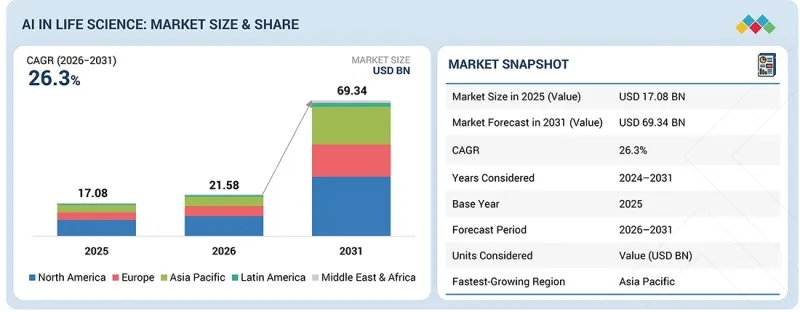
Based on region, the AI in life science market is segmented into North America, Europe, Asia Pacific, Latin America, and the Middle East & Africa. North America is the dominant region in the global AI in life science market owing to the presence of sophisticated research networks, high levels of digitalization, and considerable investment in innovations in biotechnology and pharma. The region leverages its strengths in terms of synergies between universities, hospitals, and tech companies, helping to implement AI-driven advancements more quickly. Moreover, a positive regulatory environment and rapid adoption of sophisticated analytics in drug discovery and clinical trials have helped to consolidate the region's position as a leader in this market. Europe is the second-largest market in the segment due to the growing interest of governments and companies in AI technology and AI products compliant with data privacy requirements.
Based on offerings, the AI in life science market is divided into end-to-end solutions, niche/point solutions, AI technology, and services. In 2025, end-to-end solutions had the largest market share due to increasing demand for integrated platforms that support data ingestion, model building, validation, and deployment across the entire life sciences value chain. These solutions make the life sciences workflow more efficient and cohesive, from target identification to clinical and commercial levels. Companies in the industry now tend to prefer full-stack AI platforms over stand-alone software for their ability to scale, comply with regulations, and enable collaboration across functions. This shift reflects a broader market trend moving from experimental AI applications toward enterprise-level implementation that requires consistent, repeatable, and auditable processes for research and development and clinical trials. For example, in October 2025, the Italian organization expert.ai launched AI-powered solutions to optimize clinical trial design and regulatory and research workflows. Additionally, in June 2025, ArisGlobal (US) implemented its LifeSphere NavaX AI platform at a leading pharmaceutical company globally, enabling automated analysis of roughly 350,000 safety cases annually.
Based on application, the AI in life science market is divided into clinical applications and non-clinical applications. The clinical applications segment is expected to see the fastest growth in this market. This is attributed to the rise in the use of AI to improve patient experiences, conduct clinical trials more effectively, and adopt precision medicine through real-time data analysis. AI-powered software is helping to improve patient enrollment, trial management, and protocol optimization, thereby reducing trial periods and improving success rates. In addition, the transition toward patient-focused, decentralized clinical trials is driving the adoption of AI-powered software. This trend was reflected in the following development. By March 2026, IQVIA had deployed over 150 AI agents, which were used by 19 of the top 20 pharmaceutical firms. In June 2025, IQVIA Holdings Inc. (US) released AI agents to streamline clinical operations.
TABLE OF CONTENTS
1 INTRODUCTION
- 1.1 STUDY OBJECTIVES
- 1.2 MARKET DEFINITION
- 1.3 STUDY SCOPE
- 1.3.1 MARKET SEGMENTATION AND REGIONAL SCOPE
- 1.3.2 INCLUSIONS AND EXCLUSIONS
- 1.3.3 YEARS CONSIDERED
- 1.4 CURRENCY CONSIDERED
- 1.5 STAKEHOLDERS
2 EXECUTIVE SUMMARY
- 2.1 KEY INSIGHTS AND MARKET HIGHLIGHTS
- 2.2 KEY MARKET PARTICIPANTS: SHARE INSIGHTS AND STRATEGIC DEVELOPMENTS
- 2.3 DISRUPTIVE TRENDS SHAPING THE MARKET
- 2.4 HIGH-GROWTH SEGMENTS & EMERGING FRONTIERS
- 2.5 SNAPSHOT: GLOBAL MARKET SIZE, GROWTH RATE, AND FORECAST
3 PREMIUM INSIGHTS
- 3.1 AI IN LIFE SCIENCE MARKET OVERVIEW
- 3.2 AI IN LIFE SCIENCE MARKET, BY APPLICATION & REGION
- 3.3 AI IN LIFE SCIENCE MARKET: REGIONAL SNAPSHOT
4 MARKET OVERVIEW
- 4.1 INTRODUCTION
- 4.2 MARKET DYNAMICS
- 4.2.1 DRIVERS
- 4.2.1.1 Surging demand for accelerated drug discovery and R&D pipeline optimization
- 4.2.1.2 Growing cross-industry partnerships
- 4.2.1.3 Expanding applications of AI in clinical trial design, patient recruitment, and operational efficiency
- 4.2.1.4 Growing availability of large-scale biomedical datasets and advances in computing infrastructure
- 4.2.1.5 Supportive government policies, funding initiatives, and regulatory frameworks
- 4.2.2 RESTRAINTS
- 4.2.2.1 Data privacy and cybersecurity concerns
- 4.2.2.2 Algorithmic bias and clinician trust deficits
- 4.2.2.3 High implementation costs, technical complexity, and integration challenges with legacy IT systems
- 4.2.3 OPPORTUNITIES
- 4.2.3.1 Generative AI and foundation models for de novo drug design
- 4.2.3.2 Rising focus on rare disease treatments
- 4.2.3.3 Growing demand for precision and personalized medicine
- 4.2.3.4 AI integration in academic research institutes and government-backed biomedical innovation programs
- 4.2.4 CHALLENGES
- 4.2.4.1 Low data fragmentation, interoperability deficits
- 4.2.4.2 Talent scarcity and organizational readiness
- 4.2.1 DRIVERS
- 4.3 UNMET NEEDS AND WHITE SPACES
- 4.4 INTERCONNECTED MARKETS AND CROSS-SECTOR OPPORTUNITIES
- 4.5 STRATEGIC MOVES BY TIER-1/2/3 PLAYERS
5 INDUSTRY TRENDS
- 5.1 PORTER'S FIVE FORCES ANALYSIS
- 5.1.1 BARGAINING POWER OF SUPPLIERS
- 5.1.2 BARGAINING POWER OF BUYERS
- 5.1.3 THREAT OF SUBSTITUTES
- 5.1.4 THREAT OF NEW ENTRANTS
- 5.1.5 INTENSITY OF COMPETITIVE RIVALRY
- 5.2 MACROECONOMIC INDICATORS
- 5.2.1 INTRODUCTION
- 5.2.2 GDP TRENDS AND FORECAST
- 5.2.3 TRENDS IN GLOBAL HEALTHCARE IT INDUSTRY
- 5.3 VALUE CHAIN ANALYSIS
- 5.4 ECOSYSTEM ANALYSIS
- 5.5 PRICING ANALYSIS
- 5.5.1 INDICATIVE PRICE FOR AI IN LIFE SCIENCE MARKET (2025)
- 5.5.2 INDICATIVE PRICE FOR AI IN LIFE SCIENCE MARKET, BY REGION (2025)
- 5.6 KEY CONFERENCES AND EVENTS, 2026-2027
- 5.7 TRENDS/DISRUPTIONS IMPACTING CUSTOMER BUSINESS
- 5.8 INVESTMENT AND FUNDING SCENARIO
- 5.9 CASE STUDY ANALYSIS
- 5.10 IMPACT OF 2025 US TARIFF - AI IN LIFE SCIENCE MARKET
- 5.10.1 INTRODUCTION
- 5.10.2 KEY TARIFF RATES
- 5.10.3 PRICE IMPACT ANALYSIS
- 5.10.4 IMPACT ON COUNTRY/REGION
- 5.10.4.1 US
- 5.10.4.2 Europe
- 5.10.4.3 Asia Pacific
- 5.10.5 IMPACT ON END USERS
- 5.10.5.1 CRO & CDMO
- 5.10.5.2 Pharmaceutical & biotechnology companies
- 5.10.5.3 Research centers & academic institutes
- 5.10.5.4 Diagnostic companies
6 REGULATORY LANDSCAPE
- 6.1 REGIONAL REGULATIONS AND COMPLIANCE
- 6.1.1 REGULATORY BODIES, GOVERNMENT AGENCIES, AND OTHER ORGANIZATIONS
- 6.1.2 NORTH AMERICA
- 6.1.3 EUROPE
- 6.1.4 ASIA PACIFIC
- 6.1.5 MIDDLE EAST & AFRICA
- 6.1.6 LATIN AMERICA
- 6.1.7 INDUSTRY STANDARDS
7 STRATEGIC DISRUPTION THROUGH TECHNOLOGY, PATENTS, DIGITAL, AND AI ADOPTION
- 7.1 KEY EMERGING TECHNOLOGIES
- 7.1.1 GRAPH NEURAL NETWORKS
- 7.1.2 COMPUTER VISION
- 7.1.3 PREDICTIVE ANALYTICS
- 7.2 COMPLEMENTARY TECHNOLOGIES
- 7.2.1 NEXT-GENERATION SEQUENCING
- 7.2.2 REAL-WORLD EVIDENCE/REAL-WORLD DATA
- 7.2.3 PERSONALIZATION ENGINES
- 7.3 ADJACENT TECHNOLOGIES
- 7.3.1 CLOUD COMPUTING
- 7.3.2 BLOCKCHAIN
- 7.3.3 BIG DATA & ADVANCED ANALYTICS
- 7.4 TECHNOLOGY/PRODUCT ROADMAP
- 7.5 PATENT ANALYSIS
- 7.5.1 INSIGHTS: JURISDICTION AND TOP APPLICANT ANALYSIS
- 7.6 FUTURE APPLICATIONS
- 7.6.1 AI-DRIVEN DRUG DISCOVERY
- 7.6.2 GENOMIC ANALYSIS
- 7.6.3 PRECISION MEDICINE
- 7.6.4 VIRTUAL DRUG SCREENING
8 CUSTOMER LANDSCAPE & BUYER BEHAVIOR
- 8.1 INTRODUCTION
- 8.2 DECISION-MAKING PROCESS
- 8.3 BUYER STAKEHOLDERS AND BUYING EVALUATION CRITERIA
- 8.3.1 KEY STAKEHOLDERS IN BUYING PROCESS
- 8.3.2 BUYING CRITERIA
- 8.4 ADOPTION BARRIERS & INTERNAL CHALLENGES
- 8.5 UNMET NEEDS FROM VARIOUS END-USE INDUSTRIES
- 8.5.1 UNMET NEEDS
- 8.5.2 END USER EXPECTATIONS
- 8.6 MARKET PROFITABILITY
9 AI IN LIFE SCIENCE MARKET, BY TOOL
- 9.1 INTRODUCTION
- 9.2 MACHINE LEARNING
- 9.2.1 DEEP LEARNING
- 9.2.1.1 Convolutional neural networks
- 9.2.1.1.1 High-sensitivity medical imaging AI across oncology and radiology pathways - key driver
- 9.2.1.2 Recurrent neural networks
- 9.2.1.2.1 Sequential biological data processing drives adoption in clinical and genomic applications
- 9.2.1.3 Generative adversarial networks
- 9.2.1.3.1 Synthetic data generation to overcome life science data scarcity barriers boosts adoption
- 9.2.1.4 Graph neural networks
- 9.2.1.4.1 Graph AI architectures modeling molecular interactions to advance target and pathway discovery
- 9.2.1.5 Others
- 9.2.1.5.1 Transformer and diffusion architectures expanding deep learning frontiers in life sciences
- 9.2.1.1 Convolutional neural networks
- 9.2.2 SUPERVISED LEARNING
- 9.2.2.1 Segment driven by accurate prediction of compound potency and selectivity across diverse chemical series
- 9.2.3 REINFORCEMENT LEARNING
- 9.2.3.1 Optimized drug dosing, trial design, and autonomous laboratory systems to drive segment
- 9.2.4 UNSUPERVISED LEARNING
- 9.2.4.1 Unsupervised AI revealing hidden biological patterns within high-dimensional omics datasets
- 9.2.5 OTHER MACHINE LEARNING TECHNOLOGIES
- 9.2.5.1 Semi-supervised and federated learning overcome data scarcity and privacy constraints
- 9.2.1 DEEP LEARNING
- 9.3 NATURAL LANGUAGE PROCESSING
- 9.3.1 BIOMEDICAL LLMS AND CLINICAL NLP AUTOMATING KNOWLEDGE EXTRACTION FROM UNSTRUCTURED HEALTH DATA
- 9.4 CONTEXT-AWARE PROCESSING AND COMPUTING
- 9.4.1 SEGMENT DRIVEN BY DYNAMIC, PATIENT-SPECIFIC INSIGHTS ACROSS CLINICAL WORKFLOWS
- 9.5 COMPUTER VISION
- 9.5.1 TRANSFORMATION OF PATHOLOGY, DERMATOLOGY, AND DRUG MANUFACTURING INSPECTION PROCESSES - KEY DRIVERS
- 9.6 IMAGE ANALYSIS
- 9.6.1 ACCELERATED DIGITAL PATHOLOGY, LAB IMAGING, AND DOCUMENT PROCESSING TO BOOST ADOPTION
- 9.7 OTHER TOOLS
10 AI IN LIFE SCIENCE MARKET, BY APPLICATION
- 10.1 INTRODUCTION
- 10.2 CLINICAL APPLICATIONS
- 10.2.1 REDUCED DEVELOPMENT TIMELINES AND IMPROVED CLINICAL SUCCESS TO DRIVE SEGMENT
- 10.2.2 DRUG DISCOVERY
- 10.2.2.1 AI-driven target identification transforming biopharma R&D productivity and success rates
- 10.2.3 MEDICAL IMAGING & DIAGNOSTICS
- 10.2.3.1 Accelerating FDA clearances and radiology digitization drives clinical AI imaging adoption
- 10.2.4 CLINICAL TRIALS
- 10.2.4.1 AI-powered trial optimization and decentralized models accelerating patient-centric research
- 10.2.5 PRECISION MEDICINE
- 10.2.5.1 Multi-Omics AI integration enabling individualized therapy selection at population scale
- 10.2.6 OTHER CLINICAL APPLICATIONS
- 10.2.6.1 AI-augmented clinical decision support expanding into pharmacovigilance and rare disease
- 10.3 NON-CLINICAL APPLICATIONS
- 10.3.1 R&D SUPPORT
- 10.3.1.1 AI-enabled literature mining and lab automation multiplying R&D throughput significantly
- 10.3.2 DATA ANALYTICS & REPORTING
- 10.3.2.1 Real-world evidence and AI analytics transforming strategic decision-making across organizations
- 10.3.3 MANUFACTURING & QUALITY ASSURANCE
- 10.3.3.1 Predictive quality AI and continuous manufacturing reduce batch failures and compliance risk
- 10.3.4 REGULATORY AFFAIRS
- 10.3.4.1 FDA and EMA AI guidance catalyzing regulatory submission automation and pharmacovigilance efficiency
- 10.3.1 R&D SUPPORT
11 AI IN LIFE SCIENCE MARKET, BY COMPONENT
- 11.1 INTRODUCTION
- 11.2 SOFTWARE
- 11.2.1 AI SOFTWARE PLATFORMS BECOMING CORE INFRASTRUCTURE FOR LIFE SCIENCE DIGITAL TRANSFORMATION
- 11.3 SERVICE
- 11.3.1 SPECIALIZED AI SERVICES BRIDGING VALIDATION AND COMPLIANCE GAPS ACROSS LIFE SCIENCE ENTERPRISES
12 AI IN LIFE SCIENCE MARKET, BY DEPLOYMENT
- 12.1 INTRODUCTION
- 12.2 CLOUD-BASED SOLUTIONS
- 12.2.1 HYPERSCALE CLOUD INFRASTRUCTURE ACCELERATES LIFE SCIENCE AI SCALABILITY AND COLLABORATIVE RESEARCH
- 12.3 ON-PREMISE SOLUTIONS
- 12.3.1 DATA SOVEREIGNTY AND GXP COMPLIANCE SUSTAIN ON-PREMISE AI DEPLOYMENT ACROSS REGULATED ENVIRONMENTS
- 12.4 HYBRID SOLUTIONS
- 12.4.1 HYBRID ARCHITECTURES BALANCE REGULATORY COMPLIANCE, DATA SECURITY, AND AI SCALABILITY DEMANDS
13 AI IN LIFE SCIENCE MARKET, BY END USER
- 13.1 INTRODUCTION
- 13.2 CRO & CDMO
- 13.2.1 AI-POWERED CROS & CDMOS COMPETE ON SPEED, QUALITY, AND DATA INTELLIGENCE DIFFERENTIATION
- 13.3 PHARMACEUTICAL COMPANIES
- 13.3.1 AI EMBEDDED ACROSS DISCOVERY, TRIALS, AND COMMERCIAL OPERATIONS BROADLY BY PHARMA LEADERS
- 13.4 BIOTECHNOLOGY COMPANIES
- 13.4.1 AI-NATIVE BIOTECH MODELS COMPRESSING DRUG DISCOVERY TIMELINES FROM YEARS TO MONTHS
- 13.5 DIAGNOSTIC COMPANIES
- 13.5.1 AI-AUGMENTED DIAGNOSTICS ELEVATE SENSITIVITY AND THROUGHPUT ACROSS MOLECULAR AND IMAGING PLATFORMS
- 13.6 ACADEMIC & GOVERNMENT LABORATORIES
- 13.6.1 PUBLIC AI RESEARCH PROGRAMS AND OPEN SCIENCE INITIATIVES BUILD FOUNDATIONAL LIFE SCIENCE INFRASTRUCTURE
- 13.7 OTHER END USERS
14 AI IN LIFE SCIENCE MARKET, BY OFFERING
- 14.1 INTRODUCTION
- 14.2 END-TO-END SOLUTION
- 14.2.1 INTEGRATED AI PLATFORMS COMPRESSING DRUG DEVELOPMENT TIMELINES ACROSS ENTIRE VALUE CHAINS
- 14.3 NICHE/POINT SOLUTIONS
- 14.3.1 DISEASE-SPECIFIC AI TOOLS DELIVER MEASURABLE OUTCOMES IN TARGETED RESEARCH WORKFLOWS
- 14.4 AI TECHNOLOGY
- 14.4.1 FOUNDATION MODELS AND GENERATIVE AI REDEFINE CORE SCIENTIFIC DISCOVERY CAPABILITIES
- 14.5 SERVICES
- 14.5.1 PROFESSIONAL AI SERVICES ENABLE COMPLIANT DEPLOYMENT ACROSS REGULATED LIFE SCIENCE ENVIRONMENTS
15 AI IN LIFE SCIENCE MARKET, BY REGION
- 15.1 INTRODUCTION
- 15.2 NORTH AMERICA
- 15.2.1 MACROECONOMIC OUTLOOK FOR NORTH AMERICA
- 15.2.2 US
- 15.2.2.1 Record FDA approvals and federal funding propel AI medical device commercialization
- 15.2.3 CANADA
- 15.2.3.1 Federal AI investment and sovereign compute strategy catalyze life sciences innovation
- 15.3 EUROPE
- 15.3.1 MACROECONOMIC OUTLOOK FOR EUROPE
- 15.3.2 GERMANY
- 15.3.2.1 Prescription digital health app framework propels market
- 15.3.3 FRANCE
- 15.3.3.1 National AI-health data strategy and health data hub anchor data-driven life sciences
- 15.3.4 UK
- 15.3.4.1 NHS Ten-Year Plan positions AI as core infrastructure for national care transformation
- 15.3.5 ITALY
- 15.3.5.1 National recovery plan digitization funding opens new hospital AI adoption pathways
- 15.3.6 SPAIN
- 15.3.6.1 National AI strategy and SNS digitization align life sciences sector with EU AI ambitions
- 15.3.7 REST OF EUROPE
- 15.4 ASIA PACIFIC
- 15.4.1 MACROECONOMIC OUTLOOK FOR ASIA PACIFIC
- 15.4.2 CHINA
- 15.4.2.1 NMPA high-end device policy and AI standardization body streamline AI commercialization
- 15.4.3 JAPAN
- 15.4.3.1 PMDA adaptive AI framework and medical DX reforms accelerate SaMD commercialization
- 15.4.4 INDIA
- 15.4.4.1 IndiaAI mission and national health data infrastructure enable population-scale AI deployment
- 15.4.5 AUSTRALIA
- 15.4.5.1 My Health Record ecosystem and TGA SaMD pathways underpin AI-ready digital infrastructure
- 15.4.6 SOUTH KOREA
- 15.4.6.1 K-Medtech ecosystem and MFDS AI regulatory guidance propel smart hospital AI adoption
- 15.4.7 REST OF ASIA PACIFIC
- 15.5 LATIN AMERICA
- 15.5.1 MACROECONOMIC OUTLOOK FOR LATIN AMERICA
- 15.5.2 BRAZIL
- 15.5.2.1 RNDS National Health Network provides digital backbone for AI healthcare integration
- 15.5.3 MEXICO
- 15.5.3.1 IMSS digital transformation and National AI Strategy drive AI integration into public healthcare
- 15.5.4 REST OF LATIN AMERICA
- 15.6 MIDDLE EAST & AFRICA
- 15.6.1 MACROECONOMIC OUTLOOK FOR MIDDLE EAST & AFRICA
- 15.6.2 GCC
- 15.6.3 SAUDI ARABIA
- 15.6.3.1 Vision 2030 health sector transformation program drives AI-enabled care delivery at scale
- 15.6.4 UAE
- 15.6.4.1 Malaffi, NABIDH interoperability and Emirati Genome Programme establish AI-ready data foundation
- 15.6.5 REST OF GCC
- 15.6.5.1 Rising demand for telehealth & virtual care to propel market
- 15.6.6 SOUTH AFRICA
- 15.6.6.1 National health insurance framework and digital health programs catalyze AI market entry
- 15.6.7 REST OF MIDDLE EAST & AFRICA
16 COMPETITIVE LANDSCAPE
- 16.1 OVERVIEW
- 16.2 KEY PLAYER STRATEGIES/RIGHT TO WIN
- 16.2.1 OVERVIEW OF STRATEGIES ADOPTED BY KEY PLAYERS IN AI IN LIFE SCIENCE MARKET
- 16.3 REVENUE ANALYSIS
- 16.4 MARKET SHARE ANALYSIS, 2025
- 16.5 COMPANY EVALUATION MATRIX: KEY PLAYERS, 2025
- 16.5.1 STARS
- 16.5.2 EMERGING LEADERS
- 16.5.3 PERVASIVE PLAYERS
- 16.5.4 PARTICIPANTS
- 16.5.5 COMPANY FOOTPRINT: KEY PLAYERS, 2025
- 16.5.5.1 Company footprint
- 16.5.5.2 Region footprint
- 16.5.5.3 Offering footprint
- 16.5.5.4 Application footprint
- 16.5.5.5 End user footprint
- 16.5.5.6 Tools footprint
- 16.6 COMPANY EVALUATION MATRIX: STARTUPS/SMES, 2025
- 16.6.1 PROGRESSIVE COMPANIES
- 16.6.2 RESPONSIVE COMPANIES
- 16.6.3 DYNAMIC COMPANIES
- 16.6.4 STARTING BLOCKS
- 16.6.5 COMPETITIVE BENCHMARKING: STARTUPS/SMES, 2025
- 16.6.5.1 Detailed list of key startups/SMEs
- 16.6.5.2 Competitive benchmarking of startups/SMEs
- 16.7 VALUATION & FINANCIAL METRICS
- 16.7.1 FINANCIAL METRICS
- 16.7.2 COMPANY VALUATION
- 16.8 BRAND/SOFTWARE COMPARISON
- 16.9 COMPETITIVE SCENARIO
- 16.9.1 PRODUCT/SERVICE LAUNCHES & APPROVALS
- 16.9.2 DEALS
- 16.9.3 EXPANSIONS
17 COMPANY PROFILES
- 17.1 KEY PLAYERS
- 17.1.1 NVIDIA CORPORATION
- 17.1.1.1 Business overview
- 17.1.1.2 Products/Solutions offered
- 17.1.1.3 Recent developments
- 17.1.1.3.1 Product launches & enhancements
- 17.1.1.3.2 Deals
- 17.1.1.3.3 Other developments
- 17.1.1.4 MnM view
- 17.1.1.4.1 Key strengths
- 17.1.1.4.2 Strategic choices
- 17.1.1.4.3 Weaknesses and competitive threats
- 17.1.2 ILLUMINA, INC.
- 17.1.2.1 Business overview
- 17.1.2.2 Products/Solutions offered
- 17.1.2.3 Recent developments
- 17.1.2.3.1 Product launches & enhancements
- 17.1.2.3.2 Deals
- 17.1.2.4 MnM view
- 17.1.2.4.1 Key strengths
- 17.1.2.4.2 Strategic choices
- 17.1.2.4.3 Weaknesses and competitive threats
- 17.1.3 TEMPUS AI, INC.
- 17.1.3.1 Business overview
- 17.1.3.2 Products offered
- 17.1.3.3 Recent developments
- 17.1.3.3.1 Deals
- 17.1.3.3.2 Other developments
- 17.1.4 RECURSION
- 17.1.4.1 Business overview
- 17.1.4.2 Products/Solutions offered
- 17.1.4.3 Recent developments
- 17.1.4.3.1 Product launches & enhancements
- 17.1.4.3.2 Deals
- 17.1.4.3.3 Expansions
- 17.1.4.4 MnM view
- 17.1.4.4.1 Key strengths
- 17.1.4.4.2 Strategic choices
- 17.1.4.4.3 Weaknesses and competitive threats
- 17.1.5 DASSAULT SYSTEMES SE
- 17.1.5.1 Business overview
- 17.1.5.2 Products offered
- 17.1.5.3 Recent developments
- 17.1.5.3.1 Product launches & enhancements
- 17.1.5.3.2 Deals
- 17.1.5.3.3 Other developments
- 17.1.6 SCHRODINGER, INC.
- 17.1.6.1 Business overview
- 17.1.6.2 Products/Solutions offered
- 17.1.6.3 Recent developments
- 17.1.6.3.1 Deals
- 17.1.6.3.2 Other Developments
- 17.1.7 DATA4CURE, INC.
- 17.1.7.1 Business overview
- 17.1.7.2 Products offered
- 17.1.7.3 Recent developments
- 17.1.7.3.1 Product launches & enhancements
- 17.1.7.3.2 Other developments
- 17.1.8 MICROSOFT CORPORATION
- 17.1.8.1 Business overview
- 17.1.8.2 Products offered
- 17.1.8.3 Recent developments
- 17.1.8.3.1 Product launches & enhancements
- 17.1.8.3.2 Deals
- 17.1.8.3.3 Other developments
- 17.1.9 INSILICO MEDICINE
- 17.1.9.1 Business overview
- 17.1.9.2 Products/Services offered
- 17.1.9.3 Recent developments
- 17.1.9.3.1 Product launches & enhancements
- 17.1.9.3.2 Deals
- 17.1.9.3.3 Other developments
- 17.1.9.3.4 Expansions
- 17.1.10 EUROFINS DISCOVERY
- 17.1.10.1 Business overview
- 17.1.10.2 Products offered
- 17.1.10.3 Recent developments
- 17.1.10.3.1 Product launches & approvals
- 17.1.10.3.2 Deals
- 17.1.11 BENEVOLENTAI LIMITED
- 17.1.11.1 Business overview
- 17.1.11.2 Products offered
- 17.1.11.3 Recent developments
- 17.1.11.3.1 Deals
- 17.1.12 OWKIN
- 17.1.12.1 Business overview
- 17.1.12.2 Products offered
- 17.1.12.3 Recent developments
- 17.1.12.3.1 Product launches & approvals
- 17.1.12.3.2 Deals
- 17.1.12.3.3 Other developments
- 17.1.13 PATHAI
- 17.1.13.1 Business overview
- 17.1.13.2 Products offered
- 17.1.13.3 Recent developments
- 17.1.13.3.1 Product launches & approvals
- 17.1.13.3.2 Deals
- 17.1.14 AIDOC MEDICAL LTD.
- 17.1.14.1 Business overview
- 17.1.14.2 Products offered
- 17.1.14.3 Recent developments
- 17.1.14.3.1 Product launches & approvals
- 17.1.14.3.2 Other developments
- 17.1.15 QURE.AI
- 17.1.15.1 Business overview
- 17.1.15.2 Products offered
- 17.1.15.3 Recent developments
- 17.1.15.3.1 Product launches & approvals
- 17.1.16 DEEP GENOMICS
- 17.1.16.1 Business overview
- 17.1.16.2 Products offered
- 17.1.16.3 Recent developments
- 17.1.16.3.1 Expansions
- 17.1.17 SOPHIA GENETICS SA
- 17.1.17.1 Business overview
- 17.1.17.2 Products offered
- 17.1.17.3 Recent developments
- 17.1.17.3.1 Product launches & enhancements
- 17.1.17.3.2 Deals
- 17.1.18 UNLEARN.AI
- 17.1.18.1 Business overview
- 17.1.18.2 Products offered
- 17.1.18.3 Recent developments
- 17.1.18.3.1 Deals
- 17.1.19 VERGE GENOMICS
- 17.1.19.1 Business overview
- 17.1.19.2 Products offered
- 17.1.19.3 Recent developments
- 17.1.19.3.1 Deals
- 17.1.1 NVIDIA CORPORATION
- 17.2 OTHER PLAYERS
- 17.2.1 SYNTHIO LABS LTD
- 17.2.2 BIOPTIMUS
- 17.2.3 KARYON BIO
- 17.2.4 COUNTERFORCE HEALTH
- 17.2.5 PROMISE BIO
18 RESEARCH METHODOLOGY
- 18.1 RESEARCH APPROACH
- 18.1.1 SECONDARY RESEARCH
- 18.1.1.1 Key data from secondary sources
- 18.1.2 PRIMARY RESEARCH
- 18.1.2.1 Primary sources
- 18.1.2.2 Key data from primary sources
- 18.1.2.3 Breakdown of primary interviews
- 18.1.2.4 Insights from primary experts
- 18.1.1 SECONDARY RESEARCH
- 18.2 RESEARCH METHODOLOGY DESIGN
- 18.3 MARKET SIZE ESTIMATION
- 18.4 DATA TRIANGULATION
- 18.5 RESEARCH ASSUMPTIONS
- 18.6 RESEARCH LIMITATIONS
- 18.6.1 METHODOLOGY-RELATED
- 18.6.2 SCOPE-RELATED
- 18.7 RISK ASSESSMENT
19 APPENDIX
- 19.1 DISCUSSION GUIDE
- 19.2 KNOWLEDGESTORE: MARKETSANDMARKETS' SUBSCRIPTION PORTAL
- 19.3 CUSTOMIZATION OPTIONS
- 19.4 RELATED REPORTS:
- 19.5 AUTHOR DETAILS
List of Tables
- TABLE 1 EXCHANGE RATES UTILIZED FOR CONVERSION TO USD
- TABLE 2 AI IN LIFE SCIENCE MARKET: PORTER'S FIVE FORCES ANALYSIS
- TABLE 3 AI IN LIFE SCIENCE MARKET: ROLE IN ECOSYSTEM
- TABLE 4 CASE 1: GENERATIVE AI ACCELERATES DRUG DISCOVERY, CLINICAL RESEARCH, AND OPERATIONAL EFFICIENCY IN LIFE SCIENCES
- TABLE 5 CASE 2: JOHNSON & JOHNSON EXPANDS AI INTEGRATION ACROSS DRUG DISCOVERY, SURGICAL INNOVATION, AND HEALTHCARE OPERATIONS
- TABLE 6 CASE 3: AI-DRIVEN DRUG DISCOVERY AND CLINICAL OPTIMIZATION ACCELERATE INNOVATION IN LIFE SCIENCES
- TABLE 7 US ADJUSTED RECIPROCAL TARIFF RATES
- TABLE 8 NORTH AMERICA: REGULATORY BODIES, GOVERNMENT AGENCIES, AND OTHER ORGANIZATIONS
- TABLE 9 EUROPE: REGULATORY BODIES, GOVERNMENT AGENCIES, AND OTHER ORGANIZATIONS
- TABLE 10 ASIA PACIFIC: REGULATORY BODIES, GOVERNMENT AGENCIES, AND OTHER ORGANIZATIONS
- TABLE 11 LATIN AMERICA: REGULATORY BODIES, GOVERNMENT AGENCIES, AND OTHER ORGANIZATIONS
- TABLE 12 MIDDLE EAST & AFRICA: REGULATORY BODIES, GOVERNMENT AGENCIES, AND OTHER ORGANIZATIONS
- TABLE 13 JURISDICTION ANALYSIS OF TOP APPLICANT COUNTRIES FOR AI IN LIFE SCIENCE MARKET
- TABLE 14 AI IN LIFE SCIENCE MARKET: KEY PATENTS/PATENT APPLICATIONS
- TABLE 15 INFLUENCE OF STAKEHOLDERS ON BUYING PROCESS OF TOP THREE END USERS (%)
- TABLE 16 KEY BUYING CRITERIA FOR TOP THREE END USERS
- TABLE 17 UNMET NEEDS IN AI IN LIFE SCIENCE MARKET
- TABLE 18 END USER EXPECTATIONS IN AI IN LIFE SCIENCE MARKET
- TABLE 19 AI IN LIFE SCIENCE MARKET, BY TOOL, 2024-2031 (USD MILLION)
- TABLE 20 AI IN LIFE SCIENCE MARKET FOR MACHINE LEARNING, BY TYPE, 2024-2031 (USD MILLION)
- TABLE 21 AI IN LIFE SCIENCE MARKET FOR MACHINE LEARNING, BY REGION, 2024-2031 (USD MILLION)
- TABLE 22 AI IN LIFE SCIENCE MARKET FOR DEEP LEARNING, BY TYPE, 2024-2031 (USD MILLION)
- TABLE 23 AI IN LIFE SCIENCE MARKET FOR DEEP LEARNING, BY REGION, 2024-2031 (USD MILLION)
- TABLE 24 AI IN LIFE SCIENCE MARKET FOR CONVOLUTIONAL NEURAL NETWORKS, BY REGION, 2024-2031 (USD MILLION)
- TABLE 25 AI IN LIFE SCIENCE MARKET FOR RECURRENT NEURAL NETWORKS, BY REGION, 2024-2031 (USD MILLION)
- TABLE 26 AI IN LIFE SCIENCE MARKET FOR GENERATIVE ADVERSARIAL NETWORKS, BY REGION, 2024-2031 (USD MILLION)
- TABLE 27 AI IN LIFE SCIENCE MARKET FOR GRAPH NEURAL NETWORKS, BY REGION, 2024-2031 (USD MILLION)
- TABLE 28 AI IN LIFE SCIENCE MARKET FOR OTHER DEEP LEARNING TOOLS, BY REGION, 2024-2031 (USD MILLION)
- TABLE 29 AI IN LIFE SCIENCE MARKET FOR SUPERVISED LEARNING, BY REGION, 2024-2031 (USD MILLION)
- TABLE 30 AI IN LIFE SCIENCE MARKET FOR REINFORCEMENT LEARNING, BY REGION, 2024-2031 (USD MILLION)
- TABLE 31 AI IN LIFE SCIENCE MARKET FOR UNSUPERVISED LEARNING, BY REGION, 2024-2031 (USD MILLION)
- TABLE 32 AI IN LIFE SCIENCE MARKET FOR OTHER MACHINE LEARNING TECHNOLOGIES, BY REGION, 2024-2031 (USD MILLION)
- TABLE 33 AI IN LIFE SCIENCE MARKET FOR NATURAL LANGUAGE PROCESSING, BY REGION, 2024-2031 (USD MILLION)
- TABLE 34 AI IN LIFE SCIENCE MARKET FOR CONTEXT-AWARE PROCESSING AND COMPUTING, BY REGION, 2024-2031 (USD MILLION)
- TABLE 35 AI IN LIFE SCIENCE MARKET FOR COMPUTER VISION, BY REGION, 2024-2031 (USD MILLION)
- TABLE 36 AI IN LIFE SCIENCE MARKET FOR IMAGE ANALYSIS, BY REGION, 2024-2031 (USD MILLION)
- TABLE 37 AI IN LIFE SCIENCE MARKET FOR OTHER TOOLS, BY REGION, 2024-2031 (USD MILLION)
- TABLE 38 AI IN LIFE SCIENCE MARKET, BY APPLICATION, 2024-2031 (USD MILLION)
- TABLE 39 AI IN LIFE SCIENCE MARKET FOR CLINICAL APPLICATIONS, BY TYPE, 2024-2031 (USD MILLION)
- TABLE 40 AI IN LIFE SCIENCE MARKET FOR CLINICAL APPLICATIONS, BY REGION, 2024-2031 (USD MILLION)
- TABLE 41 AI IN LIFE SCIENCE MARKET FOR DRUG DISCOVERY, BY REGION, 2024-2031 (USD MILLION)
- TABLE 42 AI IN LIFE SCIENCE MARKET FOR MEDICAL IMAGING AND DIAGNOSTICS, BY REGION, 2024-2031 (USD MILLION)
- TABLE 43 AI IN LIFE SCIENCE MARKET FOR CLINICAL TRIALS, BY REGION, 2024-2031 (USD MILLION)
- TABLE 44 AI IN LIFE SCIENCE MARKET FOR PRECISION MEDICINE, BY REGION, 2024-2031 (USD MILLION)
- TABLE 45 AI IN LIFE SCIENCE MARKET FOR OTHER CLINICAL APPLICATIONS, BY REGION, 2024-2031 (USD MILLION)
- TABLE 46 AI IN LIFE SCIENCE MARKET FOR NON-CLINICAL APPLICATIONS, BY TYPE, 2024-2031 (USD MILLION)
- TABLE 47 AI IN LIFE SCIENCE MARKET FOR NON-CLINICAL APPLICATIONS, BY REGION, 2024-2031 (USD MILLION)
- TABLE 48 AI IN LIFE SCIENCE MARKET FOR R&D SUPPORT, BY REGION, 2024-2031 (USD MILLION)
- TABLE 49 AI IN LIFE SCIENCE MARKET FOR DATA ANALYTICS AND REPORTING, BY REGION, 2024-2031 (USD MILLION)
- TABLE 50 AI IN LIFE SCIENCE MARKET FOR MANUFACTURING & QUALITY ASSURANCE, BY REGION, 2024-2031 (USD MILLION)
- TABLE 51 AI IN LIFE SCIENCE MARKET FOR REGULATORY AFFAIRS, BY REGION, 2024-2031 (USD MILLION)
- TABLE 52 AI IN LIFE SCIENCE MARKET, BY COMPONENT, 2024-2031 (USD MILLION)
- TABLE 53 AI IN LIFE SCIENCE MARKET FOR SOFTWARE, BY REGION, 2024-2031 (USD MILLION)
- TABLE 54 AI IN LIFE SCIENCE MARKET FOR SERVICE, BY REGION, 2024-2031 (USD MILLION)
- TABLE 55 AI IN LIFE SCIENCE MARKET, BY DEPLOYMENT, 2024-2031 (USD MILLION)
- TABLE 56 AI IN LIFE SCIENCE MARKET FOR CLOUD-BASED SOLUTIONS, BY REGION, 2024-2031 (USD MILLION)
- TABLE 57 AI IN LIFE SCIENCE MARKET FOR ON-PREMISE SOLUTIONS, BY REGION, 2024-2031 (USD MILLION)
- TABLE 58 AI IN LIFE SCIENCE MARKET FOR HYBRID SOLUTIONS, BY REGION, 2024-2031 (USD MILLION)
- TABLE 59 AI IN LIFE SCIENCE MARKET, BY END USER, 2024-2031 (USD MILLION)
- TABLE 60 AI IN LIFE SCIENCE MARKET FOR CRO & CDMO, BY REGION, 2024-2031 (USD MILLION)
- TABLE 61 AI IN LIFE SCIENCE MARKET FOR PHARMACEUTICAL COMPANIES, BY REGION, 2024-2031 (USD MILLION)
- TABLE 62 AI IN LIFE SCIENCE MARKET FOR BIOTECHNOLOGY COMPANIES, BY REGION, 2024-2031 (USD MILLION)
- TABLE 63 AI IN LIFE SCIENCE MARKET FOR DIAGNOSTIC COMPANIES, BY REGION, 2024-2031 (USD MILLION)
- TABLE 64 AI IN LIFE SCIENCE MARKET FOR ACADEMIC AND GOVERNMENT LABORATORIES, BY REGION, 2024-2031 (USD MILLION)
- TABLE 65 AI IN LIFE SCIENCE MARKET FOR OTHER END USERS, BY REGION, 2024-2031 (USD MILLION)
- TABLE 66 AI IN LIFE SCIENCE MARKET, BY OFFERING, 2024-2031 (USD MILLION)
- TABLE 67 AI IN LIFE SCIENCE MARKET FOR END-TO-END SOLUTIONS, BY REGION, 2024-2031 (USD MILLION)
- TABLE 68 AI IN LIFE SCIENCE MARKET FOR NICHE/POINT SOLUTIONS, BY REGION, 2024-2031 (USD MILLION)
- TABLE 69 AI IN LIFE SCIENCE MARKET FOR AI TECHNOLOGY, BY REGION, 2024-2031 (USD MILLION)
- TABLE 70 AI IN LIFE SCIENCE MARKET FOR SERVICES, BY REGION, 2024-2031 (USD MILLION)
- TABLE 71 AI IN LIFE SCIENCE MARKET, BY REGION, 2024-2031 (USD MILLION)
- TABLE 72 NORTH AMERICA: AI IN LIFE SCIENCE MARKET, BY COUNTRY, 2024-2031 (USD MILLION)
- TABLE 73 NORTH AMERICA: AI IN LIFE SCIENCE MARKET, BY OFFERING, 2024-2031 (USD MILLION)
- TABLE 74 NORTH AMERICA: AI IN LIFE SCIENCE MARKET, BY APPLICATION, 2024-2031 (USD MILLION)
- TABLE 75 NORTH AMERICA: AI IN LIFE SCIENCE MARKET FOR CLINICAL APPLICATIONS, BY TYPE, 2024-2031 (USD MILLION)
- TABLE 76 NORTH AMERICA: AI IN LIFE SCIENCE MARKET FOR NON-CLINICAL APPLICATIONS, BY TYPE, 2024-2031 (USD MILLION)
- TABLE 77 NORTH AMERICA: AI IN LIFE SCIENCE MARKET, BY COMPONENT, 2024-2031 (USD MILLION)
- TABLE 78 NORTH AMERICA: AI IN LIFE SCIENCE MARKET, BY TOOL, 2024-2031 (USD MILLION)
- TABLE 79 NORTH AMERICA: AI IN LIFE SCIENCE MARKET FOR MACHINE LEARNING, BY TYPE, 2024-2031 (USD MILLION)
- TABLE 80 NORTH AMERICA: AI IN LIFE SCIENCE MARKET FOR DEEP LEARNING, BY TYPE, 2024-2031 (USD MILLION)
- TABLE 81 NORTH AMERICA: AI IN LIFE SCIENCE MARKET, BY DEPLOYMENT MODE, 2024-2031 (USD MILLION)
- TABLE 82 NORTH AMERICA: AI IN LIFE SCIENCE MARKET, BY END USER, 2024-2031 (USD MILLION)
- TABLE 83 US: AI IN LIFE SCIENCE MARKET, BY OFFERING, 2024-2031 (USD MILLION)
- TABLE 84 US: AI IN LIFE SCIENCE MARKET, BY APPLICATION, 2024-2031 (USD MILLION)
- TABLE 85 US: AI IN LIFE SCIENCE MARKET FOR CLINICAL APPLICATIONS, BY TYPE, 2024-2031 (USD MILLION)
- TABLE 86 US: AI IN LIFE SCIENCE MARKET FOR NON-CLINICAL APPLICATIONS, BY TYPE, 2024-2031 (USD MILLION)
- TABLE 87 US: AI IN LIFE SCIENCE MARKET, BY COMPONENT, 2024-2031 (USD MILLION)
- TABLE 88 US: AI IN LIFE SCIENCE MARKET, BY TOOL, 2024-2031 (USD MILLION)
- TABLE 89 US: AI IN LIFE SCIENCE MARKET FOR MACHINE LEARNING, BY TYPE, 2024-2031 (USD MILLION)
- TABLE 90 US: AI IN LIFE SCIENCE MARKET FOR DEEP LEARNING, BY TYPE, 2024-2031 (USD MILLION)
- TABLE 91 US: AI IN LIFE SCIENCE MARKET, BY DEPLOYMENT MODE, 2024-2031 (USD MILLION)
- TABLE 92 US: AI IN LIFE SCIENCE MARKET, BY END USER, 2024-2031 (USD MILLION)
- TABLE 93 CANADA: AI IN LIFE SCIENCE MARKET, BY OFFERING, 2024-2031 (USD MILLION)
- TABLE 94 CANADA: AI IN LIFE SCIENCE MARKET, BY APPLICATION, 2024-2031 (USD MILLION)
- TABLE 95 CANADA: AI IN LIFE SCIENCE MARKET FOR CLINICAL APPLICATIONS, BY TYPE, 2024-2031 (USD MILLION)
- TABLE 96 CANADA: AI IN LIFE SCIENCE MARKET FOR NON-CLINICAL APPLICATIONS, BY TYPE, 2024-2031 (USD MILLION)
- TABLE 97 CANADA: AI IN LIFE SCIENCE MARKET, BY COMPONENT, 2024-2031 (USD MILLION)
- TABLE 98 CANADA: AI IN LIFE SCIENCE MARKET, BY TOOL, 2024-2031 (USD MILLION)
- TABLE 99 CANADA: AI IN LIFE SCIENCE MARKET FOR MACHINE LEARNING, BY TYPE, 2024-2031 (USD MILLION)
- TABLE 100 CANADA: AI IN LIFE SCIENCE MARKET FOR DEEP LEARNING, BY TYPE, 2024-2031 (USD MILLION)
- TABLE 101 CANADA: AI IN LIFE SCIENCE MARKET, BY DEPLOYMENT MODE, 2024-2031 (USD MILLION)
- TABLE 102 CANADA: AI IN LIFE SCIENCE MARKET, BY END USER, 2024-2031 (USD MILLION)
- TABLE 103 EUROPE: AI IN LIFE SCIENCE MARKET, BY COUNTRY, 2024-2031 (USD MILLION)
- TABLE 104 EUROPE: AI IN LIFE SCIENCE MARKET, BY OFFERING, 2024-2031 (USD MILLION)
- TABLE 105 EUROPE: AI IN LIFE SCIENCE MARKET, BY APPLICATION, 2024-2031 (USD MILLION)
- TABLE 106 EUROPE: AI IN LIFE SCIENCE MARKET FOR CLINICAL APPLICATIONS, BY TYPE, 2024-2031 (USD MILLION)
- TABLE 107 EUROPE: AI IN LIFE SCIENCE MARKET FOR NON-CLINICAL APPLICATIONS, BY TYPE, 2024-2031 (USD MILLION)
- TABLE 108 EUROPE: AI IN LIFE SCIENCE MARKET, BY COMPONENT, 2024-2031 (USD MILLION)
- TABLE 109 EUROPE: AI IN LIFE SCIENCE MARKET, BY TOOL, 2024-2031 (USD MILLION)
- TABLE 110 EUROPE: AI IN LIFE SCIENCE MARKET FOR MACHINE LEARNING, BY TYPE, 2024-2031 (USD MILLION)
- TABLE 111 EUROPE: AI IN LIFE SCIENCE MARKET FOR DEEP LEARNING, BY TYPE, 2024-2031 (USD MILLION)
- TABLE 112 EUROPE: AI IN LIFE SCIENCE MARKET, BY DEPLOYMENT MODE, 2024-2031 (USD MILLION)
- TABLE 113 EUROPE: AI IN LIFE SCIENCE MARKET, BY END USER, 2024-2031 (USD MILLION)
- TABLE 114 GERMANY: AI IN LIFE SCIENCE MARKET, BY OFFERING, 2024-2031 (USD MILLION)
- TABLE 115 GERMANY: AI IN LIFE SCIENCE MARKET, BY APPLICATION, 2024-2031 (USD MILLION)
- TABLE 116 GERMANY: AI IN LIFE SCIENCE MARKET FOR CLINICAL APPLICATIONS, BY TYPE, 2024-2031 (USD MILLION)
- TABLE 117 GERMANY: AI IN LIFE SCIENCE MARKET FOR NON-CLINICAL APPLICATIONS, BY TYPE, 2024-2031 (USD MILLION)
- TABLE 118 GERMANY: AI IN LIFE SCIENCE MARKET, BY COMPONENT, 2024-2031 (USD MILLION)
- TABLE 119 GERMANY: AI IN LIFE SCIENCE MARKET, BY TOOL, 2024-2031 (USD MILLION)
- TABLE 120 GERMANY: AI IN LIFE SCIENCE MARKET FOR MACHINE LEARNING, BY TYPE, 2024-2031 (USD MILLION)
- TABLE 121 GERMANY: AI IN LIFE SCIENCE MARKET FOR DEEP LEARNING, BY TYPE, 2024-2031 (USD MILLION)
- TABLE 122 GERMANY: AI IN LIFE SCIENCE MARKET, BY DEPLOYMENT MODE, 2024-2031 (USD MILLION)
- TABLE 123 GERMANY: AI IN LIFE SCIENCE MARKET, BY END USER, 2024-2031 (USD MILLION)
- TABLE 124 FRANCE: AI IN LIFE SCIENCE MARKET, BY OFFERING, 2024-2031 (USD MILLION)
- TABLE 125 FRANCE: AI IN LIFE SCIENCE MARKET, BY APPLICATION, 2024-2031 (USD MILLION)
- TABLE 126 FRANCE: AI IN LIFE SCIENCE MARKET FOR CLINICAL APPLICATIONS, BY TYPE, 2024-2031 (USD MILLION)
- TABLE 127 FRANCE: AI IN LIFE SCIENCE MARKET FOR NON-CLINICAL APPLICATIONS, BY TYPE, 2024-2031 (USD MILLION)
- TABLE 128 FRANCE: AI IN LIFE SCIENCE MARKET, BY COMPONENT, 2024-2031 (USD MILLION)
- TABLE 129 FRANCE: AI IN LIFE SCIENCE MARKET, BY TOOL, 2024-2031 (USD MILLION)
- TABLE 130 FRANCE: AI IN LIFE SCIENCE MARKET FOR MACHINE LEARNING, BY TYPE, 2024-2031 (USD MILLION)
- TABLE 131 FRANCE: AI IN LIFE SCIENCE MARKET FOR DEEP LEARNING, BY TYPE, 2024-2031 (USD MILLION)
- TABLE 132 FRANCE: AI IN LIFE SCIENCE MARKET, BY DEPLOYMENT MODE, 2024-2031 (USD MILLION)
- TABLE 133 FRANCE: AI IN LIFE SCIENCE MARKET, BY END USER, 2024-2031 (USD MILLION)
- TABLE 134 UK: AI IN LIFE SCIENCE MARKET, BY OFFERING, 2024-2031 (USD MILLION)
- TABLE 135 UK: AI IN LIFE SCIENCE MARKET, BY APPLICATION, 2024-2031 (USD MILLION)
- TABLE 136 UK: AI IN LIFE SCIENCE MARKET FOR CLINICAL APPLICATIONS, BY TYPE, 2024-2031 (USD MILLION)
- TABLE 137 UK: AI IN LIFE SCIENCE MARKET FOR NON-CLINICAL APPLICATIONS, BY TYPE, 2024-2031 (USD MILLION)
- TABLE 138 UK: AI IN LIFE SCIENCE MARKET, BY COMPONENT, 2024-2031 (USD MILLION)
- TABLE 139 UK: AI IN LIFE SCIENCE MARKET, BY TOOL, 2024-2031 (USD MILLION)
- TABLE 140 UK: AI IN LIFE SCIENCE MARKET FOR MACHINE LEARNING, BY TYPE, 2024-2031 (USD MILLION)
- TABLE 141 UK: AI IN LIFE SCIENCE MARKET FOR DEEP LEARNING, BY TYPE, 2024-2031 (USD MILLION)
- TABLE 142 UK: AI IN LIFE SCIENCE MARKET, BY DEPLOYMENT MODE, 2024-2031 (USD MILLION)
- TABLE 143 UK: AI IN LIFE SCIENCE MARKET, BY END USER, 2024-2031 (USD MILLION)
- TABLE 144 ITALY: AI IN LIFE SCIENCE MARKET, BY OFFERING, 2024-2031 (USD MILLION)
- TABLE 145 ITALY: AI IN LIFE SCIENCE MARKET, BY APPLICATION, 2024-2031 (USD MILLION)
- TABLE 146 ITALY: AI IN LIFE SCIENCE MARKET FOR CLINICAL APPLICATIONS, BY TYPE, 2024-2031 (USD MILLION)
- TABLE 147 ITALY: AI IN LIFE SCIENCE MARKET FOR NON-CLINICAL APPLICATIONS, BY TYPE, 2024-2031 (USD MILLION)
- TABLE 148 ITALY: AI IN LIFE SCIENCE MARKET, BY COMPONENT, 2024-2031 (USD MILLION)
- TABLE 149 ITALY: AI IN LIFE SCIENCE MARKET, BY TOOL, 2024-2031 (USD MILLION)
- TABLE 150 ITALY: AI IN LIFE SCIENCE MARKET FOR MACHINE LEARNING, BY TYPE, 2024-2031 (USD MILLION)
- TABLE 151 ITALY: AI IN LIFE SCIENCE MARKET FOR DEEP LEARNING, BY TYPE, 2024-2031 (USD MILLION)
- TABLE 152 ITALY: AI IN LIFE SCIENCE MARKET, BY DEPLOYMENT MODE, 2024-2031 (USD MILLION)
- TABLE 153 ITALY: AI IN LIFE SCIENCE MARKET, BY END USER, 2024-2031 (USD MILLION)
- TABLE 154 SPAIN: AI IN LIFE SCIENCE MARKET, BY OFFERING, 2024-2031 (USD MILLION)
- TABLE 155 SPAIN: AI IN LIFE SCIENCE MARKET, BY APPLICATION, 2024-2031 (USD MILLION)
- TABLE 156 SPAIN: AI IN LIFE SCIENCE MARKET FOR CLINICAL APPLICATIONS, BY TYPE, 2024-2031 (USD MILLION)
- TABLE 157 SPAIN: AI IN LIFE SCIENCE MARKET FOR NON-CLINICAL APPLICATIONS, BY TYPE, 2024-2031 (USD MILLION)
- TABLE 158 SPAIN: AI IN LIFE SCIENCE MARKET, BY COMPONENT, 2024-2031 (USD MILLION)
- TABLE 159 SPAIN: AI IN LIFE SCIENCE MARKET, BY TOOL, 2024-2031 (USD MILLION)
- TABLE 160 SPAIN: AI IN LIFE SCIENCE MARKET FOR MACHINE LEARNING, BY TYPE, 2024-2031 (USD MILLION)
- TABLE 161 SPAIN: AI IN LIFE SCIENCE MARKET FOR DEEP LEARNING, BY TYPE, 2024-2031 (USD MILLION)
- TABLE 162 SPAIN: AI IN LIFE SCIENCE MARKET, BY DEPLOYMENT MODE, 2024-2031 (USD MILLION)
- TABLE 163 SPAIN: AI IN LIFE SCIENCE MARKET, BY END USER, 2024-2031 (USD MILLION)
- TABLE 164 REST OF EUROPE: AI IN LIFE SCIENCE MARKET, BY OFFERING, 2024-2031 (USD MILLION)
- TABLE 165 REST OF EUROPE: AI IN LIFE SCIENCE MARKET, BY APPLICATION, 2024-2031 (USD MILLION)
- TABLE 166 REST OF EUROPE: AI IN LIFE SCIENCE MARKET FOR CLINICAL APPLICATIONS, BY TYPE, 2024-2031 (USD MILLION)
- TABLE 167 REST OF EUROPE: AI IN LIFE SCIENCE MARKET FOR NON-CLINICAL APPLICATIONS, BY TYPE, 2024-2031 (USD MILLION)
- TABLE 168 REST OF EUROPE: AI IN LIFE SCIENCE MARKET, BY COMPONENT, 2024-2031 (USD MILLION)
- TABLE 169 REST OF EUROPE: AI IN LIFE SCIENCE MARKET, BY TOOL, 2024-2031 (USD MILLION)
- TABLE 170 REST OF EUROPE: AI IN LIFE SCIENCE MARKET FOR MACHINE LEARNING, BY TYPE, 2024-2031 (USD MILLION)
- TABLE 171 REST OF EUROPE: AI IN LIFE SCIENCE MARKET FOR DEEP LEARNING, BY TYPE, 2024-2031 (USD MILLION)
- TABLE 172 REST OF EUROPE: AI IN LIFE SCIENCE MARKET, BY DEPLOYMENT MODE, 2024-2031 (USD MILLION)
- TABLE 173 REST OF EUROPE: AI IN LIFE SCIENCE MARKET, BY END USER, 2024-2031 (USD MILLION)
- TABLE 174 ASIA PACIFIC: AI IN LIFE SCIENCE MARKET, BY COUNTRY, 2024-2031 (USD MILLION)
- TABLE 175 ASIA PACIFIC: AI IN LIFE SCIENCE MARKET, BY OFFERING, 2024-2031 (USD MILLION)
- TABLE 176 ASIA PACIFIC: AI IN LIFE SCIENCE MARKET, BY APPLICATION, 2024-2031 (USD MILLION)
- TABLE 177 ASIA PACIFIC: AI IN LIFE SCIENCE MARKET FOR CLINICAL APPLICATIONS, BY TYPE, 2024-2031 (USD MILLION)
- TABLE 178 ASIA PACIFIC: AI IN LIFE SCIENCE MARKET FOR NON-CLINICAL APPLICATIONS, BY TYPE, 2024-2031 (USD MILLION)
- TABLE 179 ASIA PACIFIC: AI IN LIFE SCIENCE MARKET, BY COMPONENT, 2024-2031 (USD MILLION)
- TABLE 180 ASIA PACIFIC: AI IN LIFE SCIENCE MARKET, BY TOOL, 2024-2031 (USD MILLION)
- TABLE 181 ASIA PACIFIC: AI IN LIFE SCIENCE MARKET FOR MACHINE LEARNING, BY TYPE, 2024-2031 (USD MILLION)
- TABLE 182 ASIA PACIFIC: AI IN LIFE SCIENCE MARKET FOR DEEP LEARNING, BY TYPE, 2024-2031 (USD MILLION)
- TABLE 183 ASIA PACIFIC: AI IN LIFE SCIENCE MARKET, BY DEPLOYMENT MODE, 2024-2031 (USD MILLION)
- TABLE 184 ASIA PACIFIC: AI IN LIFE SCIENCE MARKET, BY END USER, 2024-2031 (USD MILLION)
- TABLE 185 CHINA: AI IN LIFE SCIENCE MARKET, BY OFFERING, 2024-2031 (USD MILLION)
- TABLE 186 CHINA: AI IN LIFE SCIENCE MARKET, BY APPLICATION, 2024-2031 (USD MILLION)
- TABLE 187 CHINA: AI IN LIFE SCIENCE MARKET FOR CLINICAL APPLICATIONS, BY TYPE, 2024-2031 (USD MILLION)
- TABLE 188 CHINA: AI IN LIFE SCIENCE MARKET FOR NON-CLINICAL APPLICATIONS, BY TYPE, 2024-2031 (USD MILLION)
- TABLE 189 CHINA: AI IN LIFE SCIENCE MARKET, BY COMPONENT, 2024-2031 (USD MILLION)
- TABLE 190 CHINA: AI IN LIFE SCIENCE MARKET, BY TOOL, 2024-2031 (USD MILLION)
- TABLE 191 CHINA: AI IN LIFE SCIENCE MARKET FOR MACHINE LEARNING, BY TYPE, 2024-2031 (USD MILLION)
- TABLE 192 CHINA: AI IN LIFE SCIENCE MARKET FOR DEEP LEARNING, BY TYPE, 2024-2031 (USD MILLION)
- TABLE 193 CHINA: AI IN LIFE SCIENCE MARKET, BY DEPLOYMENT MODE, 2024-2031 (USD MILLION)
- TABLE 194 CHINA: AI IN LIFE SCIENCE MARKET, BY END USER, 2024-2031 (USD MILLION)
- TABLE 195 JAPAN: AI IN LIFE SCIENCE MARKET, BY OFFERING, 2024-2031 (USD MILLION)
- TABLE 196 JAPAN: AI IN LIFE SCIENCE MARKET, BY APPLICATION, 2024-2031 (USD MILLION)
- TABLE 197 JAPAN: AI IN LIFE SCIENCE MARKET FOR CLINICAL APPLICATIONS, BY TYPE, 2024-2031 (USD MILLION)
- TABLE 198 JAPAN: AI IN LIFE SCIENCE MARKET FOR NON-CLINICAL APPLICATIONS, BY TYPE, 2024-2031 (USD MILLION)
- TABLE 199 JAPAN: AI IN LIFE SCIENCE MARKET, BY COMPONENT, 2024-2031 (USD MILLION)
- TABLE 200 JAPAN: AI IN LIFE SCIENCE MARKET, BY TOOL, 2024-2031 (USD MILLION)
- TABLE 201 JAPAN: AI IN LIFE SCIENCE MARKET FOR MACHINE LEARNING, BY TYPE, 2024-2031 (USD MILLION)
- TABLE 202 JAPAN: AI IN LIFE SCIENCE MARKET FOR DEEP LEARNING, BY TYPE, 2024-2031 (USD MILLION)
- TABLE 203 JAPAN: AI IN LIFE SCIENCE MARKET, BY DEPLOYMENT MODE, 2024-2031 (USD MILLION)
- TABLE 204 JAPAN: AI IN LIFE SCIENCE MARKET, BY END USER, 2024-2031 (USD MILLION)
- TABLE 205 INDIA: AI IN LIFE SCIENCE MARKET, BY OFFERING, 2024-2031 (USD MILLION)
- TABLE 206 INDIA: AI IN LIFE SCIENCE MARKET, BY APPLICATION, 2024-2031 (USD MILLION)
- TABLE 207 INDIA: AI IN LIFE SCIENCE MARKET FOR CLINICAL APPLICATIONS, BY TYPE, 2024-2031 (USD MILLION)
- TABLE 208 INDIA: AI IN LIFE SCIENCE MARKET FOR NON-CLINICAL APPLICATIONS, BY TYPE, 2024-2031 (USD MILLION)
- TABLE 209 INDIA: AI IN LIFE SCIENCE MARKET, BY COMPONENT, 2024-2031 (USD MILLION)
- TABLE 210 INDIA: AI IN LIFE SCIENCE MARKET, BY TOOL, 2024-2031 (USD MILLION)
- TABLE 211 INDIA: AI IN LIFE SCIENCE MARKET FOR MACHINE LEARNING, BY TYPE, 2024-2031 (USD MILLION)
- TABLE 212 INDIA: AI IN LIFE SCIENCE MARKET FOR DEEP LEARNING, BY TYPE, 2024-2031 (USD MILLION)
- TABLE 213 INDIA: AI IN LIFE SCIENCE MARKET, BY DEPLOYMENT MODE, 2024-2031 (USD MILLION)
- TABLE 214 INDIA: AI IN LIFE SCIENCE MARKET, BY END USER, 2024-2031 (USD MILLION)
- TABLE 215 AUSTRALIA: AI IN LIFE SCIENCE MARKET, BY OFFERING, 2024-2031 (USD MILLION)
- TABLE 216 AUSTRALIA: AI IN LIFE SCIENCE MARKET, BY APPLICATION, 2024-2031 (USD MILLION)
- TABLE 217 AUSTRALIA: AI IN LIFE SCIENCE MARKET FOR CLINICAL APPLICATIONS, BY TYPE, 2024-2031 (USD MILLION)
- TABLE 218 AUSTRALIA: AI IN LIFE SCIENCE MARKET FOR NON-CLINICAL APPLICATIONS, BY TYPE, 2024-2031 (USD MILLION)
- TABLE 219 AUSTRALIA: AI IN LIFE SCIENCE MARKET, BY COMPONENT, 2024-2031 (USD MILLION)
- TABLE 220 AUSTRALIA: AI IN LIFE SCIENCE MARKET, BY TOOL, 2024-2031 (USD MILLION)
- TABLE 221 AUSTRALIA: AI IN LIFE SCIENCE MARKET FOR MACHINE LEARNING, BY TYPE, 2024-2031 (USD MILLION)
- TABLE 222 AUSTRALIA: AI IN LIFE SCIENCE MARKET FOR DEEP LEARNING, BY TYPE, 2024-2031 (USD MILLION)
- TABLE 223 AUSTRALIA: AI IN LIFE SCIENCE MARKET, BY DEPLOYMENT MODE, 2024-2031 (USD MILLION)
- TABLE 224 AUSTRALIA: AI IN LIFE SCIENCE MARKET, BY END USER, 2024-2031 (USD MILLION)
- TABLE 225 SOUTH KOREA: AI IN LIFE SCIENCE MARKET, BY OFFERING, 2024-2031 (USD MILLION)
- TABLE 226 SOUTH KOREA: AI IN LIFE SCIENCE MARKET, BY APPLICATION, 2024-2031 (USD MILLION)
- TABLE 227 SOUTH KOREA: AI IN LIFE SCIENCE MARKET FOR CLINICAL APPLICATIONS, BY TYPE, 2024-2031 (USD MILLION)
- TABLE 228 SOUTH KOREA: AI IN LIFE SCIENCE MARKET FOR NON-CLINICAL APPLICATIONS, BY TYPE, 2024-2031 (USD MILLION)
- TABLE 229 SOUTH KOREA: AI IN LIFE SCIENCE MARKET, BY COMPONENT, 2024-2031 (USD MILLION)
- TABLE 230 SOUTH KOREA: AI IN LIFE SCIENCE MARKET, BY TOOL, 2024-2031 (USD MILLION)
- TABLE 231 SOUTH KOREA: AI IN LIFE SCIENCE MARKET FOR MACHINE LEARNING, BY TYPE, 2024-2031 (USD MILLION)
- TABLE 232 SOUTH KOREA: AI IN LIFE SCIENCE MARKET FOR DEEP LEARNING, BY TYPE, 2024-2031 (USD MILLION)
- TABLE 233 SOUTH KOREA: AI IN LIFE SCIENCE MARKET, BY DEPLOYMENT MODE, 2024-2031 (USD MILLION)
- TABLE 234 SOUTH KOREA: AI IN LIFE SCIENCE MARKET, BY END USER, 2024-2031 (USD MILLION)
- TABLE 235 REST OF ASIA PACIFIC: AI IN LIFE SCIENCE MARKET, BY OFFERING, 2024-2031 (USD MILLION)
- TABLE 236 REST OF ASIA PACIFIC: AI IN LIFE SCIENCE MARKET, BY APPLICATION, 2024-2031 (USD MILLION)
- TABLE 237 REST OF ASIA PACIFIC: AI IN LIFE SCIENCE MARKET FOR CLINICAL APPLICATIONS, BY TYPE, 2024-2031 (USD MILLION)
- TABLE 238 REST OF ASIA PACIFIC: AI IN LIFE SCIENCE MARKET FOR NON-CLINICAL APPLICATIONS, BY TYPE, 2024-2031 (USD MILLION)
- TABLE 239 REST OF ASIA PACIFIC: AI IN LIFE SCIENCE MARKET, BY COMPONENT, 2024-2031 (USD MILLION)
- TABLE 240 REST OF ASIA PACIFIC: AI IN LIFE SCIENCE MARKET, BY TOOL, 2024-2031 (USD MILLION)
- TABLE 241 REST OF ASIA PACIFIC: AI IN LIFE SCIENCE MARKET FOR MACHINE LEARNING, BY TYPE, 2024-2031 (USD MILLION)
- TABLE 242 REST OF ASIA PACIFIC: AI IN LIFE SCIENCE MARKET FOR DEEP LEARNING, BY TYPE, 2024-2031 (USD MILLION)
- TABLE 243 REST OF ASIA PACIFIC: AI IN LIFE SCIENCE MARKET, BY DEPLOYMENT MODE, 2024-2031 (USD MILLION)
- TABLE 244 REST OF ASIA PACIFIC: AI IN LIFE SCIENCE MARKET, BY END USER, 2024-2031 (USD MILLION)
- TABLE 245 LATIN AMERICA: AI IN LIFE SCIENCE MARKET, BY COUNTRY, 2024-2031 (USD MILLION)
- TABLE 246 LATIN AMERICA: AI IN LIFE SCIENCE MARKET, BY OFFERING, 2024-2031 (USD MILLION)
- TABLE 247 LATIN AMERICA: AI IN LIFE SCIENCE MARKET, BY APPLICATION, 2024-2031 (USD MILLION)
- TABLE 248 LATIN AMERICA: AI IN LIFE SCIENCE MARKET FOR CLINICAL APPLICATIONS, BY TYPE, 2024-2031 (USD MILLION)
- TABLE 249 LATIN AMERICA: AI IN LIFE SCIENCE MARKET FOR NON-CLINICAL APPLICATIONS, BY TYPE, 2024-2031 (USD MILLION)
- TABLE 250 LATIN AMERICA: AI IN LIFE SCIENCE MARKET, BY COMPONENT, 2024-2031 (USD MILLION)
- TABLE 251 LATIN AMERICA: AI IN LIFE SCIENCE MARKET, BY TOOL, 2024-2031 (USD MILLION)
- TABLE 252 LATIN AMERICA: AI IN LIFE SCIENCE MARKET FOR MACHINE LEARNING, BY TYPE, 2024-2031 (USD MILLION)
- TABLE 253 LATIN AMERICA: AI IN LIFE SCIENCE MARKET FOR DEEP LEARNING, BY TYPE, 2024-2031 (USD MILLION)
- TABLE 254 LATIN AMERICA: AI IN LIFE SCIENCE MARKET, BY DEPLOYMENT MODE, 2024-2031 (USD MILLION)
- TABLE 255 LATIN AMERICA: AI IN LIFE SCIENCE MARKET, BY END USER, 2024-2031 (USD MILLION)
- TABLE 256 BRAZIL: AI IN LIFE SCIENCE MARKET, BY OFFERING, 2024-2031 (USD MILLION)
- TABLE 257 BRAZIL: AI IN LIFE SCIENCE MARKET, BY APPLICATION, 2024-2031 (USD MILLION)
- TABLE 258 BRAZIL: AI IN LIFE SCIENCE MARKET FOR CLINICAL APPLICATIONS, BY TYPE, 2024-2031 (USD MILLION)
- TABLE 259 BRAZIL: AI IN LIFE SCIENCE MARKET FOR NON-CLINICAL APPLICATIONS, BY TYPE, 2024-2031 (USD MILLION)
- TABLE 260 BRAZIL: AI IN LIFE SCIENCE MARKET, BY COMPONENT, 2024-2031 (USD MILLION)
- TABLE 261 BRAZIL: AI IN LIFE SCIENCE MARKET, BY TOOL, 2024-2031 (USD MILLION)
- TABLE 262 BRAZIL: AI IN LIFE SCIENCE MARKET FOR MACHINE LEARNING, BY TYPE, 2024-2031 (USD MILLION)
- TABLE 263 BRAZIL: AI IN LIFE SCIENCE MARKET FOR DEEP LEARNING, BY TYPE, 2024-2031 (USD MILLION)
- TABLE 264 BRAZIL: AI IN LIFE SCIENCE MARKET, BY DEPLOYMENT MODE, 2024-2031 (USD MILLION)
- TABLE 265 BRAZIL: AI IN LIFE SCIENCE MARKET, BY END USER, 2024-2031 (USD MILLION)
- TABLE 266 MEXICO: AI IN LIFE SCIENCE MARKET, BY OFFERING, 2024-2031 (USD MILLION)
- TABLE 267 MEXICO: AI IN LIFE SCIENCE MARKET, BY APPLICATION, 2024-2031 (USD MILLION)
- TABLE 268 MEXICO: AI IN LIFE SCIENCE MARKET FOR CLINICAL APPLICATIONS, BY TYPE, 2024-2031 (USD MILLION)
- TABLE 269 MEXICO: AI IN LIFE SCIENCE MARKET FOR NON-CLINICAL APPLICATIONS, BY TYPE, 2024-2031 (USD MILLION)
- TABLE 270 MEXICO: AI IN LIFE SCIENCE MARKET, BY COMPONENT, 2024-2031 (USD MILLION)
- TABLE 271 MEXICO: AI IN LIFE SCIENCE MARKET, BY TOOL, 2024-2031 (USD MILLION)
- TABLE 272 MEXICO: AI IN LIFE SCIENCE MARKET FOR MACHINE LEARNING, BY TYPE, 2024-2031 (USD MILLION)
- TABLE 273 MEXICO: AI IN LIFE SCIENCE MARKET FOR DEEP LEARNING, BY TYPE, 2024-2031 (USD MILLION)
- TABLE 274 MEXICO: AI IN LIFE SCIENCE MARKET, BY DEPLOYMENT MODE, 2024-2031 (USD MILLION)
- TABLE 275 MEXICO: AI IN LIFE SCIENCE MARKET, BY END USER, 2024-2031 (USD MILLION)
- TABLE 276 REST OF LATIN AMERICA: AI IN LIFE SCIENCE MARKET, BY OFFERING, 2024-2031 (USD MILLION)
- TABLE 277 REST OF LATIN AMERICA: AI IN LIFE SCIENCE MARKET, BY APPLICATION, 2024-2031 (USD MILLION)
- TABLE 278 REST OF LATIN AMERICA: AI IN LIFE SCIENCE MARKET FOR CLINICAL APPLICATIONS, BY TYPE, 2024-2031 (USD MILLION)
- TABLE 279 REST OF LATIN AMERICA: AI IN LIFE SCIENCE MARKET FOR NON-CLINICAL APPLICATIONS, BY TYPE, 2024-2031 (USD MILLION)
- TABLE 280 REST OF LATIN AMERICA: AI IN LIFE SCIENCE MARKET, BY COMPONENT, 2024-2031 (USD MILLION)
- TABLE 281 REST OF LATIN AMERICA: AI IN LIFE SCIENCE MARKET, BY TOOL, 2024-2031 (USD MILLION)
- TABLE 282 REST OF LATIN AMERICA: AI IN LIFE SCIENCE MARKET FOR MACHINE LEARNING, BY TYPE, 2024-2031 (USD MILLION)
- TABLE 283 REST OF LATIN AMERICA: AI IN LIFE SCIENCE MARKET FOR DEEP LEARNING, BY TYPE, 2024-2031 (USD MILLION)
- TABLE 284 REST OF LATIN AMERICA: AI IN LIFE SCIENCE MARKET, BY DEPLOYMENT MODE, 2024-2031 (USD MILLION)
- TABLE 285 REST OF LATIN AMERICA: AI IN LIFE SCIENCE MARKET, BY END USER, 2024-2031 (USD MILLION)
- TABLE 286 MIDDLE EAST & AFRICA: AI IN LIFE SCIENCE MARKET, BY COUNTRY, 2024-2031 (USD MILLION)
- TABLE 287 MIDDLE EAST & AFRICA: AI IN LIFE SCIENCE MARKET, BY OFFERING, 2024-2031 (USD MILLION)
- TABLE 288 MIDDLE EAST & AFRICA: AI IN LIFE SCIENCE MARKET, BY APPLICATION, 2024-2031 (USD MILLION)
- TABLE 289 MIDDLE EAST & AFRICA: AI IN LIFE SCIENCE MARKET FOR CLINICAL APPLICATIONS, BY TYPE, 2024-2031 (USD MILLION)
- TABLE 290 MIDDLE EAST & AFRICA: AI IN LIFE SCIENCE MARKET FOR NON-CLINICAL APPLICATIONS, BY TYPE, 2024-2031 (USD MILLION)
- TABLE 291 MIDDLE EAST & AFRICA: AI IN LIFE SCIENCE MARKET, BY COMPONENT, 2024-2031 (USD MILLION)
- TABLE 292 MIDDLE EAST & AFRICA: AI IN LIFE SCIENCE MARKET, BY TOOL, 2024-2031 (USD MILLION)
- TABLE 293 MIDDLE EAST & AFRICA: AI IN LIFE SCIENCE MARKET FOR MACHINE LEARNING, BY TYPE, 2024-2031 (USD MILLION)
- TABLE 294 MIDDLE EAST & AFRICA: AI IN LIFE SCIENCE MARKET FOR DEEP LEARNING, BY TYPE, 2024-2031 (USD MILLION)
- TABLE 295 MIDDLE EAST & AFRICA: AI IN LIFE SCIENCE MARKET, BY DEPLOYMENT MODE, 2024-2031 (USD MILLION)
- TABLE 296 MIDDLE EAST & AFRICA: AI IN LIFE SCIENCE MARKET, BY END USER, 2024-2031 (USD MILLION)
- TABLE 297 GCC: AI IN LIFE SCIENCE MARKET, BY COUNTRY, 2024-2031 (USD MILLION)
- TABLE 298 GCC: AI IN LIFE SCIENCE MARKET, BY OFFERING, 2024-2031 (USD MILLION)
- TABLE 299 GCC: AI IN LIFE SCIENCE MARKET, BY APPLICATION, 2024-2031 (USD MILLION)
- TABLE 300 GCC: AI IN LIFE SCIENCE MARKET FOR CLINICAL APPLICATIONS, BY TYPE, 2024-2031 (USD MILLION)
- TABLE 301 GCC: AI IN LIFE SCIENCE MARKET FOR NON-CLINICAL APPLICATIONS, BY TYPE, 2024-2031 (USD MILLION)
- TABLE 302 GCC: AI IN LIFE SCIENCE MARKET, BY COMPONENT, 2024-2031 (USD MILLION)
- TABLE 303 GCC: AI IN LIFE SCIENCE MARKET, BY TOOL, 2024-2031 (USD MILLION)
- TABLE 304 GCC: AI IN LIFE SCIENCE MARKET FOR MACHINE LEARNING, BY TYPE, 2024-2031 (USD MILLION)
- TABLE 305 GCC: AI IN LIFE SCIENCE MARKET FOR DEEP LEARNING, BY TYPE, 2024-2031 (USD MILLION)
- TABLE 306 GCC: AI IN LIFE SCIENCE MARKET, BY DEPLOYMENT MODE, 2024-2031 (USD MILLION)
- TABLE 307 GCC: AI IN LIFE SCIENCE MARKET, BY END USER, 2024-2031 (USD MILLION)
- TABLE 308 SAUDI ARABIA: AI IN LIFE SCIENCE MARKET, BY OFFERING, 2024-2031 (USD MILLION)
- TABLE 309 SAUDI ARABIA: AI IN LIFE SCIENCE MARKET, BY APPLICATION, 2024-2031 (USD MILLION)
- TABLE 310 SAUDI ARABIA: AI IN LIFE SCIENCE MARKET FOR CLINICAL APPLICATIONS, BY TYPE, 2024-2031 (USD MILLION)
- TABLE 311 SAUDI ARABIA: AI IN LIFE SCIENCE MARKET FOR NON-CLINICAL APPLICATIONS, BY TYPE, 2024-2031 (USD MILLION)
- TABLE 312 SAUDI ARABIA: AI IN LIFE SCIENCE MARKET, BY COMPONENT, 2024-2031 (USD MILLION)
- TABLE 313 SAUDI ARABIA: AI IN LIFE SCIENCE MARKET, BY TOOL, 2024-2031 (USD MILLION)
- TABLE 314 SAUDI ARABIA: AI IN LIFE SCIENCE MARKET FOR MACHINE LEARNING, BY TYPE, 2024-2031 (USD MILLION)
- TABLE 315 SAUDI ARABIA: AI IN LIFE SCIENCE MARKET FOR DEEP LEARNING, BY TYPE, 2024-2031 (USD MILLION)
- TABLE 316 SAUDI ARABIA: AI IN LIFE SCIENCE MARKET, BY DEPLOYMENT MODE, 2024-2031 (USD MILLION)
- TABLE 317 SAUDI ARABIA: AI IN LIFE SCIENCE MARKET, BY END USER, 2024-2031 (USD MILLION)
- TABLE 318 UAE: AI IN LIFE SCIENCE MARKET, BY OFFERING, 2024-2031 (USD MILLION)
- TABLE 319 UAE: AI IN LIFE SCIENCE MARKET, BY APPLICATION, 2024-2031 (USD MILLION)
- TABLE 320 UAE: AI IN LIFE SCIENCE MARKET FOR CLINICAL APPLICATIONS, BY TYPE, 2024-2031 (USD MILLION)
- TABLE 321 UAE: AI IN LIFE SCIENCE MARKET FOR NON-CLINICAL APPLICATIONS, BY TYPE, 2024-2031 (USD MILLION)
- TABLE 322 UAE: AI IN LIFE SCIENCE MARKET, BY COMPONENT, 2024-2031 (USD MILLION)
- TABLE 323 UAE: AI IN LIFE SCIENCE MARKET, BY TOOL, 2024-2031 (USD MILLION)
- TABLE 324 UAE: AI IN LIFE SCIENCE MARKET FOR MACHINE LEARNING, BY TYPE, 2024-2031 (USD MILLION)
- TABLE 325 UAE: AI IN LIFE SCIENCE MARKET FOR DEEP LEARNING, BY TYPE, 2024-2031 (USD MILLION)
- TABLE 326 UAE: AI IN LIFE SCIENCE MARKET, BY DEPLOYMENT MODE, 2024-2031 (USD MILLION)
- TABLE 327 UAE: AI IN LIFE SCIENCE MARKET, BY END USER, 2024-2031 (USD MILLION)
- TABLE 328 REST OF GCC: AI IN LIFE SCIENCE MARKET, BY OFFERING, 2024-2031 (USD MILLION)
- TABLE 329 REST OF GCC: AI IN LIFE SCIENCE MARKET, BY APPLICATION, 2024-2031 (USD MILLION)
- TABLE 330 REST OF GCC: AI IN LIFE SCIENCE MARKET FOR CLINICAL APPLICATIONS, BY TYPE, 2024-2031 (USD MILLION)
- TABLE 331 REST OF GCC: AI IN LIFE SCIENCE MARKET FOR NON-CLINICAL APPLICATIONS, BY TYPE, 2024-2031 (USD MILLION)
- TABLE 332 REST OF GCC: AI IN LIFE SCIENCE MARKET, BY COMPONENT, 2024-2031 (USD MILLION)
- TABLE 333 REST OF GCC: AI IN LIFE SCIENCE MARKET, BY TOOL, 2024-2031 (USD MILLION)
- TABLE 334 REST OF GCC: AI IN LIFE SCIENCE MARKET FOR MACHINE LEARNING, BY TYPE, 2024-2031 (USD MILLION)
- TABLE 335 REST OF GCC: AI IN LIFE SCIENCE MARKET FOR DEEP LEARNING, BY TYPE, 2024-2031 (USD MILLION)
- TABLE 336 REST OF GCC: AI IN LIFE SCIENCE MARKET, BY DEPLOYMENT MODE, 2024-2031 (USD MILLION)
- TABLE 337 REST OF GCC: AI IN LIFE SCIENCE MARKET, BY END USER, 2024-2031 (USD MILLION)
- TABLE 338 SOUTH AFRICA: AI IN LIFE SCIENCE MARKET, BY OFFERING, 2024-2031 (USD MILLION)
- TABLE 339 SOUTH AFRICA: AI IN LIFE SCIENCE MARKET, BY APPLICATION, 2024-2031 (USD MILLION)
- TABLE 340 SOUTH AFRICA: AI IN LIFE SCIENCE MARKET FOR CLINICAL APPLICATIONS, BY TYPE, 2024-2031 (USD MILLION)
- TABLE 341 SOUTH AFRICA: AI IN LIFE SCIENCE MARKET FOR NON-CLINICAL APPLICATIONS, BY TYPE, 2024-2031 (USD MILLION)
- TABLE 342 SOUTH AFRICA: AI IN LIFE SCIENCE MARKET, BY COMPONENT, 2024-2031 (USD MILLION)
- TABLE 343 SOUTH AFRICA: AI IN LIFE SCIENCE MARKET, BY TOOL, 2024-2031 (USD MILLION)
- TABLE 344 SOUTH AFRICA: AI IN LIFE SCIENCE MARKET FOR MACHINE LEARNING, BY TYPE, 2024-2031 (USD MILLION)
- TABLE 345 SOUTH AFRICA: AI IN LIFE SCIENCE MARKET FOR DEEP LEARNING, BY TYPE, 2024-2031 (USD MILLION)
- TABLE 346 SOUTH AFRICA: AI IN LIFE SCIENCE MARKET, BY DEPLOYMENT MODE, 2024-2031 (USD MILLION)
- TABLE 347 SOUTH AFRICA: AI IN LIFE SCIENCE MARKET, BY END USER, 2024-2031 (USD MILLION)
- TABLE 348 REST OF MIDDLE EAST & AFRICA: AI IN LIFE SCIENCE MARKET, BY OFFERING, 2024-2031 (USD MILLION)
- TABLE 349 REST OF MIDDLE EAST & AFRICA: AI IN LIFE SCIENCE MARKET, BY APPLICATION, 2024-2031 (USD MILLION)
- TABLE 350 REST OF MIDDLE EAST & AFRICA: AI IN LIFE SCIENCE MARKET FOR CLINICAL APPLICATIONS, BY TYPE, 2024-2031 (USD MILLION)
- TABLE 351 REST OF MIDDLE EAST & AFRICA: AI IN LIFE SCIENCE MARKET FOR NON-CLINICAL APPLICATIONS, BY TYPE, 2024-2031 (USD MILLION)
- TABLE 352 REST OF MIDDLE EAST & AFRICA: AI IN LIFE SCIENCE MARKET, BY COMPONENT, 2024-2031 (USD MILLION)
- TABLE 353 REST OF MIDDLE EAST & AFRICA: AI IN LIFE SCIENCE MARKET, BY TOOL, 2024-2031 (USD MILLION)
- TABLE 354 REST OF MIDDLE EAST & AFRICA: AI IN LIFE SCIENCE MARKET FOR MACHINE LEARNING, BY TYPE, 2024-2031 (USD MILLION)
- TABLE 355 REST OF MIDDLE EAST & AFRICA: AI IN LIFE SCIENCE MARKET FOR DEEP LEARNING, BY TYPE, 2024-2031 (USD MILLION)
- TABLE 356 REST OF MIDDLE EAST & AFRICA: AI IN LIFE SCIENCE MARKET, BY DEPLOYMENT MODE, 2024-2031 (USD MILLION)
- TABLE 357 REST OF MIDDLE EAST & AFRICA: AI IN LIFE SCIENCE MARKET, BY END USER, 2024-2031 (USD MILLION)
- TABLE 358 OVERVIEW OF STRATEGIES ADOPTED BY KEY PLAYERS IN AI IN LIFE SCIENCE MARKET, JANUARY 2023-APRIL 2026
- TABLE 359 AI IN LIFE SCIENCE MARKET: DEGREE OF COMPETITION
- TABLE 360 AI IN LIFE SCIENCE MARKET: REGION FOOTPRINT
- TABLE 361 AI IN LIFE SCIENCE MARKET: OFFERING FOOTPRINT
- TABLE 362 AI IN LIFE SCIENCE MARKET: APPLICATION FOOTPRINT
- TABLE 363 AI IN LIFE SCIENCE MARKET: END USER FOOTPRINT
- TABLE 364 AI IN LIFE SCIENCE MARKET: TOOLS FOOTPRINT
- TABLE 365 AI IN LIFE SCIENCE MARKET: DETAILED LIST OF KEY STARTUP/SME PLAYERS
- TABLE 366 AI IN LIFE SCIENCE MARKET: COMPETITIVE BENCHMARKING OF KEY EMERGING PLAYERS/STARTUPS, BY REGION
- TABLE 367 AI IN LIFE SCIENCE MARKET: COMPETITIVE BENCHMARKING OF KEY EMERGING PLAYERS/STARTUPS, BY OFFERING
- TABLE 368 AI IN LIFE SCIENCE MARKET: COMPETITIVE BENCHMARKING OF KEY EMERGING PLAYERS/STARTUPS, BY APPLICATION
- TABLE 369 AI IN LIFE SCIENCE MARKET: SOLUTION LAUNCHES & APPROVALS, JANUARY 2023-APRIL 2026
- TABLE 370 AI IN LIFE SCIENCE MARKET: DEALS, JANUARY 2023-APRIL 2026
- TABLE 371 AI IN LIFE SCIENCE MARKET: EXPANSIONS, JANUARY 2023-APRIL 2026
- TABLE 372 NVIDIA CORPORATION: COMPANY OVERVIEW
- TABLE 373 NVIDIA CORPORATION: PRODUCTS /SOLUTIONS OFFERED
- TABLE 374 NVIDIA CORPORATION: PRODUCT LAUNCHES & ENHANCEMENTS, JANUARY 2023-APRIL 2026
- TABLE 375 NVIDIA CORPORATION: DEALS, JANUARY 2023- APRIL 2026
- TABLE 376 NVIDIA CORPORATION: OTHER DEVELOPMENTS, JANUARY 2023-APRIL 2026
- TABLE 377 ILLUMINA, INC.: COMPANY OVERVIEW
- TABLE 378 ILLUMINA, INC.: PRODUCTS /SOLUTIONS OFFERED
- TABLE 379 ILLUMINA, INC.: PRODUCT LAUNCHES & ENHANCEMENTS, JANUARY 2023-APRIL 2026
- TABLE 380 ILLUMINA, INC.: DEALS, JANUARY 2023-APRIL 2026
- TABLE 381 TEMPUS AI, INC.: COMPANY OVERVIEW
- TABLE 382 TEMPUS AI, INC.: PRODUCTS OFFERED
- TABLE 383 TEMPUS AI, INC.: DEALS, JANUARY 2023-APRIL 2026
- TABLE 384 TEMPUS AI, INC.: OTHER DEVELOPMENTS, JANUARY 2023-APRIL 2026
- TABLE 385 RECURSION: COMPANY OVERVIEW
- TABLE 386 RECURSION: PRODUCTS /SOLUTIONS OFFERED
- TABLE 387 RECURSION: PRODUCT LAUNCHES & ENHANCEMENTS, JANUARY 2023-APRIL 2026
- TABLE 388 RECURSION: DEALS, JANUARY 2023- APRIL 2026
- TABLE 389 RECURSION: EXPANSIONS, JANUARY 2023-APRIL 2026
- TABLE 390 DASSAULT SYSTEMES SE: COMPANY OVERVIEW
- TABLE 391 DASSAULT SYSTEMES SE: PRODUCTS OFFERED
- TABLE 392 DASSAULT SYSTEMES SE: PRODUCT LAUNCHES & ENHANCEMENTS, JANUARY 2023-APRIL 2026
- TABLE 393 DASSAULT SYSTEMES SE: DEALS, JANUARY 2023-APRIL 2026
- TABLE 394 DASSAULT SYSTEMES SE: OTHER DEVELOPMENTS, JANUARY 2023-APRIL 2026
- TABLE 395 SCHRODINGER, INC.: COMPANY OVERVIEW
- TABLE 396 SCHRODINGER, INC.: PRODUCTS /SOLUTIONS OFFERED
- TABLE 397 SCHRODINGER, INC.: DEALS, JANUARY 2023-APRIL 2026
- TABLE 398 SCHRODINGER, INC.: OTHER DEVELOPMENTS, JANUARY 2023-APRIL 2026
- TABLE 399 DATA4CURE, INC.: COMPANY OVERVIEW
- TABLE 400 DATA4CURE, INC.: PRODUCTS OFFERED
- TABLE 401 DATA4CURE, INC.: PRODUCT LAUNCHES & ENHANCEMENTS, JANUARY 2023-APRIL 2026
- TABLE 402 DATA4CURE, INC.: OTHER DEVELOPMENTS, JANUARY 2023-APRIL 2026
- TABLE 403 MICROSOFT CORPORATION: COMPANY OVERVIEW
- TABLE 404 MICROSOFT CORPORATION: PRODUCTS OFFERED
- TABLE 405 MICROSOFT CORPORATION: PRODUCT LAUNCHES & ENHANCEMENTS, JANUARY 2023-APRIL 2026
- TABLE 406 MICROSOFT CORPORATION: DEALS, JANUARY 2023-APRIL 2026
- TABLE 407 MICROSOFT CORPORATION: OTHER DEVELOPMENTS, JANUARY 2023-APRIL 2026
- TABLE 408 INSILICO MEDICINE: COMPANY OVERVIEW
- TABLE 409 INSILICO MEDICINE: PRODUCTS /SERVICES OFFERED
- TABLE 410 INSILICO MEDICINE: PRODUCT/SERVICE LAUNCHES, JANUARY 2023-APRIL 2026
- TABLE 411 INSILICO MEDICINE: DEALS, JANUARY 2023-APRIL 2026
- TABLE 412 INSILICO MEDICINE: OTHER DEVELOPMENTS, JANUARY 2023-APRIL 2026
- TABLE 413 INSILICO MEDICINE: EXPANSIONS, JANUARY 2023-APRIL 2026
- TABLE 414 EUROFINS DISCOVERY: COMPANY OVERVIEW
- TABLE 415 EUROFINS DISCOVERY: PRODUCTS OFFERED
- TABLE 416 EUROFINS DISCOVERY: PRODUCT LAUNCHES & APPROVALS, JANUARY 2023-APRIL 2026
- TABLE 417 EUROFINS DISCOVERY: DEALS, JANUARY 2023-APRIL 2026
- TABLE 418 BENEVOLENTAI LIMITED: COMPANY OVERVIEW
- TABLE 419 BENEVOLENTAI LIMITED: PRODUCTS OFFERED
- TABLE 420 BENEVOLENTAI LIMITED: DEALS, JANUARY 2023-APRIL 2026
- TABLE 421 OWKIN: COMPANY OVERVIEW
- TABLE 422 OWKIN: PRODUCTS OFFERED
- TABLE 423 OWKIN: PRODUCT LAUNCHES & APPROVALS, JANUARY 2023-APRIL 2026
- TABLE 424 OWKIN: DEALS, JANUARY 2023-APRIL 2026
- TABLE 425 OWKIN: OTHER DEVELOPMENTS, JANUARY 2023-APRIL 2026
- TABLE 426 PATHAI: COMPANY OVERVIEW
- TABLE 427 PATHAI: PRODUCTS OFFERED
- TABLE 428 PATHAI: PRODUCT LAUNCHES & APPROVALS, JANUARY 2023-APRIL 2026
- TABLE 429 PATHAI: DEALS, JANUARY 2023-APRIL 2026
- TABLE 430 AIDOC MEDICAL LTD.: COMPANY OVERVIEW
- TABLE 431 AIDOC MEDICAL LTD.: PRODUCTS OFFERED
- TABLE 432 AIDOC MEDICAL LTD.: PRODUCT LAUNCHES & APPROVALS, JANUARY 2023-APRIL 2026
- TABLE 433 AIDOC MEDICAL LTD.: OTHER DEVELOPMENTS, JANUARY 2023-APRIL 2026
- TABLE 434 QURE.AI: COMPANY OVERVIEW
- TABLE 435 QURE.AI: PRODUCTS OFFERED
- TABLE 436 QURE.AI: PRODUCT LAUNCHES & APPROVALS, JANUARY 2023-APRIL 2026
- TABLE 437 DEEP GENOMICS: COMPANY OVERVIEW
- TABLE 438 DEEP GENOMICS: PRODUCTS OFFERED
- TABLE 439 DEEP GENOMICS: EXPANSIONS, JANUARY 2023-APRIL 2026
- TABLE 440 SOPHIA GENETICS SA: COMPANY OVERVIEW
- TABLE 441 SOPHIA GENETICS SA: PRODUCTS OFFERED
- TABLE 442 SOPHIA GENETICS SA: PRODUCT LAUNCHES & ENHANCEMENTS, JANUARY 2023-APRIL 2026
- TABLE 443 SOPHIA GENETICS SA: DEALS, JANUARY 2023-APRIL 2026
- TABLE 444 UNLEARN.AI: COMPANY OVERVIEW
- TABLE 445 UNLEARN.AI: PRODUCTS OFFERED
- TABLE 446 UNLEARN.AI: DEALS, JANUARY 2023-APRIL 2026
- TABLE 447 VERGE GENOMICS: COMPANY OVERVIEW
- TABLE 448 VERGE GENOMICS: PRODUCTS OFFERED
- TABLE 449 VERGE GENOMICS: DEALS, JANUARY 2023-APRIL 2026
- TABLE 450 SYNTHIO LABS LTD: COMPANY OVERVIEW
- TABLE 451 BIOPTIMUS: COMPANY OVERVIEW
- TABLE 452 KARYON BIO: COMPANY OVERVIEW
- TABLE 453 COUNTERFORCE HEALTH: COMPANY OVERVIEW
- TABLE 454 PROMISE BIO: COMPANY OVERVIEW
List of Figures
- FIGURE 1 MARKET SCENARIO
- FIGURE 2 GLOBAL AI IN LIFE SCIENCE MARKET, 2024-2031
- FIGURE 3 MAJOR STRATEGIES ADOPTED BY KEY PLAYERS IN AI IN LIFE SCIENCE MARKET, 2023-2026
- FIGURE 4 DISRUPTIONS INFLUENCING GROWTH OF AI IN LIFE SCIENCE MARKET
- FIGURE 5 HIGH-GROWTH SEGMENTS IN AI IN LIFE SCIENCE MARKET, 2026-2031
- FIGURE 6 ASIA PACIFIC TO REGISTER HIGHEST CAGR IN AI IN LIFE SCIENCE MARKET DURING FORECAST PERIOD
- FIGURE 7 GROWING ADOPTION OF PRECISION MEDICINE AND AI IN DRUG DISCOVERY TO DRIVE MARKET
- FIGURE 8 CLINICAL APPLICATIONS IN NORTH AMERICA ACCOUNTED FOR LARGEST MARKET SHARE IN 2025
- FIGURE 9 JAPAN TO REGISTER HIGHEST GROWTH RATE DURING FORECAST PERIOD
- FIGURE 10 AI IN LIFE SCIENCE MARKET: DRIVERS, RESTRAINTS, OPPORTUNITIES, AND CHALLENGES
- FIGURE 11 AI IN LIFE SCIENCE MARKET: PORTER'S FIVE FORCES ANALYSIS
- FIGURE 12 AI IN LIFE SCIENCE MARKET: VALUE CHAIN ANALYSIS (2025)
- FIGURE 13 AI IN LIFE SCIENCE MARKET: ECOSYSTEM ANALYSIS
- FIGURE 14 TRENDS/DISRUPTIONS IMPACTING CUSTOMERS' BUSINESSES
- FIGURE 15 TOTAL FUNDING OF PLAYERS IN AI IN LIFE SCIENCE MARKET
- FIGURE 16 JURISDICTION AND TOP APPLICANT ANALYSIS FOR AI IN LIFE SCIENCE MARKET
- FIGURE 17 TOP APPLICANTS & OWNERS (COMPANIES/INSTITUTIONS) FOR AI IN LIFE SCIENCE MARKET (JANUARY 2015 TO DECEMBER 2025)
- FIGURE 18 INFLUENCE OF STAKEHOLDERS ON BUYING PROCESS FOR END USERS
- FIGURE 19 KEY BUYING CRITERIA FOR TOP THREE END USERS
- FIGURE 20 NORTH AMERICA: AI IN LIFE SCIENCE MARKET SNAPSHOT
- FIGURE 21 ASIA PACIFIC: AI IN LIFE SCIENCE MARKET SNAPSHOT
- FIGURE 22 REVENUE ANALYSIS OF KEY PLAYERS IN AI IN LIFE SCIENCE MARKET, 2021-2025 (USD MILLION)
- FIGURE 23 AI IN LIFE SCIENCE MARKET SHARE ANALYSIS OF KEY PLAYERS (2025)
- FIGURE 24 AI IN LIFE SCIENCE MARKET: COMPANY EVALUATION MATRIX (KEY PLAYERS), 2025
- FIGURE 25 AI IN LIFE SCIENCE MARKET: COMPANY FOOTPRINT
- FIGURE 26 AI IN LIFE SCIENCE MARKET: COMPANY EVALUATION MATRIX (STARTUPS/SMES), 2025
- FIGURE 27 EV/EBITDA OF KEY VENDORS
- FIGURE 28 YEAR-TO-DATE (YTD) PRICE TOTAL RETURN AND 5-YEAR STOCK BETA OF KEY VENDORS
- FIGURE 29 AI IN LIFE SCIENCE MARKET: BRAND/SOFTWARE COMPARATIVE ANALYSIS
- FIGURE 30 NVIDIA CORPORATION: COMPANY SNAPSHOT (2025)
- FIGURE 31 ILLUMINA, INC.: COMPANY SNAPSHOT (2025)
- FIGURE 32 TEMPUS AI, INC.: COMPANY SNAPSHOT (2025)
- FIGURE 33 RECURSION: COMPANY SNAPSHOT (2024)
- FIGURE 34 DASSAULT SYSTEMES SE: COMPANY SNAPSHOT (2025)
- FIGURE 35 SCHRODINGER, INC.: COMPANY SNAPSHOT (2024)
- FIGURE 36 MICROSOFT CORPORATION: COMPANY SNAPSHOT (2025)
- FIGURE 37 SOPHIA GENETICS SA: COMPANY SNAPSHOT (2025)
- FIGURE 38 RESEARCH DESIGN
- FIGURE 39 RESEARCH METHODOLOGY: HYPOTHESIS BUILDING
- FIGURE 40 BOTTOM-UP APPROACH
- FIGURE 41 TOP-DOWN APPROACH
- FIGURE 42 CAGR PROJECTIONS FROM ANALYSIS OF MARKET DRIVERS, RESTRAINTS, OPPORTUNITIES, AND CHALLENGES
- FIGURE 43 CAGR PROJECTIONS: SUPPLY-SIDE ANALYSIS
- FIGURE 44 DATA TRIANGULATION

