
PUBLISHER: MarketsandMarkets | PRODUCT CODE: 2055594

PUBLISHER: MarketsandMarkets | PRODUCT CODE: 2055594
Airborne ISR Market by Solution, Application (Search & Rescue, Border & Maritime Patrol, Target Acquisition), Component (Sensor, RF Module, Antenna, Optical Assemblies), End User, Platform, and Region- Global Forecast to 2031
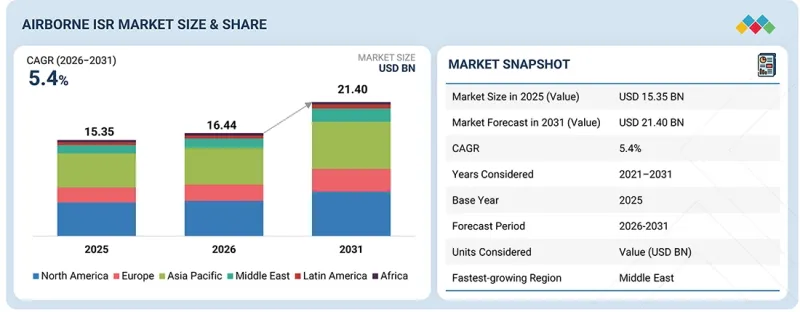
The airborne ISR market is projected to grow from USD 16.44 billion in 2026 to USD 21.40 billion by 2031, at a CAGR of 5.4% during the forecast period.
| Scope of the Report | |
|---|---|
| Years Considered for the Study | 2021-2031 |
| Base Year | 2025 |
| Forecast Period | 2026-2031 |
| Units Considered | Value (USD Billion) |
| Segments | By Solution, Application, Component and Region |
| Regions covered | North America, Europe, APAC, RoW |
Modern defense forces are increasingly incorporating airborne ISR platforms to improve situational awareness, enhance tracking of dynamic targets, and support faster decision-making in complex operational environments. This is resulting in the growth of the airborne ISR market.
"The fixed-wing aircraft segment is the largest platform for airborne ISR."
Based on platform, the fixed-wing aircraft segment is estimated to account for the largest market share in 2026. They are widely used for ISR missions and particularly advantageous for operators tasked with overseeing vast terrestrial or maritime regions while synthesizing data from various sensors in real-time. The trend of converting business jets, turboprop aircraft, and military platforms into ISR capabilities is significantly driving growth in this sector. This conversion enables defense and security organizations to seamlessly integrate advanced systems, including radar, electro-optical/infrared (EO/IR) sensors, signals intelligence (SIGINT) payloads, sophisticated mission consoles, secure communications, and robust data links, eliminating the necessity for developing entirely new airframes.
"The military & defense end user segment is poised to be the faster-growing segment during the forecast period."
The military & defense segment is projected to grow at a faster rate than the homeland security segment in the airborne ISR market by end user. Modern defense operations necessitate advanced airborne systems proficient in threat detection, movement tracking, signals collection, and maritime surveillance, all while facilitating near real-time intelligence sharing with command personnel. This operational requirement is propelling the demand for platforms integrated with ISR capabilities, including ISR-enhanced aircraft, UAVs, advanced mission computers, sophisticated radar systems, EO/IR payloads, SIGINT systems, and secure communication networks.
"The Middle East is projected to be the fastest-growing region during the forecast period."
The Middle East is the fastest-growing market for airborne ISR. The imperative to secure critical energy infrastructure, maritime ports, desert peripheries, Red Sea shipping routes, Gulf navigation corridors, and high-value military installations against a spectrum of threats, including missile strikes, drone incursions, maritime security challenges, and cross-border aggressions, is significantly enhancing the demand for advanced defense capabilities in this region. Many countries in the region are not only acquiring cutting-edge defense systems but are also establishing indigenous defense industries that specialize in the production of UAVs, sophisticated sensors, electro-optical systems, and comprehensive mission integration solutions. This shift is driving the demand for Medium-Altitude Long-Endurance (MALE) UAVs, tactical drones, electro-optical/infrared (EO/IR) systems, radar technologies, electronic intelligence payloads, secure datalinks, operational software, as well as local training and maintenance frameworks.
The breakdown of profiles for primary participants in the airborne ISR market is provided below:
- By Company Type: Tier 1 - 55%, Tier 2 - 25%, and Tier 3 - 20%
- By Designation: C-Level - 75%, Manager-Level - 25%
- By Region: North America - 20%, Europe - 25%, Asia Pacific - 30%, Middle East - 10%, Rest of the World - 15%
Research Coverage:
This market study covers the airborne ISR market across various segments and subsegments. It aims to estimate the size and growth potential of this market across different regions. This study also includes an in-depth competitive analysis of the key players in the market, their company profiles, key observations related to their products and business offerings, recent developments, and key market strategies they adopted.
Reasons to Buy This Report:
The report will help the market leaders/new entrants with information on the closest approximations of the revenue numbers for the overall airborne ISR market. It will also help stakeholders understand the competitive landscape and gain more insights to position their businesses better and plan suitable go-to-market strategies. The report will also help stakeholders understand the market pulse and will provide information on key market drivers, restraints, challenges, and opportunities.
The report provides insights into the following pointers:
- Market drivers (continuous surveillance requirements, ISR upgrades across existing airborne platforms, and expansion of ISR coverage on unmanned and optionally manned platforms), restraints (high procurement and lifecycle costs, export controls and technology transfer restrictions, and shortage of skilled ISR operators and analysts), opportunities (AI-enabled exploitation, advent of ISR-as-a-Service, and low-SWaP payload development), challenges (Real-time data management challenges and contested electromagnetic and cyber environments)
- Market Penetration: Comprehensive information on airborne ISR offered by the top players in the market
- Product Development/Innovation: Detailed insights into upcoming technologies, research & development activities, and product launches in the airborne ISR market
- Market Development: Comprehensive information about lucrative markets across varied regions
- Market Diversification: Exhaustive information about new products, untapped geographies, recent developments, and investments in the airborne ISR market
- Competitive Assessment: In-depth assessment of market share, growth strategies, products, and manufacturing capabilities of leading players in the airborne ISR market
TABLE OF CONTENTS
1 INTRODUCTION
- 1.1 STUDY OBJECTIVES
- 1.2 MARKET DEFINITION
- 1.3 STUDY SCOPE
- 1.3.1 MARKET SEGMENTATION AND REGIONAL SCOPE
- 1.3.2 INCLUSIONS AND EXCLUSIONS
- 1.3.3 YEARS CONSIDERED
- 1.4 CURRENCY CONSIDERED
- 1.5 STAKEHOLDERS
- 1.6 SUMMARY OF CHANGES
2 EXECUTIVE SUMMARY
- 2.1 KEY INSIGHTS AND MARKET HIGHLIGHTS
- 2.2 KEY MARKET PARTICIPANTS: MAPPING OF STRATEGIC DEVELOPMENTS
- 2.3 DISRUPTIVE TRENDS SHAPING MARKET
- 2.4 HIGH-GROWTH SEGMENTS
- 2.5 REGIONAL SNAPSHOT: MARKET SIZE, GROWTH RATE, AND FORECAST
3 PREMIUM INSIGHTS
- 3.1 ATTRACTIVE OPPORTUNITIES FOR PLAYERS IN AIRBORNE ISR MARKET
- 3.2 AIRBORNE ISR MARKET, BY END USER
- 3.3 AIRBORNE ISR SERVICE MARKET, BY TYPE
- 3.4 AIRBORNE ISR MARKET, BY FIXED-WING AIRCRAFT TYPE
- 3.5 AIRBORNE ISR MARKET, BY UNMANNED AERIAL VEHICLE TYPE
4 MARKET OVERVIEW
- 4.1 INTRODUCTION
- 4.2 MARKET DYNAMICS
- 4.2.1 DRIVERS
- 4.2.1.1 Continuous surveillance requirements
- 4.2.1.2 ISR upgrades across existing airborne platforms
- 4.2.1.3 Expansion of ISR coverage on unmanned and optionally manned platforms
- 4.2.2 RESTRAINTS
- 4.2.2.1 High procurement and lifecycle costs
- 4.2.2.2 Export controls and technology transfer restrictions
- 4.2.2.3 Shortage of skilled ISR operators and analysts
- 4.2.3 OPPORTUNITIES
- 4.2.3.1 AI-enabled exploitation
- 4.2.3.2 Advent of ISR-as-a-Service
- 4.2.3.3 Low-SWaP payload development
- 4.2.4 CHALLENGES
- 4.2.4.1 Real-time data management challenges
- 4.2.4.2 Contested electromagnetic and cyber environments
- 4.2.1 DRIVERS
- 4.3 UNMET NEEDS AND WHITE SPACES
- 4.3.1 MISSION-READY ISR INTEGRATION PACKAGES REDUCING AIRCRAFT CONVERSION TIMELINES
- 4.3.2 AFFORDABLE WIDE-AREA SURVEILLANCE OPENING ADOPTION AMONG MEDIUM-BUDGET USERS
- 4.3.3 SOVEREIGN ISR DATA AND MISSION SOFTWARE CONTROL BECOMING BUYER PRIORITY
- 4.3.4 SIMPLER SUSTAINMENT AND FIELD SUPPORT MODELS IMPROVING MISSION AVAILABILITY
- 4.4 INTERCONNECTED MARKETS AND CROSS-SECTOR OPPORTUNITIES
- 4.4.1 UNMANNED SYSTEM MARKET CREATING DEMAND FOR INTEGRATED ISR PAYLOAD SOLUTIONS
- 4.4.2 AI, DATA ANALYTICS, AND MISSION SOFTWARE MARKET SUPPORTING FASTER INTELLIGENCE EXPLOITATION
- 4.4.3 SECURE COMMUNICATIONS AND TACTICAL NETWORKING MARKET ENABLING REAL-TIME ISR SHARING
- 4.4.4 DEFENSE MRO AND MISSION SYSTEM INTEGRATION MARKET EXPANDING LIFECYCLE REVENUE
- 4.5 STRATEGIC MOVES BY TIER-1/2/3 PLAYERS
5 INDUSTRY TRENDS
- 5.1 ECOSYSTEM ANALYSIS
- 5.1.1 PLATFORM AND SYSTEM INTEGRATORS
- 5.1.2 SENSOR AND MISSION PAYLOAD PROVIDERS
- 5.1.3 SOFTWARE, COMMUNICATIONS, AND DATA PROCESSING PROVIDERS
- 5.1.4 END USERS
- 5.2 VALUE CHAIN ANALYSIS
- 5.2.1 RESEARCH AND DEVELOPMENT (~25%)
- 5.2.2 SENSOR AND COMPONENT DEVELOPMENT (~15%)
- 5.2.3 PAYLOAD AND SYSTEM MANUFACTURING (~25%)
- 5.2.4 PLATFORM INTEGRATION AND TESTING (~20%)
- 5.2.5 LIFECYCLE SUPPORT AND SERVICES (~15%)
- 5.3 TRADE ANALYSIS
- 5.3.1 IMPORT SCENARIO (HS CODE 902750)
- 5.3.2 EXPORT SCENARIO (HS CODE 902750)
- 5.4 CASE STUDY ANALYSIS
- 5.4.1 US NAVY P-8A POSEIDON MARITIME ISR&T UPGRADE
- 5.4.2 US COAST GUARD CONTRACTOR-OPERATED UAS ISR SERVICES
- 5.4.3 NATO BALTIC SENTRY FOR UNDERSEA INFRASTRUCTURE MONITORING
- 5.4.4 CBP MQ-9 UAS FOR BORDER AND MARITIME DOMAIN AWARENESS
- 5.5 KEY CONFERENCES AND EVENTS, 2026
- 5.6 TRENDS/DISRUPTIONS IMPACTING CUSTOMER BUSINESS
- 5.7 TOTAL COST OF OWNERSHIP
- 5.8 INVESTMENT AND FUNDING SCENARIO
- 5.9 OPERATIONAL DATA
- 5.10 PRICING ANALYSIS
- 5.10.1 INDICATIVE PRICING ANALYSIS OF AIRBORNE ISR PLATFORMS, BY SOLUTION, 2025
- 5.10.2 INDICATIVE PRICING ANALYSIS OF AIRBORNE ISR PLATFORMS, BY SYSTEM, 2025
- 5.11 MACROECONOMIC OUTLOOK
- 5.12 GDP TRENDS AND FORECAST
- 5.12.1 TRENDS IN GLOBAL AIRBORNE ISR INDUSTRY
- 5.12.2 TRENDS IN GLOBAL AEROSPACE AND DEFENSE INDUSTRY
- 5.13 BILL OF MATERIALS
- 5.14 BUSINESS MODELS
- 5.14.1 MISSION SYSTEM INTEGRATION
- 5.14.2 ISR PAYLOAD AND SENSOR PRODUCT SALES
- 5.14.3 ISR-AS-A-SERVICE/COCO
- 5.14.4 LIFECYCLE SUPPORT AND UPGRADE CONTRACTS
- 5.14.5 SOFTWARE AND DATA EXPLOITATION
6 TECHNOLOGICAL ADVANCEMENTS, AI-DRIVEN IMPACT, PATENTS, INNOVATIONS, AND FUTURE APPLICATIONS
- 6.1 KEY TECHNOLOGIES
- 6.1.1 ELECTRO-OPTICAL AND INFRARED PAYLOADS
- 6.1.2 AIRBORNE SURVEILLANCE RADARS
- 6.1.3 SIGNALS INTELLIGENCE SYSTEMS
- 6.2 COMPLEMENTARY TECHNOLOGIES
- 6.2.1 AI, EDGE PROCESSING, AND SENSOR FUSION
- 6.2.2 TACTICAL DATA LINKS, SATCOM, AND ISR VIDEO LINKS
- 6.3 ADJACENT TECHNOLOGIES
- 6.3.1 C4ISR AND BATTLE MANAGEMENT NETWORKS
- 6.3.2 ELECTRONIC WARFARE
- 6.4 TECHNOLOGY ROADMAP
- 6.5 IMPACT OF AI/ GEN AI
- 6.5.1 TOP USE CASES AND MARKET POTENTIAL
- 6.5.2 BEST PRACTICES
- 6.5.3 CASE STUDIES OF AI IMPLEMENTATION
- 6.5.4 INTERCONNECTED ECOSYSTEM AND IMPACT ON MARKET PLAYERS
- 6.5.5 CLIENTS' READINESS TO ADOPT GEN AI
- 6.6 PATENT ANALYSIS
- 6.7 FUTURE APPLICATIONS
- 6.8 SUCCESS STORIES AND REAL-WORLD APPLICATIONS
- 6.8.1 PALANTIR TECHNOLOGIES: MAVEN SMART SYSTEM
- 6.8.2 GENERAL ATOMICS AERONAUTICAL SYSTEMS, INC.: SMART SENSOR ISR PROTOTYPE
- 6.8.3 ANDURIL INDUSTRIES: IRIS AIRBORNE AUTONOMOUS SENSOR FAMILY
7 REGULATORY LANDSCAPE
- 7.1 REGIONAL REGULATIONS AND COMPLIANCE
- 7.1.1 REGULATORY BODIES, GOVERNMENT AGENCIES, AND OTHER ORGANIZATIONS
- 7.1.2 INDUSTRY STANDARDS
8 CUSTOMER LANDSCAPE AND BUYER BEHAVIOR
- 8.1 DECISION-MAKING PROCESS
- 8.2 KEY STAKEHOLDERS INVOLVED IN BUYING PROCESS AND THEIR EVALUATION CRITERIA
- 8.2.1 KEY STAKEHOLDERS IN BUYING PROCESS
- 8.2.2 BUYING CRITERIA
- 8.3 ADOPTION BARRIERS AND INTERNAL CHALLENGES
- 8.4 UNMET NEEDS OF VARIOUS END-USE INDUSTRIES
9 AIRBORNE ISR MARKET, BY PLATFORM
- 9.1 INTRODUCTION
- 9.2 FIXED-WING AIRCRAFT
- 9.2.1 EXPANDING LONG-RANGE ISR PAYLOAD INTEGRATION TO DRIVE MARKET
- 9.2.2 SPECIAL MISSION AIRCRAFT
- 9.2.3 MARITIME PATROL AIRCRAFT
- 9.2.4 BORDER & HOMELAND SURVEILLANCE AIRCRAFT
- 9.2.5 ISR-MODIFIED TRANSPORT & UTILITY AIRCRAFT
- 9.3 ROTARY-WING AIRCRAFT
- 9.3.1 COMBINING CLOSE-RANGE SURVEILLANCE WITH MISSION RESPONSE TO DRIVE MARKET
- 9.3.2 MILITARY HELICOPTERS
- 9.3.3 COAST GUARD & MARITIME HELICOPTERS
- 9.3.4 SPECIAL OPERATIONS HELICOPTERS
- 9.4 UNMANNED AERIAL VEHICLES
- 9.4.1 EXTENDING PERSISTENT SURVEILLANCE WITH LOWER CREW EXPOSURE TO DRIVE MARKET
- 9.4.2 SMALL UNMANNED AERIAL VEHICLES
- 9.4.3 TACTICAL UNMANNED AERIAL VEHICLES
- 9.4.4 STRATEGIC UNMANNED AERIAL VEHICLES
- 9.4.4.1 MALE
- 9.4.4.2 HALE
10 AIRBORNE ISR MARKET, BY SOLUTION
- 10.1 INTRODUCTION
- 10.2 SYSTEMS
- 10.2.1 UPGRADING AIRBORNE PLATFORMS WITH MULTI-SENSOR MISSION PAYLOADS TO DRIVE MARKET
- 10.2.2 EO/IR GIMBAL & TURRET PAYLOADS
- 10.2.2.1 Small/Compact EO/IR gimbals (6-10 inches)
- 10.2.2.2 Medium EO/IR gimbals & turrets (11-15 inches)
- 10.2.2.3 Large/Long-range EO/IR turrets (>15 inches)
- 10.2.3 RADAR SURVEILLANCE SYSTEMS
- 10.2.3.1 Synthetic aperture radar
- 10.2.3.2 Ground moving target indicator radar
- 10.2.3.3 Maritime surveillance radar
- 10.2.3.4 Airborne search & multi-mode surveillance radar
- 10.2.4 SIGNALS INTELLIGENCE SYSTEMS
- 10.2.4.1 Communications intelligence systems
- 10.2.4.2 Electronic intelligence systems
- 10.2.4.3 Electronic support measures
- 10.2.4.4 RF detection & geo-location systems
- 10.3 SOFTWARE
- 10.3.1 TURNING SENSOR DATA INTO USABLE MISSION INTELLIGENCE TO DRIVE MARKET
- 10.3.2 SENSOR CONTROL & PAYLOAD MANAGEMENT SOFTWARE
- 10.3.2.1 Gimbal control
- 10.3.2.2 Sensor mode management
- 10.3.2.3 Payload health monitoring
- 10.3.2.4 Mission system interface
- 10.3.3 AI-BASED ANALYTICS & AUTO-TRACKING SOFTWARE
- 10.3.3.1 Automatic target detection
- 10.3.3.2 Automatic target tracking
- 10.3.3.3 Object classification
- 10.3.3.4 Moving target indication in video
- 10.3.4 TARGETING & GEO-LOCATION SOFTWARE
- 10.3.4.1 Target coordinate generation
- 10.3.4.2 Laser designation control
- 10.3.4.3 Range & bearing calculation
- 10.3.4.4 Sensor-to-Shooter data support
- 10.3.5 MISSION MANAGEMENT & VIDEO EXPLORATION SOFTWARE
- 10.3.5.1 Mission planning & sensor tasking
- 10.3.5.2 Video exploitation & annotation
- 10.3.5.3 ISR data management
- 10.3.5.4 Command & control integration
- 10.4 SERVICES
- 10.4.1 KEEPING ISR FLEETS MISSION-READY THROUGH INTEGRATION AND LIFECYCLE SUPPORT TO DRIVE MARKET
- 10.4.2 ISR-AS-A-SERVICE
- 10.4.3 INTEGRATION & INSTALLATION
- 10.4.4 MAINTENANCE, REPAIR, & OVERHAUL
- 10.4.5 TRAINING & SIMULATION
11 AIRBORNE ISR MARKET, BY APPLICATION
- 11.1 INTRODUCTION
- 11.2 SEARCH & RESCUE OPERATIONS
- 11.2.1 REDUCING SEARCH TIME IN COMPLEX RESCUE MISSIONS TO DRIVE MARKET
- 11.3 BORDER & MARITIME PATROL
- 11.3.1 IMPROVING WIDE-AREA MONITORING OF NON-COOPERATIVE ACTIVITY TO DRIVE MARKET
- 11.4 TARGET ACQUISITION & TRACKING
- 11.4.1 SENSOR-LED TARGET CONFIRMATION TO DRIVE MARKET
- 11.5 OTHER APPLICATIONS
12 AIRBORNE ISR MARKET, BY COMPONENT
- 12.1 INTRODUCTION
- 12.2 SENSOR & RECEIVER MODULES
- 12.2.1 ENHANCING DETECTION ACROSS DAY, NIGHT, WEATHER, AND SIGNAL ENVIRONMENTS TO DRIVE MARKET
- 12.2.2 DAYLIGHT ELECTRO-OPTICAL SENSORS
- 12.2.3 INFRARED SENSORS
- 12.2.4 LOW-LIGHT SENSORS
- 12.2.5 SWIR & MULTISPECTRAL SENSORS
- 12.2.6 RADAR RECEIVERS
- 12.2.7 SIGNALS INTELLIGENCE RECEIVERS
- 12.3 LASER & TARGETING MODULES
- 12.3.1 STRENGTHENING TARGET CONFIRMATION AND PRECISION MISSION SUPPORT TO DRIVE MARKET
- 12.3.2 LASER RANGEFINDERS
- 12.3.3 LASER POINTERS/ILLUMINATORS
- 12.3.4 LASER DESIGNATORS
- 12.4 STABILIZATION, CONTROL, & PROCESSING MODULES
- 12.4.1 CONVERTING RAW SENSOR INPUTS INTO STEADY AND USABLE MISSION INTELLIGENCE TO DRIVE MARKET
- 12.4.2 GIMBAL STABILIZATION UNITS
- 12.4.3 INERTIAL MEASUREMENT & LINE-OF-SIGHT CONTROL UNITS
- 12.4.4 PAYLOAD CONTROL UNITS
- 12.4.5 ONBOARD VIDEO PROCESSING HARDWARE
- 12.5 OPTICAL ASSEMBLIES
- 12.5.1 FOCUS ON ENHANCING IMAGE CLARITY AND SENSOR PERFORMANCE TO DRIVE MARKET
- 12.6 ANTENNAS
- 12.6.1 RELIABLE ISR DATA TRANSFER ACROSS AIRBORNE AND GROUND NETWORKS TO DRIVE MARKET
- 12.7 RF MODULES
- 12.7.1 EXPANDING ELECTRONIC SENSING AND SECURE COMMUNICATION CAPABILITY TO DRIVE MARKET
- 12.8 OTHER COMPONENTS
13 AIRBORNE ISR MARKET, BY END USER
- 13.1 INTRODUCTION
- 13.2 MILITARY & DEFENSE
- 13.2.1 IMPROVING MISSION AWARENESS ACROSS CONTESTED OPERATING AREAS TO DRIVE MARKET
- 13.3 HOMELAND SECURITY
- 13.3.1 NEED FOR FASTER INCIDENT VERIFICATION AND BETTER COORDINATION BETWEEN AIRBORNE ASSETS TO DRIVE MARKET
14 AIRBORNE ISR MARKET, BY REGION
- 14.1 INTRODUCTION
- 14.2 NORTH AMERICA
- 14.2.1 US
- 14.2.1.1 Deep-sensing modernization and domestic ISR integration to drive market
- 14.2.2 CANADA
- 14.2.2.1 Arctic surveillance and multi-role maritime ISR expansion to drive market
- 14.2.1 US
- 14.3 EUROPE
- 14.3.1 UK
- 14.3.1.1 Certified uncrewed ISR operations and NATO-focused surveillance modernization to drive market
- 14.3.2 GERMANY
- 14.3.2.1 SIGINT renewal and NATO eastern-flank surveillance to drive market
- 14.3.3 FRANCE
- 14.3.3.1 Sovereign electronic intelligence and overseas maritime surveillance to drive market
- 14.3.4 ITALY
- 14.3.4.1 Multi-mission G550 fleet expansion and Mediterranean surveillance needs to drive market
- 14.3.5 SPAIN
- 14.3.5.1 Sovereign SIGINT development and maritime surveillance fleet renewal to drive market
- 14.3.6 POLAND
- 14.3.6.1 Eastern-flank threat monitoring and drone-based ISR expansion to drive market
- 14.3.7 REST OF EUROPE
- 14.3.1 UK
- 14.4 ASIA PACIFIC
- 14.4.1 CHINA
- 14.4.1.1 Western Pacific surveillance and indigenous high-end UAV development to drive market
- 14.4.2 JAPAN
- 14.4.2.1 Island-chain surveillance and uncrewed maritime ISR expansion to drive market
- 14.4.3 INDIA
- 14.4.3.1 Indian Ocean surveillance, border intelligence, and indigenous ISR modernization to drive market
- 14.4.4 SOUTH KOREA
- 14.4.4.1 North Korea threat monitoring and networked airborne surveillance to drive market
- 14.4.5 AUSTRALIA
- 14.4.5.1 Indo-Pacific maritime surveillance and ISR expansion to drive market
- 14.4.6 REST OF ASIA PACIFIC
- 14.4.1 CHINA
- 14.5 MIDDLE EAST
- 14.5.1 GCC
- 14.5.1.1 UAE
- 14.5.1.1.1 Gulf maritime security and local unmanned ISR production to drive market
- 14.5.1.2 Saudi Arabia
- 14.5.1.2.1 Defense localization and long-endurance UAV ISR expansion to drive market
- 14.5.1.1 UAE
- 14.5.2 ISRAEL
- 14.5.2.1 Multi-front threat monitoring and domestic ISR sensor production to market
- 14.5.3 TURKEY
- 14.5.3.1 Domestic UAV scale-up and cross-border ISR requirements to drive market
- 14.5.4 REST OF MIDDLE EAST
- 14.5.1 GCC
- 14.6 LATIN AMERICA
- 14.6.1 BRAZIL
- 14.6.1.1 Amazon border monitoring and C-390 maritime ISR development to drive market
- 14.6.2 MEXICO
- 14.6.2.1 Border security, anti-cartel surveillance, and domestic drone development to drive market
- 14.6.3 REST OF LATIN AMERICA
- 14.6.1 BRAZIL
- 14.7 AFRICA
- 14.7.1 SOUTH AFRICA
- 14.7.1.1 Border protection, maritime security, and local UAV capability to drive market
- 14.7.2 NIGERIA
- 14.7.2.1 Counter-insurgency surveillance and Gulf of Guinea security to drive market
- 14.7.3 REST OF AFRICA
- 14.7.1 SOUTH AFRICA
15 COMPETITIVE LANDSCAPE
- 15.1 INTRODUCTION
- 15.2 KEY PLAYER STRATEGIES/RIGHT TO WIN, 2021-2025
- 15.3 REVENUE ANALYSIS, 2021-2025
- 15.4 MARKET SHARE ANALYSIS, 2025
- 15.5 BRAND/PRODUCT COMPARISON
- 15.6 COMPANY VALUATION AND FINANCIAL METRICS
- 15.7 COMPANY EVALUATION MATRIX: KEY PLAYERS, 2025
- 15.7.1 STARS
- 15.7.2 EMERGING LEADERS
- 15.7.3 PERVASIVE PLAYERS
- 15.7.4 PARTICIPANTS
- 15.7.5 COMPANY FOOTPRINT
- 15.7.5.1 Company footprint
- 15.7.5.2 Region footprint
- 15.7.5.3 Solution footprint
- 15.7.5.4 Platform footprint
- 15.7.5.5 End user footprint
- 15.8 COMPANY EVALUATION MATRIX: STARTUPS/SMES, 2025
- 15.8.1 PROGRESSIVE COMPANIES
- 15.8.2 RESPONSIVE COMPANIES
- 15.8.3 DYNAMIC COMPANIES
- 15.8.4 STARTING BLOCKS
- 15.8.5 COMPETITIVE BENCHMARKING
- 15.8.5.1 List of startups/SMEs
- 15.8.5.2 Competitive benchmarking of startups/SMEs
- 15.9 COMPETITIVE SCENARIO
- 15.9.1 PRODUCT LAUNCHES
- 15.9.2 DEALS
- 15.9.3 OTHER DEVELOPMENTS
16 COMPANY PROFILES
- 16.1 KEY PLAYERS
- 16.1.1 RTX
- 16.1.1.1 Business overview
- 16.1.1.2 Products offered
- 16.1.1.3 Recent developments
- 16.1.1.3.1 Other developments
- 16.1.1.4 MnM view
- 16.1.1.4.1 Right to win
- 16.1.1.4.2 Strategic choices
- 16.1.1.4.3 Weaknesses and competitive threats
- 16.1.2 L3HARRIS TECHNOLOGIES, INC.
- 16.1.2.1 Business overview
- 16.1.2.2 Products offered
- 16.1.2.3 Recent developments
- 16.1.2.3.1 Deals
- 16.1.2.3.2 Other developments
- 16.1.2.4 MnM view
- 16.1.2.4.1 Right to win
- 16.1.2.4.2 Strategic choices
- 16.1.2.4.3 Weaknesses and competitive threats
- 16.1.3 LEONARDO DRS
- 16.1.3.1 Business overview
- 16.1.3.2 Products offered
- 16.1.3.3 Recent developments
- 16.1.3.3.1 Product launches
- 16.1.3.3.2 Deals
- 16.1.3.4 MnM view
- 16.1.3.4.1 Right to win
- 16.1.3.4.2 Strategic choices
- 16.1.3.4.3 Weaknesses and competitive threats
- 16.1.4 THALES
- 16.1.4.1 Business overview
- 16.1.4.2 Products offered
- 16.1.4.3 Recent developments
- 16.1.4.3.1 Deals
- 16.1.4.3.2 Other developments
- 16.1.4.4 MnM view
- 16.1.4.4.1 Right to win
- 16.1.4.4.2 Strategic choices
- 16.1.4.4.3 Weaknesses and competitive threats
- 16.1.5 NORTHROP GRUMMAN
- 16.1.5.1 Business overview
- 16.1.5.2 Products offered
- 16.1.5.3 Recent developments
- 16.1.5.3.1 Other developments
- 16.1.5.4 MnM view
- 16.1.5.4.1 Right to win
- 16.1.5.4.2 Strategic choices
- 16.1.5.4.3 Weaknesses and competitive threats
- 16.1.6 BAE SYSTEMS
- 16.1.6.1 Business overview
- 16.1.6.2 Products offered
- 16.1.6.3 Recent developments
- 16.1.6.3.1 Deals
- 16.1.6.3.2 Other developments
- 16.1.7 RHEINMETALL AG
- 16.1.7.1 Business overview
- 16.1.7.2 Products offered
- 16.1.7.3 Recent developments
- 16.1.7.3.1 Other developments
- 16.1.8 GENERAL DYNAMICS CORPORATION
- 16.1.8.1 Business overview
- 16.1.8.2 Products offered
- 16.1.9 ELBIT SYSTEMS LTD.
- 16.1.9.1 Business overview
- 16.1.9.2 Products offered
- 16.1.9.3 Recent developments
- 16.1.9.3.1 Other developments
- 16.1.10 GENERAL ATOMICS AERONAUTICAL SYSTEMS, INC.
- 16.1.10.1 Business overview
- 16.1.10.2 Products offered
- 16.1.10.3 Recent developments
- 16.1.10.3.1 Deals
- 16.1.10.3.2 Other developments
- 16.1.11 TELEDYNE FLIR DEFENSE INC.
- 16.1.11.1 Business overview
- 16.1.11.2 Products offered
- 16.1.11.3 Recent developments
- 16.1.11.3.1 Product launches
- 16.1.11.3.2 Other developments
- 16.1.12 LOCKHEED MARTIN CORPORATION
- 16.1.12.1 Business overview
- 16.1.12.2 Products offered
- 16.1.12.3 Recent developments
- 16.1.12.3.1 Deals
- 16.1.12.3.2 Other developments
- 16.1.13 RAFAEL ADVANCED DEFENSE SYSTEMS LTD.
- 16.1.13.1 Business overview
- 16.1.13.2 Products offered
- 16.1.14 SAAB AB
- 16.1.14.1 Business overview
- 16.1.14.2 Products offered
- 16.1.14.3 Recent developments
- 16.1.14.3.1 Deals
- 16.1.14.3.2 Other developments
- 16.1.15 HENSOLDT AG
- 16.1.15.1 Business overview
- 16.1.15.2 Products offered
- 16.1.15.3 Recent developments
- 16.1.15.3.1 Deals
- 16.1.15.3.2 Other developments
- 16.1.16 ASELSAN A.S.
- 16.1.16.1 Business overview
- 16.1.16.2 Products offered
- 16.1.16.3 Recent developments
- 16.1.16.3.1 Product launches
- 16.1.16.3.2 Deals
- 16.1.16.3.3 Other developments
- 16.1.17 ISRAEL AEROSPACE INDUSTRIES LTD.
- 16.1.17.1 Business overview
- 16.1.17.2 Products offered
- 16.1.17.3 Recent developments
- 16.1.17.3.1 Deals
- 16.1.17.3.2 Other developments
- 16.1.18 SAFRAN
- 16.1.18.1 Business overview
- 16.1.18.2 Products offered
- 16.1.18.3 Recent developments
- 16.1.18.3.1 Deals
- 16.1.18.3.2 Other developments
- 16.1.1 RTX
- 16.2 OTHER PLAYERS
- 16.2.1 OCTOPUS ISR SYSTEMS
- 16.2.2 TRAKKA SYSTEMS
- 16.2.3 BHARAT ELECTRONICS LIMITED
- 16.2.4 TATA ADVANCED SYSTEMS LIMITED
- 16.2.5 KAPPA OPTRONICS GMBH
- 16.2.6 DELOPT
- 16.2.7 ENORD
- 16.2.8 PAL AEROSPACE
- 16.2.9 SCHIEBEL CORPORATION
- 16.2.10 PERSISTENT SYSTEMS, LLC
17 RESEARCH METHODOLOGY
- 17.1 RESEARCH DATA
- 17.1.1 SECONDARY DATA
- 17.1.1.1 Key data from secondary sources
- 17.1.2 PRIMARY DATA
- 17.1.2.1 Primary sources
- 17.1.2.2 Key data from primary sources
- 17.1.2.3 Breakdown of primary interviews
- 17.1.2.4 Insights from primary experts
- 17.1.1 SECONDARY DATA
- 17.2 FACTOR ANALYSIS
- 17.2.1 DEMAND-SIDE INDICATORS
- 17.2.2 SUPPLY-SIDE INDICATORS
- 17.3 MARKET SIZE ESTIMATION
- 17.3.1 BOTTOM-UP APPROACH
- 17.3.2 TOP-DOWN APPROACH
- 17.4 DATA TRIANGULATION
- 17.5 RESEARCH ASSUMPTIONS
- 17.6 RESEARCH LIMITATIONS
- 17.7 RISK ASSESSMENT
18 APPENDIX
- 18.1 DISCUSSION GUIDE
- 18.2 ANNEXURE: DEFENSE PROGRAMS
- 18.3 KNOWLEDGESTORE: MARKETSANDMARKETS' SUBSCRIPTION PORTAL
- 18.4 CUSTOMIZATION OPTIONS
- 18.5 RELATED REPORTS
- 18.6 AUTHOR DETAILS
List of Tables
- TABLE 1 USD EXCHANGE RATES, 2021-2025
- TABLE 2 UNMET NEEDS AND WHITE SPACES
- TABLE 3 CROSS-SECTOR OPPORTUNITIES
- TABLE 4 STRATEGIC MOVES BY TIER-1/2/3 PLAYERS
- TABLE 5 ROLE OF COMPANIES IN ECOSYSTEM
- TABLE 6 IMPORT DATA FOR HS CODE 902750-COMPLIANT PRODUCTS, BY COUNTRY, 2021-2025 (USD THOUSAND)
- TABLE 7 EXPORT DATA FOR HS CODE 902750-COMPLIANT PRODUCTS, BY COUNTRY, 2021-2025 (USD THOUSAND)
- TABLE 8 KEY CONFERENCES AND EVENTS, 2026
- TABLE 9 TOTAL COST OF OWNERSHIP OF AIRBORNE ISR SYSTEMS
- TABLE 10 PROCUREMENT OF AIRCRAFT PLATFORMS, 2021-2025 (UNITS)
- TABLE 11 PROCUREMENT OF AIRCRAFT PLATFORMS, 2026-2031 (UNITS)
- TABLE 12 INDICATIVE PRICING OF AIRBORNE ISR PLATFORMS, BY SOLUTION, 2025 (USD MILLION)
- TABLE 13 INDICATIVE PRICING OF AIRBORNE ISR PLATFORMS, BY SYSTEM, 2025 (USD MILLION)
- TABLE 14 GDP PERCENTAGE CHANGE, BY COUNTRY, 2021-2030
- TABLE 15 REGIONAL DEFENSE SPENDING OVERVIEW, 2025
- TABLE 16 BILL OF MATERIALS FOR AIRBORNE ISR SYSTEMS
- TABLE 17 ADVANTAGES AND DISADVANTAGES OF BUSINESS MODELS
- TABLE 18 EVOLUTION OF AIRBORNE ISR TECHNOLOGIES
- TABLE 19 PATENT ANALYSIS
- TABLE 20 AI-ENABLED REAL-TIME MISSION INTELLIGENCE: FUTURE OF AUTOMATED ISR DATA PROCESSING AND TARGET DETECTION
- TABLE 21 NETWORKED AIRBORNE ISR: FUTURE OF CONNECTED MULTIDOMAIN SITUATIONAL AWARENESS
- TABLE 22 NORTH AMERICA: REGULATORY BODIES, GOVERNMENT AGENCIES, AND OTHER ORGANIZATIONS
- TABLE 23 EUROPE: REGULATORY BODIES, GOVERNMENT AGENCIES, AND OTHER ORGANIZATIONS
- TABLE 24 ASIA PACIFIC: REGULATORY BODIES, GOVERNMENT AGENCIES, AND OTHER ORGANIZATIONS
- TABLE 25 MIDDLE EAST: REGULATORY BODIES, GOVERNMENT AGENCIES, AND OTHER ORGANIZATIONS
- TABLE 26 LATIN AMERICA: REGULATORY BODIES, GOVERNMENT AGENCIES, AND OTHER ORGANIZATIONS
- TABLE 27 AFRICA: REGULATORY BODIES, GOVERNMENT AGENCIES, AND OTHER ORGANIZATIONS
- TABLE 28 GLOBAL INDUSTRY STANDARDS
- TABLE 29 INFLUENCE OF STAKEHOLDERS ON BUYING PROCESS, BY SOLUTION
- TABLE 30 KEY BUYING CRITERIA, BY SOLUTION
- TABLE 31 UNMET NEEDS IN AIRBORNE ISR MARKET, BY END-USER
- TABLE 32 AIRBORNE ISR MARKET, BY PLATFORM, 2021-2025 (USD MILLION)
- TABLE 33 AIRBORNE ISR MARKET, BY PLATFORM, 2026-2031 (USD MILLION)
- TABLE 34 FIXED-WING AIRCRAFT: AIRBORNE ISR MARKET, BY TYPE, 2021-2025 (USD MILLION)
- TABLE 35 FIXED-WING AIRCRAFT: AIRBORNE ISR MARKET, BY TYPE, 2026-2031 (USD MILLION)
- TABLE 36 ROTARY-WING AIRCRAFT: AIRBORNE ISR MARKET, BY TYPE, 2021-2025 (USD MILLION)
- TABLE 37 ROTARY-WING AIRCRAFT: AIRBORNE ISR MARKET, BY TYPE, 2026-2031 (USD MILLION)
- TABLE 38 UNMANNED AERIAL VEHICLES: AIRBORNE ISR MARKET, BY TYPE, 2021-2025 (USD MILLION)
- TABLE 39 UNMANNED AERIAL VEHICLES: AIRBORNE ISR MARKET, BY TYPE, 2026-2031 (USD MILLION)
- TABLE 40 AIRBORNE ISR MARKET, BY SOLUTION, 2021-2025 (USD MILLION)
- TABLE 41 AIRBORNE ISR MARKET, BY SOLUTION, 2026-2031 (USD MILLION)
- TABLE 42 SYSTEMS: AIRBORNE ISR MARKET, BY TYPE, 2021-2025 (USD MILLION)
- TABLE 43 SYSTEMS: AIRBORNE ISR MARKET, BY TYPE, 2026-2031 (USD MILLION)
- TABLE 44 EO/IR GIMBAL & TURRET PAYLOADS: AIRBORNE ISR MARKET, BY TYPE, 2021-2025 (USD MILLION)
- TABLE 45 EO/IR GIMBAL & TURRET PAYLOADS: AIRBORNE ISR MARKET, BY TYPE, 2026-2031 (USD MILLION)
- TABLE 46 RADAR SURVEILLANCE SYSTEMS: AIRBORNE ISR MARKET, BY TYPE, 2021-2025 (USD MILLION)
- TABLE 47 RADAR SURVEILLANCE SYSTEMS: AIRBORNE ISR MARKET, BY TYPE, 2026-2031 (USD MILLION)
- TABLE 48 SIGNALS INTELLIGENCE SYSTEMS: AIRBORNE ISR MARKET, BY TYPE, 2021-2025 (USD MILLION)
- TABLE 49 SIGNALS INTELLIGENCE SYSTEMS: AIRBORNE ISR MARKET, BY TYPE, 2026-2031 (USD MILLION)
- TABLE 50 SOFTWARE: AIRBORNE ISR MARKET, BY TYPE, 2021-2025 (USD MILLION)
- TABLE 51 SOFTWARE: AIRBORNE ISR MARKET, BY TYPE, 2026-2031 (USD MILLION)
- TABLE 52 SERVICES: AIRBORNE ISR MARKET, BY TYPE, 2021-2025 (USD MILLION)
- TABLE 53 SERVICES: AIRBORNE ISR MARKET, BY TYPE, 2026-2031 (USD MILLION)
- TABLE 54 AIRBORNE ISR MARKET, BY APPLICATION, 2021-2025 (USD MILLION)
- TABLE 55 AIRBORNE ISR MARKET, BY APPLICATION, 2026-2031 (USD MILLION)
- TABLE 56 AIRBORNE ISR MARKET, BY COMPONENT, 2021-2025 (USD MILLION)
- TABLE 57 AIRBORNE ISR MARKET, BY COMPONENT, 2026-2031 (USD MILLION)
- TABLE 58 SENSOR & RECEIVER MODULES: AIRBORNE ISR MARKET, BY TYPE, 2021-2025 (USD MILLION)
- TABLE 59 SENSOR & RECEIVER MODULES: AIRBORNE ISR MARKET, BY TYPE, 2026-2031 (USD MILLION)
- TABLE 60 LASER & TARGETING MODULES: AIRBORNE ISR MARKET, BY TYPE, 2021-2025 (USD MILLION)
- TABLE 61 LASER & TARGETING MODULES: AIRBORNE ISR MARKET, BY TYPE, 2026-2031 (USD MILLION)
- TABLE 62 STABILIZATION, CONTROL, & PROCESSING MODULES: AIRBORNE ISR MARKET, BY TYPE, 2021-2025 (USD MILLION)
- TABLE 63 STABILIZATION, CONTROL, & PROCESSING MODULES: AIRBORNE ISR MARKET, BY TYPE, 2026-2031 (USD MILLION)
- TABLE 64 AIRBORNE ISR MARKET, BY END USER, 2021-2025 (USD MILLION)
- TABLE 65 AIRBORNE ISR MARKET, BY END USER, 2026-2031 (USD MILLION)
- TABLE 66 AIRBORNE ISR MARKET, BY REGION, 2021-2025 (USD MILLION)
- TABLE 67 AIRBORNE ISR MARKET, BY REGION, 2026-2031 (USD MILLION)
- TABLE 68 NORTH AMERICA: AIRBORNE ISR MARKET, BY COUNTRY, 2021-2025 (USD MILLION)
- TABLE 69 NORTH AMERICA: AIRBORNE ISR MARKET, BY COUNTRY, 2026-2031 (USD MILLION)
- TABLE 70 NORTH AMERICA: AIRBORNE ISR MARKET, BY PLATFORM, 2021-2025 (USD MILLION)
- TABLE 71 NORTH AMERICA: AIRBORNE ISR MARKET, BY PLATFORM, 2026-2031 (USD MILLION)
- TABLE 72 NORTH AMERICA: AIRBORNE ISR MARKET, BY FIXED-WING AIRCRAFT, 2021-2025 (USD MILLION)
- TABLE 73 NORTH AMERICA: AIRBORNE ISR MARKET, BY FIXED-WING AIRCRAFT, 2026-2031 (USD MILLION)
- TABLE 74 NORTH AMERICA: AIRBORNE ISR MARKET, BY ROTARY-WING AIRCRAFT, 2021-2025 (USD MILLION)
- TABLE 75 NORTH AMERICA: AIRBORNE ISR MARKET, BY ROTARY-WING AIRCRAFT, 2026-2031 (USD MILLION)
- TABLE 76 NORTH AMERICA: AIRBORNE ISR MARKET, BY UNMANNED AERIAL VEHICLE, 2021-2025 (USD MILLION)
- TABLE 77 NORTH AMERICA: AIRBORNE ISR MARKET, BY UNMANNED AERIAL VEHICLE, 2026-2031 (USD MILLION)
- TABLE 78 NORTH AMERICA: AIRBORNE ISR MARKET, BY SOLUTION, 2021-2025 (USD MILLION)
- TABLE 79 NORTH AMERICA: AIRBORNE ISR MARKET, BY SOLUTION, 2026-2031 (USD MILLION)
- TABLE 80 NORTH AMERICA: AIRBORNE ISR MARKET, BY SYSTEM, 2021-2025 (USD MILLION)
- TABLE 81 NORTH AMERICA: AIRBORNE ISR MARKET, BY SYSTEM, 2026-2031 (USD MILLION)
- TABLE 82 NORTH AMERICA: AIRBORNE ISR MARKET, BY EO/IR GIMBAL & TURRET PAYLOAD, 2021-2025 (USD MILLION)
- TABLE 83 NORTH AMERICA: AIRBORNE ISR MARKET, BY EO/IR GIMBAL & TURRET PAYLOAD, 2026-2031 (USD MILLION)
- TABLE 84 NORTH AMERICA: AIRBORNE ISR MARKET, BY RADAR SURVEILLANCE SYSTEM, 2021-2025 (USD MILLION)
- TABLE 85 NORTH AMERICA: AIRBORNE ISR MARKET, BY RADAR SURVEILLANCE SYSTEM, 2026-2031 (USD MILLION)
- TABLE 86 NORTH AMERICA: AIRBORNE ISR MARKET, BY SIGNALS INTELLIGENCE SYSTEM, 2021-2025 (USD MILLION)
- TABLE 87 NORTH AMERICA: AIRBORNE ISR MARKET, BY SIGNALS INTELLIGENCE SYSTEM, 2026-2031 (USD MILLION)
- TABLE 88 NORTH AMERICA: AIRBORNE ISR MARKET, BY SOFTWARE, 2021-2025 (USD MILLION)
- TABLE 89 NORTH AMERICA: AIRBORNE ISR MARKET, BY SOFTWARE, 2026-2031 (USD MILLION)
- TABLE 90 NORTH AMERICA: AIRBORNE ISR MARKET, BY SERVICE, 2021-2025 (USD MILLION)
- TABLE 91 NORTH AMERICA: AIRBORNE ISR MARKET, BY SERVICE, 2026-2031 (USD MILLION)
- TABLE 92 NORTH AMERICA: AIRBORNE ISR MARKET, BY APPLICATION, 2021-2025 (USD MILLION)
- TABLE 93 NORTH AMERICA: AIRBORNE ISR MARKET, BY APPLICATION, 2026-2031 (USD MILLION)
- TABLE 94 NORTH AMERICA: AIRBORNE ISR MARKET, BY END USER, 2021-2025 (USD MILLION)
- TABLE 95 NORTH AMERICA: AIRBORNE ISR MARKET, BY END USER, 2026-2031 (USD MILLION)
- TABLE 96 US: AIRBORNE ISR MARKET, BY PLATFORM, 2021-2025 (USD MILLION)
- TABLE 97 US: AIRBORNE ISR MARKET, BY PLATFORM, 2026-2031 (USD MILLION)
- TABLE 98 US: AIRBORNE ISR MARKET, BY FIXED-WING AIRCRAFT, 2021-2025 (USD MILLION)
- TABLE 99 US: AIRBORNE ISR MARKET, BY FIXED-WING AIRCRAFT, 2026-2031 (USD MILLION)
- TABLE 100 US: AIRBORNE ISR MARKET, BY ROTARY-WING AIRCRAFT, 2021-2025 (USD MILLION)
- TABLE 101 US: AIRBORNE ISR MARKET, BY ROTARY-WING AIRCRAFT, 2026-2031 (USD MILLION)
- TABLE 102 US: AIRBORNE ISR MARKET, BY UNMANNED AERIAL VEHICLE, 2021-2025 (USD MILLION)
- TABLE 103 US: AIRBORNE ISR MARKET, BY UNMANNED AERIAL VEHICLE, 2026-2031 (USD MILLION)
- TABLE 104 US: AIRBORNE ISR MARKET, BY SOLUTION, 2021-2025 (USD MILLION)
- TABLE 105 US: AIRBORNE ISR MARKET, BY SOLUTION, 2026-2031 (USD MILLION)
- TABLE 106 CANADA: AIRBORNE ISR MARKET, BY PLATFORM, 2021-2025 (USD MILLION)
- TABLE 107 CANADA: AIRBORNE ISR MARKET, BY PLATFORM, 2026-2031 (USD MILLION)
- TABLE 108 CANADA: AIRBORNE ISR MARKET, BY FIXED-WING AIRCRAFT, 2021-2025 (USD MILLION)
- TABLE 109 CANADA: AIRBORNE ISR MARKET, BY FIXED-WING AIRCRAFT, 2026-2031 (USD MILLION)
- TABLE 110 CANADA: AIRBORNE ISR MARKET, BY ROTARY-WING AIRCRAFT, 2021-2025 (USD MILLION)
- TABLE 111 CANADA: AIRBORNE ISR MARKET, BY ROTARY-WING AIRCRAFT, 2026-2031 (USD MILLION)
- TABLE 112 CANADA: AIRBORNE ISR MARKET, BY UNMANNED AERIAL VEHICLE, 2021-2025 (USD MILLION)
- TABLE 113 CANADA: AIRBORNE ISR MARKET, BY UNMANNED AERIAL VEHICLE, 2026-2031 (USD MILLION)
- TABLE 114 CANADA: AIRBORNE ISR MARKET, BY SOLUTION, 2021-2025 (USD MILLION)
- TABLE 115 CANADA: AIRBORNE ISR MARKET, BY SOLUTION, 2026-2031 (USD MILLION)
- TABLE 116 EUROPE: AIRBORNE ISR MARKET, BY COUNTRY, 2021-2025 (USD MILLION)
- TABLE 117 EUROPE: AIRBORNE ISR MARKET, BY COUNTRY, 2026-2031 (USD MILLION)
- TABLE 118 EUROPE: AIRBORNE ISR MARKET, BY PLATFORM, 2021-2025 (USD MILLION)
- TABLE 119 EUROPE: AIRBORNE ISR MARKET, BY PLATFORM, 2026-2031 (USD MILLION)
- TABLE 120 EUROPE: AIRBORNE ISR MARKET, BY FIXED-WING AIRCRAFT, 2021-2025 (USD MILLION)
- TABLE 121 EUROPE: AIRBORNE ISR MARKET, BY FIXED-WING AIRCRAFT, 2026-2031 (USD MILLION)
- TABLE 122 EUROPE: AIRBORNE ISR MARKET, BY ROTARY-WING AIRCRAFT, 2021-2025 (USD MILLION)
- TABLE 123 EUROPE: AIRBORNE ISR MARKET, BY ROTARY-WING AIRCRAFT, 2026-2031 (USD MILLION)
- TABLE 124 EUROPE: AIRBORNE ISR MARKET, BY UNMANNED AERIAL VEHICLE, 2021-2025 (USD MILLION)
- TABLE 125 EUROPE: AIRBORNE ISR MARKET, BY UNMANNED AERIAL VEHICLE, 2026-2031 (USD MILLION)
- TABLE 126 EUROPE: AIRBORNE ISR MARKET, BY SOLUTION, 2021-2025 (USD MILLION)
- TABLE 127 EUROPE: AIRBORNE ISR MARKET, BY SOLUTION, 2026-2031 (USD MILLION)
- TABLE 128 EUROPE: AIRBORNE ISR MARKET, BY SYSTEM, 2021-2025 (USD MILLION)
- TABLE 129 EUROPE: AIRBORNE ISR MARKET, BY SYSTEM, 2026-2031 (USD MILLION)
- TABLE 130 EUROPE: AIRBORNE ISR MARKET, BY EO/IR GIMBAL & TURRET PAYLOAD, 2021-2025 (USD MILLION)
- TABLE 131 EUROPE: AIRBORNE ISR MARKET, BY EO/IR GIMBAL & TURRET PAYLOAD, 2026-2031 (USD MILLION)
- TABLE 132 EUROPE: AIRBORNE ISR MARKET, BY RADAR SURVEILLANCE SYSTEM, 2021-2025 (USD MILLION)
- TABLE 133 EUROPE: AIRBORNE ISR MARKET, BY RADAR SURVEILLANCE SYSTEM, 2026-2031 (USD MILLION)
- TABLE 134 EUROPE: AIRBORNE ISR MARKET, BY SIGNALS INTELLIGENCE SYSTEM, 2021-2025 (USD MILLION)
- TABLE 135 EUROPE: AIRBORNE ISR MARKET, BY SIGNALS INTELLIGENCE SYSTEM, 2026-2031 (USD MILLION)
- TABLE 136 EUROPE: AIRBORNE ISR MARKET, BY SOFTWARE, 2021-2025 (USD MILLION)
- TABLE 137 EUROPE: AIRBORNE ISR MARKET, BY SOFTWARE, 2026-2031 (USD MILLION)
- TABLE 138 EUROPE: AIRBORNE ISR MARKET, BY SERVICE, 2021-2025 (USD MILLION)
- TABLE 139 EUROPE: AIRBORNE ISR MARKET, BY SERVICE, 2026-2031 (USD MILLION)
- TABLE 140 EUROPE: AIRBORNE ISR MARKET, BY APPLICATION, 2021-2025 (USD MILLION)
- TABLE 141 EUROPE: AIRBORNE ISR MARKET, BY APPLICATION, 2026-2031 (USD MILLION)
- TABLE 142 EUROPE: AIRBORNE ISR MARKET, BY END USER, 2021-2025 (USD MILLION)
- TABLE 143 EUROPE: AIRBORNE ISR MARKET, BY END USER, 2026-2031 (USD MILLION)
- TABLE 144 UK: AIRBORNE ISR MARKET, BY PLATFORM, 2021-2025 (USD MILLION)
- TABLE 145 UK: AIRBORNE ISR MARKET, BY PLATFORM, 2026-2031 (USD MILLION)
- TABLE 146 UK: AIRBORNE ISR MARKET, BY FIXED-WING AIRCRAFT, 2021-2025 (USD MILLION)
- TABLE 147 UK: AIRBORNE ISR MARKET, BY FIXED-WING AIRCRAFT, 2026-2031 (USD MILLION)
- TABLE 148 UK: AIRBORNE ISR MARKET, BY ROTARY-WING AIRCRAFT, 2021-2025 (USD MILLION)
- TABLE 149 UK: AIRBORNE ISR MARKET, BY ROTARY-WING AIRCRAFT, 2026-2031 (USD MILLION)
- TABLE 150 UK: AIRBORNE ISR MARKET, BY UNMANNED AERIAL VEHICLE, 2021-2025 (USD MILLION)
- TABLE 151 UK: AIRBORNE ISR MARKET, BY UNMANNED AERIAL VEHICLE, 2026-2031 (USD MILLION)
- TABLE 152 UK: AIRBORNE ISR MARKET, BY SOLUTION, 2021-2025 (USD MILLION)
- TABLE 153 UK: AIRBORNE ISR MARKET, BY SOLUTION, 2026-2031 (USD MILLION)
- TABLE 154 GERMANY: AIRBORNE ISR MARKET, BY PLATFORM, 2021-2025 (USD MILLION)
- TABLE 155 GERMANY: AIRBORNE ISR MARKET, BY PLATFORM, 2026-2031 (USD MILLION)
- TABLE 156 GERMANY: AIRBORNE ISR MARKET, BY FIXED-WING AIRCRAFT, 2021-2025 (USD MILLION)
- TABLE 157 GERMANY: AIRBORNE ISR MARKET, BY FIXED-WING AIRCRAFT, 2026-2031 (USD MILLION)
- TABLE 158 GERMANY: AIRBORNE ISR MARKET, BY ROTARY-WING AIRCRAFT, 2021-2025 (USD MILLION)
- TABLE 159 GERMANY: AIRBORNE ISR MARKET, BY ROTARY-WING AIRCRAFT, 2026-2031 (USD MILLION)
- TABLE 160 GERMANY: AIRBORNE ISR MARKET, BY UNMANNED AERIAL VEHICLE, 2021-2025 (USD MILLION)
- TABLE 161 GERMANY: AIRBORNE ISR MARKET, BY UNMANNED AERIAL VEHICLE, 2026-2031 (USD MILLION)
- TABLE 162 GERMANY: AIRBORNE ISR MARKET, BY SOLUTION, 2021-2025 (USD MILLION)
- TABLE 163 GERMANY: AIRBORNE ISR MARKET, BY SOLUTION, 2026-2031 (USD MILLION)
- TABLE 164 FRANCE: AIRBORNE ISR MARKET, BY PLATFORM, 2021-2025 (USD MILLION)
- TABLE 165 FRANCE: AIRBORNE ISR MARKET, BY PLATFORM, 2026-2031 (USD MILLION)
- TABLE 166 FRANCE: AIRBORNE ISR MARKET, BY FIXED-WING AIRCRAFT, 2021-2025 (USD MILLION)
- TABLE 167 FRANCE: AIRBORNE ISR MARKET, BY FIXED-WING AIRCRAFT, 2026-2031 (USD MILLION)
- TABLE 168 FRANCE: AIRBORNE ISR MARKET, BY ROTARY-WING AIRCRAFT, 2021-2025 (USD MILLION)
- TABLE 169 FRANCE: AIRBORNE ISR MARKET, BY ROTARY-WING AIRCRAFT, 2026-2031 (USD MILLION)
- TABLE 170 FRANCE: AIRBORNE ISR MARKET, BY UNMANNED AERIAL VEHICLE, 2021-2025 (USD MILLION)
- TABLE 171 FRANCE: AIRBORNE ISR MARKET, BY UNMANNED AERIAL VEHICLE, 2026-2031 (USD MILLION)
- TABLE 172 FRANCE: AIRBORNE ISR MARKET, BY SOLUTION, 2021-2025 (USD MILLION)
- TABLE 173 FRANCE: AIRBORNE ISR MARKET, BY SOLUTION, 2026-2031 (USD MILLION)
- TABLE 174 ITALY: AIRBORNE ISR MARKET, BY PLATFORM, 2021-2025 (USD MILLION)
- TABLE 175 ITALY: AIRBORNE ISR MARKET, BY PLATFORM, 2026-2031 (USD MILLION)
- TABLE 176 ITALY: AIRBORNE ISR MARKET, BY FIXED-WING AIRCRAFT, 2021-2025 (USD MILLION)
- TABLE 177 ITALY: AIRBORNE ISR MARKET, BY FIXED-WING AIRCRAFT, 2026-2031 (USD MILLION)
- TABLE 178 ITALY: AIRBORNE ISR MARKET, BY ROTARY-WING AIRCRAFT, 2021-2025 (USD MILLION)
- TABLE 179 ITALY: AIRBORNE ISR MARKET, BY ROTARY-WING AIRCRAFT, 2026-2031 (USD MILLION)
- TABLE 180 ITALY: AIRBORNE ISR MARKET, BY UNMANNED AERIAL VEHICLE, 2021-2025 (USD MILLION)
- TABLE 181 ITALY: AIRBORNE ISR MARKET, BY UNMANNED AERIAL VEHICLE, 2026-2031 (USD MILLION)
- TABLE 182 ITALY: AIRBORNE ISR MARKET, BY SOLUTION, 2021-2025 (USD MILLION)
- TABLE 183 ITALY: AIRBORNE ISR MARKET, BY SOLUTION, 2026-2031 (USD MILLION)
- TABLE 184 SPAIN: AIRBORNE ISR MARKET, BY PLATFORM, 2021-2025 (USD MILLION)
- TABLE 185 SPAIN: AIRBORNE ISR MARKET, BY PLATFORM, 2026-2031 (USD MILLION)
- TABLE 186 SPAIN: AIRBORNE ISR MARKET, BY FIXED-WING AIRCRAFT, 2021-2025 (USD MILLION)
- TABLE 187 SPAIN: AIRBORNE ISR MARKET, BY FIXED-WING AIRCRAFT, 2026-2031 (USD MILLION)
- TABLE 188 SPAIN: AIRBORNE ISR MARKET, BY ROTARY-WING AIRCRAFT, 2021-2025 (USD MILLION)
- TABLE 189 SPAIN: AIRBORNE ISR MARKET, BY ROTARY-WING AIRCRAFT, 2026-2031 (USD MILLION)
- TABLE 190 SPAIN: AIRBORNE ISR MARKET, BY UNMANNED AERIAL VEHICLE, 2021-2025 (USD MILLION)
- TABLE 191 SPAIN: AIRBORNE ISR MARKET, BY UNMANNED AERIAL VEHICLE, 2026-2031 (USD MILLION)
- TABLE 192 SPAIN: AIRBORNE ISR MARKET, BY SOLUTION, 2021-2025 (USD MILLION)
- TABLE 193 SPAIN: AIRBORNE ISR MARKET, BY SOLUTION, 2026-2031 (USD MILLION)
- TABLE 194 POLAND: AIRBORNE ISR MARKET, BY PLATFORM, 2021-2025 (USD MILLION)
- TABLE 195 POLAND: AIRBORNE ISR MARKET, BY PLATFORM, 2026-2031 (USD MILLION)
- TABLE 196 POLAND: AIRBORNE ISR MARKET, BY FIXED-WING AIRCRAFT, 2021-2025 (USD MILLION)
- TABLE 197 POLAND: AIRBORNE ISR MARKET, BY FIXED-WING AIRCRAFT, 2026-2031 (USD MILLION)
- TABLE 198 POLAND: AIRBORNE ISR MARKET, BY ROTARY-WING AIRCRAFT, 2021-2025 (USD MILLION)
- TABLE 199 POLAND: AIRBORNE ISR MARKET, BY ROTARY-WING AIRCRAFT, 2026-2031 (USD MILLION)
- TABLE 200 POLAND: AIRBORNE ISR MARKET, BY UNMANNED AERIAL VEHICLE, 2021-2025 (USD MILLION)
- TABLE 201 POLAND: AIRBORNE ISR MARKET, BY UNMANNED AERIAL VEHICLE, 2026-2031 (USD MILLION)
- TABLE 202 POLAND: AIRBORNE ISR MARKET, BY SOLUTION, 2021-2025 (USD MILLION)
- TABLE 203 POLAND: AIRBORNE ISR MARKET, BY SOLUTION, 2026-2031 (USD MILLION)
- TABLE 204 REST OF EUROPE: AIRBORNE ISR MARKET, BY PLATFORM, 2021-2025 (USD MILLION)
- TABLE 205 REST OF EUROPE: AIRBORNE ISR MARKET, BY PLATFORM, 2026-2031 (USD MILLION)
- TABLE 206 REST OF EUROPE: AIRBORNE ISR MARKET, BY FIXED-WING AIRCRAFT, 2021-2025 (USD MILLION)
- TABLE 207 REST OF EUROPE: AIRBORNE ISR MARKET, BY FIXED-WING AIRCRAFT, 2026-2031 (USD MILLION)
- TABLE 208 REST OF EUROPE: AIRBORNE ISR MARKET, BY ROTARY-WING AIRCRAFT, 2021-2025 (USD MILLION)
- TABLE 209 REST OF EUROPE: AIRBORNE ISR MARKET, BY ROTARY-WING AIRCRAFT, 2026-2031 (USD MILLION)
- TABLE 210 REST OF EUROPE: AIRBORNE ISR MARKET, BY UNMANNED AERIAL VEHICLE, 2021-2025 (USD MILLION)
- TABLE 211 REST OF EUROPE: AIRBORNE ISR MARKET, BY UNMANNED AERIAL VEHICLE, 2026-2031 (USD MILLION)
- TABLE 212 REST OF EUROPE: AIRBORNE ISR MARKET, BY SOLUTION, 2021-2025 (USD MILLION)
- TABLE 213 REST OF EUROPE: AIRBORNE ISR MARKET, BY SOLUTION, 2026-2031 (USD MILLION)
- TABLE 214 ASIA PACIFIC: AIRBORNE ISR MARKET, BY COUNTRY, 2021-2025 (USD MILLION)
- TABLE 215 ASIA PACIFIC: AIRBORNE ISR MARKET, BY COUNTRY, 2026-2031 (USD MILLION)
- TABLE 216 ASIA PACIFIC: AIRBORNE ISR MARKET, BY PLATFORM, 2021-2025 (USD MILLION)
- TABLE 217 ASIA PACIFIC: AIRBORNE ISR MARKET, BY PLATFORM, 2026-2031 (USD MILLION)
- TABLE 218 ASIA PACIFIC: AIRBORNE ISR MARKET, BY FIXED-WING AIRCRAFT, 2021-2025 (USD MILLION)
- TABLE 219 ASIA PACIFIC: AIRBORNE ISR MARKET, BY FIXED-WING AIRCRAFT, 2026-2031 (USD MILLION)
- TABLE 220 ASIA PACIFIC: AIRBORNE ISR MARKET, BY ROTARY-WING AIRCRAFT, 2021-2025 (USD MILLION)
- TABLE 221 ASIA PACIFIC: AIRBORNE ISR MARKET, BY ROTARY-WING AIRCRAFT, 2026-2031 (USD MILLION)
- TABLE 222 ASIA PACIFIC: AIRBORNE ISR MARKET, BY UNMANNED AERIAL VEHICLE, 2021-2025 (USD MILLION)
- TABLE 223 ASIA PACIFIC: AIRBORNE ISR MARKET, BY UNMANNED AERIAL VEHICLE, 2026-2031 (USD MILLION)
- TABLE 224 ASIA PACIFIC: AIRBORNE ISR MARKET, BY SOLUTION, 2021-2025 (USD MILLION)
- TABLE 225 ASIA PACIFIC: AIRBORNE ISR MARKET, BY SOLUTION, 2026-2031 (USD MILLION)
- TABLE 226 ASIA PACIFIC: AIRBORNE ISR MARKET, BY SYSTEM, 2021-2025 (USD MILLION)
- TABLE 227 ASIA PACIFIC: AIRBORNE ISR MARKET, BY SYSTEM, 2026-2031 (USD MILLION)
- TABLE 228 ASIA PACIFIC: AIRBORNE ISR MARKET, BY EO/IR GIMBAL & TURRET PAYLOAD, 2021-2025 (USD MILLION)
- TABLE 229 ASIA PACIFIC: AIRBORNE ISR MARKET, BY EO/IR GIMBAL & TURRET PAYLOAD, 2026-2031 (USD MILLION)
- TABLE 230 ASIA PACIFIC: AIRBORNE ISR MARKET, BY RADAR SURVEILLANCE SYSTEM, 2021-2025 (USD MILLION)
- TABLE 231 ASIA PACIFIC: AIRBORNE ISR MARKET, BY RADAR SURVEILLANCE SYSTEM, 2026-2031 (USD MILLION)
- TABLE 232 ASIA PACIFIC: AIRBORNE ISR MARKET, BY SIGNALS INTELLIGENCE SYSTEM, 2021-2025 (USD MILLION)
- TABLE 233 ASIA PACIFIC: AIRBORNE ISR MARKET, BY SIGNALS INTELLIGENCE SYSTEM, 2026-2031 (USD MILLION)
- TABLE 234 ASIA PACIFIC: AIRBORNE ISR MARKET, BY SOFTWARE, 2021-2025 (USD MILLION)
- TABLE 235 ASIA PACIFIC: AIRBORNE ISR MARKET, BY SOFTWARE, 2026-2031 (USD MILLION)
- TABLE 236 ASIA PACIFIC: AIRBORNE ISR MARKET, BY SERVICE, 2021-2025 (USD MILLION)
- TABLE 237 ASIA PACIFIC: AIRBORNE ISR MARKET, BY SERVICE, 2026-2031 (USD MILLION)
- TABLE 238 ASIA PACIFIC: AIRBORNE ISR MARKET, BY APPLICATION, 2021-2025 (USD MILLION)
- TABLE 239 ASIA PACIFIC: AIRBORNE ISR MARKET, BY APPLICATION, 2026-2031 (USD MILLION)
- TABLE 240 ASIA PACIFIC: AIRBORNE ISR MARKET, BY END USER, 2021-2025 (USD MILLION)
- TABLE 241 ASIA PACIFIC: AIRBORNE ISR MARKET, BY END USER, 2026-2031 (USD MILLION)
- TABLE 242 CHINA: AIRBORNE ISR MARKET, BY PLATFORM, 2021-2025 (USD MILLION)
- TABLE 243 CHINA: AIRBORNE ISR MARKET, BY PLATFORM, 2026-2031 (USD MILLION)
- TABLE 244 CHINA: AIRBORNE ISR MARKET, BY FIXED-WING AIRCRAFT, 2021-2025 (USD MILLION)
- TABLE 245 CHINA: AIRBORNE ISR MARKET, BY FIXED-WING AIRCRAFT, 2026-2031 (USD MILLION)
- TABLE 246 CHINA: AIRBORNE ISR MARKET, BY ROTARY-WING AIRCRAFT, 2021-2025 (USD MILLION)
- TABLE 247 CHINA: AIRBORNE ISR MARKET, BY ROTARY-WING AIRCRAFT, 2026-2031 (USD MILLION)
- TABLE 248 CHINA: AIRBORNE ISR MARKET, BY UNMANNED AERIAL VEHICLE, 2021-2025 (USD MILLION)
- TABLE 249 CHINA: AIRBORNE ISR MARKET, BY UNMANNED AERIAL VEHICLE, 2026-2031 (USD MILLION)
- TABLE 250 CHINA: AIRBORNE ISR MARKET, BY SOLUTION, 2021-2025 (USD MILLION)
- TABLE 251 CHINA: AIRBORNE ISR MARKET, BY SOLUTION, 2026-2031 (USD MILLION)
- TABLE 252 JAPAN: AIRBORNE ISR MARKET, BY PLATFORM, 2021-2025 (USD MILLION)
- TABLE 253 JAPAN: AIRBORNE ISR MARKET, BY PLATFORM, 2026-2031 (USD MILLION)
- TABLE 254 JAPAN: AIRBORNE ISR MARKET, BY FIXED-WING AIRCRAFT, 2021-2025 (USD MILLION)
- TABLE 255 JAPAN: AIRBORNE ISR MARKET, BY FIXED-WING AIRCRAFT, 2026-2031 (USD MILLION)
- TABLE 256 JAPAN: AIRBORNE ISR MARKET, BY ROTARY-WING AIRCRAFT, 2021-2025 (USD MILLION)
- TABLE 257 JAPAN: AIRBORNE ISR MARKET, BY ROTARY-WING AIRCRAFT, 2026-2031 (USD MILLION)
- TABLE 258 JAPAN: AIRBORNE ISR MARKET, BY UNMANNED AERIAL VEHICLE, 2021-2025 (USD MILLION)
- TABLE 259 JAPAN: AIRBORNE ISR MARKET, BY UNMANNED AERIAL VEHICLE, 2026-2031 (USD MILLION)
- TABLE 260 JAPAN: AIRBORNE ISR MARKET, BY SOLUTION, 2021-2025 (USD MILLION)
- TABLE 261 JAPAN: AIRBORNE ISR MARKET, BY SOLUTION, 2026-2031 (USD MILLION)
- TABLE 262 INDIA: AIRBORNE ISR MARKET, BY PLATFORM, 2021-2025 (USD MILLION)
- TABLE 263 INDIA: AIRBORNE ISR MARKET, BY PLATFORM, 2026-2031 (USD MILLION)
- TABLE 264 INDIA: AIRBORNE ISR MARKET, BY FIXED-WING AIRCRAFT, 2021-2025 (USD MILLION)
- TABLE 265 INDIA: AIRBORNE ISR MARKET, BY FIXED-WING AIRCRAFT, 2026-2031 (USD MILLION)
- TABLE 266 INDIA: AIRBORNE ISR MARKET, BY ROTARY-WING AIRCRAFT, 2021-2025 (USD MILLION)
- TABLE 267 INDIA: AIRBORNE ISR MARKET, BY ROTARY-WING AIRCRAFT, 2026-2031 (USD MILLION)
- TABLE 268 INDIA: AIRBORNE ISR MARKET, BY UNMANNED AERIAL VEHICLE, 2021-2025 (USD MILLION)
- TABLE 269 INDIA: AIRBORNE ISR MARKET, BY UNMANNED AERIAL VEHICLE, 2026-2031 (USD MILLION)
- TABLE 270 INDIA: AIRBORNE ISR MARKET, BY SOLUTION, 2021-2025 (USD MILLION)
- TABLE 271 INDIA: AIRBORNE ISR MARKET, BY SOLUTION, 2026-2031 (USD MILLION)
- TABLE 272 SOUTH KOREA: AIRBORNE ISR MARKET, BY PLATFORM, 2021-2025 (USD MILLION)
- TABLE 273 SOUTH KOREA: AIRBORNE ISR MARKET, BY PLATFORM, 2026-2031 (USD MILLION)
- TABLE 274 SOUTH KOREA: AIRBORNE ISR MARKET, BY FIXED-WING AIRCRAFT, 2021-2025 (USD MILLION)
- TABLE 275 SOUTH KOREA: AIRBORNE ISR MARKET, BY FIXED-WING AIRCRAFT, 2026-2031 (USD MILLION)
- TABLE 276 SOUTH KOREA: AIRBORNE ISR MARKET, BY ROTARY-WING AIRCRAFT, 2021-2025 (USD MILLION)
- TABLE 277 SOUTH KOREA: AIRBORNE ISR MARKET, BY ROTARY-WING AIRCRAFT, 2026-2031 (USD MILLION)
- TABLE 278 SOUTH KOREA: AIRBORNE ISR MARKET, BY UNMANNED AERIAL VEHICLE, 2021-2025 (USD MILLION)
- TABLE 279 SOUTH KOREA: AIRBORNE ISR MARKET, BY UNMANNED AERIAL VEHICLE, 2026-2031 (USD MILLION)
- TABLE 280 SOUTH KOREA: AIRBORNE ISR MARKET, BY SOLUTION, 2021-2025 (USD MILLION)
- TABLE 281 SOUTH KOREA: AIRBORNE ISR MARKET, BY SOLUTION, 2026-2031 (USD MILLION)
- TABLE 282 AUSTRALIA: AIRBORNE ISR MARKET, BY PLATFORM, 2021-2025 (USD MILLION)
- TABLE 283 AUSTRALIA: AIRBORNE ISR MARKET, BY PLATFORM, 2026-2031 (USD MILLION)
- TABLE 284 AUSTRALIA: AIRBORNE ISR MARKET, BY FIXED-WING AIRCRAFT, 2021-2025 (USD MILLION)
- TABLE 285 AUSTRALIA: AIRBORNE ISR MARKET, BY FIXED-WING AIRCRAFT, 2026-2031 (USD MILLION)
- TABLE 286 AUSTRALIA: AIRBORNE ISR MARKET, BY ROTARY-WING AIRCRAFT, 2021-2025 (USD MILLION)
- TABLE 287 AUSTRALIA: AIRBORNE ISR MARKET, BY ROTARY-WING AIRCRAFT, 2026-2031 (USD MILLION)
- TABLE 288 AUSTRALIA: AIRBORNE ISR MARKET, BY UNMANNED AERIAL VEHICLE, 2021-2025 (USD MILLION)
- TABLE 289 AUSTRALIA: AIRBORNE ISR MARKET, BY UNMANNED AERIAL VEHICLE, 2026-2031 (USD MILLION)
- TABLE 290 AUSTRALIA: AIRBORNE ISR MARKET, BY SOLUTION, 2021-2025 (USD MILLION)
- TABLE 291 AUSTRALIA: AIRBORNE ISR MARKET, BY SOLUTION, 2026-2031 (USD MILLION)
- TABLE 292 REST OF ASIA PACIFIC: AIRBORNE ISR MARKET, BY PLATFORM, 2021-2025 (USD MILLION)
- TABLE 293 REST OF ASIA PACIFIC: AIRBORNE ISR MARKET, BY PLATFORM, 2026-2031 (USD MILLION)
- TABLE 294 REST OF ASIA PACIFIC: AIRBORNE ISR MARKET, BY FIXED-WING AIRCRAFT, 2021-2025 (USD MILLION)
- TABLE 295 REST OF ASIA PACIFIC: AIRBORNE ISR MARKET, BY FIXED-WING AIRCRAFT, 2026-2031 (USD MILLION)
- TABLE 296 REST OF ASIA PACIFIC: AIRBORNE ISR MARKET, BY ROTARY-WING AIRCRAFT, 2021-2025 (USD MILLION)
- TABLE 297 REST OF ASIA PACIFIC: AIRBORNE ISR MARKET, BY ROTARY-WING AIRCRAFT, 2026-2031 (USD MILLION)
- TABLE 298 REST OF ASIA PACIFIC: AIRBORNE ISR MARKET, BY UNMANNED AERIAL VEHICLE, 2021-2025 (USD MILLION)
- TABLE 299 REST OF ASIA PACIFIC: AIRBORNE ISR MARKET, BY UNMANNED AERIAL VEHICLE, 2026-2031 (USD MILLION)
- TABLE 300 REST OF ASIA PACIFIC: AIRBORNE ISR MARKET, BY SOLUTION, 2021-2025 (USD MILLION)
- TABLE 301 REST OF ASIA PACIFIC: AIRBORNE ISR MARKET, BY SOLUTION, 2026-2031 (USD MILLION)
- TABLE 302 MIDDLE EAST: AIRBORNE ISR MARKET, BY COUNTRY, 2021-2025 (USD MILLION)
- TABLE 303 MIDDLE EAST: AIRBORNE ISR MARKET, BY COUNTRY, 2026-2031 (USD MILLION)
- TABLE 304 MIDDLE EAST: AIRBORNE ISR MARKET, BY PLATFORM, 2021-2025 (USD MILLION)
- TABLE 305 MIDDLE EAST: AIRBORNE ISR MARKET, BY PLATFORM, 2026-2031 (USD MILLION)
- TABLE 306 MIDDLE EAST: AIRBORNE ISR MARKET, BY FIXED-WING AIRCRAFT, 2021-2025 (USD MILLION)
- TABLE 307 MIDDLE EAST: AIRBORNE ISR MARKET, BY FIXED-WING AIRCRAFT, 2026-2031 (USD MILLION)
- TABLE 308 MIDDLE EAST: AIRBORNE ISR MARKET, BY ROTARY-WING AIRCRAFT, 2021-2025 (USD MILLION)
- TABLE 309 MIDDLE EAST: AIRBORNE ISR MARKET, BY ROTARY-WING AIRCRAFT, 2026-2031 (USD MILLION)
- TABLE 310 MIDDLE EAST: AIRBORNE ISR MARKET, BY UNMANNED AERIAL VEHICLE, 2021-2025 (USD MILLION)
- TABLE 311 MIDDLE EAST: AIRBORNE ISR MARKET, BY UNMANNED AERIAL VEHICLE, 2026-2031 (USD MILLION)
- TABLE 312 MIDDLE EAST: AIRBORNE ISR MARKET, BY SOLUTION, 2021-2025 (USD MILLION)
- TABLE 313 MIDDLE EAST: AIRBORNE ISR MARKET, BY SOLUTION, 2026-2031 (USD MILLION)
- TABLE 314 MIDDLE EAST: AIRBORNE ISR MARKET, BY SYSTEM, 2021-2025 (USD MILLION)
- TABLE 315 MIDDLE EAST: AIRBORNE ISR MARKET, BY SYSTEM, 2026-2031 (USD MILLION)
- TABLE 316 MIDDLE EAST: AIRBORNE ISR MARKET, BY EO/IR GIMBAL & TURRET PAYLOAD, 2021-2025 (USD MILLION)
- TABLE 317 MIDDLE EAST: AIRBORNE ISR MARKET, BY EO/IR GIMBAL & TURRET PAYLOAD, 2026-2031 (USD MILLION)
- TABLE 318 MIDDLE EAST: AIRBORNE ISR MARKET, BY RADAR SURVEILLANCE SYSTEM, 2021-2025 (USD MILLION)
- TABLE 319 MIDDLE EAST: AIRBORNE ISR MARKET, BY RADAR SURVEILLANCE SYSTEM, 2026-2031 (USD MILLION)
- TABLE 320 MIDDLE EAST: AIRBORNE ISR MARKET, BY SIGNALS INTELLIGENCE SYSTEM, 2021-2025 (USD MILLION)
- TABLE 321 MIDDLE EAST: AIRBORNE ISR MARKET, BY SIGNALS INTELLIGENCE SYSTEM, 2026-2031 (USD MILLION)
- TABLE 322 MIDDLE EAST: AIRBORNE ISR MARKET, BY SOFTWARE, 2021-2025 (USD MILLION)
- TABLE 323 MIDDLE EAST: AIRBORNE ISR MARKET, BY SOFTWARE, 2026-2031 (USD MILLION)
- TABLE 324 MIDDLE EAST: AIRBORNE ISR MARKET, BY SERVICE, 2021-2025 (USD MILLION)
- TABLE 325 MIDDLE EAST: AIRBORNE ISR MARKET, BY SERVICE, 2026-2031 (USD MILLION)
- TABLE 326 MIDDLE EAST: AIRBORNE ISR MARKET, BY APPLICATION, 2021-2025 (USD MILLION)
- TABLE 327 MIDDLE EAST: AIRBORNE ISR MARKET, BY APPLICATION, 2026-2031 (USD MILLION)
- TABLE 328 MIDDLE EAST: AIRBORNE ISR MARKET, BY END USER, 2021-2025 (USD MILLION)
- TABLE 329 MIDDLE EAST: AIRBORNE ISR MARKET, BY END USER, 2026-2031 (USD MILLION)
- TABLE 330 UAE: AIRBORNE ISR MARKET, BY PLATFORM, 2021-2025 (USD MILLION)
- TABLE 331 UAE: AIRBORNE ISR MARKET, BY PLATFORM, 2026-2031 (USD MILLION)
- TABLE 332 UAE: AIRBORNE ISR MARKET, BY FIXED-WING AIRCRAFT, 2021-2025 (USD MILLION)
- TABLE 333 UAE: AIRBORNE ISR MARKET, BY FIXED-WING AIRCRAFT, 2026-2031 (USD MILLION)
- TABLE 334 UAE: AIRBORNE ISR MARKET, BY ROTARY-WING AIRCRAFT, 2021-2025 (USD MILLION)
- TABLE 335 UAE: AIRBORNE ISR MARKET, BY ROTARY-WING AIRCRAFT, 2026-2031 (USD MILLION)
- TABLE 336 UAE: AIRBORNE ISR MARKET, BY UNMANNED AERIAL VEHICLE, 2021-2025 (USD MILLION)
- TABLE 337 UAE: AIRBORNE ISR MARKET, BY UNMANNED AERIAL VEHICLE, 2026-2031 (USD MILLION)
- TABLE 338 UAE: AIRBORNE ISR MARKET, BY SOLUTION, 2021-2025 (USD MILLION)
- TABLE 339 UAE: AIRBORNE ISR MARKET, BY SOLUTION, 2026-2031 (USD MILLION)
- TABLE 340 SAUDI ARABIA: AIRBORNE ISR MARKET, BY PLATFORM, 2021-2025 (USD MILLION)
- TABLE 341 SAUDI ARABIA: AIRBORNE ISR MARKET, BY PLATFORM, 2026-2031 (USD MILLION)
- TABLE 342 SAUDI ARABIA: AIRBORNE ISR MARKET, BY FIXED-WING AIRCRAFT, 2021-2025 (USD MILLION)
- TABLE 343 SAUDI ARABIA: AIRBORNE ISR MARKET, BY FIXED-WING AIRCRAFT, 2026-2031 (USD MILLION)
- TABLE 344 SAUDI ARABIA: AIRBORNE ISR MARKET, BY ROTARY-WING AIRCRAFT, 2021-2025 (USD MILLION)
- TABLE 345 SAUDI ARABIA: AIRBORNE ISR MARKET, BY ROTARY-WING AIRCRAFT, 2026-2031 (USD MILLION)
- TABLE 346 SAUDI ARABIA: AIRBORNE ISR MARKET, BY UNMANNED AERIAL VEHICLE, 2021-2025 (USD MILLION)
- TABLE 347 SAUDI ARABIA: AIRBORNE ISR MARKET, BY UNMANNED AERIAL VEHICLE, 2026-2031 (USD MILLION)
- TABLE 348 SAUDI ARABIA: AIRBORNE ISR MARKET, BY SOLUTION, 2021-2025 (USD MILLION)
- TABLE 349 SAUDI ARABIA: AIRBORNE ISR MARKET, BY SOLUTION, 2026-2031 (USD MILLION)
- TABLE 350 ISRAEL: AIRBORNE ISR MARKET, BY PLATFORM, 2021-2025 (USD MILLION)
- TABLE 351 ISRAEL: AIRBORNE ISR MARKET, BY PLATFORM, 2026-2031 (USD MILLION)
- TABLE 352 ISRAEL: AIRBORNE ISR MARKET, BY FIXED-WING AIRCRAFT, 2021-2025 (USD MILLION)
- TABLE 353 ISRAEL: AIRBORNE ISR MARKET, BY FIXED-WING AIRCRAFT, 2026-2031 (USD MILLION)
- TABLE 354 ISRAEL: AIRBORNE ISR MARKET, BY ROTARY-WING AIRCRAFT, 2021-2025 (USD MILLION)
- TABLE 355 ISRAEL: AIRBORNE ISR MARKET, BY ROTARY-WING AIRCRAFT, 2026-2031 (USD MILLION)
- TABLE 356 ISRAEL: AIRBORNE ISR MARKET, BY UNMANNED AERIAL VEHICLE, 2021-2025 (USD MILLION)
- TABLE 357 ISRAEL: AIRBORNE ISR MARKET, BY UNMANNED AERIAL VEHICLE, 2026-2031 (USD MILLION)
- TABLE 358 ISRAEL: AIRBORNE ISR MARKET, BY SOLUTION, 2021-2025 (USD MILLION)
- TABLE 359 ISRAEL: AIRBORNE ISR MARKET, BY SOLUTION, 2026-2031 (USD MILLION)
- TABLE 360 TURKEY: AIRBORNE ISR MARKET, BY PLATFORM, 2021-2025 (USD MILLION)
- TABLE 361 TURKEY: AIRBORNE ISR MARKET, BY PLATFORM, 2026-2031 (USD MILLION)
- TABLE 362 TURKEY: AIRBORNE ISR MARKET, BY FIXED-WING AIRCRAFT, 2021-2025 (USD MILLION)
- TABLE 363 TURKEY: AIRBORNE ISR MARKET, BY FIXED-WING AIRCRAFT, 2026-2031 (USD MILLION)
- TABLE 364 TURKEY: AIRBORNE ISR MARKET, BY ROTARY-WING AIRCRAFT, 2021-2025 (USD MILLION)
- TABLE 365 TURKEY: AIRBORNE ISR MARKET, BY ROTARY-WING AIRCRAFT, 2026-2031 (USD MILLION)
- TABLE 366 TURKEY: AIRBORNE ISR MARKET, BY UNMANNED AERIAL VEHICLE, 2021-2025 (USD MILLION)
- TABLE 367 TURKEY: AIRBORNE ISR MARKET, BY UNMANNED AERIAL VEHICLE, 2026-2031 (USD MILLION)
- TABLE 368 TURKEY: AIRBORNE ISR MARKET, BY SOLUTION, 2021-2025 (USD MILLION)
- TABLE 369 TURKEY: AIRBORNE ISR MARKET, BY SOLUTION, 2026-2031 (USD MILLION)
- TABLE 370 REST OF MIDDLE EAST: AIRBORNE ISR MARKET, BY PLATFORM, 2021-2025 (USD MILLION)
- TABLE 371 REST OF MIDDLE EAST: AIRBORNE ISR MARKET, BY PLATFORM, 2026-2031 (USD MILLION)
- TABLE 372 REST OF MIDDLE EAST: AIRBORNE ISR MARKET, BY FIXED-WING AIRCRAFT, 2021-2025 (USD MILLION)
- TABLE 373 REST OF MIDDLE EAST: AIRBORNE ISR MARKET, BY FIXED-WING AIRCRAFT, 2026-2031 (USD MILLION)
- TABLE 374 REST OF MIDDLE EAST: AIRBORNE ISR MARKET, BY ROTARY-WING AIRCRAFT, 2021-2025 (USD MILLION)
- TABLE 375 REST OF MIDDLE EAST: AIRBORNE ISR MARKET, BY ROTARY-WING AIRCRAFT, 2026-2031 (USD MILLION)
- TABLE 376 REST OF MIDDLE EAST: AIRBORNE ISR MARKET, BY UNMANNED AERIAL VEHICLE, 2021-2025 (USD MILLION)
- TABLE 377 REST OF MIDDLE EAST: AIRBORNE ISR MARKET, BY UNMANNED AERIAL VEHICLE, 2026-2031 (USD MILLION)
- TABLE 378 REST OF MIDDLE EAST: AIRBORNE ISR MARKET, BY SOLUTION, 2021-2025 (USD MILLION)
- TABLE 379 REST OF MIDDLE EAST: AIRBORNE ISR MARKET, BY SOLUTION, 2026-2031 (USD MILLION)
- TABLE 380 LATIN AMERICA: AIRBORNE ISR MARKET, BY COUNTRY, 2021-2025 (USD MILLION)
- TABLE 381 LATIN AMERICA: AIRBORNE ISR MARKET, BY COUNTRY, 2026-2031 (USD MILLION)
- TABLE 382 LATIN AMERICA: AIRBORNE ISR MARKET, BY PLATFORM, 2021-2025 (USD MILLION)
- TABLE 383 LATIN AMERICA: AIRBORNE ISR MARKET, BY PLATFORM, 2026-2031 (USD MILLION)
- TABLE 384 LATIN AMERICA: AIRBORNE ISR MARKET, BY FIXED-WING AIRCRAFT, 2021-2025 (USD MILLION)
- TABLE 385 LATIN AMERICA: AIRBORNE ISR MARKET, BY FIXED-WING AIRCRAFT, 2026-2031 (USD MILLION)
- TABLE 386 LATIN AMERICA: AIRBORNE ISR MARKET, BY ROTARY-WING AIRCRAFT, 2021-2025 (USD MILLION)
- TABLE 387 LATIN AMERICA: AIRBORNE ISR MARKET, BY ROTARY-WING AIRCRAFT, 2026-2031 (USD MILLION)
- TABLE 388 LATIN AMERICA: AIRBORNE ISR MARKET, BY UNMANNED AERIAL VEHICLE, 2021-2025 (USD MILLION)
- TABLE 389 LATIN AMERICA: AIRBORNE ISR MARKET, BY UNMANNED AERIAL VEHICLE, 2026-2031 (USD MILLION)
- TABLE 390 LATIN AMERICA: AIRBORNE ISR MARKET, BY SOLUTION, 2021-2025 (USD MILLION)
- TABLE 391 LATIN AMERICA: AIRBORNE ISR MARKET, BY SOLUTION, 2026-2031 (USD MILLION)
- TABLE 392 LATIN AMERICA: AIRBORNE ISR MARKET, BY SYSTEM, 2021-2025 (USD MILLION)
- TABLE 393 LATIN AMERICA: AIRBORNE ISR MARKET, BY SYSTEM, 2026-2031 (USD MILLION)
- TABLE 394 LATIN AMERICA: AIRBORNE ISR MARKET, BY EO/IR GIMBAL & TURRET PAYLOAD, 2021-2025 (USD MILLION)
- TABLE 395 LATIN AMERICA: AIRBORNE ISR MARKET, BY EO/IR GIMBAL & TURRET PAYLOAD, 2026-2031 (USD MILLION)
- TABLE 396 LATIN AMERICA: AIRBORNE ISR MARKET, BY RADAR SURVEILLANCE SYSTEM, 2021-2025 (USD MILLION)
- TABLE 397 LATIN AMERICA: AIRBORNE ISR MARKET, BY RADAR SURVEILLANCE SYSTEM, 2026-2031 (USD MILLION)
- TABLE 398 LATIN AMERICA: AIRBORNE ISR MARKET, BY SIGNALS INTELLIGENCE SYSTEM, 2021-2025 (USD MILLION)
- TABLE 399 LATIN AMERICA: AIRBORNE ISR MARKET, BY SIGNALS INTELLIGENCE SYSTEM, 2026-2031 (USD MILLION)
- TABLE 400 LATIN AMERICA: AIRBORNE ISR MARKET, BY SOFTWARE, 2021-2025 (USD MILLION)
- TABLE 401 LATIN AMERICA: AIRBORNE ISR MARKET, BY SOFTWARE, 2026-2031 (USD MILLION)
- TABLE 402 LATIN AMERICA: AIRBORNE ISR MARKET, BY SERVICE, 2021-2025 (USD MILLION)
- TABLE 403 LATIN AMERICA: AIRBORNE ISR MARKET, BY SERVICE, 2026-2031 (USD MILLION)
- TABLE 404 LATIN AMERICA: AIRBORNE ISR MARKET, BY APPLICATION, 2021-2025 (USD MILLION)
- TABLE 405 LATIN AMERICA: AIRBORNE ISR MARKET, BY APPLICATION, 2026-2031 (USD MILLION)
- TABLE 406 LATIN AMERICA: AIRBORNE ISR MARKET, BY END USER, 2021-2025 (USD MILLION)
- TABLE 407 LATIN AMERICA: AIRBORNE ISR MARKET, BY END USER, 2026-2031 (USD MILLION)
- TABLE 408 BRAZIL: AIRBORNE ISR MARKET, BY PLATFORM, 2021-2025 (USD MILLION)
- TABLE 409 BRAZIL: AIRBORNE ISR MARKET, BY PLATFORM, 2026-2031 (USD MILLION)
- TABLE 410 BRAZIL: AIRBORNE ISR MARKET, BY FIXED-WING AIRCRAFT, 2021-2025 (USD MILLION)
- TABLE 411 BRAZIL: AIRBORNE ISR MARKET, BY FIXED-WING AIRCRAFT, 2026-2031 (USD MILLION)
- TABLE 412 BRAZIL: AIRBORNE ISR MARKET, BY ROTARY-WING AIRCRAFT, 2021-2025 (USD MILLION)
- TABLE 413 BRAZIL: AIRBORNE ISR MARKET, BY ROTARY-WING AIRCRAFT, 2026-2031 (USD MILLION)
- TABLE 414 BRAZIL: AIRBORNE ISR MARKET, BY UNMANNED AERIAL VEHICLE, 2021-2025 (USD MILLION)
- TABLE 415 BRAZIL: AIRBORNE ISR MARKET, BY UNMANNED AERIAL VEHICLE, 2026-2031 (USD MILLION)
- TABLE 416 BRAZIL: AIRBORNE ISR MARKET, BY SOLUTION, 2021-2025 (USD MILLION)
- TABLE 417 BRAZIL: AIRBORNE ISR MARKET, BY SOLUTION, 2026-2031 (USD MILLION)
- TABLE 418 MEXICO: AIRBORNE ISR MARKET, BY PLATFORM, 2021-2025 (USD MILLION)
- TABLE 419 MEXICO: AIRBORNE ISR MARKET, BY PLATFORM, 2026-2031 (USD MILLION)
- TABLE 420 MEXICO: AIRBORNE ISR MARKET, BY FIXED-WING AIRCRAFT, 2021-2025 (USD MILLION)
- TABLE 421 MEXICO: AIRBORNE ISR MARKET, BY FIXED-WING AIRCRAFT, 2026-2031 (USD MILLION)
- TABLE 422 MEXICO: AIRBORNE ISR MARKET, BY ROTARY-WING AIRCRAFT, 2021-2025 (USD MILLION)
- TABLE 423 MEXICO: AIRBORNE ISR MARKET, BY ROTARY-WING AIRCRAFT, 2026-2031 (USD MILLION)
- TABLE 424 MEXICO: AIRBORNE ISR MARKET, BY UNMANNED AERIAL VEHICLE, 2021-2025 (USD MILLION)
- TABLE 425 MEXICO: AIRBORNE ISR MARKET, BY UNMANNED AERIAL VEHICLE, 2026-2031 (USD MILLION)
- TABLE 426 MEXICO: AIRBORNE ISR MARKET, BY SOLUTION, 2021-2025 (USD MILLION)
- TABLE 427 MEXICO: AIRBORNE ISR MARKET, BY SOLUTION, 2026-2031 (USD MILLION)
- TABLE 428 REST OF LATIN AMERICA: AIRBORNE ISR MARKET, BY PLATFORM, 2021-2025 (USD MILLION)
- TABLE 429 REST OF LATIN AMERICA: AIRBORNE ISR MARKET, BY PLATFORM, 2026-2031 (USD MILLION)
- TABLE 430 REST OF LATIN AMERICA: AIRBORNE ISR MARKET, BY FIXED-WING AIRCRAFT, 2021-2025 (USD MILLION)
- TABLE 431 REST OF LATIN AMERICA: AIRBORNE ISR MARKET, BY FIXED-WING AIRCRAFT, 2026-2031 (USD MILLION)
- TABLE 432 REST OF LATIN AMERICA: AIRBORNE ISR MARKET, BY ROTARY-WING AIRCRAFT, 2021-2025 (USD MILLION)
- TABLE 433 REST OF LATIN AMERICA: AIRBORNE ISR MARKET, BY ROTARY-WING AIRCRAFT, 2026-2031 (USD MILLION)
- TABLE 434 REST OF LATIN AMERICA: AIRBORNE ISR MARKET, BY UNMANNED AERIAL VEHICLE, 2021-2025 (USD MILLION)
- TABLE 435 REST OF LATIN AMERICA: AIRBORNE ISR MARKET, BY UNMANNED AERIAL VEHICLE, 2026-2031 (USD MILLION)
- TABLE 436 REST OF LATIN AMERICA: AIRBORNE ISR MARKET, BY SOLUTION, 2021-2025 (USD MILLION)
- TABLE 437 REST OF LATIN AMERICA: AIRBORNE ISR MARKET, BY SOLUTION, 2026-2031 (USD MILLION)
- TABLE 438 AFRICA: AIRBORNE ISR MARKET, BY COUNTRY, 2021-2025 (USD MILLION)
- TABLE 439 AFRICA: AIRBORNE ISR MARKET, BY COUNTRY, 2026-2031 (USD MILLION)
- TABLE 440 AFRICA: AIRBORNE ISR MARKET, BY PLATFORM, 2021-2025 (USD MILLION)
- TABLE 441 AFRICA: AIRBORNE ISR MARKET, BY PLATFORM, 2026-2031 (USD MILLION)
- TABLE 442 AFRICA: AIRBORNE ISR MARKET, BY FIXED-WING AIRCRAFT, 2021-2025 (USD MILLION)
- TABLE 443 AFRICA: AIRBORNE ISR MARKET, BY FIXED-WING AIRCRAFT, 2026-2031 (USD MILLION)
- TABLE 444 AFRICA: AIRBORNE ISR MARKET, BY ROTARY-WING AIRCRAFT, 2021-2025 (USD MILLION)
- TABLE 445 AFRICA: AIRBORNE ISR MARKET, BY ROTARY-WING AIRCRAFT, 2026-2031 (USD MILLION)
- TABLE 446 AFRICA: AIRBORNE ISR MARKET, BY UNMANNED AERIAL VEHICLE, 2021-2025 (USD MILLION)
- TABLE 447 AFRICA: AIRBORNE ISR MARKET, BY UNMANNED AERIAL VEHICLE, 2026-2031 (USD MILLION)
- TABLE 448 AFRICA: AIRBORNE ISR MARKET, BY SOLUTION, 2021-2025 (USD MILLION)
- TABLE 449 AFRICA: AIRBORNE ISR MARKET, BY SOLUTION, 2026-2031 (USD MILLION)
- TABLE 450 AFRICA: AIRBORNE ISR MARKET, BY SYSTEM, 2021-2025 (USD MILLION)
- TABLE 451 AFRICA: AIRBORNE ISR MARKET, BY SYSTEM, 2026-2031 (USD MILLION)
- TABLE 452 AFRICA: AIRBORNE ISR MARKET, BY EO/IR GIMBAL & TURRET PAYLOAD, 2021-2025 (USD MILLION)
- TABLE 453 AFRICA: AIRBORNE ISR MARKET, BY EO/IR GIMBAL & TURRET PAYLOAD, 2026-2031 (USD MILLION)
- TABLE 454 AFRICA: AIRBORNE ISR MARKET, BY RADAR SURVEILLANCE SYSTEM, 2021-2025 (USD MILLION)
- TABLE 455 AFRICA: AIRBORNE ISR MARKET, BY RADAR SURVEILLANCE SYSTEM, 2026-2031 (USD MILLION)
- TABLE 456 AFRICA: AIRBORNE ISR MARKET, BY SIGNALS INTELLIGENCE SYSTEM, 2021-2025 (USD MILLION)
- TABLE 457 AFRICA: AIRBORNE ISR MARKET, BY SIGNALS INTELLIGENCE SYSTEM, 2026-2031 (USD MILLION)
- TABLE 458 AFRICA: AIRBORNE ISR MARKET, BY SOFTWARE, 2021-2025 (USD MILLION)
- TABLE 459 AFRICA: AIRBORNE ISR MARKET, BY SOFTWARE, 2026-2031 (USD MILLION)
- TABLE 460 AFRICA: AIRBORNE ISR MARKET, BY SERVICE, 2021-2025 (USD MILLION)
- TABLE 461 AFRICA: AIRBORNE ISR MARKET, BY SERVICE, 2026-2031 (USD MILLION)
- TABLE 462 AFRICA: AIRBORNE ISR MARKET, BY APPLICATION, 2021-2025 (USD MILLION)
- TABLE 463 AFRICA: AIRBORNE ISR MARKET, BY APPLICATION, 2026-2031 (USD MILLION)
- TABLE 464 AFRICA: AIRBORNE ISR MARKET, BY END USER, 2021-2025 (USD MILLION)
- TABLE 465 AFRICA: AIRBORNE ISR MARKET, BY END USER, 2026-2031 (USD MILLION)
- TABLE 466 SOUTH AFRICA: AIRBORNE ISR MARKET, BY PLATFORM, 2021-2025 (USD MILLION)
- TABLE 467 SOUTH AFRICA: AIRBORNE ISR MARKET, BY PLATFORM, 2026-2031 (USD MILLION)
- TABLE 468 SOUTH AFRICA: AIRBORNE ISR MARKET, BY FIXED-WING AIRCRAFT, 2021-2025 (USD MILLION)
- TABLE 469 SOUTH AFRICA: AIRBORNE ISR MARKET, BY FIXED-WING AIRCRAFT, 2026-2031 (USD MILLION)
- TABLE 470 SOUTH AFRICA: AIRBORNE ISR MARKET, BY ROTARY-WING AIRCRAFT, 2021-2025 (USD MILLION)
- TABLE 471 SOUTH AFRICA: AIRBORNE ISR MARKET, BY ROTARY-WING AIRCRAFT, 2026-2031 (USD MILLION)
- TABLE 472 SOUTH AFRICA: AIRBORNE ISR MARKET, BY UNMANNED AERIAL VEHICLE, 2021-2025 (USD MILLION)
- TABLE 473 SOUTH AFRICA: AIRBORNE ISR MARKET, BY UNMANNED AERIAL VEHICLE, 2026-2031 (USD MILLION)
- TABLE 474 SOUTH AFRICA: AIRBORNE ISR MARKET, BY SOLUTION, 2021-2025 (USD MILLION)
- TABLE 475 SOUTH AFRICA: AIRBORNE ISR MARKET, BY SOLUTION, 2026-2031 (USD MILLION)
- TABLE 476 NIGERIA: AIRBORNE ISR MARKET, BY PLATFORM, 2021-2025 (USD MILLION)
- TABLE 477 NIGERIA: AIRBORNE ISR MARKET, BY PLATFORM, 2026-2031 (USD MILLION)
- TABLE 478 NIGERIA: AIRBORNE ISR MARKET, BY FIXED-WING AIRCRAFT, 2021-2025 (USD MILLION)
- TABLE 479 NIGERIA: AIRBORNE ISR MARKET, BY FIXED-WING AIRCRAFT, 2026-2031 (USD MILLION)
- TABLE 480 NIGERIA: AIRBORNE ISR MARKET, BY ROTARY-WING AIRCRAFT, 2021-2025 (USD MILLION)
- TABLE 481 NIGERIA: AIRBORNE ISR MARKET, BY ROTARY-WING AIRCRAFT, 2026-2031 (USD MILLION)
- TABLE 482 NIGERIA: AIRBORNE ISR MARKET, BY UNMANNED AERIAL VEHICLE, 2021-2025 (USD MILLION)
- TABLE 483 NIGERIA: AIRBORNE ISR MARKET, BY UNMANNED AERIAL VEHICLE, 2026-2031 (USD MILLION)
- TABLE 484 NIGERIA: AIRBORNE ISR MARKET, BY SOLUTION, 2021-2025 (USD MILLION)
- TABLE 485 NIGERIA: AIRBORNE ISR MARKET, BY SOLUTION, 2026-2031 (USD MILLION)
- TABLE 486 REST OF AFRICA: AIRBORNE ISR MARKET, BY PLATFORM, 2021-2025 (USD MILLION)
- TABLE 487 REST OF AFRICA: AIRBORNE ISR MARKET, BY PLATFORM, 2026-2031 (USD MILLION)
- TABLE 488 REST OF AFRICA: AIRBORNE ISR MARKET, BY FIXED-WING AIRCRAFT, 2021-2025 (USD MILLION)
- TABLE 489 REST OF AFRICA: AIRBORNE ISR MARKET, BY FIXED-WING AIRCRAFT, 2026-2031 (USD MILLION)
- TABLE 490 REST OF AFRICA: AIRBORNE ISR MARKET, BY ROTARY-WING AIRCRAFT, 2021-2025 (USD MILLION)
- TABLE 491 REST OF AFRICA: AIRBORNE ISR MARKET, BY ROTARY-WING AIRCRAFT, 2026-2031 (USD MILLION)
- TABLE 492 REST OF AFRICA: AIRBORNE ISR MARKET, BY UNMANNED AERIAL VEHICLE, 2021-2025 (USD MILLION)
- TABLE 493 REST OF AFRICA: AIRBORNE ISR MARKET, BY UNMANNED AERIAL VEHICLE, 2026-2031 (USD MILLION)
- TABLE 494 REST OF AFRICA: AIRBORNE ISR MARKET, BY SOLUTION, 2021-2025 (USD MILLION)
- TABLE 495 REST OF AFRICA: AIRBORNE ISR MARKET, BY SOLUTION, 2026-2031 (USD MILLION)
- TABLE 496 KEY PLAYER STRATEGIES/RIGHT TO WIN, 2021-2026
- TABLE 497 AIRBORNE ISR MARKET: DEGREE OF COMPETITION
- TABLE 498 REGION FOOTPRINT
- TABLE 499 SOLUTION TYPE FOOTPRINT
- TABLE 500 PLATFORM FOOTPRINT
- TABLE 501 END USER FOOTPRINT
- TABLE 502 LIST OF STARTUPS/SMES
- TABLE 503 COMPETITIVE BENCHMARKING OF STARTUPS/SMES
- TABLE 504 AIRBORNE ISR MARKET: PRODUCT LAUNCHES, 2021-2026
- TABLE 505 AIRBORNE ISR MARKET: DEALS, 2021-2026
- TABLE 506 AIRBORNE ISR MARKET: OTHER DEVELOPMENTS, 2021-2026
- TABLE 507 RTX: COMPANY OVERVIEW
- TABLE 508 RTX: PRODUCTS OFFERED
- TABLE 509 RTX: OTHER DEVELOPMENTS
- TABLE 510 L3HARRIS TECHNOLOGIES, INC.: COMPANY OVERVIEW
- TABLE 511 L3HARRIS TECHNOLOGIES, INC.: PRODUCTS OFFERED
- TABLE 512 L3HARRIS TECHNOLOGIES, INC.: DEALS
- TABLE 513 L3HARRIS TECHNOLOGIES, INC.: OTHER DEVELOPMENTS
- TABLE 514 LEONARDO DRS: COMPANY OVERVIEW
- TABLE 515 LEONARDO DRS: PRODUCTS OFFERED
- TABLE 516 LEONARDO DRS: PRODUCT LAUNCHES
- TABLE 517 LEONARDO DRS: DEALS
- TABLE 518 THALES: COMPANY OVERVIEW
- TABLE 519 THALES: PRODUCTS OFFERED
- TABLE 520 THALES: DEALS
- TABLE 521 THALES: OTHER DEVELOPMENTS
- TABLE 522 NORTHROP GRUMMAN: COMPANY OVERVIEW
- TABLE 523 NORTHROP GRUMMAN: PRODUCTS OFFERED
- TABLE 524 NORTHROP GRUMMAN: OTHER DEVELOPMENTS
- TABLE 525 BAE SYSTEMS: COMPANY OVERVIEW
- TABLE 526 BAE SYSTEMS: PRODUCTS OFFERED
- TABLE 527 BAE SYSTEMS: DEALS
- TABLE 528 BAE SYSTEMS: OTHER DEVELOPMENTS
- TABLE 529 RHEINMETALL AG: COMPANY OVERVIEW
- TABLE 530 RHEINMETALL AG: PRODUCTS OFFERED
- TABLE 531 RHEINMETALL AG: OTHER DEVELOPMENTS
- TABLE 532 GENERAL DYNAMICS CORPORATION: COMPANY OVERVIEW
- TABLE 533 GENERAL DYNAMICS CORPORATION: PRODUCTS OFFERED
- TABLE 534 ELBIT SYSTEMS LTD.: COMPANY OVERVIEW
- TABLE 535 ELBIT SYSTEMS LTD.: PRODUCTS OFFERED
- TABLE 536 ELBIT SYSTEMS LTD.: OTHER DEVELOPMENTS
- TABLE 537 GENERAL ATOMICS AERONAUTICAL SYSTEMS, INC.: COMPANY OVERVIEW
- TABLE 538 GENERAL ATOMICS AERONAUTICAL SYSTEMS, INC.: PRODUCTS OFFERED
- TABLE 539 GENERAL ATOMICS AERONAUTICAL SYSTEMS, INC.: DEALS
- TABLE 540 GENERAL ATOMICS AERONAUTICAL SYSTEMS, INC.: OTHER DEVELOPMENTS
- TABLE 541 TELEDYNE FLIR DEFENSE INC.: COMPANY OVERVIEW
- TABLE 542 TELEDYNE FLIR DEFENSE INC.: PRODUCTS OFFERED
- TABLE 543 TELEDYNE FLIR DEFENSE INC.: PRODUCT LAUNCHES
- TABLE 544 TELEDYNE FLIR DEFENSE INC.: OTHER DEVELOPMENTS
- TABLE 545 LOCKHEED MARTIN CORPORATION: COMPANY OVERVIEW
- TABLE 546 LOCKHEED MARTIN CORPORATION: PRODUCTS OFFERED
- TABLE 547 LOCKHEED MARTIN CORPORATION: DEALS
- TABLE 548 LOCKHEED MARTIN CORPORATION: OTHER DEVELOPMENTS
- TABLE 549 RAFAEL ADVANCED DEFENSE SYSTEMS LTD.: COMPANY OVERVIEW
- TABLE 550 RAFAEL ADVANCED DEFENSE SYSTEMS LTD.: PRODUCTS OFFERED
- TABLE 551 SAAB AB: COMPANY OVERVIEW
- TABLE 552 SAAB AB: PRODUCTS OFFERED
- TABLE 553 SAAB AB: DEALS
- TABLE 554 SAAB AB: OTHER DEVELOPMENTS
- TABLE 555 HENSOLDT AG: COMPANY OVERVIEW
- TABLE 556 HENSOLDT AG: PRODUCTS OFFERED
- TABLE 557 HENSOLDT AG: DEALS
- TABLE 558 HENSOLDT AG: OTHER DEVELOPMENTS
- TABLE 559 ASELSAN A.S.: COMPANY OVERVIEW
- TABLE 560 ASELSAN A.S.: PRODUCTS OFFERED
- TABLE 561 ASELSAN A.S.: PRODUCT LAUNCHES
- TABLE 562 ASELSAN A.S.: DEALS
- TABLE 563 ASELSAN A.S.: OTHER DEVELOPMENTS
- TABLE 564 ISRAEL AEROSPACE INDUSTRIES LTD.: COMPANY OVERVIEW
- TABLE 565 ISRAEL AEROSPACE INDUSTRIES LTD.: PRODUCTS OFFERED
- TABLE 566 ISRAEL AEROSPACE INDUSTRIES LTD.: DEALS
- TABLE 567 ISRAEL AEROSPACE INDUSTRIES LTD.: OTHER DEVELOPMENTS
- TABLE 568 SAFRAN: COMPANY OVERVIEW
- TABLE 569 SAFRAN: PRODUCTS OFFERED
- TABLE 570 SAFRAN: DEALS
- TABLE 571 SAFRAN: OTHER DEVELOPMENTS
- TABLE 572 OCTOPUS ISR SYSTEMS: COMPANY OVERVIEW
- TABLE 573 TRAKKA SYSTEMS: COMPANY OVERVIEW
- TABLE 574 BHARAT ELECTRONICS LIMITED: COMPANY OVERVIEW
- TABLE 575 TATA ADVANCED SYSTEMS LIMITED: COMPANY OVERVIEW
- TABLE 576 KAPPA OPTRONICS GMBH: COMPANY OVERVIEW
- TABLE 577 DELOPT: COMPANY OVERVIEW
- TABLE 578 ENORD: COMPANY OVERVIEW
- TABLE 579 PAL AEROSPACE: COMPANY OVERVIEW
- TABLE 580 SCHIEBEL CORPORATION: COMPANY OVERVIEW
- TABLE 581 PERSISTENT SYSTEMS, LLC: COMPANY OVERVIEW
- TABLE 582 MARKET SIZE ESTIMATION PROCEDURE
- TABLE 583 SOLUTION ADOPTION MATRIX BY PLATFORM
List of Figures
- FIGURE 1 MARKET SCENARIO
- FIGURE 2 GLOBAL AIRBORNE ISR MARKET, 2021-2031
- FIGURE 3 MAJOR STRATEGIES ADOPTED BY KEY PLAYERS IN AIRBORNE ISR MARKET
- FIGURE 4 DISRUPTIONS INFLUENCING GROWTH OF AIRBORNE ISR MARKET
- FIGURE 5 HIGH-GROWTH SEGMENTS IN AIRBORNE ISR MARKET
- FIGURE 6 MIDDLE EAST TO BE FASTEST-GROWING REGION DURING FORECAST PERIOD
- FIGURE 7 RISING DEFENSE MODERNIZATION, UAV-BASED ISR ADOPTION, AND BORDER & MARITIME SURVEILLANCE NEEDS TO DRIVE MARKET
- FIGURE 8 MILITARY & DEFENSE TO BE LARGER THAN HOMELAND SECURITY IN 2026
- FIGURE 9 MAINTENANCE, REPAIR, & OVERHAUL SERVICES TO EXHIBIT FASTEST GROWTH DURING FORECAST PERIOD
- FIGURE 10 SPECIAL MISSION AIRCRAFT TO RECORD HIGHEST CAGR DURING FORECAST PERIOD
- FIGURE 11 SMALL UNMANNED AERIAL VEHICLES TO GROW FASTER DURING FORECAST PERIOD
- FIGURE 12 AIRBORNE ISR MARKET DYNAMICS
- FIGURE 13 ECOSYSTEM ANALYSIS
- FIGURE 14 VALUE CHAIN ANALYSIS
- FIGURE 15 IMPORT DATA FOR HS CODE 902750-COMPLIANT PRODUCTS, BY COUNTRY, 2021-2025 (USD THOUSAND)
- FIGURE 16 EXPORT DATA FOR HS CODE 902750-COMPLIANT PRODUCTS, BY COUNTRY, 2021-2025 (USD THOUSAND)
- FIGURE 17 TRENDS/DISRUPTIONS IMPACTING CUSTOMER BUSINESS
- FIGURE 18 INVESTMENT AND FUNDING SCENARIO, 2021-2026 (USD MILLION)
- FIGURE 19 TOTAL FUNDING RAISED, 2016-2026 (USD MILLION)
- FIGURE 20 GLOBAL MILITARY EXPENDITURE OF LEADING COUNTRIES, 2025
- FIGURE 21 TECHNOLOGY ROADMAP
- FIGURE 22 IMPACT OF AI/GEN AI
- FIGURE 23 PATENT ANALYSIS
- FIGURE 24 FUTURE APPLICATIONS
- FIGURE 25 DECISION-MAKING FACTORS
- FIGURE 26 INFLUENCE OF STAKEHOLDERS ON BUYING PROCESS, BY SOLUTION
- FIGURE 27 KEY BUYING CRITERIA, BY SOLUTION
- FIGURE 28 ADOPTION BARRIERS AND INTERNAL CHALLENGES
- FIGURE 29 AIRBORNE ISR MARKET, BY PLATFORM, 2026-2031 (USD MILLION)
- FIGURE 30 AIRBORNE ISR MARKET, BY SOLUTION, 2026-2031 (USD MILLION)
- FIGURE 31 AIRBORNE ISR MARKET, BY APPLICATION, 2026-2031 (USD MILLION)
- FIGURE 32 AIRBORNE ISR MARKET, BY COMPONENT, 2026-2031 (USD MILLION)
- FIGURE 33 AIRBORNE ISR MARKET, BY END USER, 2026-2031 (USD MILLION)
- FIGURE 34 AIRBORNE ISR MARKET, BY REGION, 2026-2031
- FIGURE 35 NORTH AMERICA: AIRBORNE ISR MARKET SNAPSHOT
- FIGURE 36 EUROPE: AIRBORNE ISR MARKET SNAPSHOT
- FIGURE 37 ASIA PACIFIC: AIRBORNE ISR MARKET SNAPSHOT
- FIGURE 38 MIDDLE EAST: AIRBORNE ISR MARKET SNAPSHOT
- FIGURE 39 LATIN AMERICA: AIRBORNE ISR MARKET SNAPSHOT
- FIGURE 40 AFRICA: AIRBORNE ISR MARKET SNAPSHOT
- FIGURE 41 REVENUE ANALYSIS OF TOP FIVE PLAYERS, 2021-2025
- FIGURE 42 MARKET SHARE ANALYSIS OF KEY PLAYERS, 2025
- FIGURE 43 BRAND/PRODUCT COMPARISON
- FIGURE 44 FINANCIAL METRICS (EV/EBITDA)
- FIGURE 45 COMPANY VALUATION (USD BILLION)
- FIGURE 46 COMPANY EVALUATION MATRIX (KEY PLAYERS), 2025
- FIGURE 47 COMPANY FOOTPRINT
- FIGURE 48 COMPANY EVALUATION MATRIX (STARTUPS/SMES), 2026
- FIGURE 49 RTX: COMPANY SNAPSHOT
- FIGURE 50 L3HARRIS TECHNOLOGIES, INC.: COMPANY SNAPSHOT
- FIGURE 51 LEONARDO DRS: COMPANY SNAPSHOT
- FIGURE 52 THALES: COMPANY SNAPSHOT
- FIGURE 53 NORTHROP GRUMMAN: COMPANY SNAPSHOT
- FIGURE 54 BAE SYSTEMS: COMPANY SNAPSHOT
- FIGURE 55 RHEINMETALL AG: COMPANY SNAPSHOT
- FIGURE 56 GENERAL DYNAMICS CORPORATION: COMPANY SNAPSHOT
- FIGURE 57 ELBIT SYSTEMS LTD.: COMPANY SNAPSHOT
- FIGURE 58 TELEDYNE FLIR DEFENSE INC.: COMPANY SNAPSHOT
- FIGURE 59 LOCKHEED MARTIN CORPORATION: COMPANY SNAPSHOT
- FIGURE 60 RAFAEL ADVANCED DEFENSE SYSTEMS LTD.: COMPANY SNAPSHOT
- FIGURE 61 SAAB AB: COMPANY SNAPSHOT
- FIGURE 62 HENSOLDT AG: COMPANY SNAPSHOT
- FIGURE 63 ASELSAN A.S.: COMPANY SNAPSHOT
- FIGURE 64 ISRAEL AEROSPACE INDUSTRIES LTD.: COMPANY SNAPSHOT
- FIGURE 65 SAFRAN: COMPANY SNAPSHOT
- FIGURE 66 RESEARCH DESIGN MODEL
- FIGURE 67 RESEARCH DESIGN
- FIGURE 68 BOTTOM-UP APPROACH
- FIGURE 69 TOP-DOWN APPROACH
- FIGURE 70 DATA TRIANGULATION

