PUBLISHER: Mordor Intelligence | PRODUCT CODE: 2113320

PUBLISHER: Mordor Intelligence | PRODUCT CODE: 2113320
Airborne ISR - Market Share Analysis, Industry Trends & Statistics, Growth Forecasts (2025 - 2031)
According to Mordor Intelligence, the airborne ISR market size is expected to grow from USD 10.26 billion in 2025 to USD 10.91 billion in 2026 and is forecasted to reach USD 15.60 billion by 2031 at a 7.41% CAGR over 2026-2031.
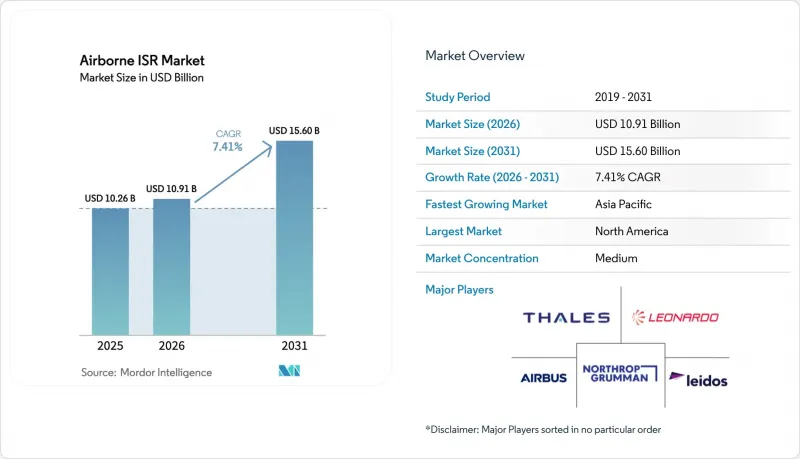
This report is Segmented by Platform Type (Manned, and Unmanned), Application (Overland/Maritime Surveillance, Warfare Mission, Environmental Monitoring, and Search and Rescue), Solution (Systems, and Software), End User (Defense, Homeland Security, and Commercial and Civil), and Geography (North America, Europe, and More). The Market Forecasts are Provided in Terms of Value (USD).
Global Airborne ISR Market Trends and Insights
Accelerating Shift to Multi-INT Sensor Fusion on Open-Architecture Pods
Open-architecture pods that blend EO/IR, SAR, SIGINT, and ELINT streams on a single pylon are displacing monolithic mission systems. L3Harris's SOSA-certified AgilePod, a 450-pound unit that has now exceeded 10,000 flight hours on F-16 and MQ-9 platforms, enables operators to swap sensor loads in under four hours, eliminating weeks-long depot cycles. The US Air Force's Open Mission Systems mandate requires all new airborne ISR market entrants to comply by fiscal 2027, nudging export buyers to follow suit. Smaller nations thus field multi-INT capability without procuring purpose-built SIGINT aircraft, broadening the airborne ISR market's customer base. Modular pods also drive after-sales revenue, as each new sensor cartridge ships with its own software license.
AI-Enabled PED Reducing Tip-to-Product Cycle Below Five Minutes
Machine-learning models now auto-cue targets, classify vehicles, and prioritize frames, collapsing the PED chain from hours to minutes. Project Maven processes full-motion video at 30 frames per second and flags anomalies with 92% accuracy, enabling strike cells to act before adversaries relocate. Northrop Grumman's AI-PED suite trimmed analyst workload by 60% during 2025 Indo-Pacific drills on the RQ-4 Global Hawk, raising mission tempo without additional personnel. These gains justify premium software subscriptions, reinforce platform relevance against space-based substitutes, and underpin a 1.5 percentage-point CAGR uplift across the airborne ISR market.
RF Spectrum Congestion and ITAR Constraints Delaying Export Clearances
The FCC's 2024 C-band auction carved 100 MHz from DoD allocations, forcing ISR datalinks to hop frequencies or accept degraded throughput. Concurrently, ITAR classifies advanced EO/IR sensors and AI-PED software as defense articles, stretching export reviews to as long as 24 months for otherwise close allies. L3Harris disclosed that such delays postponed USD 180 million in international ISR contracts during 2024, driving it to develop downgraded export variants. The result is a 0.8 percentage-point drag on the medium-term growth of the airborne ISR market.
Other drivers and restraints analyzed in the detailed report include:
- DoD Replicator Program Spurring Demand for Attritable ISR Drones
- Geopolitical Flash-Points Fueling an Eight-Year ISR Recapitalization Boom
- Sensor-Grade Semiconductor Shortages Lengthening Lead-Times Beyond 24 Months
For complete list of drivers and restraints, kindly check the Table Of Contents.
Segment Analysis
Manned aircraft maintained 71.17% of airborne ISR revenue in 2025, demonstrating that traditional crewed fleets continue to dominate budgets even as new technologies emerge. The cornerstone platforms are the P-8A Poseidon maritime patrol aircraft and the E-7 Wedgetail airborne early warning jet, both of which have confirmed procurement lines extending into the 2030s. Each airframe carries payloads exceeding 20,000 pounds and can remain on station for well above ten hours, enabling comprehensive anti-submarine sweeps and real-time analysis by onboard mission crews. Because both designs share commercial B737 structures, international operators benefit from global parts inventories and established maintenance networks, locking in multi-year logistics contracts that deliver predictable annual profit streams.
Unmanned systems are projected to post a robust 10.45% CAGR through 2031, gradually reducing the proportional dominance of crewed platforms while pushing total units delivered to new highs. The MQ-9B SkyGuardian exemplifies this trend; priced at roughly one-quarter of a P-8A, it offers 30-hour endurance, satellite-tolerant datalinks, and plug-and-play multi-INT pods compatible with the Replicator initiative's requirement for rapid, low-cost mass production. Parallel Collaborative Combat Aircraft prototypes will act as autonomous wingmen, funneling sensor data directly into the Joint All-Domain Command and Control network to bypass contested air defenses.
Warfare missions remained the economic backbone of airborne ISR in 2025, bringing in 41.80% of total revenue and charting a forward 7.75% CAGR through 2031. Within this domain, P-8A patrols across the Indo-Pacific routinely drop about 400 sonobuoys per sortie, while Northrop Grumman's ALQ-257 pod determines hostile-emitter coordinates in two seconds. High-tempo, sensor-intensive sorties guarantee a steady refresh cycle for radars, processors, and edge-compute hardware. Although traditional overland and maritime surveillance remains the second-largest application, civil uses such as wildfire mapping and search-and-rescue are currently the fastest-growing niches as governments dedicate climate-resilience funding to persistent aerial sensing operations.
The warfare slice is reinforcing its primacy, even amid proliferating low-Earth-orbit (LEO) constellations that challenge traditional surveillance roles. In contrast, applications dominated by routine border observation or economic-zone patrols are growing more slowly, reflecting budget competition from orbital sensors and shifting procurement priorities inside many defense ministries. The divergence highlights a strategic spending pattern: stakeholders allocate premium budgets to mission sets that directly support strike effectiveness, submarine deterrence, and electromagnetic maneuver warfare, while delegating broad-area awareness to less expensive space-based or commercial data services for routine security requirements.
Complete Report Scope:
- By Platform Type
- Manned
- Unmanned
- By Application
- Overland/Maritime Survelliance
- Border Patrol
- ISTAR Operations
- Exclusive Economic Zone (EEZ)
- Warfare Mission
- Anti-Submarine Warfare (ASW) and Anti-Surface Warfare (ASuW)
- Air to Ground Support (AGS)
- Electronic Warfare
- Critical Infrastructure Monitoring
- Environmental Monitoring
- Pollution Monitoring
- Disaster Relief
- Search and Rescue (SAR)
- Maritime SAR
- Land SAR
- Overland/Maritime Survelliance
- By Solution
- Systems
- Software
- By End User
- Defense
- Homeland Security
- Commercial and Civil
- By Geography
- North America
- United States
- Canada
- Mexico
- Europe
- United Kingdom
- Germany
- France
- Italy
- Spain
- Italy
- Russia
- Rest of Europe
- Asia-Pacific
- China
- Japan
- India
- South Korea
- Australia
- Rest of Asia-Pacific
- South America
- Brazil
- Rest of South America
- Middle East and Africa
- Middle East
- Saudi Arabia
- United Arab Emirates
- Israel
- Turkey
- Rest of Middle East
- Africa
- South Africa
- Rest of Africa
- Middle East
- North America
Geography Analysis
North America contributed 34.20% of the 2025 airborne ISR revenue, primarily driven by the United States, which plans to operate 156 P-8A Poseidons by 2030 and has awarded USD 1.5 billion for the development of the Collaborative Combat Aircraft. Canada added 16 Poseidons to replace its CP-140 Aurora patrol planes, while Mexico converted additional King Air 350ERs into ISR (Intelligence, Surveillance, and Reconnaissance) roles to support counternarcotics patrols along the shared border. The regional focus remains on anti-submarine surveillance across the Arctic and Pacific gateways, as well as constant monitoring of drug-trafficking corridors. Extensive industrial bases in Washington, California, and Quebec supply avionics, mission software, and depot maintenance, ensuring that North America retains technological leadership and large sustainment budgets throughout the forecast period.
In Europe, the United Kingdom is phasing in E-7 Wedgetail aircraft to replace aging E-3D Sentry platforms, while Germany has ordered five P-8A Poseidons to retire its veteran P-3C Orion fleet. France is advancing the tri-national Future Combat Air System, integrating stealth fighters with loyal-wingman drones that will share sensor data across secure clouds. Poland, Romania, and the Baltic states continue procuring MQ-9B SkyGuardian systems to monitor Russian troop concentrations, demonstrating alignment between eastern and western members on airborne threat detection. This mix of high-end manned assets and adaptable drones consolidates Europe's medium-term growth trajectory for ISR modernization.
Asia-Pacific posts the highest CAGR of 7.87%, reflecting mounting maritime disputes and rapid force modernization. India's USD 3.5 billion order for six additional P-8I aircraft will enlarge its fleet to 18 for Indian Ocean patrols. At the same time, Japan has allocated USD 2.1 billion to field E-2D Hawkeye and RQ-4 Global Hawk platforms that shadow Chinese carrier strike groups. Australia is introducing MQ-4C Triton drones to ensure persistent coverage of northern sea lanes, and South Korea is procuring high-altitude unmanned systems to monitor missile sites. Nascent operators, such as those in the Philippines, are exploring medium-altitude UAVs for exclusive economic zone surveillance, driving regional market growth.
- Airbus SE
- BAE Systems plc
- The Boeing Company
- Curtiss-Wright Corporation
- Elbit Systems Ltd.
- General Atomics Aeronautical Systems, Inc.
- Bombardier Inc.
- HENSOLDT AG
- Israel Aerospace Industries Ltd.
- L3Harris Technologies, Inc.
- Leonardo S.p.A.
- Lockheed Martin Corporation
- Metrea LLC
- Northrop Grumman Corporation
- AEVEX Aerospace
- Saab AB
- Diamond Aircraft Industries GmbH
- Teledyne Technologies Incorporated
- Textron Inc.
- Thales Group
Additional Benefits:
- The market estimate (ME) sheet in Excel format
- 3 months of analyst support
TABLE OF CONTENTS
1 INTRODUCTION
- 1.1 Study Assumptions and Market Definition
- 1.2 Scope of the Study
2 RESEARCH METHODOLOGY
3 EXECUTIVE SUMMARY
4 MARKET LANDSCAPE
- 4.1 Market Overview
- 4.2 Market Drivers
- 4.2.1 Accelerating shift to multi-INT sensor fusion on open-architecture pods
- 4.2.2 AI-enabled PED reducing tip-to-product cycle below 5 min
- 4.2.3 DoD "Replicator" program spurring demand for attritable ISR drones
- 4.2.4 Geopolitical flash-points fuelling 8-year ISR recapitalisation boom
- 4.2.5 Commercial-satellite data licensing lowering entry barriers for SMEs
- 4.2.6 Defense-cloud zero-trust mandates driving airborne edge-compute retrofits
- 4.3 Market Restraints
- 4.3.1 RF spectrum congestion and ITAR constraints delaying export clearances
- 4.3.2 Sensor-grade semiconductor shortages lengthening lead-times more than 24 months
- 4.3.3 High-altitude balloons and LEO sats emerging as lower-cost substitutes
- 4.3.4 Cyber-hardening mandates adding 12-15 % to sustainment budgets
- 4.4 Value Chain Analysis
- 4.5 Regulatory Landscape
- 4.6 Technological Outlook
- 4.7 Porter's Five Forces Analysis
- 4.7.1 Bargaining Power of Suppliers
- 4.7.2 Bargaining Power of Buyers/Consumers
- 4.7.3 Threat of New Entrants
- 4.7.4 Threat of Substitute Products
- 4.7.5 Intensity of Competitive Rivalry
5 MARKET SIZE AND GROWTH FORECASTS (VALUE)
- 5.1 By Platform Type
- 5.1.1 Manned
- 5.1.2 Unmanned
- 5.2 By Application
- 5.2.1 Overland/Maritime Survelliance
- 5.2.1.1 Border Patrol
- 5.2.1.2 ISTAR Operations
- 5.2.1.3 Exclusive Economic Zone (EEZ)
- 5.2.2 Warfare Mission
- 5.2.2.1 Anti-Submarine Warfare (ASW) and Anti-Surface Warfare (ASuW)
- 5.2.2.2 Air to Ground Support (AGS)
- 5.2.2.3 Electronic Warfare
- 5.2.2.4 Critical Infrastructure Monitoring
- 5.2.3 Environmental Monitoring
- 5.2.3.1 Pollution Monitoring
- 5.2.3.2 Disaster Relief
- 5.2.4 Search and Rescue (SAR)
- 5.2.4.1 Maritime SAR
- 5.2.4.2 Land SAR
- 5.2.1 Overland/Maritime Survelliance
- 5.3 By Solution
- 5.3.1 Systems
- 5.3.2 Software
- 5.4 By End User
- 5.4.1 Defense
- 5.4.2 Homeland Security
- 5.4.3 Commercial and Civil
- 5.5 By Geography
- 5.5.1 North America
- 5.5.1.1 United States
- 5.5.1.2 Canada
- 5.5.1.3 Mexico
- 5.5.2 Europe
- 5.5.2.1 United Kingdom
- 5.5.2.2 Germany
- 5.5.2.3 France
- 5.5.2.4 Italy
- 5.5.2.5 Spain
- 5.5.2.6 Italy
- 5.5.2.7 Russia
- 5.5.2.8 Rest of Europe
- 5.5.3 Asia-Pacific
- 5.5.3.1 China
- 5.5.3.2 Japan
- 5.5.3.3 India
- 5.5.3.4 South Korea
- 5.5.3.5 Australia
- 5.5.3.6 Rest of Asia-Pacific
- 5.5.4 South America
- 5.5.4.1 Brazil
- 5.5.4.2 Rest of South America
- 5.5.5 Middle East and Africa
- 5.5.5.1 Middle East
- 5.5.5.1.1 Saudi Arabia
- 5.5.5.1.2 United Arab Emirates
- 5.5.5.1.3 Israel
- 5.5.5.1.4 Turkey
- 5.5.5.1.5 Rest of Middle East
- 5.5.5.2 Africa
- 5.5.5.2.1 South Africa
- 5.5.5.2.2 Rest of Africa
- 5.5.5.1 Middle East
- 5.5.1 North America
6 COMPETITIVE LANDSCAPE
- 6.1 Market Concentration
- 6.2 Strategic Moves
- 6.3 Market Share Analysis
- 6.4 Company Profiles (includes Global level Overview, Market level overview, Core Segments, Financials, Strategic Info, Market Rank/Share, Products and Services, and Recent Developments)
- 6.4.1 Airbus SE
- 6.4.2 BAE Systems plc
- 6.4.3 The Boeing Company
- 6.4.4 Curtiss-Wright Corporation
- 6.4.5 Elbit Systems Ltd.
- 6.4.6 General Atomics Aeronautical Systems, Inc.
- 6.4.7 Bombardier Inc.
- 6.4.8 HENSOLDT AG
- 6.4.9 Israel Aerospace Industries Ltd.
- 6.4.10 L3Harris Technologies, Inc.
- 6.4.11 Leonardo S.p.A.
- 6.4.12 Lockheed Martin Corporation
- 6.4.13 Metrea LLC
- 6.4.14 Northrop Grumman Corporation
- 6.4.15 AEVEX Aerospace
- 6.4.16 Saab AB
- 6.4.17 Diamond Aircraft Industries GmbH
- 6.4.18 Teledyne Technologies Incorporated
- 6.4.19 Textron Inc.
- 6.4.20 Thales Group
7 MARKET OPPORTUNITIES AND FUTURE OUTLOOK
- 7.1 White-space and Unmet-Need Assessment

