PUBLISHER: MarketsandMarkets | PRODUCT CODE: 2081119
PUBLISHER: MarketsandMarkets | PRODUCT CODE: 2081119
Dental Bone Graft Substitutes Market by Type (Xenograft, Allograft, Synthetic Bone Grafts, Alloplast), Application (Sinus Lift, Ridge Augmentation, Socket Preservation), Product (BioOss, Osteograf, Grafton), End User, Region - Global Forecast to 2031
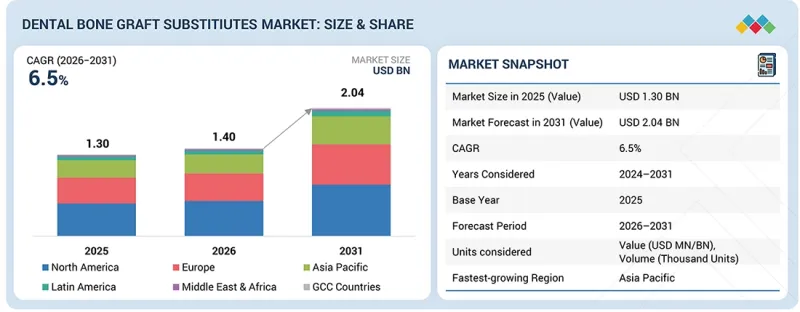
The dental bone graft substitutes market is projected to reach USD 2.04 billion by 2031 from USD 1.40 billion in 2026, at a CAGR of 6.5% during the forecast period.
| Scope of the Report | |
|---|---|
| Years Considered for the Study | 2024-2031 |
| Base Year | 2025 |
| Forecast Period | 2026-2031 |
| Units Considered | Value (USD billion) |
| Segments | Product, Type, Mechanism, Application, End User, and Region |
| Regions covered | North America, Europe, APAC, LATAM, MEA |
The dental bone graft substitutes industry is largely driven by a rising prevalence of dental diseases, such as tooth loss, periodontitis, and maxillofacial defects. This surge has increased the demand for effective bone regeneration solutions. Additionally, the growing popularity of dental implants and advanced restorative materials has significantly increased demand for high-quality graft materials.
Innovations in graft substitutes, such as xenografts, allografts, and synthetic alternatives, have led to better clinical outcomes, greater predictability, and greater convenience, making them the preferred choice among dental practitioners. Furthermore, the growing awareness of oral health among patients and clinicians, along with the expansion of dental facilities and specialized surgical services, has positively impacted market growth.
The combination of clinical needs, technological advancements, and heightened patient awareness is driving the global demand for dental bone graft substitutes.
"By application, resins are expected to hold the largest market share in the dental bone graft substitutes market."
In the dental bone graft substitutes market, the socket preservation segment holds the largest share. This is due to its frequent use during the postoperative period following tooth extractions and its crucial role in preserving alveolar bone stock. After a tooth extraction, rapid bone resorption may eventually necessitate the placement of dental implants. As a result, socket preservation is a viable option within the dental bone graft substitutes market. Dental bone graft substitutes are typically placed immediately after an extraction to stabilize the socket and promote bone formation. Tooth extractions are quite common worldwide for various reasons, including dental caries, periodontal disease, and trauma, underscoring the importance of the socket preservation market. This segment is widely appreciated in the industry for its ease of application and predictable outcomes, making it a favored choice among dentists across specialties.
"By end user, hospitals are expected to hold the largest share in the dental bone graft substitutes market."
In the dental bone graft substitutes market, hospitals hold a significant market share. This is largely due to their established clinical settings and ability to treat a large number of patients while performing various complex dental and oral surgeries. For example, hospitals are equipped to handle cases requiring dental and jaw reconstruction procedures that involve bone grafting substitutes. These cases include dental implant procedures, periodontal treatments, and jaw rebuilding or reconstruction surgeries. Bone graft substitutes are essential for all dental and jaw surgeries, given the high technical and clinical demands of these procedures. Additionally, dental and jaw departments in hospitals are well-established and efficiently managed, thereby enhancing their capacity to use these substitutes effectively. Consequently, hospitals are considered the primary end-user facilities for dental bone substitutes.
"The US is expected to grow at the highest CAGR in the North American dental bone graft substitutes market during the forecast period."
The dental bone graft substitutes market in North America is expected to grow at the highest rate in the US, driven by several key factors. A growing aging population and an increasing prevalence of age-related dental issues, such as tooth loss and periodontitis, are driving the demand for dental substitutes in the country. Additionally, the presence of a favorable dental care infrastructure and a greater acceptance of innovative dental technologies are contributing to the growth of dental bone graft substitutes in America. Furthermore, the rising use of dental procedures like dental implantology, along with increasing awareness of dental and periodontal health among dental surgeons and conscientious consumers, is also supporting the expansion of this market. Collectively, these factors have positioned the US as the leading market for dental bone graft substitutes in North America.
A breakdown of the primary participants (on the supply side) for the dental bone graft substitutes market referenced in this report is provided below:
- By Company Type: Tier 1 (35%), Tier 2 (40%), and Tier 3 (25%)
- By Designation: C-level Executives (45%), Directors (35%), and Others (20%)
- By Region: North America (27%), Europe (25%), Asia Pacific (30%), Latin America (8%), and the Middle East & Africa (10%)
The prominent players in the dental bone graft substitutes market are Dentsply Sirona (US), Envista (US), Johnson & Johnson (US), Institut Straumann AG (Switzerland), Medtronic (Ireland), Zimvie Inc. (US), Henry Schein Inc. (US), RTI Surgical (US), and LifeNet Health (US).
Research Coverage:
The report provides an analysis of the dental bone graft substitutes market, focusing on estimating its size and future growth potential across segments such as product, application, type, mechanism, end user, and region. Additionally, the report features a competitive analysis of key players in the market, including their company profiles, product offerings, recent developments, and key market strategies.
Reasons to Buy the Report
The report provides valuable insights for both market leaders and new entrants in the dental bone graft substitutes market, offering the most accurate revenue estimates. It helps stakeholders understand the competitive landscape, enabling them to better position their businesses and develop effective go-to-market strategies. Additionally, the report highlights key market drivers, restraints, challenges, and opportunities, giving stakeholders a comprehensive understanding of current market trends.
This report provides insights into the following pointers:
- Analysis of key drivers (growing market for dental tourism in emerging countries, increasing disposable income in developing counties, rising cases of dental caries and subsequent increase in tooth repair procedures, and changing demographics), restraints (lack of proper reimbursement scenario, stringent regulations pertaining to medical devices used in dentistry, and dearth of trained dental practitioners), opportunities (increasing demand from customers and rising inclination towards cosmetic dentistry, low penetration rates for dental bone graft substitutes, consolidation of dental practices and rising DSO activity, and growing demand for bone graft substitutes from emerging markets), and challenges (pricing pressure faced by prominent market players).
- Market Penetration: It includes extensive information on the products offered by the major players in the global dental bone graft substitutes market. The report includes various segments, such as products, applications, types, mechanisms, end users, and regions.
- Product Enhancement/Innovation: Comprehensive details about new product launches and anticipated trends in the global dental bone graft substitutes market.
- Market Development: Thorough knowledge and analysis of the profitable rising markets by product, type, mechanism, application, end user, and region.
- Market Diversification: Comprehensive information about newly launched products, expanding markets, current advancements, and investments in the global dental bone graft substitutes market.
- Competitive Assessment: A comprehensive assessment of market shares, growth strategies, product offerings, and capabilities of key competitors in the global dental bone graft substitutes market.
TABLE OF CONTENTS
1 INTRODUCTION
- 1.1 STUDY OBJECTIVES
- 1.2 MARKET DEFINITION
- 1.3 STUDY SCOPE
- 1.3.1 MARKET SEGMENTATION
- 1.3.2 INCLUSIONS AND EXCLUSIONS
- 1.3.3 YEARS CONSIDERED
- 1.3.4 CURRENCY CONSIDERED
- 1.4 KEY STAKEHOLDERS
- 1.5 SUMMARY OF CHANGES
2 EXECUTIVE SUMMARY
- 2.1 KEY MARKET PARTICIPANTS: SHARE INSIGHTS AND MARKET DEVELOPMENTS
- 2.2 DISRUPTIVE TRENDS SHAPING MARKET
- 2.3 HIGH-GROWTH SEGMENTS & EMERGING FRONTIERS
- 2.4 SNAPSHOT: GLOBAL MARKET SIZE, GROWTH RATE, AND FORECAST
3 PREMIUM INSIGHTS
- 3.1 DENTAL BONE GRAFT SUBSTITUTES MARKET OVERVIEW
- 3.2 ASIA PACIFIC: DENTAL BONE GRAFT SUBSTITUTES MARKET, BY TYPE AND COUNTRY, (2025)
- 3.3 DENTAL BONE GRAFT SUBSTITUTES MARKET: GEOGRAPHIC GROWTH OPPORTUNITIES
- 3.4 DENTAL BONE GRAFT SUBSTITUTES MARKET, REGIONAL MIX, 2024-2031
- 3.5 DENTAL BONE GRAFT SUBSTITUTES MARKET: EMERGING VS. DEVELOPED MARKETS
4 MARKET OVERVIEW
- 4.1 INTRODUCTION
- 4.2 MARKET DYNAMICS
- 4.2.1 DRIVERS
- 4.2.1.1 Growth of dental tourism in emerging countries
- 4.2.1.2 Increasing disposable income in developing countries
- 4.2.1.3 Rising cases of dental caries and subsequent increase in tooth repair procedures
- 4.2.1.4 Changing demographics
- 4.2.2 RESTRAINTS
- 4.2.2.1 Lack of proper reimbursement scenario
- 4.2.2.2 Stringent regulations pertaining to medical devices used in dentistry
- 4.2.2.3 Dearth of trained dental practitioners
- 4.2.3 OPPORTUNITIES
- 4.2.3.1 Increasing demand from customers and rising inclination toward cosmetic dentistry
- 4.2.3.2 Consolidation of dental practices and rising DSO activity
- 4.2.3.3 Growing demand for bone graft substitutes from emerging markets
- 4.2.4 CHALLENGES
- 4.2.4.1 Pricing pressure faced by prominent market players
- 4.2.1 DRIVERS
- 4.3 UNMET NEEDS AND WHITE SPACES
- 4.3.1 UNMET NEEDS
- 4.3.2 WHITE SPACE OPPORTUNITIES
- 4.4 INTERCONNECTED MARKETS AND CROSS-SECTOR OPPORTUNITIES
- 4.4.1 INTERCONNECTED MARKETS
- 4.4.2 CROSS-SECTOR OPPORTUNITIES
- 4.5 STRATEGIC MOVES BY TIER- 1/2/3 PLAYERS
5 INDUSTRY TRENDS
- 5.1 PORTER'S FIVE FORCES ANALYSIS
- 5.1.1 THREAT OF NEW ENTRANTS
- 5.1.2 THREAT OF SUBSTITUTES
- 5.1.3 BARGAINING POWER OF SUPPLIERS
- 5.1.4 BARGAINING POWER OF BUYERS
- 5.1.5 INTENSITY OF COMPETITIVE RIVALRY
- 5.2 MACROECONOMIC OUTLOOK
- 5.2.1 INTRODUCTION
- 5.2.2 GDP TRENDS AND FORECAST
- 5.2.3 TRENDS IN DENTAL BONE GRAFT SUBSTITUTES MARKET
- 5.3 VALUE CHAIN ANALYSIS
- 5.4 SUPPLY CHAIN ANALYSIS
- 5.5 ECOSYSTEM ANALYSIS
- 5.6 PRICING ANALYSIS
- 5.6.1 AVERAGE SELLING PRICE TREND, BY KEY PLAYER, 2023-2025
- 5.6.2 AVERAGE SELLING PRICE TREND, BY REGION, 2023-2025
- 5.7 TRADE ANALYSIS
- 5.7.1 IMPORT DATA FOR HS CODE 3006
- 5.7.2 EXPORT DATA FOR HS CODE 3006
- 5.8 KEY CONFERENCES AND EVENTS, 2026-2027
- 5.9 CASE STUDY ANALYSIS
- 5.9.1 CASE STUDY 1: SINUS FLOOR ELEVATION AND RIDGE AUGMENTATION USING GEISTLICH BIO-OSS
- 5.9.2 CASE STUDY 2: RIDGE PRESERVATION AND BONE REGENERATION USING NOVABONE DENTAL PUTTY
- 5.10 INVESTMENT AND FUNDING SCENARIO
- 5.11 IMPACT OF US TARIFFS-DENTAL BONE GRAFT SUBSTITUTES MARKET
- 5.11.1 INTRODUCTION
- 5.11.2 KEY TARIFF RATES
- 5.11.3 PRICE IMPACT ANALYSIS
- 5.11.4 IMPACT ON COUNTRIES/REGIONS
- 5.11.4.1 US
- 5.11.4.2 Europe
- 5.11.4.3 Asia Pacific
- 5.11.5 IMPACT ON END-USER INDUSTRIES
6 TECHNOLOGICAL ADVANCEMENTS, AI-DRIVEN IMPACT, PATENTS, INNOVATIONS, AND FUTURE APPLICATIONS
- 6.1 KEY EMERGING TECHNOLOGIES
- 6.1.1 GROWTH FACTOR-ENHANCED BONE GRAFTS
- 6.1.2 SYNTHETIC BIOMIMETIC BONE GRAFT MATERIALS
- 6.1.3 GUIDED BONE REGENERATION TECHNOLOGY
- 6.2 COMPLEMENTARY TECHNOLOGIES
- 6.2.1 BARRIER MEMBRANE TECHNOLOGY
- 6.2.2 TITANIUM MESH TECHNOLOGY
- 6.3 ADJACENT TECHNOLOGIES
- 6.3.1 COMPUTER-GUIDED IMPLANT PLANNING SOFTWARE
- 6.3.2 CONE-BEAM COMPUTED TOMOGRAPHY
- 6.4 TECHNOLOGY/PRODUCT ROADMAP
- 6.4.1 SHORT-TERM | RECENT TECHNOLOGIES| FOUNDATION & EARLY COMMERCIALIZATION
- 6.4.2 MID-TERM (2027-2030) | EXPANSION & STANDARDIZATION
- 6.4.3 LONG-TERM (2030-2035+) | MASS COMMERCIALIZATION & DISRUPTION
- 6.5 PATENT ANALYSIS
- 6.5.1 PATENT PUBLICATION TRENDS
- 6.5.2 JURISDICTION ANALYSIS
- 6.6 IMPACT OF AI/GEN AI ON DENTAL BONE GRAFT SUBSTITUTES MARKET
- 6.6.1 TOP USE CASES AND MARKET POTENTIAL
- 6.6.2 INTERCONNECTED ADJACENT ECOSYSTEMS AND IMPACT ON MARKET PLAYERS
- 6.6.3 CLIENTS' READINESS TO ADOPT GENERATIVE AI IN DENTAL BONE GRAFT SUBSTITUTES MARKET
- 6.7 SUCCESS STORIES AND REAL-WORLD APPLICATIONS
- 6.7.1 INSTITUT STRAUMANN/BOTISS: CAD/CAM CUSTOMIZED BONE BLOCK FOR RIDGE AUGMENTATION
- 6.7.2 DENTSPLY SIRONA: AI-POWERED DIGITAL WORKFLOW WITH SYMBIOS REGENERATIVE PORTFOLIO
7 REGULATORY LANDSCAPE
- 7.1 REGIONAL REGULATIONS AND COMPLIANCE
- 7.1.1 REGULATORY BODIES, GOVERNMENT AGENCIES, AND OTHER ORGANIZATIONS
- 7.1.2 INDUSTRY STANDARDS
- 7.1.2.1 North America
- 7.1.2.1.1 US
- 7.1.2.1.2 Canada
- 7.1.2.2 Europe
- 7.1.2.3 Asia Pacific
- 7.1.2.3.1 China
- 7.1.2.3.2 Japan
- 7.1.2.4 Latin America
- 7.1.2.4.1 Brazil
- 7.1.2.4.2 Mexico
- 7.1.2.5 Middle East
- 7.1.2.6 Africa
- 7.1.2.1 North America
- 7.2 CERTIFICATIONS, LABELING, AND ECO-STANDARDS
8 CUSTOMER LANDSCAPE & BUYER BEHAVIOR
- 8.1 DECISION-MAKING PROCESS
- 8.2 KEY STAKEHOLDERS INVOLVED IN BUYING PROCESS AND THEIR EVALUATION CRITERIA
- 8.2.1 KEY STAKEHOLDERS IN BUYING PROCESS
- 8.2.2 BUYING CRITERIA
- 8.3 ADOPTION BARRIERS & INTERNAL CHALLENGES
- 8.4 UNMET NEEDS FROM VARIOUS END-USE INDUSTRIES
9 DENTAL BONE GRAFT SUBSTITUTES MARKET, BY TYPE
- 9.1 INTRODUCTION
- 9.2 SYNTHETIC BONE GRAFTS
- 9.2.1 INCREASING TECHNOLOGICAL ADVANCEMENTS TO DRIVE ADOPTION OF SYNTHETIC BONE GRAFTS
- 9.3 XENOGRAFTS
- 9.3.1 RISING ADOPTION OF ADVANCED XENOGRAFT MATERIALS SUPPORTED BY TECHNOLOGICAL IMPROVEMENTS TO DRIVE MARKET
- 9.4 ALLOGRAFTS
- 9.4.1 GROWING PREFERENCE FOR ALLOGRAFTS DUE TO REDUCED SURGICAL BURDEN
- 9.4.2 DEMINERALIZED BONE MATRIX
- 9.4.2.1 Demineralized bone possesses more osteoinductive properties
- 9.4.3 OTHER ALLOGRAFTS
- 9.5 OTHER DENTAL BONE GRAFT SUBSTITUTES
10 DENTAL BONE GRAFT SUBSTITUTES MARKET, BY APPLICATION
- 10.1 INTRODUCTION
- 10.2 SOCKET PRESERVATION
- 10.2.1 SOCKET PRESERVATION REDUCES BONE LOSS AFTER TOOTH EXTRACTION
- 10.3 RIDGE AUGMENTATION
- 10.3.1 RIDGE AUGMENTATION RECREATES NATURAL CONTOUR OF GUMS AND JAW
- 10.4 PERIODONTAL DEFECT REGENERATION
- 10.4.1 CHANGES IN LIFESTYLE AND EATING HABITS TO LEAD TO USE OF DENTAL BONE GRAFT SUBSTITUTES FOR PERIODONTAL DEFECT REGENERATION
- 10.5 IMPLANT BONE REGENERATION
- 10.5.1 UTILIZATION OF GUIDED BONE REGENERATION MEMBRANES FACILITATES HEALING OF GRAFTED MATERIAL
- 10.6 SINUS LIFT
- 10.6.1 SINUS AUGMENTATION RAISES SINUS FLOOR AND DEVELOPS BONE FOR PLACEMENT OF DENTAL IMPLANTS
11 DENTAL BONE GRAFT SUBSTITUTES MARKET, BY MECHANISM
- 11.1 INTRODUCTION
- 11.2 OSTEOCONDUCTION
- 11.2.1 OSTEOCONDUCTION SERVES AS A SCAFFOLD FOR BONE CELLS TO ATTACH, MIGRATE, GROW, AND DIVIDE
- 11.3 OSTEOINDUCTION
- 11.3.1 OSTEOINDUCTION FACILITATES BONE HEALING PROCESS
- 11.4 OSTEOPROMOTION
- 11.4.1 OSTEOPROMOTION INVOLVES ENHANCEMENT OF OSTEOINDUCTION WITHOUT POSSESSION OF OSTEOINDUCTIVE PROPERTIES
- 11.5 OSTEOGENESIS
- 11.5.1 OSTEOGENESIS PLAYS CRUCIAL ROLE IN FACILITATING SUCCESSFUL BONE REGENERATION AND REPAIR
12 DENTAL BONE GRAFT SUBSTITUTES MARKET, BY END USER
- 12.1 INTRODUCTION
- 12.2 DENTAL HOSPITALS
- 12.2.1 INCREASING NUMBER OF COSMETIC DENTISTRY PROCEDURES ACROSS DENTAL HOSPITALS TO DRIVE MARKET GROWTH
- 12.3 DENTAL CLINICS
- 12.3.1 EASY ACCESS AND AVAILABILITY OF HIGH-QUALITY SERVICES TO DRIVE MARKET GROWTH
- 12.4 OTHER END USERS
13 DENTAL BONE GRAFT SUBSTITUTES MARKET, BY REGION
- 13.1 INTRODUCTION
- 13.2 NORTH AMERICA
- 13.2.1 MACROECONOMIC OUTLOOK FOR NORTH AMERICA
- 13.2.2 US
- 13.2.2.1 Increasing patient awareness about advantages of dental bone graft substitutes over traditional treatments to boost growth
- 13.2.3 CANADA
- 13.2.3.1 Rising geriatric population to propel market expansion
- 13.3 EUROPE
- 13.3.1 MACROECONOMIC OUTLOOK FOR EUROPE
- 13.3.2 GERMANY
- 13.3.2.1 Country's robust health insurance system to drive popularity of dental bone graft substitutes
- 13.3.3 UK
- 13.3.3.1 Preference for costly procedures due to the availability of reimbursement facilities to lead to potential growth
- 13.3.4 FRANCE
- 13.3.4.1 Rising awareness among people regarding benefits of dental bone graft substitutes and presence of major players to drive growth
- 13.3.5 ITALY
- 13.3.5.1 Intensive R&D and use of sophisticated materials to manufacture advanced products to propel market
- 13.3.6 SPAIN
- 13.3.6.1 Government initiatives to provide dental cover to people to boost market
- 13.3.7 REST OF EUROPE
- 13.4 ASIA PACIFIC
- 13.4.1 MACROECONOMIC OUTLOOK FOR ASIA PACIFIC
- 13.4.2 JAPAN
- 13.4.2.1 Increasing awareness, availability of reimbursement, and growing income levels to offer growth opportunities for market players
- 13.4.3 CHINA
- 13.4.3.1 Growing geriatric population, economic boom, and increasing per capita income to propel growth
- 13.4.4 INDIA
- 13.4.4.1 Diverse, lucrative opportunities offered to dental product and service providers to ensure adequate market progress
- 13.4.5 AUSTRALIA
- 13.4.5.1 Popularity of xenograft and allograft to open new opportunities for growth of market players
- 13.4.6 SOUTH KOREA
- 13.4.6.1 Rising geriatric population and medical tourism to drive market
- 13.4.7 REST OF ASIA PACIFIC
- 13.5 LATIN AMERICA
- 13.5.1 MACROECONOMIC OUTLOOK FOR LATIN AMERICA
- 13.5.2 BRAZIL
- 13.5.2.1 Improving healthcare infrastructure and rising investments by leading players to spur demand
- 13.5.3 MEXICO
- 13.5.3.1 Rising medical tourism to support market growth
- 13.5.4 ARGENTINA
- 13.5.4.1 Growing demand for personalized dentistry to spur market demand
- 13.5.5 REST OF LATIN AMERICA
- 13.6 MIDDLE EAST & AFRICA
- 13.6.1 GROWING INVESTMENTS IN DIGITAL HEALTHCARE INDUSTRY TO BOOST DEMAND FOR DENTAL BONE GRAFT SUBSTITUTES
- 13.6.2 MACROECONOMIC OUTLOOK FOR MIDDLE EAST & AFRICA
- 13.7 GCC COUNTRIES
- 13.7.1 INCREASING DEMAND FOR HEALTH SERVICES DUE TO POPULATION GROWTH TO DRIVE MARKET FOR DENTAL BONE GRAFT SUBSTITUTES
- 13.7.2 MACROECONOMIC OUTLOOK FOR GCC COUNTRIES
14 COMPETITIVE LANDSCAPE
- 14.1 INTRODUCTION
- 14.2 KEY PLAYER STRATEGIES/RIGHT TO WIN
- 14.2.1 OVERVIEW OF STRATEGIES ADOPTED BY KEY PLAYERS IN DENTAL BONE GRAFT SUBSTITUTES MARKET
- 14.3 REVENUE ANALYSIS
- 14.4 MARKET SHARE ANALYSIS (2025)
- 14.5 COMPANY VALUATION AND FINANCIAL METRICS
- 14.5.1 COMPANY VALUATION
- 14.5.2 FINANCIAL METRICS
- 14.6 BRAND/PRODUCT COMPARISON
- 14.7 COMPANY EVALUATION MATRIX: KEY PLAYERS, 2025
- 14.7.1 STARS
- 14.7.2 EMERGING LEADERS
- 14.7.3 PERVASIVE PLAYERS
- 14.7.4 PARTICIPANTS
- 14.7.5 COMPANY FOOTPRINT (KEY PLAYERS), 2025
- 14.7.5.1 Company footprint
- 14.7.5.2 Region footprint
- 14.7.5.3 Type footprint
- 14.7.5.4 APPLICATION Footprint
- 14.7.5.5 Mechanism Footprint
- 14.7.5.6 End-user footprint
- 14.8 COMPANY EVALUATION MATRIX: STARTUPS/SMES (2025)
- 14.8.1 PROGRESSIVE COMPANIES
- 14.8.2 RESPONSIVE COMPANIES
- 14.8.3 DYNAMIC COMPANIES
- 14.8.4 STARTING BLOCKS
- 14.8.5 COMPETITIVE BENCHMARKING: STARTUPS/SMES, 2025
- 14.8.5.1 Detailed list of key startups/SMEs
- 14.8.5.2 Competitive benchmarking of startups/SMEs
- 14.9 R&D EXPENDITURE OF KEY PLAYERS (DENTAL BONE GRAFT SUBSTITUTES MARKET)
- 14.10 COMPETITIVE SCENARIO
- 14.10.1 PRODUCT LAUNCHES AND APPROVALS
- 14.10.2 DEALS
- 14.10.3 EXPANSIONS
- 14.10.4 OTHER DEVELOPMENTS
15 COMPANY PROFILES
- 15.1 KEY PLAYERS
- 15.1.1 DENTSPLY SIRONA INC.
- 15.1.1.1 Business overview
- 15.1.1.2 Products offered
- 15.1.1.3 Recent developments
- 15.1.1.3.1 Product launches and approvals
- 15.1.1.3.2 Deals
- 15.1.1.4 MnM view
- 15.1.1.4.1 Right to win
- 15.1.1.4.2 Strategic choices
- 15.1.1.4.3 Weaknesses and competitive threats
- 15.1.2 ENVISTA
- 15.1.2.1 Business overview
- 15.1.2.2 Products offered
- 15.1.2.3 Recent developments
- 15.1.2.3.1 Deals
- 15.1.2.3.2 Expansions
- 15.1.2.4 MnM view
- 15.1.2.4.1 Right to win
- 15.1.2.4.2 Strategic choices
- 15.1.2.4.3 Weaknesses and competitive threats
- 15.1.3 INSTITUT STRAUMANN AG
- 15.1.3.1 Business overview
- 15.1.3.2 Products offered
- 15.1.3.3 Recent developments
- 15.1.3.3.1 Deals
- 15.1.3.3.2 Expansions
- 15.1.3.4 MnM view
- 15.1.3.4.1 Right to win
- 15.1.3.4.2 Strategic choices
- 15.1.3.4.3 Weaknesses and competitive threats
- 15.1.4 ADVANCED MEDICAL SOLUTIONS GROUP PLC
- 15.1.4.1 Business overview
- 15.1.4.2 Products offered
- 15.1.4.3 Recent developments
- 15.1.4.3.1 Deals
- 15.1.5 ZIMVIE INC.
- 15.1.5.1 Business overview
- 15.1.5.2 Products offered
- 15.1.5.3 Recent developments
- 15.1.5.3.1 Product launches and approvals
- 15.1.5.3.2 Deals
- 15.1.6 HENRY SCHEIN, INC.
- 15.1.6.1 Business overview
- 15.1.6.2 Products offered
- 15.1.6.3 Recent developments
- 15.1.6.3.1 Deals
- 15.1.6.3.2 Expansions
- 15.1.6.4 MnM view
- 15.1.6.4.1 Right to win
- 15.1.6.4.2 Strategic choices
- 15.1.6.4.3 Weaknesses and competitive threats
- 15.1.7 EVERGEN (FORMERLY RTI SURGICAL)
- 15.1.7.1 Business overview
- 15.1.7.2 Products offered
- 15.1.7.3 Recent developments
- 15.1.7.3.1 Deals
- 15.1.7.3.2 Other developments
- 15.1.8 LIFENET HEALTH
- 15.1.8.1 Business overview
- 15.1.8.2 Products offered
- 15.1.8.3 Recent developments
- 15.1.8.3.1 Product launches and approvals
- 15.1.8.3.2 Deals
- 15.1.9 NOVABONE
- 15.1.9.1 Business overview
- 15.1.9.2 Products offered
- 15.1.9.3 Recent developments
- 15.1.9.3.1 Product launches and approvals
- 15.1.9.3.2 Deals
- 15.1.10 GEISTLICH PHARMA AG
- 15.1.10.1 Business overview
- 15.1.10.2 Products offered
- 15.1.10.3 Recent developments
- 15.1.10.3.1 Deals
- 15.1.10.3.2 Other developments
- 15.1.1 DENTSPLY SIRONA INC.
- 15.2 OTHER PLAYERS
- 15.2.1 BOTISS BIOMATERIALS GMBH
- 15.2.2 REGENITY
- 15.2.3 OSTEOGENIC BIOMEDICAL
- 15.2.4 HANNOX INTERNATIONAL CORP
- 15.2.5 KEYSTONE DENTAL GROUP
- 15.2.6 YOUNG INNOVATIONS INC
- 15.2.7 BEGO GMBH &CO.KG
- 15.2.8 TISSUE REGENIX GROUP
- 15.2.9 DENTIUM CO., LTD
- 15.2.10 MEDBONE
- 15.2.11 PURGO BIOLOGICS INC
- 15.2.12 REGEDENT AG
- 15.2.13 TECNOSS DENTAL SRL
- 15.2.14 SIGMAGRAFT BIOMATERIALS
- 15.2.15 CITAGENIX
16 RESEARCH METHODOLOGY
- 16.1 RESEARCH DATA
- 16.1.1 SECONDARY DATA
- 16.1.1.1 Key data from secondary sources
- 16.1.2 PRIMARY DATA
- 16.1.2.1 Key data from primary sources
- 16.1.2.2 Key industry insights
- 16.1.1 SECONDARY DATA
- 16.2 MARKET SIZE ESTIMATION
- 16.3 MARKET BREAKDOWN AND DATA TRIANGULATION
- 16.4 MARKET SHARE ESTIMATION
- 16.5 RESEARCH ASSUMPTIONS
- 16.6 RESEARCH LIMITATIONS
- 16.6.1 SCOPE-RELATED LIMITATIONS
- 16.6.2 METHODOLOGY-RELATED LIMITATIONS
- 16.7 RISK ASSESSMENT
17 APPENDIX
- 17.1 DISCUSSION GUIDE
- 17.2 KNOWLEDGESTORE: MARKETSANDMARKETS' SUBSCRIPTION PORTAL
- 17.3 CUSTOMIZATION OPTIONS
- 17.4 RELATED REPORTS
- 17.5 AUTHOR DETAILS
List of Tables
- TABLE 1 STANDARD CURRENCY CONVERSION RATES, 2018-2022
- TABLE 2 DENTAL BONE GRAFT SUBSTITUTES MARKET: UNMET NEEDS
- TABLE 3 DENTAL BONE GRAFT SUBSTITUTES MARKET: PORTER'S FIVE FORCES ANALYSIS
- TABLE 4 GDP PERCENTAGE CHANGE, BY KEY COUNTRIES, 2021-2030
- TABLE 5 AVERAGE SELLING PRICE TREND OF DENTAL BONE GRAFT SUBSTITUTES, BY KEY PLAYER, 2023-2025
- TABLE 6 AVERAGE SELLING PRICE TREND OF XENOGRAFTS, BY REGION, 2023-2025
- TABLE 7 AVERAGE SELLING PRICE TREND OF ALLOGRAFTS, BY REGION, 2023-2025
- TABLE 8 IMPORT DATA FOR DENTAL BONE GRAFT SUBSTITUTE PRODUCTS (HS CODE 3006), BY COUNTRY, 2021-2025 (USD THOUSAND)
- TABLE 9 EXPORT DATA FOR DENTAL BONE GRAFT SUBSTITUTE PRODUCTS (HS CODE 3006), BY COUNTRY, 2021-2025 (USD THOUSAND)
- TABLE 10 DENTAL BONE GRAFT SUBSTITUTES MARKET: KEY CONFERENCES AND EVENTS, 2025-2026
- TABLE 11 US ADJUSTED RECIPROCAL TARIFF RATES
- TABLE 12 DENTAL BONE GRAFT SUBSTITUTES MARKET: INNOVATIONS AND PATENT REGISTRATIONS, 2023-2025
- TABLE 13 TOP USE CASES AND MARKET POTENTIAL
- TABLE 14 INTERCONNECTED ADJACENT ECOSYSTEMS AND IMPACT ON MARKET PLAYERS
- TABLE 15 NORTH AMERICA: LIST OF REGULATORY BODIES, GOVERNMENT AGENCIES, AND OTHER ORGANIZATIONS
- TABLE 16 EUROPE: LIST OF REGULATORY BODIES, GOVERNMENT AGENCIES, AND OTHER ORGANIZATIONS
- TABLE 17 ASIA PACIFIC: LIST OF REGULATORY BODIES, GOVERNMENT AGENCIES, AND OTHER ORGANIZATIONS
- TABLE 18 LATIN AMERICA: LIST OF REGULATORY BODIES, GOVERNMENT AGENCIES, AND OTHER ORGANIZATIONS
- TABLE 19 MIDDLE EAST & AFRICA: REGULATORY BODIES, GOVERNMENT AGENCIES, AND OTHER ORGANIZATIONS
- TABLE 20 CERTIFICATIONS, LABELING, ECO-STANDARDS IN DENTAL BONE GRAFT SUBSTITUTES MARKET
- TABLE 21 INFLUENCE OF STAKEHOLDERS ON BUYING PROCESS FOR TOP THREE APPLICATIONS
- TABLE 22 KEY BUYING CRITERIA FOR TOP THREE END USERS
- TABLE 23 DENTAL BONE GRAFT SUBSTITUTES MARKET: UNMET NEEDS/ END-USER EXPECTATIONS
- TABLE 24 DENTAL BONE GRAFT SUBSTITUTES MARKET, BY TYPE, 2024-2031 (USD MILLION)
- TABLE 25 SYNTHETIC BONE GRAFTS MARKET, BY COUNTRY, 2024-2031 (USD MILLION)
- TABLE 26 XENOGRAFTS MARKET, BY COUNTRY, 2024-2031 (USD MILLION)
- TABLE 27 XENOGRAFTS MARKET, BY REGION, 2024-2031 (THOUSAND UNITS)
- TABLE 28 ALLOGRAFTS MARKET, BY TYPE, 2024-2031 (USD MILLION)
- TABLE 29 ALLOGRAFTS MARKET, BY COUNTRY, 2024-2031 (USD MILLION)
- TABLE 30 ALLOGRAFTS MARKET, BY REGION, 2024-2031 (THOUSAND UNITS)
- TABLE 31 DEMINERALIZED BONE MATRIX MARKET, BY COUNTRY, 2024-2031 (USD MILLION)
- TABLE 32 OTHER ALLOGRAFTS MARKET, BY COUNTRY, 2024-2031 (USD MILLION)
- TABLE 33 OTHER DENTAL BONE GRAFT SUBSTITUTES MARKET, BY COUNTRY, 2024-2031 (USD MILLION)
- TABLE 34 DENTAL BONE GRAFT SUBSTITUTES MARKET, BY APPLICATION, 2024-2031 (USD MILLION)
- TABLE 35 DENTAL BONE GRAFT SUBSTITUTES MARKET FOR SOCKET PRESERVATION, BY COUNTRY, 2024-2031 (USD MILLION)
- TABLE 36 DENTAL BONE GRAFT SUBSTITUTES MARKET FOR RIDGE AUGMENTATION, BY COUNTRY, 2024-2031 (USD MILLION)
- TABLE 37 DENTAL BONE GRAFT SUBSTITUTES MARKET FOR PERIODONTAL DEFECT REGENERATION, BY COUNTRY, 2024-2031 (USD MILLION)
- TABLE 38 DENTAL BONE GRAFT SUBSTITUTES MARKET FOR IMPLANT BONE REGENERATION, BY COUNTRY, 2024-2031 (USD MILLION)
- TABLE 39 DENTAL BONE GRAFT SUBSTITUTES MARKET FOR SINUS LIFT, BY COUNTRY, 2024-2031 (USD MILLION)
- TABLE 40 DENTAL BONE GRAFT SUBSTITUTES MARKET, BY MECHANISM, 2024-2031 (USD MILLION)
- TABLE 41 DENTAL BONE GRAFT SUBSTITUTES MARKET FOR OSTEOCONDUCTION, BY COUNTRY, 2024-2031 (USD MILLION)
- TABLE 42 DENTAL BONE GRAFT SUBSTITUTES MARKET FOR OSTEOINDUCTION, BY COUNTRY, 2024-2031 (USD MILLION)
- TABLE 43 DENTAL BONE GRAFT SUBSTITUTES MARKET FOR OSTEOPROMOTION, BY COUNTRY, 2024-2031 (USD MILLION)
- TABLE 44 DENTAL BONE GRAFT SUBSTITUTES MARKET FOR OSTEOGENESIS, BY COUNTRY, 2024-2031 (USD MILLION)
- TABLE 45 DENTAL BONE GRAFT SUBSTITUTES MARKET, BY END USER, 2024-2031 (USD MILLION)
- TABLE 46 DENTAL BONE GRAFT SUBSTITUTES MARKET FOR DENTAL HOSPITALS, BY COUNTRY, 2024-2031 (USD MILLION)
- TABLE 47 DENTAL BONE GRAFT SUBSTITUTES MARKET FOR DENTAL CLINICS, BY COUNTRY, 2024-2031 (USD MILLION)
- TABLE 48 DENTAL BONE GRAFT SUBSTITUTES MARKET FOR OTHER END USERS, BY COUNTRY, 2024-2031 (USD MILLION)
- TABLE 49 DENTAL BONE GRAFT SUBSTITUTES MARKET, BY REGION, 2024-2031 (USD MILLION)
- TABLE 50 NORTH AMERICA: DENTAL BONE GRAFT SUBSTITUTES MARKET, BY COUNTRY, 2024-2031 (USD MILLION)
- TABLE 51 NORTH AMERICA: DENTAL BONE GRAFT SUBSTITUTES MARKET, BY TYPE, 2024-2031 (USD MILLION)
- TABLE 52 NORTH AMERICA: ALLOGRAFTS MARKET, BY TYPE, 2024-2031 (USD MILLION)
- TABLE 53 NORTH AMERICA: DENTAL BONE GRAFT SUBSTITUTES MARKET, BY APPLICATION, 2024-2031 (USD MILLION)
- TABLE 54 NORTH AMERICA: DENTAL BONE GRAFT SUBSTITUTES MARKET, BY MECHANISM, 2024-2031 (USD MILLION)
- TABLE 55 NORTH AMERICA: DENTAL BONE GRAFT SUBSTITUTES MARKET, BY END USER, 2024-2031 (USD MILLION)
- TABLE 56 US: DENTAL BONE GRAFT SUBSTITUTES MARKET, BY TYPE, 2024-2031 (USD MILLION)
- TABLE 57 US: ALLOGRAFTS MARKET, BY TYPE, 2024-2031 (USD MILLION)
- TABLE 58 US: DENTAL BONE GRAFT SUBSTITUTES MARKET, BY APPLICATION, 2024-2031 (USD MILLION)
- TABLE 59 US: DENTAL BONE GRAFT SUBSTITUTES MARKET, BY MECHANISM, 2024-2031 (USD MILLION)
- TABLE 60 US: DENTAL BONE GRAFT SUBSTITUTES MARKET, BY END USER, 2024-2031 (USD MILLION)
- TABLE 61 CANADA: DENTAL BONE GRAFT SUBSTITUTES MARKET, BY TYPE, 2024-2031 (USD MILLION)
- TABLE 62 CANADA: ALLOGRAFTS MARKET, BY TYPE, 2024-2031 (USD MILLION)
- TABLE 63 CANADA: DENTAL BONE GRAFT SUBSTITUTES MARKET, BY APPLICATION, 2024-2031 (USD MILLION)
- TABLE 64 CANADA: DENTAL BONE GRAFT SUBSTITUTES MARKET, BY MECHANISM, 2024-2031 (USD MILLION)
- TABLE 65 CANADA: DENTAL BONE GRAFT SUBSTITUTES MARKET, BY END USER, 2024-2031 (USD MILLION)
- TABLE 66 EUROPE: DENTAL BONE GRAFT SUBSTITUTES MARKET, BY COUNTRY, 2024-2031 (USD MILLION)
- TABLE 67 EUROPE: DENTAL BONE GRAFT SUBSTITUTES MARKET, BY TYPE, 2024-2031 (USD MILLION)
- TABLE 68 EUROPE: ALLOGRAFTS MARKET, BY TYPE, 2024-2031 (USD MILLION)
- TABLE 69 EUROPE: DENTAL BONE GRAFT SUBSTITUTES MARKET, BY APPLICATION, 2024-2031 (USD MILLION)
- TABLE 70 EUROPE: DENTAL BONE GRAFT SUBSTITUTES MARKET, BY MECHANISM, 2024-2031 (USD MILLION)
- TABLE 71 EUROPE: DENTAL BONE GRAFT SUBSTITUTES MARKET, BY END USER, 2024-2031 (USD MILLION)
- TABLE 72 GERMANY: DENTAL BONE GRAFT SUBSTITUTES MARKET, BY TYPE, 2024-2031 (USD MILLION)
- TABLE 73 GERMANY: ALLOGRAFTS MARKET, BY TYPE, 2024-2031 (USD MILLION)
- TABLE 74 GERMANY: DENTAL BONE GRAFT SUBSTITUTES MARKET, BY APPLICATION, 2024-2031 (USD MILLION)
- TABLE 75 GERMANY: DENTAL BONE GRAFT SUBSTITUTES MARKET, BY MECHANISM, 2024-2031 (USD MILLION)
- TABLE 76 GERMANY: DENTAL BONE GRAFT SUBSTITUTES MARKET, BY END USER, 2024-2031 (USD MILLION)
- TABLE 77 UK: DENTAL BONE GRAFT SUBSTITUTES MARKET, BY TYPE, 2024-2031 (USD MILLION)
- TABLE 78 UK: ALLOGRAFTS MARKET, BY TYPE, 2024-2031 (USD MILLION)
- TABLE 79 UK: DENTAL BONE GRAFT SUBSTITUTES MARKET, BY APPLICATION, 2024-2031 (USD MILLION)
- TABLE 80 UK: DENTAL BONE GRAFT SUBSTITUTES MARKET, BY MECHANISM, 2024-2031 (USD MILLION)
- TABLE 81 UK: DENTAL BONE GRAFT SUBSTITUTES MARKET, BY END USER, 2024-2031 (USD MILLION)
- TABLE 82 FRANCE: DENTAL BONE GRAFT SUBSTITUTES MARKET, BY TYPE, 2024-2031 (USD MILLION)
- TABLE 83 FRANCE: ALLOGRAFTS MARKET, BY TYPE, 2024-2031 (USD MILLION)
- TABLE 84 FRANCE: DENTAL BONE GRAFT SUBSTITUTES MARKET, BY APPLICATION, 2024-2031 (USD MILLION)
- TABLE 85 FRANCE: DENTAL BONE GRAFT SUBSTITUTES MARKET, BY MECHANISM, 2024-2031 (USD MILLION)
- TABLE 86 FRANCE: DENTAL BONE GRAFT SUBSTITUTES MARKET, BY END USER, 2024-2031 (USD MILLION)
- TABLE 87 ITALY: DENTAL BONE GRAFT SUBSTITUTES MARKET, BY TYPE, 2024-2031 (USD MILLION)
- TABLE 88 ITALY: ALLOGRAFTS MARKET, BY TYPE, 2024-2031 (USD MILLION)
- TABLE 89 ITALY: DENTAL BONE GRAFT SUBSTITUTES MARKET, BY APPLICATION, 2024-2031 (USD MILLION)
- TABLE 90 ITALY: DENTAL BONE GRAFT SUBSTITUTES MARKET, BY MECHANISM, 2024-2031 (USD MILLION)
- TABLE 91 ITALY: DENTAL BONE GRAFT SUBSTITUTES MARKET, BY END USER, 2024-2031 (USD MILLION)
- TABLE 92 SPAIN: DENTAL BONE GRAFT SUBSTITUTES MARKET, BY TYPE, 2024-2031 (USD MILLION)
- TABLE 93 SPAIN: ALLOGRAFTS MARKET, BY TYPE, 2024-2031 (USD MILLION)
- TABLE 94 SPAIN: DENTAL BONE GRAFT SUBSTITUTES MARKET, BY APPLICATION, 2024-2031 (USD MILLION)
- TABLE 95 SPAIN: DENTAL BONE GRAFT SUBSTITUTES MARKET, BY MECHANISM, 2024-2031 (USD MILLION)
- TABLE 96 SPAIN: DENTAL BONE GRAFT SUBSTITUTES MARKET, BY END USER, 2024-2031 (USD MILLION)
- TABLE 97 REST OF EUROPE: DENTAL BONE GRAFT SUBSTITUTES MARKET, BY TYPE, 2024-2031 (USD MILLION)
- TABLE 98 REST OF EUROPE: ALLOGRAFTS MARKET, BY TYPE, 2024-2031 (USD MILLION)
- TABLE 99 REST OF EUROPE: DENTAL BONE GRAFT SUBSTITUTES MARKET, BY APPLICATION, 2024-2031 (USD MILLION)
- TABLE 100 REST OF EUROPE: DENTAL BONE GRAFT SUBSTITUTES MARKET, BY MECHANISM, 2024-2031 (USD MILLION)
- TABLE 101 REST OF EUROPE: DENTAL BONE GRAFT SUBSTITUTES MARKET, BY END USER, 2024-2031 (USD MILLION)
- TABLE 102 ASIA PACIFIC: DENTAL BONE GRAFT SUBSTITUTES MARKET, BY COUNTRY, 2024-2031 (USD MILLION)
- TABLE 103 ASIA PACIFIC: DENTAL BONE GRAFT SUBSTITUTES MARKET, BY TYPE, 2024-2031 (USD MILLION)
- TABLE 104 ASIA PACIFIC: ALLOGRAFTS MARKET, BY TYPE, 2024-2031 (USD MILLION)
- TABLE 105 ASIA PACIFIC: DENTAL BONE GRAFT SUBSTITUTES MARKET, BY APPLICATION, 2024-2031 (USD MILLION)
- TABLE 106 ASIA PACIFIC: DENTAL BONE GRAFT SUBSTITUTES MARKET, BY MECHANISM, 2024-2031 (USD MILLION)
- TABLE 107 ASIA PACIFIC: DENTAL BONE GRAFT SUBSTITUTES MARKET, BY END USER, 2024-2031 (USD MILLION)
- TABLE 108 JAPAN: DENTAL BONE GRAFT SUBSTITUTES MARKET, BY TYPE, 2024-2031 (USD MILLION)
- TABLE 109 JAPAN: ALLOGRAFTS MARKET, BY TYPE, 2024-2031 (USD MILLION)
- TABLE 110 JAPAN: DENTAL BONE GRAFT SUBSTITUTES MARKET, BY APPLICATION, 2024-2031 (USD MILLION)
- TABLE 111 JAPAN: DENTAL BONE GRAFT SUBSTITUTES MARKET, BY MECHANISM, 2024-2031 (USD MILLION)
- TABLE 112 JAPAN: DENTAL BONE GRAFT SUBSTITUTES MARKET, BY END USER, 2024-2031 (USD MILLION
- TABLE 113 CHINA: DENTAL BONE GRAFT SUBSTITUTES MARKET, BY TYPE, 2024-2031 (USD MILLION)
- TABLE 114 CHINA: ALLOGRAFTS MARKET, BY TYPE, 2024-2031 (USD MILLION)
- TABLE 115 CHINA: DENTAL BONE GRAFT SUBSTITUTES MARKET, BY APPLICATION, 2024-2031 (USD MILLION)
- TABLE 116 CHINA: DENTAL BONE GRAFT SUBSTITUTES MARKET, BY MECHANISM, 2024-2031 (USD MILLION)
- TABLE 117 CHINA: DENTAL BONE GRAFT SUBSTITUTES MARKET, BY END USER, 2024-2031 (USD MILLION
- TABLE 118 INDIA: DENTAL BONE GRAFT SUBSTITUTES MARKET, BY TYPE, 2024-2031 (USD MILLION)
- TABLE 119 INDIA: ALLOGRAFTS MARKET, BY TYPE, 2024-2031 (USD MILLION)
- TABLE 120 INDIA: DENTAL BONE GRAFT SUBSTITUTES MARKET, BY APPLICATION, 2024-2031 (USD MILLION)
- TABLE 121 INDIA: DENTAL BONE GRAFT SUBSTITUTES MARKET, BY MECHANISM, 2024-2031 (USD MILLION)
- TABLE 122 INDIA: DENTAL BONE GRAFT SUBSTITUTES MARKET, BY END USER, 2024-2031 (USD MILLION
- TABLE 123 AUSTRALIA: DENTAL BONE GRAFT SUBSTITUTES MARKET, BY TYPE, 2024-2031 (USD MILLION)
- TABLE 124 AUSTRALIA: ALLOGRAFTS MARKET, BY TYPE, 2024-2031 (USD MILLION)
- TABLE 125 AUSTRALIA: DENTAL BONE GRAFT SUBSTITUTES MARKET, BY APPLICATION, 2024-2031 (USD MILLION)
- TABLE 126 AUSTRALIA: DENTAL BONE GRAFT SUBSTITUTES MARKET, BY MECHANISM, 2024-2031 (USD MILLION)
- TABLE 127 AUSTRALIA: DENTAL BONE GRAFT SUBSTITUTES MARKET, BY END USER, 2024-2031 (USD MILLION)
- TABLE 128 SOUTH KOREA: DENTAL BONE GRAFT SUBSTITUTES MARKET, BY TYPE, 2024-2031 (USD MILLION)
- TABLE 129 SOUTH KOREA: ALLOGRAFTS MARKET, BY TYPE, 2024-2031 (USD MILLION)
- TABLE 130 SOUTH KOREA: DENTAL BONE GRAFT SUBSTITUTES MARKET, BY APPLICATION, 2024-2031 (USD MILLION)
- TABLE 131 SOUTH KOREA: DENTAL BONE GRAFT SUBSTITUTES MARKET, BY MECHANISM, 2024-2031 (USD MILLION)
- TABLE 132 SOUTH KOREA: DENTAL BONE GRAFT SUBSTITUTES MARKET, BY END USER, 2024-2031 (USD MILLION)
- TABLE 133 REST OF ASIA PACIFIC: DENTAL BONE GRAFT SUBSTITUTES MARKET, BY TYPE, 2024-2031 (USD MILLION)
- TABLE 134 REST OF ASIA PACIFIC: ALLOGRAFTS MARKET, BY TYPE, 2024-2031 (USD MILLION)
- TABLE 135 REST OF ASIA PACIFIC: DENTAL BONE GRAFT SUBSTITUTES MARKET, BY APPLICATION, 2024-2031 (USD MILLION)
- TABLE 136 REST OF ASIA PACIFIC: DENTAL BONE GRAFT SUBSTITUTES MARKET, BY MECHANISM, 2024-2031 (USD MILLION)
- TABLE 137 REST OF ASIA PACIFIC: DENTAL BONE GRAFT SUBSTITUTES MARKET, BY END USER, 2024-2031 (USD MILLION
- TABLE 138 LATIN AMERICA: DENTAL BONE GRAFT SUBSTITUTES MARKET, BY COUNTRY, 2024-2031 (USD MILLION)
- TABLE 139 LATIN AMERICA: DENTAL BONE GRAFT SUBSTITUTES MARKET, BY TYPE, 2024-2031 (USD MILLION)
- TABLE 140 LATIN AMERICA: ALLOGRAFTS MARKET, BY TYPE, 2024-2031 (USD MILLION)
- TABLE 141 LATIN AMERICA: DENTAL BONE GRAFT SUBSTITUTES MARKET, BY APPLICATION, 2024-2031 (USD MILLION)
- TABLE 142 LATIN AMERICA: DENTAL BONE GRAFT SUBSTITUTES MARKET, BY MECHANISM, 2024-2031 (USD MILLION)
- TABLE 143 LATIN AMERICA: DENTAL BONE GRAFT SUBSTITUTES MARKET, BY END USER, 2024-2031 (USD MILLION)
- TABLE 144 BRAZIL: DENTAL BONE GRAFT SUBSTITUTES MARKET, BY TYPE, 2024-2031 (USD MILLION)
- TABLE 145 BRAZIL: ALLOGRAFTS MARKET, BY TYPE, 2024-2031 (USD MILLION)
- TABLE 146 BRAZIL: DENTAL BONE GRAFT SUBSTITUTES MARKET, BY APPLICATION, 2024-2031 (USD MILLION)
- TABLE 147 BRAZIL: DENTAL BONE GRAFT SUBSTITUTES MARKET, BY MECHANISM, 2024-2031 (USD MILLION)
- TABLE 148 BRAZIL: DENTAL BONE GRAFT SUBSTITUTES MARKET, BY END USER, 2024-2031 (USD MILLION)
- TABLE 149 MEXICO: DENTAL BONE GRAFT SUBSTITUTES MARKET, BY TYPE, 2024-2031 (USD MILLION)
- TABLE 150 MEXICO: ALLOGRAFTS MARKET, BY TYPE, 2024-2031 (USD MILLION)
- TABLE 151 MEXICO: DENTAL BONE GRAFT SUBSTITUTES MARKET, BY APPLICATION, 2024-2031 (USD MILLION)
- TABLE 152 MEXICO: DENTAL BONE GRAFT SUBSTITUTES MARKET, BY MECHANISM, 2024-2031 (USD MILLION)
- TABLE 153 MEXICO: DENTAL BONE GRAFT SUBSTITUTES MARKET, BY END USER, 2024-2031 (USD MILLION)
- TABLE 154 ARGENTINA: DENTAL BONE GRAFT SUBSTITUTES MARKET, BY TYPE, 2024-2031 (USD MILLION)
- TABLE 155 ARGENTINA: ALLOGRAFTS MARKET, BY TYPE, 2024-2031 (USD MILLION)
- TABLE 156 ARGENTINA: DENTAL BONE GRAFT SUBSTITUTES MARKET, BY APPLICATION, 2024-2031 (USD MILLION)
- TABLE 157 ARGENTINA: DENTAL BONE GRAFT SUBSTITUTES MARKET, BY MECHANISM, 2024-2031 (USD MILLION)
- TABLE 158 ARGENTINA: DENTAL BONE GRAFT SUBSTITUTES MARKET, BY END USER, 2024-2031 (USD MILLION)
- TABLE 159 REST OF LATIN AMERICA: DENTAL BONE GRAFT SUBSTITUTES MARKET, BY TYPE, 2024-2031 (USD MILLION)
- TABLE 160 REST OF LATIN AMERICA: ALLOGRAFTS MARKET, BY TYPE, 2024-2031 (USD MILLION)
- TABLE 161 REST OF LATIN AMERICA: DENTAL BONE GRAFT SUBSTITUTES MARKET, BY APPLICATION, 2024-2031 (USD MILLION)
- TABLE 162 REST OF LATIN AMERICA: DENTAL BONE GRAFT SUBSTITUTES MARKET, BY MECHANISM, 2024-2031 (USD MILLION)
- TABLE 163 REST OF LATIN AMERICA: DENTAL BONE GRAFT SUBSTITUTES MARKET, BY END USER, 2024-2031 (USD MILLION)
- TABLE 164 MIDDLE EAST & AFRICA: DENTAL BONE GRAFT SUBSTITUTES MARKET, BY TYPE, 2024-2031 (USD MILLION)
- TABLE 165 MIDDLE EAST & AFRICA: ALLOGRAFTS MARKET, BY TYPE, 2024-2031 (USD MILLION)
- TABLE 166 MIDDLE EAST & AFRICA: DENTAL BONE GRAFT SUBSTITUTES MARKET, BY APPLICATION, 2024-2031 (USD MILLION)
- TABLE 167 MIDDLE EAST & AFRICA: DENTAL BONE GRAFT SUBSTITUTES MARKET, BY MECHANISM, 2024-2031 (USD MILLION)
- TABLE 168 MIDDLE EAST & AFRICA: DENTAL BONE GRAFT SUBSTITUTES MARKET, BY END USER, 2024-2031 (USD MILLION)
- TABLE 169 GCC COUNTRIES: DENTAL BONE GRAFT SUBSTITUTES MARKET, BY TYPE, 2024-2031 (USD MILLION)
- TABLE 170 GCC COUNTRIES: ALLOGRAFTS MARKET, BY TYPE, 2024-2031 (USD MILLION)
- TABLE 171 GCC COUNTRIES: DENTAL BONE GRAFT SUBSTITUTES MARKET, BY APPLICATION, 2024-2031 (USD MILLION)
- TABLE 172 GCC COUNTRIES: DENTAL BONE GRAFT SUBSTITUTES MARKET, BY MECHANISM, 2024-2031 (USD MILLION)
- TABLE 173 GCC COUNTRIES: DENTAL BONE GRAFT SUBSTITUTES MARKET, BY END USER, 2024-2031 (USD MILLION)
- TABLE 174 OVERVIEW OF STRATEGIES DEPLOYED BY KEY PLAYERS IN DENTAL BONE GRAFT SUBSTITUTES MARKET, JANUARY 2022 - JANUARY 2026
- TABLE 175 DENTAL BONE GRAFT SUBSTITUTES MARKET: DEGREE OF COMPETITION
- TABLE 176 DENTAL BONE GRAFT SUBSTITUTES MARKET: REGION FOOTPRINT
- TABLE 177 DENTAL BONE GRAFT SUBSTITUTES MARKET: TYPE FOOTPRINT
- TABLE 178 DENTAL BONE GRAFT SUBSTITUTES MARKET: APPLICATION FOOTPRINT
- TABLE 179 DENTAL BONE GRAFT SUBSTITUTES MARKET: MECHANISM FOOTPRINT
- TABLE 180 DENTAL BONE GRAFT SUBSTITUTES MARKET: END-USER FOOTPRINT
- TABLE 181 DENTAL BONE GRAFT SUBSTITUTES MARKET: DETAILED LIST OF KEY STARTUPS/SMES
- TABLE 182 DENTAL BONE GRAFT SUBSTITUTES MARKET: COMPETITIVE BENCHMARKING OF STARTUPS/SMES, 2025
- TABLE 183 DENTAL BONE GRAFT SUBSTITUTES MARKET: PRODUCT LAUNCHES, JANUARY 2022-JANUARY 2026
- TABLE 184 DENTAL BONE GRAFT SUBSTITUTES MARKET: DEALS, JANUARY 2020-JANUARY 2026
- TABLE 185 DENTAL BONE GRAFT SUBSTITUTES MARKET: EXPANSIONS, JANUARY 2022-JANUARY 2026
- TABLE 186 DENTAL BONE GRAFT SUBSTITUTES MARKET: OTHER DEVELOPMENTS, JANUARY 2022-JANUARY 2026
- TABLE 187 DENTSPLY SIRONA INC.: COMPANY OVERVIEW
- TABLE 188 DENTSPLY SIRONA INC.: PRODUCTS OFFERED
- TABLE 189 DENTSPLY SIRONA: PRODUCT LAUNCHES AND APPROVALS, JANUARY 2022-JANUARY 2026
- TABLE 190 DENTSPLY SIRONA: DEALS, JANUARY 2022-JANUARY 2026
- TABLE 191 ENVISTA: COMPANY OVERVIEW
- TABLE 192 ENVISTA: PRODUCTS OFFERED
- TABLE 193 ENVISTA: DEALS, JANUARY 2022-JANUARY 2026
- TABLE 194 ENVISTA: EXPANSIONS (JANUARY 2022-JANUARY 2026)
- TABLE 195 INSTITUT STRAUMANN AG: BUSINESS OVERVIEW
- TABLE 196 INSTITUT STRAUMANN AG: PRODUCTS OFFERED
- TABLE 197 INSTITUT STRAUMANN AG: DEALS, JANUARY 2022-JANUARY 2026
- TABLE 198 INSTITUT STRAUMANN AG: EXPANSIONS, JANUARY 2022-JANUARY 2026
- TABLE 199 ADVANCED MEDICAL SOLUTIONS GROUP PLC: COMPANY OVERVIEW
- TABLE 200 ADVANCED MEDICAL SOLUTIONS GROUP PLC: PRODUCTS OFFERED
- TABLE 201 ADVANCED MEDICAL SOLUTIONS GROUP PLC: DEALS, JANUARY 2022-JANUARY 2026
- TABLE 202 ZIMVIE INC.: BUSINESS OVERVIEW
- TABLE 203 ZIMVIE, INC.: PRODUCTS OFFERED
- TABLE 204 ZIMVIE, INC.: PRODUCT LAUNCHES AND APPROVALS, JANUARY 2022-JANUARY 2026
- TABLE 205 ZIMVIE, INC.: DEALS, JANUARY 2022-JANUARY 2026
- TABLE 206 HENRY SCHEIN, INC.: BUSINESS OVERVIEW
- TABLE 207 HENRY SCHEIN, INC.: PRODUCTS OFFERED
- TABLE 208 HENRY SCHEIN, INC.: DEALS, JANUARY 2022-JANUARY 2026
- TABLE 209 HENRY SCHEIN, INC.: EXPANSIONS, JANUARY 2022-JANUARY 2026
- TABLE 210 EVERGEN (RTI SURGICAL): COMPANY OVERVIEW
- TABLE 211 EVERGEN (RTI SURGICAL): PRODUCTS OFFERED
- TABLE 212 EVERGEN (RTI SURGICAL): DEALS, JANUARY 2022-JANUARY 2026
- TABLE 213 EVERGEN (RTI SURGICAL): OTHER DEVELOPMENTS, JANUARY 2022- JANUARY 2026
- TABLE 214 LIFENET HEALTH: COMPANY OVERVIEW
- TABLE 215 LIFENET HEALTH: PRODUCTS OFFERED
- TABLE 216 LIFENET HEALTH: PRODUCT LAUNCHES AND APPROVALS, JANUARY 2022-JANUARY 2026
- TABLE 217 LIFENET HEALTH: DEALS, JANUARY 2022-JANUARY 2026
- TABLE 218 NOVABONE: COMPANY OVERVIEW
- TABLE 219 NOVABONE: PRODUCTS OFFERED
- TABLE 220 NOVABONE: PRODUCT LAUNCHES AND APPROVALS, JANUARY 2022-JANUARY 2026
- TABLE 221 NOVABONE: DEALS, JANUARY 2022-JANUARY 2026
- TABLE 222 GEISTLICH PHARMA AG: COMPANY OVERVIEW
- TABLE 223 GEISTLICH PHARMA AG: PRODUCTS OFFERED
- TABLE 224 GEISTLICH PHARMA AG: DEALS, JANUARY 2022-JANUARY 2026
- TABLE 225 GEISTLICH PHARMA AG: OTHER DEVELOPMENTS, JANUARY 2022-JANUARY 2026
- TABLE 226 DENTAL BONE GRAFT SUBSTITUTES MARKET: RISK ASSESSMENT
List of Figures
- FIGURE 1 KEY INSIGHTS AND MARKET HIGHLIGHTS
- FIGURE 2 DENTAL BONE GRAFT SUBSTITUTES MARKET OVERVIEW, 2024-2031
- FIGURE 3 MAJOR STRATEGIES ADOPTED BY KEY PLAYERS IN DENTAL BONE GRAFT SUBSTITUTES MARKET
- FIGURE 4 DISRUPTIVE TRENDS IMPACTING GROWTH OF DENTAL BONE GRAFT SUBSTITUTES MARKET
- FIGURE 5 HIGH-GROWTH SEGMENTS AND EMERGING FRONTIERS IN DENTAL BONE GRAFT SUBSTITUTES MARKET, 2025
- FIGURE 6 NORTH AMERICA TO REGISTER HIGHEST GROWTH DURING FORECAST PERIOD
- FIGURE 7 RISING INCIDENCE OF DENTAL DISEASES TO DRIVE MARKET
- FIGURE 8 XENOGRAFTS SEGMENT ACCOUNTED FOR LARGEST SHARE IN ASIA PACIFIC MARKET IN 2025
- FIGURE 9 CHINA TO REGISTER HIGHEST GROWTH DURING FORECAST PERIOD
- FIGURE 10 ASIA PACIFIC WILL CONTINUE TO DOMINATE DENTAL BONE GRAFT SUBSTITUTES MARKET DURING FORECAST PERIOD
- FIGURE 11 EMERGING MARKETS TO REGISTER HIGHER GROWTH DURING FORECAST PERIOD
- FIGURE 12 DENTAL BONE GRAFT SUBSTITUTES MARKET: DRIVERS, RESTRAINTS, OPPORTUNITIES, AND CHALLENGES
- FIGURE 13 DENTAL BONE GRAFT SUBSTITUTES MARKET: PORTER'S FIVE FORCES ANALYSIS
- FIGURE 14 DENTAL BONE GRAFT SUBSTITUTES MARKET: VALUE CHAIN ANALYSIS
- FIGURE 15 DENTAL BONE GRAFT SUBSTITUTES MARKET: SUPPLY CHAIN ANALYSIS
- FIGURE 16 DENTAL BONE GRAFT SUBSTITUTES MARKET: ECOSYSTEM ANALYSIS
- FIGURE 17 DENTAL BONE GRAFT SUBSTITUTES MARKET: INVESTMENT AND FUNDING SCENARIO, 2021-2023
- FIGURE 18 GLOBAL PATENT PUBLICATION TRENDS (JANUARY 2015-DECEMBER 2025)
- FIGURE 19 TOP PATENT APPLICANT COUNTRIES FOR DENTAL BONE GRAFT SUBSTITUTES, BY REGION, JANUARY 2015-DECEMBER 2025
- FIGURE 20 DENTAL BONE GRAFT SUBSTITUTES MARKET: PATENT ANALYSIS, JANUARY 2015-DECEMBER 2025
- FIGURE 21 INFLUENCE OF STAKEHOLDERS ON BUYING PROCESS FOR TOP THREE APPLICATIONS
- FIGURE 22 KEY BUYING CRITERIA FOR TOP THREE APPLICATIONS
- FIGURE 23 DENTAL BONE GRAFT SUBSTITUTES MARKET: GEOGRAPHIC GROWTH OPPORTUNITIES, 2026-2031
- FIGURE 24 NORTH AMERICA: DENTAL BONE GRAFT SUBSTITUTES MARKET SNAPSHOT
- FIGURE 25 ASIA PACIFIC: DENTAL BONE GRAFT SUBSTITUTES MARKET SNAPSHOT
- FIGURE 26 REVENUE ANALYSIS OF KEY PLAYERS IN DENTAL BONE GRAFT SUBSTITUTES MARKET, 2021-2025
- FIGURE 27 DENTAL BONE GRAFT SUBSTITUTES MARKET SHARE, BY KEY PLAYER, 2025
- FIGURE 28 EV/EBITDA OF KEY VENDORS
- FIGURE 29 YEAR-TO-DATE (YTD) PRICE TOTAL RETURN AND 5-YEAR STOCK BETA OF KEY VENDORS
- FIGURE 30 DENTAL BONE GRAFT SUBSTITUTES MARKET: BRAND/PRODUCT COMPARATIVE ANALYSIS
- FIGURE 31 DENTAL BONE GRAFT SUBSTITUTES MARKET: COMPANY EVALUATION MATRIX
- FIGURE 32 DENTAL BONE GRAFT SUBSTITUTES MARKET: COMPANY FOOTPRINT
- FIGURE 33 DENTAL BONE GRAFT SUBSTITUTES MARKET: COMPANY EVALUATION MATRIX FOR SMES/START-UPS, 2025
- FIGURE 34 R&D EXPENDITURE OF KEY PLAYERS IN DENTAL BONE GRAFT SUBSTITUES MARKET, 2023-2025
- FIGURE 35 DENTSPLY SIRONA INC.: COMPANY SNAPSHOT (2025)
- FIGURE 36 ENVISTA: COMPANY SNAPSHOT (2025)
- FIGURE 37 INSTITUT STRAUMANN AG: COMPANY SNAPSHOT (2025)
- FIGURE 38 ADVANCED MEDICAL SOLUTIONS GROUP PLC: COMPANY SNAPSHOT (2025)
- FIGURE 39 ZIMVIE, INC.: COMPANY SNAPSHOT (2025)
- FIGURE 40 HENRY SCHEIN, INC.: COMPANY SNAPSHOT (2025)
- FIGURE 41 RESEARCH DESIGN
- FIGURE 42 PRIMARY SOURCES
- FIGURE 43 BREAKDOWN OF PRIMARY INTERVIEWS: SUPPLY-SIDE AND DEMAND-SIDE PARTICIPANTS
- FIGURE 44 BREAKDOWN OF PRIMARY INTERVIEWS (SUPPLY SIDE): BY COMPANY TYPE, DESIGNATION, AND REGION
- FIGURE 45 BREAKDOWN OF PRIMARY INTERVIEWS (DEMAND SIDE): BY END USER, DESIGNATION, AND REGION
- FIGURE 46 SUPPLY-SIDE MARKET SIZE ESTIMATION: REVENUE SHARE ANALYSIS
- FIGURE 47 REVENUE SHARE ANALYSIS ILLUSTRATION: INSTITUT STRAUMANN AG
- FIGURE 48 SUPPLY-SIDE MARKET SIZE ESTIMATION: DENTAL BONE GRAFT SUBSTITUTES MARKET (2025)
- FIGURE 49 BOTTOM-UP APPROACH
- FIGURE 50 TOP-DOWN APPROACH
- FIGURE 51 CAGR PROJECTIONS FROM DRIVERS, RESTRAINTS, OPPORTUNITIES, AND CHALLENGES ANALYSIS, 2026-2031
- FIGURE 52 CAGR PROJECTIONS: SUPPLY-SIDE ANALYSIS
- FIGURE 53 DATA TRIANGULATION METHODOLOGY

