PUBLISHER: Mordor Intelligence | PRODUCT CODE: 2116124

PUBLISHER: Mordor Intelligence | PRODUCT CODE: 2116124
Dental Bone Graft Substitutes - Market Share Analysis, Industry Trends & Statistics, Growth Forecasts (2026 - 2031)
According to Mordor Intelligence, the dental bone graft substitutes market size is expected to grow from USD 0.87 billion in 2025 to USD 0.93 billion in 2026 and is forecast to reach USD 1.32 billion by 2031 at 7.25% CAGR over 2026-2031.
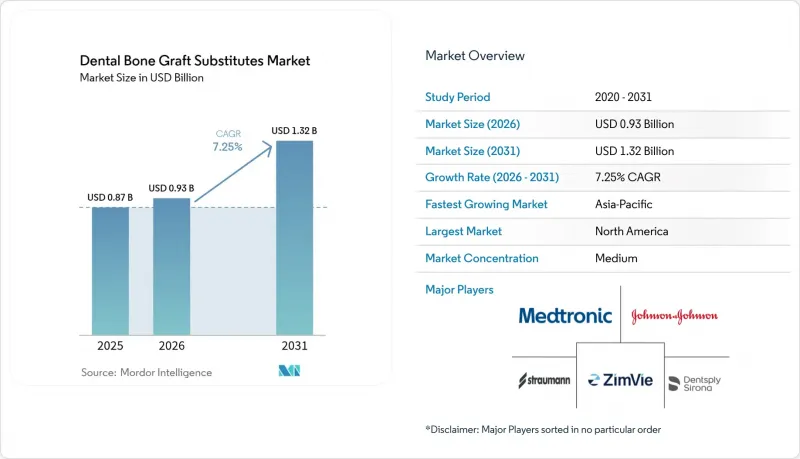
This report is Segmented by Product Type (Xenograft, Allograft, Autograft and More), Mechanism (Osteoconduction, Osteoinduction, and More), Material (Ceramic-Based, Collagen-Based, and More), Application (Socket Preservation, Ridge Augmentation, and More), End Users (Hospitals, and More), and Geography (North America, Europe, and More). The Market Forecasts are Provided in Terms of Value (USD).
Global Dental Bone Graft Substitutes Market Trends and Insights
Escalating Global Burden of Periodontal & Edentulous Disorders
The World Health Organization reports that 3.5 billion people live with oral diseases, generating USD 387 billion in direct costs each year. Severe periodontitis accelerates alveolar bone loss, expanding the need for regeneration solutions. Clinical trials show 35.6% greater bone volume when FGF-2-impregnated atelocollagen sponges are used. An aging demographic exacerbates demand, as 353 million people were edentulous in 2024, with projections of 661 million by 2050. This demographic and clinical pressure directly fuels procedure volumes within the dental bone graft substitutes market.
Rapid Adoption of CAD/CAM & 3-D Printing-Enabled Custom Grafts
Nanoscale 3-D printing breakthroughs from the University of Sydney deliver bone-mimicking scaffolds with natural-like porosity and strength. Open-source CAD/CAM software lets surgeons design titanium meshes that fit precisely, shortening operating times. Bioactive glass scaffolds fabricated through additive manufacturing yielded 43.93% bone volume fraction in atrophic ridges. These digital workflows command premium pricing yet curb revision rates, sustaining margin expansion for suppliers competing in the dental bone graft substitutes market.
High Procedure & Product Cost Vis-a-Vis Conventional Dentures
Economic evaluations show retaining at-risk teeth is cheaper than replacing them with implants, especially once peri-implantitis maintenance is considered. Graft materials alone add USD 46.2-140 per case. Multiple visits and protracted healing magnify total spend, dampening uptake among cost-sensitive groups. Providers in the dental bone graft substitutes market mitigate sticker shock through bundled procedure pricing and in-house manufacturing that compresses overhead.
Other drivers and restraints analyzed in the detailed report include:
- Growing Preference for Synthetic Alloplasts Amid Religious/Ethical Concerns
- Emergence of Growth-Factor-Laden Biomimetic Matrices
- Limited Reimbursement in Emerging Markets
For complete list of drivers and restraints, kindly check the Table Of Contents.
Segment Analysis
Allografts maintained a 55.10% share in 2025, driven by surgeon familiarity and extensive clinical evidence. However, the tuberculosis outbreak triggered stricter screening, nudging clinicians toward disease-free synthetics. Synthetic/alloplast innovations post a 9.78% CAGR, buoyed by coral-inspired designs and growth-factor additives that sidestep donor-tissue shortages. The dental bone graft substitutes market size for synthetic/alloplast products is slated to widen as 3-D printing streamlines custom shapes.
Autografts remain the biological benchmark yet suffer donor-site morbidity and limited volume. Xenografts serve niche complex reconstructions; segmented equine sheets achieved horizontal gains of 6.18 mm in 3-D defects. Emerging dentin-derived xenogeneic matrices extend indications by retaining organic components.
Osteoconductive scaffolds accounted for 60.10% of the dental bone graft substitutes market in 2025. Reliability across socket preservation and ridge augmentation sustains volume. Osteoinductive products, led by recombinant growth-factor matrices, are tracking a 9.02% CAGR owing to superior defect fill: FGF-2 sponges produced 35.6% extra bone area in lab studies.
Hybrid constructs now merge osteoconduction, osteoinduction, and osteogenesis. An integrative matrix reached 100% spinal fusion at 12 months. As evidence accumulates, hospitals revise protocols, increasing the dental bone graft substitutes market share of multi-mechanism devices.
Complete Report Scope:
- By Product Type
- Autograft
- Allograft
- Xenograft
- Synthetic/Alloplast
- Other Types
- By Mechanism
- Osteoconduction
- Osteoinduction
- Osteogenesis
- Osteopromotion
- By Material
- Ceramic-based
- Collagen-based
- Growth-factor-enhanced
- Polymer & Composite
- By Application
- Socket Preservation
- Ridge Augmentation
- Sinus Lift
- Periodontal Defect Regeneration
- Implant Bone Regeneration
- By End User
- Hospitals
- Dental Clinics & Implant Centers
- Ambulatory Surgical Centers
- Academic & Research Institutes
- Geography
- North America
- United States
- Canada
- Mexico
- Europe
- Germany
- United Kingdom
- France
- Italy
- Spain
- Rest of Europe
- Asia-Pacific
- China
- Japan
- India
- South Korea
- Australia
- Rest of Asia-Pacific
- Middle East and Africa
- GCC
- South Africa
- Rest of Middle East and Africa
- South America
- Brazil
- Argentina
- Rest of South America
- North America
Geography Analysis
North America held 35.40% share in 2025, boosted by comprehensive reimbursement and early technology adoption. UnitedHealthcare's 2024 policy clarified graft coverage, raising case volumes. The FDA's 2024 breakthrough device awards to Renovos and CGBio signal continued innovation support. Nonetheless, the 2023 allograft-linked tuberculosis outbreak led to tighter donor screening, temporarily slowing allograft sales. These dynamics encourage synthetic uptake, reinforcing momentum for the dental bone graft substitutes market.
Asia-Pacific is the fastest-growing region at 11.05% CAGR on the back of enlarging medical tourism hubs and rising discretionary income. Thailand's medical-device sector reached USD 7.2 billion in 2024, exemplifying supportive infrastructure. Super-aged profiles in Japan, South Korea, and Thailand elevate demand for implants and associated grafts. However, limited reimbursement hinders mass adoption, keeping price-sensitive segments reliant on lower-cost xenografts.
Europe maintains a mature yet innovation-friendly market. Rigorous CE-mark pathways favor companies with strong clinical dossiers, while public health systems emphasize ethical sourcing, fueling synthetic alternatives. Collaborative research networks expedite biomaterial breakthroughs that quickly reach German and Scandinavian clinics. Economic pressures temper expenditure growth but stable aging demographics ensure steady baseline demand for the dental bone graft substitutes market.
- Dentsply Sirona
- Johnson & Johnson
- Straumann Group
- Medtronic
- ZimVie
- Geistlich Pharma
- BioHorizons Implant Systems Inc.
- Dentium Co. Ltd.
- LifeNet Health
- Collagen Matrix
- Botiss Biomaterials
- NovaBone Products LLC
- RTI Surgical
- TBF Tissue Engineering
- Graftys SA
- Wright Medical Group
- Kuros Biosciences AG
- Sunstar Guidor
- Stryker
- Purgo Biologics
Additional Benefits:
- The market estimate (ME) sheet in Excel format
- 3 months of analyst support
TABLE OF CONTENTS
1 Introduction
- 1.1 Study Assumptions & Market Definition
- 1.2 Scope of the Study
2 Research Methodology
3 Executive Summary
4 Market Landscape
- 4.1 Market Overview
- 4.2 Market Drivers
- 4.2.1 Soaring Outbound Medical & Dental Tourism Flows
- 4.2.2 Escalating Global Burden Of Periodontal & Edentulous Disorders
- 4.2.3 Rapid Adoption Of CAD/CAM & 3-D Printing-Enabled Custom Grafts
- 4.2.4 Growing Preference For Synthetic Alloplasts Amid Religious/Ethical Concerns
- 4.2.5 Favorable Reimbursement Expansion For Regenerative Dental Procedures
- 4.2.6 Emergence Of Growth-Factor-Laden Biomimetic Matrices
- 4.3 Market Restraints
- 4.3.1 High Procedure & Product Cost Vis-A-Vis Conventional Dentures
- 4.3.2 Limited Reimbursement In Emerging Markets
- 4.3.3 Scarcity & Logistics Issues In Human-Donor Tissue Supply Chains
- 4.3.4 Persistent Ethical Push-Back Against Xenograft Sourcing
- 4.4 Porter's Five Forces Analysis
- 4.4.1 Bargaining Power of Buyers/Consumers
- 4.4.2 Bargaining Power of Suppliers
- 4.4.3 Threat of New Entrants
- 4.4.4 Threat of Substitute Products
- 4.4.5 Intensity of Competitive Rivalry
5 Market Size & Growth Forecasts (Value, USD)
- 5.1 By Product Type
- 5.1.1 Autograft
- 5.1.2 Allograft
- 5.1.3 Xenograft
- 5.1.4 Synthetic/Alloplast
- 5.1.5 Other Types
- 5.2 By Mechanism
- 5.2.1 Osteoconduction
- 5.2.2 Osteoinduction
- 5.2.3 Osteogenesis
- 5.2.4 Osteopromotion
- 5.3 By Material
- 5.3.1 Ceramic-based
- 5.3.2 Collagen-based
- 5.3.3 Growth-factor-enhanced
- 5.3.4 Polymer & Composite
- 5.4 By Application
- 5.4.1 Socket Preservation
- 5.4.2 Ridge Augmentation
- 5.4.3 Sinus Lift
- 5.4.4 Periodontal Defect Regeneration
- 5.4.5 Implant Bone Regeneration
- 5.5 By End User
- 5.5.1 Hospitals
- 5.5.2 Dental Clinics & Implant Centers
- 5.5.3 Ambulatory Surgical Centers
- 5.5.4 Academic & Research Institutes
- 5.6 Geography
- 5.6.1 North America
- 5.6.1.1 United States
- 5.6.1.2 Canada
- 5.6.1.3 Mexico
- 5.6.2 Europe
- 5.6.2.1 Germany
- 5.6.2.2 United Kingdom
- 5.6.2.3 France
- 5.6.2.4 Italy
- 5.6.2.5 Spain
- 5.6.2.6 Rest of Europe
- 5.6.3 Asia-Pacific
- 5.6.3.1 China
- 5.6.3.2 Japan
- 5.6.3.3 India
- 5.6.3.4 South Korea
- 5.6.3.5 Australia
- 5.6.3.6 Rest of Asia-Pacific
- 5.6.4 Middle East and Africa
- 5.6.4.1 GCC
- 5.6.4.2 South Africa
- 5.6.4.3 Rest of Middle East and Africa
- 5.6.5 South America
- 5.6.5.1 Brazil
- 5.6.5.2 Argentina
- 5.6.5.3 Rest of South America
- 5.6.1 North America
6 Competitive Landscape
- 6.1 Market Concentration
- 6.2 Market Share Analysis
- 6.3 Company Profiles (includes Global level Overview, Market level overview, Core Business Segments, Financials, Headcount, Key Information, Market Rank, Market Share, Products and Services, and analysis of Recent Developments)
- 6.3.1 Dentsply Sirona
- 6.3.2 Johnson & Johnson (DePuy Synthes)
- 6.3.3 Institut Straumann AG
- 6.3.4 Medtronic plc
- 6.3.5 ZimVie Inc
- 6.3.6 Geistlich Pharma AG
- 6.3.7 BioHorizons Implant Systems Inc.
- 6.3.8 Dentium Co. Ltd.
- 6.3.9 LifeNet Health
- 6.3.10 Collagen Matrix Inc.
- 6.3.11 Botiss Biomaterials GmbH
- 6.3.12 NovaBone Products LLC
- 6.3.13 RTI Surgical Holdings Inc.
- 6.3.14 TBF Tissue Engineering
- 6.3.15 Graftys SA
- 6.3.16 Wright Medical Group NV
- 6.3.17 Kuros Biosciences AG
- 6.3.18 Sunstar Guidor
- 6.3.19 Stryker Corporation
- 6.3.20 Purgo Biologics
7 Market Opportunities & Future Outlook
- 7.1 White-space & Unmet-need Assessment

