PUBLISHER: MarketsandMarkets | PRODUCT CODE: 2092398
PUBLISHER: MarketsandMarkets | PRODUCT CODE: 2092398
Edge Computing Market by Offering (Hardware, Software, Services), Application (Video Analytics, Asset Monitoring, Automation, IoT Monitoring, Content Delivery), Deployment Mode, Organization Size, Vertical, and Region - Global Forecast to 2031
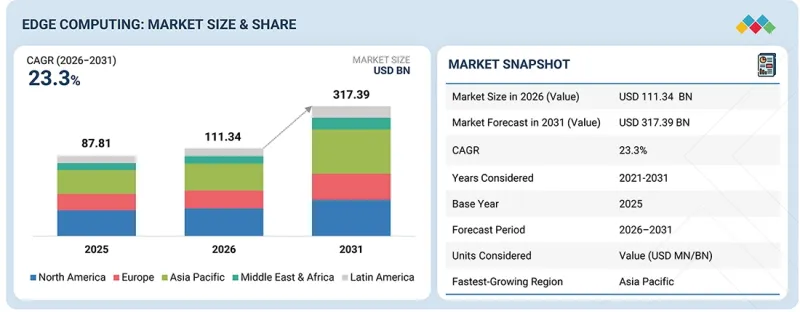
The global edge computing market is expanding rapidly, with a projected market size rising from USD 111.34 billion in 2026 to USD 317.39 billion by 2031, for a CAGR of 23.3%. Several key drivers and restraints primarily shape the growth of the edge computing market. Drivers include the surge in adoption and practice of Internet of Things solutions across various industries, driving the need for real-time data processing and analytics at the network's edge. Rising demand for low-latency applications further propels market expansion, alongside strict government regulatory requirements that encourage secure and compliant edge deployments.
| Scope of the Report | |
|---|---|
| Years Considered for the Study | 2021-2031 |
| Base Year | 2025 |
| Forecast Period | 2026-2031 |
| Units Considered | Value (USD Million/Billion) |
| Segments | Offering, Application, Organization Size, Deployment Mode, Vertical |
| Regions covered | North America, Europe, Asia Pacific, Middle East & Africa, Latin America |
Additionally, integrating artificial intelligence and machine learning empowers organizations to realize smarter, autonomous operations directly at the edge. On the other hand, restraints center around the complex nature of edge computing infrastructure, which poses significant challenges in deployment, management, and seamless integration with legacy systems.
""By application, real-time analytics & decision support is expected to account for the fastest growth rate during the forecast period."
Real-time analytics & decision support is expected to account for the fastest growth during the forecast period. This growth is driven by rising demand for instant data processing, low-latency insights, and automated decision-making across manufacturing, healthcare, transportation, retail, energy, and smart city environments. Edge computing enables operational data to be processed closer to machines, sensors, devices, and enterprise systems, reducing response time, bandwidth usage, and dependency on centralized cloud infrastructure. As organizations adopt AI-enabled analytics, industrial IoT systems, predictive monitoring, and autonomous workflows across distributed locations, edge computing becomes critical for faster detection, localized intelligence, and continuous operational decision-making. This creates strong opportunities for vendors offering scalable, secure, and industry-specific real-time analytics and decision support platforms at the edge.
""By deployment mode, the regional/cloud edge segment is expected to account for the largest market share during the forecast period."
The regional/cloud edge segment is expected to account for the largest market share during the forecast period. This dominance is driven by expanding hyperscaler edge zones, CDN edge compute, distributed cloud regions, and cloud-managed infrastructure deployed closer to users, devices, and enterprise locations. Organizations are increasingly using regional/cloud edge to support low-latency applications, AI inference, video analytics, content delivery, gaming, IoT platforms, and multi-site digital operations without fully managing on-premises infrastructure. The segment benefits from easier scalability, centralized management, faster deployment, and integration with public cloud services. As enterprises modernize distributed workloads and adopt hybrid architectures, regional/cloud edge is becoming the preferred deployment model for scalable, secure, and latency-sensitive edge computing environments.
"North America leads the edge computing market with advanced infrastructure, strong 5G coverage, and high enterprise demand for real-time solutions, while Asia Pacific is the fastest-growing region driven by rapid cloud adoption, large-scale IoT deployments, and government-backed investments in localized edge infrastructure."
North America is expected to lead the edge computing market, driven by increasing enterprise demand for real-time data processing, low-latency applications, and secure distributed architectures. For vendors and solution providers, this presents significant opportunities to deliver scalable platforms and services to industries such as manufacturing, healthcare, telecommunications, and autonomous vehicles. The region's mature 5G infrastructure and growing IoT deployments enable the shift from centralized cloud to edge-based processing, creating a critical need for localized solutions that ensure compliance with data sovereignty regulations. Strategic partnerships, such as integrating edge capabilities into telecommunications networks, demonstrate how edge computing enhances operational efficiency and user experience. Capitalizing on these trends allows vendors to address evolving customer requirements, reduce latency, and establish a strong foothold in a market poised for rapid growth and innovation.
Breakdown of Primaries
In-depth interviews were conducted with Chief Executive Officers (CEOs), innovation and technology directors, system integrators, and executives from various key organizations operating in the edge computing market.
- By Company: Tier I - 35%, Tier II - 25%, and Tier III - 40%
- By Designation: C-Level Executives - 25%, D-Level Executives -30%, and others - 45%
- By Region: North America - 42%, Europe - 25%, Asia Pacific - 18%, and Rest of the world - 15%
The report includes a study of key players in the edge computing market. It profiles major vendors in the edge computing market. The major market players include HPE (US), AWS (US), Dell Technologies (US), Cisco (US), Microsoft (US), IBM (US), Google (US), Nvidia (US), Intel (US), Huawei (China), Nokia (Finland), VMware (US), Fastly (US), Adlink (Taiwan), Oracle (US), Semtech (US), Moxa (US), Belden (US), GE Digital (US), DG International (US), Litmus Automation (US), Zededa (US), Clearblade (US), and Vapor IO (US).
Research Coverage
This research report categorizes the edge computing market based on Offering [edge infrastructure hardware, software, and services], Application, Organization Size, Deployment Mode, Vertical, and Region. By offering, edge infrastructure hardware includes edge servers & appliances, edge gateways, AI accelerators & processors, edge storage, and networking equipment. Software includes edge orchestration & management platforms, edge AI & analytics platforms, edge data management & integration software, and edge security software. Services include professional services and managed edge services. By application, the market includes video analytics & computer vision, asset monitoring & predictive maintenance, industrial automation & operational control, connected asset & IoT monitoring, real-time analytics & decision support, content delivery & network optimization, autonomous systems & immersive applications, and other applications. By organization size, the market is segmented into large enterprises and SMEs. By deployment mode, the market covers on-premises edge, telco/network edge, and regional/cloud edge. By vertical, the market covers manufacturing, telecommunications, retail & e-commerce, healthcare & life sciences, transportation & logistics, energy & utilities, government & defense, BFSI, and media & entertainment. By region, the market covers North America, Europe, Asia Pacific, Middle East & Africa, and Latin America.
Reason to buy this Report
The report would provide market leaders and new entrants with information on the closest approximations of the revenue numbers for the overall edge computing market and its subsegments. It would help stakeholders understand the competitive landscape and gain more insights to better position their businesses and plan suitable go-to-market strategies. It also helps stakeholders understand the market's pulse and provides them with information on key market drivers, restraints, challenges, and opportunities.
The report provides insights into the following pointers:
- Analysis of key drivers (Surge in adoption and practice of IoT across industries, Rising demand for low-latency applications, Strict government regulatory requirements, Integration of AI and ML), restraints (Complex nature of the edge computing infrastructure), opportunities (Advent of 5G network to provide open avenues for large-scale 5G network deployment, Proliferation of IoT, Rapid adoption of edge computing solutions across sectors, Emergence of autonomous automobiles and connected car infrastructure), and challenges (Increasing data privacy and security concerns, Challenges in compatibility or interoperability)
- Product Development/Innovation: Detailed insights on upcoming technologies, research & development activities, and new product & service launches in the edge computing market
- Market Development: Comprehensive information about lucrative markets - the report analyses the edge computing market across varied regions
- Market Diversification: Exhaustive information about new products & services, untapped geographies, recent developments, and investments in the edge computing market
- Competitive Assessment: Competitive Assessment: In-depth assessment of market shares, growth strategies, and service offerings of leading players such as Dell Technologies (US), NVIDIA (US), HPE (US), Microsoft (US), Huawei (China), Cisco (US), IBM (US), Google (US), Intel (US), Supermicro (US), Advantech (Taiwan), Akamai Technologies (US), Nokia (Finland), Lenovo (China), Siemens (Germany), Broadcom (US), ZTE (China), Oracle (US), Belden (US), Moxa (Taiwan), Scale Computing (US), and ClearBlade (US). The report also helps stakeholders understand the pulse of the edge computing market and provides information on key drivers, restraints, challenges, and opportunities.
TABLE OF CONTENTS
1 INTRODUCTION
- 1.1 STUDY OBJECTIVES
- 1.2 MARKET DEFINITION
- 1.3 MARKET SCOPE
- 1.3.1 MARKET SEGMENTATION AND REGIONAL SCOPE
- 1.3.2 INCLUSIONS AND EXCLUSIONS
- 1.3.3 YEARS CONSIDERED
- 1.4 CURRENCY CONSIDERED
- 1.5 LIMITATIONS
- 1.6 STAKEHOLDERS
2 REGULATORY BODIES, INDUSTRY ALLIANCES, AND TECHNOLOGY INVESTORS EXECUTIVE SUMMARY
- 2.1 MARKET HIGHLIGHTS AND KEY INSIGHTS
- 2.2 KEY MARKET PARTICIPANTS: MAPPING OF STRATEGIC DEVELOPMENTS
- 2.3 DISRUPTIVE TRENDS IN EDGE COMPUTING MARKET
- 2.4 HIGH-GROWTH SEGMENTS
- 2.5 REGIONAL SNAPSHOT: MARKET SIZE, GROWTH RATE, AND FORECAST
3 PREMIUM INSIGHTS
- 3.1 ATTRACTIVE OPPORTUNITIES FOR PLAYERS IN EDGE COMPUTING MARKET
- 3.2 EDGE COMPUTING MARKET, BY OFFERING
- 3.3 EDGE COMPUTING MARKET, BY HARDWARE
- 3.4 EDGE COMPUTING MARKET, BY APPLICATION
- 3.5 EDGE COMPUTING MARKET, BY REGION
4 MARKET OVERVIEW
- 4.1 INTRODUCTION
- 4.2 MARKET DYNAMICS
- 4.2.1 DRIVERS
- 4.2.1.1 Rising demand for low-latency processing across distributed enterprise environments
- 4.2.1.2 Increasing adoption of AI-led automation and computer vision at edge
- 4.2.1.3 Growing deployment of private 5G and MEC to enable reliable low-latency edge connectivity
- 4.2.2 RESTRAINTS
- 4.2.2.1 Limited enterprise readiness and specialized skill shortages delaying edge AI adoption
- 4.2.2.2 Expanding Security Risks and Governance Complexity Across Distributed Edge Environments
- 4.2.3 OPPORTUNITIES
- 4.2.3.1 Growing shift toward managed lifecycle orchestration to address scaling complexity in distributed edge environments
- 4.2.3.2 Increasing enterprise shift toward pre-packaged industry-specific edge AI deployments
- 4.2.4 CHALLENGES
- 4.2.4.1 Network performance variability and infrastructure heterogeneity limiting edge reliability at scale
- 4.2.4.2 Difficulty in standardizing multi-site edge deployments from pilot to production
- 4.2.1 DRIVERS
- 4.3 UNMET NEEDS AND WHITE SPACES
- 4.3.1 UNMET NEEDS IN EDGE COMPUTING MARKET
- 4.3.2 WHITE SPACE OPPORTUNITIES
- 4.4 INTERCONNECTED MARKETS AND CROSS-SECTOR OPPORTUNITIES
- 4.4.1 INTERCONNECTED MARKETS
- 4.4.2 CROSS-SECTOR OPPORTUNITIES
- 4.5 EMERGING BUSINESS MODELS AND ECOSYSTEM SHIFTS
- 4.5.1 EMERGING BUSINESS MODELS
- 4.5.2 EDGE COMPUTING BUSINESS MODELS
- 4.5.3 ECOSYSTEM SHIFTS
- 4.6 STRATEGIC MOVES BY TIER-1/2/3 PLAYERS
5 INDUSTRY TRENDS
- 5.1 PORTER'S FIVE FORCES ANALYSIS
- 5.1.1 THREAT OF NEW ENTRANTS
- 5.1.2 THREAT OF SUBSTITUTES
- 5.1.3 BARGAINING POWER OF SUPPLIERS
- 5.1.4 BARGAINING POWER OF BUYERS
- 5.1.5 INTENSITY OF COMPETITIVE RIVALRY
- 5.2 MACROECONOMIC INDICATORS
- 5.2.1 INTRODUCTION
- 5.2.2 GDP TRENDS AND FORECASTS
- 5.2.3 TRENDS IN GLOBAL CLOUD COMPUTING INDUSTRY
- 5.2.4 TRENDS IN GLOBAL IOT INDUSTRY
- 5.3 VALUE CHAIN ANALYSIS
- 5.4 ECOSYSTEM ANALYSIS
- 5.5 KEY CONFERENCES AND EVENTS, 2025-2026
- 5.6 TRENDS/DISRUPTIONS IMPACTING CUSTOMER BUSINESS
- 5.7 CASE STUDY ANALYSIS
- 5.7.1 DELL TECHNOLOGIES ENABLED LOWE'S TO TRANSFORM RETAIL OPERATIONS THROUGH EDGE AI
- 5.7.2 GOOGLE CLOUD ENABLED NLB TO DELIVER LOW-LATENCY IMMERSIVE AI EXPERIENCES
- 5.7.3 HPE ENABLED BOSCH DIGITAL TWIN INDUSTRIES TO DELIVER EDGE AI-POWERED PREDICTIVE MAINTENANCE
- 5.8 IMPACT OF 2025 US TARIFF - EDGE COMPUTING MARKET
- 5.8.1 INTRODUCTION
- 5.8.2 KEY TARIFF RATES
- 5.8.3 PRICE IMPACT ANALYSIS
- 5.8.4 IMPACT ON COUNTRY/REGION
- 5.8.4.1 US
- 5.8.4.2 Europe
- 5.8.4.3 Asia Pacific
- 5.8.5 IMPACT ON END-USE INDUSTRIES
- 5.8.5.1 Manufacturing
- 5.8.5.2 Telecommunications
- 5.8.5.3 Retail & E-Commerce
- 5.8.5.4 Healthcare & life sciences
- 5.8.5.5 Transportation & logistics
- 5.8.5.6 Energy & utilities
- 5.8.5.7 Government & defense
- 5.8.5.8 BFSI
- 5.8.5.9 Media & entertainment
6 STRATEGIC DISRUPTION THROUGH TECHNOLOGY, PATENTS, DIGITAL, AND AI ADOPTION
- 6.1 TECHNOLOGY ANALYSIS
- 6.1.1 KEY EMERGING TECHNOLOGIES
- 6.1.1.1 Edge Artificial Intelligence
- 6.1.1.2 Private 5G and Multi-access Edge Computing
- 6.1.1.3 Edge Orchestration and Management Platforms
- 6.1.2 COMPLEMENTARY TECHNOLOGIES
- 6.1.2.1 Internet of Things and Industrial IoT
- 6.1.2.2 Cloud Computing and Distributed Cloud
- 6.1.2.3 Edge Security and Zero Trust
- 6.1.3 ADJACENT TECHNOLOGIES
- 6.1.3.1 Digital Twin Technology
- 6.1.3.2 Generative AI
- 6.1.3.3 5G and Advanced Connectivity Infrastructure
- 6.1.1 KEY EMERGING TECHNOLOGIES
- 6.2 TECHNOLOGY/PRODUCT ROADMAP
- 6.2.1 SHORT-TERM (2026-2028) | EDGE AI SCALING & CLOUD-MANAGED EDGE EXPANSION
- 6.2.1.1 Focus Areas:
- 6.2.1.1.1 Technology Development
- 6.2.1.1.2 Product/Service Innovations
- 6.2.1.1.3 Market Adoption
- 6.2.1.1 Focus Areas:
- 6.2.2 MID-TERM (2028-2031) | PLATFORMIZED EDGE ECOSYSTEMS & INDUSTRY-SPECIFIC SOLUTIONS
- 6.2.2.1 Focus Areas
- 6.2.2.1.1 Technology Development
- 6.2.2.1.2 Product/Service Innovations
- 6.2.2.1.3 Market Adoption
- 6.2.2.1 Focus Areas
- 6.2.3 LONG-TERM (2031-2035) | AUTONOMOUS, AI-NATIVE & SELF-OPTIMIZING EDGE ECOSYSTEMS
- 6.2.3.1 Focus Areas
- 6.2.3.1.1 Technology Development
- 6.2.3.1.2 Product/Service Innovations
- 6.2.3.1.3 Market Adoption
- 6.2.3.1 Focus Areas
- 6.2.1 SHORT-TERM (2026-2028) | EDGE AI SCALING & CLOUD-MANAGED EDGE EXPANSION
- 6.3 PATENT ANALYSIS
- 6.4 FUTURE APPLICATIONS
- 6.4.1 AI-POWERED INDUSTRIAL AUTOMATION & PREDICTIVE MAINTENANCE
- 6.4.2 EDGE COMPUTER VISION & REAL-TIME VIDEO ANALYTICS
- 6.4.3 PRIVATE 5G/MEC-ENABLED ENTERPRISE APPLICATIONS
- 6.4.4 CONNECTED HEALTHCARE & REMOTE DIAGNOSTICS
- 6.4.5 AUTONOMOUS LOGISTICS & SMART TRANSPORTATION
- 6.5 IMPACT OF AI/GENERATIVE AI ON EDGE COMPUTING MARKET
- 6.5.1 TOP USE CASES AND MARKET POTENTIAL
- 6.5.2 BEST PRACTICES IN EDGE COMPUTING
- 6.5.3 CASE STUDY OF AI IMPLEMENTATION IN EDGE COMPUTING MARKET
- 6.5.3.1 Siemens and NVIDIA Enabled Industrial AI and Edge-based Factory Intelligence
- 6.5.4 INTERCONNECTED ADJACENT ECOSYSTEMS AND IMPACT ON MARKET PLAYERS
- 6.5.5 CLIENT READINESS TO ADOPT AI/GENERATIVE AI IN EDGE COMPUTING MARKET
- 6.5.6 DELL TECHNOLOGIES: AI-READY EDGE INFRASTRUCTURE FOR DISTRIBUTED ENTERPRISE OPERATIONS
- 6.5.7 AWS: CLOUD-MANAGED EDGE SERVICES FOR LOW-LATENCY AND IOT-DRIVEN WORKLOADS
7 REGULATORY LANDSCAPE
- 7.1 REGULATORY LANDSCAPE
- 7.1.1 REGULATORY BODIES, GOVERNMENT AGENCIES, AND OTHER ORGANIZATIONS
- 7.1.2 INDUSTRY STANDARDS, BY REGION
8 CUSTOMER LANDSCAPE AND BUYER BEHAVIOR
- 8.1 DECISION-MAKING PROCESS
- 8.2 BUYER STAKEHOLDERS AND BUYING EVALUATION CRITERIA
- 8.2.1 KEY STAKEHOLDERS IN BUYING PROCESS
- 8.2.2 BUYING CRITERIA
- 8.3 ADOPTION BARRIERS AND INTERNAL CHALLENGES
- 8.4 UNMET NEEDS ACROSS END-USE INDUSTRIES
- 8.5 MARKET PROFITABILITY
- 8.5.1 REVENUE POTENTIAL
- 8.5.2 COST DYNAMICS
- 8.5.3 MARGIN OPPORTUNITIES IN END-USE INDUSTRIES
9 EDGE COMPUTING MARKET, BY OFFERING
- 9.1 INTRODUCTION
- 9.1.1 OFFERING: EDGE COMPUTING MARKET DRIVERS
- 9.2 EDGE INFRASTRUCTURE HARDWARE
- 9.2.1 EDGE SERVERS & APPLIANCES
- 9.2.1.1 Rising Demand for Distributed Compute Is Driving Workload-Specific Edge Server Adoption
- 9.2.1.2 Compact/Ruggedized Edge Servers
- 9.2.1.3 Hyperconverged Edge Appliances
- 9.2.1.4 Edge AI Compute Appliances
- 9.2.2 EDGE GATEWAYS
- 9.2.2.1 Edge Gateways Are Evolving from Connectivity Devices into Intelligent Local Control Layers
- 9.2.2.2 Industrial IoT Gateways
- 9.2.2.3 Network/MEC Gateways
- 9.2.3 AI ACCELERATORS & PROCESSORS
- 9.2.3.1 Growing Edge AI Workloads Are Accelerating Demand for Specialized Local Processing Hardware
- 9.2.3.2 Edge GPUs & AI Modules
- 9.2.3.3 Edge-optimized CPUs & SoCs
- 9.2.3.4 FPGAs & ASICs/NPUs
- 9.2.4 EDGE STORAGE
- 9.2.4.1 Increasing Local Data Retention Needs Are Reshaping Distributed Edge Storage Architectures
- 9.2.4.2 Local Edge Storage
- 9.2.4.3 Shared/Distributed Edge Storage
- 9.2.5 NETWORKING EQUIPMENT
- 9.2.5.1 Edge Networking Is Shifting Toward Intelligent, Secure, and Low-Latency Distributed Connectivity
- 9.2.5.2 Edge Switches
- 9.2.5.3 Edge Routers
- 9.2.5.4 Wireless Networking Infrastructure
- 9.2.1 EDGE SERVERS & APPLIANCES
- 9.3 SOFTWARE
- 9.3.1 EDGE ORCHESTRATION & MANAGEMENT PLATFORMS
- 9.3.1.1 Enterprises Are Standardizing Edge Operations Through Centralized Orchestration and Lifecycle Control
- 9.3.1.2 Container Orchestration for Edge
- 9.3.1.3 Edge Device & Fleet Management
- 9.3.1.4 Edge Operating Systems & Runtimes
- 9.3.2 EDGE AI & ANALYTICS PLATFORMS
- 9.3.2.1 Edge AI Platforms Are Moving Decision Intelligence Closer to Real-Time Operational Environments
- 9.3.2.2 Edge AI Inference & Model Serving
- 9.3.2.3 Real-time Streaming Analytics
- 9.3.2.4 Edge MLOps & Model Lifecycle Management
- 9.3.2.5 Computer Vision/Video Analytics Platforms
- 9.3.3 EDGE DATA MANAGEMENT & INTEGRATION SOFTWARE
- 9.3.3.1 Edge Data Platforms Are Shifting from Data Movement to Controlled Local Intelligence
- 9.3.3.2 Edge-Cloud Data Synchronization
- 9.3.3.3 Edge Databases & Time-Series Data Stores
- 9.3.3.4 Event Streaming & Messaging at Edge
- 9.3.4 EDGE SECURITY SOFTWARE
- 9.3.4.1 Edge Security Is Evolving from Perimeter Defense to Distributed Identity-Led Protection
- 9.3.4.2 Zero-Trust & Identity/Access Management at Edge
- 9.3.4.3 Edge Data Protection & Encryption
- 9.3.4.4 Edge Threat Detection & SASE
- 9.3.1 EDGE ORCHESTRATION & MANAGEMENT PLATFORMS
- 9.4 SERVICES
- 9.4.1 PROFESSIONAL SERVICES
- 9.4.1.1 Professional Services are Standardizing Edge Deployments Through Scalable Architecture and Integration Frameworks
- 9.4.1.2 Consulting, Advisory, and Architecture Design
- 9.4.1.3 Deployment, Integration & Support
- 9.4.2 MANAGED EDGE SERVICES
- 9.4.2.1 Managed Edge Services Are Expanding as Enterprises Outsource Distributed Infrastructure Operations at Scale
- 9.4.2.2 Managed Edge Infrastructure & Operations
- 9.4.2.3 Managed Edge Security & Platform Services
- 9.4.1 PROFESSIONAL SERVICES
10 EDGE COMPUTING MARKET, BY APPLICATION
- 10.1 INTRODUCTION
- 10.1.1 APPLICATION: EDGE COMPUTING MARKET DRIVERS
- 10.2 APPLICATION
- 10.2.1 VIDEO ANALYTICS & COMPUTER VISION
- 10.2.1.1 Video Analytics Is Moving from Passive Monitoring to Real-Time Operational Decision Intelligence
- 10.2.2 ASSET MONITORING & PREDICTIVE MAINTENANCE
- 10.2.2.1 Predictive Maintenance Is Replacing Scheduled Servicing with Continuous Edge-Based Asset Intelligence
- 10.2.3 INDUSTRIAL AUTOMATION & OPERATIONAL CONTROL
- 10.2.3.1 Industrial Operations Are Becoming Software-Defined as Intelligence Moves Closer to Production Assets
- 10.2.4 CONNECTED ASSET & IOT MONITORING
- 10.2.4.1 IoT Monitoring Is Evolving from Device Connectivity to Standardized Edge Data Orchestration
- 10.2.5 REAL-TIME ANALYTICS & DECISION SUPPORT
- 10.2.5.1 Real-Time Analytics Is Shifting Enterprise Decisions from Centralized Systems to Local Execution
- 10.2.6 CONTENT DELIVERY & NETWORK OPTIMIZATION
- 10.2.6.1 Content Delivery Is Expanding into Distributed Compute, Security, and Traffic Optimization Layers
- 10.2.7 AUTONOMOUS SYSTEMS & IMMERSIVE APPLICATIONS
- 10.2.7.1 Autonomous Systems Are Accelerating Demand for Low-Latency AI and Localized Edge Intelligence
- 10.2.8 OTHER APPLICATIONS
- 10.2.1 VIDEO ANALYTICS & COMPUTER VISION
11 EDGE COMPUTING MARKET, BY DEPLOYMENT MODE
- 11.1 INTRODUCTION
- 11.1.1 DEPLOYMENT MODE: EDGE COMPUTING MARKET DRIVERS
- 11.2 ON-PREMISE EDGE
- 11.2.1 ON-PREMISE EDGE IS STRENGTHENING ENTERPRISE CONTROL OVER LOCALIZED DATA AND CRITICAL OPERATIONS
- 11.3 TELCO/NETWORK EDGE
- 11.3.1 TELCO EDGE IS CONVERTING NETWORK INFRASTRUCTURE INTO DISTRIBUTED LOW-LATENCY SERVICE PLATFORMS
- 11.4 REGIONAL/CLOUD EDGE
- 11.4.1 REGIONAL/CLOUD EDGE IS EXPANDING CLOUD PROXIMITY FOR LOCALIZED PROCESSING AND COMPLIANCE NEEDS
12 EDGE COMPUTING MARKET, BY ORGANIZATION SIZE
- 12.1 INTRODUCTION
- 12.1.1 ORGANIZATION SIZE: EDGE COMPUTING MARKET DRIVERS
- 12.2 LARGE ENTERPRISES
- 12.2.1 LARGE ENTERPRISES ARE STANDARDIZING EDGE PLATFORMS TO GOVERN DISTRIBUTED AI, DATA, AND OPERATIONS
- 12.3 SMES
- 12.3.1 SMES ARE ACCELERATING EDGE ADOPTION THROUGH SIMPLIFIED, PACKAGED, AND CLOUD-MANAGED SOLUTIONS
13 EDGE COMPUTING MARKET, BY VERTICAL
- 13.1 INTRODUCTION
- 13.1.1 VERTICAL: EDGE COMPUTING MARKET DRIVERS
- 13.2 RETAIL & E-COMMERCE
- 13.2.1 RETAILERS ARE MOVING STORE INTELLIGENCE CLOSER TO SHELVES, CHECKOUT, INVENTORY, AND CUSTOMER INTERACTION POINTS
- 13.2.2 USE CASES: RETAIL & E-COMMERCE
- 13.2.3 SMART STORES
- 13.2.4 INVENTORY OPTIMIZATION
- 13.2.5 CASHIER-LESS CHECKOUTS
- 13.2.6 DYNAMIC CUSTOMER EXPERIENCE
- 13.3 MANUFACTURING & INDUSTRIAL
- 13.3.1 INDUSTRIAL ENTERPRISES ARE SHIFTING AI CONTROL, QUALITY, AUTOMATION, AND SIMULATION WORKLOADS TO THE FACTORY EDGE
- 13.3.2 USE CASES: MANUFACTURING & INDUSTRIAL
- 13.3.3 SMART FACTORY OPERATIONS
- 13.3.4 PRODUCTION QUALITY ENHANCEMENT
- 13.3.5 PROCESS AUTOMATION
- 13.3.6 DIGITAL TWIN-BASED OPERATIONS
- 13.4 IT & DATA CENTERS
- 13.4.1 DISTRIBUTED IT ARCHITECTURES ARE BECOMING CLOUD-CONTROLLED EDGE FABRICS FOR AI, COMPLIANCE, AND LOCAL DATA PROCESSING
- 13.4.2 USE CASES: IT & DATA CENTERS
- 13.4.3 DISTRIBUTED INFRASTRUCTURE MANAGEMENT
- 13.4.4 EDGE CLOUD SERVICES
- 13.4.5 DATA PROCESSING OPTIMIZATION
- 13.5 TELECOMMUNICATIONS
- 13.5.1 TELECOM OPERATORS ARE EMBEDDING EDGE COMPUTE INTO 5G NETWORKS TO IMPROVE PERFORMANCE AND MONETIZE LOW-LATENCY SERVICES
- 13.5.2 USE CASES: TELECOMMUNICATIONS
- 13.5.3 5G NETWORK OPTIMIZATION
- 13.5.4 MULTI-ACCESS EDGE COMPUTING
- 13.5.5 CONTENT CACHING
- 13.5.6 VIRTUAL NETWORK FUNCTIONS
- 13.6 AUTOMOTIVE
- 13.6.1 AUTOMOTIVE EDGE COMPUTING IS SHIFTING INTELLIGENCE INTO VEHICLES, CHARGING NETWORKS, ROADSIDE SYSTEMS, AND MOBILITY FLEETS
- 13.6.2 USE CASES: AUTOMOTIVE
- 13.6.3 CONNECTED VEHICLE SERVICES
- 13.6.4 VEHICLE-TO-EVERYTHING COMMUNICATION
- 13.6.5 EV CHARGING INFRASTRUCTURE OPTIMIZATION
- 13.6.6 AUTONOMOUS FLEET COORDINATION
- 13.7 HEALTHCARE & LIFE SCIENCES
- 13.7.1 HEALTHCARE EDGE COMPUTING IS MOVING CLINICAL INTELLIGENCE CLOSER TO PATIENTS, DEVICES, IMAGING SYSTEMS, AND CARE TEAMS
- 13.7.2 USE CASES: HEALTHCARE & LIFE SCIENCES
- 13.7.3 REMOTE PATIENT MONITORING
- 13.7.4 CONNECTED MEDICAL DEVICES
- 13.7.5 TELEMEDICINE ENABLEMENT
- 13.7.6 MEDICAL IMAGING WORKFLOW SUPPORT
- 13.8 TRANSPORTATION & LOGISTICS
- 13.8.1 TRANSPORTATION AND LOGISTICS COMPANIES ARE BRINGING OPERATIONAL INTELLIGENCE CLOSER TO VEHICLES, WAREHOUSES, DISTRIBUTION CENTERS, AND SUPPLY CHAIN ASSETS
- 13.8.2 USE CASES: TRANSPORTATION & LOGISTICS
- 13.8.3 FLEET MANAGEMENT
- 13.8.4 ROUTE OPTIMIZATION
- 13.8.5 WAREHOUSE AUTOMATION
- 13.8.6 SHIPMENT TRACKING
- 13.9 ENERGY & UTILITIES
- 13.9.1 ENERGY PROVIDERS ARE MOVING GRID INTELLIGENCE CLOSER TO DISTRIBUTED ASSETS, SUBSTATIONS, RENEWABLE SYSTEMS, AND CRITICAL FIELD OPERATIONS
- 13.9.2 USE CASES: ENERGY & UTILITIES
- 13.9.3 SMART GRID MANAGEMENT
- 13.9.4 POWER DISTRIBUTION MONITORING
- 13.9.5 OIL & GAS FIELD OPERATIONS
- 13.9.6 RENEWABLE ENERGY OPTIMIZATION
- 13.10 GOVERNMENT & DEFENSE
- 13.10.1 GOVERNMENT AGENCIES AND DEFENSE ORGANIZATIONS ARE DEPLOYING EDGE INTELLIGENCE CLOSER TO FIELD OPERATIONS, PUBLIC SAFETY SYSTEMS, AND MISSION-CRITICAL ENVIRONMENTS
- 13.10.2 USE CASES: GOVERNMENT & DEFENSE
- 13.10.3 PUBLIC SAFETY SYSTEMS
- 13.10.4 EMERGENCY RESPONSE SYSTEMS
- 13.10.5 MISSION-CRITICAL FIELD OPERATIONS
- 13.10.6 BATTLEFIELD EDGE COMPUTING
- 13.11 BFSI
- 13.11.1 FINANCIAL INSTITUTIONS ARE BRINGING INTELLIGENCE CLOSER TO BRANCHES, ATMS, CUSTOMER TOUCHPOINTS, AND REAL-TIME TRANSACTION PROCESSING
- 13.11.2 USE CASES: BFSI
- 13.11.3 BRANCH ANALYTICS
- 13.11.4 ATM MONITORING
- 13.11.5 FRAUD INVESTIGATION SUPPORT
- 13.11.6 EDGE-BASED CUSTOMER SERVICE
- 13.12 MEDIA & ENTERTAINMENT
- 13.12.1 MEDIA COMPANIES ARE MOVING CONTENT PROCESSING CLOSER TO VIEWERS TO ENABLE INTERACTIVE STREAMING, IMMERSIVE EXPERIENCES, AND LOW-LATENCY CONTENT DELIVERY
- 13.12.2 USE CASES: MEDIA & ENTERTAINMENT
- 13.12.3 CONTENT DELIVERY
- 13.12.4 LIVE STREAMING OPTIMIZATION
- 13.12.5 IMMERSIVE AR/VR EXPERIENCES
- 13.13 OTHER VERTICALS
14 EDGE COMPUTING MARKET, BY REGION
- 14.1 INTRODUCTION
- 14.2 NORTH AMERICA
- 14.2.1 US
- 14.2.1.1 US Expands AI-Centric Edge Zones Through Metro Compute, Fiber Density, and 5G Scale
- 14.2.2 CANADA
- 14.2.2.1 Canada strengthens immersive entertainment through game development talent and expanding digital infrastructure
- 14.2.1 US
- 14.3 EUROPE
- 14.3.1 UK
- 14.3.1.1 The UK Commercializes Telecom Edge Through 5G Density, Enterprise Mobility, and Real-Time Services
- 14.3.2 GERMANY
- 14.3.2.1 Germany Advances Industrial Edge Through Private 5G, Fiber Expansion, and Sovereign AI Infrastructure
- 14.3.3 FRANCE
- 14.3.3.1 France Expands Edge Readiness Through National Fiber Scale and Energy-Efficient 5G Modernization
- 14.3.4 ITALY
- 14.3.4.1 Italy Converts Telecom-Led Cloud Assets into Sovereign Enterprise Edge Infrastructure
- 14.3.5 REST OF EUROPE
- 14.3.1 UK
- 14.4 ASIA PACIFIC
- 14.4.1 CHINA
- 14.4.1.1 China Scales Industrial Edge Through Massive 5G, IoT, and Manufacturing Infrastructure
- 14.4.2 JAPAN
- 14.4.2.1 Japan Converts Mature 5G Infrastructure into Secure Enterprise MEC and Industrial AI Deployments
- 14.4.3 INDIA
- 14.4.3.1 India Builds Mass-Scale Edge Demand Through 5G Reach, Fiber Expansion, and Enterprise Digitization
- 14.4.4 AUSTRALIA & NEW ZEALAND (ANZ)
- 14.4.4.1 Australia and New Zealand Expand Edge Through Remote Operations, Enterprise Networks, and Data-Center Density
- 14.4.5 REST OF ASIA PACIFIC
- 14.4.1 CHINA
- 14.5 MIDDLE EAST & AFRICA
- 14.5.1 GCC COUNTRIES
- 14.5.1.1 Saudi Arabia
- 14.5.1.1.1 Saudi Arabia Anchors Edge Growth Through Sovereign Cloud Regions, AI Factories, and Industrial Compute Capacity
- 14.5.1.2 United Arab Emirates (UAE)
- 14.5.1.2.1 UAE Strengthens Edge Leadership Through Sovereign Cloud, Fiber Depth, and 5.5G Enterprise Networks
- 14.5.1.3 Rest of GCC
- 14.5.1.1 Saudi Arabia
- 14.5.2 SOUTH AFRICA
- 14.5.2.1 South Africa Converts Cloud Maturity and Network Resilience into Sub-Saharan Edge Infrastructure Readiness
- 14.5.3 REST OF MIDDLE EAST & AFRICA
- 14.5.1 GCC COUNTRIES
- 14.6 LATIN AMERICA
- 14.6.1 BRAZIL
- 14.6.1.1 Brazil Scales Hyperscale Cloud and 5G Density into Industrial and Enterprise Edge Deployments
- 14.6.2 MEXICO
- 14.6.2.1 Mexico Accelerates Edge Infrastructure Through Queretaro Cloud Expansion and Nearshoring-Led Digital Demand
- 14.6.3 REST OF LATIN AMERICA
- 14.6.1 BRAZIL
15 COMPETITIVE LANDSCAPE
- 15.1 INTRODUCTION
- 15.2 KEY PLAYER STRATEGIES/RIGHT TO WIN, 2023-2026
- 15.3 REVENUE ANALYSIS, 2021-2025
- 15.4 MARKET SHARE ANALYSIS, 2025
- 15.5 PRODUCT COMPARISON, 2026
- 15.6 COMPANY EVALUATION MATRIX: KEY PLAYERS, 2025 (EDGE COMPUTING MARKET)
- 15.6.1 STARS
- 15.6.2 EMERGING LEADERS
- 15.6.3 PERVASIVE PLAYERS
- 15.6.4 PARTICIPANTS
- 15.6.5 COMPANY FOOTPRINT: KEY PLAYERS, 2025
- 15.6.5.1 Company footprint
- 15.6.5.2 Regional footprint
- 15.6.5.3 Hardware footprint
- 15.6.5.4 Software footprint
- 15.6.5.5 Services footprint
- 15.7 COMPANY EVALUATION MATRIX: STARTUPS/SMES, 2025
- 15.7.1 EVALUATION MATRIX FOR STARTUPS/SMES: CRITERIA WEIGHTAGE
- 15.7.2 PROGRESSIVE COMPANIES
- 15.7.3 RESPONSIVE COMPANIES
- 15.7.4 DYNAMIC COMPANIES
- 15.7.5 STARTING BLOCKS
- 15.7.6 COMPETITIVE BENCHMARKING: STARTUPS/SMES, 2025
- 15.7.6.1 Detailed list of key startups/SMEs
- 15.7.6.2 Competitive benchmarking of key startups/SMEs
- 15.8 COMPANY VALUATION AND FINANCIAL METRICS, 2026
- 15.8.1 COMPANY VALUATION OF KEY VENDORS
- 15.8.2 FINANCIAL METRICS OF KEY VENDORS
- 15.9 COMPETITIVE SCENARIO
- 15.9.1 PRODUCT LAUNCHES
- 15.9.2 DEALS
16 COMPANY PROFILES
- 16.1 INTRODUCTION
- 16.2 KEY PLAYERS
- 16.2.1 AMAZON WEB SERVICES (AWS)
- 16.2.1.1 Business overview
- 16.2.1.2 Products/Solutions/Services offered
- 16.2.1.3 Recent developments
- 16.2.1.3.1 Product launches and enhancements
- 16.2.1.3.2 Deals
- 16.2.1.4 MnM view
- 16.2.1.4.1 Right to win
- 16.2.1.4.2 Strategic choices
- 16.2.1.4.3 Weaknesses and competitive threats
- 16.2.2 DELL TECHNOLOGIES
- 16.2.2.1 Business overview
- 16.2.2.2 Products/Solutions/Services offered
- 16.2.2.3 Recent developments
- 16.2.2.3.1 Product launches and enhancements
- 16.2.2.3.2 Deals
- 16.2.2.4 MnM view
- 16.2.2.4.1 Right to win
- 16.2.2.4.2 Strategic choices
- 16.2.2.4.3 Weaknesses and competitive threats
- 16.2.3 NVIDIA
- 16.2.3.1 Business overview
- 16.2.3.2 Products/Solutions/Services offered
- 16.2.3.3 Recent developments
- 16.2.3.3.1 Product launches and enhancements
- 16.2.3.3.2 Deals
- 16.2.3.4 MnM view
- 16.2.3.4.1 Right to win
- 16.2.3.4.2 Strategic choices
- 16.2.3.4.3 Weaknesses and competitive threats
- 16.2.4 MICROSOFT
- 16.2.4.1 Business overview
- 16.2.4.2 Products/Solutions/Services offered
- 16.2.4.3 Recent developments
- 16.2.4.3.1 Product launches and enhancements
- 16.2.4.3.2 Deals
- 16.2.4.4 MnM view
- 16.2.4.4.1 Right to win
- 16.2.4.4.2 Strategic choices
- 16.2.4.4.3 Weaknesses and competitive threats
- 16.2.5 HEWLETT PACKARD ENTERPRISE COMPANY (HPE)
- 16.2.5.1 Business overview
- 16.2.5.2 Products/Solutions/Services offered
- 16.2.5.3 Recent developments
- 16.2.5.3.1 Product launches and enhancements
- 16.2.5.3.2 Deals
- 16.2.5.4 MnM view
- 16.2.5.4.1 Right to win
- 16.2.5.4.2 Strategic choices
- 16.2.5.4.3 Weaknesses and competitive threats
- 16.2.6 GOOGLE
- 16.2.6.1 Business overview
- 16.2.6.2 Products/Solutions/Services offered
- 16.2.6.3 Recent developments
- 16.2.6.3.1 Product launches and enhancements
- 16.2.6.3.2 Deals
- 16.2.7 CISCO
- 16.2.7.1 Business overview
- 16.2.7.2 Products/Solutions/Services offered
- 16.2.7.3 Recent developments
- 16.2.7.3.1 Product launches and enhancements
- 16.2.7.3.2 Deals
- 16.2.8 HUAWEI TECHNOLOGIES
- 16.2.8.1 Business overview
- 16.2.8.2 Products/Solutions/Services offered
- 16.2.8.3 Recent developments
- 16.2.8.3.1 Product launches and enhancements
- 16.2.8.3.2 Deals
- 16.2.9 IBM
- 16.2.9.1 Business overview
- 16.2.9.2 Products/Solutions/Services offered
- 16.2.9.3 Recent developments
- 16.2.9.3.1 Product launches and enhancements
- 16.2.9.3.2 Deals
- 16.2.10 INTEL
- 16.2.10.1 Business overview
- 16.2.10.2 Products/Solutions/Services offered
- 16.2.10.3 Recent developments
- 16.2.10.3.1 Product launches and enhancements
- 16.2.10.3.2 Deals
- 16.2.1 AMAZON WEB SERVICES (AWS)
- 16.3 OTHER PLAYERS
- 16.3.1 ZEDEDA
- 16.3.2 SPECTRO CLOUD
- 16.3.3 AVASSA SYSTEMS AB
- 16.3.4 AXELERA AI
- 16.3.5 KNERON
- 16.3.6 EDGECORTIX INC
- 16.3.7 VAPOR IO
- 16.3.8 NOKIA
- 16.3.9 LENOVO
- 16.3.10 ZTE
- 16.3.11 SIEMENS
- 16.3.12 ADVANTECH
- 16.3.13 BELDEN
- 16.3.14 ORACLE
- 16.3.15 AKAMAI TECHNOLOGIES
- 16.3.16 CLEARBLADE
- 16.3.17 MOXA
- 16.3.18 BROADCOM
- 16.3.19 SUPERMICRO
- 16.3.20 SCALE COMPUTING
17 RESEARCH METHODOLOGY
- 17.1 RESEARCH DATA
- 17.1.1 SECONDARY DATA
- 17.1.1.1 Data & List of Key Secondary Sources
- 17.1.2 PRIMARY DATA
- 17.1.2.1 Breakdown of primary interviews
- 17.1.2.2 Key industry insights
- 17.1.3 MARKET SIZE ESTIMATION
- 17.1.4 DATA TRIANGULATION
- 17.1.5 FACTOR ANALYSIS
- 17.1.6 RESEARCH ASSUMPTIONS
- 17.1.1 SECONDARY DATA
18 APPENDIX
- 18.1 DISCUSSION GUIDE
- 18.2 KNOWLEDGESTORE: MARKETSANDMARKETS' SUBSCRIPTION PORTAL
- 18.3 CUSTOMIZATION OPTIONS
- 18.4 RELATED REPORTS
- 18.5 AUTHOR DETAILS
List of Tables
- TABLE 1 INCLUSIONS AND EXCLUSIONS
- TABLE 2 USD EXCHANGE RATES, 2020-2025
- TABLE 3 KEY MOVES AND STRATEGIC FOCUS
- TABLE 4 IMPACT OF PORTER'S FIVE FORCES ON EDGE COMPUTING MARKET
- TABLE 5 GDP PERCENTAGE CHANGE, BY KEY COUNTRY, 2021-2029
- TABLE 6 EDGE COMPUTING MARKET: ROLE OF COMPANIES IN ECOSYSTEM
- TABLE 7 EDGE COMPUTING MARKET: LIST OF KEY CONFERENCES AND EVENTS, 2026-2027
- TABLE 8 US ADJUSTED RECIPROCAL TARIFF RATES
- TABLE 9 LIST OF GRANTED PATENTS IN EDGE COMPUTING MARKET, 2023-2025
- TABLE 10 TOP USE CASES AND MARKET POTENTIAL
- TABLE 11 BEST PRACTICES: COMPANIES IMPLEMENTING USE CASES
- TABLE 12 INTERCONNECTED ADJACENT ECOSYSTEMS AND IMPLICATIONS FOR MARKET PLAYERS
- TABLE 13 NORTH AMERICA: REGULATORY BODIES, GOVERNMENT AGENCIES, AND OTHER ORGANIZATIONS
- TABLE 14 EUROPE: REGULATORY BODIES, GOVERNMENT AGENCIES, AND OTHER ORGANIZATIONS
- TABLE 15 ASIA PACIFIC: REGULATORY BODIES, GOVERNMENT AGENCIES, AND OTHER ORGANIZATIONS
- TABLE 16 OTHERS: REGULATORY BODIES, GOVERNMENT AGENCIES, AND OTHER ORGANIZATIONS
- TABLE 17 NORTH AMERICA
- TABLE 18 EUROPE
- TABLE 19 ASIA PACIFIC
- TABLE 20 MIDDLE EAST & AFRICA
- TABLE 21 LATIN AMERICA
- TABLE 22 INFLUENCE OF STAKEHOLDERS ON BUYING PROCESS FOR TOP THREE VERTICALS (%)
- TABLE 23 KEY BUYING CRITERIA FOR TOP THREE VERTICALS
- TABLE 24 EDGE COMPUTING MARKET: UNMET NEEDS ACROSS END-USE INDUSTRIES
- TABLE 25 EDGE COMPUTING MARKET, BY OFFERING, 2021-2025 (USD MILLION)
- TABLE 26 EDGE COMPUTING MARKET, BY OFFERING, 2026-2031 (USD MILLION)
- TABLE 27 EDGE INFRASTRUCTURE MARKET, BY HARDWARE, 2021-2025 (USD MILLION)
- TABLE 28 EDGE INFRASTRUCTURE MARKET, BY HARDWARE, 2026-2031 (USD MILLION)
- TABLE 29 EDGE INFRASTRUCTURE HARDWARE MARKET, BY REGION, 2021-2025 (USD MILLION)
- TABLE 30 EDGE INFRASTRUCTURE HARDWARE MARKET, BY REGION, 2026-2031 (USD MILLION)
- TABLE 31 EDGE SERVERS AND APPLIANCES MARKET, BY REGION, 2021-2025 (USD MILLION)
- TABLE 32 EDGE SERVERS AND APPLIANCES MARKET, BY REGION, 2026-2031 (USD MILLION)
- TABLE 33 EDGE GATEWAYS MARKET, BY REGION, 2021-2025 (USD MILLION)
- TABLE 34 EDGE GATEWAYS MARKET, BY REGION, 2026-2031 (USD MILLION)
- TABLE 35 AI ACCELERATORS AND PROCESSORS MARKET, BY REGION, 2021-2025 (USD MILLION)
- TABLE 36 AI ACCELERATORS AND PROCESSORS MARKET, BY REGION, 2026-2031 (USD MILLION)
- TABLE 37 EDGE STORAGE MARKET, BY REGION, 2021-2025 (USD MILLION)
- TABLE 38 EDGE STORAGE MARKET, BY REGION, 2026-2031 (USD MILLION)
- TABLE 39 NETWORKING EQUIPMENT MARKET, BY REGION, 2021-2025 (USD MILLION)
- TABLE 40 NETWORKING EQUIPMENT MARKET, BY REGION, 2026-2031 (USD MILLION)
- TABLE 41 EDGE COMPUTING MARKET, BY SOFTWARE,2021-2025 (USD MILLION)
- TABLE 42 EDGE COMPUTING MARKET, BY SOFTWARE, 2026-2031 (USD MILLION)
- TABLE 43 EDGE COMPUTING SOFTWARE MARKET, BY REGION, 2021-2025 (USD MILLION)
- TABLE 44 EDGE COMPUTING SOFTWARE MARKET, BY REGION, 2026-2031 (USD MILLION)
- TABLE 45 EDGE ORCHESTRATION AND MANAGEMENT PLATFORMS MARKET, BY REGION, 2021-2025 (USD MILLION)
- TABLE 46 EDGE ORCHESTRATION AND MANAGEMENT PLATFORMS MARKET, BY REGION, 2026-2031 (USD MILLION)
- TABLE 47 EDGE AI AND ANALYTICS PLATFORMS MARKET, BY REGION, 2021-2025 (USD MILLION)
- TABLE 48 EDGE AI AND ANALYTICS PLATFORMS MARKET, BY REGION, 2026-2031 (USD MILLION)
- TABLE 49 EDGE DATA MANAGEMENT AND INTEGRATION SOFTWARE MARKET, BY REGION, 2021-2025 (USD MILLION)
- TABLE 50 EDGE DATA MANAGEMENT AND INTEGRATION SOFTWARE MARKET, BY REGION, 2026-2031 (USD MILLION)
- TABLE 51 EDGE SECURITY SOFTWARE MARKET, BY REGION, 2021-2025 (USD MILLION)
- TABLE 52 EDGE SECURITY SOFTWARE MARKET, BY REGION, 2026-2031 (USD MILLION)
- TABLE 53 EDGE COMPUTING MARKET, BY SERVICE, 2021-2025 (USD MILLION)
- TABLE 54 EDGE COMPUTING MARKET, BY SERVICE, 2026-2031 (USD MILLION)
- TABLE 55 EDGE COMPUTING SERVICES MARKET, BY REGION, 2021-2025 (USD MILLION)
- TABLE 56 EDGE COMPUTING SERVICES MARKET, BY REGION, 2026-2031 (USD MILLION)
- TABLE 57 EDGE COMPUTING PROFESSIONAL SERVICES MARKET, BY REGION, 2021-2025 (USD MILLION)
- TABLE 58 EDGE COMPUTING PROFESSIONAL SERVICES MARKET, BY REGION, 2026-2031 (USD MILLION)
- TABLE 59 MANAGED EDGE SERVICES MARKET, BY REGION, 2021-2025 (USD MILLION)
- TABLE 60 MANAGED EDGE SERVICES MARKET, BY REGION, 2026-2031 (USD MILLION)
- TABLE 61 EDGE COMPUTING MARKET, BY APPLICATION, 2021-2025 (USD MILLION)
- TABLE 62 EDGE COMPUTING MARKET, BY APPLICATION, 2026-2031 (USD MILLION)
- TABLE 63 EDGE COMPUTING MARKET IN VIDEO ANALYTICS AND COMPUTER VISION, BY REGION, 2021-2025 (USD MILLION)
- TABLE 64 EDGE COMPUTING MARKET IN VIDEO ANALYTICS AND COMPUTER VISION, BY REGION, 2026-2031 (USD MILLION)
- TABLE 65 EDGE COMPUTING MARKET IN ASSET MONITORING AND PREDICTIVE MAINTENANCE, BY REGION, 2021-2025 (USD MILLION)
- TABLE 66 EDGE COMPUTING MARKET IN ASSET MONITORING AND PREDICTIVE MAINTENANCE, BY REGION, 2026-2031 (USD MILLION)
- TABLE 67 EDGE COMPUTING MARKET IN INDUSTRIAL AUTOMATION AND OPERATIONAL CONTROL, BY REGION, 2021-2025 (USD MILLION)
- TABLE 68 EDGE COMPUTING MARKET IN INDUSTRIAL AUTOMATION AND OPERATIONAL CONTROL, BY REGION, 2026-2031 (USD MILLION)
- TABLE 69 EDGE COMPUTING MARKET IN CONNECTED ASSET AND IOT MONITORING, BY REGION, 2021-2025 (USD MILLION)
- TABLE 70 EDGE COMPUTING MARKET IN CONNECTED ASSET AND IOT MONITORING, BY REGION, 2026-2031 (USD MILLION)
- TABLE 71 EDGE COMPUTING MARKET IN REAL-TIME ANALYTICS AND DECISION SUPPORT, BY REGION, 2021-2025 (USD MILLION)
- TABLE 72 EDGE COMPUTING MARKET IN REAL-TIME ANALYTICS AND DECISION SUPPORT, BY REGION, 2026-2031 (USD MILLION)
- TABLE 73 EDGE COMPUTING MARKET IN CONTENT DELIVERY AND NETWORK OPTIMIZATION, BY REGION, 2021-2025 (USD MILLION)
- TABLE 74 EDGE COMPUTING MARKET IN CONTENT DELIVERY AND NETWORK OPTIMIZATION, BY REGION, 2026-2031 (USD MILLION)
- TABLE 75 EDGE COMPUTING MARKET IN AUTONOMOUS SYSTEMS AND IMMERSIVE APPLICATIONS, BY REGION, 2021-2025 (USD MILLION)
- TABLE 76 EDGE COMPUTING MARKET IN AUTONOMOUS SYSTEMS AND IMMERSIVE APPLICATIONS, BY REGION, 2026-2031 (USD MILLION)
- TABLE 77 EDGE COMPUTING MARKET IN OTHER APPLICATIONS, BY REGION, 2021-2025 (USD MILLION)
- TABLE 78 EDGE COMPUTING MARKET IN OTHER APPLICATIONS, BY REGION, 2026-2031 (USD MILLION)
- TABLE 79 EDGE COMPUTING MARKET, BY DEPLOYMENT MODE, 2021-2025 (USD MILLION)
- TABLE 80 EDGE COMPUTING MARKET, BY DEPLOYMENT MODE, 2026-2031 (USD MILLION)
- TABLE 81 ON-PREMISE EDGE COMPUTING MARKET, BY REGION, 2021-2025 (USD MILLION)
- TABLE 82 ON-PREMISE EDGE COMPUTING MARKET, BY REGION, 2026-2031 (USD MILLION)
- TABLE 83 TELCO AND NETWORK EDGE COMPUTING MARKET, BY REGION, 2021-2025 (USD MILLION)
- TABLE 84 TELCO AND NETWORK EDGE COMPUTING MARKET, BY REGION, 2026-2031 (USD MILLION)
- TABLE 85 REGIONAL AND CLOUD EDGE COMPUTING MARKET, BY REGION, 2021-2025 (USD MILLION)
- TABLE 86 REGIONAL AND CLOUD EDGE COMPUTING MARKET, BY REGION, 2026-2031 (USD MILLION)
- TABLE 87 EDGE COMPUTING MARKET, BY ORGANIZATION SIZE, 2021-2025 (USD MILLION)
- TABLE 88 EDGE COMPUTING MARKET, BY ORGANIZATION SIZE, 2026-2031 (USD MILLION)
- TABLE 89 EDGE COMPUTING MARKET FOR LARGE ENTERPRISES, BY REGION, 2021-2025 (USD MILLION)
- TABLE 90 EDGE COMPUTING MARKET FOR LARGE ENTERPRISES, BY REGION, 2026-2031 (USD MILLION)
- TABLE 91 EDGE COMPUTING MARKET FOR SMES, BY REGION, 2021-2025 (USD MILLION)
- TABLE 92 EDGE COMPUTING MARKET FOR SMES, BY REGION, 2026-2031 (USD MILLION)
- TABLE 93 EDGE COMPUTING MARKET, BY VERTICAL, 2021-2025 (USD MILLION)
- TABLE 94 EDGE COMPUTING MARKET, BY VERTICAL, 2026-2031 (USD MILLION)
- TABLE 95 EDGE COMPUTING MARKET IN RETAIL AND E-COMMERCE, BY REGION, 2021-2025 (USD MILLION)
- TABLE 96 EDGE COMPUTING MARKET IN RETAIL AND E-COMMERCE, BY REGION, 2026-2031 (USD MILLION)
- TABLE 97 EDGE COMPUTING MARKET IN MANUFACTURING, BY REGION, 2021-2025 (USD MILLION)
- TABLE 98 EDGE COMPUTING MARKET IN MANUFACTURING, BY REGION, 2026-2031 (USD MILLION)
- TABLE 99 EDGE COMPUTING MARKET IN IT AND DATA CENTERS, BY REGION, 2021-2025 (USD MILLION)
- TABLE 100 EDGE COMPUTING MARKET IN IT AND DATA CENTERS, BY REGION, 2026-2031 (USD MILLION)
- TABLE 101 EDGE COMPUTING MARKET IN TELECOMMUNICATIONS, BY REGION, 2021-2025 (USD MILLION)
- TABLE 102 EDGE COMPUTING MARKET IN TELECOMMUNICATIONS, BY REGION, 2026-2031 (USD MILLION)
- TABLE 103 EDGE COMPUTING MARKET IN AUTOMOTIVE, BY REGION, 2021-2025 (USD MILLION)
- TABLE 104 EDGE COMPUTING MARKET IN AUTOMOTIVE, BY REGION, 2026-2031 (USD MILLION)
- TABLE 105 EDGE COMPUTING MARKET IN HEALTHCARE AND LIFE SCIENCES, BY REGION, 2021-2025 (USD MILLION)
- TABLE 106 EDGE COMPUTING MARKET IN HEALTHCARE AND LIFE SCIENCES, BY REGION, 2026-2031 (USD MILLION)
- TABLE 107 EDGE COMPUTING MARKET IN TRANSPORTATION AND LOGISTICS, BY REGION, 2021-2025 (USD MILLION)
- TABLE 108 EDGE COMPUTING MARKET IN TRANSPORTATION AND LOGISTICS, BY REGION, 2026-2031 (USD MILLION)
- TABLE 109 EDGE COMPUTING MARKET IN ENERGY AND UTILITIES, BY REGION, 2021-2025 (USD MILLION)
- TABLE 110 EDGE COMPUTING MARKET IN ENERGY AND UTILITIES, BY REGION, 2026-2031 (USD MILLION)
- TABLE 111 EDGE COMPUTING MARKET IN GOVERNMENT AND DEFENSE, BY REGION, 2021-2025 (USD MILLION)
- TABLE 112 EDGE COMPUTING MARKET IN GOVERNMENT AND DEFENSE, BY REGION, 2026-2031 (USD MILLION)
- TABLE 113 EDGE COMPUTING MARKET IN BFSI, BY REGION, 2021-2025 (USD MILLION)
- TABLE 114 EDGE COMPUTING MARKET IN BFSI, BY REGION, 2026-2031 (USD MILLION)
- TABLE 115 EDGE COMPUTING MARKET IN MEDIA AND ENTERTAINMENT, BY REGION, 2021-2025 (USD MILLION)
- TABLE 116 EDGE COMPUTING MARKET IN MEDIA AND ENTERTAINMENT, BY REGION, 2026-2031 (USD MILLION)
- TABLE 117 EDGE COMPUTING MARKET IN OTHER VERTICALS, BY REGION, 2021-2025 (USD MILLION)
- TABLE 118 EDGE COMPUTING MARKET IN OTHER VERTICALS, BY REGION, 2026-2031 (USD MILLION)
- TABLE 119 EDGE COMPUTING MARKET, BY REGION, 2021-2025 (USD MILLION)
- TABLE 120 EDGE COMPUTING MARKET, BY REGION, 2026-2031 (USD MILLION)
- TABLE 121 NORTH AMERICA: EDGE COMPUTING MARKET, BY OFFERING, 2021-2025 (USD MILLION)
- TABLE 122 NORTH AMERICA: EDGE COMPUTING MARKET, BY OFFERING, 2026-2031 (USD MILLION)
- TABLE 123 NORTH AMERICA: EDGE INFRASTRUCTURE MARKET, BY HARDWARE, 2021-2025 (USD MILLION)
- TABLE 124 NORTH AMERICA: EDGE INFRASTRUCTURE MARKET, BY HARDWARE, 2026-2031 (USD MILLION)
- TABLE 125 NORTH AMERICA: EDGE COMPUTING MARKET, BY SOFTWARE, 2021-2025 (USD MILLION)
- TABLE 126 NORTH AMERICA: EDGE COMPUTING MARKET, BY SOFTWARE, 2026-2031 (USD MILLION)
- TABLE 127 NORTH AMERICA: EDGE COMPUTING MARKET, BY SERVICE, 2021-2025 (USD MILLION)
- TABLE 128 NORTH AMERICA: EDGE COMPUTING MARKET, BY SERVICE, 2026-2031 (USD MILLION)
- TABLE 129 NORTH AMERICA: EDGE COMPUTING MARKET, BY APPLICATION, 2021-2025 (USD MILLION)
- TABLE 130 NORTH AMERICA: EDGE COMPUTING MARKET, BY APPLICATION, 2026-2031 (USD MILLION)
- TABLE 131 NORTH AMERICA: EDGE COMPUTING MARKET, BY DEPLOYMENT MODE, 2021-2025 (USD MILLION)
- TABLE 132 NORTH AMERICA: EDGE COMPUTING MARKET, BY DEPLOYMENT MODE, 2026-2031 (USD MILLION)
- TABLE 133 NORTH AMERICA: EDGE COMPUTING MARKET, BY ORGANIZATION SIZE, 2021-2025 (USD MILLION)
- TABLE 134 NORTH AMERICA: EDGE COMPUTING MARKET, BY ORGANIZATION SIZE, 2026-2031 (USD MILLION)
- TABLE 135 NORTH AMERICA: EDGE COMPUTING MARKET, BY VERTICAL, 2021-2025 (USD MILLION)
- TABLE 136 NORTH AMERICA: EDGE COMPUTING MARKET, BY VERTICAL, 2026-2031 (USD MILLION)
- TABLE 137 NORTH AMERICA: EDGE COMPUTING MARKET, BY COUNTRY, 2021-2025 (USD MILLION)
- TABLE 138 NORTH AMERICA: EDGE COMPUTING MARKET, BY COUNTRY, 2026-2031 (USD MILLION)
- TABLE 139 US: EDGE COMPUTING MARKET, BY OFFERING, 2021-2025 (USD MILLION)
- TABLE 140 US: EDGE COMPUTING MARKET, BY OFFERING, 2026-2031 (USD MILLION)
- TABLE 141 CANADA: EDGE COMPUTING MARKET, BY OFFERING, 2021-2025 (USD MILLION)
- TABLE 142 CANADA: EDGE COMPUTING MARKET, BY OFFERING, 2026-2031 (USD MILLION)
- TABLE 143 EUROPE: EDGE COMPUTING MARKET, BY OFFERING, 2021-2025 (USD MILLION)
- TABLE 144 EUROPE: EDGE COMPUTING MARKET, BY OFFERING, 2026-2031 (USD MILLION)
- TABLE 145 EUROPE: EDGE INFRASTRUCTURE MARKET, BY HARDWARE, 2021-2025 (USD MILLION)
- TABLE 146 EUROPE: EDGE INFRASTRUCTURE MARKET, BY HARDWARE, 2026-2031 (USD MILLION)
- TABLE 147 EUROPE: EDGE COMPUTING MARKET, BY SOFTWARE, 2021-2025 (USD MILLION)
- TABLE 148 EUROPE: EDGE COMPUTING MARKET, BY SOFTWARE, 2026-2031 (USD MILLION)
- TABLE 149 EUROPE: EDGE COMPUTING MARKET, BY SERVICE, 2021-2025 (USD MILLION)
- TABLE 150 EUROPE: EDGE COMPUTING MARKET, BY SERVICE, 2026-2031 (USD MILLION)
- TABLE 151 EUROPE: EDGE COMPUTING MARKET, BY APPLICATION, 2021-2025 (USD MILLION)
- TABLE 152 EUROPE: EDGE COMPUTING MARKET, BY APPLICATION, 2026-2031 (USD MILLION)
- TABLE 153 EUROPE: EDGE COMPUTING MARKET, BY DEPLOYMENT MODE, 2021-2025 (USD MILLION)
- TABLE 154 EUROPE: EDGE COMPUTING MARKET, BY DEPLOYMENT MODE, 2026-2031 (USD MILLION)
- TABLE 155 EUROPE: EDGE COMPUTING MARKET, BY ORGANIZATION SIZE, 2021-2025 (USD MILLION)
- TABLE 156 EUROPE: EDGE COMPUTING MARKET, BY ORGANIZATION SIZE, 2026-2031 (USD MILLION)
- TABLE 157 EUROPE: EDGE COMPUTING MARKET, BY VERTICAL, 2021-2025 (USD MILLION)
- TABLE 158 EUROPE: EDGE COMPUTING MARKET, BY VERTICAL, 2026-2031 (USD MILLION)
- TABLE 159 EUROPE: EDGE COMPUTING MARKET, BY COUNTRY, 2021-2025 (USD MILLION)
- TABLE 160 EUROPE: EDGE COMPUTING MARKET, BY COUNTRY, 2026-2031 (USD MILLION)
- TABLE 161 UK: EDGE COMPUTING MARKET, BY OFFERING, 2021-2025 (USD MILLION)
- TABLE 162 UK: EDGE COMPUTING MARKET, BY OFFERING, 2026-2031 (USD MILLION)
- TABLE 163 GERMANY: EDGE COMPUTING MARKET, BY OFFERING, 2021-2025 (USD MILLION)
- TABLE 164 GERMANY: EDGE COMPUTING MARKET, BY OFFERING, 2026-2031 (USD MILLION)
- TABLE 165 FRANCE: EDGE COMPUTING MARKET, BY OFFERING, 2021-2025 (USD MILLION)
- TABLE 166 FRANCE: EDGE COMPUTING MARKET, BY OFFERING, 2026-2031 (USD MILLION)
- TABLE 167 ITALY: EDGE COMPUTING MARKET, BY OFFERING, 2021-2025 (USD MILLION)
- TABLE 168 ITALY: EDGE COMPUTING MARKET, BY OFFERING, 2026-2031 (USD MILLION)
- TABLE 169 REST OF EUROPE: EDGE COMPUTING MARKET, BY OFFERING, 2021-2025 (USD MILLION)
- TABLE 170 REST OF EUROPE: EDGE COMPUTING MARKET, BY OFFERING, 2026-2031 (USD MILLION)
- TABLE 171 ASIA PACIFIC: EDGE COMPUTING MARKET, BY OFFERING, 2021-2025 (USD MILLION)
- TABLE 172 ASIA PACIFIC: EDGE COMPUTING MARKET, BY OFFERING, 2026-2031 (USD MILLION)
- TABLE 173 ASIA PACIFIC: EDGE INFRASTRUCTURE MARKET, BY HARDWARE, 2021-2025 (USD MILLION)
- TABLE 174 ASIA PACIFIC: EDGE INFRASTRUCTURE MARKET, BY HARDWARE, 2026-2031 (USD MILLION)
- TABLE 175 ASIA PACIFIC: EDGE COMPUTING MARKET, BY SOFTWARE, 2021-2025 (USD MILLION)
- TABLE 176 ASIA PACIFIC: EDGE COMPUTING MARKET, BY SOFTWARE, 2026-2031 (USD MILLION)
- TABLE 177 ASIA PACIFIC: EDGE COMPUTING MARKET, BY SERVICE, 2021-2025 (USD MILLION)
- TABLE 178 ASIA PACIFIC: EDGE COMPUTING MARKET, BY SERVICE, 2026-2031 (USD MILLION)
- TABLE 179 ASIA PACIFIC: EDGE COMPUTING MARKET, BY APPLICATION, 2021-2025 (USD MILLION)
- TABLE 180 ASIA PACIFIC: EDGE COMPUTING MARKET, BY APPLICATION, 2026-2031 (USD MILLION)
- TABLE 181 ASIA PACIFIC: EDGE COMPUTING MARKET, BY DEPLOYMENT MODE, 2021-2025 (USD MILLION)
- TABLE 182 ASIA PACIFIC: EDGE COMPUTING MARKET, BY DEPLOYMENT MODE, 2026-2031 (USD MILLION)
- TABLE 183 ASIA PACIFIC: EDGE COMPUTING MARKET, BY ORGANIZATION SIZE, 2021-2025 (USD MILLION)
- TABLE 184 ASIA PACIFIC: EDGE COMPUTING MARKET, BY ORGANIZATION SIZE, 2026-2031 (USD MILLION)
- TABLE 185 ASIA PACIFIC: EDGE COMPUTING MARKET, BY VERTICAL, 2021-2025 (USD MILLION)
- TABLE 186 ASIA PACIFIC: EDGE COMPUTING MARKET, BY VERTICAL, 2026-2031 (USD MILLION)
- TABLE 187 ASIA PACIFIC: EDGE COMPUTING MARKET, BY COUNTRY, 2021-2025 (USD MILLION)
- TABLE 188 ASIA PACIFIC: EDGE COMPUTING MARKET, BY COUNTRY, 2026-2031 (USD MILLION)
- TABLE 189 CHINA: EDGE COMPUTING MARKET, BY OFFERING, 2021-2025 (USD MILLION)
- TABLE 190 CHINA: EDGE COMPUTING MARKET, BY OFFERING, 2026-2031 (USD MILLION)
- TABLE 191 JAPAN: EDGE COMPUTING MARKET, BY OFFERING, 2021-2025 (USD MILLION)
- TABLE 192 JAPAN: EDGE COMPUTING MARKET, BY OFFERING, 2026-2031 (USD MILLION)
- TABLE 193 INDIA: EDGE COMPUTING MARKET, BY OFFERING, 2021-2025 (USD MILLION)
- TABLE 194 INDIA: EDGE COMPUTING MARKET, BY OFFERING, 2026-2031 (USD MILLION)
- TABLE 195 AUSTRALIA & NEW ZEALAND (ANZ): EDGE COMPUTING MARKET, BY OFFERING, 2021-2025 (USD MILLION)
- TABLE 196 AUSTRALIA & NEW ZEALAND (ANZ): EDGE COMPUTING MARKET, BY OFFERING, 2026-2031 (USD MILLION)
- TABLE 197 REST OF ASIA PACIFIC: EDGE COMPUTING MARKET, BY OFFERING, 2021-2025 (USD MILLION)
- TABLE 198 REST OF ASIA PACIFIC: EDGE COMPUTING MARKET, BY OFFERING, 2026-2031 (USD MILLION)
- TABLE 199 MIDDLE EAST & AFRICA: EDGE COMPUTING MARKET, BY OFFERING, 2021-2025 (USD MILLION)
- TABLE 200 MIDDLE EAST & AFRICA: EDGE COMPUTING MARKET, BY OFFERING, 2026-2031 (USD MILLION)
- TABLE 201 MIDDLE EAST & AFRICA: EDGE INFRASTRUCTURE MARKET, BY HARDWARE, 2021-2025 (USD MILLION)
- TABLE 202 MIDDLE EAST & AFRICA: EDGE INFRASTRUCTURE MARKET, BY HARDWARE, 2026-2031 (USD MILLION)
- TABLE 203 MIDDLE EAST & AFRICA: EDGE COMPUTING MARKET, BY SOFTWARE, 2021-2025 (USD MILLION)
- TABLE 204 MIDDLE EAST & AFRICA: EDGE COMPUTING MARKET, BY SOFTWARE, 2026-2031 (USD MILLION)
- TABLE 205 MIDDLE EAST & AFRICA: EDGE COMPUTING MARKET, BY SERVICE, 2021-2025 (USD MILLION)
- TABLE 206 MIDDLE EAST & AFRICA: EDGE COMPUTING MARKET, BY SERVICE, 2026-2031 (USD MILLION)
- TABLE 207 MIDDLE EAST & AFRICA: EDGE COMPUTING MARKET, BY APPLICATION, 2021-2025 (USD MILLION)
- TABLE 208 MIDDLE EAST & AFRICA: EDGE COMPUTING MARKET, BY APPLICATION, 2026-2031 (USD MILLION)
- TABLE 209 MIDDLE EAST & AFRICA: EDGE COMPUTING MARKET, BY DEPLOYMENT MODE, 2021-2025 (USD MILLION)
- TABLE 210 MIDDLE EAST & AFRICA: EDGE COMPUTING MARKET, BY DEPLOYMENT MODE, 2026-2031 (USD MILLION)
- TABLE 211 MIDDLE EAST & AFRICA: EDGE COMPUTING MARKET, BY ORGANIZATION SIZE, 2021-2025 (USD MILLION)
- TABLE 212 MIDDLE EAST & AFRICA: EDGE COMPUTING MARKET, BY ORGANIZATION SIZE, 2026-2031 (USD MILLION)
- TABLE 213 MIDDLE EAST & AFRICA: EDGE COMPUTING MARKET, BY VERTICAL, 2021-2025 (USD MILLION)
- TABLE 214 MIDDLE EAST & AFRICA: EDGE COMPUTING MARKET, BY VERTICAL, 2026-2031 (USD MILLION)
- TABLE 215 MIDDLE EAST & AFRICA: EDGE COMPUTING MARKET, BY COUNTRY, 2021-2025 (USD MILLION)
- TABLE 216 MIDDLE EAST & AFRICA: EDGE COMPUTING MARKET, BY COUNTRY, 2026-2031 (USD MILLION)
- TABLE 217 GCC COUNTRIES: EDGE COMPUTING MARKET, BY COUNTRY, 2021-2025 (USD MILLION)
- TABLE 218 GCC COUNTRIES: EDGE COMPUTING MARKET, BY COUNTRY, 2026-2031 (USD MILLION)
- TABLE 219 SAUDI ARABIA: EDGE COMPUTING MARKET, BY OFFERING, 2021-2025 (USD MILLION)
- TABLE 220 SAUDI ARABIA: EDGE COMPUTING MARKET, BY OFFERING, 2026-2031 (USD MILLION)
- TABLE 221 UNITED ARAB EMIRATES (UAE): EDGE COMPUTING MARKET, BY OFFERING, 2021-2025 (USD MILLION)
- TABLE 222 UNITED ARAB EMIRATES (UAE): EDGE COMPUTING MARKET, BY OFFERING, 2026-2031 (USD MILLION)
- TABLE 223 REST OF GCC: EDGE COMPUTING MARKET, BY OFFERING, 2021-2025 (USD MILLION)
- TABLE 224 REST OF GCC: EDGE COMPUTING MARKET, BY OFFERING, 2026-2031 (USD MILLION)
- TABLE 225 SOUTH AFRICA: EDGE COMPUTING MARKET, BY OFFERING, 2021-2025 (USD MILLION)
- TABLE 226 SOUTH AFRICA: EDGE COMPUTING MARKET, BY OFFERING, 2026-2031 (USD MILLION)
- TABLE 227 REST OF MIDDLE EAST & AFRICA: EDGE COMPUTING MARKET, BY OFFERING, 2021-2025 (USD MILLION)
- TABLE 228 REST OF MIDDLE EAST & AFRICA: EDGE COMPUTING MARKET, BY OFFERING, 2026-2031 (USD MILLION)
- TABLE 229 LATIN AMERICA: EDGE COMPUTING MARKET, BY OFFERING, 2021-2025 (USD MILLION)
- TABLE 230 LATIN AMERICA: EDGE COMPUTING MARKET, BY OFFERING, 2026-2031 (USD MILLION)
- TABLE 231 LATIN AMERICA: EDGE INFRASTRUCTURE MARKET, BY HARDWARE, 2021-2025 (USD MILLION)
- TABLE 232 LATIN AMERICA: EDGE INFRASTRUCTURE MARKET, BY HARDWARE, 2026-2031 (USD MILLION)
- TABLE 233 LATIN AMERICA: EDGE COMPUTING MARKET, BY SOFTWARE, 2021-2025 (USD MILLION)
- TABLE 234 LATIN AMERICA: EDGE COMPUTING MARKET, BY SOFTWARE, 2026-2031 (USD MILLION)
- TABLE 235 LATIN AMERICA: EDGE COMPUTING MARKET, BY SERVICE, 2021-2025 (USD MILLION)
- TABLE 236 LATIN AMERICA: EDGE COMPUTING MARKET, BY SERVICE, 2026-2031 (USD MILLION)
- TABLE 237 LATIN AMERICA: EDGE COMPUTING MARKET, BY APPLICATION, 2021-2025 (USD MILLION)
- TABLE 238 LATIN AMERICA: EDGE COMPUTING MARKET, BY APPLICATION, 2026-2031 (USD MILLION)
- TABLE 239 LATIN AMERICA: EDGE COMPUTING MARKET, BY DEPLOYMENT MODE, 2021-2025 (USD MILLION)
- TABLE 240 LATIN AMERICA: EDGE COMPUTING MARKET, BY DEPLOYMENT MODE, 2026-2031 (USD MILLION)
- TABLE 241 LATIN AMERICA: EDGE COMPUTING MARKET, BY ORGANIZATION SIZE, 2021-2025 (USD MILLION)
- TABLE 242 LATIN AMERICA: EDGE COMPUTING MARKET, BY ORGANIZATION SIZE, 2026-2031 (USD MILLION)
- TABLE 243 LATIN AMERICA: EDGE COMPUTING MARKET, BY VERTICAL, 2021-2025 (USD MILLION)
- TABLE 244 LATIN AMERICA: EDGE COMPUTING MARKET, BY VERTICAL, 2026-2031 (USD MILLION)
- TABLE 245 LATIN AMERICA: EDGE COMPUTING MARKET, BY COUNTRY, 2021-2025 (USD MILLION)
- TABLE 246 LATIN AMERICA: EDGE COMPUTING MARKET, BY COUNTRY, 2026-2031 (USD MILLION)
- TABLE 247 BRAZIL: EDGE COMPUTING MARKET, BY OFFERING, 2021-2025 (USD MILLION)
- TABLE 248 BRAZIL: EDGE COMPUTING MARKET, BY OFFERING, 2026-2031 (USD MILLION)
- TABLE 249 MEXICO: EDGE COMPUTING MARKET, BY OFFERING, 2021-2025 (USD MILLION)
- TABLE 250 MEXICO: EDGE COMPUTING MARKET, BY OFFERING, 2026-2031 (USD MILLION)
- TABLE 251 REST OF LATIN AMERICA: EDGE COMPUTING MARKET, BY OFFERING, 2021-2025 (USD MILLION)
- TABLE 252 REST OF LATIN AMERICA: EDGE COMPUTING MARKET, BY OFFERING, 2026-2031 (USD MILLION)
- TABLE 253 EDGE COMPUTING MARKET: OVERVIEW OF STRATEGIES ADOPTED BY KEY PLAYERS, 2023-2026
- TABLE 254 MARKET SHARE OF KEY VENDORS, 2025
- TABLE 255 EDGE COMPUTING MARKET: REGIONAL FOOTPRINT, 2025
- TABLE 256 EDGE COMPUTING MARKET: EDGE INFRASTRUCTURE HARDWARE FOOTPRINT, 2025
- TABLE 257 EDGE COMPUTING MARKET: SOFTWARE TYPE FOOTPRINT, 2025
- TABLE 258 EDGE COMPUTING MARKET: SERVICES FOOTPRINT, 2025
- TABLE 259 EDGE COMPUTING MARKET: LIST OF KEY STARTUPS/SMES
- TABLE 260 EDGE COMPUTING MARKET: COMPETITIVE BENCHMARKING OF KEY STARTUPS/SMES
- TABLE 261 EDGE COMPUTING MARKET: PRODUCT LAUNCHES/ENHANCEMENTS, MARCH 2023- JUNE 2026
- TABLE 262 EDGE COMPUTING MARKET: DEALS, MAY 2023-JUNE 2026
- TABLE 263 AMAZON WEB SERVICES (AWS): COMPANY OVERVIEW
- TABLE 264 AMAZON WEB SERVICES (AWS): PRODUCTS/SOLUTIONS/SERVICES OFFERED
- TABLE 265 AMAZON WEB SERVICES (AWS): PRODUCT LAUNCHES AND ENHANCEMENTS
- TABLE 266 AMAZON WEB SERVICES (AWS): DEALS
- TABLE 267 DELL TECHNOLOGIES: COMPANY OVERVIEW
- TABLE 268 DELL TECHNOLOGIES: PRODUCTS/SOLUTIONS/SERVICES OFFERED
- TABLE 269 DELL TECHNOLOGIES: PRODUCT LAUNCHES AND ENHANCEMENTS
- TABLE 270 DELL TECHNOLOGIES: DEALS
- TABLE 271 NVIDIA: COMPANY OVERVIEW
- TABLE 272 NVIDIA: PRODUCTS/SOLUTIONS/SERVICES OFFERED
- TABLE 273 NVIDIA: PRODUCT LAUNCHES AND ENHANCEMENTS
- TABLE 274 NVIDIA: DEALS
- TABLE 275 MICROSOFT: COMPANY OVERVIEW
- TABLE 276 MICROSOFT: PRODUCTS/SOLUTIONS/SERVICES OFFERED
- TABLE 277 MICROSOFT: PRODUCT LAUNCHES AND ENHANCEMENTS
- TABLE 278 MICROSOFT: DEALS
- TABLE 279 HEWLETT PACKARD ENTERPRISE COMPANY (HPE): COMPANY OVERVIEW
- TABLE 280 HEWLETT PACKARD ENTERPRISE COMPANY (HPE): PRODUCTS/SOLUTIONS/ SERVICES OFFERED
- TABLE 281 HEWLETT PACKARD ENTERPRISE COMPANY (HPE): PRODUCT LAUNCHES AND ENHANCEMENTS
- TABLE 282 HEWLETT PACKARD ENTERPRISE COMPANY (HPE): DEALS
- TABLE 283 GOOGLE: COMPANY OVERVIEW
- TABLE 284 GOOGLE: PRODUCTS/SOLUTIONS/SERVICES OFFERED
- TABLE 285 GOOGLE: PRODUCT LAUNCHES AND ENHANCEMENTS
- TABLE 286 GOOGLE: DEALS
- TABLE 287 CISCO: COMPANY OVERVIEW
- TABLE 288 CISCO: PRODUCTS/SOLUTIONS/SERVICES OFFERED
- TABLE 289 CISCO: PRODUCT LAUNCHES AND ENHANCEMENTS
- TABLE 290 CISCO: DEALS
- TABLE 291 HUAWEI TECHNOLOGIES: COMPANY OVERVIEW
- TABLE 292 HUAWEI TECHNOLOGIES: PRODUCTS/SOLUTIONS/SERVICES OFFERED
- TABLE 293 HUAWEI TECHNOLOGIES: PRODUCT LAUNCHES AND ENHANCEMENTS
- TABLE 294 HUAWEI TECHNOLOGIES: DEALS
- TABLE 295 IBM: COMPANY OVERVIEW
- TABLE 296 IBM: PRODUCTS/SOLUTIONS/SERVICES OFFERED
- TABLE 297 IBM: PRODUCT LAUNCHES AND ENHANCEMENTS
- TABLE 298 IBM: DEALS
- TABLE 299 INTEL: COMPANY OVERVIEW
- TABLE 300 INTEL: PRODUCTS/SOLUTIONS/SERVICES OFFERED
- TABLE 301 INTEL: PRODUCT LAUNCHES AND ENHANCEMENTS
- TABLE 302 INTEL: DEALS
- TABLE 303 FACTOR ANALYSIS
List of Figures
- FIGURE 1 EDGE COMPUTING MARKET SEGMENTATION AND REGIONAL SCOPE
- FIGURE 2 STUDY YEARS CONSIDERED
- FIGURE 3 LIMITATIONS
- FIGURE 4 MARKET SCENARIO
- FIGURE 5 GLOBAL EDGE COMPUTING MARKET, 2021-2031
- FIGURE 6 MAJOR STRATEGIES ADOPTED BY KEY PLAYERS IN EDGE COMPUTING MARKET (2023-2026)
- FIGURE 7 DISRUPTIONS INFLUENCING GROWTH OF EDGE COMPUTING MARKET
- FIGURE 8 HIGH-GROWTH SEGMENTS IN EDGE COMPUTING MARKET, 2026-2031
- FIGURE 9 ASIA PACIFIC TO REGISTER HIGHEST CAGR IN EDGE COMPUTING MARKET DURING FORECAST PERIOD
- FIGURE 10 RISING ENTERPRISE AI DEPLOYMENTS, PRIVATE 5G EXPANSION, AND INDUSTRIAL AUTOMATION TO DRIVE EDGE COMPUTING MARKET GROWTH
- FIGURE 11 EDGE INFRASTRUCTURE HARDWARE SEGMENT TO ACCOUNT FOR LARGEST MARKET SHARE
- FIGURE 12 EDGE SERVERS & APPLIANCES TO ACCOUNT FOR LARGEST MARKET SHARE
- FIGURE 13 VIDEO ANALYTICS & COMPUTER VISION TO HOLD LARGEST MARKET SHARE
- FIGURE 14 NORTH AMERICA TO EMERGE AS MOST SIGNIFICANT MARKET IN NEXT FIVE YEARS
- FIGURE 15 MARKET DYNAMICS
- FIGURE 16 EDGE COMPUTING MARKET: PORTER'S FIVE FORCES ANALYSIS
- FIGURE 17 EDGE COMPUTING MARKET: VALUE CHAIN ANALYSIS
- FIGURE 18 EDGE COMPUTING MARKET: ECOSYSTEM ANALYSIS
- FIGURE 19 TRENDS/DISRUPTIONS IMPACTING CUSTOMER BUSINESS
- FIGURE 20 PATENTS APPLIED AND GRANTED, 2015-2025
- FIGURE 21 FUTURE APPLICATIONS OF EDGE COMPUTING
- FIGURE 22 SUCCESS STORIES AND REAL-WORLD APPLICATIONS
- FIGURE 23 EDGE COMPUTING MARKET DECISION-MAKING FACTORS
- FIGURE 24 KEY BUYING CRITERIA FOR TOP THREE ENTERTAINMENT TYPES
- FIGURE 25 KEY BUYING CRITERIA FOR TOP THREE VERTICALS
- FIGURE 26 ADOPTION BARRIERS AND INTERNAL CHALLENGES
- FIGURE 27 EDGE INFRASTRUCTURE HARDWARE TO DOMINATE MARKET DURING FORECAST PERIOD
- FIGURE 28 VIDEO ANALYTICS & COMPUTER VISION TO DOMINATE MARKET DURING FORECAST PERIOD
- FIGURE 29 REGIONAL/CLOUD EDGE TO DOMINATE MARKET DURING FORECAST PERIOD
- FIGURE 30 LARGE ENTERPRISES TO DOMINATE MARKET DURING FORECAST PERIOD
- FIGURE 31 RETAIL & E-COMMERCE TO DOMINATE MARKET DURING FORECAST PERIOD
- FIGURE 32 NORTH AMERICA TO ACCOUNT FOR LARGEST SHARE DURING FORECAST PERIOD
- FIGURE 33 NORTH AMERICA: EDGE COMPUTING MARKET SNAPSHOT
- FIGURE 34 ASIA PACIFIC: EDGE COMPUTING MARKET SNAPSHOT
- FIGURE 35 EDGE COMPUTING MARKET: REVENUE ANALYSIS OF KEY VENDORS, 2021-2025 (USD MILLION)
- FIGURE 36 EDGE COMPUTING MARKET: MARKET SHARE ANALYSIS, 2025
- FIGURE 37 EDGE COMPUTING MARKET: COMPARATIVE ANALYSIS OF LEADING EDGE INFRASTRUCTURE AND PLATFORM PROVIDERS
- FIGURE 38 COMPANY EVALUATION MATRIX FOR KEY PLAYERS: CRITERIA WEIGHTAGE
- FIGURE 39 EDGE COMPUTING MARKET: COMPANY EVALUATION MATRIX (KEY PLAYERS), 2025
- FIGURE 40 EDGE COMPUTING MARKET: COMPANY FOOTPRINT, 2025
- FIGURE 41 EDGE COMPUTING MARKET: COMPANY EVALUATION MATRIX (STARTUPS/SMES), 2025
- FIGURE 42 COMPANY VALUATION OF KEY VENDORS, 2026 (USD BILLION)
- FIGURE 43 EV/EBITDA ANALYSIS OF KEY VENDORS, 2026
- FIGURE 44 YEAR-TO-DATE (YTD) PRICE, TOTAL RETURN, AND 5-YEAR STOCK BETA OF KEY VENDORS, 2026
- FIGURE 45 AMAZON WEB SERVICES (AWS): COMPANY SNAPSHOT
- FIGURE 46 DELL TECHNOLOGIES: COMPANY SNAPSHOT
- FIGURE 47 NVIDIA: COMPANY SNAPSHOT
- FIGURE 48 MICROSOFT: COMPANY SNAPSHOT
- FIGURE 49 HEWLETT PACKARD ENTERPRISE COMPANY (HPE): COMPANY SNAPSHOT
- FIGURE 50 GOOGLE: COMPANY SNAPSHOT
- FIGURE 51 CISCO: COMPANY SNAPSHOT
- FIGURE 52 IBM: COMPANY SNAPSHOT
- FIGURE 53 INTEL: COMPANY SNAPSHOT
- FIGURE 54 EDGE COMPUTING MARKET: RESEARCH DESIGN
- FIGURE 55 LIST OF KEY SECONDARY SOURCES
- FIGURE 56 BREAKDOWN OF PRIMARY INTERVIEWS, BY COMPANY TYPE, DESIGNATION, AND REGION
- FIGURE 57 KEY INDUSTRY INSIGHTS
- FIGURE 58 EDGE COMPUTING MARKET: TOP-DOWN AND BOTTOM-UP APPROACHES
- FIGURE 59 SUPPLY-SIDE ANALYSIS
- FIGURE 60 APPROACH 2 (DEMAND SIDE): REVENUE GENERATED FROM EDGE INFRASTRUCTURE, SOFTWARE PLATFORMS, AND SERVICES
- FIGURE 61 APPROACH 2 (DEMAND SIDE): EDGE COMPUTING MARKET
- FIGURE 62 EDGE COMPUTING MARKET: DATA TRIANGULATION
- FIGURE 63 RESEARCH ASSUMPTIONS

