PUBLISHER: Mordor Intelligence | PRODUCT CODE: 2119733

PUBLISHER: Mordor Intelligence | PRODUCT CODE: 2119733
Industrial Edge Computing - Market Share Analysis, Industry Trends & Statistics, Growth Forecasts (2026 - 2031)
According to Mordor Intelligence, the industrial edge computing market size is expected to grow from USD 54.46 billion in 2025 to USD 61.67 billion in 2026 and is forecast to reach USD 114.87 billion by 2031 at 13.24% CAGR over 2026-2031.
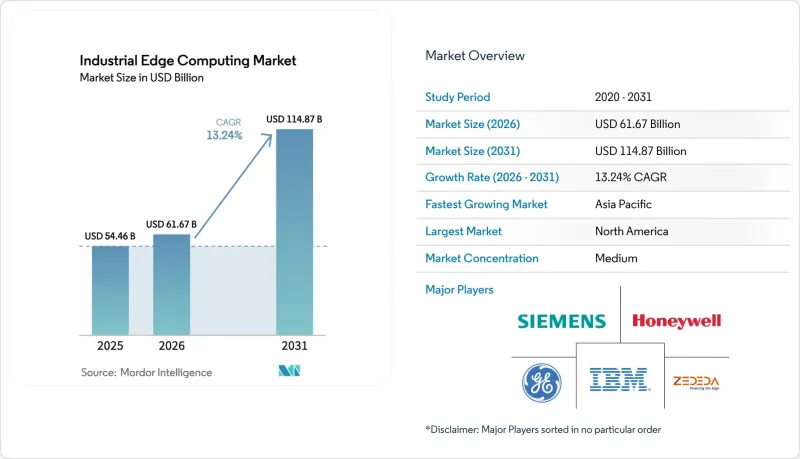
This report is Segmented by Component (Hardware, Software and Platform, and Services), End-User Industry (Manufacturing, Oil and Gas, and More), Application (Predictive Maintenance, Quality Inspection and Machine Vision, and More), Deployment Model (On-Premises Edge Appliances, Integrated Edge On Network Equipment, and More), and Geography. The Market Forecasts are Provided in Terms of Value (USD).
Global Industrial Edge Computing Market Trends and Insights
Surge in IIoT-sensor deployments and factory automation
Enterprises are attaching millions of sensors to machines, conveyors, and utilities, generating torrents of telemetry that overwhelm cloud backhauls if processed remotely. Edge nodes eliminate that bottleneck by applying real-time filtering and analytics within the factory walls. Discrete manufacturers are particularly sensitive to microsecond delays, driving uptake among automotive, electronics, and packaging lines. The pattern reinforces itself: every new sensor multiplies data interactions, accelerating demand for local compute. As AI models for optimization run directly beside controllers, edge platforms shift from optional add-ons to core infrastructure.
Rapid adoption of low-latency analytics in smart manufacturing
Smart-manufacturing pilots show how milliseconds translate into millions of dollars. ExxonMobil's open-process testbed cut a 15-second loop to roughly 40 milliseconds by relocating analytics to the edge. Faster feedback prevents quality drift and reduces scrap in continuous industries such as chemicals and metals. Firms often start by monitoring noncritical assets, then migrate to mission-critical loops once confidence grows. Vision-based inspection is a prime catalyst because any lag between camera capture and corrective action lets defects propagate down the line.
OT-IT skills gap for edge integration
Effective deployment demands professionals fluent in industrial protocols, cybersecurity, and cloud-native stacks, yet fewer than 15% of engineers possess that mix. Hiring shortages extend project timelines and inflate consulting fees. Smaller plants feel the pinch more acutely, often postponing projects until integrators package turnkey offerings. Although certification programs are growing, workforce development lags technology rollout, keeping the skills gap a mid-term drag on the Industrial Edge Computing market.
Other drivers and restraints analyzed in the detailed report include:
- Roll-out of private-5G industrial networks
- Containerized workloads on existing OT network equipment
- High upfront hardware and retrofit costs
For complete list of drivers and restraints, kindly check the Table Of Contents.
Segment Analysis
Hardware captured 45.02% revenue in 2025 as factories invested in gateways, vision accelerators, and rugged servers able to withstand vibration, dust, and temperature swings. Those purchases anchor the current Industrial Edge Computing market, ensuring deterministic performance near production lines. Software and platform offerings, however, are scaling faster at a 13.95% CAGR because they decouple workloads from proprietary iron. Enterprises can now install a digital-twin microservice on the same node that hosts a PLC, then redeploy it to a different plant through a centralized registry. Subscription pricing also aligns with operating budgets, giving finance teams predictable expense curves.
The growing availability of container runtimes on control hardware blurs the boundary between device and application. Softing Industrial's 2025 OPC UA expansion, supporting more than 60 companion models, illustrates how standardized information models boost software value. As orchestration maturity improves, buyers increasingly weigh platform flexibility and lifecycle automation over processor counts. Services remain the smallest slice but influence purchasing decisions because integration partners tie disparate assets into a unified management plane.
Manufacturing held 42.10% of global spending in 2025 as early Industry 4.0 adopters sought microsecond decision loops for robotics and process control. The Industrial Edge Computing market resonates with this sector because downtime costs can exceed USD 25,000 per minute in automotive stamping lines. Yet transportation and logistics is climbing fastest at a 13.96% CAGR, propelled by fleet telematics, terminal automation, and autonomous yard vehicles requiring compute at depots. Oil and gas remain substantial due to remote field assets where satellite latency is prohibitive.
Life sciences plants are also accelerating deployments as FDA guidance endorses advanced manufacturing technologies that ensure lot-level traceability. Mining, metals, and utilities apply edge analytics to worker safety and grid-stability use cases. Food and beverage plants deploy real-time vision inspection to comply with stringent labeling and allergen regulations. While each vertical value offers latency reduction, compliance reporting, and energy savings that often tip the business case, broadening the Industrial Edge Computing industry's addressable base.
Complete Report Scope:
- By Component
- Hardware
- Software and Platform
- Services
- By End-user Industry
- Manufacturing
- Oil and Gas
- Mining and Metals
- Utilities and Energy
- Transportation and Logistics
- Pharmaceuticals and Life Sciences
- Food and Beverage
- Other End-user Industries
- By Application
- Predictive Maintenance
- Quality Inspection and Machine Vision
- Real-time Process Optimisation
- Remote Asset Monitoring
- Safety and Compliance Analytics
- Edge AI Vision Analytics
- By Deployment Model
- On-premise Edge Appliances
- Integrated Edge on Network Equipment
- Managed Edge Platform-as-a-Service
- Industrial Edge Micro-Data-Centers
- By Geography
- North America
- South America
- Europe
- Asia Pacific
- Middle East and Africa
Geography Analysis
North America's 39.45% 2025 share reflects a confluence of early private-5G adoption, robust cyber-insurance frameworks, and corporate sustainability targets that incentivize on-premise analytics. Multinationals like ExxonMobil validate open architectures that blend legacy DCS with containerized microservices, cementing customer trust. Revenue growth now tilts toward mid-sized plants modernizing brownfield lines rather than flagship pilots, extending the Industrial Edge Computing market beyond early adopters.
Asia Pacific records the fastest 13.62% CAGR, underscored by China's Made-in-China 2025 program and Japan's Society 5.0 vision. Greenfield factories integrate edge capabilities from initial design, bypassing retrofit bottlenecks. Sustainability-linked loans, often priced 20-30 basis points lower, reward real-time energy optimization achieved through local analytics. The region's export-driven manufacturers view latency-free quality control as a strategic differentiator in global supply chains.
Europe remains pivotal thanks to IEC 62443 cyber mandates and GDPR-driven data-locality rules that privilege on-premise processing. Automotive and food producers lead, supported by Horizon-funded research that subsidizes pilot deployments. Meanwhile, South American mines and Middle East oilfields deploy rugged edge nodes to cut unplanned downtime on remote assets, illustrating how the Industrial Edge Computing market scales across disparate economic environments.
- International Business Machines Corporation
- Rockwell Automation, Inc.
- Siemens AG
- General Electric Company
- Honeywell International Inc.
- Huawei Technologies Co., Ltd.
- Microsoft Corporation
- SAP SE
- Intel Corporation
- Cisco Systems, Inc.
- Hewlett Packard Enterprise Company
- Dell Technologies Inc.
- Amazon Web Services, Inc.
- Schneider Electric SE
- Nokia Corporation
- Advantech Co., Ltd.
- ABB Ltd.
- Emerson Electric Co.
- Mitsubishi Electric Corporation
- Bosch Rexroth AG
- Foghorn Systems, Inc.
- ZEDEDA
- PTC Inc.
- ClearBlade, Inc.
Additional Benefits:
- The market estimate (ME) sheet in Excel format
- 3 months of analyst support
TABLE OF CONTENTS
1 INTRODUCTION
- 1.1 Study Assumptions and Market Definition
- 1.2 Scope of the Study
2 RESEARCH METHODOLOGY
3 EXECUTIVE SUMMARY
4 MARKET LANDSCAPE
- 4.1 Market Overview
- 4.2 Market Drivers
- 4.2.1 Surge in IIoT-sensor deployments and factory automation
- 4.2.2 Rapid adoption of low-latency analytics in smart manufacturing
- 4.2.3 Roll-out of private-5G industrial networks
- 4.2.4 Containerized workloads on existing OT network equipment
- 4.2.5 Cyber-insurance discounts for on-premise edge analytics
- 4.2.6 Sustainability-linked financing favouring local energy optimisation
- 4.3 Market Restraints
- 4.3.1 OT-IT skills gap for edge integration
- 4.3.2 High upfront hardware and retro-fit costs
- 4.3.3 Fragmented middleware standards hindering portability
- 4.3.4 Long-term security-patch obligations raising TCO
- 4.4 Industry Value Chain Analysis
- 4.5 Regulatory Landscape
- 4.6 Technological Outlook
- 4.7 Porter's Five Forces Analysis
- 4.7.1 Bargaining Power of Buyers
- 4.7.2 Bargaining Power of Suppliers
- 4.7.3 Threat of New Entrants
- 4.7.4 Threat of Substitutes
- 4.7.5 Intensity of Competitive Rivalry
5 MARKET SIZE AND GROWTH FORECASTS (VALUE)
- 5.1 By Component
- 5.1.1 Hardware
- 5.1.2 Software and Platform
- 5.1.3 Services
- 5.2 By End-user Industry
- 5.2.1 Manufacturing
- 5.2.2 Oil and Gas
- 5.2.3 Mining and Metals
- 5.2.4 Utilities and Energy
- 5.2.5 Transportation and Logistics
- 5.2.6 Pharmaceuticals and Life Sciences
- 5.2.7 Food and Beverage
- 5.2.8 Other End-user Industries
- 5.3 By Application
- 5.3.1 Predictive Maintenance
- 5.3.2 Quality Inspection and Machine Vision
- 5.3.3 Real-time Process Optimisation
- 5.3.4 Remote Asset Monitoring
- 5.3.5 Safety and Compliance Analytics
- 5.3.6 Edge AI Vision Analytics
- 5.4 By Deployment Model
- 5.4.1 On-premise Edge Appliances
- 5.4.2 Integrated Edge on Network Equipment
- 5.4.3 Managed Edge Platform-as-a-Service
- 5.4.4 Industrial Edge Micro-Data-Centers
- 5.5 By Geography
- 5.5.1 North America
- 5.5.2 South America
- 5.5.3 Europe
- 5.5.4 Asia Pacific
- 5.5.5 Middle East and Africa
6 COMPETITIVE LANDSCAPE
- 6.1 Market Concentration
- 6.2 Strategic Moves
- 6.3 Market Share Analysis
- 6.4 Company Profiles (includes Global-level Overview, Market-level Overview, Core Segments, Financials as available, Strategic Information, Market Rank/Share, Products and Services, Recent Developments)
- 6.4.1 International Business Machines Corporation
- 6.4.2 Rockwell Automation, Inc.
- 6.4.3 Siemens AG
- 6.4.4 General Electric Company
- 6.4.5 Honeywell International Inc.
- 6.4.6 Huawei Technologies Co., Ltd.
- 6.4.7 Microsoft Corporation
- 6.4.8 SAP SE
- 6.4.9 Intel Corporation
- 6.4.10 Cisco Systems, Inc.
- 6.4.11 Hewlett Packard Enterprise Company
- 6.4.12 Dell Technologies Inc.
- 6.4.13 Amazon Web Services, Inc.
- 6.4.14 Schneider Electric SE
- 6.4.15 Nokia Corporation
- 6.4.16 Advantech Co., Ltd.
- 6.4.17 ABB Ltd.
- 6.4.18 Emerson Electric Co.
- 6.4.19 Mitsubishi Electric Corporation
- 6.4.20 Bosch Rexroth AG
- 6.4.21 Foghorn Systems, Inc.
- 6.4.22 ZEDEDA
- 6.4.23 PTC Inc.
- 6.4.24 ClearBlade, Inc.
7 MARKET OPPORTUNITIES AND FUTURE OUTLOOK
- 7.1 White-space and Unmet-need Assessment

