PUBLISHER: MarketsandMarkets | PRODUCT CODE: 2096351
PUBLISHER: MarketsandMarkets | PRODUCT CODE: 2096351
Mass Spectrometry Market by Product, Inlet Type (LC-MS, GC-MS, ICP-MS, Other Inlet Types), Application (Omics, Drug Discovery, Food, Environmental), End User (Pharma, Biotech) - Global Forecast to 2031
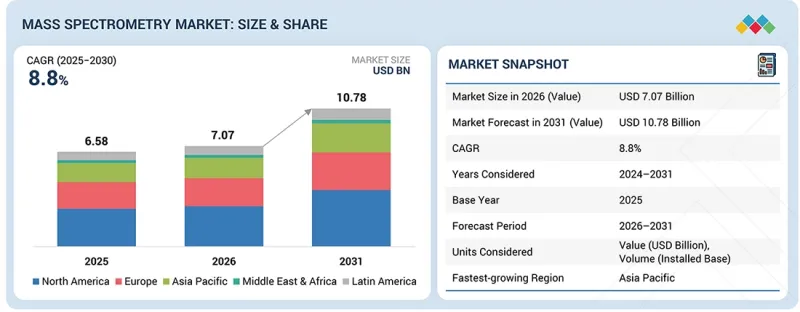
The global mass spectrometry market is projected to reach USD 10,783.3 million by 2031 from USD 7,074.0 million in 2026, at a CAGR of 8.8% from 2026 to 2031.
| Scope of the Report | |
|---|---|
| Years Considered for the Study | 2026-2031 |
| Base Year | 2025 |
| Forecast Period | 2026-2031 |
| Units Considered | Value (USD billion) |
| Segments | Product, Inlet Type, Application, End User, and Region |
| Regions covered | North America, Europe, the Asia Pacific, Latin America, and the Middle East & Africa |
The global mass spectrometry market is experiencing strong growth driven by the rapid expansion of precision medicine, biologics development, multi-omics research, and regulatory-driven bioanalytical testing across pharmaceutical, biotechnology, clinical diagnostics, food safety, and environmental sectors. One of the latest trends accelerating market growth is the increasing adoption of high-resolution LC-MS/MS and hybrid mass spectrometry platforms integrated with AI-enabled analytics, automation, cloud-connected laboratory workflows, and robotic sample preparation to improve throughput, reproducibility, and operational efficiency.
Pharmaceutical and biopharmaceutical companies are heavily investing in advanced mass spectrometry systems for biomarker discovery, antibody-drug conjugate (ADC) characterization, cell and gene therapy development, and FDA-compliant pharmacokinetic analysis, while hospitals and diagnostic laboratories are increasingly deploying benchtop clinical LC-MS/MS systems for endocrinology, toxicology, and precision oncology testing. Additionally, the rapid growth of outsourced bioanalytical services through CROs, increasing PFAS and environmental contaminant testing, and the transition toward digitally integrated and standardized analytical ecosystems are further strengthening global demand for next-generation hybrid and high-throughput mass spectrometry platforms.
The instruments segment accounted for the largest share of the mass spectrometry market.
By product, the mass spectrometry market is segmented into instruments, software, and services. During the forecast period, the instruments segment is projected to hold the largest share of the mass spectrometry market owing to increasing investments in advanced analytical technologies across pharmaceutical, biotechnology, clinical research, and multi-omics applications. The growing demand for high-performance mass spectrometry instruments is being driven by the rising complexity of drug development workflows involving biologics, antibody-drug conjugates (ADCs), cell and gene therapies, and precision medicine initiatives. Pharmaceutical and biopharmaceutical companies are increasingly investing in next-generation mass spectrometry platforms with improved sensitivity, high-resolution analysis, automation, and AI-enabled workflow capabilities to enhance bioanalytical efficiency, accelerate research timelines, and ensure regulatory compliance. Furthermore, developed regions such as North America and Europe are witnessing faster instrument replacement and upgrade cycles due to continuous technological innovation and the increasing adoption of high-throughput analytical systems across research laboratories, hospitals, and clinical institutions.
"The LC-MS segment accounted for the largest share of the mass spectrometry market."
By inlet type, the mass spectrometry market is segmented into GC-MS, LC-MS, ICP-MS, and other inlet types. During the forecast period, the LC-MS segment is expected to dominate the global mass spectrometry market owing to its widespread adoption across pharmaceutical, biotechnology, clinical diagnostics, food safety, and environmental testing applications. LC-MS is one of the most extensively utilized analytical techniques for the identification and quantification of complex biological and chemical compounds with high sensitivity and accuracy. The segment is witnessing significant growth due to increasing regulatory acceptance, expanding biologics and precision medicine research, and rising demand for advanced bioanalytical testing workflows. One of the major market trends driving LC-MS adoption is the implementation of ICH M10 bioanalytical method validation guidelines by the U.S. Food and Drug Administration and other international regulatory agencies, which recognize LC-MS/MS as the preferred technology for pharmacokinetic analysis, biomarker quantification, and regulated drug testing. This regulatory shift is encouraging pharmaceutical companies and contract research organizations to increase investments in next-generation LC-MS/MS platforms to support clinical development, regulatory compliance, and high-throughput drug analysis applications.
"The pharma/biopharma manufacturing application segment accounted for the largest share of the mass spectrometry market."
The pharmaceutical and biopharmaceutical sectors are emerging as major application areas and key news trends in the mass spectrometry market due to the growing demand for advanced analytical technologies in drug discovery, biologics characterization, biomarker identification, and GMP-compliant quality control. Pharmaceutical companies are increasingly adopting LC-MS/MS and high-resolution mass spectrometry systems to support complex biologics, antibody-drug conjugates, peptides, cell and gene therapies, and biosimilar development, where traditional analytical methods are often insufficient. The rising focus on precision medicine, regulatory compliance, impurity profiling, and real-time process monitoring is further accelerating the adoption of advanced mass spectrometry platforms across pharmaceutical R&D and manufacturing operations.
In addition, the rapid expansion of omics research, proteomics, metabolomics, and personalized medicine is driving continuous innovation and product launches in the mass spectrometry industry. Leading companies are introducing automated, high-throughput, and AI-enabled mass spectrometry solutions to support translational research and biopharma workflows. The increasing outsourcing of bioanalytical testing to CROs and CDMOs, along with growing investments in biologics and advanced therapies, is further strengthening the role of mass spectrometry in pharmaceutical and biotechnology applications. These trends are positioning pharma and biopharma as the fastest-growing and highest-revenue-generating application segments within the global mass spectrometry market.
By end-user, the pharmaceutical companies segment is projected to account for the largest market share during the forecast period.
By end user, the mass spectrometry market is segmented into pharmaceutical companies, biotechnology companies, research laboratories & academic institutes, environmental testing laboratories, food & beverage industry, hospital clinical & forensic laboratories, petrochemical industry, and other end users. During the forecast period, the pharmaceutical companies segment is expected to register the fastest growth owing to the increasing adoption of advanced analytical technologies in biologics development, precision therapeutics, and multi-omics-based drug discovery workflows. One of the major trends driving growth in this segment is the rising deployment of advanced hybrid mass spectrometry platforms such as Orbitrap, Q-TOF, Triple Quadrupole Linear Ion Trap, and FT-MS systems for complex biologic characterization, antibody-drug conjugate (ADC) analysis, host-cell protein monitoring, and real-time process analytical technology (PAT) applications. Pharmaceutical and biopharmaceutical manufacturers are increasingly integrating high-resolution hybrid MS systems into manufacturing, quality control, and bioanalytical environments to support continuous bioprocessing, impurity profiling, glycosylation studies, and ultra-trace contaminant detection. This trend is particularly prominent in monoclonal antibody, mRNA, and cell therapy manufacturing facilities, where next-generation therapeutics require highly sensitive and high-resolution analytical capabilities beyond conventional testing technologies.
"Asia Pacific is projected to show the highest growth rate in the mass spectrometry market."
The mass spectrometry market spans five primary regions: North America, Europe, Asia Pacific, Latin America, and the Middle East & Africa. The Asia-Pacific mass spectrometry market is witnessing rapid transformation driven by the expansion of biologics manufacturing, multi-omics research, precision medicine programs, and large-scale pharmaceutical outsourcing across China, India, Japan, South Korea, and Southeast Asia. One of the latest trends is the increasing deployment of high-resolution hybrid LC-MS/MS, Orbitrap, and Q-TOF systems in CROs, CDMOs, and biopharmaceutical manufacturing facilities for advanced biologic characterization, impurity profiling, glycan analysis, and cell & gene therapy workflows. Governments across the region are heavily investing in genomics, proteomics, metabolomics, and translational medicine initiatives, accelerating the adoption of AI-enabled and cloud-connected mass spectrometry platforms in both research and clinical diagnostics environments. Another major trend reshaping the region is the rapid digitalization of analytical laboratories through robotic sample preparation, laboratory information system (LIS) integration, and automated bioanalytical workflows to support high-throughput drug development and regulatory compliance. Additionally, APAC is emerging as a global pharmaceutical and bioanalytical outsourcing hub, creating strong recurring demand for advanced LC-MS infrastructure among CROs and contract testing laboratories.
A breakdown of the primary participants referred to for this report is provided below:
- By Company Type: Tier 1 (35%), Tier 2 (45%), and Tier 3 (20%)
- By Designation: C-level Executives (35%), Directors (25%), and Others (40%)
- By Region: North America (40%), Europe (30%), Asia Pacific (20%), Latin America (5%), and Middle East & Africa (5%)
The major players in the mass spectrometry market include Thermo Fisher Scientific (US), Agilent Technologies (US), Sciex (US), Waters Corporation (US), Bruker (US), Shimadzu Corporation (Japan), and PerkinElmer Inc. (US), among others.
Research Coverage
The research report examines the mass spectrometry market by product, inlet type, application, end users, and region. This research covers factors that are driving market expansion, analyzes prospects and parameters faced by industries in the present time, and provides specifics on the competitive landscape, considering market leaders and small and medium enterprises. This research also estimates the revenue of different market segments by considering five regions and micro-market analysis.
Reasons to Buy the Report
The report will provide market leaders and new entrants with valuable information regarding the revenue estimates for the overall mass spectrometry market and its subsegments. It will help stakeholders understand the competitive landscape, allowing them to position their businesses more effectively and develop appropriate go-to-market strategies. Additionally, the report offers insights into the market dynamics, including key drivers, restraints, challenges, and opportunities.
This report provides insightful data on the following pointers:
- Market Penetration: In-depth coverage of product portfolios offered by the top players in the mass spectrometry market
- Product Development/Innovation: In-depth coverage of product portfolios offered by the top players in the mass spectrometry market
- Market Development: Insightful data on profitable developing areas
- Market Diversification: Details about recent developments and advancements in the mass spectrometry market
- Competitive Assessment: Extensive assessment of the products, growth tactics, revenue projections, and market categories of the top competitors
TABLE OF CONTENTS
1 INTRODUCTION
- 1.1 STUDY OBJECTIVES
- 1.2 MARKET DEFINITION
- 1.3 MARKET SCOPE
- 1.3.1 MARKET SEGMENTATION AND REGIONAL SCOPE
- 1.3.2 INCLUSIONS AND EXCLUSIONS
- 1.3.3 YEARS CONSIDERED
- 1.4 CURRENCY CONSIDERED
- 1.5 STAKEHOLDERS
- 1.6 SUMMARY OF CHANGES
2 EXECUTIVE SUMMARY
- 2.1 MARKET HIGHLIGHTS AND KEY INSIGHTS
- 2.2 KEY MARKET PARTICIPANTS: MAPPING OF STRATEGIC DEVELOPMENTS
- 2.3 DISRUPTIVE TRENDS IN MASS SPECTROMETRY MARKET
- 2.4 HIGH-GROWTH SEGMENTS
- 2.5 REGIONAL SNAPSHOT: MARKET SIZE, GROWTH RATE, AND FORECAST
3 PREMIUM INSIGHTS
- 3.1 ATTRACTIVE OPPORTUNITIES FOR PLAYERS IN MASS SPECTROMETRY MARKET
- 3.2 ASIA PACIFIC: MASS SPECTROMETRY MARKET, BY INLET TYPE AND COUNTRY
- 3.3 MASS SPECTROMETRY MARKET: GEOGRAPHIC GROWTH OPPORTUNITIES
4 MARKET OVERVIEW
- 4.1 INTRODUCTION
- 4.2 MARKET DYNAMICS
- 4.2.1 DRIVERS
- 4.2.1.1 Precision medicine & biomarker-driven healthcare system to drive adoption
- 4.2.1.2 Adoption of send-out tests to control turnaround and cost
- 4.2.1.3 Increased privatization of environmental services and regulatory framework
- 4.2.1.4 Increasing investments in pharmaceutical research & development
- 4.2.2 RESTRAINTS
- 4.2.2.1 Capital-intensive investments for high-end equipment
- 4.2.2.2 Time-consuming sample preparation steps
- 4.2.3 OPPORTUNITIES
- 4.2.3.1 Growing application of mass spectrometry in clinical and forensic settings
- 4.2.3.2 Expansion of microbiome and infection diagnostics
- 4.2.3.3 Development of novel mass sensors and nanopore ion sources
- 4.2.4 CHALLENGES
- 4.2.4.1 Software interoperability and data management fragmentation
- 4.2.4.2 Inadequate infrastructure and shortage of skilled professionals
- 4.2.1 DRIVERS
- 4.3 TRENDS/DISRUPTIONS IMPACTING CUSTOMER BUSINESS
- 4.4 UNMET NEEDS
- 4.5 INTERCONNECTED MARKETS AND CROSS-SECTOR OPPORTUNITIES
- 4.6 STRATEGIC MOVES BY TIER-1/2/3 PLAYERS
5 INDUSTRY TRENDS
- 5.1 PORTER'S FIVE FORCES ANALYSIS
- 5.1.1 BARGAINING POWER OF SUPPLIERS
- 5.1.2 BARGAINING POWER OF BUYERS
- 5.1.3 THREAT OF NEW ENTRANTS
- 5.1.4 THREAT OF SUBSTITUTES
- 5.1.5 INTENSITY OF COMPETITIVE RIVALRY
- 5.2 MACROECONOMIC OUTLOOK
- 5.2.1 INTRODUCTION
- 5.2.2 GDP TRENDS AND FORECAST
- 5.2.3 TRENDS IN MASS SPECTROMETRY INDUSTRY
- 5.3 VALUE CHAIN ANALYSIS
- 5.3.1 R&D
- 5.3.2 RAW MATERIAL PROCUREMENT
- 5.3.3 MANUFACTURING
- 5.3.4 DISTRIBUTION, MARKETING & SALES, AND POST-SALES SERVICES
- 5.4 ECOSYSTEM ANALYSIS
- 5.5 PRICING ANALYSIS
- 5.5.1 AVERAGE SELLING PRICE TREND, BY PRODUCT
- 5.5.2 AVERAGE SELLING PRICE TREND, BY REGION
- 5.6 TRADE ANALYSIS
- 5.6.1 IMPORT SCENARIO (HS CODE 902781)
- 5.6.2 EXPORT SCENARIO (HS CODE 902781)
- 5.7 KEY CONFERENCES AND EVENTS, 2026-2027
- 5.8 TRENDS/DISRUPTIONS IMPACTING CUSTOMER BUSINESS
- 5.9 INVESTMENT AND FUNDING SCENARIO
- 5.10 CASE STUDY ANALYSIS
- 5.11 IMPACT OF 2025 US TARIFF - MASS SPECTROMETRY MARKET
- 5.11.1 INTRODUCTION
- 5.11.2 KEY TARIFF RATES
- 5.11.3 PRICE IMPACT ANALYSIS
- 5.11.4 IMPACT ON COUNTRIES/REGIONS
- 5.11.4.1 US
- 5.11.4.2 Europe
- 5.11.4.3 Asia Pacific
- 5.11.5 IMPACT ON END-USE INDUSTRIES
6 TECHNOLOGICAL ADVANCEMENTS, AI-DRIVEN IMPACT, PATENTS, AND INNOVATIONS
- 6.1 TECHNOLOGICAL ANALYSIS
- 6.1.1 KEY TECHNOLOGIES
- 6.1.1.1 Miniaturized ion trap and quadrupole mass analyzer
- 6.1.1.2 Quadrupole mass analyzer
- 6.1.1.3 Time-of-flight mass analyzer
- 6.1.1.4 Ion trap mass analyzer
- 6.1.2 COMPLEMENTARY TECHNOLOGIES
- 6.1.2.1 LC-MS
- 6.1.2.2 IOT sensor integration and environmental monitoring networks
- 6.1.3 ADJACENT TECHNOLOGIES
- 6.1.3.1 Mass spectrometry imaging
- 6.1.3.2 Ion mobility spectrometry
- 6.1.1 KEY TECHNOLOGIES
- 6.2 PATENT ANALYSIS
- 6.3 IMPACT OF AI ON MASS SPECTROMETRY MARKET
- 6.3.1 TOP USE CASES AND MARKET POTENTIAL
- 6.3.2 KEY COMPANIES IMPLEMENTING AI
- 6.3.3 BEST PRACTICES IN MASS SPECTROMETRY MARKET
- 6.3.4 INTERCONNECTED ECOSYSTEM AND IMPACT ON MARKET PLAYERS
- 6.3.5 CLIENTS' READINESS TO ADOPT AI IN MASS SPECTROMETRY
- 6.4 SUCCESS STORIES AND REAL-WORLD APPLICATIONS
7 REGULATORY LANDSCAPE
- 7.1 REGIONAL REGULATIONS AND COMPLIANCE
- 7.1.1 REGULATORY BODIES, GOVERNMENT AGENCIES, AND OTHER ORGANIZATIONS
- 7.1.2 REGULATORY SCENARIO
- 7.1.2.1 North America
- 7.1.2.2 Europe
- 7.1.2.3 Asia Pacific
- 7.1.2.4 Rest of the World
8 CUSTOMER LANDSCAPE AND BUYER BEHAVIOR
- 8.1 DECISION-MAKING PROCESS
- 8.2 KEY STAKEHOLDERS AND BUYING CRITERIA
- 8.2.1 KEY STAKEHOLDERS IN BUYING PROCESS
- 8.2.2 KEY BUYING CRITERIA
- 8.3 UNMET NEEDS OF END USERS
- 8.4 MARKET PROFITABILITY
9 MASS SPECTROMETRY MARKET, BY OFFERING
- 9.1 INTRODUCTION
- 9.2 INSTRUMENTS
- 9.2.1 HYBRID MASS SPECTROMETRY INSTRUMENTS
- 9.2.1.1 Triple quadrupole MS
- 9.2.1.1.1 Enhanced selectivity, better accuracy, and greater reproducibility to drive adoption
- 9.2.1.2 Quadrupole-time of flight (Q-TOF) MS
- 9.2.1.2.1 Latest advances in Q-TOF mass spectrometry technology to streamline workflow, making it more efficient
- 9.2.1.3 Fourier transform MS
- 9.2.1.3.1 High-resolution biomolecule analysis to drive adoption
- 9.2.1.1 Triple quadrupole MS
- 9.2.2 SINGLE MASS SPECTROMETRY INSTRUMENTS
- 9.2.2.1 Quadrupole MS
- 9.2.2.1.1 Wide application base in industry and academia to boost market growth
- 9.2.2.2 Time-of-flight MS
- 9.2.2.2.1 More precise results in proteomics and conventional analytical studies to favor adoption
- 9.2.2.3 Ion trap MS
- 9.2.2.3.1 More accurate results on higher mass-to-charge ratio extensions to favor adoption in specialized studies
- 9.2.2.1 Quadrupole MS
- 9.2.3 OTHER MASS SPECTROMETRY INSTRUMENTS
- 9.2.1 HYBRID MASS SPECTROMETRY INSTRUMENTS
- 9.3 SOFTWARE & SERVICES
- 9.3.1 NEED FOR EFFICIENT DATA MANAGEMENT AND PROCESSING TO PROPEL MARKET
10 MASS SPECTROMETRY MARKET, BY INLET TYPE
- 10.1 INTRODUCTION
- 10.2 LC-MS
- 10.2.1 REGULATORY SHIFTS WILL DRIVE ADOPTION OF LC-MS IN ENVIRONMENTAL TESTING
- 10.3 GC-MS
- 10.3.1 STANDARDIZED METHODS AND REGULATORY REFORMS FOR VOLATILE ORGANIC MOLECULES TO INCREASE ADOPTION OF GC-MS
- 10.4 ICP-MS
- 10.4.1 SIMPLE SAMPLE PREPARATION AND HIGH THROUGHPUT TO DRIVE GROWTH
- 10.5 OTHER INLET TYPES
11 MASS SPECTROMETRY MARKET, BY APPLICATION
- 11.1 INTRODUCTION
- 11.2 OMICS RESEARCH
- 11.2.1 RECENT ADVANCEMENTS IN BIOLOGICAL RESEARCH, PARTICULARLY IN PROTEOMICS AND GENOMICS, TO DRIVE MARKET
- 11.3 DRUG DISCOVERY
- 11.3.1 NEED FOR HIGHER EFFICACY AND PRODUCT QUALITY TO SUPPORT GROWTH
- 11.4 ENVIRONMENTAL TESTING
- 11.4.1 INCREASING NEED FOR MONITORING WATER CONTAMINATION TO PROPEL MARKET
- 11.5 FOOD TESTING
- 11.5.1 INCREASING IMPORTANCE OF SAFETY STANDARDS TO AMPLIFY GROWTH
- 11.6 PHARMA/BIOPHARMA MANUFACTURING
- 11.6.1 RISING USE OF MASS SPECTROMETRY IN PESTICIDE RESIDUE ANALYSIS, PROTEIN IDENTIFICATION, AND CARBON DATING TO AID GROWTH
- 11.7 CLINICAL DIAGNOSTICS
- 11.7.1 GROWING USE OF MASS SPECTROMETRY IN DRUG MONITORING, TOXICOLOGY, AND ENDOCRINOLOGY TO DRIVE MARKET
- 11.8 APPLIED SCIENCES
- 11.8.1 NEED FOR QUALITY CONTROL IN SEMICONDUCTOR INDUSTRY TO SUPPORT GROWTH
- 11.9 OTHER APPLICATIONS
12 MASS SPECTROMETRY MARKET, BY END USER
- 12.1 INTRODUCTION
- 12.2 PHARMACEUTICAL COMPANIES
- 12.2.1 GROWTH IN PHARMACEUTICAL SECTOR WILL FUEL DEMAND FOR MASS SPECTROMETRY
- 12.3 BIOTECHNOLOGY COMPANIES
- 12.3.1 GROWING BIOPHARMACEUTICAL APPLICATIONS TO DRIVE MARKET
- 12.4 RESEARCH LABS & ACADEMIC INSTITUTES
- 12.4.1 BREAKTHROUGH DEVELOPMENTS AND INDUSTRY-ACADEMIA PARTNERSHIPS TO PROPEL MARKET
- 12.5 ENVIRONMENTAL TESTING LABS
- 12.5.1 NEW AMENDMENTS IN ENVIRONMENTAL LAWS AND PRIVATIZATION OF TESTING SERVICES TO DRIVE MARKET
- 12.6 FOOD & BEVERAGE INDUSTRY
- 12.6.1 GROWING FOOD SAFETY CONCERNS TO SUPPORT MARKET GROWTH
- 12.7 FORENSIC LABS
- 12.7.1 ADVANCEMENTS IN TECHNOLOGY AND STRICT LAWS TO CREATE OPPORTUNITIES FOR MASS SPECTROMETRY
- 12.8 PETROCHEMICAL INDUSTRY
- 12.8.1 GROWING NUMBER OF NEW OIL & GAS FIELDS TO PROPEL MARKET
- 12.9 OTHER END USERS
13 MASS SPECTROMETRY MARKET, BY REGION
- 13.1 INTRODUCTION
- 13.2 NORTH AMERICA
- 13.2.1 US
- 13.2.1.1 Increased government investments and research funding to drive market
- 13.2.2 CANADA
- 13.2.2.1 Growing focus on clean energy technology to propel market
- 13.2.1 US
- 13.3 EUROPE
- 13.3.1 GERMANY
- 13.3.1.1 Growing pharmaceutical industry to drive market
- 13.3.2 UK
- 13.3.2.1 Industry academia partnerships to drive market
- 13.3.3 FRANCE
- 13.3.3.1 Strong environmental policies and public-funded research programs to drive demand
- 13.3.4 ITALY
- 13.3.4.1 Growing utilization of mass spectrometry among pharmaceutical and biotechnology end-use industries to drive market
- 13.3.5 SPAIN
- 13.3.5.1 Strong environmental monitoring framework to drive market
- 13.3.6 REST OF EUROPE
- 13.3.1 GERMANY
- 13.4 ASIA PACIFIC
- 13.4.1 JAPAN
- 13.4.1.1 Strong research infrastructure to drive demand for advanced MS models
- 13.4.2 CHINA
- 13.4.2.1 Increasing investments in scientific R&D to advance growth
- 13.4.3 INDIA
- 13.4.3.1 Increased government investments to drive market
- 13.4.4 SOUTH KOREA
- 13.4.4.1 Large industrial application base to drive demand for mass spectrometry
- 13.4.5 AUSTRALIA
- 13.4.5.1 Increasing focus on early cancer diagnosis and development of RNA therapies to aid growth
- 13.4.6 REST OF ASIA PACIFIC
- 13.4.1 JAPAN
- 13.5 LATIN AMERICA
- 13.5.1 BRAZIL
- 13.5.1.1 Increased local agricultural manufacturing to drive market growth
- 13.5.2 MEXICO
- 13.5.2.1 Growth in local manufacturing for pharmaceuticals to drive market
- 13.5.3 REST OF LATIN AMERICA
- 13.5.1 BRAZIL
- 13.6 MIDDLE EAST & AFRICA
- 13.6.1 GCC COUNTRIES
- 13.6.1.1 Favorable government initiatives to support market growth
- 13.6.2 REST OF MIDDLE EAST & AFRICA
- 13.6.1 GCC COUNTRIES
14 COMPETITIVE LANDSCAPE
- 14.1 OVERVIEW
- 14.2 KEY PLAYER STRATEGIES/RIGHT TO WIN
- 14.2.1 OVERVIEW OF STRATEGIES ADOPTED BY PLAYERS IN MASS SPECTROMETRY MARKET, JANUARY 2022-JUNE 2026
- 14.3 REVENUE ANALYSIS, 2021-2025
- 14.4 MARKET SHARE ANALYSIS, 2025
- 14.5 COMPANY EVALUATION MATRIX: KEY PLAYERS, 2025
- 14.5.1 STARS
- 14.5.2 EMERGING LEADERS
- 14.5.3 PERVASIVE PLAYERS
- 14.5.4 PARTICIPANTS
- 14.5.5 COMPANY FOOTPRINT: KEY PLAYERS, 2025
- 14.5.5.1 Company footprint
- 14.5.5.2 Offering footprint
- 14.5.5.3 Application footprint
- 14.5.5.4 End-user footprint
- 14.5.5.5 Region footprint
- 14.6 COMPANY EVALUATION MATRIX: STARTUPS/SMES, 2025
- 14.6.1 PROGRESSIVE COMPANIES
- 14.6.2 RESPONSIVE COMPANIES
- 14.6.3 DYNAMIC COMPANIES
- 14.6.4 STARTING BLOCKS
- 14.6.5 COMPETITIVE BENCHMARKING: STARTUPS/SMES, 2025
- 14.6.5.1 Detailed list of key startups/SMEs, 2025
- 14.6.5.2 Competitive benchmarking of key startups/SMEs
- 14.7 COMPANY VALUATION & FINANCIAL METRICS
- 14.7.1 FINANCIAL METRICS
- 14.7.2 COMPANY VALUATION
- 14.8 BRAND COMPARISON
- 14.9 COMPETITIVE SCENARIO
- 14.9.1 PRODUCT LAUNCHES
- 14.9.2 DEALS
- 14.9.3 EXPANSIONS
15 COMPANY PROFILES
- 15.1 KEY PLAYERS
- 15.1.1 AGILENT TECHNOLOGIES, INC.
- 15.1.1.1 Business overview
- 15.1.1.2 Products offered
- 15.1.1.3 Recent developments
- 15.1.1.3.1 Product launches & approvals
- 15.1.1.3.2 Deals
- 15.1.1.3.3 Expansions
- 15.1.1.4 MnM view
- 15.1.1.4.1 Right to win
- 15.1.1.4.2 Strategic choices
- 15.1.1.4.3 Weaknesses & competitive threats
- 15.1.2 THERMO FISHER SCIENTIFIC INC.
- 15.1.2.1 Business overview
- 15.1.2.2 Products offered
- 15.1.2.3 Recent developments
- 15.1.2.3.1 Product launches
- 15.1.2.3.2 Deals
- 15.1.2.3.3 Expansions
- 15.1.2.4 MnM view
- 15.1.2.4.1 Right to win
- 15.1.2.4.2 Strategic choices
- 15.1.2.4.3 Weaknesses & competitive threats
- 15.1.3 WATERS CORPORATION
- 15.1.3.1 Business overview
- 15.1.3.2 Products Offered
- 15.1.3.3 Recent developments
- 15.1.3.3.1 Product launches
- 15.1.3.3.2 Deals
- 15.1.3.3.3 Expansions
- 15.1.3.4 MnM view
- 15.1.3.4.1 Right to win
- 15.1.3.4.2 Strategic choices
- 15.1.3.4.3 Weaknesses & competitive threats
- 15.1.4 DANAHER CORPORATION
- 15.1.4.1 Business overview
- 15.1.4.2 Products offered
- 15.1.4.3 Recent developments
- 15.1.4.3.1 Product launches
- 15.1.4.3.2 Deals
- 15.1.4.3.3 Expansions
- 15.1.4.4 MnM view
- 15.1.4.4.1 Right to win
- 15.1.4.4.2 Strategic choices
- 15.1.4.4.3 Weaknesses & competitive threats
- 15.1.5 BRUKER CORPORATION
- 15.1.5.1 Business overview
- 15.1.5.2 Products offered
- 15.1.5.3 Recent developments
- 15.1.5.3.1 Product launches & approvals
- 15.1.5.3.2 Deals
- 15.1.5.3.3 Expansions
- 15.1.5.3.4 Other developments
- 15.1.5.4 MnM view
- 15.1.5.4.1 Right to win
- 15.1.5.4.2 Strategic choices
- 15.1.5.4.3 Weaknesses & competitive threats
- 15.1.6 SHIMADZU CORPORATION
- 15.1.6.1 Business overview
- 15.1.6.2 Products offered
- 15.1.6.3 Recent developments
- 15.1.6.3.1 Product launches
- 15.1.6.3.2 Deals
- 15.1.6.3.3 Expansions
- 15.1.7 MKS INC.
- 15.1.7.1 Business overview
- 15.1.7.2 Products offered
- 15.1.8 PERKINELMER, INC.
- 15.1.8.1 Business overview
- 15.1.8.2 Products offered
- 15.1.8.3 Recent developments
- 15.1.8.3.1 Product launches
- 15.1.8.3.2 Deals
- 15.1.9 JEOL LTD
- 15.1.9.1 Business overview
- 15.1.9.2 Products offered
- 15.1.10 HITACHI HIGH-TECH CORPORATION
- 15.1.10.1 Business overview
- 15.1.10.2 Products offered
- 15.1.10.3 Recent developments
- 15.1.10.3.1 Other developments
- 15.1.11 TELEDYNE TECHNOLOGIES INCORPORATED
- 15.1.11.1 Business overview
- 15.1.11.2 Products offered
- 15.1.11.3 Recent developments
- 15.1.11.3.1 Product launches
- 15.1.11.3.2 Deals
- 15.1.12 AMETEK, INC.
- 15.1.12.1 Business overview
- 15.1.12.2 Products offered
- 15.1.12.3 Recent developments
- 15.1.12.3.1 Deals
- 15.1.13 JASCO
- 15.1.13.1 Business overview
- 15.1.13.2 Products offered
- 15.1.14 F. HOFFMANN-LA ROCHE LTD.
- 15.1.14.1 Business overview
- 15.1.14.2 Products offered
- 15.1.14.3 Recent developments
- 15.1.14.3.1 Product launches
- 15.1.14.3.2 Expansions
- 15.1.1 AGILENT TECHNOLOGIES, INC.
- 15.2 OTHER PLAYERS
- 15.2.1 ANALYTIK JENA GMBH
- 15.2.2 HIDEN ANALYTICAL
- 15.2.3 LECO CORPORATION
- 15.2.4 RIGAKU HOLDINGS CORPORATION
- 15.2.5 YOUNGIN CHROMASS
- 15.2.6 SCION INSTRUMENTS
- 15.2.7 KORE TECHNOLOGY
- 15.2.8 PROCESS INSIGHTS, INC.
- 15.2.9 MASSTECH
- 15.2.10 ADVION, INC.
- 15.2.11 SPACETEK TECHNOLOGY AG
- 15.2.12 ELEMENTAR ANALYSENSYSTEME GMBH
- 15.2.13 SKYRAY INSTRUMENTS USA, INC.
- 15.2.14 MICROSAIC SYSTEMS PLC
- 15.2.15 PFEIFFER VACUUM GMBH
16 RESEARCH METHODOLOGY
- 16.1 RESEARCH DATA
- 16.1.1 SECONDARY RESEARCH
- 16.1.1.1 Key secondary sources
- 16.1.1.2 Key data from secondary sources
- 16.1.2 PRIMARY RESEARCH
- 16.1.2.1 Key primary sources
- 16.1.2.2 Key supply- and demand-side participants
- 16.1.2.3 Breakdown of primary interviews
- 16.1.2.4 Key primary insights
- 16.1.1 SECONDARY RESEARCH
- 16.2 MARKET SIZE ESTIMATION METHODOLOGY
- 16.2.1 REVENUE MAPPING-BASED MARKET ESTIMATION
- 16.2.2 END-USER-BASED MAPPING MARKET ESTIMATION
16.3 GROWTH FORECASTING MODEL
- 16.4 DATA TRIANGULATION AND MARKET BREAKDOWN
- 16.5 RESEARCH ASSUMPTIONS
- 16.6 RESEARCH LIMITATIONS
- 16.7 RISK ANALYSIS
17 APPENDIX
- 17.1 DISCUSSION GUIDE
- 17.2 KNOWLEDGESTORE: MARKETSANDMARKETS' SUBSCRIPTION PORTAL
- 17.3 CUSTOMIZATION OPTIONS
- 17.4 RELATED REPORTS
- 17.5 AUTHOR DETAILS
List of Tables
- TABLE 1 MASS SPECTROMETRY MARKET: INCLUSIONS AND EXCLUSIONS OF STUDY
- TABLE 2 MASS SPECTROMETRY MARKET: UNMET NEEDS
- TABLE 3 STRATEGIC FOCUS OF TIER-1/2/3 PLAYERS
- TABLE 4 MASS SPECTROMETRY MARKET: PORTER'S FIVE FORCES ANALYSIS
- TABLE 5 MASS SPECTROMETRY MARKET: ROLE OF COMPANIES IN ECOSYSTEM
- TABLE 6 AVERAGE SELLING PRICING TREND OF MASS SPECTROMETERS, BY KEY PLAYER, 2023-2025 (USD THOUSAND)
- TABLE 7 AVERAGE SELLING PRICING TREND OF MASS SPECTROMETERS, BY REGION, 2023-2025 (USD THOUSAND)
- TABLE 8 IMPORT DATA FOR HS CODE 902781-COMPLIANT PRODUCTS, BY COUNTRY, 2022-2025 (USD THOUSAND)
- TABLE 9 EXPORT DATA FOR HS CODE 902781-COMPLIANT PRODUCTS, BY COUNTRY, 2022-2025 (USD THOUSAND)
- TABLE 10 MASS SPECTROMETRY MARKET: LIST OF MAJOR CONFERENCES AND EVENTS IN 2026-2027
- TABLE 11 CASE STUDY 1: THERMO FISHER SCIENTIFIC - ORBITRAP ASTRAL ZOOM
- TABLE 12 CASE STUDY 2: AGILENT TECHNOLOGIES - INFINITYLAB PRO IQ SERIES
- TABLE 13 US-ADJUSTED RECIPROCAL TARIFF RATES
- TABLE 14 MASS SPECTROMETRY MARKET: INNOVATIONS AND PATENT REGISTRATIONS, 2024-2026
- TABLE 15 NORTH AMERICA: LIST OF REGULATORY BODIES, GOVERNMENT AGENCIES, AND OTHER ORGANIZATIONS
- TABLE 16 EUROPE: LIST OF REGULATORY BODIES, GOVERNMENT AGENCIES, AND OTHER ORGANIZATIONS
- TABLE 17 ASIA PACIFIC: LIST OF REGULATORY BODIES, GOVERNMENT AGENCIES, AND OTHER ORGANIZATIONS
- TABLE 18 LATIN AMERICA: LIST OF REGULATORY BODIES, GOVERNMENT AGENCIES, AND OTHER ORGANIZATIONS
- TABLE 19 MIDDLE EAST & AFRICA: LIST OF REGULATORY BODIES, GOVERNMENT AGENCIES, AND OTHER ORGANIZATIONS
- TABLE 20 INFLUENCE OF STAKEHOLDERS ON BUYING PROCESS
- TABLE 21 INFLUENCE OF STAKEHOLDERS ON BUYING PROCESS FOR TOP THREE END USERS
- TABLE 22 MASS SPECTROMETRY MARKET: LIST OF UNMET NEEDS
- TABLE 23 MASS SPECTROMETRY MARKET, BY OFFERING, 2024-2031 (USD MILLION)
- TABLE 24 MASS SPECTROMETRY INSTRUMENTS MARKET, BY TYPE, 2024-2031 (USD MILLION)
- TABLE 25 MASS SPECTROMETRY INSTRUMENTS MARKET, BY REGION, 2024-2031 (USD MILLION)
- TABLE 26 HYBRID MASS SPECTROMETRY INSTRUMENTS MARKET, BY TYPE, 2024-2031 (USD MILLION)
- TABLE 27 HYBRID MASS SPECTROMETRY INSTRUMENTS MARKET, BY REGION, 2024-2031 (USD MILLION)
- TABLE 28 TRIPLE QUADRUPOLE MASS SPECTROMETERS MARKET, BY REGION, 2024-2031 (USD MILLION)
- TABLE 29 Q-TOF MASS SPECTROMETERS MARKET, BY REGION, 2024-2031 (USD MILLION)
- TABLE 30 FOURIER TRANSFORM MASS SPECTROMETERS MARKET, BY REGION, 2024-2031 (USD MILLION)
- TABLE 31 SINGLE MASS SPECTROMETRY INSTRUMENTS MARKET, BY TYPE, 2024-2031 (USD MILLION)
- TABLE 32 SINGLE MASS SPECTROMETRY INSTRUMENTS MARKET, BY REGION, 2024-2031 (USD MILLION)
- TABLE 33 QUADRUPOLE MASS SPECTROMETERS MARKET, BY REGION, 2024-2031 (USD MILLION)
- TABLE 34 TIME-OF-FLIGHT MASS SPECTROMETERS MARKET, BY REGION, 2024-2031 (USD MILLION)
- TABLE 35 ION TRAP MASS SPECTROMETERS MARKET, BY REGION, 2024-2031 (USD MILLION)
- TABLE 36 OTHER MASS SPECTROMETRY INSTRUMENTS MARKET, BY REGION, 2024-2031 (USD MILLION)
- TABLE 37 MASS SPECTROMETRY MARKET FOR SOFTWARE & SERVICES, BY REGION, 2024-2031 (USD MILLION)
- TABLE 38 MASS SPECTROMETRY MARKET, BY INLET TYPE, 2024-2031 USD MILLION)
- TABLE 39 MASS SPECTROMETRY MARKET FOR LC-MS, BY REGION, 2024-2031 (USD MILLION)
- TABLE 40 MASS SPECTROMETRY MARKET FOR GC-MS, BY REGION, 2024-2031 (USD MILLION)
- TABLE 41 MASS SPECTROMETRY MARKET FOR ICP-MS, BY REGION, 2024-2031 USD MILLION)
- TABLE 42 MASS SPECTROMETRY MARKET FOR OTHER INLET TYPES, BY REGION, 2024-2031 (USD MILLION)
- TABLE 43 MASS SPECTROMETRY MARKET, BY APPLICATION, 2024-2031 (USD MILLION)
- TABLE 44 MASS SPECTROMETRY MARKET FOR OMICS RESEARCH, BY REGION, 2024-2031 (USD MILLION)
- TABLE 45 MASS SPECTROMETRY MARKET FOR DRUG DISCOVERY, BY REGION, 2024-2031 (USD MILLION)
- TABLE 46 MASS SPECTROMETRY MARKET FOR ENVIRONMENTAL TESTING, BY REGION, 2024-2031 (USD MILLION)
- TABLE 47 MASS SPECTROMETRY MARKET FOR FOOD TESTING, BY REGION, 2024-2031 (USD MILLION)
- TABLE 48 MASS SPECTROMETRY MARKET FOR PHARMA/BIOPHARMA MANUFACTURING, BY REGION, 2024-2031 (USD MILLION)
- TABLE 49 MASS SPECTROMETRY MARKET FOR CLINICAL DIAGNOSTICS, BY REGION, 2024-2031 (USD MILLION)
- TABLE 50 MASS SPECTROMETRY MARKET FOR APPLIED SCIENCES, BY REGION, 2024-2031 (USD MILLION)
- TABLE 51 MASS SPECTROMETRY MARKET FOR OTHER APPLICATIONS, BY REGION, 2024-2031 (USD MILLION)
- TABLE 52 MASS SPECTROMETRY MARKET, BY END USER, 2024-2031 (USD MILLION)
- TABLE 53 MASS SPECTROMETRY MARKET FOR PHARMACEUTICAL COMPANIES, BY REGION, 2024-2031 (USD MILLION)
- TABLE 54 MASS SPECTROMETRY MARKET FOR BIOTECHNOLOGY COMPANIES, BY REGION, 2024-2031 (USD MILLION)
- TABLE 55 MASS SPECTROMETRY MARKET FOR RESEARCH LABS & ACADEMIC INSTITUTES, BY REGION, 2024-2031 (USD MILLION)
- TABLE 56 MASS SPECTROMETRY MARKET FOR ENVIRONMENTAL TESTING LABS, BY REGION, 2024-2031 (USD MILLION)
- TABLE 57 MASS SPECTROMETRY MARKET FOR FOOD & BEVERAGE INDUSTRY, BY REGION, 2024-2031 (USD MILLION)
- TABLE 58 MASS SPECTROMETRY MARKET FOR FORENSIC LABS, BY REGION, 2024-2031 (USD MILLION)
- TABLE 59 MASS SPECTROMETRY MARKET FOR PETROCHEMICAL INDUSTRY, BY REGION, 2024-2031 (USD MILLION)
- TABLE 60 MASS SPECTROMETRY MARKET FOR OTHER END USERS, BY REGION, 2024-2031 (USD MILLION)
- TABLE 61 MASS SPECTROMETRY MARKET, BY REGION, 2024-2031 (USD MILLION)
- TABLE 62 NORTH AMERICA: MASS SPECTROMETRY MARKET, BY COUNTRY, 2024-2031 (USD MILLION)
- TABLE 63 NORTH AMERICA: MASS SPECTROMETRY MARKET, BY OFFERING, 2024-2031 (USD MILLION)
- TABLE 64 NORTH AMERICA: MASS SPECTROMETRY INSTRUMENTS MARKET, BY TYPE, 2024-2031 (USD MILLION)
- TABLE 65 NORTH AMERICA: HYBRID MASS SPECTROMETRY INSTRUMENTS MARKET, BY TYPE, 2024-2031 (USD MILLION)
- TABLE 66 NORTH AMERICA: SINGLE MASS SPECTROMETRY INSTRUMENTS MARKET, BY TYPE, 2024-2031 (USD MILLION)
- TABLE 67 NORTH AMERICA: MASS SPECTROMETRY MARKET, BY INLET TYPE, 2024-2031 (USD MILLION)
- TABLE 68 NORTH AMERICA: MASS SPECTROMETRY MARKET, BY APPLICATION, 2024-2031 (USD MILLION)
- TABLE 69 NORTH AMERICA: MASS SPECTROMETRY MARKET, BY END USER, 2024-2031 (USD MILLION)
- TABLE 70 US: MASS SPECTROMETRY MARKET, BY OFFERING, 2024-2031 (USD MILLION)
- TABLE 71 US: MASS SPECTROMETRY INSTRUMENTS MARKET, BY TYPE, 2024-2031 (USD MILLION)
- TABLE 72 US: HYBRID MASS SPECTROMETRY INSTRUMENTS MARKET, BY TYPE, 2024-2031 (USD MILLION)
- TABLE 73 US: SINGLE MASS SPECTROMETRY INSTRUMENTS MARKET, BY TYPE, 2024-2031 (USD MILLION)
- TABLE 74 CANADA: MASS SPECTROMETRY MARKET, BY OFFERING, 2024-2031 (USD MILLION)
- TABLE 75 CANADA: MASS SPECTROMETRY INSTRUMENTS MARKET, BY TYPE, 2024-2031 (USD MILLION)
- TABLE 76 CANADA: HYBRID MASS SPECTROMETRY INSTRUMENTS MARKET, BY TYPE, 2024-2031 (USD MILLION)
- TABLE 77 CANADA: SINGLE MASS SPECTROMETRY INSTRUMENTS MARKET, BY TYPE, 2024-2031 (USD MILLION)
- TABLE 78 EUROPE: MASS SPECTROMETRY MARKET, BY COUNTRY, 2024-2031 (USD MILLION)
- TABLE 79 EUROPE: MASS SPECTROMETRY MARKET, BY OFFERING, 2024-2031 (USD MILLION)
- TABLE 80 EUROPE: MASS SPECTROMETRY INSTRUMENTS MARKET, BY TYPE, 2024-2031 (USD MILLION)
- TABLE 81 EUROPE: HYBRID MASS SPECTROMETRY INSTRUMENTS MARKET, BY TYPE, 2024-2031 (USD MILLION)
- TABLE 82 EUROPE: SINGLE MASS SPECTROMETRY INSTRUMENTS MARKET, BY TYPE, 2024-2031 (USD MILLION)
- TABLE 83 EUROPE: MASS SPECTROMETRY MARKET, BY INLET TYPE, 2024-2031 (USD MILLION)
- TABLE 84 EUROPE: MASS SPECTROMETRY MARKET, BY APPLICATION, 2024-2031 (USD MILLION)
- TABLE 85 EUROPE: MASS SPECTROMETRY MARKET, BY END USER, 2024-2031 (USD MILLION)
- TABLE 86 GERMANY: MASS SPECTROMETRY MARKET, BY OFFERING, 2024-2031 (USD MILLION)
- TABLE 87 GERMANY: MASS SPECTROMETRY INSTRUMENTS MARKET, BY TYPE, 2024-2031 (USD MILLION)
- TABLE 88 GERMANY: HYBRID MASS SPECTROMETRY INSTRUMENTS MARKET, BY TYPE, 2024-2031 (USD MILLION)
- TABLE 89 GERMANY: SINGLE MASS SPECTROMETRY INSTRUMENTS MARKET, BY TYPE, 2024-2031 (USD MILLION)
- TABLE 90 UK: MASS SPECTROMETRY MARKET, BY OFFERING, 2024-2031 (USD MILLION)
- TABLE 91 UK: MASS SPECTROMETRY INSTRUMENTS MARKET, BY TYPE, 2024-2031 (USD MILLION)
- TABLE 92 UK: HYBRID MASS SPECTROMETRY INSTRUMENTS MARKET, BY TYPE, 2024-2031 (USD MILLION)
- TABLE 93 UK: SINGLE MASS SPECTROMETRY INSTRUMENTS MARKET, BY TYPE, 2024-2031 (USD MILLION)
- TABLE 94 FRANCE: MASS SPECTROMETRY MARKET, BY OFFERING, 2024-2031 (USD MILLION)
- TABLE 95 FRANCE: MASS SPECTROMETRY INSTRUMENTS MARKET, BY TYPE, 2024-2031 (USD MILLION)
- TABLE 96 FRANCE: HYBRID MASS SPECTROMETRY INSTRUMENTS MARKET, BY TYPE, 2024-2031 (USD MILLION)
- TABLE 97 FRANCE: SINGLE MASS SPECTROMETRY INSTRUMENTS MARKET, BY TYPE, 2024-2031 (USD MILLION)
- TABLE 98 ITALY: MASS SPECTROMETRY MARKET, BY OFFERING, 2024-2031 (USD MILLION)
- TABLE 99 ITALY: MASS SPECTROMETRY INSTRUMENTS MARKET, BY TYPE, 2024-2031 (USD MILLION)
- TABLE 100 ITALY: HYBRID MASS SPECTROMETRY INSTRUMENTS MARKET, BY TYPE, 2024-2031 (USD MILLION)
- TABLE 101 ITALY: SINGLE MASS SPECTROMETRY INSTRUMENTS MARKET, BY TYPE, 2024-2031 (USD MILLION)
- TABLE 102 SPAIN: MASS SPECTROMETRY MARKET, BY OFFERING, 2024-2031 (USD MILLION)
- TABLE 103 SPAIN: MASS SPECTROMETRY INSTRUMENTS MARKET, BY TYPE, 2024-2031 (USD MILLION)
- TABLE 104 SPAIN: HYBRID MASS SPECTROMETRY INSTRUMENTS MARKET, BY TYPE, 2024-2031 (USD MILLION)
- TABLE 105 SPAIN: SINGLE MASS SPECTROMETRY INSTRUMENTS MARKET, BY TYPE, 2024-2031 (USD MILLION)
- TABLE 106 REST OF EUROPE: MASS SPECTROMETRY MARKET, BY OFFERING, 2024-2031 (USD MILLION)
- TABLE 107 REST OF EUROPE: MASS SPECTROMETRY INSTRUMENTS MARKET, BY TYPE, 2024-2031 (USD MILLION)
- TABLE 108 REST OF EUROPE: HYBRID MASS SPECTROMETRY INSTRUMENTS MARKET, BY TYPE, 2024-2031 (USD MILLION)
- TABLE 109 REST OF EUROPE: SINGLE MASS SPECTROMETRY INSTRUMENTS MARKET, BY TYPE, 2024-2031 (USD MILLION)
- TABLE 110 ASIA PACIFIC: MASS SPECTROMETRY MARKET, BY COUNTRY, 2024-2031 (USD MILLION)
- TABLE 111 ASIA PACIFIC: MASS SPECTROMETRY MARKET, BY OFFERING, 2024-2031 (USD MILLION)
- TABLE 112 ASIA PACIFIC: MASS SPECTROMETRY INSTRUMENTS MARKET, BY TYPE, 2024-2031 (USD MILLION)
- TABLE 113 ASIA PACIFIC: HYBRID MASS SPECTROMETRY INSTRUMENTS MARKET, BY TYPE, 2024-2031 (USD MILLION)
- TABLE 114 ASIA PACIFIC: SINGLE MASS SPECTROMETRY INSTRUMENTS MARKET, BY TYPE, 2024-2031 (USD MILLION)
- TABLE 115 ASIA PACIFIC: MASS SPECTROMETRY MARKET, BY INLET TYPE, 2024-2031 (USD MILLION)
- TABLE 116 ASIA PACIFIC: MASS SPECTROMETRY MARKET, BY APPLICATION, 2024-2031 (USD MILLION)
- TABLE 117 ASIA PACIFIC: MASS SPECTROMETRY MARKET, BY END USER, 2024-2031 (USD MILLION)
- TABLE 118 JAPAN: MASS SPECTROMETRY MARKET, BY OFFERING, 2024-2031 (USD MILLION)
- TABLE 119 JAPAN: MASS SPECTROMETRY INSTRUMENTS MARKET, BY TYPE, 2024-2031 (USD MILLION)
- TABLE 120 JAPAN: HYBRID MASS SPECTROMETRY INSTRUMENTS MARKET, BY TYPE , 2024-2031 (USD MILLION)
- TABLE 121 JAPAN: SINGLE MASS SPECTROMETRY INSTRUMENTS MARKET, BY TYPE, 2024-2031 (USD MILLION)
- TABLE 122 CHINA: MASS SPECTROMETRY MARKET, BY OFFERING, 2024-2031 (USD MILLION)
- TABLE 123 CHINA: MASS SPECTROMETRY INSTRUMENTS MARKET, BY TYPE, 2024-2031 (USD MILLION)
- TABLE 124 CHINA: HYBRID MASS SPECTROMETRY INSTRUMENTS MARKET, BY TYPE, 2024-2031 (USD MILLION)
- TABLE 125 CHINA: SINGLE MASS SPECTROMETRY INSTRUMENTS MARKET, BY TYPE, 2024-2031 (USD MILLION)
- TABLE 126 INDIA: MASS SPECTROMETRY MARKET, BY OFFERING, 2024-2031 (USD MILLION)
- TABLE 127 INDIA: MASS SPECTROMETRY INSTRUMENTS MARKET, BY TYPE, 2024-2031 (USD MILLION)
- TABLE 128 INDIA: HYBRID MASS SPECTROMETRY INSTRUMENTS MARKET, BY TYPE, 2024-2031 (USD MILLION)
- TABLE 129 INDIA: SINGLE MASS SPECTROMETRY INSTRUMENTS MARKET, BY TYPE, 2024-2031 (USD MILLION)
- TABLE 130 SOUTH KOREA: MASS SPECTROMETRY MARKET, BY OFFERING, 2024-2031 (USD MILLION)
- TABLE 131 SOUTH KOREA: MASS SPECTROMETRY INSTRUMENTS MARKET, BY TYPE, 2024-2031 (USD MILLION)
- TABLE 132 SOUTH KOREA: HYBRID MASS SPECTROMETRY INSTRUMENTS MARKET, BY TYPE, 2024-2031 (USD MILLION)
- TABLE 133 SOUTH KOREA: SINGLE MASS SPECTROMETRY INSTRUMENTS MARKET, BY TYPE, 2024-2031 (USD MILLION)
- TABLE 134 AUSTRALIA: MASS SPECTROMETRY MARKET, BY OFFERING, 2024-2031 (USD MILLION)
- TABLE 135 AUSTRALIA: MASS SPECTROMETRY INSTRUMENTS MARKET, BY TYPE, 2024-2031 (USD MILLION)
- TABLE 136 AUSTRALIA: HYBRID MASS SPECTROMETRY INSTRUMENTS MARKET, BY TYPE, 2024-2031 (USD MILLION)
- TABLE 137 AUSTRALIA: SINGLE MASS SPECTROMETRY INSTRUMENTS MARKET, BY TYPE, 2024-2031 (USD MILLION)
- TABLE 138 REST OF ASIA PACIFIC: MASS SPECTROMETRY MARKET, BY OFFERING, 2024-2031 (USD MILLION)
- TABLE 139 REST OF ASIA PACIFIC: MASS SPECTROMETRY INSTRUMENTS MARKET, BY TYPE, 2024-2031 (USD MILLION)
- TABLE 140 REST OF ASIA PACIFIC: HYBRID MASS SPECTROMETRY INSTRUMENTS MARKET, BY TYPE, 2024-2031 (USD MILLION)
- TABLE 141 REST OF ASIA PACIFIC: SINGLE MASS SPECTROMETRY INSTRUMENTS MARKET, BY TYPE, 2024-2031 (USD MILLION)
- TABLE 142 LATIN AMERICA: MASS SPECTROMETRY MARKET, BY COUNTRY, 2024-2031 (USD MILLION)
- TABLE 143 LATIN AMERICA: MASS SPECTROMETRY MARKET, BY OFFERING, 2024-2031 (USD MILLION)
- TABLE 144 LATIN AMERICA: MASS SPECTROMETRY INSTRUMENTS MARKET, BY TYPE, 2024-2031 (USD MILLION)
- TABLE 145 LATIN AMERICA: HYBRID MASS SPECTROMETRY INSTRUMENTS MARKET, BY TYPE, 2024-2031 (USD MILLION)
- TABLE 146 LATIN AMERICA: SINGLE MASS SPECTROMETRY INSTRUMENTS MARKET, BY TYPE, 2024-2031 (USD MILLION)
- TABLE 147 LATIN AMERICA: MASS SPECTROMETRY MARKET, BY INLET TYPE, 2024-2031 (USD MILLION)
- TABLE 148 LATIN AMERICA: MASS SPECTROMETRY MARKET, BY APPLICATION, 2024-2031 (USD MILLION)
- TABLE 149 LATIN AMERICA: MASS SPECTROMETRY MARKET, BY END USER, 2024-2031 (USD MILLION)
- TABLE 150 BRAZIL: MASS SPECTROMETRY MARKET, BY OFFERING, 2024-2031 (USD MILLION)
- TABLE 151 BRAZIL: MASS SPECTROMETRY INSTRUMENTS MARKET, BY TYPE, 2024-2031 (USD MILLION)
- TABLE 152 BRAZIL: HYBRID MASS SPECTROMETRY INSTRUMENTS MARKET, BY TYPE, 2024-2031 (USD MILLION)
- TABLE 153 BRAZIL: SINGLE MASS SPECTROMETRY INSTRUMENTS MARKET, BY TYPE, 2024-2031 (USD MILLION)
- TABLE 154 MEXICO: MASS SPECTROMETRY MARKET, BY OFFERING, 2024-2031 (USD MILLION)
- TABLE 155 MEXICO: MASS SPECTROMETRY INSTRUMENTS MARKET, BY TYPE, 2024-2031 (USD MILLION)
- TABLE 156 MEXICO: HYBRID MASS SPECTROMETRY INSTRUMENTS MARKET, BY TYPE, 2024-2031 (USD MILLION)
- TABLE 157 MEXICO: SINGLE MASS SPECTROMETRY INSTRUMENTS MARKET, BY TYPE, 2024-2031 (USD MILLION)
- TABLE 158 REST OF LATIN AMERICA: MASS SPECTROMETRY MARKET, BY OFFERING, 2024-2031 (USD MILLION)
- TABLE 159 REST OF LATIN AMERICA: MASS SPECTROMETRY INSTRUMENTS MARKET, BY TYPE, 2024-2031 (USD MILLION)
- TABLE 160 REST OF LATIN AMERICA: HYBRID MASS SPECTROMETRY INSTRUMENTS MARKET, BY TYPE, 2024-2031 (USD MILLION)
- TABLE 161 REST OF LATIN AMERICA: SINGLE MASS SPECTROMETRY INSTRUMENTS MARKET, BY TYPE, 2024-2031 (USD MILLION)
- TABLE 162 MIDDLE EAST & AFRICA: MASS SPECTROMETRY MARKET, BY REGION, 2024-2031 (USD MILLION)
- TABLE 163 MIDDLE EAST & AFRICA: MASS SPECTROMETRY MARKET, BY OFFERING, 2024-2031 (USD MILLION)
- TABLE 164 MIDDLE EAST & AFRICA: MASS SPECTROMETRY INSTRUMENTS MARKET, BY TYPE, 2024-2031 (USD MILLION)
- TABLE 165 MIDDLE EAST & AFRICA: HYBRID MASS SPECTROMETRY INSTRUMENTS MARKET, BY TYPE, 2024-2031 (USD MILLION)
- TABLE 166 MIDDLE EAST & AFRICA: SINGLE MASS SPECTROMETRY INSTRUMENTS MARKET, BY TYPE, 2024-2031 (USD MILLION)
- TABLE 167 MIDDLE EAST & AFRICA: MASS SPECTROMETRY MARKET, BY INLET TYPE, 2024-2031 (USD MILLION)
- TABLE 168 MIDDLE EAST & AFRICA: MASS SPECTROMETRY MARKET, BY APPLICATION, 2024-2031 (USD MILLION)
- TABLE 169 MIDDLE EAST & AFRICA: MASS SPECTROMETRY MARKET, BY END USER, 2024-2031 (USD MILLION)
- TABLE 170 GCC COUNTRIES: MASS SPECTROMETRY MARKET, BY OFFERING, 2024-2031 (USD MILLION)
- TABLE 171 GCC COUNTRIES: MASS SPECTROMETRY INSTRUMENTS MARKET, BY TYPE, 2024-2031 (USD MILLION)
- TABLE 172 GCC COUNTRIES: HYBRID MASS SPECTROMETRY INSTRUMENTS MARKET, BY TYPE, 2024-2031 (USD MILLION)
- TABLE 173 GCC COUNTRIES: SINGLE MASS SPECTROMETRY INSTRUMENTS MARKET, BY TYPE, 2024-2031 (USD MILLION)
- TABLE 174 REST OF MIDDLE EAST & AFRICA: MASS SPECTROMETRY MARKET, BY OFFERING, 2024-2031 (USD MILLION)
- TABLE 175 REST OF MIDDLE EAST & AFRICA: MASS SPECTROMETRY INSTRUMENTS MARKET, BY TYPE, 2024-2031 (USD MILLION)
- TABLE 176 REST OF MIDDLE EAST & AFRICA: HYBRID MASS SPECTROMETRY INSTRUMENTS MARKET, BY TYPE, 2024-2031 (USD MILLION)
- TABLE 177 REST OF MIDDLE EAST & AFRICA: SINGLE MASS SPECTROMETRY INSTRUMENTS MARKET, BY TYPE, 2024-2031 (USD MILLION)
- TABLE 178 OVERVIEW OF STRATEGIES ADOPTED BY KEY MANUFACTURING COMPANIES, JANUARY 2022-JUNE 2026
- TABLE 179 MASS SPECTROMETRY MARKET: DEGREE OF COMPETITION
- TABLE 180 MASS SPECTROMETRY MARKET: OFFERING FOOTPRINT
- TABLE 181 MASS SPECTROMETRY MARKET: APPLICATION FOOTPRINT
- TABLE 182 MASS SPECTROMETRY MARKET: END-USER FOOTPRINT
- TABLE 183 MASS SPECTROMETRY MARKET: REGION FOOTPRINT
- TABLE 184 MASS SPECTROMETRY MARKET: DETAILED LIST OF KEY STARTUPS/SMES
- TABLE 185 MASS SPECTROMETRY MARKET: COMPETITIVE BENCHMARKING OF KEY STARTUPS/SMES
- TABLE 186 MASS SPECTROMETRY MARKET: PRODUCT LAUNCHES, JANUARY 2022-JUNE 2026
- TABLE 187 MASS SPECTROMETRY MARKET: DEALS, JANUARY 2022-JUNE 2026
- TABLE 188 MASS SPECTROMETRY MARKET: EXPANSIONS, JANUARY 2022-JUNE 2026
- TABLE 189 AGILENT TECHNOLOGIES, INC.: COMPANY OVERVIEW
- TABLE 190 AGILENT TECHNOLOGIES, INC.: PRODUCTS OFFERED
- TABLE 191 AGILENT TECHNOLOGIES, INC.: PRODUCT LAUNCHES & APPROVALS, JANUARY 2022-JUNE 2026
- TABLE 192 AGILENT TECHNOLOGIES, INC.: DEALS, JANUARY 2022-JUNE 2026
- TABLE 193 AGILENT TECHNOLOGIES INC.: EXPANSIONS, JANUARY 2022-JUNE 2026
- TABLE 194 THERMO FISHER SCIENTIFIC INC.: BUSINESS OVERVIEW
- TABLE 195 THERMO FISHER SCIENTIFIC INC.: PRODUCTS OFFERED
- TABLE 196 THERMO FISHER SCIENTIFIC, INC.: PRODUCT LAUNCHES, JANUARY 2022-JUNE 2026
- TABLE 197 THERMO FISHER SCIENTIFIC, INC.: DEALS, JANUARY 2022-JUNE 2026
- TABLE 198 THERMO FISHER SCIENTIFIC, INC.: EXPANSIONS, JANUARY 2022-JUNE 2026
- TABLE 199 WATERS CORPORATION: COMPANY OVERVIEW
- TABLE 200 WATERS CORPORATION: PRODUCTS OFFERED
- TABLE 201 WATERS CORPORATION: PRODUCT LAUNCHES, JANUARY 2022-JUNE 2026
- TABLE 202 WATERS CORPORATION: DEALS, JANUARY 2022-JUNE 2026
- TABLE 203 WATERS CORPORATION: EXPANSIONS, JANUARY 2022-JUNE 2026
- TABLE 204 DANAHER CORPORATION: BUSINESS OVERVIEW
- TABLE 205 DANAHER CORPORATION: PRODUCTS OFFERED
- TABLE 206 DANAHER CORPORATION: PRODUCT LAUNCHES & APPROVALS, JANUARY 2022-JUNE 2026
- TABLE 207 DANAHER CORPORATION: DEALS, JANUARY 2022-JUNE 2026
- TABLE 208 DANAHER CORPORATION: EXPANSIONS, JANUARY 2022-JUNE 2026
- TABLE 209 BRUKER CORPORATION: COMPANY OVERVIEW
- TABLE 210 BRUKER CORPORATION: PRODUCTS OFFERED
- TABLE 211 BRUKER CORPORATION: PRODUCT LAUNCHES & APPROVALS, JANUARY 2022-JUNE 2026
- TABLE 212 BRUKER CORPORATION: DEALS, JANUARY 2022-JUNE 2026
- TABLE 213 BRUKER CORPORATION: EXPANSIONS, JANUARY 2022-JUNE 2026
- TABLE 214 BRUKER CORPORATION: OTHER DEVELOPMENTS
- TABLE 215 SHIMADZU CORPORATION: COMPANY OVERVIEW
- TABLE 216 SHIMADZU CORPORATION: PRODUCTS OFFERED
- TABLE 217 SHIMADZU CORPORATION: PRODUCT LAUNCHES & APPROVALS, JANUARY 2022-JUNE 2026
- TABLE 218 SHIMADZU CORPORATION: DEALS, JANUARY 2022-JUNE 2026
- TABLE 219 SHIMADZU CORPORATION: EXPANSIONS, JANUARY 2022-JUNE 2026
- TABLE 220 MKS INC.: COMPANY OVERVIEW
- TABLE 221 MKS INC.: PRODUCTS OFFERED
- TABLE 222 PERKINELMER, INC.: COMPANY OVERVIEW
- TABLE 223 PERKINELMER, INC.: PRODUCTS OFFERED
- TABLE 224 PERKINELMER, INC.: PRODUCT LAUNCHES & APPROVALS, JANUARY 2022-JUNE 2026
- TABLE 225 PERKINELMER, INC.: DEALS, JANUARY 2022-JUNE 2026
- TABLE 226 JEOL LTD.: COMPANY OVERVIEW
- TABLE 227 JEOL LTD.: PRODUCTS OFFERED
- TABLE 228 HITACHI HIGH-TECH CORPORATION: COMPANY OVERVIEW
- TABLE 229 HITACHI HIGH-TECH CORPORATION: PRODUCTS OFFERED
- TABLE 230 HITACHI HIGH-TECH CORPORATION: OTHER DEVELOPMENTS, JANUARY 2022-JUNE 2026
- TABLE 231 TELEDYNE TECHNOLOGIES INCORPORATED: COMPANY OVERVIEW
- TABLE 232 TELEDYNE TECHNOLOGIES INCORPORATED: PRODUCTS OFFERED
- TABLE 233 TELEDYNE TECHNOLOGIES INCORPORATED: PRODUCT LAUNCHES, JANUARY 2022-JUNE 2026
- TABLE 234 TELEDYNE TECHNOLOGIES INCORPORATED: DEALS, JANUARY 2022-JUNE 2026
- TABLE 235 AMETEK, INC.: COMPANY OVERVIEW
- TABLE 236 AMETEK, INC.: PRODUCTS OFFERED
- TABLE 237 AMETEK, INC.: DEALS, JANUARY 2022-JUNE 2026
- TABLE 238 JASCO: COMPANY OVERVIEW
- TABLE 239 JASCO: PRODUCTS OFFERED
- TABLE 240 F. HOFFMANN-LA ROCHE LTD.: COMPANY OVERVIEW
- TABLE 241 F. HOFFMANN-LA ROCHE LTD.: PRODUCTS OFFERED
- TABLE 242 F. HOFFMANN-LA ROCHE LTD.: PRODUCT LAUNCHES, JANUARY 2022-JUNE 2026
- TABLE 243 F. HOFFMANN-LA ROCHE LTD.: EXPANSIONS, JANUARY 2022-JUNE 2026
- TABLE 244 ANALYTIK JENA GMBH: COMPANY OVERVIEW
- TABLE 245 HIDEN ANALYTICAL: COMPANY OVERVIEW
- TABLE 246 LECO CORPORATION: COMPANY OVERVIEW
- TABLE 247 RIGAKU HOLDINGS CORPORATION: COMPANY OVERVIEW
- TABLE 248 YOUNGIN CHROMASS: COMPANY OVERVIEW
- TABLE 249 SCION INSTRUMENTS: COMPANY OVERVIEW
- TABLE 250 KORE TECHNOLOGY: COMPANY OVERVIEW
- TABLE 251 PROCESS INSIGHTS, INC.: COMPANY OVERVIEW
- TABLE 252 MASSTECH: COMPANY OVERVIEW
- TABLE 253 ADVION, INC.: COMPANY OVERVIEW
- TABLE 254 SPACETEK TECHNOLOGY AG: COMPANY OVERVIEW
- TABLE 255 ELEMENTAR ANALYSENSYSTEME GMBH: COMPANY OVERVIEW
- TABLE 256 SKYRAY INSTRUMENTS USA, INC.: COMPANY OVERVIEW
- TABLE 257 MICROSAIC SYSTEMS PLC: COMPANY OVERVIEW
- TABLE 258 PFEIFFER VACUUM GMBH: COMPANY OVERVIEW
- TABLE 259 MASS SPECTROMETRY MARKET: RISK ANALYSIS
List of Figures
- FIGURE 1 MASS SPECTROMETRY MARKET SEGMENTATION AND REGIONAL SCOPE
- FIGURE 2 MASS SPECTROMETRY MARKET: YEARS CONSIDERED
- FIGURE 3 MARKET SCENARIO
- FIGURE 4 MASS SPECTROMETRY MARKET, 2024-2031
- FIGURE 5 MAJOR STRATEGIES ADOPTED BY KEY PLAYERS IN MASS SPECTROMETRY MARKET, 2023-2026
- FIGURE 6 DISRUPTIONS INFLUENCING GROWTH OF MASS SPECTROMETRY MARKET
- FIGURE 7 HIGH-GROWTH SEGMENTS IN MASS SPECTROMETRY MARKET, 2026-2031
- FIGURE 8 ASIA PACIFIC TO REGISTER HIGHEST CAGR DURING FORECAST PERIOD
- FIGURE 9 INCREASED DEMAND FOR ON-SITE TESTING TO DRIVE MARKET
- FIGURE 10 LC-MS SEGMENT ACCOUNTED FOR LARGEST MARKET SHARE IN 2025
- FIGURE 11 CHINA TO REGISTER HIGHEST CAGR FROM 2026 TO 2031
- FIGURE 12 MASS SPECTROMETRY MARKET: DRIVERS, RESTRAINTS, OPPORTUNITIES, AND CHALLENGES
- FIGURE 13 MASS SPECTROMETRY MARKET: PORTER'S FIVE FORCES ANALYSIS
- FIGURE 14 MASS SPECTROMETRY MARKET: VALUE CHAIN ANALYSIS
- FIGURE 15 MASS SPECTROMETRY MARKET: ECOSYSTEM ANALYSIS
- FIGURE 16 AVERAGE SELLING PRICE TREND OF MASS SPECTROMETERS, BY KEY PLAYER, 2023-2025
- FIGURE 17 AVERAGE SELLING PRICE TREND OF MASS SPECTROMETERS, BY REGION, 2023-2025
- FIGURE 18 IMPORT DATA FOR HS CODE 902781-COMPLIANT PRODUCTS, BY COUNTRY, 2022-2025 (USD THOUSAND)
- FIGURE 19 EXPORT DATA FOR HS CODE 902781-COMPLIANT PRODUCTS, BY COUNTRY, 2022-2025 (USD THOUSAND)
- FIGURE 20 NEW REVENUE POCKETS FOR PLAYERS IN MASS SPECTROMETRY MARKET
- FIGURE 21 MASS SPECTROMETRY MARKET: INVESTMENT AND FUNDING SCENARIO, 2019-2023 (USD MILLION)
- FIGURE 22 NUMBER OF DEALS IN MASS SPECTROMETRY MARKET, BY KEY PLAYER, 2019-2023
- FIGURE 23 VALUE OF DEALS IN MASS SPECTROMETRY MARKET, BY KEY PLAYER, 2019-2023 (USD MILLION)
- FIGURE 24 MASS SPECTROMETRY MARKET: PATENT ANALYSIS, JANUARY 2015-DECEMBER 2025
- FIGURE 25 INFLUENCE OF STAKEHOLDERS ON BUYING PROCESS
- FIGURE 26 KEY BUYING CRITERIA, BY END USER
- FIGURE 27 NORTH AMERICA: MASS SPECTROMETRY MARKET SNAPSHOT
- FIGURE 28 ASIA PACIFIC: MASS SPECTROMETRY MARKET SNAPSHOT
- FIGURE 29 REVENUE ANALYSIS OF TOP FIVE PLAYERS IN MASS SPECTROMETRY MARKET, 2021-2025
- FIGURE 30 MARKET SHARE ANALYSIS OF KEY PLAYERS IN MASS SPECTROMETRY MARKET, 2025
- FIGURE 31 MASS SPECTROMETRY MARKET: COMPANY EVALUATION MATRIX (KEY PLAYERS), 2025
- FIGURE 32 MASS SPECTROMETRY MARKET: COMPANY FOOTPRINT
- FIGURE 33 MASS SPECTROMETRY MARKET: COMPANY EVALUATION MATRIX (STARTUPS/SMES), 2025
- FIGURE 34 EV/EBITDA OF KEY VENDORS
- FIGURE 35 YEAR-TO-DATE (YTD) PRICE TOTAL RETURN AND 5-YEAR STOCK BETA OF KEY VENDORS
- FIGURE 36 MASS SPECTROMETRY MARKET: BRAND COMPARATIVE ANALYSIS
- FIGURE 37 AGILENT TECHNOLOGIES, INC.: COMPANY SNAPSHOT (2025)
- FIGURE 38 THERMO FISHER SCIENTIFIC INC.: COMPANY SNAPSHOT (2025)
- FIGURE 39 WATERS CORPORATION: COMPANY SNAPSHOT (2025)
- FIGURE 40 DANAHER CORPORATION: COMPANY SNAPSHOT (2025)
- FIGURE 41 BRUKER CORPORATION: COMPANY SNAPSHOT (2025)
- FIGURE 42 SHIMADZU CORPORATION: COMPANY SNAPSHOT (2025)
- FIGURE 43 MKS INC.: COMPANY SNAPSHOT (2025)
- FIGURE 44 PERKINELMER: COMPANY SNAPSHOT (2023)
- FIGURE 45 JEOL: COMPANY SNAPSHOT (2025)
- FIGURE 46 HITACHI HIGH-TECH CORPORATION: COMPANY SNAPSHOT (2025)
- FIGURE 47 TELEDYNE TECHNOLOGIES INCORPORATED: COMPANY SNAPSHOT (2025)
- FIGURE 48 AMETEK, INC.: COMPANY SNAPSHOT (2025)
- FIGURE 49 F. HOFFMANN-LA ROCHE LTD.: COMPANY SNAPSHOT (2025)
- FIGURE 50 MASS SPECTROMETRY MARKET: RESEARCH DATA
- FIGURE 51 MASS SPECTROMETRY MARKET: RESEARCH DESIGN
- FIGURE 52 MASS SPECTROMETRY MARKET: KEY SECONDARY SOURCES
- FIGURE 53 MASS SPECTROMETRY MARKET: KEY DATA FROM SECONDARY SOURCES
- FIGURE 54 MASS SPECTROMETRY MARKET: KEY PRIMARY SOURCES (DEMAND AND SUPPLY SIDES)
- FIGURE 55 MASS SPECTROMETRY MARKET: KEY SUPPLY- AND DEMAND-SIDE PARTICIPANTS
- FIGURE 56 BREAKDOWN OF PRIMARY INTERVIEWS: BY COMPANY TYPE, DESIGNATION, AND REGION
- FIGURE 57 MASS SPECTROMETRY MARKET: KEY INSIGHTS FROM PRIMARY EXPERTS
- FIGURE 58 RESEARCH METHODOLOGY: HYPOTHESIS BUILDING
- FIGURE 59 MASS SPECTROMETRY MARKET: COMPANY REVENUE ESTIMATION, 2025
- FIGURE 60 MASS SPECTROMETRY MARKET: MARKET SIZE ESTIMATION METHODOLOGY
- FIGURE 61 MASS SPECTROMETRY MARKET: GROWTH PROJECTIONS BASED ON REVENUE IMPACT OF KEY MACRO INDICATORS
- FIGURE 62 DATA TRIANGULATION

