PUBLISHER: Mordor Intelligence | PRODUCT CODE: 2113904

PUBLISHER: Mordor Intelligence | PRODUCT CODE: 2113904
Europe Mass Spectrometry - Market Share Analysis, Industry Trends & Statistics, Growth Forecasts (2026 - 2031)
According to Mordor Intelligence, the Europe mass spectrometry market size is expected to increase from USD 1.93 billion in 2025 to USD 2.06 billion in 2026 and reach USD 2.87 billion by 2031, growing at a CAGR of 6.85% over 2026-2031.
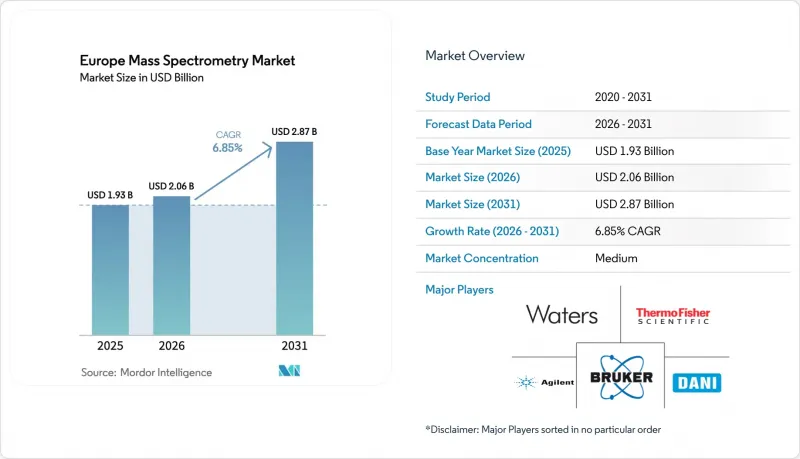
This report is Segmented by Platform (Instruments, Consumables, Software & Services), Technology (Hybrid MS, Single MS, ICP-MS, and More), Application (Pharmaceuticals, Biotechnology, Clinical Diagnostics, and More), End User (Pharma & Biotech Companies, Academic & Research Institutes, and More), and Geography (Germany, Italy, Spain, and More). Market Forecasts are Provided in Terms of Value (USD).
Europe Mass Spectrometry Market Trends and Insights
Rising Pharmaceutical & Biotech R&D Expenditure
European pharmaceutical firms invested EUR 55 billion in R&D during 2024, driving sustained orders for liquid-chromatography-mass-spectrometry platforms that handle large molecule impurity profiling and biosimilar comparability under EMA guidelines. The European Biotech Act, proposed in December 2025, promises streamlined authorizations for cell and gene therapies, pushing research laboratories toward Orbitrap and quadrupole-time-of-flight systems that deliver sub-ppm accuracy needed for complex glycoform mapping. Contract research organizations such as Quotient Sciences have enlarged United Kingdom bioanalytical suites, adding triple-quadrupole lines to meet Good Laboratory Practice capacity commitments. Spain's 974 biotech entities alone deployed more than 120 new high-resolution instruments across 80 science parks in 2025, a trend likely to extend as oncology pipelines mature. Because Phase I and Phase II studies increasingly demand 24-hour bioanalysis, procurement momentum is expected to persist through 2031.
Stringent EU Regulations for Food Safety & Environmental Monitoring
The European Food Safety Authority tightened maximum residue limits for 126 pesticides in 2024, obliging laboratories to validate multi-residue screens that quantify 500+ compounds in a single run-functionality delivered only by triple-quadrupole or accurate-mass platforms. The 2024 amendment to the EU Water Framework Directive added 24 PFAS to the priority list, requiring quarterly monitoring at levels below 1 ng/L and pushing environmental agencies to adopt triple-quadrupole ICP-MS for metal-free background and sub-ppt detection. Germany and the Netherlands have procured time-of-flight ICP-MS units that can track PFAS plumes around fluoropolymer facilities in real time. Food-testing labs across Denmark upgraded older single-quadrupole GC-MS to tandem configurations that meet ISO/IEC 17025 accreditation in under six months, shortening method-transfer cycles. This regulatory landscape is projected to lift the Europe mass spectrometry market CAGR by 1.5 percentage points through 2028, after which compliance-driven replacement demand levels off.
High Capital & Maintenance Costs of Advanced Instruments
List prices for triple-quadrupole and Orbitrap systems range between EUR 300,000 and EUR 1.2 million, with annual service contracts adding up to 12% of purchase cost. Smaller clinical laboratories in Spain and Greece defer upgrades, relying on send-out testing despite turnaround delays. Reagent-rental and pay-per-sample models offered by vendors reduce upfront burden but lock customers into multi-year consumable commitments that can exceed original capital cost. Refurbished equipment remains scarce because high-resolution systems stay useful for a decade. This fiscal drag is expected to shave 0.9 percentage points from the Europe mass spectrometry market CAGR until component prices fall and secondary markets mature.
Other drivers and restraints analyzed in the detailed report include:
- Rapid Adoption of Hybrid & High-Resolution MS Technologies
- Expansion of Clinical Diagnostics & Personalized Medicine
- Shortage of Skilled Mass Spectrometrists
For complete list of drivers and restraints, kindly check the Table Of Contents.
Segment Analysis
Instruments captured 72.55% of 2025 revenue, underscoring the capital-intensive nature of Orbitrap, triple-quadrupole, and ICP-MS purchases. Yet the software and services slice is projected to grow at 9.85% CAGR, outpacing hardware as laboratories prioritize data-integration, compliance documentation, and cloud pipelines. High-throughput contract labs that run 500 samples daily on a single triple-quadrupole consume EUR 70,000 in columns, calibration mixes, and ion-source spares each year, creating sticky recurring revenue. Subscription licensing models for enterprise chromatography data systems align vendor incentives with uptime, intensifying competition around analytics rather than detection limits.
Laboratories that already house multiple systems now view sample-to-report turnaround as the primary bottleneck. The Europe mass spectrometry market size for software tools that automate peak picking and audit trails rose sharply after Thermo Fisher introduced Chromeleon 7.3.2, which unites instrument control, LIMS connectivity, and AI-assisted method setup. Open-source alternatives such as MZmine 3 pressure commercial suites to prove tangible compliance benefits. As artificial-intelligence features mature, services tied to continuous algorithm upgrades are expected to offset slower instrument unit shipments, lifting overall market resilience.
Hybrid platforms contributed 48.53% of revenue in 2025, favored for their ability to toggle between discovery and targeted assays in a single run. Triple-quadrupole LC-MS/MS remains dominant in pharmaceutical bioanalysis because it pairs femtogram-level sensitivity with rugged uptime. Quadrupole-time-of-flight instruments excel in untargeted metabolomics, where mass accuracy below 3 ppm speeds unknown identifications. Orbitrap instruments, a subset of Fourier-transform technology, now extend to 200 Hz acquisition, opening doors for single-cell proteomics.
Environmental legislation is accelerating ICP-MS adoption; the Europe mass spectrometry market share for ICP-MS is projected to climb as triple-quadrupole configurations remove spectral interferences that once hampered arsenic or selenium quantitation below regulatory cut-offs. Germany alone commissioned 25 time-of-flight ICP-MS units in 2025 to monitor PFAS plumes, and Italy's water authorities plan similar upgrades by 2027. Though magnetic-sector systems keep a toehold in isotope ratio studies, high-resolution Orbitraps are eroding that niche with comparable precision at a lower total cost of ownership.
Complete Report Scope:
- By Platform
- Instruments
- Consumables
- Software & Services
- By Technology
- Hybrid Mass Spectrometry
- Triple Quadrupole (Tandem)
- Quadrupole-TOF (Q-TOF)
- FT-MS / Orbitrap
- Single Mass Spectrometry
- Ion Trap
- Quadrupole
- Time-of-Flight (TOF)
- Inductively-Coupled Plasma MS (ICP-MS)
- Single Quadrupole ICP-MS
- Triple Quadrupole ICP-MS
- TOF-ICP-MS
- Magnetic-Sector MS
- Other Specialised Technologies
- Hybrid Mass Spectrometry
- By Application
- Pharmaceuticals Industry
- Biotechnology Industry
- Clinical Diagnostics
- Forensic & Toxicology
- Other Applications
- By End User
- Pharmaceutical & Biotechnology Companies
- Academic & Research Institutes
- Contract Research Organisations
- Hospitals & Clinical Laboratories
- Other End Users
- By Country
- Germany
- United Kingdom
- France
- Italy
- Spain
- Rest of Europe
List of Companies Covered in this Report:
- Agilent Technologies
- Ametek
- Analytik Jena
- Bruker
- Danaher
- Dani Instruments
- Endress+Hauser (Analytik Jena)
- Hitachi
- HORIBA Ltd.
- JEOL Ltd.
- Kore Technology Ltd.
- LECO
- Microsaic Systems plc
- PerkinElmer
- Rigaku
- Shimadzu
- SPECTRO Ametek
- Teledyne FLIR
- Thermo Fisher Scientific
- TOFWERK AG
- Waters Corporation
Additional Benefits:
- The market estimate (ME) sheet in Excel format
- 3 months of analyst support
TABLE OF CONTENTS
1 Introduction
- 1.1 Study Assumptions & Market Definition
- 1.2 Scope of the Study
2 Research Methodology
3 Executive Summary
4 Market Landscape
- 4.1 Market Overview
- 4.2 Market Drivers
- 4.2.1 Rising pharmaceutical & biotech R&D expenditure
- 4.2.2 Stringent EU regulations for food safety & environmental monitoring
- 4.2.3 Rapid adoption of hybrid & high-resolution MS technologies
- 4.2.4 Expansion of clinical diagnostics & personalised medicine
- 4.2.5 AI-driven spectral interpretation enabling higher lab throughput
- 4.2.6 Emergence of portable/benchtop MS unlocking decentralised testing
- 4.3 Market Restraints
- 4.3.1 High capital & maintenance costs of advanced instruments
- 4.3.2 Shortage of skilled mass-spectrometrists
- 4.3.3 Complex regulatory validation & method-standardisation hurdles
- 4.3.4 Helium & high-purity gas supply volatility post-Ukraine conflict
- 4.4 Supply-Chain Analysis
- 4.5 Regulatory Landscape
- 4.6 Technological Outlook
- 4.7 Porter's Five Forces
- 4.7.1 Threat of New Entrants
- 4.7.2 Bargaining Power of Buyers
- 4.7.3 Bargaining Power of Suppliers
- 4.7.4 Threat of Substitutes
- 4.7.5 Intensity of Competitive Rivalry
5 Market Size & Growth Forecasts (Value, USD)
- 5.1 By Platform
- 5.1.1 Instruments
- 5.1.2 Consumables
- 5.1.3 Software & Services
- 5.2 By Technology
- 5.2.1 Hybrid Mass Spectrometry
- 5.2.1.1 Triple Quadrupole (Tandem)
- 5.2.1.2 Quadrupole-TOF (Q-TOF)
- 5.2.1.3 FT-MS / Orbitrap
- 5.2.2 Single Mass Spectrometry
- 5.2.2.1 Ion Trap
- 5.2.2.2 Quadrupole
- 5.2.2.3 Time-of-Flight (TOF)
- 5.2.3 Inductively-Coupled Plasma MS (ICP-MS)
- 5.2.3.1 Single Quadrupole ICP-MS
- 5.2.3.2 Triple Quadrupole ICP-MS
- 5.2.3.3 TOF-ICP-MS
- 5.2.4 Magnetic-Sector MS
- 5.2.5 Other Specialised Technologies
- 5.2.1 Hybrid Mass Spectrometry
- 5.3 By Application
- 5.3.1 Pharmaceuticals Industry
- 5.3.2 Biotechnology Industry
- 5.3.3 Clinical Diagnostics
- 5.3.4 Forensic & Toxicology
- 5.3.5 Other Applications
- 5.4 By End User
- 5.4.1 Pharmaceutical & Biotechnology Companies
- 5.4.2 Academic & Research Institutes
- 5.4.3 Contract Research Organisations
- 5.4.4 Hospitals & Clinical Laboratories
- 5.4.5 Other End Users
- 5.5 By Country
- 5.5.1 Germany
- 5.5.2 United Kingdom
- 5.5.3 France
- 5.5.4 Italy
- 5.5.5 Spain
- 5.5.6 Rest of Europe
6 Competitive Landscape
- 6.1 Market Concentration
- 6.2 Market Share Analysis
- 6.3 Company Profiles (includes Global level Overview, Market level overview, Core Segments, Financials as available, Strategic Information, Market Rank/Share, Products & Services, Recent Developments)
- 6.3.1 Agilent Technologies Inc.
- 6.3.2 Ametek
- 6.3.3 Analytik Jena AG
- 6.3.4 Bruker Corporation
- 6.3.5 Danaher Corporation
- 6.3.6 Dani Instruments SpA
- 6.3.7 Endress+Hauser (Analytik Jena)
- 6.3.8 Hitachi High-Tech Corporation
- 6.3.9 HORIBA Ltd.
- 6.3.10 JEOL Ltd.
- 6.3.11 Kore Technology Ltd.
- 6.3.12 LECO Corporation
- 6.3.13 Microsaic Systems plc
- 6.3.14 PerkinElmer Inc.
- 6.3.15 Rigaku Corporation
- 6.3.16 Shimadzu Corporation
- 6.3.17 SPECTRO Ametek
- 6.3.18 Teledyne FLIR
- 6.3.19 Thermo Fisher Scientific Inc.
- 6.3.20 TOFWERK AG
- 6.3.21 Waters Corporation
7 Market Opportunities & Future Outlook
- 7.1 White-Space & Unmet-Need Assessment

