PUBLISHER: MarketsandMarkets | PRODUCT CODE: 2105115
PUBLISHER: MarketsandMarkets | PRODUCT CODE: 2105115
Road Marking Materials Market by Type (Performance-based (Thermoplastic, Cold Plastic), Paint-based (Water-based, Solvent-based)), Application (Road & Highway, Parking Lot, Factory, Airport, Antiskid Marking), and Region - Global Forecast to 2031
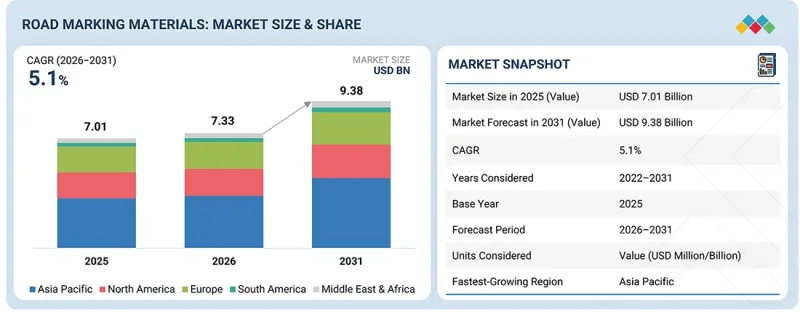
The global road marking materials market is projected to grow from USD 7.33 billion in 2026 to USD 9.38 billion in 2031, at a CAGR of 5.1% during the forecast period. Road marking materials are used to create lane lines, symbols, and traffic guidance markings that enhance road safety and improve traffic flow. Common materials include thermoplastics, water-based paints, epoxy coatings, and reflective glass beads, with thermoplastics being widely preferred for their durability and visibility.
| Scope of the Report | |
|---|---|
| Years Considered for the Study | 2022-2031 |
| Base Year | 2025 |
| Forecast Period | 2026-2031 |
| Units Considered | Value (USD Million) |
| Segments | By type, Application, and Region |
| Regions covered | North America, Asia Pacific, Europe, Middle East & Africa, and South America |
The market is expected to grow due to increasing investments in road infrastructure, highway expansion, and urbanization. Rising emphasis on road safety regulations and the adoption of smart transportation systems are further driving demand. Additionally, the shift toward eco-friendly and long-lasting marking materials is creating new growth opportunities for manufacturers.
"By type, the thermoplastic segment is projected to account for the second-largest share during the forecast period in terms of value."
The thermoplastic segment is expected to account for the second-largest share of the road marking materials market during the forecast period in terms of value due to its widespread adoption for highway roads, urban streets, pedestrian crossings, airport runways, and parking facilities. Thermoplastic road marking materials are highly preferred for their excellent durability, superior retroreflectivity, fast drying time, strong adhesion to pavement surfaces, and long service life, making them an ideal choice for high-traffic road networks. Growing investments in road infrastructure development, highway expansion, smart city projects, and airport modernization are driving demand for thermoplastic road markings across both developed and emerging economies. Additionally, increasing emphasis on road safety regulations, reduced maintenance requirements, and the need for high-performance pavement markings capable of withstanding heavy traffic and harsh weather conditions are expected to further strengthen the market position of the thermoplastic segment throughout the forecast period.
"By application, the parking lot marking segment is expected to account for the second-largest market share during the forecast period."
The parking lot marking segment is expected to account for the second-largest share of the road marking materials market during the forecast period in terms of value due to the increasing construction of commercial complexes, shopping malls, airports, hospitals, educational institutions, industrial facilities, and residential developments. Parking lot markings are essential for ensuring organized traffic flow, maximizing space utilization, enhancing pedestrian safety, and complying with regulatory and accessibility standards. Growing investments in urban infrastructure, smart city projects, and the expansion of electric vehicle (EV) charging facilities are driving demand for durable, high-visibility parking lot marking materials. Additionally, the increasing focus on regular maintenance, re-striping activities, and the adoption of long-lasting thermoplastic and high-performance paint systems are expected to strengthen further the market position of the parking lot marking segment throughout the forecast period.
"North America to account for second-largest market share during forecast period."
North America is expected to account for the second-largest share of the road marking materials market during the forecast period in terms of value due to the region's well-established transportation infrastructure, continuous investments in road maintenance, and stringent road safety regulations. The increasing rehabilitation of highways, expansion of urban road networks, and modernization of airports and parking facilities are driving the demand for high-performance road marking materials across the region. Additionally, the growing adoption of durable thermoplastic markings, waterborne paints, and reflective materials to improve traffic safety, visibility, and pavement longevity is further supporting market growth. Rising government investments in infrastructure development, smart transportation systems, and sustainable road marking solutions, along with the presence of leading road marking material manufacturers, are expected to further strengthen North America's position in the road marking materials market throughout the forecast period.
Profile break-up of primary participants for the report:
- By Company Type: Tier 1 - 65%, Tier 2 - 20%, and Tier 3 - 15%
- By Designation: Directors - 25%, Managers - 30%, and Others - 45%
- By Region: North America - 30%, Asia Pacific - 40%, Europe - 20%, and Rest of World - 10%
The Sherwin-Williams Company (US), PPG INDUSTRIES, INC (US), Swarco (Austria), 3M (US), and Geveko Marking (Sweden) are some of the major players operating in the road marking materials market.
Research Coverage:
The report segments the road marking materials market based on material, processing technology, type, application, and region. It provides detailed information regarding the major factors influencing the market's growth, such as drivers, restraints, opportunities, and challenges. It strategically profiles road marking materials manufacturers, comprehensively analyzing their market shares and core competencies.
Reasons to Buy the Report:
The report is expected to help market leaders/new entrants by providing the closest approximations of revenue numbers for the road marking materials market and its segments. This report is also expected to help stakeholders improve their understanding of the market's competitive landscape, gain insights to strengthen their business position, and develop suitable go-to-market strategies. It also enables stakeholders to understand the market's pulse and provides information on key market drivers, restraints, challenges, and opportunities.
The report provides insights on the following pointers:
Analysis of critical DROCs: Drivers (Accelerating Global Road Infrastructure Investment, Strengthening Road Safety Mandates and Retroreflectivity Standards; Rising shift toward liquid cooling architectures amid increasing server density), Restraints (Stringent VOC Emission Regulations and the Need for Continuous Product Reformulation), Opportunities (Growing Integration of Road Markings with ADAS, Lane Departure Warning Systems (LDWS), and Autonomous Driving Technologies, Development of Intelligent Transportation Systems (ITS) Driving Demand for Advanced Functional Road marking materials ), and Challenges (Raw Material Price Volatility (Titanium Dioxide, Petrochemical Feedstocks, and Glass Beads), Maintaining Long-Term Road Marking Performance Under Diverse Traffic, Weather, and Environmental Conditions).
- Product Development/Innovation: Detailed insights on upcoming technologies and research & development activities in the road marking materials market
- Market Development: Comprehensive information about lucrative markets - the report analyzes the road marking materials market across varied regions
- Competitive Assessment: In-depth assessment of market shares, growth strategies, and product offerings of leading players such as The Sherwin-Williams Company (US), PPG INDUSTRIES, INC (US), Swarco (Austria), 3M (US), and Geveko Marking (Sweden) in the road marking materials market
TABLE OF CONTENTS
1 INTRODUCTION
- 1.1 STUDY OBJECTIVES
- 1.2 MARKET DEFINITION
- 1.3 STUDY SCOPE
- 1.3.1 MARKET SEGMENTATION AND REGIONAL SCOPE
- 1.3.2 INCLUSIONS AND EXCLUSIONS
- 1.3.3 YEARS CONSIDERED
- 1.4 CURRENCY CONSIDERED
- 1.5 UNITS CONSIDERED
- 1.6 STAKEHOLDERS
- 1.7 SUMMARY OF CHANGES
2 EXECUTIVE SUMMARY
- 2.1 MARKET HIGHLIGHTS AND KEY INSIGHTS
- 2.2 KEY MARKET PARTICIPANTS: MAPPING OF STRATEGIC DEVELOPMENTS
- 2.3 DISRUPTIVE TRENDS IN ROAD MARKING MATERIALS MARKET
- 2.4 HIGH GROWTH SEGMENTS
- 2.5 REGIONAL SNAPSHOT: MARKET SIZE, GROWTH RATE, AND FORECAST
3 PREMIUM INSIGHTS
- 3.1 ATTRACTIVE OPPORTUNITIES FOR PLAYERS IN ROAD MARKING MATERIALS MARKET
- 3.2 ROAD MARKING MATERIALS MARKET, BY REGION
- 3.3 ROAD MARKING MATERIALS MARKET, BY TYPE
- 3.4 ROAD MARKING MATERIALS MARKET, BY KEY COUNTRY
4 MARKET OVERVIEW
- 4.1 INTRODUCTION
- 4.2 MARKET DYNAMICS
- 4.2.1 DRIVERS
- 4.2.1.1 Accelerating investment in global road infrastructure
- 4.2.1.2 Rising implementation of stringent road safety mandates and retroreflectivity standards
- 4.2.1.3 Increasing urban mobility and traffic density
- 4.2.2 RESTRAINTS
- 4.2.2.1 Need for VOC emission compliance and continuous product reformulation
- 4.2.2.2 High initial cost of premium marking materials
- 4.2.3 OPPORTUNITIES
- 4.2.3.1 Growing popularity of connected and autonomous vehicles
- 4.2.3.2 Rising development of intelligent transportation systems (ITS)
- 4.2.4 CHALLENGES
- 4.2.4.1 Volatility in raw material prices
- 4.2.4.2 Issues in maintaining long-term marking performance
- 4.2.1 DRIVERS
- 4.3 UNMET NEEDS AND WHITE SPACES
- 4.4 INTERCONNECTED MARKETS AND CROSS-SECTOR OPPORTUNITIES
- 4.5 STRATEGIC MOVES BY TIER-1/2/3 PLAYERS
5 INDUSTRY TRENDS
- 5.1 PORTER'S FIVE FORCES ANALYSIS
- 5.1.1 BARGAINING POWER OF SUPPLIERS
- 5.1.2 BARGAINING POWER OF BUYERS
- 5.1.3 THREAT OF NEW ENTRANTS
- 5.1.4 THREAT OF SUBSTITUTES
- 5.1.5 INTENSITY OF COMPETITIVE RIVALRY
- 5.2 MACROECONOMIC OUTLOOK
- 5.2.1 INTRODUCTION
- 5.2.2 GDP TRENDS AND FORECAST
- 5.2.3 TREND IN GLOBAL TRANSPORTATION INFRASTRUCTURE INDUSTRY
- 5.2.4 TREND IN GLOBAL CONSTRUCTION INDUSTRY
- 5.3 SUPPLY CHAIN ANALYSIS
- 5.4 ECOSYSTEM ANALYSIS
- 5.5 PRICING ANALYSIS
- 5.5.1 AVERAGE SELLING PRICE TREND OF ROAD MARKING MATERIALS, BY REGION, 2023-2025
- 5.5.2 AVERAGE SELLING PRICE OF ROAD MARKING MATERIALS, BY KEY PLAYER, 2025
- 5.6 TRADE ANALYSIS
- 5.6.1 IMPORT SCENARIO (HS CODE 320619)
- 5.6.2 EXPORT SCENARIO (HS CODE 320619)
- 5.7 KEY CONFERENCES AND EVENTS, 2026-2027
- 5.8 TRENDS/DISRUPTIONS IMPACTING CUSTOMER BUSINESS
- 5.9 INVESTMENT AND FUNDING SCENARIO
- 5.10 CASE STUDY ANALYSIS
- 5.10.1 SWARCO ENHANCES AIRPORT SAFETY THROUGH HIGH-PERFORMANCE AIRFIELD MARKING SYSTEMS
- 5.10.2 GEVEKO MARKINGS IMPROVES PASSENGER SAFETY AT LONDON EUSTON STATION WITH PREMARK THERMOPLASTIC MARKING SYSTEM
- 5.10.3 GEVEKO MARKINGS ENHANCES MOBILITY FOR BLIND AND VISUALLY IMPAIRED PEDESTRIANS IN DENMARK WITH TACGUIDE TACTILE MARKING SYSTEM
- 5.11 IMPACT OF US TARIFFS - ROAD MARKING MATERIALS MARKET
- 5.11.1 INTRODUCTION
- 5.11.2 KEY TARIFF RATES
- 5.11.3 PRICE IMPACT ANALYSIS
- 5.11.4 IMPACT ON COUNTRIES/REGIONS
- 5.11.4.1 US
- 5.11.4.2 Europe
- 5.11.4.3 Asia Pacific
- 5.11.5 IMPACT ON APPLICATIONS
- 5.11.5.1 Road & highway marking
- 5.11.5.2 Antiskid marking
- 5.11.5.3 Parking lot marking
- 5.11.5.4 Factory marking
- 5.11.5.5 Airport marking
- 5.11.5.6 Other applications
6 TECHNOLOGICAL ADVANCEMENTS, AI-DRIVEN IMPACT, PATENTS, INNOVATIONS, AND FUTURE APPLICATIONS
- 6.1 KEY EMERGING TECHNOLOGIES
- 6.1.1 INTELLIGENT & MACHINE-READABLE ROAD MARKING MATERIALS
- 6.2 COMPLEMENTARY TECHNOLOGIES
- 6.2.1 ADAS & AUTONOMOUS DRIVING
- 6.3 TECHNOLOGY/PRODUCT ROADMAP
- 6.3.1 SHORT-TERM (2025-2027) | PROCESS OPTIMIZATION & SUSTAINABILITY ENHANCEMENT
- 6.3.2 MID-TERM (2027-2030) | SMART MATERIAL INTEGRATION & PERFORMANCE ADVANCEMENT
- 6.3.3 LONG-TERM (2030-2035+) | INTELLIGENT INFRASTRUCTURE & AUTONOMOUS MOBILITY
- 6.4 PATENT ANALYSIS
- 6.5 FUTURE APPLICATIONS
- 6.6 IMPACT OF AI/GEN AI ON ROAD MARKING MATERIALS MARKET
- 6.6.1 TOP USE CASES AND MARKET POTENTIAL
- 6.6.2 BEST PRACTICES FOLLOWED BY MANUFACTURERS/OEMS IN ROAD MARKING MATERIALS MARKET
- 6.6.3 CASE STUDIES RELATED TO AI/GEN AI IMPLEMENTATION IN ROAD MARKING MATERIALS MARKET
- 6.6.4 INTERCONNECTED ECOSYSTEM AND IMPACT ON MARKET PLAYERS
- 6.6.5 CLIENTS' READINESS TO ADOPT AI/GEN AI-INTEGRATED ROAD MARKING MATERIALS
7 REGULATORY LANDSCAPE AND SUSTAINABILITY INITIATIVES
- 7.1 REGIONAL REGULATIONS AND COMPLIANCE
- 7.1.1 REGULATORY BODIES, GOVERNMENT AGENCIES, AND OTHER ORGANIZATIONS
- 7.1.2 INDUSTRY STANDARDS
- 7.1.3 CERTIFICATIONS, LABELING, AND ECO-STANDARDS
- 7.2 SUSTAINABILITY INITIATIVES
- 7.2.1 CARBON IMPACT AND ECO-APPLICATIONS
- 7.2.1.1 Carbon impact reduction
- 7.2.1.2 Eco-applications
- 7.2.1 CARBON IMPACT AND ECO-APPLICATIONS
- 7.3 IMPACT OF REGULATORY POLICIES ON SUSTAINABILITY INITIATIVES
8 CUSTOMER LANDSCAPE AND BUYER BEHAVIOUR
- 8.1 INTRODUCTION
- 8.2 DECISION-MAKING PROCESS
- 8.3 KEY STAKEHOLDERS INVOLVED IN BUYING PROCESS AND THEIR EVALUATION CRITERIA
- 8.3.1 KEY STAKEHOLDERS IN BUYING PROCESS
- 8.3.2 BUYING CRITERIA
- 8.4 ADOPTION BARRIERS AND INTERNAL CHALLENGES
- 8.5 UNMET NEEDS OF VARIOUS APPLICATIONS
- 8.6 MARKET PROFITABILITY
- 8.6.1 REVENUE POTENTIAL
- 8.6.2 COST DYNAMICS
- 8.6.3 MARGIN OPPORTUNITIES IN KEY APPLICATIONS
9 APPLICATION METHODS OF ROAD MARKING MATERIALS
- 9.1 INTRODUCTION
- 9.2 EXTRUSION
- 9.3 KNIFE COATING
- 9.4 SPRAY
- 9.5 TAPE APPLICATION
10 ROAD MARKING MATERIALS MARKET, BY TYPE
- 10.1 INTRODUCTION
- 10.2 PERFORMANCE-BASED MARKINGS
- 10.2.1 THERMOPLASTIC
- 10.2.1.1 Excellent durability, rapid setting characteristics, and resistance to wear to foster segmental growth
- 10.2.2 COLD PLASTIC
- 10.2.2.1 Exceptional durability, adhesion, abrasion resistance, and excellent color and retroreflectivity retention to spur demand
- 10.2.1 THERMOPLASTIC
- 10.3 PAINT-BASED MARKINGS
- 10.3.1 WATER-BASED
- 10.3.1.1 Ease of application and compatibility with modern road maintenance practices to boost segmental growth
- 10.3.2 SOLVENT-BASED
- 10.3.2.1 Rapid drying characteristics, excellent adhesion, and reliable performance to contribute to segmental growth
- 10.3.1 WATER-BASED
11 ROAD MARKING MATERIALS MARKET, BY APPLICATION
- 11.1 INTRODUCTION
- 11.2 ROAD & HIGHWAY MARKING
- 11.2.1 RAPID URBANIZATION, GROWING VEHICLE OWNERSHIP, AND RISING TRAFFIC DENSITY TO EXPEDITE SEGMENTAL GROWTH
- 11.3 ANTISKID MARKING
- 11.3.1 GROWING EMPHASIS ON REDUCING ROAD ACCIDENTS AND IMPROVING TRAFFIC SAFETY TO FUEL SEGMENTAL GROWTH
- 11.4 PARKING LOT MARKING
- 11.4.1 RISING COMMERCIAL AND RESIDENTIAL INFRASTRUCTURE DEVELOPMENTS TO FACILITATE SEGMENTAL GROWTH
- 11.5 FACTORY MARKING
- 11.5.1 EXPANDING MANUFACTURING FACILITIES AND RISE IN LOGISTICS AND WAREHOUSING ACTIVITIES TO AUGMENT SEGMENTAL GROWTH
- 11.6 AIRPORT MARKING
- 11.6.1 GROWING EMPHASIS ON MAINTAINING OPERATIONAL SAFETY AND REGULATORY COMPLIANCE TO BOLSTER SEGMENTAL GROWTH
- 11.7 OTHER APPLICATIONS
12 ROAD MARKING MATERIALS MARKET, BY REGION
- 12.1 INTRODUCTION
- 12.2 NORTH AMERICA
- 12.2.1 US
- 12.2.1.1 Extensive highway network and investment in transportation infrastructure to boost market growth
- 12.2.2 CANADA
- 12.2.2.1 Growing emphasis on municipal road upgrades and airport infrastructure development to fuel market growth
- 12.2.3 MEXICO
- 12.2.3.1 Government initiatives to expand and modernize highways, expressways, and urban roads to augment market growth
- 12.2.1 US
- 12.3 ASIA PACIFIC
- 12.3.1 CHINA
- 12.3.1.1 Extensive transportation infrastructure and rapid urbanization to contribute to market growth
- 12.3.2 SOUTH KOREA
- 12.3.2.1 Government initiatives to promote smart city development to accelerate market growth
- 12.3.3 JAPAN
- 12.3.3.1 Continuous investments in expressway maintenance, municipal road improvements, and airport modernization to drive market
- 12.3.4 INDIA
- 12.3.4.1 Increasing investments in multimodal transportation infrastructure and urban road development to drive market
- 12.3.5 REST OF ASIA PACIFIC
- 12.3.1 CHINA
- 12.4 EUROPE
- 12.4.1 GERMANY
- 12.4.1.1 Extensive transportation networks to contribute to market growth
- 12.4.2 FRANCE
- 12.4.2.1 Rising emphasis on modernizing transportation infrastructure to fuel market growth
- 12.4.3 UK
- 12.4.3.1 Strong emphasis on roadway safety, asset management, and network resilience to augment market growth
- 12.4.4 RUSSIA
- 12.4.4.1 Increasing need to improve national connectivity, freight movement, and economic development to expedite market growth
- 12.4.5 TURKEY
- 12.4.5.1 Ongoing roadway maintenance and rehabilitation activities to accelerate market growth
- 12.4.6 REST OF EUROPE
- 12.4.1 GERMANY
- 12.5 MIDDLE EAST & AFRICA
- 12.5.1 GCC
- 12.5.1.1 Saudi Arabia
- 12.5.1.1.1 Large-scale investments in transportation infrastructure, urban development, and economic diversification to drive market
- 12.5.1.2 UAE
- 12.5.1.2.1 Strong focus on strengthening road network to accommodate increasing population and tourism to foster market growth
- 12.5.1.1 Saudi Arabia
- 12.5.2 REST OF MIDDLE EAST & AFRICA
- 12.5.1 GCC
- 12.6 SOUTH AMERICA
- 12.6.1 BRAZIL
- 12.6.1.1 Increasing investment in construction, rehabilitation, and maintenance of highways to expedite market growth
- 12.6.2 ARGENTINA
- 12.6.2.1 Growing focus on maintaining and rehabilitating national and provincial road networks to bolster market growth
- 12.6.3 REST OF SOUTH AMERICA
- 12.6.1 BRAZIL
13 COMPETITIVE LANDSCAPE
- 13.1 OVERVIEW
- 13.2 KEY PLAYER COMPETITIVE STRATEGIES/RIGHT TO WIN, 2021-2026
- 13.3 REVENUE ANALYSIS, 2021-2025
- 13.4 MARKET SHARE ANALYSIS, 2025
- 13.5 PRODUCT COMPARISON
- 13.5.1 SHERWIN-WILLIAMS' TRAFFIC MARKINGS
- 13.5.2 ENNIS-FLINT'S ROAD MARKING SOLUTIONS
- 13.5.3 3M'S ROAD MARKING SOLUTIONS
- 13.5.4 SWARCO'S ROAD MARKING SYSTEMS
- 13.5.5 GEVEKO MARKINGS' PREFORMED ROAD MARKINGS
- 13.6 COMPANY EVALUATION MATRIX: KEY PLAYERS, 2025
- 13.6.1 STARS
- 13.6.2 EMERGING LEADERS
- 13.6.3 PERVASIVE PLAYERS
- 13.6.4 PARTICIPANTS
- 13.6.5 COMPANY FOOTPRINT: KEY PLAYERS, 2025
- 13.6.5.1 Company footprint
- 13.6.5.2 Region footprint
- 13.6.5.3 Type footprint
- 13.6.5.4 Application footprint
- 13.7 COMPANY EVALUATION MATRIX: STARTUPS/SMES, 2025
- 13.7.1 PROGRESSIVE COMPANIES
- 13.7.2 RESPONSIVE COMPANIES
- 13.7.3 DYNAMIC COMPANIES
- 13.7.4 STARTING BLOCKS
- 13.7.5 COMPETITIVE BENCHMARKING: STARTUPS/SMES, 2025
- 13.7.5.1 Detailed list of key startups/SMES
- 13.7.5.2 Competitive benchmarking of key startups/SMES
- 13.8 COMPETITIVE SCENARIO
- 13.8.1 PRODUCT LAUNCHES
- 13.8.2 DEALS
- 13.8.3 EXPANSIONS
- 13.9 COMPANY VALUATION AND FINANCIAL METRICS
14 COMPANY PROFILES
- 14.1 KEY PLAYERS
- 14.1.1 THE SHERWIN-WILLIAMS COMPANY
- 14.1.1.1 Business overview
- 14.1.1.2 Products/Solutions/Services offered
- 14.1.1.3 MnM view
- 14.1.1.3.1 Key strengths/Right to win
- 14.1.1.3.2 Strategic choices
- 14.1.1.3.3 Weaknesses/Competitive threats
- 14.1.2 PPG INDUSTRIES, INC.
- 14.1.2.1 Business overview
- 14.1.2.2 Products/Solutions/Services offered
- 14.1.2.3 Recent developments
- 14.1.2.3.1 Product launches/enhancements
- 14.1.2.3.2 Deals
- 14.1.2.4 MnM view
- 14.1.2.4.1 Key strengths/Right to win
- 14.1.2.4.2 Strategic choices
- 14.1.2.4.3 Weaknesses/Competitive threats
- 14.1.3 3M
- 14.1.3.1 Business overview
- 14.1.3.2 Products/Solutions/Services offered
- 14.1.3.3 Recent developments
- 14.1.3.3.1 Product launches/enhancements
- 14.1.3.4 MnM view
- 14.1.3.4.1 Key strengths/Right to win
- 14.1.3.4.2 Strategic choices
- 14.1.3.4.3 Weaknesses/Competitive threats
- 14.1.4 SWARCO
- 14.1.4.1 Business overview
- 14.1.4.2 Products/Solutions/Services offered
- 14.1.4.3 Recent developments
- 14.1.4.3.1 Product launches/enhancements
- 14.1.4.3.2 Deals
- 14.1.4.3.3 Expansions
- 14.1.4.4 MnM view
- 14.1.4.4.1 Key strengths/Right to win
- 14.1.4.4.2 Strategic choices
- 14.1.4.4.3 Weaknesses/Competitive threats
- 14.1.5 GEVEKO MARKINGS
- 14.1.5.1 Business overview
- 14.1.5.2 Products/Solutions/Services offered
- 14.1.5.3 Recent developments
- 14.1.5.3.1 Deals
- 14.1.5.4 MnM view
- 14.1.5.4.1 Key strengths/Right to win
- 14.1.5.4.2 Strategic choices
- 14.1.5.4.3 Weaknesses/Competitive threats
- 14.1.6 AKZO NOBEL N.V.
- 14.1.6.1 Business overview
- 14.1.6.2 Products/Solutions/Services offered
- 14.1.6.3 Recent developments
- 14.1.6.3.1 Product launches/enhancements
- 14.1.6.3.2 Deals
- 14.1.6.3.3 Expansions
- 14.1.7 SIKA AG
- 14.1.7.1 Business overview
- 14.1.7.2 Products/Solutions/Services offered
- 14.1.7.3 Recent developments
- 14.1.7.3.1 Product launches/enhancements
- 14.1.7.3.2 Deals
- 14.1.7.3.3 Expansions
- 14.1.8 HEMPEL A/S
- 14.1.8.1 Business overview
- 14.1.8.2 Products/Solutions/Services offered
- 14.1.9 KANSAI PAINT CO., LTD.
- 14.1.9.1 Business overview
- 14.1.9.2 Products/Solutions/Services offered
- 14.1.10 DOW
- 14.1.10.1 Business overview
- 14.1.10.2 Products/Solutions/Services offered
- 14.1.10.3 Recent developments
- 14.1.10.3.1 Product launches/enhancements
- 14.1.11 BASLER AG
- 14.1.11.1 Business overview
- 14.1.11.2 Products/Solutions/Services offered
- 14.1.12 INGEVITY
- 14.1.12.1 Business overview
- 14.1.12.2 Products/Solutions/Services offered
- 14.1.12.3 Recent development
- 14.1.12.3.1 Product launches/enhancements
- 14.1.13 PRISMO
- 14.1.13.1 Business overview
- 14.1.13.2 Products/Solutions/Services offered
- 14.1.13.3 Recent developments
- 14.1.13.3.1 Product launches/enhancements
- 14.1.13.3.2 Expansions
- 14.1.13.3.3 Other developments
- 14.1.14 SEALMASTER
- 14.1.14.1 Business overview
- 14.1.14.2 Products/Solutions/Services offered
- 14.1.15 KELLY BROS.
- 14.1.15.1 Business overview
- 14.1.15.2 Products/Solutions/Services offered
- 14.1.15.3 Recent developments
- 14.1.15.3.1 Expansions
- 14.1.15.3.2 Other developments
- 14.1.16 BERGER PAINTS INDIA
- 14.1.16.1 Business overview
- 14.1.16.2 Products/Solutions/Services offered
- 14.1.17 ASIAN PAINTS PPG PVT. LTD.
- 14.1.17.1 Business overview
- 14.1.17.2 Products/Solutions/Services offered
- 14.1.17.3 Recent developments
- 14.1.17.3.1 Deals
- 14.1.18 REDA NATIONAL
- 14.1.18.1 Business overview
- 14.1.18.2 Products/Solutions/Services offered
- 14.1.19 AUTOMARK INDUSTRIES (INDIA) PVT. LTD.
- 14.1.19.1 Business overview
- 14.1.19.2 Products/Solutions/Services offered
- 14.1.19.3 Recent developments
- 14.1.19.3.1 Product launches/enhancements
- 14.1.20 A.M.P.E.R.E. UK LTD
- 14.1.20.1 Business overview
- 14.1.20.2 Products/Solutions/Services offered
- 14.1.1 THE SHERWIN-WILLIAMS COMPANY
- 14.2 OTHER PLAYERS
- 14.2.1 KATALINE LTD.
- 14.2.2 VIS SIGNS PRIVATE LIMITED
- 14.2.3 PROMAX ROAD MARKING
- 14.2.4 SAFOMARK
- 14.2.5 ASPHALT LINEOLUX
15 RESEARCH METHODOLOGY
- 15.1 RESEARCH DATA
- 15.1.1 SECONDARY DATA
- 15.1.1.1 List of key secondary sources
- 15.1.1.2 Key data from secondary sources
- 15.1.2 PRIMARY DATA
- 15.1.2.1 Key data from primary sources
- 15.1.2.2 List of primary interview participants
- 15.1.2.3 Key industry insights
- 15.1.2.4 Breakdown of primary interviews
- 15.1.1 SECONDARY DATA
- 15.2 MARKET SIZE ESTIMATION
- 15.2.1 BOTTOM-UP APPROACH
- 15.2.2 TOP-DOWN APPROACH
- 15.3 FORECAST
- 15.4 DATA TRIANGULATION
- 15.5 RESEARCH ASSUMPTIONS
- 15.6 RESEARCH LIMITATIONS
- 15.7 RISK ANALYSIS
16 APPENDIX
- 16.1 DISCUSSION GUIDE
- 16.2 KNOWLEDGESTORE: MARKETSANDMARKETS' SUBSCRIPTION PORTAL
- 16.3 CUSTOMIZATION OPTIONS
- 16.4 RELATED REPORTS
- 16.5 AUTHOR DETAILS
List of Tables
- TABLE 1 ROAD MARKING MATERIALS MARKET: INCLUSIONS AND EXCLUSIONS
- TABLE 2 ROAD MARKING MATERIALS MARKET: SUMMARY OF CHANGES
- TABLE 3 INTERCONNECTED MARKETS
- TABLE 4 KEY MOVES AND STRATEGIC FOCUS OF TIER-1/2/3 PLAYERS
- TABLE 5 IMPACT OF PORTER'S FIVE FORCES
- TABLE 6 GDP GROWTH (ANNUAL PERCENTAGE CHANGE), BY COUNTRY, 2022-2025 (%)
- TABLE 7 UNEMPLOYMENT RATE, BY COUNTRY, 2022-2025 (%)
- TABLE 8 INFLATION RATE, AVERAGE CONSUMER PRICES, BY COUNTRY, 2022-2025 (%)
- TABLE 9 FOREIGN DIRECT INVESTMENT, BY REGION, 2022-2024
- TABLE 10 ROLES OF COMPANIES IN ROAD MARKING MATERIALS ECOSYSTEM
- TABLE 11 AVERAGE SELLING PRICE TREND OF ROAD MARKING MATERIALS, BY REGION, 2023-2025 (USD/KG)
- TABLE 12 AVERAGE SELLING PRICE OF ROAD MARKING MATERIALS, BY KEY PLAYER, 2025 (USD/TON)
- TABLE 13 IMPORT DATA FOR HS CODE 320619-COMPLIANT PRODUCTS, BY COUNTRY, 2021-2025 (USD THOUSAND)
- TABLE 14 EXPORT DATA FOR HS CODE 320619-COMPLIANT PRODUCTS, BY COUNTRY, 2021-2025 (USD THOUSAND)
- TABLE 15 LIST OF KEY CONFERENCES AND EVENTS, 2026-2027
- TABLE 16 SWARCO OFFERS INTEGRATED AIRPORT MARKING SYSTEM TO DELIVER SUPERIOR RETROREFLECTIVITY AND LONG-LASTING PERFORMANCE
- TABLE 17 GEVEKO MARKINGS SUPPLIES PREMARK TO ENABLE PERMANENT SAFETY SIGNAGE AT LONDON EUSTON STATION
- TABLE 18 GEVEKO MARKINGS PROVIDES TACGUIDE TACTILE MARKING SYSTEM TO IMPROVE NAVIGATION FOR BLIND AND VISUALLY IMPAIRED PEDESTRIANS IN DENMARK
- TABLE 19 LIST OF MAJOR PATENTS, 2021-2025
- TABLE 20 SMART HIGHWAYS & CONNECTED TRANSPORTATION INFRASTRUCTURE: ROAD MARKINGS EVOLVING INTO INTELLIGENT INFRASTRUCTURE, SUPPORTING CONNECTED MOBILITY AND DIGITAL TRAFFIC MANAGEMENT
- TABLE 21 AUTONOMOUS & CONNECTED VEHICLE INFRASTRUCTURE: ROAD MARKINGS OPTIMIZED FOR CAMERA-BASED LANE RECOGNITION AND AUTONOMOUS VEHICLE NAVIGATION
- TABLE 22 SMART AIRPORT & DIGITAL AIRFIELD OPERATIONS: ADVANCED PAVEMENT MARKING SYSTEMS SUPPORTING DIGITAL AIRFIELD MANAGEMENT AND AUTONOMOUS GROUND OPERATIONS
- TABLE 23 AUTOMATED WAREHOUSES & LOGISTICS FACILITIES: HIGH-PERFORMANCE FLOOR MARKING SYSTEMS SUPPORTING WAREHOUSE AUTOMATION AND AUTONOMOUS MATERIAL HANDLING
- TABLE 24 SMART CITIES & MULTIMODAL URBAN MOBILITY: ADVANCED PAVEMENT MARKINGS SUPPORTING SUSTAINABLE, MULTIMODAL, AND DIGITALLY CONNECTED URBAN TRANSPORTATION
- TABLE 25 NORTH AMERICA: REGULATORY BODIES, GOVERNMENT AGENCIES, AND OTHER ORGANIZATIONS
- TABLE 26 EUROPE: REGULATORY BODIES, GOVERNMENT AGENCIES, AND OTHER ORGANIZATIONS
- TABLE 27 ASIA PACIFIC: REGULATORY BODIES, GOVERNMENT AGENCIES, AND OTHER ORGANIZATIONS
- TABLE 28 SOUTH AMERICA: REGULATORY BODIES, GOVERNMENT AGENCIES, AND OTHER ORGANIZATIONS
- TABLE 29 MIDDLE EAST & AFRICA: REGULATORY BODIES, GOVERNMENT AGENCIES, AND OTHER ORGANIZATIONS
- TABLE 30 GLOBAL STANDARDS IN ROAD MARKING MATERIALS MARKET
- TABLE 31 CERTIFICATIONS, LABELING, AND ECO-STANDARDS IN ROAD MARKING MATERIALS MARKET
- TABLE 32 INFLUENCE OF STAKEHOLDERS ON BUYING PROCESS FOR TOP THREE APPLICATIONS (%)
- TABLE 33 BUYING CRITERIA FOR TOP THREE APPLICATIONS
- TABLE 34 UNMET NEEDS, BY KEY APPLICATION
- TABLE 35 ROAD MARKING MATERIALS MARKET, BY TYPE, 2022-2025 (USD MILLION)
- TABLE 36 ROAD MARKING MATERIALS MARKET, BY TYPE, 2026-2031 (USD MILLION)
- TABLE 37 ROAD MARKING MATERIALS MARKET, BY TYPE, 2022-2025 (MILLION GALLONS)
- TABLE 38 ROAD MARKING MATERIALS MARKET, BY TYPE, 2026-2031 (MILLION GALLONS)
- TABLE 39 PERFORMANCE-BASED MARKINGS: ROAD MARKING MATERIALS MARKET, BY REGION, 2022-2025 (USD MILLION)
- TABLE 40 PERFORMANCE-BASED MARKINGS: ROAD MARKING MATERIALS MARKET, BY REGION, 2026-2031 (USD MILLION)
- TABLE 41 PERFORMANCE-BASED MARKINGS: ROAD MARKING MATERIALS MARKET, BY REGION, 2022-2025 (MILLION GALLONS)
- TABLE 42 PERFORMANCE-BASED MARKINGS: ROAD MARKING MATERIALS MARKET, BY REGION, 2026-2031 (MILLION GALLONS)
- TABLE 43 PAINT-BASED MARKINGS: ROAD MARKING MATERIALS MARKET, BY REGION, 2022-2025 (USD MILLION)
- TABLE 44 PAINT-BASED MARKINGS: ROAD MARKING MATERIALS MARKET, BY REGION, 2026-2031 (USD MILLION)
- TABLE 45 PAINT-BASED MARKINGS: ROAD MARKING MATERIALS MARKET, BY REGION, 2022-2025 (MILLION GALLONS)
- TABLE 46 PAINT-BASED MARKINGS: ROAD MARKING MATERIALS MARKET, BY REGION, 2026-2031 (MILLION GALLONS)
- TABLE 47 ROAD MARKING MATERIALS MARKET, BY APPLICATION, 2022-2025 (USD MILLION)
- TABLE 48 ROAD MARKING MATERIALS MARKET, BY APPLICATION, 2026-2031 (USD MILLION)
- TABLE 49 ROAD & HIGHWAY MARKING: ROAD MARKING MATERIALS MARKET, BY REGION, 2022-2025 (USD MILLION)
- TABLE 50 ROAD & HIGHWAY MARKING: ROAD MARKING MATERIALS MARKET, BY REGION, 2026-2031 (USD MILLION)
- TABLE 51 ANTISKID MARKING: ROAD MARKING MATERIALS MARKET, BY REGION, 2022-2025 (USD MILLION)
- TABLE 52 ANTISKID MARKING: ROAD MARKING MATERIALS MARKET, BY REGION, 2026-2031 (USD MILLION)
- TABLE 53 PARKING LOT MARKING: ROAD MARKING MATERIALS MARKET, BY REGION, 2022-2025 (USD MILLION)
- TABLE 54 PARKING LOT MARKING: ROAD MARKING MATERIALS MARKET, BY REGION, 2026-2031 (USD MILLION)
- TABLE 55 FACTORY MARKING: ROAD MARKING MATERIALS MARKET, BY REGION, 2022-2025 (USD MILLION)
- TABLE 56 FACTORY MARKING: ROAD MARKING MATERIALS MARKET, BY REGION, 2026-2031 (USD MILLION)
- TABLE 57 AIRPORT MARKING: ROAD MARKING MATERIALS MARKET, BY REGION, 2022-2025 (USD MILLION)
- TABLE 58 AIRPORT MARKING: ROAD MARKING MATERIALS MARKET, BY REGION, 2026-2031 (USD MILLION)
- TABLE 59 OTHER APPLICATIONS: ROAD MARKING MATERIALS MARKET, BY REGION, 2022-2025 (USD MILLION)
- TABLE 60 OTHER APPLICATIONS: ROAD MARKING MATERIALS MARKET, BY REGION, 2026-2031 (USD MILLION)
- TABLE 61 ROAD MARKING MATERIALS MARKET, BY REGION, 2022-2025 (USD MILLION)
- TABLE 62 ROAD MARKING MATERIALS MARKET, BY REGION, 2026-2031 (USD MILLION)
- TABLE 63 ROAD MARKING MATERIALS MARKET, BY REGION, 2022-2025 (MILLION GALLONS)
- TABLE 64 ROAD MARKING MATERIALS MARKET, BY REGION, 2026-2031 (MILLION GALLONS)
- TABLE 65 NORTH AMERICA: ROAD MARKING MATERIALS MARKET, BY COUNTRY, 2022-2025 (USD MILLION)
- TABLE 66 NORTH AMERICA: ROAD MARKING MATERIALS MARKET, BY COUNTRY, 2026-2031 (USD MILLION)
- TABLE 67 NORTH AMERICA: ROAD MARKING MATERIALS MARKET, BY COUNTRY, 2022-2025 (MILLION GALLONS)
- TABLE 68 NORTH AMERICA: ROAD MARKING MATERIALS MARKET, BY COUNTRY, 2026-2031 (MILLION GALLONS)
- TABLE 69 NORTH AMERICA: ROAD MARKING MATERIALS MARKET, BY TYPE, 2022-2025 (USD MILLION)
- TABLE 70 NORTH AMERICA: ROAD MARKING MATERIALS MARKET, BY TYPE, 2026-2031 (USD MILLION)
- TABLE 71 NORTH AMERICA: ROAD MARKING MATERIALS MARKET, BY TYPE, 2022-2025 (MILLION GALLONS)
- TABLE 72 NORTH AMERICA: ROAD MARKING MATERIALS MARKET, BY TYPE, 2026-2031 (MILLION GALLONS)
- TABLE 73 NORTH AMERICA: ROAD MARKING MATERIALS MARKET, BY APPLICATION, 2022-2025 (USD MILLION)
- TABLE 74 NORTH AMERICA: ROAD MARKING MATERIALS MARKET, BY APPLICATION, 2026-2031 (USD MILLION)
- TABLE 75 US: ROAD MARKING MATERIALS MARKET, BY TYPE, 2022-2025 (USD MILLION)
- TABLE 76 US: ROAD MARKING MATERIALS MARKET, BY TYPE, 2026-2031 (USD MILLION)
- TABLE 77 US: ROAD MARKING MATERIALS MARKET, BY TYPE, 2022-2025 (MILLION GALLONS)
- TABLE 78 US: ROAD MARKING MATERIALS MARKET, BY TYPE, 2026-2031 (MILLION GALLONS)
- TABLE 79 US: ROAD MARKING MATERIALS MARKET, BY APPLICATION, 2022-2025 (USD MILLION)
- TABLE 80 US: ROAD MARKING MATERIALS MARKET, BY APPLICATION, 2026-2031 (USD MILLION)
- TABLE 81 CANADA: ROAD MARKING MATERIALS MARKET, BY TYPE, 2022-2025 (USD MILLION)
- TABLE 82 CANADA: ROAD MARKING MATERIALS MARKET, BY TYPE, 2026-2031 (USD MILLION)
- TABLE 83 CANADA: ROAD MARKING MATERIALS MARKET, BY TYPE, 2022-2025 (MILLION GALLONS)
- TABLE 84 CANADA: ROAD MARKING MATERIALS MARKET, BY TYPE, 2026-2031 (MILLION GALLONS)
- TABLE 85 CANADA: ROAD MARKING MATERIALS MARKET, BY APPLICATION, 2022-2025 (USD MILLION)
- TABLE 86 CANADA: ROAD MARKING MATERIALS MARKET, BY APPLICATION, 2026-2031 (USD MILLION)
- TABLE 87 MEXICO: ROAD MARKING MATERIALS MARKET, BY TYPE, 2022-2025 (USD MILLION)
- TABLE 88 MEXICO: ROAD MARKING MATERIALS MARKET, BY TYPE, 2026-2031 (USD MILLION)
- TABLE 89 MEXICO: ROAD MARKING MATERIALS MARKET, BY TYPE, 2022-2025 (MILLION GALLONS)
- TABLE 90 MEXICO: ROAD MARKING MATERIALS MARKET, BY TYPE, 2026-2031 (MILLION GALLONS)
- TABLE 91 MEXICO: ROAD MARKING MATERIALS MARKET, BY APPLICATION, 2022-2025 (USD MILLION)
- TABLE 92 MEXICO: ROAD MARKING MATERIALS MARKET, BY APPLICATION, 2026-2031 (USD MILLION)
- TABLE 93 ASIA PACIFIC: ROAD MARKING MATERIALS MARKET, BY COUNTRY, 2022-2025 (USD MILLION)
- TABLE 94 ASIA PACIFIC: ROAD MARKING MATERIALS MARKET, BY COUNTRY, 2026-2031 (USD MILLION)
- TABLE 95 ASIA PACIFIC: ROAD MARKING MATERIALS MARKET, BY COUNTRY, 2022-2025 (MILLION GALLONS)
- TABLE 96 ASIA PACIFIC: ROAD MARKING MATERIALS MARKET, BY COUNTRY, 2026-2031 (MILLION GALLONS)
- TABLE 97 ASIA PACIFIC: ROAD MARKING MATERIALS MARKET, BY TYPE, 2022-2025 (USD MILLION)
- TABLE 98 ASIA PACIFIC: ROAD MARKING MATERIALS MARKET, BY TYPE, 2026-2031 (USD MILLION)
- TABLE 99 ASIA PACIFIC: ROAD MARKING MATERIALS MARKET, BY TYPE, 2022-2025 (MILLION GALLONS)
- TABLE 100 ASIA PACIFIC: ROAD MARKING MATERIALS MARKET, BY TYPE, 2026-2031 (MILLION GALLONS)
- TABLE 101 ASIA PACIFIC: ROAD MARKING MATERIALS MARKET, BY APPLICATION, 2022-2025 (USD MILLION)
- TABLE 102 ASIA PACIFIC: ROAD MARKING MATERIALS MARKET, BY APPLICATION, 2026-2031 (USD MILLION)
- TABLE 103 CHINA: ROAD MARKING MATERIALS MARKET, BY TYPE, 2022-2025 (USD MILLION)
- TABLE 104 CHINA: ROAD MARKING MATERIALS MARKET, BY TYPE, 2026-2031 (USD MILLION)
- TABLE 105 CHINA: ROAD MARKING MATERIALS MARKET, BY TYPE, 2022-2025 (MILLION GALLONS)
- TABLE 106 CHINA: ROAD MARKING MATERIALS MARKET, BY TYPE, 2026-2031 (MILLION GALLONS)
- TABLE 107 CHINA: ROAD MARKING MATERIALS MARKET, BY APPLICATION, 2022-2025 (USD MILLION)
- TABLE 108 CHINA: ROAD MARKING MATERIALS MARKET, BY APPLICATION, 2026-2031 (USD MILLION)
- TABLE 109 SOUTH KOREA: ROAD MARKING MATERIALS MARKET, BY TYPE, 2022-2025 (USD MILLION)
- TABLE 110 SOUTH KOREA: ROAD MARKING MATERIALS MARKET, BY TYPE, 2026-2031 (USD MILLION)
- TABLE 111 SOUTH KOREA: ROAD MARKING MATERIALS MARKET, BY TYPE, 2022-2025 (MILLION GALLONS)
- TABLE 112 SOUTH KOREA: ROAD MARKING MATERIALS MARKET, BY TYPE, 2026-2031 (MILLION GALLONS)
- TABLE 113 SOUTH KOREA: ROAD MARKING MATERIALS MARKET, BY APPLICATION, 2022-2025 (USD MILLION)
- TABLE 114 SOUTH KOREA: ROAD MARKING MATERIALS MARKET, BY APPLICATION, 2026-2031 (USD MILLION)
- TABLE 115 JAPAN: ROAD MARKING MATERIALS MARKET, BY TYPE, 2022-2025 (USD MILLION)
- TABLE 116 JAPAN: ROAD MARKING MATERIALS MARKET, BY TYPE, 2026-2031 (USD MILLION)
- TABLE 117 JAPAN: ROAD MARKING MATERIALS MARKET, BY TYPE, 2022-2025 (MILLION GALLONS)
- TABLE 118 JAPAN: ROAD MARKING MATERIALS MARKET, BY TYPE, 2026-2031 (MILLION GALLONS)
- TABLE 119 JAPAN: ROAD MARKING MATERIALS MARKET, BY APPLICATION, 2022-2025 (USD MILLION)
- TABLE 120 JAPAN: ROAD MARKING MATERIALS MARKET, BY APPLICATION, 2026-2031 (USD MILLION)
- TABLE 121 INDIA: ROAD MARKING MATERIALS MARKET, BY TYPE, 2022-2025 (USD MILLION)
- TABLE 122 INDIA: ROAD MARKING MATERIALS MARKET, BY TYPE, 2026-2031 (USD MILLION)
- TABLE 123 INDIA: ROAD MARKING MATERIALS MARKET, BY TYPE, 2022-2025 (MILLION GALLONS)
- TABLE 124 INDIA: ROAD MARKING MATERIALS MARKET, BY TYPE, 2026-2031 (MILLION GALLONS)
- TABLE 125 INDIA: ROAD MARKING MATERIALS MARKET, BY APPLICATION, 2022-2025 (USD MILLION)
- TABLE 126 INDIA: ROAD MARKING MATERIALS MARKET, BY APPLICATION, 2026-2031 (USD MILLION)
- TABLE 127 REST OF ASIA PACIFIC: ROAD MARKING MATERIALS MARKET, BY TYPE, 2022-2025 (USD MILLION)
- TABLE 128 REST OF ASIA PACIFIC: ROAD MARKING MATERIALS MARKET, BY TYPE, 2026-2031 (USD MILLION)
- TABLE 129 REST OF ASIA PACIFIC: ROAD MARKING MATERIALS MARKET, BY TYPE, 2022-2025 (MILLION GALLONS)
- TABLE 130 REST OF ASIA PACIFIC: ROAD MARKING MATERIALS MARKET, BY TYPE, 2026-2031 (MILLION GALLONS)
- TABLE 131 REST OF ASIA PACIFIC: ROAD MARKING MATERIALS MARKET, BY APPLICATION, 2022-2025 (USD MILLION)
- TABLE 132 REST OF ASIA PACIFIC: ROAD MARKING MATERIALS MARKET, BY APPLICATION, 2026-2031 (USD MILLION)
- TABLE 133 EUROPE: ROAD MARKING MATERIALS MARKET, BY COUNTRY, 2022-2025 (USD MILLION)
- TABLE 134 EUROPE: ROAD MARKING MATERIALS MARKET, BY COUNTRY, 2026-2031 (USD MILLION)
- TABLE 135 EUROPE: ROAD MARKING MATERIALS MARKET, BY COUNTRY, 2022-2025 (MILLION GALLONS)
- TABLE 136 EUROPE: ROAD MARKING MATERIALS MARKET, BY COUNTRY, 2026-2031 (MILLION GALLONS)
- TABLE 137 EUROPE: ROAD MARKING MATERIALS MARKET, BY TYPE, 2022-2025 (USD MILLION)
- TABLE 138 EUROPE: ROAD MARKING MATERIALS MARKET, BY TYPE, 2026-2031 (USD MILLION)
- TABLE 139 EUROPE: ROAD MARKING MATERIALS MARKET, BY TYPE, 2022-2025 (MILLION GALLONS)
- TABLE 140 EUROPE: ROAD MARKING MATERIALS MARKET, BY TYPE, 2026-2031 (MILLION GALLONS)
- TABLE 141 EUROPE: ROAD MARKING MATERIALS MARKET, BY APPLICATION, 2022-2025 (USD MILLION)
- TABLE 142 EUROPE: ROAD MARKING MATERIALS MARKET, BY APPLICATION, 2026-2031 (USD MILLION)
- TABLE 143 GERMANY: ROAD MARKING MATERIALS MARKET, BY TYPE, 2022-2025 (USD MILLION)
- TABLE 144 GERMANY: ROAD MARKING MATERIALS MARKET, BY TYPE, 2026-2031 (USD MILLION)
- TABLE 145 GERMANY: ROAD MARKING MATERIALS MARKET, BY TYPE, 2022-2025 (MILLION GALLONS)
- TABLE 146 GERMANY: ROAD MARKING MATERIALS MARKET, BY TYPE, 2026-2031 (MILLION GALLONS)
- TABLE 147 GERMANY: ROAD MARKING MATERIALS MARKET, BY APPLICATION, 2022-2025 (USD MILLION)
- TABLE 148 GERMANY: ROAD MARKING MATERIALS MARKET, BY APPLICATION, 2026-2031 (USD MILLION)
- TABLE 149 FRANCE: ROAD MARKING MATERIALS MARKET, BY TYPE, 2022-2025 (USD MILLION)
- TABLE 150 FRANCE: ROAD MARKING MATERIALS MARKET, BY TYPE, 2026-2031 (USD MILLION)
- TABLE 151 FRANCE: ROAD MARKING MATERIALS MARKET, BY TYPE, 2022-2025 (MILLION GALLONS)
- TABLE 152 FRANCE: ROAD MARKING MATERIALS MARKET, BY TYPE, 2026-2031 (MILLION GALLONS)
- TABLE 153 FRANCE: ROAD MARKING MATERIALS MARKET, BY APPLICATION, 2022-2025 (USD MILLION)
- TABLE 154 FRANCE: ROAD MARKING MATERIALS MARKET, BY APPLICATION, 2026-2031 (USD MILLION)
- TABLE 155 UK: ROAD MARKING MATERIALS MARKET, BY TYPE, 2022-2025 (USD MILLION)
- TABLE 156 UK: ROAD MARKING MATERIALS MARKET, BY TYPE, 2026-2031 (USD MILLION)
- TABLE 157 UK: ROAD MARKING MATERIALS MARKET, BY TYPE, 2022-2025 (MILLION GALLONS)
- TABLE 158 UK: ROAD MARKING MATERIALS MARKET, BY TYPE, 2026-2031 (MILLION GALLONS)
- TABLE 159 UK: ROAD MARKING MATERIALS MARKET, BY APPLICATION, 2022-2025 (USD MILLION)
- TABLE 160 UK: ROAD MARKING MATERIALS MARKET, BY APPLICATION, 2026-2031 (USD MILLION)
- TABLE 161 RUSSIA: ROAD MARKING MATERIALS MARKET, BY TYPE, 2022-2025 (USD MILLION)
- TABLE 162 RUSSIA: ROAD MARKING MATERIALS MARKET, BY TYPE, 2026-2031 (USD MILLION)
- TABLE 163 RUSSIA: ROAD MARKING MATERIALS MARKET, BY TYPE, 2022-2025 (MILLION GALLONS)
- TABLE 164 RUSSIA: ROAD MARKING MATERIALS MARKET, BY TYPE, 2026-2031 (MILLION GALLONS)
- TABLE 165 RUSSIA: ROAD MARKING MATERIALS MARKET, BY APPLICATION, 2022-2025 (USD MILLION)
- TABLE 166 RUSSIA: ROAD MARKING MATERIALS MARKET, BY APPLICATION, 2026-2031 (USD MILLION)
- TABLE 167 TURKEY: ROAD MARKING MATERIALS MARKET, BY TYPE, 2022-2025 (USD MILLION)
- TABLE 168 TURKEY: ROAD MARKING MATERIALS MARKET, BY TYPE, 2026-2031 (USD MILLION)
- TABLE 169 TURKEY: ROAD MARKING MATERIALS MARKET, BY TYPE, 2022-2025 (MILLION GALLONS)
- TABLE 170 TURKEY: ROAD MARKING MATERIALS MARKET, BY TYPE, 2026-2031 (MILLION GALLONS)
- TABLE 171 TURKEY: ROAD MARKING MATERIALS MARKET, BY APPLICATION, 2022-2025 (USD MILLION)
- TABLE 172 TURKEY: ROAD MARKING MATERIALS MARKET, BY APPLICATION, 2026-2031 (USD MILLION)
- TABLE 173 REST OF EUROPE: ROAD MARKING MATERIALS MARKET, BY TYPE, 2022-2025 (USD MILLION)
- TABLE 174 REST OF EUROPE: ROAD MARKING MATERIALS MARKET, BY TYPE, 2026-2031 (USD MILLION)
- TABLE 175 REST OF EUROPE: ROAD MARKING MATERIALS MARKET, BY TYPE, 2022-2025 (MILLION GALLONS)
- TABLE 176 REST OF EUROPE: ROAD MARKING MATERIALS MARKET, BY TYPE, 2026-2031 (MILLION GALLONS)
- TABLE 177 REST OF EUROPE: ROAD MARKING MATERIALS MARKET, BY APPLICATION, 2022-2025 (USD MILLION)
- TABLE 178 REST OF EUROPE: ROAD MARKING MATERIALS MARKET, BY APPLICATION, 2026-2031 (USD MILLION)
- TABLE 179 MIDDLE EAST & AFRICA: ROAD MARKING MATERIALS MARKET, BY COUNTRY, 2022-2025 (USD MILLION)
- TABLE 180 MIDDLE EAST & AFRICA: ROAD MARKING MATERIALS MARKET, BY COUNTRY, 2026-2031 (USD MILLION)
- TABLE 181 MIDDLE EAST & AFRICA: ROAD MARKING MATERIALS MARKET, BY COUNTRY, 2022-2025 (MILLION GALLONS)
- TABLE 182 MIDDLE EAST & AFRICA: ROAD MARKING MATERIALS MARKET, BY COUNTRY, 2026-2031 (MILLION GALLONS)
- TABLE 183 MIDDLE EAST & AFRICA: ROAD MARKING MATERIALS MARKET, BY TYPE, 2022-2025 (USD MILLION)
- TABLE 184 MIDDLE EAST & AFRICA: ROAD MARKING MATERIALS MARKET, BY TYPE, 2026-2031 (USD MILLION)
- TABLE 185 MIDDLE EAST & AFRICA: ROAD MARKING MATERIALS MARKET, BY TYPE, 2022-2025 (MILLION GALLONS)
- TABLE 186 MIDDLE EAST & AFRICA: ROAD MARKING MATERIALS MARKET, BY TYPE, 2026-2031 (MILLION GALLONS)
- TABLE 187 MIDDLE EAST & AFRICA: ROAD MARKING MATERIALS MARKET, BY APPLICATION, 2022-2025 (USD MILLION)
- TABLE 188 MIDDLE EAST & AFRICA: ROAD MARKING MATERIALS MARKET, BY APPLICATION, 2026-2031 (USD MILLION)
- TABLE 189 SAUDI ARABIA: ROAD MARKING MATERIALS MARKET, BY TYPE, 2022-2025 (USD MILLION)
- TABLE 190 SAUDI ARABIA: ROAD MARKING MATERIALS MARKET, BY TYPE, 2026-2031 (USD MILLION)
- TABLE 191 SAUDI ARABIA: ROAD MARKING MATERIALS MARKET, BY TYPE, 2022-2025 (MILLION GALLONS)
- TABLE 192 SAUDI ARABIA: ROAD MARKING MATERIALS MARKET, BY TYPE, 2026-2031 (MILLION GALLONS)
- TABLE 193 SAUDI ARABIA: ROAD MARKING MATERIALS MARKET, BY APPLICATION, 2022-2025 (USD MILLION)
- TABLE 194 SAUDI ARABIA: ROAD MARKING MATERIALS MARKET, BY APPLICATION, 2026-2031 (USD MILLION)
- TABLE 195 UAE: ROAD MARKING MATERIALS MARKET, BY TYPE, 2022-2025 (USD MILLION)
- TABLE 196 UAE: ROAD MARKING MATERIALS MARKET, BY TYPE, 2026-2031 (USD MILLION)
- TABLE 197 UAE: ROAD MARKING MATERIALS MARKET, BY TYPE, 2022-2025 (MILLION GALLONS)
- TABLE 198 UAE: ROAD MARKING MATERIALS MARKET, BY TYPE, 2026-2031 (MILLION GALLONS)
- TABLE 199 UAE: ROAD MARKING MATERIALS MARKET, BY APPLICATION, 2022-2025 (USD MILLION)
- TABLE 200 UAE: ROAD MARKING MATERIALS MARKET, BY APPLICATION, 2026-2031 (USD MILLION)
- TABLE 201 REST OF MIDDLE EAST & AFRICA: ROAD MARKING MATERIALS MARKET, BY TYPE, 2022-2025 (USD MILLION)
- TABLE 202 REST OF MIDDLE EAST & AFRICA: ROAD MARKING MATERIALS MARKET, BY TYPE, 2026-2031 (USD MILLION)
- TABLE 203 REST OF MIDDLE EAST & AFRICA: ROAD MARKING MATERIALS MARKET, BY TYPE, 2022-2025 (MILLION GALLONS)
- TABLE 204 REST OF MIDDLE EAST & AFRICA: ROAD MARKING MATERIALS MARKET, BY TYPE, 2026-2031 (MILLION GALLONS)
- TABLE 205 REST OF MIDDLE EAST & AFRICA: ROAD MARKING MATERIALS MARKET, BY APPLICATION, 2022-2025 (USD MILLION)
- TABLE 206 REST OF MIDDLE EAST & AFRICA: ROAD MARKING MATERIALS MARKET, BY APPLICATION, 2026-2031 (USD MILLION)
- TABLE 207 SOUTH AMERICA: ROAD MARKING MATERIALS MARKET, BY COUNTRY, 2022-2025 (USD MILLION)
- TABLE 208 SOUTH AMERICA: ROAD MARKING MATERIALS MARKET, BY COUNTRY, 2026-2031 (USD MILLION)
- TABLE 209 SOUTH AMERICA: ROAD MARKING MATERIALS MARKET, BY COUNTRY, 2022-2025 (MILLION GALLONS)
- TABLE 210 SOUTH AMERICA: ROAD MARKING MATERIALS MARKET, BY COUNTRY, 2026-2031 (MILLION GALLONS)
- TABLE 211 SOUTH AMERICA: ROAD MARKING MATERIALS MARKET, BY TYPE, 2022-2025 (USD MILLION)
- TABLE 212 SOUTH AMERICA: ROAD MARKING MATERIALS MARKET, BY TYPE, 2026-2031 (USD MILLION)
- TABLE 213 SOUTH AMERICA: ROAD MARKING MATERIALS MARKET, BY TYPE, 2022-2025 (MILLION GALLONS)
- TABLE 214 SOUTH AMERICA: ROAD MARKING MATERIALS MARKET, BY TYPE, 2026-2031 (MILLION GALLONS)
- TABLE 215 SOUTH AMERICA: ROAD MARKING MATERIALS MARKET, BY APPLICATION, 2022-2025 (USD MILLION)
- TABLE 216 SOUTH AMERICA: ROAD MARKING MATERIALS MARKET, BY APPLICATION, 2026-2031 (USD MILLION)
- TABLE 217 BRAZIL: ROAD MARKING MATERIALS MARKET, BY TYPE, 2022-2025 (USD MILLION)
- TABLE 218 BRAZIL: ROAD MARKING MATERIALS MARKET, BY TYPE, 2026-2031 (USD MILLION)
- TABLE 219 BRAZIL: ROAD MARKING MATERIALS MARKET, BY TYPE, 2022-2025 (MILLION GALLONS)
- TABLE 220 BRAZIL: ROAD MARKING MATERIALS MARKET, BY TYPE, 2026-2031 (MILLION GALLONS)
- TABLE 221 BRAZIL: ROAD MARKING MATERIALS MARKET, BY APPLICATION, 2022-2025 (USD MILLION)
- TABLE 222 BRAZIL: ROAD MARKING MATERIALS MARKET, BY APPLICATION, 2026-2031 (USD MILLION)
- TABLE 223 ARGENTINA: ROAD MARKING MATERIALS MARKET, BY TYPE, 2022-2025 (USD MILLION)
- TABLE 224 ARGENTINA: ROAD MARKING MATERIALS MARKET, BY TYPE, 2026-2031 (USD MILLION)
- TABLE 225 ARGENTINA: ROAD MARKING MATERIALS MARKET, BY TYPE, 2022-2025 (MILLION GALLONS)
- TABLE 226 ARGENTINA: ROAD MARKING MATERIALS MARKET, BY TYPE, 2026-2031 (MILLION GALLONS)
- TABLE 227 ARGENTINA: ROAD MARKING MATERIALS MARKET, BY APPLICATION, 2022-2025 (USD MILLION)
- TABLE 228 ARGENTINA: ROAD MARKING MATERIALS MARKET, BY APPLICATION, 2026-2031 (USD MILLION)
- TABLE 229 REST OF SOUTH AMERICA: ROAD MARKING MATERIALS MARKET, BY TYPE, 2022-2025 (USD MILLION)
- TABLE 230 REST OF SOUTH AMERICA: ROAD MARKING MATERIALS MARKET, BY TYPE, 2026-2031 (USD MILLION)
- TABLE 231 REST OF SOUTH AMERICA: ROAD MARKING MATERIALS MARKET, BY TYPE, 2022-2025 (MILLION GALLONS)
- TABLE 232 REST OF SOUTH AMERICA: ROAD MARKING MATERIALS MARKET, BY TYPE, 2026-2031 (MILLION GALLONS)
- TABLE 233 REST OF SOUTH AMERICA: ROAD MARKING MATERIALS MARKET, BY APPLICATION, 2022-2025 (USD MILLION)
- TABLE 234 REST OF SOUTH AMERICA: ROAD MARKING MATERIALS MARKET, BY APPLICATION, 2026-2031 (USD MILLION)
- TABLE 235 ROAD MARKING MATERIALS MARKET: OVERVIEW OF STRATEGIES ADOPTED BY KEY PLAYERS, JANUARY 2021-JULY 2026
- TABLE 236 ROAD MARKING MATERIALS MARKET: DEGREE OF COMPETITION, 2025
- TABLE 237 ROAD MARKING MATERIALS MARKET: REGION FOOTPRINT
- TABLE 238 ROAD MARKING MATERIALS MARKET: TYPE FOOTPRINT
- TABLE 239 ROAD MARKING MATERIALS MARKET: APPLICATION FOOTPRINT
- TABLE 240 ROAD MARKING MATERIALS MARKET: DETAILED LIST OF KEY STARTUPS/SMES
- TABLE 241 ROAD MARKING MATERIALS MARKET: COMPETITIVE BENCHMARKING OF KEY STARTUPS/SMES
- TABLE 242 ROAD MARKING MATERIALS MARKET: PRODUCT LAUNCHES, JANUARY 2021-JULY 2026
- TABLE 243 ROAD MARKING MATERIALS MARKET: DEALS, JANUARY 2021-JULY 2026
- TABLE 244 ROAD MARKING MATERIALS MARKET: EXPANSIONS, JANUARY 2021-JULY 2026
- TABLE 245 THE SHERWIN-WILLIAMS COMPANY: COMPANY OVERVIEW
- TABLE 246 THE SHERWIN-WILLIAMS COMPANY: PRODUCTS/SOLUTIONS/SERVICES OFFERED
- TABLE 247 PPG INDUSTRIES, INC.: COMPANY OVERVIEW
- TABLE 248 PPG INDUSTRIES, INC.: PRODUCTS/SOLUTIONS/SERVICES OFFERED
- TABLE 249 PPG INDUSTRIES, INC.: PRODUCT LAUNCHES/ENHANCEMENTS
- TABLE 250 PPG INDUSTRIES, INC.: DEALS
- TABLE 251 3M: COMPANY OVERVIEW
- TABLE 252 3M: PRODUCTS/SOLUTIONS/SERVICES OFFERED
- TABLE 253 3M: PRODUCT LAUNCHES/ENHANCEMENTS
- TABLE 254 SWARCO: COMPANY OVERVIEW
- TABLE 255 SWARCO: PRODUCTS/SOLUTIONS/SERVICES OFFERED
- TABLE 256 SWARCO: PRODUCT LAUNCHES/ENHANCEMENTS
- TABLE 257 SWARCO: DEALS
- TABLE 258 SWARCO: EXPANSIONS
- TABLE 259 GEVEKO MARKINGS: COMPANY OVERVIEW
- TABLE 260 GEVEKO MARKINGS: PRODUCTS/SOLUTIONS/SERVICES OFFERED
- TABLE 261 GEVEKO MARKINGS: DEALS
- TABLE 262 AKZO NOBEL N.V.: COMPANY OVERVIEW
- TABLE 263 AKZO NOBEL N.V.: PRODUCTS/SOLUTIONS/SERVICES OFFERED
- TABLE 264 AKZO NOBEL N.V.: PRODUCT LAUNCHES/ENHANCEMENTS
- TABLE 265 AKZO NOBEL N.V.: DEALS
- TABLE 266 AKZO NOBEL N.V.: EXPANSIONS
- TABLE 267 SIKA AG: COMPANY OVERVIEW
- TABLE 268 SIKA AG: PRODUCTS/SOLUTIONS/SERVICES OFFERED
- TABLE 269 SIKA AG: PRODUCT LAUNCHES/ENHANCEMENTS
- TABLE 270 SIKA AG: DEALS
- TABLE 271 SIKA AG: EXPANSIONS
- TABLE 272 HEMPEL A/S: COMPANY OVERVIEW
- TABLE 273 HEMPEL A/S: PRODUCTS/SOLUTIONS/SERVICES OFFERED
- TABLE 274 KANSAI PAINT CO., LTD.: COMPANY OVERVIEW
- TABLE 275 KANSAI PAINT CO., LTD.: PRODUCTS/SOLUTIONS/SERVICES OFFERED
- TABLE 276 DOW: COMPANY OVERVIEW
- TABLE 277 DOW: PRODUCTS/SOLUTIONS/SERVICES OFFERED
- TABLE 278 DOW: PRODUCT LAUNCHES/ENHANCEMENTS
- TABLE 279 BASLER AG: COMPANY OVERVIEW
- TABLE 280 BASLER AG: PRODUCTS/SOLUTIONS/SERVICES OFFERED
- TABLE 281 INGEVITY: COMPANY OVERVIEW
- TABLE 282 INGEVITY: PRODUCTS/SOLUTIONS/SERVICES OFFERED
- TABLE 283 INGEVITY: PRODUCT LAUNCHES/ENHANCEMENTS
- TABLE 284 PRISMO: COMPANY OVERVIEW
- TABLE 285 PRISMO: PRODUCTS/SOLUTIONS/SERVICES OFFERED
- TABLE 286 PRISMO: PRODUCT LAUNCHES/ENHANCEMENTS
- TABLE 287 PRISMO: EXPANSIONS
- TABLE 288 PRISMO: OTHER DEVELOPMENTS
- TABLE 289 SEALMASTER: COMPANY OVERVIEW
- TABLE 290 SEALMASTER: PRODUCTS/SOLUTIONS/SERVICES OFFERED
- TABLE 291 KELLY BROS.: COMPANY OVERVIEW
- TABLE 292 KELLY BROS.: PRODUCTS/SOLUTIONS/SERVICES OFFERED
- TABLE 293 KELLY BROS.: EXPANSIONS
- TABLE 294 KELLY BROS.: OTHER DEVELOPMENTS
- TABLE 295 BERGER PAINTS INDIA: COMPANY OVERVIEW
- TABLE 296 BERGER PAINTS INDIA: PRODUCTS/SOLUTIONS/SERVICES OFFERED
- TABLE 297 ASIAN PAINTS PPG PVT. LTD.: COMPANY OVERVIEW
- TABLE 298 ASIAN PAINTS PPG PVT. LTD.: PRODUCTS/SOLUTIONS/SERVICES OFFERED
- TABLE 299 ASIAN PAINTS PPG PVT. LTD.: DEALS
- TABLE 300 REDA NATIONAL: COMPANY OVERVIEW
- TABLE 301 REDA NATIONAL: PRODUCTS/SOLUTIONS/SERVICES OFFERED
- TABLE 302 AUTOMARK INDUSTRIES (INDIA) PVT. LTD.: COMPANY OVERVIEW
- TABLE 303 AUTOMARK INDUSTRIES (INDIA) PVT. LTD.: PRODUCTS/SOLUTIONS/SERVICES OFFERED
- TABLE 304 AUTOMARK INDUSTRIES (INDIA) PVT. LTD.: PRODUCT LAUNCHES/ENHANCEMENTS
- TABLE 305 A.M.P.E.R.E. UK LTD: COMPANY OVERVIEW
- TABLE 306 A.M.P.E.R.E. UK LTD: PRODUCTS/SOLUTIONS/SERVICES OFFERED
- TABLE 307 KATALINE LTD: COMPANY OVERVIEW
- TABLE 308 VIS SIGNS PRIVATE LIMITED: COMPANY OVERVIEW
- TABLE 309 PROMAX ROAD MARKING: COMPANY OVERVIEW
- TABLE 310 SAFOMARK: COMPANY OVERVIEW
- TABLE 311 ASPHALT LINEOLUX: COMPANY OVERVIEW
- TABLE 312 MAJOR SECONDARY SOURCES
- TABLE 313 PRIMARY INTERVIEW PARTICIPANTS
List of Figures
- FIGURE 1 ROAD MARKING MATERIALS MARKET SEGMENTATION AND REGIONAL SCOPE
- FIGURE 2 ROAD MARKING MATERIALS MARKET: DURATION COVERED
- FIGURE 3 ROAD MARKING MATERIALS MARKET SCENARIO
- FIGURE 4 GLOBAL ROAD MARKING MATERIALS MARKET SIZE, 2022-2031
- FIGURE 5 MAJOR STRATEGIES ADOPTED BY KEY PLAYERS IN ROAD MARKING MATERIALS MARKET, 2021-2026
- FIGURE 6 DISRUPTIONS INFLUENCING GROWTH OF ROAD MARKING MATERIALS MARKET
- FIGURE 7 HIGH-GROWTH SEGMENTS IN ROAD MARKING MATERIALS MARKET, 2026-2031
- FIGURE 8 ASIA PACIFIC TO REGISTER HIGHEST CAGR IN ROAD MARKING MATERIALS MARKET DURING FORECAST PERIOD
- FIGURE 9 INCREASING INVESTMENT IN TRANSPORTATION INFRASTRUCTURE TO CREATE LUCRATIVE OPPORTUNITIES FOR MARKET PLAYERS
- FIGURE 10 ASIA PACIFIC TO DOMINATE MARKET, IN TERMS OF VOLUME, FROM 2026 TO 2031
- FIGURE 11 PAINT-BASED MARKINGS SEGMENT TO LEAD MARKET, IN TERMS OF VOLUME, BETWEEN 2026 AND 2031
- FIGURE 12 INDIA TO REGISTER HIGHEST CAGR IN GLOBAL MARKET, IN TERMS OF VOLUME, DURING FORECAST PERIOD
- FIGURE 13 DRIVERS, RESTRAINTS, OPPORTUNITIES, AND CHALLENGES
- FIGURE 14 ROAD INFRASTRUCTURE INVESTMENT, BY KEY COUNTRY, 2020 VS. 2024
- FIGURE 15 ROAD MAINTENANCE SPENDING, BY KEY COUNTRY, 2020 VS. 2024
- FIGURE 16 TRANSPORT INFRASTRUCTURE INVESTMENT AS GDP PERCENTAGE, 2022-2024
- FIGURE 17 FIRST PURCHASE PRICES OF CRUDE OIL, 2011-2025
- FIGURE 18 PORTER'S FIVE FORCES ANALYSIS
- FIGURE 19 ROAD MARKING MATERIALS SUPPLY CHAIN ANALYSIS
- FIGURE 20 ROAD MARKING MATERIALS ECOSYSTEM
- FIGURE 21 AVERAGE SELLING PRICE TREND OF ROAD MARKING MATERIALS, BY REGION, 2023-2025
- FIGURE 22 IMPORT DATA FOR HS CODE 320619-COMPLIANT PRODUCTS IN TOP FIVE COUNTRIES, 2021-2025
- FIGURE 23 EXPORT DATA FOR HS CODE 320619-COMPLIANT PRODUCTS IN TOP FIVE COUNTRIES, 2021-2025
- FIGURE 24 TRENDS/DISRUPTIONS INFLUENCING CUSTOMER BUSINESS
- FIGURE 25 INVESTMENT AND FUNDING SCENARIO, 2022-2025
- FIGURE 26 PATENTS APPLIED AND GRANTED, 2015-2025
- FIGURE 27 FUTURE APPLICATIONS OF ROAD MARKING MATERIALS
- FIGURE 28 DECISION-MAKING FACTORS IN ROAD MARKING MATERIALS MARKET
- FIGURE 29 INFLUENCE OF STAKEHOLDERS ON BUYING PROCESS FOR TOP THREE APPLICATIONS
- FIGURE 30 KEY BUYING CRITERIA FOR TOP THREE APPLICATIONS
- FIGURE 31 ROAD MARKING MATERIAL ADOPTION BARRIERS AND INTERNAL CHALLENGES
- FIGURE 32 PAINT-BASED MARKINGS SEGMENT TO DOMINATE MARKET BETWEEN 2026 AND 2031
- FIGURE 33 ROAD & HIGHWAY MARKING SEGMENT TO HOLD LARGEST MARKET SHARE IN 2026 AND 2031
- FIGURE 34 ASIA PACIFIC TO ACCOUNT FOR LARGEST MARKET SHARE IN 2026 AND 2032
- FIGURE 35 NORTH AMERICA: ROAD MARKING MATERIALS MARKET SNAPSHOT
- FIGURE 36 ASIA PACIFIC: ROAD MARKING MATERIALS MARKET SNAPSHOT
- FIGURE 37 EUROPE: ROAD MARKING MATERIALS MARKET SNAPSHOT
- FIGURE 38 ROAD MARKING MATERIALS MARKET: REVENUE ANALYSIS OF TOP TWO PLAYERS, 2021-2025
- FIGURE 39 MARKET SHARE ANALYSIS OF COMPANIES OFFERING ROAD MARKING MATERIALS, 2025
- FIGURE 40 PRODUCT COMPARISON
- FIGURE 41 ROAD MARKING MATERIALS MARKET: COMPANY EVALUATION MATRIX (KEY PLAYERS), 2025
- FIGURE 42 ROAD MARKING MATERIALS MARKET: COMPANY FOOTPRINT
- FIGURE 43 ROAD MARKING MATERIALS MARKET: COMPANY EVALUATION MATRIX (STARTUPS/SMES), 2025
- FIGURE 44 COMPANY VALUATION
- FIGURE 45 FINANCIAL METRICS (EV/EBITDA)
- FIGURE 46 YEAR-TO-DATE (YTD) PRICE TOTAL RETURN AND FIVE-YEAR STOCK BETA OF KEY MANUFACTURERS
- FIGURE 47 THE SHERWIN-WILLIAMS COMPANY: COMPANY SNAPSHOT
- FIGURE 48 PPG INDUSTRIES, INC.: COMPANY SNAPSHOT
- FIGURE 49 3M: COMPANY SNAPSHOT
- FIGURE 50 AKZO NOBEL N.V.: COMPANY SNAPSHOT
- FIGURE 51 SIKA AG: COMPANY SNAPSHOT
- FIGURE 52 HEMPEL A/S: COMPANY SNAPSHOT
- FIGURE 53 KANSAI PAINT CO., LTD.: COMPANY SNAPSHOT
- FIGURE 54 DOW: COMPANY SNAPSHOT
- FIGURE 55 INGEVITY: COMPANY SNAPSHOT
- FIGURE 56 BERGER PAINTS INDIA: COMPANY SNAPSHOT
- FIGURE 57 ROAD MARKING MATERIALS MARKET: RESEARCH DESIGN
- FIGURE 58 DATA CAPTURED FROM SECONDARY SOURCES
- FIGURE 59 DATA CAPTURED FROM PRIMARY SOURCES
- FIGURE 60 CORE FINDINGS FROM INDUSTRY EXPERTS
- FIGURE 61 BREAKDOWN OF PRIMARY INTERVIEWS, BY COMPANY TYPE, DESIGNATION, AND REGION
- FIGURE 62 KEY MATRIX CONSIDERED FOR DEMAND-SIDE ANALYSIS
- FIGURE 63 ROAD MARKING MATERIALS MARKET: BOTTOM-UP APPROACH
- FIGURE 64 ROAD MARKING MATERIALS MARKET: TOP-DOWN APPROACH
- FIGURE 65 METHODOLOGY FOR SUPPLY-SIDE SIZING OF ROAD MARKING MATERIALS MARKET (1/2)
- FIGURE 66 METHODOLOGY FOR SUPPLY-SIDE SIZING OF ROAD MARKING MATERIALS MARKET (2/2)
- FIGURE 67 ROAD MARKING MATERIALS MARKET: DATA TRIANGULATION
- FIGURE 68 ROAD MARKING MATERIALS MARKET: RESEARCH ASSUMPTIONS
- FIGURE 69 ROAD MARKING MATERIALS MARKET: RESEARCH LIMITATIONS
- FIGURE 70 ROAD MARKING MATERIALS MARKET: RISK ANALYSIS

