PUBLISHER: MarketsandMarkets | PRODUCT CODE: 2105652
PUBLISHER: MarketsandMarkets | PRODUCT CODE: 2105652
Fraud Detection and Prevention (FDP) Market by Fraud Type (Identity, Payment, Insider, Investment), Offering (Solutions (Fraud Analytics, Authentication, and GRC) and Services), Vertical (BFSI, Healthcare, Retail), and Region - Global Forecast to 2031
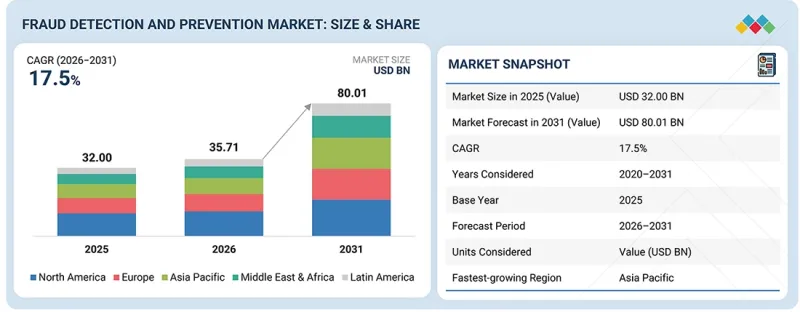
The fraud detection and prevention (FDP) market is projected to grow from USD 35.71 billion in 2026 to USD 80.01 billion by 2031, at a CAGR of 17.5% during the forecast period. The surge in synthetic identities and fraudulent activities, combined with an evolving regulatory environment, is accelerating demand for fraud detection and prevention solutions.
| Scope of the Report | |
|---|---|
| Years Considered for the Study | 2020-2031 |
| Base Year | 2025 |
| Forecast Period | 2026-2031 |
| Units Considered | Value (USD Million/Billion) |
| Segments | Fraud Type, Offering, Deployment Mode, Organization Size, Vertical, and Region |
| Regions covered | North America, Europe, Asia Pacific, Middle East & Africa, and Latin America |
Organizations are investing in AI-driven fraud analytics, identity verification, behavioral biometrics, and risk-based authentication to detect increasingly sophisticated fraud while meeting stringent regulatory requirements related to know your customer (KYC), anti-money laundering (AML), strong customer authentication (SCA), and data protection. These solutions strengthen compliance, reduce fraud losses, and enable secure digital onboarding and transactions across industries.
By fraud type, the insider fraud segment is expected to record the fastest growth rate during the forecast period.
The insider fraud segment is expected to register the highest growth during the forecast period as organizations face increasing risks from employees, contractors, vendors, and privileged users with authorized access to sensitive systems and financial data. The widespread adoption of hybrid work models, cloud platforms, and digital collaboration tools has expanded opportunities for insider threats involving financial fraud, data theft, account misuse, and policy violations. Organizations are increasingly deploying fraud analytics, user and entity behavior analytics (UEBA), identity intelligence, continuous authentication, and AI-driven anomaly detection to identify suspicious internal activities before they result in financial or reputational damage. Regulatory requirements related to data privacy, financial crime prevention, and corporate governance are also encouraging enterprises to strengthen internal fraud monitoring and access controls. Machine learning-based behavioral profiling enables organizations to distinguish legitimate employee behavior from malicious activities while reducing false positives and improving investigation efficiency. According to the LexisNexis Risk Solutions Cybercrime Report, published in March 2026, analysis of more than 116 billion online transactions during 2025 found that human-initiated attacks increased by 15% year over year, highlighting the growing importance of monitoring trusted users and strengthening identity-based fraud controls to mitigate insider-driven risks.
"By deployment mode, the on-premises segment is expected to account for the largest market share in 2026."
The on-premises deployment segment holds the largest market share as highly regulated industries continue to prioritize complete control over sensitive customer information, fraud models, and critical financial systems. Banking, financial services, government agencies, and large enterprises often maintain fraud detection platforms within their own infrastructure to meet stringent data residency, privacy, and compliance requirements while ensuring low latency and seamless integration with legacy systems. On-premises deployments also provide greater customization, governance, and security for mission-critical fraud detection workloads involving payment processing, customer authentication, and financial crime monitoring. Large organizations managing high transaction volumes prefer dedicated infrastructure to optimize performance and maintain operational resilience against evolving cyber threats. The availability of skilled internal security teams and established IT environments also supports continued investment in on-premises deployments despite increasing cloud adoption. According to Experian's 2025 US Identity & Fraud Report, published in July 2025, nearly 60% of businesses reported rising fraud-related losses, while approximately 70% planned to increase investments in fraud-prevention technologies, reflecting the continued modernization of enterprise fraud-detection environments, particularly among large, regulated organizations.
"By vertical, the BFSI segment is projected to hold the largest market share in 2026."
The BFSI segment holds the largest market share due to the industry's high exposure to payment fraud, identity theft, account takeover, synthetic identity fraud, money laundering, and digital banking attacks. Financial institutions process millions of transactions every day across online banking, mobile banking, digital payments, and card networks, making real-time fraud detection and identity verification critical for maintaining customer trust and regulatory compliance. Banks are increasingly investing in AI-driven fraud analytics, behavioral biometrics, risk-based authentication, and transaction monitoring platforms to reduce financial losses while improving customer experience. Growing adoption of instant payments, open banking, embedded finance, and digital wallets has expanded the fraud landscape, increasing the need for advanced fraud prevention technologies. Regulatory frameworks governing know your customer (KYC), anti-money laundering (AML), and payment security continue to accelerate technology adoption across the sector. According to the LexisNexis Risk Solutions Cybercrime Report, published in March 2026, account takeover attacks increased by 18% globally in 2025, while first-party fraud remained one of the most prevalent fraud types affecting financial institutions, underscoring the need for sustained investment in fraud detection and prevention solutions across the BFSI sector.
Breakdown of Primaries
The study draws insights from a range of industry experts, including component suppliers, Tier 1 companies, and OEMs. The breakdown of the primaries is as follows:
- By Company Type: Tier 1 - 55%, Tier 2 - 20%, and Tier 3 - 25%
- By Designation: C-level Executives - 60% and Managerial & Other Levels - 40%
- By Region: North America - 35%, Europe - 30%, Asia Pacific - 25%, Middle East and Africa - 5%, and Latin America - 5%
Major vendors in the FDP market include Fiserv (US), LexisNexis Risk Solutions (US), TransUnion (US), FIS Global (US), NICE Actimize (US), Experian (Ireland), IBM (US), ACI Worldwide (US), SAS Institute (US), RSA Security (US), SAP (Germany), FICO (US), Microsoft (US), F5 (US), AWS (US), Bottomline Technologies (US), Genpact (Bermuda), Securonix (US), (US), Feedzai (Portugal), Caseware (Canada), (US), Signifyd (US), BioCatch (Israel), FRISS (Netherlands), MaxMind (US), DataVisor (US), Clefy (Italy), Gurucul (US), Riskified (Israel), Thomson Reuters (Canada), Sift (US), NoFraud (US), XTN Cognitive Security (Italy), Featurespace (UK), Equifax (US), Alfa Group (Italy), Ping Identity (US), GFT Technologies (Germany), GB Group (UK), Kroll (US), Alloy (US), SEON (Hungary), SpyCloud (US), Enzoic (US), Deduce (US), (US), Resistant Al (Czech Republic), Amani Technologies (UAE), Fugu (Singapore), Pipl (US), Agnovi (US), and Clari5 (Singapore).
The study includes an in-depth competitive analysis of the key players in the FDP market, their company profiles, recent developments, and key market strategies.
Research Coverage
The report segments the FDP market and forecasts its size based on fraud type (check fraud, identity fraud, insider fraud, investment fraud, payment fraud, insurance fraud, friendly fraud, and others), offering (solutions and services), functionality (real-time detection and fraud investigation and case management), deployment mode (on-premises, cloud, and hybrid), organization size (large enterprises and SMEs), vertical (BFSI, retail & eCommerce, government, healthcare, manufacturing, travel & transportation, real estate, telecommunications, and others), and region (North America, Europe, Asia Pacific, Middle East & Africa, and Latin America).
The study also includes an in-depth competitive analysis of the market's key players, their company profiles, key observations related to product and business offerings, recent developments, and key market strategies.
Key Benefits of Buying the Report
The report will help market leaders/new entrants with information on the closest approximations of revenue numbers for the overall FDP market and its subsegments. This report will help stakeholders understand the competitive landscape and gain valuable insights to better position their businesses and plan suitable go-to-market strategies. The report also helps stakeholders understand the market pulse and provides information on key market drivers, restraints, challenges, and opportunities.
The report provides insights into the following pointers:
- Analysis of critical drivers (surge in synthetic identities, evolving regulatory environment, increased revenue losses and chargebacks due to fraud, surge in fraudulent activities, rising adoption of fraud analytics and risk-based authentication solutions to combat fraud), restraints (false positives with highly sensitive fraud detection systems, rise in online fraud complexity, privacy concerns related to fraud detection), opportunities (rising use of predictive analytics in fraud detection and prevention, increased adoption of advanced technologies, rising demand for transaction fraud protection-as-a-service among digital payment providers, expansion of application fraud detection solutions across online account onboarding channels, growing use of fraud detection tools by card issuers and payment processors to prevent payment fraud, emergence of crypto-focused fraud prevention use cases with growing DeFi and Web3 transactions), and challenges (multifaceted cross-channel fraud, lack of trained professionals to analyze fraud attacks)
- Product Development/Innovation: Detailed insights on upcoming technologies, research and development activities, new products, and service launches in the FDP market
- Market Development: Comprehensive information about lucrative markets. The report analyses the FDP market across varied regions
- Market Diversification: Exhaustive information about new solutions and services, untapped geographies, recent developments, and investments in the FDP market
- Competitive Assessment: In-depth assessment of market shares, growth strategies, and service offerings of leading players, such as Fiserv (US), LexisNexis Risk Solutions (US), TransUnion (US), FIS Global (US), NICE Actimize (US), Experian (Ireland), ACI Worldwide (US), SAS Institute (US), RSA Security (US), SAP (Germany), and FICO (US), in the FDP market.
TABLE OF CONTENTS
1 INTRODUCTION
- 1.1 STUDY OBJECTIVES
- 1.2 MARKET DEFINITION
- 1.3 STUDY SCOPE AND SEGMENTATION
- 1.3.1 MARKET SEGMENTATION
- 1.3.2 INCLUSIONS AND EXCLUSIONS
- 1.3.3 YEARS CONSIDERED
- 1.4 CURRENCY CONSIDERED
- 1.5 STAKEHOLDERS
- 1.6 SUMMARY OF CHANGES
2 EXECUTIVE SUMMARY
- 2.1 MARKET HIGHLIGHTS AND KEY INSIGHTS
- 2.2 KEY MARKET PARTICIPANTS: MAPPING OF STRATEGIC DEVELOPMENTS
- 2.3 DISRUPTIVE TRENDS SHAPING MARKET
- 2.4 HIGH-GROWTH SEGMENTS & EMERGING FRONTIERS
- 2.5 SNAPSHOT: GLOBAL MARKET SIZE, GROWTH RATE, AND FORECAST
3 PREMIUM INSIGHTS
- 3.1 ATTRACTIVE OPPORTUNITIES FOR PLAYERS IN FRAUD DETECTION AND PREVENTION (FDP) MARKET
- 3.2 FRAUD DETECTION AND PREVENTION (FDP) MARKET, BY FRAUD TYPE
- 3.3 FRAUD DETECTION AND PREVENTION (FDP) MARKET, BY SOLUTION
- 3.4 FRAUD DETECTION AND PREVENTION (FDP) MARKET, BY VERTICAL
- 3.5 FRAUD DETECTION AND PREVENTION (FDP) MARKET, BY REGION
4 MARKET OVERVIEW
- 4.1 INTRODUCTION
- 4.2 MARKET DYNAMICS
- 4.2.1 DRIVERS
- 4.2.1.1 Surge in synthetic identities and fraudulent activities
- 4.2.1.2 Evolving regulatory environment
- 4.2.1.3 Increased revenue losses and chargebacks due to fraud
- 4.2.1.4 Rise in adoption of fraud analytics and risk-based authentication solutions to combat fraud
- 4.2.2 RESTRAINTS
- 4.2.2.1 False positives with highly sensitive fraud detection systems
- 4.2.2.2 Rise in online fraud complexity
- 4.2.2.3 Privacy concerns related to fraud detection
- 4.2.3 OPPORTUNITIES
- 4.2.3.1 Rising use of predictive analytics in fraud detection and prevention
- 4.2.3.2 Increased adoption of advanced technologies such as AI and ML
- 4.2.3.3 Rising demand for Transaction Fraud Protection-as-a-Service among digital payment providers
- 4.2.3.4 Expansion of application fraud detection solutions across online account onboarding channels
- 4.2.3.5 Growing use of fraud detection tools by card issuers and payment processors to prevent payment fraud
- 4.2.3.6 Emergence of crypto-focused fraud prevention use cases with growing DeFi and Web3 transactions
- 4.2.4 CHALLENGES
- 4.2.4.1 Multifaceted cross-channel fraud
- 4.2.4.2 Lack of trained professionals to analyze fraud attacks
- 4.2.1 DRIVERS
- 4.3 UNMET NEEDS AND WHITE SPACES
- 4.4 INTERCONNECTED MARKETS AND CROSS-SECTOR OPPORTUNITIES
- 4.4.1 INTERCONNECTED MARKETS
- 4.4.2 CROSS-SECTOR OPPORTUNITIES
- 4.5 STRATEGIC MOVES BY TIER-1/2/3 PLAYERS
- 4.5.1 CROSS-TIER STRATEGIC PATTERNS
- 4.5.2 STRATEGIC TRENDS
- 4.5.2.1 AI-driven Fraud Intelligence and Autonomous Decisioning
- 4.5.2.2 Convergence of Fraud Prevention and Financial Crime Compliance
- 4.5.2.3 Identity Centric Security and Real-time Payment Protection
5 INDUSTRY TRENDS
- 5.1 PORTER'S FIVE FORCES ANALYSIS
- 5.1.1 THREAT OF NEW ENTRANTS
- 5.1.2 THREAT OF SUBSTITUTES
- 5.1.3 BARGAINING POWER OF SUPPLIERS
- 5.1.4 BARGAINING POWER OF BUYERS
- 5.1.5 INTENSITY OF COMPETITIVE RIVALRY
- 5.2 MACROECONOMIC INDICATORS
- 5.2.1 INTRODUCTION
- 5.2.2 GDP TRENDS AND FORECAST
- 5.2.3 TRENDS IN GLOBAL ICT INDUSTRY
- 5.2.4 TRENDS IN GLOBAL CYBERSECURITY INDUSTRY
- 5.3 VALUE CHAIN ANALYSIS
- 5.3.1 PLANNING AND DESIGNING
- 5.3.2 FDP SOLUTION DEVELOPMENT & DEPLOYMENT
- 5.3.3 SYSTEM INTEGRATION
- 5.3.4 DISTRIBUTION
- 5.3.5 END USERS
- 5.4 ECOSYSTEM
- 5.5 PRICING ANALYSIS
- 5.5.1 AVERAGE SELLING PRICE TREND OF KEY PLAYERS, BY OFFERING, 2025
- 5.5.2 INDICATIVE PRICING ANALYSIS, BY VENDOR, 2025
- 5.6 KEY CONFERENCES AND EVENTS IN 2026-2027
- 5.7 TRENDS AND DISRUPTIONS IMPACTING CUSTOMER BUSINESS
- 5.8 INVESTMENT AND FUNDING SCENARIO
- 5.9 CASE STUDY ANALYSIS
- 5.9.1 JUICYSCORE HELPED UNA FINANCIAL STRENGTHEN DIGITAL LENDING FRAUD PREVENTION
- 5.9.2 BIOCATCH HELPED NATWEST REDUCE AUTHORIZED PUSH PAYMENT FRAUD
- 5.9.3 FEEDZAI HELPED CITY NATIONAL BANK ENHANCE REAL-TIME PAYMENT FRAUD DETECTION
- 5.10 IMPACT OF 2025 US TARIFF - FRAUD DETECTION AND PREVENTION (FDP) MARKET
- 5.10.1 INTRODUCTION
- 5.10.2 KEY TARIFF RATES
- 5.10.3 PRICE IMPACT ANALYSIS
- 5.10.4 IMPACT ON COUNTRY/REGION
- 5.10.4.1 North America
- 5.10.4.2 Europe
- 5.10.4.3 Asia Pacific
- 5.10.5 IMPACT ON END-USE INDUSTRIES
6 REGULATORY LANDSCAPE
- 6.1 REGIONAL REGULATIONS AND COMPLIANCE
- 6.1.1 REGULATORY BODIES, GOVERNMENT AGENCIES, AND OTHER ORGANIZATIONS
- 6.1.2 INDUSTRY STANDARDS
7 CONSUMER LANDSCAPE & BUYER BEHAVIOR
- 7.1 DECISION-MAKING PROCESS
- 7.2 BUYER STAKEHOLDERS AND BUYING EVALUATION CRITERIA
- 7.2.1 KEY STAKEHOLDERS IN BUYING PROCESS
- 7.2.2 BUYING CRITERIA
- 7.3 ADOPTION BARRIERS & INTERNAL CHALLENGES
- 7.4 UNMET NEEDS IN VARIOUS END-USE INDUSTRIES
- 7.4.1 REVENUE POTENTIAL
- 7.4.2 COST DYNAMICS
- 7.4.3 MARGIN OPPORTUNITIES IN KEY APPLICATIONS
8 TECHNOLOGICAL ADVANCEMENTS, AI-DRIVEN IMPACT, PATENTS, INNOVATIONS, AND FUTURE APPLICATIONS
- 8.1 TECHNOLOGY ANALYSIS
- 8.1.1 KEY EMERGING TECHNOLOGIES
- 8.1.1.1 AI and ML
- 8.1.1.2 Big data analytics
- 8.1.1.3 Predictive analytics
- 8.1.2 COMPLEMENTARY TECHNOLOGIES
- 8.1.2.1 Cloud computing
- 8.1.2.2 Authentication
- 8.1.2.3 Encryption
- 8.1.3 ADJACENT TECHNOLOGIES
- 8.1.3.1 Internet of Things (IoT)
- 8.1.3.2 Blockchain
- 8.1.1 KEY EMERGING TECHNOLOGIES
- 8.2 TECHNOLOGY ROADMAP
- 8.2.1 SHORT-TERM (2026-2027) | FOUNDATION & EARLY PLATFORM EXPANSION
- 8.2.2 MID-TERM (2027-2030) | SCALING, AUTOMATION & UNIFIED FINANCIAL CRIME MANAGEMENT
- 8.2.3 LONG-TERM (2030-2035+) | AUTONOMOUS, ADAPTIVE & AI-DRIVEN FDP
- 8.3 PATENT ANALYSIS
- 8.4 FUTURE APPLICATIONS
- 8.4.1 AI-DRIVEN FRAUD ANALYTICS AND PREDICTIVE RISK INTELLIGENCE
- 8.4.2 BEHAVIORAL BIOMETRICS AND IDENTITY-CENTRIC FRAUD PREVENTION
- 8.4.3 UNIFIED FINANCIAL CRIME MANAGEMENT PLATFORMS
- 8.4.4 ADAPTIVE AUTHENTICATION AND REAL-TIME FRAUD PREVENTION
- 8.4.5 PRIVACY-PRESERVING FRAUD INTELLIGENCE AND FEDERATED LEARNING
- 8.5 IMPACT OF AI/GEN AI ON FRAUD DETECTION AND PREVENTION (FDP) MARKET
- 8.5.1 BEST PRACTICES IN FRAUD DETECTION AND PREVENTION (FDP) MARKET
- 8.5.2 CASE STUDIES OF AI IMPLEMENTATION IN FRAUD DETECTION AND PREVENTION(FDP) MARKET
- 8.5.3 INTERCONNECTED ADJACENT ECOSYSTEM AND IMPACT ON MARKET PLAYERS
- 8.5.4 CLIENTS' READINESS TO ADOPT GENERATIVE AI IN FRAUD DETECTION AND PREVENTION (FDP) MARKET
- 8.6 SUCCESS STORIES AND REAL-WORLD APPLICATIONS
- 8.6.1 FEEDZAI: AI-DRIVEN PAYMENT FRAUD PREVENTION FOR GLOBAL FINANCIAL INSTITUTION
- 8.6.2 BIOCATCH: BEHAVIORAL BIOMETRICS FOR IDENTITY FRAUD PREVENTION
9 FRAUD DETECTION AND PREVENTION MARKET, BY FRAUD TYPE
- 9.1 INTRODUCTION
- 9.1.1 FRAUD TYPE: FRAUD DETECTION AND PREVENTION MARKET DRIVERS
- 9.1.2 MNM STRATEGIC INSIGHTS OF FRAUD TYPES
- 9.2 CHECK FRAUD
- 9.2.1 TECHNOLOGICAL ADVANCEMENTS AND EFFECTIVENESS OF SECURITY MEASURES TO INFLUENCE MARKET
- 9.3 IDENTITY FRAUD
- 9.3.1 SPIKE IN IDENTITY FRAUD WITH INCREASE IN DIGITAL TRANSACTIONS
- 9.4 INSIDER FRAUD
- 9.4.1 EFFECTIVE PREVENTION, DETECTION, AND RESPONSE MEASURES CRUCIAL FOR RISK MITIGATION
- 9.5 INVESTMENT FRAUD
- 9.5.1 INCREASING ADOPTION OF BLOCKCHAIN AND CRYPTOCURRENCIES TO BOOST MARKET
- 9.6 PAYMENT FRAUD
- 9.6.1 GROWING USE OF CREDIT AND DEBIT CARDS AND DIGITALIZATION OF MONETARY TRANSACTIONS TO ACCELERATE MARKET GROWTH
- 9.7 INSURANCE FRAUD
- 9.7.1 GROWING DEMAND FOR ANALYTICS AND COMPLIANCE SOLUTIONS TO SAFEGUARD POLICYHOLDERS
- 9.8 FRIENDLY FRAUD
- 9.8.1 IMPROVING CUSTOMER COMMUNICATION AND OPTIMIZING FRAUD DETECTION SYSTEMS TO PROPEL MARKET GROWTH
- 9.9 OTHER FRAUD TYPES
10 FRAUD DETECTION AND PREVENTION MARKET, BY OFFERING
- 10.1 INTRODUCTION
- 10.1.1 OFFERING: FRAUD DETECTION AND PREVENTION MARKET DRIVERS
- 10.1.2 MNM STRATEGIC INSIGHTS OF OFFERING
- 10.2 SOLUTIONS
- 10.2.1 SURGE IN REVENUE LOSS TO DRIVE DEMAND FOR FDP SOLUTIONS
- 10.2.2 SOLUTIONS: FRAUD DETECTION AND PREVENTION MARKET DRIVERS
- 10.2.3 FRAUD ANALYTICS
- 10.2.3.1 Involves set of analytical techniques that analyze enterprises' systems and databases to identify vulnerabilities
- 10.2.3.2 Predictive analytics
- 10.2.3.3 Descriptive analytics
- 10.2.3.4 Prescriptive analytics
- 10.2.3.5 Social network analysis
- 10.2.3.6 Text analytics
- 10.2.3.7 Behavioral analytics
- 10.2.4 AUTHENTICATION
- 10.2.4.1 Helps block unauthorized access and identify false user input
- 10.2.4.2 Single-factor authentication
- 10.2.4.3 Multi-factor authentication
- 10.2.4.4 Risk-based authentication
- 10.2.5 GOVERNANCE, RISK, AND COMPLIANCE
- 10.2.5.1 Detects identity fraud, payment fraud, and anti-money laundering scams
- 10.3 SERVICES
- 10.3.1 SERVICES: FRAUD DETECTION AND PREVENTION MARKET DRIVERS
- 10.3.2 PROFESSIONAL SERVICES
- 10.3.2.1 Surging demand for identification, prevention, and mitigation of fraud risks
- 10.3.2.2 Risk assessment
- 10.3.2.3 Consulting services
- 10.3.2.4 Training and education
- 10.3.2.5 Implementation
- 10.3.3 MANAGED SERVICES
- 10.3.3.1 Help organizations focus on core operations while leveraging expertise of service providers
11 FRAUD DETECTION AND PREVENTION MARKET, BY DEPLOYMENT MODE
- 11.1 INTRODUCTION
- 11.1.1 DEPLOYMENT MODE: FRAUD DETECTION AND PREVENTION MARKET DRIVERS
- 11.1.2 MNM STRATEGIC INSIGHTS OF DEPLOYMENT MODE
- 11.2 ON-PREMISES
- 11.2.1 COMPLETE CONTROL OVER PLATFORMS, SYSTEMS, AND DATA TO BOOST DEMAND FOR ON-PREMISES SOLUTIONS
- 11.3 CLOUD
- 11.3.1 COST-EFFECTIVENESS AND EASE OF SECURING APPLICATIONS ON CLOUD TO BOOST MARKET
- 11.4 HYBRID
- 11.4.1 ENABLES ORGANIZATIONS TO MODERNIZE THEIR FRAUD PREVENTION CAPABILITIES WITHOUT REPLACING EXISTING SYSTEMS
12 FRAUD DETECTION AND PREVENTION MARKET, BY FUNCTIONALITY
- 12.1 INTRODUCTION
- 12.1.1 FUNCTIONALITY: FRAUD DETECTION AND PREVENTION MARKET DRIVERS
- 12.1.2 MNM STRATEGIC INSIGHTS OF FUNCTIONALITY
- 12.2 REAL-TIME DETECTION
- 12.2.1 RISING NEED FOR IDENTIFICATION AND PREVENTION OF FRAUDULENT TRANSACTIONS IN NEAR REAL-TIME TO FOSTER MARKET GROWTH
- 12.3 FRAUD INVESTIGATION & CASE MANAGEMENT
- 12.3.1 ENABLING ORGANIZATIONS TO ACCELERATE FRAUD RESPONSE AND RESOLUTION
13 FRAUD DETECTION AND PREVENTION MARKET, BY ORGANIZATION SIZE
- 13.1 INTRODUCTION
- 13.1.1 ORGANIZATION SIZE: FRAUD DETECTION AND PREVENTION MARKET DRIVERS
- 13.1.2 MNM STRATEGIC INSIGHTS OF ORGANIZATIONS
- 13.2 LARGE ENTERPRISES
- 13.2.1 SURGING DEMAND FOR EFFECTIVE MANAGEMENT OF BUSINESS APPLICATIONS TO BOOST MARKET
- 13.3 SMALL & MEDIUM-SIZED ENTERPRISES (SMES)
- 13.3.1 RISING NEED TO PROTECT APPLICATIONS FROM VULNERABILITIES AND ATTACKS TO DRIVE MARKET
14 FRAUD DETECTION AND PREVENTION MARKET, BY VERTICAL
- 14.1 INTRODUCTION
- 14.1.1 VERTICAL: FRAUD DETECTION AND PREVENTION MARKET DRIVERS
- 14.1.2 MNM STRATEGIC INSIGHTS OF VERTICALS
- 14.2 BANKING, FINANCIAL SERVICES, AND INSURANCE
- 14.2.1 RAPID DIGITALIZATION OF BANKING AND FINANCIAL SERVICES TO BOOST MARKET GROWTH
- 14.2.2 BANKING
- 14.2.2.1 Account Opening (Digital Customer Onboarding - KYC/eKYC)
- 14.2.2.2 Account Access and Re-authentication
- 14.2.2.3 High-value Transaction Authorization
- 14.2.2.4 Account Takeover Detection and Prevention
- 14.2.2.5 Customer, Employee, and Agent Identity Verification
- 14.2.3 FINANCIAL SERVICES
- 14.2.3.1 Payment & Remittance
- 14.2.3.2 Lending & Credit Management
- 14.2.3.3 Crypto & Digital Asset Exchange
- 14.2.3.4 Investment, Wealth Management & Brokerage
- 14.2.3.5 Others (Credit Rating Agencies, Financial Advisory & Consulting, Treasury & Cash Management)
- 14.2.4 INSURANCE
- 14.3 RETAIL & ECOMMERCE
- 14.3.1 INCREASING MONETARY TRANSACTIONS THROUGH DIGITAL CHANNELS TO BOOST MARKET
- 14.4 GOVERNMENT
- 14.4.1 DEPLOYMENT OF DIGITAL APPLICATIONS HANDLING CRITICAL DATA BY GOVERNMENT INSTITUTES TO DRIVE MARKET
- 14.5 HEALTHCARE
- 14.5.1 NEED TO SECURE PRIVATE AND HIGHLY CONFIDENTIAL HEALTHCARE DATA AND PRESERVE TRUST AMONG PATIENTS TO PROPEL MARKET
- 14.6 MANUFACTURING
- 14.6.1 INCREASING INVESTMENTS IN FDP SOLUTIONS TO DRIVE MARKET
- 14.7 TRAVEL & TRANSPORTATION
- 14.7.1 SURGE TO PREVENT FRAUDSTERS FROM TARGETING LOYALTY ACCOUNTS TO BOOST MARKET
- 14.8 REAL ESTATE
- 14.8.1 GROWING PROPERTY FLIPPING FRAUD, MORTGAGE FRAUD, FORECLOSURE FRAUD, AND RENTAL FRAUD TO DRIVE MARKET
- 14.9 TELECOMMUNICATIONS
- 14.9.1 INCREASING DEMAND FOR MITIGATION OF FRAUDULENT ACTIVITIES AND PROTECTION OF CUSTOMER INTERESTS TO FOSTER MARKET GROWTH
- 14.10 OTHER VERTICALS
15 FRAUD DETECTION AND PREVENTION MARKET, BY REGION
- 15.1 INTRODUCTION
- 15.2 NORTH AMERICA
- 15.2.1 NORTH AMERICA: FRAUD DETECTION AND PREVENTION MARKET DRIVERS
- 15.2.2 NORTH AMERICA: MNM STRATEGIC INSIGHTS
- 15.2.3 NORTH AMERICA: REGULATORY LANDSCAPE
- 15.2.4 US
- 15.2.4.1 Increased technological advancements, regulatory norms, and evolving fraud types to drive market
- 15.2.5 CANADA
- 15.2.5.1 Rise in fraudulent activities and increased threat of deepfakes to propel market
- 15.3 EUROPE
- 15.3.1 EUROPE: FRAUD DETECTION AND PREVENTION MARKET DRIVERS
- 15.3.2 EUROPE: MNM STRATEGIC INSIGHTS
- 15.3.3 EUROPE: REGULATORY LANDSCAPE
- 15.3.4 UK
- 15.3.4.1 Increased government initiatives to combat fraud to boost market
- 15.3.5 GERMANY
- 15.3.5.1 Rising adoption of FDP solutions by banks and financial institutions to drive market
- 15.3.6 FRANCE
- 15.3.6.1 Implementation of stringent regulations to fuel market growth
- 15.3.7 SPAIN
- 15.3.7.1 Increased government initiatives and strict regulations to boost market growth
- 15.3.8 ITALY
- 15.3.8.1 Continued investment in technology and awareness regarding cybersecurity to propel market growth
- 15.3.9 POLAND
- 15.3.9.1 Government initiatives to combat fraud and investments in advanced technology to bolster market growth
- 15.3.10 IRELAND
- 15.3.10.1 Advancements in technologies and innovations in fraud prevention solutions to boost market
- 15.3.11 CZECH REPUBLIC
- 15.3.11.1 Spike in fraud, embezzlement, and money laundering in finance, insurance, and real estate sectors to drive market
- 15.3.12 REST OF EUROPE
- 15.4 ASIA PACIFIC
- 15.4.1 ASIA PACIFIC: FRAUD DETECTION AND PREVENTION MARKET DRIVERS
- 15.4.2 ASIA PACIFIC: MNM STRATEGIC INSIGHTS
- 15.4.3 ASIA PACIFIC: REGULATORY LANDSCAPE
- 15.4.4 CHINA
- 15.4.4.1 Growing threat of online scammers and rising internet fraud to boost market
- 15.4.5 JAPAN
- 15.4.5.1 Implementation of robust internal controls for prevention of fraud incidents to boost market
- 15.4.6 AUSTRALIA & NEW ZEALAND
- 15.4.6.1 Regulatory requirements aimed at improving data security and customer privacy to fuel market growth
- 15.4.7 INDIA
- 15.4.7.1 Increased internet penetration, improved telecom services, and government initiatives to drive market
- 15.4.8 SINGAPORE
- 15.4.8.1 Growing emphasis on cybersecurity measures to bolster market growth
- 15.4.9 REST OF ASIA PACIFIC
- 15.5 MIDDLE EAST & AFRICA
- 15.5.1 MIDDLE EAST & AFRICA: FRAUD DETECTION AND PREVENTION MARKET DRIVERS
- 15.5.2 MIDDLE EAST & AFRICA: MNM STRATEGIC INSIGHTS
- 15.5.3 GCC
- 15.5.3.1 UAE
- 15.5.3.1.1 Increased government initiatives with increasing prevalence of fraudulent activities to accelerate market growth
- 15.5.3.2 KSA
- 15.5.3.2.1 Increasing fraud awareness to boost market
- 15.5.3.3 Rest of GCC countries
- 15.5.3.1 UAE
- 15.5.4 SOUTH AFRICA
- 15.5.4.1 Rise in mobile and internet penetration and rapid digitalization to accelerate market growth
- 15.5.5 REST OF MIDDLE EAST & AFRICA
- 15.6 LATIN AMERICA
- 15.6.1 LATIN AMERICA: FRAUD DETECTION AND PREVENTION MARKET DRIVERS
- 15.6.2 LATIN AMERICA: MNM STRATEGIC INSIGHTS
- 15.6.3 BRAZIL
- 15.6.3.1 Increased digitalization and adoption of digital payments to drive market
- 15.6.4 MEXICO
- 15.6.4.1 Increased requirement to protect sensitive information to drive adoption of FDP solutions
- 15.6.5 COLOMBIA
- 15.6.5.1 Increasing financial crimes and rapid investments in advanced technologies to drive market
- 15.6.6 REST OF LATIN AMERICA
16 COMPETITIVE LANDSCAPE
- 16.1 INTRODUCTION
- 16.2 KEY PLAYER STRATEGIES/RIGHT TO WIN, 2024-2026
- 16.3 REVENUE ANALYSIS, 2021-2025
- 16.4 MARKET SHARE ANALYSIS, 2025
- 16.5 BRAND COMPARISON
- 16.6 COMPANY VALUATION AND FINANCIAL METRICS, 2025
- 16.6.1 COMPANY VALUATION
- 16.6.2 FINANCIAL METRICS USING EV/EBIDTA, 2025
- 16.7 COMPANY EVALUATION MATRIX: KEY PLAYERS, 2025
- 16.7.1 STARS
- 16.7.2 EMERGING LEADERS
- 16.7.3 PERVASIVE PLAYERS
- 16.7.4 PARTICIPANTS
- 16.7.5 COMPANY FOOTPRINT: KEY PLAYERS, 2025
- 16.7.5.1 Company footprint
- 16.7.5.2 Offering footprint
- 16.7.5.3 Fraud type footprint
- 16.7.5.4 Vertical footprint
- 16.7.5.5 Region footprint
- 16.8 COMPANY EVALUATION MATRIX: STARTUPS/SMES, 2025
- 16.8.1 PROGRESSIVE COMPANIES
- 16.8.2 RESPONSIVE COMPANIES
- 16.8.3 DYNAMIC COMPANIES
- 16.8.4 STARTING BLOCKS
- 16.8.5 COMPETITIVE BENCHMARKING: STARTUPS/SMES, 2025
- 16.8.5.1 Detailed list of key startups/SMEs
- 16.8.5.2 Competitive benchmarking of key startups/SMEs
- 16.8.5.3 Competitive benchmarking of key startups/SMEs
- 16.9 COMPETITIVE SCENARIO AND TRENDS
- 16.9.1 PRODUCT LAUNCHES AND ENHANCEMENTS
- 16.9.2 DEALS
17 COMPANY PROFILES
- 17.1 KEY PLAYERS
- 17.1.1 LEXISNEXIS RISK SOLUTIONS
- 17.1.1.1 Business overview
- 17.1.1.2 Products/Solutions/Services offered
- 17.1.1.3 Recent developments
- 17.1.1.3.1 Deals
- 17.1.1.4 MnM view
- 17.1.1.4.1 Right to win
- 17.1.1.4.2 Strategic choices
- 17.1.1.4.3 Weaknesses and competitive threats
- 17.1.2 TRANSUNION
- 17.1.2.1 Business overview
- 17.1.2.2 Products/Solutions/Services offered
- 17.1.2.3 Recent developments
- 17.1.2.3.1 Product launches
- 17.1.2.3.2 Deals
- 17.1.2.4 MnM view
- 17.1.2.4.1 Right to win
- 17.1.2.4.2 Strategic choices
- 17.1.2.4.3 Weaknesses and competitive threats
- 17.1.3 FIS GLOBAL
- 17.1.3.1 Business overview
- 17.1.3.2 Products/Solutions/Services offered
- 17.1.3.3 Recent developments
- 17.1.3.3.1 Product launches
- 17.1.3.3.2 Deals
- 17.1.3.4 MnM view
- 17.1.3.4.1 Right to win
- 17.1.3.4.2 Strategic choices
- 17.1.3.4.3 Weaknesses and competitive threats
- 17.1.4 FISERV
- 17.1.4.1 Business overview
- 17.1.4.2 Products/Solutions/Services offered
- 17.1.4.3 Recent developments
- 17.1.4.3.1 Deals
- 17.1.4.4 MnM view
- 17.1.4.4.1 Right to win
- 17.1.4.4.2 Strategic choices
- 17.1.4.4.3 Weaknesses and competitive threats
- 17.1.5 SAS INSTITUTE
- 17.1.5.1 Business overview
- 17.1.5.2 Products/Solutions/Services offered
- 17.1.5.3 Recent developments
- 17.1.5.3.1 Deals
- 17.1.5.4 MnM view
- 17.1.5.4.1 Right to win
- 17.1.5.4.2 Strategic choices
- 17.1.5.4.3 Weaknesses and competitive threats
- 17.1.6 NICE ACTIMIZE
- 17.1.6.1 Business overview
- 17.1.6.2 Products/Solutions/Services offered
- 17.1.6.3 Recent developments
- 17.1.6.3.1 Product launches and enhancements
- 17.1.7 EXPERIAN
- 17.1.7.1 Business overview
- 17.1.7.2 Products/Solutions/Services offered
- 17.1.7.3 Recent developments
- 17.1.7.3.1 Product launches
- 17.1.7.3.2 Deals
- 17.1.8 IBM
- 17.1.8.1 Business overview
- 17.1.8.2 Products/Solutions/Services offered
- 17.1.8.3 Recent developments
- 17.1.8.3.1 Product launches and enhancements
- 17.1.9 ACI WORLDWIDE
- 17.1.9.1 Business overview
- 17.1.9.2 Products/Solutions/Services offered
- 17.1.9.3 Recent developments
- 17.1.9.3.1 Deals
- 17.1.10 RSA SECURITY (OUTSEER)
- 17.1.10.1 Business overview
- 17.1.10.2 Products/Solutions/Services offered
- 17.1.11 SAP
- 17.1.11.1 Business overview
- 17.1.11.2 Products/Solutions/Services offered
- 17.1.12 FICO
- 17.1.12.1 Business overview
- 17.1.12.2 Products/Solutions/Services offered
- 17.1.12.3 Recent developments
- 17.1.12.3.1 Product launches and enhancements
- 17.1.12.3.2 Deals
- 17.1.13 MICROSOFT
- 17.1.13.1 Business overview
- 17.1.13.2 Products/Solutions/Services offered
- 17.1.13.3 Recent developments
- 17.1.13.3.1 Deals
- 17.1.14 F5
- 17.1.14.1 Business overview
- 17.1.14.2 Products/Solutions/Services offered
- 17.1.15 AWS
- 17.1.15.1 Business overview
- 17.1.15.2 Products/Solutions/Services offered
- 17.1.15.3 Recent developments
- 17.1.15.3.1 Deals
- 17.1.16 BOTTOMLINE TECHNOLOGIES
- 17.1.16.1 Business overview
- 17.1.16.2 Products/Solutions/Services offered
- 17.1.16.3 Recent developments
- 17.1.16.3.1 Product launches
- 17.1.16.3.2 Deals
- 17.1.17 GENPACT
- 17.1.17.1 Business overview
- 17.1.17.2 Products/Solutions/Services offered
- 17.1.18 SECURONIX
- 17.1.18.1 Business overview
- 17.1.18.2 Products/Solutions/Services offered
- 17.1.19 ACCERTIFY
- 17.1.19.1 Business overview
- 17.1.19.2 Products/Solutions/Services offered
- 17.1.19.3 Recent developments
- 17.1.19.3.1 Deals
- 17.1.20 FEEDZAI
- 17.1.20.1 Business overview
- 17.1.20.2 Products/Solutions/Services offered
- 17.1.20.3 Recent developments
- 17.1.20.3.1 Deals
- 17.1.21 CASEWARE
- 17.1.21.1 Business overview
- 17.1.21.2 Products/Solutions/Services offered
- 17.1.22 ONESPAN
- 17.1.22.1 Business overview
- 17.1.22.2 Products/Solutions/Services offered
- 17.1.22.3 Recent developments
- 17.1.22.3.1 Product launches and enhancements
- 17.1.22.3.2 Deals
- 17.1.23 JUICYSCORE
- 17.1.23.1 Business Overview
- 17.1.23.2 Products/Solutions/Services offered
- 17.1.23.3 Recent developments
- 17.1.23.3.1 Product launches
- 17.1.24 SIGNIFYD
- 17.1.24.1 Business overview
- 17.1.24.2 Products/Solutions/Services offered
- 17.1.24.3 Recent developments
- 17.1.24.3.1 Product launches
- 17.1.24.3.2 Deals
- 17.1.25 BIOCATCH
- 17.1.25.1 Business overview
- 17.1.25.2 Products/Solutions/Services offered
- 17.1.25.3 Recent developments
- 17.1.25.3.1 Product launches/enhancements
- 17.1.25.4 Deals
- 17.1.26 FRISS
- 17.1.26.1 Business overview
- 17.1.26.2 Products/Solutions/Services offered
- 17.1.26.3 Recent developments
- 17.1.26.3.1 Deals
- 17.1.27 MAXMIND
- 17.1.27.1 Business overview
- 17.1.27.2 Products/Solutions/Services offered
- 17.1.28 DATAVISOR
- 17.1.28.1 Business overview
- 17.1.28.2 Products/Solutions/Services offered
- 17.1.28.3 Recent developments
- 17.1.28.3.1 Deals
- 17.1.29 CLEAFY
- 17.1.29.1 Business overview
- 17.1.29.2 Products/Solutions/Services offered
- 17.1.29.3 Recent developments
- 17.1.29.3.1 Product launches and enhancements
- 17.1.29.3.2 Deals
- 17.1.30 GURUCUL
- 17.1.30.1 Business overview
- 17.1.30.2 Products/Solutions/Services offered
- 17.1.31 RISKIFIED
- 17.1.31.1 Business overview
- 17.1.31.2 Products/Solutions/Services offered
- 17.1.31.3 Recent developments
- 17.1.31.3.1 Product launches
- 17.1.31.3.2 Deals
- 17.1.32 THOMSON REUTERS
- 17.1.32.1 Business overview
- 17.1.32.2 Products/Solutions/Services offered
- 17.1.32.3 Recent developments
- 17.1.32.3.1 Product launches
- 17.1.33 SIFT
- 17.1.33.1 Business overview
- 17.1.33.2 Products/Solutions/Services offered
- 17.1.33.3 Recent developments
- 17.1.33.3.1 Deals
- 17.1.34 WYLLO (NOFRAUD)
- 17.1.34.1 Business overview
- 17.1.34.2 Products/Solutions/Services offered
- 17.1.35 FEATURESPACE
- 17.1.35.1 Business overview
- 17.1.35.2 Products/Solutions/Services offered
- 17.1.36 XTN COGNITIVE SECURITY
- 17.1.36.1 Business overview
- 17.1.36.2 Products/Solutions/Services offered
- 17.1.37 EQUIFAX
- 17.1.37.1 Business overview
- 17.1.37.2 Products/Solutions/Services offered
- 17.1.37.3 Recent developments
- 17.1.37.3.1 Product launches
- 17.1.37.3.2 Deals
- 17.1.38 ALFA GROUP
- 17.1.38.1 Business overview
- 17.1.38.2 Products/Solutions/Services offered
- 17.1.39 PING IDENTITY
- 17.1.39.1 Business Overview
- 17.1.39.2 Products/Solutions/Services offered
- 17.1.39.3 Recent developments
- 17.1.39.3.1 Deals
- 17.1.40 GFT TECHNOLOGIES
- 17.1.40.1 Business overview
- 17.1.40.2 Products/Solutions/Services offered
- 17.1.40.3 Recent developments
- 17.1.40.3.1 Deals
- 17.1.41 GBG
- 17.1.41.1 Business Overview
- 17.1.41.2 Products/Solutions/Services offered
- 17.1.41.3 Recent developments
- 17.1.41.3.1 Product launches
- 17.1.41.3.2 Deals
- 17.1.42 KROLL
- 17.1.42.1 Business Overview
- 17.1.42.2 Products/Solutions/Services offered
- 17.1.42.3 Recent developments
- 17.1.42.3.1 Product launches
- 17.1.1 LEXISNEXIS RISK SOLUTIONS
- 17.2 OTHER KEY PLAYERS
- 17.2.1 ALLOY
- 17.2.2 CASTLE
- 17.2.3 ENZOIC
- 17.2.4 SPYCLOUD
- 17.2.5 SEON
- 17.2.6 DEDUCE (CHEQ)
- 17.2.7 INCOGNIA
- 17.2.8 RESISTANT AI
- 17.2.9 AMANI
- 17.2.10 FUGU
- 17.2.11 PIPL
- 17.2.12 AGNOVI CORPORATION
- 17.2.13 CLARI5
- 17.2.14 THREATMARK
18 RESEARCH METHODOLOGY
- 18.1 RESEARCH DATA
- 18.1.1 SECONDARY DATA
- 18.1.2 PRIMARY DATA
- 18.1.2.1 Breakup of primary profiles
- 18.1.2.2 Key industry insights
- 18.2 DATA TRIANGULATION
- 18.3 MARKET SIZE ESTIMATION
- 18.3.1 TOP-DOWN APPROACH
- 18.3.2 BOTTOM-UP APPROACH
- 18.4 MARKET FORECAST
- 18.5 RESEARCH ASSUMPTIONS
- 18.6 RESEARCH LIMITATIONS
19 APPENDIX
- 19.1 DISCUSSION GUIDE
- 19.2 KNOWLEDGESTORE: MARKETSANDMARKETS' SUBSCRIPTION PORTAL
- 19.3 CUSTOMIZATION OPTIONS
- 19.4 RELATED REPORTS
- 19.5 AUTHOR DETAILS
List of Tables
- TABLE 1 USD EXCHANGE RATES, 2021-2025
- TABLE 2 UNMET NEEDS AND WHITE SPACES IN FRAUD DETECTION AND PREVENTION (FDP) MARKET
- TABLE 3 STRATEGIC MOVES BY PLAYERS IN FRAUD DETECTION AND PREVENTION (FDP) MARKET
- TABLE 4 CROSS-TIER STRATEGIC PATTERNS OF VENDORS
- TABLE 5 PORTER'S FIVE FORCES' IMPACT ON FRAUD DETECTION AND PREVENTION (FDP) MARKET
- TABLE 6 GDP PERCENTAGE CHANGE, BY KEY COUNTRY, 2021-2030
- TABLE 7 FRAUD DETECTION AND PREVENTION (FDP) MARKET: ECOSYSTEM
- TABLE 8 AVERAGE SELLING PRICES FOR FDP SOLUTIONS OFFERED BY KEY PLAYERS, BY OFFERING, 2025
- TABLE 9 INDICATIVE PRICING OF FRAUD DETECTION AND PREVENTION OFFERING, BY VENDOR, 2025
- TABLE 10 FRAUD DETECTION AND PREVENTION (FDP) MARKET: DETAILED LIST OF CONFERENCES AND EVENTS, 2026-2027
- TABLE 11 KEY TARIFF RATES
- TABLE 12 NORTH AMERICA: LIST OF REGULATORY BODIES, GOVERNMENT AGENCIES, AND OTHER ORGANIZATIONS
- TABLE 13 EUROPE: LIST OF REGULATORY BODIES, GOVERNMENT AGENCIES, AND OTHER ORGANIZATIONS
- TABLE 14 ASIA PACIFIC: LIST OF REGULATORY BODIES, GOVERNMENT AGENCIES, AND OTHER ORGANIZATIONS
- TABLE 15 ROW: LIST OF REGULATORY BODIES, GOVERNMENT AGENCIES, AND OTHER ORGANIZATIONS
- TABLE 16 GLOBAL INDUSTRY STANDARDS IN FRAUD DETECTION & PREVENTION (FDP) MARKET
- TABLE 17 INFLUENCE OF STAKEHOLDERS ON BUYING PROCESS FOR TOP THREE VERTICALS (%)
- TABLE 18 KEY BUYING CRITERIA FOR TOP THREE VERTICALS
- TABLE 19 UNMET NEEDS IN FRAUD DETECTION AND PREVENTION (FDP) MARKET, BY END-USE INDUSTRY
- TABLE 20 LIST OF TOP PATENTS IN FRAUD DETECTION AND PREVENTION (FDP) MARKET, 2024-2026
- TABLE 21 TOP USE CASES AND MARKET POTENTIAL
- TABLE 22 BEST PRACTICES: COMPANIES IMPLEMENTING USE CASES
- TABLE 23 FRAUD DETECTION AND PREVENTION (FDP) MARKET: CASE STUDIES RELATED TO GEN AI IMPLEMENTATION
- TABLE 24 INTERCONNECTED ADJACENT ECOSYSTEM AND IMPACT ON MARKET PLAYERS
- TABLE 25 FRAUD DETECTION AND PREVENTION MARKET, BY FRAUD TYPE, 2020-2025 (USD MILLION)
- TABLE 26 FRAUD DETECTION AND PREVENTION MARKET, BY FRAUD TYPE, 2026-2031 (USD MILLION)
- TABLE 27 CHECK FRAUD: FRAUD DETECTION AND PREVENTION MARKET, BY REGION, 2020-2025 (USD MILLION)
- TABLE 28 CHECK FRAUD: FRAUD DETECTION AND PREVENTION MARKET, BY REGION, 2026-2031 (USD MILLION)
- TABLE 29 IDENTITY FRAUD: FRAUD DETECTION AND PREVENTION MARKET, BY REGION, 2020-2025 (USD MILLION)
- TABLE 30 IDENTITY FRAUD: FRAUD DETECTION AND PREVENTION MARKET, BY REGION, 2026-2031 (USD MILLION)
- TABLE 31 INSIDER FRAUD: FRAUD DETECTION AND PREVENTION MARKET, BY REGION, 2020-2025 (USD MILLION)
- TABLE 32 INSIDER FRAUD: FRAUD DETECTION AND PREVENTION MARKET, BY REGION, 2026-2031 (USD MILLION)
- TABLE 33 INVESTMENT FRAUD: FRAUD DETECTION AND PREVENTION MARKET, BY REGION, 2020-2025 (USD MILLION)
- TABLE 34 INVESTMENT FRAUD: FRAUD DETECTION AND PREVENTION MARKET, BY REGION, 2026-2031 (USD MILLION)
- TABLE 35 PAYMENT FRAUD: FRAUD DETECTION AND PREVENTION MARKET, BY REGION, 2020-2025 (USD MILLION)
- TABLE 36 PAYMENT FRAUD: FRAUD DETECTION AND PREVENTION MARKET, BY REGION, 2026-2031 (USD MILLION)
- TABLE 37 INSURANCE FRAUD: FRAUD DETECTION AND PREVENTION MARKET, BY REGION, 2020-2025 (USD MILLION)
- TABLE 38 INSURANCE FRAUD: FRAUD DETECTION AND PREVENTION MARKET, BY REGION, 2026-2031 (USD MILLION)
- TABLE 39 FRIENDLY FRAUD: FRAUD DETECTION AND PREVENTION MARKET, BY REGION, 2020-2025 (USD MILLION)
- TABLE 40 FRIENDLY FRAUD: FRAUD DETECTION AND PREVENTION MARKET, BY REGION, 2026-2031 (USD MILLION)
- TABLE 41 OTHER FRAUD TYPES: FRAUD DETECTION AND PREVENTION MARKET, BY REGION, 2020-2025 (USD MILLION)
- TABLE 42 OTHER FRAUD TYPES: FRAUD DETECTION AND PREVENTION MARKET, BY REGION, 2026-2031 (USD MILLION)
- TABLE 43 FRAUD DETECTION AND PREVENTION MARKET, BY OFFERING, 2020-2025 (USD MILLION)
- TABLE 44 FRAUD DETECTION AND PREVENTION MARKET, BY OFFERING, 2026-2031 (USD MILLION)
- TABLE 45 SOLUTIONS: FRAUD DETECTION AND PREVENTION MARKET, BY REGION, 2020-2025 (USD MILLION)
- TABLE 46 SOLUTIONS: FRAUD DETECTION AND PREVENTION MARKET, BY REGION, 2026-2031 (USD MILLION)
- TABLE 47 FRAUD DETECTION AND PREVENTION MARKET, BY SOLUTION, 2020-2025 (USD MILLION)
- TABLE 48 FRAUD DETECTION AND PREVENTION MARKET, BY SOLUTION, 2026-2031 (USD MILLION)
- TABLE 49 FRAUD ANALYTICS: FRAUD DETECTION AND PREVENTION MARKET, BY REGION, 2020-2025 (USD MILLION)
- TABLE 50 FRAUD ANALYTICS: FRAUD DETECTION AND PREVENTION MARKET, BY REGION, 2026-2031 (USD MILLION)
- TABLE 51 AUTHENTICATION: FRAUD DETECTION AND PREVENTION MARKET, BY REGION, 2020-2025 (USD MILLION)
- TABLE 52 AUTHENTICATION: FRAUD DETECTION AND PREVENTION MARKET, BY REGION, 2026-2031 (USD MILLION)
- TABLE 53 GOVERNANCE, RISK, AND COMPLIANCE: FRAUD DETECTION AND PREVENTION MARKET, BY REGION, 2020-2025 (USD MILLION)
- TABLE 54 GOVERNANCE, RISK, AND COMPLIANCE: FRAUD DETECTION AND PREVENTION MARKET, BY REGION, 2026-2031 (USD MILLION)
- TABLE 55 FRAUD DETECTION AND PREVENTION MARKET, BY SERVICE, 2020-2025 (USD MILLION)
- TABLE 56 FRAUD DETECTION AND PREVENTION MARKET, BY SERVICE, 2026-2031 (USD MILLION)
- TABLE 57 SERVICES: FRAUD DETECTION AND PREVENTION MARKET, BY REGION, 2020-2025 (USD MILLION)
- TABLE 58 SERVICES: FRAUD DETECTION AND PREVENTION MARKET, BY REGION, 2026-2031 (USD MILLION)
- TABLE 59 PROFESSIONAL SERVICES: FRAUD DETECTION AND PREVENTION MARKET, BY REGION, 2020-2025 (USD MILLION)
- TABLE 60 PROFESSIONAL SERVICES: FRAUD DETECTION AND PREVENTION MARKET, BY REGION, 2026-2031 (USD MILLION)
- TABLE 61 MANAGED SERVICES: FRAUD DETECTION AND PREVENTION MARKET, BY REGION, 2020-2025 (USD MILLION)
- TABLE 62 MANAGED SERVICES: FRAUD DETECTION AND PREVENTION MARKET, BY REGION, 2026-2031 (USD MILLION)
- TABLE 63 FRAUD DETECTION AND PREVENTION MARKET, BY DEPLOYMENT MODE, 2020-2025 (USD MILLION)
- TABLE 64 FRAUD DETECTION AND PREVENTION MARKET, BY DEPLOYMENT MODE, 2026-2031 (USD MILLION)
- TABLE 65 ON-PREMISES: FRAUD DETECTION AND PREVENTION MARKET, BY REGION, 2020-2025 (USD MILLION)
- TABLE 66 ON-PREMISES: FRAUD DETECTION AND PREVENTION MARKET, BY REGION, 2026-2031 (USD MILLION)
- TABLE 67 CLOUD: FRAUD DETECTION AND PREVENTION MARKET, BY REGION, 2020-2025 (USD MILLION)
- TABLE 68 CLOUD: FRAUD DETECTION AND PREVENTION MARKET, BY REGION, 2026-2031 (USD MILLION)
- TABLE 69 HYBRID: FRAUD DETECTION AND PREVENTION MARKET, BY REGION, 2020-2025 (USD MILLION)
- TABLE 70 HYBRID: FRAUD DETECTION AND PREVENTION MARKET, BY REGION, 2026-2031 (USD MILLION)
- TABLE 71 FRAUD DETECTION AND PREVENTION MARKET, BY FUNCTIONALITY, 2020-2025 (USD MILLION)
- TABLE 72 FRAUD DETECTION AND PREVENTION MARKET, BY FUNCTIONALITY, 2026-2031 (USD MILLION)
- TABLE 73 REAL-TIME DETECTION: FRAUD DETECTION AND PREVENTION MARKET, BY REGION, 2020-2025 (USD MILLION)
- TABLE 74 REAL-TIME DETECTION: FRAUD DETECTION AND PREVENTION MARKET, BY REGION, 2026-2031 (USD MILLION)
- TABLE 75 FRAUD INVESTIGATION & CASE MANAGEMENT: FRAUD DETECTION AND PREVENTION MARKET, BY REGION, 2020-2025 (USD MILLION)
- TABLE 76 FRAUD INVESTIGATION & CASE MANAGEMENT: FRAUD DETECTION AND PREVENTION MARKET, BY REGION, 2026-2031 (USD MILLION)
- TABLE 77 FRAUD DETECTION AND PREVENTION MARKET, BY ORGANIZATION SIZE, 2020-2025 (USD MILLION)
- TABLE 78 FRAUD DETECTION AND PREVENTION MARKET, BY ORGANIZATION SIZE, 2026-2031 (USD MILLION)
- TABLE 79 LARGE ENTERPRISES: FRAUD DETECTION AND PREVENTION MARKET, BY REGION, 2020-2025 (USD MILLION)
- TABLE 80 LARGE ENTERPRISES: FRAUD DETECTION AND PREVENTION MARKET, BY REGION, 2026-2031 (USD MILLION)
- TABLE 81 SMES: FRAUD DETECTION AND PREVENTION MARKET, BY REGION, 2020-2025 (USD MILLION)
- TABLE 82 SMES: FRAUD DETECTION AND PREVENTION MARKET, BY REGION, 2026-2031 (USD MILLION)
- TABLE 83 FRAUD DETECTION AND PREVENTION MARKET, BY VERTICAL, 2020-2025 (USD MILLION)
- TABLE 84 FRAUD DETECTION AND PREVENTION MARKET, BY VERTICAL, 2026-2031 (USD MILLION)
- TABLE 85 BANKING, FINANCIAL SERVICES, AND INSURANCE: FRAUD DETECTION AND PREVENTION MARKET, BY REGION, 2020-2025 (USD MILLION)
- TABLE 86 BANKING, FINANCIAL SERVICES, AND INSURANCE: FRAUD DETECTION AND PREVENTION MARKET, BY REGION, 2026-2031 (USD MILLION)
- TABLE 87 FRAUD DETECTION AND PREVENTION MARKET, BY BFSI TYPE, 2020-2025 (USD MILLION)
- TABLE 88 FRAUD DETECTION AND PREVENTION MARKET, BY BFSI TYPE, 2026-2031 (USD MILLION)
- TABLE 89 BANKING: FRAUD DETECTION AND PREVENTION MARKET, BY REGION, 2020-2025 (USD MILLION)
- TABLE 90 BANKING: FRAUD DETECTION AND PREVENTION MARKET, BY REGION, 2026-2031 (USD MILLION)
- TABLE 91 FINANCIAL SERVICES: FRAUD DETECTION AND PREVENTION MARKET, BY REGION, 2020-2025 (USD MILLION)
- TABLE 92 FINANCIAL SERVICES: FRAUD DETECTION AND PREVENTION MARKET, BY REGION, 2026-2031 (USD MILLION)
- TABLE 93 INSURANCE: FRAUD DETECTION AND PREVENTION MARKET, BY REGION, 2020-2025 (USD MILLION)
- TABLE 94 INSURANCE: FRAUD DETECTION AND PREVENTION MARKET, BY REGION, 2026-2031 (USD MILLION)
- TABLE 95 RETAIL & ECOMMERCE: FRAUD DETECTION AND PREVENTION MARKET, BY REGION, 2020-2025 (USD MILLION)
- TABLE 96 RETAIL & ECOMMERCE: FRAUD DETECTION AND PREVENTION MARKET, BY REGION, 2026-2031 (USD MILLION)
- TABLE 97 GOVERNMENT: FRAUD DETECTION AND PREVENTION MARKET, BY REGION, 2020-2025 (USD MILLION)
- TABLE 98 GOVERNMENT: FRAUD DETECTION AND PREVENTION MARKET, BY REGION, 2026-2031 (USD MILLION)
- TABLE 99 HEALTHCARE: FRAUD DETECTION AND PREVENTION MARKET, BY REGION, 2020-2025 (USD MILLION)
- TABLE 100 HEALTHCARE: FRAUD DETECTION AND PREVENTION MARKET, BY REGION, 2026-2031 (USD MILLION)
- TABLE 101 MANUFACTURING: FRAUD DETECTION AND PREVENTION MARKET, BY REGION, 2020-2025 (USD MILLION)
- TABLE 102 MANUFACTURING: FRAUD DETECTION AND PREVENTION MARKET, BY REGION, 2026-2031 (USD MILLION)
- TABLE 103 TRAVEL & TRANSPORTATION: FRAUD DETECTION AND PREVENTION MARKET, BY REGION, 2020-2025 (USD MILLION)
- TABLE 104 TRAVEL & TRANSPORTATION: FRAUD DETECTION AND PREVENTION MARKET, BY REGION, 2026-2031 (USD MILLION)
- TABLE 105 REAL ESTATE: FRAUD DETECTION AND PREVENTION MARKET, BY REGION, 2020-2025 (USD MILLION)
- TABLE 106 REAL ESTATE: FRAUD DETECTION AND PREVENTION MARKET, BY REGION, 2026-2031 (USD MILLION)
- TABLE 107 TELECOMMUNICATIONS: FRAUD DETECTION AND PREVENTION MARKET, BY REGION, 2020-2025 (USD MILLION)
- TABLE 108 TELECOMMUNICATIONS: FRAUD DETECTION AND PREVENTION MARKET, BY REGION, 2026-2031 (USD MILLION)
- TABLE 109 OTHER VERTICALS: FRAUD DETECTION AND PREVENTION MARKET, BY REGION, 2020-2025 (USD MILLION)
- TABLE 110 OTHER VERTICALS: FRAUD DETECTION AND PREVENTION MARKET, BY REGION, 2026-2031 (USD MILLION)
- TABLE 111 FRAUD DETECTION AND PREVENTION MARKET, BY REGION, 2020-2025 (USD MILLION)
- TABLE 112 FRAUD DETECTION AND PREVENTION MARKET, BY REGION, 2026-2031 (USD MILLION)
- TABLE 113 NORTH AMERICA: FRAUD DETECTION AND PREVENTION MARKET, BY OFFERING, 2020-2025 (USD MILLION)
- TABLE 114 NORTH AMERICA: FRAUD DETECTION AND PREVENTION MARKET, BY OFFERING, 2026-2031 (USD MILLION)
- TABLE 115 NORTH AMERICA: FRAUD DETECTION AND PREVENTION MARKET, BY SOLUTION, 2020-2025 (USD MILLION)
- TABLE 116 NORTH AMERICA: FRAUD DETECTION AND PREVENTION MARKET, BY SOLUTION, 2026-2031 (USD MILLION)
- TABLE 117 NORTH AMERICA: FRAUD DETECTION AND PREVENTION MARKET, BY SERVICE, 2020-2025 (USD MILLION)
- TABLE 118 NORTH AMERICA: FRAUD DETECTION AND PREVENTION MARKET, BY SERVICE, 2026-2031 (USD MILLION)
- TABLE 119 NORTH AMERICA: FRAUD DETECTION AND PREVENTION MARKET, BY DEPLOYMENT MODE, 2020-2025 (USD MILLION)
- TABLE 120 NORTH AMERICA: FRAUD DETECTION AND PREVENTION MARKET, BY DEPLOYMENT MODE, 2026-2031 (USD MILLION)
- TABLE 121 NORTH AMERICA: FRAUD DETECTION AND PREVENTION MARKET, BY ORGANIZATION SIZE, 2020-2025 (USD MILLION)
- TABLE 122 NORTH AMERICA: FRAUD DETECTION AND PREVENTION MARKET, BY ORGANIZATION SIZE, 2026-2031 (USD MILLION)
- TABLE 123 NORTH AMERICA: FRAUD DETECTION AND PREVENTION MARKET, BY VERTICAL, 2020-2025 (USD MILLION)
- TABLE 124 NORTH AMERICA: FRAUD DETECTION AND PREVENTION MARKET, BY VERTICAL, 2026-2031 (USD MILLION)
- TABLE 125 NORTH AMERICA: FRAUD DETECTION AND PREVENTION MARKET, BY FRAUD TYPE, 2020-2025 (USD MILLION)
- TABLE 126 NORTH AMERICA: FRAUD DETECTION AND PREVENTION MARKET, BY FRAUD TYPE, 2026-2031 (USD MILLION)
- TABLE 127 NORTH AMERICA: FRAUD DETECTION AND PREVENTION MARKET, BY FUNCTIONALITY, 2020-2025 (USD MILLION)
- TABLE 128 NORTH AMERICA: FRAUD DETECTION AND PREVENTION MARKET, BY FUNCTIONALITY, 2026-2031 (USD MILLION)
- TABLE 129 NORTH AMERICA: FRAUD DETECTION AND PREVENTION MARKET, BY BFSI TYPE, 2020-2025 (USD MILLION)
- TABLE 130 NORTH AMERICA: FRAUD DETECTION AND PREVENTION MARKET, BY BFSI TYPE, 2026-2031 (USD MILLION)
- TABLE 131 NORTH AMERICA: FRAUD DETECTION AND PREVENTION MARKET, BY COUNTRY, 2020-2025 (USD MILLION)
- TABLE 132 NORTH AMERICA: FRAUD DETECTION AND PREVENTION MARKET, BY COUNTRY, 2026-2031 (USD MILLION)
- TABLE 133 US: FRAUD DETECTION AND PREVENTION MARKET, BY OFFERING, 2020-2025 (USD MILLION)
- TABLE 134 US: FRAUD DETECTION AND PREVENTION MARKET, BY OFFERING, 2026-2031 (USD MILLION)
- TABLE 135 US: FRAUD DETECTION AND PREVENTION MARKET, BY SOLUTION, 2020-2025 (USD MILLION)
- TABLE 136 US: FRAUD DETECTION AND PREVENTION MARKET, BY SOLUTION, 2026-2031 (USD MILLION)
- TABLE 137 US: FRAUD DETECTION AND PREVENTION MARKET, BY SERVICE, 2020-2025 (USD MILLION)
- TABLE 138 US: FRAUD DETECTION AND PREVENTION MARKET, BY SERVICE, 2026-2031 (USD MILLION)
- TABLE 139 US: FRAUD DETECTION AND PREVENTION MARKET, BY DEPLOYMENT MODE, 2020-2025 (USD MILLION)
- TABLE 140 US: FRAUD DETECTION AND PREVENTION MARKET, BY DEPLOYMENT MODE, 2026-2031 (USD MILLION)
- TABLE 141 US: FRAUD DETECTION AND PREVENTION MARKET, BY ORGANIZATION SIZE, 2020-2025 (USD MILLION)
- TABLE 142 US: FRAUD DETECTION AND PREVENTION MARKET, BY ORGANIZATION SIZE, 2026-2031 (USD MILLION)
- TABLE 143 US: FRAUD DETECTION AND PREVENTION MARKET, BY VERTICAL, 2020-2025 (USD MILLION)
- TABLE 144 US: FRAUD DETECTION AND PREVENTION MARKET, BY VERTICAL, 2026-2031 (USD MILLION)
- TABLE 145 US: FRAUD DETECTION AND PREVENTION MARKET, BY FRAUD TYPE, 2020-2025 (USD MILLION)
- TABLE 146 US: FRAUD DETECTION AND PREVENTION MARKET, BY FRAUD TYPE, 2026-2031 (USD MILLION)
- TABLE 147 US: FRAUD DETECTION AND PREVENTION MARKET, BY FUNCTIONALITY, 2020-2025 (USD MILLION)
- TABLE 148 US: FRAUD DETECTION AND PREVENTION MARKET, BY FUNCTIONALITY, 2026-2031 (USD MILLION)
- TABLE 149 US: FRAUD DETECTION AND PREVENTION MARKET, BY BFSI TYPE, 2020-2025 (USD MILLION)
- TABLE 150 US: FRAUD DETECTION AND PREVENTION MARKET, BY BFSI TYPE, 2026-2031 (USD MILLION)
- TABLE 151 CANADA: FRAUD DETECTION AND PREVENTION MARKET, BY OFFERING, 2020-2025 (USD MILLION)
- TABLE 152 CANADA: FRAUD DETECTION AND PREVENTION MARKET, BY OFFERING, 2026-2031 (USD MILLION)
- TABLE 153 CANADA: FRAUD DETECTION AND PREVENTION MARKET, BY SOLUTION, 2020-2025 (USD MILLION)
- TABLE 154 CANADA: FRAUD DETECTION AND PREVENTION MARKET, BY SOLUTION, 2026-2031 (USD MILLION)
- TABLE 155 CANADA: FRAUD DETECTION AND PREVENTION MARKET, BY SERVICE, 2020-2025 (USD MILLION)
- TABLE 156 CANADA: FRAUD DETECTION AND PREVENTION MARKET, BY SERVICE, 2026-2031 (USD MILLION)
- TABLE 157 CANADA: FRAUD DETECTION AND PREVENTION MARKET, BY DEPLOYMENT MODE, 2020-2025 (USD MILLION)
- TABLE 158 CANADA: FRAUD DETECTION AND PREVENTION MARKET, BY DEPLOYMENT MODE, 2026-2031 (USD MILLION)
- TABLE 159 CANADA: FRAUD DETECTION AND PREVENTION MARKET, BY ORGANIZATION SIZE, 2020-2025 (USD MILLION)
- TABLE 160 CANADA: FRAUD DETECTION AND PREVENTION MARKET, BY ORGANIZATION SIZE, 2026-2031 (USD MILLION)
- TABLE 161 CANADA: FRAUD DETECTION AND PREVENTION MARKET, BY VERTICAL, 2020-2025 (USD MILLION)
- TABLE 162 CANADA: FRAUD DETECTION AND PREVENTION MARKET, BY VERTICAL, 2026-2031 (USD MILLION)
- TABLE 163 CANADA: FRAUD DETECTION AND PREVENTION MARKET, BY FRAUD TYPE, 2020-2025 (USD MILLION)
- TABLE 164 CANADA: FRAUD DETECTION AND PREVENTION MARKET, BY FRAUD TYPE, 2026-2031 (USD MILLION)
- TABLE 165 CANADA: FRAUD DETECTION AND PREVENTION MARKET, BY FUNCTIONALITY, 2020-2025 (USD MILLION)
- TABLE 166 CANADA: FRAUD DETECTION AND PREVENTION MARKET, BY FUNCTIONALITY, 2026-2031 (USD MILLION)
- TABLE 167 CANADA: FRAUD DETECTION AND PREVENTION MARKET, BY BFSI TYPE, 2020-2025 (USD MILLION)
- TABLE 168 CANADA: FRAUD DETECTION AND PREVENTION MARKET, BY BFSI TYPE, 2026-2031 (USD MILLION)
- TABLE 169 EUROPE: FRAUD DETECTION AND PREVENTION MARKET, BY OFFERING, 2020-2025 (USD MILLION)
- TABLE 170 EUROPE: FRAUD DETECTION AND PREVENTION MARKET, BY OFFERING, 2026-2031 (USD MILLION)
- TABLE 171 EUROPE: FRAUD DETECTION AND PREVENTION MARKET, BY SOLUTION, 2020-2025 (USD MILLION)
- TABLE 172 EUROPE: FRAUD DETECTION AND PREVENTION MARKET, BY SOLUTION, 2026-2031 (USD MILLION)
- TABLE 173 EUROPE: FRAUD DETECTION AND PREVENTION MARKET, BY SERVICES, 2020-2025 (USD MILLION)
- TABLE 174 EUROPE: FRAUD DETECTION AND PREVENTION MARKET, BY SERVICES, 2026-2031 (USD MILLION)
- TABLE 175 EUROPE: FRAUD DETECTION AND PREVENTION MARKET, BY DEPLOYMENT MODE, 2020-2025 (USD MILLION)
- TABLE 176 EUROPE: FRAUD DETECTION AND PREVENTION MARKET, BY DEPLOYMENT MODE, 2026-2031 (USD MILLION)
- TABLE 177 EUROPE: FRAUD DETECTION AND PREVENTION MARKET, BY ORGANIZATION SIZE, 2020-2025 (USD MILLION)
- TABLE 178 EUROPE: FRAUD DETECTION AND PREVENTION MARKET, BY ORGANIZATION SIZE, 2026-2031 (USD MILLION)
- TABLE 179 EUROPE: FRAUD DETECTION AND PREVENTION MARKET, BY VERTICAL, 2020-2025 (USD MILLION)
- TABLE 180 EUROPE: FRAUD DETECTION AND PREVENTION MARKET, BY VERTICAL, 2026-2031 (USD MILLION)
- TABLE 181 EUROPE: FRAUD DETECTION AND PREVENTION MARKET, BY FRAUD TYPE, 2020-2025 (USD MILLION)
- TABLE 182 EUROPE: FRAUD DETECTION AND PREVENTION MARKET, BY FRAUD TYPE, 2026-2031 (USD MILLION)
- TABLE 183 EUROPE: FRAUD DETECTION AND PREVENTION MARKET, BY FUNCTIONALITY, 2020-2025 (USD MILLION)
- TABLE 184 EUROPE: FRAUD DETECTION AND PREVENTION MARKET, BY FUNCTIONALITY, 2026-2031 (USD MILLION)
- TABLE 185 EUROPE: FRAUD DETECTION AND PREVENTION MARKET, BY BFSI TYPE, 2020-2025 (USD MILLION)
- TABLE 186 EUROPE: FRAUD DETECTION AND PREVENTION MARKET, BY BFSI TYPE, 2026-2031 (USD MILLION)
- TABLE 187 EUROPE: FRAUD DETECTION AND PREVENTION MARKET, BY COUNTRY, 2020-2025 (USD MILLION)
- TABLE 188 EUROPE: FRAUD DETECTION AND PREVENTION MARKET, BY COUNTRY, 2026-2031 (USD MILLION)
- TABLE 189 UK: FRAUD DETECTION AND PREVENTION MARKET, BY OFFERING, 2020-2025 (USD MILLION)
- TABLE 190 UK: FRAUD DETECTION AND PREVENTION MARKET, BY OFFERING, 2026-2031 (USD MILLION)
- TABLE 191 UK: FRAUD DETECTION AND PREVENTION MARKET, BY SOLUTION, 2020-2025 (USD MILLION)
- TABLE 192 UK: FRAUD DETECTION AND PREVENTION MARKET, BY SOLUTION, 2026-2031 (USD MILLION)
- TABLE 193 UK: FRAUD DETECTION AND PREVENTION MARKET, BY SERVICE, 2020-2025 (USD MILLION)
- TABLE 194 UK: FRAUD DETECTION AND PREVENTION MARKET, BY SERVICE, 2026-2031 (USD MILLION)
- TABLE 195 UK: FRAUD DETECTION AND PREVENTION MARKET, BY DEPLOYMENT MODE, 2020-2025 (USD MILLION)
- TABLE 196 UK: FRAUD DETECTION AND PREVENTION MARKET, BY DEPLOYMENT MODE, 2026-2031 (USD MILLION)
- TABLE 197 UK: FRAUD DETECTION AND PREVENTION MARKET, BY ORGANIZATION SIZE, 2020-2025 (USD MILLION)
- TABLE 198 UK: FRAUD DETECTION AND PREVENTION MARKET, BY ORGANIZATION SIZE, 2026-2031 (USD MILLION)
- TABLE 199 UK: FRAUD DETECTION AND PREVENTION MARKET, BY VERTICAL, 2020-2025 (USD MILLION)
- TABLE 200 UK: FRAUD DETECTION AND PREVENTION MARKET, BY VERTICAL, 2026-2031 (USD MILLION)
- TABLE 201 UK: FRAUD DETECTION AND PREVENTION MARKET, BY FRAUD TYPE, 2020-2025 (USD MILLION)
- TABLE 202 UK: FRAUD DETECTION AND PREVENTION MARKET, BY FRAUD TYPE, 2026-2031 (USD MILLION)
- TABLE 203 UK: FRAUD DETECTION AND PREVENTION MARKET, BY FUNCTIONALITY, 2020-2025 (USD MILLION)
- TABLE 204 UK: FRAUD DETECTION AND PREVENTION MARKET, BY FUNCTIONALITY, 2026-2031 (USD MILLION)
- TABLE 205 UK: FRAUD DETECTION AND PREVENTION MARKET, BY BFSI TYPE, 2020-2025 (USD MILLION)
- TABLE 206 UK: FRAUD DETECTION AND PREVENTION MARKET, BY BFSI TYPE, 2026-2031 (USD MILLION)
- TABLE 207 GERMANY: FRAUD DETECTION AND PREVENTION MARKET, BY OFFERING, 2020-2025 (USD MILLION)
- TABLE 208 GERMANY: FRAUD DETECTION AND PREVENTION MARKET, BY OFFERING, 2026-2031 (USD MILLION)
- TABLE 209 GERMANY: FRAUD DETECTION AND PREVENTION MARKET, BY SOLUTION, 2020-2025 (USD MILLION)
- TABLE 210 GERMANY: FRAUD DETECTION AND PREVENTION MARKET, BY SOLUTION, 2026-2031 (USD MILLION)
- TABLE 211 GERMANY: FRAUD DETECTION AND PREVENTION MARKET, BY SERVICE, 2020-2025 (USD MILLION)
- TABLE 212 GERMANY: FRAUD DETECTION AND PREVENTION MARKET, BY SERVICE, 2026-2031 (USD MILLION)
- TABLE 213 GERMANY: FRAUD DETECTION AND PREVENTION MARKET, BY DEPLOYMENT MODE, 2020-2025 (USD MILLION)
- TABLE 214 GERMANY: FRAUD DETECTION AND PREVENTION MARKET, BY DEPLOYMENT MODE, 2026-2031 (USD MILLION)
- TABLE 215 GERMANY: FRAUD DETECTION AND PREVENTION MARKET, BY ORGANIZATION SIZE, 2020-2025 (USD MILLION)
- TABLE 216 GERMANY: FRAUD DETECTION AND PREVENTION MARKET, BY ORGANIZATION SIZE, 2026-2031 (USD MILLION)
- TABLE 217 GERMANY: FRAUD DETECTION AND PREVENTION MARKET, BY VERTICAL, 2020-2025 (USD MILLION)
- TABLE 218 GERMANY: FRAUD DETECTION AND PREVENTION MARKET, BY VERTICAL, 2026-2031 (USD MILLION)
- TABLE 219 GERMANY: FRAUD DETECTION AND PREVENTION MARKET, BY FRAUD TYPE, 2020-2025 (USD MILLION)
- TABLE 220 GERMANY: FRAUD DETECTION AND PREVENTION MARKET, BY FRAUD TYPE, 2026-2031 (USD MILLION)
- TABLE 221 GERMANY: FRAUD DETECTION AND PREVENTION MARKET, BY FUNCTIONALITY, 2020-2025 (USD MILLION)
- TABLE 222 GERMANY: FRAUD DETECTION AND PREVENTION MARKET, BY FUNCTIONALITY, 2026-2031 (USD MILLION)
- TABLE 223 GERMANY: FRAUD DETECTION AND PREVENTION MARKET, BY BFSI TYPE, 2020-2025 (USD MILLION)
- TABLE 224 GERMANY: FRAUD DETECTION AND PREVENTION MARKET, BY BFSI TYPE, 2026-2031 (USD MILLION)
- TABLE 225 FRANCE: FRAUD DETECTION AND PREVENTION MARKET, BY OFFERING, 2020-2025 (USD MILLION)
- TABLE 226 FRANCE: FRAUD DETECTION AND PREVENTION MARKET, BY OFFERING, 2026-2031 (USD MILLION)
- TABLE 227 FRANCE: FRAUD DETECTION AND PREVENTION MARKET, BY SOLUTION, 2020-2025 (USD MILLION)
- TABLE 228 FRANCE: FRAUD DETECTION AND PREVENTION MARKET, BY SOLUTION, 2026-2031 (USD MILLION)
- TABLE 229 FRANCE: FRAUD DETECTION AND PREVENTION MARKET, BY SERVICE, 2020-2025 (USD MILLION)
- TABLE 230 FRANCE: FRAUD DETECTION AND PREVENTION MARKET, BY SERVICE, 2026-2031 (USD MILLION)
- TABLE 231 FRANCE: FRAUD DETECTION AND PREVENTION MARKET, BY DEPLOYMENT MODE, 2020-2025 (USD MILLION)
- TABLE 232 FRANCE: FRAUD DETECTION AND PREVENTION MARKET, BY DEPLOYMENT MODE, 2026-2031 (USD MILLION)
- TABLE 233 FRANCE: FRAUD DETECTION AND PREVENTION MARKET, BY ORGANIZATION SIZE, 2020-2025 (USD MILLION)
- TABLE 234 FRANCE: FRAUD DETECTION AND PREVENTION MARKET, BY ORGANIZATION SIZE, 2026-2031 (USD MILLION)
- TABLE 235 FRANCE: FRAUD DETECTION AND PREVENTION MARKET, BY VERTICAL, 2020-2025 (USD MILLION)
- TABLE 236 FRANCE: FRAUD DETECTION AND PREVENTION MARKET, BY VERTICAL, 2026-2031 (USD MILLION)
- TABLE 237 FRANCE: FRAUD DETECTION AND PREVENTION MARKET, BY FRAUD TYPE, 2020-2025 (USD MILLION)
- TABLE 238 FRANCE: FRAUD DETECTION AND PREVENTION MARKET, BY FRAUD TYPE, 2026-2031 (USD MILLION)
- TABLE 239 FRANCE: FRAUD DETECTION AND PREVENTION MARKET, BY FUNCTIONALITY, 2020-2025 (USD MILLION)
- TABLE 240 FRANCE: FRAUD DETECTION AND PREVENTION MARKET, BY FUNCTIONALITY, 2026-2031 (USD MILLION)
- TABLE 241 FRANCE: FRAUD DETECTION AND PREVENTION MARKET, BY BFSI TYPE, 2020-2025 (USD MILLION)
- TABLE 242 FRANCE: FRAUD DETECTION AND PREVENTION MARKET, BY BFSI TYPE, 2026-2031 (USD MILLION)
- TABLE 243 SPAIN: FRAUD DETECTION AND PREVENTION MARKET, BY OFFERING, 2020-2025 (USD MILLION)
- TABLE 244 SPAIN: FRAUD DETECTION AND PREVENTION MARKET, BY OFFERING, 2026-2031 (USD MILLION)
- TABLE 245 SPAIN: FRAUD DETECTION AND PREVENTION MARKET, BY SOLUTION, 2020-2025 (USD MILLION)
- TABLE 246 SPAIN: FRAUD DETECTION AND PREVENTION MARKET, BY SOLUTION, 2026-2031 (USD MILLION)
- TABLE 247 SPAIN: FRAUD DETECTION AND PREVENTION MARKET, BY SERVICE, 2020-2025 (USD MILLION)
- TABLE 248 SPAIN: FRAUD DETECTION AND PREVENTION MARKET, BY SERVICE, 2026-2031 (USD MILLION)
- TABLE 249 SPAIN: FRAUD DETECTION AND PREVENTION MARKET, BY DEPLOYMENT MODE, 2020-2025 (USD MILLION)
- TABLE 250 SPAIN: FRAUD DETECTION AND PREVENTION MARKET, BY DEPLOYMENT MODE, 2026-2031 (USD MILLION)
- TABLE 251 SPAIN: FRAUD DETECTION AND PREVENTION MARKET, BY ORGANIZATION SIZE, 2020-2025 (USD MILLION)
- TABLE 252 SPAIN: FRAUD DETECTION AND PREVENTION MARKET, BY ORGANIZATION SIZE, 2026-2031 (USD MILLION)
- TABLE 253 SPAIN: FRAUD DETECTION AND PREVENTION MARKET, BY VERTICAL, 2020-2025 (USD MILLION)
- TABLE 254 SPAIN: FRAUD DETECTION AND PREVENTION MARKET, BY VERTICAL, 2026-2031 (USD MILLION)
- TABLE 255 SPAIN: FRAUD DETECTION AND PREVENTION MARKET, BY FRAUD TYPE, 2020-2025 (USD MILLION)
- TABLE 256 SPAIN: FRAUD DETECTION AND PREVENTION MARKET, BY FRAUD TYPE, 2026-2031 (USD MILLION)
- TABLE 257 SPAIN: FRAUD DETECTION AND PREVENTION MARKET, BY FUNCTIONALITY, 2020-2025 (USD MILLION)
- TABLE 258 SPAIN: FRAUD DETECTION AND PREVENTION MARKET, BY FUNCTIONALITY, 2026-2031 (USD MILLION)
- TABLE 259 SPAIN: FRAUD DETECTION AND PREVENTION MARKET, BY BFSI TYPE, 2020-2025 (USD MILLION)
- TABLE 260 SPAIN: FRAUD DETECTION AND PREVENTION MARKET, BY BFSI TYPE, 2026-2031 (USD MILLION)
- TABLE 261 ITALY: FRAUD DETECTION AND PREVENTION MARKET, BY OFFERING, 2020-2025 (USD MILLION)
- TABLE 262 ITALY: FRAUD DETECTION AND PREVENTION MARKET, BY OFFERING, 2026-2031 (USD MILLION)
- TABLE 263 ITALY: FRAUD DETECTION AND PREVENTION MARKET, BY SOLUTION, 2020-2025 (USD MILLION)
- TABLE 264 ITALY: FRAUD DETECTION AND PREVENTION MARKET, BY SOLUTION, 2026-2031 (USD MILLION)
- TABLE 265 ITALY: FRAUD DETECTION AND PREVENTION MARKET, BY SERVICE, 2020-2025 (USD MILLION)
- TABLE 266 ITALY: FRAUD DETECTION AND PREVENTION MARKET, BY SERVICE, 2026-2031 (USD MILLION)
- TABLE 267 ITALY: FRAUD DETECTION AND PREVENTION MARKET, BY DEPLOYMENT MODE, 2020-2025 (USD MILLION)
- TABLE 268 ITALY: FRAUD DETECTION AND PREVENTION MARKET, BY DEPLOYMENT MODE, 2026-2031 (USD MILLION)
- TABLE 269 ITALY: FRAUD DETECTION AND PREVENTION MARKET, BY ORGANIZATION SIZE, 2020-2025 (USD MILLION)
- TABLE 270 ITALY: FRAUD DETECTION AND PREVENTION MARKET, BY ORGANIZATION SIZE, 2026-2031 (USD MILLION)
- TABLE 271 ITALY: FRAUD DETECTION AND PREVENTION MARKET, BY VERTICAL, 2020-2025 (USD MILLION)
- TABLE 272 ITALY: FRAUD DETECTION AND PREVENTION MARKET, BY VERTICAL, 2026-2031 (USD MILLION)
- TABLE 273 ITALY: FRAUD DETECTION AND PREVENTION MARKET, BY FRAUD TYPE, 2020-2025 (USD MILLION)
- TABLE 274 ITALY: FRAUD DETECTION AND PREVENTION MARKET, BY FRAUD TYPE, 2026-2031 (USD MILLION)
- TABLE 275 ITALY: FRAUD DETECTION AND PREVENTION MARKET, BY FUNCTIONALITY, 2020-2025 (USD MILLION)
- TABLE 276 ITALY: FRAUD DETECTION AND PREVENTION MARKET, BY FUNCTIONALITY, 2026-2031 (USD MILLION)
- TABLE 277 ITALY: FRAUD DETECTION AND PREVENTION MARKET, BY BFSI TYPE, 2020-2025 (USD MILLION)
- TABLE 278 ITALY: FRAUD DETECTION AND PREVENTION MARKET, BY BFSI TYPE, 2026-2031 (USD MILLION)
- TABLE 279 POLAND: FRAUD DETECTION AND PREVENTION MARKET, BY OFFERING, 2020-2025 (USD MILLION)
- TABLE 280 POLAND: FRAUD DETECTION AND PREVENTION MARKET, BY OFFERING, 2026-2031 (USD MILLION)
- TABLE 281 POLAND: FRAUD DETECTION AND PREVENTION MARKET, BY SOLUTION, 2020-2025 (USD MILLION)
- TABLE 282 POLAND: FRAUD DETECTION AND PREVENTION MARKET, BY SOLUTION, 2026-2031 (USD MILLION)
- TABLE 283 POLAND: FRAUD DETECTION AND PREVENTION MARKET, BY SERVICE, 2020-2025 (USD MILLION)
- TABLE 284 POLAND: FRAUD DETECTION AND PREVENTION MARKET, BY SERVICE, 2026-2031 (USD MILLION)
- TABLE 285 POLAND: FRAUD DETECTION AND PREVENTION MARKET, BY DEPLOYMENT MODE, 2020-2025 (USD MILLION)
- TABLE 286 POLAND: FRAUD DETECTION AND PREVENTION MARKET, BY DEPLOYMENT MODE, 2026-2031 (USD MILLION)
- TABLE 287 POLAND: FRAUD DETECTION AND PREVENTION MARKET, BY ORGANIZATION SIZE, 2020-2025 (USD MILLION)
- TABLE 288 POLAND: FRAUD DETECTION AND PREVENTION MARKET, BY ORGANIZATION SIZE, 2026-2031 (USD MILLION)
- TABLE 289 POLAND: FRAUD DETECTION AND PREVENTION MARKET, BY VERTICAL, 2020-2025 (USD MILLION)
- TABLE 290 POLAND: FRAUD DETECTION AND PREVENTION MARKET, BY VERTICAL, 2026-2031 (USD MILLION)
- TABLE 291 POLAND: FRAUD DETECTION AND PREVENTION MARKET, BY FRAUD TYPE, 2020-2025 (USD MILLION)
- TABLE 292 POLAND: FRAUD DETECTION AND PREVENTION MARKET, BY FRAUD TYPE, 2026-2031 (USD MILLION)
- TABLE 293 POLAND: FRAUD DETECTION AND PREVENTION MARKET, BY FUNCTIONALITY, 2020-2025 (USD MILLION)
- TABLE 294 POLAND: FRAUD DETECTION AND PREVENTION MARKET, BY FUNCTIONALITY, 2026-2031 (USD MILLION)
- TABLE 295 POLAND: FRAUD DETECTION AND PREVENTION MARKET, BY BFSI TYPE, 2020-2025 (USD MILLION)
- TABLE 296 POLAND: FRAUD DETECTION AND PREVENTION MARKET, BY BFSI TYPE, 2026-2031 (USD MILLION)
- TABLE 297 IRELAND: FRAUD DETECTION AND PREVENTION MARKET, BY OFFERING, 2020-2025 (USD MILLION)
- TABLE 298 IRELAND: FRAUD DETECTION AND PREVENTION MARKET, BY OFFERING, 2026-2031 (USD MILLION)
- TABLE 299 IRELAND: FRAUD DETECTION AND PREVENTION MARKET, BY SOLUTION, 2020-2025 (USD MILLION)
- TABLE 300 IRELAND: FRAUD DETECTION AND PREVENTION MARKET, BY SOLUTION, 2026-2031 (USD MILLION)
- TABLE 301 IRELAND: FRAUD DETECTION AND PREVENTION MARKET, BY SERVICE, 2020-2025 (USD MILLION)
- TABLE 302 IRELAND: FRAUD DETECTION AND PREVENTION MARKET, BY SERVICE, 2026-2031 (USD MILLION)
- TABLE 303 IRELAND: FRAUD DETECTION AND PREVENTION MARKET, BY DEPLOYMENT MODE, 2020-2025 (USD MILLION)
- TABLE 304 IRELAND: FRAUD DETECTION AND PREVENTION MARKET, BY DEPLOYMENT MODE, 2026-2031 (USD MILLION)
- TABLE 305 IRELAND: FRAUD DETECTION AND PREVENTION MARKET, BY ORGANIZATION SIZE, 2020-2025 (USD MILLION)
- TABLE 306 IRELAND: FRAUD DETECTION AND PREVENTION MARKET, BY ORGANIZATION SIZE, 2026-2031 (USD MILLION)
- TABLE 307 IRELAND: FRAUD DETECTION AND PREVENTION MARKET, BY VERTICAL, 2020-2025 (USD MILLION)
- TABLE 308 IRELAND: FRAUD DETECTION AND PREVENTION MARKET, BY VERTICAL, 2026-2031 (USD MILLION)
- TABLE 309 IRELAND: FRAUD DETECTION AND PREVENTION MARKET, BY FRAUD TYPE, 2020-2025 (USD MILLION)
- TABLE 310 IRELAND: FRAUD DETECTION AND PREVENTION MARKET, BY FRAUD TYPE, 2026-2031 (USD MILLION)
- TABLE 311 IRELAND: FRAUD DETECTION AND PREVENTION MARKET, BY FUNCTIONALITY, 2020-2025 (USD MILLION)
- TABLE 312 IRELAND: FRAUD DETECTION AND PREVENTION MARKET, BY FUNCTIONALITY, 2026-2031 (USD MILLION)
- TABLE 313 IRELAND: FRAUD DETECTION AND PREVENTION MARKET, BY BFSI TYPE, 2020-2025 (USD MILLION)
- TABLE 314 IRELAND: FRAUD DETECTION AND PREVENTION MARKET, BY BFSI TYPE, 2026-2031 (USD MILLION)
- TABLE 315 CZECH REPUBLIC: FRAUD DETECTION AND PREVENTION MARKET, BY OFFERING, 2020-2025 (USD MILLION)
- TABLE 316 CZECH REPUBLIC: FRAUD DETECTION AND PREVENTION MARKET, BY OFFERING, 2026-2031 (USD MILLION)
- TABLE 317 CZECH REPUBLIC: FRAUD DETECTION AND PREVENTION MARKET, BY SOLUTION, 2020-2025 (USD MILLION)
- TABLE 318 CZECH REPUBLIC: FRAUD DETECTION AND PREVENTION MARKET, BY SOLUTION, 2026-2031 (USD MILLION)
- TABLE 319 CZECH REPUBLIC: FRAUD DETECTION AND PREVENTION MARKET, BY SERVICE, 2020-2025 (USD MILLION)
- TABLE 320 CZECH REPUBLIC: FRAUD DETECTION AND PREVENTION MARKET, BY SERVICE, 2026-2031 (USD MILLION)
- TABLE 321 CZECH REPUBLIC: FRAUD DETECTION AND PREVENTION MARKET, BY DEPLOYMENT MODE, 2020-2025 (USD MILLION)
- TABLE 322 CZECH REPUBLIC: FRAUD DETECTION AND PREVENTION MARKET, BY DEPLOYMENT MODE, 2026-2031 (USD MILLION)
- TABLE 323 CZECH REPUBLIC: FRAUD DETECTION AND PREVENTION MARKET, BY ORGANIZATION SIZE, 2020-2025 (USD MILLION)
- TABLE 324 CZECH REPUBLIC: FRAUD DETECTION AND PREVENTION MARKET, BY ORGANIZATION SIZE, 2026-2031 (USD MILLION)
- TABLE 325 CZECH REPUBLIC: FRAUD DETECTION AND PREVENTION MARKET, BY VERTICAL, 2020-2025 (USD MILLION)
- TABLE 326 CZECH REPUBLIC: FRAUD DETECTION AND PREVENTION MARKET, BY VERTICAL, 2026-2031 (USD MILLION)
- TABLE 327 CZECH REPUBLIC: FRAUD DETECTION AND PREVENTION MARKET, BY FRAUD TYPE, 2020-2025 (USD MILLION)
- TABLE 328 CZECH REPUBLIC: FRAUD DETECTION AND PREVENTION MARKET, BY FRAUD TYPE, 2026-2031 (USD MILLION)
- TABLE 329 CZECH REPUBLIC: FRAUD DETECTION AND PREVENTION MARKET, BY FUNCTIONALITY, 2020-2025 (USD MILLION)
- TABLE 330 CZECH REPUBLIC: FRAUD DETECTION AND PREVENTION MARKET, BY FUNCTIONALITY, 2026-2031 (USD MILLION)
- TABLE 331 CZECH REPUBLIC: FRAUD DETECTION AND PREVENTION MARKET, BY BFSI TYPE, 2020-2025 (USD MILLION)
- TABLE 332 CZECH REPUBLIC: FRAUD DETECTION AND PREVENTION MARKET, BY BFSI TYPE, 2026-2031 (USD MILLION)
- TABLE 333 REST OF EUROPE: FRAUD DETECTION AND PREVENTION MARKET, BY OFFERING, 2020-2025 (USD MILLION)
- TABLE 334 REST OF EUROPE: FRAUD DETECTION AND PREVENTION MARKET, BY OFFERING, 2026-2031 (USD MILLION)
- TABLE 335 REST OF EUROPE: FRAUD DETECTION AND PREVENTION MARKET, BY SOLUTION, 2020-2025 (USD MILLION)
- TABLE 336 REST OF EUROPE: FRAUD DETECTION AND PREVENTION MARKET, BY SOLUTION, 2026-2031 (USD MILLION)
- TABLE 337 REST OF EUROPE: FRAUD DETECTION AND PREVENTION MARKET, BY SERVICE, 2020-2025 (USD MILLION)
- TABLE 338 REST OF EUROPE: FRAUD DETECTION AND PREVENTION MARKET, BY SERVICE, 2026-2031 (USD MILLION)
- TABLE 339 REST OF EUROPE: FRAUD DETECTION AND PREVENTION MARKET, BY DEPLOYMENT MODE, 2020-2025 (USD MILLION)
- TABLE 340 REST OF EUROPE: FRAUD DETECTION AND PREVENTION MARKET, BY DEPLOYMENT MODE, 2026-2031 (USD MILLION)
- TABLE 341 REST OF EUROPE: FRAUD DETECTION AND PREVENTION MARKET, BY ORGANIZATION SIZE, 2020-2025 (USD MILLION)
- TABLE 342 REST OF EUROPE: FRAUD DETECTION AND PREVENTION MARKET, BY ORGANIZATION SIZE, 2026-2031 (USD MILLION)
- TABLE 343 REST OF EUROPE: FRAUD DETECTION AND PREVENTION MARKET, BY VERTICAL, 2020-2025 (USD MILLION)
- TABLE 344 REST OF EUROPE: FRAUD DETECTION AND PREVENTION MARKET, BY VERTICAL, 2026-2031 (USD MILLION)
- TABLE 345 REST OF EUROPE: FRAUD DETECTION AND PREVENTION MARKET, BY FRAUD TYPE, 2020-2025 (USD MILLION)
- TABLE 346 REST OF EUROPE: FRAUD DETECTION AND PREVENTION MARKET, BY FRAUD TYPE, 2026-2031 (USD MILLION)
- TABLE 347 REST OF EUROPE: FRAUD DETECTION AND PREVENTION MARKET, BY FUNCTIONALITY, 2020-2025 (USD MILLION)
- TABLE 348 REST OF EUROPE: FRAUD DETECTION AND PREVENTION MARKET, BY FUNCTIONALITY, 2026-2031 (USD MILLION)
- TABLE 349 REST OF EUROPE: FRAUD DETECTION AND PREVENTION MARKET, BY BFSI TYPE, 2020-2025 (USD MILLION)
- TABLE 350 REST OF EUROPE: FRAUD DETECTION AND PREVENTION MARKET, BY BFSI TYPE, 2026-2031 (USD MILLION)
- TABLE 351 ASIA PACIFIC: FRAUD DETECTION AND PREVENTION MARKET, BY OFFERING, 2020-2025 (USD MILLION)
- TABLE 352 ASIA PACIFIC: FRAUD DETECTION AND PREVENTION MARKET, BY OFFERING, 2026-2031 (USD MILLION)
- TABLE 353 ASIA PACIFIC: FRAUD DETECTION AND PREVENTION MARKET, BY SOLUTION, 2020-2025 (USD MILLION)
- TABLE 354 ASIA PACIFIC: FRAUD DETECTION AND PREVENTION MARKET, BY SOLUTION, 2026-2031 (USD MILLION)
- TABLE 355 ASIA PACIFIC: FRAUD DETECTION AND PREVENTION MARKET, BY SERVICE, 2020-2025 (USD MILLION)
- TABLE 356 ASIA PACIFIC: FRAUD DETECTION AND PREVENTION MARKET, BY SERVICE, 2026-2031 (USD MILLION)
- TABLE 357 ASIA PACIFIC: FRAUD DETECTION AND PREVENTION MARKET, BY DEPLOYMENT MODE, 2020-2025 (USD MILLION)
- TABLE 358 ASIA PACIFIC: FRAUD DETECTION AND PREVENTION MARKET, BY DEPLOYMENT MODE, 2026-2031 (USD MILLION)
- TABLE 359 ASIA PACIFIC: FRAUD DETECTION AND PREVENTION MARKET, BY ORGANIZATION SIZE, 2020-2025 (USD MILLION)
- TABLE 360 ASIA PACIFIC: FRAUD DETECTION AND PREVENTION MARKET, BY ORGANIZATION SIZE, 2026-2031 (USD MILLION)
- TABLE 361 ASIA PACIFIC: FRAUD DETECTION AND PREVENTION MARKET, BY VERTICAL, 2020-2025 (USD MILLION)
- TABLE 362 ASIA PACIFIC: FRAUD DETECTION AND PREVENTION MARKET, BY VERTICAL, 2026-2031 (USD MILLION)
- TABLE 363 ASIA PACIFIC: FRAUD DETECTION AND PREVENTION MARKET, BY FRAUD TYPE, 2020-2025 (USD MILLION)
- TABLE 364 ASIA PACIFIC: FRAUD DETECTION AND PREVENTION MARKET, BY FRAUD TYPE, 2026-2031 (USD MILLION)
- TABLE 365 ASIA PACIFIC: FRAUD DETECTION AND PREVENTION MARKET, BY FUNCTIONALITY, 2020-2025 (USD MILLION)
- TABLE 366 ASIA PACIFIC: FRAUD DETECTION AND PREVENTION MARKET, BY FUNCTIONALITY, 2026-2031 (USD MILLION)
- TABLE 367 ASIA PACIFIC: FRAUD DETECTION AND PREVENTION MARKET, BY BFSI TYPE, 2020-2025 (USD MILLION)
- TABLE 368 ASIA PACIFIC: FRAUD DETECTION AND PREVENTION MARKET, BY BFSI TYPE, 2026-2031 (USD MILLION)
- TABLE 369 ASIA PACIFIC: FRAUD DETECTION AND PREVENTION MARKET, BY COUNTRY, 2020-2025 (USD MILLION)
- TABLE 370 ASIA PACIFIC: FRAUD DETECTION AND PREVENTION MARKET, BY COUNTRY, 2026-2031 (USD MILLION)
- TABLE 371 CHINA: FRAUD DETECTION AND PREVENTION MARKET, BY OFFERING, 2020-2025 (USD MILLION)
- TABLE 372 CHINA: FRAUD DETECTION AND PREVENTION MARKET, BY OFFERING, 2026-2031 (USD MILLION)
- TABLE 373 CHINA: FRAUD DETECTION AND PREVENTION MARKET, BY SOLUTION, 2020-2025 (USD MILLION)
- TABLE 374 CHINA: FRAUD DETECTION AND PREVENTION MARKET, BY SOLUTION, 2026-2031 (USD MILLION)
- TABLE 375 CHINA: FRAUD DETECTION AND PREVENTION MARKET, BY SERVICE, 2020-2025 (USD MILLION)
- TABLE 376 CHINA: FRAUD DETECTION AND PREVENTION MARKET, BY SERVICE, 2026-2031 (USD MILLION)
- TABLE 377 CHINA: FRAUD DETECTION AND PREVENTION MARKET, BY DEPLOYMENT MODE, 2020-2025 (USD MILLION)
- TABLE 378 CHINA: FRAUD DETECTION AND PREVENTION MARKET, BY DEPLOYMENT MODE, 2026-2031 (USD MILLION)
- TABLE 379 CHINA: FRAUD DETECTION AND PREVENTION MARKET, BY ORGANIZATION SIZE, 2020-2025 (USD MILLION)
- TABLE 380 CHINA: FRAUD DETECTION AND PREVENTION MARKET, BY ORGANIZATION SIZE, 2026-2031 (USD MILLION)
- TABLE 381 CHINA: FRAUD DETECTION AND PREVENTION MARKET, BY VERTICAL, 2020-2025 (USD MILLION)
- TABLE 382 CHINA: FRAUD DETECTION AND PREVENTION MARKET, BY VERTICAL, 2026-2031 (USD MILLION)
- TABLE 383 CHINA: FRAUD DETECTION AND PREVENTION MARKET, BY FRAUD TYPE, 2020-2025 (USD MILLION)
- TABLE 384 CHINA: FRAUD DETECTION AND PREVENTION MARKET, BY FRAUD TYPE, 2026-2031 (USD MILLION)
- TABLE 385 CHINA: FRAUD DETECTION AND PREVENTION MARKET, BY FUNCTIONALITY, 2020-2025 (USD MILLION)
- TABLE 386 CHINA: FRAUD DETECTION AND PREVENTION MARKET, BY FUNCTIONALITY, 2026-2031 (USD MILLION)
- TABLE 387 CHINA: FRAUD DETECTION AND PREVENTION MARKET, BY BFSI TYPE, 2020-2025 (USD MILLION)
- TABLE 388 CHINA: FRAUD DETECTION AND PREVENTION MARKET, BY BFSI TYPE, 2026-2031 (USD MILLION)
- TABLE 389 JAPAN: FRAUD DETECTION AND PREVENTION MARKET, BY OFFERING, 2020-2025 (USD MILLION)
- TABLE 390 JAPAN: FRAUD DETECTION AND PREVENTION MARKET, BY OFFERING, 2026-2031 (USD MILLION)
- TABLE 391 JAPAN: FRAUD DETECTION AND PREVENTION MARKET, BY SOLUTION, 2020-2025 (USD MILLION)
- TABLE 392 JAPAN: FRAUD DETECTION AND PREVENTION MARKET, BY SOLUTION, 2026-2031 (USD MILLION)
- TABLE 393 JAPAN: FRAUD DETECTION AND PREVENTION MARKET, BY SERVICE, 2020-2025 (USD MILLION)
- TABLE 394 JAPAN: FRAUD DETECTION AND PREVENTION MARKET, BY SERVICE, 2026-2031 (USD MILLION)
- TABLE 395 JAPAN: FRAUD DETECTION AND PREVENTION MARKET, BY DEPLOYMENT MODE, 2020-2025 (USD MILLION)
- TABLE 396 JAPAN: FRAUD DETECTION AND PREVENTION MARKET, BY DEPLOYMENT MODE, 2026-2031 (USD MILLION)
- TABLE 397 JAPAN: FRAUD DETECTION AND PREVENTION MARKET, BY ORGANIZATION SIZE, 2020-2025 (USD MILLION)
- TABLE 398 JAPAN: FRAUD DETECTION AND PREVENTION MARKET, BY ORGANIZATION SIZE, 2026-2031 (USD MILLION)
- TABLE 399 JAPAN: FRAUD DETECTION AND PREVENTION MARKET, BY VERTICAL, 2020-2025 (USD MILLION)
- TABLE 400 JAPAN: FRAUD DETECTION AND PREVENTION MARKET, BY VERTICAL, 2026-2031 (USD MILLION)
- TABLE 401 JAPAN: FRAUD DETECTION AND PREVENTION MARKET, BY FRAUD TYPE, 2020-2025 (USD MILLION)
- TABLE 402 JAPAN: FRAUD DETECTION AND PREVENTION MARKET, BY FRAUD TYPE, 2026-2031 (USD MILLION)
- TABLE 403 JAPAN: FRAUD DETECTION AND PREVENTION MARKET, BY FUNCTIONALITY, 2020-2025 (USD MILLION)
- TABLE 404 JAPAN: FRAUD DETECTION AND PREVENTION MARKET, BY FUNCTIONALITY, 2026-2031 (USD MILLION)
- TABLE 405 JAPAN: FRAUD DETECTION AND PREVENTION MARKET, BY BFSI TYPE, 2020-2025 (USD MILLION)
- TABLE 406 JAPAN: FRAUD DETECTION AND PREVENTION MARKET, BY BFSI TYPE, 2026-2031 (USD MILLION)
- TABLE 407 ANZ: FRAUD DETECTION AND PREVENTION MARKET, BY OFFERING, 2020-2025 (USD MILLION)
- TABLE 408 ANZ: FRAUD DETECTION AND PREVENTION MARKET, BY OFFERING, 2026-2031 (USD MILLION)
- TABLE 409 ANZ: FRAUD DETECTION AND PREVENTION MARKET, BY SOLUTION, 2020-2025 (USD MILLION)
- TABLE 410 ANZ: FRAUD DETECTION AND PREVENTION MARKET, BY SOLUTION, 2026-2031 (USD MILLION)
- TABLE 411 ANZ: FRAUD DETECTION AND PREVENTION MARKET, BY SERVICE, 2020-2025 (USD MILLION)
- TABLE 412 ANZ: FRAUD DETECTION AND PREVENTION MARKET, BY SERVICE, 2026-2031 (USD MILLION)
- TABLE 413 ANZ: FRAUD DETECTION AND PREVENTION MARKET, BY DEPLOYMENT MODE, 2020-2025 (USD MILLION)
- TABLE 414 ANZ: FRAUD DETECTION AND PREVENTION MARKET, BY DEPLOYMENT MODE, 2026-2031 (USD MILLION)
- TABLE 415 ANZ: FRAUD DETECTION AND PREVENTION MARKET, BY ORGANIZATION SIZE, 2020-2025 (USD MILLION)
- TABLE 416 ANZ: FRAUD DETECTION AND PREVENTION MARKET, BY ORGANIZATION SIZE, 2026-2031 (USD MILLION)
- TABLE 417 ANZ: FRAUD DETECTION AND PREVENTION MARKET, BY VERTICAL, 2020-2025 (USD MILLION)
- TABLE 418 ANZ: FRAUD DETECTION AND PREVENTION MARKET, BY VERTICAL, 2026-2031 (USD MILLION)
- TABLE 419 ANZ: FRAUD DETECTION AND PREVENTION MARKET, BY FRAUD TYPE, 2020-2025 (USD MILLION)
- TABLE 420 ANZ: FRAUD DETECTION AND PREVENTION MARKET, BY FRAUD TYPE, 2026-2031 (USD MILLION)
- TABLE 421 ANZ: FRAUD DETECTION AND PREVENTION MARKET, BY FUNCTIONALITY, 2020-2025 (USD MILLION)
- TABLE 422 ANZ: FRAUD DETECTION AND PREVENTION MARKET, BY FUNCTIONALITY, 2026-2031 (USD MILLION)
- TABLE 423 ANZ: FRAUD DETECTION AND PREVENTION MARKET, BY BFSI TYPE, 2020-2025 (USD MILLION)
- TABLE 424 ANZ: FRAUD DETECTION AND PREVENTION MARKET, BY BFSI TYPE, 2026-2031 (USD MILLION)
- TABLE 425 INDIA: FRAUD DETECTION AND PREVENTION MARKET, BY OFFERING, 2020-2025 (USD MILLION)
- TABLE 426 INDIA: FRAUD DETECTION AND PREVENTION MARKET, BY OFFERING, 2026-2031 (USD MILLION)
- TABLE 427 INDIA: FRAUD DETECTION AND PREVENTION MARKET, BY SOLUTION, 2020-2025 (USD MILLION)
- TABLE 428 INDIA: FRAUD DETECTION AND PREVENTION MARKET, BY SOLUTION, 2026-2031 (USD MILLION)
- TABLE 429 INDIA: FRAUD DETECTION AND PREVENTION MARKET, BY SERVICE, 2020-2025 (USD MILLION)
- TABLE 430 INDIA: FRAUD DETECTION AND PREVENTION MARKET, BY SERVICE, 2026-2031 (USD MILLION)
- TABLE 431 INDIA: FRAUD DETECTION AND PREVENTION MARKET, BY DEPLOYMENT MODE, 2020-2025 (USD MILLION)
- TABLE 432 INDIA: FRAUD DETECTION AND PREVENTION MARKET, BY DEPLOYMENT MODE, 2026-2031 (USD MILLION)
- TABLE 433 INDIA: FRAUD DETECTION AND PREVENTION MARKET, BY ORGANIZATION SIZE, 2020-2025 (USD MILLION)
- TABLE 434 INDIA: FRAUD DETECTION AND PREVENTION MARKET, BY ORGANIZATION SIZE, 2026-2031 (USD MILLION)
- TABLE 435 INDIA: FRAUD DETECTION AND PREVENTION MARKET, BY VERTICAL, 2020-2025 (USD MILLION)
- TABLE 436 INDIA: FRAUD DETECTION AND PREVENTION MARKET, BY VERTICAL, 2026-2031 (USD MILLION)
- TABLE 437 INDIA: FRAUD DETECTION AND PREVENTION MARKET, BY FRAUD TYPE, 2020-2025 (USD MILLION)
- TABLE 438 INDIA: FRAUD DETECTION AND PREVENTION MARKET, BY FRAUD TYPE, 2026-2031 (USD MILLION)
- TABLE 439 INDIA: FRAUD DETECTION AND PREVENTION MARKET, BY FUNCTIONALITY, 2020-2025 (USD MILLION)
- TABLE 440 INDIA: FRAUD DETECTION AND PREVENTION MARKET, BY FUNCTIONALITY, 2026-2031 (USD MILLION)
- TABLE 441 INDIA: FRAUD DETECTION AND PREVENTION MARKET, BY BFSI TYPE, 2020-2025 (USD MILLION)
- TABLE 442 INDIA: FRAUD DETECTION AND PREVENTION MARKET, BY BFSI TYPE, 2026-2031 (USD MILLION)
- TABLE 443 SINGAPORE: FRAUD DETECTION AND PREVENTION MARKET, BY OFFERING, 2020-2025 (USD MILLION)
- TABLE 444 SINGAPORE: FRAUD DETECTION AND PREVENTION MARKET, BY OFFERING, 2026-2031 (USD MILLION)
- TABLE 445 SINGAPORE: FRAUD DETECTION AND PREVENTION MARKET, BY SOLUTION, 2020-2025 (USD MILLION)
- TABLE 446 SINGAPORE: FRAUD DETECTION AND PREVENTION MARKET, BY SOLUTION, 2026-2031 (USD MILLION)
- TABLE 447 SINGAPORE: FRAUD DETECTION AND PREVENTION MARKET, BY SERVICE, 2020-2025 (USD MILLION)
- TABLE 448 SINGAPORE: FRAUD DETECTION AND PREVENTION MARKET, BY SERVICE, 2026-2031 (USD MILLION)
- TABLE 449 SINGAPORE: FRAUD DETECTION AND PREVENTION MARKET, BY DEPLOYMENT MODE, 2020-2025 (USD MILLION)
- TABLE 450 SINGAPORE: FRAUD DETECTION AND PREVENTION MARKET, BY DEPLOYMENT MODE, 2026-2031 (USD MILLION)
- TABLE 451 SINGAPORE: FRAUD DETECTION AND PREVENTION MARKET, BY ORGANIZATION SIZE, 2020-2025 (USD MILLION)
- TABLE 452 SINGAPORE: FRAUD DETECTION AND PREVENTION MARKET, BY ORGANIZATION SIZE, 2026-2031 (USD MILLION)
- TABLE 453 SINGAPORE: FRAUD DETECTION AND PREVENTION MARKET, BY VERTICAL, 2020-2025 (USD MILLION)
- TABLE 454 SINGAPORE: FRAUD DETECTION AND PREVENTION MARKET, BY VERTICAL, 2026-2031 (USD MILLION)
- TABLE 455 SINGAPORE: FRAUD DETECTION AND PREVENTION MARKET, BY FRAUD TYPE, 2020-2025 (USD MILLION)
- TABLE 456 SINGAPORE: FRAUD DETECTION AND PREVENTION MARKET, BY FRAUD TYPE, 2026-2031 (USD MILLION)
- TABLE 457 SINGAPORE: FRAUD DETECTION AND PREVENTION MARKET, BY FUNCTIONALITY, 2020-2025 (USD MILLION)
- TABLE 458 SINGAPORE: FRAUD DETECTION AND PREVENTION MARKET, BY FUNCTIONALITY, 2026-2031 (USD MILLION)
- TABLE 459 SINGAPORE: FRAUD DETECTION AND PREVENTION MARKET, BY BFSI TYPE, 2020-2025 (USD MILLION)
- TABLE 460 SINGAPORE: FRAUD DETECTION AND PREVENTION MARKET, BY BFSI TYPE, 2026-2031 (USD MILLION)
- TABLE 461 REST OF ASIA PACIFIC: FRAUD DETECTION AND PREVENTION MARKET, BY OFFERING, 2020-2025 (USD MILLION)
- TABLE 462 REST OF ASIA PACIFIC: FRAUD DETECTION AND PREVENTION MARKET, BY OFFERING, 2026-2031 (USD MILLION)
- TABLE 463 REST OF ASIA PACIFIC: FRAUD DETECTION AND PREVENTION MARKET, BY SOLUTION, 2020-2025 (USD MILLION)
- TABLE 464 REST OF ASIA PACIFIC: FRAUD DETECTION AND PREVENTION MARKET, BY SOLUTION, 2026-2031 (USD MILLION)
- TABLE 465 REST OF ASIA PACIFIC: FRAUD DETECTION AND PREVENTION MARKET, BY SERVICE, 2020-2025 (USD MILLION)
- TABLE 466 REST OF ASIA PACIFIC: FRAUD DETECTION AND PREVENTION MARKET, BY SERVICE, 2026-2031 (USD MILLION)
- TABLE 467 REST OF ASIA PACIFIC: FRAUD DETECTION AND PREVENTION MARKET, BY DEPLOYMENT MODE, 2020-2025 (USD MILLION)
- TABLE 468 REST OF ASIA PACIFIC: FRAUD DETECTION AND PREVENTION MARKET, BY DEPLOYMENT MODE, 2026-2031 (USD MILLION)
- TABLE 469 REST OF ASIA PACIFIC: FRAUD DETECTION AND PREVENTION MARKET, BY ORGANIZATION SIZE, 2020-2025 (USD MILLION)
- TABLE 470 REST OF ASIA PACIFIC: FRAUD DETECTION AND PREVENTION MARKET, BY ORGANIZATION SIZE, 2026-2031 (USD MILLION)
- TABLE 471 REST OF ASIA PACIFIC: FRAUD DETECTION AND PREVENTION MARKET, BY VERTICAL, 2020-2025 (USD MILLION)
- TABLE 472 REST OF ASIA PACIFIC: FRAUD DETECTION AND PREVENTION MARKET, BY VERTICAL, 2026-2031 (USD MILLION)
- TABLE 473 REST OF ASIA PACIFIC: FRAUD DETECTION AND PREVENTION MARKET, BY FRAUD TYPE, 2020-2025 (USD MILLION)
- TABLE 474 REST OF ASIA PACIFIC: FRAUD DETECTION AND PREVENTION MARKET, BY FRAUD TYPE, 2026-2031 (USD MILLION)
- TABLE 475 REST OF ASIA PACIFIC: FRAUD DETECTION AND PREVENTION MARKET, BY FUNCTIONALITY, 2020-2025 (USD MILLION)
- TABLE 476 REST OF ASIA PACIFIC: FRAUD DETECTION AND PREVENTION MARKET, BY FUNCTIONALITY, 2026-2031 (USD MILLION)
- TABLE 477 REST OF ASIA PACIFIC: FRAUD DETECTION AND PREVENTION MARKET, BY BFSI TYPE, 2020-2025 (USD MILLION)
- TABLE 478 REST OF ASIA PACIFIC: FRAUD DETECTION AND PREVENTION MARKET, BY BFSI TYPE, 2026-2031 (USD MILLION)
- TABLE 479 MIDDLE EAST & AFRICA: REGULATORY LANDSCAPE
- TABLE 480 MIDDLE EAST & AFRICA: FRAUD DETECTION AND PREVENTION MARKET, BY OFFERING, 2020-2025 (USD MILLION)
- TABLE 481 MIDDLE EAST & AFRICA: FRAUD DETECTION AND PREVENTION MARKET, BY OFFERING, 2026-2031 (USD MILLION)
- TABLE 482 MIDDLE EAST & AFRICA: FRAUD DETECTION AND PREVENTION MARKET, BY SOLUTION, 2020-2025 (USD MILLION)
- TABLE 483 MIDDLE EAST & AFRICA: FRAUD DETECTION AND PREVENTION MARKET, BY SOLUTION, 2026-2031 (USD MILLION)
- TABLE 484 MIDDLE EAST & AFRICA: FRAUD DETECTION AND PREVENTION MARKET, BY SERVICE, 2020-2025 (USD MILLION)
- TABLE 485 MIDDLE EAST & AFRICA: FRAUD DETECTION AND PREVENTION MARKET, BY SERVICE, 2026-2031 (USD MILLION)
- TABLE 486 MIDDLE EAST & AFRICA: FRAUD DETECTION AND PREVENTION MARKET, BY DEPLOYMENT MODE, 2020-2025 (USD MILLION)
- TABLE 487 MIDDLE EAST & AFRICA: FRAUD DETECTION AND PREVENTION MARKET, BY DEPLOYMENT MODE, 2026-2031 (USD MILLION)
- TABLE 488 MIDDLE EAST & AFRICA: FRAUD DETECTION AND PREVENTION MARKET, BY ORGANIZATION SIZE, 2020-2025 (USD MILLION)
- TABLE 489 MIDDLE EAST & AFRICA: FRAUD DETECTION AND PREVENTION MARKET, BY ORGANIZATION SIZE, 2026-2031 (USD MILLION)
- TABLE 490 MIDDLE EAST & AFRICA: FRAUD DETECTION AND PREVENTION MARKET, BY VERTICAL, 2020-2025 (USD MILLION)
- TABLE 491 MIDDLE EAST & AFRICA: FRAUD DETECTION AND PREVENTION MARKET, BY VERTICAL, 2026-2031 (USD MILLION)
- TABLE 492 MIDDLE EAST & AFRICA: FRAUD DETECTION AND PREVENTION MARKET, BY FRAUD TYPE, 2020-2025 (USD MILLION)
- TABLE 493 MIDDLE EAST & AFRICA: FRAUD DETECTION AND PREVENTION MARKET, BY FRAUD TYPE, 2026-2031 (USD MILLION)
- TABLE 494 MIDDLE EAST & AFRICA: FRAUD DETECTION AND PREVENTION MARKET, BY FUNCTIONALITY, 2020-2025 (USD MILLION)
- TABLE 495 MIDDLE EAST & AFRICA: FRAUD DETECTION AND PREVENTION MARKET, BY FUNCTIONALITY, 2026-2031 (USD MILLION)
- TABLE 496 MIDDLE EAST & AFRICA: FRAUD DETECTION AND PREVENTION MARKET, BY BFSI TYPE, 2020-2025 (USD MILLION)
- TABLE 497 MIDDLE EAST & AFRICA: FRAUD DETECTION AND PREVENTION MARKET, BY BFSI TYPE, 2026-2031 (USD MILLION)
- TABLE 498 MIDDLE EAST & AFRICA: FRAUD DETECTION AND PREVENTION MARKET, BY COUNTRY, 2020-2025 (USD MILLION)
- TABLE 499 MIDDLE EAST & AFRICA: FRAUD DETECTION AND PREVENTION MARKET, BY COUNTRY, 2026-2031 (USD MILLION)
- TABLE 500 GCC: FRAUD DETECTION AND PREVENTION MARKET, BY OFFERING, 2020-2025 (USD MILLION)
- TABLE 501 GCC: FRAUD DETECTION AND PREVENTION MARKET, BY OFFERING, 2026-2031 (USD MILLION)
- TABLE 502 GCC: FRAUD DETECTION AND PREVENTION MARKET, BY SOLUTION, 2020-2025 (USD MILLION)
- TABLE 503 GCC: FRAUD DETECTION AND PREVENTION MARKET, BY SOLUTION, 2026-2031 (USD MILLION)
- TABLE 504 GCC: FRAUD DETECTION AND PREVENTION MARKET, BY SERVICE, 2020-2025 (USD MILLION)
- TABLE 505 GCC: FRAUD DETECTION AND PREVENTION MARKET, BY SERVICE, 2026-2031 (USD MILLION)
- TABLE 506 GCC: FRAUD DETECTION AND PREVENTION MARKET, BY DEPLOYMENT MODE, 2020-2025 (USD MILLION)
- TABLE 507 GCC: FRAUD DETECTION AND PREVENTION MARKET, BY DEPLOYMENT MODE, 2026-2031 (USD MILLION)
- TABLE 508 GCC: FRAUD DETECTION AND PREVENTION MARKET, BY ORGANIZATION SIZE, 2020-2025 (USD MILLION)
- TABLE 509 GCC: FRAUD DETECTION AND PREVENTION MARKET, BY ORGANIZATION SIZE, 2026-2031 (USD MILLION)
- TABLE 510 GCC: FRAUD DETECTION AND PREVENTION MARKET, BY VERTICAL, 2020-2025 (USD MILLION)
- TABLE 511 GCC: FRAUD DETECTION AND PREVENTION MARKET, BY VERTICAL, 2026-2031 (USD MILLION)
- TABLE 512 GCC: FRAUD DETECTION AND PREVENTION MARKET, BY FRAUD TYPE, 2020-2025 (USD MILLION)
- TABLE 513 GCC: FRAUD DETECTION AND PREVENTION MARKET, BY FRAUD TYPE, 2026-2031 (USD MILLION)
- TABLE 514 GCC: FRAUD DETECTION AND PREVENTION MARKET, BY FUNCTIONALITY, 2020-2025 (USD MILLION)
- TABLE 515 GCC: FRAUD DETECTION AND PREVENTION MARKET, BY FUNCTIONALITY, 2026-2031 (USD MILLION)
- TABLE 516 GCC: FRAUD DETECTION AND PREVENTION MARKET, BY BFSI TYPE, 2020-2025 (USD MILLION)
- TABLE 517 GCC: FRAUD DETECTION AND PREVENTION MARKET, BY BFSI TYPE, 2026-2031 (USD MILLION)
- TABLE 518 GCC: FRAUD DETECTION AND PREVENTION MARKET, BY COUNTRY, 2020-2025 (USD MILLION)
- TABLE 519 GCC: FRAUD DETECTION AND PREVENTION MARKET, BY COUNTRY, 2026-2031 (USD MILLION)
- TABLE 520 UAE: FRAUD DETECTION AND PREVENTION MARKET, BY OFFERING, 2020-2025 (USD MILLION)
- TABLE 521 UAE: FRAUD DETECTION AND PREVENTION MARKET, BY OFFERING, 2026-2031 (USD MILLION)
- TABLE 522 UAE: FRAUD DETECTION AND PREVENTION MARKET, BY SOLUTION, 2020-2025 (USD MILLION)
- TABLE 523 UAE: FRAUD DETECTION AND PREVENTION MARKET, BY SOLUTION, 2026-2031 (USD MILLION)
- TABLE 524 UAE: FRAUD DETECTION AND PREVENTION MARKET, BY SERVICE, 2020-2025 (USD MILLION)
- TABLE 525 UAE: FRAUD DETECTION AND PREVENTION MARKET, BY SERVICE, 2026-2031 (USD MILLION)
- TABLE 526 UAE: FRAUD DETECTION AND PREVENTION MARKET, BY DEPLOYMENT MODE, 2020-2025 (USD MILLION)
- TABLE 527 UAE: FRAUD DETECTION AND PREVENTION MARKET, BY DEPLOYMENT MODE, 2026-2031 (USD MILLION)
- TABLE 528 UAE: FRAUD DETECTION AND PREVENTION MARKET, BY ORGANIZATION SIZE, 2020-2025 (USD MILLION)
- TABLE 529 UAE: FRAUD DETECTION AND PREVENTION MARKET, BY ORGANIZATION SIZE, 2026-2031 (USD MILLION)
- TABLE 530 UAE: FRAUD DETECTION AND PREVENTION MARKET, BY VERTICAL, 2020-2025 (USD MILLION)
- TABLE 531 UAE: FRAUD DETECTION AND PREVENTION MARKET, BY VERTICAL, 2026-2031 (USD MILLION)
- TABLE 532 UAE: FRAUD DETECTION AND PREVENTION MARKET, BY FRAUD TYPE, 2020-2025 (USD MILLION)
- TABLE 533 UAE: FRAUD DETECTION AND PREVENTION MARKET, BY FRAUD TYPE, 2026-2031 (USD MILLION)
- TABLE 534 UAE: FRAUD DETECTION AND PREVENTION MARKET, BY FUNCTIONALITY, 2020-2025 (USD MILLION)
- TABLE 535 UAE: FRAUD DETECTION AND PREVENTION MARKET, BY FUNCTIONALITY, 2026-2031 (USD MILLION)
- TABLE 536 UAE: FRAUD DETECTION AND PREVENTION MARKET, BY BFSI TYPE, 2020-2025 (USD MILLION)
- TABLE 537 UAE: FRAUD DETECTION AND PREVENTION MARKET, BY BFSI TYPE, 2026-2031 (USD MILLION)
- TABLE 538 KSA: FRAUD DETECTION AND PREVENTION MARKET, BY OFFERING, 2020-2025 (USD MILLION)
- TABLE 539 KSA: FRAUD DETECTION AND PREVENTION MARKET, BY OFFERING, 2026-2031 (USD MILLION)
- TABLE 540 KSA: FRAUD DETECTION AND PREVENTION MARKET, BY SOLUTION, 2020-2025 (USD MILLION)
- TABLE 541 KSA: FRAUD DETECTION AND PREVENTION MARKET, BY SOLUTION, 2026-2031 (USD MILLION)
- TABLE 542 KSA: FRAUD DETECTION AND PREVENTION MARKET, BY SERVICE, 2020-2025 (USD MILLION)
- TABLE 543 KSA: FRAUD DETECTION AND PREVENTION MARKET, BY SERVICE, 2026-2031 (USD MILLION)
- TABLE 544 KSA: FRAUD DETECTION AND PREVENTION MARKET, BY DEPLOYMENT MODE, 2020-2025 (USD MILLION)
- TABLE 545 KSA: FRAUD DETECTION AND PREVENTION MARKET, BY DEPLOYMENT MODE, 2026-2031 (USD MILLION)
- TABLE 546 KSA: FRAUD DETECTION AND PREVENTION MARKET, BY ORGANIZATION SIZE, 2020-2025 (USD MILLION)
- TABLE 547 KSA: FRAUD DETECTION AND PREVENTION MARKET, BY ORGANIZATION SIZE, 2026-2031 (USD MILLION)
- TABLE 548 KSA: FRAUD DETECTION AND PREVENTION MARKET, BY VERTICAL, 2020-2025 (USD MILLION)
- TABLE 549 KSA: FRAUD DETECTION AND PREVENTION MARKET, BY VERTICAL, 2026-2031 (USD MILLION)
- TABLE 550 KSA: FRAUD DETECTION AND PREVENTION MARKET, BY FRAUD TYPE, 2020-2025 (USD MILLION)
- TABLE 551 KSA: FRAUD DETECTION AND PREVENTION MARKET, BY FRAUD TYPE, 2026-2031 (USD MILLION)
- TABLE 552 KSA: FRAUD DETECTION AND PREVENTION MARKET, BY FUNCTIONALITY, 2020-2025 (USD MILLION)
- TABLE 553 KSA: FRAUD DETECTION AND PREVENTION MARKET, BY FUNCTIONALITY, 2026-2031 (USD MILLION)
- TABLE 554 KSA: FRAUD DETECTION AND PREVENTION MARKET, BY BFSI TYPE, 2020-2025 (USD MILLION)
- TABLE 555 KSA: FRAUD DETECTION AND PREVENTION MARKET, BY BFSI TYPE, 2026-2031 (USD MILLION)
- TABLE 556 REST OF GCC: FRAUD DETECTION AND PREVENTION MARKET, BY OFFERING, 2020-2025 (USD MILLION)
- TABLE 557 REST OF GCC: FRAUD DETECTION AND PREVENTION MARKET, BY OFFERING, 2026-2031 (USD MILLION)
- TABLE 558 REST OF GCC: FRAUD DETECTION AND PREVENTION MARKET, BY SOLUTION, 2020-2025 (USD MILLION)
- TABLE 559 REST OF GCC: FRAUD DETECTION AND PREVENTION MARKET, BY SOLUTION, 2026-2031 (USD MILLION)
- TABLE 560 REST OF GCC: FRAUD DETECTION AND PREVENTION MARKET, BY SERVICE, 2020-2025 (USD MILLION)
- TABLE 561 REST OF GCC: FRAUD DETECTION AND PREVENTION MARKET, BY SERVICE, 2026-2031 (USD MILLION)
- TABLE 562 REST OF GCC: FRAUD DETECTION AND PREVENTION MARKET, BY DEPLOYMENT MODE, 2020-2025 (USD MILLION)
- TABLE 563 REST OF GCC: FRAUD DETECTION AND PREVENTION MARKET, BY DEPLOYMENT MODE, 2026-2031 (USD MILLION)
- TABLE 564 REST OF GCC: FRAUD DETECTION AND PREVENTION MARKET, BY ORGANIZATION SIZE, 2020-2025 (USD MILLION)
- TABLE 565 REST OF GCC: FRAUD DETECTION AND PREVENTION MARKET, BY ORGANIZATION SIZE, 2026-2031 (USD MILLION)
- TABLE 566 REST OF GCC: FRAUD DETECTION AND PREVENTION MARKET, BY VERTICAL, 2020-2025 (USD MILLION)
- TABLE 567 REST OF GCC: FRAUD DETECTION AND PREVENTION MARKET, BY VERTICAL, 2026-2031 (USD MILLION)
- TABLE 568 REST OF GCC: FRAUD DETECTION AND PREVENTION MARKET, BY FRAUD TYPE, 2020-2025 (USD MILLION)
- TABLE 569 REST OF GCC: FRAUD DETECTION AND PREVENTION MARKET, BY FRAUD TYPE, 2026-2031 (USD MILLION)
- TABLE 570 REST OF GCC: FRAUD DETECTION AND PREVENTION MARKET, BY FUNCTIONALITY, 2020-2025 (USD MILLION)
- TABLE 571 REST OF GCC: FRAUD DETECTION AND PREVENTION MARKET, BY FUNCTIONALITY, 2026-2031 (USD MILLION)
- TABLE 572 REST OF GCC: FRAUD DETECTION AND PREVENTION MARKET, BY BFSI TYPE, 2020-2025 (USD MILLION)
- TABLE 573 REST OF GCC: FRAUD DETECTION AND PREVENTION MARKET, BY BFSI TYPE, 2026-2031 (USD MILLION)
- TABLE 574 SOUTH AFRICA: FRAUD DETECTION AND PREVENTION MARKET, BY OFFERING, 2020-2025 (USD MILLION)
- TABLE 575 SOUTH AFRICA: FRAUD DETECTION AND PREVENTION MARKET, BY OFFERING, 2026-2031 (USD MILLION)
- TABLE 576 SOUTH AFRICA: FRAUD DETECTION AND PREVENTION MARKET, BY SOLUTION, 2020-2025 (USD MILLION)
- TABLE 577 SOUTH AFRICA: FRAUD DETECTION AND PREVENTION MARKET, BY SOLUTION, 2026-2031 (USD MILLION)
- TABLE 578 SOUTH AFRICA: FRAUD DETECTION AND PREVENTION MARKET, BY SERVICE, 2020-2025 (USD MILLION)
- TABLE 579 SOUTH AFRICA: FRAUD DETECTION AND PREVENTION MARKET, BY SERVICE, 2026-2031 (USD MILLION)
- TABLE 580 SOUTH AFRICA: FRAUD DETECTION AND PREVENTION MARKET, BY DEPLOYMENT MODE, 2020-2025 (USD MILLION)
- TABLE 581 SOUTH AFRICA: FRAUD DETECTION AND PREVENTION MARKET, BY DEPLOYMENT MODE, 2026-2031 (USD MILLION)
- TABLE 582 SOUTH AFRICA: FRAUD DETECTION AND PREVENTION MARKET, BY ORGANIZATION SIZE, 2020-2025 (USD MILLION)
- TABLE 583 SOUTH AFRICA: FRAUD DETECTION AND PREVENTION MARKET, BY ORGANIZATION SIZE, 2026-2031 (USD MILLION)
- TABLE 584 SOUTH AFRICA: FRAUD DETECTION AND PREVENTION MARKET, BY VERTICAL, 2020-2025 (USD MILLION)
- TABLE 585 SOUTH AFRICA: FRAUD DETECTION AND PREVENTION MARKET, BY VERTICAL, 2026-2031 (USD MILLION)
- TABLE 586 SOUTH AFRICA: FRAUD DETECTION AND PREVENTION MARKET, BY FRAUD TYPE, 2020-2025 (USD MILLION)
- TABLE 587 SOUTH AFRICA: FRAUD DETECTION AND PREVENTION MARKET, BY FRAUD TYPE, 2026-2031 (USD MILLION)
- TABLE 588 SOUTH AFRICA: FRAUD DETECTION AND PREVENTION MARKET, BY FUNCTIONALITY, 2020-2025 (USD MILLION)
- TABLE 589 SOUTH AFRICA: FRAUD DETECTION AND PREVENTION MARKET, BY FUNCTIONALITY, 2026-2031 (USD MILLION)
- TABLE 590 SOUTH AFRICA: FRAUD DETECTION AND PREVENTION MARKET, BY BFSI TYPE, 2020-2025 (USD MILLION)
- TABLE 591 SOUTH AFRICA: FRAUD DETECTION AND PREVENTION MARKET, BY BFSI TYPE, 2026-2031 (USD MILLION)
- TABLE 592 REST OF MIDDLE EAST & AFRICA: FRAUD DETECTION AND PREVENTION MARKET, BY OFFERING, 2020-2025 (USD MILLION)
- TABLE 593 REST OF MIDDLE EAST & AFRICA: FRAUD DETECTION AND PREVENTION MARKET, BY OFFERING, 2026-2031 (USD MILLION)
- TABLE 594 REST OF MIDDLE EAST & AFRICA: FRAUD DETECTION AND PREVENTION MARKET, BY SOLUTION, 2020-2025 (USD MILLION)
- TABLE 595 REST OF MIDDLE EAST & AFRICA: FRAUD DETECTION AND PREVENTION MARKET, BY SOLUTION, 2026-2031 (USD MILLION)
- TABLE 596 REST OF MIDDLE EAST & AFRICA: FRAUD DETECTION AND PREVENTION MARKET, BY SERVICE, 2020-2025 (USD MILLION)
- TABLE 597 REST OF MIDDLE EAST & AFRICA: FRAUD DETECTION AND PREVENTION MARKET, BY SERVICE, 2026-2031 (USD MILLION)
- TABLE 598 REST OF MIDDLE EAST & AFRICA: FRAUD DETECTION AND PREVENTION MARKET, BY DEPLOYMENT MODE, 2020-2025 (USD MILLION)
- TABLE 599 REST OF MIDDLE EAST & AFRICA: FRAUD DETECTION AND PREVENTION MARKET, BY DEPLOYMENT MODE, 2026-2031 (USD MILLION)
- TABLE 600 REST OF MIDDLE EAST & AFRICA: FRAUD DETECTION AND PREVENTION MARKET, BY ORGANIZATION SIZE, 2020-2025 (USD MILLION)
- TABLE 601 REST OF MIDDLE EAST & AFRICA: FRAUD DETECTION AND PREVENTION MARKET, BY ORGANIZATION SIZE, 2026-2031 (USD MILLION)
- TABLE 602 REST OF MIDDLE EAST & AFRICA: FRAUD DETECTION AND PREVENTION MARKET, BY VERTICAL, 2020-2025 (USD MILLION)
- TABLE 603 REST OF MIDDLE EAST & AFRICA: FRAUD DETECTION AND PREVENTION MARKET, BY VERTICAL, 2026-2031 (USD MILLION)
- TABLE 604 REST OF MIDDLE EAST & AFRICA: FRAUD DETECTION AND PREVENTION MARKET, BY FRAUD TYPE, 2020-2025 (USD MILLION)
- TABLE 605 REST OF MIDDLE EAST & AFRICA: FRAUD DETECTION AND PREVENTION MARKET, BY FRAUD TYPE, 2026-2031 (USD MILLION)
- TABLE 606 REST OF MIDDLE EAST & AFRICA: FRAUD DETECTION AND PREVENTION MARKET, BY FUNCTIONALITY, 2020-2025 (USD MILLION)
- TABLE 607 REST OF MIDDLE EAST & AFRICA: FRAUD DETECTION AND PREVENTION MARKET, BY FUNCTIONALITY, 2026-2031 (USD MILLION)
- TABLE 608 REST OF MIDDLE EAST & AFRICA: FRAUD DETECTION AND PREVENTION MARKET, BY BFSI TYPE, 2020-2025 (USD MILLION)
- TABLE 609 REST OF MIDDLE EAST & AFRICA: FRAUD DETECTION AND PREVENTION MARKET, BY BFSI TYPE, 2026-2031 (USD MILLION)
- TABLE 610 REGULATORY LANDSCA
- TABLE 611 LATIN AMERICA: FRAUD DETECTION AND PREVENTION MARKET, BY OFFERING, 2020-2025 (USD MILLION)
- TABLE 612 LATIN AMERICA: FRAUD DETECTION AND PREVENTION MARKET, BY OFFERING, 2026-2031 (USD MILLION)
- TABLE 613 LATIN AMERICA: FRAUD DETECTION AND PREVENTION MARKET, BY SOLUTION, 2020-2025 (USD MILLION)
- TABLE 614 LATIN AMERICA: FRAUD DETECTION AND PREVENTION MARKET, BY SOLUTION, 2026-2031 (USD MILLION)
- TABLE 615 LATIN AMERICA: FRAUD DETECTION AND PREVENTION MARKET, BY SERVICE, 2020-2025 (USD MILLION)
- TABLE 616 LATIN AMERICA: FRAUD DETECTION AND PREVENTION MARKET, BY SERVICE, 2026-2031 (USD MILLION)
- TABLE 617 LATIN AMERICA: FRAUD DETECTION AND PREVENTION MARKET, BY DEPLOYMENT MODE, 2020-2025 (USD MILLION)
- TABLE 618 LATIN AMERICA: FRAUD DETECTION AND PREVENTION MARKET, BY DEPLOYMENT MODE, 2026-2031 (USD MILLION)
- TABLE 619 LATIN AMERICA: FRAUD DETECTION AND PREVENTION MARKET, BY ORGANIZATION SIZE, 2020-2025 (USD MILLION)
- TABLE 620 LATIN AMERICA: FRAUD DETECTION AND PREVENTION MARKET, BY ORGANIZATION SIZE, 2026-2031 (USD MILLION)
- TABLE 621 LATIN AMERICA: FRAUD DETECTION AND PREVENTION MARKET, BY VERTICAL, 2020-2025 (USD MILLION)
- TABLE 622 LATIN AMERICA: FRAUD DETECTION AND PREVENTION MARKET, BY VERTICAL, 2026-2031 (USD MILLION)
- TABLE 623 LATIN AMERICA: FRAUD DETECTION AND PREVENTION MARKET, BY FRAUD TYPE, 2020-2025 (USD MILLION)
- TABLE 624 LATIN AMERICA: FRAUD DETECTION AND PREVENTION MARKET, BY FRAUD TYPE, 2026-2031 (USD MILLION)
- TABLE 625 LATIN AMERICA: FRAUD DETECTION AND PREVENTION MARKET, BY FUNCTIONALITY, 2020-2025 (USD MILLION)
- TABLE 626 LATIN AMERICA: FRAUD DETECTION AND PREVENTION MARKET, BY FUNCTIONALITY, 2026-2031 (USD MILLION)
- TABLE 627 LATIN AMERICA: FRAUD DETECTION AND PREVENTION MARKET, BY BFSI TYPE, 2020-2025 (USD MILLION)
- TABLE 628 LATIN AMERICA: FRAUD DETECTION AND PREVENTION MARKET, BY BFSI TYPE, 2026-2031 (USD MILLION)
- TABLE 629 LATIN AMERICA: FRAUD DETECTION AND PREVENTION MARKET, BY COUNTRY, 2020-2025 (USD MILLION)
- TABLE 630 LATIN AMERICA: FRAUD DETECTION AND PREVENTION MARKET, BY COUNTRY, 2026-2031 (USD MILLION)
- TABLE 631 BRAZIL: FRAUD DETECTION AND PREVENTION MARKET, BY OFFERING, 2020-2025 (USD MILLION)
- TABLE 632 BRAZIL: FRAUD DETECTION AND PREVENTION MARKET, BY OFFERING, 2026-2031 (USD MILLION)
- TABLE 633 BRAZIL: FRAUD DETECTION AND PREVENTION MARKET, BY SOLUTION, 2020-2025 (USD MILLION)
- TABLE 634 BRAZIL: FRAUD DETECTION AND PREVENTION MARKET, BY SOLUTION, 2026-2031 (USD MILLION)
- TABLE 635 BRAZIL: FRAUD DETECTION AND PREVENTION MARKET, BY SERVICE, 2020-2025 (USD MILLION)
- TABLE 636 BRAZIL: FRAUD DETECTION AND PREVENTION MARKET, BY SERVICE, 2026-2031 (USD MILLION)
- TABLE 637 BRAZIL: FRAUD DETECTION AND PREVENTION MARKET, BY DEPLOYMENT MODE, 2020-2025 (USD MILLION)
- TABLE 638 BRAZIL: FRAUD DETECTION AND PREVENTION MARKET, BY DEPLOYMENT MODE, 2026-2031 (USD MILLION)
- TABLE 639 BRAZIL: FRAUD DETECTION AND PREVENTION MARKET, BY ORGANIZATION SIZE, 2020-2025 (USD MILLION)
- TABLE 640 BRAZIL: FRAUD DETECTION AND PREVENTION MARKET, BY ORGANIZATION SIZE, 2026-2031 (USD MILLION)
- TABLE 641 BRAZIL: FRAUD DETECTION AND PREVENTION MARKET, BY VERTICAL, 2020-2025 (USD MILLION)
- TABLE 642 BRAZIL: FRAUD DETECTION AND PREVENTION MARKET, BY VERTICAL, 2026-2031 (USD MILLION)
- TABLE 643 BRAZIL: FRAUD DETECTION AND PREVENTION MARKET, BY FRAUD TYPE, 2020-2025 (USD MILLION)
- TABLE 644 BRAZIL: FRAUD DETECTION AND PREVENTION MARKET, BY FRAUD TYPE, 2026-2031 (USD MILLION)
- TABLE 645 BRAZIL: FRAUD DETECTION AND PREVENTION MARKET, BY FUNCTIONALITY, 2020-2025 (USD MILLION)
- TABLE 646 BRAZIL: FRAUD DETECTION AND PREVENTION MARKET, BY FUNCTIONALITY, 2026-2031 (USD MILLION)
- TABLE 647 BRAZIL: FRAUD DETECTION AND PREVENTION MARKET, BY BFSI TYPE, 2020-2025 (USD MILLION)
- TABLE 648 BRAZIL: FRAUD DETECTION AND PREVENTION MARKET, BY BFSI TYPE, 2026-2031 (USD MILLION)
- TABLE 649 MEXICO: FRAUD DETECTION AND PREVENTION MARKET, BY OFFERING, 2020-2025 (USD MILLION)
- TABLE 650 MEXICO: FRAUD DETECTION AND PREVENTION MARKET, BY OFFERING, 2026-2031 (USD MILLION)
- TABLE 651 MEXICO: FRAUD DETECTION AND PREVENTION MARKET, BY SOLUTION, 2020-2025 (USD MILLION)
- TABLE 652 MEXICO: FRAUD DETECTION AND PREVENTION MARKET, BY SOLUTION, 2026-2031 (USD MILLION)
- TABLE 653 MEXICO: FRAUD DETECTION AND PREVENTION MARKET, BY SERVICE, 2020-2025 (USD MILLION)
- TABLE 654 MEXICO: FRAUD DETECTION AND PREVENTION MARKET, BY SERVICE, 2026-2031 (USD MILLION)
- TABLE 655 MEXICO: FRAUD DETECTION AND PREVENTION MARKET, BY DEPLOYMENT MODE, 2020-2025 (USD MILLION)
- TABLE 656 MEXICO: FRAUD DETECTION AND PREVENTION MARKET, BY DEPLOYMENT MODE, 2026-2031 (USD MILLION)
- TABLE 657 MEXICO: FRAUD DETECTION AND PREVENTION MARKET, BY ORGANIZATION SIZE, 2020-2025 (USD MILLION)
- TABLE 658 MEXICO: FRAUD DETECTION AND PREVENTION MARKET, BY ORGANIZATION SIZE, 2026-2031 (USD MILLION)
- TABLE 659 MEXICO: FRAUD DETECTION AND PREVENTION MARKET, BY VERTICAL, 2020-2025 (USD MILLION)
- TABLE 660 MEXICO: FRAUD DETECTION AND PREVENTION MARKET, BY VERTICAL, 2026-2031 (USD MILLION)
- TABLE 661 MEXICO: FRAUD DETECTION AND PREVENTION MARKET, BY FRAUD TYPE, 2020-2025 (USD MILLION)
- TABLE 662 MEXICO: FRAUD DETECTION AND PREVENTION MARKET, BY FRAUD TYPE, 2026-2031 (USD MILLION)
- TABLE 663 MEXICO: FRAUD DETECTION AND PREVENTION MARKET, BY FUNCTIONALITY, 2020-2025 (USD MILLION)
- TABLE 664 MEXICO: FRAUD DETECTION AND PREVENTION MARKET, BY FUNCTIONALITY, 2026-2031 (USD MILLION)
- TABLE 665 MEXICO: FRAUD DETECTION AND PREVENTION MARKET, BY BFSI TYPE, 2020-2025 (USD MILLION)
- TABLE 666 MEXICO: FRAUD DETECTION AND PREVENTION MARKET, BY BFSI TYPE, 2026-2031 (USD MILLION)
- TABLE 667 COLOMBIA: FRAUD DETECTION AND PREVENTION MARKET, BY OFFERING, 2020-2025 (USD MILLION)
- TABLE 668 COLOMBIA: FRAUD DETECTION AND PREVENTION MARKET, BY OFFERING, 2026-2031 (USD MILLION)
- TABLE 669 COLOMBIA: FRAUD DETECTION AND PREVENTION MARKET, BY SOLUTION, 2020-2025 (USD MILLION)
- TABLE 670 COLOMBIA: FRAUD DETECTION AND PREVENTION MARKET, BY SOLUTION, 2026-2031 (USD MILLION)
- TABLE 671 COLOMBIA: FRAUD DETECTION AND PREVENTION MARKET, BY SERVICE, 2020-2025 (USD MILLION)
- TABLE 672 COLOMBIA: FRAUD DETECTION AND PREVENTION MARKET, BY SERVICE, 2026-2031 (USD MILLION)
- TABLE 673 COLOMBIA: FRAUD DETECTION AND PREVENTION MARKET, BY DEPLOYMENT MODE, 2020-2025 (USD MILLION)
- TABLE 674 COLOMBIA: FRAUD DETECTION AND PREVENTION MARKET, BY DEPLOYMENT MODE, 2026-2031 (USD MILLION)
- TABLE 675 COLOMBIA: FRAUD DETECTION AND PREVENTION MARKET, BY ORGANIZATION SIZE, 2020-2025 (USD MILLION)
- TABLE 676 COLOMBIA: FRAUD DETECTION AND PREVENTION MARKET, BY ORGANIZATION SIZE, 2026-2031 (USD MILLION)
- TABLE 677 COLOMBIA: FRAUD DETECTION AND PREVENTION MARKET, BY VERTICAL, 2020-2025 (USD MILLION)
- TABLE 678 COLOMBIA: FRAUD DETECTION AND PREVENTION MARKET, BY VERTICAL, 2026-2031 (USD MILLION)
- TABLE 679 COLOMBIA: FRAUD DETECTION AND PREVENTION MARKET, BY FRAUD TYPE, 2020-2025 (USD MILLION)
- TABLE 680 COLOMBIA: FRAUD DETECTION AND PREVENTION MARKET, BY FRAUD TYPE, 2026-2031 (USD MILLION)
- TABLE 681 COLOMBIA: FRAUD DETECTION AND PREVENTION MARKET, BY FUNCTIONALITY, 2020-2025 (USD MILLION)
- TABLE 682 COLOMBIA: FRAUD DETECTION AND PREVENTION MARKET, BY FUNCTIONALITY, 2026-2031 (USD MILLION)
- TABLE 683 COLOMBIA: FRAUD DETECTION AND PREVENTION MARKET, BY BFSI TYPE, 2020-2025 (USD MILLION)
- TABLE 684 COLOMBIA: FRAUD DETECTION AND PREVENTION MARKET, BY BFSI TYPE, 2026-2031 (USD MILLION)
- TABLE 685 REST OF LATIN AMERICA: FRAUD DETECTION AND PREVENTION MARKET, BY OFFERING, 2020-2025 (USD MILLION)
- TABLE 686 REST OF LATIN AMERICA: FRAUD DETECTION AND PREVENTION MARKET, BY OFFERING, 2026-2031 (USD MILLION)
- TABLE 687 REST OF LATIN AMERICA: FRAUD DETECTION AND PREVENTION MARKET, BY SOLUTION, 2020-2025 (USD MILLION)
- TABLE 688 REST OF LATIN AMERICA: FRAUD DETECTION AND PREVENTION MARKET, BY SOLUTION, 2026-2031 (USD MILLION)
- TABLE 689 REST OF LATIN AMERICA: FRAUD DETECTION AND PREVENTION MARKET, BY SERVICE, 2020-2025 (USD MILLION)
- TABLE 690 REST OF LATIN AMERICA: FRAUD DETECTION AND PREVENTION MARKET, BY SERVICE, 2026-2031 (USD MILLION)
- TABLE 691 REST OF LATIN AMERICA: FRAUD DETECTION AND PREVENTION MARKET, BY DEPLOYMENT MODE, 2020-2025 (USD MILLION)
- TABLE 692 REST OF LATIN AMERICA: FRAUD DETECTION AND PREVENTION MARKET, BY DEPLOYMENT MODE, 2026-2031 (USD MILLION)
- TABLE 693 REST OF LATIN AMERICA: FRAUD DETECTION AND PREVENTION MARKET, BY ORGANIZATION SIZE, 2020-2025 (USD MILLION)
- TABLE 694 REST OF LATIN AMERICA: FRAUD DETECTION AND PREVENTION MARKET, BY ORGANIZATION SIZE, 2026-2031 (USD MILLION)
- TABLE 695 REST OF LATIN AMERICA: FRAUD DETECTION AND PREVENTION MARKET, BY VERTICAL, 2020-2025 (USD MILLION)
- TABLE 696 REST OF LATIN AMERICA: FRAUD DETECTION AND PREVENTION MARKET, BY VERTICAL, 2026-2031 (USD MILLION)
- TABLE 697 REST OF LATIN AMERICA: FRAUD DETECTION AND PREVENTION MARKET, BY FRAUD TYPE, 2020-2025 (USD MILLION)
- TABLE 698 REST OF LATIN AMERICA: FRAUD DETECTION AND PREVENTION MARKET, BY FRAUD TYPE, 2026-2031 (USD MILLION)
- TABLE 699 REST OF LATIN AMERICA: FRAUD DETECTION AND PREVENTION MARKET, BY FUNCTIONALITY, 2020-2025 (USD MILLION)
- TABLE 700 REST OF LATIN AMERICA: FRAUD DETECTION AND PREVENTION MARKET, BY FUNCTIONALITY, 2026-2031 (USD MILLION)
- TABLE 701 REST OF LATIN AMERICA: FRAUD DETECTION AND PREVENTION MARKET, BY BFSI TYPE, 2020-2025 (USD MILLION)
- TABLE 702 REST OF LATIN AMERICA: FRAUD DETECTION AND PREVENTION MARKET, BY BFSI TYPE, 2026-2031 (USD MILLION)
- TABLE 703 OVERVIEW OF STRATEGIES ADOPTED BY KEY FRAUD DETECTION AND PREVENTION VENDORS, 2024-2026
- TABLE 704 FRAUD DETECTION AND PREVENTION MARKET: DEGREE OF COMPETITION
- TABLE 705 FRAUD DETECTION AND PREVENTION MARKET: OFFERING FOOTPRINT
- TABLE 706 FRAUD DETECTION AND PREVENTION MARKET: FRAUD TYPE FOOTPRINT
- TABLE 707 FRAUD DETECTION AND PREVENTION MARKET: VERTICAL FOOTPRINT
- TABLE 708 FRAUD DETECTION AND PREVENTION MARKET: REGION FOOTPRINT
- TABLE 709 FRAUD DETECTION AND PREVENTION MARKET: KEY STARTUPS/SMES
- TABLE 710 FRAUD DETECTION AND PREVENTION MARKET: COMPETITIVE BENCHMARKING OF KEY STARTUPS/SMES, BY OFFERING
- TABLE 711 FRAUD DETECTION AND PREVENTION MARKET: COMPETITIVE BENCHMARKING OF STARTUPS/SMES
- TABLE 712 FRAUD DETECTION AND PREVENTION MARKET: COMPETITIVE BENCHMARKING OF STARTUPS/SMES
- TABLE 713 FRAUD DETECTION AND PREVENTION MARKET: PRODUCT LAUNCHES AND ENHANCEMENTS, JANUARY 2024-JULY 2026
- TABLE 714 FRAUD DETECTION AND PREVENTION MARKET: DEALS, JANUARY 2024-JULY 2026
- TABLE 715 LEXISNEXIS RISK SOLUTIONS: COMPANY OVERVIEW
- TABLE 716 LEXISNEXIS RISK SOLUTIONS: PRODUCTS/SOLUTIONS/SERVICES OFFERED
- TABLE 717 LEXISNEXIS RISK SOLUTIONS: DEALS
- TABLE 718 TRANSUNION: COMPANY OVERVIEW
- TABLE 719 TRANSUNION: PRODUCTS/SOLUTIONS/SERVICES OFFERED
- TABLE 720 TRANSUNION: PRODUCT LAUNCHES
- TABLE 721 TRANSUNION: DEALS
- TABLE 722 FIS GLOBAL: COMPANY OVERVIEW
- TABLE 723 FIS GLOBAL: PRODUCTS/SOLUTIONS/SERVICES OFFERED
- TABLE 724 FIS GLOBAL: PRODUCT LAUNCHES
- TABLE 725 FIS GLOBAL: DEALS
- TABLE 726 FISERV: COMPANY OVERVIEW
- TABLE 727 FISERV: PRODUCTS/SOLUTIONS/SERVICES OFFERED
- TABLE 728 FISERV: DEALS
- TABLE 729 SAS INSTITUTE: COMPANY OVERVIEW
- TABLE 730 SAS INSTITUTE: PRODUCTS/SOLUTIONS/SERVICES OFFERED
- TABLE 731 SAS INSTITUTE: DEALS
- TABLE 732 NICE ACTIMIZE: COMPANY OVERVIEW
- TABLE 733 NICE ACTIMIZE: PRODUCTS/SOLUTIONS/SERVICES OFFERED
- TABLE 734 NICE ACTIMIZE: PRODUCT LAUNCHES AND ENHANCEMENTS
- TABLE 735 EXPERIAN: COMPANY OVERVIEW
- TABLE 736 EXPERIAN: PRODUCTS/SOLUTIONS/SERVICES OFFERED
- TABLE 737 EXPERIAN: PRODUCT LAUNCHES
- TABLE 738 EXPERIAN: DEALS
- TABLE 739 IBM: COMPANY OVERVIEW
- TABLE 740 IBM: PRODUCTS/SOLUTIONS/SERVICES OFFERED
- TABLE 741 IBM: PRODUCT LAUNCHES AND ENHANCEMENTS
- TABLE 742 ACI WORLDWIDE: COMPANY OVERVIEW
- TABLE 743 ACI WORLDWIDE: PRODUCTS/SOLUTIONS/SERVICES OFFERED
- TABLE 744 ACI WORLDWIDE: DEALS
- TABLE 745 RSA SECURITY: COMPANY OVERVIEW
- TABLE 746 RSA SECURITY: PRODUCTS/SOLUTIONS/SERVICES OFFERED
- TABLE 747 SAP: COMPANY OVERVIEW
- TABLE 748 SAP: PRODUCTS/SOLUTIONS/SERVICES OFFERED
- TABLE 749 FICO: COMPANY OVERVIEW
- TABLE 750 FICO: PRODUCTS/SOLUTIONS/SERVICES OFFERED
- TABLE 751 FICO: PRODUCT LAUNCHES AND ENHANCEMENTS
- TABLE 752 FICO: DEALS
- TABLE 753 MICROSOFT: COMPANY OVERVIEW
- TABLE 754 MICROSOFT: PRODUCTS/SOLUTIONS/SERVICES OFFERED
- TABLE 755 MICROSOFT: DEALS
- TABLE 756 F5: COMPANY OVERVIEW
- TABLE 757 F5: PRODUCTS/SOLUTIONS/SERVICES OFFERED
- TABLE 758 AWS: COMPANY OVERVIEW
- TABLE 759 AWS: PRODUCTS/SOLUTIONS/SERVICES OFFERED
- TABLE 760 AWS: DEALS
- TABLE 761 BOTTOMLINE TECHNOLOGIES: COMPANY OVERVIEW
- TABLE 762 BOTTOMLINE TECHNOLOGIES: PRODUCTS/SOLUTIONS/SERVICES OFFERED
- TABLE 763 BOTTOMLINE TECHNOLOGIES: PRODUCT LAUNCHES
- TABLE 764 BOTTOMLINE TECHNOLOGIES: DEALS
- TABLE 765 GENPACT: COMPANY OVERVIEW
- TABLE 766 GENPACT: PRODUCTS/SOLUTIONS/SERVICES OFFERED
- TABLE 767 SECURONIX: COMPANY OVERVIEW
- TABLE 768 SECURONIX: PRODUCTS/SOLUTIONS/SERVICES OFFERED
- TABLE 769 ACCERTIFY: COMPANY OVERVIEW
- TABLE 770 ACCERTIFY: PRODUCTS/SOLUTIONS/SERVICES OFFERED
- TABLE 771 ACCERTIFY: DEALS
- TABLE 772 FEEDZAI: COMPANY OVERVIEW
- TABLE 773 FEEDZAI: PRODUCTS/SOLUTIONS/SERVICES OFFERED
- TABLE 774 FEEDZAI: DEALS
- TABLE 775 CASEWARE: COMPANY OVERVIEW
- TABLE 776 CASEWARE: PRODUCTS/SOLUTIONS/SERVICES OFFERED
- TABLE 777 ONESPAN: COMPANY OVERVIEW
- TABLE 778 ONESPAN: PRODUCTS/SOLUTIONS/SERVICES OFFERED
- TABLE 779 ONESPAN: PRODUCT LAUNCHES AND ENHANCEMENTS
- TABLE 780 ONESPAN: DEALS
- TABLE 781 JUICYSCORE: COMPANY OVERVIEW
- TABLE 782 JUICYSCORE: PRODUCTS/SOLUTIONS/SERVICES OFFERINGS
- TABLE 783 JUICYSCORE: PRODUCT LAUNCHES
- TABLE 784 SIGNIFYD: COMPANY OVERVIEW
- TABLE 785 SIGNIFYD: PRODUCTS/SOLUTIONS/SERVICES OFFERED
- TABLE 786 SIGNIFYD: PRODUCT LAUNCHES
- TABLE 787 SIGNIFYD: DEALS
- TABLE 788 BIOCATCH: COMPANY OVERVIEW
- TABLE 789 BIOCATCH: PRODUCTS/SOLUTIONS/SERVICES OFFERED
- TABLE 790 BIOCATCH: PRODUCT LAUNCHES/ENHANCEMENTS
- TABLE 791 BIOCATCH: DEALS
- TABLE 792 FRISS: COMPANY OVERVIEW
- TABLE 793 FRISS: PRODUCTS/SOLUTIONS/SERVICES OFFERED
- TABLE 794 FRISS: DEALS
- TABLE 795 MAXMIND: COMPANY OVERVIEW
- TABLE 796 MAXMIND: PRODUCTS/SOLUTIONS/SERVICES OFFERED
- TABLE 797 DATAVISOR: COMPANY OVERVIEW
- TABLE 798 DATAVISOR: PRODUCTS/SOLUTIONS/SERVICES OFFERED
- TABLE 799 DATAVISOR: DEALS
- TABLE 800 CLEAFY: COMPANY OVERVIEW
- TABLE 801 CLEAFY: PRODUCTS/SOLUTIONS/SERVICES OFFERED
- TABLE 802 CLEAFY: PRODUCT LAUNCHES AND ENHANCEMENTS
- TABLE 803 CLEAFY: DEALS
- TABLE 804 GURUCUL: COMPANY OVERVIEW
- TABLE 805 GURUCUL: PRODUCTS/SOLUTIONS/SERVICES OFFERED
- TABLE 806 RISKIFIED: COMPANY OVERVIEW
- TABLE 807 RISKIFIED: PRODUCTS/SOLUTIONS/SERVICES OFFERED
- TABLE 808 RISKIFIED: PRODUCT LAUNCHES
- TABLE 809 RISKIFIED: DEALS
- TABLE 810 THOMSON REUTERS: COMPANY OVERVIEW
- TABLE 811 THOMSON REUTERS: PRODUCTS/SOLUTIONS/SERVICES OFFERINGS
- TABLE 812 THOMSON REUTERS: PRODUCT LAUNCHES
- TABLE 813 SIFT: COMPANY OVERVIEW
- TABLE 814 SIFT: PRODUCTS/SOLUTIONS/SERVICES OFFERED
- TABLE 815 SIFT: DEALS
- TABLE 816 WYLLO (NOFRAUD): COMPANY OVERVIEW
- TABLE 817 WYLLO (NOFRAUD): PRODUCTS/SOLUTIONS/SERVICES OFFERED
- TABLE 818 FEATURESPACE: COMPANY OVERVIEW
- TABLE 819 FEATURESPACE: PRODUCTS/SOLUTIONS/SERVICES OFFERED
- TABLE 820 XTN COGNITIVE SECURITY: COMPANY OVERVIEW
- TABLE 821 XTN COGNITIVE SECURITY: PRODUCTS/SOLUTIONS/SERVICES OFFERED
- TABLE 822 EQUIFAX: COMPANY OVERVIEW
- TABLE 823 EQUIFAX: PRODUCTS/SOLUTIONS/SERVICES OFFERED
- TABLE 824 EQUIFAX: PRODUCT LAUNCHES
- TABLE 825 EQUIFAX: DEALS
- TABLE 826 ALFA GROUP: COMPANY OVERVIEW
- TABLE 827 ALFA GROUP: PRODUCTS/SOLUTIONS/SERVICES OFFERED
- TABLE 828 PING IDENTITY: COMPANY OVERVIEW
- TABLE 829 PING IDENTITY: PRODUCTS/SOLUTIONS/SERVICES OFFERINGS
- TABLE 830 PING IDENTITY: DEALS
- TABLE 831 GFT TECHNOLOGIES: COMPANY OVERVIEW
- TABLE 832 GFT TECHNOLOGIES: PRODUCTS/SOLUTIONS/SERVICES OFFERINGS
- TABLE 833 GFT TECHNOLOGIES: DEALS
- TABLE 834 GBG: COMPANY OVERVIEW
- TABLE 835 GBG: PRODUCTS/SOLUTIONS/SERVICES OFFERED
- TABLE 836 GBG: PRODUCT LAUNCHES
- TABLE 837 GBG: DEALS
- TABLE 838 KROLL: COMPANY OVERVIEW
- TABLE 839 KROLL: PRODUCTS/SOLUTIONS/SERVICES OFFERINGS
- TABLE 840 KROLL: PRODUCT LAUNCHES
- TABLE 841 FACTOR ANALYSIS
List of Figures
- FIGURE 1 FRAUD DETECTION AND PREVENTION (FDP) MARKET SEGMENTATION
- FIGURE 2 STUDY YEARS CONSIDERED
- FIGURE 3 MARKET SCENARIO
- FIGURE 4 GLOBAL FRAUD DETECTION AND PREVENTION (FDP) MARKET, 2020-2031
- FIGURE 5 MAJOR STRATEGIES ADOPTED BY KEY PLAYERS IN FRAUD DETECTION AND PREVENTION (FDP) MARKET 2021-2026
- FIGURE 6 DISRUPTIVE TRENDS IMPACTING GROWTH OF FRAUD DETECTION AND PREVENTION (FDP) MARKET
- FIGURE 7 HIGH-GROWTH SEGMENTS & EMERGING FRONTIERS IN FRAUD DETECTION AND PREVENTION (FDP) MARKET, 2026-2031
- FIGURE 8 ASIA PACIFIC TO REGISTER FASTEST GROWTH DURING FORECAST PERIOD
- FIGURE 9 GROWTH IN INTERNATIONAL E-COMMERCE AND GROWING USAGE OF CRYPTO WALLETS TO DRIVE DEMAND FOR FRAUD DETECTION AND PREVENTION
- FIGURE 10 IDENTITY FRAUD SEGMENT TO ACCOUNT FOR LARGEST MARKET SHARE
- FIGURE 11 FRAUD ANALYTICS SEGMENT TO ACCOUNT FOR LARGEST MARKET SHARE
- FIGURE 12 BFSI SEGMENT TO ACCOUNT FOR LARGEST MARKET SHARE
- FIGURE 13 ASIA PACIFIC TO EMERGE AS BEST MARKET FOR INVESTMENT IN NEXT FIVE YEARS
- FIGURE 14 FRAUD DETECTION AND PREVENTION (FDP) MARKET: DRIVERS, RESTRAINTS, OPPORTUNITIES, AND CHALLENGES
- FIGURE 15 PORTER'S FIVE FORCES ANALYSIS: FRAUD DETECTION AND PREVENTION (FDP) MARKET
- FIGURE 16 FRAUD DETECTION AND PREVENTION (FDP) MARKET: VALUE CHAIN ANALYSIS
- FIGURE 17 KEY PLAYERS IN FRAUD DETECTION AND PREVENTION (FDP) MARKET ECOSYSTEM
- FIGURE 18 AVERAGE SELLING PRICES OF KEY PLAYERS FOR FDP OFFERINGS (USD), 2025
- FIGURE 19 TRENDS/DISRUPTIONS IMPACTING CUSTOMERS' BUSINESSES
- FIGURE 20 LEADING GLOBAL FRAUD DETECTION AND PREVENTION (FDP) STARTUPS AND SMALL AND MEDIUM-SIZED ENTERPRISES BY TOTAL FUNDING AND NUMBER OF FUNDING ROUNDS, 2021-2025
- FIGURE 21 FRAUD DETECTION AND PREVENTION (FDP) MARKET: DECISION-MAKING FACTORS
- FIGURE 22 INFLUENCE OF STAKEHOLDERS ON BUYING PROCESS FOR TOP THREE VERTICALS
- FIGURE 23 KEY BUYING CRITERIA FOR TOP THREE VERTICALS
- FIGURE 24 ADOPTION BARRIERS AND INTERNAL CHALLENGES
- FIGURE 25 NUMBER OF PATENTS GRANTED FOR FRAUD DETECTION AND PREVENTION (FDP) MARKET, 2016-2026
- FIGURE 26 REGIONAL ANALYSIS OF PATENTS GRANTED FOR FRAUD DETECTION AND PREVENTION (FDP) MARKET, 2026
- FIGURE 27 FUTURE APPLICATIONS OF FRAUD DETECTION AND PREVENTION (FDP)
- FIGURE 28 IDENTITY FRAUD SEGMENT TO ACCOUNT FOR LARGEST MARKET
- FIGURE 29 GLOBAL FRAUD TRENDS AND STATISTICS, 2025-2026
- FIGURE 30 SOLUTIONS SEGMENT TO ACCOUNT FOR LARGER MARKET
- FIGURE 31 FRAUD ANALYTICS ADOPTION RATES
- FIGURE 32 FRAUD ANALYTICS TO ACCOUNT FOR LARGEST MARKET
- FIGURE 33 PROFESSIONAL SERVICES SEGMENT TO ACCOUNT FOR LARGER MARKET
- FIGURE 34 ON-PREMISES SEGMENT TO DOMINATE MARKET
- FIGURE 35 DEPLOYMENT MODE STRATEGIC INSIGHTS
- FIGURE 36 REAL-TIME DETECTION SEGMENT TO ACCOUNT FOR LARGER MARKET
- FIGURE 37 FDP FUNCTIONALITY STRATEGIC INSIGHTS
- FIGURE 38 LARGE ENTERPRISES SEGMENT TO ACCOUNT FOR LARGER MARKET
- FIGURE 39 STRATEGIC INSIGHTS LARGE ENTERPRISES VS. SMES
- FIGURE 40 BFSI SEGMENT TO ACCOUNT FOR LARGEST MARKET SHARE
- FIGURE 41 RISING CYBER FRAUD TRENDS ACROSS VERTICALS
- FIGURE 42 BFSI SEGMENT TO ACCOUNT FOR LARGEST MARKET
- FIGURE 43 ASIA PACIFIC TO GROW AT HIGHEST CAGR DURING FORECAST PERIOD
- FIGURE 44 NORTH AMERICA: MARKET SNAPSHOT
- FIGURE 45 KEY FRAUD TRENDS AND REGULATORY MILESTONES IN EUROPE
- FIGURE 46 ASIA PACIFIC: MARKET SNAPSHOT
- FIGURE 47 ASIA PACIFIC: MARKET SNAPSHOT
- FIGURE 48 FRAUD TRENDS IN MIDDLE EAST & AFRICA
- FIGURE 49 RISE IN FRAUD INCIDENTS IN LATIN AMERICA
- FIGURE 50 TOP FIVE PLAYERS DOMINATING MARKET IN LAST FIVE YEARS, 2021-2025 (USD MILLION)
- FIGURE 51 SHARE OF LEADING COMPANIES IN FRAUD DETECTION AND PREVENTION MARKET, 2025
- FIGURE 52 FDP MARKET: BRAND COMPARISON
- FIGURE 53 FRAUD DETECTION AND PREVENTION MARKET: COMPANY VALUATION OF KEY VENDORS (USD BILLION)
- FIGURE 54 FRAUD DETECTION AND PREVENTION MARKET: FINANCIAL METRICS OF KEY VENDORS
- FIGURE 55 FRAUD DETECTION AND PREVENTION MARKET: COMPANY EVALUATION MATRIX (KEY PLAYERS), 2025
- FIGURE 56 FRAUD DETECTION AND PREVENTION MARKET: COMPANY FOOTPRINT
- FIGURE 57 FRAUD DETECTION AND PREVENTION MARKET: COMPANY EVALUATION MATRIX (STARTUPS/SMES), 2025
- FIGURE 58 LEXISNEXIS: COMPANY SNAPSHOT
- FIGURE 59 TRANSUNION: COMPANY SNAPSHOT
- FIGURE 60 FIS GLOBAL: COMPANY SNAPSHOT
- FIGURE 61 FISERV: COMPANY SNAPSHOT
- FIGURE 62 NICE ACTIMIZE: COMPANY SNAPSHOT
- FIGURE 63 EXPERIAN: COMPANY SNAPSHOT
- FIGURE 64 IBM: COMPANY SNAPSHOT
- FIGURE 65 ACI WORLDWIDE: COMPANY SNAPSHOT
- FIGURE 66 SAP: COMPANY SNAPSHOT
- FIGURE 67 FICO: COMPANY SNAPSHOT
- FIGURE 68 MICROSOFT: COMPANY SNAPSHOT
- FIGURE 69 F5: COMPANY SNAPSHOT
- FIGURE 70 AWS: COMPANY SNAPSHOT
- FIGURE 71 GENPACT: COMPANY SNAPSHOT
- FIGURE 72 ONESPAN: COMPANY SNAPSHOT
- FIGURE 73 THOMSON REUTERS: COMPANY SNAPSHOT
- FIGURE 74 GFT TECHNOLOGIES: COMPANY SNAPSHOT
- FIGURE 75 GBG: COMPANY SNAPSHOT
- FIGURE 76 FRAUD DETECTION AND PREVENTION (FDP) MARKET: RESEARCH DESIGN
- FIGURE 77 BREAKUP OF PRIMARY PROFILES, BY COMPANY TYPE, DESIGNATION, AND REGION
- FIGURE 78 KEY INSIGHTS FROM INDUSTRY EXPERTS
- FIGURE 79 DATA TRIANGULATION
- FIGURE 80 APPROACH 1 (SUPPLY SIDE): REVENUE OF FRAUD DETECTION AND PREVENTION (FDP) SOLUTIONS AND SERVICES FROM VENDORS
- FIGURE 81 APPROACH 1 (SUPPLY SIDE) ANALYSIS
- FIGURE 82 FRAUD DETECTION AND PREVENTION (FDP) MARKET ESTIMATION: RESEARCH FLOW
- FIGURE 83 APPROACH 2: BOTTOM-UP (DEMAND SIDE) - PLATFORMS/SOLUTIONS/SERVICES

