PUBLISHER: MarketsandMarkets | PRODUCT CODE: 2111240
PUBLISHER: MarketsandMarkets | PRODUCT CODE: 2111240
Private 5G Market by Offering, Frequency, Network, Spectrum - Forecast to 2032
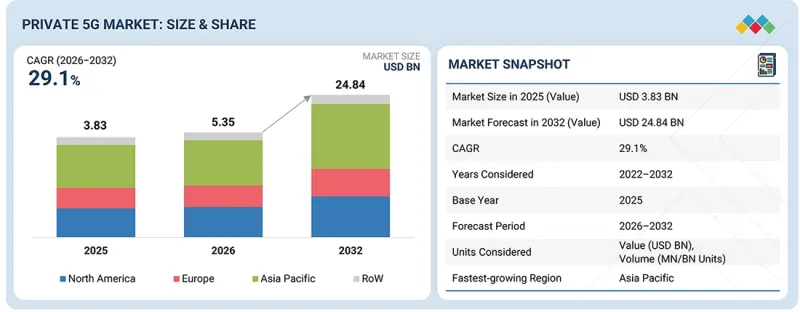
The global private 5G market is projected to grow from USD 5.35 billion in 2026 to USD 24.84 billion by 2032, registering a CAGR of 29.1%. The demand for private 5G networks is increasing with the rapid proliferation of automated technologies because modern systems require continuous, high-density data processing in complex environments.
| Scope of the Report | |
|---|---|
| Years Considered for the Study | 2021-2032 |
| Base Year | 2025 |
| Forecast Period | 2026-2032 |
| Units Considered | Value (USD Billion) |
| Segments | By Offering, Frequency band and Region |
| Regions covered | North America, Europe, APAC, RoW |
The expansion of autonomous mobile robots (AMRs), computer vision systems, and industrial Internet of Things (IIoT) devices has significantly increased data transmission requirements, leading to a greater need for secure, ultra-reliable low-latency connectivity. Inadequate or latency-prone network connectivity can degrade system algorithms, reduce operational efficiency, and cause process downtime. As a result, enterprises are integrating advanced standalone 5G cores, dedicated sub-6 GHz spectrum, and multi-access edge computing (MEC) to maintain data accuracy, secure proprietary operational information, and comply with strict safety regulations, especially in high-density automated manufacturing facilities.
"Mid Band, by frequency band, is expected to record the highest CAGR during the forecast period."
The mid band segment is expected to be the fastest-growing segment in the private 5G network market due to its ability to deliver an optimal balance between broad coverage and high-speed data capacity. Mid-band frequencies (typically ranging from 1 GHz to 6 GHz, such as the 3.5 GHz CBRS spectrum) provide the necessary bandwidth for data-intensive enterprise applications while penetrating indoor factory walls and physical obstacles. This makes them highly effective for applications such as automated guided vehicles (AGVs), real-time computer vision, and industrial robotics across large manufacturing complexes. With the expansion of automated applications driven by Industry 4.0 initiatives, smart logistics, and campus-wide enterprise networks, transmitting high-volume data over extended coverage areas at low latencies is necessary. Additionally, mid-band spectrum allocations offer stable propagation characteristics, high processing efficiency, and ease of hardware integration into standard indoor and outdoor small cell architectures.
"The manufacturing segment dominated the private 5G market, by vertical, in 2025"
The manufacturing segment captured a dominant share of the private 5G network market in 2025 due to the widespread requirement for dedicated connectivity and low-latency communication in automated industrial facilities. Modern manufacturing operations continuously incorporate complex technologies such as automated guided vehicles (AGVs), collaborative robots, industrial Internet of Things (IIoT) sensors, and real-time computer vision systems. These applications require rapid and secure data processing to optimize production algorithms, protect proprietary operational data, and enable responsive factory environments. The expanding adoption of Industry 4.0 initiatives across heavy machinery, automotive assembly, and electronics manufacturing creates a consistent demand for reliable, dedicated private network infrastructure.
"The US secured the largest share of the North American private 5G market in 2025."
The US secured the largest share of the North American private 5G network market due to its capacity in industrial automation and advanced digital infrastructure. The country serves as a global hub for enterprise technology adoption. This includes the large-scale deployment of smart factories, automated logistics hubs, and connected healthcare facilities. These operations require secure private 5G components for real-time data processing. Additionally, the availability of shared spectrum such as Citizens Broadband Radio Service (CBRS) and the growth of the autonomous vehicle sector further increase demand for dedicated network hardware. Government initiatives, established supply chains, and the presence of major telecommunications vendors support local network infrastructure. These operational factors strengthen its market position and enable the US to maintain its regional share.
- By Company Type: Tier 1 - 25%, Tier 2 - 40%, and Tier 3 - 35%
- By Designation: Directors - 35%, C-level Executives - 30%, and Others - 35%
- By Region: North America - 25%, Europe - 20%, Asia Pacific - 45%, and RoW - 10%
Prominent players profiled in this report include Telefonaktiebolaget LM Ericsson (Sweden), Huawei Technologies Co., Ltd. (China), Nokia (Finland), ZTE Corporation (China), Hewlett Packard Enterprise Development LP (US), Samsung (South Korea), NEC Corporation (Japan), Oracle (US), Cisco Systems, Inc. (US), and Ciena Corporation (US), among others.
Research Coverage:
The report defines, describes, and forecasts the private 5G market based on Network Type (Non-standalone 5G and Standalone 5G), Frequency Band (Low Band, Mid Band, and mmWave), Cloud Model [On-premises (Private/Dedicated Cloud), Public Cloud, and Hybrid Cloud], Offering (Hardware, Software, and Services), Spectrum Allocation (Unlicensed/Shared Spectrum and Licensed Spectrum), Organization Size (Small and Medium-sized Enterprises and Large Enterprises), Vertical (Manufacturing, Energy & Utilities, Retail & E-commerce, Healthcare, BFSI, Infrastructure, Transportation & Logistics, Aerospace, Media & Entertainment, IT & Telecommunication, and Other Verticals), and Region (North America, Europe, Asia Pacific, and RoW). It provides detailed information regarding drivers, restraints, opportunities, and challenges influencing the market's growth. It also analyzes competitive developments, including acquisitions, product launches, expansions, and actions taken by key players to grow in the market.
Reasons to Buy This Report:
The report will help market leaders/new entrants with information on the closest approximations of the revenue for the overall private 5G market and its subsegments. The report will help stakeholders understand the competitive landscape and gain more insight to position their business better and plan suitable go-to-market strategies. The report also helps stakeholders understand the market's pulse and provides information on key drivers, restraints, opportunities, and challenges.
The report will provide insights into the following points:
- Analysis of Key Drivers (Increasing adoption of Industry 4.0 and industrial automation, Growing demand for secure, low-latency enterprise connectivity ), restraints (High initial setup and infrastructure investment costs, Shortage of skilled technical personnel for deployment and management ), opportunities (Integration of multi access edge computing (MEC) and AI-RAN, Expansion of Private 5G-as-a-Service business models ), and challenges (Complex spectrum allocation and regional licensing regulations, Integration with legacy IT/OT systems and Wi-Fi networks ) of the private 5G market
- Product Development/Innovation: Detailed insights into upcoming technologies, research & development activities, and product launches in the private 5G market
- Market Development: Comprehensive information about lucrative markets (The report analyzes the private 5G market across various regions.)
- Market Diversification: Exhaustive information about new products launched, untapped geographies, recent developments, and investments in the private 5G market
- Competitive Assessment: In-depth assessment of market share, growth strategies, and offerings of leading players, including Telefonaktiebolaget LM Ericsson (Sweden), Huawei Technologies Co., Ltd. (China), Nokia (Finland), ZTE Corporation (China), Hewlett Packard Enterprise Development LP (US), in the private 5G market
TABLE OF CONTENTS
1 INTRODUCTION
- 1.1 STUDY OBJECTIVES
- 1.2 MARKET DEFINITION
- 1.3 MARKET SCOPE
- 1.3.1 MARKETS SEGMENTATION AND REGIONAL SCOPE
- 1.3.2 YEARS CONSIDERED
- 1.3.3 INCLUSIONS AND EXCLUSIONS
- 1.4 CURRENCY CONSIDERED
- 1.5 UNITS CONSIDERED
- 1.6 STAKEHOLDERS
- 1.7 SUMMARY OF CHANGES
2 EXECUTIVE SUMMARY
- 2.1 MARKET HIGHLIGHTS AND KEY INSIGHTS
- 2.2 KEY MARKET PARTICIPANTS: MAPPING OF STRATEGIC DEVELOPMENTS
- 2.3 DISRUPTIVE TRENDS IN PRIVATE 5G MARKET
- 2.4 HIGH-GROWTH SEGMENTS
- 2.5 REGIONAL SNAPSHOT: MARKET SIZE, GROWTH RATE, AND FORECAST
3 PREMIUM INSIGHTS
- 3.1 ATTRACTIVE OPPORTUNITIES FOR PLAYERS IN PRIVATE 5G MARKET
- 3.2 PRIVATE 5G MARKET, BY NETWORK TYPE
- 3.3 PRIVATE 5G MARKET, BY FREQUENCY BAND
- 3.4 PRIVATE 5G MARKET, BY CLOUD MODEL
- 3.5 PRIVATE 5G MARKET, BY OFFERING
- 3.6 PRIVATE 5G MARKET, BY SPECTRUM ALLOCATION
- 3.7 PRIVATE 5G MARKET, BY ORGANIZATION SIZE
- 3.8 PRIVATE 5G MARKET, BY VERTICAL
- 3.9 PRIVATE 5G MARKET IN NORTH AMERICA, BY VERTICAL AND COUNTRY
- 3.10 PRIVATE 5G MARKET, BY GEOGRAPHY
4 MARKET OVERVIEW
- 4.1 INTRODUCTION
- 4.2 MARKET DYNAMICS
- 4.2.1 DRIVERS
- 4.2.1.1 Growing investment in industrial automation and smart manufacturing under Industry 4.0 initiatives
- 4.2.1.2 Increasing adoption of IIoT in manufacturing environments
- 4.2.1.3 Enterprise demand for dedicated infrastructure with greater security and data control
- 4.2.2 RESTRAINTS
- 4.2.2.1 Limited and fragmented spectrum availability and complex licensing allocation process
- 4.2.3 OPPORTUNITIES
- 4.2.3.1 Rising deployment of private 5G networks across hospital and clinical environments
- 4.2.3.2 Convergence of private 5G with on-premises edge computing
- 4.2.4 CHALLENGES
- 4.2.4.1 High upfront deployment cost and uncertain return on investment
- 4.2.4.2 Integration complexities with legacy systems and heterogeneous network environments
- 4.2.1 DRIVERS
- 4.3 INTERCONNECTED MARKETS AND CROSS-SECTOR OPPORTUNITIES
- 4.4 STRATEGIC MOVES BY TIER 1/2/3 PLAYERS
5 INDUSTRY TRENDS
- 5.1 PORTER'S FIVE FORCES ANALYSIS
- 5.1.1 INTENSITY OF COMPETITIVE RIVALRY
- 5.1.2 BARGAINING POWER OF SUPPLIERS
- 5.1.3 BARGAINING POWER OF BUYERS
- 5.1.4 THREAT OF SUBSTITUTES
- 5.1.5 THREAT OF NEW ENTRANTS
- 5.2 MACROECONOMIC OUTLOOK
- 5.2.1 INTRODUCTION
- 5.2.2 GDP TRENDS AND FORECAST
- 5.2.3 TRENDS IN MANUFACTURING VERTICAL
- 5.2.4 TRENDS IN ENERGY & UTILITIES VERTICAL
- 5.2.5 TRENDS IN HEALTHCARE VERTICAL
- 5.3 VALUE CHAIN ANALYSIS
- 5.4 ECOSYSTEM ANALYSIS
- 5.5 PRICING ANALYSIS
- 5.5.1 AVERAGE SELLING PRICE OF PRIVATE 5G OFFERINGS, BY KEY PLAYER, 2025
- 5.5.2 AVERAGE SELLING PRICE TREND OF PRIVATE 5G OFFERINGS, BY REGION, 2022-2025
- 5.6 TRADE ANALYSIS
- 5.6.1 IMPORT SCENARIO (HS CODE 8517)
- 5.6.2 EXPORT SCENARIO (HS CODE 8517)
- 5.7 KEY CONFERENCES AND EVENTS, 2026-2027
- 5.8 TRENDS/DISRUPTIONS IMPACTING CUSTOMER BUSINESS
- 5.9 INVESTMENT AND FUNDING SCENARIO
- 5.10 CASE STUDY ANALYSIS
- 5.10.1 TRANSFORMING STEEL MANUFACTURING OPERATIONS AT ARCELORMITTAL FRANCE WITH ERICSSON'S PRIVATE 5G NETWORK
- 5.10.2 ENHANCING MINING OPERATIONS AT JIUQUAN IRON AND STEEL CO., LTD. WITH HUAWEI'S 5G PRIVATE NETWORKS
- 5.10.3 TRANSFORMING CLINICAL OPERATIONS AT OULU UNIVERSITY HOSPITAL WITH NOKIA'S PRIVATE 5G NETWORK
- 5.10.4 ENHANCING LOGISTICS OPERATIONS AT LUFTHANSA CARGO WITH ERICSSON'S PRIVATE 5G NETWORK
- 5.11 IMPACT OF US TARIFF - PRIVATE 5G MARKET
- 5.11.1 INTRODUCTION
- 5.11.2 KEY TARIFF RATES
- 5.11.3 PRICE IMPACT ANALYSIS
- 5.11.4 IMPACT ON COUNTRIES/REGIONS
- 5.11.4.1 US
- 5.11.4.2 Europe
- 5.11.4.3 Asia Pacific
- 5.11.5 IMPACT ON VERTICALS
6 TECHNOLOGICAL ADVANCEMENTS, AI-DRIVEN IMPACT, PATENTS, AND INNOVATIONS
- 6.1 TECHNOLOGY ANALYSIS
- 6.1.1 KEY TECHNOLOGIES
- 6.1.1.1 Network slicing
- 6.1.1.2 Radio access network
- 6.1.2 COMPLEMENTARY TECHNOLOGIES
- 6.1.2.1 Edge computing
- 6.1.2.2 Industrial Internet of Things
- 6.1.3 ADJACENT TECHNOLOGIES
- 6.1.3.1 Wi-Fi 6
- 6.1.3.2 Private LTE
- 6.1.1 KEY TECHNOLOGIES
- 6.2 TECHNOLOGY ROADMAP
- 6.3 PATENT ANALYSIS
- 6.4 IMPACT OF AI/GEN AI ON PRIVATE 5G MARKET
- 6.4.1 TOP USE CASES AND MARKET POTENTIAL
- 6.4.1.1 Ultra-reliable low-latency enterprise connectivity and automation
- 6.4.1.2 Autonomous yard logistics and fleet management
- 6.4.1.3 Warehouse optimization and real-time asset tracking
- 6.4.1.4 Industrial safety and remote equipment monitoring
- 6.4.2 BEST PRACTICES FOLLOWED BY PLAYERS IN PRIVATE 5G MARKET
- 6.4.3 CASE STUDIES RELATED TO AI IMPLEMENTATION IN PRIVATE 5GMARKET
- 6.4.4 INTERCONNECTED/ADJACENT ECOSYSTEM AND IMPACT ON MARKET PLAYERS
- 6.4.5 CLIENTS' READINESS TO ADOPT AI-INTEGRATED PRIVATE 5G NETWORKS
- 6.4.1 TOP USE CASES AND MARKET POTENTIAL
- 6.5 SUCCESS STORIES AND REAL-WORLD APPLICATIONS
7 REGULATORY LANDSCAPE
- 7.1 REGIONAL REGULATIONS AND COMPLIANCE
- 7.1.1 REGULATORY BODIES, GOVERNMENT AGENCIES, AND OTHER ORGANIZATIONS
- 7.1.2 INDUSTRY STANDARDS
- 7.1.3 REGULATIONS
8 CUSTOMER LANDSCAPE AND BUYER BEHAVIOR
- 8.1 INTRODUCTION
- 8.2 DECISION-MAKING PROCESS
- 8.3 KEY STAKEHOLDERS INVOLVED IN BUYING PROCESS AND THEIR EVALUATION CRITERIA
- 8.3.1 KEY STAKEHOLDERS IN BUYING PROCESS
- 8.3.2 BUYING CRITERIA
- 8.4 ADOPTION BARRIERS AND INTERNAL CHALLENGES
- 8.5 UNMET NEEDS OF VARIOUS VERTICALS
- 8.6 MARKET PROFITABILITY
- 8.6.1 REVENUE POTENTIAL
- 8.6.2 COST DYNAMICS
- 8.6.3 MARGIN OPPORTUNITIES, BY VERTICAL
9 AI CAPABILITIES IN PRIVATE 5G NETWORKS
- 9.1 AI-ASSISTED NETWORK OPTIMIZATION
- 9.2 AI-ENABLED RAN
- 9.3 AI-ENABLED CORE
- 9.4 PREDICTIVE MAINTENANCE
- 9.5 AUTONOMOUS NETWORK OPERATIONS
10 PRIVATE 5G MARKET, BY OFFERING
- 10.1 INTRODUCTION
- 10.2 HARDWARE
- 10.2.1 RADIO ACCESS NETWORK
- 10.2.1.1 Increasing deployment of 5G RAN infrastructure for high-speed enterprise connectivity to fuel segmental growth
- 10.2.1.2 Base stations
- 10.2.1.3 Antenna systems
- 10.2.1.4 Remote radio units
- 10.2.2 CORE NETWORK
- 10.2.2.1 Ability to optimize traffic routing through automated session management and access control to spur demand
- 10.2.2.2 5G Core
- 10.2.2.3 Evolved Packet Core
- 10.2.3 BACKHAUL & TRANSPORT
- 10.2.3.1 Potential to support low-latency, high-throughput communications across critical industries to foster market growth
- 10.2.3.2 Routers and switches
- 10.2.3.3 Fiber-optic cables
- 10.2.3.4 Microwave links
- 10.2.4 EDGE COMPUTING INFRASTRUCTURE
- 10.2.4.1 Rising adoption of real-time analytics and automation across industries to facilitate segmental growth
- 10.2.4.2 Edge servers
- 10.2.4.3 Edge gateways
- 10.2.4.4 Multi-access edge computing
- 10.2.4.5 Content delivery networks
- 10.2.1 RADIO ACCESS NETWORK
- 10.3 SOFTWARE
- 10.3.1 RISING DEMAND FOR SOFTWARE-DEFINED NETWORKING TO SUPPORT PRIVATE 5G DEPLOYMENT
- 10.3.2 NETWORK MANAGEMENT SOFTWARE
- 10.3.3 NETWORK SECURITY SOFTWARE
- 10.3.4 CLOUD-BASED SOFTWARE SOLUTIONS
- 10.4 SERVICES
- 10.4.1 INCREASING ENTERPRISE DEMAND FOR LOW-LATENCY AND HIGH-RELIABILITY NETWORKS TO SUPPORT SEGMENTAL GROWTH
- 10.4.2 PROFESSIONAL SERVICES
- 10.4.2.1 Installation & integration
- 10.4.2.2 Training & enablement
- 10.4.3 MANAGED SERVICES
- 10.4.3.1 Network monitoring
- 10.4.3.2 Support & maintenance
- 10.4.4 SECURITY SERVICES
- 10.4.4.1 Identity and access management
- 10.4.4.1.1 Multi-factor authentication
- 10.4.4.1.2 Role-based access control
- 10.4.4.1.3 Device identity management
- 10.4.4.2 Encryption and data protection
- 10.4.4.1 Identity and access management
- 10.4.5 EDGE COMPUTING SERVICES
- 10.4.5.1 Multi-access edge computing
- 10.4.5.2 Edge application hosting
- 10.4.6 CONNECTIVITY SERVICES
- 10.4.6.1 Bandwidth provisioning
- 10.4.6.2 SIM/Device management
11 PRIVATE 5G MARKET, BY CLOUD MODEL
- 11.1 INTRODUCTION
- 11.2 PRIVATE/DEDICATED CLOUD
- 11.2.1 FOCUS OF MISSION-CRITICAL INDUSTRIES ON FULL CONTROL OVER DATA AND SECURITY TO PROPEL SEGMENTAL GROWTH
- 11.3 PUBLIC CLOUD
- 11.3.1 INCLINATION TOWARD COST-OPTIMIZED AND SCALABLE PRIVATE 5G OPERATIONS TO ACCELERATE DEMAND FOR PUBLIC CLOUD MODELS
- 11.4 HYBRID CLOUD
- 11.4.1 NEED TO BALANCE FLEXIBILITY AND RESOURCE EFFICIENCY TO PROPEL SEGMENTAL GROWTH
12 PRIVATE 5G MARKET, BY FREQUENCY BAND
- 12.1 INTRODUCTION
- 12.2 LOW BAND
- 12.2.1 SUITABILITY FOR WIDE-AREA CONNECTIVITY AND HARD-TO-REACH ENVIRONMENTS TO REINFORCE ADOPTION
- 12.3 MID BAND
- 12.3.1 ABILITY TO SUPPORT STABLE AND HIGH-PERFORMANCE CONNECTIVITY ACROSS URBAN AND SEMI-URBAN ENVIRONMENTS TO PROPEL DEMAND
- 12.4 MMWAVE
- 12.4.1 RISING USE IN BANDWIDTH-HEAVY APPLICATIONS FOR SUPERIOR NETWORK PERFORMANCE TO CONTRIBUTE TO SEGMENTAL GROWTH
13 PRIVATE 5G MARKET, BY SPECTRUM ALLOCATION
- 13.1 INTRODUCTION
- 13.2 UNLICENSED/SHARED SPECTRUM
- 13.2.1 EASY ACCESSIBILITY, FASTER INSTALLATION, AND HIGH AFFORDABILITY FEATURES TO ACCELERATE DEMAND
- 13.3 LICENSED SPECTRUM
- 13.3.1 RISING DEMAND FOR ULTRA-RELIABLE, LOW-LATENCY COMMUNICATION TO STIMULATE SEGMENTAL GROWTH
14 PRIVATE 5G MARKET, BY ORGANIZATION SIZE
- 14.1 INTRODUCTION
- 14.2 SMALL AND MEDIUM ENTERPRISES
- 14.2.1 RISING FOCUS OF SMES ON ENHANCING CUSTOMER EXPERIENCE AND PREDICTIVE MAINTENANCE TO FUEL MARKET GROWTH
- 14.3 LARGE ENTERPRISES
- 14.3.1 EMPHASIS ON ENHANCING OPERATIONAL EFFICIENCY AND REDUCING LATENCY TO ENCOURAGE PRIVATE 5G ADOPTION
15 PRIVATE 5G MARKET, BY NETWORK TYPE
- 15.1 INTRODUCTION
- 15.2 NON-STANDALONE 5G
- 15.2.1 ABILITY TO SUPPORT AR/VR, VIDEO STREAMING, AND IMMERSIVE MEDIA WITH LOWER LATENCY AND HIGHER DATA THROUGHPUT TO SPIKE DEMAND
- 15.3 STANDALONE 5G
- 15.3.1 SIMPLIFIED AND FLEXIBLE ARCHITECTURE AND HIGH-SPEED CONNECTIVITY ATTRIBUTES TO STIMULATE DEMAND
16 PRIVATE 5G MARKET, BY VERTICAL
- 16.1 INTRODUCTION
- 16.2 MANUFACTURING
- 16.2.1 SHIFT TOWARD INDUSTRY 4.0 TO SPIKE DEMAND FOR PRIVATE 5G
- 16.2.2 SMART FACTORY
- 16.2.3 INDUSTRIAL IOT
- 16.3 ENERGY & UTILITIES
- 16.3.1 NEED FOR ROBUST NETWORK PERFORMANCE WITH GRID MODERNIZATION AND AUTOMATION INITIATIVES TO DRIVE DEMAND
- 16.3.2 SMART GRIDS
- 16.3.3 RENEWABLE ENERGY MANAGEMENT
- 16.3.4 SMART METERING
- 16.4 RETAIL & E-COMMERCE
- 16.4.1 NECESSITY FOR RAPID DATA PROCESSING IN INVENTORY VISIBILITY AND ORDER MANAGEMENT APPLICATIONS TO PROPEL MARKET
- 16.4.2 CUSTOMER EXPERIENCE ENHANCEMENT
- 16.4.3 INVENTORY MANAGEMENT
- 16.5 HEALTHCARE
- 16.5.1 NEED FOR UNINTERRUPTED COMMUNICATIONS AMONG CLINICIANS AND DEVICES DURING ROBOTIC SURGERY TO ACCELERATE ADOPTION
- 16.5.2 REMOTE PATIENT MONITORING
- 16.5.3 TELEMEDICINE
- 16.5.4 MEDICAL IMAGING
- 16.6 BFSI
- 16.6.1 DIGITAL TRANSFORMATION INITIATIVES TO CREATE GROWTH OPPORTUNITIES
- 16.6.2 AUTOMATED TRADING
- 16.6.3 FRAUD DETECTION AND PREVENTION
- 16.6.4 MOBILE BANKING
- 16.7 INFRASTRUCTURE
- 16.7.1 INCREASING INVESTMENT IN SMART CITY PROJECTS AND GROWING ADOPTION OF DIGITAL TECHNOLOGY TO STIMULATE DEMAND
- 16.7.2 SMART CITY
- 16.7.3 SECURITY & SURVEILLANCE
- 16.7.4 FACILITY MANAGEMENT
- 16.8 TRANSPORTATION & LOGISTICS
- 16.8.1 REQUIREMENT FOR RESPONSIVE, AGILE, AND SCALABLE NETWORKS FROM LOGISTICS COMPANIES TO AUGMENT MARKET GROWTH
- 16.8.2 FLEET MANAGEMENT
- 16.8.3 AUTONOMOUS VEHICLES
- 16.8.4 SUPPLY CHAIN MANAGEMENT
- 16.9 AEROSPACE
- 16.9.1 RISING USE OF ADVANCED SENSORS FOR BAGGAGE TRACKING, CARGO HANDLING, AND DIGITAL CHECK-INS TO FOSTER MARKET GROWTH
- 16.9.2 SMART PORTS & AIRPORTS
- 16.9.3 TRAINING & SIMULATION
- 16.9.4 SECURE COMMUNICATIONS
- 16.9.5 REMOTE MONITORING & SURVEILLANCE
- 16.10 MEDIA & ENTERTAINMENT
- 16.10.1 REVOLUTIONIZING MEDIA BROADCASTING OPERATIONS AND CONTENT DISTRIBUTION INFRASTRUCTURE TO CONTRIBUTE TO MARKET GROWTH
- 16.10.2 LIVE EVENT BROADCASTING
- 16.10.3 AR/VR EXPERIENCE
- 16.10.4 CONTENT DELIVERY NETWORKS
- 16.11 IT & TELECOMMUNICATIONS
- 16.11.1 NEED FOR ISOLATED, PURPOSE-BUILT NETWORK ENVIRONMENTS TO ENCOURAGE ADOPTION OF PRIVATE 5G BY TELECOM OPERATORS
- 16.11.2 NETWORK MANAGEMENT & OPTIMIZATION
- 16.11.3 NETWORK SLICING
- 16.11.4 SUPPLY CHAIN MANAGEMENT
- 16.12 OTHER VERTICALS
17 PRIVATE 5G MARKET, BY REGION
- 17.1 INTRODUCTION
- 17.2 NORTH AMERICA
- 17.2.1 US
- 17.2.1.1 Digital transformation of manufacturing, logistics, aviation, and healthcare verticals to expedite market growth
- 17.2.2 CANADA
- 17.2.2.1 Thriving automotive sector to create growth opportunities
- 17.2.3 MEXICO
- 17.2.3.1 Rising demand for customized connectivity solutions and evolving spectrum policies to fuel market growth
- 17.2.1 US
- 17.3 EUROPE
- 17.3.1 GERMANY
- 17.3.1.1 Growing emphasis on smart manufacturing and EV infrastructure building to augment market growth
- 17.3.2 UK
- 17.3.2.1 Commitment to enabling digital infrastructure in strategic research and innovation hubs to elevate adoption
- 17.3.3 FRANCE
- 17.3.3.1 Autonomous vehicle deployment to support market growth
- 17.3.4 ITALY
- 17.3.4.1 Energy and sports verticals to contribute most to market growth
- 17.3.5 SPAIN
- 17.3.5.1 Growing demand for drones and digital airport services to foster market growth
- 17.3.6 POLAND
- 17.3.6.1 Surging use of next-generation 5G-based communication systems to improve rail networks to facilitate market growth
- 17.3.7 NORDIC COUNTRIES
- 17.3.7.1 Growing enterprise demand for high-performance, secure connectivity networks to fuel market growth
- 17.3.8 REST OF EUROPE
- 17.3.1 GERMANY
- 17.4 ASIA PACIFIC
- 17.4.1 CHINA
- 17.4.1.1 Rapid deployment of 5G base stations to stimulate market growth
- 17.4.2 JAPAN
- 17.4.2.1 Need for energy-efficient, cloud-native architectures to foster market growth
- 17.4.3 SOUTH KOREA
- 17.4.3.1 Announcement of nationwide 5G coverage to drive growth
- 17.4.4 INDIA
- 17.4.4.1 Establishment of 5G centers of excellence to propel growth
- 17.4.5 AUSTRALIA
- 17.4.5.1 Rising demand from mining, logistics, and critical infrastructure sectors to fuel market growth
- 17.4.6 INDONESIA
- 17.4.6.1 Digital transformation of seaport operations to accelerate demand
- 17.4.7 MALAYSIA
- 17.4.7.1 Private 5G deployment at Kuala Lumpur International Airport to support market growth
- 17.4.8 THAILAND
- 17.4.8.1 Government-backed Industry 4.0 initiatives to contribute to maretk growth
- 17.4.9 VIETNAM
- 17.4.9.1 Government focus on telecom innovation to foster market growth
- 17.4.10 REST OF ASIA PACIFIC
- 17.4.1 CHINA
- 17.5 ROW
- 17.5.1 MIDDLE EAST
- 17.5.1.1 Saudi Arabia
- 17.5.1.1.1 Sanction of specialized 450 MHz spectrum license to stimulate market growth
- 17.5.1.2 UAE
- 17.5.1.2.1 Strategic collaborations between telcos and private 5G vendors to lead to market expansion
- 17.5.1.3 Qatar
- 17.5.1.3.1 Network modernization efforts to contribute to market growth
- 17.5.1.4 Kuwait
- 17.5.1.4.1 Growing focus of enterprises on upgrading digital infrastructure to foster market growth
- 17.5.1.5 Oman
- 17.5.1.5.1 Spectrum allocation by TRA to major private 5G companies to facilitate market growth
- 17.5.1.6 Bahrain
- 17.5.1.6.1 Partnerships between private 5G vendors to propel market
- 17.5.1.7 Rest of Middle East
- 17.5.1.1 Saudi Arabia
- 17.5.2 SOUTH AMERICA
- 17.5.2.1 Digital transformation across key industrial sectors to drive market
- 17.5.3 AFRICA
- 17.5.3.1 South Africa
- 17.5.3.1.1 Deployment of largest private 5G mining network to support market growth
- 17.5.3.2 Rest of Africa
- 17.5.3.1 South Africa
- 17.5.1 MIDDLE EAST
18 COMPETITIVE LANDSCAPE
- 18.1 OVERVIEW
- 18.2 KEY PLAYER COMPETITIVE STRATEGIES/RIGHT TO WIN, 2023-2026
- 18.2.1 PRODUCT PORTFOLIO EXPANSION
- 18.2.2 REGIONAL FOOTPRINT EXPANSION
- 18.2.3 SOLUTION OFFERING EXPANSION
- 18.2.4 ORGANIC/INORGANIC STRATEGIES
- 18.3 REVENUE ANALYSIS, 2021-2025
- 18.4 MARKET SHARE ANALYSIS, 2O25
- 18.5 COMPANY VALUATION AND FINANCIAL METRICS
- 18.6 BRAND COMPARISON
- 18.6.1 NOKIA (FINLAND)
- 18.6.2 TELEFONAKTIEBOLAGET LM ERICSSON (SWEDEN)
- 18.6.3 ZTE CORPORATION (CHINA)
- 18.6.4 HEWLETT PACKARD ENTERPRISE DEVELOPMENT LP (US)
- 18.6.5 HUAWEI TECHNOLOGIES CO. LTD. (CHINA)
- 18.7 COMPANY EVALUATION MATRIX: KEY PLAYERS, 2025
- 18.7.1 STARS
- 18.7.2 EMERGING LEADERS
- 18.7.3 PERVASIVE PLAYERS
- 18.7.4 PARTICIPANTS
- 18.7.5 COMPANY FOOTPRINT: KEY PLAYERS, 2025
- 18.7.5.1 Company footprint
- 18.7.5.2 Region footprint
- 18.7.5.3 Network type footprint
- 18.7.5.4 Offering footprint
- 18.7.5.5 Vertical footprint
- 18.8 COMPANY EVALUATION MATRIX: STARTUPS/SMES, 2025
- 18.8.1 PROGRESSIVE COMPANIES
- 18.8.2 RESPONSIVE COMPANIES
- 18.8.3 DYNAMIC COMPANIES
- 18.8.4 STARTING BLOCKS
- 18.8.5 COMPETITIVE BENCHMARKING: STARTUPS/SMES, 2025
- 18.8.5.1 Detailed list of key startups/SMEs
- 18.8.5.2 Competitive benchmarking of key startups/SMEs
- 18.9 COMPETITIVE SCENARIO
- 18.9.1 PRODUCT LAUNCHES/DEVELOPMENTS
- 18.9.2 DEALS
19 COMPANY PROFILES
- 19.1 KEY PLAYERS
- 19.1.1 TELEFONAKTIEBOLAGET LM ERICSSON
- 19.1.1.1 Business overview
- 19.1.1.2 Products/Solutions/Services offered
- 19.1.1.3 Recent developments
- 19.1.1.3.1 Product launches/developments
- 19.1.1.3.2 Deals
- 19.1.1.4 MnM view
- 19.1.1.4.1 Key strengths/Right to win
- 19.1.1.4.2 Strategic choices
- 19.1.1.4.3 Weaknesses/competitive threats
- 19.1.2 HUAWEI TECHNOLOGIES CO., LTD.
- 19.1.2.1 Business overview
- 19.1.2.2 Products/Solutions/Services offered
- 19.1.2.3 Recent developments
- 19.1.2.3.1 Product launches/developments
- 19.1.2.3.2 Deals
- 19.1.2.3.3 Other developments
- 19.1.2.4 MnM view
- 19.1.2.4.1 Key strengths/Right to win
- 19.1.2.4.2 Strategic choices
- 19.1.2.4.3 Weaknesses/competitive threats
- 19.1.3 NOKIA
- 19.1.3.1 Business overview
- 19.1.3.2 Products/Solutions/Services offered
- 19.1.3.3 Recent developments
- 19.1.3.3.1 Product launches/developments
- 19.1.3.3.2 Deals
- 19.1.3.4 MnM view
- 19.1.3.4.1 Right to win
- 19.1.3.4.2 Strategic choices
- 19.1.3.4.3 Weaknesses and competitive threats
- 19.1.4 ZTE CORPORATION
- 19.1.4.1 Business overview
- 19.1.4.2 Products/Solutions/Services offered
- 19.1.4.3 Recent developments
- 19.1.4.3.1 Product launches/developments
- 19.1.4.3.2 Deals
- 19.1.4.4 MnM view
- 19.1.4.4.1 Right to win
- 19.1.4.4.2 Strategic choices
- 19.1.4.4.3 Weaknesses and competitive threats
- 19.1.5 HEWLETT PACKARD ENTERPRISE DEVELOPMENT LP
- 19.1.5.1 Business overview
- 19.1.5.2 Products/Solutions/Services offered
- 19.1.5.3 Recent developments
- 19.1.5.3.1 Product launches/developments
- 19.1.5.3.2 Deals
- 19.1.5.3.3 Other developments
- 19.1.5.4 MnM view
- 19.1.5.4.1 Right to win
- 19.1.5.4.2 Strategic choices
- 19.1.5.4.3 Weaknesses and competitive threats
- 19.1.6 SAMSUNG
- 19.1.6.1 Business overview
- 19.1.6.2 Products/Solutions/Services offered
- 19.1.6.3 Recent developments
- 19.1.6.3.1 Product launches/developments
- 19.1.6.3.2 Deals
- 19.1.6.3.3 Other developments
- 19.1.7 NEC CORPORATION
- 19.1.7.1 Business overview
- 19.1.7.2 Products/Solutions/Services offered
- 19.1.7.3 Recent developments
- 19.1.7.3.1 Product launches/developments
- 19.1.7.3.2 Deals
- 19.1.7.3.3 Other developments
- 19.1.8 ORACLE
- 19.1.8.1 Business overview
- 19.1.8.2 Products/Solutions/Services offered
- 19.1.8.3 Recent developments
- 19.1.8.3.1 Deals
- 19.1.9 CISCO SYSTEMS, INC.
- 19.1.9.1 Business overview
- 19.1.9.2 Products/Solutions/Services offered
- 19.1.9.3 Recent developments
- 19.1.9.3.1 Product launches/developments
- 19.1.9.3.2 Deals
- 19.1.10 CIENA CORPORATION
- 19.1.10.1 Business overview
- 19.1.10.2 Products/Solutions/Services offered
- 19.1.10.3 Recent developments
- 19.1.10.3.1 Deals
- 19.1.1 TELEFONAKTIEBOLAGET LM ERICSSON
- 19.2 OTHER PLAYERS
- 19.2.1 CELONA INC.
- 19.2.2 MAVENIR
- 19.2.3 PARALLEL WIRELESS
- 19.2.4 NTT DATA GROUP CORPORATION
- 19.2.5 AT&T
- 19.2.6 COMMSCOPE TECHNOLOGIES LLC
- 19.2.7 COMBA TELECOM LIMITED
- 19.2.8 LOGICALIS GROUP
- 19.2.9 BOLDYN NETWORKS
- 19.2.10 PENTE NETWORKS
- 19.2.11 NEUTRAL WIRELESS
- 19.2.12 FIRECELL
- 19.2.13 NEUTROON TECHNOLOGIES S.L.
- 19.2.14 KYNDRYL INC.
- 19.2.15 AIRSPAN
20 RESEARCH METHODOLOGY
- 20.1 RESEARCH DATA
- 20.1.1 SECONDARY DATA
- 20.1.1.1 List of key secondary sources
- 20.1.1.2 Key data from secondary sources
- 20.1.2 PRIMARY DATA
- 20.1.2.1 List of primary interview participants
- 20.1.2.2 Breakdown of primary interviews
- 20.1.2.3 Key data from primary sources
- 20.1.2.4 Key industry insights
- 20.1.3 SECONDARY AND PRIMARY RESEARCH
- 20.1.1 SECONDARY DATA
- 20.2 MARKET SIZE ESTIMATION
- 20.2.1 BOTTOM-UP APPROACH
- 20.2.1.1 Approach to arrive at market size using bottom-up analysis (demand side)
- 20.2.2 TOP-DOWN APPROACH
- 20.2.2.1 Approach to arrive at market size using top-down analysis (supply side)
- 20.2.1 BOTTOM-UP APPROACH
- 20.3 FACTOR ANALYSIS
- 20.3.1 DEMAND-SIDE ANALYSIS
- 20.3.2 SUPPLY-SIDE ANALYSIS
- 20.4 DATA TRIANGULATION
- 20.5 RESEARCH ASSUMPTIONS
- 20.6 RESEARCH LIMITATIONS
- 20.7 RISK ASSESSMENT
21 APPENDIX
- 21.1 KNOWLEDGESTORE: MARKETSANDMARKETS' SUBSCRIPTION PORTAL
- 21.2 CUSTOMIZATION OPTIONS
- 21.3 RELATED REPORTS
- 21.4 AUTHOR DETAILS
List of Tables
- TABLE 1 REPORT INCLUSIONS AND EXCLUSIONS
- TABLE 2 PRIVATE 5G MARKET: SUMMARY OF CHANGES
- TABLE 3 INTERCONNECTED MARKETS AND CROSS-SECTOR OPPORTUNITIES RELATED TO PRIVATE 5G TECHNOLOGY
- TABLE 4 STRATEGIC FOCUS ON MAJOR COMPANIES IN PRIVATE 5G MARKET
- TABLE 5 PORTER'S FIVE FORCES ANALYSIS
- TABLE 6 GDP GROWTH RATES (%), BY COUNTRY, 2021-2030
- TABLE 7 ROLE OF COMPANIES IN PRIVATE 5G ECOSYSTEM
- TABLE 8 AVERAGE SELLING PRICE OF PRIVATE 5G OFFERINGS, BY KEY PLAYER, 2025 (USD)
- TABLE 9 AVERAGE SELLING PRICE TREND OF PRIVATE 5G OFFERINGS, BY REGION, 2022-2025 (USD)
- TABLE 10 IMPORT DATA FOR HS CODE 8517-COMPLIANT PRODUCTS, BY COUNTRY, 2021-2025 (USD MILLION)
- TABLE 11 EXPORT DATA FOR HS CODE 8517-COMPLIANT PRODUCTS, BY COUNTRY, 2021-2025 (USD MILLION)
- TABLE 12 LIST OF KEY CONFERENCES AND EVENTS, 2026-2027
- TABLE 13 US-ADJUSTED RECIPROCAL TARIFF RATES, 2024 (USD BILLION)
- TABLE 14 ANTICIPATED CHANGE IN PRICES AND IMPACT ON VERTICALS DUE TO TARIFF
- TABLE 15 LIST OF MAJOR PATENTS IN 2026
- TABLE 16 BEST PRACTICES FOLLOWED BY COMPANIES IN PRIVATE 5G MARKET
- TABLE 17 CASE STUDIES RELATED TO IMPLEMENTATION OF AI IN PRIVATE 5G
- TABLE 18 IMPACT OF AI IMPLEMENTATION ON ECOSYSTEM
- TABLE 19 NORTH AMERICA: REGULATORY BODIES, GOVERNMENT AGENCIES, AND OTHER ORGANIZATIONS
- TABLE 20 EUROPE: REGULATORY BODIES, GOVERNMENT AGENCIES, AND OTHER ORGANIZATIONS
- TABLE 21 ASIA PACIFIC: REGULATORY BODIES, GOVERNMENT AGENCIES, AND OTHER ORGANIZATIONS
- TABLE 22 ROW: REGULATORY BODIES, GOVERNMENT AGENCIES, AND OTHER ORGANIZATIONS
- TABLE 23 INFLUENCE OF STAKEHOLDERS ON BUYING PROCESS FOR TOP 3 VERTICALS
- TABLE 24 KEY BUYING CRITERIA FOR TOP 3 VERTICALS
- TABLE 25 ADOPTION BARRIERS AND INTERNAL CHALLENGES
- TABLE 26 UNMET NEEDS IN PRIVATE 5G MARKET, BY VERTICAL
- TABLE 27 PRIVATE 5G MARKET, BY OFFERING, 2022-2025 (USD MILLION)
- TABLE 28 PRIVATE 5G MARKET, BY OFFERING, 2026-2032 (USD MILLION)
- TABLE 29 HARDWARE: PRIVATE 5G MARKET, BY TYPE, 2022-2025 (USD MILLION)
- TABLE 30 HARDWARE: PRIVATE 5G MARKET, BY TYPE, 2026-2032 (USD MILLION)
- TABLE 31 PRIVATE 5G MARKET, BY CLOUD MODEL, 2022-2025 (USD MILLION)
- TABLE 32 PRIVATE 5G MARKET, BY CLOUD MODEL, 2026-2032 (USD MILLION)
- TABLE 33 PRIVATE 5G MARKET, BY FREQUENCY BAND, 2022-2025 (USD MILLION)
- TABLE 34 PRIVATE 5G MARKET, BY FREQUENCY BAND, 2026-2032 (USD MILLION)
- TABLE 35 LOW BAND: PRIVATE 5G MARKET, BY REGION, 2022-2025 (USD MILLION)
- TABLE 36 LOW BAND: PRIVATE 5G MARKET, BY REGION, 2026-2032 (USD MILLION)
- TABLE 37 MID BAND: PRIVATE 5G MARKET, BY REGION, 2022-2025 (USD MILLION)
- TABLE 38 MID BAND: PRIVATE 5G MARKET, BY REGION, 2026-2032 (USD MILLION)
- TABLE 39 MMWAVE: PRIVATE 5G MARKET, BY REGION, 2022-2025 (USD MILLION)
- TABLE 40 MMWAVE: PRIVATE 5G MARKET, BY REGION, 2026-2032 (USD MILLION)
- TABLE 41 PRIVATE 5G MARKET, BY SPECTRUM ALLOCATION, 2022-2025 (USD MILLION)
- TABLE 42 PRIVATE 5G MARKET, BY SPECTRUM ALLOCATION, 2026-2032 (USD MILLION)
- TABLE 43 UNLICENSED/SHARED SPECTRUM: PRIVATE 5G MARKET, BY REGION, 2022-2025 (USD MILLION)
- TABLE 44 UNLICENSED/SHARED SPECTRUM: PRIVATE 5G MARKET, BY REGION, 2026-2032 (USD MILLION)
- TABLE 45 LICENSED SPECTRUM: PRIVATE 5G MARKET, BY REGION, 2022-2025 (USD MILLION)
- TABLE 46 LICENSED SPECTRUM: PRIVATE 5G MARKET, BY REGION, 2026-2032 (USD MILLION)
- TABLE 47 PRIVATE 5G MARKET, BY ORGANIZATION SIZE, 2022-2025 (USD MILLION)
- TABLE 48 PRIVATE 5G MARKET, BY ORGANIZATION SIZE, 2026-2032 (USD MILLION)
- TABLE 49 SMALL AND MEDIUM ENTERPRISES: PRIVATE 5G MARKET, BY REGION, 2022-2025 (USD MILLION)
- TABLE 50 SMALL AND MEDIUM ENTERPRISES: PRIVATE 5G MARKET, BY REGION, 2026-2032 (USD MILLION)
- TABLE 51 LARGE ENTERPRISES: PRIVATE 5G MARKET, BY REGION, 2022-2025 (USD MILLION)
- TABLE 52 LARGE ENTERPRISES: PRIVATE 5G MARKET, BY REGION, 2026-2032 (USD MILLION)
- TABLE 53 PRIVATE 5G MARKET, BY NETWORK TYPE, 2022-2025 (USD MILLION)
- TABLE 54 PRIVATE 5G MARKET, BY NETWORK TYPE, 2026-2032 (USD MILLION)
- TABLE 55 NON-STANDALONE 5G: PRIVATE 5G MARKET, BY REGION, 2022-2025 (USD MILLION)
- TABLE 56 NON-STANDALONE 5G: PRIVATE 5G MARKET, BY REGION, 2026-2032 (USD MILLION)
- TABLE 57 STANDALONE 5G: PRIVATE 5G MARKET, BY REGION, 2022-2025 (USD MILLION)
- TABLE 58 STANDALONE 5G: PRIVATE 5G MARKET, BY REGION, 2026-2032 (USD MILLION)
- TABLE 59 PRIVATE 5G MARKET, BY VERTICAL, 2022-2025 (USD MILLION)
- TABLE 60 PRIVATE 5G MARKET, BY VERTICAL, 2026-2032 (USD MILLION)
- TABLE 61 MANUFACTURING: PRIVATE 5G MARKET, BY REGION, 2022-2025 (USD MILLION)
- TABLE 62 MANUFACTURING: PRIVATE 5G MARKET, BY REGION, 2026-2032 (USD MILLION)
- TABLE 63 ENERGY & UTILITIES: PRIVATE 5G MARKET, BY REGION, 2022-2025 (USD MILLION)
- TABLE 64 ENERGY & UTILITIES: PRIVATE 5G MARKET, BY REGION, 2026-2032 (USD MILLION)
- TABLE 65 RETAIL & E-COMMERCE: PRIVATE 5G MARKET, BY REGION, 2022-2025 (USD MILLION)
- TABLE 66 RETAIL & E-COMMERCE: PRIVATE 5G MARKET, BY REGION, 2026-2032 (USD MILLION)
- TABLE 67 HEALTHCARE: PRIVATE 5G MARKET, BY REGION, 2022-2025 (USD MILLION)
- TABLE 68 HEALTHCARE: PRIVATE 5G MARKET, BY REGION, 2026-2032 (USD MILLION)
- TABLE 69 BFSI: PRIVATE 5G MARKET, BY REGION, 2022-2025 (USD MILLION)
- TABLE 70 BFSI: PRIVATE 5G MARKET, BY REGION, 2026-2032 (USD MILLION)
- TABLE 71 INFRASTRUCTURE: PRIVATE 5G MARKET, BY REGION, 2022-2025 (USD MILLION)
- TABLE 72 INFRASTRUCTURE: PRIVATE 5G MARKET, BY REGION, 2026-2032 (USD MILLION)
- TABLE 73 TRANSPORTATION & LOGISTICS: PRIVATE 5G MARKET, BY REGION, 2022-2025 (USD MILLION)
- TABLE 74 TRANSPORTATION & LOGISTICS: PRIVATE 5G MARKET, BY REGION, 2026-2032 (USD MILLION)
- TABLE 75 AEROSPACE: PRIVATE 5G MARKET, BY REGION, 2022-2025 (USD MILLION)
- TABLE 76 AEROSPACE: PRIVATE 5G MARKET, BY REGION, 2026-2032 (USD MILLION)
- TABLE 77 MEDIA & ENTERTAINMENT: PRIVATE 5G MARKET, BY REGION, 2022-2025 (USD MILLION)
- TABLE 78 MEDIA & ENTERTAINMENT: PRIVATE 5G MARKET, BY REGION, 2026-2032 (USD MILLION)
- TABLE 79 IT & TELECOMMUNICATIONS: PRIVATE 5G MARKET, BY REGION, 2022-2025 (USD MILLION)
- TABLE 80 IT & TELECOMMUNICATIONS: PRIVATE 5G MARKET, BY REGION, 2026-2032 (USD MILLION)
- TABLE 81 OTHER VERTICALS: PRIVATE 5G MARKET, BY REGION, 2022-2025 (USD MILLION)
- TABLE 82 OTHER VERTICALS: PRIVATE 5G MARKET, BY REGION, 2026-2032 (USD MILLION)
- TABLE 83 PRIVATE 5G MARKET, BY REGION, 2022-2025 (USD MILLION)
- TABLE 84 PRIVATE 5G MARKET, BY REGION, 2026-2032 (USD MILLION)
- TABLE 85 NORTH AMERICA: PRIVATE 5G MARKET, BY COUNTRY, 2022-2025 (USD MILLION)
- TABLE 86 NORTH AMERICA: PRIVATE 5G MARKET, BY COUNTRY, 2026-2032 (USD MILLION)
- TABLE 87 NORTH AMERICA: PRIVATE 5G MARKET, BY VERTICAL, 2022-2025 (USD MILLION)
- TABLE 88 NORTH AMERICA: PRIVATE 5G MARKET, BY VERTICAL, 2026-2032 (USD MILLION)
- TABLE 89 NORTH AMERICA: PRIVATE 5G MARKET, BY NETWORK TYPE, 2022-2025 (USD MILLION)
- TABLE 90 NORTH AMERICA: PRIVATE 5G MARKET, BY NETWORK TYPE, 2026-2032 (USD MILLION)
- TABLE 91 NORTH AMERICA: PRIVATE 5G MARKET, BY FREQUENCY BAND, 2022-2025 (USD MILLION)
- TABLE 92 NORTH AMERICA: PRIVATE 5G MARKET, BY FREQUENCY BAND, 2026-2032 (USD MILLION)
- TABLE 93 NORTH AMERICA: PRIVATE 5G MARKET, BY SPECTRUM ALLOCATION, 2022-2025 (USD MILLION)
- TABLE 94 NORTH AMERICA: PRIVATE 5G MARKET, BY SPECTRUM ALLOCATION, 2026-2032 (USD MILLION)
- TABLE 95 NORTH AMERICA: PRIVATE 5G MARKET, BY ORGANIZATION SIZE, 2022-2025 (USD MILLION)
- TABLE 96 NORTH AMERICA: PRIVATE 5G MARKET, BY ORGANIZATION SIZE, 2026-2032 (USD MILLION)
- TABLE 97 US: PRIVATE 5G MARKET, BY VERTICAL, 2022-2025 (USD MILLION)
- TABLE 98 US: PRIVATE 5G MARKET, BY VERTICAL, 2026-2032 (USD MILLION)
- TABLE 99 CANADA: PRIVATE 5G MARKET, BY VERTICAL, 2022-2025 (USD MILLION)
- TABLE 100 CANADA: PRIVATE 5G MARKET, BY VERTICAL, 2026-2032 (USD MILLION)
- TABLE 101 MEXICO: PRIVATE 5G MARKET, BY VERTICAL, 2022-2025 (USD MILLION)
- TABLE 102 MEXICO: PRIVATE 5G MARKET, BY VERTICAL, 2026-2032 (USD MILLION)
- TABLE 103 EUROPE: PRIVATE 5G MARKET, BY COUNTRY, 2022-2025 (USD MILLION)
- TABLE 104 EUROPE: PRIVATE 5G MARKET, BY COUNTRY, 2026-2032 (USD MILLION)
- TABLE 105 EUROPE: PRIVATE 5G MARKET, BY VERTICAL, 2022-2025 (USD MILLION)
- TABLE 106 EUROPE: PRIVATE 5G MARKET, BY VERTICAL, 2026-2032 (USD MILLION)
- TABLE 107 EUROPE: PRIVATE 5G MARKET, BY NETWORK TYPE, 2022-2025 (USD MILLION)
- TABLE 108 EUROPE: PRIVATE 5G MARKET, BY NETWORK TYPE, 2026-2032 (USD MILLION)
- TABLE 109 EUROPE: PRIVATE 5G MARKET, BY FREQUENCY BAND, 2022-2025 (USD MILLION)
- TABLE 110 EUROPE: PRIVATE 5G MARKET, BY FREQUENCY BAND, 2026-2032 (USD MILLION)
- TABLE 111 EUROPE: PRIVATE 5G MARKET, BY SPECTRUM ALLOCATION, 2022-2025 (USD MILLION)
- TABLE 112 EUROPE: PRIVATE 5G MARKET, BY SPECTRUM ALLOCATION, 2026-2032 (USD MILLION)
- TABLE 113 EUROPE: PRIVATE 5G MARKET, BY ORGANIZATION SIZE, 2022-2025 (USD MILLION)
- TABLE 114 EUROPE: PRIVATE 5G MARKET, BY ORGANIZATION SIZE, 2026-2032 (USD MILLION)
- TABLE 115 GERMANY: PRIVATE 5G MARKET, BY VERTICAL, 2022-2025 (USD MILLION)
- TABLE 116 GERMANY: PRIVATE 5G MARKET, BY VERTICAL, 2026-2032 (USD MILLION)
- TABLE 117 UK: PRIVATE 5G MARKET, BY VERTICAL, 2022-2025 (USD MILLION)
- TABLE 118 UK: PRIVATE 5G MARKET, BY VERTICAL, 2026-2032 (USD MILLION)
- TABLE 119 FRANCE: PRIVATE 5G MARKET, BY VERTICAL, 2022-2025 (USD MILLION)
- TABLE 120 FRANCE: PRIVATE 5G MARKET, BY VERTICAL, 2026-2032 (USD MILLION)
- TABLE 121 ITALY: PRIVATE 5G MARKET, BY VERTICAL, 2022-2025 (USD MILLION)
- TABLE 122 ITALY: PRIVATE 5G MARKET, BY VERTICAL, 2026-2032 (USD MILLION)
- TABLE 123 SPAIN: PRIVATE 5G MARKET, BY VERTICAL, 2022-2025 (USD MILLION)
- TABLE 124 SPAIN: PRIVATE 5G MARKET, BY VERTICAL, 2026-2032 (USD MILLION)
- TABLE 125 POLAND: PRIVATE 5G MARKET, BY VERTICAL, 2022-2025 (USD MILLION)
- TABLE 126 POLAND: PRIVATE 5G MARKET, BY VERTICAL, 2026-2032 (USD MILLION)
- TABLE 127 NORDIC COUNTRIES: PRIVATE 5G MARKET, BY VERTICAL, 2022-2025 (USD MILLION)
- TABLE 128 NORDIC COUNTRIES: PRIVATE 5G MARKET, BY VERTICAL, 2026-2032 (USD MILLION)
- TABLE 129 REST OF EUROPE: PRIVATE 5G MARKET, BY VERTICAL, 2022-2025 (USD MILLION)
- TABLE 130 REST OF EUROPE: PRIVATE 5G MARKET, BY VERTICAL, 2026-2032 (USD MILLION)
- TABLE 131 ASIA PACIFIC: PRIVATE 5G MARKET, BY COUNTRY, 2022-2025 (USD MILLION)
- TABLE 132 ASIA PACIFIC: PRIVATE 5G MARKET, BY COUNTRY, 2026-2032 (USD MILLION)
- TABLE 133 ASIA PACIFIC: PRIVATE 5G MARKET, BY VERTICAL, 2022-2025 (USD MILLION)
- TABLE 134 ASIA PACIFIC: PRIVATE 5G MARKET, BY VERTICAL, 2026-2032 (USD MILLION)
- TABLE 135 ASIA PACIFIC: PRIVATE 5G MARKET, BY NETWORK TYPE, 2022-2025 (USD MILLION)
- TABLE 136 ASIA PACIFIC: PRIVATE 5G MARKET, BY NETWORK TYPE, 2026-2032 (USD MILLION)
- TABLE 137 ASIA PACIFIC: PRIVATE 5G MARKET, BY FREQUENCY BAND, 2022-2025 (USD MILLION)
- TABLE 138 ASIA PACIFIC: PRIVATE 5G MARKET, BY FREQUENCY BAND, 2026-2032 (USD MILLION)
- TABLE 139 ASIA PACIFIC: PRIVATE 5G MARKET, BY SPECTRUM ALLOCATION, 2022-2025 (USD MILLION)
- TABLE 140 ASIA PACIFIC: PRIVATE 5G MARKET, BY SPECTRUM ALLOCATION, 2026-2032 (USD MILLION)
- TABLE 141 ASIA PACIFIC: PRIVATE 5G MARKET, BY ORGANIZATION SIZE, 2022-2025 (USD MILLION)
- TABLE 142 ASIA PACIFIC: PRIVATE 5G MARKET, BY ORGANIZATION SIZE, 2026-2032 (USD MILLION)
- TABLE 143 CHINA: PRIVATE 5G MARKET, BY VERTICAL, 2022-2025 (USD MILLION)
- TABLE 144 CHINA: PRIVATE 5G MARKET, BY VERTICAL, 2026-2032 (USD MILLION)
- TABLE 145 JAPAN: PRIVATE 5G MARKET, BY VERTICAL, 2022-2025 (USD MILLION)
- TABLE 146 JAPAN: PRIVATE 5G MARKET, BY VERTICAL, 2026-2032 (USD MILLION)
- TABLE 147 SOUTH KOREA: PRIVATE 5G MARKET, BY VERTICAL, 2022-2025 (USD MILLION)
- TABLE 148 SOUTH KOREA: PRIVATE 5G MARKET, BY VERTICAL, 2026-2032 (USD MILLION)
- TABLE 149 INDIA: PRIVATE 5G MARKET, BY VERTICAL, 2022-2025 (USD MILLION)
- TABLE 150 INDIA: PRIVATE 5G MARKET, BY VERTICAL, 2026-2032 (USD MILLION)
- TABLE 151 AUSTRALIA: PRIVATE 5G MARKET, BY VERTICAL, 2022-2025 (USD MILLION)
- TABLE 152 AUSTRALIA: PRIVATE 5G MARKET, BY VERTICAL, 2026-2032 (USD MILLION)
- TABLE 153 INDONESIA: PRIVATE 5G MARKET, BY VERTICAL, 2022-2025 (USD MILLION)
- TABLE 154 INDONESIA: PRIVATE 5G MARKET, BY VERTICAL, 2026-2032 (USD MILLION)
- TABLE 155 MALAYSIA: PRIVATE 5G MARKET, BY VERTICAL, 2022-2025 (USD MILLION)
- TABLE 156 MALAYSIA: PRIVATE 5G MARKET, BY VERTICAL, 2026-2032 (USD MILLION)
- TABLE 157 THAILAND: PRIVATE 5G MARKET, BY VERTICAL, 2022-2025 (USD MILLION)
- TABLE 158 THAILAND: PRIVATE 5G MARKET, BY VERTICAL, 2026-2032 (USD MILLION)
- TABLE 159 VIETNAM: PRIVATE 5G MARKET, BY VERTICAL, 2022-2025 (USD MILLION)
- TABLE 160 VIETNAM: PRIVATE 5G MARKET, BY VERTICAL, 2026-2032 (USD MILLION)
- TABLE 161 REST OF ASIA PACIFIC: PRIVATE 5G MARKET, BY VERTICAL, 2022-2025 (USD MILLION)
- TABLE 162 REST OF ASIA PACIFIC: PRIVATE 5G MARKET, BY VERTICAL, 2026-2032 (USD MILLION)
- TABLE 163 ROW: PRIVATE 5G MARKET, BY REGION, 2022-2025 (USD MILLION)
- TABLE 164 ROW: PRIVATE 5G MARKET, BY REGION, 2026-2032 (USD MILLION)
- TABLE 165 ROW: PRIVATE 5G MARKET, BY VERTICAL, 2022-2025 (USD MILLION)
- TABLE 166 ROW: PRIVATE 5G MARKET, BY VERTICAL, 2026-2032 (USD MILLION)
- TABLE 167 ROW: PRIVATE 5G MARKET, BY NETWORK TYPE, 2022-2025 (USD MILLION)
- TABLE 168 ROW: PRIVATE 5G MARKET, BY NETWORK TYPE, 2026-2032 (USD MILLION)
- TABLE 169 ROW: PRIVATE 5G MARKET, BY FREQUENCY BAND, 2022-2025 (USD MILLION)
- TABLE 170 ROW: PRIVATE 5G MARKET, BY FREQUENCY BAND, 2026-2032 (USD MILLION)
- TABLE 171 ROW: PRIVATE 5G MARKET, BY SPECTRUM ALLOCATION, 2022-2025 (USD MILLION)
- TABLE 172 ROW: PRIVATE 5G MARKET, BY SPECTRUM ALLOCATION, 2026-2032 (USD MILLION)
- TABLE 173 ROW: PRIVATE 5G MARKET, BY ORGANIZATION SIZE, 2022-2025 (USD MILLION)
- TABLE 174 ROW: PRIVATE 5G MARKET, BY ORGANIZATION SIZE, 2026-2032 (USD MILLION)
- TABLE 175 MIDDLE EAST: PRIVATE 5G MARKET, BY COUNTRY, 2022-2025 (USD MILLION)
- TABLE 176 MIDDLE EAST: PRIVATE 5G MARKET, BY COUNTRY, 2026-2032 (USD MILLION)
- TABLE 177 MIDDLE EAST: PRIVATE 5G MARKET, BY VERTICAL, 2022-2025 (USD MILLION)
- TABLE 178 MIDDLE EAST: PRIVATE 5G MARKET, BY VERTICAL, 2026-2032 (USD MILLION)
- TABLE 179 SOUTH AMERICA: PRIVATE 5G MARKET, BY VERTICAL, 2022-2025 (USD MILLION)
- TABLE 180 SOUTH AMERICA: PRIVATE 5G MARKET, BY VERTICAL, 2026-2032 (USD MILLION)
- TABLE 181 AFRICA: PRIVATE 5G MARKET, BY COUNTRY, 2022-2025 (USD MILLION)
- TABLE 182 AFRICA: PRIVATE 5G MARKET, BY COUNTRY, 2026-2032 (USD MILLION)
- TABLE 183 AFRICA: PRIVATE 5G MARKET, BY VERTICAL, 2022-2025 (USD MILLION)
- TABLE 184 AFRICA: PRIVATE 5G MARKET, BY VERTICAL, 2026-2032 (USD MILLION)
- TABLE 185 PRIVATE 5G MARKET: OVERVIEW OF STRATEGIES ADOPTED BY KEY PLAYERS, FEBRUARY 2023-JULY 2026
- TABLE 186 PRIVATE 5G MARKET: DEGREE OF COMPETITION, 2025
- TABLE 187 PRIVATE 5G MARKET: REGION FOOTPRINT
- TABLE 188 PRIVATE 5G MARKET: NETWORK TYPE FOOTPRINT
- TABLE 189 PRIVATE 5G MARKET: OFFERING FOOTPRINT
- TABLE 190 PRIVATE 5G MARKET: VERTICAL FOOTPRINT
- TABLE 191 PRIVATE 5G MARKET: DETAILED LIST OF KEY STARTUPS/SMES
- TABLE 192 PRIVATE 5G MARKET: COMPETITIVE BENCHMARKING OF KEY STARTUPS/SMES
- TABLE 193 PRIVATE 5G MARKET: PRODUCT LAUNCHES/DEVELOPMENTS, FEBRUARY 2023-JULY 2026
- TABLE 194 PRIVATE 5G MARKET: DEALS, FEBRUARY 2023-JULY 2026
- TABLE 195 TELEFONAKTIEBOLAGET LM ERICSSON: COMPANY OVERVIEW
- TABLE 196 TELEFONAKTIEBOLAGET LM ERICSSON: PRODUCTS/SOLUTIONS/SERVICES OFFERED
- TABLE 197 TELEFONAKTIEBOLAGET LM ERICSSON: PRODUCT LAUNCHES
- TABLE 198 TELEFONAKTIEBOLAGET LM ERICSSON: DEALS
- TABLE 199 HUAWEI TECHNOLOGIES CO., LTD.: COMPANY OVERVIEW
- TABLE 200 HUAWEI TECHNOLOGIES CO., LTD.: PRODUCTS/SOLUTIONS/SERVICES OFFERED
- TABLE 201 HUAWEI TECHNOLOGIES CO., LTD.: PRODUCT LAUNCHES/DEVELOPMENTS
- TABLE 202 HUAWEI TECHNOLOGIES CO., LTD.: DEALS
- TABLE 203 HUAWEI TECHNOLOGIES CO., LTD.: OTHER DEVELOPMENTS
- TABLE 204 NOKIA: COMPANY OVERVIEW
- TABLE 205 NOKIA: PRODUCTS/SOLUTIONS/SERVICES OFFERED
- TABLE 206 NOKIA: PRODUCT LAUNCHES/DEVELOPMENTS
- TABLE 207 NOKIA: DEALS
- TABLE 208 ZTE CORPORATION: COMPANY OVERVIEW
- TABLE 209 ZTE CORPORATION: PRODUCTS/SOLUTIONS/SERVICES OFFERED
- TABLE 210 ZTE CORPORATION: PRODUCT LAUNCHES/DEVELOPMENTS
- TABLE 211 ZTE CORPORATION: DEALS
- TABLE 212 HEWLETT PACKARD ENTERPRISE DEVELOPMENT LP: COMPANY OVERVIEW
- TABLE 213 HEWLETT PACKARD ENTERPRISE DEVELOPMENT LP: PRODUCTS/SOLUTIONS/SERVICES OFFERED
- TABLE 214 HEWLETT PACKARD ENTERPRISE DEVELOPMENT LP: PRODUCT LAUNCHES/DEVELOPMENTS
- TABLE 215 HEWLETT PACKARD ENTERPRISE DEVELOPMENT LP: DEALS
- TABLE 216 HEWLETT PACKARD ENTERPRISE DEVELOPMENT LP: OTHER DEVELOPMENTS
- TABLE 217 SAMSUNG: COMPANY OVERVIEW
- TABLE 218 SAMSUNG: PRODUCTS/SOLUTIONS/SERVICES OFFERED
- TABLE 219 SAMSUNG: PRODUCT LAUNCHES/DEVELOPMENTS
- TABLE 220 SAMSUNG: DEALS
- TABLE 221 SAMSUNG: OTHER DEVELOPMENTS
- TABLE 222 NEC CORPORATION: COMPANY OVERVIEW
- TABLE 223 NEC CORPORATION: PRODUCTS/SOLUTIONS/SERVICES OFFERED
- TABLE 224 NEC CORPORATION: PRODUCT LAUNCHES/DEVELOPMENTS
- TABLE 225 NEC CORPORATION: DEALS
- TABLE 226 NEC CORPORATION: OTHER DEVELOPMENTS
- TABLE 227 ORACLE: COMPANY OVERVIEW
- TABLE 228 ORACLE: PRODUCTS/SOLUTIONS/SERVICES OFFERED
- TABLE 229 ORACLE: DEALS
- TABLE 230 CISCO SYSTEMS, INC.: COMPANY OVERVIEW
- TABLE 231 CISCO SYSTEMS, INC.: PRODUCTS/SOLUTIONS/SERVICES OFFERED
- TABLE 232 CISCO SYSTEMS, INC.: PRODUCT LAUNCHES/DEVELOPMENTS
- TABLE 233 CISCO SYSTEMS, INC.: DEALS
- TABLE 234 CIENA CORPORATION: COMPANY OVERVIEW
- TABLE 235 CIENA CORPORATION: PRODUCTS/SOLUTIONS/SERVICES OFFERED
- TABLE 236 CIENA CORPORATION: DEALS
- TABLE 237 CELONA INC.: COMPANY OVERVIEW
- TABLE 238 MAVENIR: COMPANY OVERVIEW
- TABLE 239 PARALLEL WIRELESS: COMPANY OVERVIEW
- TABLE 240 NTT DATA GROUP CORPORATION: COMPANY OVERVIEW
- TABLE 241 AT&T: COMPANY OVERVIEW
- TABLE 242 COMMSCOPE TECHNOLOGIES LLC: COMPANY OVERVIEW
- TABLE 243 COMBA TELECOM LIMITED: COMPANY OVERVIEW
- TABLE 244 LOGICALIS GROUP: COMPANY OVERVIEW
- TABLE 245 BOLDYN NETWORKS: COMPANY OVERVIEW
- TABLE 246 PENTE NETWORKS: COMPANY OVERVIEW
- TABLE 247 NEUTRAL WIRELESS: COMPANY OVERVIEW
- TABLE 248 FIRECELL: COMPANY OVERVIEW
- TABLE 249 NEUTROON TECHNOLOGIES S.L.: COMPANY OVERVIEW
- TABLE 250 KYNDRYL INC.: COMPANY OVERVIEW
- TABLE 251 AIRSPAN: COMPANY OVERVIEW
- TABLE 252 DATA OBTAINED FROM PRIMARY SOURCES
- TABLE 253 PRIVATE 5G MARKET: RISK ASSESSMENT
List of Figures
- FIGURE 1 MARKETS COVERED AND REGIONAL SCOPE
- FIGURE 2 DURATION COVERED
- FIGURE 3 MARKET SCENARIO
- FIGURE 4 GLOBAL PRIVATE 5G MARKET, 2022-2032
- FIGURE 5 MAJOR STRATEGIES ADOPTED BY KEY PLAYERS IN PRIVATE 5G MARKET, FEBRUARY 2023-JULY 2026
- FIGURE 6 DISRUPTIONS INFLUENCING GROWTH OF PRIVATE 5G MARKET
- FIGURE 7 HIGH-GROWTH SEGMENTS IN PRIVATE 5G MARKET, 2026-2032
- FIGURE 8 ASIA PACIFIC TO REGISTER HIGHEST CAGR IN PRIVATE 5G MARKET DURING FORECAST PERIOD
- FIGURE 9 INCREASING SMART MANUFACTURING FACILITIES AND INCLINATION TOWARD AUTOMATED INDUSTRIAL NETWORKING TO CREATE OPPORTUNITIES
- FIGURE 10 STANDALONE 5G SEGMENT TO CAPTURE MAJORITY OF PRIVATE 5G MARKET SHARE, BY NETWORK TYPE, IN 2032
- FIGURE 11 MID BAND SEGMENT TO DOMINATE PRIVATE 5G MARKET, BY FREQUENCY BAND, IN 2032
- FIGURE 12 PRIVATE/DEDICATED CLOUD SEGMENT TO ACCOUNT FOR LARGEST SHARE OF PRIVATE 5G MARKET, BY CLOUD MODEL, IN 2026
- FIGURE 13 SERVICES SEGMENT TO LEAD PRIVATE 5G MARKET, BY OFFERING, IN 2032
- FIGURE 14 UNLICENSED/SHARED SPECTRUM SEGMENT TO COMMAND PRIVATE 5G MARKET, BY SPECTRUM ALLOCATION, IN 2032
- FIGURE 15 LARGE ENTERPRISES SEGMENT TO DOMINATE PRIVATE 5G MARKET, BY ORGANIZATION SIZE, IN 2032
- FIGURE 16 MANUFACTURING VERTICAL TO HOLD LARGEST SHARE OF PRIVATE 5G MARKET, BY VERTICAL, IN 2032
- FIGURE 17 MANUFACTURING VERTICAL AND US TO HOLD LARGEST SHARE OF NORTH AMERICAN PRIVATE 5G MARKET IN 2032
- FIGURE 18 INDIA TO EXHIBIT HIGHEST CAGR IN GLOBAL PRIVATE 5G MARKET DURING FORECAST PERIOD
- FIGURE 19 DRIVERS, RESTRAINTS, OPPORTUNITIES, AND CHALLENGES
- FIGURE 20 IMPACT ANALYSIS OF DRIVERS
- FIGURE 21 IMPACT ANALYSIS OF RESTRAINTS
- FIGURE 22 IMPACT ANALYSIS OF OPPORTUNITIES
- FIGURE 23 IMPACT ANALYSIS OF CHALLENGES
- FIGURE 24 PORTER'S FIVE FORCES ANALYSIS
- FIGURE 25 VALUE CHAIN ANALYSIS
- FIGURE 26 ECOSYSTEM ANALYSIS
- FIGURE 27 AVERAGE SELLING PRICE TREND OF PRIVATE 5G OFFERINGS, BY REGION, 2022-2025
- FIGURE 28 IMPORT SCENARIO FOR HS CODE 8517-COMPLIANT PRODUCTS IN TOP 5 COUNTRIES, 2021-2025
- FIGURE 29 EXPORT SCENARIO FOR HS CODE 8517-COMPLIANT PRODUCTS IN TOP 5 COUNTRIES, 2021-2025
- FIGURE 30 TRENDS/DISRUPTIONS IMPACTING CUSTOMER BUSINESS
- FIGURE 31 INVESTMENT AND FUNDING SCENARIO, 2022-2025
- FIGURE 32 PATENT ANALYSIS, 2017-2026
- FIGURE 33 STRATEGIC BUYING CRITERIA FOR PRIVATE 5G
- FIGURE 34 INFLUENCE OF STAKEHOLDERS ON BUYING PROCESS FOR TOP 3 VERTICALS
- FIGURE 35 KEY BUYING CRITERIA FOR TOP 3 VERTICALS
- FIGURE 36 SERVICES SEGMENT TO HOLD LARGEST SHARE OF PRIVATE 5G MARKET IN 2032
- FIGURE 37 PUBLIC CLOUD SEGMENT TO REGISTER HIGHEST CAGR IN PRIVATE 5G MARKET DURING FORECAST PERIOD
- FIGURE 38 MID BAND SEGMENT TO HOLD LARGEST SHARE OF PRIVATE 5G MARKET IN 2032
- FIGURE 39 UNLICENSED/SHARED SPECTRUM SEGMENT TO DOMINATE PRIVATE 5G MARKET IN 2032
- FIGURE 40 LARGE ENTERPRISES SEGMENT TO HOLD PROMINENT SHARE OF PRIVATE 5G MARKET IN 2032
- FIGURE 41 NON-STANDALONE 5G VS. STANDALONE 5G
- FIGURE 42 STANDALONE 5G SEGMENT TO HOLD DOMINANT SHARE OF PRIVATE 5G MARKET IN 2032
- FIGURE 43 MANUFACTURING VERTICAL TO CAPTURE LARGEST SHARE OF PRIVATE 5G MARKET IN 2032
- FIGURE 44 ASIA PACIFIC TO LEAD PRIVATE 5G MARKET IN 2032
- FIGURE 45 NORTH AMERICA: PRIVATE 5G MARKET SNAPSHOT
- FIGURE 46 EUROPE: PRIVATE 5G MARKET SNAPSHOT
- FIGURE 47 ASIA PACIFIC: PRIVATE 5G MARKET SNAPSHOT
- FIGURE 48 REVENUE ANALYSIS OF TOP PLAYERS IN PRIVATE 5G MARKET, 2021-2025
- FIGURE 49 MARKET SHARE ANALYSIS OF KEY PLAYERS PROVIDING PRIVATE 5G OFFERINGS, 2025
- FIGURE 50 COMPANY VALUATION
- FIGURE 51 FINANCIAL METRICS (EV/EBITDA)
- FIGURE 52 BRAND COMPARISON
- FIGURE 53 PRIVATE 5G MARKET: COMPANY EVALUATION MATRIX (KEY COMPANIES), 2025
- FIGURE 54 PRIVATE 5G MARKET: COMPANY FOOTPRINT
- FIGURE 55 PRIVATE 5G MARKET: COMPANY EVALUATION MATRIX (STARTUPS/SMES), 2025
- FIGURE 56 TELEFONAKTIEBOLAGET LM ERICSSON: COMPANY SNAPSHOT
- FIGURE 57 HUAWEI TECHNOLOGIES CO., LTD.: COMPANY SNAPSHOT
- FIGURE 58 NOKIA: COMPANY SNAPSHOT
- FIGURE 59 ZTE CORPORATION: COMPANY SNAPSHOT
- FIGURE 60 HEWLETT PACKARD ENTERPRISE DEVELOPMENT LP: COMPANY SNAPSHOT
- FIGURE 61 SAMSUNG: COMPANY SNAPSHOT
- FIGURE 62 NEC CORPORATION: COMPANY SNAPSHOT
- FIGURE 63 ORACLE: COMPANY SNAPSHOT
- FIGURE 64 CISCO SYSTEMS, INC.: COMPANY SNAPSHOT
- FIGURE 65 CIENA CORPORATION: COMPANY SNAPSHOT
- FIGURE 66 PRIVATE 5G MARKET: RESEARCH DESIGN
- FIGURE 67 PRIVATE 5G MARKET: BOTTOM-UP APPROACH
- FIGURE 68 PRIVATE 5G MARKET: TOP-DOWN APPROACH
- FIGURE 69 PRIVATE 5G MARKET SIZE ESTIMATION METHODOLOGY (SUPPLY SIDE)
- FIGURE 70 PRIVATE 5G MARKET: DATA TRIANGULATION
- FIGURE 71 PRIVATE 5G MARKET: RESEARCH ASSUMPTIONS

