PUBLISHER: Mordor Intelligence | PRODUCT CODE: 2154360

PUBLISHER: Mordor Intelligence | PRODUCT CODE: 2154360
Private Networks For Mining - Market Share Analysis, Industry Trends & Statistics, Growth Forecasts (2026 - 2031)
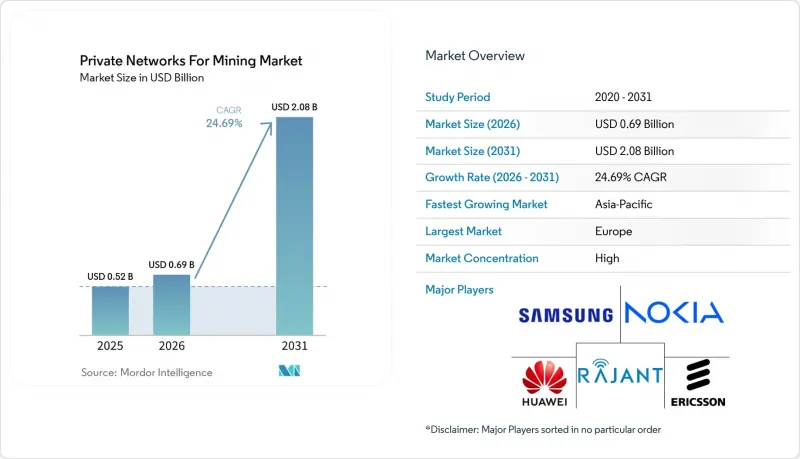
According to Mordor Intelligence, the private networks for Mining Market size is projected to expand from USD 0.52 billion in 2025 to USD 0.69 billion in 2026, and to USD 2.08 billion by 2031, registering a CAGR of 24.69% between 2026 and 2031.
Global Private Networks For Mining Market Trends and Insights
Rising Automation of Remote and Autonomous Mining Equipment
Autonomous haulage requires reliable, low-latency links, steady uplink capacity, and dependable handovers across large operating areas. ISO 23725:2024 defined communication interface requirements between autonomous systems and fleet management systems, making interoperability a clearer technical requirement for deployments. Private cellular networks can support the controlled movement of vehicles, drills, and dozers where conventional Wi-Fi coverage is limited. Newmont and Ericsson reported that a private 5G deployment at Cadia supported 12 remotely controlled dozers across a 2.5-kilometer area using a single radio unit. Epiroc reported that its LinkOA system enabled autonomous operations across mixed-truck fleets at Roy Hill, reinforcing the need for networks that support equipment from multiple manufacturers. The Private Networks for Mining Market benefits as network capability becomes part of automation planning rather than a separate site upgrade.
Mission-Critical Connectivity for Safety and Productivity
Underground operations need dependable voice and data coverage for emergency response, worker location, and daily coordination. Private cellular systems can provide a more consistent replacement path for aging leaky-feeder and Wi-Fi systems in difficult mine layouts. IAMGOLD and Ambra Solutions completed a private 4G and 5G deployment at the Cote Gold Mine in March 2026 using Nokia Modular Private Wireless technology. The installation supports autonomous and remote applications across the surface pit, underground workings, and processing plant. Connected-worker tools such as distress alerts, gas-monitoring links, and push-to-talk services can serve as an initial use case before a site commits to full automation. The Private Networks for Mining Market also benefits from the operational value of faster response times and reduced idle time during safety-related interruptions.
High Upfront Deployment Cost and Uncertain Mine-Level ROI
A private LTE or 5G build requires radio equipment, backhaul, ruggedized devices, civil work, and specialist integration. These costs can be difficult to approve when mining revenues depend on commodity cycles and site life. Benefits such as safer work, reduced downtime, and shorter truck cycles are spread across different functions, which complicates a single financial case. Network-as-a-Service can shift design, deployment, and operations into a recurring contract instead of a large upfront purchase. Epiroc offers Network-as-a-Service for mining customers that need connectivity as part of an operational service model. Smaller operators remain harder to serve because vendors must manage deployment scale, closure risk, and uncertain demand at each site.
Other drivers and restraints analyzed in the detailed report include:
- Convergence of Private Networks, Edge Computing, and Industrial AI
- Expansion of Industrial Spectrum and Shared-Spectrum Access
- Systems-Integration Complexity Across OT, IT, and OEM Platforms
For complete list of drivers and restraints, kindly check the Table Of Contents.
Segment Analysis
Private LTE held 55.12% of revenue in 2025 because it has an established base of mine-tested devices and operating practices. Its installed presence reflects years of use in fleet activity, shift changes, and emergency communications. Operators value LTE where the network design must work in underground settings with complex coverage conditions. It remains a practical option for sites that need reliable connectivity without an immediate need for the advanced functions of standalone 5G. Its broad device base also allows mines to add connected-worker tools, cameras, and equipment telemetry without replacing every endpoint simultaneously.
Private 5G Standalone is forecast to grow at a CAGR of 26.66% from 2026 to 2031. Its network slicing capabilities can separate critical automation traffic from lower-priority video and sensor traffic. Nokia and Ericsson have focused their industrial portfolios on private 5G systems and ruggedized radio equipment. Private 5G Non-Standalone and hybrid LTE-and-5 G configurations offer a transition path for mines that want to retain LTE investments. Epiroc and Ericsson formalized a 2026 agreement to make LTE and 5G connectivity available at Epiroc customer centers, expanding access via a mining-focused sales channel.
Hardware accounted for 51.79% of revenue in 2025 because each mine network needs radios, core equipment, transport links, and ruggedized edge devices. Mine conditions require equipment that can withstand dust, vibration, temperature variation, and interference from heavy machinery. Hardware will remain necessary as new mine sites deploy private cellular coverage. Its revenue mix may decline as installed networks need more software, monitoring, and lifecycle services. Procurement decisions also cover spare units, power protection, fiber routes, and mounting arrangements that are specific to each mine layout.
Managed services are projected to grow at a CAGR of 25.12% through 2031 as operators seek to transfer network operations to specialized providers. The model can include spectrum, radio access equipment, core software, monitoring, and technical support in 1 contract. Vodafone Australia offers mobile private network services for enterprise customers, combining secure connectivity with managed delivery. Network management software is becoming increasingly important as it connects wireless infrastructure to fleet management and enterprise systems. Professional services will remain important at brownfield mines where planning and integration work must precede commissioning.
Complete Report Scope:
- By Technology
- Private LTE
- Private 5G Non-Standalone
- Private 5G Standalone
- Hybrid LTE and 5G
- By Component
- Radio Access Network
- Core Network
- Backhaul and Transport
- Edge Computing Infrastructure
- Network Management Software
- Professional Services
- Managed Services
- By Deployment Model
- Dedicated On-Premises
- Hybrid Public-Private
- Network-as-a-Service
- Portable and Rapid-Deployment Networks
- By Frequency Band
- Low Band, Below 1 GHz
- Mid Band, 1-6 GHz
- Millimeter Wave, Above 24 GHz
- By Application
- Autonomous Haulage and Fleet Management
- Remote-Controlled Drilling and Dozing
- Connected Worker and Mission-Critical Communications
- Real-Time Video, Inspection, and Drone Monitoring
- Other Applications
- By Organization Size
- Large Mining Enterprises
- Mid-Sized Mining Enterprises
- By Geography
- North America
- United States
- Canada
- Mexico
- South America
- Brazil
- Argentina
- Chile
- Rest of South America
- Europe
- Germany
- United Kingdom
- France
- Italy
- Spain
- Rest of Europe
- Asia-Pacific
- China
- Japan
- India
- South Korea
- Australia
- Rest of Asia-Pacific
- Middle East
- United Arab Emirates
- Saudi Arabia
- Qatar
- Rest of Middle East
- Africa
- South Africa
- Egypt
- Nigeria
- Rest of Africa
- North America
Geography Analysis
Europe accounted for 34.23% of revenue in 2025, supported by the digitalization of underground mining and local spectrum policy. Nokia and Boldyn Networks deployed a private 5G network at the Callio FutureMINE site in Finland in September 2025, extending 1.5 kilometers underground across several tunnel levels. The project showed how European mine sites can serve as technology validation locations before wider commercial use. Digita and Outokumpu also announced a private 5G deployment at the Kemi underground mine in Finland during December 2025. The European spectrum framework gives mine operators a clearer path to local-band access.
Asia-Pacific is forecast to grow at a CAGR of 25.43% between 2026 and 2031. Australia has advanced private LTE and 5G deployments closely linked to autonomous fleet programs. Epiroc reported that Roy Hill completed the conversion of 78 haul trucks from Caterpillar and Hitachi for autonomous operation in October 2025. India offers a different route to adoption through state-linked telecommunications and mining initiatives. Coal India's Amlohri deployment illustrates the role of private 5G in a major emerging mining economy.
South America has demand centered on Chilean copper, Peruvian polymetallic operations, and Brazilian iron ore and lithium projects. The Private Networks for Mining Market in the region benefits from large open-pit operations that can support fleet management and surface automation use cases. Suppliers must adapt designs to remote locations, high-altitude operations, and mixed equipment fleets. Africa is developing demand for worker safety systems in deep mines and fleet connectivity in open-pit operations.
- Nokia Corporation
- Telefonaktiebolaget LM Ericsson
- Huawei Technologies Co., Ltd.
- Samsung Electronics Co., Ltd.
- Cisco Systems, Inc.
- Rajant Corporation
- Motorola Solutions, Inc.
- ZTE Corporation
- NEC Corporation
- Qualcomm Incorporated
- Siemens AG
- ABB Ltd.
- Epiroc AB
- Sandvik AB
- Newmont Corporation
- AngloGold Ashanti plc
- Komatsu Ltd.
- Caterpillar Inc.
- Hitachi Construction Machinery Co., Ltd.
- Wenco International Mining Systems Ltd.
- Celona, Inc.
Additional Benefits:
- The market estimate (ME) sheet in Excel format
- 3 months of analyst support
TABLE OF CONTENTS
1 INTRODUCTION
- 1.1 Study Assumptions and Market Definition
- 1.2 Scope of the Study
2 RESEARCH METHODOLOGY
3 EXECUTIVE SUMMARY
4 MARKET LANDSCAPE
- 4.1 Market Overview
- 4.2 Market Drivers
- 4.2.1 Rising Automation of Remote and Autonomous Mining Equipment
- 4.2.2 Mission-Critical Connectivity for Safety and Productivity
- 4.2.3 Expansion of Industrial Spectrum and Shared-Spectrum Access
- 4.2.4 Convergence of Private Networks, Edge Computing, and Industrial AI
- 4.2.5 Relocatable Connectivity for Dynamic Open-Pit and Underground Workfaces
- 4.2.6 Brownfield Retrofit Demand from Mixed Legacy Mine Fleets
- 4.3 Market Restraints
- 4.3.1 High Upfront Deployment Cost and Uncertain Mine-Level ROI
- 4.3.2 Systems-Integration Complexity Across OT, IT, and OEM Platforms
- 4.3.3 Underground Propagation, Electromagnetic Interference, and Rapid Topology Change
- 4.3.4 Scarcity of Multi-Band Devices and Mine-Qualified Integration Talent
- 4.4 Impact of Macroeconomic Factors on the Market
- 4.5 Industry Value-Chain Analysis
- 4.6 Technology Outlook
- 4.7 Regulatory Landscape
- 4.8 Porter's Five Forces Analysis
- 4.8.1 Threat of New Entrants
- 4.8.2 Bargaining Power of Suppliers
- 4.8.3 Bargaining Power of Buyers
- 4.8.4 Threat of Substitutes
- 4.8.5 Intensity of Competitive Rivalry
5 MARKET SIZE AND GROWTH FORECASTS (VALUE)
- 5.1 By Technology
- 5.1.1 Private LTE
- 5.1.2 Private 5G Non-Standalone
- 5.1.3 Private 5G Standalone
- 5.1.4 Hybrid LTE and 5G
- 5.2 By Component
- 5.2.1 Radio Access Network
- 5.2.2 Core Network
- 5.2.3 Backhaul and Transport
- 5.2.4 Edge Computing Infrastructure
- 5.2.5 Network Management Software
- 5.2.6 Professional Services
- 5.2.7 Managed Services
- 5.3 By Deployment Model
- 5.3.1 Dedicated On-Premises
- 5.3.2 Hybrid Public-Private
- 5.3.3 Network-as-a-Service
- 5.3.4 Portable and Rapid-Deployment Networks
- 5.4 By Frequency Band
- 5.4.1 Low Band, Below 1 GHz
- 5.4.2 Mid Band, 1-6 GHz
- 5.4.3 Millimeter Wave, Above 24 GHz
- 5.5 By Application
- 5.5.1 Autonomous Haulage and Fleet Management
- 5.5.2 Remote-Controlled Drilling and Dozing
- 5.5.3 Connected Worker and Mission-Critical Communications
- 5.5.4 Real-Time Video, Inspection, and Drone Monitoring
- 5.5.5 Other Applications
- 5.6 By Organization Size
- 5.6.1 Large Mining Enterprises
- 5.6.2 Mid-Sized Mining Enterprises
- 5.7 By Geography
- 5.7.1 North America
- 5.7.1.1 United States
- 5.7.1.2 Canada
- 5.7.1.3 Mexico
- 5.7.2 South America
- 5.7.2.1 Brazil
- 5.7.2.2 Argentina
- 5.7.2.3 Chile
- 5.7.2.4 Rest of South America
- 5.7.3 Europe
- 5.7.3.1 Germany
- 5.7.3.2 United Kingdom
- 5.7.3.3 France
- 5.7.3.4 Italy
- 5.7.3.5 Spain
- 5.7.3.6 Rest of Europe
- 5.7.4 Asia-Pacific
- 5.7.4.1 China
- 5.7.4.2 Japan
- 5.7.4.3 India
- 5.7.4.4 South Korea
- 5.7.4.5 Australia
- 5.7.4.6 Rest of Asia-Pacific
- 5.7.5 Middle East
- 5.7.5.1 United Arab Emirates
- 5.7.5.2 Saudi Arabia
- 5.7.5.3 Qatar
- 5.7.5.4 Rest of Middle East
- 5.7.6 Africa
- 5.7.6.1 South Africa
- 5.7.6.2 Egypt
- 5.7.6.3 Nigeria
- 5.7.6.4 Rest of Africa
- 5.7.1 North America
6 COMPETITIVE LANDSCAPE
- 6.1 Market Concentration
- 6.2 Strategic Moves
- 6.3 Market Share Analysis
- 6.4 Company Profiles (includes Global Level Overview, Market Level Overview, Core Segments, Financials as available, Strategic Information, Market Rank/Share, Products and Services, Recent Developments)
- 6.4.1 Nokia Corporation
- 6.4.2 Telefonaktiebolaget LM Ericsson
- 6.4.3 Huawei Technologies Co., Ltd.
- 6.4.4 Samsung Electronics Co., Ltd.
- 6.4.5 Cisco Systems, Inc.
- 6.4.6 Rajant Corporation
- 6.4.7 Motorola Solutions, Inc.
- 6.4.8 ZTE Corporation
- 6.4.9 NEC Corporation
- 6.4.10 Qualcomm Incorporated
- 6.4.11 Siemens AG
- 6.4.12 ABB Ltd.
- 6.4.13 Epiroc AB
- 6.4.14 Sandvik AB
- 6.4.15 Newmont Corporation
- 6.4.16 AngloGold Ashanti plc
- 6.4.17 Komatsu Ltd.
- 6.4.18 Caterpillar Inc.
- 6.4.19 Hitachi Construction Machinery Co., Ltd.
- 6.4.20 Wenco International Mining Systems Ltd.
- 6.4.21 Celona, Inc.
7 MARKET OPPORTUNITIES AND FUTURE OUTLOOK
- 7.1 White-Space and Unmet-Need Assessment

