PUBLISHER: MarketsandMarkets | PRODUCT CODE: 2130444
PUBLISHER: MarketsandMarkets | PRODUCT CODE: 2130444
Transformer Monitoring Market by Component (Hardware, Software), Service (Oil Monitoring, Bushing Monitoring, Partial Discharge Monitoring, OLTC Monitoring), Voltage, Type, Installation, End User, Application, and Region - Global Forecast to 2031
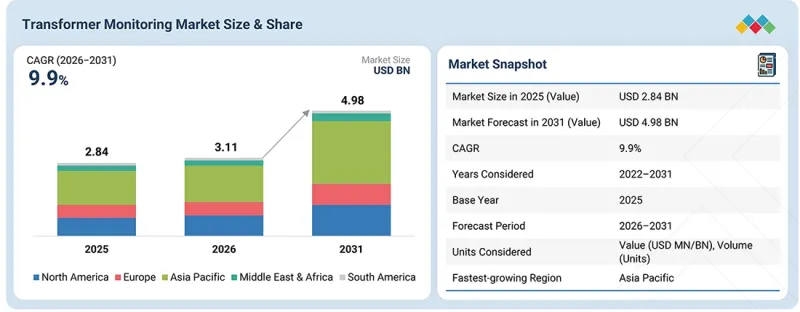
The transformer monitoring market is projected to reach USD 4.98 billion by 2031 from USD 3.11 billion in 2026, recording a CAGR of 9.9% during the forecast period. The market is expected to grow rapidly due to the growing emphasis on grid reliability, transformer asset health, and condition-based maintenance.
| Scope of the Report | |
|---|---|
| Years Considered for the Study | 2022-2031 |
| Base Year | 2025 |
| Forecast Period | 2026-2031 |
| Units Considered | Value (USD Million/Billion), Volume (Units) |
| Segments | by Component, Service, Voltage, Type, Installation, End User, Application, and Region |
| Regions covered | North America, South America, Europe, Asia Pacific, and the Middle East & Africa |
Utilities and industrial operators are increasingly using monitoring systems to detect unusual operating conditions, ensuring the early detection of failures, and preventing unexpected transformer failures. The need to extend transformers' operational life and improve the maintenance process will further stimulate the use of predictive diagnostics, real-time monitoring systems, and asset health assessment.
"New segment to maintain the leading position during the forecast period"
In terms of installation, the new segment is anticipated to maintain the leading position in the transformer monitoring market from 2026 to 2031 due to the trend of including monitoring systems in newly commissioned transformers even during the design and manufacturing stages. Factory-integrated sensors, communication interfaces, and monitoring platforms allow monitoring capabilities to be built into the transformer rather than added later, supporting comprehensive condition assessment from the beginning of operation. The growing number of new transformer installations in the expanding and upgrading power grid of regions opens great prospects for integrated monitoring technologies. Moreover, new installations allow more room for utilizing multi-parameter monitoring, digital communication, and asset management technologies, maintaining steady demand for monitoring solutions for new installations.
"Data centers segment to exhibit the highest CAGR between 2026 and 2031"
In terms of end user, the data centers segment is likely to record the highest growth rate in the transformer monitoring market during the forecast period, driven by rapid expansion of hyperscale and colocation facilities, rising AI workloads, and increasing power-density requirements. Growing dependence on uninterrupted power supply is strengthening demand for real-time transformer monitoring to detect emerging faults, prevent unplanned outages, and enhance power infrastructure reliability. As data centers operate mission-critical electrical systems continuously, operators are prioritizing predictive maintenance, asset health assessment, and condition-based monitoring to minimize downtime and optimize maintenance costs. In addition, the integration of digital substations, IoT-enabled sensors, and remote monitoring platforms is enabling centralized visibility across electrical assets, supporting higher uptime, operational resilience, and lifecycle optimization of transformer infrastructure.
"Asia Pacific to hold the largest share of the transformer monitoring market in 2031"
In terms of region, Asia Pacific is expected to account for the largest market share in 2031, owing to the rapid grid expansion, accelerating urbanization, and substantial investments in transmission and distribution infrastructure modernization. Growing electricity demand, renewable energy integration, and cross-border power connectivity are increasing the operational complexity of regional grids, strengthening the need for real-time asset visibility. Aging transformer fleets across developed markets such as Japan, South Korea, and Australia are driving adoption of condition monitoring and predictive maintenance solutions, while emerging economies are expanding monitoring capabilities alongside new grid infrastructure. Additionally, investments in smart grids, digital substations, IoT-enabled monitoring, and grid resilience are encouraging utilities to transition toward data-driven asset management and minimize unplanned outages.
Breakdown of Primaries
In-depth interviews with key industry participants, subject-matter experts, C-level executives of key market players, and directors, among other experts, were conducted to obtain and verify critical qualitative and quantitative information, as well as to assess future market prospects. The primary interviews were distributed as follows:
By Company Type: Tier 1- 65%, Tier 2 - 24%, and Tier 3 - 11%
By Designation: C-Level Executives - 30%, Directors - 25%, Others - 45%
By Region: North America - 20%, Europe - 25%, Asia Pacific - 30%, Middle East & Africa - 10%, South America - 15%.
Note: Others include sales managers, engineers, and regional managers.
Tier 1 company: revenue >USD 5 billion; tier 2 company: revenue between USD 1 and USD 5 billion; and tier 3 company: revenue <USD 1 billion in 2025
Well-established technology companies and transformer monitoring manufacturers predominantly govern the transformer monitoring market. Key players profiled in the report include GE Vernova (US), Schneider Electric (France), Siemens (Germany), Hitachi Energy Ltd. (Switzerland), Eaton (Ireland), Mistras Group (US), Vaisala (Finland), Reinhausen GmbH (Germany), Qualitrol Company LLC. (US), and Doble Engineering Company (US), among others. Their strong manufacturing footprints, services technology leadership, and continued investments in Transformer Monitoring Systems transition and regional capacity expansion continue to shape the competitive landscape.
Research Coverage
The report provides a comprehensive definition, description, and forecast of the transformer monitoring across component (hardware and software), type (oil-immersed, cast-resin, and other types), service (dissolved gas analysis, bushing monitoring, partial discharge monitoring, OLTC monitoring, and other services), voltage (below 36 kV, 36-230 kV, and above 230 kV), application (power transformers, distribution transformers, and other applications), installation (new and retrofit), end user (power utilities, industrial, residential/commercial, data centers, and other end users), and region (North America, Europe, Asia Pacific, South America, and the Middle East & Africa). It delivers qualitative and quantitative analysis of market drivers, restraints, opportunities, and challenges. The study also includes competitive landscape assessment, market sizing and forecasts, technology trends, ecosystem analysis, commercial use cases, company benchmarking, and recent developments to provide a comprehensive view of the Transformer Monitoring market.
Key Benefits of Buying the Report
The report is designed to support OEMs, installers, utilities, policymakers, investors, and other stakeholders in understanding the evolving Transformer Monitoring market. It provides reliable market forecasts across all major segments and regions while delivering insights into technology adoption, competitive positioning, and future growth opportunities. The report enables stakeholders to make informed business decisions through detailed market intelligence and strategic analysis.
- Analysis of Key Market Dynamics: Covers the major drivers (Increasing adoption of digital substations and smart grids, Growing power demand in data centers, Mounting adoption of condition-based and predictive maintenance for transformers), restraints (High initial investment and installation costs, Complex integration with existing infrastructure), opportunities (Rising adoption of big data analytics and cloud-based monitoring platforms, Increasing reliance on renewables), and challenges (Cybersecurity and data protection risks) influencing the growth of the transformer monitoring market
- Technology and Product Innovation: Examines advancements in online dissolved gas analysis, partial discharge monitoring, bushing monitoring, temperature and moisture measuring, IoT sensors, cloud and edge computing, and analytics-based health assessment of transformers that facilitate continuous condition monitoring and fault detection
- Market Development: Highlights how the modernization of the grid, aging transformer fleets, penetration of renewable energies, rising demand for electricity, and transition towards condition-based maintenance spur the implementation of transformer monitoring systems in utilities, industries, and critical power infrastructure
- Market Diversification: Evaluates transformer monitoring applications extending from traditional electric utility assets to new sectors, including industrial companies, data centers, and other infrastructure requiring high amounts of energy
- Competitive Assessment: Provides detailed analysis of leading companies including GE Vernova (US), Schneider Electric (France), Siemens (Germany), Hitachi Energy Ltd. (Switzerland), Eaton (Ireland), Mistras Group (US), Vaisala (Finland), Reinhausen GmbH (Germany), Qualitrol Company LLC. (US), Doble Engineering Company (US), Dynamic Ratings (US), Camlin Energy (Ireland), TreeTech (Brazil), Rugged Monitoring (Canada), and H2scan (US), covering their product portfolios, strategic initiatives, technological capabilities, and competitive positioning
TABLE OF CONTENTS
1 INTRODUCTION
- 1.1 STUDY OBJECTIVES
- 1.2 MARKET DEFINITION
- 1.3 MARKET SCOPE
- 1.3.1 MARKET SEGMENTATION AND REGIONAL SCOPE
- 1.3.2 INCLUSIONS AND EXCLUSIONS
- 1.3.3 YEARS CONSIDERED
- 1.4 CURRENCY CONSIDERED
- 1.5 LIMITATIONS
- 1.6 STAKEHOLDERS
- 1.7 SUMMARY OF CHANGES
2 EXECUTIVE SUMMARY
- 2.1 MARKET HIGHLIGHTS AND KEY INSIGHTS
- 2.2 KEY MARKET PARTICIPANTS: MAPPING OF STRATEGIC DEVELOPMENTS
- 2.3 DISRUPTIVE TRENDS IN TRANSFORMER MONITORING MARKET
- 2.4 HIGH-GROWTH SEGMENTS
- 2.5 REGIONAL SNAPSHOT: MARKET SIZE, GROWTH RATE, AND FORECAST
3 PREMIUM INSIGHTS
- 3.1 ATTRACTIVE OPPORTUNITIES FOR PLAYERS IN TRANSFORMER MONITORING MARKET
- 3.2 TRANSFORMER MONITORING MARKET, BY COMPONENT AND REGION
- 3.3 TRANSFORMER MONITORING MARKET, BY COMPONENT
- 3.4 TRANSFORMER MONITORING MARKET, BY TYPE
- 3.5 TRANSFORMER MONITORING MARKET, BY APPLICATION
- 3.6 TRANSFORMER MONITORING MARKET, BY SERVICE
- 3.7 TRANSFORMER MONITORING MARKET, BY VOLTAGE RATING
- 3.8 TRANSFORMER MONITORING MARKET, BY INSTALLATION
- 3.9 TRANSFORMER MONITORING MARKET, BY END USER
- 3.10 TRANSFORMER MONITORING MARKET, BY COUNTRY
4 MARKET OVERVIEW
- 4.1 INTRODUCTION
- 4.2 MARKET DYNAMICS
- 4.2.1 DRIVERS
- 4.2.1.1 Increasing digitalization of utilities and adoption of digital substations and smart grids
- 4.2.1.2 Growing data center power demand and transformer deployment
- 4.2.1.3 Growing adoption of condition-based and predictive maintenance for transformers
- 4.2.2 RESTRAINTS
- 4.2.2.1 High initial investment and installation costs
- 4.2.2.2 Complex integration with existing infrastructure
- 4.2.3 OPPORTUNITIES
- 4.2.3.1 Growing adoption of big data analytics and cloud-based monitoring platforms
- 4.2.3.2 Growth of renewables
- 4.2.4 CHALLENGES
- 4.2.4.1 Cybersecurity and data protection risks
- 4.2.1 DRIVERS
- 4.3 UNMET NEEDS AND WHITE SPACES
- 4.4 INTERCONNECTED MARKETS AND CROSS-SECTOR OPPORTUNITIES
- 4.5 STRATEGIC MOVES BY TIER-1/2/3 PLAYERS
5 INDUSTRY TRENDS
- 5.1 PORTER'S FIVE FORCES ANALYSIS
- 5.1.1 INTENSITY OF COMPETITIVE RIVALRY
- 5.1.2 THREAT OF NEW ENTRANTS
- 5.1.3 BARGAINING POWER OF SUPPLIERS
- 5.1.4 BARGAINING POWER OF BUYERS
- 5.1.5 THREATS OF SUBSTITUTES
- 5.2 MACROECONOMIC OUTLOOK
- 5.2.1 INTRODUCTION
- 5.2.1.1 Increasing electricity demand and grid infrastructure expansion
- 5.2.1.2 Accelerating renewable energy integration
- 5.2.1.3 Growing digitalization of power infrastructure
- 5.2.2 GDP TRENDS AND FORECAST
- 5.2.3 TRENDS IN GLOBAL TRANSFORMER MONITORING INDUSTRY
- 5.2.1 INTRODUCTION
- 5.3 VALUE CHAIN ANALYSIS
- 5.3.1 RAW MATERIAL SUPPLIERS
- 5.3.2 COMPONENT MANUFACTURERS
- 5.3.3 TRANSFORMER MONITORING MANUFACTURERS
- 5.3.4 END USERS
- 5.3.5 POST-SALES SERVICE PROVIDERS
- 5.4 ECOSYSTEM ANALYSIS
- 5.5 PRICING ANALYSIS
- 5.5.1 AVERAGE SELLING PRICE TREND OF TRANSFORMER MONITORING SYSTEMS, BY APPLICATION, 2022-2025
- 5.5.2 AVERAGE SELLING PRICE TREND OF TRANSFORMER MONITORING SYSTEMS, BY REGION, 2022-2025
- 5.6 TRADE ANALYSIS
- 5.6.1 IMPORT SCENARIO (HS CODE 8504)
- 5.6.2 EXPORT SCENARIO (HS CODE 8504)
- 5.7 KEY CONFERENCES AND EVENTS, 2026-2027
- 5.8 TRENDS/DISRUPTIONS IMPACTING CUSTOMER BUSINESS
- 5.9 INVESTMENT AND FUNDING SCENARIO
- 5.10 CASE STUDY ANALYSIS
- 5.10.1 HITACHI ENERGY DIGITALIZED TRANSFORMER MONITORING FOR FORTUM'S HYDROPOWER PLANT
- 5.10.2 HITACHI ENERGY IMPLEMENTS ONLINE TRANSFORMER MONITORING FOR TATA STEEL
- 5.10.3 CAMLIN ENERGY DEPLOYS TRANSFORMER MONITORING FOR VATTENFALL RENEWABLES
- 5.11 IMPACT OF 2025 US TARIFF - TRANSFORMER MONITORING MARKET
- 5.11.1 INTRODUCTION
- 5.11.2 KEY TARIFF RATES
- 5.11.3 PRICE IMPACT ANALYSIS
- 5.11.4 IMPACT ON COUNTRIES/REGIONS
- 5.11.4.1 US
- 5.11.4.2 Europe
- 5.11.4.3 Asia Pacific
- 5.11.4.4 South America
- 5.11.4.5 Middle East & Africa
- 5.11.5 IMPACT ON END-USE INDUSTRIES
6 TECHNOLOGICAL ADVANCEMENTS, AI-DRIVEN IMPACT, PATENTS, INNOVATIONS, AND FUTURE APPLICATIONS
- 6.1 KEY TECHNOLOGIES
- 6.1.1 SENSORS AND INTERNET OF THINGS (IOT)
- 6.1.2 DATA ANALYTICS AND ARTIFICIAL INTELLIGENCE (AI)
- 6.2 COMPLEMENTARY TECHNOLOGIES
- 6.2.1 DIGITAL TWINS AND SIMULATION
- 6.2.2 CLOUD AND EDGE COMPUTING
- 6.3 TECHNOLOGY/PRODUCT ROADMAP
- 6.3.1 SHORT-TERM (2025-2027) | FOUNDATION & EARLY COMMERCIALIZATION
- 6.3.2 MID-TERM (2027-2030) | EXPANSION & STANDARDIZATION
- 6.3.3 LONG-TERM (2030+) | MASS COMMERCIALIZATION & DISRUPTION
- 6.4 PATENT ANALYSIS
- 6.5 FUTURE APPLICATIONS
- 6.6 IMPACT OF AI/GEN AI ON TRANSFORMER MONITORING MARKET
- 6.6.1 TOP USE CASES AND MARKET POTENTIAL
- 6.6.2 BEST PRACTICES FOLLOWED BY OEMS IN TRANSFORMER MONITORING MARKET
- 6.6.3 CASE STUDIES RELATED TO AI/GEN AI IMPLEMENTATION IN TRANSFORMER MONITORING MARKET
- 6.6.4 INTERCONNECTED ECOSYSTEM AND IMPACT ON MARKET PLAYERS
- 6.6.5 CLIENTS' READINESS TO ADOPT AI/GEN AI-INTEGRATED TRANSFORMER MONITORING
- 6.7 SUCCESS STORIES AND REAL-WORLD APPLICATIONS
- 6.7.1 GE VERNOVA: AI-ENABLED TRANSFORMER ASSET PERFORMANCE MANAGEMENT
- 6.7.2 SIEMENS ENERGY: AI-BASED TRANSFORMER CONDITION MONITORING
- 6.7.3 SCHNEIDER ELECTRIC: AI-ENABLED TRANSFORMER FLEET HEALTH MANAGEMENT
7 REGULATORY LANDSCAPE
- 7.1 REGIONAL REGULATIONS AND COMPLIANCE
- 7.1.1 REGULATORY BODIES, GOVERNMENT AGENCIES, AND OTHER ORGANIZATIONS
- 7.1.2 INDUSTRY STANDARDS
8 CUSTOMER LANDSCAPE AND BUYER BEHAVIOR
- 8.1 DECISION-MAKING PROCESS
- 8.2 KEY STAKEHOLDERS INVOLVED IN BUYING PROCESS AND THEIR EVALUATION CRITERIA
- 8.2.1 KEY STAKEHOLDERS IN BUYING PROCESS
- 8.2.2 BUYING CRITERIA
- 8.3 ADOPTION BARRIERS AND INTERNAL CHALLENGES
- 8.4 MARKET PROFITABILITY
- 8.4.1 REVENUE POTENTIAL
- 8.4.2 COST DYNAMICS
9 TRANSFORMER MONITORING MARKET, BY COMPONENT
- 9.1 INTRODUCTION
- 9.2 HARDWARE
- 9.2.1 RISING NEED FOR REAL-TIME CONDITION MONITORING AND ASSET LIFE EXTENSION TO DRIVE DEMAND
- 9.3 SOFTWARE
- 9.3.1 INCREASING ADOPTION OF IOT AND ADVANCED ANALYTICS TO ENABLE REAL-TIME MONITORING TO DRIVE MARKET
10 TRANSFORMER MONITORING MARKET, BY TYPE
- 10.1 INTRODUCTION
- 10.2 OIL-IMMERSED
- 10.2.1 INCREASING FOCUS ON REAL-TIME CONDITION MONITORING AND ASSET LIFE EXTENSION TO OPTIMIZE TRANSFORMER PERFORMANCE
- 10.3 CAST RESIN
- 10.3.1 GROWING ADOPTION OF REAL-TIME MONITORING TO ENHANCE RELIABILITY AND ASSET PERFORMANCE TO PROPEL MARKET
- 10.4 OTHER TYPES
11 TRANSFORMER MONITORING MARKET, BY APPLICATION
- 11.1 INTRODUCTION
- 11.2 POWER TRANSFORMERS
- 11.2.1 GROWING DEMAND FOR REAL-TIME MONITORING AND ASSET OPTIMIZATION TO ENHANCE POWER TRANSFORMER PERFORMANCE
- 11.3 DISTRIBUTION TRANSFORMERS
- 11.3.1 ACCELERATING GRID DIGITALIZATION AND RENEWABLE INTEGRATION TO DRIVE ADOPTION OF DISTRIBUTION TRANSFORMER MONITORING SOLUTIONS
- 11.4 OTHER APPLICATIONS
12 TRANSFORMER MONITORING MARKET, BY SERVICE
- 12.1 INTRODUCTION
- 12.2 DISSOLVED GAS ANALYSIS
- 12.2.1 INCREASING ADOPTION OF CONTINUOUS ONLINE DGA TO ENABLE EARLY FAULT DETECTION TO PROPEL MARKET
- 12.3 BUSHING MONITORING
- 12.3.1 RISING DEMAND FOR REAL-TIME BUSHING HEALTH ASSESSMENT TO STRENGTHEN TRANSFORMER RELIABILITY AND OPERATIONAL VISIBILITY
- 12.4 PARTIAL DISCHARGE MONITORING
- 12.4.1 INCREASING ADOPTION OF ONLINE PARTIAL DISCHARGE MONITORING TO STRENGTHEN INSULATION ASSESSMENT AND TRANSFORMER RELIABILITY
- 12.5 ON-LOAD TAP CHANGER MONITORING
- 12.5.1 RISING ADOPTION OF ADVANCED OLTC MONITORING TO ENHANCE VOLTAGE REGULATION AND OPTIMIZE TRANSFORMER PERFORMANCE
- 12.6 OTHER SERVICES
13 TRANSFORMER MONITORING MARKET, BY VOLTAGE RATING
- 13.1 INTRODUCTION
- 13.2 UP TO 36 KV
- 13.2.1 WIDELY USED IN DISTRIBUTION, COMMERCIAL, AND INDUSTRIAL APPLICATIONS REQUIRING LOWER VOLTAGE LEVELS
- 13.3 36-230 KV
- 13.3.1 WIDELY USED IN SUB-TRANSMISSION AND POWER TRANSMISSION NETWORKS TO SUPPORT RISING POWER DEMAND
- 13.4 ABOVE 230 KV
- 13.4.1 WIDELY DEPLOYED IN HIGH-VOLTAGE TRANSMISSION NETWORKS FOR LONG-DISTANCE POWER TRANSFER AND GRID INTERCONNECTION
14 TRANSFORMER MONITORING MARKET, BY INSTALLATION
- 14.1 INTRODUCTION
- 14.2 NEW
- 14.2.1 RISING DEPLOYMENT OF NEW TRANSFORMERS ACROSS EXPANDING POWER GRIDS TO DRIVE DEMAND
- 14.3 RETROFIT
- 14.3.1 INCREASING DIGITALIZATION OF AGING TRANSFORMER FLEETS TO DRIVE ADOPTION OF RETROFIT MONITORING SOLUTIONS
15 TRANSFORMER MONITORING MARKET, BY END USER
- 15.1 INTRODUCTION
- 15.2 POWER UTILITIES
- 15.2.1 EXPANDING POWER GRIDS AND RISING ELECTRICITY DEMAND TO DRIVE ADOPTION OF TRANSFORMER MONITORING SOLUTIONS
- 15.3 INDUSTRIAL
- 15.3.1 INCREASING TRANSFORMER DEPLOYMENT ACROSS ENERGY-INTENSIVE INDUSTRIES TO DRIVE DEMAND FOR CONDITION MONITORING SOLUTIONS
- 15.4 COMMERCIAL AND RESIDENTIAL
- 15.4.1 INCREASING DEPLOYMENT OF ELECTRICAL INFRASTRUCTURE ACROSS COMMERCIAL AND RESIDENTIAL FACILITIES TO SUPPORT DEMAND
- 15.5 DATA CENTERS
- 15.5.1 RAPID DATA CENTER EXPANSION AND RISING POWER DENSITY TO ACCELERATE DEMAND FOR REAL-TIME TRANSFORMER MONITORING SOLUTIONS
- 15.6 OTHER END USERS
16 TRANSFORMER MONITORING MARKET, BY REGION
- 16.1 INTRODUCTION
- 16.2 NORTH AMERICA
- 16.2.1 US
- 16.2.1.1 Rapid data center expansion, grid modernization, and aging transformers to drive market
- 16.2.2 CANADA
- 16.2.2.1 Aging grid infrastructure and renewable energy integration to propel market
- 16.2.3 MEXICO
- 16.2.3.1 Industrial modernization and grid infrastructure investments to support market growth
- 16.2.1 US
- 16.3 EUROPE
- 16.3.1 UK
- 16.3.1.1 Rising grid modernization, renewable integration, and aging transformer assets to accelerate market growth
- 16.3.2 FRANCE
- 16.3.2.1 Nuclear power infrastructure, grid modernization, and renewable integration to drive market growth
- 16.3.3 GERMANY
- 16.3.3.1 Industrial modernization and grid reliability to drive market
- 16.3.4 RUSSIA
- 16.3.4.1 Aging grid infrastructure, energy sector modernization, and harsh operating conditions to drive growth
- 16.3.5 ITALY
- 16.3.5.1 Grid modernization and renewable integration to strengthen transformer monitoring demand
- 16.3.6 REST OF EUROPE
- 16.3.1 UK
- 16.4 ASIA PACIFIC
- 16.4.1 CHINA
- 16.4.1.1 Renewable energy expansion, grid modernization, and reliability requirements to propel market
- 16.4.2 INDIA
- 16.4.2.1 Grid modernization, renewable integration, and aging transformer infrastructure to drive adoption
- 16.4.3 JAPAN
- 16.4.3.1 Aging grid assets, reliability requirements, and digitalization to strengthen adoption
- 16.4.4 SOUTH KOREA
- 16.4.4.1 Smart grid deployment and predictive asset diagnostics to drive market
- 16.4.5 AUSTRALIA
- 16.4.5.1 Grid resilience, distributed generation, and asset-life optimization to propel market
- 16.4.6 REST OF ASIA PACIFIC
- 16.4.1 CHINA
- 16.5 SOUTH AMERICA
- 16.5.1 BRAZIL
- 16.5.1.1 Renewable energy integration and aging transformer infrastructure to drive growth
- 16.5.2 ARGENTINA
- 16.5.2.1 Oil & gas infrastructure and grid reliability needs to support adoption
- 16.5.3 VENEZUELA
- 16.5.3.1 Aging grid infrastructure and reliability requirements to support market growth
- 16.5.4 REST OF SOUTH AMERICA
- 16.5.1 BRAZIL
- 16.6 MIDDLE EAST & AFRICA
- 16.6.1 GCC COUNTRIES
- 16.6.1.1 Saudi Arabia
- 16.6.1.1.1 Grid expansion, energy diversification, and industrial electrification to strengthen demand
- 16.6.1.2 UAE
- 16.6.1.2.1 Rising investments in solar energy generation to drive market growth
- 16.6.1.3 Qatar
- 16.6.1.3.1 Oil & gas expansion, grid modernization, and renewable energy integration to drive market
- 16.6.1.4 Rest of GCC countries
- 16.6.1.1 Saudi Arabia
- 16.6.2 ALGERIA
- 16.6.2.1 Growing power grid modernization and oil & gas infrastructure to drive market
- 16.6.3 IRAN
- 16.6.3.1 Aging grid infrastructure and renewable energy integration to drive market growth
- 16.6.4 SOUTH AFRICA
- 16.6.4.1 Growing power generation and grid reliability requirements to accelerate adoption
- 16.6.5 REST OF MIDDLE EAST & AFRICA
- 16.6.1 GCC COUNTRIES
17 COMPETITIVE LANDSCAPE
- 17.1 OVERVIEW
- 17.2 KEY PLAYER COMPETITIVE STRATEGIES/RIGHT TO WIN, JANUARY 2023-AUGUST 2026
- 17.3 MARKET SHARE ANALYSIS, 2025
- 17.4 REVENUE ANALYSIS, 2021-2025
- 17.5 BRAND COMPARISON
- 17.5.1 GE VERNOVA (US)
- 17.5.2 SIEMENS ENERGY (GERMANY)
- 17.5.3 SCHNEIDER ELECTRIC (FRANCE)
- 17.5.4 EATON (IRELAND)
- 17.5.5 VAISALA (FINLAND)
- 17.6 COMPANY EVALUATION MATRIX: KEY PLAYERS, 2025
- 17.6.1 STARS
- 17.6.2 EMERGING LEADERS
- 17.6.3 PERVASIVE PLAYERS
- 17.6.4 PARTICIPANTS
- 17.6.5 COMPANY FOOTPRINT: KEY PLAYERS, 2025
- 17.6.5.1 Company footprint
- 17.6.5.2 Region footprint
- 17.6.5.3 Component footprint
- 17.6.5.4 Service footprint
- 17.6.5.5 End-user footprint
- 17.7 COMPANY EVALUATION MATRIX: STARTUPS/SMES, 2025
- 17.7.1 PROGRESSIVE COMPANIES
- 17.7.2 RESPONSIVE COMPANIES
- 17.7.3 DYNAMIC COMPANIES
- 17.7.4 STARTING BLOCKS
- 17.7.5 COMPETITIVE BENCHMARKING: STARTUPS/SMES, 2025
- 17.7.5.1 Detailed list of key startups/SMEs
- 17.7.5.2 Competitive benchmarking of key startups/SMEs
- 17.8 COMPANY VALUATION AND FINANCIAL METRICS
- 17.9 COMPETITIVE SCENARIO
- 17.9.1 PRODUCT LAUNCHES
- 17.9.2 DEALS
- 17.9.3 EXPANSIONS
18 COMPANY PROFILES
- 18.1 KEY PLAYERS
- 18.1.1 GE VERNOVA
- 18.1.1.1 Business overview
- 18.1.1.2 Products/Solutions/Services offered
- 18.1.1.3 Recent developments
- 18.1.1.3.1 Product launches
- 18.1.1.3.2 Deals
- 18.1.1.4 MnM view
- 18.1.1.4.1 Key strengths/Right to win
- 18.1.1.4.2 Strategic choices
- 18.1.1.4.3 Weaknesses/Competitive threats
- 18.1.2 SCHNEIDER ELECTRIC
- 18.1.2.1 Business overview
- 18.1.2.2 Products/Solutions/Services offered
- 18.1.2.3 Recent developments
- 18.1.2.3.1 Product Launches
- 18.1.2.3.2 Deals
- 18.1.2.4 MnM view
- 18.1.2.4.1 Key strengths/Right to win
- 18.1.2.4.2 Strategic choices
- 18.1.2.4.3 Weaknesses/Competitive threats
- 18.1.3 SIEMENS ENERGY
- 18.1.3.1 Business overview
- 18.1.3.2 Products/Solutions/Services offered
- 18.1.3.3 Recent developments
- 18.1.3.3.1 Deals
- 18.1.3.3.2 Expansions
- 18.1.3.4 MnM view
- 18.1.3.4.1 Key strengths/Right to win
- 18.1.3.4.2 Strategic choices
- 18.1.3.4.3 Weaknesses/Competitive threats
- 18.1.4 EATON
- 18.1.4.1 Business overview
- 18.1.4.2 Products/Solutions/Services offered
- 18.1.4.3 Recent developments
- 18.1.4.3.1 Deals
- 18.1.4.3.2 Expansions
- 18.1.4.4 MnM view
- 18.1.4.4.1 Key strengths/Right to win
- 18.1.4.4.2 Strategic choices
- 18.1.4.4.3 Weaknesses/Competitive threats
- 18.1.5 VAISALA
- 18.1.5.1 Business overview
- 18.1.5.2 Products/Solutions/Services offered
- 18.1.5.2.1 Product Launches
- 18.1.5.3 MnM view
- 18.1.5.3.1 Key strengths/Right to win
- 18.1.5.3.2 Strategic choices
- 18.1.5.3.3 Weaknesses/Competitive threats
- 18.1.6 MISTRAS GROUP
- 18.1.6.1 Business overview
- 18.1.6.2 Products/Solutions/Services offered
- 18.1.6.3 Recent developments
- 18.1.6.3.1 Product launches
- 18.1.7 HITACHI ENERGY LTD.
- 18.1.7.1 Business overview
- 18.1.7.2 Products/Solutions/Services offered
- 18.1.7.3 Recent developments
- 18.1.7.3.1 Product launches
- 18.1.7.3.2 Expansions
- 18.1.8 REINHAUSEN GMBH
- 18.1.8.1 Business overview
- 18.1.8.2 Products/Solutions/Services offered
- 18.1.8.3 Recent Developments
- 18.1.8.3.1 Deals
- 18.1.8.3.2 Expansions
- 18.1.9 QUALITROL COMPANY LLC
- 18.1.9.1 Business overview
- 18.1.9.2 Products/Solutions/Services offered
- 18.1.9.3 Recent developments
- 18.1.9.3.1 Product launches
- 18.1.10 DOBLE ENGINEERING COMPANY
- 18.1.10.1 Business overview
- 18.1.10.2 Products/Solutions/Services offered
- 18.1.10.3 Recent developments
- 18.1.10.3.1 Product launches
- 18.1.10.3.2 Expansions
- 18.1.10.3.3 Deals
- 18.1.11 DYNAMIC RATINGS
- 18.1.11.1 Business overview
- 18.1.11.2 Products/Solutions/Services offered
- 18.1.11.3 Recent developments
- 18.1.11.3.1 Product launches
- 18.1.11.3.2 Expansions
- 18.1.11.3.3 Deals
- 18.1.12 CAMLIN ENERGY
- 18.1.12.1 Business overview
- 18.1.12.2 Products/Solutions/Services offered
- 18.1.12.3 Recent developments
- 18.1.12.3.1 Deals
- 18.1.13 MTE METER TEST EQUIPMENT AG
- 18.1.13.1 Business overview
- 18.1.13.2 Products/Solutions/Services offered
- 18.1.14 H2SCAN
- 18.1.14.1 Business overview
- 18.1.14.2 Products/Solutions/Services offered
- 18.1.14.3 Recent developments
- 18.1.14.3.1 Product launches
- 18.1.15 FRANKLIN ELECTRIC GRID SOLUTIONS
- 18.1.15.1 Business overview
- 18.1.15.2 Products/Solutions/Services offered
- 18.1.1 GE VERNOVA
- 18.2 OTHER PLAYERS
- 18.2.1 TREETECH
- 18.2.2 EMCO ELECTRONICS
- 18.2.3 ADVANCED POWER TECHNOLOGIES
- 18.2.4 RUGGED MONITORING
- 18.2.5 EDGE ZERO
- 18.2.6 MEGGER
- 18.2.7 NINGBO LIGONG ENVIRONMENT AND ENERGY TECHNOLOGY CO., LTD.
- 18.2.8 HAOMAI ELECTRIC TEST EQUIPMENT CO., LTD.
- 18.2.9 CREATIVE MICRO SYSTEMS
- 18.2.10 INFOLECH
19 RESEARCH METHODOLOGY
- 19.1 RESEARCH DATA
- 19.1.1 SECONDARY DATA
- 19.1.1.1 List of major secondary sources
- 19.1.1.2 Key data from secondary sources
- 19.1.2 PRIMARY DATA
- 19.1.2.1 List of primary interview participants
- 19.1.2.2 Key industry insights
- 19.1.2.3 Breakdown of primaries
- 19.1.2.4 Key data from primary sources
- 19.1.1 SECONDARY DATA
- 19.2 DATA TRIANGULATION
- 19.3 MARKET SIZE ESTIMATION
- 19.3.1 BOTTOM-UP APPROACH
- 19.3.2 TOP-DOWN APPROACH
- 19.4 DEMAND-SIDE ANALYSIS
- 19.4.1 ASSUMPTIONS FOR DEMAND-SIDE ANALYSIS
- 19.4.2 CALCULATIONS FOR DEMAND-SIDE ANALYSIS
- 19.5 SUPPLY-SIDE ANALYSIS
- 19.5.1 ASSUMPTIONS FOR SUPPLY-SIDE ANALYSIS
- 19.5.2 CALCULATIONS FOR SUPPLY-SIDE ANALYSIS
- 19.6 GROWTH FORECAST ASSUMPTIONS
- 19.7 RESEARCH LIMITATIONS
- 19.8 RISK ASSESSMENT
20 APPENDIX
- 20.1 DISCUSSION GUIDE
- 20.2 KNOWLEDGE STORE: MARKETSANDMARKETS' SUBSCRIPTION PORTAL
- 20.3 CUSTOMIZATION OPTIONS
- 20.4 RELATED REPORTS
- 20.5 AUTHOR DETAILS
List of Tables
- TABLE 1 INTERCONNECTED MARKETS
- TABLE 2 KEY MOVES AND STRATEGIC FOCUS OF TIER-1/2/3 PLAYERS
- TABLE 3 IMPACT OF PORTER'S FIVE FORCES
- TABLE 4 GDP PERCENTAGE CHANGE, BY KEY COUNTRY, 2021-2029
- TABLE 5 COMPANIES AND THEIR ROLE IN TRANSFORMER MONITORING ECOSYSTEM
- TABLE 6 AVERAGE SELLING PRICE TREND OF TRANSFORMER MONITORING SYSTEMS, BY APPLICATION, 2022-2025 (USD/UNIT)
- TABLE 7 AVERAGE SELLING PRICE TREND OF TRANSFORMER MONITORING SYSTEMS, BY REGION, 2022-2025 (USD/UNIT)
- TABLE 8 IMPORT DATA FOR HS CODE 8504-COMPLIANT PRODUCTS, BY COUNTRY, 2021-2025 (USD THOUSAND)
- TABLE 9 EXPORT DATA FOR HS CODE 8504-COMPLIANT PRODUCTS, BY COUNTRY, 2021-2025 (USD THOUSAND)
- TABLE 10 TRANSFORMER MONITORING MARKET: LIST OF KEY CONFERENCES AND EVENTS, 2026-2027
- TABLE 11 US-ADJUSTED RECIPROCAL TARIFF RATES
- TABLE 12 EXPECTED CHANGE IN PRICES AND POTENTIAL IMPACT ON MARKET PLAYERS DUE TO TARIFFS
- TABLE 13 LIST OF PATENTS, 2025
- TABLE 14 REAL-TIME TRANSFORMER HEALTH MONITORING
- TABLE 15 PREDICTIVE MAINTENANCE & ASSET LIFE EXTENSION
- TABLE 16 SMART GRID & DIGITAL SUBSTATION INTEGRATION
- TABLE 17 RENEWABLE ENERGY & GRID INTEGRATION
- TABLE 18 REMOTE MONITORING & FLEET ASSET MANAGEMENT
- TABLE 19 TOP USE CASES AND MARKET POTENTIAL
- TABLE 20 BEST PRACTICES: USE CASES OF TRANSFORMER MONITORING, BY COMPANY
- TABLE 21 CASE STUDIES RELATED TO AI/GEN AI IMPLEMENTATION
- TABLE 22 INTERCONNECTED ECOSYSTEM AND IMPACT ON TRANSFORMER MONITORING MARKET PLAYERS
- TABLE 23 NORTH AMERICA: REGULATORY BODIES, GOVERNMENT AGENCIES, AND OTHER ORGANIZATIONS
- TABLE 24 EUROPE: LIST OF REGULATORY BODIES, GOVERNMENT AGENCIES, AND OTHER ORGANIZATIONS
- TABLE 25 ASIA PACIFIC: LIST OF REGULATORY BODIES, GOVERNMENT AGENCIES, AND OTHER ORGANIZATIONS
- TABLE 26 ROW: LIST OF REGULATORY BODIES, GOVERNMENT AGENCIES, AND OTHER ORGANIZATIONS
- TABLE 27 GLOBAL: LIST OF REGULATORY BODIES, GOVERNMENT AGENCIES, AND OTHER ORGANIZATIONS
- TABLE 28 GLOBAL INDUSTRY STANDARDS
- TABLE 29 INFLUENCE OF STAKEHOLDERS ON BUYING PROCESS, BY END USER (%)
- TABLE 30 KEY BUYING CRITERIA FOR END USERS
- TABLE 31 TRANSFORMER MONITORING MARKET, BY COMPONENT, 2022-2025 (USD MILLION)
- TABLE 32 TRANSFORMER MONITORING MARKET, BY COMPONENT, 2026-2031 (USD MILLION)
- TABLE 33 HARDWARE: TRANSFORMER MONITORING MARKET, BY REGION, 2022-2025 (USD MILLION)
- TABLE 34 HARDWARE: TRANSFORMER MONITORING MARKET, BY REGION, 2026-2031 (USD MILLION)
- TABLE 35 SOFTWARE: TRANSFORMER MONITORING MARKET, BY REGION, 2022-2025 (USD MILLION)
- TABLE 36 SOFTWARE: TRANSFORMER MONITORING MARKET, BY REGION, 2026-2031 (USD MILLION)
- TABLE 37 TRANSFORMER MONITORING MARKET, BY TYPE, 2022-2025 (USD MILLION)
- TABLE 38 TRANSFORMER MONITORING MARKET, BY TYPE, 2026-2031 (USD MILLION)
- TABLE 39 OIL-IMMERSED: TRANSFORMER MONITORING MARKET, BY REGION, 2022-2025 (USD MILLION)
- TABLE 40 OIL-IMMERSED: TRANSFORMER MONITORING MARKET, BY REGION, 2026-2031 (USD MILLION)
- TABLE 41 CAST RESIN: TRANSFORMER MONITORING MARKET, BY REGION, 2022-2025 (USD MILLION)
- TABLE 42 CAST RESIN: TRANSFORMER MONITORING MARKET, BY REGION, 2026-2031 (USD MILLION)
- TABLE 43 OTHER TYPES: TRANSFORMER MONITORING MARKET, BY REGION, 2022-2025 (USD MILLION)
- TABLE 44 OTHER TYPES: TRANSFORMER MONITORING MARKET, BY REGION, 2026-2031 (USD MILLION)
- TABLE 45 TRANSFORMER MONITORING MARKET, BY APPLICATION, 2022-2025 (USD MILLION)
- TABLE 46 TRANSFORMER MONITORING MARKET, BY APPLICATION, 2026-2031 (USD MILLION)
- TABLE 47 TRANSFORMER MONITORING MARKET, BY APPLICATION, 2022-2025 (UNITS)
- TABLE 48 TRANSFORMER MONITORING MARKET, BY APPLICATION, 2026-2031 (UNITS)
- TABLE 49 POWER TRANSFORMERS: TRANSFORMER MONITORING MARKET, BY REGION, 2022-2025 (USD MILLION)
- TABLE 50 POWER TRANSFORMERS: TRANSFORMER MONITORING MARKET, BY REGION, 2026-2031 (USD MILLION)
- TABLE 51 POWER TRANSFORMERS: TRANSFORMER MONITORING MARKET, BY REGION, 2022-2025 (UNITS)
- TABLE 52 POWER TRANSFORMERS: TRANSFORMER MONITORING MARKET, BY REGION, 2026-2031 (UNITS)
- TABLE 53 DISTRIBUTION TRANSFORMERS: TRANSFORMER MONITORING MARKET, BY REGION, 2022-2025 (USD MILLION)
- TABLE 54 DISTRIBUTION TRANSFORMERS: TRANSFORMER MONITORING MARKET, BY REGION, 2026-2031 (USD MILLION)
- TABLE 55 DISTRIBUTION TRANSFORMERS: TRANSFORMER MONITORING MARKET, BY REGION, 2022-2025 (UNITS)
- TABLE 56 DISTRIBUTION TRANSFORMERS: TRANSFORMER MONITORING MARKET, BY REGION, 2026-2031 (UNITS)
- TABLE 57 OTHER APPLICATIONS: TRANSFORMER MONITORING MARKET, BY REGION, 2022-2025 (USD MILLION)
- TABLE 58 OTHER APPLICATIONS: TRANSFORMER MONITORING MARKET, BY REGION, 2026-2031 (USD MILLION)
- TABLE 59 OTHER APPLICATIONS: TRANSFORMER MONITORING MARKET, BY REGION, 2022-2025 (UNITS)
- TABLE 60 OTHER APPLICATIONS: TRANSFORMER MONITORING MARKET, BY REGION, 2026-2031 (UNITS)
- TABLE 61 TRANSFORMER MONITORING MARKET, BY SERVICE, 2022-2025 (USD MILLION)
- TABLE 62 TRANSFORMER MONITORING MARKET, BY SERVICE, 2026-2031 (USD MILLION)
- TABLE 63 DISSOLVED GAS ANALYSIS: TRANSFORMER MONITORING MARKET, BY REGION, 2022-2025 (USD MILLION)
- TABLE 64 DISSOLVED GAS ANALYSIS: TRANSFORMER MONITORING MARKET, BY REGION, 2026-2031 (USD MILLION)
- TABLE 65 BUSHING MONITORING: TRANSFORMER MONITORING MARKET, BY REGION, 2022-2025 (USD MILLION)
- TABLE 66 BUSHING MONITORING: TRANSFORMER MONITORING MARKET, BY REGION, 2026-2031 (USD MILLION)
- TABLE 67 PARTIAL DISCHARGE MONITORING: TRANSFORMER MONITORING MARKET, BY REGION, 2022-2025 (USD MILLION)
- TABLE 68 PARTIAL DISCHARGE MONITORING: TRANSFORMER MONITORING MARKET, BY REGION, 2026-2031 (USD MILLION)
- TABLE 69 OLTC MONITORING: TRANSFORMER MONITORING MARKET, BY REGION, 2022-2025 (USD MILLION)
- TABLE 70 OLTC MONITORING: TRANSFORMER MONITORING MARKET, BY REGION, 2026-2031 (USD MILLION)
- TABLE 71 OTHER SERVICES: TRANSFORMER MONITORING MARKET, BY REGION, 2022-2025 (USD MILLION)
- TABLE 72 OTHER SERVICES: TRANSFORMER MONITORING MARKET, BY REGION, 2026-2031 (USD MILLION)
- TABLE 73 TRANSFORMER MONITORING MARKET, BY VOLTAGE RATING, 2022-2025 (USD MILLION)
- TABLE 74 TRANSFORMER MONITORING MARKET, BY VOLTAGE RATING, 2026-2031 (USD MILLION)
- TABLE 75 UP TO 36 KV: TRANSFORMER MONITORING MARKET, BY REGION, 2022-2025 (USD MILLION)
- TABLE 76 UP TO 36 KV: TRANSFORMER MONITORING MARKET, BY REGION, 2026-2031 (USD MILLION)
- TABLE 77 36-230 KV: TRANSFORMER MONITORING MARKET, BY REGION, 2022-2025 (USD MILLION)
- TABLE 78 36-230 KV: TRANSFORMER MONITORING MARKET, BY REGION, 2026-2031 (USD MILLION)
- TABLE 79 ABOVE 230 KV: TRANSFORMER MONITORING MARKET, BY REGION, 2022-2025 (USD MILLION)
- TABLE 80 ABOVE 230 KV: TRANSFORMER MONITORING MARKET, BY REGION, 2026-2031 (USD MILLION)
- TABLE 81 TRANSFORMER MONITORING MARKET, BY INSTALLATION, 2022-2025 (USD MILLION)
- TABLE 82 TRANSFORMER MONITORING MARKET, BY INSTALLATION, 2026-2031 (USD MILLION)
- TABLE 83 NEW: TRANSFORMER MONITORING MARKET, BY REGION, 2022-2025 (USD MILLION)
- TABLE 84 NEW: TRANSFORMER MONITORING MARKET, BY REGION, 2026-2031 (USD MILLION)
- TABLE 85 RETROFIT: TRANSFORMER MONITORING MARKET, BY REGION, 2022-2025 (USD MILLION)
- TABLE 86 RETROFIT: TRANSFORMER MONITORING MARKET, BY REGION, 2026-2031 (USD MILLION)
- TABLE 87 TRANSFORMER MONITORING MARKET, BY END USER, 2022-2025 (USD MILLION)
- TABLE 88 TRANSFORMER MONITORING MARKET, BY END USER, 2026-2031 (USD MILLION)
- TABLE 89 POWER UTILITIES: TRANSFORMER MONITORING MARKET, BY REGION, 2022-2025 (USD MILLION)
- TABLE 90 POWER UTILITIES: TRANSFORMER MONITORING MARKET, BY REGION, 2026-2031 (USD MILLION)
- TABLE 91 INDUSTRIAL: TRANSFORMER MONITORING MARKET, BY REGION, 2022-2025 (USD MILLION)
- TABLE 92 INDUSTRIAL: TRANSFORMER MONITORING MARKET, BY REGION, 2026-2031 (USD MILLION)
- TABLE 93 COMMERCIAL AND RESIDENTIAL: TRANSFORMER MONITORING MARKET, BY REGION, 2022-2025 (USD MILLION)
- TABLE 94 COMMERCIAL AND RESIDENTIAL: TRANSFORMER MONITORING MARKET, BY REGION, 2026-2031 (USD MILLION)
- TABLE 95 DATA CENTERS: TRANSFORMER MONITORING MARKET, BY REGION, 2022-2025 (USD MILLION)
- TABLE 96 DATA CENTERS: TRANSFORMER MONITORING MARKET, BY REGION, 2026-2031 (USD MILLION)
- TABLE 97 OTHER END USERS: TRANSFORMER MONITORING MARKET, BY REGION, 2022-2025 (USD MILLION)
- TABLE 98 OTHER END USERS: TRANSFORMER MONITORING MARKET, BY REGION, 2026-2031 (USD MILLION)
- TABLE 99 TRANSFORMER MONITORING MARKET, BY REGION, 2022-2025 (USD MILLION)
- TABLE 100 TRANSFORMER MONITORING MARKET, BY REGION, 2026-2031 (USD MILLION)
- TABLE 101 NORTH AMERICA: TRANSFORMER MONITORING MARKET, BY COMPONENT, 2022-2025 (USD MILLION)
- TABLE 102 NORTH AMERICA: TRANSFORMER MONITORING MARKET, BY COMPONENT, 2026-2031 (USD MILLION)
- TABLE 103 NORTH AMERICA: TRANSFORMER MONITORING MARKET, BY TYPE, 2022-2025 (USD MILLION)
- TABLE 104 NORTH AMERICA: TRANSFORMER MONITORING MARKET, BY TYPE, 2026-2031 (USD MILLION)
- TABLE 105 NORTH AMERICA: TRANSFORMER MONITORING MARKET, BY APPLICATION, 2022-2025 (USD MILLION)
- TABLE 106 NORTH AMERICA: TRANSFORMER MONITORING MARKET, BY APPLICATION, 2026-2031 (USD MILLION)
- TABLE 107 NORTH AMERICA: TRANSFORMER MONITORING MARKET, BY SERVICE, 2022-2025 (USD MILLION)
- TABLE 108 NORTH AMERICA: TRANSFORMER MONITORING MARKET, BY SERVICE, 2026-2031 (USD MILLION)
- TABLE 109 NORTH AMERICA: TRANSFORMER MONITORING MARKET, BY VOLTAGE RATING, 2022-2025 (USD MILLION)
- TABLE 110 NORTH AMERICA: TRANSFORMER MONITORING MARKET, BY VOLTAGE RATING, 2026-2031 (USD MILLION)
- TABLE 111 NORTH AMERICA: TRANSFORMER MONITORING MARKET, BY INSTALLATION, 2022-2025 (USD MILLION)
- TABLE 112 NORTH AMERICA: TRANSFORMER MONITORING MARKET, BY INSTALLATION, 2026-2031 (USD MILLION)
- TABLE 113 NORTH AMERICA: TRANSFORMER MONITORING MARKET, BY END USER, 2022-2025 (USD MILLION)
- TABLE 114 NORTH AMERICA: TRANSFORMER MONITORING MARKET, BY END USER, 2026-2031 (USD MILLION)
- TABLE 115 NORTH AMERICA: TRANSFORMER MONITORING MARKET, BY COUNTRY, 2022-2025 (USD MILLION)
- TABLE 116 NORTH AMERICA: TRANSFORMER MONITORING MARKET, BY COUNTRY, 2026-2031 (USD MILLION)
- TABLE 117 US: TRANSFORMER MONITORING MARKET, BY SERVICE, 2022-2025 (USD MILLION)
- TABLE 118 US: TRANSFORMER MONITORING MARKET, BY SERVICE, 2026-2031 (USD MILLION)
- TABLE 119 CANADA: TRANSFORMER MONITORING MARKET, BY SERVICE, 2022-2025 (USD MILLION)
- TABLE 120 CANADA: TRANSFORMER MONITORING MARKET, BY SERVICE, 2026-2031 (USD MILLION)
- TABLE 121 MEXICO: TRANSFORMER MONITORING MARKET, BY SERVICE, 2022-2025 (USD MILLION)
- TABLE 122 MEXICO: TRANSFORMER MONITORING MARKET, BY SERVICE, 2026-2031 (USD MILLION)
- TABLE 123 EUROPE: TRANSFORMER MONITORING MARKET, BY COMPONENT, 2022-2025 (USD MILLION)
- TABLE 124 EUROPE: TRANSFORMER MONITORING MARKET, BY COMPONENT, 2026-2031 (USD MILLION)
- TABLE 125 EUROPE: TRANSFORMER MONITORING MARKET, BY TYPE, 2022-2025 (USD MILLION)
- TABLE 126 EUROPE: TRANSFORMER MONITORING MARKET, BY TYPE, 2026-2031 (USD MILLION)
- TABLE 127 EUROPE: TRANSFORMER MONITORING MARKET, BY APPLICATION, 2022-2025 (USD MILLION)
- TABLE 128 EUROPE: TRANSFORMER MONITORING MARKET, BY APPLICATION, 2026-2031 (USD MILLION)
- TABLE 129 EUROPE: TRANSFORMER MONITORING MARKET, BY SERVICE, 2022-2025 (USD MILLION)
- TABLE 130 EUROPE: TRANSFORMER MONITORING MARKET, BY SERVICE, 2026-2031 (USD MILLION)
- TABLE 131 EUROPE: TRANSFORMER MONITORING MARKET, BY VOLTAGE RATING, 2022-2025 (USD MILLION)
- TABLE 132 EUROPE: TRANSFORMER MONITORING MARKET, BY VOLTAGE RATING, 2026-2031 (USD MILLION)
- TABLE 133 EUROPE: TRANSFORMER MONITORING MARKET, BY INSTALLATION, 2022-2025 (USD MILLION)
- TABLE 134 EUROPE: TRANSFORMER MONITORING MARKET, BY INSTALLATION, 2026-2031 (USD MILLION)
- TABLE 135 EUROPE: TRANSFORMER MONITORING MARKET, BY END USER, 2022-2025 (USD MILLION)
- TABLE 136 EUROPE: TRANSFORMER MONITORING MARKET, BY END USER, 2026-2031 (USD MILLION)
- TABLE 137 EUROPE: TRANSFORMER MONITORING MARKET, BY COUNTRY, 2022-2025 (USD MILLION)
- TABLE 138 EUROPE: TRANSFORMER MONITORING MARKET, BY COUNTRY, 2026-2031 (USD MILLION)
- TABLE 139 UK: TRANSFORMER MONITORING MARKET, BY SERVICE, 2022-2025 (USD MILLION)
- TABLE 140 UK: TRANSFORMER MONITORING MARKET, BY SERVICE, 2026-2031 (USD MILLION)
- TABLE 141 FRANCE: TRANSFORMER MONITORING MARKET, BY SERVICE, 2022-2025 (USD MILLION)
- TABLE 142 FRANCE: TRANSFORMER MONITORING MARKET, BY SERVICE, 2026-2031 (USD MILLION)
- TABLE 143 GERMANY: TRANSFORMER MONITORING MARKET, BY SERVICE, 2022-2025 (USD MILLION)
- TABLE 144 GERMANY: TRANSFORMER MONITORING MARKET, BY SERVICE, 2026-2031 (USD MILLION)
- TABLE 145 RUSSIA: TRANSFORMER MONITORING MARKET, BY SERVICE, 2022-2025 (USD MILLION)
- TABLE 146 RUSSIA: TRANSFORMER MONITORING MARKET, BY SERVICE, 2026-2031 (USD MILLION)
- TABLE 147 ITALY: TRANSFORMER MONITORING MARKET, BY SERVICE, 2022-2025 (USD MILLION)
- TABLE 148 ITALY: TRANSFORMER MONITORING MARKET, BY SERVICE, 2026-2031 (USD MILLION)
- TABLE 149 REST OF EUROPE: TRANSFORMER MONITORING MARKET, BY SERVICE, 2022-2025 (USD MILLION)
- TABLE 150 REST OF EUROPE: TRANSFORMER MONITORING MARKET, BY SERVICE, 2026-2031 (USD MILLION)
- TABLE 151 ASIA PACIFIC: TRANSFORMER MONITORING MARKET, BY COMPONENT, 2022-2025 (USD MILLION)
- TABLE 152 ASIA PACIFIC: TRANSFORMER MONITORING MARKET, BY COMPONENT, 2026-2031 (USD MILLION)
- TABLE 153 ASIA PACIFIC: TRANSFORMER MONITORING MARKET, BY TYPE, 2022-2025 (USD MILLION)
- TABLE 154 ASIA PACIFIC: TRANSFORMER MONITORING MARKET, BY TYPE, 2026-2031 (USD MILLION)
- TABLE 155 ASIA PACIFIC: TRANSFORMER MONITORING MARKET, BY APPLICATION, 2022-2025 (USD MILLION)
- TABLE 156 ASIA PACIFIC: TRANSFORMER MONITORING MARKET, BY APPLICATION, 2026-2031 (USD MILLION)
- TABLE 157 ASIA PACIFIC: TRANSFORMER MONITORING MARKET, BY SERVICE, 2022-2025 (USD MILLION)
- TABLE 158 ASIA PACIFIC: TRANSFORMER MONITORING MARKET, BY SERVICE, 2026-2031 (USD MILLION)
- TABLE 159 ASIA PACIFIC: TRANSFORMER MONITORING MARKET, BY VOLTAGE RATING, 2022-2025 (USD MILLION)
- TABLE 160 ASIA PACIFIC: TRANSFORMER MONITORING MARKET, BY VOLTAGE RATING, 2026-2031 (USD MILLION)
- TABLE 161 ASIA PACIFIC: TRANSFORMER MONITORING MARKET, BY INSTALLATION, 2022-2025 (USD MILLION)
- TABLE 162 ASIA PACIFIC: TRANSFORMER MONITORING MARKET, BY INSTALLATION, 2026-2031 (USD MILLION)
- TABLE 163 ASIA PACIFIC: TRANSFORMER MONITORING MARKET, BY END USER, 2022-2025 (USD MILLION)
- TABLE 164 ASIA PACIFIC: TRANSFORMER MONITORING MARKET, BY END USER, 2026-2031 (USD MILLION)
- TABLE 165 ASIA PACIFIC: TRANSFORMER MONITORING MARKET, BY COUNTRY, 2022-2025 (USD MILLION)
- TABLE 166 ASIA PACIFIC: TRANSFORMER MONITORING MARKET, BY COUNTRY, 2026-2031 (USD MILLION)
- TABLE 167 CHINA: TRANSFORMER MONITORING MARKET, BY SERVICE, 2022-2025 (USD MILLION)
- TABLE 168 CHINA: TRANSFORMER MONITORING MARKET, BY SERVICE, 2026-2031 (USD MILLION)
- TABLE 169 INDIA: TRANSFORMER MONITORING MARKET, BY SERVICE, 2022-2025 (USD MILLION)
- TABLE 170 INDIA: TRANSFORMER MONITORING MARKET, BY SERVICE, 2026-2031 (USD MILLION)
- TABLE 171 JAPAN: TRANSFORMER MONITORING MARKET, BY SERVICE, 2022-2025 (USD MILLION)
- TABLE 172 JAPAN: TRANSFORMER MONITORING MARKET, BY SERVICE, 2026-2031 (USD MILLION)
- TABLE 173 SOUTH KOREA: TRANSFORMER MONITORING MARKET, BY SERVICE, 2022-2025 (USD MILLION)
- TABLE 174 SOUTH KOREA: TRANSFORMER MONITORING MARKET, BY SERVICE, 2026-2031 (USD MILLION)
- TABLE 175 AUSTRALIA: TRANSFORMER MONITORING MARKET, BY SERVICE, 2022-2025 (USD MILLION)
- TABLE 176 AUSTRALIA: TRANSFORMER MONITORING MARKET, BY SERVICE, 2026-2031 (USD MILLION)
- TABLE 177 REST OF ASIA PACIFIC: TRANSFORMER MONITORING MARKET, BY SERVICE, 2022-2025 (USD MILLION)
- TABLE 178 REST OF ASIA PACIFIC: TRANSFORMER MONITORING MARKET, BY SERVICE, 2026-2031 (USD MILLION)
- TABLE 179 SOUTH AMERICA: TRANSFORMER MONITORING MARKET, BY COMPONENT, 2022-2025 (USD MILLION)
- TABLE 180 SOUTH AMERICA: TRANSFORMER MONITORING MARKET, BY COMPONENT, 2026-2031 (USD MILLION)
- TABLE 181 SOUTH AMERICA: TRANSFORMER MONITORING MARKET, BY TYPE, 2022-2025 (USD MILLION)
- TABLE 182 SOUTH AMERICA TRANSFORMER MONITORING MARKET, BY TYPE, 2026-2031 (USD MILLION)
- TABLE 183 SOUTH AMERICA: TRANSFORMER MONITORING MARKET, BY APPLICATION, 2022-2025 (USD MILLION)
- TABLE 184 SOUTH AMERICA: TRANSFORMER MONITORING MARKET, BY APPLICATION, 2026-2031 (USD MILLION)
- TABLE 185 SOUTH AMERICA: TRANSFORMER MONITORING MARKET, BY SERVICE, 2022-2025 (USD MILLION)
- TABLE 186 SOUTH AMERICA: TRANSFORMER MONITORING MARKET, BY SERVICE, 2026-2031 (USD MILLION)
- TABLE 187 SOUTH AMERICA: TRANSFORMER MONITORING MARKET, BY VOLTAGE RATING, 2022-2025 (USD MILLION)
- TABLE 188 SOUTH AMERICA: TRANSFORMER MONITORING MARKET, BY VOLTAGE RATING, 2026-2031 (USD MILLION)
- TABLE 189 SOUTH AMERICA: TRANSFORMER MONITORING MARKET, BY INSTALLATION, 2022-2025 (USD MILLION)
- TABLE 190 SOUTH AMERICA: TRANSFORMER MONITORING MARKET, BY INSTALLATION, 2026-2031 (USD MILLION)
- TABLE 191 SOUTH AMERICA: TRANSFORMER MONITORING MARKET, BY END USER, 2022-2025 (USD MILLION)
- TABLE 192 SOUTH AMERICA: TRANSFORMER MONITORING MARKET, BY END USER, 2026-2031 (USD MILLION)
- TABLE 193 SOUTH AMERICA: TRANSFORMER MONITORING MARKET, BY COUNTRY, 2022-2025 (USD MILLION)
- TABLE 194 SOUTH AMERICA: TRANSFORMER MONITORING MARKET, BY COUNTRY, 2026-2031 (USD MILLION)
- TABLE 195 BRAZIL: TRANSFORMER MONITORING MARKET, BY SERVICE, 2022-2025 (USD MILLION)
- TABLE 196 BRAZIL: TRANSFORMER MONITORING MARKET, BY SERVICE, 2026-2031 (USD MILLION)
- TABLE 197 ARGENTINA: TRANSFORMER MONITORING MARKET, BY SERVICE, 2022-2025 (USD MILLION)
- TABLE 198 ARGENTINA: TRANSFORMER MONITORING MARKET, BY SERVICE, 2026-2031 (USD MILLION)
- TABLE 199 VENEZUELA: TRANSFORMER MONITORING MARKET, BY SERVICE, 2022-2025 (USD MILLION)
- TABLE 200 VENEZUELA: TRANSFORMER MONITORING MARKET, BY SERVICE, 2026-2031 (USD MILLION)
- TABLE 201 REST OF SOUTH AMERICA: TRANSFORMER MONITORING MARKET, BY SERVICE, 2022-2025 (USD MILLION)
- TABLE 202 REST OF SOUTH AMERICA: TRANSFORMER MONITORING MARKET, BY SERVICE, 2026-2031 (USD MILLION)
- TABLE 203 MIDDLE EAST & AFRICA: TRANSFORMER MONITORING MARKET, BY COMPONENT, 2022-2025 (USD MILLION)
- TABLE 204 MIDDLE EAST & AFRICA: TRANSFORMER MONITORING MARKET, BY COMPONENT, 2026-2031 (USD MILLION)
- TABLE 205 MIDDLE EAST & AFRICA: TRANSFORMER MONITORING MARKET, BY TYPE, 2022-2025 (USD MILLION)
- TABLE 206 MIDDLE EAST & AFRICA: TRANSFORMER MONITORING MARKET, BY TYPE, 2026-2031 (USD MILLION)
- TABLE 207 MIDDLE EAST & AFRICA: TRANSFORMER MONITORING MARKET, BY APPLICATION, 2022-2025 (USD MILLION)
- TABLE 208 MIDDLE EAST & AFRICA: TRANSFORMER MONITORING MARKET, BY APPLICATION, 2026-2031 (USD MILLION)
- TABLE 209 MIDDLE EAST & AFRICA: TRANSFORMER MONITORING MARKET, BY SERVICE, 2022-2025 (USD MILLION)
- TABLE 210 MIDDLE EAST & AFRICA: TRANSFORMER MONITORING MARKET, BY SERVICE, 2026-2031 (USD MILLION)
- TABLE 211 MIDDLE EAST & AFRICA: TRANSFORMER MONITORING MARKET, BY VOLTAGE RATING, 2022-2025 (USD MILLION)
- TABLE 212 MIDDLE EAST & AFRICA: TRANSFORMER MONITORING MARKET, BY VOLTAGE RATING, 2026-2031 (USD MILLION)
- TABLE 213 MIDDLE EAST & AFRICA: TRANSFORMER MONITORING MARKET, BY INSTALLATION, 2022-2025 (USD MILLION)
- TABLE 214 MIDDLE EAST & AFRICA: TRANSFORMER MONITORING MARKET, BY INSTALLATION, 2026-2031 (USD MILLION)
- TABLE 215 MIDDLE EAST & AFRICA: TRANSFORMER MONITORING MARKET, BY END USER, 2022-2025 (USD MILLION)
- TABLE 216 MIDDLE EAST & AFRICA: TRANSFORMER MONITORING MARKET, BY END USER, 2026-2031 (USD MILLION)
- TABLE 217 MIDDLE EAST & AFRICA: TRANSFORMER MONITORING MARKET, BY COUNTRY, 2022-2025 (USD MILLION)
- TABLE 218 MIDDLE EAST & AFRICA: TRANSFORMER MONITORING MARKET, BY COUNTRY, 2026-2031 (USD MILLION)
- TABLE 219 GCC COUNTRIES: TRANSFORMER MONITORING MARKET, BY COUNTRY, 2022-2025 (USD MILLION)
- TABLE 220 GCC COUNTRIES: TRANSFORMER MONITORING MARKET, BY COUNTRY, 2026-2031 (USD MILLION)
- TABLE 221 GCC COUNTRIES: TRANSFORMER MONITORING MARKET, BY SERVICE, 2022-2025 (USD MILLION)
- TABLE 222 GCC COUNTRIES: TRANSFORMER MONITORING MARKET, BY SERVICE, 2026-2031 (USD MILLION)
- TABLE 223 SAUDI ARABIA: TRANSFORMER MONITORING MARKET, BY SERVICE, 2022-2025 (USD MILLION)
- TABLE 224 SAUDI ARABIA: TRANSFORMER MONITORING MARKET, BY SERVICE, 2026-2031 (USD MILLION)
- TABLE 225 UAE: TRANSFORMER MONITORING MARKET, BY SERVICE, 2022-2025 (USD MILLION)
- TABLE 226 UAE: TRANSFORMER MONITORING MARKET, BY SERVICE, 2026-2031 (USD MILLION)
- TABLE 227 QATAR: TRANSFORMER MONITORING MARKET, BY SERVICE, 2022-2025 (USD MILLION)
- TABLE 228 QATAR: TRANSFORMER MONITORING MARKET, BY SERVICE, 2026-2031 (USD MILLION)
- TABLE 229 REST OF GCC COUNTRIES: TRANSFORMER MONITORING MARKET, BY SERVICE, 2022-2025 (USD MILLION)
- TABLE 230 REST OF GCC COUNTRIES: TRANSFORMER MONITORING MARKET, BY SERVICE, 2026-2031 (USD MILLION)
- TABLE 231 ALGERIA: TRANSFORMER MONITORING MARKET, BY SERVICE, 2022-2025 (USD MILLION)
- TABLE 232 ALGERIA: TRANSFORMER MONITORING MARKET, BY SERVICE, 2026-2031 (USD MILLION)
- TABLE 233 IRAN: TRANSFORMER MONITORING MARKET, BY SERVICE, 2022-2025 (USD MILLION)
- TABLE 234 IRAN: TRANSFORMER MONITORING MARKET, BY SERVICE, 2026-2031 (USD MILLION)
- TABLE 235 SOUTH AFRICA: TRANSFORMER MONITORING MARKET, BY SERVICE, 2022-2025 (USD MILLION)
- TABLE 236 SOUTH AFRICA: TRANSFORMER MONITORING MARKET, BY SERVICE, 2026-2031 (USD MILLION)
- TABLE 237 REST OF MIDDLE EAST & AFRICA: TRANSFORMER MONITORING MARKET, BY SERVICE, 2022-2025 (USD MILLION)
- TABLE 238 REST OF MIDDLE EAST & AFRICA: TRANSFORMER MONITORING MARKET, BY SERVICE, 2026-2031 (USD MILLION)
- TABLE 239 TRANSFORMER MONITORING MARKET: OVERVIEW OF STRATEGIES ADOPTED BY KEY PLAYERS, JANUARY 2023-AUGUST 2026
- TABLE 240 TRANSFORMER MONITORING MARKET: DEGREE OF COMPETITION, 2025
- TABLE 241 TRANSFORMER MONITORING MARKET: REGION FOOTPRINT
- TABLE 242 TRANSFORMER MONITORING MARKET: COMPONENT FOOTPRINT
- TABLE 243 TRANSFORMER MONITORING MARKET: SERVICE FOOTPRINT
- TABLE 244 TRANSFORMER MONITORING MARKET: END-USER FOOTPRINT
- TABLE 245 TRANSFORMER MONITORING MARKET: DETAILED LIST OF KEY STARTUPS/SMES
- TABLE 246 TRANSFORMER MONITORING MARKET: COMPETITIVE BENCHMARKING OF KEY STARTUPS/SMES
- TABLE 247 TRANSFORMER MONITORING MARKET: PRODUCT LAUNCHES, JANUARY 2023-AUGUST 2026
- TABLE 248 TRANSFORMER MONITORING MARKET: DEALS, JANUARY 2023-AUGUST 2026
- TABLE 249 TRANSFORMER MONITORING MARKET: EXPANSIONS, JANUARY 2023-AUGUST 2026
- TABLE 250 GE VERNOVA: COMPANY OVERVIEW
- TABLE 251 GE VERNOVA: PRODUCTS/SOLUTIONS/SERVICES OFFERED
- TABLE 252 GE VERNOVA: PRODUCT LAUNCHES
- TABLE 253 GE VERNOVA: DEALS
- TABLE 254 SCHNEIDER ELECTRIC: COMPANY OVERVIEW
- TABLE 255 SCHNEIDER ELECTRIC: PRODUCTS/SOLUTIONS/SERVICES OFFERED
- TABLE 256 SCHNEIDER ELECTRIC: PRODUCT LAUNCHES
- TABLE 257 SCHNEIDER ELECTRIC: DEALS
- TABLE 258 SIEMENS ENERGY: COMPANY OVERVIEW
- TABLE 259 SIEMENS ENERGY: PRODUCTS/SOLUTIONS/SERVICES OFFERED
- TABLE 260 SIEMENS ENERGY: DEALS
- TABLE 261 SIEMENS ENERGY: EXPANSIONS
- TABLE 262 EATON: COMPANY OVERVIEW
- TABLE 263 EATON: PRODUCTS/SOLUTIONS/SERVICES OFFERED
- TABLE 264 EATON: DEALS
- TABLE 265 EATON: EXPANSIONS
- TABLE 266 VAISALA: COMPANY OVERVIEW
- TABLE 267 VAISALA: PRODUCTS/SOLUTIONS/SERVICES OFFERED
- TABLE 268 VAISALA: PRODUCT LAUNCHES
- TABLE 269 MISTRAS GROUP: COMPANY OVERVIEW
- TABLE 270 MISTRAS GROUP: PRODUCTS/SOLUTIONS/SERVICES OFFERED
- TABLE 271 MISTRAS GROUP: PRODUCT LAUNCHES
- TABLE 272 HITACHI ENERGY LTD.: COMPANY OVERVIEW
- TABLE 273 HITACHI ENERGY LTD.: PRODUCTS/SOLUTIONS/SERVICES OFFERED
- TABLE 274 HITACHI ENERGY LTD.: PRODUCT LAUNCHES
- TABLE 275 HITACHI ENERGY LTD.: EXPANSIONS
- TABLE 276 REINHAUSEN GMBH: COMPANY OVERVIEW
- TABLE 277 REINHAUSEN GMBH: PRODUCTS/SOLUTIONS/SERVICES OFFERED
- TABLE 278 REINHAUSEN GMBH: DEALS
- TABLE 279 REINHAUSEN GMBH: EXPANSION
- TABLE 280 QUALITROL COMPANY LLC: COMPANY OVERVIEW
- TABLE 281 QUALITROL COMPANY LLC: PRODUCTS/SOLUTIONS/SERVICES OFFERED
- TABLE 282 QUALITROL COMPANY LLC: PRODUCT LAUNCHES
- TABLE 283 DOBLE ENGINEERING COMPANY: COMPANY OVERVIEW
- TABLE 284 DOBLE ENGINEERING COMPANY: PRODUCTS/SOLUTIONS/SERVICES OFFERED
- TABLE 285 DOBLE ENGINEERING COMPANY: PRODUCT LAUNCHES
- TABLE 286 DOBLE ENGINEERING COMPANY: EXPANSIONS
- TABLE 287 DOBLE ENGINEERING COMPANY: DEALS
- TABLE 288 DYNAMIC RATINGS: COMPANY OVERVIEW
- TABLE 289 DYNAMIC RATINGS: PRODUCTS/SOLUTIONS/SERVICES OFFERED
- TABLE 290 DYNAMIC RATINGS: PRODUCT LAUNCHES
- TABLE 291 DYNAMIC RATINGS: EXPANSIONS
- TABLE 292 DYNAMIC RATINGS: DEALS
- TABLE 293 CAMLIN ENERGY: COMPANY OVERVIEW
- TABLE 294 CAMLIN ENERGY: PRODUCTS/SOLUTIONS/SERVICES OFFERED
- TABLE 295 CAMLIN ENERGY: DEALS
- TABLE 296 MTE METER TEST EQUIPMENT AG: COMPANY OVERVIEW
- TABLE 297 MTE METER TEST EQUIPMENT AG: PRODUCTS/SOLUTIONS/SERVICES OFFERED
- TABLE 298 H2SCAN: COMPANY OVERVIEW
- TABLE 299 H2SCAN: PRODUCTS/SOLUTIONS/SERVICES OFFERED
- TABLE 300 H2SCAN: PRODUCT LAUNCHES
- TABLE 301 FRANKLIN ELECTRIC GRID SOLUTIONS: COMPANY OVERVIEW
- TABLE 302 FRANKLIN ELECTRIC GRID SOLUTIONS: PRODUCTS/SOLUTIONS/SERVICES OFFERED
- TABLE 303 TREETECH: COMPANY OVERVIEW
- TABLE 304 EMCO ELECTRONICS: COMPANY OVERVIEW
- TABLE 305 ADVANCED POWER TECHNOLOGIES: COMPANY OVERVIEW
- TABLE 306 RUGGED MONITORING: COMPANY OVERVIEW
- TABLE 307 EDGE ZERO: COMPANY OVERVIEW
- TABLE 308 MEGGER: COMPANY OVERVIEW
- TABLE 309 NINGBO LIGONG ENVIRONMENT AND ENERGY TECHNOLOGY CO., LTD.: COMPANY OVERVIEW
- TABLE 310 HAOMAI ELECTRIC TEST EQUIPMENT CO., LTD.: COMPANY OVERVIEW
- TABLE 311 CREATIVE MICRO SYSTEMS: COMPANY OVERVIEW
- TABLE 312 INFOLECH: COMPANY OVERVIEW
List of Figures
- FIGURE 1 TRANSFORMER MONITORING MARKET SEGMENTATION AND REGIONAL SCOPE
- FIGURE 2 TRANSFORMER MONITORING MARKET SCENARIO
- FIGURE 3 GLOBAL TRANSFORMER MONITORING MARKET SIZE, 2022-2031
- FIGURE 4 MAJOR STRATEGIES ADOPTED BY KEY PLAYERS IN TRANSFORMER MONITORING MARKET, 2023-2026
- FIGURE 5 DISRUPTIONS INFLUENCING GROWTH OF TRANSFORMER MONITORING MARKET
- FIGURE 6 HIGH-GROWTH SEGMENTS IN TRANSFORMER MONITORING MARKET, 2026-2031
- FIGURE 7 ASIA PACIFIC TO REGISTER HIGHEST CAGR DURING FORECAST PERIOD
- FIGURE 8 INCREASING INVESTMENTS IN DATA CENTERS AND POWER UTILITY INFRASTRUCTURE TO DRIVE MARKET
- FIGURE 9 HARDWARE SEGMENT AND ASIA PACIFIC ACCOUNTED FOR LARGEST MARKET SHARES IN 2025
- FIGURE 10 SOFTWARE SEGMENT TO REGISTER HIGHEST GROWTH FROM 2026 TO 2031
- FIGURE 11 OIL-IMMERSED SEGMENT TO DOMINATE MARKET FROM 2026 TO 2031
- FIGURE 12 POWER TRANSFORMERS SEGMENT TO EXHIBIT HIGHEST CAGR BETWEEN 2026 AND 2031
- FIGURE 13 DISSOLVED GAS ANALYSIS SEGMENT TO EXHIBIT HIGHEST CAGR BETWEEN 2026 AND 2031
- FIGURE 14 36-230 KV SEGMENT TO EXHIBIT HIGHEST CAGR BETWEEN 2026 AND 2031
- FIGURE 15 NEW INSTALLATION SEGMENT TO EXHIBIT HIGHER CAGR BETWEEN 2026 AND 2031
- FIGURE 16 DATA CENTERS SEGMENT TO REGISTER HIGHEST CAGR BETWEEN 2026 AND 2031
- FIGURE 17 CHINA TO REGISTER HIGHEST CAGR IN TRANSFORMER MONITORING MARKET DURING FORECAST PERIOD
- FIGURE 18 TRANSFORMER MONITORING MARKET: DRIVERS, RESTRAINTS, OPPORTUNITIES, AND CHALLENGES
- FIGURE 19 GLOBAL INVESTMENTS IN POWER GRID, 2020-2025
- FIGURE 20 GLOBAL ELECTRICITY TOTAL DEMAND GROWTH BY DATA CENTERS, 2015-2025
- FIGURE 21 RENEWABLES GROWTH, 2019-2030 (GW)
- FIGURE 22 GLOBAL AVERAGE WEEKLY CYBERATTACKS ON ENERGY ORGANISATIONS, 2020 VS. 2024
- FIGURE 23 PORTER'S FIVE FORCES ANALYSIS
- FIGURE 24 TRANSFORMER MONITORING MARKET: VALUE CHAIN ANALYSIS
- FIGURE 25 TRANSFORMER MONITORING MARKET: ECOSYSTEM MAPPING
- FIGURE 26 AVERAGE SELLING PRICE TREND OF TRANSFORMER MONITORING SYSTEMS, BY APPLICATION, 2022-2025
- FIGURE 27 AVERAGE SELLING PRICE TREND OF TRANSFORMER MONITORING SYSTEMS, BY REGION, 2022-2025
- FIGURE 28 IMPORT DATA FOR HS CODE 8504-COMPLIANT PRODUCTS FOR CAMLIN ENERGY COUNTRIES, 2021-2025
- FIGURE 29 EXPORT DATA FOR HS CODE 8504-COMPLIANT PRODUCTS FOR TOP FIVE COUNTRIES, 2021-2025
- FIGURE 30 TRENDS/DISRUPTIONS INFLUENCING CUSTOMER BUSINESS
- FIGURE 31 INVESTMENT AND FUNDING SCENARIO
- FIGURE 32 PATENTS APPLIED AND GRANTED, 2016-2025
- FIGURE 33 FUTURE APPLICATIONS OF TRANSFORMER MONITORING
- FIGURE 34 REAL-WORLD APPLICATIONS
- FIGURE 35 DECISION-MAKING FACTORS
- FIGURE 36 INFLUENCE OF STAKEHOLDERS ON BUYING PROCESS, BY END USER
- FIGURE 37 KEY BUYING CRITERIA, BY END USER
- FIGURE 38 TRANSFORMER MONITORING ADOPTION BARRIERS AND INTERNAL CHALLENGES
- FIGURE 39 HARDWARE SEGMENT ACCOUNTED FOR LARGEST MARKET SHARE IN 2025
- FIGURE 40 OIL-IMMERSED SEGMENT DOMINATED TRANSFORMER MONITORING MARKET IN 2025
- FIGURE 41 POWER TRANSFORMERS SEGMENT ACCOUNTED FOR LARGEST MARKET SHARE IN 2025
- FIGURE 42 DISSOLVED GAS ANALYSIS SEGMENT HELD LARGEST SHARE OF TRANSFORMER MONITORING MARKET IN 2025
- FIGURE 43 UP TO 36 KV SEGMENT ACCOUNTED FOR LARGEST MARKET SHARE IN 2025
- FIGURE 44 NEW INSTALLATION SEGMENT HELD LARGER SHARE OF TRANSFORMER MONITORING MARKET IN 2025
- FIGURE 45 POWER UTILITIES SEGMENT ACCOUNTED FOR LARGEST MARKET SHARE IN 2025
- FIGURE 46 CHINA TO REGISTER HIGHEST CAGR IN TRANSFORMER MONITORING MARKET DURING FORECAST PERIOD
- FIGURE 47 ASIA PACIFIC HELD LARGEST MARKET SHARE IN 2025
- FIGURE 48 NORTH AMERICA: TRANSFORMER MONITORING MARKET SNAPSHOT
- FIGURE 49 ASIA PACIFIC: TRANSFORMER MONITORING MARKET SNAPSHOT
- FIGURE 50 MARKET SHARE ANALYSIS OF COMPANIES PROVIDING TRANSFORMER MONITORING, 2025
- FIGURE 51 TRANSFORMER MONITORING MARKET: REVENUE ANALYSIS OF TOP PLAYERS, 2021-2025
- FIGURE 52 BRAND COMPARISON
- FIGURE 53 TRANSFORMER MONITORING MARKET: COMPANY EVALUATION MATRIX (KEY PLAYERS), 2025
- FIGURE 54 TRANSFORMER MONITORING MARKET: COMPANY FOOTPRINT
- FIGURE 55 TRANSFORMER MONITORING MARKET: COMPANY EVALUATION MATRIX (STARTUPS/SMES), 2025
- FIGURE 56 COMPANY VALUATION
- FIGURE 57 FINANCIAL METRICS (EV/EBITDA)
- FIGURE 58 GE VERNOVA: COMPANY SNAPSHOT
- FIGURE 59 SCHNEIDER ELECTRIC: COMPANY SNAPSHOT
- FIGURE 60 SIEMENS ENERGY: COMPANY SNAPSHOT
- FIGURE 61 EATON: COMPANY SNAPSHOT
- FIGURE 62 VAISALA: COMPANY SNAPSHOT
- FIGURE 63 MISTRAS GROUP: COMPANY SNAPSHOT
- FIGURE 64 TRANSFORMER MONITORING MARKET: RESEARCH DESIGN
- FIGURE 65 TRANSFORMER MONITORING MARKET: DATA TRIANGULATION
- FIGURE 66 TRANSFORMER MONITORING MARKET: BOTTOM-UP APPROACH
- FIGURE 67 TRANSFORMER MONITORING MARKET: TOP-DOWN APPROACH
- FIGURE 68 TRANSFORMER MONITORING MARKET: DEMAND-SIDE ANALYSIS
- FIGURE 69 METRICS CONSIDERED FOR ANALYZING DEMAND FOR TRANSFORMER MONITORING
- FIGURE 70 KEY METRICS CONSIDERED FOR ASSESSING SUPPLY OF TRANSFORMER MONITORING PROVIDERS
- FIGURE 71 TRANSFORMER MONITORING MARKET: SUPPLY-SIDE ANALYSIS
- FIGURE 72 MARKET SHARE ANALYSIS OF TRANSFORMER MONITORING MARKET, 2025

