PUBLISHER: MarketsandMarkets | PRODUCT CODE: 2134054

PUBLISHER: MarketsandMarkets | PRODUCT CODE: 2134054
Underfloor Heating Market by Product Type (Manifolds & Valves, Zone Valves, Heating Pipes, Wiring Centers, Thermal Actuators, Heating Cables, Mats, Thermostats & Sensors), Installation (New, Retrofit), Offering, and Region - Global Forecast to 2032
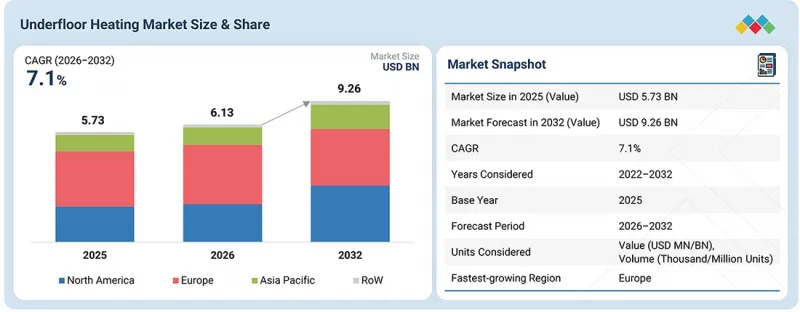
The global underfloor heating market is anticipated to reach USD 6.13 billion in 2026 and USD 9.26 billion by 2032, registering a CAGR of 7.1%. The demand for underfloor heating systems is increasing with the proliferation of energy-efficient building standards as modern facilities require continuous, low-temperature thermal management in complex indoor environments. The focus on smart home automation, connected IoT thermostats, and air-to-water heat pumps has significantly increased system balancing requirements, leading to a greater need for dependable, zone-specific temperature regulation. Inadequate or uneven thermal distribution can degrade indoor comfort, reduce operational energy efficiency, and cause elevated utility expenses.
| Scope of the Report | |
|---|---|
| Years Considered for the Study | 2021-2032 |
| Base Year | 2025 |
| Forecast Period | 2026-2032 |
| Units Considered | Value (USD Billion) |
| Segments | By Product Type, Installation, Offering and Region |
| Regions covered | North America, Europe, APAC, RoW |
As a result, building operators and property owners are integrating advanced distribution manifolds, cross-linked polyethylene (PEX) piping, and multi-zone digital thermostats to maintain thermal accuracy, lower building energy footprints, and comply with strict environmental building codes, especially in modern residential and commercial properties.
"Services segment to record the highest CAGR in the underfloor heating market from 2026 to 2032"
By offering, the services segment is expected to be the fastest-growing during the forecast period due to the increasing need for professional system design, precision installation, and long-term maintenance support. Modern underfloor heating systems (particularly complex hydronic pipe networks and integrated electric heating mats) require specialized engineering to ensure uniform thermal distribution across diverse flooring types and structural substrates. This expertise is critical for high-efficiency applications such as residential retrofits, large commercial spaces, and healthcare facilities where improper sub-floor installation can result in suboptimal energy performance or expensive structural repairs. With the expansion of low-temperature heating infrastructure driven by building decarbonization policies and green building standards, configuring system balancing and pressure testing has become essential. Additionally, professional services provide ongoing diagnostic support, hydronic manifold balancing, and integration with automated smart home climate platforms.
"Residential segment captured the largest share of the underfloor heating market in 2025"
By application, the residential segment held the largest market share in 2025 due to the widespread requirement for energy-efficient climate control and uniform heat distribution in domestic buildings. Modern residential developments continuously incorporate integrated building technologies such as air-to-water heat pumps, multi-zone hydronic manifolds, low-profile dry retrofit panels, and smart IoT thermostats. These applications require balanced fluid circulation and precise temperature regulation to optimize energy efficiency, reduce utility costs, and enable comfortable living environments. The expanding adoption of building decarbonization mandates across single-family housing, multi-family apartment complexes, and home renovation projects creates a consistent demand for reliable, dedicated radiant underfloor heating infrastructure.
"North America to grow at a significant rate in the underfloor heating market between 2026 and 2032"
By region, North America is expected to be the second-fastest-growing region during the forecast period. The regional market is driven by rising demand for energy-efficient and high-comfort heating solutions, particularly across residential renovations, new housing, and premium commercial spaces. Increasing adoption of heat pumps and other low-carbon heating technologies is creating synergies with hydronic underfloor systems, which can operate efficiently at lower water temperatures. In parallel, stringent energy-efficiency requirements and growing emphasis on building performance are encouraging developers and homeowners to consider integrated heating solutions that can reduce energy consumption and improve thermal comfort. Renovation of aging building stock, especially in colder parts of the US and Canada, is further expanding the addressable market. Rising consumer preference for zoned temperature control, smart-home integration, and aesthetically unobtrusive heating is also supporting adoption. Meanwhile, demand for luxury bathrooms, kitchens, and high-end residential developments is positioning electric underfloor heating as an increasingly attractive comfort-enhancement solution.
- By Company Type: Tier 1 - 25%, Tier 2 - 40%, and Tier 3 - 35%
- By Designation: Directors - 35%, C-level Executives - 30%, and Others - 35%
- By Region: North America - 25%, Europe - 20%, Asia Pacific - 45%, and RoW - 10%
Prominent players profiled in this report include Uponor Corporation (Finland), Danfoss (Denmark), REHAU (Switzerland), Resideo Technologies Inc (US), Watts (US), Warmup Plc (UK), MAGNUM Heating Group B.V. (Netherlands), Emerson Electric Co. (US), Robert Bosch GmbH (Germany), and Mitsubishi Electric Corporation (Japan), among others.
Research Coverage
The report defines, describes, and forecasts the underfloor heating market based on offering (hardware and services), product type (hydronic underfloor heating and electric underfloor heating), installation type (new installations and retrofit installations), application (residential, commercial, industrial, healthcare, sports & entertainment, and others), and Region (North America, Europe, Asia Pacific, and RoW). It provides detailed information regarding drivers, restraints, opportunities, and challenges influencing the market's growth. It also analyzes competitive developments, including acquisitions, product launches, expansions, and actions taken by key players to grow in the market.
Reasons to Buy This Report
The report will help market leaders/new entrants with information on the closest approximations of the revenue for the overall underfloor heating market and its subsegments. The report will help stakeholders understand the competitive landscape and gain more insight to position their business better and plan suitable go-to-market strategies. The report also helps stakeholders understand the market's pulse and provides information on key drivers, restraints, opportunities, and challenges.
The report will provide insights into the following points:
- Analysis of key drivers (Increasing demand for energy-efficient heating solutions, Rising implementation of stringent building codes and decarbonization mandates), restraints (High initial setup and installation costs, Longer thermal response times compared with convective heating systems), opportunities (Emergence of IoT-based smart thermostats and home automation, Integration with renewable energy sources), and challenges (Setup and retrofitting issues in existing building structures, Compatibility limitations across diverse flooring materials) influencing the growth of the underfloor heating market
- Product Development/Innovation: Detailed insights into upcoming technologies, research & development activities, and product launches in the market
- Market Development: Comprehensive information about lucrative markets (the report analyzes the market across various regions)
- Market Diversification: Exhaustive information about new products launched, untapped geographies, recent developments, and investments in the market
- Competitive Assessment: In-depth assessment of market share, growth strategies, and offerings of leading players, including Uponor Corporation (Finland), Danfoss (Denmark), REHAU (Switzerland), Resideo Technologies Inc (US), and Watts (US), in the market
TABLE OF CONTENTS
1 INTRODUCTION
- 1.1 STUDY OBJECTIVES
- 1.2 MARKET DEFINITION
- 1.3 MARKET SCOPE
- 1.3.1 MARKETS COVERED AND REGIONAL SCOPE
- 1.3.2 YEARS CONSIDERED
- 1.3.3 INCLUSIONS AND EXCLUSIONS
- 1.4 CURRENCY CONSIDERED
- 1.5 UNITS CONSIDERED
- 1.6 STAKEHOLDERS
- 1.7 SUMMARY OF CHANGES
2 EXECUTIVE SUMMARY
- 2.1 MARKET HIGHLIGHTS AND KEY INSIGHTS
- 2.2 KEY MARKET PARTICIPANTS: MAPPING OF STRATEGIC DEVELOPMENTS
- 2.3 DISRUPTIVE TRENDS IN UNDERFLOOR HEATING MARKET
- 2.4 HIGH-GROWTH SEGMENTS
- 2.5 REGIONAL SNAPSHOT: MARKET SIZE, GROWTH RATE, AND FORECAST
3 PREMIUM INSIGHTS
- 3.1 ATTRACTIVE OPPORTUNITIES FOR PLAYERS IN UNDERFLOOR HEATING MARKET
- 3.2 UNDERFLOOR HEATING MARKET, BY OFFERING
- 3.3 UNDERFLOOR HEATING MARKET, BY PRODUCT TYPE
- 3.4 UNDERFLOOR HEATING MARKET, BY INSTALLATION TYPE
- 3.5 UNDERFLOOR HEATING MARKET, BY APPLICATION
- 3.6 UNDERFLOOR HEATING MARKET IN NORTH AMERICA, BY APPLICATION AND COUNTRY
- 3.7 UNDERFLOOR HEATING MARKET, BY COUNTRY
4 MARKET OVERVIEW
- 4.1 INTRODUCTION
- 4.2 MARKET DYNAMICS
- 4.2.1 DRIVERS
- 4.2.1.1 Increasing demand for cost-effective and advanced heating solutions
- 4.2.1.2 Rising adoption due to government support and incentives
- 4.2.1.3 Implementation of stringent building codes
- 4.2.1.4 Integration of renewable energy sources
- 4.2.2 RESTRAINTS
- 4.2.2.1 Longer response time than for other heating systems
- 4.2.2.2 High installation costs
- 4.2.2.3 Time-consuming and complex regulatory approval process
- 4.2.3 OPPORTUNITIES
- 4.2.3.1 Technological advancements and digitalization trends
- 4.2.3.2 Emergence of IoT-based underfloor heating systems
- 4.2.3.3 Expanding construction industry
- 4.2.4 CHALLENGES
- 4.2.4.1 Setup issues associated with underfloor heating systems
- 4.2.1 DRIVERS
- 4.3 INTERCONNECTED MARKETS AND CROSS SECTOR OPPORTUNITIES
- 4.4 STRATEGIC MOVES BY TIER 1/2/3 PLAYERS
5 INDUSTRY TRENDS
- 5.1 PORTER'S FIVE FORCES ANALYSIS
- 5.1.1 THREAT OF NEW ENTRANTS
- 5.1.2 THREAT OF SUBSTITUTES
- 5.1.3 BARGAINING POWER OF SUPPLIERS
- 5.1.4 BARGAINING POWER OF BUYERS
- 5.1.5 INTENSITY OF COMPETITIVE RIVALRY
- 5.2 MACROECONOMIC OUTLOOK
- 5.2.1 INTRODUCTION
- 5.2.2 GDP TRENDS AND FORECAST
- 5.2.3 TRENDS IN RESIDENTIAL APPLICATION
- 5.2.4 TRENDS IN COMMERCIAL APPLICATION
- 5.2.5 TRENDS IN INDUSTRIAL APPLICATION
- 5.3 VALUE CHAIN ANALYSIS
- 5.4 ECOSYSTEM ANALYSIS
- 5.5 PRICING ANALYSIS
- 5.5.1 INDICATIVE PRICING OF UNDERFLOOR HEATING, BY KEY PLAYER, 2025
- 5.5.2 AVERAGE SELLING PRICE TREND, BY REGION, 2022-2025
- 5.6 TRADE ANALYSIS
- 5.6.1 IMPORT SCENARIO (HS CODE 841861)
- 5.6.2 EXPORT SCENARIO (HS CODE 841861)
- 5.7 KEY CONFERENCES AND EVENTS, 2026-2027
- 5.8 TRENDS/DISRUPTIONS IMPACTING CUSTOMER BUSINESS
- 5.9 INVESTMENT AND FUNDING SCENARIO
- 5.10 CASE STUDY ANALYSIS
- 5.10.1 UPONOR RADIANT UNDERFLOOR HEATING SYSTEM INSTALLED IN RESIDENTIAL PROJECT TO OPTIMIZE THERMAL EFFICIENCY AND AIR QUALITY
- 5.10.2 HARROW ROAD DEVELOPMENT INSTALLS WARMUP HYDRONIC UNDERFLOOR HEATING SYSTEM TO OPTIMIZE ENERGY PERFORMANCE
- 5.10.3 ROSSLYN CASTLE INSTALLS REHAU UNDERFLOOR HEATING SYSTEM TO DELIVER LOW CARBON HEAT AND PRESERVE HISTORIC ARCHITECTURE
- 5.10.4 DANFOSS ICON2 SYSTEM INSTALLED IN RESIDENTIAL PROPERTY TO IMPROVE THERMAL REGULATION AND REDUCE ENERGY CONSUMPTION
- 5.10.5 COPENHAGEN MODERN COMMUNITY DEPLOYS DANFOSS HYDRONIC UNDERFLOOR HEATING SYSTEM TO ENHANCE DISTRICT ENERGY EFFICIENCY
- 5.11 IMPACT OF 2025 US TARIFF - UNDERFLOOR HEATING MARKET
- 5.11.1 INTRODUCTION
- 5.11.2 KEY TARIFF RATES
- 5.11.3 PRICE IMPACT ANALYSIS
- 5.11.4 IMPACT ON COUNTRIES/REGIONS
- 5.11.4.1 US
- 5.11.4.2 Europe
- 5.11.4.3 Asia Pacific
- 5.11.5 IMPACT ON APPLICATIONS
6 TECHNOLOGICAL ADVANCEMENTS, AI-DRIVEN IMPACT, PATENTS, INNOVATIONS, AND FUTURE APPLICATIONS
- 6.1 TECHNOLOGY ANALYSIS
- 6.1.1 KEY TECHNOLOGIES
- 6.1.1.1 Internet of Things (IoT)
- 6.1.1.2 Predictive maintenance
- 6.1.2 COMPLEMENTARY TECHNOLOGIES
- 6.1.2.1 Artificial intelligence (AI)
- 6.1.3 ADJACENT TECHNOLOGIES
- 6.1.3.1 Graphene heating films
- 6.1.1 KEY TECHNOLOGIES
- 6.2 TECHNOLOGY/PRODUCT ROADMAP
- 6.3 PATENT ANALYSIS
- 6.4 IMPACT OF AI/GEN AI ON UNDERFLOOR HEATING MARKET
- 6.4.1 TOP USE CASES AND MARKET POTENTIAL
- 6.4.1.1 Adaptive radiant control via machine learning (GF building flow solutions/Uponor Smatrix AI)
- 6.4.1.2 Cloud-based AI heating optimization for district-connected buildings (Danfoss Leanheat Building)
- 6.4.1.3 Real-time occupancy-based heating automation (Honeywell Forge + Cisco Spaces Integration)
- 6.4.2 BEST PRACTICES FOLLOWED BY OEMS IN UNDERFLOOR HEATING MARKET
- 6.4.3 CASE STUDIES RELATED TO AI/GEN AI IMPLEMENTATION IN UNDERFLOOR HEATING MARKET
- 6.4.4 INTERCONNECTED ECOSYSTEM AND IMPACT ON MARKET PLAYERS
- 6.4.5 CLIENTS' READINESS TO ADOPT AI/GEN AI-INTEGRATED UNDERFLOOR HEATING SOLUTIONS
- 6.4.1 TOP USE CASES AND MARKET POTENTIAL
- 6.5 SUCCESS STORIES AND REAL WORLD APPLICATIONS
7 REGULATORY LANDSCAPE
- 7.1 REGIONAL REGULATIONS AND COMPLIANCE
- 7.1.1 REGULATORY BODIES, GOVERNMENT AGENCIES, AND OTHER ORGANIZATIONS
- 7.1.2 STANDARDS
- 7.1.3 REGULATIONS
8 CUSTOMER LANDSCAPE & BUYER BEHAVIOUR
- 8.1 INTRODUCTION
- 8.2 DECISION-MAKING PROCESS
- 8.3 KEY STAKEHOLDERS INVOLVED IN BUYING PROCESS AND EVALUATION CRITERIA
- 8.3.1 KEY STAKEHOLDERS IN BUYING PROCESS
- 8.3.2 BUYING CRITERIA
- 8.4 ADOPTION BARRIERS AND INTERNAL CHALLENGES
- 8.5 UNMET NEEDS OF VARIOUS APPLICATIONS
- 8.6 MARKET PROFITABILITY
- 8.6.1 REVENUE POTENTIAL
- 8.6.2 COST DYNAMICS
- 8.6.3 MARGIN OPPORTUNITIES, BY APPLICATION
9 TYPES OF FLOOR COVERINGS FOR UNDERFLOOR HEATING
- 9.1 INTRODUCTION
- 9.2 TILE AND STONE
- 9.2.1 PROVIDE LONG-LASTING WARMTH DUE TO HIGH THERMAL CONDUCTIVITY
- 9.3 WOOD FLOORING
- 9.3.1 OFFERS VARYING DEGREES OF WARMTH BASED ON DENSITY
- 9.4 LAMINATE FLOORING
- 9.4.1 MOST APPROPRIATE CHOICE FOR RESIDENTIAL APPLICATIONS
- 9.5 VINYL AND LINOLEUM FLOORING
- 9.5.1 PROVIDES QUICK HEATING AND COOLING IN HOMES
- 9.6 RUBBER AND CARPET FLOORING
- 9.6.1 HIGHLY CONDUCTIVE RUBBER PREFERRED IN INDUSTRIAL AREAS
10 CONNECTION TYPES OF UNDERFLOOR HEATING SYSTEMS
- 10.1 INTRODUCTION
- 10.2 CONNECTED
- 10.2.1 IMPROVED FUNCTIONALITY DUE TO INTEGRATION OF NEW TECHNOLOGIES
- 10.3 NON-CONNECTED
- 10.3.1 COST-EFFECTIVE AND EASY TO INSTALL
11 COMPONENTS OF UNDERFLOOR HEATING
- 11.1 INTRODUCTION
- 11.2 HEATING COMPONENTS
- 11.2.1 HEATING PIPES
- 11.2.2 HEATING CABLES
- 11.2.3 HEATING MATS
- 11.2.4 HEATING FILMS
- 11.2.5 OTHER HEATING ELEMENTS
- 11.3 HYDRONIC COMPONENTS
- 11.3.1 MANIFOLDS
- 11.3.2 ACTUATORS
- 11.3.3 PUMPS
- 11.3.4 MIXING VALVES
- 11.3.5 ZONE VALVES
- 11.3.6 FLOW METERS
- 11.3.7 PIPE FITTINGS
- 11.3.8 BALANCING VALVES
- 11.3.9 WIRING CENTERS
- 11.4 THERMAL COMPONENTS
- 11.4.1 INSULATION BOARDS
- 11.4.2 THERMAL REFLECTIVE LAYERS
- 11.4.3 UNDERLAYMENTS
- 11.4.4 SCREEDS
- 11.4.5 FLOOR PANELS
- 11.5 CONTROL COMPONENTS
- 11.5.1 THERMOSTATS
- 11.5.2 SENSORS
- 11.5.2.1 Temperature sensors
- 11.5.2.2 Floor sensors
- 11.5.2.3 Humidity sensors
- 11.5.3 SMART CONTROLLERS
- 11.5.4 ZONE CONTROLLERS
- 11.5.5 WI-FI CONTROLLERS
- 11.5.6 WIRELESS CONTROLS
12 UNDERFLOOR HEATING MARKET, BY INSTALLATION TYPE
- 12.1 INTRODUCTION
- 12.2 NEW INSTALLATIONS
- 12.2.1 STRICT ENERGY EFFICIENCY STANDARDS AND CODES TO DRIVE DEMAND
- 12.3 RETROFIT INSTALLATIONS
- 12.3.1 WIDER ADOPTION OF ELECTRIC SYSTEMS FOR RENOVATIONS TO BOOST MARKET
13 UNDERFLOOR HEATING MARKET, BY OFFERING
- 13.1 INTRODUCTION
- 13.2 HARDWARE
- 13.2.1 ADVANCEMENTS RELATED TO HARDWARE INTEGRATION TO DRIVE DEMAND
- 13.3 SERVICES
- 13.3.1 INCREASED DEMAND IN RESIDENTIAL AND COMMERCIAL SECTORS TO BOOST MARKET
14 UNDERFLOOR HEATING MARKET, BY PRODUCT TYPE
- 14.1 INTRODUCTION
- 14.2 HYDRONIC UNDERFLOOR HEATING
- 14.2.1 HEATING PIPES
- 14.2.1.1 Designed to disperse heat evenly
- 14.2.2 THERMOSTATS & SENSORS
- 14.2.2.1 Used to regulate temperature
- 14.2.3 THERMAL ACTUATORS
- 14.2.3.1 Designed to control hot water flow in underfloor heating zones
- 14.2.4 ZONE VALVES
- 14.2.4.1 Used to control heating operations of different building zones
- 14.2.5 WIRING CENTERS
- 14.2.5.1 Regulate heating operations from centralized location
- 14.2.6 MANIFOLDS & VALVES
- 14.2.6.1 Used to control room temperature
- 14.2.1 HEATING PIPES
- 14.3 ELECTRIC UNDERFLOOR HEATING
- 14.3.1 HEATING CABLES
- 14.3.1.1 Used to facilitate underfloor heating
- 14.3.2 HEATING MATS
- 14.3.2.1 Critical part of DIY-based underfloor heating systems
- 14.3.3 THERMOSTATS & SENSORS
- 14.3.3.1 Monitor and maintain floor temperature
- 14.3.1 HEATING CABLES
15 UNDERFLOOR HEATING MARKET, BY APPLICATION
- 15.1 INTRODUCTION
- 15.2 RESIDENTIAL
- 15.2.1 SINGLE-FAMILY HOMES
- 15.2.1.1 Need for energy efficiency and design flexibility to drive demand
- 15.2.2 APARTMENTS
- 15.2.2.1 Reduced energy consumption to boost market
- 15.2.1 SINGLE-FAMILY HOMES
- 15.3 COMMERCIAL
- 15.3.1 RETAIL
- 15.3.1.1 Growing adoption of humidity control systems to drive market
- 15.3.2 TRANSPORTATION AND LOGISTICS
- 15.3.2.1 Need for efficient heating systems to fuel adoption
- 15.3.3 HOSPITALITY
- 15.3.3.1 High energy efficiency and aesthetic advantages to drive demand
- 15.3.1 RETAIL
- 15.4 HEALTHCARE
- 15.4.1 GROWING DEPLOYMENT IN MEDICAL FACILITIES TO PROPEL MARKET
- 15.5 SPORTS & ENTERTAINMENT
- 15.5.1 RISING USE TO CREATE COMFORTABLE ENVIRONMENTS TO DRIVE MARKET
- 15.6 INDUSTRIAL
- 15.6.1 INCREASING DEPLOYMENT IN VARIOUS SETTINGS TO DRIVE DEMAND
- 15.7 OTHERS
16 UNDERFLOOR HEATING MARKET, BY REGION
- 16.1 INTRODUCTION
- 16.2 NORTH AMERICA
- 16.2.1 US
- 16.2.1.1 Strict government regulations to drive demand
- 16.2.2 CANADA
- 16.2.2.1 Increasing public awareness to boost market
- 16.2.3 MEXICO
- 16.2.3.1 Government efforts to increase adoption to bolster market
- 16.2.1 US
- 16.3 EUROPE
- 16.3.1 UK
- 16.3.1.1 Government initiatives and regulations to boost market
- 16.3.2 GERMANY
- 16.3.2.1 Mandatory construction standards and directives to drive demand
- 16.3.3 FRANCE
- 16.3.3.1 Focus on sustainability to fuel market
- 16.3.4 BELGIUM
- 16.3.4.1 Increasing renovation and retrofit projects to boost market
- 16.3.5 NETHERLANDS
- 16.3.5.1 Focus on reducing energy consumption to drive market
- 16.3.6 POLAND
- 16.3.6.1 Commitment to thermal modernization to boost demand
- 16.3.7 REST OF EUROPE
- 16.3.1 UK
- 16.4 ASIA PACIFIC
- 16.4.1 CHINA
- 16.4.1.1 Need to reduce greenhouse gas emissions to drive market
- 16.4.2 JAPAN
- 16.4.2.1 Increasing demand for modern heating solutions to fuel market
- 16.4.3 SOUTH KOREA
- 16.4.3.1 Rising requirement for efficient heating systems to propel demand
- 16.4.4 REST OF ASIA PACIFIC
- 16.4.1 CHINA
- 16.5 ROW
- 16.5.1 MIDDLE EAST & AFRICA
- 16.5.1.1 Expanding luxury real estate developments and green building standards to drive demand
- 16.5.2 SOUTH AMERICA
- 16.5.2.1 Growing demand for sustainable solutions to bolster market
- 16.5.1 MIDDLE EAST & AFRICA
17 COMPETITIVE LANDSCAPE
- 17.1 OVERVIEW
- 17.2 KEY PLAYER COMPETITIVE STRATEGIES/RIGHT TO WIN, 2023-2026
- 17.2.1 PRODUCT PORTFOLIO EXPANSION
- 17.2.2 REGIONAL FOOTPRINT EXPANSION
- 17.2.3 SOLUTION OFFERING EXPANSION
- 17.2.4 ORGANIC/INORGANIC STRATEGIES
- 17.3 REVENUE ANALYSIS, 2021-2025
- 17.4 MARKET SHARE ANALYSIS, 2O25
- 17.5 COMPANY VALUATION AND FINANCIAL METRICS
- 17.6 BRAND COMPARISON
- 17.7 COMPANY EVALUATION MATRIX: KEY PLAYERS, 2025
- 17.7.1 STARS
- 17.7.2 EMERGING LEADERS
- 17.7.3 PERVASIVE PLAYERS
- 17.7.4 PARTICIPANTS
- 17.7.5 COMPANY FOOTPRINT: KEY PLAYERS, 2025
- 17.7.5.1 Company footprint
- 17.7.5.2 Region footprint
- 17.7.5.3 Product type footprint
- 17.7.5.4 Installation type footprint
- 17.7.5.5 Application footprint
- 17.8 COMPANY EVALUATION MATRIX: STARTUPS/SMES, 2025
- 17.8.1 PROGRESSIVE COMPANIES
- 17.8.2 RESPONSIVE COMPANIES
- 17.8.3 DYNAMIC COMPANIES
- 17.8.4 STARTING BLOCKS
- 17.8.5 COMPETITIVE BENCHMARKING: STARTUPS/SMES, 2025
- 17.8.5.1 Detailed list of key startups/SMEs
- 17.8.5.2 Competitive benchmarking of key startups/SMEs
- 17.9 COMPETITIVE SCENARIO
- 17.9.1 PRODUCT LAUNCHES
- 17.9.2 DEALS
18 COMPANY PROFILES
- 18.1 KEY PLAYERS
- 18.1.1 UPONOR CORPORATION
- 18.1.1.1 Business overview
- 18.1.1.2 Products/Solutions/Services offered
- 18.1.1.3 Recent developments
- 18.1.1.3.1 Deals
- 18.1.1.4 MnM view
- 18.1.1.4.1 Key strengths/Right to win
- 18.1.1.4.2 Strategic choices
- 18.1.1.4.3 Weaknesses/Competitive threats
- 18.1.2 DANFOSS
- 18.1.2.1 Business overview
- 18.1.2.2 Products/Solutions/Services offered
- 18.1.2.3 Recent developments
- 18.1.2.3.1 Deals
- 18.1.2.4 MnM view
- 18.1.2.4.1 Key strengths/Right to win
- 18.1.2.4.2 Strategic choices
- 18.1.2.4.3 Weaknesses/Competitive threats
- 18.1.3 REHAU LTD
- 18.1.3.1 Business overview
- 18.1.3.2 Products/Solutions/Services offered
- 18.1.3.3 Recent developments
- 18.1.3.3.1 Product launches
- 18.1.3.4 MnM view
- 18.1.3.4.1 Key strengths/Right to win
- 18.1.3.4.2 Strategic choices
- 18.1.3.4.3 Weaknesses/Competitive threats
- 18.1.4 RESIDEO TECHNOLOGIES INC.
- 18.1.4.1 Business overview
- 18.1.4.2 Products/Solutions/Services offered
- 18.1.4.3 Recent developments
- 18.1.4.3.1 Product launches
- 18.1.4.3.2 Deals
- 18.1.4.4 MnM view
- 18.1.4.4.1 Key strengths/Right to win
- 18.1.4.4.2 Strategic choices
- 18.1.4.4.3 Weaknesses/Competitive threats
- 18.1.5 WATTS
- 18.1.5.1 Business overview
- 18.1.5.2 Products/Solutions/Services offered
- 18.1.5.3 Recent developments
- 18.1.5.3.1 Product launches
- 18.1.5.4 MnM view
- 18.1.5.4.1 Key strengths/Right to win
- 18.1.5.4.2 Strategic choices
- 18.1.5.4.3 Weaknesses/Competitive threats
- 18.1.6 WARMUP PLC
- 18.1.6.1 Business overview
- 18.1.6.2 Products/Solutions/Services offered
- 18.1.6.3 Recent developments
- 18.1.6.3.1 Product launches
- 18.1.6.4 MnM view
- 18.1.6.4.1 Key strengths/Right to win
- 18.1.6.4.2 Strategic choices
- 18.1.6.4.3 Weaknesses/Competitive threats
- 18.1.7 MAGNUM HEATING GROUP B.V.
- 18.1.7.1 Business overview
- 18.1.7.2 Products/Solutions/Services offered
- 18.1.7.3 MnM view
- 18.1.7.3.1 Key strengths/Right to win
- 18.1.7.3.2 Strategic choices
- 18.1.7.3.3 Weaknesses/Competitive threats
- 18.1.8 EMERSON ELECTRIC CO.
- 18.1.8.1 Business overview
- 18.1.8.2 Products/Solutions/Services offered
- 18.1.9 ROBERT BOSCH GMBH
- 18.1.9.1 Business overview
- 18.1.9.2 Products/Solutions/Services offered
- 18.1.9.3 Recent developments
- 18.1.9.3.1 Deals
- 18.1.10 MITSUBISHI ELECTRIC CORPORATION
- 18.1.10.1 Business overview
- 18.1.10.2 Products/Solutions/Services offered
- 18.1.10.3 Recent developments
- 18.1.10.3.1 Product launches
- 18.1.11 SIEMENS AG
- 18.1.11.1 Business overview
- 18.1.11.2 Products/Solutions/Services offered
- 18.1.12 SCHNEIDER ELECTRIC
- 18.1.12.1 Business overview
- 18.1.12.2 Products/Solutions/Services offered
- 18.1.13 INCOGNITO HEAT CO.
- 18.1.13.1 Business overview
- 18.1.13.2 Products/Solutions/Services offered
- 18.1.1 UPONOR CORPORATION
- 18.2 OTHER PLAYERS
- 18.2.1 MYSON
- 18.2.2 THERMOSOFT INTERNATIONAL CORPORATION
- 18.2.3 FLEXEL INTERNATIONAL
- 18.2.4 NEXANS
- 18.2.5 AMUHEAT
- 18.2.6 ESI HEATING AND COOLING
- 18.2.7 JANES RADIANT HEATING
- 18.2.8 WARMAFLOOR
- 18.2.9 RAYOTEC LTD
- 18.2.10 RBT UNDERFLOOR LTD
- 18.2.11 UHEAT
- 18.2.12 SCHLUTER SYSTEMS
19 RESEARCH METHODOLOGY
- 19.1 RESEARCH DATA
- 19.1.1 SECONDARY DATA
- 19.1.1.1 List of key secondary sources
- 19.1.1.2 Key data from secondary sources
- 19.1.2 PRIMARY DATA
- 19.1.2.1 List of primary interview participants
- 19.1.2.2 Breakdown of primary interviews
- 19.1.2.3 Key data from primary sources
- 19.1.2.4 Key industry insights
- 19.1.3 SECONDARY AND PRIMARY RESEARCH
- 19.1.1 SECONDARY DATA
- 19.2 MARKET SIZE ESTIMATION
- 19.2.1 BOTTOM-UP APPROACH
- 19.2.1.1 Approach to arrive at market size using bottom-up analysis (demand side)
- 19.2.2 TOP-DOWN APPROACH
- 19.2.2.1 Approach to arrive at market size using top-down analysis (supply side)
- 19.2.1 BOTTOM-UP APPROACH
- 19.3 FACTOR ANALYSIS
- 19.3.1 DEMAND-SIDE ANALYSIS
- 19.3.2 SUPPLY-SIDE ANALYSIS
- 19.4 MARKET BREAKDOWN AND DATA TRIANGULATION
- 19.5 RESEARCH ASSUMPTIONS
- 19.6 RISK ANALYSIS
- 19.7 RESEARCH LIMITATIONS
20 APPENDIX
- 20.1 KNOWLEDGESTORE: MARKETSANDMARKETS' SUBSCRIPTION PORTAL
- 20.2 CUSTOMIZATION OPTIONS
- 20.3 RELATED REPORTS
- 20.4 AUTHOR DETAILS
List of Tables
- TABLE 1 UNDERFLOOR HEATING MARKET: INCLUSIONS AND EXCLUSIONS
- TABLE 2 UNDERFLOOR HEATING MARKET: SUMMARY OF CHANGES
- TABLE 3 INTERCONNECTED MARKETS AND CROSS SECTOR OPPORTUNITIES RELATED TO UNDERFLOOR HEATING
- TABLE 4 STRATEGIC FOCUS ON MAJOR COMPANIES IN UNDERFLOOR HEATING MARKET
- TABLE 5 PORTER'S FIVE FORCES ANALYSIS
- TABLE 6 GDP GROWTH RATES (%), BY COUNTRY, 2021-2030
- TABLE 7 ROLE OF COMPANIES IN UNDERFLOOR HEATING ECOSYSTEM
- TABLE 8 INDICATIVE PRICING OF UNDERFLOOR HEATING, BY KEY PLAYER, 2025 (USD)
- TABLE 9 AVERAGE SELLING PRICE TREND OF UNDERFLOOR HEATING, BY REGION, 2022-2025 (USD)
- TABLE 10 IMPORT DATA FOR HS CODE 841861-COMPLIANT PRODUCTS, BY COUNTRY, 2021-2025 (USD MILLION)
- TABLE 11 EXPORT DATA FOR HS CODE 841861-COMPLIANT PRODUCTS, BY COUNTRY, 2021-2025 (USD MILLION)
- TABLE 12 LIST OF KEY CONFERENCES AND EVENTS, 2026-2027
- TABLE 13 UPONOR RADIANT UNDERFLOOR HEATING SYSTEM INSTALLED TO OPTIMIZE THERMAL EFFICIENCY AND REDUCE ENERGY USAGE
- TABLE 14 WARMUP HYDRONIC UNDERFLOOR HEATING SYSTEM INSTALLED TO OPTIMIZE ENERGY PERFORMANCE AND THERMAL COMFORT
- TABLE 15 REHAU UNDERFLOOR HEATING SYSTEM INSTALLED TO DELIVER LOW-CARBON HEAT AND REDUCE ENERGY CONSUMPTION
- TABLE 16 DANFOSS ICON2 SYSTEM INSTALLED TO OPTIMIZE HYDRONIC HEATING EFFICIENCY AND ENHANCE TEMPERATURE CONTROL
- TABLE 17 DANFOSS HYDRONIC UNDERFLOOR HEATING SYSTEM INSTALLED TO OPTIMIZE DISTRICT HEATING EFFICIENCY AND REDUCE SYSTEM DOWNTIME
- TABLE 18 US ADJUSTED RECIPROCAL TARIFF RATES, 2025 (USD BILLION)
- TABLE 19 LIST OF MAJOR PATENTS, 2017-2026
- TABLE 20 BEST PRACTICES FOLLOWED BY COMPANIES IN UNDERFLOOR HEATING MARKET
- TABLE 21 CASE STUDIES RELATED TO AI/GEN AI IMPLEMENTATION
- TABLE 22 INTERCONNECTED ECOSYSTEM AND IMPACT ON UNDERFLOOR HEATING MARKET PLAYERS
- TABLE 23 NORTH AMERICA: REGULATORY BODIES, GOVERNMENT AGENCIES, AND OTHER ORGANIZATIONS
- TABLE 24 EUROPE: REGULATORY BODIES, GOVERNMENT AGENCIES, AND OTHER ORGANIZATIONS
- TABLE 25 ASIA PACIFIC: REGULATORY BODIES, GOVERNMENT AGENCIES, AND OTHER ORGANIZATIONS
- TABLE 26 ROW: REGULATORY BODIES, GOVERNMENT AGENCIES, AND OTHER ORGANIZATIONS
- TABLE 27 INFLUENCE OF STAKEHOLDERS ON BUYING PROCESS FOR TOP THREE APPLICATIONS
- TABLE 28 KEY BUYING CRITERIA FOR TOP THREE APPLICATIONS
- TABLE 29 UNDERFLOOR HEATING ADOPTION BARRIERS AND INTERNAL CHALLENGES
- TABLE 30 UNMET NEEDS IN UNDERFLOOR HEATING MARKET, BY APPLICATION
- TABLE 31 COMPARISON OF FLOOR COVERING TYPES
- TABLE 32 ADVANTAGES OF VARIOUS FLOOR COVERING TYPES
- TABLE 33 ADVANTAGES OF WOODEN FLOOR COVERINGS
- TABLE 34 UNDERFLOOR HEATING MARKET, BY INSTALLATION TYPE, 2022-2025 (USD MILLION)
- TABLE 35 UNDERFLOOR HEATING MARKET, BY INSTALLATION TYPE, 2026-2032 (USD MILLION)
- TABLE 36 NEW INSTALLATIONS: UNDERFLOOR HEATING MARKET, BY APPLICATION, 2022-2025 (USD MILLION)
- TABLE 37 NEW INSTALLATIONS: UNDERFLOOR HEATING MARKET, BY APPLICATION, 2026-2032 (USD MILLION)
- TABLE 38 RETROFIT INSTALLATIONS: UNDERFLOOR HEATING MARKET, BY APPLICATION, 2022-2025 (USD MILLION)
- TABLE 39 RETROFIT INSTALLATIONS: UNDERFLOOR HEATING MARKET, BY APPLICATION, 2026-2032 (USD MILLION)
- TABLE 40 UNDERFLOOR HEATING MARKET, BY OFFERING, 2022-2025 (USD MILLION)
- TABLE 41 UNDERFLOOR HEATING MARKET, BY OFFERING, 2026-2032 (USD MILLION)
- TABLE 42 HARDWARE: UNDERFLOOR HEATING MARKET, BY PRODUCT TYPE, 2022-2025 (USD MILLION)
- TABLE 43 HARDWARE: UNDERFLOOR HEATING MARKET, BY PRODUCT TYPE, 2026-2032 (USD MILLION)
- TABLE 44 SERVICES: UNDERFLOOR HEATING MARKET, BY PRODUCT TYPE, 2022-2025 (USD MILLION)
- TABLE 45 SERVICES: UNDERFLOOR HEATING MARKET, BY PRODUCT TYPE, 2026-2032 (USD MILLION)
- TABLE 46 UNDERFLOOR HEATING MARKET, BY PRODUCT TYPE, 2022-2025 (USD MILLION)
- TABLE 47 UNDERFLOOR HEATING MARKET, BY PRODUCT TYPE, 2026-2032 (USD MILLION)
- TABLE 48 HYDRONIC UNDERFLOOR HEATING: UNDERFLOOR HEATING MARKET, BY COMPONENT TYPE, 2022-2025 (MILLION UNITS/MILLION FEET)
- TABLE 49 HYDRONIC UNDERFLOOR HEATING: UNDERFLOOR HEATING MARKET, BY COMPONENT TYPE, 2026-2032 (MILLION UNITS/MILLION FEET)
- TABLE 50 ELECTRIC UNDERFLOOR HEATING: UNDERFLOOR HEATING MARKET, BY COMPONENT TYPE, 2022-2025 (MILLION UNITS/MILLION FEET/ MILLION SQUARE FEET)
- TABLE 51 ELECTRIC UNDERFLOOR HEATING: UNDERFLOOR HEATING MARKET, BY COMPONENT TYPE, 2026-2032 (MILLION UNITS/MILLION FEET/ MILLION SQUARE FEET)
- TABLE 52 HYDRONIC UNDERFLOOR HEATING: UNDERFLOOR HEATING MARKET, BY APPLICATION, 2022-2025 (USD MILLION)
- TABLE 53 HYDRONIC UNDERFLOOR HEATING: UNDERFLOOR HEATING MARKET, BY APPLICATION, 2026-2032 (USD MILLION)
- TABLE 54 HYDRONIC UNDERFLOOR HEATING: UNDERFLOOR HEATING MARKET, BY OFFERING, 2022-2025 (USD MILLION)
- TABLE 55 HYDRONIC UNDERFLOOR HEATING: UNDERFLOOR HEATING MARKET, BY OFFERING, 2026-2032 (USD MILLION)
- TABLE 56 HYDRONIC UNDERFLOOR HEATING: UNDERFLOOR HEATING MARKET, BY COMPONENT TYPE, 2022-2025 (USD MILLION)
- TABLE 57 HYDRONIC UNDERFLOOR HEATING: UNDERFLOOR HEATING MARKET, BY COMPONENT TYPE, 2026-2032 (USD MILLION)
- TABLE 58 ELECTRIC UNDERFLOOR HEATING: UNDERFLOOR HEATING MARKET, BY APPLICATION, 2022-2025 (USD MILLION)
- TABLE 59 ELECTRIC UNDERFLOOR HEATING: UNDERFLOOR HEATING MARKET, BY APPLICATION, 2026-2032 (USD MILLION)
- TABLE 60 ELECTRIC UNDERFLOOR HEATING: UNDERFLOOR HEATING MARKET, BY OFFERING, 2022-2025 (USD MILLION)
- TABLE 61 ELECTRIC UNDERFLOOR HEATING: UNDERFLOOR HEATING MARKET, BY OFFERING, 2026-2032 (USD MILLION)
- TABLE 62 ELECTRIC UNDERFLOOR HEATING: UNDERFLOOR HEATING MARKET, BY COMPONENT TYPE, 2022-2025 (USD MILLION)
- TABLE 63 ELECTRIC UNDERFLOOR HEATING: UNDERFLOOR HEATING MARKET, BY COMPONENT TYPE, 2026-2032 (USD MILLION)
- TABLE 64 UNDERFLOOR HEATING MARKET, BY APPLICATION, 2022-2025 (USD MILLION)
- TABLE 65 UNDERFLOOR HEATING MARKET, BY APPLICATION, 2026-2032 (USD MILLION)
- TABLE 66 RESIDENTIAL: UNDERFLOOR HEATING MARKET, BY PRODUCT TYPE, 2022-2025 (USD MILLION)
- TABLE 67 RESIDENTIAL: UNDERFLOOR HEATING MARKET, BY PRODUCT TYPE, 2026-2032 (USD MILLION)
- TABLE 68 RESIDENTIAL: UNDERFLOOR HEATING MARKET, BY INSTALLATION TYPE, 2022-2025 (USD MILLION)
- TABLE 69 RESIDENTIAL: UNDERFLOOR HEATING MARKET, BY INSTALLATION TYPE, 2026-2032 (USD MILLION)
- TABLE 70 RESIDENTIAL: UNDERFLOOR HEATING MARKET, BY REGION, 2022-2025 (USD MILLION)
- TABLE 71 RESIDENTIAL: UNDERFLOOR HEATING MARKET, BY REGION, 2026-2032 (USD MILLION)
- TABLE 72 COMMERCIAL: UNDERFLOOR HEATING MARKET, BY PRODUCT TYPE, 2022-2025 (USD MILLION)
- TABLE 73 COMMERCIAL: UNDERFLOOR HEATING MARKET, BY PRODUCT TYPE, 2026-2032 (USD MILLION)
- TABLE 74 COMMERCIAL: UNDERFLOOR HEATING MARKET, BY INSTALLATION TYPE, 2022-2025 (USD MILLION)
- TABLE 75 COMMERCIAL: UNDERFLOOR HEATING MARKET, BY INSTALLATION TYPE, 2026-2032 (USD MILLION)
- TABLE 76 COMMERCIAL: UNDERFLOOR HEATING MARKET, BY REGION, 2022-2025 (USD MILLION)
- TABLE 77 COMMERCIAL: UNDERFLOOR HEATING MARKET, BY REGION, 2026-2032 (USD MILLION)
- TABLE 78 HEALTHCARE: UNDERFLOOR HEATING MARKET, BY PRODUCT TYPE, 2022-2025 (USD MILLION)
- TABLE 79 HEALTHCARE: UNDERFLOOR HEATING MARKET, BY PRODUCT TYPE, 2026-2032 (USD MILLION)
- TABLE 80 HEALTHCARE: UNDERFLOOR HEATING MARKET, BY INSTALLATION TYPE, 2022-2025 (USD MILLION)
- TABLE 81 HEALTHCARE: UNDERFLOOR HEATING MARKET, BY INSTALLATION TYPE, 2026-2032 (USD MILLION)
- TABLE 82 HEALTHCARE: UNDERFLOOR HEATING MARKET, BY REGION, 2022-2025 (USD MILLION)
- TABLE 83 HEALTHCARE: UNDERFLOOR HEATING MARKET, BY REGION, 2026-2032 (USD MILLION)
- TABLE 84 SPORTS & ENTERTAINMENT: UNDERFLOOR HEATING MARKET, BY PRODUCT TYPE, 2022-2025 (USD MILLION)
- TABLE 85 SPORTS & ENTERTAINMENT: UNDERFLOOR HEATING MARKET, BY PRODUCT TYPE, 2026-2032 (USD MILLION)
- TABLE 86 SPORTS & ENTERTAINMENT: UNDERFLOOR HEATING MARKET, BY INSTALLATION TYPE, 2022-2025 (USD MILLION)
- TABLE 87 SPORTS & ENTERTAINMENT: UNDERFLOOR HEATING MARKET, BY INSTALLATION TYPE, 2026-2032 (USD MILLION)
- TABLE 88 SPORTS & ENTERTAINMENT: UNDERFLOOR HEATING MARKET, BY REGION, 2022-2025 (USD MILLION)
- TABLE 89 SPORTS & ENTERTAINMENT: UNDERFLOOR HEATING MARKET, BY REGION, 2026-2032 (USD MILLION)
- TABLE 90 INDUSTRIAL: UNDERFLOOR HEATING MARKET, BY PRODUCT TYPE, 2022-2025 (USD MILLION)
- TABLE 91 INDUSTRIAL: UNDERFLOOR HEATING MARKET, BY PRODUCT TYPE, 2026-2032 (USD MILLION)
- TABLE 92 INDUSTRIAL: UNDERFLOOR HEATING MARKET, BY INSTALLATION TYPE, 2022-2025 (USD MILLION)
- TABLE 93 INDUSTRIAL: UNDERFLOOR HEATING MARKET, BY INSTALLATION TYPE, 2026-2032 (USD MILLION)
- TABLE 94 INDUSTRIAL: UNDERFLOOR HEATING MARKET, BY REGION, 2022-2025 (USD MILLION)
- TABLE 95 INDUSTRIAL: UNDERFLOOR HEATING MARKET, BY REGION, 2026-2032 (USD MILLION)
- TABLE 96 OTHERS: UNDERFLOOR HEATING MARKET, BY PRODUCT TYPE, 2022-2025 (USD MILLION)
- TABLE 97 OTHERS: UNDERFLOOR HEATING MARKET, BY PRODUCT TYPE, 2026-2032 (USD MILLION)
- TABLE 98 OTHERS: UNDERFLOOR HEATING MARKET, BY INSTALLATION TYPE, 2022-2025 (USD MILLION)
- TABLE 99 OTHERS: UNDERFLOOR HEATING MARKET, BY INSTALLATION TYPE, 2026-2032 (USD MILLION)
- TABLE 100 OTHERS: UNDERFLOOR HEATING MARKET, BY REGION, 2022-2025 (USD MILLION)
- TABLE 101 OTHERS: UNDERFLOOR HEATING MARKET, BY REGION, 2026-2032 (USD MILLION)
- TABLE 102 UNDERFLOOR HEATING MARKET, BY REGION, 2022-2025 (USD MILLION)
- TABLE 103 UNDERFLOOR HEATING MARKET, BY REGION, 2026-2032 (USD MILLION)
- TABLE 104 NORTH AMERICA: UNDERFLOOR HEATING MARKET, BY COUNTRY, 2022-2025 (USD MILLION)
- TABLE 105 NORTH AMERICA: UNDERFLOOR HEATING MARKET, BY COUNTRY, 2026-2032 (USD MILLION)
- TABLE 106 NORTH AMERICA: UNDERFLOOR HEATING MARKET, BY APPLICATION, 2022-2025 (USD MILLION)
- TABLE 107 NORTH AMERICA: UNDERFLOOR HEATING MARKET, BY APPLICATION, 2026-2032 (USD MILLION)
- TABLE 108 EUROPE: UNDERFLOOR HEATING MARKET, BY COUNTRY, 2022-2025 (USD MILLION)
- TABLE 109 EUROPE: UNDERFLOOR HEATING MARKET, BY COUNTRY, 2026-2032 (USD MILLION)
- TABLE 110 EUROPE: UNDERFLOOR HEATING MARKET, BY APPLICATION, 2022-2025 (USD MILLION)
- TABLE 111 EUROPE: UNDERFLOOR HEATING MARKET, BY APPLICATION, 2026-2032 (USD MILLION)
- TABLE 112 ASIA PACIFIC: UNDERFLOOR HEATING MARKET, BY COUNTRY, 2022-2025 (USD MILLION)
- TABLE 113 ASIA PACIFIC: UNDERFLOOR HEATING MARKET, BY COUNTRY, 2026-2032 (USD MILLION)
- TABLE 114 ASIA PACIFIC: UNDERFLOOR HEATING MARKET, BY APPLICATION, 2022-2025 (USD MILLION)
- TABLE 115 ASIA PACIFIC: UNDERFLOOR HEATING MARKET, BY APPLICATION, 2026-2032 (USD MILLION)
- TABLE 116 ROW: UNDERFLOOR HEATING MARKET, BY REGION, 2022-2025 (USD BILLION)
- TABLE 117 ROW: UNDERFLOOR HEATING MARKET, BY REGION, 2026-2032 (USD BILLION)
- TABLE 118 ROW: UNDERFLOOR HEATING MARKET, BY APPLICATION, 2022-2025 (USD MILLION)
- TABLE 119 ROW: UNDERFLOOR HEATING MARKET, BY APPLICATION, 2026-2032 (USD MILLION)
- TABLE 120 UNDERFLOOR HEATING MARKET: OVERVIEW OF STRATEGIES ADOPTED BY KEY PLAYERS, JANUARY 2023-AUGUST 2026
- TABLE 121 UNDERFLOOR HEATING MARKET: DEGREE OF COMPETITION, 2025
- TABLE 122 UNDERFLOOR HEATING MARKET: REGION FOOTPRINT
- TABLE 123 UNDERFLOOR HEATING MARKET: PRODUCT TYPE FOOTPRINT
- TABLE 124 UNDERFLOOR HEATING MARKET: INSTALLATION TYPE FOOTPRINT
- TABLE 125 UNDERFLOOR HEATING MARKET: APPLICATION FOOTPRINT
- TABLE 126 UNDERFLOOR HEATING MARKET: DETAILED LIST OF KEY STARTUPS/SMES
- TABLE 127 UNDERFLOOR HEATING MARKET: COMPETITIVE BENCHMARKING OF KEY STARTUPS/SMES
- TABLE 128 UNDERFLOOR HEATING MARKET: PRODUCT LAUNCHES, JANUARY 2023-AUGUST 2026
- TABLE 129 UNDERFLOOR HEATING MARKET: DEALS, JANUARY 2023-AUGUST 2026
- TABLE 130 UPONOR CORPORATION: COMPANY OVERVIEW
- TABLE 131 UPONOR CORPORATION: PRODUCTS/SOLUTIONS/SERVICES OFFERED
- TABLE 132 UPONOR CORPORATION: DEALS
- TABLE 133 DANFOSS: COMPANY OVERVIEW
- TABLE 134 DANFOSS: PRODUCTS/SOLUTIONS/SERVICES OFFERED
- TABLE 135 DANFOSS: DEALS
- TABLE 136 REHAU LTD: COMPANY OVERVIEW
- TABLE 137 REHAU LTD: PRODUCTS/SOLUTIONS/SERVICES OFFERED
- TABLE 138 REHAU LTD: PRODUCT LAUNCHES
- TABLE 139 RESIDEO TECHNOLOGIES INC.: COMPANY OVERVIEW
- TABLE 140 RESIDEO TECHNOLOGIES INC.: PRODUCTS/SOLUTIONS/SERVICES OFFERED
- TABLE 141 RESIDEO TECHNOLOGIES INC.: PRODUCT LAUNCHES
- TABLE 142 RESIDEO TECHNOLOGIES INC.: DEALS
- TABLE 143 WATTS: COMPANY OVERVIEW
- TABLE 144 WATTS: PRODUCTS/SOLUTIONS/SERVICES OFFERED
- TABLE 145 WATTS: PRODUCT LAUNCHES
- TABLE 146 WARMUP PLC: COMPANY OVERVIEW
- TABLE 147 WARMUP PLC: PRODUCTS/SOLUTIONS/SERVICES OFFERED
- TABLE 148 WARMUP PLC: PRODUCT LAUNCHES
- TABLE 149 MAGNUM HEATING GROUP B.V.: COMPANY OVERVIEW
- TABLE 150 MAGNUM HEATING GROUP B.V.: PRODUCTS/SOLUTIONS/SERVICES OFFERED
- TABLE 151 EMERSON ELECTRIC CO.: COMPANY OVERVIEW
- TABLE 152 EMERSON ELECTRIC CO.: PRODUCTS/SOLUTIONS/SERVICES OFFERED
- TABLE 153 ROBERT BOSCH GMBH: COMPANY OVERVIEW
- TABLE 154 ROBERT BOSCH GMBH: PRODUCTS/SOLUTIONS/SERVICES OFFERED
- TABLE 155 ROBERT BOSCH GMBH: DEALS
- TABLE 156 MITSUBISHI ELECTRIC CORPORATION: COMPANY OVERVIEW
- TABLE 157 MITSUBISHI ELECTRIC CORPORATION: PRODUCTS/SOLUTIONS/ SERVICES OFFERED
- TABLE 158 MITSUBISHI ELECTRIC CORPORATION: PRODUCT LAUNCHES
- TABLE 159 SIEMENS AG: COMPANY OVERVIEW
- TABLE 160 SIEMENS AG: PRODUCTS/SOLUTIONS/SERVICES OFFERED
- TABLE 161 SCHNEIDER ELECTRIC: COMPANY OVERVIEW
- TABLE 162 SCHNEIDER ELECTRIC: PRODUCT/SOLUTION/SERVICE OFFERINGS
- TABLE 163 INCOGNITO HEAT CO.: COMPANY OVERVIEW
- TABLE 164 INCOGNITO HEAT CO.: PRODUCTS/SOLUTIONS/SERVICES OFFERED
- TABLE 165 UNDERFLOOR HEATING MARKET: RISK ANALYSIS
List of Figures
- FIGURE 1 UNDERFLOOR HEATING MARKET SEGMENTATION AND REGIONAL SCOPE
- FIGURE 2 MARKET SCENARIO
- FIGURE 3 GLOBAL UNDERFLOOR HEATING MARKET, 2022-2032
- FIGURE 4 MAJOR STRATEGIES ADOPTED BY KEY PLAYERS IN UNDERFLOOR HEATING MARKET, JUNE 2022-AUGUST 2026
- FIGURE 5 DISRUPTIONS INFLUENCING GROWTH OF UNDERFLOOR HEATING MARKET
- FIGURE 6 HIGH-GROWTH SEGMENTS IN UNDERFLOOR HEATING MARKET, 2026-2032
- FIGURE 7 EUROPE TO REGISTER HIGHEST CAGR IN UNDERFLOOR HEATING MARKET DURING FORECAST PERIOD
- FIGURE 8 INCREASING ADOPTION OF ENERGY-EFFICIENT HEATING SYSTEMS AND SMART CLIMATE CONTROL TECHNOLOGIES
- FIGURE 9 HARDWARE SEGMENT TO CAPTURE LARGER SHARE OF UNDERFLOOR HEATING MARKET IN 2026 AND 2032
- FIGURE 10 HYDRONIC UNDERFLOOR HEATING SEGMENT TO CAPTURE LARGER MARKET SHARE IN 2026 AND 2032
- FIGURE 11 NEW INSTALLATIONS SEGMENT TO CAPTURE LARGER MARKET SHARE IN 2026
- FIGURE 12 RESIDENTIAL SEGMENT TO HOLD LARGEST SHARE OF UNDERFLOOR HEATING MARKET IN 2032
- FIGURE 13 RESIDENTIAL SEGMENT AND US TO HOLD LARGEST SHARE OF NORTH AMERICAN UNDERFLOOR HEATING MARKET IN 2032
- FIGURE 14 UK TO EXHIBIT HIGHEST CAGR IN GLOBAL UNDERFLOOR HEATING MARKET DURING FORECAST PERIOD
- FIGURE 15 DRIVERS, RESTRAINTS, OPPORTUNITIES, AND CHALLENGES
- FIGURE 16 IMPACT ANALYSIS OF DRIVERS
- FIGURE 17 IMPACT ANALYSIS OF RESTRAINTS
- FIGURE 18 IMPACT ANALYSIS OF OPPORTUNITIES
- FIGURE 19 IMPACT ANALYSIS OF CHALLENGES
- FIGURE 20 PORTER'S FIVE FORCES ANALYSIS
- FIGURE 21 VALUE CHAIN ANALYSIS
- FIGURE 22 ECOSYSTEM ANALYSIS
- FIGURE 23 AVERAGE SELLING PRICE TREND OF UNDERFLOOR HEATING, BY REGION, 2022-2025
- FIGURE 24 IMPORT DATA FOR HS CODE 841861-COMPLIANT PRODUCTS, BY COUNTRY, 2021-2025
- FIGURE 25 EXPORT DATA FOR HS CODE 841861-COMPLIANT PRODUCTS, BY COUNTRY, 2021-2025
- FIGURE 26 TRENDS/DISRUPTIONS IMPACTING CUSTOMER BUSINESS
- FIGURE 27 INVESTMENT AND FUNDING SCENARIO, 2022-2025
- FIGURE 28 PATENT ANALYSIS, 2017-2026
- FIGURE 29 STRATEGIC BUYING CRITERIA FOR UNDERFLOOR HEATING
- FIGURE 30 INFLUENCE OF STAKEHOLDERS ON BUYING PROCESS FOR TOP THREE APPLICATIONS
- FIGURE 31 KEY BUYING CRITERIA FOR TOP THREE APPLICATIONS
- FIGURE 32 NEW INSTALLATIONS SEGMENT TO LEAD MARKET IN 2032
- FIGURE 33 HARDWARE SEGMENT TO HOLD LARGER MARKET SHARE IN 2032
- FIGURE 34 ELECTRIC UNDERFLOOR HEATING SEGMENT TO REGISTER HIGHEST CAGR FROM 2026 TO 2032
- FIGURE 35 RESIDENTIAL SEGMENT TO DOMINATE MARKET DURING FORECAST PERIOD
- FIGURE 36 EUROPE TO BE FASTEST-GROWING REGION DURING FORECAST PERIOD
- FIGURE 37 NORTH AMERICA: SNAPSHOT OF UNDERFLOOR HEATING MARKET
- FIGURE 38 EUROPE: SNAPSHOT OF UNDERFLOOR HEATING MARKET
- FIGURE 39 ASIA PACIFIC: SNAPSHOT OF UNDERFLOOR HEATING MARKET
- FIGURE 40 UNDERFLOOR HEATING MARKET: REVENUE ANALYSIS OF TOP PLAYERS, 2021-2025
- FIGURE 41 MARKET SHARE ANALYSIS OF KEY PLAYERS OFFERING UNDERFLOOR HEATING MARKET, 2025
- FIGURE 42 COMPANY VALUATION
- FIGURE 43 FINANCIAL METRICS (EV/EBITDA)
- FIGURE 44 BRAND COMPARISON
- FIGURE 45 UNDERFLOOR HEATING MARKET: COMPANY EVALUATION MATRIX (KEY COMPANIES), 2025
- FIGURE 46 UNDERFLOOR HEATING MARKET: COMPANY FOOTPRINT
- FIGURE 47 UNDERFLOOR HEATING MARKET: COMPANY EVALUATION MATRIX (STARTUPS/SMES), 2025
- FIGURE 48 DANFOSS: COMPANY SNAPSHOT
- FIGURE 49 RESIDEO TECHNOLOGIES INC.: COMPANY SNAPSHOT
- FIGURE 50 WATTS: COMPANY SNAPSHOT
- FIGURE 51 EMERSON ELECTRIC CO.: COMPANY SNAPSHOT
- FIGURE 52 ROBERT BOSCH GMBH: COMPANY SNAPSHOT
- FIGURE 53 MITSUBISHI ELECTRIC CORPORATION: COMPANY SNAPSHOT
- FIGURE 54 SIEMENS AG: COMPANY SNAPSHOT
- FIGURE 55 SCHNEIDER ELECTRIC: COMPANY SNAPSHOT
- FIGURE 56 UNDERFLOOR HEATING MARKET: RESEARCH DESIGN
- FIGURE 57 CORE FINDINGS FROM INDUSTRY EXPERTS
- FIGURE 58 UNDERFLOOR HEATING MARKET: BOTTOM-UP APPROACH
- FIGURE 59 UNDERFLOOR HEATING MARKET: TOP-DOWN APPROACH
- FIGURE 60 UNDERFLOOR HEATING MARKET SIZE ESTIMATION METHODOLOGY (SUPPLY SIDE)
- FIGURE 61 UNDERFLOOR HEATING MARKET: DATA TRIANGULATION
- FIGURE 62 UNDERFLOOR HEATING MARKET: RESEARCH ASSUMPTIONS

