PUBLISHER: Mordor Intelligence | PRODUCT CODE: 2124510

PUBLISHER: Mordor Intelligence | PRODUCT CODE: 2124510
Underfloor Heating - Market Share Analysis, Industry Trends & Statistics, Growth Forecasts (2026 - 2031)
According to Mordor Intelligence, the underfloor heating market size was valued at USD 5.5 billion in 2025 and estimated to grow from USD 5.91 billion in 2026 to reach USD 8.44 billion by 2031, at a CAGR of 7.39% during the forecast period (2026-2031).
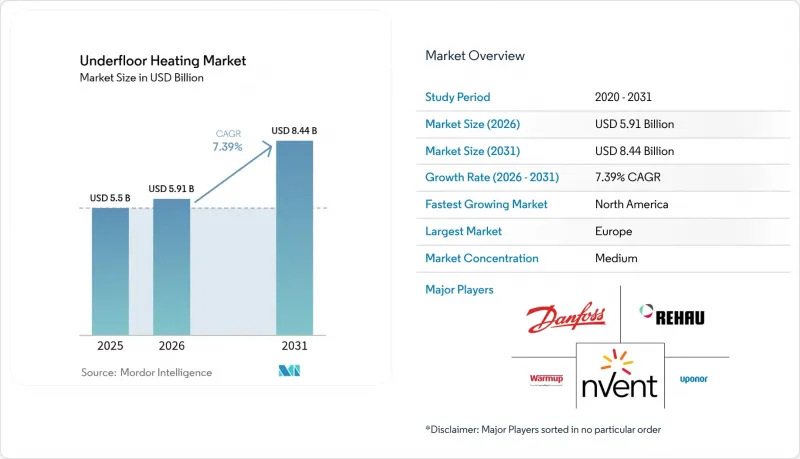
This report Segments the Industry Into Offering (Hardware, Services), Type (Electric, Hydronic), Component (Heating Systems, Control Systems and More), Installation Type (New Installations, and More), Application (Residential, Commercial, and More), Floor Covering(Tiles and Stone, and More) and Geography (North America, Europe, and More). The Market Sizes and Forecasts are Provided in Terms of Value (USD).
Global Underfloor Heating Market Trends and Insights
Energy-Efficient Heating Demand in Cold-Climate Europe Driving Hydronic Adoption
Governments across Europe are tying renovation grants to renewable integration, pushing hydronic floor heating into mainstream building specifications. Germany's Building Energy Act funds up to 70% of compliant systems. The UK Heat Network Technical Assurance Scheme sets performance thresholds tailored to low-temperature heat distribution. Parallel incentives in France and Italy accelerate market penetration. The resulting scale lowers component prices and encourages a shift toward integrated solar-hydronic packages that align with the EU's zero-emission target.
Decarbonisation Targets Favour Low-Temperature Radiant Heating in Nordics
Nordic authorities promote supply temperatures of 25-27 °C that maximize heat-pump efficiency. Denmark's Heat Pump Pool offers DKK 27,000 grants for water-source units pairing seamlessly with underfloor manifolds. District-heating networks in Sweden and Norway gain lower return temperatures, reducing system losses. This synergy between grid upgrades and in-building efficiency cements long-run demand across the Nordic underfloor heating market.
High Up-front Installation Cost in Emerging South American Markets
Hydronic floor systems cost USD 10-20 per square foot to install, which can be challenging for affordability in price-sensitive economies. Currency volatility and reliance on imported components prolong payback periods, confining demand to upscale projects. Lower-cost electric mats face high tariff-driven running expenses, underscoring the need for localised production.
Other drivers and restraints analyzed in the detailed report include:
- Government Subsidies for Electrified Retrofitting in North America
- Rapid Smart-Home Renovations Boosting Intelligent Floor Heating Controls in Asia
- Limited Skilled Installers Restricting Retrofit Penetration in Africa
For complete list of drivers and restraints, kindly check the Table Of Contents.
Segment Analysis
Hardware generated the majority of 2024 revenue as pipes, cables, manifolds, and actuators remain non-negotiable building-block purchases. Standardisation efforts and bio-based PEX innovation by leaders such as Uponor cut embedded emissions and lower total installed cost. Services, although smaller in value, are growing at a 8.92% CAGR as connected platforms demand professional commissioning and predictive maintenance subscriptions. Vendors now package floor loops, smart thermostats, and installation services to safeguard performance warranties and create new margin streams. The underfloor heating market is increasingly rewarding solution providers that reduce lifecycle risk and streamline building owner decision-making processes.
Technician demand escalates because smart controls must be calibrated to occupancy profiles and integrated with building-management systems. After-sales optimisation contracts help customers hit energy-target benchmarks mandated by regulators, converting once-off equipment sales into annuity revenues. These shifts enhance ecosystem stickiness and cement hardware-plus-service bundles as the default procurement path within the underfloor heating market.
Hydronic loops retained a 60.85% share in 2025, thanks to superior operating cost economics in large footprints. Electric mats and cables, however, are registering an 8.34% CAGR by excelling in space-constrained renovations where minimal floor build-up is critical. The Schluter DITRA-HEAT-E assembly reduces total height to 5.5 mm, enabling rapid bathroom upgrades without door-threshold changes. Hybrid layouts, where hydronic supplies principal zones and electric patches serve wet rooms, are becoming common in multifamily developments. This complementary adoption pattern expands the addressable market for underfloor heating.
Hydronic systems continue to garner green-building accolades because they complement heat pumps and solar-thermal collectors. Controls now automatically adjust flow temperature based on outside-air sensors, reducing pump energy losses. Electric solutions compete through refined thermostatic zoning and dynamic demand-response functionality that unlock utility rebates. These technology pathways ensure both system categories will coexist and flourish in distinct project archetypes within the underfloor heating market.
Complete Report Scope:
- By Offering
- Hardware
- Services
- By System Type
- Electric
- Hydronic
- By Component
- Heating Pipes and Cables
- Insulation Panels
- Manifolds and Mixing Units
- Control Systems (Thermostats, Sensors and Actuators)
- By Installation Type
- New Construction
- Retrofit
- By Floor Covering
- Tiles and Stone
- Laminate and Engineered Wood
- Carpet and Rugs
- Vinyl and Linoleum
- By Application
- Residential
- Single-Family
- Multi-Family
- Commercial
- Offices
- Retail
- Hospitality
- Institutional
- Healthcare
- Educational Facilities
- Industrial
- Residential
- By Geography
- North America
- United States
- Canada
- Mexico
- South America
- Brazil
- Argentina
- Rest of South America
- Europe
- Germany
- United Kingdom
- France
- Italy
- Spain
- Nordics
- Benelux
- Russia
- Rest of Europe
- Middle East
- GCC
- Turkey
- Rest of Middle East
- Africa
- South Africa
- Nigeria
- Egypt
- Rest of Africa
- Asia-Pacific
- China
- Japan
- India
- South Korea
- Southeast Asia
- Rest of Asia-Pacific
- North America
Geography Analysis
Europe retained a 28.15% share in 2025 as region-wide grant schemes, low-carbon building codes, and mature installer networks underpin steady adoption. Germany's subsidies, the UK's network standards, and Italy's Eco Bonus provide multi-layered financial backing. Nordic grid decarbonisation aligns perfectly with 25 °C supply loops, creating a robust local underfloor heating market. European manufacturers invest in circular-material PEX pipelines, improving life-cycle credentials and safeguarding regional technological leadership.
The Asia-Pacific region exhibits the fastest trajectory, with a 10.28% CAGR, driven by urban densification, expanding middle-class comfort expectations, and national smart-city agendas. China's heat-pump schemes unlock synergistic low-temperature floor applications. Japanese and Korean builders utilize IoT controls for occupancy-driven energy management, integrating underfloor heating into home automation packages. India's premium mixed-use towers specify radiant floors to meet greener-building codes, while Australia's resort sector exploits solar-linked hydronic arrays to curb diesel reliance.
North America blends mature new-build uptake with policy-seeded retrofit momentum. Federal electrification incentives and 2028 circulator-pump standards enhance cost competitiveness. The underfloor heating market size for retrofit corridors is poised to expand as states tighten thermal envelope regulations.
The Middle East benefits from HVAC redesign in retail and hospitality, where radiant slabs counteract the effects of high ceiling stratification. South America faces affordability hurdles yet leverages infrastructure investment to integrate floor heating into flagship projects despite currency headwinds. Africa's pipeline remains aspirational, limited by installer scarcity and financing gaps, though targeted skills programmes are underway.
- Uponor Corporation
- Danfoss Group (incl. DEVI)
- nVent Electric plc (Raychem)
- Honeywell International Inc.
- Robert Bosch GmbH
- Mitsubishi Electric Corporation
- Siemens AG
- Schneider Electric SE
- Nexans SA
- Warmup PLC
- Rehau AG and Co.
- Pentair plc
- Watts Water Technologies Inc.
- Schluter Systems
- Nu-Heat UK Ltd.
- ThermoSoft International Corp.
- Flexel International Ltd.
- Eberle Controls GmbH
- Emmeti SpA
- Henco Industries
- Amuheat Pty Ltd.
Additional Benefits:
- The market estimate (ME) sheet in Excel format
- 3 months of analyst support
TABLE OF CONTENTS
1 INTRODUCTION
- 1.1 Study Assumptions and Market Definition
- 1.2 Scope of the Study
2 RESEARCH METHODOLOGY
3 EXECUTIVE SUMMARY
4 MARKET LANDSCAPE
- 4.1 Market Overview
- 4.2 Market Drivers
- 4.2.1 Energy-Efficient Heating Demand in Cold-Climate Europe Driving Hydronic Adoption
- 4.2.2 Decarbonisation Targets Favour Low-Temperature Radiant Heating in Nordics
- 4.2.3 Government Subsidies for Electrified Retrofitting in North America
- 4.2.4 Rapid Smart-Home Renovations Boosting Intelligent Floor Heating Controls in Asia
- 4.2.5 Rising Commercial Floor-Space in GCC Integrated with Underfloor Systems
- 4.2.6 Cost Savings from Solar-Hydronic Solutions in Off-Grid Oceania Resorts
- 4.3 Market Restraints
- 4.3.1 High Up-front Installation Cost in Emerging South American Markets
- 4.3.2 Limited Skilled Installers Restricting Retrofit Penetration in Africa
- 4.3.3 Latency in Heat-Up/Cool-Down vs. Forced-Air Systems
- 4.3.4 Moisture and Flooring-Material Compatibility Issues in Humid Tropics
- 4.4 Value / Supply-Chain Analysis
- 4.5 Regulatory Outlook
- 4.6 Technological Outlook
- 4.7 Porter's Five Forces Analysis
- 4.7.1 Bargaining Power of Suppliers
- 4.7.2 Bargaining Power of Buyers
- 4.7.3 Threat of New Entrants
- 4.7.4 Threat of Substitutes
- 4.7.5 Intensity of Rivalry
- 4.8 Investment Analysis
5 MARKET SIZE AND GROWTH FORECASTS (VALUE)
- 5.1 By Offering
- 5.1.1 Hardware
- 5.1.2 Services
- 5.2 By System Type
- 5.2.1 Electric
- 5.2.2 Hydronic
- 5.3 By Component
- 5.3.1 Heating Pipes and Cables
- 5.3.2 Insulation Panels
- 5.3.3 Manifolds and Mixing Units
- 5.3.4 Control Systems (Thermostats, Sensors and Actuators)
- 5.4 By Installation Type
- 5.4.1 New Construction
- 5.4.2 Retrofit
- 5.5 By Floor Covering
- 5.5.1 Tiles and Stone
- 5.5.2 Laminate and Engineered Wood
- 5.5.3 Carpet and Rugs
- 5.5.4 Vinyl and Linoleum
- 5.6 By Application
- 5.6.1 Residential
- 5.6.1.1 Single-Family
- 5.6.1.2 Multi-Family
- 5.6.2 Commercial
- 5.6.2.1 Offices
- 5.6.2.2 Retail
- 5.6.2.3 Hospitality
- 5.6.3 Institutional
- 5.6.3.1 Healthcare
- 5.6.3.2 Educational Facilities
- 5.6.4 Industrial
- 5.6.1 Residential
- 5.7 By Geography
- 5.7.1 North America
- 5.7.1.1 United States
- 5.7.1.2 Canada
- 5.7.1.3 Mexico
- 5.7.2 South America
- 5.7.2.1 Brazil
- 5.7.2.2 Argentina
- 5.7.2.3 Rest of South America
- 5.7.3 Europe
- 5.7.3.1 Germany
- 5.7.3.2 United Kingdom
- 5.7.3.3 France
- 5.7.3.4 Italy
- 5.7.3.5 Spain
- 5.7.3.6 Nordics
- 5.7.3.7 Benelux
- 5.7.3.8 Russia
- 5.7.3.9 Rest of Europe
- 5.7.4 Middle East
- 5.7.4.1 GCC
- 5.7.4.2 Turkey
- 5.7.4.3 Rest of Middle East
- 5.7.5 Africa
- 5.7.5.1 South Africa
- 5.7.5.2 Nigeria
- 5.7.5.3 Egypt
- 5.7.5.4 Rest of Africa
- 5.7.6 Asia-Pacific
- 5.7.6.1 China
- 5.7.6.2 Japan
- 5.7.6.3 India
- 5.7.6.4 South Korea
- 5.7.6.5 Southeast Asia
- 5.7.6.6 Rest of Asia-Pacific
- 5.7.1 North America
6 COMPETITIVE LANDSCAPE
- 6.1 Market Concentration
- 6.2 Strategic Moves
- 6.3 Market Share Analysis
- 6.4 Company Profiles (includes Global level Overview, Market level overview, Core Segments, Financials as available, Strategic Information, Market Rank/Share, Products and Services, Recent Developments)
- 6.4.1 Uponor Corporation
- 6.4.2 Danfoss Group (incl. DEVI)
- 6.4.3 nVent Electric plc (Raychem)
- 6.4.4 Honeywell International Inc.
- 6.4.5 Robert Bosch GmbH
- 6.4.6 Mitsubishi Electric Corporation
- 6.4.7 Siemens AG
- 6.4.8 Schneider Electric SE
- 6.4.9 Nexans SA
- 6.4.10 Warmup PLC
- 6.4.11 Rehau AG and Co.
- 6.4.12 Pentair plc
- 6.4.13 Watts Water Technologies Inc.
- 6.4.14 Schluter Systems
- 6.4.15 Nu-Heat UK Ltd.
- 6.4.16 ThermoSoft International Corp.
- 6.4.17 Flexel International Ltd.
- 6.4.18 Eberle Controls GmbH
- 6.4.19 Emmeti SpA
- 6.4.20 Henco Industries
- 6.4.21 Amuheat Pty Ltd.
7 MARKET OPPORTUNITIES AND FUTURE OUTLOOK
- 7.1 White-Space and Unmet-Need Assessment

