PUBLISHER: MarketsandMarkets | PRODUCT CODE: 2144548

PUBLISHER: MarketsandMarkets | PRODUCT CODE: 2144548
Clinical Trial Supplies Market by Service (Manufacturing, Packaging, Logistics), Phases, Type (Small Molecules, Biologics, Vaccine), Therapeutic Areas (Oncology, Neurology, Ophthalmology, Dermatology), Region - Global Forecast to 2031
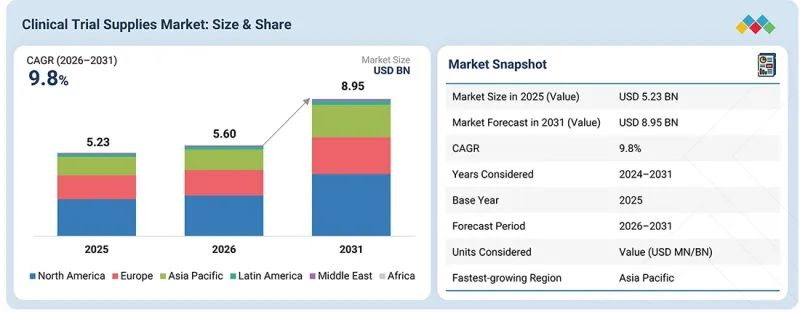
The clinical trial supplies market is projected to reach USD 8.95 billion by 2031, up from USD 5.60 billion in 2026, at a 9.8% CAGR from 2026 to 2031. The market is expected to grow as the number of clinical trials rises, pharmaceutical and biotechnology R&D spending expands, and sponsors conduct more global, multicenter, decentralized, and adaptive studies. These changes increase demand for compliant sourcing, packaging and labeling, storage, temperature-controlled distribution, and real-time supply visibility.
| Scope of the Report | |
|---|---|
| Years Considered for the Study | 2026-2031 |
| Base Year | 2025 |
| Forecast Period | 2026-2031 |
| Units Considered | Value (USD billion) |
| Segments | Services, Phase, Type, Therapeutic Area, and End User |
| Regions covered | North America, Europe, Asia Pacific, Latin America, Middle East, and Africa |
However, high costs for comparator procurement, cold-chain handling, country-specific labeling, storage, and transportation can increase trial budgets. Drug shortages, geopolitical disruption, complex import requirements, and inaccurate demand forecasts may also delay deliveries and increase product wastage.
"Logistics & distribution services accounted for the largest share, by service, in 2024 and continued to lead in 2025."
Based on service, the clinical trial supplies market is segmented into sourcing & procurement; packaging & labeling; logistics & distribution; storage & retention; and other services, including biological sample management, destruction & waste management, and kit assembly. Logistics & distribution services held the largest share in 2025. This large share highlights the growing need to move investigational products, comparators, medical devices, and ancillary supplies across dispersed sites while maintaining chain of custody and product stability. Growth in biologics, vaccines, and cell & gene therapies is increasing demand for cold-chain, cryogenic, and ultra-low-temperature capabilities. Decentralized and direct-to-patient models further expand delivery destinations and require tighter coordination, monitoring, and returns management.
"The small molecules segment accounted for the largest share of the clinical trial supplies market, by type, in 2025."
Based on type, the global clinical trial supplies market is segmented into small molecules, biologics, and medical devices. Small molecules accounted for the largest share of market revenue in 2025, supported by established manufacturing processes, cost-efficient production, ease of oral administration, and broad use across oncology, cardiovascular, neurological, and infectious diseases. Biologics include monoclonal antibodies, vaccines, cell & gene therapies, recombinant proteins, plasma-derived products, biosimilars, and peptides. Many of these products require refrigerated, frozen, or cryogenic handling and continuous temperature monitoring. Medical-device trials add requirements for component control, study-specific labeling, device accountability, and controlled distribution. The resulting range of dosage forms, stability profiles, and handling requirements sustains demand for specialized clinical supply partners with global quality and logistics capabilities.
"Asia Pacific is expected to grow at the highest CAGR in the clinical trial supplies market during the forecast period."
The clinical trial supplies market is segmented into North America, Europe, Asia Pacific, Latin America, the Middle East, and Africa. Asia Pacific is estimated to record the highest CAGR during the forecast period, supported by expanding pharmaceutical and biopharmaceutical industries, competitive trial costs, favorable government policies, and a growing CRO base. The region is attracting more multinational trials, which increases demand for local depots, import and export support, country-specific labeling, comparator sourcing, and temperature-controlled delivery. North America accounted for the largest share of market revenue in 2025, supported by the adoption of decentralized trials and advanced cold-chain logistics. Europe also remains an important market because of its established clinical research infrastructure and substantial multinational study activity.
The primary interviews conducted for this report can be categorized as follows:
- By Respondent: Supply Side - 70% and Demand Side - 30%
- By Company Type: Tier 1 - 40%, Tier 2 - 30%, and Tier 3 - 30%
- By Designation: CXOs and Directors - 30%, Managers - 45%, and Others - 25%
- By Region: North America - 35%, Europe - 25%, Asia Pacific - 20%, Latin America - 10%, the Middle East - 5%, and Africa - 5%
List of Companies Profiled in the Report
- Thermo Fisher Scientific Inc.
- Almac Group
- Novo Holdings A/S (Catalent, Inc.)
- Marken (UPS)
- PCI Pharma Services
- Piramal Group
- Sharp Services LLC
- Cencora, Inc.
- Myonex
- Clinigen Limited
- Inceptua Group
- Eurofins Scientific
- Parexel International Corporation
- ICON plc
- IQVIA
- BioCair
- Lonza
Research Coverage
This research report categorizes the clinical trial supplies market by service, phase, type, therapeutic area, end user, and region. Services covered include logistics & distribution, packaging, labeling & blinding, storage & retention, manufacturing, comparator sourcing, and other services. The report assesses Phase I, Phase II, Phase III, Phase IV, and bioavailability/bioequivalence studies; small molecules, biologics, and medical devices; and major therapeutic areas. End users include pharmaceutical & biotechnology companies, CROs & CDMOs, and other organizations such as medical-device companies and academic & research institutes. The scope includes detailed analysis of market drivers, restraints, opportunities, and challenges. It also evaluates leading providers through their business overview, service portfolio, partnerships, acquisitions, expansions, agreements, and other recent developments associated with the clinical trial supplies market. Competitive analysis covers established players and emerging companies across the market ecosystem.
Key Benefits of Buying the Report
The report will help market leaders and new entrants by providing the closest approximations of revenue for the overall clinical trial supplies market and its subsegments. It will help stakeholders compare the competitive position and service capabilities of major providers and identify markets aligned with their expansion strategies. The report will also enable stakeholders to understand market demand across services, trial phases, therapy types, therapeutic areas, end users, and regions. It covers factors shaping growth, including clinical trial activity, supply-chain costs, decentralized trial models, digital supply technologies, drug shortages, and regulatory complexity.
The report provides insights into the following pointers:
- Analysis of key drivers (growth in clinical trials and drug development, expansion of global and multicenter trials, and rising demand for personalized medicines and biologics), restraints (high costs associated with clinical trial supplies), opportunities (decentralized and virtual trials and the integration of digital supply-chain technologies), and challenges (supply-chain disruptions, drug shortages, and complex country-specific requirements) influencing the growth of the clinical trial supplies market
- Service Development/Innovation: Detailed insights into new and expanded clinical trial supply services, including comparator sourcing, direct-to-patient delivery, digital tracking, and cold-chain logistics
- Market Development: Comprehensive information about attractive markets and analysis of the clinical trial supplies market across North America, Europe, Asia Pacific, Latin America, the Middle East, and Africa
- Market Diversification: Detailed information about new services, untapped geographies, recent developments, partnerships, acquisitions, capacity expansions, and investments in the clinical trial supplies market
- Competitive Assessment: In-depth assessment of market shares, growth strategies, and service portfolios of leading players such as Thermo Fisher Scientific Inc. (US), Almac Group (UK), Novo Holdings A/S (Catalent, Inc.) (Denmark/US), Marken (UPS) (US), and PCI Pharma Services (US), among others
TABLE OF CONTENTS
1 INTRODUCTION
- 1.1 STUDY OBJECTIVES
- 1.2 MARKET DEFINITION
- 1.3 MARKET SCOPE
- 1.3.1 MARKETS & REGIONS COVERED
- 1.3.2 INCLUSIONS & EXCLUSIONS
- 1.3.3 YEARS CONSIDERED
- 1.3.4 CURRENCY CONSIDERED
- 1.4 STAKEHOLDERS
- 1.5 SUMMARY OF CHANGES
2 EXECUTIVE SUMMARY
- 2.1 KEY INSIGHTS AND MARKET HIGHLIGHTS
- 2.2 KEY MARKET PARTICIPANTS: SHARE INSIGHTS AND STRATEGIC DEVELOPMENTS
- 2.3 DISRUPTIVE TRENDS SHAPING THE MARKET
- 2.4 HIGH-GROWTH SEGMENTS & EMERGING FRONTIERS
- 2.5 SNAPSHOT: GLOBAL MARKET SIZE, GROWTH RATE, AND FORECAST
3 PREMIUM INSIGHTS
- 3.1 CLINICAL TRIAL SUPPLIES MARKET OVERVIEW
- 3.2 NORTH AMERICA: CLINICAL TRIAL SUPPLIES MARKET, BY TYPE AND COUNTRY (2025)
- 3.3 CLINICAL TRIAL SUPPLIES MARKET SHARE, BY TYPE, 2026 VS. 2031
- 3.4 CLINICAL TRIAL SUPPLIES MARKET: GEOGRAPHIC GROWTH OPPORTUNITIES
4 MARKET OVERVIEW
- 4.1 INTRODUCTION
- 4.2 MARKET DYNAMICS
- 4.2.1 DRIVERS
- 4.2.1.1 Growth in clinical trials & drug development
- 4.2.1.2 Expansion of global and multicenter trials accelerating demand for clinical trial supplies
- 4.2.1.3 Rising demand for personalized medicine and biologics
- 4.2.2 RESTRAINTS
- 4.2.2.1 High costs associated with clinical trial supplies
- 4.2.3 OPPORTUNITIES
- 4.2.3.1 Rise in decentralized and virtual trials
- 4.2.3.2 Integration of digital technologies in supply chain management
- 4.2.4 CHALLENGES
- 4.2.4.1 Supply chain disruptions and drug shortages
- 4.2.1 DRIVERS
- 4.3 UNMET NEEDS AND WHITE SPACES
- 4.4 INTERCONNECTED MARKETS AND CROSS-SECTOR OPPORTUNITIES
- 4.5 STRATEGIC MOVES BY TIER-1/2/3 PLAYERS
5 INDUSTRY TRENDS
- 5.1 PORTER'S FIVE FORCES ANALYSIS
- 5.1.1 THREAT OF NEW ENTRANTS
- 5.1.2 BARGAINING POWER OF SUPPLIERS
- 5.1.3 BARGAINING POWER OF BUYERS
- 5.1.4 THREAT OF SUBSTITUTES
- 5.1.5 INTENSITY OF COMPETITIVE RIVALRY
- 5.2 MACROECONOMIC OUTLOOK
- 5.2.1 INTRODUCTION
- 5.2.2 GDP TRENDS AND FORECAST
- 5.2.3 TRENDS IN GLOBAL CLINICAL TRIAL SUPPLIES MARKET
- 5.3 VALUE CHAIN ANALYSIS
- 5.4 ECOSYSTEM ANALYSIS
- 5.4.1 CLINICAL TRIAL SUPPLIES MARKET: RAW MATERIAL PROVIDERS
- 5.4.2 CLINICAL TRIAL SUPPLIES MARKET: SERVICE PROVIDERS
- 5.4.3 CLINICAL TRIAL SUPPLIES MARKET: END USERS
- 5.4.4 CLINICAL TRIAL SUPPLIES MARKET: REGULATORY BODIES
- 5.5 PRICING ANALYSIS
- 5.5.1 AVERAGE SELLING PRICE, BY KEY PLAYER (QUALITATIVE)
- 5.5.2 INDICATIVE PRICE, BY SERVICE (QUALITATIVE)
- 5.6 INVESTMENT AND FUNDING SCENARIO
- 5.7 TRENDS/DISRUPTIONS IMPACTING CUSTOMERS' BUSINESSES
- 5.8 KEY CONFERENCES AND EVENTS, 2026-2027
- 5.9 IMPACT OF 2025 US TARIFFS-CLINICAL TRIAL SUPPLIES MARKET
- 5.9.1 INTRODUCTION
- 5.9.2 KEY TARIFF RATES
- 5.9.3 PRICE IMPACT ANALYSIS
- 5.9.4 IMPACT ON COUNTRIES/REGIONS
- 5.9.4.1 North America
- 5.9.4.1.1 US
- 5.9.4.2 Europe
- 5.9.4.3 Asia Pacific
- 5.9.4.1 North America
- 5.9.5 IMPACT ON END-USE INDUSTRIES
- 5.9.5.1 Pharmaceutical & biotech companies
- 5.9.5.2 Medical devices companies
- 5.9.5.3 Academic institutes
6 TECHNOLOGICAL ADVANCEMENTS, AI-DRIVEN IMPACT, INNOVATIONS AND FUTURE APPLICATIONS
- 6.1 TECHNOLOGY ANALYSIS
- 6.1.1 KEY TECHNOLOGIES
- 6.1.1.1 Serialization & track-and-trace technologies
- 6.1.1.2 Interactive response technology (IRT/IVR/IWR)
- 6.1.1.3 Cold chain & temperature monitoring solutions
- 6.1.2 COMPLEMENTARY TECHNOLOGIES
- 6.1.2.1 Artificial intelligence (AI) & machine learning (ML)
- 6.1.2.2 Blockchain for supply chain transparency
- 6.1.3 ADJACENT TECHNOLOGIES
- 6.1.3.1 Cryopreservation & advanced storage technologies
- 6.1.3.2 Advanced robotics in warehousing & distribution
- 6.1.1 KEY TECHNOLOGIES
- 6.2 TECHNOLOGY/PRODUCT ROADMAP
- 6.3 IMPACT OF AI/GEN AI ON CLINICAL TRIAL SUPPLIES MARKET
- 6.3.1 TOP USE CASES AND MARKET POTENTIAL
- 6.3.2 CASE STUDIES OF AI IMPLEMENTATION IN CLINICAL TRIAL SUPPLIES MARKET
- 6.3.3 INTERCONNECTED ADJACENT ECOSYSTEM AND IMPACT ON MARKET PLAYERS
- 6.3.4 CLIENTS' READINESS TO ADOPT GENERATIVE AI IN CLINICAL TRIAL SUPPLIES MARKET
7 REGULATORY LANDSCAPE
- 7.1 REGIONAL REGULATIONS AND COMPLIANCE
- 7.1.1 REGULATORY BODIES, GOVERNMENT AGENCIES, AND OTHER ORGANIZATIONS
- 7.1.2 REGULATORY FRAMEWORK
- 7.1.2.1 North America
- 7.1.2.1.1 US
- 7.1.2.1.2 Canada
- 7.1.2.2 Europe
- 7.1.2.2.1 Germany
- 7.1.2.2.2 France
- 7.1.2.2.3 Italy
- 7.1.2.3 Asia Pacific
- 7.1.2.3.1 Japan
- 7.1.2.3.2 China
- 7.1.2.3.3 India
- 7.1.2.4 Latin America
- 7.1.2.4.1 Brazil
- 7.1.2.5 Middle East & Africa
- 7.1.2.5.1 GCC Countries
- 7.1.2.5.2 South Africa
- 7.1.2.1 North America
8 CUSTOMER LANDSCAPE & BUYER BEHAVIOR
- 8.1 DECISION-MAKING PROCESS
- 8.2 BUYER STAKEHOLDERS AND BUYING EVALUATION CRITERIA
- 8.2.1 KEY STAKEHOLDERS IN BUYING PROCESS
- 8.2.2 KEY BUYING CRITERIA, BY END USER
- 8.3 ADOPTION BARRIERS & INTERNAL CHALLENGES
- 8.4 UNMET NEEDS FROM VARIOUS END-USE INDUSTRIES
- 8.5 MARKET PROFITABILITY
9 CLINICAL TRIAL SUPPLIES MARKET, BY SERVICE
- 9.1 INTRODUCTION
- 9.2 LOGISTICS & DISTRIBUTION SERVICES
- 9.2.1 RISING DEMAND DUE TO INCREASING EMPHASIS ON CLINICAL DIAGNOSTICS TO SUPPORT MARKET GROWTH
- 9.3 STORAGE & RETENTION SERVICES
- 9.3.1 RISING DEMAND FOR ULTRA-LOW-TEMPERATURE STORAGE TO DRIVE GROWTH
- 9.4 PACKAGING, LABELING, AND BLINDING SERVICES
- 9.4.1 PRIMARY PACKAGING SERVICES
- 9.4.1.1 Increasing demand for innovative drug formulations to support market growth
- 9.4.2 SECONDARY PACKAGING SERVICES
- 9.4.2.1 Increasing complexity of global clinical trials to propel market
- 9.4.3 LABELING & BLINDING SERVICES
- 9.4.3.1 Rising number of randomized and double-blind studies to propel market
- 9.4.1 PRIMARY PACKAGING SERVICES
- 9.5 MANUFACTURING SERVICES
- 9.5.1 RISING COMPLEXITY OF TRIALS, DEMAND FOR BIOLOGICS, AND RELIANCE ON CDMOS TO DRIVE MARKET
- 9.6 COMPARATOR SOURCING SERVICES
- 9.6.1 RISING DEMAND FOR COMPARATOR SOURCING TO DRIVE MARKET
- 9.7 OTHER SERVICES
10 CLINICAL TRIAL SUPPLIES MARKET, BY PHASE
- 10.1 INTRODUCTION
- 10.2 PHASE III
- 10.2.1 DEVELOPMENT OF BIOLOGICS AND ADVANCED THERAPIES TO SUPPORT MARKET GROWTH
- 10.3 PHASE II
- 10.3.1 NEED FOR GREATER EFFICIENCY AND COMPLIANCE IN TRIAL LOGISTICS TO SUPPORT MARKET GROWTH
- 10.4 PHASE I
- 10.4.1 RISING COMPLEXITY OF INVESTIGATIONAL DRUGS TO DRIVE MARKET GROWTH
- 10.5 PHASE IV
- 10.5.1 INCREASING FOCUS ON PATIENT-CENTRIC APPROACHES TO DRIVE MARKET GROWTH
- 10.6 PHASE BA/BE
- 10.6.1 ACCELERATING GENERIC DRUG APPROVALS THROUGH OPTIMIZED BA/BE STUDIES TO SUPPORT MARKET GROWTH
11 CLINICAL TRIAL SUPPLIES MARKET, BY TYPE
- 11.1 INTRODUCTION
- 11.2 SMALL MOLECULES
- 11.2.1 HIGH VOLUME OF SMALL-MOLECULE CLINICAL TRIALS
- 11.3 BIOLOGICS
- 11.3.1 MONOCLONAL ANTIBODIES
- 11.3.1.1 Rising demand for monoclonal antibodies to drive growth
- 11.3.2 VACCINES
- 11.3.2.1 Increased focus on development of novel vaccines to drive growth
- 11.3.3 OTHER BIOLOGICS
- 11.3.1 MONOCLONAL ANTIBODIES
- 11.4 MEDICAL DEVICES
- 11.4.1 RISING DEMAND FOR SPECIALIZED LOGISTICS IN MEDICAL DEVICE CLINICAL TRIALS TO DRIVE MARKET GROWTH
12 CLINICAL TRIAL SUPPLIES MARKET, BY THERAPEUTIC AREA
- 12.1 INTRODUCTION
- 12.2 ONCOLOGY
- 12.2.1 RISING DISEASE BURDEN TO SUPPORT MARKET GROWTH
- 12.3 NEUROLOGY
- 12.3.1 INCREASING R&D INVESTMENT TO SUPPORT MARKET GROWTH
- 12.4 RESPIRATORY DISORDERS
- 12.4.1 RISING INCIDENCE OF RESPIRATORY DISORDERS TO SUPPORT MARKET GROWTH
- 12.5 METABOLIC DISORDERS/ENDOCRINOLOGY
- 12.5.1 INCREASING GLOBAL DIABETES POPULATION TO SUPPORT MARKET GROWTH
- 12.6 CARDIOVASCULAR SYSTEM DISORDERS
- 12.6.1 RISING DEMAND IN CLINICAL DIAGNOSTICS TO PROPEL MARKET GROWTH
- 12.7 DERMATOLOGY
- 12.7.1 GROWING FOCUS ON DRUG DEVELOPMENT TO SUPPORT MARKET GROWTH
- 12.8 GASTROINTESTINAL SYSTEM DISORDERS
- 12.8.1 INCREASING INCIDENCE OF LIFESTYLE AND DIETARY RISK FACTORS TO DRIVE DEMAND
- 12.9 IMMUNOLOGIC DISORDERS
- 12.9.1 GROWING CLINICAL RESEARCH TO SUPPORT MARKET GROWTH
- 12.10 INFECTIOUS DISEASES
- 12.10.1 RISING OUTBREAKS OF INFECTIOUS DISEASES TO SUPPORT MARKET GROWTH
- 12.11 PSYCHIATRY
- 12.11.1 RISING INCIDENCE OF PSYCHIATRIC DISORDERS TO PROPEL MARKET GROWTH
- 12.12 OPHTHALMOLOGY
- 12.12.1 RISING NUMBER OF OPHTHALMIC PIPELINE DRUGS TO AID MARKET GROWTH
- 12.13 HEMATOLOGY
- 12.13.1 INTEGRATION OF ADVANCED SUPPLY CHAIN TECHNOLOGIES TO FUEL MARKET GROWTH
- 12.14 GENITOURINARY & WOMEN'S HEALTH
- 12.14.1 RISING PREVALENCE OF CHRONIC DISORDERS IN WOMEN TO PROPEL MARKET GROWTH
- 12.15 OTHER THERAPEUTIC AREAS
13 CLINICAL TRIAL SUPPLIES MARKET, BY END USER
- 13.1 INTRODUCTION
- 13.2 PHARMACEUTICAL & BIOTECHNOLOGY COMPANIES
- 13.2.1 EXPANDING R&D PIPELINES AND INCREASING TRIAL COMPLEXITY TO DRIVE DEMAND FOR CLINICAL TRIAL SUPPLIES
- 13.3 CROS
- 13.3.1 INCREASING INTEGRATION OF CLINICAL OPERATIONS AND SUPPLY CHAIN MANAGEMENT TO DRIVE MARKET GROWTH
- 13.4 MEDICAL DEVICE COMPANIES
- 13.4.1 RISING CLINICAL EVIDENCE REQUIREMENTS AND DEVICE INNOVATION TO DRIVE DEMAND FOR CLINICAL TRIAL SUPPLIES
14 CLINICAL TRIAL SUPPLIES MARKET, BY REGION
- 14.1 INTRODUCTION
- 14.2 NORTH AMERICA
- 14.2.1 MACROECONOMIC OUTLOOK FOR NORTH AMERICA
- 14.2.2 US
- 14.2.2.1 Robust hospital infrastructure and drug research & development to stimulate growth
- 14.2.3 CANADA
- 14.2.3.1 Growing preference of pharmaceutical companies to conduct trials to favor growth
- 14.3 EUROPE
- 14.3.1 MACROECONOMIC OUTLOOK FOR EUROPE
- 14.3.2 GERMANY
- 14.3.2.1 Growing focus on reducing approval timelines and high spending by global pharmaceutical players to propel market
- 14.3.3 UK
- 14.3.3.1 Expanding tax credits to encourage growth
- 14.3.4 FRANCE
- 14.3.4.1 Evolving regulatory landscape to stimulate growth
- 14.3.5 ITALY
- 14.3.5.1 Increasing number of drug approvals to accelerate growth
- 14.3.6 SPAIN
- 14.3.6.1 Favorable clinical trial network in public health system to sustain growth
- 14.3.7 SWITZERLAND
- 14.3.7.1 Presence of multinational corporations and small and medium-sized pharmaceutical companies to fuel market
- 14.3.8 NETHERLANDS
- 14.3.8.1 Increasing collaborations among pharmaceutical giants to promote growth
- 14.3.9 REST OF EUROPE
- 14.4 ASIA PACIFIC
- 14.4.1 MACROECONOMIC OUTLOOK FOR ASIA PACIFIC
- 14.4.2 CHINA
- 14.4.2.1 High proportion of domestic industry-sponsored trials to speed up growth
- 14.4.3 JAPAN
- 14.4.3.1 Increasing focus on lowering regulatory timelines to facilitate growth
- 14.4.4 INDIA
- 14.4.4.1 Rise in early-phase clinical trials to spur growth
- 14.4.5 AUSTRALIA
- 14.4.5.1 Increasing research funding to favor growth
- 14.4.6 SOUTH KOREA
- 14.4.6.1 Growing focus on new drug development research to drive market
- 14.4.7 SINGAPORE
- 14.4.7.1 Advanced research facilities to intensify growth
- 14.4.8 REST OF ASIA PACIFIC
- 14.5 LATIN AMERICA
- 14.5.1 MACROECONOMIC OUTLOOK FOR LATIN AMERICA
- 14.5.2 BRAZIL
- 14.5.2.1 Regulatory improvements to support growth
- 14.5.3 MEXICO
- 14.5.3.1 Expanding landscape of clinical trials to boost market
- 14.5.4 REST OF LATIN AMERICA
- 14.6 MIDDLE EAST
- 14.6.1 MACROECONOMIC OUTLOOK FOR MIDDLE EAST
- 14.6.2 GCC COUNTRIES
- 14.6.2.1 Saudi Arabia
- 14.6.2.1.1 Booming investments in research infrastructure and life sciences development to aid growth
- 14.6.2.2 UAE
- 14.6.2.2.1 Increasing public-private partnerships and genomic research initiatives to augment growth
- 14.6.2.3 Rest of GCC Countries
- 14.6.2.1 Saudi Arabia
- 14.6.3 REST OF MIDDLE EAST
- 14.7 AFRICA
- 14.7.1 GROWING DEMAND FOR OUTSOURCING SERVICES TO DRIVE MARKET GROWTH
- 14.7.2 MACROECONOMIC OUTLOOK FOR AFRICA
15 COMPETITIVE LANDSCAPE
- 15.1 INTRODUCTION
- 15.2 KEY PLAYER STRATEGIES/RIGHT TO WIN
- 15.2.1 OVERVIEW OF STRATEGIES ADOPTED BY KEY PLAYERS IN CLINICAL TRIAL SUPPLIES MARKET
- 15.3 REVENUE ANALYSIS, 2023-2025
- 15.4 MARKET SHARE ANALYSIS, 2025
- 15.5 COMPANY EVALUATION MATRIX: KEY PLAYERS, 2025
- 15.5.1 STARS
- 15.5.2 EMERGING LEADERS
- 15.5.3 PERVASIVE PLAYERS
- 15.5.4 PARTICIPANTS
- 15.5.5 COMPANY FOOTPRINT: KEY PLAYERS, 2025
- 15.5.5.1 Company footprint
- 15.5.5.2 Region footprint
- 15.5.5.3 Service footprint
- 15.5.5.4 Type footprint
- 15.5.5.5 End-user footprint
- 15.6 COMPANY EVALUATION MATRIX: STARTUPS/SMES, 2025
- 15.6.1 PROGRESSIVE COMPANIES
- 15.6.2 RESPONSIVE COMPANIES
- 15.6.3 DYNAMIC COMPANIES
- 15.6.4 STARTING BLOCKS
- 15.6.5 COMPETITIVE BENCHMARKING: STARTUPS/SMES, 2025
- 15.6.5.1 Detailed list of key startups/SMEs
- 15.6.5.2 Competitive benchmarking of key startups/SMEs
- 15.7 COMPANY VALUATION & FINANCIAL METRICS
- 15.7.1 COMPANY VALUATION
- 15.7.2 FINANCIAL METRICS
- 15.8 BRAND/SERVICE COMPARISON
- 15.9 COMPETITIVE SCENARIO
- 15.9.1 DEALS
- 15.9.2 EXPANSIONS
16 COMPANY PROFILES
- 16.1 KEY PLAYERS
- 16.1.1 THERMO FISHER SCIENTIFIC INC.
- 16.1.1.1 Business overview
- 16.1.1.2 Services offered
- 16.1.1.3 Recent developments
- 16.1.1.3.1 Service launches
- 16.1.1.3.2 Expansions
- 16.1.1.4 MnM view
- 16.1.1.4.1 Right to win
- 16.1.1.4.2 Strategic choices
- 16.1.1.4.3 Weaknesses & competitive threats
- 16.1.2 NOVO HOLDINGS A/S (CATALENT, INC.)
- 16.1.2.1 Business overview
- 16.1.2.2 Services offered
- 16.1.2.3 Recent developments
- 16.1.2.3.1 Deals
- 16.1.2.3.2 Expansions
- 16.1.2.4 MnM view
- 16.1.2.4.1 Right to win
- 16.1.2.4.2 Strategic choices
- 16.1.2.4.3 Weaknesses & competitive threats
- 16.1.3 UNITED PARCEL SERVICE OF AMERICA, INC.
- 16.1.3.1 Business overview
- 16.1.3.2 Services offered
- 16.1.3.3 Recent developments
- 16.1.3.3.1 Deals
- 16.1.3.3.2 Expansions
- 16.1.3.4 MnM view
- 16.1.3.4.1 Right to win
- 16.1.3.4.2 Strategic choices
- 16.1.3.4.3 Weaknesses & competitive threats
- 16.1.4 EUROFINS SCIENTIFIC
- 16.1.4.1 Business overview
- 16.1.4.2 Services offered
- 16.1.4.3 Recent developments
- 16.1.4.3.1 Expansions
- 16.1.4.3.2 Other developments
- 16.1.4.4 MnM view
- 16.1.4.4.1 Right to win
- 16.1.4.4.2 Strategic choices
- 16.1.4.4.3 Weaknesses & competitive threats
- 16.1.5 PIRAMAL PHARMA LIMITED
- 16.1.5.1 Business overview
- 16.1.5.2 Services offered
- 16.1.5.3 Recent developments
- 16.1.5.3.1 Deals
- 16.1.5.3.2 Expansions
- 16.1.5.4 MnM view
- 16.1.5.4.1 Right to win
- 16.1.5.4.2 Strategic choices
- 16.1.5.4.3 Weaknesses & competitive threats
- 16.1.6 IQVIA
- 16.1.6.1 Business overview
- 16.1.6.2 Services offered
- 16.1.7 ICON PLC
- 16.1.7.1 Business overview
- 16.1.7.2 Services offered
- 16.1.7.3 Recent developments
- 16.1.7.3.1 Service launches
- 16.1.7.3.2 Deals
- 16.1.8 LONZA
- 16.1.8.1 Business overview
- 16.1.8.2 Services offered
- 16.1.8.3 Recent developments
- 16.1.8.3.1 Deals
- 16.1.8.3.2 Expansions
- 16.1.9 UNIPHAR GROUP PLC
- 16.1.9.1 Business overview
- 16.1.9.2 Services offered
- 16.1.9.3 Recent developments
- 16.1.9.3.1 Deals
- 16.1.9.3.2 Expansions
- 16.1.10 ALMAC GROUP
- 16.1.10.1 Business overview
- 16.1.10.2 Services offered
- 16.1.10.3 Recent developments
- 16.1.10.3.1 Service launches
- 16.1.10.3.2 Expansions
- 16.1.11 SHARP SERVICES, LLC
- 16.1.11.1 Business overview
- 16.1.11.2 Services offered
- 16.1.11.3 Recent developments
- 16.1.11.3.1 Deals
- 16.1.11.3.2 Expansions
- 16.1.12 PCI PHARMA SERVICES
- 16.1.12.1 Business overview
- 16.1.12.2 Services offered
- 16.1.12.3 Recent developments
- 16.1.12.3.1 Deals
- 16.1.12.3.2 Expansions
- 16.1.13 PAREXEL INTERNATIONAL (MA) CORPORATION
- 16.1.13.1 Business overview
- 16.1.13.2 Services offered
- 16.1.14 BIOCAIR
- 16.1.14.1 Business overview
- 16.1.14.2 Services offered
- 16.1.1 THERMO FISHER SCIENTIFIC INC.
- 16.2 OTHER PLAYERS
- 16.2.1 CENCORA, INC.
- 16.2.2 CLINIGEN LIMITED
- 16.2.3 KLIFO
- 16.2.4 IPS PHARMA
- 16.2.5 COREX LOGISTICS LIMITED
- 16.2.6 OCT GROUP LLC
- 16.2.7 MYONEX
- 16.2.8 INCEPTUA GROUP
- 16.2.9 ANCILLARE, LP
- 16.2.10 ADALLEN PHARMA
- 16.2.11 CLINICAL SERVICES INTERNATIONAL (CSI)
- 16.2.12 NUVISAN GMBH
- 16.2.13 AENOVA HOLDING GMBH
17 RESEARCH METHODOLOGY
- 17.1 RESEARCH DATA
- 17.1.1 SECONDARY DATA
- 17.1.2 PRIMARY RESEARCH
- 17.2 MARKET SIZE ESTIMATION
- 17.2.1 GLOBAL MARKET ESTIMATION
- 17.2.1.1 Insights from primary experts
- 17.2.2 SEGMENTAL MARKET ESTIMATION (TOP-DOWN APPROACH)
- 17.2.1 GLOBAL MARKET ESTIMATION
- 17.3 MARKET GROWTH RATE PROJECTIONS
- 17.4 DATA TRIANGULATION
- 17.5 RESEARCH ASSUMPTIONS
- 17.6 RESEARCH LIMITATIONS
- 17.7 RISK ANALYSIS
18 APPENDIX
- 18.1 DISCUSSION GUIDE
- 18.2 KNOWLEDGESTORE: MARKETSANDMARKETS' SUBSCRIPTION PORTAL
- 18.3 CUSTOMIZATION OPTIONS
- 18.4 RELATED REPORTS
- 18.5 AUTHOR DETAILS
List of Tables
- TABLE 1 CLINICAL TRIAL SUPPLIES MARKET: IMPACT ANALYSIS OF MARKET DYNAMICS
- TABLE 2 CLINICAL TRIAL SUPPLIES MARKET: PORTER'S FIVE FORCES ANALYSIS
- TABLE 3 CLINICAL TRIAL SUPPLIES MARKET: PRODUCT MANUFACTURERS
- TABLE 4 CLINICAL TRIAL SUPPLIES MARKET: SERVICE PROVIDERS
- TABLE 5 CLINICAL TRIAL SUPPLIES MARKET: END USERS
- TABLE 6 CLINICAL TRIAL SUPPLIES MARKET: REGULATORY BODIES
- TABLE 7 CLINICAL TRIAL SUPPLIES MARKET: KEY CONFERENCES AND EVENTS, 2026-2027
- TABLE 8 CASE STUDIES OF AI-ENABLED CLINICAL-TRIAL OPERATIONS AND SUPPLY IMPACT
- TABLE 9 CLIENTS' READINESS TO ADOPT GENERATIVE AI IN CLINICAL TRIAL SUPPLIES MARKET
- TABLE 10 NORTH AMERICA: REGULATORY BODIES, GOVERNMENT AGENCIES, AND OTHER ORGANIZATIONS
- TABLE 11 EUROPE: REGULATORY BODIES, GOVERNMENT AGENCIES, AND OTHER ORGANIZATIONS
- TABLE 12 ASIA PACIFIC: REGULATORY BODIES, GOVERNMENT AGENCIES, AND OTHER ORGANIZATIONS
- TABLE 13 LATIN AMERICA: REGULATORY BODIES, GOVERNMENT AGENCIES, AND OTHER ORGANIZATIONS
- TABLE 14 MIDDLE EAST & AFRICA: REGULATORY BODIES, GOVERNMENT AGENCIES, AND OTHER ORGANIZATIONS
- TABLE 15 INFLUENCE OF STAKEHOLDERS ON BUYING PROCESS OF CLINICAL TRIAL SERVICES, BY TYPE
- TABLE 16 KEY BUYING CRITERIA, BY END USER
- TABLE 17 CLINICAL TRIAL SUPPLIES MARKET, BY SERVICE, 2023-2031 (USD MILLION)
- TABLE 18 CLINICAL TRIAL SUPPLIES MARKET FOR LOGISTICS & DISTRIBUTION SERVICES, BY REGION, 2023-2031 (USD MILLION)
- TABLE 19 NORTH AMERICA: CLINICAL TRIAL SUPPLIES MARKET FOR LOGISTICS & DISTRIBUTION SERVICES, BY COUNTRY, 2023-2031 (USD MILLION)
- TABLE 20 EUROPE: CLINICAL TRIAL SUPPLIES MARKET FOR LOGISTICS & DISTRIBUTION SERVICES, BY COUNTRY, 2023-2031 (USD MILLION)
- TABLE 21 ASIA PACIFIC: CLINICAL TRIAL SUPPLIES MARKET FOR LOGISTICS & DISTRIBUTION SERVICES, BY COUNTRY, 2023-2031 (USD MILLION)
- TABLE 22 LATIN AMERICA: CLINICAL TRIAL SUPPLIES MARKET FOR LOGISTICS & DISTRIBUTION SERVICES, BY COUNTRY, 2023-2031 (USD MILLION)
- TABLE 23 MIDDLE EAST: CLINICAL TRIAL SUPPLIES MARKET FOR LOGISTICS & DISTRIBUTION SERVICES, BY REGION, 2023-2031 (USD MILLION)
- TABLE 24 GCC COUNTRIES: CLINICAL TRIAL SUPPLIES MARKET FOR LOGISTICS & DISTRIBUTION SERVICES, BY COUNTRY, 2023-2031 (USD MILLION)
- TABLE 25 CLINICAL TRIAL SUPPLIES MARKET FOR STORAGE & RETENTION SERVICES, BY REGION, 2023-2031 (USD MILLION)
- TABLE 26 NORTH AMERICA: CLINICAL TRIAL SUPPLIES MARKET FOR STORAGE & RETENTION SERVICES, BY COUNTRY, 2023-2031 (USD MILLION)
- TABLE 27 EUROPE: CLINICAL TRIAL SUPPLIES MARKET FOR STORAGE & RETENTION SERVICES, BY COUNTRY, 2023-2031 (USD MILLION)
- TABLE 28 ASIA PACIFIC: CLINICAL TRIAL SUPPLIES MARKET FOR STORAGE & RETENTION SERVICES, BY COUNTRY, 2023-2031 (USD MILLION)
- TABLE 29 LATIN AMERICA: CLINICAL TRIAL SUPPLIES MARKET FOR STORAGE & RETENTION SERVICES, BY COUNTRY, 2023-2031 (USD MILLION)
- TABLE 30 MIDDLE EAST: CLINICAL TRIAL SUPPLIES MARKET FOR STORAGE & RETENTION SERVICES, BY REGION, 2023-2031 (USD MILLION)
- TABLE 31 GCC COUNTRIES: CLINICAL TRIAL SUPPLIES MARKET FOR STORAGE & RETENTION SERVICES, BY COUNTRY, 2023-2031 (USD MILLION)
- TABLE 32 CLINICAL TRIAL SUPPLIES MARKET FOR PACKAGING, LABELING, AND BLINDING SERVICES, BY TYPE, 2023-2031 (USD MILLION)
- TABLE 33 CLINICAL TRIAL SUPPLIES MARKET FOR PACKAGING, LABELING, AND BLINDING SERVICES, BY REGION, 2023-2031 (USD MILLION)
- TABLE 34 NORTH AMERICA: CLINICAL TRIAL SUPPLIES MARKET FOR PACKAGING, LABELING, AND BLINDING SERVICES, BY COUNTRY, 2023-2031 (USD MILLION)
- TABLE 35 EUROPE: CLINICAL TRIAL SUPPLIES MARKET FOR PACKAGING, LABELING, AND BLINDING SERVICES, BY COUNTRY, 2023-2031 (USD MILLION)
- TABLE 36 ASIA PACIFIC: CLINICAL TRIAL SUPPLIES MARKET FOR PACKAGING, LABELING, AND BLINDING SERVICES, BY COUNTRY, 2023-2031 (USD MILLION)
- TABLE 37 LATIN AMERICA: CLINICAL TRIAL SUPPLIES MARKET FOR PACKAGING, LABELING, AND BLINDING SERVICES, BY COUNTRY, 2023-2031 (USD MILLION)
- TABLE 38 MIDDLE EAST: CLINICAL TRIAL SUPPLIES MARKET FOR PACKAGING, LABELING, AND BLINDING SERVICES, BY REGION, 2023-2031 (USD MILLION)
- TABLE 39 GCC COUNTRIES: CLINICAL TRIAL SUPPLIES MARKET FOR PACKAGING, LABELING, AND BLINDING SERVICES, BY COUNTRY, 2023-2031 (USD MILLION)
- TABLE 40 PRIMARY PACKAGING SERVICES MARKET, BY REGION, 2023-2031 (USD MILLION)
- TABLE 41 NORTH AMERICA: PRIMARY PACKAGING SERVICES MARKET, BY COUNTRY, 2023-2031 (USD MILLION)
- TABLE 42 EUROPE: PRIMARY PACKAGING SERVICES MARKET, BY COUNTRY, 2023-2031 (USD MILLION)
- TABLE 43 ASIA PACIFIC: PRIMARY PACKAGING SERVICES MARKET, BY COUNTRY, 2023-2031 (USD MILLION)
- TABLE 44 LATIN AMERICA: PRIMARY PACKAGING SERVICES MARKET, BY COUNTRY, 2023-2031 (USD MILLION)
- TABLE 45 MIDDLE EAST: PRIMARY PACKAGING SERVICES MARKET, BY REGION, 2023-2031 (USD MILLION)
- TABLE 46 GCC COUNTRIES: PRIMARY PACKAGING SERVICES MARKET, BY COUNTRY, 2023-2031 (USD MILLION)
- TABLE 47 SECONDARY PACKAGING SERVICES MARKET, BY REGION, 2023-2031 (USD MILLION)
- TABLE 48 NORTH AMERICA: SECONDARY PACKAGING SERVICES MARKET, BY COUNTRY, 2023-2031 (USD MILLION)
- TABLE 49 EUROPE: SECONDARY PACKAGING SERVICES MARKET, BY COUNTRY, 2023-2031 (USD MILLION)
- TABLE 50 ASIA PACIFIC: SECONDARY PACKAGING SERVICES MARKET, BY COUNTRY, 2023-2031 (USD MILLION)
- TABLE 51 LATIN AMERICA: SECONDARY PACKAGING SERVICES MARKET, BY COUNTRY, 2023-2031 (USD MILLION)
- TABLE 52 MIDDLE EAST: SECONDARY PACKAGING SERVICES MARKET, BY REGION, 2023-2031 (USD MILLION)
- TABLE 53 GCC COUNTRIES: SECONDARY PACKAGING SERVICES MARKET, BY COUNTRY, 2023-2031 (USD MILLION)
- TABLE 54 LABELING & BLINDING SERVICES MARKET, BY REGION, 2023-2031 (USD MILLION)
- TABLE 55 NORTH AMERICA: LABELING & BLINDING SERVICES MARKET, BY COUNTRY, 2023-2031 (USD MILLION)
- TABLE 56 EUROPE: LABELING & BLINDING SERVICES MARKET, BY COUNTRY, 2023-2031 (USD MILLION)
- TABLE 57 ASIA PACIFIC: LABELING & BLINDING SERVICES MARKET, BY COUNTRY, 2023-2031 (USD MILLION)
- TABLE 58 LATIN AMERICA: LABELING & BLINDING SERVICES MARKET, BY COUNTRY, 2023-2031 (USD MILLION)
- TABLE 59 MIDDLE EAST: LABELING & BLINDING SERVICES MARKET, BY REGION, 2023-2031 (USD MILLION)
- TABLE 60 GCC COUNTRIES: LABELING & BLINDING SERVICES MARKET, BY COUNTRY, 2023-2031 (USD MILLION)
- TABLE 61 CLINICAL TRIAL SUPPLIES MARKET FOR MANUFACTURING SERVICES, BY REGION, 2023-2031 (USD MILLION)
- TABLE 62 NORTH AMERICA: CLINICAL TRIAL SUPPLIES MARKET FOR MANUFACTURING SERVICES, BY COUNTRY, 2023-2031 (USD MILLION)
- TABLE 63 EUROPE: CLINICAL TRIAL SUPPLIES MARKET FOR MANUFACTURING SERVICES, BY COUNTRY, 2023-2031 (USD MILLION)
- TABLE 64 ASIA PACIFIC: CLINICAL TRIAL SUPPLIES MARKET FOR MANUFACTURING SERVICES, BY COUNTRY, 2023-2031 (USD MILLION)
- TABLE 65 LATIN AMERICA: CLINICAL TRIAL SUPPLIES MARKET FOR MANUFACTURING SERVICES, BY COUNTRY, 2023-2031 (USD MILLION)
- TABLE 66 MIDDLE EAST: CLINICAL TRIAL SUPPLIES MARKET FOR MANUFACTURING SERVICES, BY REGION, 2023-2031 (USD MILLION)
- TABLE 67 GCC COUNTRIES: CLINICAL TRIAL SUPPLIES MARKET FOR MANUFACTURING SERVICES, BY COUNTRY, 2023-2031 (USD MILLION)
- TABLE 68 CLINICAL TRIAL SUPPLIES MARKET FOR COMPARATOR SOURCING SERVICES, BY REGION, 2023-2031 (USD MILLION)
- TABLE 69 NORTH AMERICA: CLINICAL TRIAL SUPPLIES MARKET FOR COMPARATOR SOURCING SERVICES, BY COUNTRY, 2023-2031 (USD MILLION)
- TABLE 70 EUROPE: CLINICAL TRIAL SUPPLIES MARKET FOR COMPARATOR SOURCING SERVICES, BY COUNTRY, 2023-2031 (USD MILLION)
- TABLE 71 ASIA PACIFIC: CLINICAL TRIAL SUPPLIES MARKET FOR COMPARATOR SOURCING SERVICES, BY COUNTRY, 2023-2031 (USD MILLION)
- TABLE 72 LATIN AMERICA: CLINICAL TRIAL SUPPLIES MARKET FOR COMPARATOR SOURCING SERVICES, BY COUNTRY, 2023-2031 (USD MILLION)
- TABLE 73 MIDDLE EAST: CLINICAL TRIAL SUPPLIES MARKET FOR COMPARATOR SOURCING SERVICES, BY REGION, 2023-2031 (USD MILLION)
- TABLE 74 GCC COUNTRIES: CLINICAL TRIAL SUPPLIES MARKET FOR COMPARATOR SOURCING SERVICES, BY COUNTRY, 2023-2031 (USD MILLION)
- TABLE 75 CLINICAL TRIAL SUPPLIES MARKET FOR OTHER SERVICES, BY REGION, 2023-2031 (USD MILLION)
- TABLE 76 NORTH AMERICA: CLINICAL TRIAL SUPPLIES MARKET FOR OTHER SERVICES, BY COUNTRY, 2023-2031 (USD MILLION)
- TABLE 77 EUROPE: CLINICAL TRIAL SUPPLIES MARKET FOR OTHER SERVICES, BY COUNTRY, 2023-2031 (USD MILLION)
- TABLE 78 ASIA PACIFIC: CLINICAL TRIAL SUPPLIES MARKET FOR OTHER SERVICES, BY COUNTRY, 2023-2031 (USD MILLION)
- TABLE 79 LATIN AMERICA: CLINICAL TRIAL SUPPLIES MARKET FOR OTHER SERVICES, BY COUNTRY, 2023-2031 (USD MILLION)
- TABLE 80 MIDDLE EAST: CLINICAL TRIAL SUPPLIES MARKET FOR OTHER SERVICES, BY REGION, 2023-2031 (USD MILLION)
- TABLE 81 GCC COUNTRIES: CLINICAL TRIAL SUPPLIES MARKET FOR OTHER SERVICES, BY COUNTRY, 2023-2031 (USD MILLION)
- TABLE 82 CLINICAL TRIAL SUPPLIES MARKET, BY PHASE, 2023-2031 (USD MILLION)
- TABLE 83 CLINICAL TRIAL SUPPLIES MARKET FOR PHASE III TRIALS, BY REGION, 2023-2031 (USD MILLION)
- TABLE 84 NORTH AMERICA: CLINICAL TRIAL SUPPLIES MARKET FOR PHASE III TRIALS, BY COUNTRY, 2023-2031 (USD MILLION)
- TABLE 85 EUROPE: CLINICAL TRIAL SUPPLIES MARKET FOR PHASE III TRIALS, BY COUNTRY, 2023-2031 (USD MILLION)
- TABLE 86 ASIA PACIFIC: CLINICAL TRIAL SUPPLIES MARKET FOR PHASE III TRIALS, BY COUNTRY, 2023-2031 (USD MILLION)
- TABLE 87 LATIN AMERICA: CLINICAL TRIAL SUPPLIES MARKET FOR PHASE III TRIALS, BY COUNTRY, 2023-2031 (USD MILLION)
- TABLE 88 MIDDLE EAST: CLINICAL TRIAL SUPPLIES MARKET FOR PHASE III TRIALS, BY REGION, 2023-2031 (USD MILLION)
- TABLE 89 GCC COUNTRIES: CLINICAL TRIAL SUPPLIES MARKET FOR PHASE III TRIALS, BY COUNTRY, 2023-2031 (USD MILLION)
- TABLE 90 CLINICAL TRIAL SUPPLIES MARKET FOR PHASE II TRIALS, BY REGION, 2023-2031 (USD MILLION)
- TABLE 91 NORTH AMERICA: CLINICAL TRIAL SUPPLIES MARKET FOR PHASE II TRIALS, BY COUNTRY, 2023-2031 (USD MILLION)
- TABLE 92 EUROPE: CLINICAL TRIAL SUPPLIES MARKET FOR PHASE II TRIALS, BY COUNTRY, 2023-2031 (USD MILLION)
- TABLE 93 ASIA PACIFIC: CLINICAL TRIAL SUPPLIES MARKET FOR PHASE II TRIALS, BY COUNTRY, 2023-2031 (USD MILLION)
- TABLE 94 LATIN AMERICA: CLINICAL TRIAL SUPPLIES MARKET FOR PHASE II TRIALS, BY COUNTRY, 2023-2031 (USD MILLION)
- TABLE 95 MIDDLE EAST: CLINICAL TRIAL SUPPLIES MARKET FOR PHASE II TRIALS, BY REGION, 2023-2031 (USD MILLION)
- TABLE 96 GCC COUNTRIES: CLINICAL TRIAL SUPPLIES MARKET FOR PHASE II TRIALS, BY COUNTRY, 2023-2031 (USD MILLION)
- TABLE 97 CLINICAL TRIAL SUPPLIES MARKET FOR PHASE I TRIALS, BY REGION, 2023-2031 (USD MILLION)
- TABLE 98 NORTH AMERICA: CLINICAL TRIAL SUPPLIES MARKET FOR PHASE I TRIALS, BY COUNTRY, 2023-2031 (USD MILLION)
- TABLE 99 EUROPE: CLINICAL TRIAL SUPPLIES MARKET FOR PHASE I TRIALS, BY COUNTRY, 2023-2031 (USD MILLION)
- TABLE 100 ASIA PACIFIC: CLINICAL TRIAL SUPPLIES MARKET FOR PHASE I TRIALS, BY COUNTRY, 2023-2031 (USD MILLION)
- TABLE 101 LATIN AMERICA: CLINICAL TRIAL SUPPLIES MARKET FOR PHASE I TRIALS, BY COUNTRY, 2023-2031 (USD MILLION)
- TABLE 102 MIDDLE EAST: CLINICAL TRIAL SUPPLIES MARKET FOR PHASE I TRIALS, BY REGION, 2023-2031 (USD MILLION)
- TABLE 103 GCC COUNTRIES: CLINICAL TRIAL SUPPLIES MARKET FOR PHASE I TRIALS, BY COUNTRY, 2023-2031 (USD MILLION)
- TABLE 104 CLINICAL TRIAL SUPPLIES MARKET FOR PHASE IV TRIALS, BY REGION, 2023-2031 (USD MILLION)
- TABLE 105 NORTH AMERICA: CLINICAL TRIAL SUPPLIES MARKET FOR PHASE IV TRIALS, BY COUNTRY, 2023-2031 (USD MILLION)
- TABLE 106 EUROPE: CLINICAL TRIAL SUPPLIES MARKET FOR PHASE IV TRIALS, BY COUNTRY, 2023-2031 (USD MILLION)
- TABLE 107 ASIA PACIFIC: CLINICAL TRIAL SUPPLIES MARKET FOR PHASE IV TRIALS, BY COUNTRY, 2023-2031 (USD MILLION)
- TABLE 108 LATIN AMERICA: CLINICAL TRIAL SUPPLIES MARKET FOR PHASE IV TRIALS, BY COUNTRY, 2023-2031 (USD MILLION)
- TABLE 109 MIDDLE EAST: CLINICAL TRIAL SUPPLIES MARKET FOR PHASE IV TRIALS, BY REGION, 2023-2031 (USD MILLION)
- TABLE 110 GCC COUNTRIES: CLINICAL TRIAL SUPPLIES MARKET FOR PHASE IV TRIALS, BY COUNTRY, 2023-2031 (USD MILLION)
- TABLE 111 CLINICAL TRIAL SUPPLIES MARKET FOR PHASE BA/BE STUDIES, BY REGION, 2023-2031 (USD MILLION)
- TABLE 112 NORTH AMERICA: CLINICAL TRIAL SUPPLIES MARKET FOR PHASE BA/BE STUDIES, BY COUNTRY, 2023-2031 (USD MILLION)
- TABLE 113 EUROPE: CLINICAL TRIAL SUPPLIES MARKET FOR PHASE BA/BE STUDIES, BY COUNTRY, 2023-2031 (USD MILLION)
- TABLE 114 ASIA PACIFIC: CLINICAL TRIAL SUPPLIES MARKET FOR PHASE BA/BE STUDIES, BY COUNTRY, 2023-2031 (USD MILLION)
- TABLE 115 LATIN AMERICA: CLINICAL TRIAL SUPPLIES MARKET FOR PHASE BA/BE STUDIES, BY COUNTRY, 2023-2031 (USD MILLION)
- TABLE 116 MIDDLE EAST: CLINICAL TRIAL SUPPLIES MARKET FOR PHASE BA/BE STUDIES, BY REGION, 2023-2031 (USD MILLION)
- TABLE 117 GCC COUNTRIES: CLINICAL TRIAL SUPPLIES MARKET FOR PHASE BA/BE STUDIES, BY COUNTRY, 2023-2031 (USD MILLION)
- TABLE 118 CLINICAL TRIAL SUPPLIES MARKET, BY TYPE, 2023-2031 (USD MILLION)
- TABLE 119 CLINICAL TRIAL SUPPLIES MARKET FOR SMALL MOLECULES, BY REGION, 2023-2031 (USD MILLION)
- TABLE 120 NORTH AMERICA: CLINICAL TRIAL SUPPLIES MARKET FOR SMALL MOLECULES, BY COUNTRY, 2023-2031 (USD MILLION)
- TABLE 121 EUROPE: CLINICAL TRIAL SUPPLIES MARKET FOR SMALL MOLECULES, BY COUNTRY, 2023-2031 (USD MILLION)
- TABLE 122 ASIA PACIFIC: CLINICAL TRIAL SUPPLIES MARKET FOR SMALL MOLECULES, BY COUNTRY, 2023-2031 (USD MILLION)
- TABLE 123 LATIN AMERICA: CLINICAL TRIAL SUPPLIES MARKET FOR SMALL MOLECULES, BY COUNTRY, 2023-2031 (USD MILLION)
- TABLE 124 MIDDLE EAST: CLINICAL TRIAL SUPPLIES MARKET FOR SMALL MOLECULES, BY REGION, 2023-2031 (USD MILLION)
- TABLE 125 GCC COUNTRIES: CLINICAL TRIAL SUPPLIES MARKET FOR SMALL MOLECULES, BY COUNTRY, 2023-2031 (USD MILLION)
- TABLE 126 CLINICAL TRIAL SUPPLIES MARKET FOR BIOLOGICS, BY TYPE, 2023-2031 (USD MILLION)
- TABLE 127 CLINICAL TRIAL SUPPLIES MARKET FOR BIOLOGICS, BY REGION, 2023-2031 (USD MILLION)
- TABLE 128 NORTH AMERICA: CLINICAL TRIAL SUPPLIES MARKET FOR BIOLOGICS, BY COUNTRY, 2023-2031 (USD MILLION)
- TABLE 129 EUROPE: CLINICAL TRIAL SUPPLIES MARKET FOR BIOLOGICS, BY COUNTRY, 2023-2031 (USD MILLION)
- TABLE 130 ASIA PACIFIC: CLINICAL TRIAL SUPPLIES MARKET FOR BIOLOGICS, BY COUNTRY, 2023-2031 (USD MILLION)
- TABLE 131 LATIN AMERICA: CLINICAL TRIAL SUPPLIES MARKET FOR BIOLOGICS, BY COUNTRY, 2023-2031 (USD MILLION)
- TABLE 132 MIDDLE EAST: CLINICAL TRIAL SUPPLIES MARKET FOR BIOLOGICS, BY REGION, 2023-2031 (USD MILLION)
- TABLE 133 GCC COUNTRIES: CLINICAL TRIAL SUPPLIES MARKET FOR BIOLOGICS, BY COUNTRY, 2023-2031 (USD MILLION)
- TABLE 134 CLINICAL TRIAL SUPPLIES MARKET FOR MONOCLONAL ANTIBODIES, BY REGION, 2023-2031 (USD MILLION)
- TABLE 135 NORTH AMERICA: CLINICAL TRIAL SUPPLIES MARKET FOR MONOCLONAL ANTIBODIES, BY COUNTRY, 2023-2031 (USD MILLION)
- TABLE 136 EUROPE: CLINICAL TRIAL SUPPLIES MARKET FOR MONOCLONAL ANTIBODIES, BY COUNTRY, 2023-2031 (USD MILLION)
- TABLE 137 ASIA PACIFIC: CLINICAL TRIAL SUPPLIES MARKET FOR MONOCLONAL ANTIBODIES, BY COUNTRY, 2023-2031 (USD MILLION)
- TABLE 138 LATIN AMERICA: CLINICAL TRIAL SUPPLIES MARKET FOR MONOCLONAL ANTIBODIES, BY COUNTRY, 2023-2031 (USD MILLION)
- TABLE 139 MIDDLE EAST: CLINICAL TRIAL SUPPLIES MARKET FOR MONOCLONAL ANTIBODIES, BY REGION, 2023-2031 (USD MILLION)
- TABLE 140 GCC COUNTRIES: CLINICAL TRIAL SUPPLIES MARKET FOR MONOCLONAL ANTIBODIES, BY COUNTRY, 2023-2031 (USD MILLION)
- TABLE 141 CLINICAL TRIAL SUPPLIES MARKET FOR VACCINES, BY REGION, 2023-2031 (USD MILLION)
- TABLE 142 NORTH AMERICA: CLINICAL TRIAL SUPPLIES MARKET FOR VACCINES, BY COUNTRY, 2023-2031 (USD MILLION)
- TABLE 143 EUROPE: CLINICAL TRIAL SUPPLIES MARKET FOR VACCINES, BY COUNTRY, 2023-2031 (USD MILLION)
- TABLE 144 ASIA PACIFIC: CLINICAL TRIAL SUPPLIES MARKET FOR VACCINES, BY COUNTRY, 2023-2031 (USD MILLION)
- TABLE 145 LATIN AMERICA: CLINICAL TRIAL SUPPLIES MARKET FOR VACCINES, BY COUNTRY, 2023-2031 (USD MILLION)
- TABLE 146 MIDDLE EAST: CLINICAL TRIAL SUPPLIES MARKET FOR VACCINES, BY REGION, 2023-2031 (USD MILLION)
- TABLE 147 GCC COUNTRIES: CLINICAL TRIAL SUPPLIES MARKET FOR VACCINES, BY COUNTRY, 2023-2031 (USD MILLION)
- TABLE 148 CLINICAL TRIAL SUPPLIES MARKET FOR OTHER BIOLOGICS, BY REGION, 2023-2031 (USD MILLION)
- TABLE 149 NORTH AMERICA: CLINICAL TRIAL SUPPLIES MARKET FOR OTHER BIOLOGICS, BY COUNTRY, 2023-2031 (USD MILLION)
- TABLE 150 EUROPE: CLINICAL TRIAL SUPPLIES MARKET FOR OTHER BIOLOGICS, BY COUNTRY, 2023-2031 (USD MILLION)
- TABLE 151 ASIA PACIFIC: CLINICAL TRIAL SUPPLIES MARKET FOR OTHER BIOLOGICS, BY COUNTRY, 2023-2031 (USD MILLION)
- TABLE 152 LATIN AMERICA: CLINICAL TRIAL SUPPLIES MARKET FOR OTHER BIOLOGICS, BY COUNTRY, 2023-2031 (USD MILLION)
- TABLE 153 MIDDLE EAST: CLINICAL TRIAL SUPPLIES MARKET FOR OTHER BIOLOGICS, BY REGION, 2023-2031 (USD MILLION)
- TABLE 154 GCC COUNTRIES: CLINICAL TRIAL SUPPLIES MARKET FOR OTHER BIOLOGICS, BY COUNTRY, 2023-2031 (USD MILLION)
- TABLE 155 CLINICAL TRIAL SUPPLIES MARKET FOR MEDICAL DEVICES, BY REGION, 2023-2031 (USD MILLION)
- TABLE 156 NORTH AMERICA: CLINICAL TRIAL SUPPLIES MARKET FOR MEDICAL DEVICES, BY COUNTRY, 2023-2031 (USD MILLION)
- TABLE 157 EUROPE: CLINICAL TRIAL SUPPLIES MARKET FOR MEDICAL DEVICES, BY COUNTRY, 2023-2031 (USD MILLION)
- TABLE 158 ASIA PACIFIC: CLINICAL TRIAL SUPPLIES MARKET FOR MEDICAL DEVICES, BY COUNTRY, 2023-2031 (USD MILLION)
- TABLE 159 LATIN AMERICA: CLINICAL TRIAL SUPPLIES MARKET FOR MEDICAL DEVICES, BY COUNTRY, 2023-2031 (USD MILLION)
- TABLE 160 MIDDLE EAST: CLINICAL TRIAL SUPPLIES MARKET FOR MEDICAL DEVICES, BY REGION, 2023-2031 (USD MILLION)
- TABLE 161 GCC COUNTRIES: CLINICAL TRIAL SUPPLIES MARKET FOR MEDICAL DEVICES, BY COUNTRY, 2023-2031 (USD MILLION)
- TABLE 162 CLINICAL TRIAL SUPPLIES MARKET, BY THERAPEUTIC AREA, 2023-2031 (USD MILLION)
- TABLE 163 US: NUMBER OF NEW CANCER CASES, BY TYPE, 2022 VS. 2040
- TABLE 164 CLINICAL TRIAL SUPPLIES MARKET FOR ONCOLOGY, BY REGION, 2023-2031 (USD MILLION)
- TABLE 165 NORTH AMERICA: CLINICAL TRIAL SUPPLIES MARKET FOR ONCOLOGY, BY COUNTRY, 2023-2031 (USD MILLION)
- TABLE 166 EUROPE: CLINICAL TRIAL SUPPLIES MARKET FOR ONCOLOGY, BY COUNTRY, 2023-2031 (USD MILLION)
- TABLE 167 ASIA PACIFIC: CLINICAL TRIAL SUPPLIES MARKET FOR ONCOLOGY, BY COUNTRY, 2023-2031 (USD MILLION)
- TABLE 168 LATIN AMERICA: CLINICAL TRIAL SUPPLIES MARKET FOR ONCOLOGY, BY COUNTRY, 2023-2031 (USD MILLION)
- TABLE 169 MIDDLE EAST: CLINICAL TRIAL SUPPLIES MARKET FOR ONCOLOGY, BY REGION, 2023-2031 (USD MILLION)
- TABLE 170 GCC COUNTRIES: CLINICAL TRIAL SUPPLIES MARKET FOR ONCOLOGY, BY COUNTRY, 2023-2031 (USD MILLION)
- TABLE 171 CLINICAL TRIAL SUPPLIES MARKET FOR NEUROLOGY, BY REGION, 2023-2031 (USD MILLION)
- TABLE 172 NORTH AMERICA: CLINICAL TRIAL SUPPLIES MARKET FOR NEUROLOGY, BY COUNTRY, 2023-2031 (USD MILLION)
- TABLE 173 EUROPE: CLINICAL TRIAL SUPPLIES MARKET FOR NEUROLOGY, BY COUNTRY, 2023-2031 (USD MILLION)
- TABLE 174 ASIA PACIFIC: CLINICAL TRIAL SUPPLIES MARKET FOR NEUROLOGY, BY COUNTRY, 2023-2031 (USD MILLION)
- TABLE 175 LATIN AMERICA: CLINICAL TRIAL SUPPLIES MARKET FOR NEUROLOGY, BY COUNTRY, 2023-2031 (USD MILLION)
- TABLE 176 MIDDLE EAST: CLINICAL TRIAL SUPPLIES MARKET FOR NEUROLOGY, BY REGION, 2023-2031 (USD MILLION)
- TABLE 177 GCC COUNTRIES: CLINICAL TRIAL SUPPLIES MARKET FOR NEUROLOGY, BY COUNTRY, 2023-2031 (USD MILLION)
- TABLE 178 CLINICAL TRIAL SUPPLIES MARKET FOR RESPIRATORY DISORDERS, BY REGION, 2023-2031 (USD MILLION)
- TABLE 179 NORTH AMERICA: CLINICAL TRIAL SUPPLIES MARKET FOR RESPIRATORY DISORDERS, BY COUNTRY, 2023-2031 (USD MILLION)
- TABLE 180 EUROPE: CLINICAL TRIAL SUPPLIES MARKET FOR RESPIRATORY DISORDERS, BY COUNTRY, 2023-2031 (USD MILLION)
- TABLE 181 ASIA PACIFIC: CLINICAL TRIAL SUPPLIES MARKET FOR RESPIRATORY DISORDERS, BY COUNTRY, 2023-2031 (USD MILLION)
- TABLE 182 LATIN AMERICA: CLINICAL TRIAL SUPPLIES MARKET FOR RESPIRATORY DISORDERS, BY COUNTRY, 2023-2031 (USD MILLION)
- TABLE 183 MIDDLE EAST: CLINICAL TRIAL SUPPLIES MARKET FOR RESPIRATORY DISORDERS, BY REGION, 2023-2031 (USD MILLION)
- TABLE 184 GCC COUNTRIES: CLINICAL TRIAL SUPPLIES MARKET FOR RESPIRATORY DISORDERS, BY COUNTRY, 2023-2031 (USD MILLION)
- TABLE 185 CLINICAL TRIAL SUPPLIES MARKET FOR METABOLIC DISORDERS/ENDOCRINOLOGY, BY REGION, 2023-2031 (USD MILLION)
- TABLE 186 NORTH AMERICA: CLINICAL TRIAL SUPPLIES MARKET FOR METABOLIC DISORDERS/ENDOCRINOLOGY, BY COUNTRY, 2023-2031 (USD MILLION)
- TABLE 187 EUROPE: CLINICAL TRIAL SUPPLIES MARKET FOR METABOLIC DISORDERS/ENDOCRINOLOGY, BY COUNTRY, 2023-2031 (USD MILLION)
- TABLE 188 ASIA PACIFIC: CLINICAL TRIAL SUPPLIES MARKET FOR METABOLIC DISORDERS/ENDOCRINOLOGY, BY COUNTRY, 2023-2031 (USD MILLION)
- TABLE 189 LATIN AMERICA: CLINICAL TRIAL SUPPLIES MARKET FOR METABOLIC DISORDERS/ENDOCRINOLOGY, BY COUNTRY, 2023-2031 (USD MILLION)
- TABLE 190 MIDDLE EAST: CLINICAL TRIAL SUPPLIES MARKET FOR METABOLIC DISORDERS/ENDOCRINOLOGY, BY REGION, 2023-2031 (USD MILLION)
- TABLE 191 GCC COUNTRIES: CLINICAL TRIAL SUPPLIES MARKET FOR METABOLIC DISORDERS/ENDOCRINOLOGY, BY COUNTRY, 2023-2031 (USD MILLION)
- TABLE 192 CLINICAL TRIAL SUPPLIES MARKET FOR CARDIOVASCULAR SYSTEM DISORDERS, BY REGION, 2023-2031 (USD MILLION)
- TABLE 193 NORTH AMERICA: CLINICAL TRIAL SUPPLIES MARKET FOR CARDIOVASCULAR SYSTEM DISORDERS, BY COUNTRY, 2023-2031 (USD MILLION)
- TABLE 194 EUROPE: CLINICAL TRIAL SUPPLIES MARKET FOR CARDIOVASCULAR SYSTEM DISORDERS, BY COUNTRY, 2023-2031 (USD MILLION)
- TABLE 195 ASIA PACIFIC: CLINICAL TRIAL SUPPLIES MARKET FOR CARDIOVASCULAR SYSTEM DISORDERS, BY COUNTRY, 2023-2031 (USD MILLION)
- TABLE 196 LATIN AMERICA: CLINICAL TRIAL SUPPLIES MARKET FOR CARDIOVASCULAR SYSTEM DISORDERS, BY COUNTRY, 2023-2031 (USD MILLION)
- TABLE 197 MIDDLE EAST: CLINICAL TRIAL SUPPLIES MARKET FOR CARDIOVASCULAR SYSTEM DISORDERS, BY REGION, 2023-2031 (USD MILLION)
- TABLE 198 GCC COUNTRIES: CLINICAL TRIAL SUPPLIES MARKET FOR CARDIOVASCULAR SYSTEM DISORDERS, BY COUNTRY, 2023-2031 (USD MILLION)
- TABLE 199 CLINICAL TRIAL SUPPLIES MARKET FOR DERMATOLOGY, BY REGION, 2023-2031 (USD MILLION)
- TABLE 200 NORTH AMERICA: CLINICAL TRIAL SUPPLIES MARKET FOR DERMATOLOGY, BY COUNTRY, 2023-2031 (USD MILLION)
- TABLE 201 EUROPE: CLINICAL TRIAL SUPPLIES MARKET FOR DERMATOLOGY, BY COUNTRY, 2023-2031 (USD MILLION)
- TABLE 202 ASIA PACIFIC: CLINICAL TRIAL SUPPLIES MARKET FOR DERMATOLOGY, BY COUNTRY, 2023-2031 (USD MILLION)
- TABLE 203 LATIN AMERICA: CLINICAL TRIAL SUPPLIES MARKET FOR DERMATOLOGY, BY COUNTRY, 2023-2031 (USD MILLION)
- TABLE 204 MIDDLE EAST: CLINICAL TRIAL SUPPLIES MARKET FOR DERMATOLOGY, BY REGION, 2023-2031 (USD MILLION)
- TABLE 205 GCC COUNTRIES: CLINICAL TRIAL SUPPLIES MARKET FOR DERMATOLOGY, BY COUNTRY, 2023-2031 (USD MILLION)
- TABLE 206 CLINICAL TRIAL SUPPLIES MARKET FOR GASTROINTESTINAL SYSTEM DISORDERS, BY REGION, 2023-2031 (USD MILLION)
- TABLE 207 NORTH AMERICA: CLINICAL TRIAL SUPPLIES MARKET FOR GASTROINTESTINAL SYSTEM DISORDERS, BY COUNTRY, 2023-2031 (USD MILLION)
- TABLE 208 EUROPE: CLINICAL TRIAL SUPPLIES MARKET FOR GASTROINTESTINAL SYSTEM DISORDERS, BY COUNTRY, 2023-2031 (USD MILLION)
- TABLE 209 ASIA PACIFIC: CLINICAL TRIAL SUPPLIES MARKET FOR GASTROINTESTINAL SYSTEM DISORDERS, BY COUNTRY, 2023-2031 (USD MILLION)
- TABLE 210 LATIN AMERICA: CLINICAL TRIAL SUPPLIES MARKET FOR GASTROINTESTINAL SYSTEM DISORDERS, BY COUNTRY, 2023-2031 (USD MILLION)
- TABLE 211 MIDDLE EAST: CLINICAL TRIAL SUPPLIES MARKET FOR GASTROINTESTINAL SYSTEM DISORDERS, BY REGION, 2023-2031 (USD MILLION)
- TABLE 212 GCC COUNTRIES: CLINICAL TRIAL SUPPLIES MARKET FOR GASTROINTESTINAL SYSTEM DISORDERS, BY COUNTRY, 2023-2031 (USD MILLION)
- TABLE 213 CLINICAL TRIAL SUPPLIES MARKET FOR IMMUNOLOGICAL DISORDERS, BY REGION, 2023-2031 (USD MILLION)
- TABLE 214 NORTH AMERICA: CLINICAL TRIAL SUPPLIES MARKET FOR IMMUNOLOGICAL DISORDERS, BY COUNTRY, 2023-2031 (USD MILLION)
- TABLE 215 EUROPE: CLINICAL TRIAL SUPPLIES MARKET FOR IMMUNOLOGICAL DISORDERS, BY COUNTRY, 2023-2031 (USD MILLION)
- TABLE 216 ASIA PACIFIC: CLINICAL TRIAL SUPPLIES MARKET FOR IMMUNOLOGICAL DISORDERS, BY COUNTRY, 2023-2031 (USD MILLION)
- TABLE 217 LATIN AMERICA: CLINICAL TRIAL SUPPLIES MARKET FOR IMMUNOLOGICAL DISORDERS, BY COUNTRY, 2023-2031 (USD MILLION)
- TABLE 218 MIDDLE EAST: CLINICAL TRIAL SUPPLIES MARKET FOR IMMUNOLOGICAL DISORDERS, BY REGION, 2023-2031 (USD MILLION)
- TABLE 219 GCC COUNTRIES: CLINICAL TRIAL SUPPLIES MARKET FOR IMMUNOLOGICAL DISORDERS, BY COUNTRY, 2023-2031 (USD MILLION)
- TABLE 220 CLINICAL TRIAL SUPPLIES MARKET FOR INFECTIOUS DISEASES, BY REGION, 2023-2031 (USD MILLION)
- TABLE 221 NORTH AMERICA: CLINICAL TRIAL SUPPLIES MARKET FOR INFECTIOUS DISEASES, BY COUNTRY, 2023-2031 (USD MILLION)
- TABLE 222 EUROPE: CLINICAL TRIAL SUPPLIES MARKET FOR INFECTIOUS DISEASES, BY COUNTRY, 2023-2031 (USD MILLION)
- TABLE 223 ASIA PACIFIC: CLINICAL TRIAL SUPPLIES MARKET FOR INFECTIOUS DISEASES, BY COUNTRY, 2023-2031 (USD MILLION)
- TABLE 224 LATIN AMERICA: CLINICAL TRIAL SUPPLIES MARKET FOR INFECTIOUS DISEASES, BY COUNTRY, 2023-2031 (USD MILLION)
- TABLE 225 MIDDLE EAST: CLINICAL TRIAL SUPPLIES MARKET FOR INFECTIOUS DISEASES, BY REGION, 2023-2031 (USD MILLION)
- TABLE 226 GCC COUNTRIES: CLINICAL TRIAL SUPPLIES MARKET FOR INFECTIOUS DISEASES, BY COUNTRY, 2023-2031 (USD MILLION)
- TABLE 227 CLINICAL TRIAL SUPPLIES MARKET FOR PSYCHIATRY, BY REGION, 2023-2031 (USD MILLION)
- TABLE 228 NORTH AMERICA: CLINICAL TRIAL SUPPLIES MARKET FOR PSYCHIATRY, BY COUNTRY, 2023-2031 (USD MILLION)
- TABLE 229 EUROPE: CLINICAL TRIAL SUPPLIES MARKET FOR PSYCHIATRY, BY COUNTRY, 2023-2031 (USD MILLION)
- TABLE 230 ASIA PACIFIC: CLINICAL TRIAL SUPPLIES MARKET FOR PSYCHIATRY, BY COUNTRY, 2023-2031 (USD MILLION)
- TABLE 231 LATIN AMERICA: CLINICAL TRIAL SUPPLIES MARKET FOR PSYCHIATRY, BY COUNTRY, 2023-2031 (USD MILLION)
- TABLE 232 MIDDLE EAST: CLINICAL TRIAL SUPPLIES MARKET FOR PSYCHIATRY, BY REGION, 2023-2031 (USD MILLION)
- TABLE 233 GCC COUNTRIES: CLINICAL TRIAL SUPPLIES MARKET FOR PSYCHIATRY, BY COUNTRY, 2023-2031 (USD MILLION)
- TABLE 234 CLINICAL TRIAL SUPPLIES MARKET FOR OPHTHALMOLOGY, BY REGION, 2023-2031 (USD MILLION)
- TABLE 235 NORTH AMERICA: CLINICAL TRIAL SUPPLIES MARKET FOR OPHTHALMOLOGY, BY COUNTRY, 2023-2031 (USD MILLION)
- TABLE 236 EUROPE: CLINICAL TRIAL SUPPLIES MARKET FOR OPHTHALMOLOGY, BY COUNTRY, 2023-2031 (USD MILLION)
- TABLE 237 ASIA PACIFIC: CLINICAL TRIAL SUPPLIES MARKET FOR OPHTHALMOLOGY, BY COUNTRY, 2023-2031 (USD MILLION)
- TABLE 238 LATIN AMERICA: CLINICAL TRIAL SUPPLIES MARKET FOR OPHTHALMOLOGY, BY COUNTRY, 2023-2031 (USD MILLION)
- TABLE 239 MIDDLE EAST: CLINICAL TRIAL SUPPLIES MARKET FOR OPHTHALMOLOGY, BY REGION, 2023-2031 (USD MILLION)
- TABLE 240 GCC COUNTRIES: CLINICAL TRIAL SUPPLIES MARKET FOR OPHTHALMOLOGY, BY COUNTRY, 2023-2031 (USD MILLION)
- TABLE 241 CLINICAL TRIAL SUPPLIES MARKET FOR HEMATOLOGY, BY REGION, 2023-2031 (USD MILLION)
- TABLE 242 NORTH AMERICA: CLINICAL TRIAL SUPPLIES MARKET FOR HEMATOLOGY, BY COUNTRY, 2023-2031 (USD MILLION)
- TABLE 243 EUROPE: CLINICAL TRIAL SUPPLIES MARKET FOR HEMATOLOGY, BY COUNTRY, 2023-2031 (USD MILLION)
- TABLE 244 ASIA PACIFIC: CLINICAL TRIAL SUPPLIES MARKET FOR HEMATOLOGY, BY COUNTRY, 2023-2031 (USD MILLION)
- TABLE 245 LATIN AMERICA: CLINICAL TRIAL SUPPLIES MARKET FOR HEMATOLOGY, BY COUNTRY, 2023-2031 (USD MILLION)
- TABLE 246 MIDDLE EAST: CLINICAL TRIAL SUPPLIES MARKET FOR HEMATOLOGY, BY REGION, 2023-2031 (USD MILLION)
- TABLE 247 GCC COUNTRIES: CLINICAL TRIAL SUPPLIES MARKET FOR HEMATOLOGY, BY COUNTRY, 2023-2031 (USD MILLION)
- TABLE 248 CLINICAL TRIAL SUPPLIES MARKET FOR GENITOURINARY & WOMEN'S HEALTH, BY REGION, 2023-2031 (USD MILLION)
- TABLE 249 NORTH AMERICA: CLINICAL TRIAL SUPPLIES MARKET FOR GENITOURINARY & WOMEN'S HEALTH, BY COUNTRY, 2023-2031 (USD MILLION)
- TABLE 250 EUROPE: CLINICAL TRIAL SUPPLIES MARKET FOR GENITOURINARY & WOMEN'S HEALTH, BY COUNTRY, 2023-2031 (USD MILLION)
- TABLE 251 ASIA PACIFIC: CLINICAL TRIAL SUPPLIES MARKET FOR GENITOURINARY & WOMEN'S HEALTH, BY COUNTRY, 2023-2031 (USD MILLION)
- TABLE 252 LATIN AMERICA: CLINICAL TRIAL SUPPLIES MARKET FOR GENITOURINARY & WOMEN'S HEALTH, BY COUNTRY, 2023-2031 (USD MILLION)
- TABLE 253 MIDDLE EAST: CLINICAL TRIAL SUPPLIES MARKET FOR GENITOURINARY & WOMEN'S HEALTH, BY REGION, 2023-2031 (USD MILLION)
- TABLE 254 GCC COUNTRIES: CLINICAL TRIAL SUPPLIES MARKET FOR GENITOURINARY & WOMEN'S HEALTH, BY COUNTRY, 2023-2031 (USD MILLION)
- TABLE 255 CLINICAL TRIAL SUPPLIES MARKET FOR OTHER THERAPEUTIC AREAS, BY REGION, 2023-2031 (USD MILLION)
- TABLE 256 NORTH AMERICA: CLINICAL TRIAL SUPPLIES MARKET FOR OTHER THERAPEUTIC AREAS, BY COUNTRY, 2023-2031 (USD MILLION)
- TABLE 257 EUROPE: CLINICAL TRIAL SUPPLIES MARKET FOR OTHER THERAPEUTIC AREAS, BY COUNTRY, 2023-2031 (USD MILLION)
- TABLE 258 ASIA PACIFIC: CLINICAL TRIAL SUPPLIES MARKET FOR OTHER THERAPEUTIC AREAS, BY COUNTRY, 2023-2031 (USD MILLION)
- TABLE 259 LATIN AMERICA: CLINICAL TRIAL SUPPLIES MARKET FOR OTHER THERAPEUTIC AREAS, BY COUNTRY, 2023-2031 (USD MILLION)
- TABLE 260 MIDDLE EAST: CLINICAL TRIAL SUPPLIES MARKET FOR OTHER THERAPEUTIC AREAS, BY REGION, 2023-2031 (USD MILLION)
- TABLE 261 GCC COUNTRIES: CLINICAL TRIAL SUPPLIES MARKET FOR OTHER THERAPEUTIC AREAS, BY COUNTRY, 2023-2031 (USD MILLION)
- TABLE 262 CLINICAL TRIAL SUPPLIES MARKET, BY END USER, 2023-2031 (USD MILLION)
- TABLE 263 CLINICAL TRIAL SUPPLIES MARKET FOR PHARMACEUTICAL & BIOTECHNOLOGY COMPANIES, BY REGION, 2023-2031 (USD MILLION)
- TABLE 264 NORTH AMERICA: CLINICAL TRIAL SUPPLIES MARKET FOR PHARMACEUTICAL & BIOTECHNOLOGY COMPANIES, BY COUNTRY, 2023-2031 (USD MILLION)
- TABLE 265 EUROPE: CLINICAL TRIAL SUPPLIES MARKET FOR PHARMACEUTICAL & BIOTECHNOLOGY COMPANIES, BY COUNTRY, 2023-2031 (USD MILLION)
- TABLE 266 ASIA PACIFIC: CLINICAL TRIAL SUPPLIES MARKET FOR PHARMACEUTICAL & BIOTECHNOLOGY COMPANIES, BY COUNTRY, 2023-2031 (USD MILLION)
- TABLE 267 LATIN AMERICA: CLINICAL TRIAL SUPPLIES MARKET FOR PHARMACEUTICAL & BIOTECHNOLOGY COMPANIES, BY COUNTRY, 2023-2031 (USD MILLION)
- TABLE 268 MIDDLE EAST: CLINICAL TRIAL SUPPLIES MARKET FOR PHARMACEUTICAL & BIOTECHNOLOGY COMPANIES, BY REGION, 2023-2031 (USD MILLION)
- TABLE 269 GCC COUNTRIES: CLINICAL TRIAL SUPPLIES MARKET FOR PHARMACEUTICAL & BIOTECHNOLOGY COMPANIES, BY COUNTRY, 2023-2031 (USD MILLION)
- TABLE 270 CLINICAL TRIAL SUPPLIES MARKET FOR CROS, BY REGION, 2023-2031 (USD MILLION)
- TABLE 271 NORTH AMERICA: CLINICAL TRIAL SUPPLIES MARKET FOR CROS, BY COUNTRY, 2023-2031 (USD MILLION)
- TABLE 272 EUROPE: CLINICAL TRIAL SUPPLIES MARKET FOR CROS, BY COUNTRY, 2023-2031 (USD MILLION)
- TABLE 273 ASIA PACIFIC: CLINICAL TRIAL SUPPLIES MARKET FOR CROS, BY COUNTRY, 2023-2031 (USD MILLION)
- TABLE 274 LATIN AMERICA: CLINICAL TRIAL SUPPLIES MARKET FOR CROS, BY COUNTRY, 2023-2031 (USD MILLION)
- TABLE 275 MIDDLE EAST: CLINICAL TRIAL SUPPLIES MARKET FOR CROS, BY REGION, 2023-2031 (USD MILLION)
- TABLE 276 GCC COUNTRIES: CLINICAL TRIAL SUPPLIES MARKET FOR CROS, BY COUNTRY, 2023-2031 (USD MILLION)
- TABLE 277 CLINICAL TRIAL SUPPLIES MARKET FOR MEDICAL DEVICE COMPANIES, BY REGION, 2023-2031 (USD MILLION)
- TABLE 278 NORTH AMERICA: CLINICAL TRIAL SUPPLIES MARKET FOR MEDICAL DEVICE COMPANIES, BY COUNTRY, 2023-2031 (USD MILLION)
- TABLE 279 EUROPE: CLINICAL TRIAL SUPPLIES MARKET FOR MEDICAL DEVICE COMPANIES, BY COUNTRY, 2023-2031 (USD MILLION)
- TABLE 280 ASIA PACIFIC: CLINICAL TRIAL SUPPLIES MARKET FOR MEDICAL DEVICE COMPANIES, BY COUNTRY, 2023-2031 (USD MILLION)
- TABLE 281 LATIN AMERICA: CLINICAL TRIAL SUPPLIES MARKET FOR MEDICAL DEVICE COMPANIES, BY COUNTRY, 2023-2031 (USD MILLION)
- TABLE 282 MIDDLE EAST: CLINICAL TRIAL SUPPLIES MARKET FOR MEDICAL DEVICE COMPANIES, BY REGION, 2023-2031 (USD MILLION)
- TABLE 283 GCC COUNTRIES: CLINICAL TRIAL SUPPLIES MARKET FOR MEDICAL DEVICE COMPANIES, BY COUNTRY, 2023-2031 (USD MILLION)
- TABLE 284 CLINICAL TRIAL SUPPLIES MARKET, BY REGION, 2023-2031 (USD MILLION)
- TABLE 285 NORTH AMERICA: KEY MACROECONOMIC INDICATORS
- TABLE 286 NORTH AMERICA: CLINICAL TRIAL SUPPLIES MARKET, BY COUNTRY, 2023-2031 (USD MILLION)
- TABLE 287 NORTH AMERICA: CLINICAL TRIAL SUPPLIES MARKET, BY SERVICE, 2023-2031 (USD MILLION)
- TABLE 288 NORTH AMERICA: CLINICAL TRIAL SUPPLIES MARKET FOR PACKAGING, LABELING, AND BLINDING SERVICES, BY TYPE, 2023-2031 (USD MILLION)
- TABLE 289 NORTH AMERICA: CLINICAL TRIAL SUPPLIES MARKET, BY PHASE, 2023-2031 (USD MILLION)
- TABLE 290 NORTH AMERICA: CLINICAL TRIAL SUPPLIES MARKET, BY TYPE, 2023-2031 (USD MILLION)
- TABLE 291 NORTH AMERICA: CLINICAL TRIAL SUPPLIES MARKET FOR BIOLOGICS, BY TYPE, 2023-2031 (USD MILLION)
- TABLE 292 NORTH AMERICA: CLINICAL TRIAL SUPPLIES MARKET, BY THERAPEUTIC AREA, 2023-2031 (USD MILLION)
- TABLE 293 NORTH AMERICA: CLINICAL TRIAL SUPPLIES MARKET, BY END USER, 2023-2031 (USD MILLION)
- TABLE 294 US: CLINICAL TRIAL SUPPLIES MARKET, BY SERVICE, 2023-2031 (USD MILLION)
- TABLE 295 US: CLINICAL TRIAL SUPPLIES MARKET FOR PACKAGING, LABELING, AND BLINDING SERVICES, BY TYPE, 2023-2031 (USD MILLION)
- TABLE 296 US: CLINICAL TRIAL SUPPLIES MARKET, BY PHASE, 2023-2031 (USD MILLION)
- TABLE 297 US: CLINICAL TRIAL SUPPLIES MARKET, BY TYPE, 2023-2031 (USD MILLION)
- TABLE 298 US: CLINICAL TRIAL SUPPLIES MARKET FOR BIOLOGICS, BY TYPE, 2023-2031 (USD MILLION)
- TABLE 299 US: CLINICAL TRIAL SUPPLIES MARKET, BY THERAPEUTIC AREA, 2023-2031 (USD MILLION)
- TABLE 300 US: CLINICAL TRIAL SUPPLIES MARKET, BY END USER, 2023-2031 (USD MILLION)
- TABLE 301 CANADA: CLINICAL TRIAL SUPPLIES MARKET, BY SERVICE, 2023-2031 (USD MILLION)
- TABLE 302 CANADA: CLINICAL TRIAL SUPPLIES MARKET FOR PACKAGING, LABELING, AND BLINDING SERVICES, BY TYPE, 2023-2031 (USD MILLION)
- TABLE 303 CANADA: CLINICAL TRIAL SUPPLIES MARKET, BY PHASE, 2023-2031 (USD MILLION)
- TABLE 304 CANADA: CLINICAL TRIAL SUPPLIES MARKET, BY TYPE, 2023-2031 (USD MILLION)
- TABLE 305 CANADA: CLINICAL TRIAL SUPPLIES MARKET FOR BIOLOGICS, BY TYPE, 2023-2031 (USD MILLION)
- TABLE 306 CANADA: CLINICAL TRIAL SUPPLIES MARKET, BY THERAPEUTIC AREA, 2023-2031 (USD MILLION)
- TABLE 307 CANADA: CLINICAL TRIAL SUPPLIES MARKET, BY END USER, 2023-2031 (USD MILLION)
- TABLE 308 EUROPE: KEY MACROECONOMIC INDICATORS
- TABLE 309 EUROPE: CLINICAL TRIAL SUPPLIES MARKET, BY COUNTRY, 2023-2031 (USD MILLION)
- TABLE 310 EUROPE: CLINICAL TRIAL SUPPLIES MARKET, BY SERVICE, 2023-2031 (USD MILLION)
- TABLE 311 EUROPE: CLINICAL TRIAL SUPPLIES MARKET FOR PACKAGING, LABELING, AND BLINDING SERVICES, BY TYPE, 2023-2031 (USD MILLION)
- TABLE 312 EUROPE: CLINICAL TRIAL SUPPLIES MARKET, BY PHASE, 2023-2031 (USD MILLION)
- TABLE 313 EUROPE: CLINICAL TRIAL SUPPLIES MARKET, BY TYPE, 2023-2031 (USD MILLION)
- TABLE 314 EUROPE: CLINICAL TRIAL SUPPLIES MARKE FOR BIOLOGICS, BY TYPE, 2023-2031 (USD MILLION)
- TABLE 315 EUROPE: CLINICAL TRIAL SUPPLIES MARKET, BY THERAPEUTIC AREA, 2023-2031 (USD MILLION)
- TABLE 316 EUROPE: CLINICAL TRIAL SUPPLIES MARKET, BY END USER, 2023-2031 (USD MILLION)
- TABLE 317 GERMANY: CLINICAL TRIAL SUPPLIES MARKET, BY SERVICE, 2023-2031 (USD MILLION)
- TABLE 318 GERMANY: CLINICAL TRIAL SUPPLIES MARKET FOR PACKAGING, LABELING, AND BLINDING SERVICES, BY TYPE, 2023-2031 (USD MILLION)
- TABLE 319 GERMANY: CLINICAL TRIAL SUPPLIES MARKET, BY PHASE, 2023-2031 (USD MILLION)
- TABLE 320 GERMANY: CLINICAL TRIAL SUPPLIES MARKET, BY TYPE, 2023-2031 (USD MILLION)
- TABLE 321 GERMANY: CLINICAL TRIAL SUPPLIES MARKET FOR BIOLOGICS, BY TYPE, 2023-2031 (USD MILLION)
- TABLE 322 GERMANY: CLINICAL TRIAL SUPPLIES MARKET, BY THERAPEUTIC AREA, 2023-2031 (USD MILLION)
- TABLE 323 GERMANY: CLINICAL TRIAL SUPPLIES MARKET, BY END USER, 2023-2031 (USD MILLION)
- TABLE 324 UK: CLINICAL TRIAL SUPPLIES MARKET, BY SERVICE, 2023-2031 (USD MILLION)
- TABLE 325 UK: CLINICAL TRIAL SUPPLIES MARKET FOR PACKAGING, LABELING, AND BLINDING SERVICES, BY TYPE, 2023-2031 (USD MILLION)
- TABLE 326 UK: CLINICAL TRIAL SUPPLIES MARKET, BY PHASE, 2023-2031 (USD MILLION)
- TABLE 327 UK: CLINICAL TRIAL SUPPLIES MARKET, BY TYPE, 2023-2031 (USD MILLION)
- TABLE 328 UK: CLINICAL TRIAL SUPPLIES MARKET FOR BIOLOGICS, BY TYPE, 2023-2031 (USD MILLION)
- TABLE 329 UK: CLINICAL TRIAL SUPPLIES MARKET, BY THERAPEUTIC AREA, 2023-2031 (USD MILLION)
- TABLE 330 UK: CLINICAL TRIAL SUPPLIES MARKET, BY END USER, 2023-2031 (USD MILLION)
- TABLE 331 FRANCE: CLINICAL TRIAL SUPPLIES MARKET, BY SERVICE, 2023-2031 (USD MILLION)
- TABLE 332 FRANCE: CLINICAL TRIAL SUPPLIES MARKET FOR PACKAGING, LABELING, AND BLINDING SERVICES, BY TYPE, 2023-2031 (USD MILLION)
- TABLE 333 FRANCE: CLINICAL TRIAL SUPPLIES MARKET, BY PHASE, 2023-2031 (USD MILLION)
- TABLE 334 FRANCE: CLINICAL TRIAL SUPPLIES MARKET, BY TYPE, 2023-2031 (USD MILLION)
- TABLE 335 FRANCE: CLINICAL TRIAL SUPPLIES MARKET FOR BIOLOGICS, BY TYPE, 2023-2031 (USD MILLION)
- TABLE 336 FRANCE: CLINICAL TRIAL SUPPLIES MARKET, BY THERAPEUTIC AREA, 2023-2031 (USD MILLION)
- TABLE 337 FRANCE: CLINICAL TRIAL SUPPLIES MARKET, BY END USER, 2023-2031 (USD MILLION)
- TABLE 338 ITALY: CLINICAL TRIAL SUPPLIES MARKET, BY SERVICE, 2023-2031 (USD MILLION)
- TABLE 339 ITALY: CLINICAL TRIAL SUPPLIES MARKET FOR PACKAGING, LABELING, AND BLINDING SERVICES, BY TYPE, 2023-2031 (USD MILLION)
- TABLE 340 ITALY: CLINICAL TRIAL SUPPLIES MARKET, BY PHASE, 2023-2031 (USD MILLION)
- TABLE 341 ITALY: CLINICAL TRIAL SUPPLIES MARKET, BY TYPE, 2023-2031 (USD MILLION)
- TABLE 342 ITALY: CLINICAL TRIAL SUPPLIES MARKET FOR BIOLOGICS, BY TYPE, 2023-2031 (USD MILLION)
- TABLE 343 ITALY: CLINICAL TRIAL SUPPLIES MARKET, BY THERAPEUTIC AREA, 2023-2031 (USD MILLION)
- TABLE 344 ITALY: CLINICAL TRIAL SUPPLIES MARKET, BY END USER, 2023-2031 (USD MILLION)
- TABLE 345 SPAIN: CLINICAL TRIAL SUPPLIES MARKET, BY SERVICE, 2023-2031 (USD MILLION)
- TABLE 346 SPAIN: CLINICAL TRIAL SUPPLIES MARKET FOR PACKAGING, LABELING, AND BLINDING SERVICES, BY TYPE, 2023-2031 (USD MILLION)
- TABLE 347 SPAIN: CLINICAL TRIAL SUPPLIES MARKET, BY PHASE, 2023-2031 (USD MILLION)
- TABLE 348 SPAIN: CLINICAL TRIAL SUPPLIES MARKET, BY TYPE, 2023-2031 (USD MILLION)
- TABLE 349 SPAIN: CLINICAL TRIAL SUPPLIES MARKET FOR BIOLOGICS, BY TYPE, 2023-2031 (USD MILLION)
- TABLE 350 SPAIN: CLINICAL TRIAL SUPPLIES MARKET, BY THERAPEUTIC AREA, 2023-2031 (USD MILLION)
- TABLE 351 SPAIN: CLINICAL TRIAL SUPPLIES MARKET, BY END USER, 2023-2031 (USD MILLION)
- TABLE 352 SWITZERLAND: CLINICAL TRIAL SUPPLIES MARKET, BY SERVICE, 2023-2031 (USD MILLION)
- TABLE 353 SWITZERLAND: CLINICAL TRIAL SUPPLIES MARKET FOR PACKAGING, LABELING, AND BLINDING SERVICES, BY TYPE, 2023-2031 (USD MILLION)
- TABLE 354 SWITZERLAND: CLINICAL TRIAL SUPPLIES MARKET, BY PHASE, 2023-2031 (USD MILLION)
- TABLE 355 SWITZERLAND: CLINICAL TRIAL SUPPLIES MARKET, BY TYPE, 2023-2031 (USD MILLION)
- TABLE 356 SWITZERLAND: CLINICAL TRIAL SUPPLIES MARKET FOR BIOLOGICS, BY TYPE, 2023-2031 (USD MILLION)
- TABLE 357 SWITZERLAND: CLINICAL TRIAL SUPPLIES MARKET, BY THERAPEUTIC AREA, 2023-2031 (USD MILLION)
- TABLE 358 SWITZERLAND: CLINICAL TRIAL SUPPLIES MARKET, BY END USER, 2023-2031 (USD MILLION)
- TABLE 359 NETHERLANDS: CLINICAL TRIAL SUPPLIES MARKET, BY SERVICE, 2023-2031 (USD MILLION)
- TABLE 360 NETHERLANDS: CLINICAL TRIAL SUPPLIES MARKET FOR PACKAGING, LABELING, AND BLINDING SERVICES, BY TYPE, 2023-2031 (USD MILLION)
- TABLE 361 NETHERLANDS: CLINICAL TRIAL SUPPLIES MARKET, BY PHASE, 2023-2031 (USD MILLION)
- TABLE 362 NETHERLANDS: CLINICAL TRIAL SUPPLIES MARKET, BY TYPE, 2023-2031 (USD MILLION)
- TABLE 363 NETHERLANDS: CLINICAL TRIAL SUPPLIES MARKET FOR BIOLOGICS, BY TYPE, 2023-2031 (USD MILLION)
- TABLE 364 NETHERLANDS: CLINICAL TRIAL SUPPLIES MARKET, BY THERAPEUTIC AREA, 2023-2031 (USD MILLION)
- TABLE 365 NETHERLANDS: CLINICAL TRIAL SUPPLIES MARKET, BY END USER, 2023-2031 (USD MILLION)
- TABLE 366 REST OF EUROPE: CLINICAL TRIAL SUPPLIES MARKET, BY SERVICE, 2023-2031 (USD MILLION)
- TABLE 367 REST OF EUROPE: CLINICAL TRIAL SUPPLIES MARKET FOR PACKAGING, LABELING, AND BLINDING SERVICES, BY TYPE, 2023-2031 (USD MILLION)
- TABLE 368 REST OF EUROPE: CLINICAL TRIAL SUPPLIES MARKET, BY PHASE, 2023-2031 (USD MILLION)
- TABLE 369 REST OF EUROPE: CLINICAL TRIAL SUPPLIES MARKET, BY TYPE, 2023-2031 (USD MILLION)
- TABLE 370 REST OF EUROPE: CLINICAL TRIAL SUPPLIES MARKET FOR BIOLOGICS, BY TYPE, 2023-2031 (USD MILLION)
- TABLE 371 REST OF EUROPE: CLINICAL TRIAL SUPPLIES MARKET, BY THERAPEUTIC AREA, 2023-2031 (USD MILLION)
- TABLE 372 REST OF EUROPE: CLINICAL TRIAL SUPPLIES MARKET, BY END USER, 2023-2031 (USD MILLION)
- TABLE 373 ASIA PACIFIC: KEY MACROECONOMIC INDICATORS
- TABLE 374 ASIA PACIFIC: CLINICAL TRIAL SUPPLIES MARKET, BY COUNTRY, 2023-2031 (USD MILLION)
- TABLE 375 ASIA PACIFIC: CLINICAL TRIAL SUPPLIES MARKET, BY SERVICE, 2023-2031 (USD MILLION)
- TABLE 376 ASIA PACIFIC: CLINICAL TRIAL SUPPLIES MARKET FOR PACKAGING, LABELING, AND BLINDING SERVICES, BY TYPE, 2023-2031 (USD MILLION)
- TABLE 377 ASIA PACIFIC: CLINICAL TRIAL SUPPLIES MARKET, BY PHASE, 2023-2031 (USD MILLION)
- TABLE 378 ASIA PACIFIC: CLINICAL TRIAL SUPPLIES MARKET, BY TYPE, 2023-2031 (USD MILLION)
- TABLE 379 ASIA PACIFIC: CLINICAL TRIAL SUPPLIES MARKET FOR BIOLOGICS, BY TYPE, 2023-2031 (USD MILLION)
- TABLE 380 ASIA PACIFIC: CLINICAL TRIAL SUPPLIES MARKET, BY THERAPEUTIC AREA, 2023-2031 (USD MILLION)
- TABLE 381 ASIA PACIFIC: CLINICAL TRIAL SUPPLIES MARKET, BY END USER, 2023-2031 (USD MILLION)
- TABLE 382 CHINA: CLINICAL TRIAL SUPPLIES MARKET, BY SERVICE, 2023-2031 (USD MILLION)
- TABLE 383 CHINA: CLINICAL TRIAL SUPPLIES MARKET FOR PACKAGING, LABELING, AND BLINDING SERVICES, BY TYPE, 2023-2031 (USD MILLION)
- TABLE 384 CHINA: CLINICAL TRIAL SUPPLIES MARKET, BY PHASE, 2023-2031 (USD MILLION)
- TABLE 385 CHINA: CLINICAL TRIAL SUPPLIES MARKET, BY TYPE, 2023-2031 (USD MILLION)
- TABLE 386 CHINA: CLINICAL TRIAL SUPPLIES MARKET FOR BIOLOGICS, BY TYPE, 2023-2031 (USD MILLION)
- TABLE 387 CHINA: CLINICAL TRIAL SUPPLIES MARKET, BY THERAPEUTIC AREA, 2023-2031 (USD MILLION)
- TABLE 388 CHINA: CLINICAL TRIAL SUPPLIES MARKET, BY END USER, 2023-2031 (USD MILLION)
- TABLE 389 JAPAN: CLINICAL TRIAL SUPPLIES MARKET, BY SERVICE, 2023-2031 (USD MILLION)
- TABLE 390 JAPAN: CLINICAL TRIAL SUPPLIES MARKET FOR PACKAGING, LABELING, AND BLINDING SERVICES, BY TYPE, 2023-2031 (USD MILLION)
- TABLE 391 JAPAN: CLINICAL TRIAL SUPPLIES MARKET, BY PHASE, 2023-2031 (USD MILLION)
- TABLE 392 JAPAN: CLINICAL TRIAL SUPPLIES MARKET, BY TYPE, 2023-2031 (USD MILLION)
- TABLE 393 JAPAN: CLINICAL TRIAL SUPPLIES MARKET FOR BIOLOGICS, BY TYPE, 2023-2031 (USD MILLION)
- TABLE 394 JAPAN: CLINICAL TRIAL SUPPLIES MARKET, BY THERAPEUTIC AREA, 2023-2031 (USD MILLION)
- TABLE 395 JAPAN: CLINICAL TRIAL SUPPLIES MARKET, BY END USER, 2023-2031 (USD MILLION)
- TABLE 396 INDIA: CLINICAL TRIAL SUPPLIES MARKET, BY SERVICE, 2023-2031 (USD MILLION)
- TABLE 397 INDIA: CLINICAL TRIAL SUPPLIES MARKET FOR PACKAGING, LABELING, AND BLINDING SERVICES, BY TYPE, 2023-2031 (USD MILLION)
- TABLE 398 INDIA: CLINICAL TRIAL SUPPLIES MARKET, BY PHASE, 2023-2031 (USD MILLION)
- TABLE 399 INDIA: CLINICAL TRIAL SUPPLIES MARKET, BY TYPE, 2023-2031 (USD MILLION)
- TABLE 400 INDIA: CLINICAL TRIAL SUPPLIES MARKET FOR BIOLOGICS, BY TYPE, 2023-2031 (USD MILLION)
- TABLE 401 INDIA: CLINICAL TRIAL SUPPLIES MARKET, BY THERAPEUTIC AREA, 2023-2031 (USD MILLION)
- TABLE 402 INDIA: CLINICAL TRIAL SUPPLIES MARKET, BY END USER, 2023-2031 (USD MILLION)
- TABLE 403 AUSTRALIA: CLINICAL TRIAL SUPPLIES MARKET, BY SERVICE, 2023-2031 (USD MILLION)
- TABLE 404 AUSTRALIA: CLINICAL TRIAL SUPPLIES MARKET FOR PACKAGING, LABELING, AND BLINDING SERVICES, BY TYPE, 2023-2031 (USD MILLION)
- TABLE 405 AUSTRALIA: CLINICAL TRIAL SUPPLIES MARKET, BY PHASE, 2023-2031 (USD MILLION)
- TABLE 406 AUSTRALIA: CLINICAL TRIAL SUPPLIES MARKET, BY TYPE, 2023-2031 (USD MILLION)
- TABLE 407 AUSTRALIA: CLINICAL TRIAL SUPPLIES MARKET FOR BIOLOGICS, BY TYPE, 2023-2031 (USD MILLION)
- TABLE 408 AUSTRALIA: CLINICAL TRIAL SUPPLIES MARKET, BY THERAPEUTIC AREA, 2023-2031 (USD MILLION)
- TABLE 409 AUSTRALIA: CLINICAL TRIAL SUPPLIES MARKET, BY END USER, 2023-2031 (USD MILLION)
- TABLE 410 SOUTH KOREA: CLINICAL TRIAL SUPPLIES MARKET, BY SERVICE, 2023-2031 (USD MILLION)
- TABLE 411 SOUTH KOREA: CLINICAL TRIAL SUPPLIES MARKET FOR PACKAGING, LABELING, AND BLINDING SERVICES, BY TYPE, 2023-2031 (USD MILLION)
- TABLE 412 SOUTH KOREA: CLINICAL TRIAL SUPPLIES MARKET, BY PHASE, 2023-2031 (USD MILLION)
- TABLE 413 SOUTH KOREA: CLINICAL TRIAL SUPPLIES MARKET, BY TYPE, 2023-2031 (USD MILLION)
- TABLE 414 SOUTH KOREA: CLINICAL TRIAL SUPPLIES MARKET FOR BIOLOGICS, BY TYPE, 2023-2031 (USD MILLION)
- TABLE 415 SOUTH KOREA: CLINICAL TRIAL SUPPLIES MARKET, BY THERAPEUTIC AREA, 2023-2031 (USD MILLION)
- TABLE 416 SOUTH KOREA: CLINICAL TRIAL SUPPLIES MARKET, BY END USER, 2023-2031 (USD MILLION)
- TABLE 417 SINGAPORE: CLINICAL TRIAL SUPPLIES MARKET, BY SERVICE, 2023-2031 (USD MILLION)
- TABLE 418 SINGAPORE: CLINICAL TRIAL SUPPLIES MARKET FOR PACKAGING, LABELING, AND BLINDING SERVICES, BY TYPE, 2023-2031 (USD MILLION)
- TABLE 419 SINGAPORE: CLINICAL TRIAL SUPPLIES MARKET, BY PHASE, 2023-2031 (USD MILLION)
- TABLE 420 SINGAPORE: CLINICAL TRIAL SUPPLIES MARKET, BY TYPE, 2023-2031 (USD MILLION)
- TABLE 421 SINGAPORE: CLINICAL TRIAL SUPPLIES MARKET FOR BIOLOGICS, BY TYPE, 2023-2031 (USD MILLION)
- TABLE 422 SINGAPORE: CLINICAL TRIAL SUPPLIES MARKET, BY THERAPEUTIC AREA, 2023-2031 (USD MILLION)
- TABLE 423 SINGAPORE: CLINICAL TRIAL SUPPLIES MARKET, BY END USER, 2023-2031 (USD MILLION)
- TABLE 424 REST OF ASIA PACIFIC: CLINICAL TRIAL SUPPLIES MARKET, BY SERVICE, 2023-2031 (USD MILLION)
- TABLE 425 REST OF ASIA PACIFIC: CLINICAL TRIAL SUPPLIES MARKET FOR PACKAGING, LABELING, AND BLINDING SERVICES, BY TYPE, 2023-2031 (USD MILLION)
- TABLE 426 REST OF ASIA PACIFIC: CLINICAL TRIAL SUPPLIES MARKET, BY PHASE, 2023-2031 (USD MILLION)
- TABLE 427 REST OF ASIA PACIFIC: CLINICAL TRIAL SUPPLIES MARKET, BY TYPE, 2023-2031 (USD MILLION)
- TABLE 428 REST OF ASIA PACIFIC: CLINICAL TRIAL SUPPLIES MARKET FOR BIOLOGICS, BY TYPE, 2023-2031 (USD MILLION)
- TABLE 429 REST OF ASIA PACIFIC: CLINICAL TRIAL SUPPLIES MARKET, BY THERAPEUTIC AREA, 2023-2031 (USD MILLION)
- TABLE 430 REST OF ASIA PACIFIC: CLINICAL TRIAL SUPPLIES MARKET, BY END USER, 2023-2031 (USD MILLION)
- TABLE 431 LATIN AMERICA: KEY MACROECONOMIC INDICATORS
- TABLE 432 LATIN AMERICA: CLINICAL TRIAL SUPPLIES MARKET, BY COUNTRY, 2023-2031 (USD MILLION)
- TABLE 433 LATIN AMERICA: CLINICAL TRIAL SUPPLIES MARKET, BY SERVICE, 2023-2031 (USD MILLION)
- TABLE 434 LATIN AMERICA: CLINICAL TRIAL SUPPLIES MARKET FOR PACKAGING, LABELING, AND BLINDING SERVICES, BY TYPE, 2023-2031 (USD MILLION)
- TABLE 435 LATIN AMERICA: CLINICAL TRIAL SUPPLIES MARKET, BY PHASE, 2023-2031 (USD MILLION)
- TABLE 436 LATIN AMERICA: CLINICAL TRIAL SUPPLIES MARKET, BY TYPE, 2023-2031 (USD MILLION)
- TABLE 437 LATIN AMERICA: CLINICAL TRIAL SUPPLIES MARKET FOR BIOLOGICS, BY TYPE, 2023-2031 (USD MILLION)
- TABLE 438 LATIN AMERICA: CLINICAL TRIAL SUPPLIES MARKET, BY THERAPEUTIC AREA, 2023-2031 (USD MILLION)
- TABLE 439 LATIN AMERICA: CLINICAL TRIAL SUPPLIES MARKET, BY END USER, 2023-2031 (USD MILLION)
- TABLE 440 BRAZIL: CLINICAL TRIAL SUPPLIES MARKET, BY SERVICE, 2023-2031 (USD MILLION)
- TABLE 441 BRAZIL: CLINICAL TRIAL SUPPLIES MARKET FOR PACKAGING, LABELING, AND BLINDING SERVICES, BY TYPE, 2023-2031 (USD MILLION)
- TABLE 442 BRAZIL: CLINICAL TRIAL SUPPLIES MARKET, BY PHASE, 2023-2031 (USD MILLION)
- TABLE 443 BRAZIL: CLINICAL TRIAL SUPPLIES MARKET, BY TYPE, 2023-2031 (USD MILLION)
- TABLE 444 BRAZIL: CLINICAL TRIAL SUPPLIES MARKET FOR BIOLOGICS, BY TYPE, 2023-2031 (USD MILLION)
- TABLE 445 BRAZIL: CLINICAL TRIAL SUPPLIES MARKET, BY THERAPEUTIC AREA, 2023-2031 (USD MILLION)
- TABLE 446 BRAZIL: CLINICAL TRIAL SUPPLIES MARKET, BY END USER, 2023-2031 (USD MILLION)
- TABLE 447 MEXICO: CLINICAL TRIAL SUPPLIES MARKET, BY SERVICE, 2023-2031 (USD MILLION)
- TABLE 448 MEXICO: CLINICAL TRIAL SUPPLIES MARKET FOR PACKAGING, LABELING, AND BLINDING SERVICES, BY TYPE, 2023-2031 (USD MILLION)
- TABLE 449 MEXICO: CLINICAL TRIAL SUPPLIES MARKET, BY PHASE, 2023-2031 (USD MILLION)
- TABLE 450 MEXICO: CLINICAL TRIAL SUPPLIES MARKET, BY TYPE, 2023-2031 (USD MILLION)
- TABLE 451 MEXICO: CLINICAL TRIAL SUPPLIES MARKET FOR BIOLOGICS, BY TYPE, 2023-2031 (USD MILLION)
- TABLE 452 MEXICO: CLINICAL TRIAL SUPPLIES MARKET, BY THERAPEUTIC AREA, 2023-2031 (USD MILLION)
- TABLE 453 MEXICO: CLINICAL TRIAL SUPPLIES MARKET, BY END USER, 2023-2031 (USD MILLION)
- TABLE 454 REST OF LATIN AMERICA: CLINICAL TRIAL SUPPLIES MARKET, BY SERVICE, 2023-2031 (USD MILLION)
- TABLE 455 REST OF LATIN AMERICA: CLINICAL TRIAL SUPPLIES MARKET FOR PACKAGING, LABELING, AND BLINDING SERVICES, BY TYPE, 2023-2031 (USD MILLION)
- TABLE 456 REST OF LATIN AMERICA: CLINICAL TRIAL SUPPLIES MARKET, BY PHASE, 2023-2031 (USD MILLION)
- TABLE 457 REST OF LATIN AMERICA: CLINICAL TRIAL SUPPLIES MARKET, BY TYPE, 2023-2031 (USD MILLION)
- TABLE 458 REST OF LATIN AMERICA: CLINICAL TRIAL SUPPLIES MARKET FOR BIOLOGICS, BY TYPE, 2023-2031 (USD MILLION)
- TABLE 459 REST OF LATIN AMERICA: CLINICAL TRIAL SUPPLIES MARKET, BY THERAPEUTIC AREA, 2023-2031 (USD MILLION)
- TABLE 460 REST OF LATIN AMERICA: CLINICAL TRIAL SUPPLIES MARKET, BY END USER, 2023-2031 (USD MILLION)
- TABLE 461 MIDDLE EAST: KEY MACROECONOMIC INDICATORS
- TABLE 462 MIDDLE EAST: CLINICAL TRIAL SUPPLIES MARKET, BY REGION, 2023-2031 (USD MILLION)
- TABLE 463 MIDDLE EAST: CLINICAL TRIAL SUPPLIES MARKET, BY SERVICE, 2023-2031 (USD MILLION)
- TABLE 464 MIDDLE EAST: CLINICAL TRIAL SUPPLIES MARKET FOR PACKAGING, LABELING, AND BLINDING SERVICES, BY TYPE, 2023-2031 (USD MILLION)
- TABLE 465 MIDDLE EAST: CLINICAL TRIAL SUPPLIES MARKET, BY PHASE, 2023-2031 (USD MILLION)
- TABLE 466 MIDDLE EAST: CLINICAL TRIAL SUPPLIES MARKET, BY TYPE, 2023-2031 (USD MILLION)
- TABLE 467 MIDDLE EAST: CLINICAL TRIAL SUPPLIES MARKET FOR BIOLOGICS, BY TYPE, 2023-2031 (USD MILLION)
- TABLE 468 MIDDLE EAST: CLINICAL TRIAL SUPPLIES MARKET, BY THERAPEUTIC AREA, 2023-2031 (USD MILLION)
- TABLE 469 MIDDLE EAST: CLINICAL TRIAL SUPPLIES MARKET, BY END USER, 2023-2031 (USD MILLION)
- TABLE 470 GCC COUNTRIES: CLINICAL TRIAL SUPPLIES MARKET, BY COUNTRY, 2023-2031 (USD MILLION)
- TABLE 471 GCC COUNTRIES: CLINICAL TRIAL SUPPLIES MARKET, BY SERVICE, 2023-2031 (USD MILLION)
- TABLE 472 GCC COUNTRIES: CLINICAL TRIAL SUPPLIES MARKET FOR PACKAGING, LABELING, AND BLINDING SERVICES, BY TYPE, 2023-2031 (USD MILLION)
- TABLE 473 GCC COUNTRIES: CLINICAL TRIAL SUPPLIES MARKET, BY PHASE, 2023-2031 (USD MILLION)
- TABLE 474 GCC COUNTRIES: CLINICAL TRIAL SUPPLIES MARKET, BY TYPE, 2023-2031 (USD MILLION)
- TABLE 475 GCC COUNTRIES: CLINICAL TRIAL SUPPLIES MARKET FOR BIOLOGICS, BY TYPE, 2023-2031 (USD MILLION)
- TABLE 476 GCC COUNTRIES: CLINICAL TRIAL SUPPLIES MARKET, BY THERAPEUTIC AREA, 2023-2031 (USD MILLION)
- TABLE 477 GCC COUNTRIES: CLINICAL TRIAL SUPPLIES MARKET, BY END USER, 2023-2031 (USD MILLION)
- TABLE 478 SAUDI ARABIA: CLINICAL TRIAL SUPPLIES MARKET, BY SERVICE, 2023-2031 (USD MILLION)
- TABLE 479 SAUDI ARABIA: CLINICAL TRIAL SUPPLIES MARKET FOR PACKAGING, LABELING, AND BLINDING SERVICES, BY TYPE, 2023-2031 (USD MILLION)
- TABLE 480 SAUDI ARABIA: CLINICAL TRIAL SUPPLIES MARKET, BY PHASE, 2023-2031 (USD MILLION)
- TABLE 481 SAUDI ARABIA: CLINICAL TRIAL SUPPLIES MARKET, BY TYPE, 2023-2031 (USD MILLION)
- TABLE 482 SAUDI ARABIA: CLINICAL TRIAL SUPPLIES MARKET FOR BIOLOGICS, BY TYPE, 2023-2031 (USD MILLION)
- TABLE 483 SAUDI ARABIA: CLINICAL TRIAL SUPPLIES MARKET, BY THERAPEUTIC AREA, 2023-2031 (USD MILLION)
- TABLE 484 SAUDI ARABIA: CLINICAL TRIAL SUPPLIES MARKET, BY END USER, 2023-2031 (USD MILLION)
- TABLE 485 UAE: CLINICAL TRIAL SUPPLIES MARKET, BY SERVICE, 2023-2031 (USD MILLION)
- TABLE 486 UAE: CLINICAL TRIAL SUPPLIES MARKET FOR PACKAGING, LABELING, AND BLINDING SERVICES, BY TYPE, 2023-2031 (USD MILLION)
- TABLE 487 UAE: CLINICAL TRIAL SUPPLIES MARKET, BY PHASE, 2023-2031 (USD MILLION)
- TABLE 488 UAE: CLINICAL TRIAL SUPPLIES MARKET, BY TYPE, 2023-2031 (USD MILLION)
- TABLE 489 UAE: CLINICAL TRIAL SUPPLIES MARKET FOR BIOLOGICS, BY TYPE, 2023-2031 (USD MILLION)
- TABLE 490 UAE: CLINICAL TRIAL SUPPLIES MARKET, BY THERAPEUTIC AREA, 2023-2031 (USD MILLION)
- TABLE 491 UAE: CLINICAL TRIAL SUPPLIES MARKET, BY END USER, 2023-2031 (USD MILLION)
- TABLE 492 REST OF GCC COUNTRIES: CLINICAL TRIAL SUPPLIES MARKET, BY SERVICE, 2023-2031 (USD MILLION)
- TABLE 493 REST OF GCC COUNTRIES: CLINICAL TRIAL SUPPLIES MARKET FOR PACKAGING, LABELING, AND BLINDING SERVICES, BY TYPE, 2023-2031 (USD MILLION)
- TABLE 494 REST OF GCC COUNTRIES: CLINICAL TRIAL SUPPLIES MARKET, BY PHASE, 2023-2031 (USD MILLION)
- TABLE 495 REST OF GCC COUNTRIES: CLINICAL TRIAL SUPPLIES MARKET, BY TYPE, 2023-2031 (USD MILLION)
- TABLE 496 REST OF GCC COUNTRIES: CLINICAL TRIAL SUPPLIES MARKET FOR BIOLOGICS, BY TYPE, 2023-2031 (USD MILLION)
- TABLE 497 REST OF GCC COUNTRIES: CLINICAL TRIAL SUPPLIES MARKET, BY THERAPEUTIC AREA, 2023-2031 (USD MILLION)
- TABLE 498 REST OF GCC COUNTRIES: CLINICAL TRIAL SUPPLIES MARKET, BY END USER, 2023-2031 (USD MILLION)
- TABLE 499 REST OF MIDDLE EAST: CLINICAL TRIAL SUPPLIES MARKET, BY SERVICE, 2023-2031 (USD MILLION)
- TABLE 500 REST OF MIDDLE EAST: CLINICAL TRIAL SUPPLIES MARKET FOR PACKAGING, LABELING, AND BLINDING SERVICES, BY TYPE, 2023-2031 (USD MILLION)
- TABLE 501 REST OF MIDDLE EAST: CLINICAL TRIAL SUPPLIES MARKET, BY PHASE, 2023-2031 (USD MILLION)
- TABLE 502 REST OF MIDDLE EAST: CLINICAL TRIAL SUPPLIES MARKET, BY TYPE, 2023-2031 (USD MILLION)
- TABLE 503 REST OF MIDDLE EAST: CLINICAL TRIAL SUPPLIES MARKET FOR BIOLOGICS, BY TYPE, 2023-2031 (USD MILLION)
- TABLE 504 REST OF MIDDLE EAST: CLINICAL TRIAL SUPPLIES MARKET, BY THERAPEUTIC AREA, 2023-2031 (USD MILLION)
- TABLE 505 REST OF MIDDLE EAST: CLINICAL TRIAL SUPPLIES MARKET, BY END USER, 2023-2031 (USD MILLION)
- TABLE 506 AFRICA: KEY MACROECONOMIC INDICATORS
- TABLE 507 AFRICA: CLINICAL TRIAL SUPPLIES MARKET, BY SERVICE, 2023-2031 (USD MILLION)
- TABLE 508 AFRICA: CLINICAL TRIAL SUPPLIES MARKET FOR PACKAGING, LABELING, AND BLINDING SERVICES, BY TYPE, 2023-2031 (USD MILLION)
- TABLE 509 AFRICA: CLINICAL TRIAL SUPPLIES MARKET, BY PHASE, 2023-2031 (USD MILLION)
- TABLE 510 AFRICA: CLINICAL TRIAL SUPPLIES MARKET, BY TYPE, 2023-2031 (USD MILLION)
- TABLE 511 AFRICA: CLINICAL TRIAL SUPPLIES MARKET FOR BIOLOGICS, BY TYPE, 2023-2031 (USD MILLION)
- TABLE 512 AFRICA: CLINICAL TRIAL SUPPLIES MARKET, BY THERAPEUTIC AREA, 2023-2031 (USD MILLION)
- TABLE 513 AFRICA: CLINICAL TRIAL SUPPLIES MARKET, BY END USER, 2023-2031 (USD MILLION)
- TABLE 514 OVERVIEW OF STRATEGIES DEPLOYED BY KEY PLAYERS IN THE CLINICAL TRIAL SUPPLIES MARKET
- TABLE 515 CLINICAL TRIAL SUPPLIES MARKET: DEGREE OF COMPETITION
- TABLE 516 CLINICAL TRIALS SUPPLIES MARKET: REGION FOOTPRINT
- TABLE 517 CLINICAL TRIAL SUPPLIES MARKET: SERVICE FOOTPRINT
- TABLE 518 CLINICAL TRIAL SUPPLIES MARKET: TYPE FOOTPRINT
- TABLE 519 CLINICAL TRIAL SUPPLIES MARKET: END-USER FOOTPRINT
- TABLE 520 CLINICAL TRIAL SUPPLIES MARKET: DETAILED LIST OF KEY STARTUPS/SMES
- TABLE 521 CLINICAL TRIAL SUPPLIES MARKET: COMPETITIVE BENCHMARKING OF KEY STARTUPS/SMES
- TABLE 522 CLINICAL TRIAL SUPPLIES MARKET: DEALS, JANUARY 2023-AUGUST 2026
- TABLE 523 CLINICAL TRIAL SUPPLIES MARKET: EXPANSIONS, JANUARY 2023-AUGUST 2026
- TABLE 524 THERMO FISHER SCIENTIFIC INC.: COMPANY OVERVIEW
- TABLE 525 THERMO FISHER SCIENTIFIC INC.: SERVICES OFFERED
- TABLE 526 THERMO FISHER SCIENTIFIC INC.: SERVICE LAUNCHES, JANUARY 2023-AUGUST 2026
- TABLE 527 THERMO FISHER SCIENTIFIC INC.: EXPANSIONS, JANUARY 2023-AUGUST 2026
- TABLE 528 NOVO HOLDINGS A/S: COMPANY OVERVIEW
- TABLE 529 NOVO HOLDINGS A/S (CATALENT, INC.): SERVICES OFFERED
- TABLE 530 NOVO HOLDINGS A/S (CATALENT, INC.): DEALS, JANUARY 2023-AUGUST 2026
- TABLE 531 NOVO HOLDINGS A/S (CATALENT, INC.): EXPANSIONS, JANUARY 2023-AUGUST 2026
- TABLE 532 UNITED PARCEL SERVICE OF AMERICA, INC.: COMPANY OVERVIEW
- TABLE 533 UNITED PARCEL SERVICE OF AMERICA, INC.: SERVICES OFFERED
- TABLE 534 UNITED PARCEL SERVICE OF AMERICA, INC. (US): DEALS, JANUARY 2023-AUGUST 2026
- TABLE 535 UNITED PARCEL SERVICE OF AMERICA, INC. (US): EXPANSIONS, JANUARY 2023-AUGUST 2026
- TABLE 536 EUROFINS SCIENTIFIC: COMPANY OVERVIEW
- TABLE 537 EUROFINS SCIENTIFIC: SERVICES OFFERED
- TABLE 538 EUROFINS SCIENTIFIC: EXPANSIONS, JANUARY 2023-AUGUST 2026
- TABLE 539 EUROFINS SCIENTIFIC: OTHER DEVELOPMENTS, JANUARY 2023-AUGUST 2026
- TABLE 540 PIRAMAL PHARMA LIMITED: COMPANY OVERVIEW
- TABLE 541 PIRAMAL PHARMA LIMITED: SERVICES OFFERED
- TABLE 542 PIRAMAL PHARMA LIMITED: DEALS, JANUARY 2023-AUGUST 2026
- TABLE 543 PIRAMAL PHARMA LIMITED: EXPANSIONS, JANUARY 2023-AUGUST 2026
- TABLE 544 IQVIA: COMPANY OVERVIEW
- TABLE 545 IQVIA: SERVICES OFFERED
- TABLE 546 ICON PLC: COMPANY OVERVIEW
- TABLE 547 ICON PLC: SERVICES OFFERED
- TABLE 548 ICON PLC: SERVICE LAUNCHES, JANUARY 2023-AUGUST 2026
- TABLE 549 ICON PLC: DEALS, JANUARY 2023-AUGUST 2026
- TABLE 550 LONZA: COMPANY OVERVIEW
- TABLE 551 LONZA: SERVICES OFFERED
- TABLE 552 LONZA: DEALS, JANUARY 2023-AUGUST 2026
- TABLE 553 LONZA: EXPANSIONS, JANUARY 2023-AUGUST 2026
- TABLE 554 UNIPHAR GROUP PLC: COMPANY OVERVIEW
- TABLE 555 UNIPHAR GROUP PLC: SERVICES OFFERED
- TABLE 556 UNIPHAR GROUP PLC: DEALS, JANUARY 2023-AUGUST 2026
- TABLE 557 UNIPHAR GROUP PLC: EXPANSIONS, JANUARY 2023-AUGUST 2026
- TABLE 558 ALMAC GROUP: COMPANY OVERVIEW
- TABLE 559 ALMAC GROUP: SERVICES OFFERED
- TABLE 560 ALMAC GROUP: SERVICE LAUNCHES, JANUARY 2023-AUGUST 2026
- TABLE 561 ALMAC GROUP: EXPANSIONS, JANUARY 2023-AUGUST 2026
- TABLE 562 SHARP SERVICES, LLC: COMPANY OVERVIEW
- TABLE 563 SHARP SERVICES, LLC: SERVICES OFFERED
- TABLE 564 SHARP SERVICES, LLC: DEALS, JANUARY 2023-AUGUST 2026
- TABLE 565 SHARP SERVICES, LLC: EXPANSIONS, JANUARY 2023-AUGUST 2026
- TABLE 566 PCI PHARMA SERVICES: COMPANY OVERVIEW
- TABLE 567 PCI PHARMA SERVICES: SERVICES OFFERED
- TABLE 568 PCI PHARMA SERVICES: DEALS, JANUARY 2023-AUGUST 2026
- TABLE 569 PCI PHARMA SERVICES: EXPANSIONS, JANUARY 2023-AUGUST 2026
- TABLE 570 PAREXEL INTERNATIONAL (MA) CORPORATION: COMPANY OVERVIEW
- TABLE 571 PAREXEL INTERNATIONAL (MA) CORPORATION: SERVICES OFFERED
- TABLE 572 BIOCAIR: COMPANY OVERVIEW
- TABLE 573 BIOCAIR: SERVICES OFFERED
- TABLE 574 CENCORA, INC.: COMPANY OVERVIEW
- TABLE 575 CLINIGEN LIMITED: COMPANY OVERVIEW
- TABLE 576 KLIFO: COMPANY OVERVIEW
- TABLE 577 IPS PHARMA: COMPANY OVERVIEW
- TABLE 578 COREX LOGISTICS LIMITED: COMPANY OVERVIEW
- TABLE 579 OCT GROUP LLC: COMPANY OVERVIEW
- TABLE 580 MYONEX: COMPANY OVERVIEW
- TABLE 581 INCEPTUA GROUP: COMPANY OVERVIEW
- TABLE 582 ANCILLARE, LP: COMPANY OVERVIEW
- TABLE 583 ADALLEN PHARMA: COMPANY OVERVIEW
- TABLE 584 CLINICAL SERVICES INTERNATIONAL (CSI): COMPANY OVERVIEW
- TABLE 585 NUVISAN GMBH: COMPANY OVERVIEW
- TABLE 586 AENOVA HOLDING GMBH: COMPANY OVERVIEW
- TABLE 587 IMPACT ANALYSIS OF SUPPLY-SIDE AND DEMAND-SIDE FACTORS
- TABLE 588 CLINICAL TRIAL SUPPLIES MARKET: RISK ASSESSMENT ANALYSIS
List of Figures
- FIGURE 1 MARKET SEGMENTATION & GEOGRAPHIC SPREAD
- FIGURE 2 MARKET SCENARIO
- FIGURE 3 GLOBAL CLINICAL TRIAL SUPPLIES MARKET, 2024-2031
- FIGURE 4 MAJOR STRATEGIES ADOPTED BY KEY PLAYERS IN CLINICAL TRIAL SUPPLIES MARKET, 2023-2025
- FIGURE 5 DISRUPTIONS INFLUENCING THE GROWTH OF THE CLINICAL TRIAL SUPPLIES MARKET
- FIGURE 6 HIGH-GROWTH SEGMENTS IN THE CLINICAL TRIAL SUPPLIES MARKET, 2026-2031
- FIGURE 7 ASIA PACIFIC TO REGISTER HIGHEST CAGR IN THE CLINICAL TRIAL SUPPLIES MARKET, IN TERMS OF VALUE, DURING THE FORECAST PERIOD
- FIGURE 8 GROWTH IN CLINICAL TRIALS AND DRUG DEVELOPMENT TO PROPEL MARKET
- FIGURE 9 SMALL MOLECULES AND BIOLOGICS ACCOUNT FOR LARGEST MARKET SHARE IN NORTH AMERICA
- FIGURE 10 SMALL MOLECULES SEGMENT TO DOMINATE MARKET DURING FORECAST PERIOD
- FIGURE 11 CHINA PROJECTED TO REGISTER HIGHEST CAGR DURING FORECAST PERIOD
- FIGURE 12 CLINICAL TRIAL SUPPLIES MARKET: DRIVERS, RESTRAINTS, OPPORTUNITIES, AND CHALLENGES
- FIGURE 13 CLINICAL TRIAL SUPPLIES MARKET: PORTER'S FIVE FORCES ANALYSIS
- FIGURE 14 CLINICAL TRIAL SUPPLIES MARKET: VALUE CHAIN ANALYSIS
- FIGURE 15 CLINICAL TRIAL SUPPLIES MARKET: ECOSYSTEM ANALYSIS
- FIGURE 16 CLINICAL TRIAL SUPPLIES MARKET: TRENDS/DISRUPTIONS IMPACTING CUSTOMERS' BUSINESSES
- FIGURE 17 INFLUENCE OF STAKEHOLDERS ON BUYING PROCESS OF CLINICAL TRIAL SUPPLIES, BY TYPE
- FIGURE 18 KEY BUYING CRITERIA, BY END USER
- FIGURE 19 NORTH AMERICA: CLINICAL TRIAL SUPPLIES MARKET SNAPSHOT
- FIGURE 20 ASIA PACIFIC: CLINICAL TRIAL SUPPLIES MARKET SNAPSHOT
- FIGURE 21 REVENUE ANALYSIS OF KEY PLAYERS IN CLINICAL TRIAL SUPPLIES MARKET, 2023-2025 (USD MILLION)
- FIGURE 22 MARKET SHARE ANALYSIS OF KEY PLAYERS (2025)
- FIGURE 23 CLINICAL TRIAL SUPPLIES MARKET: COMPANY EVALUATION MATRIX (KEY PLAYERS), 2025
- FIGURE 24 CLINICAL TRIAL SUPPLIES MARKET: COMPANY FOOTPRINT
- FIGURE 25 CLINICAL TRIAL SUPPLIES MARKET: COMPANY EVALUATION MATRIX (STARTUPS/SMES), 2025
- FIGURE 26 EV/EBITDA OF KEY VENDORS
- FIGURE 27 YEAR-TO-DATE (YTD) PRICE TOTAL RETURN AND 5-YEAR STOCK BETA OF KEY VENDORS
- FIGURE 28 CLINICAL TRIAL SUPPLIES MARKET: BRAND/SERVICE COMPARATIVE ANALYSIS
- FIGURE 29 THERMO FISHER SCIENTIFIC INC.: COMPANY SNAPSHOT
- FIGURE 30 NOVO HOLDINGS A/S: COMPANY SNAPSHOT
- FIGURE 31 UNITED PARCEL SERVICE OF AMERICA, INC.: COMPANY SNAPSHOT
- FIGURE 32 EUROFINS SCIENTIFIC: COMPANY SNAPSHOT
- FIGURE 33 PIRAMAL PHARMA LIMITED: COMPANY SNAPSHOT
- FIGURE 34 IQVIA: COMPANY SNAPSHOT
- FIGURE 35 ICON PLC: COMPANY SNAPSHOT
- FIGURE 36 LONZA: COMPANY SNAPSHOT
- FIGURE 37 UNIPHAR GROUP PLC: COMPANY SNAPSHOT
- FIGURE 38 CLINICAL TRIAL SUPPLIES MARKET: RESEARCH DESIGN
- FIGURE 39 CLINICAL TRIAL SUPPLIES MARKET: BREAKDOWN OF PRIMARY INTERVIEWS
- FIGURE 40 CLINICAL TRIAL SUPPLIES MARKET SIZE ESTIMATION (SUPPLY-SIDE ANALYSIS), 2025
- FIGURE 41 CLINICAL TRIAL SUPPLIES MARKET ESTIMATION: APPROACH 1 (COMPANY REVENUE ANALYSIS-BASED ESTIMATION), 2025
- FIGURE 42 ILLUSTRATIVE EXAMPLE OF THERMO FISHER SCIENTIFIC INC.: REVENUE SHARE ANALYSIS (2025)
- FIGURE 43 MARKET SIZE VALIDATION FROM PRIMARY SOURCES
- FIGURE 44 SEGMENTAL MARKET SIZE ESTIMATION METHODOLOGY: TOP-DOWN APPROACH
- FIGURE 45 CLINICAL TRIAL SUPPLIES MARKET: CAGR PROJECTIONS
- FIGURE 46 DATA TRIANGULATION METHODOLOGY

