PUBLISHER: MarketsandMarkets | PRODUCT CODE: 2151265

PUBLISHER: MarketsandMarkets | PRODUCT CODE: 2151265
Epoxidized Soybean Oil Market by Raw Material (Soybean Oil, Hydrogen Peroxide), Application (Plasticizers, UV Cure Applications, Others), End-use Industry (Foods & Beverages, Adhesives & Sealants, Automotives) & Region - Global Forecast to 2031
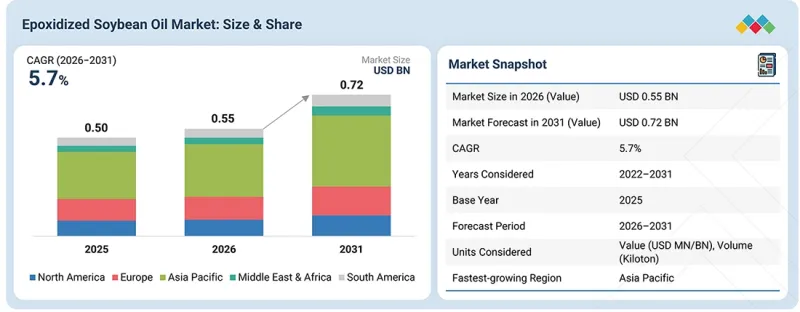
The epoxidized soybean oil (ESBO) market is projected to reach USD 0.72 billion by 2031 from USD 0.55 billion in 2026, at a CAGR of 5.7% from 2026 to 2031.
| Scope of the Report | |
|---|---|
| Years Considered for the Study | 2022-2031 |
| Base Year | 2025 |
| Forecast Period | 2026-2031 |
| Units Considered | Value (USD Million/Billion) / Volume (Kiloton) |
| Segments | Raw Material, Application, End-Use Industry, and Region |
| Regions covered | North America, Asia Pacific, Europe, the Middle East & Africa, and South America |
Demand is driven by an increasing need for environmentally friendly plasticizers, a rising use of bio-based lubricants, the favorable pricing and widespread accessibility of ESBO in relation to other bio-based oils, as well as its enhanced performance characteristics that facilitate its application across a broader array of uses.
"Hydrogen peroxide projected to be the second-largest raw material segment during the forecast period"
By raw material, the hydrogen peroxide segment is estimated to account for the second-largest share of the ESBO market as it is an essential oxidizing agent in the conventional epoxidation route used for the conversion of soybean oil into ESBO. In the industrial process, hydrogen peroxide is reacted with formic or acetic acid to generate a peroxyacid in situ that will react with the unsaturated double bonds of soybean oil to form epoxy groups. This importance is also emphasized by the fact that there are processes to use hydrogen peroxide commercially, and research is still ongoing to enhance the utilization and process efficiency. The epoxidation with hydrogen peroxide has been shown to be possible in both homogeneous (conventional peracid) and heterogeneous (catalysts) systems, with the latter designed to minimize the amount of peroxide used and its impact on the environment. A further advantage of using hydrogen peroxide is its relative purity as a relatively clean oxidant that decomposes into water upon reaction, but it requires careful control in the industrial reaction due to its high exothermicity when reacting in epoxidation. The combination of process functionality, existing industrial chemistry, availability, compatibility with various catalytic systems, and the potential for cleaner processing results in significant use of hydrogen peroxide in ESBO production.
"Functional fluids projected to be the second-largest application segment during the forecast period."
The second-largest application of ESBO is in functional fluids, where its derivatives can provide desirable properties like lubricity and chemical functionality. Additionally, renewable fluids can be used in the formulation of fluids and lubricants. The study of ESBO (epoxidized soybean oil) as a bio-based lubricant and lubricant intermediate has been conducted, focusing on its epoxy functionality to create more advanced fluid systems. Scientific literature recognizes epoxidized vegetable oils as suitable and sustainable feedstocks for lubricants and other chemicals. The long fatty acid chains in ESBO make it a hydrophobic molecule, making it ideal for lubricating applications. The epoxidation process enhances the oil's chemical properties, potentially improving its oxidative and thermal stability compared to unmodified vegetable oils. The study also indicates that epoxidized vegetable oils can serve as renewable alternatives to conventional PVC plasticizers. This segment is expected to gain further value due to the growing demand for bio-based and renewable lubricant additives, especially as manufacturers seek alternatives to petroleum-based feedstocks. However, the primary use of ESBO remains as a PVC plasticizer and co-stabilizer. From this perspective, functional fluids represent a significant secondary application, leveraging properties such as lubricity, renewability, chemical versatility, and potential for further functionalization.
"Food & beverages projected to be the second-largest end-use industry segment during the forecast period."
The second-largest end-use industry is food & beverages. ESBO is used in food contact materials and in PVC-based packaging applications, where its plasticizing and stabilizing properties are beneficial. Epoxidized soybean oil has been specifically approved by the US FDA for various food-contact uses, as outlined in multiple sections of the Code of Federal Regulations (21 CFR), including applications related to polymers and food-contact materials. Additionally, FDA records indicate that epoxidized soybean oil has been utilized in food-related systems for several technical purposes, such as a formulation aid, lubricant or release agent, and stabilizer or thickener. This suggests a broad range of applications in food-related contexts.
Its suitability for flexible packaging and other polymeric food-contact applications is further enhanced by its renewable origin. Epoxidized soybean oil has also been effectively used as a plasticizer for PVC and as a secondary stabilizer. Its importance in PVC applications is particularly noteworthy due to its dual role: it acts as a plasticizer and helps stabilize the polymer against degradation during processing. Food & beverage is a strong end-use segment for ESBO, trailing only the polymer-related end-use market due to its food contact regulatory acceptance, plasticizing/stabilizing functionality, and its suitability and demand for packaging materials.
"Europe projected to be the second-largest regional segment in terms of value during the forecast period."
Europe is estimated to be the second-largest regional market for ESBO, driven by its well-established plastics processing industry, significant domestic demand for PVC products, and government regulations for more environmentally friendly and safer additives. Europe's plastic demand in 2024 reached 52.8 million tonnes, of which 34.9% was for packaging, 23.4% for building and construction, and 9.0% for automotive applications, providing a wide downstream market for plasticizers and polymer additives in Europe. PVC is especially important for ESBO, as its use is widely spread throughout the European construction, packaging, medical product, electrical insulation, and automotive sectors. Furthermore, EU specifications for food contact materials include the requirement for safety and control of migration, traceability, and good manufacturing practices, which strongly promote the use of well-characterized additives. With the high consumption of ESBO due to the volume of polymer base usage in packaging, construction, and healthcare, Europe is the second-largest market for ESBO.
By Company Type: Tier 1: 25%, Tier 2: 42%, and Tier 3: 33%
By Designation: C-level Executives: 20%, Directors: 30%, and Other Designations: 50%
By Region: North America: 20%, Europe: 10%, Asia Pacific: 40%, South America: 10%, and Middle East & Africa 20%
Note: Tier 1: >USD 1 billion; Tier 2: USD 500 million-1 billion; and Tier 3: <USD 500 million. Other designations include sales, marketing, and product managers.
Companies Covered: CHS Inc. (US), Nan Ya Plastics Corporation (Taiwan), Adeka Corporation (Japan), Cargill (US), Valtris (US), Galata Chemicals LLC (US), Hairma Chemicals (GZ) Ltd. (China), Shandong Longkou Longda Chemical Industry Co., Ltd. (China), Guangzhou Xinjinlong Chemical Additives Co., Ltd. (China), and Inbra Industrias Quimicas, Ltda. (Brazil), among others, are covered in the report.
The study includes an in-depth competitive analysis of key players in the epoxidized soybean oil market, with their company profiles, recent developments, and key market strategies.
Research Coverage
This research report categorizes the epoxidized soybean oil market based on raw material (Soybean Oil, Hydrogen Peroxide, and Other Raw Materials), application (Plasticizers, Pigment Dispersion Agents, Flavors & Fragrances, Functional Fluids, UV Cure Applications, Fuel Additives, and Other Applications), end-use industry (Food & Beverages, Personal & Healthcare, Adhesives & Sealants, Automotive & Transportation, and Other End-use Industries), and region (North America, Europe, Asia Pacific, Middle East & Africa, and South America). The report's scope covers detailed information regarding the drivers, restraints, challenges, and opportunities influencing the growth of the market. A detailed analysis of the key industry players has been done to provide insights into their business overview, products offered, and key strategies, such as partnerships, collaborations, product launches, expansions, and acquisitions, associated with the epoxidized soybean oil market. This report also covers a competitive analysis of upcoming startups in the epoxidized soybean oil market ecosystem.
Reasons to Buy the Report
The report will offer market leaders/new entrants with information on the closest approximations of the revenue numbers for the overall epoxidized soybean oil market and the subsegments. This report will help stakeholders understand the competitive landscape, gain more insights into positioning their businesses better, and plan suitable go-to-market strategies. The report will help stakeholders understand the pulse of the market and provide them with information on key market drivers, restraints, challenges, and opportunities.
The report provides insights into the following points:
Analysis of key drivers (rising demand for eco-friendly plasticizers, biocompatible lubricants - emerging alternative for mineral oil-based lubricants, easy availability of ESBO in large volumes and at low prices, competitive advantage over other bio-based oils, superior performance properties augmenting demand), restraints (fluctuating raw material prices, hazardous to health due to excess usage of ESBO in food & beverage industry), opportunities (growing prominence of phthalate-free stabilizers providing opportunities for ESBO producers in PVC applications), and challenges (competition from other bio-based plasticizers).
- Product Development/Innovation: Detailed insights into upcoming technologies, research & development activities, and product & service launches in the epoxidized soybean oil market.
- Market Development: Comprehensive information about profitable markets - the report analyzes the epoxidized soybean oil market across varied regions.
Market Diversification: Exhaustive information about new products & services, untapped geographies, recent developments, and investments in the epoxidized soybean oil market.
- Competitive Assessment: In-depth assessment of market shares, growth strategies, and service offerings of leading players, such as CHS Inc. (US), Nan Ya Plastics Corporation (Taiwan), Adeka Corporation (Japan), Cargill (US), Valtris (US), Galata Chemicals LLC (US), Hairma Chemicals (GZ) Ltd. (China), Shandong Longkou Longda Chemical Industry Co., Ltd. (China), Guangzhou Xinjinlong Chemical Additives Co., Ltd. (China), and Inbra Industrias Quimicas, Ltda. (Brazil).
TABLE OF CONTENTS
1 INTRODUCTION
- 1.1 STUDY OBJECTIVES
- 1.2 MARKET DEFINITION
- 1.3 STUDY SCOPE
- 1.3.1 MARKETS COVERED & REGIONAL SCOPE
- 1.3.2 INCLUSIONS & EXCLUSIONS
- 1.3.3 YEARS CONSIDERED
- 1.4 CURRENCY CONSIDERED
- 1.5 UNIT CONSIDERED
- 1.6 STAKEHOLDERS
- 1.7 RESEARCH LIMITATIONS
- 1.8 SUMMARY OF STRATEGIC CHANGES IN MARKET
2 EXECUTIVE SUMMARY
- 2.1 KEY INSIGHTS AND MARKET HIGHLIGHTS
- 2.2 KEY MARKET PARTICIPANTS: SHARE INSIGHTS AND STRATEGIC DEVELOPMENTS
- 2.3 DISRUPTIVE TRENDS SHAPING THE MARKET
- 2.4 HIGH-GROWTH SEGMENTS & EMERGING FRONTIERS
- 2.5 SNAPSHOT: GLOBAL MARKET SIZE, GROWTH RATE, AND FORECAST
3 PREMIUM INSIGHTS
- 3.1 ATTRACTIVE OPPORTUNITIES FOR PLAYERS IN EPOXIDIZED SOYBEAN OIL MARKET
- 3.2 ASIA PACIFIC: EPOXIDIZED SOYBEAN OIL MARKET, BY END-USE INDUSTRY AND COUNTRY
- 3.3 EPOXIDIZED SOYBEAN OIL MARKET, BY RAW MATERIAL
- 3.4 EPOXIDIZED SOYBEAN OIL MARKET, BY APPLICATION
- 3.5 EPOXIDIZED SOYBEAN OIL MARKET, BY END-USE INDUSTRY
- 3.6 EPOXIDIZED SOYBEAN OIL MARKET, BY COUNTRY
4 MARKET OVERVIEW
- 4.1 INTRODUCTION
- 4.2 MARKET DYNAMICS
- 4.2.1 DRIVERS
- 4.2.1.1 Rising demand for eco-friendly plasticizers
- 4.2.1.2 Biocompatible lubricants - emerging alternative to mineral oil-based lubricants
- 4.2.1.3 Easy availability of epoxidized soybean oil in large volumes at low prices
- 4.2.1.4 Superior performance properties augmenting demand
- 4.2.2 RESTRAINTS
- 4.2.2.1 Fluctuating raw material prices
- 4.2.2.2 Hazardous to health due to excessive use of epoxidized soybean oil in food & beverage industry
- 4.2.3 OPPORTUNITIES
- 4.2.3.1 Growing prominence of phthalate-free stabilizers in PVC applications
- 4.2.4 CHALLENGES
- 4.2.4.1 Competition from other bio-based plasticizers
- 4.2.1 DRIVERS
- 4.3 UNMET NEEDS AND WHITE SPACES
- 4.3.1 UNMET NEEDS IN THE EPOXIDIZED SOYBEAN OIL MARKET
- 4.3.2 WHITE SPACE OPPORTUNITIES
- 4.4 INTERCONNECTED MARKETS AND CROSS-SECTOR OPPORTUNITIES
- 4.4.1 INTERCONNECTED MARKETS
- 4.4.2 CROSS-SECTOR OPPORTUNITIES
- 4.4.2.1 Food & beverage ↔ personal & healthcare
- 4.4.2.2 Adhesives & sealants ↔ automotive & transportation
- 4.5 STRATEGIC MOVES BY TIER-1/2/3 PLAYERS
- 4.5.1 TIER 1 PLAYERS: GLOBAL LEADERS DRIVING CONSOLIDATION AND INNOVATION
- 4.5.1.1 CHS Inc.'s expansion FACILITY of soybean processing in Wisconsin
- 4.5.1.2 Cargill's expansion and modernization of Ohio facility
- 4.5.2 TIER 2 PLAYERS: REGIONAL INNOVATORS AND NICHE LEADERS
- 4.5.2.1 Praana's expansion in the epoxidized soybean oil market through galata chemicals
- 4.5.3 TIER 3 PLAYERS: MODERNIZATION THROUGH TECHNOLOGY
- 4.5.3.1 Puritz chem private limited implements latest technologies and automation for production of ESBO
- 4.5.1 TIER 1 PLAYERS: GLOBAL LEADERS DRIVING CONSOLIDATION AND INNOVATION
5 INDUSTRY TRENDS
- 5.1 PORTER'S FIVE FORCES ANALYSIS
- 5.1.1 BARGAINING POWER OF SUPPLIERS
- 5.1.2 THREAT OF NEW ENTRANTS
- 5.1.3 THREAT OF SUBSTITUTES
- 5.1.4 BARGAINING POWER OF BUYERS
- 5.1.5 INTENSITY OF COMPETITIVE RIVALRY
- 5.2 MACROECONOMIC ANALYSIS
- 5.2.1 INTRODUCTION
- 5.2.2 GDP TRENDS AND FORECASTS
- 5.3 VALUE CHAIN ANALYSIS
- 5.3.1 RAW MATERIAL SUPPLIERS
- 5.3.2 EPOXIDIZED SOYBEAN OIL MANUFACTURERS
- 5.3.3 PRODUCT MANUFACTURERS
- 5.3.4 END-USE INDUSTRIES
- 5.4 ECOSYSTEM MAP
- 5.5 PRICING ANALYSIS
- 5.5.1 AVERAGE SELLING PRICE TREND OF KEY PLAYERS, BY APPLICATION
- 5.5.2 SELLING PRICE RANGE OF EPOXIDIZED SOYBEAN OIL, BY REGION, 2021-2028
- 5.5.3 SELLING PRICE RANGE OF SOYBEAN OIL, 2019-2028 (USD/LBS)
- 5.5.4 SELLING PRICE RANGE OF EPOXIDIZED SOYBEAN OIL, 2019-2028 (USD/LBS)
- 5.6 TRADE ANALYSIS
- 5.6.1 EXPORT SCENARIO (HS CODE 151800)
- 5.6.2 IMPORT SCENARIO (HS CODE 151800)
- 5.7 KEY CONFERENCES AND EVENTS, 2026-2027
- 5.8 TRENDS/DISRUPTIONS IMPACTING CUSTOMER BUSINESS
- 5.9 INVESTMENT AND FUNDING SCENARIO
- 5.10 CASE STUDY ANALYSIS
- 5.10.1 CASE STUDY 1: COMPARATIVE INVESTIGATION OF ULTRAVIOLET IRRADIATION EFFECTS ON SUNFLOWER, SOYBEAN, AND OLIVE OILS, CONSIDERING BOTH EPOXIDIZED AND NON-EPOXIDIZED VARIANTS
- 5.10.2 CASE STUDY 2: INVESTIGATING IMPACT OF INCORPORATING EPOXIDIZED SOYBEAN OIL AS A PLASTICIZER ON PHYSICAL, MECHANICAL, AND THERMAL CHARACTERISTICS OF POLYVINYL CHLORIDE
- 5.11 IMPACT OF 2025 US TARIFF: EPOXIDIZED SOYBEAN OIL MARKET
- 5.11.1 KEY TARIFF RATES
- 5.11.2 PRICE IMPACT ANALYSIS
- 5.11.3 IMPACT ON COUNTRY/REGION
- 5.11.3.1 US
- 5.11.3.2 Europe
- 5.11.3.3 Asia Pacific
- 5.11.4 END-USE INDUSTRY IMPACT
6 TECHNOLOGICAL ADVANCEMENTS, AI-DRIVEN IMPACT, PATENTS, INNOVATIONS, AND FUTURE APPLICATIONS
- 6.1 KEY TECHNOLOGIES
- 6.1.1 GREEN EPOXIDATION PROCESSES
- 6.1.2 ENZYMATIC EPOXIDATION OF SOYBEAN OIL
- 6.1.3 FUNCTIONALIZED EPOXIDIZED SOYBEAN OIL
- 6.2 COMPLEMENTARY TECHNOLOGIES
- 6.2.1 UV CURABLE EPOXIDIZED SOYBEAN OIL
- 6.2.2 NANOTECHNOLOGY IN EPOXIDIZED SOYBEAN OIL
- 6.3 ADJACENT TECHNOLOGIES
- 6.3.1 OPTIMIZING SOYBEAN OIL EPOXIDATION PROCESS BY MEANS OF ARTIFICIAL INTELLIGENCE
- 6.4 TECHNOLOGY ROADMAP
- 6.4.1 SHORT-TERM (2026-2028) | PROCESS OPTIMIZATION AND GREEN EPOXIDATION
- 6.4.2 MID-TERM (2028-2030) | ADVANCED FUNCTIONALIZATION AND PERFORMANCE ENHANCEMENT
- 6.4.3 LONG-TERM (2030-2035+) | NEXT-GENERATION BIO-BASED MATERIALS AND INTELLIGENT MANUFACTURING
- 6.5 PATENT ANALYSIS
- 6.5.1 INTRODUCTION
- 6.5.2 METHODOLOGY
- 6.5.3 EPOXIDIZED SOYBEAN OIL MARKET, PATENT ANALYSIS, 2016-2025
- 6.6 FUTURE APPLICATIONS
- 6.6.1 NANOCOMPOSITES AND HIGH-PERFORMANCE BIO-BASED MATERIALS
- 6.6.2 BIO-BASED POLYMER ELECTROLYTES FOR NEXT-GENERATION BATTERIES
- 6.6.3 SMART BIO-BASED MATERIALS FOR SOFT ROBOTICS AND ADAPTIVE DEVICES
- 6.7 IMPACT OF AI/GEN AI ON EPOXIDIZED SOYBEAN OIL MARKET
- 6.7.1 TOP USE CASES AND MARKET POTENTIAL
- 6.7.2 BEST PRACTICES IN EPOXIDIZED SOYBEAN OIL PROCESSING
- 6.7.3 CASE STUDIES OF AI IMPLEMENTATION IN EPOXIDIZED SOYBEAN OIL MARKET
- 6.7.4 INTERCONNECTED ECOSYSTEM AND IMPACT ON MARKET PLAYERS
- 6.7.5 CLIENTS' READINESS TO ADOPT GENERATIVE AI IN EPOXIDIZED SOYBEAN OIL MARKET
7 SUSTAINABILITY AND REGULATORY LANDSCAPE
- 7.1 REGIONAL REGULATIONS AND COMPLIANCE
- 7.1.1 REGULATORY BODIES, GOVERNMENT AGENCIES, AND OTHER ORGANIZATIONS
- 7.1.2 INDUSTRY STANDARDS
- 7.2 SUSTAINABILITY INITIATIVES
- 7.2.1 SUPPORTING PVC RECYCLING AND CIRCULARITY
- 7.2.2 EXPANSION OF SOYBEAN OIL INTO BIO-BASED INDUSTRIAL PRODUCTS
- 7.3 IMPACT OF REGULATORY POLICY ON SUSTAINABILITY INITIATIVES
8 CUSTOMER LANDSCAPE & BUYER BEHAVIOR
- 8.1 DECISION-MAKING PROCESS
- 8.2 BUYER STAKEHOLDERS AND BUYING EVALUATION CRITERIA
- 8.2.1 KEY STAKEHOLDERS IN THE BUYING PROCESS
- 8.2.2 BUYING CRITERIA
- 8.3 ADOPTION BARRIERS & INTERNAL CHALLENGES
- 8.4 UNMET NEEDS FROM VARIOUS END-USE INDUSTRIES
- 8.5 MARKET PROFITABILITY
- 8.5.1 REVENUE POTENTIAL
- 8.5.2 COST DYNAMICS
9 EPOXIDIZED SOYBEAN OIL MARKET, BY RAW MATERIAL
- 9.1 INTRODUCTION
- 9.2 SOYBEAN OIL
- 9.2.1 ECONOMICAL AND WIDE AVAILABILITY TO DRIVE MARKET
- 9.3 HYDROGEN PEROXIDE
- 9.3.1 COST-EFFECTIVENESS AND SUPERIOR PERFORMANCE OF TECHNOLOGY TO DRIVE MARKET
- 9.4 OTHER RAW MATERIALS
10 EPOXIDIZED SOYBEAN OIL MARKET, BY APPLICATION
- 10.1 INTRODUCTION
- 10.2 PLASTICIZERS
- 10.2.1 ENHANCEMENT OF FLEXIBILITY, PLASTICITY, AND OVERALL USABILITY OF PLASTICS TO DRIVE DEMAND
- 10.3 PIGMENT DISPERSION AGENTS
- 10.3.1 UNIFORMITY OF COLOR, CONSISTENCY, AND PERFORMANCE IN PAINTS & COATINGS, INKS, PLASTICS, AND COSMETICS TO DRIVE MARKET
- 10.4 FLAVORS & FRAGRANCES
- 10.4.1 SUSTAINABILITY AND ENHANCEMENT OF STABILITY AND PERFORMANCE OF SENSORY-DRIVEN PRODUCTS TO DRIVE MARKET
- 10.5 FUNCTIONAL FLUIDS
- 10.5.1 LOW VOLATILITY, HIGH VISCOSITY, SHEAR-STABILITY, ABSORPTION ON METAL SURFACES, AND GOOD SOLUBILITY WITH OIL ADDITIVES TO DRIVE MARKET
- 10.6 UV CURE APPLICATIONS
- 10.6.1 RISING DEMAND FOR ECO-FRIENDLY AND HIGH-PERFORMANCE FORMULATIONS TO DRIVE MARKET
- 10.7 FUEL ADDITIVES
- 10.7.1 OVERALL EFFECTIVENESS AND ENVIRONMENTAL COMPATIBILITY TO DRIVE DEMAND
- 10.8 OTHER APPLICATIONS
11 EPOXIDIZED SOYBEAN OIL MARKET, BY END-USE INDUSTRY
- 11.1 INTRODUCTION
- 11.2 FOOD & BEVERAGE
- 11.2.1 RISING DEMAND FOR NON-PHTHALATE PVC PLASTICIZERS FOR FOOD PACKAGE MATERIALS AND BEVERAGE CAN COATINGS
- 11.3 PERSONAL & HEALTHCARE
- 11.3.1 APPLICATIONS IN FABRICATION OF MEDICAL DEVICES, PHARMACEUTICAL PACKAGING, AND PERSONAL CARE PRODUCTS TO DRIVE MARKET
- 11.4 ADHESIVES & SEALANTS
- 11.4.1 ENHANCEMENT OF FLEXIBILITY, DURABILITY, AND OVERALL PERFORMANCE OF ADHESIVE FORMULATIONS TO DRIVE MARKET
- 11.5 AUTOMOTIVE & TRANSPORTATION
- 11.5.1 INCREASE IN FLEXIBILITY, IMPACT RESISTANCE, AND THERMAL STABILITY OF PVC FORMULATIONS TO DRIVE MARKET
- 11.6 OTHER END-USE INDUSTRIES
12 EPOXIDIZED SOYBEAN OIL MARKET, BY REGION
- 12.1 INTRODUCTION
- 12.2 NORTH AMERICA
- 12.2.1 US
- 12.2.1.1 Expanding construction and food & beverage industries to drive market
- 12.2.2 CANADA
- 12.2.2.1 Surging demand for replacement of non-sustainable materials in PVC plastics and natural polyols to drive market
- 12.2.3 MEXICO
- 12.2.3.1 Demand for bio-based plasticizers in PVC compounds for packaging applications to drive market
- 12.2.1 US
- 12.3 EUROPE
- 12.3.1 GERMANY
- 12.3.1.1 Growing potential in adhesives & sealants, coatings, and polymer sectors to drive market
- 12.3.2 FRANCE
- 12.3.2.1 High safety standards and environmental regulations to drive market
- 12.3.3 UK
- 12.3.3.1 Use as plasticizer and additive for packaging products to drive market
- 12.3.4 ITALY
- 12.3.4.1 Increased investments in polymer industry and environmental concerns to drive market
- 12.3.5 RUSSIA
- 12.3.5.1 Growing PVC industry to drive market
- 12.3.6 REST OF EUROPE
- 12.3.1 GERMANY
- 12.4 ASIA PACIFIC
- 12.4.1 CHINA
- 12.4.1.1 Growing economy and rapidly expanding end-use industries to drive market
- 12.4.2 INDIA
- 12.4.2.1 Government initiatives to drive market
- 12.4.3 JAPAN
- 12.4.3.1 PVC industry and high-end applications to drive market
- 12.4.4 SOUTH KOREA
- 12.4.4.1 Increasing potential in food & beverage and personal care & healthcare sectors to drive market
- 12.4.5 INDONESIA
- 12.4.5.1 Increasing potential in agriculture industry to drive market
- 12.4.6 REST OF ASIA PACIFIC
- 12.4.1 CHINA
- 12.5 MIDDLE EAST & AFRICA
- 12.5.1 GCC COUNTRIES
- 12.5.1.1 Growing end-use industries to drive market
- 12.5.1.2 Saudi Arabia
- 12.5.1.2.1 Regulatory support and propelling construction industry to drive market
- 12.5.1.3 UAE
- 12.5.1.3.1 Industrial growth and tourism to drive market
- 12.5.1.4 Rest of GCC countries
- 12.5.2 SOUTH AFRICA
- 12.5.2.1 Increasing urbanization and robust soybean industry to drive market
- 12.5.3 REST OF MIDDLE EAST & AFRICA
- 12.5.1 GCC COUNTRIES
- 12.6 SOUTH AMERICA
- 12.6.1 BRAZIL
- 12.6.1.1 Increasing demand for personal & healthcare products to drive market
- 12.6.2 ARGENTINA
- 12.6.2.1 Significant soybean production to drive market
- 12.6.3 REST OF SOUTH AMERICA
- 12.6.1 BRAZIL
13 COMPETITIVE LANDSCAPE
- 13.1 OVERVIEW
- 13.2 KEY PLAYER STRATEGIES/RIGHT TO WIN
- 13.3 REVENUE ANALYSIS
- 13.4 MARKET SHARE ANALYSIS
- 13.5 COMPANY VALUATION AND FINANCIAL METRICS
- 13.5.1 COMPANY VALUATION
- 13.6 FINANCIAL METRICS
- 13.7 BRAND/PRODUCT COMPARISON
- 13.8 COMPANY EVALUATION MATRIX: KEY PLAYERS, 2025
- 13.8.1 STARS
- 13.8.2 EMERGING LEADERS
- 13.8.3 PERVASIVE PLAYERS
- 13.8.4 PARTICIPANTS
- 13.8.5 COMPANY FOOTPRINT: KEY PLAYERS, 2025
- 13.8.5.1 Company footprint
- 13.8.5.2 Region footprint
- 13.8.5.3 Raw material footprint
- 13.8.5.4 End-use industry footprint
- 13.9 COMPANY EVALUATION MATRIX: STARTUPS/SMES, 2025
- 13.9.1 PROGRESSIVE COMPANIES
- 13.9.2 RESPONSIVE COMPANIES
- 13.9.3 DYNAMIC COMPANIES
- 13.9.4 STARTING BLOCKS
- 13.9.5 COMPETITIVE BENCHMARKING: STARTUPS/SMES, 2025
- 13.9.5.1 Detailed list of key startups/SMEs
- 13.9.5.2 Competitive benchmarking of key startups/SMEs
- 13.10 COMPETITIVE SCENARIO
- 13.10.1 DEALS
- 13.10.2 EXPANSIONS
14 COMPANY PROFILES
- 14.1 KEY PLAYERS
- 14.1.1 CHS INC.
- 14.1.1.1 Business overview
- 14.1.1.2 Products/Solutions/Services offered
- 14.1.1.3 Recent developments
- 14.1.1.4 MnM view
- 14.1.1.4.1 Right to win
- 14.1.1.4.2 Strategic choices
- 14.1.1.4.3 Weaknesses and competitive threats
- 14.1.2 NAN YA PLASTICS CORPORATION
- 14.1.2.1 Business overview
- 14.1.2.2 Products/Solutions/Services offered
- 14.1.2.3 MnM view
- 14.1.2.3.1 Right to win
- 14.1.2.3.2 Strategic choices
- 14.1.2.3.3 Weaknesses and competitive threats
- 14.1.3 ADEKA CORPORATION
- 14.1.3.1 Business overview
- 14.1.3.2 Products/Solutions/Services offered
- 14.1.3.3 MnM view
- 14.1.3.3.1 Right to win
- 14.1.3.3.2 Strategic choices
- 14.1.3.3.3 Weaknesses and competitive threats
- 14.1.4 CARGILL
- 14.1.4.1 Business overview
- 14.1.4.2 Products/Solutions/Services offered
- 14.1.4.3 Recent developments
- 14.1.4.4 MnM view
- 14.1.4.4.1 Right to win
- 14.1.4.4.2 Strategic choices
- 14.1.4.4.3 Weaknesses and competitive threats
- 14.1.5 VALTRIS
- 14.1.5.1 Business overview
- 14.1.5.2 Products/Solutions/Services offered
- 14.1.5.3 MnM view
- 14.1.5.3.1 Right to win
- 14.1.5.3.2 Strategic choices
- 14.1.5.3.3 Weaknesses and competitive threats
- 14.1.6 PRAANA GROUP
- 14.1.6.1 Business overview
- 14.1.6.2 Products/Solutions/Services offered
- 14.1.6.3 MnM view
- 14.1.7 HAIRMA CHEMICALS (GZ) LTD.
- 14.1.7.1 Business overview
- 14.1.7.2 Products/Solutions/Services offered
- 14.1.7.3 MnM view
- 14.1.8 SHANDONG LONGKOU LONGDA CHEMICAL INDUSTRY CO., LTD.
- 14.1.8.1 Business overview
- 14.1.8.2 Products/Solutions/Services offered
- 14.1.8.3 MnM view
- 14.1.9 GUANGZHOU XINJINLONG CHEMICAL ADDITIVES CO. LTD.
- 14.1.9.1 Business overview
- 14.1.9.2 Products/Solutions/Services offered
- 14.1.9.3 MnM view
- 14.1.10 INBRA INDUSTRIAS QUIMICAS, LTDA.
- 14.1.10.1 Business overview
- 14.1.10.2 Products/Solutions/Services offered
- 14.1.10.3 MnM view
- 14.1.1 CHS INC.
- 14.2 OTHER PLAYERS
- 14.2.1 SHANDONG SHENGBANG IMPORT AND EXPORT CO., LTD.
- 14.2.2 ANHUI TIANYI ENVIRONMENTAL PROTECTION TECH. CO., LTD.
- 14.2.3 DHANRAJ ORGANIC PVT. LTD.
- 14.2.4 AMIK ITALIA SPA
- 14.2.5 HALLSTAR
- 14.2.6 AJAY POLY PVT LTD (APPL)
- 14.2.7 VIZAG CHEMICAL
- 14.2.8 PURITZ CHEM PRIVATE LIMITED
- 14.2.9 CHANG CHUN PETROCHEMICAL CO., LTD.
- 14.2.10 MAKWELL PLASTICIZERS PVT LTD.,
- 14.2.11 HEBEI JINGU PLASTICIZER CO., LTD.
- 14.2.12 THE CHEMICAL COMPANY (TCC)
- 14.2.13 ATAMAN KIMYA A.S.
- 14.2.14 FAITH INDUSTRIES LTD.
- 14.2.15 PRAKASH CHEMICALS INTERNATIONAL PRIVATE LIMITED (PCIPL)
15 RESEARCH METHODOLOGY
- 15.1 RESEARCH DATA
- 15.1.1 SECONDARY DATA
- 15.1.1.1 Key data from secondary sources
- 15.1.2 PRIMARY DATA
- 15.1.2.1 Key data from primary sources
- 15.1.2.2 Key industry insights
- 15.1.1 SECONDARY DATA
- 15.2 MARKET SIZE ESTIMATION
- 15.3 DATA TRIANGULATION
- 15.4 RESEARCH ASSUMPTIONS
- 15.5 RESEARCH LIMITATIONS
- 15.6 RISK ASSESSMENT
- 15.7 GROWTH RATE ASSUMPTIONS
16 APPENDIX
- 16.1 DISCUSSION GUIDE
- 16.2 KNOWLEDGESTORE: MARKETSANDMARKETS' SUBSCRIPTION PORTAL
- 16.3 CUSTOMIZATION OPTIONS
- 16.4 RELATED REPORTS
- 16.5 AUTHOR DETAILS
List of Tables
- TABLE 1 PORTER'S FIVE FORCES ANALYSIS
- TABLE 2 WORLD REAL GDP (ANNUAL PERCENTAGE CHANGE), 2023-2027
- TABLE 3 ECOSYSTEM OF EPOXIDIZED SOYBEAN OIL MARKET
- TABLE 4 AVERAGE PRICE TREND OF KEY PLAYERS, BY TOP 3 APPLICATIONS, 2025 (USD/TON)
- TABLE 5 AVERAGE PRICE TREND OF KEY PLAYERS, BY REGION, 2021-2028 (USD/TON)
- TABLE 6 EXPORT DATA RELATED TO HS CODE 151800-COMPLIANT PRODUCTS, BY COUNTRY, 2021-2025 (USD MILLION)
- TABLE 7 IMPORT DATA RELATED TO HS CODE 151800-COMPLIANT PRODUCTS, BY COUNTRY, 2021-2025 (USD MILLION)
- TABLE 8 EPOXIDIZED SOYBEAN OIL MARKET: DETAILED LIST OF CONFERENCES AND EVENTS, 2026-2027
- TABLE 9 EPOXIDIZED SOYBEAN OIL MARKET: LIST OF KEY PATENTS, 2025
- TABLE 10 TOP USE CASES AND MARKET POTENTIAL
- TABLE 11 BEST PRACTICES: COMPANIES IMPLEMENTING USE CASES
- TABLE 12 EPOXIDIZED SOYBEAN OIL MARKET: CASE STUDIES RELATED TO AI IMPLEMENTATION
- TABLE 13 NORTH AMERICA: REGULATORY BODIES, GOVERNMENT AGENCIES, AND OTHER ORGANIZATIONS
- TABLE 14 EUROPE: REGULATORY BODIES, GOVERNMENT AGENCIES, AND OTHER ORGANIZATIONS
- TABLE 15 ASIA PACIFIC: REGULATORY BODIES, GOVERNMENT AGENCIES, AND OTHER ORGANIZATIONS
- TABLE 16 MIDDLE EAST & AFRICA: LIST OF REGULATORY BODIES, GOVERNMENT AGENCIES, INDUSTRY ASSOCIATIONS, AND OTHER ORGANIZATIONS
- TABLE 17 SOUTH AMERICA: LIST OF REGULATORY BODIES, GOVERNMENT AGENCIES, INDUSTRY ASSOCIATIONS, AND OTHER ORGANIZATIONS
- TABLE 18 GLOBAL INDUSTRY STANDARDS IN EPOXIDIZED SOYBEAN OIL MARKET
- TABLE 19 INFLUENCE OF STAKEHOLDERS ON BUYING PROCESS, BY END-USE INDUSTRY (%)
- TABLE 20 KEY BUYING CRITERIA, BY END-USE INDUSTRY
- TABLE 21 UNMET NEEDS IN THE EPOXIDIZED SOYBEAN OIL MARKET BY END-USE INDUSTRIES
- TABLE 22 MARGIN OPPORTUNITIES BY END-USE INDUSTRY
- TABLE 23 EPOXIDIZED SOYBEAN OIL MARKET, BY RAW MATERIAL, 2022-2024 (USD MILLION)
- TABLE 24 EPOXIDIZED SOYBEAN OIL MARKET, BY RAW MATERIAL, 2025-2031 (USD MILLION)
- TABLE 25 EPOXIDIZED SOYBEAN OIL MARKET, BY RAW MATERIAL, 2022-2024 (KILOTON)
- TABLE 26 EPOXIDIZED SOYBEAN OIL MARKET, BY RAW MATERIAL, 2025-2031 (KILOTON)
- TABLE 27 EPOXIDIZED SOYBEAN OIL MARKET, BY APPLICATION, 2022-2024 (USD MILLION)
- TABLE 28 EPOXIDIZED SOYBEAN OIL MARKET, BY APPLICATION, 2025-2031 (USD MILLION)
- TABLE 29 EPOXIDIZED SOYBEAN OIL MARKET, BY APPLICATION, 2022-2024 (KILOTON)
- TABLE 30 EPOXIDIZED SOYBEAN OIL MARKET, BY APPLICATION, 2025-2031 (KILOTON)
- TABLE 31 EPOXIDIZED SOYBEAN OIL MARKET, BY END-USE INDUSTRY, 2022-2024 (USD MILLION)
- TABLE 32 EPOXIDIZED SOYBEAN OIL MARKET, BY END-USE INDUSTRY, 2025-2031 (USD MILLION)
- TABLE 33 EPOXIDIZED SOYBEAN OIL MARKET, BY END-USE INDUSTRY, 2022-2024 (KILOTON)
- TABLE 34 EPOXIDIZED SOYBEAN OIL MARKET, BY END-USE INDUSTRY, 2025-2031 (KILOTON)
- TABLE 35 EPOXIDIZED SOYBEAN OIL MARKET, BY REGION, 2022-2024 (USD MILLION)
- TABLE 36 EPOXIDIZED SOYBEAN OIL MARKET, BY REGION, 2025-2031 (USD MILLION)
- TABLE 37 EPOXIDIZED SOYBEAN OIL MARKET, BY REGION, 2022-2024 (KILOTON)
- TABLE 38 EPOXIDIZED SOYBEAN OIL MARKET, BY REGION, 2025-2031 (KILOTON)
- TABLE 39 NORTH AMERICA: EPOXIDIZED SOYBEAN OIL MARKET, BY COUNTRY, 2022-2024 (USD MILLION)
- TABLE 40 NORTH AMERICA: EPOXIDIZED SOYBEAN OIL MARKET, BY COUNTRY, 2025-2031 (USD MILLION)
- TABLE 41 NORTH AMERICA: EPOXIDIZED SOYBEAN OIL MARKET, BY COUNTRY, 2022-2024 (KILOTON)
- TABLE 42 NORTH AMERICA: EPOXIDIZED SOYBEAN OIL MARKET, BY COUNTRY, 2025-2031 (KILOTON)
- TABLE 43 NORTH AMERICA: EPOXIDIZED SOYBEAN OIL MARKET, BY APPLICATION, 2022-2024 (USD MILLION)
- TABLE 44 NORTH AMERICA: EPOXIDIZED SOYBEAN OIL MARKET, BY APPLICATION, 2025-2031 (USD MILLION)
- TABLE 45 NORTH AMERICA: EPOXIDIZED SOYBEAN OIL MARKET, BY APPLICATION, 2022-2024 (KILOTON)
- TABLE 46 NORTH AMERICA: EPOXIDIZED SOYBEAN OIL MARKET, BY APPLICATION, 2025-2031 (KILOTON)
- TABLE 47 NORTH AMERICA: EPOXIDIZED SOYBEAN OIL MARKET, BY END-USE INDUSTRY, 2022-2024 (USD MILLION)
- TABLE 48 NORTH AMERICA: EPOXIDIZED SOYBEAN OIL MARKET, BY END-USE INDUSTRY, 2025-2031 (USD MILLION)
- TABLE 49 NORTH AMERICA: EPOXIDIZED SOYBEAN OIL MARKET, BY END-USE INDUSTRY, 2022-2024 (KILOTON)
- TABLE 50 NORTH AMERICA: EPOXIDIZED SOYBEAN OIL MARKET, BY END-USE INDUSTRY, 2025-2031 (KILOTON)
- TABLE 51 US: EPOXIDIZED SOYBEAN OIL MARKET, BY RAW MATERIAL, 2022-2024 (USD MILLION)
- TABLE 52 US: EPOXIDIZED SOYBEAN OIL MARKET, BY RAW MATERIAL, 2025-2031 (USD MILLION)
- TABLE 53 US: EPOXIDIZED SOYBEAN OIL MARKET, BY RAW MATERIAL, 2022-2024 (KILOTON)
- TABLE 54 US: EPOXIDIZED SOYBEAN OIL MARKET, BY RAW MATERIAL, 2025-2031 (KILOTON)
- TABLE 55 US: EPOXIDIZED SOYBEAN OIL MARKET, BY APPLICATION, 2022-2024 (USD MILLION)
- TABLE 56 US: EPOXIDIZED SOYBEAN OIL MARKET, BY APPLICATION, 2025-2031 (USD MILLION)
- TABLE 57 US: EPOXIDIZED SOYBEAN OIL MARKET, BY APPLICATION, 2022-2024 (KILOTON)
- TABLE 58 US: EPOXIDIZED SOYBEAN OIL MARKET, BY APPLICATION, 2025-2031 (KILOTON)
- TABLE 59 US: EPOXIDIZED SOYBEAN OIL MARKET, BY END-USE INDUSTRY, 2022-2024 (USD MILLION)
- TABLE 60 US: EPOXIDIZED SOYBEAN OIL MARKET, BY END-USE INDUSTRY, 2025-2031 (USD MILLION)
- TABLE 61 US: EPOXIDIZED SOYBEAN OIL MARKET, BY END-USE INDUSTRY, 2022-2024 (KILOTON)
- TABLE 62 US: EPOXIDIZED SOYBEAN OIL MARKET, BY END-USE INDUSTRY, 2025-2031 (KILOTON)
- TABLE 63 CANADA: EPOXIDIZED SOYBEAN OIL MARKET, BY RAW MATERIAL, 2022-2024 (USD MILLION)
- TABLE 64 CANADA: EPOXIDIZED SOYBEAN OIL MARKET, BY RAW MATERIAL, 2025-2031 (USD MILLION)
- TABLE 65 CANADA: EPOXIDIZED SOYBEAN OIL MARKET, BY RAW MATERIAL, 2022-2024 (KILOTON)
- TABLE 66 CANADA: EPOXIDIZED SOYBEAN OIL MARKET, BY RAW MATERIAL, 2025-2031 (KILOTON)
- TABLE 67 CANADA: EPOXIDIZED SOYBEAN OIL MARKET, BY APPLICATION, 2022-2024 (USD MILLION)
- TABLE 68 CANADA: EPOXIDIZED SOYBEAN OIL MARKET, BY APPLICATION, 2025-2031 (USD MILLION)
- TABLE 69 CANADA: EPOXIDIZED SOYBEAN OIL MARKET, BY APPLICATION, 2022-2024 (KILOTON)
- TABLE 70 CANADA: EPOXIDIZED SOYBEAN OIL MARKET, BY APPLICATION, 2025-2031 (KILOTON)
- TABLE 71 CANADA: EPOXIDIZED SOYBEAN OIL MARKET, BY END-USE INDUSTRY, 2022-2024 (USD MILLION)
- TABLE 72 CANADA: EPOXIDIZED SOYBEAN OIL MARKET, BY END-USE INDUSTRY, 2025-2031 (USD MILLION)
- TABLE 73 CANADA: EPOXIDIZED SOYBEAN OIL MARKET, BY END-USE INDUSTRY, 2022-2024 (KILOTON)
- TABLE 74 CANADA: EPOXIDIZED SOYBEAN OIL MARKET, BY END-USE INDUSTRY, 2025-2031 (KILOTON)
- TABLE 75 MEXICO: EPOXIDIZED SOYBEAN OIL MARKET, BY RAW MATERIAL, 2022-2024 (USD MILLION)
- TABLE 76 MEXICO: EPOXIDIZED SOYBEAN OIL MARKET, BY RAW MATERIAL, 2025-2031 (USD MILLION)
- TABLE 77 MEXICO: EPOXIDIZED SOYBEAN OIL MARKET, BY RAW MATERIAL, 2022-2024 (KILOTON)
- TABLE 78 MEXICO: EPOXIDIZED SOYBEAN OIL MARKET, BY RAW MATERIAL, 2025-2031 (KILOTON)
- TABLE 79 MEXICO: EPOXIDIZED SOYBEAN OIL MARKET, BY APPLICATION, 2022-2024 (USD MILLION)
- TABLE 80 MEXICO: EPOXIDIZED SOYBEAN OIL MARKET, BY APPLICATION, 2025-2031 (USD MILLION)
- TABLE 81 MEXICO: EPOXIDIZED SOYBEAN OIL MARKET, BY APPLICATION, 2022-2024 (KILOTON)
- TABLE 82 MEXICO: EPOXIDIZED SOYBEAN OIL MARKET, BY APPLICATION, 2025-2031 (KILOTON)
- TABLE 83 MEXICO: EPOXIDIZED SOYBEAN OIL MARKET, BY END-USE INDUSTRY, 2022-2024 (USD MILLION)
- TABLE 84 MEXICO: EPOXIDIZED SOYBEAN OIL MARKET, BY END-USE INDUSTRY, 2025-2031 (USD MILLION)
- TABLE 85 MEXICO: EPOXIDIZED SOYBEAN OIL MARKET, BY END-USE INDUSTRY, 2022-2024 (KILOTON)
- TABLE 86 MEXICO: EPOXIDIZED SOYBEAN OIL MARKET, BY END-USE INDUSTRY, 2025-2031 (KILOTON)
- TABLE 87 EUROPE: EPOXIDIZED SOYBEAN OIL MARKET, BY COUNTRY, 2022-2024 (USD MILLION)
- TABLE 88 EUROPE: EPOXIDIZED SOYBEAN OIL MARKET, BY COUNTRY, 2025-2031 (USD MILLION)
- TABLE 89 EUROPE: EPOXIDIZED SOYBEAN OIL MARKET, BY COUNTRY, 2022-2024 (KILOTON)
- TABLE 90 EUROPE: EPOXIDIZED SOYBEAN OIL MARKET, BY COUNTRY, 2025-2031 (KILOTON)
- TABLE 91 EUROPE: EPOXIDIZED SOYBEAN OIL MARKET, BY APPLICATION, 2022-2024 (USD MILLION)
- TABLE 92 EUROPE: EPOXIDIZED SOYBEAN OIL MARKET, BY APPLICATION, 2025-2031 (USD MILLION)
- TABLE 93 EUROPE: EPOXIDIZED SOYBEAN OIL MARKET, BY APPLICATION, 2022-2024 (KILOTON)
- TABLE 94 EUROPE: EPOXIDIZED SOYBEAN OIL MARKET, BY APPLICATION, 2025-2031 (KILOTON)
- TABLE 95 EUROPE: EPOXIDIZED SOYBEAN OIL MARKET, BY END-USE INDUSTRY, 2022-2024 (USD MILLION)
- TABLE 96 EUROPE: EPOXIDIZED SOYBEAN OIL MARKET, BY END-USE INDUSTRY, 2025-2031 (USD MILLION)
- TABLE 97 EUROPE: EPOXIDIZED SOYBEAN OIL MARKET, BY END-USE INDUSTRY, 2022-2024 (KILOTON)
- TABLE 98 EUROPE: EPOXIDIZED SOYBEAN OIL MARKET, BY END-USE INDUSTRY, 2025-2031 (KILOTON)
- TABLE 99 GERMANY: EPOXIDIZED SOYBEAN OIL MARKET, BY RAW MATERIAL, 2022-2024 (USD MILLION)
- TABLE 100 GERMANY: EPOXIDIZED SOYBEAN OIL MARKET, BY RAW MATERIAL, 2025-2031 (USD MILLION)
- TABLE 101 GERMANY: EPOXIDIZED SOYBEAN OIL MARKET, BY RAW MATERIAL, 2022-2024 (KILOTON)
- TABLE 102 GERMANY: EPOXIDIZED SOYBEAN OIL MARKET, BY RAW MATERIAL, 2025-2031 (KILOTON)
- TABLE 103 GERMANY: EPOXIDIZED SOYBEAN OIL MARKET, BY APPLICATION, 2022-2024 (USD MILLION)
- TABLE 104 GERMANY: EPOXIDIZED SOYBEAN OIL MARKET, BY APPLICATION, 2025-2031 (USD MILLION)
- TABLE 105 GERMANY: EPOXIDIZED SOYBEAN OIL MARKET, BY APPLICATION, 2022-2024 (KILOTON)
- TABLE 106 GERMANY: EPOXIDIZED SOYBEAN OIL MARKET, BY APPLICATION, 2025-2031 (KILOTON)
- TABLE 107 GERMANY: EPOXIDIZED SOYBEAN OIL MARKET, BY END-USE INDUSTRY, 2022-2024 (USD MILLION)
- TABLE 108 GERMANY: EPOXIDIZED SOYBEAN OIL MARKET, BY END-USE INDUSTRY, 2025-2031 (USD MILLION)
- TABLE 109 GERMANY: EPOXIDIZED SOYBEAN OIL MARKET, BY END-USE INDUSTRY, 2022-2024 (KILOTON)
- TABLE 110 GERMANY: EPOXIDIZED SOYBEAN OIL MARKET, BY END-USE INDUSTRY, 2025-2031 (KILOTON)
- TABLE 111 FRANCE: EPOXIDIZED SOYBEAN OIL MARKET, BY RAW MATERIAL, 2022-2024 (USD MILLION)
- TABLE 112 FRANCE: EPOXIDIZED SOYBEAN OIL MARKET, BY RAW MATERIAL, 2025-2031 (USD MILLION)
- TABLE 113 FRANCE: EPOXIDIZED SOYBEAN OIL MARKET, BY RAW MATERIAL, 2022-2024 (KILOTON)
- TABLE 114 FRANCE: EPOXIDIZED SOYBEAN OIL MARKET, BY RAW MATERIAL, 2025-2031 (KILOTON)
- TABLE 115 FRANCE: EPOXIDIZED SOYBEAN OIL MARKET, BY APPLICATION, 2022-2024 (USD MILLION)
- TABLE 116 FRANCE: EPOXIDIZED SOYBEAN OIL MARKET, BY APPLICATION, 2025-2031 (USD MILLION)
- TABLE 117 FRANCE: EPOXIDIZED SOYBEAN OIL MARKET, BY APPLICATION, 2022-2024 (KILOTON)
- TABLE 118 FRANCE: EPOXIDIZED SOYBEAN OIL MARKET, BY APPLICATION, 2025-2031 (KILOTON)
- TABLE 119 FRANCE: EPOXIDIZED SOYBEAN OIL MARKET, BY END-USE INDUSTRY, 2022-2024 (USD MILLION)
- TABLE 120 FRANCE: EPOXIDIZED SOYBEAN OIL MARKET, BY END-USE INDUSTRY, 2025-2031 (USD MILLION)
- TABLE 121 FRANCE: EPOXIDIZED SOYBEAN OIL MARKET, BY END-USE INDUSTRY, 2022-2024 (KILOTON)
- TABLE 122 FRANCE: EPOXIDIZED SOYBEAN OIL MARKET, BY END-USE INDUSTRY, 2025-2031 (KILOTON)
- TABLE 123 UK: EPOXIDIZED SOYBEAN OIL MARKET, BY RAW MATERIAL, 2022-2024 (USD MILLION)
- TABLE 124 UK: EPOXIDIZED SOYBEAN OIL MARKET, BY RAW MATERIAL, 2025-2031 (USD MILLION)
- TABLE 125 UK: EPOXIDIZED SOYBEAN OIL MARKET, BY RAW MATERIAL, 2022-2024 (KILOTON)
- TABLE 126 UK: EPOXIDIZED SOYBEAN OIL MARKET, BY RAW MATERIAL, 2025-2031 (KILOTON)
- TABLE 127 UK: EPOXIDIZED SOYBEAN OIL MARKET, BY APPLICATION, 2022-2024 (USD MILLION)
- TABLE 128 UK: EPOXIDIZED SOYBEAN OIL MARKET, BY APPLICATION, 2025-2031 (USD MILLION)
- TABLE 129 UK: EPOXIDIZED SOYBEAN OIL MARKET, BY APPLICATION, 2022-2024 (KILOTON)
- TABLE 130 UK: EPOXIDIZED SOYBEAN OIL MARKET, BY APPLICATION, 2025-2031 (KILOTON)
- TABLE 131 UK: EPOXIDIZED SOYBEAN OIL MARKET, BY END-USE INDUSTRY, 2022-2024 (USD MILLION)
- TABLE 132 UK: EPOXIDIZED SOYBEAN OIL MARKET, BY END-USE INDUSTRY, 2025-2031 (USD MILLION)
- TABLE 133 UK: EPOXIDIZED SOYBEAN OIL MARKET, BY END-USE INDUSTRY, 2022-2024 (KILOTON)
- TABLE 134 UK: EPOXIDIZED SOYBEAN OIL MARKET, BY END-USE INDUSTRY, 2025-2031 (KILOTON)
- TABLE 135 ITALY: EPOXIDIZED SOYBEAN OIL MARKET, BY RAW MATERIAL, 2022-2024 (USD MILLION)
- TABLE 136 ITALY: EPOXIDIZED SOYBEAN OIL MARKET, BY RAW MATERIAL, 2025-2031 (USD MILLION)
- TABLE 137 ITALY: EPOXIDIZED SOYBEAN OIL MARKET, BY RAW MATERIAL, 2022-2024 (KILOTON)
- TABLE 138 ITALY: EPOXIDIZED SOYBEAN OIL MARKET, BY RAW MATERIAL, 2025-2031 (KILOTON)
- TABLE 139 ITALY: EPOXIDIZED SOYBEAN OIL MARKET, BY APPLICATION, 2022-2024 (USD MILLION)
- TABLE 140 ITALY: EPOXIDIZED SOYBEAN OIL MARKET, BY APPLICATION, 2025-2031 (USD MILLION)
- TABLE 141 ITALY: EPOXIDIZED SOYBEAN OIL MARKET, BY APPLICATION, 2022-2024 (KILOTON)
- TABLE 142 ITALY: EPOXIDIZED SOYBEAN OIL MARKET, BY APPLICATION, 2025-2031 (KILOTON)
- TABLE 143 ITALY: EPOXIDIZED SOYBEAN OIL MARKET, BY END-USE INDUSTRY, 2022-2024 (USD MILLION)
- TABLE 144 ITALY: EPOXIDIZED SOYBEAN OIL MARKET, BY END-USE INDUSTRY, 2025-2031 (USD MILLION)
- TABLE 145 ITALY: EPOXIDIZED SOYBEAN OIL MARKET, BY END-USE INDUSTRY, 2022-2024 (KILOTON)
- TABLE 146 ITALY: EPOXIDIZED SOYBEAN OIL MARKET, BY END-USE INDUSTRY, 2025-2031 (KILOTON)
- TABLE 147 RUSSIA: EPOXIDIZED SOYBEAN OIL MARKET, BY RAW MATERIAL, 2022-2024 (USD MILLION)
- TABLE 148 RUSSIA: EPOXIDIZED SOYBEAN OIL MARKET, BY RAW MATERIAL, 2025-2031 (USD MILLION)
- TABLE 149 RUSSIA: EPOXIDIZED SOYBEAN OIL MARKET, BY RAW MATERIAL, 2022-2024 (KILOTON)
- TABLE 150 RUSSIA: EPOXIDIZED SOYBEAN OIL MARKET, BY RAW MATERIAL, 2025-2031 (KILOTON)
- TABLE 151 RUSSIA: EPOXIDIZED SOYBEAN OIL MARKET, BY APPLICATION, 2022-2024 (USD MILLION)
- TABLE 152 RUSSIA: EPOXIDIZED SOYBEAN OIL MARKET, BY APPLICATION, 2025-2031 (USD MILLION)
- TABLE 153 RUSSIA: EPOXIDIZED SOYBEAN OIL MARKET, BY APPLICATION, 2022-2024 (KILOTON)
- TABLE 154 RUSSIA: EPOXIDIZED SOYBEAN OIL MARKET, BY APPLICATION, 2025-2031 (KILOTON)
- TABLE 155 RUSSIA: EPOXIDIZED SOYBEAN OIL MARKET, BY END-USE INDUSTRY, 2022-2024 (USD MILLION)
- TABLE 156 RUSSIA: EPOXIDIZED SOYBEAN OIL MARKET, BY END-USE INDUSTRY, 2025-2031 (USD MILLION)
- TABLE 157 RUSSIA: EPOXIDIZED SOYBEAN OIL MARKET, BY END-USE INDUSTRY, 2022-2024 (KILOTON)
- TABLE 158 RUSSIA: EPOXIDIZED SOYBEAN OIL MARKET, BY END-USE INDUSTRY, 2025-2031 (KILOTON)
- TABLE 159 REST OF EUROPE: EPOXIDIZED SOYBEAN OIL MARKET, BY RAW MATERIAL, 2022-2024 (USD MILLION)
- TABLE 160 REST OF EUROPE: EPOXIDIZED SOYBEAN OIL MARKET, BY RAW MATERIAL, 2025-2031 (USD MILLION)
- TABLE 161 REST OF EUROPE: EPOXIDIZED SOYBEAN OIL MARKET, BY RAW MATERIAL, 2022-2024 (KILOTON)
- TABLE 162 REST OF EUROPE: EPOXIDIZED SOYBEAN OIL MARKET, BY RAW MATERIAL, 2025-2031 (KILOTON)
- TABLE 163 REST OF EUROPE: EPOXIDIZED SOYBEAN OIL MARKET, BY APPLICATION, 2022-2024 (USD MILLION)
- TABLE 164 REST OF EUROPE: EPOXIDIZED SOYBEAN OIL MARKET, BY APPLICATION, 2025-2031 (USD MILLION)
- TABLE 165 REST OF EUROPE: EPOXIDIZED SOYBEAN OIL MARKET, BY APPLICATION, 2022-2024 (KILOTON)
- TABLE 166 REST OF EUROPE: EPOXIDIZED SOYBEAN OIL MARKET, BY APPLICATION, 2025-2031 (KILOTON)
- TABLE 167 REST OF EUROPE: EPOXIDIZED SOYBEAN OIL MARKET, BY END-USE INDUSTRY, 2022-2024 (USD MILLION)
- TABLE 168 REST OF EUROPE: EPOXIDIZED SOYBEAN OIL MARKET, BY END-USE INDUSTRY, 2025-2031 (USD MILLION)
- TABLE 169 REST OF EUROPE: EPOXIDIZED SOYBEAN OIL MARKET, BY END-USE INDUSTRY, 2022-2024 (KILOTON)
- TABLE 170 REST OF EUROPE: EPOXIDIZED SOYBEAN OIL MARKET, BY END-USE INDUSTRY, 2025-2031 (KILOTON)
- TABLE 171 ASIA PACIFIC: EPOXIDIZED SOYBEAN OIL MARKET, BY COUNTRY, 2022-2024 (USD MILLION)
- TABLE 172 ASIA PACIFIC: EPOXIDIZED SOYBEAN OIL MARKET, BY COUNTRY, 2025-2031 (USD MILLION)
- TABLE 173 ASIA PACIFIC: EPOXIDIZED SOYBEAN OIL MARKET, BY COUNTRY, 2022-2024 (KILOTON)
- TABLE 174 ASIA PACIFIC: EPOXIDIZED SOYBEAN OIL MARKET, BY COUNTRY, 2025-2031 (KILOTON)
- TABLE 175 ASIA PACIFIC: EPOXIDIZED SOYBEAN OIL MARKET, BY APPLICATION, 2022-2024 (USD MILLION)
- TABLE 176 ASIA PACIFIC: EPOXIDIZED SOYBEAN OIL MARKET, BY APPLICATION, 2025-2031 (USD MILLION)
- TABLE 177 ASIA PACIFIC: EPOXIDIZED SOYBEAN OIL MARKET, BY APPLICATION, 2022-2024 (KILOTON)
- TABLE 178 ASIA PACIFIC: EPOXIDIZED SOYBEAN OIL MARKET, BY APPLICATION, 2025-2031 (KILOTON)
- TABLE 179 ASIA PACIFIC: EPOXIDIZED SOYBEAN OIL MARKET, BY END-USE INDUSTRY, 2022-2024 (USD MILLION)
- TABLE 180 ASIA PACIFIC: EPOXIDIZED SOYBEAN OIL MARKET, BY END-USE INDUSTRY, 2025-2031 (USD MILLION)
- TABLE 181 ASIA PACIFIC: EPOXIDIZED SOYBEAN OIL MARKET, BY END-USE INDUSTRY, 2022-2024 (KILOTON)
- TABLE 182 ASIA PACIFIC: EPOXIDIZED SOYBEAN OIL MARKET, BY END-USE INDUSTRY, 2025-2031 (KILOTON)
- TABLE 183 CHINA: EPOXIDIZED SOYBEAN OIL MARKET, BY RAW MATERIAL, 2022-2024 (USD MILLION)
- TABLE 184 CHINA: EPOXIDIZED SOYBEAN OIL MARKET, BY RAW MATERIAL, 2025-2031 (USD MILLION)
- TABLE 185 CHINA: EPOXIDIZED SOYBEAN OIL MARKET, BY RAW MATERIAL, 2022-2024 (KILOTON)
- TABLE 186 CHINA: EPOXIDIZED SOYBEAN OIL MARKET, BY RAW MATERIAL, 2025-2031 (KILOTON)
- TABLE 187 CHINA: EPOXIDIZED SOYBEAN OIL MARKET, BY APPLICATION, 2022-2024 (USD MILLION)
- TABLE 188 CHINA: EPOXIDIZED SOYBEAN OIL MARKET, BY APPLICATION, 2025-2031 (USD MILLION)
- TABLE 189 CHINA: EPOXIDIZED SOYBEAN OIL MARKET, BY APPLICATION, 2022-2024 (KILOTON)
- TABLE 190 CHINA: EPOXIDIZED SOYBEAN OIL MARKET, BY APPLICATION, 2025-2031 (KILOTON)
- TABLE 191 CHINA: EPOXIDIZED SOYBEAN OIL MARKET, BY END-USE INDUSTRY, 2022-2024 (USD MILLION)
- TABLE 192 CHINA: EPOXIDIZED SOYBEAN OIL MARKET, BY END-USE INDUSTRY, 2025-2031 (USD MILLION)
- TABLE 193 CHINA: EPOXIDIZED SOYBEAN OIL MARKET, BY END-USE INDUSTRY, 2022-2024 (KILOTON)
- TABLE 194 CHINA: EPOXIDIZED SOYBEAN OIL MARKET, BY END-USE INDUSTRY, 2025-2031 (KILOTON)
- TABLE 195 INDIA: EPOXIDIZED SOYBEAN OIL MARKET, BY RAW MATERIAL, 2022-2024 (USD MILLION)
- TABLE 196 INDIA: EPOXIDIZED SOYBEAN OIL MARKET, BY RAW MATERIAL, 2025-2031 (USD MILLION)
- TABLE 197 INDIA: EPOXIDIZED SOYBEAN OIL MARKET, BY RAW MATERIAL, 2022-2024 (KILOTON)
- TABLE 198 INDIA: EPOXIDIZED SOYBEAN OIL MARKET, BY RAW MATERIAL, 2025-2031 (KILOTON)
- TABLE 199 INDIA: EPOXIDIZED SOYBEAN OIL MARKET, BY APPLICATION, 2022-2024 (USD MILLION)
- TABLE 200 INDIA: EPOXIDIZED SOYBEAN OIL MARKET, BY APPLICATION, 2025-2031 (USD MILLION)
- TABLE 201 INDIA: EPOXIDIZED SOYBEAN OIL MARKET, BY APPLICATION, 2022-2024 (KILOTON)
- TABLE 202 INDIA: EPOXIDIZED SOYBEAN OIL MARKET, BY APPLICATION, 2025-2031 (KILOTON)
- TABLE 203 INDIA: EPOXIDIZED SOYBEAN OIL MARKET, BY END-USE INDUSTRY, 2022-2024 (USD MILLION)
- TABLE 204 INDIA: EPOXIDIZED SOYBEAN OIL MARKET, BY END-USE INDUSTRY, 2025-2031 (USD MILLION)
- TABLE 205 INDIA: EPOXIDIZED SOYBEAN OIL MARKET, BY END-USE INDUSTRY, 2022-2024 (KILOTON)
- TABLE 206 INDIA: EPOXIDIZED SOYBEAN OIL MARKET, BY END-USE INDUSTRY, 2025-2031 (KILOTON)
- TABLE 207 JAPAN: EPOXIDIZED SOYBEAN OIL MARKET, BY RAW MATERIAL, 2022-2024 (USD MILLION)
- TABLE 208 JAPAN: EPOXIDIZED SOYBEAN OIL MARKET, BY RAW MATERIAL, 2025-2031 (USD MILLION)
- TABLE 209 JAPAN: EPOXIDIZED SOYBEAN OIL MARKET, BY RAW MATERIAL, 2022-2024 (KILOTON)
- TABLE 210 JAPAN: EPOXIDIZED SOYBEAN OIL MARKET, BY RAW MATERIAL, 2025-2031 (KILOTON)
- TABLE 211 JAPAN: EPOXIDIZED SOYBEAN OIL MARKET, BY APPLICATION, 2022-2024 (USD MILLION)
- TABLE 212 JAPAN: EPOXIDIZED SOYBEAN OIL MARKET, BY APPLICATION, 2025-2031 (USD MILLION)
- TABLE 213 JAPAN: EPOXIDIZED SOYBEAN OIL MARKET, BY APPLICATION, 2022-2024 (KILOTON)
- TABLE 214 JAPAN: EPOXIDIZED SOYBEAN OIL MARKET, BY APPLICATION, 2025-2031 (KILOTON)
- TABLE 215 JAPAN: EPOXIDIZED SOYBEAN OIL MARKET, BY END-USE INDUSTRY, 2022-2024 (USD MILLION)
- TABLE 216 JAPAN: EPOXIDIZED SOYBEAN OIL MARKET, BY END-USE INDUSTRY, 2025-2031 (USD MILLION)
- TABLE 217 JAPAN: EPOXIDIZED SOYBEAN OIL MARKET, BY END-USE INDUSTRY, 2022-2024 (KILOTON)
- TABLE 218 JAPAN: EPOXIDIZED SOYBEAN OIL MARKET, BY END-USE INDUSTRY, 2025-2031 (KILOTON)
- TABLE 219 SOUTH KOREA: EPOXIDIZED SOYBEAN OIL MARKET, BY RAW MATERIAL, 2022-2024 (USD MILLION)
- TABLE 220 SOUTH KOREA: EPOXIDIZED SOYBEAN OIL MARKET, BY RAW MATERIAL, 2025-2031 (USD MILLION)
- TABLE 221 SOUTH KOREA: EPOXIDIZED SOYBEAN OIL MARKET, BY RAW MATERIAL, 2022-2024 (KILOTON)
- TABLE 222 SOUTH KOREA: EPOXIDIZED SOYBEAN OIL MARKET, BY RAW MATERIAL, 2025-2031 (KILOTON)
- TABLE 223 SOUTH KOREA: EPOXIDIZED SOYBEAN OIL MARKET, BY APPLICATION, 2022-2024 (USD MILLION)
- TABLE 224 SOUTH KOREA: EPOXIDIZED SOYBEAN OIL MARKET, BY APPLICATION, 2025-2031 (USD MILLION)
- TABLE 225 SOUTH KOREA: EPOXIDIZED SOYBEAN OIL MARKET, BY APPLICATION, 2022-2024 (KILOTON)
- TABLE 226 SOUTH KOREA: EPOXIDIZED SOYBEAN OIL MARKET, BY APPLICATION, 2025-2031 (KILOTON)
- TABLE 227 SOUTH KOREA: EPOXIDIZED SOYBEAN OIL MARKET, BY END-USE INDUSTRY, 2022-2024 (USD MILLION)
- TABLE 228 SOUTH KOREA: EPOXIDIZED SOYBEAN OIL MARKET, BY END-USE INDUSTRY, 2025-2031 (USD MILLION)
- TABLE 229 SOUTH KOREA: EPOXIDIZED SOYBEAN OIL MARKET, BY END-USE INDUSTRY, 2022-2024 (KILOTON)
- TABLE 230 SOUTH KOREA: EPOXIDIZED SOYBEAN OIL MARKET, BY END-USE INDUSTRY, 2025-2031 (KILOTON)
- TABLE 231 INDONESIA: EPOXIDIZED SOYBEAN OIL MARKET, BY RAW MATERIAL, 2022-2024 (USD MILLION)
- TABLE 232 INDONESIA: EPOXIDIZED SOYBEAN OIL MARKET, BY RAW MATERIAL, 2025-2031 (USD MILLION)
- TABLE 233 INDONESIA: EPOXIDIZED SOYBEAN OIL MARKET, BY RAW MATERIAL, 2022-2024 (KILOTON)
- TABLE 234 INDONESIA: EPOXIDIZED SOYBEAN OIL MARKET, BY RAW MATERIAL, 2025-2031 (KILOTON)
- TABLE 235 INDONESIA: EPOXIDIZED SOYBEAN OIL MARKET, BY APPLICATION, 2022-2024 (USD MILLION)
- TABLE 236 INDONESIA: EPOXIDIZED SOYBEAN OIL MARKET, BY APPLICATION, 2025-2031 (USD MILLION)
- TABLE 237 INDONESIA: EPOXIDIZED SOYBEAN OIL MARKET, BY APPLICATION, 2022-2024 (KILOTON)
- TABLE 238 INDONESIA: EPOXIDIZED SOYBEAN OIL MARKET, BY APPLICATION, 2025-2031 (KILOTON)
- TABLE 239 INDONESIA: EPOXIDIZED SOYBEAN OIL MARKET, BY END-USE INDUSTRY, 2022-2024 (USD MILLION)
- TABLE 240 INDONESIA: EPOXIDIZED SOYBEAN OIL MARKET, BY END-USE INDUSTRY, 2025-2031 (USD MILLION)
- TABLE 241 INDONESIA: EPOXIDIZED SOYBEAN OIL MARKET, BY END-USE INDUSTRY, 2022-2024 (KILOTON)
- TABLE 242 INDONESIA: EPOXIDIZED SOYBEAN OIL MARKET, BY END-USE INDUSTRY, 2025-2031 (KILOTON)
- TABLE 243 REST OF ASIA PACIFIC: EPOXIDIZED SOYBEAN OIL MARKET, BY RAW MATERIAL, 2022-2024 (USD MILLION)
- TABLE 244 REST OF ASIA PACIFIC: EPOXIDIZED SOYBEAN OIL MARKET, BY RAW MATERIAL, 2025-2031 (USD MILLION)
- TABLE 245 REST OF ASIA PACIFIC: EPOXIDIZED SOYBEAN OIL MARKET, BY RAW MATERIAL, 2022-2024 (KILOTON)
- TABLE 246 REST OF ASIA PACIFIC: EPOXIDIZED SOYBEAN OIL MARKET, BY RAW MATERIAL, 2025-2031 (KILOTON)
- TABLE 247 REST OF ASIA PACIFIC: EPOXIDIZED SOYBEAN OIL MARKET, BY APPLICATION, 2022-2024 (USD MILLION)
- TABLE 248 REST OF ASIA PACIFIC: EPOXIDIZED SOYBEAN OIL MARKET, BY APPLICATION, 2025-2031 (USD MILLION)
- TABLE 249 REST OF ASIA PACIFIC: EPOXIDIZED SOYBEAN OIL MARKET, BY APPLICATION, 2022-2024 (KILOTON)
- TABLE 250 REST OF ASIA PACIFIC: EPOXIDIZED SOYBEAN OIL MARKET, BY APPLICATION, 2025-2031 (KILOTON)
- TABLE 251 REST OF ASIA PACIFIC: EPOXIDIZED SOYBEAN OIL MARKET, BY END-USE INDUSTRY, 2022-2024 (USD MILLION)
- TABLE 252 REST OF ASIA PACIFIC: EPOXIDIZED SOYBEAN OIL MARKET, BY END-USE INDUSTRY, 2025-2031 (USD MILLION)
- TABLE 253 REST OF ASIA PACIFIC: EPOXIDIZED SOYBEAN OIL MARKET, BY END-USE INDUSTRY, 2022-2024 (KILOTON)
- TABLE 254 REST OF ASIA PACIFIC: EPOXIDIZED SOYBEAN OIL MARKET, BY END-USE INDUSTRY, 2025-2031 (KILOTON)
- TABLE 255 MIDDLE EAST & AFRICA: EPOXIDIZED SOYBEAN OIL MARKET, BY COUNTRY, 2022-2024 (USD MILLION)
- TABLE 256 MIDDLE EAST & AFRICA: EPOXIDIZED SOYBEAN OIL MARKET, BY COUNTRY, 2025-2031 (USD MILLION)
- TABLE 257 MIDDLE EAST & AFRICA: EPOXIDIZED SOYBEAN OIL MARKET, BY COUNTRY, 2022-2024 (KILOTON)
- TABLE 258 MIDDLE EAST & AFRICA: EPOXIDIZED SOYBEAN OIL MARKET, BY COUNTRY, 2025-2031 (KILOTON)
- TABLE 259 MIDDLE EAST & AFRICA: EPOXIDIZED SOYBEAN OIL MARKET, BY APPLICATION, 2022-2024 (USD MILLION)
- TABLE 260 MIDDLE EAST & AFRICA: EPOXIDIZED SOYBEAN OIL MARKET, BY APPLICATION, 2025-2031 (USD MILLION)
- TABLE 261 MIDDLE EAST & AFRICA: EPOXIDIZED SOYBEAN OIL MARKET, BY APPLICATION, 2022-2024 (KILOTON)
- TABLE 262 MIDDLE EAST & AFRICA: EPOXIDIZED SOYBEAN OIL MARKET, BY APPLICATION, 2025-2031 (KILOTON)
- TABLE 263 MIDDLE EAST & AFRICA: EPOXIDIZED SOYBEAN OIL MARKET, BY END-USE INDUSTRY, 2022-2024 (USD MILLION)
- TABLE 264 MIDDLE EAST & AFRICA: EPOXIDIZED SOYBEAN OIL MARKET, BY END-USE INDUSTRY, 2025-2031 (USD MILLION)
- TABLE 265 MIDDLE EAST & AFRICA: EPOXIDIZED SOYBEAN OIL MARKET, BY END-USE INDUSTRY, 2022-2024 (KILOTON)
- TABLE 266 MIDDLE EAST & AFRICA: EPOXIDIZED SOYBEAN OIL MARKET, BY END-USE INDUSTRY, 2025-2031 (KILOTON)
- TABLE 267 GCC COUNTRIES: EPOXIDIZED SOYBEAN OIL MARKET, BY RAW MATERIAL, 2022-2024 (USD MILLION)
- TABLE 268 GCC COUNTRIES: EPOXIDIZED SOYBEAN OIL MARKET, BY RAW MATERIAL, 2025-2031 (USD MILLION)
- TABLE 269 GCC COUNTRIES: EPOXIDIZED SOYBEAN OIL MARKET, BY RAW MATERIAL, 2022-2024 (KILOTON)
- TABLE 270 GCC COUNTRIES: EPOXIDIZED SOYBEAN OIL MARKET, BY RAW MATERIAL, 2025-2031 (KILOTON)
- TABLE 271 GCC COUNTRIES: EPOXIDIZED SOYBEAN OIL MARKET, BY APPLICATION, 2022-2024 (USD MILLION)
- TABLE 272 GCC COUNTRIES: EPOXIDIZED SOYBEAN OIL MARKET, BY APPLICATION, 2025-2031 (USD MILLION)
- TABLE 273 GCC COUNTRIES: EPOXIDIZED SOYBEAN OIL MARKET, BY APPLICATION, 2022-2024 (KILOTON)
- TABLE 274 GCC COUNTRIES: EPOXIDIZED SOYBEAN OIL MARKET, BY APPLICATION, 2025-2031 (KILOTON)
- TABLE 275 GCC COUNTRIES: EPOXIDIZED SOYBEAN OIL MARKET, BY END-USE INDUSTRY, 2022-2024 (USD MILLION)
- TABLE 276 GCC COUNTRIES: EPOXIDIZED SOYBEAN OIL MARKET, BY END-USE INDUSTRY, 2025-2031 (USD MILLION)
- TABLE 277 GCC COUNTRIES: EPOXIDIZED SOYBEAN OIL MARKET, BY END-USE INDUSTRY, 2022-2024 (KILOTON)
- TABLE 278 GCC COUNTRIES: EPOXIDIZED SOYBEAN OIL MARKET, BY END-USE INDUSTRY, 2025-2031 (KILOTON)
- TABLE 279 SAUDI ARABIA: EPOXIDIZED SOYBEAN OIL MARKET, BY RAW MATERIAL, 2022-2024 (USD MILLION)
- TABLE 280 SAUDI ARABIA: EPOXIDIZED SOYBEAN OIL MARKET, BY RAW MATERIAL, 2025-2031 (USD MILLION)
- TABLE 281 SAUDI ARABIA: EPOXIDIZED SOYBEAN OIL MARKET, BY RAW MATERIAL, 2022-2024 (KILOTON)
- TABLE 282 SAUDI ARABIA: EPOXIDIZED SOYBEAN OIL MARKET, BY RAW MATERIAL, 2025-2031 (KILOTON)
- TABLE 283 SAUDI ARABIA: EPOXIDIZED SOYBEAN OIL MARKET, BY APPLICATION, 2022-2024 (USD MILLION)
- TABLE 284 SAUDI ARABIA: EPOXIDIZED SOYBEAN OIL MARKET, BY APPLICATION, 2025-2031 (USD MILLION)
- TABLE 285 SAUDI ARABIA: EPOXIDIZED SOYBEAN OIL MARKET, BY APPLICATION, 2022-2024 (KILOTON)
- TABLE 286 SAUDI ARABIA: EPOXIDIZED SOYBEAN OIL MARKET, BY APPLICATION, 2025-2031 (KILOTON)
- TABLE 287 SAUDI ARABIA: EPOXIDIZED SOYBEAN OIL MARKET, BY END-USE INDUSTRY, 2022-2024 (USD MILLION)
- TABLE 288 SAUDI ARABIA: EPOXIDIZED SOYBEAN OIL MARKET, BY END-USE INDUSTRY, 2025-2031 (USD MILLION)
- TABLE 289 SAUDI ARABIA: EPOXIDIZED SOYBEAN OIL MARKET, BY END-USE INDUSTRY, 2022-2024 (KILOTON)
- TABLE 290 SAUDI ARABIA: EPOXIDIZED SOYBEAN OIL MARKET, BY END-USE INDUSTRY, 2025-2031 (KILOTON)
- TABLE 291 UAE: EPOXIDIZED SOYBEAN OIL MARKET, BY RAW MATERIAL, 2022-2024 (USD MILLION)
- TABLE 292 UAE: EPOXIDIZED SOYBEAN OIL MARKET, BY RAW MATERIAL, 2025-2031 (USD MILLION)
- TABLE 293 UAE: EPOXIDIZED SOYBEAN OIL MARKET, BY RAW MATERIAL, 2022-2024 (KILOTON)
- TABLE 294 UAE: EPOXIDIZED SOYBEAN OIL MARKET, BY RAW MATERIAL, 2025-2031 (KILOTON)
- TABLE 295 UAE: EPOXIDIZED SOYBEAN OIL MARKET, BY APPLICATION, 2022-2024 (USD MILLION)
- TABLE 296 UAE: EPOXIDIZED SOYBEAN OIL MARKET, BY APPLICATION, 2025-2031 (USD MILLION)
- TABLE 297 UAE: EPOXIDIZED SOYBEAN OIL MARKET, BY APPLICATION, 2022-2024 (KILOTON)
- TABLE 298 UAE: EPOXIDIZED SOYBEAN OIL MARKET, BY APPLICATION, 2025-2031 (KILOTON)
- TABLE 299 UAE: EPOXIDIZED SOYBEAN OIL MARKET, BY END-USE INDUSTRY, 2022-2024 (USD MILLION)
- TABLE 300 UAE: EPOXIDIZED SOYBEAN OIL MARKET, BY END-USE INDUSTRY, 2025-2031 (USD MILLION)
- TABLE 301 UAE: EPOXIDIZED SOYBEAN OIL MARKET, BY END-USE INDUSTRY, 2022-2024 (KILOTON)
- TABLE 302 UAE: EPOXIDIZED SOYBEAN OIL MARKET, BY END-USE INDUSTRY, 2025-2031 (KILOTON)
- TABLE 303 REST OF GCC: EPOXIDIZED SOYBEAN OIL MARKET, BY RAW MATERIAL, 2022-2024 (USD MILLION)
- TABLE 304 REST OF GCC: EPOXIDIZED SOYBEAN OIL MARKET, BY RAW MATERIAL, 2025-2031 (USD MILLION)
- TABLE 305 REST OF GCC: EPOXIDIZED SOYBEAN OIL MARKET, BY RAW MATERIAL, 2022-2024 (KILOTON)
- TABLE 306 REST OF GCC: EPOXIDIZED SOYBEAN OIL MARKET, BY RAW MATERIAL, 2025-2031 (KILOTON)
- TABLE 307 REST OF GCC: EPOXIDIZED SOYBEAN OIL MARKET, BY APPLICATION, 2022-2024 (USD MILLION)
- TABLE 308 REST OF GCC: EPOXIDIZED SOYBEAN OIL MARKET, BY APPLICATION, 2025-2031 (USD MILLION)
- TABLE 309 REST OF GCC: EPOXIDIZED SOYBEAN OIL MARKET, BY APPLICATION, 2022-2024 (KILOTON)
- TABLE 310 REST OF GCC: EPOXIDIZED SOYBEAN OIL MARKET, BY APPLICATION, 2025-2031 (KILOTON)
- TABLE 311 REST OF GCC: EPOXIDIZED SOYBEAN OIL MARKET, BY END-USE INDUSTRY, 2022-2024 (USD MILLION)
- TABLE 312 REST OF GCC: EPOXIDIZED SOYBEAN OIL MARKET, BY END-USE INDUSTRY, 2025-2031 (USD MILLION)
- TABLE 313 REST OF GCC: EPOXIDIZED SOYBEAN OIL MARKET, BY END-USE INDUSTRY, 2022-2024 (KILOTON)
- TABLE 314 REST OF GCC: EPOXIDIZED SOYBEAN OIL MARKET, BY END-USE INDUSTRY, 2025-2031 (KILOTON)
- TABLE 315 SOUTH AFRICA: EPOXIDIZED SOYBEAN OIL MARKET, BY RAW MATERIAL, 2022-2024 (USD MILLION)
- TABLE 316 SOUTH AFRICA: EPOXIDIZED SOYBEAN OIL MARKET, BY RAW MATERIAL, 2025-2031 (USD MILLION)
- TABLE 317 SOUTH AFRICA: EPOXIDIZED SOYBEAN OIL MARKET, BY RAW MATERIAL, 2022-2024 (KILOTON)
- TABLE 318 SOUTH AFRICA: EPOXIDIZED SOYBEAN OIL MARKET, BY RAW MATERIAL, 2025-2031 (KILOTON)
- TABLE 319 SOUTH AFRICA: EPOXIDIZED SOYBEAN OIL MARKET, BY APPLICATION, 2022-2024 (USD MILLION)
- TABLE 320 SOUTH AFRICA: EPOXIDIZED SOYBEAN OIL MARKET, BY APPLICATION, 2025-2031 (USD MILLION)
- TABLE 321 SOUTH AFRICA: EPOXIDIZED SOYBEAN OIL MARKET, BY APPLICATION, 2022-2024 (KILOTON)
- TABLE 322 SOUTH AFRICA: EPOXIDIZED SOYBEAN OIL MARKET, BY APPLICATION, 2025-2031 (KILOTON)
- TABLE 323 SOUTH AFRICA: EPOXIDIZED SOYBEAN OIL MARKET, BY END-USE INDUSTRY, 2022-2024 (USD MILLION)
- TABLE 324 SOUTH AFRICA: EPOXIDIZED SOYBEAN OIL MARKET, BY END-USE INDUSTRY, 2025-2031 (USD MILLION)
- TABLE 325 SOUTH AFRICA: EPOXIDIZED SOYBEAN OIL MARKET, BY END-USE INDUSTRY, 2022-2024 (KILOTON)
- TABLE 326 SOUTH AFRICA: EPOXIDIZED SOYBEAN OIL MARKET, BY END-USE INDUSTRY, 2025-2031 (KILOTON)
- TABLE 327 REST OF MIDDLE EAST & AFRICA: EPOXIDIZED SOYBEAN OIL MARKET, BY RAW MATERIAL, 2022-2024 (USD MILLION)
- TABLE 328 REST OF MIDDLE EAST & AFRICA: EPOXIDIZED SOYBEAN OIL MARKET, BY RAW MATERIAL, 2025-2031 (USD MILLION)
- TABLE 329 REST OF MIDDLE EAST & AFRICA: EPOXIDIZED SOYBEAN OIL MARKET, BY RAW MATERIAL, 2022-2024 (KILOTON)
- TABLE 330 REST OF MIDDLE EAST & AFRICA: EPOXIDIZED SOYBEAN OIL MARKET, BY RAW MATERIAL, 2025-2031 (KILOTON)
- TABLE 331 REST OF MIDDLE EAST & AFRICA: EPOXIDIZED SOYBEAN OIL MARKET, BY APPLICATION, 2022-2024 (USD MILLION)
- TABLE 332 REST OF MIDDLE EAST & AFRICA: EPOXIDIZED SOYBEAN OIL MARKET, BY APPLICATION, 2025-2031 (USD MILLION)
- TABLE 333 REST OF MIDDLE EAST & AFRICA: EPOXIDIZED SOYBEAN OIL MARKET, BY APPLICATION, 2022-2024 (KILOTON)
- TABLE 334 REST OF MIDDLE EAST & AFRICA: EPOXIDIZED SOYBEAN OIL MARKET, BY APPLICATION, 2025-2031 (KILOTON)
- TABLE 335 REST OF MIDDLE EAST & AFRICA: EPOXIDIZED SOYBEAN OIL MARKET, BY END-USE INDUSTRY, 2022-2024 (USD MILLION)
- TABLE 336 REST OF MIDDLE EAST & AFRICA: EPOXIDIZED SOYBEAN OIL MARKET, BY END-USE INDUSTRY, 2025-2031 (USD MILLION)
- TABLE 337 REST OF MIDDLE EAST & AFRICA: EPOXIDIZED SOYBEAN OIL MARKET, BY END-USE INDUSTRY, 2022-2024 (KILOTON)
- TABLE 338 REST OF MIDDLE EAST & AFRICA: EPOXIDIZED SOYBEAN OIL MARKET, BY END-USE INDUSTRY, 2025-2031 (KILOTON)
- TABLE 339 SOUTH AMERICA: EPOXIDIZED SOYBEAN OIL MARKET, BY COUNTRY, 2022-2024 (USD MILLION)
- TABLE 340 SOUTH AMERICA: EPOXIDIZED SOYBEAN OIL MARKET, BY COUNTRY, 2025-2031 (USD MILLION)
- TABLE 341 SOUTH AMERICA: EPOXIDIZED SOYBEAN OIL MARKET, BY COUNTRY, 2022-2024 (KILOTON)
- TABLE 342 SOUTH AMERICA: EPOXIDIZED SOYBEAN OIL MARKET, BY COUNTRY, 2025-2031 (KILOTON)
- TABLE 343 SOUTH AMERICA: EPOXIDIZED SOYBEAN OIL MARKET, BY APPLICATION, 2022-2024 (USD MILLION)
- TABLE 344 SOUTH AMERICA: EPOXIDIZED SOYBEAN OIL MARKET, BY APPLICATION, 2025-2031 (USD MILLION)
- TABLE 345 SOUTH AMERICA: EPOXIDIZED SOYBEAN OIL MARKET, BY APPLICATION, 2022-2024 (KILOTON)
- TABLE 346 SOUTH AMERICA: EPOXIDIZED SOYBEAN OIL MARKET, BY APPLICATION, 2025-2031 (KILOTON)
- TABLE 347 SOUTH AMERICA: EPOXIDIZED SOYBEAN OIL MARKET, BY END-USE INDUSTRY, 2022-2024 (USD MILLION)
- TABLE 348 SOUTH AMERICA: EPOXIDIZED SOYBEAN OIL MARKET, BY END-USE INDUSTRY, 2025-2031 (USD MILLION)
- TABLE 349 SOUTH AMERICA: EPOXIDIZED SOYBEAN OIL MARKET, BY END-USE INDUSTRY, 2022-2024 (KILOTON)
- TABLE 350 SOUTH AMERICA: EPOXIDIZED SOYBEAN OIL MARKET, BY END-USE INDUSTRY, 2025-2031 (KILOTON)
- TABLE 351 BRAZIL: EPOXIDIZED SOYBEAN OIL MARKET, BY RAW MATERIAL, 2022-2024 (USD MILLION)
- TABLE 352 BRAZIL: EPOXIDIZED SOYBEAN OIL MARKET, BY RAW MATERIAL, 2025-2031 (USD MILLION)
- TABLE 353 BRAZIL: EPOXIDIZED SOYBEAN OIL MARKET, BY RAW MATERIAL, 2022-2024 (KILOTON)
- TABLE 354 BRAZIL: EPOXIDIZED SOYBEAN OIL MARKET, BY RAW MATERIAL, 2025-2031 (KILOTON)
- TABLE 355 BRAZIL: EPOXIDIZED SOYBEAN OIL MARKET, BY APPLICATION, 2022-2024 (USD MILLION)
- TABLE 356 BRAZIL: EPOXIDIZED SOYBEAN OIL MARKET, BY APPLICATION, 2025-2031 (USD MILLION)
- TABLE 357 BRAZIL: EPOXIDIZED SOYBEAN OIL MARKET, BY APPLICATION, 2022-2024 (KILOTON)
- TABLE 358 BRAZIL: EPOXIDIZED SOYBEAN OIL MARKET, BY APPLICATION, 2025-2031 (KILOTON)
- TABLE 359 BRAZIL: EPOXIDIZED SOYBEAN OIL MARKET, BY END-USE INDUSTRY, 2022-2024 (USD MILLION)
- TABLE 360 BRAZIL: EPOXIDIZED SOYBEAN OIL MARKET, BY END-USE INDUSTRY, 2025-2031 (USD MILLION)
- TABLE 361 BRAZIL: EPOXIDIZED SOYBEAN OIL MARKET, BY END-USE INDUSTRY, 2022-2024 (KILOTON)
- TABLE 362 BRAZIL: EPOXIDIZED SOYBEAN OIL MARKET, BY END-USE INDUSTRY, 2025-2031 (KILOTON)
- TABLE 363 ARGENTINA: EPOXIDIZED SOYBEAN OIL MARKET, BY RAW MATERIAL, 2022-2024 (USD MILLION)
- TABLE 364 ARGENTINA: EPOXIDIZED SOYBEAN OIL MARKET, BY RAW MATERIAL, 2025-2031 (USD MILLION)
- TABLE 365 ARGENTINA: EPOXIDIZED SOYBEAN OIL MARKET, BY RAW MATERIAL, 2022-2024 (KILOTON)
- TABLE 366 ARGENTINA: EPOXIDIZED SOYBEAN OIL MARKET, BY RAW MATERIAL, 2025-2031 (KILOTON)
- TABLE 367 ARGENTINA: EPOXIDIZED SOYBEAN OIL MARKET, BY APPLICATION, 2022-2024 (USD MILLION)
- TABLE 368 ARGENTINA: EPOXIDIZED SOYBEAN OIL MARKET, BY APPLICATION, 2025-2031 (USD MILLION)
- TABLE 369 ARGENTINA: EPOXIDIZED SOYBEAN OIL MARKET, BY APPLICATION, 2022-2024 (KILOTON)
- TABLE 370 ARGENTINA: EPOXIDIZED SOYBEAN OIL MARKET, BY APPLICATION, 2025-2031 (KILOTON)
- TABLE 371 ARGENTINA: EPOXIDIZED SOYBEAN OIL MARKET, BY END-USE INDUSTRY, 2022-2024 (USD MILLION)
- TABLE 372 ARGENTINA: EPOXIDIZED SOYBEAN OIL MARKET, BY END-USE INDUSTRY, 2025-2031 (USD MILLION)
- TABLE 373 ARGENTINA: EPOXIDIZED SOYBEAN OIL MARKET, BY END-USE INDUSTRY, 2022-2024 (KILOTON)
- TABLE 374 ARGENTINA: EPOXIDIZED SOYBEAN OIL MARKET, BY END-USE INDUSTRY, 2025-2031 (KILOTON)
- TABLE 375 REST OF SOUTH AMERICA: EPOXIDIZED SOYBEAN OIL MARKET, BY RAW MATERIAL, 2022-2024 (USD MILLION)
- TABLE 376 REST OF SOUTH AMERICA: EPOXIDIZED SOYBEAN OIL MARKET, BY RAW MATERIAL, 2025-2031 (USD MILLION)
- TABLE 377 REST OF SOUTH AMERICA: EPOXIDIZED SOYBEAN OIL MARKET, BY RAW MATERIAL, 2022-2024 (KILOTON)
- TABLE 378 REST OF SOUTH AMERICA: EPOXIDIZED SOYBEAN OIL MARKET, BY RAW MATERIAL, 2025-2031 (KILOTON)
- TABLE 379 REST OF SOUTH AMERICA: EPOXIDIZED SOYBEAN OIL MARKET, BY APPLICATION, 2022-2024 (USD MILLION)
- TABLE 380 REST OF SOUTH AMERICA: EPOXIDIZED SOYBEAN OIL MARKET, BY APPLICATION, 2025-2031 (USD MILLION)
- TABLE 381 REST OF SOUTH AMERICA: EPOXIDIZED SOYBEAN OIL MARKET, BY APPLICATION, 2022-2024 (KILOTON)
- TABLE 382 REST OF SOUTH AMERICA: EPOXIDIZED SOYBEAN OIL MARKET, BY APPLICATION, 2025-2031 (KILOTON)
- TABLE 383 REST OF SOUTH AMERICA: EPOXIDIZED SOYBEAN OIL MARKET, BY END-USE INDUSTRY, 2022-2024 (USD MILLION)
- TABLE 384 REST OF SOUTH AMERICA: EPOXIDIZED SOYBEAN OIL MARKET, BY END-USE INDUSTRY, 2025-2031 (USD MILLION)
- TABLE 385 REST OF SOUTH AMERICA: EPOXIDIZED SOYBEAN OIL MARKET, BY END-USE INDUSTRY, 2022-2024 (KILOTON)
- TABLE 386 REST OF SOUTH AMERICA: EPOXIDIZED SOYBEAN OIL MARKET, BY END-USE INDUSTRY, 2025-2031 (KILOTON)
- TABLE 387 EPOXIDIZED SOYBEAN OIL MARKET: OVERVIEW OF STRATEGIES ADOPTED BY KEY MARKET PLAYERS BETWEEN JANUARY 2021 AND SEPTEMBER 2026
- TABLE 388 DEGREE OF COMPETITION
- TABLE 389 EPOXIDIZED SOYBEAN OIL MARKET: REGION FOOTPRINT
- TABLE 390 EPOXIDIZED SOYBEAN OIL MARKET: RAW MATERIAL FOOTPRINT
- TABLE 391 EPOXIDIZED SOYBEAN OIL MARKET: END-USE INDUSTRY FOOTPRINT
- TABLE 392 EPOXIDIZED SOYBEAN OIL MARKET: DETAILED LIST OF KEY STARTUPS/SMES
- TABLE 393 COMPETITIVE BENCHMARKING OF KEY STARTUPS/SMES (15 COMPANIES)
- TABLE 394 EPOXIDIZED SOYBEAN OIL MARKET: OTHER DEVELOPMENTS, JANUARY 2021-SEPTEMBER 2026
- TABLE 395 EPOXIDIZED SOYBEAN OIL MARKET: EXPANSIONS, JANUARY 2021-SEPTEMBER 2026
- TABLE 396 CHS INC.: COMPANY OVERVIEW
- TABLE 397 CHS INC.: PRODUCTS/SOLUTIONS/SERVICES OFFERED
- TABLE 398 CHS INC.: EXPANSION
- TABLE 399 NAN YA PLASTICS CORPORATION: COMPANY OVERVIEW
- TABLE 400 NAN YA PLASTICS CORPORATION: PRODUCTS/SOLUTIONS/SERVICES OFFERED
- TABLE 401 ADEKA CORPORATION: COMPANY OVERVIEW
- TABLE 402 ADEKA CORPORATION: PRODUCTS/SOLUTIONS/SERVICES OFFERED
- TABLE 403 CARGILL: COMPANY OVERVIEW
- TABLE 404 CARGILL: PRODUCTS/SOLUTIONS/SERVICES OFFERED
- TABLE 405 CARGILL: DEALS
- TABLE 406 CARGILL: EXPANSIONS
- TABLE 407 VALTRIS: COMPANY OVERVIEW
- TABLE 408 VALTRIS: PRODUCTS/SOLUTIONS/SERVICES OFFERED
- TABLE 409 PRAANA GROUP: COMPANY OVERVIEW
- TABLE 410 PRAANA GROUP: PRODUCTS/SOLUTIONS/SERVICES OFFERED
- TABLE 411 HAIRMA CHEMICALS (GZ) LTD.: COMPANY OVERVIEW
- TABLE 412 HAIRMA CHEMICALS (GZ) LTD.: PRODUCTS/SOLUTIONS/SERVICES OFFERED
- TABLE 413 SHANDONG LONGKOU LONGDA CHEMICAL INDUSTRY CO., LTD.: COMPANY OVERVIEW
- TABLE 414 SHANDONG LONGKOU LONGDA CHEMICAL INDUSTRY CO., LTD.: PRODUCTS/SOLUTIONS/SERVICES OFFERED
- TABLE 415 GUANGZHOU XINJINLONG CHEMICAL ADDITIVES CO. LTD.: COMPANY OVERVIEW
- TABLE 416 GUANGZHOU XINJINLONG CHEMICAL ADDITIVES CO. LTD.: PRODUCTS/SOLUTIONS/SERVICES OFFERED
- TABLE 417 INBRA INDUSTRIAS QUIMICAS, LTDA.: COMPANY OVERVIEW
- TABLE 418 INBRA INDUSTRIAS QUIMICAS, LTDA.: PRODUCTS/SOLUTIONS/SERVICES OFFERED
- TABLE 419 SHANDONG SHENGBANG IMPORT AND EXPORT CO., LTD.: COMPANY OVERVIEW
- TABLE 420 ANHUI TIANYI ENVIRONMENTAL PROTECTION TECH. CO., LTD.: COMPANY OVERVIEW
- TABLE 421 DHANRAJ ORGANIC PVT. LTD.: COMPANY OVERVIEW
- TABLE 422 AMIK ITALIA SPA: COMPANY OVERVIEW
- TABLE 423 HALLSTAR: COMPANY OVERVIEW
- TABLE 424 AJAY POLY PVT LTD (APPL): COMPANY OVERVIEW
- TABLE 425 VIZAG CHEMICAL: COMPANY OVERVIEW
- TABLE 426 PURITZ CHEM PRIVATE LIMITED: COMPANY OVERVIEW
- TABLE 427 CHANG CHUN PETROCHEMICAL CO., LTD.: COMPANY OVERVIEW
- TABLE 428 MAKWELL PLASTICIZERS PVT LTD.,: COMPANY OVERVIEW
- TABLE 429 HEBEI JINGU PLASTICIZER CO., LTD.: COMPANY OVERVIEW
- TABLE 430 THE CHEMICAL COMPANY (TCC): COMPANY OVERVIEW
- TABLE 431 ATAMAN KIMYA A.S.: COMPANY OVERVIEW
- TABLE 432 FAITH INDUSTRIES LTD.: COMPANY OVERVIEW
- TABLE 433 PRAKASH CHEMICALS INTERNATIONAL PRIVATE LIMITED (PCIPL): COMPANY OVERVIEW
- TABLE 434 LIMITATIONS & ASSOCIATED RISKS
List of Figures
- FIGURE 1 EPOXIDIZED SOYBEAN OIL MARKET SEGMENTATION & REGIONAL SCOPE
- FIGURE 2 KEY INSIGHTS AND MARKET HIGHLIGHTS
- FIGURE 3 EPOXIDIZED SOYBEAN OIL MARKET, 2022-2031
- FIGURE 4 MAJOR STRATEGIES ADOPTED BY KEY PLAYERS IN EPOXIDIZED SOYBEAN OIL MARKET (2021-2025)
- FIGURE 5 DISRUPTIVE TRENDS IMPACTING GROWTH OF EPOXIDIZED SOYBEAN OIL MARKET DURING FORECAST PERIOD
- FIGURE 6 HIGH-GROWTH SEGMENTS AND EMERGING FRONTIERS IN EPOXIDIZED SOYBEAN OIL MARKET, 2026-2031
- FIGURE 7 ASIA PACIFIC TO REGISTER HIGHEST GROWTH DURING FORECAST PERIOD
- FIGURE 8 HIGH DEMAND FOR EPOXIDIZED SOYBEAN OIL IN COSMETICS SEGMENT TO CREATE LUCRATIVE OPPORTUNITIES FOR MARKET PLAYERS
- FIGURE 9 FOOD & BEVERAGES AND CHINA ACCOUNTED FOR LARGEST MARKET SHARES IN 2025
- FIGURE 10 SOYBEAN OIL SEGMENT DOMINATED EPOXIDIZED SOYBEAN OIL MARKET IN 2025
- FIGURE 11 PLASTICIZERS SEGMENT DOMINATED EPOXIDIZED SOYBEAN OIL MARKET IN 2025
- FIGURE 12 OTHER END-USE INDUSTRIES SEGMENT DOMINATED EPOXIDIZED SOYBEAN OIL MARKET IN 2025
- FIGURE 13 INDIA TO REGISTER HIGHEST CAGR DURING FORECAST PERIOD
- FIGURE 14 EPOXIDIZED SOYBEAN OIL MARKET: DRIVERS, RESTRAINTS, OPPORTUNITIES, AND CHALLENGES
- FIGURE 15 GLOBAL PRICE OF SOYBEAN OIL, JANUARY 2024-JULY 2026
- FIGURE 16 PORTER'S FIVE FORCES ANALYSIS
- FIGURE 17 VALUE CHAIN ANALYSIS OF EPOXIDIZED SOYBEAN OIL MARKET
- FIGURE 18 ECOSYSTEM MAP
- FIGURE 19 AVERAGE SELLING PRICE TREND OF KEY PLAYERS, BY TOP 3 APPLICATIONS
- FIGURE 20 AVERAGE SELLING PRICE TREND, BY REGION (USD/TON)
- FIGURE 21 EXPORT DATA FOR HS CODE 151800-COMPLIANT PRODUCTS, BY COUNTRY, 2021-2025 (USD MILLION)
- FIGURE 22 IMPORT DATA FOR HS CODE 151800-COMPLIANT PRODUCTS, BY COUNTRY, 2021-2025 (USD MILLION)
- FIGURE 23 TRENDS/DISRUPTIONS IMPACTING CUSTOMER BUSINESS
- FIGURE 24 INVESTMENT AND FUNDING SCENARIO, 2021-2025
- FIGURE 25 LIST OF MAJOR PATENTS FOR EPOXIDIZED SOYBEAN OIL, 2016-2025
- FIGURE 26 MAJOR PATENTS OF EPOXIDIZED SOYBEAN OILS, BY COUNTRY/REGION, 2016-2025
- FIGURE 28 INFLUENCE OF STAKEHOLDERS ON BUYING PROCESS, BY END-USE INDUSTRY
- FIGURE 29 KEY BUYING CRITERIA, BY END-USE INDUSTRY
- FIGURE 31 SOYBEAN OIL SEGMENT TO DOMINATE MARKET
- FIGURE 32 PLASTICIZERS APPLICATION SEGMENT TO LEAD DURING FORECAST PERIOD
- FIGURE 33 PERSONAL & HEALTHCARE INDUSTRY TO BE FASTEST-GROWING END-USE INDUSTRY
- FIGURE 34 INDIA TO RECORD FASTEST GROWTH DURING FORECAST PERIOD
- FIGURE 35 EUROPE: EPOXIDIZED SOYBEAN OIL MARKET SNAPSHOT
- FIGURE 36 ASIA PACIFIC: EPOXIDIZED SOYBEAN OIL MARKET SNAPSHOT
- FIGURE 37 EPOXIDIZED SOYBEAN OIL MARKET: REVENUE ANALYSIS OF KEY PLAYERS, 2021-2025 (USD BILLION)
- FIGURE 38 MARKET SHARE ANALYSIS
- FIGURE 39 EPOXIDIZED SOYBEAN OIL MARKET: COMPANY VALUATION
- FIGURE 40 EPOXIDIZED SOYBEAN OIL MARKET: FINANCIAL MATRIX (EV/EBITDA RATIO)
- FIGURE 41 EPOXIDIZED SOYBEAN OIL MARKET: YEAR-TO-DATE PRICE AND FIVE-YEAR STOCK BETA
- FIGURE 42 EPOXIDIZED SOYBEAN OIL MARKET: BRAND/PRODUCT COMPARISON
- FIGURE 43 EPOXIDIZED SOYBEAN OIL MARKET: COMPANY EVALUATION MATRIX (KEY PLAYERS), 2025
- FIGURE 44 EPOXIDIZED SOYBEAN OIL MARKET: COMPANY FOOTPRINT
- FIGURE 45 EPOXIDIZED SOYBEAN OIL MARKET: COMPANY EVALUATION MATRIX (STARTUPS/SMES), 2025
- FIGURE 46 CHS INC.: COMPANY SNAPSHOT
- FIGURE 47 NAN YA PLASTICS CORPORATION: COMPANY SNAPSHOT
- FIGURE 48 ADEKA CORPORATION: COMPANY SNAPSHOT
- FIGURE 49 EPOXIDIZED SOYBEAN OIL MARKET: RESEARCH DESIGN
- FIGURE 50 BREAKDOWN OF INTERVIEWS WITH EXPERTS
- FIGURE 51 MARKET SIZE ESTIMATION: BOTTOM-UP APPROACH
- FIGURE 52 MARKET SIZE ESTIMATION: TOP-DOWN APPROACH
- FIGURE 53 MARKET SIZE ESTIMATION: SUPPLY SIDE
- FIGURE 54 EPOXIDIZED SOYBEAN OIL MARKET: DATA TRIANGULATION

