PUBLISHER: MarketsandMarkets | PRODUCT CODE: 2180631

PUBLISHER: MarketsandMarkets | PRODUCT CODE: 2180631
Rolling Stock Market by Product Type, Locomotive Type (Diesel Locomotives, Hydrogen Locomotives, Battery-electric Locomotives, Electro-diesel Locomotives), Application and Region (Asia Oceania, Europe, North America, MEA, RoW) - Global Forecast to 2033
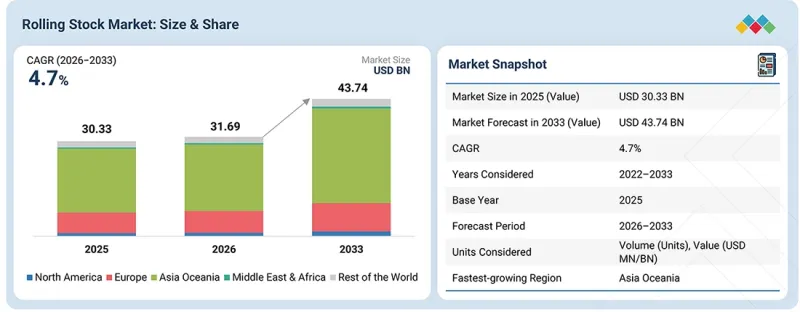
The rolling stock market is projected to grow from USD 31.69 billion in 2026 to USD 43.74 billion by 2033, at a CAGR of 4.7%. The demand for rolling stock is driven by new railway projects, rail line expansions, and the need to replace aging trains.
| Scope of the Report | |
|---|---|
| Years Considered for the Study | 2026-2033 |
| Base Year | 2025 |
| Forecast Period | 2026-2033 |
| Units Considered | USD billion |
| Segments | Rolling Stock Market by Product Type, Locomotive Type, Application and Region (Asia Oceania, Europe, North America, MEA, RoW) - Global Forecast to 2033 |
| Regions covered | Asia Oceania, Europe, North America, Middle East & Africa, Rest of the World |
Governments and companies aim to make trains more autonomous while reducing human involvement, costs, and travel time. Increased investment in electrifying, expanding, and modernizing rail networks is driving demand for new rolling stock. Additionally, growing focus on autonomous trains, battery-powered, and hydrogen fuel cell locomotives is creating new opportunities for industry players.
Metro/Subways are expected to hold a significant market share of the rapid transit rolling stock market during the forecast period.
With the world's largest metro network, China remains a major market for metro systems by track length, while rapid urbanization, congestion, and investments in mass-transit infrastructure continue to support demand for high-capacity metro and subway rolling stock. Governments and transit authorities are expanding existing networks, commissioning new corridors, and modernizing fleets with automated operation, advanced signaling, energy-efficient propulsion, and improved passenger capacity. These investments are also strengthening metro systems' role in reducing road congestion and supporting lower-emission urban mobility. In line with this trend, Alstom's metro trains and signaling solutions entered commercial operations on the extended Indore Metro Yellow Line in September 2026. The trains and associated systems were fully designed and manufactured in India, incorporating Urbalis Forward CBTC technology and lifecycle-management capabilities. For instance, in June 2026, India's Ministry of Railways announced plans to induct 60 new-generation metro rakes over the following four to five years to modernize the Kolkata Metro network. Similarly, in February 2026, the balance stretch of the Delhi-Ghaziabad-Meerut Namo Bharat corridor and Meerut Metro entered commercial operations, deploying India-made trainsets with ETCS Hybrid Level 3 signaling over LTE 4G; the Meerut Metro trains have a design speed of 135 km/h and an operational speed of up to 120 km/h.
Coaches are expected to lead the passenger transportation rolling stock market during the forecast period.
Coaches remain an important passenger rolling stock segment, particularly for intercity and long-distance rail services, where operators require flexible layouts to support different passenger needs over longer journeys. Configurations can include seating, sleeper berths, luggage space, and accessible facilities, making coaches suitable for a range of service requirements. As operators modernize these fleets, new coach designs are increasingly focused on better interiors, improved aesthetics, passenger comfort, onboard connectivity, infotainment, accessibility, and enhanced safety features. These upgrades help operators improve the passenger experience while increasing the value and specifications of new coach procurement. Indian Railways produced more than 4,224 LHB coaches during April-November 2025, up 18% year on year, with 4,838 LHB coaches targeted for production in 2025-26. For 2026-27, the production target stands at 4,802 LHB coaches, including LS and LSCN variants. Passenger rail expansion is also driving demand for advanced coaches with improved safety systems and passenger amenities. For instance, in 2026, Rail Coach Factory, Kapurthala, prepared the first 19-coach LHB rake for Bangladesh Railway under an order for 200 broad-gauge passenger coaches, featuring crashworthy construction, CCTV surveillance, and passenger alarm systems. Indian Railways is also manufacturing new AC EMU rakes for Mumbai suburban services, alongside large-scale procurement of non-AC coaches.
"Europe is expected to hold a significant share of the rolling stock market."
Europe is expected to hold a significant share of the rolling stock market due to its extensive electrified rail network, fleet modernization programs, and focus on low-emission transportation. Investments in battery-electric, hydrogen, and automated trains are increasing as operators seek alternatives for non-electrified routes while improving capacity, service frequency, and energy efficiency. For instance, in 2026, Siemens Mobility secured an order for 12 hydrogen-powered Mireo Plus H trainsets in Romania, with 15 years of maintenance, while Siemens and Stadler signed a contract with DSB for at least 226 fully automated electric S-Bahn trainsets for Copenhagen, with an option for up to 100 additional trains. The Copenhagen project includes more than 30 years of maintenance and is designed to increase service frequency by 35%. European rolling stock manufacturers are also expanding high-speed, regional, and urban rail programs through large fleet procurement and long-term service contracts. Similarly, in July 2026, Siemens Mobility and Stadler were awarded a contract to provide 350 four-car trains for Berlin's S-Bahn, alongside 30 years of maintenance and 15 years of operations. The Berlin project covers 1,400 coaches and includes the Stadtbahn and North-South networks.
We conducted in-depth interviews with CEOs, marketing directors, other innovation and technology directors, and executives from various key organizations operating in this market.
- By Company Type: OEMs (40%), Tier 1 (41%), and Tier 2 (19%)
- By Designation: CXOs (23%), Directors (42%), and Others (35%)
- By Region: North America (20%), Europe (24%), Asia Oceania (36%), the Middle East & Africa (15%), and the Rest of the World (5%)
Major players dominate the rolling stock market, including CRRC Corporation Limited (China), Siemens AG (Germany), Alstom SA (France), Stadler Rail AG (Switzerland), and Wabtec Corporation (US). These companies offer a wide range of products, including locomotives, passenger coaches, metro and light rail vehicles, freight wagons, and high-speed trains. They also provide comprehensive services such as maintenance, signaling and control systems, digital solutions, spare parts supply, and long-term service contracts, enabling operators to optimize fleet performance and operational efficiency.
Research Coverage:
The report covers the rolling stock market by component, product type (locomotive, rapid transit, wagons, and coaches), locomotive technology (conventional, turbocharged, and maglev), application (passenger transportation & freight transportation), and region. It covers the competitive landscape and company profiles of major players in the rolling stock market ecosystem.
The study also includes an in-depth competitive analysis of key market players, along with company profiles, key observations on product and business offerings, recent developments, and key market strategies.
Key Benefits of Buying the Report:
- The report will help market leaders/new entrants with information on the closest approximations of revenue numbers for the overall rolling stock market and its subsegments.
- This report will help stakeholders understand the competitive landscape and gain more insights to position their businesses better and plan suitable go-to-market strategies.
- The report also helps stakeholders understand the market pulse and provides information on key market drivers, restraints, challenges, and opportunities.
The report provides insight into the following pointers:
- Analysis of key drivers (energy-efficient and sustainable transportation shift, traffic decongestion and network optimization, expansion of freight transport capacity, and expansion of railroad network and freight corridors), restraints (optimization of the existing fleet through refurbishment, and high capital intensity and investment barriers), opportunities (adoption of hydrogen fuel cell locomotives, rising rail demand from industrial and mining expansion, growing market for battery-operated trains, and leveraging big data and smart analytics in rail infrastructure), and challenges (rising overhaul and maintenance cost burden, and intensive R&D investment requirements).
- Product Development/Innovation: Detailed insights on upcoming technologies and research & development activities in the rolling stock market.
- Market Development: Comprehensive information about lucrative markets; the report analyzes the rolling stock market across varied regions.
- Market Diversification: Exhaustive information about untapped geographies, recent developments, and investments in the rolling stock market.
- Competitive Assessment: In-depth assessment of market share, growth strategies, and product offerings of leading players such as CRRC Corporation Limited (China), Siemens AG (Germany), Alstom SA (France), Stadler Rail AG (Switzerland), and Wabtec Corporation (US) in the rolling stock market.
TABLE OF CONTENTS
1 INTRODUCTION
- 1.1 STUDY OBJECTIVES
- 1.2 MARKET DEFINITION
- 1.3 STUDY SCOPE
- 1.3.1 MARKETS COVERED
- 1.3.2 INCLUSIONS AND EXCLUSIONS
- 1.3.3 YEARS CONSIDERED
- 1.4 CURRENCY CONSIDERED
- 1.5 UNIT CONSIDERED
- 1.6 STAKEHOLDERS
- 1.7 SUMMARY OF CHANGES
2 EXECUTIVE SUMMARY
- 2.1 MARKET HIGHLIGHTS AND KEY INSIGHTS
- 2.2 KEY MARKET PARTICIPANTS: MAPPING OF STRATEGIC DEVELOPMENTS
- 2.3 DISRUPTIVE TRENDS IN ROLLING STOCK MARKET
- 2.4 HIGH-GROWTH SEGMENTS IN ROLLING STOCK MARKET
- 2.5 REGIONAL SNAPSHOT: MARKET SIZE, GROWTH RATE, AND FORECAST
3 PREMIUM INSIGHTS
- 3.1 ATTRACTIVE OPPORTUNITIES FOR PLAYERS IN ROLLING STOCK MARKET
- 3.2 ROLLING STOCK MARKET, BY PRODUCT TYPE
- 3.3 ROLLING STOCK MARKET, BY APPLICATION
- 3.4 ROLLING STOCK MARKET, BY LOCOMOTIVE TECHNOLOGY
- 3.5 ROLLING STOCK MARKET, BY REGION
4 MARKET OVERVIEW
- 4.1 INTRODUCTION
- 4.2 MARKET DYNAMICS
- 4.2.1 DRIVERS
- 4.2.1.1 Lifecycle economics shifting procurement toward performance-based models
- 4.2.1.2 Freight & passenger capacity expansion leading to higher performance rolling stock
- 4.2.1.3 Replacement and refurbishment demand due to aging rolling stock fleets
- 4.2.1.4 Demand for energy-efficient rolling stock
- 4.2.2 RESTRAINTS
- 4.2.2.1 High upfront capital requirements and long payback periods
- 4.2.2.2 Long procurement cycles and complex tendering processes
- 4.2.2.3 Complex regulatory, safety, and interoperability requirements
- 4.2.3 OPPORTUNITIES
- 4.2.3.1 Demand for intelligent rolling stock due to rail electrification and AI integration
- 4.2.3.2 Expansion of lifecycle and aftermarket services beyond new train sales
- 4.2.3.3 Increasing demand for driverless and automated metro trains
- 4.2.4 CHALLENGES
- 4.2.4.1 Navigating local content requirements and regionalized supply chains
- 4.2.4.2 Balancing customer-specific configuration with scale economies and platform standardization
- 4.2.1 DRIVERS
- 4.3 UNMET NEEDS AND WHITE SPACES
- 4.3.1 LIMITED END-TO-END DIGITAL LIFECYCLE MANAGEMENT FOR ROLLING STOCK
- 4.3.2 STANDARDIZED REAL-TIME DATA EXCHANGE ACROSS ROLLING STOCK ECOSYSTEMS
- 4.3.3 CYBERSECURE SOFTWARE MANAGEMENT AND PREDICTIVE MAINTENANCE FOR CONNECTED TRAINS
- 4.4 INTERCONNECTED MARKET AND CROSS-SECTOR OPPORTUNITIES
- 4.4.1 ROLLING STOCK - ENERGY SYSTEM INTEGRATION
- 4.4.2 ROLLING STOCK - DIGITAL TECHNOLOGY AND AI INTEGRATION
- 4.4.3 ROLLING STOCK - INTERMODAL LOGISTICS AND DIGITAL FREIGHT INTEGRATION
- 4.5 STRATEGIC MOVES BY TIER-1/2/3 PLAYERS
- 4.6 TECHNOLOGY ANALYSIS
- 4.6.1 KEY EMERGING TECHNOLOGIES
- 4.6.1.1 Digital Automatic Coupling (DAC)
- 4.6.1.2 Digital twin based fleet optimization
- 4.6.1.3 Autonomous trains
- 4.6.1.4 Hybrid and dual mode traction systems
- 4.6.1.5 Hydrogen Fuel-Cell Propulsion
- 4.6.2 COMPLEMENTARY TECHNOLOGIES
- 4.6.2.1 AI-based fault detection and health state modeling
- 4.6.3 INTELLIGENT RAIL TRANSIT
- 4.6.4 ADJACENT TECHNOLOGIES
- 4.6.4.1 Future Railway Mobile Communication System (FRMCS)
- 4.6.4.2 Big data analytics
- 4.6.1 KEY EMERGING TECHNOLOGIES
- 4.7 TECHNOLOGY/PRODUCT ROADMAP
- 4.8 PATENT ANALYSIS
- 4.9 IMPACT OF AI ON: ROLLING STOCK MARKET
- 4.9.1 KEY AI USE CASES IN ROLLING STOCK
- 4.9.2 AI-ENABLED PREDICTIVE MAINTENANCE AND FLEET OPTIMIZATION
- 4.9.3 CASE STUDIES OF AI DEPLOYMENT IN ROLLING STOCK
- 4.9.3.1 AI-based predictive maintenance for dubai tram
- 4.9.3.2 AI-based condition monitoring for pendolino trains
- 4.9.3.3 AI-enabled monitoring for indian railways
- 4.9.3.4 AI-based condition monitoring for saudi passenger trains
- 4.9.3.5 Ai-based digital asset management for rolling stock
- 4.9.4 AI ECOSYSTEM IN ROLLING STOCK
- 4.9.4.1 AI ecosystem structure
- 4.9.4.2 AI data and decision flow
- 4.9.4.3 AI ecosystem business models
- 4.9.4.4 AI partnership and deployment landscape
- 4.9.5 OPERATOR READINESS AND BARRIERS TO AI ADOPTION
- 4.9.5.1 Operator AI readiness
- 4.9.5.2 Key barriers to AI adoption
5 INDUSTRY TRENDS
- 5.1 MACROECONOMIC INDICATORS
- 5.1.1 INTRODUCTION
- 5.1.2 GDP TRENDS AND FORECAST
- 5.1.3 TRENDS IN RAIL INFRASTRUCTURE MARKET
- 5.1.4 TRENDS IN GLOBAL RAILWAY INDUSTRY
- 5.2 SUPPLY CHAIN ANALYSIS
- 5.3 ECOSYSTEM ANALYSIS
- 5.3.1 RAW MATERIALS AND COMPONENT SUPPLIERS
- 5.3.2 MANUFACTURERS
- 5.3.3 TECHNOLOGY PROVIDERS
- 5.3.4 INFRASTRUCTURE PROVIDERS
- 5.3.5 REGULATORY AND POLICY MAKERS
- 5.3.6 MAINTENANCE AND SERVICE PROVIDERS
- 5.3.7 RAILWAY OPERATORS
- 5.4 PRICING ANALYSIS
- 5.4.1 AVERAGE SELLING PRICE TREND, BY PRODUCT TYPE
- 5.4.2 AVERAGE SELLING PRICE TREND, BY REGION
- 5.5 TRADE ANALYSIS
- 5.5.1 IMPORT SCENARIO (HS CODE 8603)
- 5.5.2 EXPORT SCENARIO (HS CODE 8603)
- 5.6 KEY CONFERENCES AND EVENTS, 2026-2027
- 5.7 TRENDS AND DISRUPTIONS IMPACTING CUSTOMER BUSINESSES
- 5.8 INVESTMENT AND FUNDING SCENARIO
- 5.9 CASE STUDY ANALYSIS
- 5.9.1 LEASING BATTERY TRAINS TO REDUCE UPFRONT PROCUREMENT COSTS
- 5.9.2 DEPLOYING HYDROGEN TRAINS ON NON-ELECTRIFIED ROUTES
- 5.9.3 INTEGRATING FUEL CELLS FOR ZERO-EMISSION TRAIN OPERATIONS
- 5.9.4 DEPLOYING AUTOMATED METRO TRAINS AND DIGITAL SIGNALING
- 5.9.5 DEPLOYING HIGH-CAPACITY DOUBLE-DECK TRAINS FOR REGIONAL TRANSPORT
- 5.10 REGIONAL INVESTMENT HOTSPOTS: FLEET MODERNIZATION, LOCAL MANUFACTURING & ALTERNATIVE PROPULSION
- 5.10.1 FLEET MODERNIZATION INVESTMENT
- 5.10.2 LOCAL MANUFACTURING INVESTMENT
- 5.10.3 ALTERNATIVE PROPULSION INVESTMENT
- 5.10.4 REGIONAL INVESTMENT HOTSPOT COMPARISON
- 5.11 CAPEX OPTIMIZATION FOR OPERATORS: NEW ROLLING STOCK VS. FLEET MODERNIZATION
- 5.11.1 FLEET LIFE CYCLE STAGES
- 5.11.2 CAPEX OPTIMIZATION: NEW BUILD VS. FLEET MODERNIZATION
- 5.12 COMPETITIVE COMPARISON MATRIX: ROLLING STOCK OEM STRATEGIES
- 5.12.1 BY PROPULSION
- 5.12.2 BY APPLICATION
- 5.12.3 BY ROLLING STOCK PLATFORM ARCHITECTURE
- 5.12.4 OEM STRATEGY POSITIONING
- 5.13 DIGITALIZATION OF ROLLING STOCK: PREDICTIVE MAINTENANCE, CONDITION MONITORING & DIGITAL TWINS
- 5.13.1 DIGITAL CAPABILITIES OF MAJOR ROLLING STOCK OEMS
- 5.14 DIESEL TO LOW-EMISSION ROLLING STOCK TRANSITION
- 5.14.1 DIESEL FLEET REPLACEMENT
- 5.14.2 NON-ELECTRIFIED ROUTE DEMAND
- 5.14.3 LOW-EMISSION FLEET PROCUREMENT
- 5.14.4 FLEET TRANSITION ECONOMICS
- 5.14.5 REPLACEMENT MARKET OPPORTUNITY
- 5.15 SHIFT TOWARD LIFECYCLE REVENUE: ROLLING STOCK MAINTENANCE & ASSET-AS-A-SERVICE MODELS
- 5.15.1 LONG-TERM ROLLING STOCK MAINTENANCE CONTRACTS
- 5.15.2 ROLLING STOCK AFTERMARKET REVENUE
- 5.15.3 ASSET-AS-A-SERVICE MODELS
- 5.15.4 LIFECYCLE REVENUE OPPORTUNITY
- 5.15.5 OEM AND SUPPLIER LIFECYCLE STRATEGIES
6 SUSTAINABILITY AND REGULATORY LANDSCAPE
- 6.1 REGULATORY LANDSCAPE
- 6.1.1 REGULATORY BODIES, GOVERNMENT AGENCIES, AND OTHER ORGANIZATIONS
- 6.2 GLOBAL ROLLING STOCK REGULATORY AND STANDARDS LANDSCAPE
- 6.3 SUSTAINABILITY INITIATIVES
- 6.4 IMPACT OF REGULATORY POLICIES ON SUSTAINABILITY INITIATIVES
- 6.5 CERTIFICATION, LABELING, AND ECO-STANDARDS
7 CUSTOMER LANDSCAPE AND BUYING BEHAVIOR
- 7.1 DECISION-MAKING PROCESS
- 7.2 KEY STAKEHOLDERS AND BUYING CRITERIA
- 7.2.1 PASSENGER TRANSPORTATION
- 7.2.2 FREIGHT TRANSPORTATION
- 7.2.3 KEY STAKEHOLDERS IN BUYING PROCESS
- 7.2.4 BUYING CRITERIA
- 7.3 ADOPTION BARRIERS & INTERNAL CHALLENGES
- 7.4 UNMEET NEEDS OF VARIOUS END USERS
8 ROLLING STOCK MARKET, BY APPLICATION
- 8.1 INTRODUCTION
- 8.2 PASSENGER TRANSPORTATION
- 8.2.1 LOCOMOTIVES
- 8.2.1.1 Rising adoption of electric rail systems boosts market
- 8.2.2 COACHES
- 8.2.2.1 Adoption of enhanced safety systems supports market expansion
- 8.2.1 LOCOMOTIVES
- 8.3 FREIGHT TRANSPORTATION
- 8.3.1 LOCOMOTIVES
- 8.3.1.1 Efforts to lower logistics operational expenses support market expansion
- 8.3.2 WAGONS
- 8.3.2.1 Growing applications in freight and logistics fuel market development
- 8.3.1 LOCOMOTIVES
- 8.4 KEY PRIMARY INSIGHTS
9 ROLLING STOCK MARKET, BY PRODUCT TYPE
- 9.1 INTRODUCTION
- 9.2 LOCOMOTIVES
- 9.2.1 DIESEL LOCOMOTIVES
- 9.2.1.1 Electrification of railway networks in Europe and Asia expected to decelerate market growth
- 9.2.2 ELECTRIC LOCOMOTIVES
- 9.2.2.1 Rising electrification of rail networks support market expansion
- 9.2.3 ELECTRO-DIESEL LOCOMOTIVES
- 9.2.3.1 Emphasis on sustainable practices by government and private sector accelerates market development
- 9.2.1 DIESEL LOCOMOTIVES
- 9.3 RAPID TRANSIT
- 9.3.1 DIESEL MULTIPLE UNITS
- 9.3.1.1 Electrification constraints in select regions boost market potential
- 9.3.2 ELECTRIC MULTIPLE UNITS
- 9.3.2.1 Performance and efficiency advantages over diesel fuel market development
- 9.3.3 LIGHT RAILS/TRAMS
- 9.3.3.1 Push for alternatives to traditional buses and cars to drive market
- 9.3.4 SUBWAYS/METROS
- 9.3.4.1 Investments in urban transportation networks to drive the market
- 9.3.1 DIESEL MULTIPLE UNITS
- 9.4 COACHES
- 9.4.1 DEMAND FOR ENHANCED RAIL TRAVEL EXPERIENCE FUELS MARKET DEVELOPMENT
- 9.5 WAGONS
- 9.5.1 RISING DEMAND FOR HIGH-CAPACITY FREIGHT IN LOGISTICS AND MANUFACTURING DRIVES MARKET GROWTH
- 9.6 OTHERS
- 9.7 KEY PRIMARY INSIGHTS
10 ROLLING STOCK MARKET, BY LOCOMOTIVE TECHNOLOGY
- 10.1 INTRODUCTION
- 10.2 CONVENTIONAL LOCOMOTIVES
- 10.2.1 ENHANCING CONVENTIONAL LOCOMOTIVE EFFICIENCY THROUGH HYBRID AND TRACTION UPGRADES
- 10.3 TURBOCHARGED LOCOMOTIVES
- 10.3.1 ADVANCING TURBOCHARGED LOCOMOTIVE EFFICIENCY THROUGH EMISSION COMPLIANCE
- 10.4 MAGLEV
- 10.4.1 ELECTROMAGNETIC SUSPENSION
- 10.4.2 ELECTRODYNAMIC SUSPENSION
- 10.4.3 INDUCTRACK
- 10.5 KEY PRIMARY INSIGHTS
11 ROLLING STOCK MARKET, BY COMPONENT
- 11.1 INTRODUCTION
- 11.2 TRAIN CONTROL SYSTEMS
- 11.3 PANTOGRAPHS
- 11.4 AXLES
- 11.5 WHEELSETS
- 11.6 TRACTION MOTORS
- 11.7 PASSENGER INFORMATION SYSTEMS
- 11.8 BRAKES
- 11.9 AIR CONDITIONING SYSTEMS
- 11.10 AUXILIARY POWER SYSTEMS
- 11.11 GEARBOXES
- 11.12 BAFFLE GEARS
- 11.13 COUPLERS
12 ROLLING STOCK MARKET, BY PROPULSION
- 12.1 INTRODUCTION
- 12.1.1 DIESEL
- 12.1.2 BATTERY ELECTRIC
- 12.1.3 HYDROGEN
- 12.1.4 MULTI-FUEL
13 ROLLING STOCK MARKET, BY REGION
- 13.1 INTRODUCTION
- 13.2 ASIA OCEANIA
- 13.2.1 RAPID TRANSIT PROJECTS
- 13.2.2 LIGHT RAIL PROJECTS
- 13.2.3 HIGH-SPEED RAIL/BULLET TRAIN PROJECTS
- 13.2.4 CHINA
- 13.2.4.1 Expansion of high-speed rail infrastructure to drive market
- 13.2.5 INDIA
- 13.2.5.1 Rail electrification push creates new rolling stock demand
- 13.2.6 JAPAN
- 13.2.6.1 Fleet modernization and low emission propulsion shape Japan's rolling stock market
- 13.2.7 SOUTH KOREA
- 13.2.7.1 Public transit fleet modernization to boost market
- 13.2.8 AUSTRALIA
- 13.2.9 MALAYSIA
- 13.3 EUROPE
- 13.3.1 METRO/HIGH-SPEED RAILWAY PROJECTS
- 13.3.2 RAPID TRANSIT PROJECTS
- 13.3.3 GERMANY
- 13.3.3.1 Rising investments in railway infrastructure modernization to drive market
- 13.3.4 FRANCE
- 13.3.4.1 Government subsidies and incentives for sustainable transport to drive market
- 13.3.5 UK
- 13.3.5.1 Alignment of fleet renewal with capacity and decarbonization to propel market
- 13.3.6 ITALY
- 13.3.6.1 Accelerated fleet renewal across regional and high-speed rail to boost market
- 13.3.7 SPAIN
- 13.3.7.1 Market growth driven by high speed and urban mobility demand
- 13.3.8 SWITZERLAND
- 13.3.9 AUSTRIA
- 13.3.10 SWEDEN
- 13.4 NORTH AMERICA
- 13.4.1 HIGH-SPEED RAIL/BULLET TRAIN PROJECTS
- 13.4.2 RAPID TRANSIT PROJECTS
- 13.4.3 US
- 13.4.3.1 Modernization of existing transportation modalities to drive market
- 13.4.4 MEXICO
- 13.4.4.1 Accelerated rail fleet expansion and renewal to boost market
- 13.4.5 CANADA
- 13.4.5.1 Passenger rail fleet modernization and capacity expansion - key market drivers
- 13.5 MIDDLE EAST & AFRICA
- 13.5.1 METRO/MONORAIL PROJECTS
- 13.5.2 RAPID TRANSIT PROJECTS
- 13.5.3 SOUTH AFRICA
- 13.5.3.1 Government investments in railway sector to drive market
- 13.5.4 UAE
- 13.5.4.1 Advances in rail infrastructure to drive market
- 13.5.5 EGYPT
- 13.5.5.1 Strengthened rail capacity through tourism and fleet modernization to drive market
- 13.5.6 IRAN
- 13.6 REST OF THE WORLD
- 13.6.1 METRO/MONORAIL PROJECTS
- 13.6.2 BRAZIL
- 13.6.2.1 Expansion of freight rail investment and passenger network development to drive market
- 13.6.3 RUSSIA
- 13.6.3.1 Expansion of metro and subway networks to drive market
- 13.6.4 ARGENTINA
14 COMPETITIVE LANDSCAPE
- 14.1 INTRODUCTION
- 14.2 KEY PLAYER STRATEGIES/RIGHT TO WIN, 2023-2026
- 14.3 MARKET SHARE ANALYSIS OF ROLLING STOCK PROVIDERS, 2025
- 14.4 REVENUE ANALYSIS, 2021-2025
- 14.5 COMPANY VALUATION AND FINANCIAL METRICS
- 14.5.1 COMPANY VALUATION
- 14.5.2 FINANCIAL METRICS
- 14.6 BRAND/PRODUCT COMPARISON
- 14.7 COMPANY EVALUATION MATRIX: KEY PLAYERS, 2025
- 14.7.1 STARS
- 14.7.2 EMERGING LEADERS
- 14.7.3 PERVASIVE PLAYERS
- 14.7.4 PARTICIPANTS
- 14.7.5 COMPANY FOOTPRINT
- 14.7.5.1 Company footprint
- 14.7.5.2 Region footprint
- 14.7.5.3 Application footprint
- 14.7.5.4 Product type footprint
- 14.7.5.5 Locomotive technology footprint
- 14.8 COMPANY EVALUATION MATRIX: START-UPS/SMES, 2025
- 14.8.1 PROGRESSIVE COMPANIES
- 14.8.2 RESPONSIVE COMPANIES
- 14.8.3 DYNAMIC COMPANIES
- 14.8.4 STARTING BLOCKS
- 14.8.5 COMPETITIVE BENCHMARKING
- 14.8.5.1 List of startups/SMEs
- 14.8.5.2 Competitive benchmarking of startups/SMEs
- 14.9 COMPETITIVE SCENARIO
- 14.9.1 PRODUCT LAUNCHES
- 14.9.2 DEALS
- 14.9.3 OTHER DEVELOPMENTS
15 COMPANY PROFILES
- 15.1 KEY PLAYERS
- 15.1.1 CRRC CORPORATION LIMITED
- 15.1.1.1 Business overview
- 15.1.1.2 Products offered
- 15.1.1.3 Recent developments
- 15.1.1.3.1 Product launches/developments
- 15.1.1.3.2 Deals
- 15.1.1.3.3 Expansions
- 15.1.1.3.4 Contracts
- 15.1.1.4 MnM view
- 15.1.1.4.1 Key strengths
- 15.1.1.4.2 Strategic choices
- 15.1.1.4.3 Weaknesses and competitive threats
- 15.1.2 SIEMENS AG
- 15.1.2.1 Business overview
- 15.1.2.2 Products offered
- 15.1.2.3 Recent developments
- 15.1.2.3.1 Product launches/developments
- 15.1.2.3.2 Deals
- 15.1.2.3.3 Expansions
- 15.1.2.3.4 Contracts
- 15.1.2.3.5 Other developments
- 15.1.2.4 MnM view
- 15.1.2.4.1 Key strengths
- 15.1.2.4.2 Strategic choices
- 15.1.2.4.3 Weaknesses and competitive threats
- 15.1.3 ALSTOM SA
- 15.1.3.1 Business overview
- 15.1.3.2 Products offered
- 15.1.3.3 Recent developments
- 15.1.3.3.1 Product launches/developments
- 15.1.3.3.2 Deals
- 15.1.3.3.3 Expansions
- 15.1.3.3.4 Contracts
- 15.1.3.3.5 Other developments
- 15.1.3.4 MnM view
- 15.1.3.4.1 Key strengths
- 15.1.3.4.2 Strategic choices
- 15.1.3.4.3 Weaknesses and competitive threats
- 15.1.4 STADLER RAIL AG
- 15.1.4.1 Business overview
- 15.1.4.2 Products offered
- 15.1.4.3 Recent developments
- 15.1.4.3.1 Product launches/developments
- 15.1.4.3.2 Deals
- 15.1.4.3.3 Expansions
- 15.1.4.3.4 Contracts
- 15.1.4.4 MnM view
- 15.1.4.4.1 Key strengths
- 15.1.4.4.2 Strategic choices
- 15.1.4.4.3 Weaknesses and competitive threats
- 15.1.5 WABTEC CORPORATION
- 15.1.5.1 Business overview
- 15.1.5.2 Products offered
- 15.1.5.3 Recent developments
- 15.1.5.3.1 Product launches/developments
- 15.1.5.3.2 Deals
- 15.1.5.3.3 Expansions
- 15.1.5.3.4 Contracts
- 15.1.5.4 MnM view
- 15.1.5.4.1 Key strengths
- 15.1.5.4.2 Strategic choices
- 15.1.5.4.3 Weaknesses and competitive threats
- 15.1.6 KAWASAKI HEAVY INDUSTRIES, LTD.
- 15.1.6.1 Business overview
- 15.1.6.2 Products offered
- 15.1.6.3 Recent developments
- 15.1.6.3.1 Product launches/developments
- 15.1.6.3.2 Contracts
- 15.1.6.3.3 Other developments
- 15.1.7 CAF GROUP
- 15.1.7.1 Business overview
- 15.1.7.2 Products offered
- 15.1.7.3 Recent developments
- 15.1.7.3.1 Deals
- 15.1.7.3.2 Expansions
- 15.1.7.3.3 Contracts
- 15.1.7.3.4 Other developments
- 15.1.8 HYUNDAI ROTEM COMPANY
- 15.1.8.1 Business overview
- 15.1.8.2 Products offered
- 15.1.8.3 Recent developments
- 15.1.8.3.1 Product launches/developments
- 15.1.8.3.2 Deals
- 15.1.8.3.3 Contracts
- 15.1.8.3.4 Expansions
- 15.1.8.3.5 Other developments
- 15.1.9 MITSUBISHI HEAVY INDUSTRIES, LTD.
- 15.1.9.1 Business overview
- 15.1.9.2 Products offered
- 15.1.9.3 Recent developments
- 15.1.9.3.1 Deals
- 15.1.9.3.2 Contracts
- 15.1.10 TALGO
- 15.1.10.1 Business overview
- 15.1.10.2 Products offered
- 15.1.10.3 Recent developments
- 15.1.10.3.1 Product launches/developments
- 15.1.10.3.2 Deals
- 15.1.10.3.3 Contracts
- 15.1.10.3.4 Expansions
- 15.1.11 TRANSMASHHOLDING
- 15.1.11.1 Business overview
- 15.1.11.2 Products offered
- 15.1.11.3 Recent developments
- 15.1.11.3.1 Product launches/developments
- 15.1.11.3.2 Deals
- 15.1.11.3.3 Expansions
- 15.1.11.3.4 Contracts
- 15.1.12 TITAGARH RAIL SYSTEMS LIMITED
- 15.1.12.1 Business overview
- 15.1.12.2 Products offered
- 15.1.12.3 Recent developments
- 15.1.12.3.1 Product launches/developments
- 15.1.12.3.2 Deals
- 15.1.12.3.3 Contracts
- 15.1.1 CRRC CORPORATION LIMITED
- 15.2 OTHER PLAYERS
- 15.2.1 TOSHIBA CORPORATION
- 15.2.2 HITACHI RAIL LIMITED
- 15.2.3 STRUKTON
- 15.2.4 DEUTSCHE BAHN AG
- 15.2.5 BEML LIMITED
- 15.2.6 RAIL VIKAS NIGAM LIMITED
- 15.2.7 BRAITHWAITE & CO. (INDIA) LTD.
- 15.2.8 CHITTARANJAN LOCOMOTIVE WORKS
- 15.2.9 WJIS
- 15.2.10 RHOMBERG SERSA RAIL HOLDING GMBH
- 15.2.11 SINARA TRANSPORT MACHINES
- 15.2.12 TRINITY INDUSTRIES, INC.
- 15.2.13 THE GREENBRIER COMPANIES
- 15.2.14 DAWONSYS CO., LTD.
16 RESEARCH METHODOLOGY
- 16.1 RESEARCH DATA
- 16.1.1 SECONDARY DATA
- 16.1.1.1 Secondary sources
- 16.1.1.2 Key data from secondary sources
- 16.1.2 PRIMARY DATA
- 16.1.2.1 Primary participants
- 16.1.2.2 Key industry insights and breakdown of primary interviews
- 16.1.2.3 Breakdown of primary interviews
- 16.1.2.4 Primary participants
- 16.1.1 SECONDARY DATA
- 16.2 MARKET SIZE ESTIMATION
- 16.2.1 BOTTOM-UP APPROACH
- 16.2.2 TOP-DOWN APPROACH
- 16.3 DATA TRIANGULATION
- 16.4 FACTOR ANALYSIS
- 16.5 RESEARCH ASSUMPTIONS
- 16.6 RESEARCH LIMITATIONS
- 16.7 RISK ASSESSMENT
17 APPENDIX
- 17.1 INSIGHTS FROM INDUSTRY EXPERTS
- 17.2 DISCUSSION GUIDE
- 17.3 KNOWLEDGESTORE: MARKETSANDMARKETS' SUBSCRIPTION PORTAL
- 17.4 CUSTOMIZATIONS OPTIONS
- 17.4.1 ADDITIONAL COMPANY PROFILES (UP TO FIVE)
- 17.4.2 ROLLING STOCK MARKET, BY TECHNOLOGY, AT COUNTRY LEVEL (FOR COUNTRIES COVERED IN REPORT)
- 17.4.3 ROLLING STOCK MARKET, BY PRODUCT TYPE, AT COUNTRY LEVEL (FOR COUNTRIES COVERED IN REPORT)
- 17.5 RELATED REPORTS
- 17.6 AUTHOR DETAILS
List of Tables
- TABLE 1 MARKET DEFINITION, BY PRODUCT TYPE
- TABLE 2 MARKET DEFINITION, BY LOCOMOTIVE TECHNOLOGY
- TABLE 3 MARKET DEFINITION, BY APPLICATION
- TABLE 4 MARKET DEFINITION, BY PROPULSION
- TABLE 5 MARKET DEFINITION, BY COMPONENT
- TABLE 6 INCLUSIONS AND EXCLUSIONS
- TABLE 7 CURRENCY EXCHANGE RATES
- TABLE 8 ROLLING STOCK CONTRACTS WITH LONG-TERM LIFECYCLE SERVICES
- TABLE 9 PASSENGER CAPACITY INCREASE AT NETWORK AND CORRIDOR LEVEL, 2026
- TABLE 10 PASSENGER CAPACITY INCREASE PER TRAIN, 2026
- TABLE 11 GOVERNMENT ALLOCATIONS FOR ROLLING STOCK REPLACEMENT, LIFE EXTENSION AND MODERNIZATION
- TABLE 12 ELECTRIC AND HYDROGEN ROLLING STOCK ADOPTION INITIATIVES BY COUNTRY
- TABLE 13 ROLLING STOCK PROCUREMENT AND REPLACEMENT VALUES, 2023-2025
- TABLE 14 OEM ELECTRIFICATION AND ALTERNATIVE-PROPULSION ROLLING STOCK INITIATIVES
- TABLE 15 OEM AI AND INTELLIGENT ROLLING STOCK INITIATIVES
- TABLE 16 RECENT DRIVERLESS AND AUTOMATED METRO ROLLING STOCK EXAMPLES
- TABLE 17 IMPACT OF MARKET DYNAMICS IN ROLLING STOCK MARKET
- TABLE 18 STRATEGIC-MOVE MATRIX - TIER-1/2/3 ROLLING STOCK PLAYERS
- TABLE 19 ROLLING STOCK MARKET: OEM AUTONOMOUS TRAIN DEPLOYMENT SCALES ACROSS GLOBAL METRO NETWORKS
- TABLE 20 ROLLING STOCK MARKET: ADVANCED BATTERY-HYBRID TRAIN DEPLOYMENT AND ENERGY EFFICIENCY
- TABLE 21 ROLLING STOCK MARKET: HYDROGEN FUEL CELL ROLLING STOCK APPLICATIONS AND DEPLOYMENT COMPARISON WITH OTHER PROPULSION TYPES
- TABLE 22 ROLLING STOCK MARKET: AI-BASED FAULT DETECTION AND HEALTH STATE MODELING
- TABLE 23 INTELLIGENT RAIL TRANSIT: ENABLING CONNECTED, AUTOMATED AND DATA DRIVEN RAIL OPERATIONS
- TABLE 24 ROLLING STOCK MARKET: GSM-R VS. FRMCS
- TABLE 25 ROLLING STOCK MARKET: TECHNOLOGY/PRODUCT ROADMAP
- TABLE 26 ROLLING STOCK MARKET: SHORT-TERM TECHNOLOGY ROADMAP (2026-2027)
- TABLE 27 ROLLING STOCK MARKET: MID-TERM TECHNOLOGY ROADMAP (2028-2030)
- TABLE 28 ROLLING STOCK MARKET: LONG-TERM TECHNOLOGY ROADMAP (2031-2033)
- TABLE 29 PATENT ANALYSIS, 2024-2026
- TABLE 30 ROLLING STOCK MARKET: ROLE OF AI IN ROLLING STOCK ECOSYSTEM
- TABLE 31 ROLLING STOCK MARKET: ROLLING STOCK BUSINESS MODELS AND REVENUE OPPORTUNITIES
- TABLE 32 ROLLING STOCK MARKET: PARTNERSHIPS ENABLE CONNECTED AND PREDICTIVE ROLLING STOCK OPERATIONS
- TABLE 33 ROLLING STOCK MARKET: READINESS ACROSS ROLLING STOCK FLEET AND DIGITAL INFRASTRUCTURE
- TABLE 34 ROLLING STOCK MARKET: KEY BARRIERS TO AI ADOPTION IN ROLLING STOCK
- TABLE 35 GDP PERCENTAGE CHANGE, BY KEY COUNTRY, 2021-2030
- TABLE 36 ROLLING STOCK MARKET: ROLE OF KEY PLAYERS IN ECOSYSTEM
- TABLE 37 AVERAGE SELLING PRICE TREND, BY PRODUCT TYPE, 2024-2026 (USD THOUSAND)
- TABLE 38 AVERAGE SELLING PRICE TREND, BY REGION, 2024-2026 (USD THOUSAND)
- TABLE 39 IMPORT DATA FOR HS CODE 8603-COMPLIANT PRODUCTS, BY COUNTRY, 2022-2025 (USD MILLION)
- TABLE 40 EXPORT DATA FOR HS CODE 8603-COMPLIANT PRODUCTS, BY COUNTRY, 2022-2025 (USD MILLION)
- TABLE 41 KEY CONFERENCES AND EVENTS, 2026-2027
- TABLE 42 ROLLING STOCK FLEET MODERNIZATION INVESTMENTS BY REGION
- TABLE 43 LOCAL ROLLING STOCK MANUFACTURING AND PRODUCTION DEVELOPMENTS BY REGION
- TABLE 44 ALTERNATIVE PROPULSION DEVELOPMENTS IN THE ROLLING STOCK MARKET
- TABLE 45 ROLLING STOCK INVESTMENT OPPORTUNITY COMPARISON
- TABLE 46 ROLLING STOCK FLEET LIFE CYCLE INVESTMENT AND SPENDING AREAS
- TABLE 47 CAPEX OPTIMIZATION: NEW BUILD VS. FLEET MODERNIZATION
- TABLE 48 ROLLING STOCK PROPULSION ADOPTION BY OEM
- TABLE 49 ROLLING STOCK OEMS BY APPLICATION AND KEY FOCUS AREAS
- TABLE 50 ROLLING STOCK PLATFORM ARCHITECTURE COMPARISON ACROSS OEMS
- TABLE 51 OEM STRATEGIC POSITIONING BY COMPETITION FOCUS AREA
- TABLE 52 COMPARISON OF DIGITAL PLATFORMS AND MONITORING CAPABILITIES ACROSS OEMS
- TABLE 53 ROLLING STOCK FLEET TRANSITION OPTIONS AND ECONOMICS
- TABLE 54 ROLLING STOCK AFTERMARKET REVENUE BY COMPANY AND SEGMENT
- TABLE 55 ROLLING STOCK BUSINESS MODELS AND REVENUE STRUCTURES
- TABLE 56 OEM LIFECYCLE AND AFTERMARKET STRATEGIES IN THE ROLLING STOCK MARKET
- TABLE 57 NORTH AMERICA: REGULATORY BODIES, GOVERNMENT AGENCIES, AND OTHER ORGANIZATIONS
- TABLE 58 EUROPE: REGULATORY BODIES, GOVERNMENT AGENCIES, AND OTHER ORGANIZATIONS
- TABLE 59 ASIA PACIFIC: REGULATORY BODIES, GOVERNMENT AGENCIES, AND OTHER ORGANIZATIONS
- TABLE 60 REST OF THE WORLD: REGULATORY BODIES, GOVERNMENT AGENCIES, AND OTHER ORGANIZATIONS
- TABLE 61 EMISSION STANDARDS
- TABLE 62 QUALITY CONTROL AND MANUFACTURING STANDARDS
- TABLE 63 FIRE SAFETY AND MATERIAL STANDARDS
- TABLE 64 POLICY INITIATIVES AFFECTING SUSTAINABILITY, SAFETY, PRIVACY, AND TECHNOLOGY COMPLIANCE FOR ROLLING STOCK MARKET
- TABLE 65 CERTIFICATION, LABELLING, AND ENVIRONMENTAL STANDARDS RELEVANT TO ROLLING STOCK MARKET
- TABLE 66 INFLUENCE OF STAKEHOLDERS ON BUYING PROCESS FOR TOP APPLICATIONS (%)
- TABLE 67 KEY BUYING CRITERIA FOR TOP APPLICATIONS
- TABLE 68 EXISTING/UPCOMING HIGH-SPEED TRAINS
- TABLE 69 ROLLING STOCK MARKET, BY APPLICATION, 2022-2025 (UNITS)
- TABLE 70 ROLLING STOCK MARKET, BY APPLICATION, 2026-2033 (UNITS)
- TABLE 71 ROLLING STOCK MARKET, BY APPLICATION, 2022-2025 (USD MILLION)
- TABLE 72 ROLLING STOCK MARKET, BY APPLICATION, 2026-2033 (USD MILLION)
- TABLE 73 PASSENGER TRANSPORTATION: ROLLING STOCK MARKET, BY TYPE, 2022-2025 (UNITS)
- TABLE 74 PASSENGER TRANSPORTATION: ROLLING STOCK MARKET, BY TYPE, 2026-2033 (UNITS)
- TABLE 75 PASSENGER TRANSPORTATION: ROLLING STOCK MARKET, BY TYPE, 2022-2025 (USD MILLION)
- TABLE 76 PASSENGER TRANSPORTATION: ROLLING STOCK MARKET, BY TYPE, 2026-2033 (USD MILLION)
- TABLE 77 PASSENGER LOCOMOTIVES: ROLLING STOCK MARKET, BY REGION, 2022-2025 (UNITS)
- TABLE 78 PASSENGER LOCOMOTIVES: ROLLING STOCK MARKET, BY REGION, 2026-2033 (UNITS)
- TABLE 79 PASSENGER LOCOMOTIVES: ROLLING STOCK MARKET, BY REGION, 2022-2025 (USD MILLION)
- TABLE 80 PASSENGER LOCOMOTIVES: ROLLING STOCK MARKET, BY REGION, 2026-2033 (USD MILLION)
- TABLE 81 PASSENGER COACHES: ROLLING STOCK MARKET, BY REGION, 2022-2025 (UNITS)
- TABLE 82 PASSENGER COACHES: ROLLING STOCK MARKET, BY REGION, 2026-2033 (UNITS)
- TABLE 83 PASSENGER COACHES: ROLLING STOCK MARKET, BY REGION, 2022-2025 (USD MILLION)
- TABLE 84 PASSENGER COACHES: ROLLING STOCK MARKET, BY REGION, 2026-2033 (USD MILLION)
- TABLE 85 FREIGHT TRANSPORTATION: ROLLING STOCK MARKET, BY TYPE, 2022-2025 (UNITS)
- TABLE 86 FREIGHT TRANSPORTATION: ROLLING STOCK MARKET, BY TYPE, 2026-2033 (UNITS)
- TABLE 87 FREIGHT TRANSPORTATION: ROLLING STOCK MARKET, BY TYPE, 2022-2025 (USD MILLION)
- TABLE 88 FREIGHT TRANSPORTATION: ROLLING STOCK MARKET, BY TYPE, 2026-2033 (USD MILLION)
- TABLE 89 FREIGHT LOCOMOTIVES: ROLLING STOCK MARKET, BY REGION, 2022-2025 (UNITS)
- TABLE 90 FREIGHT LOCOMOTIVES: ROLLING STOCK MARKET, BY REGION, 2026-2033 (UNITS)
- TABLE 91 FREIGHT LOCOMOTIVES: ROLLING STOCK MARKET, BY REGION, 2022-2025 (USD MILLION)
- TABLE 92 FREIGHT LOCOMOTIVES: ROLLING STOCK MARKET, BY REGION, 2026-2033 (USD MILLION)
- TABLE 93 FREIGHT WAGONS: ROLLING STOCK MARKET, BY REGION, 2022-2025 (UNITS)
- TABLE 94 FREIGHT WAGONS: ROLLING STOCK MARKET, BY REGION, 2026-2033 (UNITS)
- TABLE 95 FREIGHT WAGONS: ROLLING STOCK MARKET, BY REGION, 2022-2025 (USD MILLION)
- TABLE 96 FREIGHT WAGONS: ROLLING STOCK MARKET, BY REGION, 2026-2033 (USD MILLION)
- TABLE 97 ROLLING STOCK MARKET, BY PRODUCT TYPE, 2022-2025 (UNITS)
- TABLE 98 ROLLING STOCK MARKET, BY PRODUCT TYPE, 2026-2033 (UNITS)
- TABLE 99 ROLLING STOCK MARKET, BY PRODUCT TYPE, 2022-2025 (USD MILLION)
- TABLE 100 ROLLING STOCK MARKET, BY PRODUCT TYPE, 2026-2033 (USD MILLION)
- TABLE 101 ROLLING STOCK MODELS, BY COMPANY
- TABLE 102 LOCOMOTIVES: ROLLING STOCK MARKET, BY TYPE, 2022-2025 (UNITS)
- TABLE 103 LOCOMOTIVES: ROLLING STOCK MARKET, BY TYPE, 2026-2033 (UNITS)
- TABLE 104 LOCOMOTIVES: ROLLING STOCK MARKET, BY TYPE, 2022-2025 (USD MILLION)
- TABLE 105 LOCOMOTIVES: ROLLING STOCK MARKET, BY TYPE, 2026-2033 (USD MILLION)
- TABLE 106 DIESEL LOCOMOTIVES: ROLLING STOCK MARKET, BY REGION, 2022-2025 (UNITS)
- TABLE 107 DIESEL LOCOMOTIVES: ROLLING STOCK MARKET, BY REGION, 2026-2033 (UNITS)
- TABLE 108 DIESEL LOCOMOTIVES: ROLLING STOCK MARKET, BY REGION, 2022-2025 (USD MILLION)
- TABLE 109 DIESEL LOCOMOTIVES: ROLLING STOCK MARKET, BY REGION, 2026 -2033 (USD MILLION)
- TABLE 110 ELECTRIC LOCOMOTIVES: ROLLING STOCK MARKET, BY REGION, 2022-2025 (UNITS)
- TABLE 111 ELECTRIC LOCOMOTIVES: ROLLING STOCK MARKET, BY REGION, 2026-2033 (UNITS)
- TABLE 112 ELECTRIC LOCOMOTIVES: ROLLING STOCK MARKET, BY REGION, 2022-2025 (USD MILLION)
- TABLE 113 ELECTRIC LOCOMOTIVES: ROLLING STOCK MARKET, BY REGION, 2026-2033 (USD MILLION)
- TABLE 114 ELECTRO-DIESEL LOCOMOTIVES: ROLLING STOCK MARKET, BY REGION, 2022-2025 (UNITS)
- TABLE 115 ELECTRO-DIESEL LOCOMOTIVES: ROLLING STOCK MARKET, BY REGION, 2026-2033 (UNITS)
- TABLE 116 ELECTRO-DIESEL LOCOMOTIVES: ROLLING STOCK MARKET, BY REGION, 2022-2025 (USD MILLION)
- TABLE 117 ELECTRO-DIESEL LOCOMOTIVES: ROLLING STOCK MARKET, BY REGION, 2026-2033 (USD MILLION)
- TABLE 118 RAPID TRANSIT: ROLLING STOCK MARKET, BY TYPE, 2022-2025 (UNITS)
- TABLE 119 RAPID TRANSIT: ROLLING STOCK MARKET, BY TYPE, 2026-2033 (UNITS)
- TABLE 120 RAPID TRANSIT: ROLLING STOCK MARKET, BY TYPE, 2022-2025 (USD MILLION)
- TABLE 121 RAPID TRANSIT: ROLLING STOCK MARKET, BY TYPE, 2026-2033 (USD MILLION)
- TABLE 122 DIESEL MULTIPLE UNITS: ROLLING STOCK MARKET, BY REGION, 2022-2025 (UNITS)
- TABLE 123 DIESEL MULTIPLE UNITS: ROLLING STOCK MARKET, BY REGION, 2026-2033 (UNITS)
- TABLE 124 DIESEL MULTIPLE UNITS: ROLLING STOCK MARKET, BY REGION, 2022-2025 (USD MILLION)
- TABLE 125 DIESEL MULTIPLE UNITS: ROLLING STOCK MARKET, BY REGION, 2026-2033 (USD MILLION)
- TABLE 126 ELECTRIC MULTIPLE UNITS: ROLLING STOCK MARKET, BY REGION, 2022-2025 (UNITS)
- TABLE 127 ELECTRIC MULTIPLE UNITS: ROLLING STOCK MARKET, BY REGION, 2026-2033 (UNITS)
- TABLE 128 ELECTRIC MULTIPLE UNITS: ROLLING STOCK MARKET, BY REGION, 2022-2025 (USD MILLION)
- TABLE 129 ELECTRIC MULTIPLE UNITS: ROLLING STOCK MARKET, BY REGION, 2026-2033 (USD MILLION)
- TABLE 130 LIGHT RAILS/TRAMS: ROLLING STOCK MARKET, BY REGION, 2022-2025 (UNITS)
- TABLE 131 LIGHT RAILS/TRAMS: ROLLING STOCK MARKET, BY REGION, 2026-2033 (UNITS)
- TABLE 132 LIGHT RAILS/TRAMS: ROLLING STOCK MARKET, BY REGION, 2022-2025 (USD MILLION)
- TABLE 133 LIGHT RAILS/TRAMS: ROLLING STOCK MARKET, BY REGION, 2026-2033 (USD MILLION)
- TABLE 134 SUBWAYS/METROS: ROLLING STOCK MARKET, BY REGION, 2022-2025 (UNITS)
- TABLE 135 SUBWAYS/METROS: ROLLING STOCK MARKET, BY REGION, 2026-2033 (UNITS)
- TABLE 136 SUBWAYS/METROS: ROLLING STOCK MARKET, BY REGION, 2022-2025 (USD MILLION)
- TABLE 137 SUBWAYS/METROS: ROLLING STOCK MARKET, BY REGION, 2026-2033 (USD MILLION)
- TABLE 138 COACHES: ROLLING STOCK MARKET, BY REGION, 2022-2025 (UNITS)
- TABLE 139 COACHES: ROLLING STOCK MARKET, BY REGION, 2026-2033 (UNITS)
- TABLE 140 COACHES: ROLLING STOCK MARKET, BY REGION, 2022-2025 (USD MILLION)
- TABLE 141 COACHES: ROLLING STOCK MARKET, BY REGION, 2026-2033 (USD MILLION)
- TABLE 142 WAGONS: ROLLING STOCK MARKET, BY REGION, 2022-2025 (UNITS)
- TABLE 143 WAGONS: ROLLING STOCK MARKET, BY REGION, 2026-2033 (UNITS)
- TABLE 144 WAGONS: ROLLING STOCK MARKET, BY REGION, 2022-2025(USD MILLION)
- TABLE 145 WAGONS: ROLLING STOCK MARKET, BY REGION, 2026-2033 (USD MILLION)
- TABLE 146 HIGH-SPEED ELECTRIC LOCOMOTIVES OFFERED: MODEL AND MANUFACTURER
- TABLE 147 ROLLING STOCK MARKET, BY LOCOMOTIVE TECHNOLOGY, 2022-2025 (UNITS)
- TABLE 148 ROLLING STOCK MARKET, BY LOCOMOTIVE TECHNOLOGY, 2026-2033 (UNITS)
- TABLE 149 ROLLING STOCK MARKET, BY LOCOMOTIVE TECHNOLOGY, 2022-2025 (USD MILLION)
- TABLE 150 ROLLING STOCK MARKET, BY LOCOMOTIVE TECHNOLOGY, 2026-2033 (USD MILLION)
- TABLE 151 CONVENTIONAL LOCOMOTIVES: ROLLING STOCK MARKET, BY REGION, 2022-2025 (UNITS)
- TABLE 152 CONVENTIONAL LOCOMOTIVES: ROLLING STOCK MARKET, BY REGION, 2026-2033 (UNITS)
- TABLE 153 CONVENTIONAL LOCOMOTIVES: ROLLING STOCK MARKET, BY REGION, 2022-2025 (USD MILLION)
- TABLE 154 CONVENTIONAL LOCOMOTIVES: ROLLING STOCK MARKET, BY REGION, 2026-2033 (USD MILLION)
- TABLE 155 TURBOCHARGED LOCOMOTIVES: ROLLING STOCK MARKET, BY REGION, 2022-2025 (UNITS)
- TABLE 156 TURBOCHARGED LOCOMOTIVES: ROLLING STOCK MARKET, BY REGION, 2026-2033 (UNITS)
- TABLE 157 TURBOCHARGED LOCOMOTIVES: ROLLING STOCK MARKET, BY REGION, 2022-2025 (USD MILLION)
- TABLE 158 TURBOCHARGED LOCOMOTIVES: ROLLING STOCK MARKET, BY REGION, 2026-2033 (USD MILLION)
- TABLE 159 COMPARISON BETWEEN CONVENTIONAL HIGH-SPEED RAIL, MAGLEV, AND HYPERLOOP
- TABLE 160 ROLLING STOCK MARKET, BY REGION, 2022-2025 (UNITS)
- TABLE 161 ROLLING STOCK MARKET, BY REGION, 2026-2033 (UNITS)
- TABLE 162 ROLLING STOCK MARKET, BY REGION, 2022-2025 (USD MILLION)
- TABLE 163 ROLLING STOCK MARKET, BY REGION, 2026-2033 (USD MILLION)
- TABLE 164 ASIA OCEANIA: PROPOSED RAPID TRANSIT PROJECTS
- TABLE 165 ASIA OCEANIA: PROPOSED LIGHT RAIL PROJECTS
- TABLE 166 ASIA OCEANIA: PROPOSED HIGH-SPEED RAIL/BULLET TRAIN PROJECTS
- TABLE 167 ASIA OCEANIA: ROLLING STOCK MARKET, BY COUNTRY, 2022-2025 (UNITS)
- TABLE 168 ASIA OCEANIA: ROLLING STOCK MARKET, BY COUNTRY, 2026-2033 (UNITS)
- TABLE 169 ASIA OCEANIA: ROLLING STOCK MARKET, BY COUNTRY, 2022-2025 (USD MILLION)
- TABLE 170 ASIA OCEANIA: ROLLING STOCK MARKET, BY COUNTRY, 2026-2033 (USD MILLION)
- TABLE 171 RAILWAY PROJECTS UNDER THE CHINA BELT
- TABLE 172 CHINA: ROLLING STOCK MARKET, BY PRODUCT TYPE, 2022-2025 (UNITS)
- TABLE 173 CHINA: ROLLING STOCK MARKET, BY PRODUCT TYPE, 2026-2033 (UNITS)
- TABLE 174 CHINA: ROLLING STOCK MARKET, BY PRODUCT TYPE, 2022-2025 (USD MILLION)
- TABLE 175 CHINA: ROLLING STOCK MARKET, BY PRODUCT TYPE, 2026-2033 (USD MILLION)
- TABLE 176 INDIA: ROLLING STOCK MARKET, BY PRODUCT TYPE, 2022-2025 (UNITS)
- TABLE 177 INDIA: ROLLING STOCK MARKET, BY PRODUCT TYPE, 2026-2033 (UNITS)
- TABLE 178 INDIA: ROLLING STOCK MARKET, BY PRODUCT TYPE, 2022-2025 (USD MILLION)
- TABLE 179 INDIA: ROLLING STOCK MARKET, BY PRODUCT TYPE, 2026-2033 (USD MILLION)
- TABLE 180 JAPAN: ROLLING STOCK MARKET, BY PRODUCT TYPE, 2022-2025 (UNITS)
- TABLE 181 JAPAN: ROLLING STOCK MARKET, BY PRODUCT TYPE, 2026-2033 (UNITS)
- TABLE 182 JAPAN: ROLLING STOCK MARKET, BY PRODUCT TYPE, 2022-2025 (USD MILLION)
- TABLE 183 JAPAN: ROLLING STOCK MARKET, BY PRODUCT TYPE, 2026-2033 (USD MILLION)
- TABLE 184 SOUTH KOREA: ROLLING STOCK MARKET, BY PRODUCT TYPE, 2022-2025 (UNITS)
- TABLE 185 SOUTH KOREA: ROLLING STOCK MARKET, BY PRODUCT TYPE, 2026-2033 (UNITS)
- TABLE 186 SOUTH KOREA: ROLLING STOCK MARKET, BY PRODUCT TYPE, 2022-2025 (USD MILLION)
- TABLE 187 SOUTH KOREA: ROLLING STOCK MARKET, BY PRODUCT TYPE, 2026-2033 (USD MILLION)
- TABLE 188 EUROPE: PROPOSED METRO/HIGH-SPEED RAILWAY PROJECTS
- TABLE 189 EUROPE: PROPOSED RAPID TRANSIT PROJECTS
- TABLE 190 EUROPE: ROLLING STOCK MARKET, BY COUNTRY, 2022-2025 (UNITS)
- TABLE 191 EUROPE: ROLLING STOCK MARKET, BY COUNTRY, 2026-2033 (UNITS)
- TABLE 192 EUROPE: ROLLING STOCK MARKET, BY COUNTRY, 2022-2025 (USD MILLION)
- TABLE 193 EUROPE: ROLLING STOCK MARKET, BY COUNTRY, 2026-2033 (USD MILLION)
- TABLE 194 GERMANY: ROLLING STOCK MARKET, BY PRODUCT TYPE, 2022-2025 (UNITS)
- TABLE 195 GERMANY: ROLLING STOCK MARKET, BY PRODUCT TYPE, 2026-2033 (UNITS)
- TABLE 196 GERMANY: ROLLING STOCK MARKET, BY PRODUCT TYPE, 2022-2025 (USD MILLION)
- TABLE 197 GERMANY: ROLLING STOCK MARKET, BY PRODUCT TYPE, 2026-2033 (USD MILLION)
- TABLE 198 FRANCE: ROLLING STOCK MARKET, BY PRODUCT TYPE, 2022-2025 (UNITS)
- TABLE 199 FRANCE: ROLLING STOCK MARKET, BY PRODUCT TYPE, 2026-2033 (UNITS)
- TABLE 200 FRANCE: ROLLING STOCK MARKET, BY PRODUCT TYPE, 2022-2025 (USD MILLION)
- TABLE 201 FRANCE: ROLLING STOCK MARKET, BY PRODUCT TYPE, 2026-2033 (USD MILLION)
- TABLE 202 UK: ROLLING STOCK MARKET, BY PRODUCT TYPE, 2022-2025 (UNITS)
- TABLE 203 UK: ROLLING STOCK MARKET, BY PRODUCT TYPE, 2026-2033 (UNITS)
- TABLE 204 UK: ROLLING STOCK MARKET, BY PRODUCT TYPE, 2022-2025 (USD MILLION)
- TABLE 205 UK: ROLLING STOCK MARKET, BY PRODUCT TYPE, 2026-2033 (USD MILLION)
- TABLE 206 ITALY: ROLLING STOCK MARKET, BY PRODUCT TYPE, 2022-2025 (UNITS)
- TABLE 207 ITALY: ROLLING STOCK MARKET, BY PRODUCT TYPE, 2026-2033 (UNITS)
- TABLE 208 ITALY: ROLLING STOCK MARKET, BY PRODUCT TYPE, 2022-2025 (USD MILLION)
- TABLE 209 ITALY: ROLLING STOCK MARKET, BY PRODUCT TYPE, 2026-2033 (USD MILLION)
- TABLE 210 SPAIN: ROLLING STOCK MARKET, BY PRODUCT TYPE, 2022-2025 (UNITS)
- TABLE 211 SPAIN: ROLLING STOCK MARKET, BY PRODUCT TYPE, 2026-2033 (UNITS)
- TABLE 212 SPAIN: ROLLING STOCK MARKET, BY PRODUCT TYPE, 2022-2025 (USD MILLION)
- TABLE 213 SPAIN: ROLLING STOCK MARKET, BY PRODUCT TYPE, 2026-2033 (USD MILLION)
- TABLE 214 NORTH AMERICA: PROPOSED HIGH-SPEED RAIL/BULLET TRAIN PROJECTS
- TABLE 215 NORTH AMERICA: PROPOSED RAPID TRANSIT PROJECTS
- TABLE 216 NORTH AMERICA: ROLLING STOCK MARKET, BY COUNTRY, 2022-2025 (UNITS)
- TABLE 217 NORTH AMERICA: ROLLING STOCK MARKET, BY COUNTRY, 2026-2033 (UNITS)
- TABLE 218 NORTH AMERICA: ROLLING STOCK MARKET, BY COUNTRY, 2022-2025 (USD MILLION)
- TABLE 219 NORTH AMERICA: ROLLING STOCK MARKET, BY COUNTRY, 2026-2033 (USD MILLION)
- TABLE 220 US: ROLLING STOCK MARKET, BY PRODUCT TYPE, 2022-2025 (UNITS)
- TABLE 221 US: ROLLING STOCK MARKET, BY PRODUCT TYPE, 2026-2033 (UNITS)
- TABLE 222 US: ROLLING STOCK MARKET, BY PRODUCT TYPE, 2022-2025 (USD MILLION)
- TABLE 223 US: ROLLING STOCK MARKET, BY PRODUCT TYPE, 2026-2033 (USD MILLION)
- TABLE 224 MEXICO: ROLLING STOCK MARKET, BY PRODUCT TYPE, 2022-2025 (UNITS)
- TABLE 225 MEXICO: ROLLING STOCK MARKET, BY PRODUCT TYPE, 2026-2033 (UNITS)
- TABLE 226 MEXICO: ROLLING STOCK MARKET, BY PRODUCT TYPE, 2022-2025 (USD MILLION)
- TABLE 227 MEXICO: ROLLING STOCK MARKET, BY PRODUCT TYPE, 2026-2033 (USD MILLION)
- TABLE 228 CANADA: ROLLING STOCK MARKET, BY PRODUCT TYPE, 2022-2025 (UNITS)
- TABLE 229 CANADA: ROLLING STOCK MARKET, BY PRODUCT TYPE, 2026-2033 (UNITS)
- TABLE 230 CANADA: ROLLING STOCK MARKET, BY PRODUCT TYPE, 2022-2025 (USD MILLION)
- TABLE 231 CANADA: ROLLING STOCK MARKET, BY PRODUCT TYPE, 2026-2033 (USD MILLION)
- TABLE 232 MIDDLE EAST & AFRICA: PROPOSED METRO/MONORAIL PROJECTS
- TABLE 233 MIDDLE EAST & AFRICA: PROPOSED RAPID TRANSIT PROJECTS
- TABLE 234 MIDDLE EAST & AFRICA: ROLLING STOCK MARKET, BY COUNTRY, 2022-2025 (UNITS)
- TABLE 235 MIDDLE EAST & AFRICA: ROLLING STOCK MARKET, BY COUNTRY, 2026-2033 (UNITS)
- TABLE 236 MIDDLE EAST & AFRICA: ROLLING STOCK MARKET, BY COUNTRY, 2022-2025 (USD MILLION)
- TABLE 237 MIDDLE EAST & AFRICA: ROLLING STOCK MARKET, BY COUNTRY, 2026-2033 (USD MILLION)
- TABLE 238 SOUTH AFRICA: ROLLING STOCK MARKET, BY PRODUCT TYPE, 2022-2025 (UNITS)
- TABLE 239 SOUTH AFRICA: ROLLING STOCK MARKET, BY PRODUCT TYPE, 2026-2033 (UNITS)
- TABLE 240 SOUTH AFRICA: ROLLING STOCK MARKET, BY PRODUCT TYPE, 2022-2025 (USD MILLION)
- TABLE 241 SOUTH AFRICA: ROLLING STOCK MARKET, BY PRODUCT TYPE, 2026-2033 (USD MILLION)
- TABLE 242 UAE: ROLLING STOCK MARKET, BY PRODUCT TYPE, 2022-2025 (UNITS)
- TABLE 243 UAE: ROLLING STOCK MARKET, BY PRODUCT TYPE, 2026-2033 (UNITS)
- TABLE 244 UAE: ROLLING STOCK MARKET, BY PRODUCT TYPE, 2022-2025 (USD MILLION)
- TABLE 245 UAE: ROLLING STOCK MARKET, BY PRODUCT TYPE, 2026-2033 (USD MILLION)
- TABLE 246 EGYPT: ROLLING STOCK MARKET, BY PRODUCT TYPE, 2022-2025 (UNITS)
- TABLE 247 EGYPT: ROLLING STOCK MARKET, BY PRODUCT TYPE, 2026-2033 (UNITS)
- TABLE 248 EGYPT: ROLLING STOCK MARKET, BY PRODUCT TYPE, 2022-2025 (USD MILLION)
- TABLE 249 EGYPT: ROLLING STOCK MARKET, BY PRODUCT TYPE, 2026-2033 (USD MILLION)
- TABLE 250 REST OF THE WORLD: PROPOSED METRO/MONORAIL PROJECTS
- TABLE 251 REST OF THE WORLD: ROLLING STOCK MARKET, BY COUNTRY, 2022-2025 (UNITS)
- TABLE 252 REST OF THE WORLD: ROLLING STOCK MARKET, BY COUNTRY, 2026-2033 (UNITS)
- TABLE 253 REST OF THE WORLD: ROLLING STOCK MARKET, BY COUNTRY, 2022-2025 (USD MILLION)
- TABLE 254 REST OF THE WORLD: ROLLING STOCK MARKET, BY COUNTRY, 2026-2033 (USD MILLION)
- TABLE 255 BRAZIL: ROLLING STOCK MARKET, BY PRODUCT TYPE, 2022-2025 (UNITS)
- TABLE 256 BRAZIL: ROLLING STOCK MARKET, BY PRODUCT TYPE, 2026-2033 (UNITS)
- TABLE 257 BRAZIL: ROLLING STOCK MARKET, BY PRODUCT TYPE, 2022-2025 (USD MILLION)
- TABLE 258 BRAZIL: ROLLING STOCK MARKET, BY PRODUCT TYPE, 2026-2033 (USD MILLION)
- TABLE 259 RUSSIA: ROLLING STOCK MARKET, BY PRODUCT TYPE, 2022-2025 (UNITS)
- TABLE 260 RUSSIA: ROLLING STOCK MARKET, BY PRODUCT TYPE, 2026-2033 (UNITS)
- TABLE 261 RUSSIA: ROLLING STOCK MARKET, BY PRODUCT TYPE, 2022-2025 (USD MILLION)
- TABLE 262 RUSSIA: ROLLING STOCK MARKET, BY PRODUCT TYPE, 2026-2033 (USD MILLION)
- TABLE 263 KEY PLAYER STRATEGIES/RIGHT TO WIN, 2023-2026
- TABLE 264 MARKET SHARE ANALYSIS OF TOP FIVE PLAYERS, 2025
- TABLE 265 ROLLING STOCK MARKET: REGION FOOTPRINT, 2025
- TABLE 266 ROLLING STOCK MARKET: APPLICATION FOOTPRINT, 2025
- TABLE 267 ROLLING STOCK MARKET: PRODUCT TYPE FOOTPRINT, 2025
- TABLE 268 ROLLING STOCK MARKET: LOCOMOTIVE TECHNOLOGY FOOTPRINT, 2025
- TABLE 269 ROLLING STOCK MARKET: LIST OF STARTUPS/SMES
- TABLE 270 COMPETITIVE BENCHMARKING OF STARTUPS/SMES
- TABLE 271 ROLLING STOCK MARKET: PRODUCT LAUNCHES/DEVELOPMENTS, JANUARY 2023- SEPTEMBER 2026
- TABLE 272 ROLLING STOCK MARKET: DEALS, JANUARY 2023- SEPTEMBER 2026
- TABLE 273 ROLLING STOCK MARKET: OTHERS JANUARY 2023- SEPTEMBER 2026
- TABLE 274 CRRC CORPORATION LIMITED: COMPANY OVERVIEW
- TABLE 275 CRRC CORPORATION LIMITED: PRODUCTS OFFERED
- TABLE 276 CRRC CORPORATION LIMITED: PRODUCT LAUNCHES/DEVELOPMENTS
- TABLE 277 CRRC CORPORATION LIMITED: DEALS
- TABLE 278 CRRC CORPORATION LIMITED: EXPANSIONS
- TABLE 279 CRRC CORPORATION LIMITED: CONTRACTS
- TABLE 280 SIEMENS AG: COMPANY OVERVIEW
- TABLE 281 SIEMENS AG: PRODUCTS OFFERED
- TABLE 282 SIEMENS AG: PRODUCT LAUNCHES/DEVELOPMENTS
- TABLE 283 SIEMENS AG: DEALS
- TABLE 284 SIEMENS AG: EXPANSIONS
- TABLE 285 SIEMENS AG: CONTRACTS
- TABLE 286 SIEMENS AG: OTHER DEVELOPMENTS
- TABLE 287 ALSTOM SA: COMPANY OVERVIEW
- TABLE 288 ALSTOM SA: PRODUCTS OFFERED
- TABLE 289 ALSTOM SA: PRODUCT LAUNCHES/DEVELOPMENTS
- TABLE 290 ALSTOM SA: DEALS
- TABLE 291 ALSTOM SA: EXPANSIONS
- TABLE 292 ALSTOM SA: CONTRACTS
- TABLE 293 ALSTOM SA: OTHER DEVELOPMENTS
- TABLE 294 STADLER RAIL AG: COMPANY OVERVIEW
- TABLE 295 STADLER RAIL AG: PRODUCTS OFFERED
- TABLE 296 STADLER RAIL AG: PRODUCT LAUNCHES/DEVELOPMENTS
- TABLE 297 STADLER RAIL AG: DEALS
- TABLE 298 STADLER RAIL AG: EXPANSIONS
- TABLE 299 STADLER RAIL AG: CONTRACTS
- TABLE 300 WABTEC CORPORATION: COMPANY OVERVIEW
- TABLE 301 WABTEC CORPORATION: PRODUCTS OFFERED
- TABLE 302 WABTEC CORPORATION: PRODUCT LAUNCHES/DEVELOPMENTS
- TABLE 303 WABTEC CORPORATION: DEALS
- TABLE 304 WABTEC CORPORATION: EXPANSIONS
- TABLE 305 WABTEC CORPORATION: CONTRACTS
- TABLE 306 KAWASAKI HEAVY INDUSTRIES, LTD.: COMPANY OVERVIEW
- TABLE 307 KAWASAKI HEAVY INDUSTRIES, LTD.: PRODUCTS OFFERED
- TABLE 308 KAWASAKI HEAVY INDUSTRIES, LTD.: PRODUCT LAUNCHES/DEVELOPMENTS
- TABLE 309 KAWASAKI HEAVY INDUSTRIES, LTD.: CONTRACTS
- TABLE 310 KAWASAKI HEAVY INDUSTRIES, LTD.: OTHER DEVELOPMENTS
- TABLE 311 CAF GROUP: COMPANY OVERVIEW
- TABLE 312 CAF GROUP: PRODUCTS OFFERED
- TABLE 313 CAF GROUP: DEALS
- TABLE 314 CAF GROUP: EXPANSIONS
- TABLE 315 CAF GROUP: CONTRACTS
- TABLE 316 CAF GROUP: OTHER DEVELOPMENTS
- TABLE 317 HYUNDAI ROTEM COMPANY: COMPANY OVERVIEW
- TABLE 318 HYUNDAI ROTEM COMPANY: PRODUCTS OFFERED
- TABLE 319 HYUNDAI ROTEM COMPANY: PRODUCT LAUNCHES/DEVELOPMENTS
- TABLE 320 HYUNDAI ROTEM COMPANY: DEALS
- TABLE 321 HYUNDAI ROTEM COMPANY: CONTRACTS
- TABLE 322 HYUNDAI ROTEM COMPANY: EXPANSIONS
- TABLE 323 HYUNDAI ROTEM COMPANY: OTHER DEVELOPMENTS
- TABLE 324 MITSUBISHI HEAVY INDUSTRIES, LTD.: COMPANY OVERVIEW
- TABLE 325 MITSUBISHI HEAVY INDUSTRIES, LTD.: PRODUCTS OFFERED
- TABLE 326 MITSUBISHI HEAVY INDUSTRIES, LTD.: DEALS
- TABLE 327 MITSUBISHI HEAVY INDUSTRIES, LTD.: CONTRACTS
- TABLE 328 TALGO, S.A.: COMPANY OVERVIEW
- TABLE 329 TALGO, S.A.: PRODUCTS OFFERED
- TABLE 330 TALGO, S.A.: PRODUCT LAUNCHES/DEVELOPMENTS
- TABLE 331 TALGO, S.A.: DEALS
- TABLE 332 TALGO, S.A.: CONTRACTS
- TABLE 333 TALGO, S.A.: EXPANSIONS
- TABLE 334 TRANSMASHHOLDING: COMPANY OVERVIEW
- TABLE 335 TRANSMASHHOLDING: PRODUCTS OFFERED
- TABLE 336 TRANSMASHHOLDING: PRODUCT LAUNCHES/DEVELOPMENTS
- TABLE 337 TRANSMASHHOLDING: DEALS
- TABLE 338 TRANSMASHHOLDING: EXPANSIONS
- TABLE 339 TRANSMASHHOLDING: CONTRACTS
- TABLE 340 TITAGARH RAIL SYSTEMS LIMITED: COMPANY OVERVIEW
- TABLE 341 TITAGARH RAIL SYSTEMS LIMITED: PRODUCTS OFFERED
- TABLE 342 TITAGARH RAIL SYSTEMS LIMITED: PRODUCT LAUNCHES/DEVELOPMENTS
- TABLE 343 TITAGARH RAIL SYSTEMS LIMITED: DEALS
- TABLE 344 TITAGARH RAIL SYSTEMS LIMITED: CONTRACTS
- TABLE 345 TOSHIBA CORPORATION: COMPANY OVERVIEW
- TABLE 346 HITACHI RAIL LIMITED: COMPANY OVERVIEW
- TABLE 347 STRUKTON: COMPANY OVERVIEW
- TABLE 348 DEUTSCHE BAHN AG: COMPANY OVERVIEW
- TABLE 349 BEML LIMITED: COMPANY OVERVIEW
- TABLE 350 RAIL VIKAS NIGAM LIMITED: COMPANY OVERVIEW
- TABLE 351 BRAITHWAITE & CO. (INDIA) LTD.: COMPANY OVERVIEW
- TABLE 352 CHITTARANJAN LOCOMOTIVE WORKS: COMPANY OVERVIEW
- TABLE 353 WJIS: COMPANY OVERVIEW
- TABLE 354 RHOMBERG SERSA RAIL HOLDING GMBH: COMPANY OVERVIEW
- TABLE 355 SINARA TRANSPORT MACHINES: COMPANY OVERVIEW
- TABLE 356 TRINITY INDUSTRIES, INC.: COMPANY OVERVIEW
- TABLE 357 THE GREENBRIER COMPANIES: COMPANY OVERVIEW
- TABLE 358 DAWONSYS CO., LTD.: COMPANY OVERVIEW
List of Figures
- FIGURE 1 ROLLING STOCK MARKET SEGMENTATION
- FIGURE 2 MARKET SCENARIO
- FIGURE 3 ROLLING STOCK MARKET, BY APPLICATI0N, 2026-2033
- FIGURE 4 MAJOR STRATEGIES ADOPTED BY KEY PLAYERS IN ROLLING STOCK MARKET, 2022-2026
- FIGURE 5 DISRUPTIONS INFLUENCING GROWTH OF ROLLING STOCK MARKET
- FIGURE 6 HIGH-GROWTH SEGMENTS IN ROLLING STOCK MARKET, 2026-2033
- FIGURE 7 ASIA OCEANIA TO REGISTER HIGHEST CAGR IN ROLLING STOCK MARKET, IN TERMS OF VALUE, DURING FORECAST PERIOD
- FIGURE 8 RISING INVESTMENTS IN RAPID TRANSIT PROJECTS TO DRIVE MARKET
- FIGURE 9 RAPID TRANSIT TO LEAD DEMAND DURING FORECAST PERIOD
- FIGURE 10 FREIGHT TRANSPORTATION TO DOMINATE MARKET DURING FORECAST PERIOD
- FIGURE 11 CONVENTIONAL LOCOMOTIVES TO BE DOMINANT SEGMENT DURING FORECAST PERIOD
- FIGURE 12 ASIA OCEANIA WAS LARGEST MARKET FOR ROLLING STOCK IN 2025
- FIGURE 13 ROLLING STOCK MARKET DYNAMICS
- FIGURE 14 PATENT ANALYSIS, 2016-2026
- FIGURE 15 ROLLING STOCK MARKET: AI & ANALYTICS
- FIGURE 16 ROLLING STOCK MARKET: ACTION & FEEDBACK
- FIGURE 17 SUPPLY CHAIN ANALYSIS
- FIGURE 18 ECOSYSTEM ANALYSIS
- FIGURE 19 AVERAGE SELLING PRICE TREND, BY PRODUCT TYPE, 2024-2026 (USD THOUSAND)
- FIGURE 20 AVERAGE SELLING PRICE TREND, BY REGION, 2024-2026 (USD THOUSAND)
- FIGURE 21 IMPORT DATA FOR HS CODE 8603-COMPLIANT PRODUCTS, BY COUNTRY, 2022-2025 (USD MILLION)
- FIGURE 22 EXPORT DATA FOR HS CODE 8603-COMPLIANT PRODUCTS, BY COUNTRY, 2022-2025 (USD MILLION)
- FIGURE 23 TRENDS AND DISRUPTIONS IMPACTING CUSTOMER BUSINESSES
- FIGURE 24 INVESTMENT AND FUNDING, 2022-2025
- FIGURE 25 INFLUENCE OF STAKEHOLDERS ON BUYING PROCESS FOR TOP APPLICATIONS
- FIGURE 26 KEY BUYING CRITERIA FOR TOP APPLICATIONS
- FIGURE 27 ROLLING STOCK MARKET, BY APPLICATION, 2026 VS. 2033 (USD MILLION)
- FIGURE 28 COACHES TO BE DOMINANT IN PASSENGER TRANSPORTATION SEGMENT DURING FORECAST PERIOD
- FIGURE 29 WAGONS TO DOMINATE IN FREIGHT TRANSPORTATION DURING FORECAST PERIOD
- FIGURE 30 ROLLING STOCK MARKET, BY PRODUCT TYPE, 2026-2033 (USD MILLION)
- FIGURE 31 ELECTRIC LOCOMOTIVES TO BE DOMINANT DURING FORECAST PERIOD
- FIGURE 32 ELECTRICAL MULTIPLE UNITS TO LEAD DURING FORECAST PERIOD
- FIGURE 33 ROLLING STOCK MARKET, BY LOCOMOTIVE TECHNOLOGY, 2026 VS. 2033 (USD MILLION)
- FIGURE 34 ROLLING STOCK MARKET, BY REGION, 2026-2033 (USD MILLION)
- FIGURE 35 ASIA OCEANIA: ROLLING STOCK MARKET SNAPSHOT
- FIGURE 36 EUROPE: ROLLING STOCK MARKET SNAPSHOT
- FIGURE 37 NORTH AMERICA: ROLLING STOCK MARKET SNAPSHOT
- FIGURE 38 MIDDLE EAST & AFRICA: ROLLING STOCK MARKET, BY COUNTRY, 2026 VS. 2033 (USD MILLION)
- FIGURE 39 REST OF THE WORLD: ROLLING STOCK MARKET, BY COUNTRY, 2026 VS. 2033 (USD MILLION)
- FIGURE 40 MARKET SHARE ANALYSIS OF TOP ROLLING STOCK PROVIDERS, 2025
- FIGURE 41 REVENUE ANALYSIS OF TOP FIVE PLAYERS, 2021-2025
- FIGURE 42 COMPANY VALUATION OF KEY PLAYERS, 2025
- FIGURE 43 FINANCIAL METRICS OF KEY PLAYERS, 2026
- FIGURE 44 BRAND/PRODUCT COMPARISON
- FIGURE 45 COMPANY EVALUATION MATRIX (KEY PLAYERS), 2025
- FIGURE 46 ROLLING STOCK MARKET: COMPANY FOOTPRINT, 2025
- FIGURE 47 COMPANY EVALUATION MATRIX (STARTUPS/SMES), 2025
- FIGURE 48 CRRC CORPORATION LIMITED: COMPANY SNAPSHOT
- FIGURE 49 SIEMENS AG: COMPANY SNAPSHOT
- FIGURE 50 ALSTOM SA: COMPANY SNAPSHOT
- FIGURE 51 ALSTOM SA: NEW BUSINESS OPPORTUNITY SPACE
- FIGURE 52 STADLER RAIL AG: COMPANY SNAPSHOT
- FIGURE 53 STADLER RAIL AG: FUTURE STRATEGY OVERVIEW
- FIGURE 54 WABTEC CORPORATION: COMPANY SNAPSHOT
- FIGURE 55 WABTEC CORPORATION: NORTH AMERICAN LOCOMOTIVES MARKET SNAPSHOT
- FIGURE 56 KAWASAKI HEAVY INDUSTRIES, LTD.: COMPANY SNAPSHOT
- FIGURE 57 CAF GROUP: COMPANY SNAPSHOT
- FIGURE 58 HYUNDAI ROTEM COMPANY: COMPANY SNAPSHOT
- FIGURE 59 MITSUBISHI HEAVY INDUSTRIES, LTD.: COMPANY SNAPSHOT
- FIGURE 60 TALGO, S.A.: COMPANY SNAPSHOT
- FIGURE 61 TITAGARH RAIL SYSTEMS LIMITED: COMPANY SNAPSHOT
- FIGURE 62 RESEARCH DESIGN
- FIGURE 63 RESEARCH DESIGN MODEL
- FIGURE 64 KEY INSIGHTS FROM INDUSTRY EXPERTS
- FIGURE 65 RESEARCH METHODOLOGY: HYPOTHESIS BUILDING
- FIGURE 66 BOTTOM-UP APPROACH
- FIGURE 67 TOP-DOWN APPROACH
- FIGURE 68 DATA TRIANGULATION
- FIGURE 69 GROWTH PROJECTIONS FROM DEMAND-SIDE DRIVERS
- FIGURE 70 DEMAND- AND SUPPLY-SIDE FACTOR ANALYSIS

