PUBLISHER: MarketsandMarkets | PRODUCT CODE: 2181756

PUBLISHER: MarketsandMarkets | PRODUCT CODE: 2181756
Dental 3D Printing Market by Product & Service [Equipment (3D Scanner), Materials], Technology (Stereolithography, LCD, FDM), Application (Prosthodontics, Orthodontics), End User (Dental Clinics & Hospitals, Dental Laboratory) - Global Forecast to 2031
The global dental 3D printing market is projected to grow from USD 4.35 billion in 2026 to USD 10.08 billion by 2031, at a CAGR of 18.3% during the forecast period.
| Scope of the Report | |
|---|---|
| Years Considered for the Study | 2024-2031 |
| Base Year | 2025 |
| Forecast Period | 2026-2031 |
| Units Considered | Value (USD billion) |
| Segments | End User, Product & Service, Application, Technology, Region |
| Regions covered | Asia Pacific, North America, Europe, Latin America, the Middle East & Africa, and GCC Countries |
Growing awareness of oral health, combined with a growing global population, is expected to drive market growth. The market is expected to expand as 3D printing technology advances. Improvements in hardware, software, and materials are enhancing accuracy, speed, and affordability, making this technology more accessible and attractive for dental applications. Additionally, an aging population that needs more dental restorations is driving market growth.
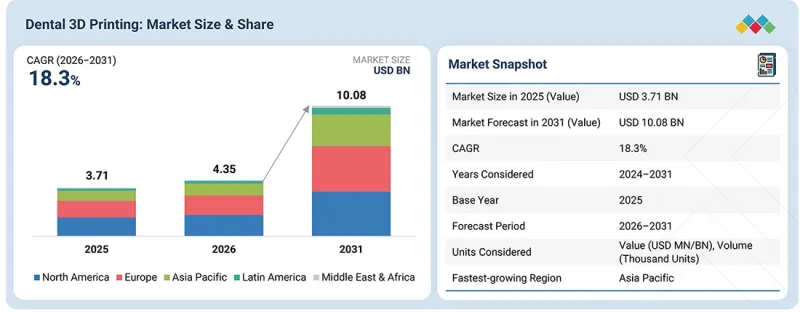
However, the high costs of dental 3D printers and strict regulatory processes for approving 3D printing equipment may limit market expansion.
Based on technology, the VAT photopolymerization segment accounted for the largest share of the dental 3D printing market.
The dental 3D printing market is divided into several technology segments: VAT photopolymerization (VPP), fused deposition modeling, selective laser sintering, PolyJet printing, and other technologies. VAT photopolymerization (VPP) holds the largest market share in dental 3D printing due to its high accuracy, compatibility with a wide range of resins, and extensive clinical applications. Technologies such as SLA (stereolithography) and DLP (digital light processing) deliver high-resolution, precise printing for restorations such as crowns, bridges, aligners, surgical guides, and splints.
Dental laboratories prefer VPP systems because they can cost-effectively mass-produce individualized components, often producing several restorations in a single print cycle. High print speeds and minimal post-processing reduce turnaround times and boost productivity. Additionally, smaller clinics and dental service organizations increasingly choose these compact, affordable systems for in-house production. Ongoing advancements in materials and integration with digital workflows further reinforce VAT photopolymerization's leading position in modern dental practices.
The materials segment is expected to register the highest CAGR in the dental 3D printing market.
By product & service, the dental 3D printing market is divided into three main segments: equipment, materials, and services. Among these, the materials segment is expected to register the highest CAGR from 2026 to 2031, as advancements in material science continue to enhance the strength, accuracy, and aesthetics of dental 3D-printed products. Demand for advanced dental materials is also increasing. Materials used to print dental 3D components primarily include plastics, biocompatible resins, polymers, metals, metal alloys, ceramics, and other biomaterials. High-quality materials enable intricate designs and anatomically accurate dental components, leading to better-fitting restorations and improved clinical outcomes.
Asia Pacific is expected to grow at the highest CAGR in the dental 3D printing market during the forecast period.
Rapid population growth, rising oral health awareness, and an expanding middle class are driving demand for dental services across the Asia Pacific region. Increasing disposable incomes and growing demand for orthodontic, restorative, and cosmetic dental treatments are encouraging dental clinics and laboratories to adopt digital dentistry solutions. Additionally, global dental 3D printing manufacturers are expanding their presence in the region by introducing advanced printers, innovative software, and a wider range of biocompatible printing materials. The growing adoption of intraoral scanners, CAD/CAM technologies, and customized dental appliances further supports market expansion in countries such as China, India, Japan, and South Korea.
A breakdown of the primary participants (supply side) for the dental 3D printing market referred to in this report is provided below:
- By Company Type: Tier 1 (35%), Tier 2 (40%), and Tier 3 (25%)
- By Designation: C-level Executives (45%), Directors (35%), and Others (20%)
- By Region: North America (27%), Europe (25%), Asia Pacific (30%), Latin America (8%), and the Middle East & Africa (10%)
Prominent players in the dental 3D printing market include Stratasys (US and Israel), 3D Systems, Inc. (US), SprintRay (US), DWS S.r.l. (Italy), Align Technology, Inc. (US), Formlabs (US), Prodways Group (France), Nikon SLM Solutions AG (Germany), Carbon, Inc. (US), Colibrium Additive - a GE Aerospace company (US), EOS GmbH (Germany), Asiga (Australia), Rapid Shape GmbH (Germany), Roland DGA Corporation (US), Dentsply Sirona (US), Shenzhen PioCreat 3D Technology Co., Ltd. (China), Zortrax (Poland), DETAX Ettlingen (Germany), DMG America (US), 3Dresyns (Spain), Micron Dental (US), Ackuretta (Taiwan), Carima Co., Ltd. (South Korea), Planmeca Oy (Finland), and SHINING 3D (China).
Research Coverage
The report analyzes the dental 3D printing market, estimating market size and future growth potential across segments including end users, regions, applications, technologies, and products & services. The report also includes a competitive analysis of key market players, detailing their company profiles, product & service offerings, recent developments, and key market strategies.
Reasons to Buy the Report
The report provides valuable insights for both market leaders and new entrants in the dental 3D printing industry, offering approximate revenue figures for the overall market and its subsegments. It helps stakeholders understand the competitive landscape, enabling them to better position their businesses and develop effective go-to-market strategies. Additionally, the report highlights key market drivers, restraints, challenges, and opportunities, helping stakeholders gauge the market's current state.
This report provides insights into the following pointers:
- Analysis of key drivers (increased speed and accuracy with better clinical workflows, high incidence of dental caries and other oral diseases, and growing demand for cosmetic dentistry and preventive dental care), restraints (high cost of dental 3D printers and lack of a skilled workforce and limited specialized training in additive manufacturing), opportunities (high growth potential of dental tourism in emerging economies and consolidation of dental practices and increased number of dental service organizations), and challenges (stringent regulatory requirements for dental 3D printing products)
- Market Penetration: It provides detailed information on the product portfolios offered by major players in the global dental 3D printing market. The report covers various segments including products & services, technologies, applications, end users, and regions.
- Product Enhancement/Innovation: Comprehensive details about new product launches and anticipated trends in the global dental 3D printing market.
- Market Development: Thorough knowledge and analysis of the profitable rising markets by product & service, technology, application, end user, and region.
- Market Diversification: Comprehensive information about newly launched products and services, expanding markets, current advancements, and investments in the global dental 3D printing market.
- Competitive Assessment: Thorough evaluation of the market shares, growth plans, offerings of products and services, and capacities of the major competitors in the global dental 3D printing market.
TABLE OF CONTENTS
1 INTRODUCTION
- 1.1 STUDY OBJECTIVES
- 1.2 MARKET DEFINITION
- 1.3 MARKET SCOPE
- 1.3.1 MARKETS COVERED
- 1.3.2 INCLUSIONS AND EXCLUSIONS
- 1.3.3 YEARS CONSIDERED
- 1.3.4 CURRENCY CONSIDERED
- 1.4 STAKEHOLDERS
- 1.5 SUMMARY OF CHANGES
2 EXECUTIVE SUMMARY
- 2.1 KEY MARKET PARTICIPANTS: SHARE INSIGHTS AND START DEVELOPMENT
- 2.2 DISRUPTIVE TRENDS SHAPING MARKET
- 2.3 HIGH-GROWTH SEGMENTS & EMERGING FRONTIERS
- 2.4 SNAPSHOT: GLOBAL MARKET SIZE, GROWTH RATE, AND FORECAST
3 PREMIUM INSIGHTS
- 3.1 DENTAL 3D PRINTING MARKET OVERVIEW
- 3.2 ASIA PACIFIC: DENTAL 3D PRINTING MARKET, BY TYPE AND COUNTRY, (2025)
- 3.3 DENTAL 3D PRINTING MARKET: GEOGRAPHIC GROWTH OPPORTUNITIES
- 3.4 DENTAL 3D PRINTING MARKET: REGIONAL MIX, 2024-2031
- 3.5 DENTAL 3D PRINTING MARKET: EMERGING VS. DEVELOPED MARKETS
4 MARKET OVERVIEW
- 4.1 INTRODUCTION
- 4.2 MARKET DYNAMICS
- 4.2.1 DRIVERS
- 4.2.1.1 Increased speed and accuracy with better clinical workflows
- 4.2.1.2 High incidence of dental caries and other oral diseases
- 4.2.1.3 Growing demand for cosmetic dentistry and preventive dental care
- 4.2.1.4 Rising edentulism in geriatric population
- 4.2.2 RESTRAINTS
- 4.2.2.1 High cost of dental 3D printers
- 4.2.2.2 Lack of skilled workforce and limited specialized training in additive manufacturing
- 4.2.3 OPPORTUNITIES
- 4.2.3.1 High growth potential of dental tourism in emerging economies
- 4.2.3.2 Consolidation of dental practices and increased number of dental service organizations
- 4.2.4 CHALLENGES
- 4.2.4.1 Stringent regulatory requirements for dental 3D printing products
- 4.2.4.2 Dearth of trained dental practitioners
- 4.2.1 DRIVERS
- 4.3 UNMET NEEDS AND WHITE SPACES
- 4.3.1 UNMET NEEDS
- 4.3.2 WHITE SPACE OPPORTUNITIES
- 4.4 INTERCONNECTED MARKETS AND CROSS-SECTOR OPPORTUNITIES
- 4.4.1 INTERCONNECTED MARKETS
- 4.4.2 CROSS-SECTOR OPPORTUNITIES
- 4.5 STRATEGIC MOVES BY TIER 1/2/3 PLAYERS
5 INDUSTRY TRENDS
- 5.1 PORTER'S FIVE FORCES ANALYSIS
- 5.1.1 INTENSITY OF COMPETITIVE RIVALRY
- 5.1.2 BARGAINING POWER OF SUPPLIERS
- 5.1.3 BARGAINING POWER OF BUYERS
- 5.1.4 THREAT OF SUBSTITUTES
- 5.1.5 THREAT OF NEW ENTRANTS
- 5.2 MACROECONOMIC OUTLOOK
- 5.2.1 INTRODUCTION
- 5.2.2 GDP TRENDS AND FORECAST
- 5.2.3 TRENDS IN DENTAL 3D PRINTING MARKET
- 5.3 VALUE CHAIN ANALYSIS
- 5.4 ECOSYSTEM ANALYSIS
- 5.5 SUPPLY CHAIN ANALYSIS
- 5.6 PRICING ANALYSIS
- 5.6.1 AVERAGE SELLING PRICE, BY KEY PLAYER, 2025
- 5.6.2 AVERAGE SELLING PRICE TREND, BY REGION, 2023-2025
- 5.7 TRADE ANALYSIS
- 5.7.1 IMPORT DATA (HS CODE: 901849)
- 5.7.2 EXPORT DATA (HS CODE: 901849)
- 5.8 KEY CONFERENCES & EVENTS DURING 2026
- 5.9 TRENDS/DISRUPTIONS IMPACTING CUSTOMERS' BUSINESSES
- 5.10 INVESTMENT & FUNDING SCENARIO
- 5.11 CASE STUDY ANALYSIS
- 5.11.1 CASE STUDY 1: 3D PRINTING MASS-CUSTOMIZED ORTHODONTICS
- 5.11.2 CASE STUDY 2: HIGH-RESOLUTION DENTAL 3D PRINTERS
- 5.11.3 CASE STUDY 3: BIOCOMPATIBLE RESTORATIONS WITH DIVERSE MATERIALS
- 5.12 IMPACT OF 2025 US TARIFFS-DENTAL 3D PRINTING MARKET
- 5.12.1 INTRODUCTION
- 5.12.2 KEY TARIFF RATES
- 5.12.3 PRICE IMPACT ANALYSIS
- 5.12.4 IMPACT ON COUNTRIES/REGIONS
- 5.12.4.1 US
- 5.12.4.2 Europe
- 5.12.4.3 Asia Pacific
- 5.12.5 IMPACT ON END-USER INDUSTRIES
6 TECHNOLOGICAL ADVANCEMENTS, AI-DRIVEN IMPACT, PATENTS, INNOVATIONS, AND FUTURE APPLICATIONS
- 6.1 KEY EMERGING TECHNOLOGIES
- 6.1.1 MULTIJET MODELING (MJM)
- 6.2 COMPLEMENTARY TECHNOLOGIES
- 6.2.1 CURING CHAMBERS
- 6.3 ADJACENT TECHNOLOGIES
- 6.3.1 CAD/CAM TECHNOLOGY
- 6.3.2 LASER DENTISTRY
- 6.4 TECHNOLOGY/PRODUCT ROADMAP
- 6.4.1 SHORT-TERM | RECENT TECHNOLOGIES | FOUNDATION & EARLY COMMERCIALIZATION
- 6.4.2 MID-TERM (2027-2030) | EXPANSION & STANDARDIZATION
- 6.4.3 LONG-TERM (2030-2035+) | MASS COMMERCIALIZATION & DISRUPTION
- 6.5 PATENT ANALYSIS
- 6.5.1 PATENT PUBLICATION TRENDS FOR DENTAL 3D PRINTING MARKET
- 6.5.2 INSIGHTS: JURISDICTION AND TOP APPLICANT ANALYSIS
- 6.5.3 TOP APPLICANTS & OWNERS (COMPANIES/INSTITUTIONS) FOR DENTAL 3D PRINTING PATENTS (JANUARY 2015-MARCH 2026)
- 6.5.4 TOP APPLICANT COUNTRIES/REGIONS PATENTS FOR DENTAL 3D PRINTING (JANUARY 2015-DECEMBER 2025)
- 6.6 IMPACT OF AI/GEN AI ON DENTAL 3D PRINTING MARKET
- 6.6.1 TOP USE CASES AND MARKET POTENTIAL
- 6.6.2 INTERCONNECTED ADJACENT ECOSYSTEMS AND IMPACT ON MARKET PLAYERS
- 6.6.3 CLIENTS' READINESS TO ADOPT GENERATIVE AI IN DENTAL 3D PRINTING MARKET
- 6.7 SUCCESS STORIES AND REAL-WORLD APPLICATIONS
- 6.7.1 FORMLABS: DENTAL 3D PRINTING AND DIGITAL WORKFLOW INTEGRATION
- 6.7.2 SPRINTRAY: CHAIRSIDE DENTAL 3D PRINTING AND SAME-DAY DENTISTRY
- 6.7.3 STRATASYS: AUTOMATED DENTAL PRODUCTION AND MULTI-APPLICATION PRINTING
7 REGULATORY LANDSCAPE
- 7.1 REGIONAL REGULATIONS AND COMPLIANCE
- 7.1.1 REGULATORY BODIES, GOVERNMENT AGENCIES, AND OTHER ORGANIZATIONS
- 7.1.2 INDUSTRY STANDARDS
- 7.1.2.1 North America
- 7.1.2.1.1 US
- 7.1.2.1.2 Canada
- 7.1.2.2 Europe
- 7.1.2.3 Asia Pacific
- 7.1.2.3.1 China
- 7.1.2.3.2 Japan
- 7.1.2.4 Latin America
- 7.1.2.4.1 Brazil
- 7.1.2.4.2 Mexico
- 7.1.2.5 Middle East & Africa
- 7.1.2.1 North America
- 7.2 REIMBURSEMENT SCENARIO
- 7.3 CERTIFICATIONS, LABELING, AND ECO-STANDARDS
8 CUSTOMER LANDSCAPE & BUYER BEHAVIOR
- 8.1 DECISION-MAKING PROCESS
- 8.2 BUYER STAKEHOLDERS AND BUYING EVALUATION CRITERIA
- 8.2.1 INFLUENCE OF KEY STAKEHOLDERS
- 8.2.2 BUYING CRITERIA
- 8.3 ADOPTION BARRIERS & INTERNAL CHALLENGES
- 8.4 UNMET NEEDS FROM VARIOUS END-USE INDUSTRIES
9 DENTAL 3D PRINTING MARKET, BY PRODUCT & SERVICE
- 9.1 INTRODUCTION
- 9.2 SERVICES
- 9.2.1 COST-EFFECTIVENESS TO BOOST SERVICES SECTOR GROWTH
- 9.3 MATERIALS
- 9.3.1 PLASTICS
- 9.3.1.1 Advancements in biocompatible resins quality and increasing versatility to promote segment growth
- 9.3.2 METALS
- 9.3.2.1 High strength and durability of metal materials to drive market
- 9.3.3 OTHER MATERIALS
- 9.3.1 PLASTICS
- 9.4 EQUIPMENT
- 9.4.1 DENTAL 3D SCANNERS
- 9.4.1.1 Rising awareness of dental 3D scanners to support segment growth
- 9.4.2 DENTAL 3D PRINTERS
- 9.4.2.1 Enhanced accuracy and precision to drive dental 3D printer adoption
- 9.4.1 DENTAL 3D SCANNERS
10 DENTAL 3D PRINTING MARKET, BY TECHNOLOGY
- 10.1 INTRODUCTION
- 10.2 VAT PHOTOPOLYMERIZATION
- 10.2.1 STEREOLITHOGRAPHY
- 10.2.1.1 SLA printers utilize lasers to solidify resin layer by layer, resulting in highly accurate and detailed restorations with smooth surfaces.
- 10.2.2 DIGITAL LIGHT PROCESSING
- 10.2.2.1 DLP printers offer high resolution and can produce smooth, detailed surfaces on printed parts.
- 10.2.3 LIQUID CRYSTAL DISPLAY
- 10.2.3.1 LCD printers generally have lower initial costs than DLP printers, making them more accessible to individual dental practices and smaller labs.
- 10.2.1 STEREOLITHOGRAPHY
- 10.3 SELECTIVE LASER SINTERING
- 10.3.1 HIGH PRODUCTIVITY AND FASTER PRINTING SPEED OF SLS TO ENCOURAGE SEGMENT GROWTH
- 10.4 POLYJET PRINTING
- 10.4.1 HIGH PRECISION ACCURACY OF POLYJET TECHNOLOGY TO BOOST MARKET GROWTH
- 10.5 FUSED DEPOSITION MODELING
- 10.5.1 FDM TECHNOLOGY-BASED PRINTERS ARE COST-EFFECTIVE, WHICH IS EXPECTED TO DRIVE MARKET GROWTH
- 10.6 OTHER TECHNOLOGIES
11 DENTAL 3D PRINTING MARKET, BY APPLICATION
- 11.1 INTRODUCTION
- 11.2 PROSTHODONTICS
- 11.2.1 ENHANCED ACCURACY AND CUSTOMIZATION TO DRIVE 3D PRINTING IN PROSTHODONTICS
- 11.3 ORTHODONTICS
- 11.3.1 HIGH PRECISION OF RETAINERS FOR OPTIMAL POST-TREATMENT TOOTH ALIGNMENT DRIVES ADOPTION IN ORTHODONTICS
- 11.4 IMPLANTOLOGY
- 11.4.1 BETTER-FITTING IMPLANTS AND RESTORATIONS, LEADING TO IMPROVED FUNCTIONALITY AND AESTHETICS TO SUPPORT SEGMENT GROWTH
12 DENTAL 3D PRINTING MARKET, BY END USER
- 12.1 INTRODUCTION
- 12.2 DENTAL LABORATORIES
- 12.2.1 RISING TECHNOLOGICAL ADVANCEMENT AND ADOPTION BY DENTAL LABORATORIES TO PROPEL SEGMENT GROWTH
- 12.3 DENTAL HOSPITALS & CLINICS
- 12.3.1 GROWING NUMBER OF DENTAL CLINICS & HOSPITALS AND GROWING AWARENESS TO PROMOTE MARKET GROWTH
- 12.4 DENTAL ACADEMIC & RESEARCH INSTITUTES
- 12.4.1 HANDS-ON LABS, CLINICAL EXPERIENCES, AND SIMULATION TRAINING FOR TECHNICAL SKILLS TO BOOST SEGMENT GROWTH
13 DENTAL 3D PRINTING MARKET, BY REGION
- 13.1 INTRODUCTION
- 13.2 NORTH AMERICA
- 13.2.1 MACROECONOMIC OUTLOOK FOR NORTH AMERICA
- 13.2.2 US
- 13.2.2.1 Presence of prominent market players and high per capita income to boost market growth
- 13.2.3 CANADA
- 13.2.3.1 High healthcare expenditure and favorable public and private funding to boost market growth
- 13.3 EUROPE
- 13.3.1 MACROECONOMIC OUTLOOK FOR EUROPE
- 13.3.2 GERMANY
- 13.3.2.1 Favorable government regulatory scenario and reimbursement policies to drive market
- 13.3.3 UK
- 13.3.3.1 Increasing awareness about dental health and favorable coverage under NHS to support market growth
- 13.3.4 FRANCE
- 13.3.4.1 Favorable government healthcare policies and high availability of dental professionals to propel market growth
- 13.3.5 ITALY
- 13.3.5.1 Low cost of dental treatment and increased focus on dental tourism to aid market growth
- 13.3.6 SPAIN
- 13.3.6.1 Strong dental care infrastructure and high focus on quality healthcare to support market growth
- 13.3.7 NETHERLANDS
- 13.3.7.1 Rising geriatric population and increasing investment in dental practices to drive market growth
- 13.3.8 REST OF EUROPE
- 13.4 ASIA PACIFIC
- 13.4.1 MACROECONOMIC OUTLOOK FOR ASIA PACIFIC
- 13.4.2 CHINA
- 13.4.2.1 Increasing number of dentists and dental laboratories to propel market growth
- 13.4.3 JAPAN
- 13.4.3.1 Rising geriatric population and increasing incidence of dental diseases to drive market
- 13.4.4 INDIA
- 13.4.4.1 Increasing prevalence of dental disorders and rising focus on dental imports to support market growth
- 13.4.5 AUSTRALIA
- 13.4.5.1 Favorable government initiatives and high incidence of dental diseases to propel market growth
- 13.4.6 SOUTH KOREA
- 13.4.6.1 Rising disposable income and increasing need for advanced treatment by geriatric population to drive market
- 13.4.7 REST OF ASIA PACIFIC
- 13.5 LATIN AMERICA
- 13.5.1 MACROECONOMIC OUTLOOK FOR LATIN AMERICA
- 13.5.2 BRAZIL
- 13.5.2.1 Rising investments in R&D and growing focus on technological advancements to promote market growth
- 13.5.3 MEXICO
- 13.5.3.1 Growing need to improve healthcare infrastructure and rising focus on dental tourism to aid market growth
- 13.5.4 ARGENTINA
- 13.5.4.1 Increasing demand for personalized dentistry to drive market
- 13.5.5 REST OF LATIN AMERICA
- 13.6 MIDDLE EAST & AFRICA
- 13.6.1 LARGE UNDERSERVED POPULATIONS AND DEMAND FOR ACCESSIBLE CARE TO DRIVE GROWTH
- 13.6.2 MACROECONOMIC OUTLOOK FOR MIDDLE EAST & AFRICA
- 13.7 GCC COUNTRIES
- 13.7.1 INCREASING DEMAND FOR HEALTH SERVICES TO DRIVE MARKET
- 13.7.2 MACROECONOMIC OUTLOOK FOR GCC COUNTRIES
14 COMPETITIVE LANDSCAPE
- 14.1 INTRODUCTION
- 14.2 KEY PLAYER STRATEGIES/RIGHT TO WIN
- 14.2.1 OVERVIEW OF STRATEGIES ADOPTED BY PLAYERS IN DENTAL 3D PRINTING MARKET
- 14.3 REVENUE SHARE ANALYSIS, 2021-2025
- 14.4 MARKET SHARE ANALYSIS, 2025
- 14.5 COMPANY EVALUATION MATRIX: KEY PLAYERS, 2025
- 14.5.1 STARS
- 14.5.2 EMERGING LEADERS
- 14.5.3 PERVASIVE PLAYERS
- 14.5.4 PARTICIPANTS
- 14.5.5 COMPANY FOOTPRINT: KEY PLAYERS, 2025
- 14.5.5.1 Company footprint
- 14.5.5.2 Region footprint
- 14.5.5.3 Product & service footprint
- 14.5.5.4 Technology footprint
- 14.5.5.5 Application footprint
- 14.5.5.6 End-user footprint
- 14.6 COMPANY EVALUATION MATRIX: STARTUPS/SMES, 2025
- 14.6.1 PROGRESSIVE COMPANIES
- 14.6.2 RESPONSIVE COMPANIES
- 14.6.3 DYNAMIC COMPANIES
- 14.6.4 STARTING BLOCKS
- 14.6.5 COMPETITIVE BENCHMARKING: STARTUPS/SMES, 2025
- 14.6.5.1 Detailed list of key startups/SMEs
- 14.6.5.2 Competitive benchmarking of key startups/SMEs
- 14.7 COMPANY VALUATION & FINANCIAL METRICS
- 14.7.1 FINANCIAL METRICS
- 14.7.2 COMPANY VALUATION
- 14.8 BRAND/PRODUCT COMPARISON
- 14.9 COMPETITIVE SCENARIO
- 14.9.1 PRODUCT LAUNCHES & APPROVALS
- 14.9.2 DEALS
- 14.9.3 EXPANSIONS
- 14.9.4 OTHER DEVELOPMENTS
15 COMPANY PROFILES
- 15.1 KEY PLAYERS
- 15.1.1 STRATASYS
- 15.1.1.1 Business overview
- 15.1.1.2 Products/Solutions/Services offered
- 15.1.1.3 Recent developments
- 15.1.1.3.1 Product launches & enhancements
- 15.1.1.3.2 Deals
- 15.1.1.3.3 Expansions
- 15.1.1.3.4 Other developments
- 15.1.1.4 MnM view
- 15.1.1.4.1 Right to win
- 15.1.1.4.2 Strategic choices
- 15.1.1.4.3 Weaknesses and competitive threats
- 15.1.2 3D SYSTEMS, INC.
- 15.1.2.1 Business overview
- 15.1.2.2 Products/Solutions/Services offered
- 15.1.2.3 Recent developments
- 15.1.2.3.1 Product launches & approvals
- 15.1.2.3.2 Deals
- 15.1.2.3.3 Other developments
- 15.1.2.4 MnM view
- 15.1.2.4.1 Right to win
- 15.1.2.4.2 Strategic choices
- 15.1.2.4.3 Weaknesses and competitive threats
- 15.1.3 SPRINTRAY INC.
- 15.1.3.1 Business overview
- 15.1.3.2 Products/Solutions/Services offered
- 15.1.3.3 Recent developments
- 15.1.3.3.1 Product launches & approvals
- 15.1.3.3.2 Deals
- 15.1.3.4 MnM view
- 15.1.3.4.1 Key strengths/Right to win
- 15.1.3.4.2 Strategic choices
- 15.1.3.4.3 Weaknesses and competitive threats
- 15.1.4 ALIGN TECHNOLOGY, INC.
- 15.1.4.1 Business overview
- 15.1.4.2 Products/Solutions/Services offered
- 15.1.4.3 Recent developments
- 15.1.4.3.1 Product launches & approvals
- 15.1.4.3.2 Deals
- 15.1.4.4 MnM view
- 15.1.4.4.1 Key strengths/Right to win
- 15.1.4.4.2 Strategic choices
- 15.1.4.4.3 Weaknesses and competitive threats
- 15.1.5 FORMLABS
- 15.1.5.1 Business overview
- 15.1.5.2 Products/Solutions/Services offered
- 15.1.5.3 Recent developments
- 15.1.5.3.1 Product launches
- 15.1.5.3.2 Deals
- 15.1.6 DWS S.R.L.
- 15.1.6.1 Business overview
- 15.1.6.2 Products/Solutions/Services offered
- 15.1.7 PRODWAYS GROUP
- 15.1.7.1 Business overview
- 15.1.7.2 Products/Solutions/Services offered
- 15.1.7.3 Recent developments
- 15.1.7.3.1 Product launches
- 15.1.7.3.2 Deals
- 15.1.8 NIKON SLM SOLUTIONS AG
- 15.1.8.1 Business overview
- 15.1.8.2 Products/Solutions/Services offered
- 15.1.8.3 Recent developments
- 15.1.8.3.1 Deals
- 15.1.9 CARBON, INC.
- 15.1.9.1 Business overview
- 15.1.9.2 Products/Solutions/Services offered
- 15.1.9.3 Recent developments
- 15.1.9.3.1 Product launches
- 15.1.9.3.2 Deals
- 15.1.10 COLIBRIUM ADDITIVE-A GE AEROSPACE COMPANY
- 15.1.10.1 Business overview
- 15.1.10.2 Products/Solutions/Services offered
- 15.1.10.3 Recent developments
- 15.1.10.3.1 Other developments
- 15.1.1 STRATASYS
- 15.2 OTHER PLAYERS
- 15.2.1 EOS GMBH
- 15.2.2 ASIGA
- 15.2.3 RAPID SHAPE GMBH
- 15.2.4 ROLAND DGA CORPORATION
- 15.2.5 DENTSPLY SIRONA
- 15.2.6 SHENZHEN PIOCREAT 3D TECHNOLOGY CO., LTD.
- 15.2.7 ZORTRAX
- 15.2.8 DETAX
- 15.2.9 DMG AMERICA
- 15.2.10 3DRESYNS
- 15.2.11 MICRON DENTAL
- 15.2.12 ACKURETTA (SUBSIDIARY OF PAC-DENT INC)
- 15.2.13 CARIMA CO., LTD.
- 15.2.14 PLANMECA OY
- 15.2.15 SHINING 3D
16 RESEARCH METHODOLOGY
- 16.1 RESEARCH DATA
- 16.1.1 SECONDARY DATA
- 16.1.1.1 Key data from secondary sources
- 16.1.2 PRIMARY DATA
- 16.1.2.1 Key data from primary sources
- 16.1.2.2 Key industry insights
- 16.1.1 SECONDARY DATA
- 16.2 MARKET SIZE ESTIMATION
- 16.3 MARKET BREAKDOWN AND DATA TRIANGULATION
- 16.4 MARKET SHARE ESTIMATION
- 16.5 RESEARCH ASSUMPTIONS
- 16.6 LIMITATIONS
- 16.6.1 SCOPE-RELATED LIMITATIONS
- 16.6.2 METHODOLOGY-RELATED LIMITATIONS
- 16.7 RISK ASSESSMENT
17 APPENDIX
- 17.1 DISCUSSION GUIDE
- 17.2 KNOWLEDGESTORE: MARKETSANDMARKETS' SUBSCRIPTION PORTAL
- 17.3 CUSTOMIZATION OPTIONS
- 17.4 RELATED REPORTS
- 17.5 AUTHOR DETAILS
List of Tables
- TABLE 1 STANDARD CURRENCY CONVERSION RATES
- TABLE 2 RISE IN GERIATRIC POPULATION, BY COUNTRY (2022)
- TABLE 3 PROJECTED INCREASE IN NUMBER OF PEOPLE AGED OVER 65 YEARS, BY REGION, 2019 VS. 2050 (MILLION)
- TABLE 4 AVERAGE PROCEDURAL COST IN TOP TEN DENTAL TOURISM DESTINATIONS (IN USD)
- TABLE 5 DENTAL 3D PRINTING MARKET: UNMET NEEDS
- TABLE 6 PORTER'S FIVE FORCES ANALYSIS: DENTAL 3D PRINTING MARKET
- TABLE 7 GDP PERCENTAGE CHANGE, BY KEY COUNTRIES, 2021-2030
- TABLE 8 ROLE IN ECOSYSTEM: DENTAL 3D PRINTING MARKET
- TABLE 9 AVERAGE SELLING PRICE OF DENTAL 3D PRINTERS, BY KEY PLAYER, 2025 (USD)
- TABLE 10 AVERAGE SELLING PRICE OF DENTAL 3D SCANNERS, BY KEY PLAYER, 2025 (USD)
- TABLE 11 AVERAGE COST RANGE OF DENTAL 3D PRINTING PRODUCTS, BY REGION, 2023-2025 (USD)
- TABLE 12 IMPORT DATA FOR DENTAL 3D PRINTERS (HS CODE: 901849), BY COUNTRY, 2020-2024 (USD THOUSAND)
- TABLE 13 EXPORT DATA FOR DENTAL 3D PRINTERS (HS CODE: 901849), BY COUNTRY, 2020-2024 (USD THOUSAND)
- TABLE 14 DENTAL 3D PRINTING MARKET: KEY CONFERENCES & EVENTS (2026)
- TABLE 15 US-ADJUSTED RECIPROCAL TARIFF RATES
- TABLE 16 KEY PRODUCT-RELATED TARIFFS EFFECTIVE FOR DENTAL PRODUCTS
- TABLE 17 LIST OF PATENTS IN DENTAL 3D PRINTING (2022-2025)
- TABLE 18 TOP USE CASES AND MARKET POTENTIAL
- TABLE 19 INTERCONNECTED ADJACENT ECOSYSTEMS AND IMPACT ON MARKET PLAYERS
- TABLE 20 NORTH AMERICA: REGULATORY BODIES, GOVERNMENT AGENCIES, AND OTHER ORGANIZATIONS
- TABLE 21 EUROPE: REGULATORY BODIES, GOVERNMENT AGENCIES, AND OTHER ORGANIZATIONS
- TABLE 22 ASIA PACIFIC: REGULATORY BODIES, GOVERNMENT AGENCIES, AND OTHER ORGANIZATIONS
- TABLE 23 LATIN AMERICA: REGULATORY BODIES, GOVERNMENT AGENCIES, AND OTHER ORGANIZATIONS
- TABLE 24 MIDDLE EAST & AFRICA: REGULATORY BODIES, GOVERNMENT AGENCIES, AND OTHER ORGANIZATIONS
- TABLE 25 CERTIFICATIONS, LABELING, ECO-STANDARDS IN DENTAL 3D PRINTING MARKET
- TABLE 26 INFLUENCE OF STAKEHOLDERS ON BUYING PROCESS FOR TOP THREE END USERS (%)
- TABLE 27 KEY BUYING CRITERIA FOR TOP THREE END USERS
- TABLE 28 DENTAL 3D PRINTING MARKET: UNMET NEEDS/END-USER EXPECTATIONS
- TABLE 29 DENTAL 3D PRINTING MARKET, BY PRODUCT & SERVICE, 2024-2031 (USD MILLION)
- TABLE 30 DENTAL 3D PRINTING SERVICES MARKET, BY COUNTRY, 2024-2031 (USD MILLION)
- TABLE 31 DENTAL 3D PRINTING MATERIALS MARKET, BY TYPE, 2024-2031 (USD MILLION)
- TABLE 32 DENTAL 3D PRINTING MATERIALS MARKET, BY COUNTRY, 2024-2031 (USD MILLION)
- TABLE 33 DENTAL 3D PRINTING MARKET FOR PLASTICS, BY COUNTRY, 2024-2031 (USD MILLION)
- TABLE 34 DENTAL 3D PRINTING MARKET FOR METALS, BY COUNTRY, 2024-2031 (USD MILLION)
- TABLE 35 OTHER MATERIALS AVAILABLE IN THE DENTAL 3D PRINTING MARKET
- TABLE 36 DENTAL 3D PRINTING MARKET FOR OTHER MATERIALS, BY COUNTRY, 2024-2031 (USD MILLION)
- TABLE 37 DENTAL 3D PRINTING EQUIPMENT MARKET, BY TYPE, 2024-2031 (USD MILLION)
- TABLE 38 DENTAL 3D PRINTING EQUIPMENT MARKET, BY COUNTRY, 2024-2031 (USD MILLION)
- TABLE 39 DENTAL 3D SCANNERS MARKET, BY COUNTRY, 2024-2031 (USD MILLION)
- TABLE 40 DENTAL 3D SCANNERS MARKET, BY REGION, 2024-2031 (MILLION UNITS)
- TABLE 41 DENTAL 3D PRINTERS MARKET, BY COUNTRY, 2024-2031 (USD MILLION)
- TABLE 42 DENTAL 3D PRINTERS MARKET, BY REGION, 2024-2031 (MILLION UNITS)
- TABLE 43 DENTAL 3D PRINTING MARKET, BY TECHNOLOGY, 2024-2031 (USD MILLION)
- TABLE 44 VAT PHOTOPOLYMERIZATION MARKET, BY TYPE, 2024-2031 (USD MILLION)
- TABLE 45 VAT PHOTOPOLYMERIZATION MARKET, BY COUNTRY, 2024-2031 (USD MILLION)
- TABLE 46 STEREOLITHOGRAPHY MARKET, BY COUNTRY, 2024-2031 (USD MILLION)
- TABLE 47 DIGITAL LIGHT PROCESSING MARKET, BY COUNTRY, 2024-2031 (USD MILLION)
- TABLE 48 MAJOR COMPANIES OFFERING DENTAL LCD 3D PRINTERS
- TABLE 49 LIQUID CRYSTAL DISPLAY MARKET, BY COUNTRY, 2024-2031 (USD MILLION)
- TABLE 50 SELECTIVE LASER SINTERING MARKET, BY COUNTRY, 2024-2031 (USD MILLION)
- TABLE 51 POLYJET PRINTING MARKET, BY COUNTRY, 2024-2031 (USD MILLION)
- TABLE 52 FUSED DEPOSITION MODELING MARKET, BY COUNTRY, 2024-2031 (USD MILLION)
- TABLE 53 OTHER DENTAL 3D PRINTING TECHNOLOGIES MARKET, BY COUNTRY, 2024-2031 (USD MILLION)
- TABLE 54 DENTAL 3D PRINTING MARKET, BY APPLICATION, 2024-2031 (USD MILLION)
- TABLE 55 DENTAL 3D PRINTING MARKET FOR PROSTHODONTICS, BY COUNTRY, 2024-2031 (USD MILLION)
- TABLE 56 DENTAL 3D PRINTING MARKET FOR ORTHODONTICS, BY COUNTRY, 2024-2031 (USD MILLION)
- TABLE 57 DENTAL 3D PRINTING MARKET FOR IMPLANTOLOGY, BY COUNTRY, 2024-2031 (USD MILLION)
- TABLE 58 DENTAL 3D PRINTING MARKET, BY END USER, 2024-2031 (USD MILLION)
- TABLE 59 DENTAL 3D PRINTING MARKET FOR DENTAL LABORATORIES, BY COUNTRY, 2024-2031 (USD MILLION)
- TABLE 60 DENTAL 3D PRINTING MARKET FOR DENTAL HOSPITALS & CLINICS, BY COUNTRY, 2024-2031 (USD MILLION)
- TABLE 61 DENTAL 3D PRINTING MARKET FOR DENTAL ACADEMIC & RESEARCH INSTITUTES, BY COUNTRY, 2024-2031 (USD MILLION)
- TABLE 62 DENTAL 3D PRINTING MARKET, BY REGION, 2024-2031 (USD MILLION)
- TABLE 63 NORTH AMERICA: DENTAL 3D PRINTING MARKET, BY COUNTRY, 2024-2031 (USD MILLION)
- TABLE 64 NORTH AMERICA: DENTAL 3D PRINTING MARKET, BY PRODUCT & SERVICE, 2024-2031 (USD MILLION)
- TABLE 65 NORTH AMERICA: DENTAL 3D PRINTING MARKET FOR MATERIALS, BY TYPE, 2024-2031 (USD MILLION)
- TABLE 66 NORTH AMERICA: DENTAL 3D PRINTING MARKET FOR EQUIPMENT, BY TYPE, 2024-2031 (USD MILLION)
- TABLE 67 NORTH AMERICA: DENTAL 3D PRINTING MARKET, BY APPLICATION, 2024-2031 (USD MILLION)
- TABLE 68 NORTH AMERICA: DENTAL 3D PRINTING MARKET, BY TECHNOLOGY, 2024-2031 (USD MILLION)
- TABLE 69 NORTH AMERICA: DENTAL 3D PRINTING MARKET FOR VAT PHOTOPOLYMERIZATION, BY TYPE, 2024-2031 (USD MILLION)
- TABLE 70 NORTH AMERICA: DENTAL 3D PRINTING MARKET, BY END USER, 2024-2031 (USD MILLION)
- TABLE 71 US: DENTAL 3D PRINTING MARKET, BY PRODUCT & SERVICE, 2024-2031 (USD MILLION)
- TABLE 72 US: DENTAL 3D PRINTING MARKET FOR MATERIALS, BY TYPE, 2024-2031 (USD MILLION)
- TABLE 73 US: DENTAL 3D PRINTING MARKET FOR EQUIPMENT, BY TYPE, 2024-2031 (USD MILLION)
- TABLE 74 US: DENTAL 3D PRINTING MARKET, BY APPLICATION, 2024-2031 (USD MILLION)
- TABLE 75 US: DENTAL 3D PRINTING MARKET, BY TECHNOLOGY, 2024-2031 (USD MILLION)
- TABLE 76 US: DENTAL 3D PRINTING MARKET FOR VAT PHOTOPOLYMERIZATION, BY TYPE, 2024-2031 (USD MILLION)
- TABLE 77 US: DENTAL 3D PRINTING MARKET, BY END USER, 2024-2031 (USD MILLION)
- TABLE 78 CANADA: DENTAL 3D PRINTING MARKET, BY PRODUCT & SERVICE, 2024-2031 (USD MILLION)
- TABLE 79 CANADA: DENTAL 3D PRINTING MARKET FOR MATERIALS, BY TYPE, 2024-2031 (USD MILLION)
- TABLE 80 CANADA: DENTAL 3D PRINTING MARKET FOR EQUIPMENT, BY TYPE, 2024-2031 (USD MILLION)
- TABLE 81 CANADA: DENTAL 3D PRINTING MARKET, BY APPLICATION, 2024-2031 (USD MILLION)
- TABLE 82 CANADA: DENTAL 3D PRINTING MARKET, BY TECHNOLOGY, 2024-2031 (USD MILLION)
- TABLE 83 CANADA: DENTAL 3D PRINTING MARKET FOR VAT PHOTOPOLYMERIZATION, BY TYPE, 2024-2031 (USD MILLION)
- TABLE 84 CANADA: DENTAL 3D PRINTING MARKET, BY END USER, 2024-2031 (USD MILLION)
- TABLE 85 EUROPE: DENTAL 3D PRINTING MARKET, BY COUNTRY, 2024-2031 (USD MILLION)
- TABLE 86 EUROPE: DENTAL 3D PRINTING MARKET, BY PRODUCT & SERVICE, 2024-2031 (USD MILLION)
- TABLE 87 EUROPE: DENTAL 3D PRINTING MARKET FOR MATERIALS, BY TYPE, 2024-2031 (USD MILLION)
- TABLE 88 EUROPE: DENTAL 3D PRINTING MARKET FOR EQUIPMENT, BY TYPE, 2024-2031 (USD MILLION)
- TABLE 89 EUROPE: DENTAL 3D PRINTING MARKET, BY APPLICATION, 2024-2031 (USD MILLION)
- TABLE 90 EUROPE: DENTAL 3D PRINTING MARKET, BY TECHNOLOGY, 2024-2031 (USD MILLION)
- TABLE 91 EUROPE: DENTAL 3D PRINTING MARKET FOR VAT PHOTOPOLYMERIZATION, BY TYPE, 2024-2031 (USD MILLION)
- TABLE 92 EUROPE: DENTAL 3D PRINTING MARKET, BY END USER, 2024-2031 (USD MILLION)
- TABLE 93 GERMANY: DENTAL 3D PRINTING MARKET, BY PRODUCT & SERVICE, 2024-2031 (USD MILLION)
- TABLE 94 GERMANY: DENTAL 3D PRINTING MARKET FOR MATERIALS, BY TYPE, 2024-2031 (USD MILLION)
- TABLE 95 GERMANY: DENTAL 3D PRINTING MARKET FOR EQUIPMENT, BY TYPE, 2024-2031 (USD MILLION)
- TABLE 96 GERMANY: DENTAL 3D PRINTING MARKET, BY APPLICATION, 2024-2031 (USD MILLION)
- TABLE 97 GERMANY: DENTAL 3D PRINTING MARKET, BY TECHNOLOGY, 2024-2031 (USD MILLION)
- TABLE 98 GERMANY: DENTAL 3D PRINTING MARKET FOR VAT PHOTOPOLYMERIZATION, BY TYPE, 2024-2031 (USD MILLION)
- TABLE 99 GERMANY: DENTAL 3D PRINTING MARKET, BY END USER, 2024-2031 (USD MILLION)
- TABLE 100 UK: DENTAL 3D PRINTING MARKET, BY PRODUCT & SERVICE, 2024-2031 (USD MILLION)
- TABLE 101 UK: DENTAL 3D PRINTING MARKET FOR MATERIALS, BY TYPE, 2024-2031 (USD MILLION)
- TABLE 102 UK: DENTAL 3D PRINTING MARKET FOR EQUIPMENT, BY TYPE, 2024-2031 (USD MILLION)
- TABLE 103 UK: DENTAL 3D PRINTING MARKET, BY APPLICATION, 2024-2031 (USD MILLION)
- TABLE 104 UK: DENTAL 3D PRINTING MARKET, BY TECHNOLOGY, 2024-2031 (USD MILLION)
- TABLE 105 UK: DENTAL 3D PRINTING MARKET FOR VAT PHOTOPOLYMERIZATION, BY TYPE, 2024-2031 (USD MILLION)
- TABLE 106 UK: DENTAL 3D PRINTING MARKET, BY END USER, 2024-2031 (USD MILLION)
- TABLE 107 FRANCE: DENTAL 3D PRINTING MARKET, BY PRODUCT & SERVICE, 2024-2031 (USD MILLION)
- TABLE 108 FRANCE: DENTAL 3D PRINTING MARKET FOR MATERIALS, BY TYPE, 2024-2031 (USD MILLION)
- TABLE 109 FRANCE: DENTAL 3D PRINTING MARKET FOR EQUIPMENT, BY TYPE, 2024-2031 (USD MILLION)
- TABLE 110 FRANCE: DENTAL 3D PRINTING MARKET, BY APPLICATION, 2024-2031 (USD MILLION)
- TABLE 111 FRANCE: DENTAL 3D PRINTING MARKET, BY TECHNOLOGY, 2024-2031 (USD MILLION)
- TABLE 112 FRANCE: DENTAL 3D PRINTING MARKET FOR VAT PHOTOPOLYMERIZATION, BY TYPE, 2024-2031 (USD MILLION)
- TABLE 113 FRANCE: DENTAL 3D PRINTING MARKET, BY END USER, 2024-2031 (USD MILLION)
- TABLE 114 ITALY: DENTAL 3D PRINTING MARKET, BY PRODUCT & SERVICE, 2024-2031 (USD MILLION)
- TABLE 115 ITALY: DENTAL 3D PRINTING MARKET FOR MATERIALS, BY TYPE, 2024-2031 (USD MILLION)
- TABLE 116 ITALY: DENTAL 3D PRINTING MARKET FOR EQUIPMENT, BY TYPE, 2024-2031 (USD MILLION)
- TABLE 117 ITALY: DENTAL 3D PRINTING MARKET, BY APPLICATION, 2024-2031 (USD MILLION)
- TABLE 118 ITALY: DENTAL 3D PRINTING MARKET, BY TECHNOLOGY, 2024-2031 (USD MILLION)
- TABLE 119 ITALY: DENTAL 3D PRINTING MARKET FOR VAT PHOTOPOLYMERIZATION, BY TYPE, 2024-2031 (USD MILLION)
- TABLE 120 ITALY: DENTAL 3D PRINTING MARKET, BY END USER, 2024-2031 (USD MILLION)
- TABLE 121 SPAIN: DENTAL 3D PRINTING MARKET, BY PRODUCT & SERVICE, 2024-2031 (USD MILLION)
- TABLE 122 SPAIN: DENTAL 3D PRINTING MARKET FOR MATERIALS, BY TYPE, 2024-2031 (USD MILLION)
- TABLE 123 SPAIN: DENTAL 3D PRINTING MARKET FOR EQUIPMENT, BY TYPE, 2024-2031 (USD MILLION)
- TABLE 124 SPAIN: DENTAL 3D PRINTING MARKET, BY APPLICATION, 2024-2031 (USD MILLION)
- TABLE 125 SPAIN: DENTAL 3D PRINTING MARKET, BY TECHNOLOGY, 2024-2031 (USD MILLION)
- TABLE 126 SPAIN: DENTAL 3D PRINTING MARKET FOR VAT PHOTOPOLYMERIZATION, BY TYPE, 2024-2031 (USD MILLION)
- TABLE 127 SPAIN: DENTAL 3D PRINTING MARKET, BY END USER, 2024-2031 (USD MILLION)
- TABLE 128 NETHERLANDS: DENTAL 3D PRINTING MARKET, BY PRODUCT & SERVICE, 2024-2031 (USD MILLION)
- TABLE 129 NETHERLANDS: DENTAL 3D PRINTING MARKET FOR MATERIALS, BY TYPE, 2024-2031 (USD MILLION)
- TABLE 130 NETHERLANDS: DENTAL 3D PRINTING MARKET FOR EQUIPMENT, BY TYPE, 2024-2031 (USD MILLION)
- TABLE 131 NETHERLANDS: DENTAL 3D PRINTING MARKET, BY APPLICATION, 2024-2031 (USD MILLION)
- TABLE 132 NETHERLANDS: DENTAL 3D PRINTING MARKET, BY TECHNOLOGY, 2024-2031 (USD MILLION)
- TABLE 133 NETHERLANDS: DENTAL 3D PRINTING MARKET FOR VAT PHOTOPOLYMERIZATION, BY TYPE, 2024-2031 (USD MILLION)
- TABLE 134 NETHERLANDS: DENTAL 3D PRINTING MARKET, BY END USER, 2024-2031 (USD MILLION)
- TABLE 135 REST OF EUROPE: DENTAL 3D PRINTING MARKET, BY PRODUCT & SERVICE, 2024-2031 (USD MILLION)
- TABLE 136 REST OF EUROPE: DENTAL 3D PRINTING MARKET FOR MATERIALS, BY TYPE, 2024-2031 (USD MILLION)
- TABLE 137 REST OF EUROPE: DENTAL 3D PRINTING MARKET FOR EQUIPMENT, BY TYPE, 2024-2031 (USD MILLION)
- TABLE 138 REST OF EUROPE: DENTAL 3D PRINTING MARKET, BY APPLICATION, 2024-2031 (USD MILLION)
- TABLE 139 REST OF EUROPE: DENTAL 3D PRINTING MARKET, BY TECHNOLOGY, 2024-2031 (USD MILLION)
- TABLE 140 REST OF EUROPE: DENTAL 3D PRINTING MARKET FOR VAT PHOTOPOLYMERIZATION, BY TYPE, 2024-2031 (USD MILLION)
- TABLE 141 REST OF EUROPE: DENTAL 3D PRINTING MARKET, BY END USER, 2024-2031 (USD MILLION)
- TABLE 142 ASIA PACIFIC: DENTAL 3D PRINTING MARKET, BY COUNTRY, 2024-2031 (USD MILLION)
- TABLE 143 ASIA PACIFIC: DENTAL 3D PRINTING MARKET, BY PRODUCT & SERVICE, 2024-2031 (USD MILLION)
- TABLE 144 ASIA PACIFIC: DENTAL 3D PRINTING MARKET FOR MATERIALS, BY TYPE, 2024-2031 (USD MILLION)
- TABLE 145 ASIA PACIFIC: DENTAL 3D PRINTING MARKET FOR EQUIPMENT, BY TYPE, 2024-2031 (USD MILLION)
- TABLE 146 ASIA PACIFIC: DENTAL 3D PRINTING MARKET, BY APPLICATION, 2024-2031 (USD MILLION)
- TABLE 147 ASIA PACIFIC: DENTAL 3D PRINTING MARKET, BY TECHNOLOGY, 2024-2031 (USD MILLION)
- TABLE 148 ASIA PACIFIC: DENTAL 3D PRINTING MARKET FOR VAT PHOTOPOLYMERIZATION, BY TYPE, 2024-2031 (USD MILLION)
- TABLE 149 ASIA PACIFIC: DENTAL 3D PRINTING MARKET, BY END USER, 2024-2031 (USD MILLION)
- TABLE 150 CHINA: DENTAL 3D PRINTING MARKET, BY PRODUCT & SERVICE, 2024-2031 (USD MILLION)
- TABLE 151 CHINA: DENTAL 3D PRINTING MARKET FOR MATERIALS, BY TYPE, 2024-2031 (USD MILLION)
- TABLE 152 CHINA: DENTAL 3D PRINTING MARKET FOR EQUIPMENT, BY TYPE, 2024-2031 (USD MILLION)
- TABLE 153 CHINA: DENTAL 3D PRINTING MARKET, BY APPLICATION, 2024-2031 (USD MILLION)
- TABLE 154 CHINA: DENTAL 3D PRINTING MARKET, BY TECHNOLOGY, 2024-2031 (USD MILLION)
- TABLE 155 CHINA: DENTAL 3D PRINTING MARKET FOR VAT PHOTOPOLYMERIZATION, BY TYPE, 2024-2031 (USD MILLION)
- TABLE 156 CHINA: DENTAL 3D PRINTING MARKET, BY END USER, 2024-2031 (USD MILLION)
- TABLE 157 JAPAN: DENTAL 3D PRINTING MARKET, BY PRODUCT & SERVICE, 2024-2031 (USD MILLION)
- TABLE 158 JAPAN: DENTAL 3D PRINTING MARKET FOR MATERIALS, BY TYPE, 2024-2031 (USD MILLION)
- TABLE 159 JAPAN: DENTAL 3D PRINTING MARKET FOR EQUIPMENT, BY TYPE, 2024-2031 (USD MILLION)
- TABLE 160 JAPAN: DENTAL 3D PRINTING MARKET, BY APPLICATION, 2024-2031 (USD MILLION)
- TABLE 161 JAPAN: DENTAL 3D PRINTING MARKET, BY TECHNOLOGY, 2024-2031 (USD MILLION)
- TABLE 162 JAPAN: DENTAL 3D PRINTING MARKET FOR VAT PHOTOPOLYMERIZATION, BY TYPE, 2024-2031 (USD MILLION)
- TABLE 163 JAPAN: DENTAL 3D PRINTING MARKET, BY END USER, 2024-2031 (USD MILLION)
- TABLE 164 INDIA: DENTAL 3D PRINTING MARKET, BY PRODUCT & SERVICE, 2024-2031 (USD MILLION)
- TABLE 165 INDIA: DENTAL 3D PRINTING MARKET FOR MATERIALS, BY TYPE, 2024-2031 (USD MILLION)
- TABLE 166 INDIA: DENTAL 3D PRINTING MARKET FOR EQUIPMENT, BY TYPE, 2024-2031 (USD MILLION)
- TABLE 167 INDIA: DENTAL 3D PRINTING MARKET, BY APPLICATION, 2024-2031 (USD MILLION)
- TABLE 168 INDIA: DENTAL 3D PRINTING MARKET, BY TECHNOLOGY, 2024-2031 (USD MILLION)
- TABLE 169 INDIA: DENTAL 3D PRINTING MARKET FOR VAT PHOTOPOLYMERIZATION, BY TYPE, 2024-2031 (USD MILLION)
- TABLE 170 INDIA: DENTAL 3D PRINTING MARKET, BY END USER, 2024-2031 (USD MILLION)
- TABLE 171 AUSTRALIA: DENTAL 3D PRINTING MARKET, BY PRODUCT & SERVICE, 2024-2031 (USD MILLION)
- TABLE 172 AUSTRALIA: DENTAL 3D PRINTING MARKET FOR MATERIALS, BY TYPE, 2024-2031 (USD MILLION)
- TABLE 173 AUSTRALIA: DENTAL 3D PRINTING MARKET FOR EQUIPMENT, BY TYPE, 2024-2031 (USD MILLION)
- TABLE 174 AUSTRALIA: DENTAL 3D PRINTING MARKET, BY APPLICATION, 2024-2031 (USD MILLION)
- TABLE 175 AUSTRALIA: DENTAL 3D PRINTING MARKET, BY TECHNOLOGY, 2024-2031 (USD MILLION)
- TABLE 176 AUSTRALIA: DENTAL 3D PRINTING MARKET FOR VAT PHOTOPOLYMERIZATION, BY TYPE, 2024-2031 (USD MILLION)
- TABLE 177 AUSTRALIA: DENTAL 3D PRINTING MARKET, BY END USER, 2024-2031 (USD MILLION)
- TABLE 178 SOUTH KOREA: DENTAL 3D PRINTING MARKET, BY PRODUCT & SERVICE, 2024-2031 (USD MILLION)
- TABLE 179 SOUTH KOREA: DENTAL 3D PRINTING MARKET FOR MATERIALS, BY TYPE, 2024-2031 (USD MILLION)
- TABLE 180 SOUTH KOREA: DENTAL 3D PRINTING MARKET FOR EQUIPMENT, BY TYPE, 2024-2031 (USD MILLION)
- TABLE 181 SOUTH KOREA: DENTAL 3D PRINTING MARKET, BY APPLICATION, 2024-2031 (USD MILLION)
- TABLE 182 SOUTH KOREA: DENTAL 3D PRINTING MARKET, BY TECHNOLOGY, 2024-2031 (USD MILLION)
- TABLE 183 SOUTH KOREA: DENTAL 3D PRINTING MARKET FOR VAT PHOTOPOLYMERIZATION, BY TYPE, 2024-2031 (USD MILLION)
- TABLE 184 SOUTH KOREA: DENTAL 3D PRINTING MARKET, BY END USER, 2024-2031 (USD MILLION)
- TABLE 185 REST OF ASIA PACIFIC: DENTAL 3D PRINTING MARKET, BY PRODUCT & SERVICE, 2024-2031 (USD MILLION)
- TABLE 186 REST OF ASIA PACIFIC: DENTAL 3D PRINTING MARKET FOR MATERIALS, BY TYPE, 2024-2031 (USD MILLION)
- TABLE 187 REST OF ASIA PACIFIC: DENTAL 3D PRINTING MARKET FOR EQUIPMENT, BY TYPE, 2024-2031 (USD MILLION)
- TABLE 188 REST OF ASIA PACIFIC: DENTAL 3D PRINTING MARKET, BY APPLICATION, 2024-2031 (USD MILLION)
- TABLE 189 REST OF ASIA PACIFIC: DENTAL 3D PRINTING MARKET, BY TECHNOLOGY, 2024-2031 (USD MILLION)
- TABLE 190 REST OF ASIA PACIFIC: DENTAL 3D PRINTING MARKET FOR VAT PHOTOPOLYMERIZATION, BY TYPE, 2024-2031 (USD MILLION)
- TABLE 191 REST OF ASIA PACIFIC: DENTAL 3D PRINTING MARKET, BY END USER, 2024-2031 (USD MILLION)
- TABLE 192 LATIN AMERICA: DENTAL 3D PRINTING MARKET, BY COUNTRY, 2024-2031 (USD MILLION)
- TABLE 193 LATIN AMERICA: DENTAL 3D PRINTING MARKET, BY PRODUCT & SERVICE, 2024-2031 (USD MILLION)
- TABLE 194 LATIN AMERICA: DENTAL 3D PRINTING MARKET FOR MATERIALS, BY TYPE, 2024-2031 (USD MILLION)
- TABLE 195 LATIN AMERICA: DENTAL 3D PRINTING MARKET FOR EQUIPMENT, BY TYPE, 2024-2031 (USD MILLION)
- TABLE 196 LATIN AMERICA: DENTAL 3D PRINTING MARKET, BY APPLICATION, 2024-2031 (USD MILLION)
- TABLE 197 LATIN AMERICA: DENTAL 3D PRINTING MARKET, BY TECHNOLOGY, 2024-2031 (USD MILLION)
- TABLE 198 LATIN AMERICA: DENTAL 3D PRINTING MARKET FOR VAT PHOTOPOLYMERIZATION, BY TYPE, 2024-2031 (USD MILLION)
- TABLE 199 LATIN AMERICA: DENTAL 3D PRINTING MARKET, BY END USER, 2024-2031 (USD MILLION)
- TABLE 200 BRAZIL: DENTAL 3D PRINTING MARKET, BY PRODUCT & SERVICE, 2024-2031 (USD MILLION)
- TABLE 201 BRAZIL: DENTAL 3D PRINTING MARKET FOR MATERIALS, BY TYPE, 2024-2031 (USD MILLION)
- TABLE 202 BRAZIL: DENTAL 3D PRINTING MARKET FOR EQUIPMENT, BY TYPE, 2024-2031 (USD MILLION)
- TABLE 203 BRAZIL: DENTAL 3D PRINTING MARKET, BY APPLICATION, 2024-2031 (USD MILLION)
- TABLE 204 BRAZIL: DENTAL 3D PRINTING MARKET, BY TECHNOLOGY, 2024-2031 (USD MILLION)
- TABLE 205 BRAZIL: DENTAL 3D PRINTING MARKET FOR VAT PHOTOPOLYMERIZATION, BY TYPE, 2024-2031 (USD MILLION)
- TABLE 206 BRAZIL: DENTAL 3D PRINTING MARKET, BY END USER, 2024-2031 (USD MILLION)
- TABLE 207 MEXICO: DENTAL 3D PRINTING MARKET, BY PRODUCT & SERVICE, 2024-2031 (USD MILLION)
- TABLE 208 MEXICO: DENTAL 3D PRINTING MARKET FOR MATERIALS, BY TYPE, 2024-2031 (USD MILLION)
- TABLE 209 MEXICO: DENTAL 3D PRINTING MARKET FOR EQUIPMENT, BY TYPE, 2024-2031 (USD MILLION)
- TABLE 210 MEXICO: DENTAL 3D PRINTING MARKET, BY APPLICATION, 2024-2031 (USD MILLION)
- TABLE 211 MEXICO: DENTAL 3D PRINTING MARKET, BY TECHNOLOGY, 2024-2031 (USD MILLION)
- TABLE 212 MEXICO: DENTAL 3D PRINTING MARKET FOR VAT PHOTOPOLYMERIZATION, BY TYPE, 2024-2031 (USD MILLION)
- TABLE 213 MEXICO: DENTAL 3D PRINTING MARKET, BY END USER, 2024-2031 (USD MILLION)
- TABLE 214 ARGENTINA: DENTAL 3D PRINTING MARKET, BY PRODUCT & SERVICE, 2024-2031 (USD MILLION)
- TABLE 215 ARGENTINA: DENTAL 3D PRINTING MARKET FOR MATERIALS, BY TYPE, 2024-2031 (USD MILLION)
- TABLE 216 ARGENTINA: DENTAL 3D PRINTING MARKET FOR EQUIPMENT, BY TYPE, 2024-2031 (USD MILLION)
- TABLE 217 ARGENTINA: DENTAL 3D PRINTING MARKET, BY APPLICATION, 2024-2031 (USD MILLION)
- TABLE 218 ARGENTINA: DENTAL 3D PRINTING MARKET, BY TECHNOLOGY, 2024-2031 (USD MILLION)
- TABLE 219 ARGENTINA: DENTAL 3D PRINTING MARKET FOR VAT PHOTOPOLYMERIZATION, BY TYPE, 2024-2031 (USD MILLION)
- TABLE 220 ARGENTINA: DENTAL 3D PRINTING MARKET, BY END USER, 2024-2031 (USD MILLION)
- TABLE 221 REST OF LATIN AMERICA: DENTAL 3D PRINTING MARKET, BY PRODUCT & SERVICE, 2024-2031 (USD MILLION)
- TABLE 222 REST OF LATIN AMERICA: DENTAL 3D PRINTING MARKET FOR MATERIALS, BY TYPE, 2024-2031 (USD MILLION)
- TABLE 223 REST OF LATIN AMERICA: DENTAL 3D PRINTING MARKET FOR EQUIPMENT, BY TYPE, 2024-2031 (USD MILLION)
- TABLE 224 REST OF LATIN AMERICA: DENTAL 3D PRINTING MARKET, BY APPLICATION, 2024-2031 (USD MILLION)
- TABLE 225 REST OF LATIN AMERICA: DENTAL 3D PRINTING MARKET, BY TECHNOLOGY, 2024-2031 (USD MILLION)
- TABLE 226 REST OF LATIN AMERICA: DENTAL 3D PRINTING MARKET FOR VAT PHOTOPOLYMERIZATION, BY TYPE, 2024-2031 (USD MILLION)
- TABLE 227 REST OF LATIN AMERICA: DENTAL 3D PRINTING MARKET, BY END USER, 2024-2031 (USD MILLION)
- TABLE 228 MIDDLE EAST & AFRICA: DENTAL 3D PRINTING MARKET, BY PRODUCT & SERVICE, 2024-2031 (USD MILLION)
- TABLE 229 MIDDLE EAST & AFRICA: DENTAL 3D PRINTING MARKET FOR MATERIALS, BY TYPE, 2024-2031 (USD MILLION)
- TABLE 230 MIDDLE EAST & AFRICA: DENTAL 3D PRINTING MARKET FOR EQUIPMENT, BY TYPE, 2024-2031 (USD MILLION)
- TABLE 231 MIDDLE EAST & AFRICA: DENTAL 3D PRINTING MARKET, BY APPLICATION, 2024-2031 (USD MILLION)
- TABLE 232 MIDDLE EAST & AFRICA: DENTAL 3D PRINTING MARKET, BY TECHNOLOGY, 2024-2031 (USD MILLION)
- TABLE 233 MIDDLE EAST & AFRICA: DENTAL 3D PRINTING MARKET FOR VAT PHOTOPOLYMERIZATION, BY TYPE, 2024-2031 (USD MILLION)
- TABLE 234 MIDDLE EAST & AFRICA: DENTAL 3D PRINTING MARKET, BY END USER, 2024-2031 (USD MILLION)
- TABLE 235 GCC COUNTRIES: DENTAL 3D PRINTING MARKET, BY PRODUCT & SERVICE, 2024-2031 (USD MILLION)
- TABLE 236 GCC COUNTRIES: DENTAL 3D PRINTING MARKET FOR MATERIALS, BY TYPE, 2024-2031 (USD MILLION)
- TABLE 237 GCC COUNTRIES: DENTAL 3D PRINTING MARKET FOR EQUIPMENT, BY TYPE, 2024-2031 (USD MILLION)
- TABLE 238 GCC COUNTRIES: DENTAL 3D PRINTING MARKET, BY APPLICATION, 2024-2031 (USD MILLION)
- TABLE 239 GCC COUNTRIES: DENTAL 3D PRINTING MARKET, BY TECHNOLOGY, 2024-2031 (USD MILLION)
- TABLE 240 GCC COUNTRIES: DENTAL 3D PRINTING MARKET FOR VAT PHOTOPOLYMERIZATION, BY TYPE, 2024-2031 (USD MILLION)
- TABLE 241 GCC COUNTRIES: DENTAL 3D PRINTING MARKET, BY END USER, 2024-2031 (USD MILLION)
- TABLE 242 STRATEGIES ADOPTED BY KEY PLAYERS IN DENTAL 3D PRINTING MARKET, JANUARY 2023-SEPTEMBER 2026
- TABLE 243 DENTAL 3D PRINTING MARKET: DEGREE OF COMPETITION
- TABLE 244 DENTAL 3D PRINTING MARKET: REGION FOOTPRINT
- TABLE 245 DENTAL 3D PRINTING MARKET: PRODUCT & SERVICE FOOTPRINT
- TABLE 246 DENTAL 3D PRINTING MARKET: TECHNOLOGY FOOTPRINT
- TABLE 247 DENTAL 3D PRINTING MARKET: APPLICATION FOOTPRINT
- TABLE 248 DENTAL 3D PRINTING MARKET: END-USER FOOTPRINT
- TABLE 249 DENTAL 3D PRINTING MARKET: DETAILED LIST OF KEY STARTUPS/SMES
- TABLE 250 DENTAL 3D PRINTING MARKET: COMPETITIVE BENCHMARKING OF KEY STARTUPS/SMES
- TABLE 251 DENTAL 3D PRINTING MARKET: PRODUCT LAUNCHES & APPROVALS, JANUARY 2023-SEPTEMBER 2026
- TABLE 252 DENTAL 3D PRINTING MARKET: DEALS, JANUARY 2023-SEPTEMBER 2026
- TABLE 253 DENTAL 3D PRINTING MARKET: EXPANSIONS, JANUARY 2023-SEPTEMBER 2026
- TABLE 254 DENTAL 3D PRINTING MARKET: OTHER DEVELOPMENTS, JANUARY 2023-SEPTEMBER 2026
- TABLE 255 STRATASYS: BUSINESS OVERVIEW
- TABLE 256 STRATASYS: PRODUCTS/SOLUTIONS/SERVICES OFFERED
- TABLE 257 STRATASYS: PRODUCT LAUNCHES & ENHANCEMENTS, JANUARY 2023-SEPTEMBER 2026
- TABLE 258 STRATASYS: DEALS, JANUARY 2023-SEPTEMBER 2026
- TABLE 259 STRATASYS: EXPANSIONS, JANUARY 2023-SEPTEMBER 2026
- TABLE 260 STRATASYS: OTHER DEVELOPMENTS, JANUARY 2023-SEPTEMBER 2026
- TABLE 261 3D SYSTEMS, INC.: COMPANY OVERVIEW
- TABLE 262 3D SYSTEMS, INC.: PRODUCTS/SOLUTIONS/SERVICES OFFERED
- TABLE 263 3D SYSTEMS, INC.: PRODUCT LAUNCHES & APPROVALS, JANUARY 2023-SEPTEMBER 2026
- TABLE 264 3D SYSTEMS, INC.: DEALS, JANUARY 2023-SEPTEMBER 2026
- TABLE 265 3D SYSTEMS, INC.: OTHER DEVELOPMENTS, JANUARY 2023-SEPTEMBER 2026
- TABLE 266 SPRINTRAY INC.: COMPANY OVERVIEW
- TABLE 267 SPRINTRAY INC.: PRODUCTS/SOLUTIONS/SERVICES OFFERED
- TABLE 268 SPRINTRAY INC.: PRODUCT LAUNCHES & APPROVALS, JANUARY 2023-SEPTEMBER 2026
- TABLE 269 SPRINTRAY INC.: DEALS, JANUARY 2023-SEPTEMBER 2026
- TABLE 270 ALIGN TECHNOLOGY, INC.: COMPANY OVERVIEW
- TABLE 271 ALIGN TECHNOLOGY, INC.: PRODUCTS/SOLUTIONS/SERVICES OFFERED
- TABLE 272 ALIGN TECHNOLOGY, INC.: PRODUCT LAUNCHES & APPROVALS, JANUARY 2023-SEPTEMBER 2026
- TABLE 273 ALIGN TECHNOLOGY, INC.: DEALS, JANUARY 2023-SEPTEMBER 2026
- TABLE 274 FORMLABS: COMPANY OVERVIEW
- TABLE 275 FORMLABS: PRODUCTS/SOLUTIONS/SERVICES OFFERED
- TABLE 276 FORMLABS: PRODUCT APPROVALS, JANUARY 2023-SEPTEMBER 2026
- TABLE 277 FORMLABS: DEALS, JANUARY 2023-SEPTEMBER 2026
- TABLE 278 DWS S.R.L.: COMPANY OVERVIEW
- TABLE 279 DWS S.R.L.: PRODUCTS/SOLUTIONS/SERVICES OFFERED
- TABLE 280 PRODWAYS GROUP: COMPANY OVERVIEW
- TABLE 281 PRODWAYS GROUP: PRODUCTS/SOLUTIONS/SERVICES OFFERED
- TABLE 282 PRODWAYS GROUP: PRODUCT LAUNCHES, JANUARY 2023-SEPTEMBER 2026
- TABLE 283 PRODWAYS GROUP: DEALS, JANUARY 2023-SEPTEMBER 2026
- TABLE 284 NIKON SLM SOLUTIONS AG: COMPANY OVERVIEW
- TABLE 285 NIKON SLM SOLUTIONS AG: PRODUCTS/SOLUTIONS/SERVICES OFFERED
- TABLE 286 NIKON SLM SOLUTIONS AG: DEALS, JANUARY 2023-SEPTEMBER 2026
- TABLE 287 CARBON, INC.: COMPANY OVERVIEW
- TABLE 288 CARBON, INC.: PRODUCTS/SOLUTIONS/SERVICES OFFERED
- TABLE 289 CARBON, INC.: PRODUCT LAUNCHES, JANUARY 2023-SEPTEMBER 2026
- TABLE 290 CARBON, INC.: DEALS, JANUARY 2023-SEPTEMBER 2026
- TABLE 291 COLIBRIUM ADDITIVE: COMPANY OVERVIEW
- TABLE 292 COLIBRIUM ADDITIVE: PRODUCTS/SOLUTIONS/SERVICES OFFERED
- TABLE 293 COLIBRIUM ADDITIVE: OTHER DEVELOPMENTS, JANUARY 2023-SEPTEMBER 2026
- TABLE 294 RESEARCH ASSUMPTIONS
- TABLE 295 RISK ASSESSMENT
List of Figures
- FIGURE 1 KEY INSIGHTS AND MARKET HIGHLIGHTS
- FIGURE 2 DENTAL 3D PRINTING MARKET, 2024- 2031
- FIGURE 3 MAJOR STRATEGIES ADOPTED BY KEY PLAYERS IN DENTAL 3D PRINTING MARKET
- FIGURE 4 DISRUPTIVE TRENDS IMPACTING GROWTH OF DENTAL 3D PRINTING MARKET
- FIGURE 5 HIGH-GROWTH SEGMENTS AND EMERGING FRONTIERS IN DENTAL 3D PRINTING MARKET, 2025
- FIGURE 6 ASIA PACIFIC TO REGISTER HIGHEST GROWTH DURING FORECAST PERIOD
- FIGURE 7 RISING PREVALENCE OF ORAL DISEASES TO DRIVE MARKET
- FIGURE 8 PROSTHODONTICS SEGMENT ACCOUNTED FOR LARGEST SHARE IN ASIA PACIFIC MARKET IN 2025
- FIGURE 9 CHINA TO REGISTER HIGHEST GROWTH DURING FORECAST PERIOD
- FIGURE 10 ASIA PACIFIC WILL CONTINUE TO DOMINATE DISPOSABLE DENTAL 3D PRINTING MARKET DURING FORECAST PERIOD
- FIGURE 11 EMERGING ECONOMIES TO REGISTER HIGHER GROWTH TILL 2031
- FIGURE 12 DRIVERS, RESTRAINTS, OPPORTUNITIES, AND CHALLENGES: DENTAL 3D PRINTING MARKET
- FIGURE 13 PORTER'S FIVE FORCES ANALYSIS
- FIGURE 14 DENTAL 3D PRINTING MARKET: VALUE CHAIN ANALYSIS
- FIGURE 15 DENTAL 3D PRINTING MARKET: ROLE IN ECOSYSTEM, 2025
- FIGURE 16 DENTAL 3D PRINTING MARKET: SUPPLY CHAIN ANALYSIS
- FIGURE 17 TRENDS/DISRUPTIONS IMPACTING CUSTOMERS' BUSINESS IN DENTAL 3D PRINTING
- FIGURE 18 INVESTMENT/VENTURE CAPITAL SCENARIO IN THE DENTAL 3D PRINTING MARKET, 2021-2025
- FIGURE 19 INFLUENCE OF STAKEHOLDERS ON BUYING PROCESS FOR TOP END USERS
- FIGURE 20 KEY BUYING CRITERIA FOR TOP THREE END USERS
- FIGURE 21 DENTAL 3D PRINTING MARKET: GEOGRAPHICAL GROWTH OPPORTUNITIES
- FIGURE 22 NORTH AMERICA: DENTAL 3D PRINTING MARKET SNAPSHOT
- FIGURE 23 ASIA PACIFIC: DENTAL 3D PRINTING MARKET SNAPSHOT
- FIGURE 24 REVENUE SHARE ANALYSIS OF KEY PLAYERS IN DENTAL 3D PRINTING MARKET, 2021-2025
- FIGURE 25 MARKET SHARE ANALYSIS OF KEY PLAYERS IN DENTAL 3D PRINTING MARKET (2025)
- FIGURE 26 DENTAL 3D PRINTING MARKET: COMPANY EVALUATION MATRIX (KEY PLAYERS), 2025
- FIGURE 27 DENTAL 3D PRINTING MARKET: COMPANY FOOTPRINT
- FIGURE 28 DENTAL 3D PRINTING MARKET: COMPANY EVALUATION MATRIX (STARTUPS/SMES), 2025
- FIGURE 29 EV/EBITDA OF KEY VENDORS
- FIGURE 30 YEAR-TO-DATE (YTD) PRICE TOTAL RETURN AND 5-YEAR STOCK BETA OF KEY VENDORS
- FIGURE 31 DENTAL 3D PRINTING MARKET: BRAND/PRODUCT COMPARATIVE ANALYSIS
- FIGURE 32 COMPANY SNAPSHOT: STRATASYS (2025)
- FIGURE 33 COMPANY SNAPSHOT: 3D SYSTEMS, INC. (2025)
- FIGURE 34 ALIGN TECHNOLOGY, INC.: COMPANY SNAPSHOT (2025)
- FIGURE 35 PRODWAYS GROUP: COMPANY SNAPSHOT (2025)
- FIGURE 36 RESEARCH DESIGN
- FIGURE 37 PRIMARY SOURCES
- FIGURE 38 BREAKDOWN OF PRIMARY INTERVIEWS: SUPPLY-SIDE AND DEMAND-SIDE PARTICIPANTS
- FIGURE 39 BREAKDOWN OF PRIMARY INTERVIEWS: BY END USER, DESIGNATION, AND REGION
- FIGURE 40 MARKET SIZE ESTIMATION: REVENUE SHARE ANALYSIS (2024)
- FIGURE 41 REVENUE SHARE ANALYSIS FOR 3D SYSTEMS, INC. (US) (2025)
- FIGURE 42 DENTAL 3D PRINTING MARKET: SUPPLY SIDE ANALYSIS (2025)
- FIGURE 43 BOTTOM-UP APPROACH
- FIGURE 44 DEMAND SIDE APPROACH: BASED ON DENTAL 3D PRINTER MARKET (2024)
- FIGURE 45 CAGR PROJECTIONS FROM DRIVERS, RESTRAINTS, OPPORTUNITIES, AND CHALLENGES ANALYSIS (2026-2031)
- FIGURE 46 CAGR PROJECTIONS: SUPPLY-SIDE ANALYSIS
- FIGURE 47 TOP-DOWN APPROACH
- FIGURE 48 DATA TRIANGULATION METHODOLOGY

