PUBLISHER: MarketsandMarkets | PRODUCT CODE: 2183485

PUBLISHER: MarketsandMarkets | PRODUCT CODE: 2183485
Cloud FinOps Market by Offering (Native & Third-party Platforms, Managed Services), Application (AI Cost Management, Cost Visibility, Anomaly Detection, Commitment & Workload Optimization), Service Model, Deployment, and Region - Global Forecast to 2031
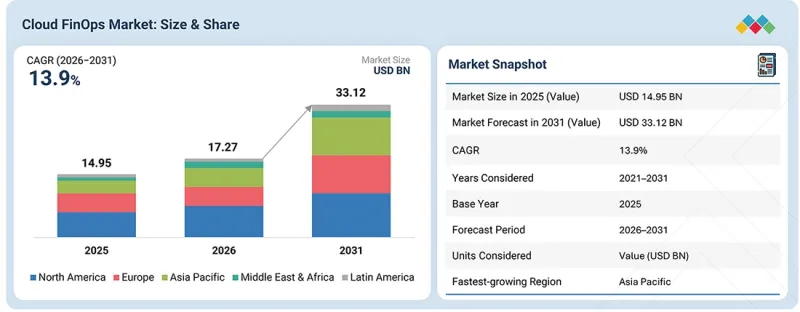
The global cloud FinOps market is projected to grow from USD 17.27 billion in 2026 to USD 33.12 billion by 2031, registering a CAGR of 13.9%. Growth is supported by increasing enterprise cloud expenditure, expanding AI infrastructure investments, and rising demand for financial accountability across complex cloud environments. Organizations are strengthening FinOps capabilities to improve cost allocation, expenditure forecasting, commitment utilization, and resource optimization across IaaS, PaaS, and SaaS environments.
| Scope of the Report | |
|---|---|
| Years Considered for the Study | 2021-2031 |
| Base Year | 2025 |
| Forecast Period | 2026-2031 |
| Units Considered | Value (USD Billion) |
| Segments | Offering, Application, Service Model, Deployment, and Region |
| Regions covered | North America, Europe, Asia Pacific, Middle East & Africa, Latin America |
AI training and inference workloads are creating additional requirements for GPU cost attribution, consumption monitoring, and workload-level financial intelligence. Increasing deployment of Kubernetes, microservices, and multi-cloud architectures further strengthens demand for automated optimization and centralized financial governance. Enterprises are also investing in managed FinOps services to improve operational efficiency and accelerate the realization of cloud cost savings. However, fragmented billing data, inconsistent cost allocation, native cloud management alternatives, and complex commitment structures can constrain adoption. Despite these challenges, increasing emphasis on cloud financial transparency and AI-driven automation is strengthening FinOps as an integral component of enterprise technology financial management.
"By service model, IaaS is expected to hold largest market share over forecast period"
Infrastructure as a Service (IaaS) is expected to account for the largest share of the cloud FinOps market throughout the forecast period. Enterprises increasingly invest in FinOps solutions to optimize spending across compute instances, storage resources, networking infrastructure, and GPU-intensive workloads. The consumption-based pricing structure of IaaS creates significant demand for continuous cost monitoring, resource rightsizing, and commitment optimization. Organizations are adopting advanced FinOps platforms to manage Reserved Instances, Savings Plans, committed-use discounts, and underutilized infrastructure resources. Increasing deployment of Kubernetes clusters, cloud-native applications, and AI infrastructure further strengthens demand for granular resource-level cost allocation and automated optimization. The availability of detailed infrastructure billing and utilization data also enables more sophisticated cost analytics and actionable recommendations. As enterprises expand infrastructure consumption across cloud environments, IaaS is expected to remain the largest contributor to FinOps adoption, supported by substantial optimization opportunities and increasing financial governance requirements.
"By deployment environment, multi-cloud to hold largest market share over forecast period."
Multi-cloud is expected to account for the largest share of the cloud FinOps market throughout the forecast period. Enterprises increasingly operate workloads across multiple cloud providers to improve infrastructure flexibility, access specialized services, and reduce dependence on individual cloud ecosystems. However, differences in billing formats, pricing structures, discount programs, and resource configurations create significant financial management complexity. Organizations are adopting centralized FinOps platforms to consolidate cloud expenditure, standardize cost allocation, and establish consistent financial governance across heterogeneous environments. Growing demand for cross-cloud commitment optimization, unified budgeting, and application-level cost visibility is strengthening investments in independent FinOps solutions. The expansion of AI workloads and distributed applications further increases the need to evaluate infrastructure costs across providers while maintaining performance and operational requirements. As enterprises prioritize financial transparency, automated optimization, and consistent spending accountability, multi-cloud environments are expected to generate sustained demand for advanced cloud FinOps capabilities.
"North America leads cloud FinOps market through mature cloud adoption and advanced financial governance practices."
North America is expected to retain the largest share of the global cloud FinOps market, supported by extensive enterprise cloud adoption, advanced digital infrastructure, and strong demand for cloud financial accountability. Organizations across the United States and Canada manage large cloud estates involving multiple accounts, complex commercial commitments, and diverse application workloads. The region benefits from the presence of major cloud providers, independent FinOps software vendors, managed service specialists, and technology-intensive enterprises investing in advanced cost management capabilities. Increasing adoption of AI inference, GPU infrastructure, Kubernetes environments, and cloud-native applications is strengthening demand for granular cost attribution and automated financial optimization. Enterprises are also prioritizing commitment portfolio management, anomaly detection, forecasting accuracy, and integration between financial and engineering workflows. Growing emphasis on measurable savings realization and enterprise-wide financial governance is encouraging adoption of advanced FinOps platforms. The development of AI-assisted cost investigation and automated remediation capabilities further strengthens the region's technology ecosystem. Continued investment in AI infrastructure, cloud modernization, and financial automation is expected to sustain North America's leading position throughout the forecast period.
Breakdown of Primaries
In-depth interviews with industry participants are used to gather insights from FinOps practice leaders, cloud infrastructure directors, technology finance managers, product leaders, cloud architects, system integrators, managed FinOps service providers, and executives from organizations operating across the cloud FinOps market.
- By Company: Tier I - 35%, Tier II - 45%, and Tier III - 20%
- By Designation: Directors - 35%, Managers - 25%, and Others - 40%
- By Region: North America - 45%, Europe - 20%, Asia Pacific - 25%, Middle East & Africa - 5%, and Latin America - 5%
The report includes a detailed study of leading participants in the cloud FinOps market. It profiles major vendors based on their business overview, FinOps solution portfolios, service capabilities, deployment models, geographic presence, partnerships, and strategic developments. Key market players include Amazon Web Services (US), Microsoft (US), Google Cloud (US), IBM (US), Broadcom - CloudHealth (US), Aquila Clouds (US), Archera (US), CAST AI (US), Certero (UK), CloudBolt Software (US), CloudKeeper (India), CloudZero (US), CoreStack (US), Datadog (US), DoiT (US), Finout (US), Flexera (US), Harness (US), Kion (US), Lucidity (India), nOps (US), OpsNow (South Korea), ScaleOps (US), Sedai (US), ServiceNow (US), Ternary (US), Vantage (US), Vega Cloud (US), Virtana (US), and Zesty (Israel).
Research Coverage
This research report categorizes the cloud FinOps market by offering into solutions and services. Solutions include native and third-party FinOps platforms, while services comprise managed cloud FinOps services and professional services. By application, the market covers cloud cost visibility, allocation & reporting; budgeting, forecasting & planning; cost anomaly management & governance; rate & commitment optimization; workload & resource optimization; chargeback & business value management; and other cloud FinOps applications. The study also segments the market by service model into IaaS, PaaS, and SaaS; by deployment environment into single-cloud and multi-cloud; by deployment mode into on-premises and cloud; by organization size into large enterprises and SMEs; by vertical into BFSI, IT & technology, telecommunications, retail & consumer goods, healthcare & life sciences, manufacturing, media & entertainment, government & public sector, energy & utilities, and other verticals; and by region into North America, Europe, Asia Pacific, Middle East & Africa, and Latin America.
The report provides detailed analysis of market drivers, restraints, opportunities, and challenges influencing industry development. It evaluates cloud financial governance, AI-driven cost intelligence, Kubernetes optimization, commitment purchasing strategies, managed FinOps adoption, and automation capabilities. Competitive analysis covers vendor positioning, product differentiation, commercial models, geographic expansion, partnerships, acquisitions, and recent product developments. The study also examines enterprise purchasing requirements, financial accountability frameworks, emerging cost management applications, and the changing relationship between cloud expenditure and measurable business outcomes.
Reasons to Buy This Report
The report provides market leaders, technology providers, and emerging vendors with detailed estimates of the global cloud FinOps market and its major segments. It enables organizations to assess competitive positioning, identify high-growth applications, evaluate customer spending priorities, and develop strategies for product innovation, market entry, and geographic expansion. The study supports investment prioritization by analyzing opportunities across native and third-party FinOps platforms, managed services, cloud deployment environments, and verticals. It also examines emerging requirements involving AI workload economics, commitment optimization, automated financial governance, and cloud cost allocation. These insights help organizations evaluate differentiated product capabilities, strengthen go-to-market strategies, prioritize technology partnerships, and identify opportunities for expanding their presence across the cloud financial management ecosystem.
The report provides insights on the following points:
- Analysis of key drivers, restraints, opportunities, and challenges: The cloud FinOps market is witnessing significant transformation as enterprises seek greater financial accountability, cost transparency, and operational efficiency across increasingly complex cloud environments. Key drivers include growing AI and workload-level cost accountability, increasing adoption of continuous cloud cost reviews, and implementation of automated optimization policies to improve resource utilization and expenditure control. Restraints include the availability of native cloud cost management tools, fragmented billing data across cloud providers, incomplete resource tagging, and difficulties in allocating shared costs and accurately forecasting expenditure. Opportunities are emerging from the adoption of finance-grade cloud cost reporting enabled by the FinOps Open Cost and Usage Specification (FOCUS), advanced commitment portfolio intelligence, and closed-loop optimization capabilities that support automated remediation and verifiable cost savings. Challenges include demonstrating realized net savings without compromising workload performance, meeting security and approval requirements for automated remediation, maintaining service-level compliance, and ensuring consistent financial reporting across cloud environments.
- Product Development/Innovation: Detailed insights into emerging FinOps technologies, AI-assisted financial operations, automated anomaly investigations, commitment optimization, Kubernetes cost management, workload-level cost attribution, and policy-based resource optimization. Recent developments, including the introduction of AWS FinOps Agent and the release of FOCUS 1.4, illustrate increasing emphasis on automation, invoice reconciliation, and standardized financial intelligence. These innovations are expanding the role of FinOps platforms from cost reporting toward continuous financial control and engineering execution.
- Market Development: Comprehensive information on attractive regional and industry opportunities, including enterprise cloud modernization, AI infrastructure expansion, adoption of financial governance frameworks, and growing demand for managed FinOps expertise. The report examines market development across major regions, organization sizes, service models, and application capabilities to identify differences in adoption maturity, spending requirements, and commercial opportunities.
- Market Diversification: Detailed information regarding emerging FinOps solutions and services, expansion into AI and SaaS financial management, automated commitment optimization, strategic partnerships, acquisitions, and geographic expansion. The study examines diversification opportunities involving advanced financial analytics, specialized workload optimization, business-value measurement, and managed FinOps delivery models. These capabilities enable vendors to address evolving enterprise requirements beyond conventional cloud cost visibility and reporting.
- Competitive Assessment: In-depth evaluation of market shares, FinOps product portfolios, service capabilities, competitive strategies, geographic presence, partnerships, and positioning of major players. The assessment covers Amazon Web Services (US), Microsoft (US), Google Cloud (US), IBM (US), Broadcom - CloudHealth (US), CoreStack (US), Datadog (US), Flexera (US), CloudZero (US), CAST AI (US), Finout (US), Harness (US), and other companies covered in the report. Particular attention is given to differentiation between native cloud financial management tools, independent FinOps platforms, autonomous optimization specialists, and managed service providers.
TABLE OF CONTENTS
1 INTRODUCTION
- 1.1 STUDY OBJECTIVES
- 1.2 MARKET DEFINITION
- 1.3 MARKET SCOPE
- 1.3.1 MARKET SEGMENTATION AND REGIONAL SCOPE
- 1.3.2 INCLUSIONS AND EXCLUSIONS
- 1.3.3 YEARS CONSIDERED
- 1.4 CURRENCY CONSIDERED
- 1.5 LIMITATIONS
- 1.6 STAKEHOLDERS
2 EXECUTIVE SUMMARY
- 2.1 MARKET HIGHLIGHTS AND KEY INSIGHTS
- 2.2 KEY MARKET PARTICIPANTS: MAPPING OF STRATEGIC DEVELOPMENTS
- 2.3 DISRUPTIVE TRENDS IN CLOUD FINOPS MARKET
- 2.4 HIGH-GROWTH SEGMENTS
- 2.5 REGIONAL SNAPSHOT: MARKET SIZE, GROWTH RATE, AND FORECAST
3 PREMIUM INSIGHTS
- 3.1 ATTRACTIVE OPPORTUNITIES FOR PLAYERS IN CLOUD FINOPS MARKET
- 3.2 CLOUD FINOPS MARKET, BY OFFERING
- 3.3 CLOUD FINOPS MARKET, BY SERVICE MODEL
- 3.4 CLOUD FINOPS MARKET, BY CLOUD ENVIRONMENT
- 3.5 CLOUD FINOPS MARKET, BY REGION
4 MARKET OVERVIEW
- 4.1 INTRODUCTION
- 4.2 MARKET DYNAMICS
- 4.2.1 DRIVERS
- 4.2.1.1 Rising cloud expenditure and persistent infrastructure waste accelerate demand for continuous FinOps optimization
- 4.2.1.2 Expanding hybrid and multicloud infrastructure increases demand for unified financial visibility and allocation
- 4.2.1.3 Rapid AI infrastructure consumption increases demand for specialized expenditure monitoring and FinOps controls
- 4.2.2 RESTRAINTS
- 4.2.2.1 Availability of bundled hyperscaler cost management tools limits standalone FinOps platform monetization
- 4.2.2.2 Limited cloud expenditure and implementation budgets restrict paid FinOps adoption among smaller enterprises
- 4.2.3 OPPORTUNITIES
- 4.2.3.1 Growing demand for AI unit economics creates opportunities for advanced financial intelligence platforms
- 4.2.3.2 Expanding FinOps coverage into SaaS and consumption-based platforms opens additional revenue opportunities
- 4.2.3.3 Advancements in policy-driven automation create opportunities for autonomous cloud FinOps optimization platforms
- 4.2.4 CHALLENGES
- 4.2.4.1 Inconsistent cloud billing structures complicate expenditure normalization and financial reconciliation across providers
- 4.2.4.2 Fragmented financial ownership across engineering and finance teams weakens FinOps accountability and execution
- 4.2.1 DRIVERS
- 4.3 UNMET NEEDS AND WHITE SPACES
- 4.3.1 UNMET NEEDS IN CLOUD FINOPS MARKET
- 4.3.2 WHITE SPACE OPPORTUNITIES
- 4.4 INTERCONNECTED MARKETS AND CROSS-SECTOR OPPORTUNITIES
- 4.4.1 CROSS-SECTOR OPPORTUNITIES
- 4.5 EMERGING BUSINESS MODELS AND ECOSYSTEM SHIFTS
- 4.5.1 EMERGING BUSINESS MODELS
- 4.5.1.1 Cloud FinOps Business Models
- 4.5.2 ECOSYSTEM SHIFTS
- 4.5.1 EMERGING BUSINESS MODELS
- 4.6 STRATEGIC MOVES BY TIER-1/2/3 PLAYERS
5 INDUSTRY TRENDS
- 5.1 PORTER'S FIVE FORCES ANALYSIS
- 5.1.1 THREAT OF NEW ENTRANTS
- 5.1.2 THREAT OF SUBSTITUTES
- 5.1.3 BARGAINING POWER OF SUPPLIERS
- 5.1.4 BARGAINING POWER OF BUYERS
- 5.1.5 INTENSITY OF COMPETITIVE RIVALRY
- 5.2 MACROECONOMIC INDICATORS
- 5.2.1 INTRODUCTION
- 5.2.2 GDP TRENDS AND FORECASTS
- 5.2.3 TRENDS IN CLOUD COMPUTING INDUSTRY
- 5.2.4 TRENDS IN OBSERVABILITY TOOLS AND PLATFORMS INDUSTRY
- 5.3 VALUE CHAIN ANALYSIS
- 5.4 ECOSYSTEM ANALYSIS
- 5.5 KEY CONFERENCES AND EVENTS, 2026-2027
- 5.6 TRENDS/DISRUPTIONS IMPACTING CUSTOMER BUSINESS
- 5.7 CASE STUDY ANALYSIS
- 5.7.1 CORESTACK ENABLED IT1 TO REDUCE CLOUD EXPENDITURE BY OVER 35% THROUGH UNIFIED FINOPS AND CLOUD GOVERNANCE
- 5.7.2 CORESTACK ENABLED CONRES TO STREAMLINE MULTICLOUD FINOPS AND FINANCIAL GOVERNANCE ACROSS APPROXIMATELY 20 CUSTOMER ENVIRONMENTS
- 5.7.3 IBM ENABLED PHILIPS TO ACHIEVE 10% CLOUD COST SAVINGS AND COMPLETE COST ALLOCATION
- 5.7.4 CLOUDZERO ENABLED PICPAY TO REDUCE ANNUAL CLOUD EXPENDITURE BY USD 18.6 MILLION
- 5.7.5 CAST AI ENABLED AKAMAI TO ACHIEVE 40-70% CLOUD COST SAVINGS THROUGH KUBERNETES OPTIMIZATION
- 5.8 IMPACT OF 2025 US TARIFFS ON CLOUD FINOPS MARKET
- 5.8.1 INTRODUCTION
- 5.8.2 KEY TARIFF RATES
- 5.8.3 PRICE IMPACT ANALYSIS
- 5.8.4 IMPACT ON COUNTRY/REGION
- 5.8.4.1 US
- 5.8.4.2 Europe
- 5.8.4.3 Asia Pacific
- 5.8.5 IMPACT ON END-USE INDUSTRIES
- 5.8.5.1 BFSI
- 5.8.5.2 IT & TECHNOLOGY
- 5.8.5.3 TELECOMMUNICATIONS
- 5.8.5.4 RETAIL & CONSUMER GOODS
- 5.8.5.5 HEALTHCARE & LIFE SCIENCES
- 5.8.5.6 MANUFACTURING
- 5.8.5.7 MEDIA & ENTERTAINMENT
- 5.8.5.8 GOVERNMENT & PUBLIC SECTOR
- 5.8.5.9 ENERGY & UTILITIES
- 5.8.5.10 OTHER VERTICALS
6 STRATEGIC DISRUPTION THROUGH TECHNOLOGY, PATENTS, DIGITAL, AND AI ADOPTION
- 6.1 TECHNOLOGY ANALYSIS
- 6.1.1 KEY EMERGING TECHNOLOGIES
- 6.1.1.1 AI-powered cloud cost intelligence and predictive analytics
- 6.1.1.2 Autonomous FinOps and agentic optimization
- 6.1.1.3 Standardized multicloud cost data and FOCUS interoperability
- 6.1.1.4 AI infrastructure and GPU cost optimization
- 6.1.2 COMPLEMENTARY TECHNOLOGIES
- 6.1.2.1 Kubernetes cost intelligence and automated resource optimization
- 6.1.2.2 Automated commitment and cloud rate optimization
- 6.1.2.3 Cloud-native observability and cost-performance locality
- 6.1.3 ADJACENT TECHNOLOGIES
- 6.1.3.1 IT financial management and technology business management
- 6.1.3.2 SaaS management and software asset optimization
- 6.1.3.3 Infrastructure as code and cloud governance automation
- 6.1.1 KEY EMERGING TECHNOLOGIES
- 6.2 TECHNOLOGY ROADMAP
- 6.2.1 SHORT-TERM (2026-2028) | AI-ASSISTED COST INTELLIGENCE, AUTOMATED OPTIMIZATION, AND BILLING INTEROPERABILITY
- 6.2.2 MID-TERM (2028-2031) | AUTONOMOUS OPTIMIZATION, AI WORKLOAD ECONOMICS, AND INTEGRATED MULTICLOUD GOVERNANCE
- 6.2.3 LONG-TERM (2031-2035) | AUTONOMOUS, POLICY-DRIVEN, AND BUSINESS-VALUE-ORIENTED CLOUD FINOPS
- 6.3 PATENT ANALYSIS
- 6.4 FUTURE APPLICATIONS
- 6.4.1 AI TRAINING, INFERENCE, AND GPU COST ECONOMICS
- 6.4.2 AUTONOMOUS CLOUD OPTIMIZATION AND POLICY ORCHESTRATION
- 6.4.3 PREDICTIVE CLOUD FINANCIAL PLANNING AND COMMITMENT INTELLIGENCE
- 6.4.4 UNIFIED MULTICLOUD COST ALLOCATION AND FINANCIAL GOVERNANCE
- 6.4.5 BUSINESS-VALUE MEASUREMENT AND CLOUD UNIT ECONOMICS
- 6.5 IMPACT OF AI/GENERATIVE AI ON CLOUD FINOPS MARKET
- 6.5.1 TOP USE CASES AND MARKET POTENTIAL
- 6.5.2 BEST PRACTICES IN CLOUD FINOPS
- 6.5.3 CASE STUDY OF AI IMPLEMENTATION IN CLOUD FINOPS MARKET
- 6.5.3.1 CloudZero enables Progress Software to strengthen AI cost control and product-level financial accountability
- 6.5.4 INTERCONNECTED ADJACENT ECOSYSTEMS AND IMPACT ON MARKET PLAYERS
- 6.5.5 CLIENT READINESS TO ADOPT AI/GENERATIVE AI IN CLOUD FINOPS MARKET
- 6.5.6 IBM CLOUDABILITY ENABLES NEXI TO STRENGTHEN MULTICLOUD FINANCIAL VISIBILITY AND EXPENDITURE CONTROL
- 6.5.7 CLOUDZERO ENABLES NINJACAT TO IMPROVE CLOUD EXPENDITURE EFFICIENCY AND CUSTOMER-LEVEL UNIT ECONOMICS
7 REGULATORY LANDSCAPE
- 7.1 REGULATORY LANDSCAPE
- 7.1.1 REGULATORY BODIES, GOVERNMENT AGENCIES, AND OTHER ORGANIZATIONS
- 7.1.2 INDUSTRY STANDARDS, BY REGION
- 7.1.2.1 North America
- 7.1.2.2 Europe
- 7.1.2.3 Asia Pacific
- 7.1.2.4 Middle East & Africa
- 7.1.2.5 Latin America
8 CUSTOMER LANDSCAPE AND BUYER BEHAVIOR
- 8.1 DECISION-MAKING PROCESS
- 8.2 BUYER STAKEHOLDERS AND BUYING EVALUATION CRITERIA
- 8.2.1 KEY STAKEHOLDERS IN BUYING PROCESS
- 8.2.2 BUYING CRITERIA
- 8.3 ADOPTION BARRIERS AND INTERNAL CHALLENGES
- 8.4 UNMET NEEDS ACROSS END-USE INDUSTRIES
- 8.5 MARKET PROFITABILITY
- 8.5.1 REVENUE POTENTIAL
- 8.5.2 COST DYNAMICS
- 8.5.3 MARGIN OPPORTUNITIES IN END-USE INDUSTRIES
9 CLOUD FINOPS MARKET, BY OFFERING
- 9.1 INTRODUCTION
- 9.1.1 OFFERING: CLOUD FINOPS MARKET DRIVERS
- 9.2 OFFERING
- 9.2.1 SOLUTIONS
- 9.2.1.1 Rising demand for automated financial intelligence accelerates FinOps software adoption
- 9.2.1.2 Native Solutions
- 9.2.1.2.1 Integrated provider tools strengthen cost visibility and accelerate optimization decisions
- 9.2.1.3 Third-Party Solutions
- 9.2.1.3.1 Increasing multicloud complexity accelerates adoption of unified financial intelligence platforms
- 9.2.1 SOLUTIONS
- 9.3 SERVICES
- 9.3.1 PROFESSIONAL SERVICES
- 9.3.1.1 Specialized consulting and implementation expertise accelerates FinOps capability development
- 9.3.2 MANAGED SERVICES
- 9.3.2.1 Continuous financial operations outsourcing enables cloud expenditure control and optimization
- 9.3.1 PROFESSIONAL SERVICES
10 CLOUD FINOPS MARKET, BY APPLICATION / CAPABILITY
- 10.1 INTRODUCTION
- 10.1.1 APPLICATION/CAPABILITY: CLOUD FINOPS MARKET DRIVERS
- 10.2 CLOUD COST VISIBILITY, ALLOCATION & REPORTING
- 10.2.1 GROWING DEMAND FOR EXPENDITURE TRANSPARENCY STRENGTHENS ADOPTION OF UNIFIED CLOUD FINANCIAL REPORTING
- 10.2.2 COST & USAGE VISIBILITY
- 10.2.3 COST ALLOCATION & TAGGING
- 10.2.4 SHOWBACK & COST REPORTING
- 10.2.5 REPORTING & ANALYTICS
- 10.3 BUDGETING, FORECASTING & PLANNING
- 10.3.1 INCREASING CLOUD EXPENDITURE VOLATILITY DRIVES ADOPTION OF INTEGRATED FINANCIAL PLANNING
- 10.3.2 CLOUD BUDGET MANAGEMENT
- 10.3.3 SPEND FORECASTING
- 10.3.4 PLANNING & ESTIMATION
- 10.3.5 BUDGET VARIANCE ANALYSIS
- 10.4 COST ANOMALY MANAGEMENT & GOVERNANCE
- 10.4.1 INCREASING EXPOSURE FROM UNEXPECTED CLOUD CONSUMPTION STRENGTHENS DEMAND FOR AUTOMATED EXPENDITURE GOVERNANCE
- 10.4.2 COST ANOMALY DETECTION
- 10.4.3 SPEND ALERTS & THRESHOLD MANAGEMENT
- 10.4.4 POLICY & BUDGET GUARDRAILS
- 10.4.5 COST GOVERNANCE & COMPLIANCE
- 10.5 RATE & COMMITMENT OPTIMIZATION
- 10.5.1 INCREASING CLOUD PURCHASING COMMITMENTS ACCELERATE ADOPTION OF PRICING AND DISCOUNT OPTIMIZATION
- 10.5.2 RESERVED INSTANCE & SAVINGS PLAN OPTIMIZATION
- 10.5.3 COMMITTED-USE DISCOUNT OPTIMIZATION
- 10.5.4 COMMITMENT PORTFOLIO MANAGEMENT
- 10.5.5 RATE & DISCOUNT OPTIMIZATION
- 10.6 WORKLOAD & RESOURCE OPTIMIZATION
- 10.6.1 INCREASING INFRASTRUCTURE INEFFICIENCIES ACCELERATE ADOPTION OF WORKLOAD AND RESOURCE OPTIMIZATION
- 10.6.2 RESOURCE RIGHTSIZING
- 10.6.3 IDLE & UNDERUTILIZED RESOURCE MANAGEMENT
- 10.6.4 KUBERNETES & CONTAINER COST OPTIMIZATION
- 10.6.5 AUTOMATED RESOURCE OPTIMIZATION
- 10.7 CHARGEBACK & BUSINESS VALUE MANAGEMENT
- 10.7.1 GROWING DEMAND FOR FINANCIAL ACCOUNTABILITY STRENGTHENS BUSINESS-ALIGNED CLOUD EXPENDITURE MANAGEMENT
- 10.7.2 CHARGEBACK & INTERNAL BILLING
- 10.7.3 COST-TO-PRODUCT/SERVICE MAPPING
- 10.7.4 BUSINESS VALUE & KPI MEASUREMENT
- 10.8 OTHER CLOUD FINOPS APPLICATIONS
11 CLOUD FINOPS MARKET, BY SERVICE MODEL
- 11.1 INTRODUCTION
- 11.1.1 SERVICE MODEL: CLOUD FINOPS MARKET DRIVERS
- 11.2 INFRASTRUCTURE AS A SERVICE (IAAS)
- 11.2.1 EXPANDING INFRASTRUCTURE CONSUMPTION ACCELERATES GRANULAR CLOUD RESOURCE FINANCIAL OPTIMIZATION
- 11.3 PLATFORM AS A SERVICE (PAAS)
- 11.3.1 GROWING MANAGED CLOUD PLATFORM ADOPTION INCREASES DEMAND FOR CONSUMPTION-BASED FINANCIAL OPTIMIZATION
- 11.4 SOFTWARE AS A SERVICE (SAAS)
- 11.4.1 EXPANDING SOFTWARE SUBSCRIPTIONS INCREASE DEMAND FOR LICENSE UTILIZATION AND EXPENDITURE OPTIMIZATION
12 CLOUD FINOPS MARKET, BY DEPLOYMENT
- 12.1 INTRODUCTION
- 12.1.1 DEPLOYMENT: CLOUD FINOPS MARKET DRIVERS
- 12.2 DEPLOYMENT ENVIRONMENT
- 12.2.1 SINGLE-CLOUD
- 12.2.1.1 Native provider integration supports streamlined financial management across single-cloud environments
- 12.2.2 MULTI-CLOUD
- 12.2.2.1 Increasing cross-provider complexity accelerates demand for unified multi-cloud financial intelligence
- 12.2.1 SINGLE-CLOUD
- 12.3 DEPLOYMENT ENVIRONMENT
- 12.3.1 ON-PREMISES
- 12.3.1.1 Stringent data control requirements sustain demand for internally hosted FinOps deployments
- 12.3.2 CLOUD
- 12.3.2.1 Growing preference for scalable hosted platforms accelerates cloud-deployed FinOps adoption
- 12.3.1 ON-PREMISES
13 CLOUD FINOPS MARKET, BY ORGANIZATION SIZE
- 13.1 INTRODUCTION
- 13.1.1 ORGANIZATION SIZE: CLOUD FINOPS MARKET DRIVERS
- 13.2 LARGE ENTERPRISES
- 13.2.1 COMPLEX TECHNOLOGY PORTFOLIOS ACCELERATE INVESTMENT IN CENTRALIZED FINOPS GOVERNANCE AND AUTOMATION
- 13.2.2 SMES
- 13.2.2.1 Increasing cloud adoption encourages SMEs to prioritize affordable, accessible FinOps solutions
14 CLOUD FINOPS MARKET, BY VERTICAL
- 14.1 INTRODUCTION
- 14.1.1 VERTICAL: CLOUD FINOPS MARKET DRIVERS
- 14.2 BFSI
- 14.2.1 INCREASING FINANCIAL WORKLOAD COMPLEXITY STRENGTHENS DEMAND FOR ACCOUNTABLE, RESILIENT CLOUD EXPENDITURE MANAGEMENT
- 14.3 IT & TECHNOLOGY
- 14.3.1 EXPANDING SAAS DELIVERY AND AI WORKLOADS ACCELERATE PRODUCT-CENTRIC FINOPS ADOPTION
- 14.4 TELECOMMUNICATIONS
- 14.4.1 EXPANDING CLOUD-NATIVE NETWORK OPERATIONS INCREASE DEMAND FOR SERVICE-LEVEL COST OPTIMIZATION
- 14.5 RETAIL & CONSUMER GOODS
- 14.5.1 GROWING OMNICHANNEL COMMERCE AND SEASONAL DEMAND FLUCTUATIONS ACCELERATE CLOUD EXPENDITURE OPTIMIZATION
- 14.6 HEALTHCARE & LIFE SCIENCES
- 14.6.1 EXPANDING CLINICAL DATA AND RESEARCH WORKLOADS INCREASE DEMAND FOR CONTROLLED CLOUD SPENDING
- 14.7 MANUFACTURING
- 14.7.1 INCREASING INDUSTRIAL DIGITIZATION DRIVES FINANCIAL OPTIMIZATION ACROSS MANUFACTURING AND ANALYTICS WORKLOADS
- 14.8 MEDIA & ENTERTAINMENT
- 14.8.1 INCREASING STREAMING CONSUMPTION DRIVES DEMAND FOR DYNAMIC MEDIA EXPENDITURE OPTIMIZATION
- 14.9 GOVERNMENT & PUBLIC SECTOR
- 14.9.1 GROWING DIGITAL PUBLIC SERVICES STRENGTHEN DEMAND FOR TRANSPARENT, ACCOUNTABLE CLOUD EXPENDITURE GOVERNANCE
- 14.10 ENERGY & UTILITIES
- 14.10.1 EXPANDING SMART GRID ANALYTICS INCREASES DEMAND FOR COST-EFFICIENT CLOUD DATA PROCESSING
- 14.11 OTHER VERTICALS
15 CLOUD FINOPS MARKET, BY REGION
- 15.1 INTRODUCTION
- 15.2 NORTH AMERICA
- 15.2.1 US
- 15.2.1.1 Expanding enterprise cloud investment and federal cost optimization strengthen US FinOps adoption
- 15.2.2 CANADA
- 15.2.2.1 Enterprise cloud consolidation and government financial governance drive FinOps adoption in Canada
- 15.2.1 US
- 15.3 EUROPE
- 15.3.1 UK
- 15.3.1.1 Increasing cloud adoption and public sector procurement reforms strengthen UK FinOps demand
- 15.3.2 GERMANY
- 15.3.2.1 Growing industrial cloud adoption and workload optimization strengthen Germany's FinOps market
- 15.3.3 FRANCE
- 15.3.3.1 Expanding enterprise cloud adoption and data sovereignty strengthen France's FinOps market
- 15.3.4 ITALY
- 15.3.4.1 Expanding enterprise cloud adoption and public sector modernization strengthen Italy's FinOps market
- 15.3.5 REST OF EUROPE
- 15.3.1 UK
- 15.4 ASIA PACIFIC
- 15.4.1 CHINA
- 15.4.1.1 Expanding AI computing infrastructure and resource utilization drive cloud cost optimization
- 15.4.2 JAPAN
- 15.4.2.1 Accelerating legacy system modernization and complex cloud operations drive financial accountability
- 15.4.3 INDIA
- 15.4.3.1 Expanding AI infrastructure and consumption-based cloud adoption drive cost optimization
- 15.4.4 AUSTRALIA AND NEW ZEALAND (ANZ)
- 15.4.4.1 Government cloud policies and mandatory cost optimization strengthen financial accountability across ANZ
- 15.4.5 REST OF ASIA PACIFIC
- 15.4.1 CHINA
- 15.5 MIDDLE EAST & AFRICA
- 15.5.1 GCC COUNTRIES
- 15.5.1.1 Saudi Arabia
- 15.5.1.1.1 Rising government cloud expenditure and digital transformation drive financial optimization
- 15.5.1.2 United Arab Emirates (UAE)
- 15.5.1.2.1 Sovereign cloud expansion and AI-driven government transformation accelerate financial optimization
- 15.5.1.3 Other GCC countries
- 15.5.1.1 Saudi Arabia
- 15.5.2 SOUTH AFRICA
- 15.5.2.1 Growing cloud investment across banking and telecommunications accelerates demand for cost optimization
- 15.5.3 REST OF MIDDLE EAST & AFRICA
- 15.5.1 GCC COUNTRIES
- 15.6 LATIN AMERICA
- 15.6.1 BRAZIL
- 15.6.1.1 Rising cloud processing consumption and federal procurement reforms reshape spending oversight
- 15.6.2 MEXICO
- 15.6.2.1 New cloud regions turn Mexico into strategic storage hub for regional workloads
- 15.6.3 REST OF LATIN AMERICA
- 15.6.1 BRAZIL
16 COMPETITIVE LANDSCAPE
- 16.1 INTRODUCTION
- 16.2 KEY PLAYER STRATEGIES/RIGHT TO WIN, 2023-2026
- 16.3 REVENUE ANALYSIS, 2021-2025
- 16.4 MARKET SHARE ANALYSIS, 2026
- 16.5 PRODUCT COMPARISON, 2026
- 16.6 COMPANY EVALUATION MATRIX: KEY PLAYERS, 2026 (CLOUD FINOPS MARKET)
- 16.6.1 STARS
- 16.6.2 EMERGING LEADERS
- 16.6.3 PERVASIVE PLAYERS
- 16.6.4 PARTICIPANTS
- 16.6.5 COMPANY FOOTPRINT: KEY PLAYERS, 2025
- 16.6.5.1 Company footprint
- 16.6.5.2 Region footprint
- 16.6.5.3 Services footprint
- 16.6.5.4 Application/Capability footprint
- 16.6.5.5 Vertical footprint
- 16.7 COMPANY EVALUATION MATRIX: STARTUPS/SMES, 2026
- 16.7.1 EVALUATION MATRIX FOR STARTUPS/SMES: CRITERIA WEIGHTAGE
- 16.7.2 PROGRESSIVE COMPANIES
- 16.7.3 RESPONSIVE COMPANIES
- 16.7.4 DYNAMIC COMPANIES
- 16.7.5 STARTING BLOCKS
- 16.7.6 COMPETITIVE BENCHMARKING: STARTUPS/SMES, 2025
- 16.7.6.1 Detailed list of key startups/SMEs
- 16.7.6.2 Competitive benchmarking of key startups/SMEs
- 16.8 COMPANY VALUATION AND FINANCIAL METRICS, 2026
- 16.8.1 COMPANY VALUATION OF KEY VENDORS
- 16.8.2 FINANCIAL METRICS OF KEY VENDORS
- 16.9 COMPETITIVE SCENARIO
- 16.9.1 PRODUCT LAUNCHES
- 16.9.2 DEALS
17 COMPANY PROFILES
- 17.1 INTRODUCTION
- 17.2 KEY PLAYERS
- 17.2.1 AMAZON WEB SERVICES (AWS)
- 17.2.1.1 Business overview
- 17.2.1.2 Products/Solutions/Services offered
- 17.2.1.3 Recent developments
- 17.2.1.3.1 Product launches and enhancements
- 17.2.1.3.2 Deals
- 17.2.1.4 MnM view
- 17.2.1.4.1 Right to win
- 17.2.1.4.2 Strategic choices
- 17.2.1.4.3 Weaknesses and competitive threats
- 17.2.2 MICROSOFT
- 17.2.2.1 Business overview
- 17.2.2.2 Products/Solutions/Services offered
- 17.2.2.3 Recent developments
- 17.2.2.3.1 Product launches and enhancements
- 17.2.2.3.2 Deals
- 17.2.2.4 MnM view
- 17.2.2.4.1 Right to win
- 17.2.2.4.2 Strategic choices
- 17.2.2.4.3 Weaknesses and competitive threats
- 17.2.3 GOOGLE
- 17.2.3.1 Business overview
- 17.2.3.2 Products/Solutions/Services offered
- 17.2.3.3 Recent developments
- 17.2.3.3.1 Product launches and enhancements
- 17.2.3.3.2 Deals
- 17.2.3.4 MnM view
- 17.2.3.4.1 Right to win
- 17.2.3.4.2 Strategic choices
- 17.2.3.4.3 Weaknesses and competitive threats
- 17.2.4 ORACLE
- 17.2.4.1 Business overview
- 17.2.4.2 Products/Solutions/Services offered
- 17.2.4.3 Recent developments
- 17.2.4.3.1 Product launches and enhancements
- 17.2.4.3.2 Deals
- 17.2.4.4 MnM view
- 17.2.4.4.1 Right to win
- 17.2.4.4.2 Strategic choices
- 17.2.4.4.3 Weaknesses and competitive threats
- 17.2.5 IBM
- 17.2.5.1 Business overview
- 17.2.5.2 Products/Solutions/Services offered
- 17.2.5.3 Recent developments
- 17.2.5.3.1 Product launches and enhancements
- 17.2.5.3.2 Deals
- 17.2.5.4 MnM view
- 17.2.5.4.1 Right to win
- 17.2.5.4.2 Strategic choices
- 17.2.5.4.3 Weaknesses and competitive threats
- 17.2.6 FLEXERA
- 17.2.6.1 Business overview
- 17.2.6.2 Products/Solutions/Services offered
- 17.2.6.3 Recent developments
- 17.2.6.3.1 Product launches and enhancements
- 17.2.6.3.2 Deals
- 17.2.7 CORESTACK
- 17.2.7.1 Business overview
- 17.2.7.2 Products/Solutions/Services offered
- 17.2.7.3 Recent developments
- 17.2.7.3.1 Product launches and enhancements
- 17.2.7.3.2 Deals
- 17.2.8 BROADCOM
- 17.2.8.1 Business overview
- 17.2.8.2 Products/Solutions/Services offered
- 17.2.8.3 Recent developments
- 17.2.8.3.1 Product launches and enhancements
- 17.2.8.3.2 Deals
- 17.2.9 CLOUDZERO
- 17.2.9.1 Business overview
- 17.2.9.2 Products/Solutions/Services offered
- 17.2.9.3 Recent developments
- 17.2.9.3.1 Product launches and enhancements
- 17.2.9.3.2 Deals
- 17.2.10 CAST AI
- 17.2.10.1 Business overview
- 17.2.10.2 Products/Solutions/Services offered
- 17.2.10.3 Recent developments
- 17.2.10.3.1 Product launches and enhancements
- 17.2.10.3.2 Deals
- 17.2.11 DOIT
- 17.2.11.1 Business overview
- 17.2.11.2 Products/Solutions/Services offered
- 17.2.11.3 Recent developments
- 17.2.11.3.1 Product launches and enhancements
- 17.2.11.3.2 Deals
- 17.2.1 AMAZON WEB SERVICES (AWS)
- 17.3 OTHER PLAYERS
- 17.3.1 HARNESS
- 17.3.2 SERVICENOW
- 17.3.3 DATADOG
- 17.3.4 FINOUT
- 17.3.5 CLOUDBOLT SOFTWARE
- 17.3.6 ZESTY
- 17.3.7 CLOUDKEEPER
- 17.3.8 NOPS
- 17.3.9 VANTAGE
- 17.3.10 ANODOT (UMBRELLA)
- 17.3.11 VIRTANA
- 17.3.12 ACCENTURE
- 17.3.13 KION
- 17.3.14 DELOITTE
- 17.3.15 SOFTWAREONE
- 17.3.16 CENTILYTICS
- 17.3.17 DENSIFY
- 17.3.18 OPENTEXT
- 17.3.19 STACKLET
- 17.3.20 TERNARY
- 17.3.21 HCLTECH
- 17.3.22 NORTH.CLOUD
- 17.3.23 RACKSPACE TECHNOLOGY
- 17.3.24 PEPPERDATA
- 17.3.25 HYPERGLANCE
18 RESEARCH METHODOLOGY
- 18.1 RESEARCH DATA
- 18.1.1 SECONDARY DATA
- 18.1.1.1 Data & list of key secondary sources
- 18.1.2 PRIMARY DATA
- 18.1.2.1 Breakdown of primary interviews
- 18.1.2.2 Key industry insights
- 18.1.3 MARKET SIZE ESTIMATION
- 18.1.4 DATA TRIANGULATION
- 18.1.5 FACTOR ANALYSIS
- 18.1.6 RESEARCH ASSUMPTIONS
- 18.1.1 SECONDARY DATA
19 APPENDIX
- 19.1 DISCUSSION GUIDE
- 19.2 KNOWLEDGESTORE: MARKETSANDMARKETS' SUBSCRIPTION PORTAL
- 19.3 CUSTOMIZATION OPTIONS
- 19.4 RELATED REPORTS
- 19.5 AUTHOR DETAILS
List of Tables
- TABLE 1 INCLUSIONS AND EXCLUSIONS
- TABLE 2 USD EXCHANGE RATES, 2020-2025
- TABLE 3 INTERCONNECTED MARKETS
- TABLE 4 KEY MOVES AND STRATEGIC FOCUS
- TABLE 5 IMPACT OF PORTER'S FIVE FORCES ON CLOUD FINOPS MARKET
- TABLE 6 GDP PERCENTAGE CHANGE, BY KEY COUNTRY, 2021-2029
- TABLE 7 CLOUD FINOPS MARKET: ROLE OF COMPANIES IN ECOSYSTEM
- TABLE 8 CLOUD FINOPS MARKET: LIST OF KEY CONFERENCES AND EVENTS, 2026-2027
- TABLE 9 US ADJUSTED RECIPROCAL TARIFF RATES
- TABLE 10 LIST OF GRANTED PATENTS IN CLOUD FINOPS MARKET
- TABLE 11 TOP USE CASES AND MARKET POTENTIAL
- TABLE 12 BEST PRACTICES: COMPANIES IMPLEMENTING USE CASES
- TABLE 13 INTERCONNECTED ADJACENT ECOSYSTEMS AND IMPLICATIONS FOR MARKET PLAYERS
- TABLE 14 NORTH AMERICA: REGULATORY BODIES, GOVERNMENT AGENCIES, AND OTHER ORGANIZATIONS
- TABLE 15 EUROPE: REGULATORY BODIES, GOVERNMENT AGENCIES, AND OTHER ORGANIZATIONS
- TABLE 16 ASIA PACIFIC: REGULATORY BODIES, GOVERNMENT AGENCIES, AND OTHER ORGANIZATIONS
- TABLE 17 OTHERS: REGULATORY BODIES, GOVERNMENT AGENCIES, AND OTHER ORGANIZATIONS
- TABLE 18 INFLUENCE OF STAKEHOLDERS ON BUYING PROCESS FOR TOP THREE VERTICALS (%)
- TABLE 19 KEY BUYING CRITERIA FOR TOP THREE VERTICALS
- TABLE 20 CLOUD FINOPS MARKET: UNMET NEEDS ACROSS END-USE INDUSTRIES
- TABLE 21 CLOUD FINOPS MARKET, BY OFFERING, 2021-2025 (USD MILLION)
- TABLE 22 CLOUD FINOPS MARKET, BY OFFERING, 2026-2031 (USD MILLION)
- TABLE 23 CLOUD FINOPS MARKET, BY SOLUTION, 2021-2025 (USD MILLION)
- TABLE 24 CLOUD FINOPS MARKET, BY SOLUTION, 2026-2031 (USD MILLION)
- TABLE 25 SOLUTIONS: CLOUD FINOPS MARKET, BY REGION, 2021-2025 (USD MILLION)
- TABLE 26 SOLUTIONS: CLOUD FINOPS MARKET, BY REGION, 2026-2031 (USD MILLION)
- TABLE 27 NATIVE SOLUTIONS: CLOUD FINOPS MARKET, BY REGION, 2021-2025 (USD MILLION)
- TABLE 28 NATIVE SOLUTIONS: CLOUD FINOPS MARKET, BY REGION, 2026-2031 (USD MILLION)
- TABLE 29 THIRD-PARTY SOLUTIONS: CLOUD FINOPS MARKET, BY REGION, 2021-2025 (USD MILLION)
- TABLE 30 THIRD-PARTY SOLUTIONS: CLOUD FINOPS MARKET, BY REGION, 2026-2031 (USD MILLION)
- TABLE 31 CLOUD FINOPS MARKET, BY SERVICE, 2021-2025 (USD MILLION)
- TABLE 32 CLOUD FINOPS MARKET, BY SERVICE, 2026-2031 (USD MILLION)
- TABLE 33 SERVICES: CLOUD FINOPS MARKET, BY REGION, 2021-2025 (USD MILLION)
- TABLE 34 SERVICES: CLOUD FINOPS MARKET, BY REGION, 2026-2031 (USD MILLION)
- TABLE 35 PROFESSIONAL SERVICES: CLOUD FINOPS MARKET, BY REGION, 2021-2025 (USD MILLION)
- TABLE 36 PROFESSIONAL SERVICES: CLOUD FINOPS MARKET, BY REGION, 2026-2031 (USD MILLION)
- TABLE 37 MANAGED SERVICES: CLOUD FINOPS MARKET, BY REGION, 2021-2025 (USD MILLION)
- TABLE 38 MANAGED SERVICES: CLOUD FINOPS MARKET, BY REGION, 2026-2031 (USD MILLION)
- TABLE 39 CLOUD FINOPS MARKET, BY APPLICATION / CAPABILITY, 2021-2025 (USD MILLION)
- TABLE 40 CLOUD FINOPS MARKET, BY APPLICATION / CAPABILITY, 2026-2031 (USD MILLION)
- TABLE 41 CLOUD COST VISIBILITY, ALLOCATION & REPORTING: CLOUD FINOPS MARKET, BY REGION, 2021-2025 (USD MILLION)
- TABLE 42 CLOUD COST VISIBILITY, ALLOCATION & REPORTING: CLOUD FINOPS MARKET, BY REGION, 2026-2031 (USD MILLION)
- TABLE 43 BUDGETING, FORECASTING & PLANNING: CLOUD FINOPS MARKET, BY REGION, 2021-2025 (USD MILLION)
- TABLE 44 BUDGETING, FORECASTING & PLANNING: CLOUD FINOPS MARKET, BY REGION, 2026-2031 (USD MILLION)
- TABLE 45 COST ANOMALY MANAGEMENT & GOVERNANCE: CLOUD FINOPS MARKET, BY REGION, 2021-2025 (USD MILLION)
- TABLE 46 COST ANOMALY MANAGEMENT & GOVERNANCE: CLOUD FINOPS MARKET, BY REGION, 2026-2031 (USD MILLION)
- TABLE 47 RATE & COMMITMENT OPTIMIZATION: CLOUD FINOPS MARKET, BY REGION, 2021-2025 (USD MILLION)
- TABLE 48 RATE & COMMITMENT OPTIMIZATION: CLOUD FINOPS MARKET, BY REGION, 2026-2031 (USD MILLION)
- TABLE 49 WORKLOAD & RESOURCE OPTIMIZATION: CLOUD FINOPS MARKET, BY REGION, 2021-2025 (USD MILLION)
- TABLE 50 WORKLOAD & RESOURCE OPTIMIZATION: CLOUD FINOPS MARKET, BY REGION, 2026-2031 (USD MILLION)
- TABLE 51 CHARGEBACK & BUSINESS VALUE MANAGEMENT: CLOUD FINOPS MARKET, BY REGION, 2021-2025 (USD MILLION)
- TABLE 52 CHARGEBACK & BUSINESS VALUE MANAGEMENT: CLOUD FINOPS MARKET, BY REGION, 2026-2031 (USD MILLION)
- TABLE 53 OTHER CLOUD FINOPS APPLICATIONS: CLOUD FINOPS MARKET, BY REGION, 2021-2025 (USD MILLION)
- TABLE 54 OTHER CLOUD FINOPS APPLICATIONS: CLOUD FINOPS MARKET, BY REGION, 2026-2031 (USD MILLION)
- TABLE 55 CLOUD FINOPS MARKET, BY SERVICE MODEL, 2021-2025 (USD MILLION)
- TABLE 56 CLOUD FINOPS MARKET, BY SERVICE MODEL, 2026-2031 (USD MILLION)
- TABLE 57 IAAS: CLOUD FINOPS MARKET, BY REGION, 2021-2025 (USD MILLION)
- TABLE 58 IAAS: CLOUD FINOPS MARKET, BY REGION, 2026-2031 (USD MILLION)
- TABLE 59 PAAS: CLOUD FINOPS MARKET, BY REGION, 2021-2025 (USD MILLION)
- TABLE 60 PAAS: CLOUD FINOPS MARKET, BY REGION, 2026-2031 (USD MILLION)
- TABLE 61 SAAS: CLOUD FINOPS MARKET, BY REGION, 2021-2025 (USD MILLION)
- TABLE 62 SAAS: CLOUD FINOPS MARKET, BY REGION, 2026-2031 (USD MILLION)
- TABLE 63 CLOUD FINOPS MARKET, BY DEPLOYMENT ENVIRONMENT, 2021-2025 (USD MILLION)
- TABLE 64 CLOUD FINOPS MARKET, BY DEPLOYMENT ENVIRONMENT, 2026-2031 (USD MILLION)
- TABLE 65 SINGLE-CLOUD: CLOUD FINOPS MARKET, BY REGION, 2021-2025 (USD MILLION)
- TABLE 66 SINGLE-CLOUD: CLOUD FINOPS MARKET, BY REGION, 2026-2031 (USD MILLION)
- TABLE 67 MULTI-CLOUD: CLOUD FINOPS MARKET, BY REGION, 2021-2025 (USD MILLION)
- TABLE 68 MULTI-CLOUD: CLOUD FINOPS MARKET, BY REGION, 2026-2031 (USD MILLION)
- TABLE 69 CLOUD FINOPS MARKET, BY DEPLOYMENT MODE, 2021-2025 (USD MILLION)
- TABLE 70 CLOUD FINOPS MARKET, BY DEPLOYMENT MODE, 2026-2031 (USD MILLION)
- TABLE 71 ON-PREMISES: CLOUD FINOPS MARKET, BY REGION, 2021-2025 (USD MILLION)
- TABLE 72 ON-PREMISES: CLOUD FINOPS MARKET, BY REGION, 2026-2031 (USD MILLION)
- TABLE 73 CLOUD: CLOUD FINOPS MARKET, BY REGION, 2021-2025 (USD MILLION)
- TABLE 74 CLOUD: CLOUD FINOPS MARKET, BY REGION, 2026-2031 (USD MILLION)
- TABLE 75 CLOUD FINOPS MARKET, BY ORGANIZATION SIZE, 2021-2025 (USD MILLION)
- TABLE 76 CLOUD FINOPS MARKET, BY ORGANIZATION SIZE, 2026-2031 (USD MILLION)
- TABLE 77 LARGE ENTERPRISES: CLOUD FINOPS MARKET, BY REGION, 2021-2025 (USD MILLION)
- TABLE 78 LARGE ENTERPRISES: CLOUD FINOPS MARKET, BY REGION, 2026-2031 (USD MILLION)
- TABLE 79 SMES: CLOUD FINOPS MARKET, BY REGION, 2021-2025 (USD MILLION)
- TABLE 80 SMES: CLOUD FINOPS MARKET, BY REGION, 2026-2031 (USD MILLION)
- TABLE 81 CLOUD FINOPS MARKET, BY VERTICAL, 2021-2025 (USD MILLION)
- TABLE 82 CLOUD FINOPS MARKET, BY VERTICAL, 2026-2031 (USD MILLION)
- TABLE 83 BFSI: CLOUD FINOPS MARKET, BY REGION, 2021-2025 (USD MILLION)
- TABLE 84 BFSI: CLOUD FINOPS MARKET, BY REGION, 2026-2031 (USD MILLION)
- TABLE 85 IT AND TECHNOLOGY: CLOUD FINOPS MARKET, BY REGION, 2021-2025 (USD MILLION)
- TABLE 86 IT AND TECHNOLOGY: CLOUD FINOPS MARKET, BY REGION, 2026-2031 (USD MILLION)
- TABLE 87 TELECOMMUNICATIONS: CLOUD FINOPS MARKET, BY REGION, 2021-2025 (USD MILLION)
- TABLE 88 TELECOMMUNICATIONS: CLOUD FINOPS MARKET, BY REGION, 2026-2031 (USD MILLION)
- TABLE 89 RETAIL AND CONSUMER GOODS: CLOUD FINOPS MARKET, BY REGION, 2021-2025 (USD MILLION)
- TABLE 90 RETAIL AND CONSUMER GOODS: CLOUD FINOPS MARKET, BY REGION, 2026-2031 (USD MILLION)
- TABLE 91 HEALTHCARE AND LIFE SCIENCES: CLOUD FINOPS MARKET, BY REGION, 2021-2025 (USD MILLION)
- TABLE 92 HEALTHCARE AND LIFE SCIENCES: CLOUD FINOPS MARKET, BY REGION, 2026-2031 (USD MILLION)
- TABLE 93 MANUFACTURING: CLOUD FINOPS MARKET, BY REGION, 2021-2025 (USD MILLION)
- TABLE 94 MANUFACTURING: CLOUD FINOPS MARKET, BY REGION, 2026-2031 (USD MILLION)
- TABLE 95 MEDIA AND ENTERTAINMENT: CLOUD FINOPS MARKET, BY REGION, 2021-2025 (USD MILLION)
- TABLE 96 MEDIA AND ENTERTAINMENT: CLOUD FINOPS MARKET, BY REGION, 2026-2031 (USD MILLION)
- TABLE 97 GOVERNMENT AND PUBLIC SECTOR: CLOUD FINOPS MARKET, BY REGION, 2021-2025 (USD MILLION)
- TABLE 98 GOVERNMENT AND PUBLIC SECTOR: CLOUD FINOPS MARKET, BY REGION, 2026-2031 (USD MILLION)
- TABLE 99 ENERGY AND UTILITIES: CLOUD FINOPS MARKET, BY REGION, 2021-2025 (USD MILLION)
- TABLE 100 ENERGY AND UTILITIES: CLOUD FINOPS MARKET, BY REGION, 2026-2031 (USD MILLION)
- TABLE 101 OTHER VERTICALS: CLOUD FINOPS MARKET, BY REGION, 2021-2025 (USD MILLION)
- TABLE 102 OTHER VERTICALS: CLOUD FINOPS MARKET, BY REGION, 2026-2031 (USD MILLION)
- TABLE 103 CLOUD FINOPS MARKET, BY REGION, 2021-2025 (USD MILLION)
- TABLE 104 CLOUD FINOPS MARKET, BY REGION, 2026-2031 (USD MILLION)
- TABLE 105 NORTH AMERICA: CLOUD FINOPS MARKET, BY OFFERING, 2021-2025 (USD MILLION)
- TABLE 106 NORTH AMERICA: CLOUD FINOPS MARKET, BY OFFERING, 2026-2031 (USD MILLION)
- TABLE 107 NORTH AMERICA: CLOUD FINOPS MARKET, BY SOLUTION, 2021-2025 (USD MILLION)
- TABLE 108 NORTH AMERICA: CLOUD FINOPS MARKET, BY SOLUTION, 2026-2031 (USD MILLION)
- TABLE 109 NORTH AMERICA: CLOUD FINOPS MARKET, BY SERVICE, 2021-2025 (USD MILLION)
- TABLE 110 NORTH AMERICA: CLOUD FINOPS MARKET, BY SERVICE, 2026-2031 (USD MILLION)
- TABLE 111 NORTH AMERICA: CLOUD FINOPS MARKET, BY APPLICATION / CAPABILITY, 2021-2025 (USD MILLION)
- TABLE 112 NORTH AMERICA: CLOUD FINOPS MARKET, BY APPLICATION / CAPABILITY, 2026-2031 (USD MILLION)
- TABLE 113 NORTH AMERICA: CLOUD FINOPS MARKET, BY SERVICE MODEL, 2021-2025 (USD MILLION)
- TABLE 114 NORTH AMERICA: CLOUD FINOPS MARKET, BY SERVICE MODEL, 2026-2031 (USD MILLION)
- TABLE 115 NORTH AMERICA: CLOUD FINOPS MARKET, BY DEPLOYMENT ENVIRONMENT, 2021-2025 (USD MILLION)
- TABLE 116 NORTH AMERICA: CLOUD FINOPS MARKET, BY DEPLOYMENT ENVIRONMENT, 2026-2031 (USD MILLION)
- TABLE 117 NORTH AMERICA: CLOUD FINOPS MARKET, BY DEPLOYMENT MODE, 2021-2025 (USD MILLION)
- TABLE 118 NORTH AMERICA: CLOUD FINOPS MARKET, BY DEPLOYMENT MODE, 2026-2031 (USD MILLION)
- TABLE 119 NORTH AMERICA: CLOUD FINOPS MARKET, BY ORGANIZATION SIZE, 2021-2025 (USD MILLION)
- TABLE 120 NORTH AMERICA: CLOUD FINOPS MARKET, BY ORGANIZATION SIZE, 2026-2031 (USD MILLION)
- TABLE 121 NORTH AMERICA: CLOUD FINOPS MARKET, BY VERTICAL, 2021-2025 (USD MILLION)
- TABLE 122 NORTH AMERICA: CLOUD FINOPS MARKET, BY VERTICAL, 2026-2031 (USD MILLION)
- TABLE 123 NORTH AMERICA: CLOUD FINOPS MARKET, BY COUNTRY, 2021-2025 (USD MILLION)
- TABLE 124 NORTH AMERICA: CLOUD FINOPS MARKET, BY COUNTRY, 2026-2031 (USD MILLION)
- TABLE 125 US: CLOUD FINOPS MARKET, BY OFFERING, 2021-2025 (USD MILLION)
- TABLE 126 US: CLOUD FINOPS MARKET, BY OFFERING, 2026-2031 (USD MILLION)
- TABLE 127 CANADA: CLOUD FINOPS MARKET, BY OFFERING, 2021-2025 (USD MILLION)
- TABLE 128 CANADA: CLOUD FINOPS MARKET, BY OFFERING, 2026-2031 (USD MILLION)
- TABLE 129 EUROPE: CLOUD FINOPS MARKET, BY OFFERING, 2021-2025 (USD MILLION)
- TABLE 130 EUROPE: CLOUD FINOPS MARKET, BY OFFERING, 2026-2031 (USD MILLION)
- TABLE 131 EUROPE: CLOUD FINOPS MARKET, BY SOLUTION, 2021-2025 (USD MILLION)
- TABLE 132 EUROPE: CLOUD FINOPS MARKET, BY SOLUTION, 2026-2031 (USD MILLION)
- TABLE 133 EUROPE: CLOUD FINOPS MARKET, BY SERVICE, 2021-2025 (USD MILLION)
- TABLE 134 EUROPE: CLOUD FINOPS MARKET, BY SERVICE, 2026-2031 (USD MILLION)
- TABLE 135 EUROPE: CLOUD FINOPS MARKET, BY APPLICATION / CAPABILITY, 2021-2025 (USD MILLION)
- TABLE 136 EUROPE: CLOUD FINOPS MARKET, BY APPLICATION / CAPABILITY, 2026-2031 (USD MILLION)
- TABLE 137 EUROPE: CLOUD FINOPS MARKET, BY SERVICE MODEL, 2021-2025 (USD MILLION)
- TABLE 138 EUROPE: CLOUD FINOPS MARKET, BY SERVICE MODEL, 2026-2031 (USD MILLION)
- TABLE 139 EUROPE: CLOUD FINOPS MARKET, BY DEPLOYMENT ENVIRONMENT, 2021-2025 (USD MILLION)
- TABLE 140 EUROPE: CLOUD FINOPS MARKET, BY DEPLOYMENT ENVIRONMENT, 2026-2031 (USD MILLION)
- TABLE 141 EUROPE: CLOUD FINOPS MARKET, BY DEPLOYMENT MODE, 2021-2025 (USD MILLION)
- TABLE 142 EUROPE: CLOUD FINOPS MARKET, BY DEPLOYMENT MODE, 2026-2031 (USD MILLION)
- TABLE 143 EUROPE: CLOUD FINOPS MARKET, BY ORGANIZATION SIZE, 2021-2025 (USD MILLION)
- TABLE 144 EUROPE: CLOUD FINOPS MARKET, BY ORGANIZATION SIZE, 2026-2031 (USD MILLION)
- TABLE 145 EUROPE: CLOUD FINOPS MARKET, BY VERTICAL, 2021-2025 (USD MILLION)
- TABLE 146 EUROPE: CLOUD FINOPS MARKET, BY VERTICAL, 2026-2031 (USD MILLION)
- TABLE 147 EUROPE: CLOUD FINOPS MARKET, BY COUNTRY, 2021-2025 (USD MILLION)
- TABLE 148 EUROPE: CLOUD FINOPS MARKET, BY COUNTRY, 2026-2031 (USD MILLION)
- TABLE 149 UK: CLOUD FINOPS MARKET, BY OFFERING, 2021-2025 (USD MILLION)
- TABLE 150 UK: CLOUD FINOPS MARKET, BY OFFERING, 2026-2031 (USD MILLION)
- TABLE 151 GERMANY: CLOUD FINOPS MARKET, BY OFFERING, 2021-2025 (USD MILLION)
- TABLE 152 GERMANY: CLOUD FINOPS MARKET, BY OFFERING, 2026-2031 (USD MILLION)
- TABLE 153 FRANCE: CLOUD FINOPS MARKET, BY OFFERING, 2021-2025 (USD MILLION)
- TABLE 154 FRANCE: CLOUD FINOPS MARKET, BY OFFERING, 2026-2031 (USD MILLION)
- TABLE 155 ITALY: CLOUD FINOPS MARKET, BY OFFERING, 2021-2025 (USD MILLION)
- TABLE 156 ITALY: CLOUD FINOPS MARKET, BY OFFERING, 2026-2031 (USD MILLION)
- TABLE 157 REST OF EUROPE: CLOUD FINOPS MARKET, BY OFFERING, 2021-2025 (USD MILLION)
- TABLE 158 REST OF EUROPE: CLOUD FINOPS MARKET, BY OFFERING, 2026-2031 (USD MILLION)
- TABLE 159 ASIA PACIFIC: CLOUD FINOPS MARKET, BY OFFERING, 2021-2025 (USD MILLION)
- TABLE 160 ASIA PACIFIC: CLOUD FINOPS MARKET, BY OFFERING, 2026-2031 (USD MILLION)
- TABLE 161 ASIA PACIFIC: CLOUD FINOPS MARKET, BY SOLUTION, 2021-2025 (USD MILLION)
- TABLE 162 ASIA PACIFIC: CLOUD FINOPS MARKET, BY SOLUTION, 2026-2031 (USD MILLION)
- TABLE 163 ASIA PACIFIC: CLOUD FINOPS MARKET, BY SERVICE, 2021-2025 (USD MILLION)
- TABLE 164 ASIA PACIFIC: CLOUD FINOPS MARKET, BY SERVICE, 2026-2031 (USD MILLION)
- TABLE 165 ASIA PACIFIC: CLOUD FINOPS MARKET, BY APPLICATION / CAPABILITY, 2021-2025 (USD MILLION)
- TABLE 166 ASIA PACIFIC: CLOUD FINOPS MARKET, BY APPLICATION / CAPABILITY, 2026-2031 (USD MILLION)
- TABLE 167 ASIA PACIFIC: CLOUD FINOPS MARKET, BY SERVICE MODEL, 2021-2025 (USD MILLION)
- TABLE 168 ASIA PACIFIC: CLOUD FINOPS MARKET, BY SERVICE MODEL, 2026-2031 (USD MILLION)
- TABLE 169 ASIA PACIFIC: CLOUD FINOPS MARKET, BY DEPLOYMENT ENVIRONMENT, 2021-2025 (USD MILLION)
- TABLE 170 ASIA PACIFIC: CLOUD FINOPS MARKET, BY DEPLOYMENT ENVIRONMENT, 2026-2031 (USD MILLION)
- TABLE 171 ASIA PACIFIC: CLOUD FINOPS MARKET, BY DEPLOYMENT MODE, 2021-2025 (USD MILLION)
- TABLE 172 ASIA PACIFIC: CLOUD FINOPS MARKET, BY DEPLOYMENT MODE, 2026-2031 (USD MILLION)
- TABLE 173 ASIA PACIFIC: CLOUD FINOPS MARKET, BY ORGANIZATION SIZE, 2021-2025 (USD MILLION)
- TABLE 174 ASIA PACIFIC: CLOUD FINOPS MARKET, BY ORGANIZATION SIZE, 2026-2031 (USD MILLION)
- TABLE 175 ASIA PACIFIC: CLOUD FINOPS MARKET, BY VERTICAL, 2021-2025 (USD MILLION)
- TABLE 176 ASIA PACIFIC: CLOUD FINOPS MARKET, BY VERTICAL, 2026-2031 (USD MILLION)
- TABLE 177 ASIA PACIFIC: CLOUD FINOPS MARKET, BY COUNTRY, 2021-2025 (USD MILLION)
- TABLE 178 ASIA PACIFIC: CLOUD FINOPS MARKET, BY COUNTRY, 2026-2031 (USD MILLION)
- TABLE 179 CHINA: CLOUD FINOPS MARKET, BY OFFERING, 2021-2025 (USD MILLION)
- TABLE 180 CHIINA: CLOUD FINOPS MARKET, BY OFFERING, 2026-2031 (USD MILLION)
- TABLE 181 JAPAN: CLOUD FINOPS MARKET, BY OFFERING, 2021-2025 (USD MILLION)
- TABLE 182 JAPAN: CLOUD FINOPS MARKET, BY OFFERING, 2026-2031 (USD MILLION)
- TABLE 183 INDIA: CLOUD FINOPS MARKET, BY OFFERING, 2021-2025 (USD MILLION)
- TABLE 184 INDIA: CLOUD FINOPS MARKET, BY OFFERING, 2026-2031 (USD MILLION)
- TABLE 185 AUSTRALIA & NEW ZEALAND (ANZ): CLOUD FINOPS MARKET, BY OFFERING, 2021-2025 (USD MILLION)
- TABLE 186 AUSTRALIA & NEW ZEALAND (ANZ): CLOUD FINOPS MARKET, BY OFFERING, 2026-2031 (USD MILLION)
- TABLE 187 REST OF ASIA PACIFIC: CLOUD FINOPS MARKET, BY OFFERING, 2021-2025 (USD MILLION)
- TABLE 188 REST OF ASIA PACIFIC: CLOUD FINOPS MARKET, BY OFFERING, 2026-2031 (USD MILLION)
- TABLE 189 MIDDLE EAST & AFRICA: CLOUD FINOPS MARKET, BY OFFERING, 2021-2025 (USD MILLION)
- TABLE 190 MIDDLE EAST & AFRICA: CLOUD FINOPS MARKET, BY OFFERING, 2026-2031 (USD MILLION)
- TABLE 191 MIDDLE EAST & AFRICA: CLOUD FINOPS MARKET, BY SOLUTION, 2021-2025 (USD MILLION)
- TABLE 192 MIDDLE EAST & AFRICA: CLOUD FINOPS MARKET, BY SOLUTION, 2026-2031 (USD MILLION)
- TABLE 193 MIDDLE EAST & AFRICA: CLOUD FINOPS MARKET, BY SERVICE, 2021-2025 (USD MILLION)
- TABLE 194 MIDDLE EAST & AFRICA: CLOUD FINOPS MARKET, BY SERVICE, 2026-2031 (USD MILLION)
- TABLE 195 MIDDLE EAST & AFRICA: CLOUD FINOPS MARKET, BY APPLICATION / CAPABILITY, 2021-2025 (USD MILLION)
- TABLE 196 MIDDLE EAST & AFRICA: CLOUD FINOPS MARKET, BY APPLICATION / CAPABILITY, 2026-2031 (USD MILLION)
- TABLE 197 MIDDLE EAST & AFRICA: CLOUD FINOPS MARKET, BY SERVICE MODEL, 2021-2025 (USD MILLION)
- TABLE 198 MIDDLE EAST & AFRICA: CLOUD FINOPS MARKET, BY SERVICE MODEL, 2026-2031 (USD MILLION)
- TABLE 199 MIDDLE EAST & AFRICA: CLOUD FINOPS MARKET, BY DEPLOYMENT ENVIRONMENT, 2021-2025 (USD MILLION)
- TABLE 200 MIDDLE EAST & AFRICA: CLOUD FINOPS MARKET, BY DEPLOYMENT ENVIRONMENT, 2026-2031 (USD MILLION)
- TABLE 201 MIDDLE EAST & AFRICA: CLOUD FINOPS MARKET, BY DEPLOYMENT MODE, 2021-2025 (USD MILLION)
- TABLE 202 MIDDLE EAST & AFRICA: CLOUD FINOPS MARKET, BY DEPLOYMENT MODE, 2026-2031 (USD MILLION)
- TABLE 203 MIDDLE EAST & AFRICA: CLOUD FINOPS MARKET, BY ORGANIZATION SIZE, 2021-2025 (USD MILLION)
- TABLE 204 MIDDLE EAST & AFRICA: CLOUD FINOPS MARKET, BY ORGANIZATION SIZE, 2026-2031 (USD MILLION)
- TABLE 205 MIDDLE EAST & AFRICA: CLOUD FINOPS MARKET, BY VERTICAL, 2021-2025 (USD MILLION)
- TABLE 206 MIDDLE EAST & AFRICA: CLOUD FINOPS MARKET, BY VERTICAL, 2026-2031 (USD MILLION)
- TABLE 207 MIDDLE EAST & AFRICA: CLOUD FINOPS MARKET, BY COUNTRY, 2021-2025 (USD MILLION)
- TABLE 208 MIDDLE EAST & AFRICA: CLOUD FINOPS MARKET, BY COUNTRY, 2026-2031 (USD MILLION)
- TABLE 209 GCC COUNTRIES: CLOUD FINOPS MARKET, BY COUNTRY, 2021-2025 (USD MILLION)
- TABLE 210 GCC COUNTRIES: CLOUD FINOPS MARKET, BY COUNTRY, 2026-2031 (USD MILLION)
- TABLE 211 SAUDI ARABIA: CLOUD FINOPS MARKET, BY OFFERING, 2021-2025 (USD MILLION)
- TABLE 212 SAUDI ARABIA: CLOUD FINOPS MARKET, BY OFFERING, 2026-2031 (USD MILLION)
- TABLE 213 UAE: CLOUD FINOPS MARKET, BY OFFERING, 2021-2025 (USD MILLION)
- TABLE 214 UAE: CLOUD FINOPS MARKET, BY OFFERING, 2026-2031 (USD MILLION)
- TABLE 215 REST OF GCC COUNTRIES: CLOUD FINOPS MARKET, BY OFFERING, 2021-2025 (USD MILLION)
- TABLE 216 REST OF GCC COUNTRIES: CLOUD FINOPS MARKET, BY OFFERING, 2026-2031 (USD MILLION)
- TABLE 217 SOUTH AFRICA: CLOUD FINOPS MARKET, BY OFFERING, 2021-2025 (USD MILLION)
- TABLE 218 SOUTH AFRICA: CLOUD FINOPS MARKET, BY OFFERING, 2026-2031 (USD MILLION)
- TABLE 219 REST OF MIDDLE EAST & AFRICA: CLOUD FINOPS MARKET, BY OFFERING, 2021-2025 (USD MILLION)
- TABLE 220 REST OF MIDDLE EAST & AFRICA: CLOUD FINOPS MARKET, BY OFFERING, 2026-2031 (USD MILLION)
- TABLE 221 LATIN AMERICA: CLOUD FINOPS MARKET, BY OFFERING, 2021-2025 (USD MILLION)
- TABLE 222 LATIN AMERICA: CLOUD FINOPS MARKET, BY OFFERING, 2026-2031 (USD MILLION)
- TABLE 223 LATIN AMERICA: CLOUD FINOPS MARKET, BY SOLUTION, 2021-2025 (USD MILLION)
- TABLE 224 LATIN AMERICA: CLOUD FINOPS MARKET, BY SOLUTION, 2026-2031 (USD MILLION)
- TABLE 225 LATIN AMERICA: CLOUD FINOPS MARKET, BY SERVICE, 2021-2025 (USD MILLION)
- TABLE 226 LATIN AMERICA: CLOUD FINOPS MARKET, BY SERVICE, 2026-2031 (USD MILLION)
- TABLE 227 LATIN AMERICA: CLOUD FINOPS MARKET, BY APPLICATION / CAPABILITY, 2021-2025 (USD MILLION)
- TABLE 228 LATIN AMERICA: CLOUD FINOPS MARKET, BY APPLICATION / CAPABILITY, 2026-2031 (USD MILLION)
- TABLE 229 LATIN AMERICA: CLOUD FINOPS MARKET, BY SERVICE MODEL, 2021-2025 (USD MILLION)
- TABLE 230 LATIN AMERICA: CLOUD FINOPS MARKET, BY SERVICE MODEL, 2026-2031 (USD MILLION)
- TABLE 231 LATIN AMERICA: CLOUD FINOPS MARKET, BY DEPLOYMENT ENVIRONMENT, 2021-2025 (USD MILLION)
- TABLE 232 LATIN AMERICA: CLOUD FINOPS MARKET, BY DEPLOYMENT ENVIRONMENT, 2026-2031 (USD MILLION)
- TABLE 233 LATIN AMERICA: CLOUD FINOPS MARKET, BY DEPLOYMENT MODE, 2021-2025 (USD MILLION)
- TABLE 234 LATIN AMERICA: CLOUD FINOPS MARKET, BY DEPLOYMENT MODE, 2026-2031 (USD MILLION)
- TABLE 235 LATIN AMERICA: CLOUD FINOPS MARKET, BY ORGANIZATION SIZE, 2021-2025 (USD MILLION)
- TABLE 236 LATIN AMERICA: CLOUD FINOPS MARKET, BY ORGANIZATION SIZE, 2026-2031 (USD MILLION)
- TABLE 237 LATIN AMERICA: CLOUD FINOPS MARKET, BY VERTICAL, 2021-2025 (USD MILLION)
- TABLE 238 LATIN AMERICA: CLOUD FINOPS MARKET, BY VERTICAL, 2026-2031 (USD MILLION)
- TABLE 239 LATIN AMERICA: CLOUD FINOPS MARKET, BY COUNTRY, 2021-2025 (USD MILLION)
- TABLE 240 LATIN AMERICA: CLOUD FINOPS MARKET, BY COUNTRY, 2026-2031 (USD MILLION)
- TABLE 241 BRAZIL: CLOUD FINOPS MARKET, BY OFFERING, 2021-2025 (USD MILLION)
- TABLE 242 BRAZIL: CLOUD FINOPS MARKET, BY OFFERING, 2026-2031 (USD MILLION)
- TABLE 243 MEXICO: CLOUD FINOPS MARKET, BY OFFERING, 2021-2025 (USD MILLION)
- TABLE 244 MEXICO: CLOUD FINOPS MARKET, BY OFFERING, 2026-2031 (USD MILLION)
- TABLE 245 REST OF LATIN AMERICA: CLOUD FINOPS MARKET, BY OFFERING, 2021-2025 (USD MILLION)
- TABLE 246 REST OF LATIN AMERICA: CLOUD FINOPS MARKET, BY OFFERING, 2026-2031 (USD MILLION)
- TABLE 247 CLOUD FINOPS MARKET: OVERVIEW OF STRATEGIES ADOPTED BY KEY PLAYERS, 2023-2026
- TABLE 248 MARKET SHARE OF KEY VENDORS, 2026
- TABLE 249 CLOUD FINOPS MARKET: REGION FOOTPRINT
- TABLE 250 CLOUD FINOPS MARKET: SERVICES FOOTPRINT
- TABLE 251 CLOUD FINOPS MARKET: SERVICES FOOTPRINT
- TABLE 252 CLOUD FINOPS MARKET: VERTICAL FOOTPRINT
- TABLE 253 CLOUD FINOPS MARKET: LIST OF KEY STARTUPS/SMES
- TABLE 254 CLOUD FINOPS MARKET: COMPETITIVE BENCHMARKING OF KEY STARTUPS/SMES
- TABLE 255 CLOUD FINOPS MARKET: PRODUCT LAUNCHES/ENHANCEMENTS, APRIL 2024- OCTOBER 2026
- TABLE 256 CLOUD FINOPS MARKET: DEALS, OCTOBER 2023 - MARCH 2026
- TABLE 257 AMAZON WEB SERVICES (AWS): COMPANY OVERVIEW
- TABLE 258 AMAZON WEB SERVICES (AWS): PRODUCTS/SOLUTIONS/SERVICES OFFERED
- TABLE 259 AMAZON WEB SERVICES (AWS): PRODUCT LAUNCHES AND ENHANCEMENTS
- TABLE 260 AMAZON WEB SERVICES (AWS): DEALS
- TABLE 261 MICROSOFT: COMPANY OVERVIEW
- TABLE 262 MICROSOFT: PRODUCTS/SOLUTIONS/SERVICES OFFERED
- TABLE 263 MICROSOFT: PRODUCT LAUNCHES AND ENHANCEMENTS
- TABLE 264 MICROSOFT: DEALS
- TABLE 265 GOOGLE: COMPANY OVERVIEW
- TABLE 266 GOOGLE: PRODUCTS/SOLUTIONS/SERVICES OFFERED
- TABLE 267 GOOGLE: PRODUCT LAUNCHES AND ENHANCEMENTS
- TABLE 268 GOOGLE: DEALS
- TABLE 269 ORACLE: COMPANY OVERVIEW
- TABLE 270 ORACLE: PRODUCTS/SOLUTIONS/SERVICES OFFERED
- TABLE 271 ORACLE: PRODUCT LAUNCHES AND ENHANCEMENTS
- TABLE 272 ORACLE: DEALS
- TABLE 273 IBM: COMPANY OVERVIEW
- TABLE 274 IBM: PRODUCTS/SOLUTIONS/SERVICES OFFERED
- TABLE 275 IBM: PRODUCT LAUNCHES AND ENHANCEMENTS
- TABLE 276 IBM: DEALS
- TABLE 277 FLEXERA: COMPANY OVERVIEW
- TABLE 278 FLEXERA: PRODUCTS/SOLUTIONS/SERVICES OFFERED
- TABLE 279 FLEXERA: PRODUCT LAUNCHES AND ENHANCEMENTS
- TABLE 280 FLEXERA: DEALS
- TABLE 281 CORESTACK: COMPANY OVERVIEW
- TABLE 282 CORESTACK: PRODUCTS/SOLUTIONS/SERVICES OFFERED
- TABLE 283 CORESTACK: PRODUCT LAUNCHES AND ENHANCEMENTS
- TABLE 284 CORESTACK: DEALS
- TABLE 285 BROADCOM: COMPANY OVERVIEW
- TABLE 286 BROADCOM: PRODUCTS/SOLUTIONS/SERVICES OFFERED
- TABLE 287 BROADCOM: PRODUCT LAUNCHES AND ENHANCEMENTS
- TABLE 288 BROADCOM: DEALS
- TABLE 289 CLOUDZERO: COMPANY OVERVIEW
- TABLE 290 CLOUDZERO: PRODUCTS/SOLUTIONS/SERVICES OFFERED
- TABLE 291 CLOUDZERO: PRODUCT LAUNCHES AND ENHANCEMENTS
- TABLE 292 CLOUDZERO: DEALS
- TABLE 293 CAST AI: COMPANY OVERVIEW
- TABLE 294 CAST AI: PRODUCTS/SOLUTIONS/SERVICES OFFERED
- TABLE 295 CAST AI: PRODUCT LAUNCHES AND ENHANCEMENTS
- TABLE 296 CAST AI: DEALS
- TABLE 297 DOIT: COMPANY OVERVIEW
- TABLE 298 DOIT: PRODUCTS/SOLUTIONS/SERVICES OFFERED
- TABLE 299 DIGITALOCEAN: PRODUCT LAUNCHES AND ENHANCEMENTS
- TABLE 300 DOIT: DEALS
- TABLE 301 FACTOR ANALYSIS
List of Figures
- FIGURE 1 CLOUD FINOPS MARKET SEGMENTATION AND REGIONAL SCOPE
- FIGURE 2 STUDY PERIOD CONSIDERED
- FIGURE 3 MARKET SCENARIO
- FIGURE 4 GLOBAL CLOUD FINOPS MARKET, 2021-2031 (USD MILLION)
- FIGURE 5 MAJOR STRATEGIES ADOPTED BY KEY PLAYERS IN CLOUD FINOPS MARKET, 2023-2026
- FIGURE 6 DISRUPTIONS INFLUENCING GROWTH OF CLOUD FINOPS MARKET
- FIGURE 7 HIGH-GROWTH SEGMENTS IN CLOUD FINOPS MARKET, 2026-2031
- FIGURE 8 ASIA PACIFIC TO REGISTER HIGHEST CAGR IN CLOUD FINOPS MARKET DURING FORECAST PERIOD
- FIGURE 9 RISING AI INFRASTRUCTURE EXPENDITURE, MULTICLOUD ADOPTION, AND GROWING FINANCIAL ACCOUNTABILITY TO ACCELERATE CLOUD FINOPS MARKET GROWTH
- FIGURE 10 SOLUTIONS SEGMENT TO ACCOUNT FOR LARGEST MARKET SHARE
- FIGURE 11 SAAS TO ACCOUNT FOR LARGEST MARKET SHARE
- FIGURE 12 CLOUD DEPLOYMENT TO HOLD LARGEST MARKET SHARE
- FIGURE 13 NORTH AMERICA TO EMERGE AS MOST SIGNIFICANT MARKET IN NEXT FIVE YEARS
- FIGURE 14 CLOUD FINOPS: MARKET DYNAMICS
- FIGURE 15 CLOUD FINOPS MARKET: PORTER'S FIVE FORCES ANALYSIS
- FIGURE 16 CLOUD FINOPS MARKET: VALUE CHAIN ANALYSIS
- FIGURE 17 CLOUD FINOPS MARKET: ECOSYSTEM ANALYSIS
- FIGURE 18 TRENDS/DISRUPTIONS IMPACTING CUSTOMER BUSINESS
- FIGURE 19 PATENTS APPLIED AND GRANTED, 2015-2025
- FIGURE 20 FUTURE APPLICATIONS OF CLOUD FINOPS
- FIGURE 21 SUCCESS STORIES AND REAL-WORLD APPLICATIONS
- FIGURE 22 CLOUD FINOPS MARKET DECISION-MAKING FACTORS
- FIGURE 23 KEY BUYING CRITERIA FOR MAJOR CLOUD FINOPS STAKEHOLDER GROUPS
- FIGURE 24 KEY BUYING CRITERIA FOR TOP THREE VERTICALS
- FIGURE 25 ADOPTION BARRIERS AND INTERNAL CHALLENGES
- FIGURE 26 SOLUTIONS TO DOMINATE MARKET DURING FORECAST PERIOD
- FIGURE 27 CLOUD COST VISIBILITY, ALLOCATION & REPORTING APPLICATIONS TO DOMINATE MARKET DURING FORECAST PERIOD
- FIGURE 28 SAAS TO DOMINATE MARKET DURING FORECAST PERIOD
- FIGURE 29 MULTI-CLOUD DEPLOYMENT ENVIRONMENT TO DOMINATE MARKET DURING FORECAST PERIOD
- FIGURE 30 LARGE ENTERPRISES TO DOMINATE MARKET DURING FORECAST PERIOD
- FIGURE 31 IT & TECHNOLOGY TO DOMINATE MARKET DURING FORECAST PERIOD
- FIGURE 32 NORTH AMERICA TO ACCOUNT FOR LARGEST SHARE DURING FORECAST PERIOD
- FIGURE 33 NORTH AMERICA: CLOUD FINOPS MARKET SNAPSHOT
- FIGURE 34 ASIA PACIFIC: CLOUD FINOPS MARKET SNAPSHOT
- FIGURE 35 CLOUD FINOPS MARKET: REVENUE ANALYSIS OF KEY VENDORS, 2021-2025
- FIGURE 36 CLOUD FINOPS MARKET: MARKET SHARE ANALYSIS, 2026
- FIGURE 37 CLOUD FINOPS MARKET: COMPETITIVE BENCHMARKING OF KEY VENDORS
- FIGURE 38 COMPANY EVALUATION MATRIX FOR KEY PLAYERS: CRITERIA WEIGHTAGE
- FIGURE 39 CLOUD FINOPS MARKET: COMPANY EVALUATION MATRIX (KEY PLAYERS), 2026
- FIGURE 40 CLOUD FINOPS MARKET: COMPANY FOOTPRINT
- FIGURE 41 COMPANY EVALUATION MATRIX FOR STARTUPS/SMES: CRITERIA WEIGHTAGE
- FIGURE 42 CLOUD FINOPS MARKET: COMPANY EVALUATION MATRIX (STARTUPS/SMES), 2026
- FIGURE 43 COMPANY VALUATION OF KEY VENDORS
- FIGURE 44 EV/EBITDA ANALYSIS OF KEY VENDORS
- FIGURE 45 YEAR-TO-DATE (YTD) PRICE TOTAL RETURN AND 5-YEAR STOCK BETA OF KEY VENDORS
- FIGURE 46 AMAZON WEB SERVICES (AWS): COMPANY SNAPSHOT
- FIGURE 47 MICROSOFT: COMPANY SNAPSHOT
- FIGURE 48 GOOGLE: COMPANY SNAPSHOT
- FIGURE 49 ORACLE: COMPANY SNAPSHOT
- FIGURE 50 IBM: COMPANY SNAPSHOT
- FIGURE 51 BROADCOM: COMPANY SNAPSHOT
- FIGURE 52 CLOUD FINOPS MARKET: RESEARCH DESIGN
- FIGURE 53 CLOUD FINOPS MARKET: KEY SECONDARY SOURCES
- FIGURE 54 CLOUD FINOPS MARKET: BREAKDOWN OF PRIMARY INTERVIEWS
- FIGURE 55 CLOUD FINOPS MARKET: KEY INDUSTRY INSIGHTS
- FIGURE 56 CLOUD FINOPS MARKET: TOP-DOWN AND BOTTOM-UP APPROACHES
- FIGURE 57 MARKET SIZE ESTIMATION METHODOLOGY - APPROACH 1 (SUPPLY SIDE)
- FIGURE 58 MARKET SIZE ESTIMATION METHODOLOGY - APPROACH 2 (DEMAND SIDE): REVENUE GENERATED FROM SOLUTIONS AND SERVICES
- FIGURE 59 MARKET SIZE ESTIMATION METHODOLOGY - APPROACH 2 (DEMAND SIDE): CLOUD FINOPS MARKET
- FIGURE 60 CLOUD FINOPS MARKET: DATA TRIANGULATION
- FIGURE 61 CLOUD FINOPS MARKET: RESEARCH ASSUMPTIONS

