PUBLISHER: Mordor Intelligence | PRODUCT CODE: 2062270

PUBLISHER: Mordor Intelligence | PRODUCT CODE: 2062270
Cloud FinOps - Market Share Analysis, Industry Trends & Statistics, Growth Forecasts (2026 - 2031)
According to Mordor Intelligence, the cloud FinOps market size is projected to expand from USD 15.77 billion in 2026 and USD 14.39 billion in 2025 to USD 24.89 billion by 2031, registering a CAGR of 9.56% between 2026 and 2031.
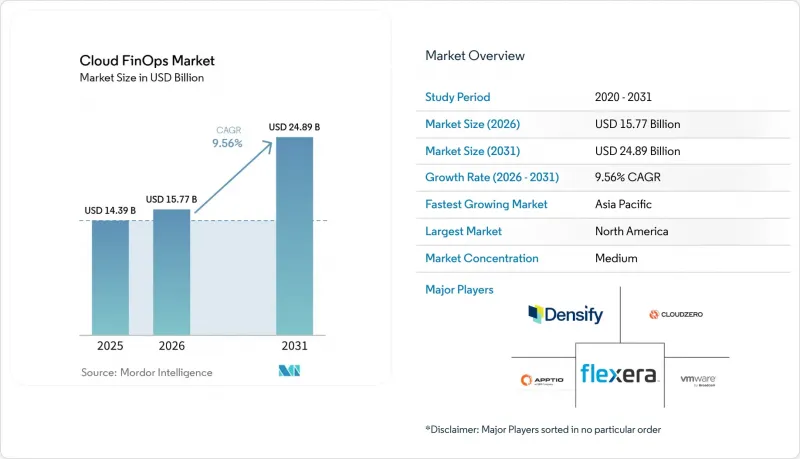
This report is Segmented by Component (Software, Services), Deployment Type (Public Cloud, Private Cloud, and More), Organization Size (Large Enterprises, Small and Medium Enterprises), End-User Industry (IT and Telecommunications, Banking Financial Services and Insurance, Retail and E-Commerce, Healthcare and Life Sciences, and More), and Geography. The Market Forecasts are Provided in Terms of Value (USD).
Global Cloud FinOps Market Trends and Insights
Escalating Multi-Cloud and Hybrid-Cloud Complexity Requires Unified Cost Governance
Organizations running workloads across Amazon Web Services, Microsoft Azure, and Google Cloud Platform navigate incompatible billing schemas, fragmented discount logic, and inconsistent tagging. The FinOps Open Cost and Usage Specification is normalizing data, yet hyperscalers prioritize proprietary lock-in, so enterprises adopt orchestration platforms that aggregate spend, allocate costs accurately, and enforce global policies. Financial services and telecommunications firms are early adopters, given regulatory segmentation that mandates precise chargeback. Unified governance is therefore a pivotal growth catalyst for the cloud FinOps market.
Mandatory CFO Oversight of Cloud Budgets After 2024 Audit-Rule Updates
Financial Accounting Standards Board guidance now treats multiyear cloud commitments as operating-lease liabilities, elevating cloud spend to the CFO agenda. A 2025 survey showed 66% of boards review cloud budgets, driving demand for audit-grade variance reporting and scenario modeling. United Kingdom banking examples illustrate savings exceeding GBP 3.8 million (USD 4.8 million) after centralizing FinOps. This regulatory driver accelerates adoption, reinforcing the credibility of the cloud FinOps market.
Shortage of Certified FinOps Practitioners Limits Enterprise Scaling
The FinOps Foundation has issued thousands of certifications, yet demand outpaces supply, especially in Asia-Pacific and Middle East markets. Enterprises pay premiums for external consultants, increasing program costs and slowing the shift from manual reviews to automated governance. Small and medium enterprises feel the pinch most acutely, often accepting shallow optimization limited to reserved-instance purchases rather than advanced rightsizing. The talent gap therefore restrains the cloud FinOps market.
Other drivers and restraints analyzed in the detailed report include:
- GenAI Workload Cost Spikes Raise Urgency for Granular Unit-Economics Tracking
- Mainstream Adoption of FinOps Framework v4.0 by Hyperscalers
- Disparate Billing APIs and Tagging Standards Complicate Data Normalization
For complete list of drivers and restraints, kindly check the Table Of Contents.
Segment Analysis
In 2025, software held a dominant 65.15% share of the cloud FinOps market, reflecting its critical role in enabling organizations to manage cloud financial operations effectively. However, services are projected to experience significant growth, with a robust 10.55% CAGR, driven largely by the lack of in-house expertise within organizations. This gap has created opportunities for managed-service providers, who are increasingly integrating FinOps into broader digital transformation initiatives. At the same time, consultancies are stepping in to address this need by training internal teams and executing targeted optimization sprints to enhance operational efficiency.
Small and medium enterprises (SMEs) are showing a preference for flat-fee pricing models, which eliminate the unpredictability of percentage-of-spend fees. These models align well with the constrained budgets typical of growth-stage businesses, making them an attractive option for this segment. On the software side, vendors are continuously innovating to strengthen their platforms. They are incorporating advanced features such as AI-driven anomaly detection to identify irregularities, Terraform integration to streamline infrastructure management, and carbon forecasting to support sustainability goals. These enhancements not only improve functionality but also increase platform stickiness, encouraging long-term customer retention. The interplay between automation and advisory services is creating a layered value proposition that appeals to a wide range of organizations. This combination sustains the momentum of the cloud FinOps market, ensuring its continued growth and relevance in an increasingly cloud-driven business environment.
In 2025, public cloud spending accounted for 46.45% of the total cloud expenditure. However, hybrid and multi-cloud estates are witnessing significant growth, expanding at an 11.34% CAGR as companies increasingly adopt these models to mitigate the risks associated with vendor lock-in. The inability to transfer reserved-instance discounts across providers has resulted in fragmented commitment management, adding complexity to cloud cost optimization strategies. Despite the rise of public and hybrid cloud models, private cloud remains a critical component in regulated sectors due to its compliance and security advantages.
Meanwhile, FinOps tools are evolving to implement consistent tagging and chargeback policies, ensuring uniformity across on-premises, edge, and public workloads. The Open Cost and Usage Specification seeks to standardize data inputs across platforms, but inconsistent adoption has underscored the continued demand for third-party normalization engines to streamline operations. This growing complexity in managing cloud environments is driving the cloud FinOps market to experience a steep and sustained growth trajectory.
Geography Analysis
In 2025, North America dominated the cloud FinOps market, accounting for 37.45% of the revenue share. This leadership was driven by the presence of hyperscaler headquarters, early adoption of the FinOps Foundation, and a deep talent pool. Boards across the region increasingly treat cloud budgets as strategic levers, accelerating the maturity of FinOps practices. These factors collectively position North America as a key player in the global market, setting benchmarks for other regions to follow.
Europe followed closely, where the Corporate Sustainability Reporting Directive played a pivotal role by incorporating GreenOps carbon metrics into financial reviews. This integration aligns cost management with ESG (Environmental, Social, and Governance) priorities, reflecting a growing emphasis on sustainability. Meanwhile, Asia-Pacific emerged as the fastest-growing region, with a remarkable 12.21% CAGR. The region's growth is anchored by the expansion of hyperscalers in China, India, and Korea, alongside localized IT services that adapt FinOps practices to address multilingual billing complexities.
The Middle East and Africa also witnessed momentum, driven by sovereign-cloud mandates in Saudi Arabia and the UAE, which spurred demand for platforms compliant with national regulations. However, the scarcity of certified talent in the region has slowed the pace of scaling these initiatives. In South America, the market remains in its emerging phase, with Brazil and Argentina leading the adoption of FinOps practices, particularly in the e-commerce and financial services sectors. This diverse geographic spread highlights the global rise of the cloud FinOps market, showcasing its growing importance across regions.
- Apptio, Inc.
- VMware, Inc. (Broadcom, Inc.)
- Flexera Software LLC
- CloudZero, Inc.
- Densify Inc.
- Harness Inc.
- Spot by NetApp, Inc.
- Microsoft Corporation (Azure Cost Management)
- Amazon Web Services, Inc. (AWS Cost Explorer)
- Google LLC (Cost Management Tools)
- Anodot Ltd.
- Turbonomic, Inc. (an IBM company)
- CloudBolt Software, Inc.
- Yotascale, Inc.
- Stackwatch, Inc. (Kubecost)
- ProsperOps, Inc.
- nOps, Inc.
- Granulate Cloud Solutions Ltd. (an Intel company)
- Finout Ltd.
- Zesty Tech Ltd.
Additional Benefits:
- The market estimate (ME) sheet in Excel format
- 3 months of analyst support
TABLE OF CONTENTS
1 INTRODUCTION
- 1.1 Market Definition and Study Assumptions
- 1.2 Scope of the Study
2 RESEARCH METHODOLOGY
3 EXECUTIVE SUMMARY
4 MARKET LANDSCAPE
- 4.1 Market Overview
- 4.2 Market Drivers
- 4.2.1 Escalating Multi-Cloud and Hybrid-Cloud Complexity Requires Unified Cost Governance
- 4.2.2 Mandatory CFO Oversight of Cloud Budgets After 2024 Audit-Rule Updates
- 4.2.3 GenAI Workload Cost Spikes Raise Urgency for Granular Unit-Economics Tracking
- 4.2.4 Mainstream Adoption of FinOps Framework v4.0 by Hyperscalers
- 4.2.5 Carbon-Aware-GreenOps-Reporting Embedded in FinOps KPIs
- 4.2.6 Rise of Cloud-Native FinOps-as-Code Pipelines Integrated in CI/CD
- 4.3 Market Restraints
- 4.3.1 Shortage of Certified FinOps Practitioners Limits Enterprise Scaling
- 4.3.2 Disparate Billing APIs and Tagging Standards Complicate Data Normalization
- 4.3.3 Resistance from Dev Teams to Real-Time Cost Guardrails Slows Automation
- 4.3.4 Edge and Sovereign-Cloud Data-Locality Rules Fragment Visibility
- 4.4 Industry Value / Supply-Chain Analysis
- 4.5 Regulatory Landscape
- 4.6 Technological Outlook
- 4.7 Porter's Five Forces Analysis
- 4.7.1 Bargaining Power of Suppliers
- 4.7.2 Bargaining Power of Consumers
- 4.7.3 Threat of New Entrants
- 4.7.4 Threat of Substitutes
- 4.7.5 Intensity of Competitive Rivalry
- 4.8 Impact of Macroeconomic Factors
5 MARKET SIZE AND GROWTH FORECASTS (VALUE)
- 5.1 By Component
- 5.1.1 Software
- 5.1.2 Services
- 5.2 By Deployment Type
- 5.2.1 Public Cloud
- 5.2.2 Private Cloud
- 5.2.3 Hybrid / Multi-Cloud
- 5.3 By Organization Size
- 5.3.1 Large Enterprises
- 5.3.2 Small and Medium Enterprises (SMEs)
- 5.4 By End-User Industry
- 5.4.1 IT and Telecommunications
- 5.4.2 Banking, Financial Services and Insurance
- 5.4.3 Retail and E-Commerce
- 5.4.4 Healthcare and Life Sciences
- 5.4.5 Manufacturing
- 5.4.6 Government and Public Sector
- 5.5 By Geography
- 5.5.1 North America
- 5.5.1.1 United States
- 5.5.1.2 Canada
- 5.5.1.3 Mexico
- 5.5.2 South America
- 5.5.2.1 Brazil
- 5.5.2.2 Argentina
- 5.5.2.3 Rest of South America
- 5.5.3 Europe
- 5.5.3.1 Germany
- 5.5.3.2 United Kingdom
- 5.5.3.3 France
- 5.5.3.4 Italy
- 5.5.3.5 Spain
- 5.5.3.6 Russia
- 5.5.3.7 Rest of Europe
- 5.5.4 Asia-Pacific
- 5.5.4.1 China
- 5.5.4.2 Japan
- 5.5.4.3 India
- 5.5.4.4 South Korea
- 5.5.4.5 Australia and New Zealand
- 5.5.4.6 Rest of Asia-Pacific
- 5.5.5 Middle East and Africa
- 5.5.5.1 Middle East
- 5.5.5.1.1 Saudi Arabia
- 5.5.5.1.2 United Arab Emirates
- 5.5.5.1.3 Turkey
- 5.5.5.1.4 Rest of Middle East
- 5.5.5.2 Africa
- 5.5.5.2.1 South Africa
- 5.5.5.2.2 Nigeria
- 5.5.5.2.3 Egypt
- 5.5.5.2.4 Rest of Africa
- 5.5.5.1 Middle East
- 5.5.1 North America
6 COMPETITIVE LANDSCAPE
- 6.1 Market Concentration
- 6.2 Strategic Moves
- 6.3 Market Share Analysis
- 6.4 Company Profiles (includes Global Level Overview, Market Level Overview, Core Segments, Financials as available, Strategic Information, Market Rank/Share, Products and Services, Recent Developments)
- 6.4.1 Apptio, Inc.
- 6.4.2 VMware, Inc. (Broadcom, Inc.)
- 6.4.3 Flexera Software LLC
- 6.4.4 CloudZero, Inc.
- 6.4.5 Densify Inc.
- 6.4.6 Harness Inc.
- 6.4.7 Spot by NetApp, Inc.
- 6.4.8 Microsoft Corporation (Azure Cost Management)
- 6.4.9 Amazon Web Services, Inc. (AWS Cost Explorer)
- 6.4.10 Google LLC (Cost Management Tools)
- 6.4.11 Anodot Ltd.
- 6.4.12 Turbonomic, Inc. (an IBM company)
- 6.4.13 CloudBolt Software, Inc.
- 6.4.14 Yotascale, Inc.
- 6.4.15 Stackwatch, Inc. (Kubecost)
- 6.4.16 ProsperOps, Inc.
- 6.4.17 nOps, Inc.
- 6.4.18 Granulate Cloud Solutions Ltd. (an Intel company)
- 6.4.19 Finout Ltd.
- 6.4.20 Zesty Tech Ltd.
7 MARKET OPPORTUNITIES AND FUTURE OUTLOOK
- 7.1 White-Space and Unmet-Need Assessment

