PUBLISHER: MarketsandMarkets | PRODUCT CODE: 2190627

PUBLISHER: MarketsandMarkets | PRODUCT CODE: 2190627
Terahertz Technology Market Size, Share, & Trends by Type, Application - Global Forecast to 2032
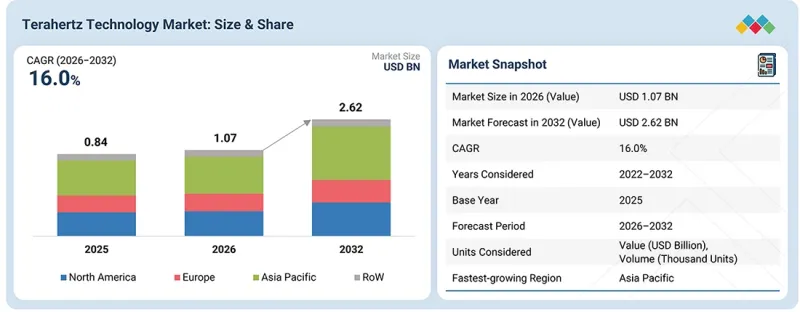
The global terahertz technology market is projected to grow from USD 1.07 billion in 2026 to USD 2.62 billion by 2032, registering a CAGR of 16.0% during the forecast period. Demand for terahertz systems is increasing as automated quality inspection technologies proliferate, because modern production lines require continuous, high-precision material evaluation in complex manufacturing environments. The expansion of automated semiconductor packaging, inline pharmaceutical coating analysis, and contactless non-destructive testing (NDT) systems has significantly increased defect-detection requirements, driving greater demand for non-ionizing, high-resolution penetration imaging. Inadequate or destructive legacy inspection methods can degrade product integrity, reduce operational throughput, and cause production line downtime.
| Scope of the Report | |
|---|---|
| Years Considered for the Study | 2021-2032 |
| Base Year | 2025 |
| Forecast Period | 2026-2032 |
| Units Considered | Value (USD Billion) |
| Segments | By Type, Application and Region |
| Regions covered | North America, Europe, APAC, RoW |
As a result, enterprises are integrating advanced continuous wave imaging arrays, dedicated time-domain spectroscopy (TDS) modules, and artificial intelligence image reconstruction algorithms to maintain inspection accuracy, secure proprietary production quality, and comply with strict worker safety regulations, especially in high-throughput cleanroom and advanced manufacturing facilities.
"Terahertz communication systems segment is expected to record the highest CAGR during the forecast period."
The terahertz communication systems segment is expected to be the fastest-growing segment in the terahertz technology market due to its ability to deliver ultra-high bandwidth and terabit-per-second data transmission rates. Submillimeter and terahertz frequencies (typically ranging from 0.1 THz to 10 THz) provide the necessary spectral bandwidth for data-intensive next-generation wireless networks while alleviating radio frequency spectrum congestion. This makes them highly effective for applications such as high-capacity data center interconnections, short-range kiosk downloads, secure military tactical links, and satellite communications. As high-speed digital applications expand through 6G infrastructure development, smart city frameworks, and ultra-connected autonomous ecosystems, transmitting massive data volumes with low latency becomes necessary. Additionally, innovations in photonic transceivers, integrated chip-scale continuous-wave emitters, and advanced beamforming components improve operational efficiency and enable hardware integration into standard indoor and outdoor communication architectures.
"The laboratory research segment dominated the terahertz technology market, by application, in 2025."
The laboratory research segment captured a dominant share of the terahertz technology market in 2025 due to the widespread requirement for fundamental material characterization and non-destructive spectroscopic evaluation across academic institutions and R&D centers. Advanced research facilities continuously incorporate complex instrumentation such as time-domain spectrometers, continuous-wave imaging arrays, cryogenic bolometers, and femtosecond lasers. These applications require high-precision molecular fingerprinting and non-ionizing radiation penetration to analyze crystal lattices, verify polymer structures, evaluate biological tissues, and support semiconductor prototype development. The growing adoption of materials science initiatives across advanced electronics, pharmaceutical chemistry, and photonics research creates consistent demand for reliable, dedicated terahertz spectroscopy and imaging equipment.
"The US accounted for the largest share of the North American terahertz technology market in 2025."
The US accounted for the largest share of the North American terahertz technology market because of its scientific research infrastructure and advanced industrial quality control. The country serves as a global hub for non-destructive testing and non-ionizing imaging adoption. This includes the large-scale deployment of terahertz spectroscopy in pharmaceutical laboratories, semiconductor wafer inspection facilities, and defense security checkpoints. These operations require high-resolution terahertz components for contactless material characterization and real-time subsurface defect detection. Additionally, federal research funding for next-generation 6G wireless communication testbeds and growth in the aerospace composites sector further increase demand for dedicated terahertz hardware. Government initiatives, established research institutions, and the presence of specialized photonics and sensing equipment vendors support local instrumentation infrastructure. These operational factors strengthen its market position and enable the US to maintain its regional share.
- By Company Type: Tier 1 - 45%, Tier 2 - 30%, and Tier 3 - 25%
- By Designation: Directors - 35%, C-level Executives - 30%, and Others - 35%
- By Region: North America - 35%, Europe - 25%, Asia Pacific - 30%, and RoW - 10%
Prominent players profiled in this report include Advantest Corporation (Japan), Luna Innovations (US), TeraView Limited (UK), TOPTICA Photonics AG (Germany), HUBNER GmbH & Co. KG (Germany), Menlo Systems (Germany), TeraSense GROUP INC. (US), Gentec Electro-Optics (Canada), QMC Instruments Ltd. (UK), and TERAVIL LTD. (Lithuania), among others.
Research Coverage:
The report defines, describes, and forecasts the terahertz technology market based on type (terahertz imaging, terahertz spectroscopy, and terahertz communication systems), application (laboratory research, medical & healthcare, military & homeland security, industrial NDT, satellite communications, tactical/military communications, and outdoor/indoor wireless communications), and region (North America, Europe, Asia Pacific, and RoW). It provides detailed information regarding drivers, restraints, opportunities, and challenges influencing the market's growth. It also analyzes competitive developments, including acquisitions, product launches, expansions, and actions taken by key players to grow in the market.
Reasons to Buy This Report:
The report will help market leaders/new entrants with information on the closest approximations of the revenue for the overall terahertz technology market and its subsegments. The report will help stakeholders understand the competitive landscape and gain more insight to position their business better and plan suitable go-to-market strategies. The report also helps stakeholders understand the market's pulse and provides information on key drivers, restraints, opportunities, and challenges.
The report will provide insights into the following points:
- Analysis of key drivers (increasing demand for non-destructive testing and non-ionizing security screening, rising adoption in pharmaceutical formulation analysis and biomedical diagnostics), restraints (high initial procurement and component manufacturing costs, lack of technical awareness and shortage of skilled operating personnel), opportunities (integration into next-generation 6G ultra-high-speed wireless communication networks, commercialization of compact chip-scale semiconductor sources and portable detectors), and challenges (high signal attenuation from atmospheric moisture absorption and limited penetration depth, complex optical calibration and integration with legacy production lines) of the terahertz technology market.
- Product Development/Innovation: Detailed insights into upcoming technologies, research & development activities, and product launches in the terahertz technology market.
- Market Development: Comprehensive information about lucrative markets. The report analyzes the terahertz technology market across various regions.
- Market Diversification: Exhaustive information about new products launched, untapped geographies, recent developments, and investments in the terahertz technology market.
- Competitive Assessment: In-depth assessment of market share, growth strategies, and offerings of leading players, including Advantest Corporation (Japan), Luna Innovations (US), HUBNER GmbH & Co. KG (Germany), Menlo Systems (Germany), TOPTICA Photonics AG (Germany), and Thorlabs, Inc. (US), in the terahertz technology market.
TABLE OF CONTENTS
1 INTRODUCTION
- 1.1 STUDY OBJECTIVES
- 1.2 MARKET DEFINITION
- 1.3 MARKET SCOPE
- 1.3.1 MARKET SEGMENTATION AND REGIONAL SCOPE
- 1.4 INCLUSIONS AND EXCLUSIONS
- 1.4.1 YEARS CONSIDERED
- 1.5 CURRENCY CONSIDERED
- 1.6 UNIT CONSIDERED
- 1.7 STAKEHOLDERS
- 1.8 SUMMARY OF CHANGES
2 EXECUTIVE SUMMARY
- 2.1 MARKET HIGHLIGHTS AND KEY INSIGHTS
- 2.2 KEY MARKET PARTICIPANTS: MAPPING OF STRATEGIC DEVELOPMENTS
- 2.3 DISRUPTIVE TRENDS IN TERAHERTZ TECHNOLOGY MARKET
- 2.4 HIGH-GROWTH SEGMENTS
- 2.5 REGIONAL SNAPSHOT: MARKET SIZE, GROWTH RATE, AND FORECAST
3 PREMIUM INSIGHTS
- 3.1 ATTRACTIVE OPPORTUNITIES FOR PLAYERS IN TERAHERTZ TECHNOLOGY MARKET
- 3.2 TERAHERTZ TECHNOLOGY MARKET, BY TYPE
- 3.3 TERAHERTZ TECHNOLOGY MARKET, BY APPLICATION
- 3.4 TERAHERTZ TECHNOLOGY MARKET, BY REGION
- 3.5 NORTH AMERICA: TERAHERTZ TECHNOLOGY MARKET, BY APPLICATION AND COUNTRY
- 3.6 TERAHERTZ TECHNOLOGY MARKET, BY COUNTRY/REGION
4 MARKET OVERVIEW
- 4.1 INTRODUCTION
- 4.2 MARKET DYNAMICS
- 4.2.1 DRIVERS
- 4.2.1.1 Increasing use in security screening and surveillance applications
- 4.2.1.2 Rising applications in medical imaging and diagnostics
- 4.2.2 RESTRAINTS
- 4.2.2.1 Limited awareness and expertise across end-user industries
- 4.2.2.2 Complex integration with existing systems
- 4.2.3 OPPORTUNITIES
- 4.2.3.1 Role in 6G and ultra-high-speed communications
- 4.2.3.2 Expansion into automotive sector with advanced driver assistance systems (ADAS)
- 4.2.3.3 Growing investment in quantum and ultrafast optics research
- 4.2.4 CHALLENGES
- 4.2.4.1 Technical barriers to generating and detecting stable terahertz signals
- 4.2.1 DRIVERS
- 4.3 INTERCONNECTED MARKETS AND CROSS-SECTOR OPPORTUNITIES
- 4.4 STRATEGIC MOVES BY TIER 1/2/3 PLAYERS
5 INDUSTRY TRENDS
- 5.1 PORTER'S FIVE FORCES ANALYSIS
- 5.1.1 THREAT OF NEW ENTRANTS
- 5.1.2 THREAT OF SUBSTITUTES
- 5.1.3 BARGAINING POWER OF SUPPLIERS
- 5.1.4 BARGAINING POWER OF BUYERS
- 5.1.5 INTENSITY OF COMPETITIVE RIVALRY
- 5.2 MACROECONOMIC OUTLOOK
- 5.2.1 INTRODUCTION
- 5.2.2 GDP TRENDS AND FORECAST
- 5.2.3 TRENDS IN GLOBAL LABORATORY RESEARCH APPLICATION
- 5.2.4 TRENDS IN GLOBAL MEDICAL AND HEALTH SCIENCE APPLICATION
- 5.2.5 TRENDS IN GLOBAL SATELLITE COMMUNICATION APPLICATIONS
- 5.3 VALUE CHAIN ANALYSIS
- 5.4 ECOSYSTEM ANALYSIS
- 5.5 PRICING ANALYSIS
- 5.5.1 AVERAGE SELLING PRICE TREND OF TERAHERTZ IMAGING, BY KEY PLAYER, 2021-2025
- 5.5.2 AVERAGE SELLING PRICE TREND OF TERAHERTZ TECHNOLOGY, BY REGION, 2022-2025
- 5.6 TRADE ANALYSIS
- 5.6.1 IMPORT SCENARIO (HS CODE 9027)
- 5.6.2 EXPORT SCENARIO (HS CODE 9027)
- 5.7 KEY CONFERENCES AND EVENTS, 2026-2027
- 5.8 TRENDS/DISRUPTIONS IMPACTING CUSTOMER BUSINESS
- 5.9 INVESTMENT AND FUNDING SCENARIO
- 5.10 CASE STUDY ANALYSIS
- 5.10.1 TERAHERTZ PULSED IMAGING DEPLOYED IN ADVANCED SEMICONDUCTOR PACKAGING TO OPTIMIZE DEFECT DETECTION ACCURACY
- 5.10.2 ROBOTIC TERAHERTZ TIME DOMAIN SPECTROSCOPY DEPLOYED IN AUTOMOTIVE PAINT LINES TO OPTIMIZE MULTILAYER COATING ACCURACY
- 5.10.3 TERAHERTZ PULSED IMAGING DEPLOYED IN SOLID DOSAGE MANUFACTURING TO OPTIMIZE PHARMACEUTICAL TABLET COATING ACCURACY
- 5.10.4 TERAHERTZ FMCW RADAR SYSTEM DEPLOYED IN AEROSPACE RADOME MANUFACTURING TO OPTIMIZE SUB-SURFACE DEFECT DETECTION
- 5.11 IMPACT OF 2025 US TARIFF - TERAHERTZ TECHNOLOGY MARKET
- 5.11.1 INTRODUCTION
- 5.11.2 KEY TARIFF RATES
- 5.11.3 PRICE IMPACT ANALYSIS
- 5.11.4 IMPACT ON COUNTRIES/REGIONS
- 5.11.4.1 US
- 5.11.4.2 Europe
- 5.11.4.3 Asia Pacific
- 5.11.5 IMPACT ON APPLICATIONS
6 TECHNOLOGICAL ADVANCEMENTS, AI-DRIVEN IMPACT, PATENTS, INNOVATIONS, AND FUTURE APPLICATIONS
- 6.1 TECHNOLOGY ANALYSIS
- 6.1.1 KEY TECHNOLOGIES
- 6.1.1.1 Terahertz detectors
- 6.1.1.2 Terahertz imaging systems
- 6.1.1.3 Terahertz spectroscopy
- 6.1.2 COMPLEMENTARY TECHNOLOGIES
- 6.1.2.1 Photonic integration
- 6.1.3 ADJACENT TECHNOLOGIES
- 6.1.3.1 Infrared and optical imaging
- 6.1.3.2 Nanotechnology
- 6.1.1 KEY TECHNOLOGIES
- 6.2 PATENT ANALYSIS
- 6.3 IMPACT OF AI/GEN AI ON TERAHERTZ TECHNOLOGY MARKET
- 6.3.1 TOP USE CASES AND MARKET POTENTIAL
- 6.3.1.1 Automated defect recognition via deep learning (Advantest TAS Platform)
- 6.3.1.2 Physics-informed ML metrology for pharmaceutical coatings (TeraView Solutions)
- 6.3.1.3 Autonomous robotic inspection integration (das-Nano +Industrial Robotics)
- 6.3.2 BEST PRACTICES FOLLOWED BY OEMS IN TERAHERTZ TECHNOLOGY MARKET
- 6.3.3 CASE STUDIES RELATED TO AI/GEN AI IMPLEMENTATION IN TERAHERTZ TECHNOLOGY MARKET
- 6.3.4 INTERCONNECTED ECOSYSTEM AND IMPACT ON MARKET PLAYERS
- 6.3.5 CLIENTS' READINESS TO ADOPT AI/GEN AI-INTEGRATED TERAHERTZ TECHNOLOGY SOLUTIONS
- 6.3.1 TOP USE CASES AND MARKET POTENTIAL
- 6.4 SUCCESS STORIES AND REAL-WORLD APPLICATIONS
7 REGULATORY LANDSCAPE
- 7.1 REGIONAL REGULATIONS AND COMPLIANCE
- 7.1.1 REGULATORY BODIES, GOVERNMENT AGENCIES, AND OTHER ORGANIZATIONS
- 7.1.2 STANDARDS
- 7.1.3 REGULATIONS
8 CUSTOMER LANDSCAPE & BUYER BEHAVIOR
- 8.1 INTRODUCTION
- 8.2 DECISION-MAKING PROCESS
- 8.3 KEY STAKEHOLDERS INVOLVED IN BUYING PROCESS AND EVALUATION CRITERIA
- 8.3.1 KEY STAKEHOLDERS IN BUYING PROCESS
- 8.3.2 BUYING CRITERIA
- 8.4 ADOPTION BARRIERS AND INTERNAL CHALLENGES
- 8.5 UNMET NEEDS OF VARIOUS APPLICATIONS
- 8.6 MARKET PROFITABILITY
- 8.6.1 REVENUE POTENTIAL
- 8.6.2 COST DYNAMICS
- 8.6.3 MARGIN OPPORTUNITIES, BY APPLICATION
9 TERAHERTZ TECHNOLOGY: SOURCES AND DETECTORS
- 9.1 INTRODUCTION
- 9.2 THZ SOURCES
- 9.2.1 QUANTUM-CASCADE LASER (QCL)
- 9.2.2 FREQUENCY MULTIPLIER
- 9.2.3 GLOBAR
- 9.2.4 PHOTOCONDUCTIVE ANTENNA (PCA)
- 9.2.5 STIMULATED TERAHERTZ AMPLIFIED RADIATION (STAR)
- 9.3 DETECTORS
- 9.3.1 SCHOTTKY DIODE
- 9.3.2 HIGH ELECTRON MOBILITY TRANSISTOR (HEMT)
- 9.3.3 NANOWIRE
- 9.3.4 PYROELECTRIC DETECTOR
- 9.3.5 GOLAY CELL
- 9.3.6 BOLOMETER AND SUPERCONDUCTIVE HOT-SPOT AIR-BRIDGE BOLOMETER (SHAB)
10 TERAHERTZ TECHNOLOGY MARKET, BY TYPE
- 10.1 INTRODUCTION
- 10.2 TERAHERTZ IMAGING
- 10.2.1 ADVANCEMENTS IN TERAHERTZ IMAGING TECHNOLOGY TO PROPEL MARKET
- 10.2.1.1 Active terahertz imaging systems
- 10.2.1.2 Passive terahertz imaging systems
- 10.2.1 ADVANCEMENTS IN TERAHERTZ IMAGING TECHNOLOGY TO PROPEL MARKET
- 10.3 TERAHERTZ SPECTROSCOPY
- 10.3.1 ADVANCEMENTS IN TERAHERTZ SPECTROSCOPY TECHNOLOGY TO SUPPORT MARKET GROWTH
- 10.3.1.1 Terahertz time-domain spectroscopy
- 10.3.1.2 Terahertz frequency-domain spectroscopy
- 10.3.1 ADVANCEMENTS IN TERAHERTZ SPECTROSCOPY TECHNOLOGY TO SUPPORT MARKET GROWTH
- 10.4 TERAHERTZ COMMUNICATION SYSTEMS
- 10.4.1 INCREASING DEMAND FOR HIGHER SPEED AND WIRELESS COMMUNICATION TO DRIVE MARKET
- 10.4.1.1 Antennas
- 10.4.1.2 Emitters
- 10.4.1.3 Modulators
- 10.4.1 INCREASING DEMAND FOR HIGHER SPEED AND WIRELESS COMMUNICATION TO DRIVE MARKET
11 TERAHERTZ TECHNOLOGY MARKET, BY APPLICATION
- 11.1 INTRODUCTION
- 11.2 LABORATORY RESEARCH
- 11.2.1 CONTINUOUS TECHNOLOGICAL ADVANCEMENTS TO PROPEL MARKET
- 11.2.1.1 Material characterization
- 11.2.1.2 Biochemistry
- 11.2.1.3 Plasma diagnostics
- 11.2.1 CONTINUOUS TECHNOLOGICAL ADVANCEMENTS TO PROPEL MARKET
- 11.3 MEDICAL & HEALTHCARE
- 11.3.1 INCREASING INTEREST IN TERAHERTZ IMAGING AND SPECTROSCOPY OF BIOLOGICALLY RELATED APPLICATIONS TO DRIVE MARKET
- 11.3.1.1 Oncology
- 11.3.1.2 Dentistry
- 11.3.1.3 Dermatology
- 11.3.1.4 Tomography
- 11.3.1 INCREASING INTEREST IN TERAHERTZ IMAGING AND SPECTROSCOPY OF BIOLOGICALLY RELATED APPLICATIONS TO DRIVE MARKET
- 11.4 MILITARY & HOMELAND SECURITY
- 11.4.1 GROWING DEMAND FOR ADVANCED COMMUNICATION AND SENSING TECHNOLOGIES TO SUPPORT MARKET GROWTH
- 11.4.1.1 Passenger screening
- 11.4.1.2 Landmine and improvised explosive device detection
- 11.4.1 GROWING DEMAND FOR ADVANCED COMMUNICATION AND SENSING TECHNOLOGIES TO SUPPORT MARKET GROWTH
- 11.5 INDUSTRIAL NON-DESTRUCTIVE TESTING (NDT)
- 11.5.1 RISING ADOPTION OF NON-DESTRUCTIVE CONTACT-FREE TESTING FOR COMPOSITE MATERIAL INTEGRITY TO PROPEL MARKET
- 11.5.1.1 Aerospace
- 11.5.1.2 Semiconductor and electronics
- 11.5.1.3 Pharmaceuticals
- 11.5.1 RISING ADOPTION OF NON-DESTRUCTIVE CONTACT-FREE TESTING FOR COMPOSITE MATERIAL INTEGRITY TO PROPEL MARKET
- 11.6 SATELLITE COMMUNICATIONS
- 11.6.1 LEVERAGING INTER-SATELLITE COMMUNICATIONS TO ENHANCE BANDWIDTH, SECURITY, AND ORBITAL ASSET MONITORING TO DRIVE MARKET
- 11.7 TACTICAL/MILITARY COMMUNICATIONS
- 11.7.1 TRANSFORMING TACTICAL CONNECTIVITY THROUGH TERAHERTZ-ENABLED ULTRA-SECURE, HIGH-BANDWIDTH BATTLEFIELD COMMUNICATIONS TO PROPEL MARKET
- 11.8 OUTDOOR/INDOOR WIRELESS COMMUNICATIONS
- 11.8.1 UNLOCKING ULTRA-HIGH DATA THROUGHPUT VIA SHORT-RANGE, LOW-TERAHERTZ WIRELESS NETWORK INNOVATION TO DRIVE MARKET
12 TERAHERTZ TECHNOLOGY MARKET, BY REGION
- 12.1 INTRODUCTION
- 12.2 NORTH AMERICA
- 12.2.1 US
- 12.2.1.1 Academic leadership and stratospheric mission validations to accelerate commercialization of terahertz systems
- 12.2.2 CANADA
- 12.2.2.1 Healthcare innovation and cancer diagnostics drive adoption of non-ionizing terahertz imaging solutions
- 12.2.3 MEXICO
- 12.2.3.1 Telecom reforms and national research infrastructure to strengthen terahertz technology capabilities
- 12.2.1 US
- 12.3 EUROPE
- 12.3.1 UK
- 12.3.1.1 Research excellence and breakthroughs to drive commercialization of terahertz applications
- 12.3.2 GERMANY
- 12.3.2.1 Breakthroughs in terahertz imaging and 6G-enabled systems to drive market
- 12.3.3 FRANCE
- 12.3.3.1 Strategic investments in security, telecom, and industrial modernization to drive market
- 12.3.4 ITALY
- 12.3.4.1 Research and industrial applications to drive market
- 12.3.5 SPAIN
- 12.3.5.1 Increased applications in non-destructive testing, quality control, and security screening to propel market
- 12.3.6 REST OF EUROPE
- 12.3.1 UK
- 12.4 ASIA PACIFIC
- 12.4.1 JAPAN
- 12.4.1.1 Innovations in terahertz devices and 6G demonstrations to drive market growth
- 12.4.2 CHINA
- 12.4.2.1 Economic expansion and semiconductor autonomy to support market growth
- 12.4.3 INDIA
- 12.4.3.1 Health, wellness, and defense-focused technological innovations to propel market
- 12.4.4 SOUTH KOREA
- 12.4.4.1 Advancements in telecommunications, defense, industrial applications, and healthcare to drive market
- 12.4.5 REST OF ASIA PACIFIC
- 12.4.1 JAPAN
- 12.5 REST OF THE WORLD (ROW)
- 12.5.1 MIDDLE EAST & AFRICA
- 12.5.1.1 Rising investments in next-generation telecommunications and cultural heritage preservation to drive market
- 12.5.2 SOUTH AMERICA
- 12.5.2.1 Advancing terahertz innovation to drive South America's science and industry landscape
- 12.5.1 MIDDLE EAST & AFRICA
13 COMPETITIVE LANDSCAPE
- 13.1 OVERVIEW
- 13.2 KEY PLAYER COMPETITIVE STRATEGIES/RIGHT TO WIN, JANUARY 2023-OCTOBER 2026
- 13.2.1 PRODUCT PORTFOLIO EXPANSION
- 13.2.2 REGIONAL FOOTPRINT EXPANSION
- 13.2.3 SOLUTION OFFERING EXPANSION
- 13.2.4 ORGANIC/INORGANIC STRATEGIES
- 13.3 REVENUE ANALYSIS, 2021-2025
- 13.4 MARKET SHARE ANALYSIS, 2025
- 13.5 COMPANY EVALUATION MATRIX: KEY PLAYERS, 2025
- 13.5.1 STARS
- 13.5.2 EMERGING LEADERS
- 13.5.3 PERVASIVE PLAYERS
- 13.5.4 PARTICIPANTS
- 13.5.5 COMPANY FOOTPRINT: KEY PLAYERS, 2025
- 13.5.5.1 Company footprint
- 13.5.5.2 Region footprint
- 13.5.5.3 Application footprint
- 13.5.5.4 Type Footprint
- 13.6 COMPANY EVALUATION MATRIX: STARTUPS/SMES, 2025
- 13.6.1 PROGRESSIVE COMPANIES
- 13.6.2 RESPONSIVE COMPANIES
- 13.6.3 DYNAMIC COMPANIES
- 13.6.4 STARTING BLOCKS
- 13.6.5 COMPETITIVE BENCHMARKING: STARTUPS/SMES, 2025
- 13.6.5.1 Detailed list of key startups/SMEs
- 13.6.5.2 Competitive benchmarking of key startups/SMEs
- 13.7 COMPETITIVE SCENARIO
- 13.7.1 PRODUCT LAUNCHES
- 13.7.2 DEALS
14 COMPANY PROFILES
- 14.1 KEY PLAYERS
- 14.1.1 ADVANTEST CORPORATION
- 14.1.1.1 Business overview
- 14.1.1.2 Products/solutions/services offered
- 14.1.1.3 MnM view
- 14.1.1.3.1 Key strengths/right to win
- 14.1.1.3.2 Strategic choices made
- 14.1.1.3.3 Weaknesses and competitive threats
- 14.1.2 LUNA INNOVATIONS
- 14.1.2.1 Business overview
- 14.1.2.2 Products/solutions/services offered
- 14.1.2.3 Recent developments
- 14.1.2.3.1 Other developments
- 14.1.2.4 MnM view
- 14.1.2.4.1 Key strengths/right to win
- 14.1.2.4.2 Strategic choices made
- 14.1.2.4.3 Weaknesses and competitive threats
- 14.1.3 TERAVIEW LIMITED
- 14.1.3.1 Business overview
- 14.1.3.2 Products/solutions/services offered
- 14.1.3.3 Recent developments
- 14.1.3.3.1 Product launches
- 14.1.3.3.2 Deals
- 14.1.3.4 MnM view
- 14.1.3.4.1 Key strengths/right to win
- 14.1.3.4.2 Strategic choices
- 14.1.3.4.3 Weaknesses and competitive threats
- 14.1.4 TOPTICA PHOTONICS AG
- 14.1.4.1 Business overview
- 14.1.4.2 Products/solutions/services offered
- 14.1.4.3 Recent developments
- 14.1.4.3.1 Product launches
- 14.1.4.4 MnM view
- 14.1.4.4.1 Key strengths/right to win
- 14.1.4.4.2 Strategic choices made
- 14.1.4.4.3 Weaknesses and competitive threats
- 14.1.5 HUBNER GMBH & CO. KG
- 14.1.5.1 Business overview
- 14.1.5.2 Products/solutions/services offered
- 14.1.5.3 Recent developments
- 14.1.5.3.1 Product launches
- 14.1.5.4 MnM view
- 14.1.5.4.1 Key strengths/right to win
- 14.1.5.4.2 Strategic choices
- 14.1.5.4.3 Weaknesses and competitive threats
- 14.1.6 MENLO SYSTEMS
- 14.1.6.1 Products/solutions/services offered
- 14.1.6.2 Recent developments
- 14.1.6.2.1 Product launches
- 14.1.6.2.2 Expansions
- 14.1.7 TERASENSE GROUP INC.
- 14.1.7.1 Business overview
- 14.1.7.2 Products/solutions/services offered
- 14.1.7.3 Recent developments
- 14.1.7.3.1 Product launches
- 14.1.8 GENTEC-EO
- 14.1.8.1 Business overview
- 14.1.8.2 Products/solutions/services offered
- 14.1.9 QMC INSTRUMENTS LTD.
- 14.1.9.1 Business overview
- 14.1.9.2 Products/solutions/services offered
- 14.1.10 TERAVI LTD.
- 14.1.10.1 Business overview
- 14.1.10.2 Products/solutions/services offered
- 14.1.1 ADVANTEST CORPORATION
- 14.2 OTHER PLAYERS
- 14.2.1 VIRGINIA DIODES, INC.
- 14.2.2 MICROTECH INSTRUMENTS
- 14.2.3 SWISSTO12
- 14.2.4 DEL MAR PHOTONICS, INC.
- 14.2.5 INSIGHT PRODUCT COMPANY
- 14.2.6 BATOP GMBH
- 14.2.7 LSASD SAS
- 14.2.8 TYDEX
- 14.2.9 QUANTUM DESIGN INC.
- 14.2.10 RAYSECUR, INC.
- 14.2.11 LONGWAVE PHOTONICS LLC
- 14.2.12 BRIDGE12 TECHNOLOGIES, INC.
- 14.2.13 ACAL BFI
- 14.2.14 THORLABS, INC.
- 14.2.15 SCIENCETECH INC.
15 RESEARCH METHODOLOGY
- 15.1 RESEARCH DATA
- 15.1.1 SECONDARY DATA
- 15.1.1.1 List of key secondary sources
- 15.1.1.2 Key data from secondary sources
- 15.1.2 PRIMARY DATA
- 15.1.2.1 List of primary interview participants
- 15.1.2.2 Breakdown of primary interviews
- 15.1.2.3 Key data from primary sources
- 15.1.2.4 Key industry insights
- 15.1.3 SECONDARY AND PRIMARY RESEARCH
- 15.1.1 SECONDARY DATA
- 15.2 MARKET SIZE ESTIMATION
- 15.2.1 BOTTOM-UP APPROACH
- 15.2.1.1 Approach to arrive at market size using bottom-up analysis (demand side)
- 15.2.2 TOP-DOWN APPROACH
- 15.2.2.1 Approach to arrive at market size using top-down analysis (supply side)
- 15.2.1 BOTTOM-UP APPROACH
- 15.3 FACTOR ANALYSIS
- 15.3.1 DEMAND-SIDE ANALYSIS
- 15.3.2 SUPPLY-SIDE ANALYSIS
- 15.4 MARKET BREAKDOWN AND DATA TRIANGULATION
- 15.5 RESEARCH ASSUMPTIONS
- 15.6 RISK ANALYSIS
- 15.7 RESEARCH LIMITATIONS
16 APPENDIX
- 16.1 KNOWLEDGESTORE: MARKETSANDMARKETS' SUBSCRIPTION PORTAL
- 16.2 CUSTOMIZATION OPTIONS
- 16.3 RELATED REPORTS
- 16.4 AUTHOR DETAILS
List of Tables
- TABLE 1 TERAHERTZ TECHNOLOGY MARKET: INCLUSIONS AND EXCLUSIONS
- TABLE 2 TERAHERTZ TECHNOLOGY MARKET: SUMMARY OF CHANGES
- TABLE 3 INTERCONNECTED MARKETS AND CROSS-SECTOR OPPORTUNITIES RELATED TO TERAHERTZ TECHNOLOGY
- TABLE 4 STRATEGIC FOCUS ON MAJOR COMPANIES IN TERAHERTZ TECHNOLOGY MARKET
- TABLE 5 PORTER'S FIVE FORCES ANALYSIS
- TABLE 6 GDP GROWTH RATES, BY COUNTRY, 2021-2030 (%)
- TABLE 7 ROLE OF COMPANIES IN TERAHERTZ TECHNOLOGY ECOSYSTEM
- TABLE 8 AVERAGE SELLING PRICE TREND OF TERAHERTZ IMAGING, BY KEY PLAYER, 2021-2025 (USD)
- TABLE 9 AVERAGE SELLING PRICE TREND OF TERAHERTZ TECHNOLOGY, BY REGION, 2022-2025 (USD)
- TABLE 10 IMPORT DATA FOR HS CODE 9027-COMPLIANT PRODUCTS, BY COUNTRY, 2021-2025 (USD MILLION)
- TABLE 11 EXPORT DATA FOR HS CODE 9027-COMPLIANT PRODUCTS, BY COUNTRY, 2021-2025 (USD MILLION)
- TABLE 12 LIST OF KEY CONFERENCES AND EVENTS, 2026-2027
- TABLE 13 TERAHERTZ ELECTRO-OPTIC TIME-DOMAIN REFLECTOMETRY INSTALLED TO OPTIMIZE FAILURE LOCALIZATION AND YIELD INTEGRITY
- TABLE 14 ROBOTIC TERAHERTZ SENSING INSTALLED TO OPTIMIZE CONTACTLESS PAINT THICKNESS MEASUREMENT AND MATERIAL SAVINGS
- TABLE 15 TERAHERTZ PULSED REFLECTOMETRY INSTALLED TO OPTIMIZE INLINE TABLET COATING THICKNESS AND DISSOLUTION CONSISTENCY
- TABLE 16 TERAHERTZ FMCW IMAGING SYSTEM INSTALLED TO OPTIMIZE COMPOSITE SANDWICH CORE INSPECTION AND RADOME STRUCTURAL INTEGRITY
- TABLE 17 US-ADJUSTED RECIPROCAL TARIFF RATES, 2025 (USD BILLION)
- TABLE 18 LIST OF KEY PATENTS, 2017-2026
- TABLE 19 BEST PRACTICES FOLLOWED BY COMPANIES IN TERAHERTZ TECHNOLOGY MARKET
- TABLE 20 CASE STUDIES RELATED TO AI/GEN AI IMPLEMENTATION
- TABLE 21 INTERCONNECTED ECOSYSTEM AND IMPACT ON TERAHERTZ TECHNOLOGY MARKET PLAYERS
- TABLE 22 NORTH AMERICA: REGULATORY BODIES, GOVERNMENT AGENCIES, AND OTHER ORGANIZATIONS
- TABLE 23 EUROPE: REGULATORY BODIES, GOVERNMENT AGENCIES, AND OTHER ORGANIZATIONS
- TABLE 24 ASIA PACIFIC: REGULATORY BODIES, GOVERNMENT AGENCIES, AND OTHER ORGANIZATIONS
- TABLE 25 ROW: REGULATORY BODIES, GOVERNMENT AGENCIES, AND OTHER ORGANIZATIONS
- TABLE 26 INFLUENCE OF STAKEHOLDERS ON BUYING PROCESS FOR TOP THREE APPLICATIONS (%)
- TABLE 27 KEY BUYING CRITERIA FOR TOP THREE APPLICATIONS
- TABLE 28 TERAHERTZ TECHNOLOGY ADOPTION BARRIERS AND INTERNAL CHALLENGES
- TABLE 29 UNMET NEEDS IN TERAHERTZ TECHNOLOGY MARKET, BY APPLICATION
- TABLE 30 TERAHERTZ TECHNOLOGY MARKET, BY TYPE, 2022-2025 (USD MILLION)
- TABLE 31 TERAHERTZ TECHNOLOGY MARKET, BY TYPE, 2026-2032 (USD MILLION)
- TABLE 32 TERAHERTZ TECHNOLOGY MARKET, BY TYPE, 2022-2025 (THOUSAND UNITS)
- TABLE 33 TERAHERTZ TECHNOLOGY MARKET, BY TYPE, 2026-2032 (THOUSAND UNITS)
- TABLE 34 TERAHERTZ IMAGING: TERAHERTZ TECHNOLOGY MARKET, BY APPLICATION, 2022-2025 (USD MILLION)
- TABLE 35 TERAHERTZ IMAGING: TERAHERTZ TECHNOLOGY MARKET, BY APPLICATION, 2026-2032 (USD MILLION)
- TABLE 36 TERAHERTZ SPECTROSCOPY: TERAHERTZ TECHNOLOGY MARKET, BY APPLICATION, 2022-2025 (USD MILLION)
- TABLE 37 TERAHERTZ SPECTROSCOPY: TERAHERTZ TECHNOLOGY MARKET, BY APPLICATION, 2026-2032 (USD MILLION)
- TABLE 38 TERAHERTZ COMMUNICATION SYSTEMS: TERAHERTZ TECHNOLOGY MARKET, BY APPLICATION, 2022-2025 (USD MILLION)
- TABLE 39 TERAHERTZ COMMUNICATION SYSTEMS: TERAHERTZ TECHNOLOGY MARKET, BY APPLICATION, 2026-2032 (USD MILLION)
- TABLE 40 TERAHERTZ TECHNOLOGY MARKET, BY APPLICATION, 2022-2025 (USD MILLION)
- TABLE 41 TERAHERTZ TECHNOLOGY MARKET, BY APPLICATION, 2026-2032 (USD MILLION)
- TABLE 42 TERAHERTZ TECHNOLOGY MARKET FOR LABORATORY RESEARCH, BY REGION, 2022-2025 (USD MILLION)
- TABLE 43 TERAHERTZ TECHNOLOGY MARKET FOR LABORATORY RESEARCH, BY REGION, 2026-2032 (USD MILLION)
- TABLE 44 NORTH AMERICA: TERAHERTZ TECHNOLOGY MARKET FOR LABORATORY RESEARCH, BY COUNTRY, 2022-2025 (USD MILLION)
- TABLE 45 NORTH AMERICA: TERAHERTZ TECHNOLOGY MARKET FOR LABORATORY RESEARCH, BY COUNTRY, 2026-2032 (USD MILLION)
- TABLE 46 EUROPE: TERAHERTZ TECHNOLOGY MARKET FOR LABORATORY RESEARCH, BY COUNTRY, 2022-2025 (USD MILLION)
- TABLE 47 EUROPE: TERAHERTZ TECHNOLOGY MARKET FOR LABORATORY RESEARCH, BY COUNTRY, 2026-2032 (USD MILLION)
- TABLE 48 ASIA PACIFIC: TERAHERTZ TECHNOLOGY MARKET FOR LABORATORY RESEARCH, BY COUNTRY, 2022-2025 (USD MILLION)
- TABLE 49 ASIA PACIFIC: TERAHERTZ TECHNOLOGY MARKET FOR LABORATORY RESEARCH, BY COUNTRY, 2026-2032 (USD MILLION)
- TABLE 50 ROW: TERAHERTZ TECHNOLOGY MARKET FOR LABORATORY RESEARCH, BY REGION, 2022-2025 (USD MILLION)
- TABLE 51 ROW: TERAHERTZ TECHNOLOGY MARKET FOR LABORATORY RESEARCH, BY REGION, 2026-2032 (USD MILLION)
- TABLE 52 TERAHERTZ TECHNOLOGY MARKET FOR MEDICAL & HEALTHCARE, BY REGION, 2022-2025 (USD MILLION)
- TABLE 53 TERAHERTZ TECHNOLOGY MARKET FOR MEDICAL & HEALTHCARE, BY REGION, 2026-2032 (USD MILLION)
- TABLE 54 NORTH AMERICA: TERAHERTZ TECHNOLOGY MARKET FOR MEDICAL & HEALTHCARE, BY COUNTRY, 2022-2025 (USD MILLION)
- TABLE 55 NORTH AMERICA: TERAHERTZ TECHNOLOGY MARKET FOR MEDICAL & HEALTHCARE, BY COUNTRY, 2026-2032 (USD MILLION)
- TABLE 56 EUROPE: TERAHERTZ TECHNOLOGY MARKET FOR MEDICAL & HEALTHCARE, BY COUNTRY, 2022-2025 (USD MILLION)
- TABLE 57 EUROPE: TERAHERTZ TECHNOLOGY MARKET FOR MEDICAL & HEALTHCARE, BY COUNTRY, 2026-2032 (USD MILLION)
- TABLE 58 ASIA PACIFIC: TERAHERTZ TECHNOLOGY MARKET FOR MEDICAL & HEALTHCARE, BY COUNTRY, 2022-2025 (USD MILLION)
- TABLE 59 ASIA PACIFIC: TERAHERTZ TECHNOLOGY MARKET FOR MEDICAL & HEALTHCARE, BY COUNTRY, 2026-2032 (USD MILLION)
- TABLE 60 ROW: TERAHERTZ TECHNOLOGY MARKET FOR MEDICAL & HEALTHCARE, BY REGION, 2022-2025 (USD MILLION)
- TABLE 61 ROW: TERAHERTZ TECHNOLOGY MARKET FOR MEDICAL & HEALTHCARE, BY REGION, 2026-2032 (USD MILLION)
- TABLE 62 TERAHERTZ TECHNOLOGY MARKET FOR MILITARY & HOMELAND SECURITY, BY REGION, 2022-2025 (USD MILLION)
- TABLE 63 TERAHERTZ TECHNOLOGY MARKET FOR MILITARY & HOMELAND SECURITY, BY REGION, 2026-2032 (USD MILLION)
- TABLE 64 NORTH AMERICA: TERAHERTZ TECHNOLOGY MARKET FOR MILITARY & HOMELAND SECURITY, BY COUNTRY, 2022-2025 (USD MILLION)
- TABLE 65 NORTH AMERICA: TERAHERTZ TECHNOLOGY MARKET FOR MILITARY & HOMELAND SECURITY, BY COUNTRY, 2026-2032 (USD MILLION)
- TABLE 66 EUROPE: TERAHERTZ TECHNOLOGY MARKET FOR MILITARY & HOMELAND SECURITY, BY COUNTRY, 2022-2025 (USD MILLION)
- TABLE 67 EUROPE: TERAHERTZ TECHNOLOGY MARKET FOR MILITARY & HOMELAND SECURITY, BY COUNTRY, 2026-2032 (USD MILLION)
- TABLE 68 ASIA PACIFIC: TERAHERTZ TECHNOLOGY MARKET FOR MILITARY & HOMELAND SECURITY, BY COUNTRY, 2022-2025 (USD MILLION)
- TABLE 69 ASIA PACIFIC: TERAHERTZ TECHNOLOGY MARKET FOR MILITARY & HOMELAND SECURITY, BY COUNTRY, 2026-2032 (USD MILLION)
- TABLE 70 ROW: TERAHERTZ TECHNOLOGY MARKET FOR MILITARY & HOMELAND SECURITY, BY REGION, 2022-2025 (USD MILLION)
- TABLE 71 ROW: TERAHERTZ TECHNOLOGY MARKET FOR MILITARY & HOMELAND SECURITY, BY REGION, 2026-2032 (USD MILLION)
- TABLE 72 TERAHERTZ TECHNOLOGY MARKET FOR INDUSTRIAL NDT, BY REGION, 2022-2025 (USD MILLION)
- TABLE 73 TERAHERTZ TECHNOLOGY MARKET FOR INDUSTRIAL NDT, BY REGION, 2026-2032 (USD MILLION)
- TABLE 74 NORTH AMERICA: TERAHERTZ TECHNOLOGY MARKET FOR INDUSTRIAL NDT, BY COUNTRY, 2022-2025 (USD MILLION)
- TABLE 75 NORTH AMERICA: TERAHERTZ TECHNOLOGY MARKET FOR INDUSTRIAL NDT, BY COUNTRY, 2026-2032 (USD MILLION)
- TABLE 76 EUROPE: TERAHERTZ TECHNOLOGY MARKET FOR INDUSTRIAL NDT, BY COUNTRY, 2022-2025 (USD MILLION)
- TABLE 77 EUROPE: TERAHERTZ TECHNOLOGY MARKET FOR INDUSTRIAL NDT, BY COUNTRY, 2026-2032 (USD MILLION)
- TABLE 78 ASIA PACIFIC: TERAHERTZ TECHNOLOGY MARKET FOR INDUSTRIAL NDT, BY COUNTRY, 2022-2025 (USD MILLION)
- TABLE 79 ASIA PACIFIC: TERAHERTZ TECHNOLOGY MARKET FOR INDUSTRIAL NDT, BY COUNTRY, 2026-2032 (USD MILLION)
- TABLE 80 ROW: TERAHERTZ TECHNOLOGY MARKET FOR INDUSTRIAL NDT, BY REGION, 2022-2025 (USD MILLION)
- TABLE 81 ROW: TERAHERTZ TECHNOLOGY MARKET FOR INDUSTRIAL NDT, BY REGION, 2026-2032 (USD MILLION)
- TABLE 82 TERAHERTZ TECHNOLOGY MARKET FOR SATELLITE COMMUNICATION, BY REGION, 2022-2025 (USD MILLION)
- TABLE 83 TERAHERTZ TECHNOLOGY MARKET FOR SATELLITE COMMUNICATION, BY REGION, 2026-2032 (USD MILLION)
- TABLE 84 NORTH AMERICA: TERAHERTZ TECHNOLOGY MARKET FOR SATELLITE COMMUNICATION, BY COUNTRY, 2022-2025 (USD MILLION)
- TABLE 85 NORTH AMERICA: TERAHERTZ TECHNOLOGY MARKET FOR SATELLITE COMMUNICATION, BY COUNTRY, 2026-2032 (USD MILLION)
- TABLE 86 EUROPE: TERAHERTZ TECHNOLOGY MARKET FOR SATELLITE COMMUNICATION, BY COUNTRY, 2022-2025 (USD MILLION)
- TABLE 87 EUROPE: TERAHERTZ TECHNOLOGY MARKET FOR SATELLITE COMMUNICATION, BY COUNTRY, 2026-2032 (USD MILLION)
- TABLE 88 ASIA PACIFIC: TERAHERTZ TECHNOLOGY MARKET FOR SATELLITE COMMUNICATION, BY COUNTRY, 2022-2025 (USD MILLION)
- TABLE 89 ASIA PACIFIC: TERAHERTZ TECHNOLOGY MARKET FOR SATELLITE COMMUNICATION, BY COUNTRY, 2026-2032 (USD MILLION)
- TABLE 90 ROW: TERAHERTZ TECHNOLOGY MARKET FOR SATELLITE COMMUNICATION, BY REGION, 2022-2025 (USD MILLION)
- TABLE 91 ROW: TERAHERTZ TECHNOLOGY MARKET FOR SATELLITE COMMUNICATION, BY REGION, 2026-2032 (USD MILLION)
- TABLE 92 TERAHERTZ TECHNOLOGY MARKET FOR TACTICAL/MILITARY COMMUNICATIONS, BY REGION, 2022-2025 (USD MILLION)
- TABLE 93 TERAHERTZ TECHNOLOGY MARKET FOR TACTICAL/MILITARY COMMUNICATIONS, BY REGION, 2026-2032 (USD MILLION)
- TABLE 94 NORTH AMERICA: TERAHERTZ TECHNOLOGY MARKET FOR TACTICAL/MILITARY COMMUNICATIONS, BY COUNTRY, 2022-2025 (USD MILLION)
- TABLE 95 NORTH AMERICA: TERAHERTZ TECHNOLOGY MARKET FOR TACTICAL/MILITARY COMMUNICATIONS, BY COUNTRY, 2026-2032 (USD MILLION)
- TABLE 96 EUROPE: TERAHERTZ TECHNOLOGY MARKET FOR TACTICAL/MILITARY COMMUNICATIONS, BY COUNTRY, 2022-2025 (USD MILLION)
- TABLE 97 EUROPE: TERAHERTZ TECHNOLOGY MARKET FOR TACTICAL/MILITARY COMMUNICATIONS, BY COUNTRY, 2026-2032 (USD MILLION)
- TABLE 98 ASIA PACIFIC: TERAHERTZ TECHNOLOGY MARKET FOR TACTICAL/MILITARY COMMUNICATIONS, BY COUNTRY, 2022-2025 (USD MILLION)
- TABLE 99 ASIA PACIFIC: TERAHERTZ TECHNOLOGY MARKET FOR TACTICAL/MILITARY COMMUNICATIONS, BY COUNTRY, 2026-2032 (USD MILLION)
- TABLE 100 ROW: TERAHERTZ TECHNOLOGY MARKET FOR TACTICAL/MILITARY COMMUNICATIONS, BY REGION, 2022-2025 (USD MILLION)
- TABLE 101 ROW: TERAHERTZ TECHNOLOGY MARKET FOR TACTICAL/MILITARY COMMUNICATIONS, BY REGION, 2026-2032 (USD MILLION)
- TABLE 102 TERAHERTZ TECHNOLOGY MARKET FOR OUTDOOR/INDOOR WIRELESS COMMUNICATIONS, BY REGION, 2022-2025 (USD MILLION)
- TABLE 103 TERAHERTZ TECHNOLOGY MARKET FOR OUTDOOR/INDOOR WIRELESS COMMUNICATIONS, BY REGION, 2026-2032 (USD MILLION)
- TABLE 104 NORTH AMERICA: TERAHERTZ TECHNOLOGY MARKET FOR OUTDOOR/INDOOR WIRELESS COMMUNICATIONS, BY COUNTRY, 2022-2025 (USD MILLION)
- TABLE 105 NORTH AMERICA: TERAHERTZ TECHNOLOGY MARKET FOR OUTDOOR/INDOOR WIRELESS COMMUNICATIONS, BY COUNTRY, 2026-2032 (USD MILLION)
- TABLE 106 EUROPE: TERAHERTZ TECHNOLOGY MARKET FOR OUTDOOR/INDOOR WIRELESS COMMUNICATIONS, BY COUNTRY, 2022-2025 (USD MILLION)
- TABLE 107 EUROPE: TERAHERTZ TECHNOLOGY MARKET FOR OUTDOOR/INDOOR WIRELESS COMMUNICATIONS, BY COUNTRY, 2026-2032 (USD MILLION)
- TABLE 108 ASIA PACIFIC: TERAHERTZ TECHNOLOGY MARKET FOR OUTDOOR/INDOOR WIRELESS COMMUNICATIONS, BY COUNTRY, 2022-2025 (USD MILLION)
- TABLE 109 ASIA PACIFIC: TERAHERTZ TECHNOLOGY MARKET FOR OUTDOOR/INDOOR WIRELESS COMMUNICATIONS, BY COUNTRY, 2026-2032 (USD MILLION)
- TABLE 110 ROW: TERAHERTZ TECHNOLOGY MARKET FOR OUTDOOR/INDOOR WIRELESS COMMUNICATIONS, BY REGION, 2022-2025 (USD MILLION)
- TABLE 111 ROW: TERAHERTZ TECHNOLOGY MARKET FOR OUTDOOR/INDOOR WIRELESS COMMUNICATIONS, BY REGION, 2026-2032 (USD MILLION)
- TABLE 112 TERAHERTZ TECHNOLOGY MARKET, BY REGION, 2022-2025 (USD MILLION)
- TABLE 113 TERAHERTZ TECHNOLOGY MARKET, BY REGION, 2026-2032 (USD MILLION)
- TABLE 114 NORTH AMERICA: TERAHERTZ TECHNOLOGY MARKET, BY COUNTRY, 2022-2025 (USD MILLION)
- TABLE 115 NORTH AMERICA: TERAHERTZ TECHNOLOGY MARKET, BY COUNTRY, 2026-2032 (USD MILLION)
- TABLE 116 NORTH AMERICA: TERAHERTZ TECHNOLOGY MARKET, BY APPLICATION, 2022-2025 (USD MILLION)
- TABLE 117 NORTH AMERICA: TERAHERTZ TECHNOLOGY MARKET, BY APPLICATION, 2026-2032 (USD MILLION)
- TABLE 118 US: TERAHERTZ TECHNOLOGY MARKET, BY APPLICATION, 2022-2025 (USD MILLION)
- TABLE 119 US: TERAHERTZ TECHNOLOGY MARKET, BY APPLICATION, 2026-2032 (USD MILLION)
- TABLE 120 CANADA: TERAHERTZ TECHNOLOGY MARKET, BY APPLICATION, 2022-2025 (USD MILLION)
- TABLE 121 CANADA: TERAHERTZ TECHNOLOGY MARKET, BY APPLICATION, 2026-2032 (USD MILLION)
- TABLE 122 MEXICO: TERAHERTZ TECHNOLOGY MARKET, BY APPLICATION, 2022-2025 (USD MILLION)
- TABLE 123 MEXICO: TERAHERTZ TECHNOLOGY MARKET, BY APPLICATION, 2026-2032 (USD MILLION)
- TABLE 124 EUROPE: TERAHERTZ TECHNOLOGY MARKET, BY COUNTRY, 2022-2025 (USD MILLION)
- TABLE 125 EUROPE: TERAHERTZ TECHNOLOGY MARKET, BY COUNTRY, 2026-2032 (USD MILLION)
- TABLE 126 EUROPE: TERAHERTZ TECHNOLOGY MARKET, BY APPLICATION, 2022-2025 (USD MILLION)
- TABLE 127 EUROPE: TERAHERTZ TECHNOLOGY MARKET, BY APPLICATION, 2026-2032 (USD MILLION)
- TABLE 128 UK: TERAHERTZ TECHNOLOGY MARKET, BY APPLICATION, 2022-2025 (USD MILLION)
- TABLE 129 UK: TERAHERTZ TECHNOLOGY MARKET, BY APPLICATION, 2026-2032 (USD MILLION)
- TABLE 130 GERMANY: TERAHERTZ TECHNOLOGY MARKET, BY APPLICATION, 2022-2025 (USD MILLION)
- TABLE 131 GERMANY: TERAHERTZ TECHNOLOGY MARKET, BY APPLICATION, 2026-2032 (USD MILLION)
- TABLE 132 FRANCE: TERAHERTZ TECHNOLOGY MARKET, BY APPLICATION, 2022-2025 (USD MILLION)
- TABLE 133 FRANCE: TERAHERTZ TECHNOLOGY MARKET, BY APPLICATION, 2026-2032 (USD MILLION)
- TABLE 134 ITALY: TERAHERTZ TECHNOLOGY MARKET, BY APPLICATION, 2022-2025 (USD MILLION)
- TABLE 135 ITALY: TERAHERTZ TECHNOLOGY MARKET, BY APPLICATION, 2026-2032 (USD MILLION)
- TABLE 136 SPAIN: TERAHERTZ TECHNOLOGY MARKET, BY APPLICATION, 2022-2025 (USD MILLION)
- TABLE 137 SPAIN: TERAHERTZ TECHNOLOGY MARKET, BY APPLICATION, 2026-2032 (USD MILLION)
- TABLE 138 REST OF EUROPE: TERAHERTZ TECHNOLOGY MARKET, BY APPLICATION, 2022-2025 (USD MILLION)
- TABLE 139 REST OF EUROPE: TERAHERTZ TECHNOLOGY MARKET, BY APPLICATION, 2026-2032 (USD MILLION)
- TABLE 140 ASIA PACIFIC: TERAHERTZ TECHNOLOGY MARKET, BY COUNTRY, 2022-2025 (USD MILLION)
- TABLE 141 ASIA PACIFIC: TERAHERTZ TECHNOLOGY MARKET, BY COUNTRY, 2026-2032 (USD MILLION)
- TABLE 142 ASIA PACIFIC: TERAHERTZ TECHNOLOGY MARKET, BY APPLICATION, 2022-2025 (USD MILLION)
- TABLE 143 ASIA PACIFIC: TERAHERTZ TECHNOLOGY MARKET, BY APPLICATION, 2026-2032 (USD MILLION)
- TABLE 144 JAPAN: TERAHERTZ TECHNOLOGY MARKET, BY APPLICATION, 2022-2025 (USD MILLION)
- TABLE 145 JAPAN: TERAHERTZ TECHNOLOGY MARKET, BY APPLICATION, 2026-2032 (USD MILLION)
- TABLE 146 CHINA: TERAHERTZ TECHNOLOGY MARKET, BY APPLICATION, 2022-2025 (USD MILLION)
- TABLE 147 CHINA: TERAHERTZ TECHNOLOGY MARKET, BY APPLICATION, 2026-2032 (USD MILLION)
- TABLE 148 INDIA: TERAHERTZ TECHNOLOGY MARKET, BY APPLICATION, 2022-2025 (USD MILLION)
- TABLE 149 INDIA: TERAHERTZ TECHNOLOGY MARKET, BY APPLICATION, 2026-2032 (USD MILLION)
- TABLE 150 SOUTH KOREA: TERAHERTZ TECHNOLOGY MARKET, BY APPLICATION, 2022-2025 (USD MILLION)
- TABLE 151 SOUTH KOREA: TERAHERTZ TECHNOLOGY MARKET, BY APPLICATION, 2026-2032 (USD MILLION)
- TABLE 152 REST OF ASIA PACIFIC: TERAHERTZ TECHNOLOGY MARKET, BY APPLICATION, 2022-2025 (USD MILLION)
- TABLE 153 REST OF ASIA PACIFIC: TERAHERTZ TECHNOLOGY MARKET, BY APPLICATION, 2026-2032 (USD MILLION)
- TABLE 154 ROW: TERAHERTZ TECHNOLOGY MARKET, BY REGION, 2022-2025 (USD MILLION)
- TABLE 155 ROW: TERAHERTZ TECHNOLOGY MARKET, BY REGION, 2026-2032 (USD MILLION)
- TABLE 156 ROW: TERAHERTZ TECHNOLOGY MARKET, BY APPLICATION, 2022-2025 (USD MILLION)
- TABLE 157 ROW: TERAHERTZ TECHNOLOGY MARKET, BY APPLICATION, 2026-2032 (USD MILLION)
- TABLE 158 MIDDLE EAST & AFRICA: TERAHERTZ TECHNOLOGY MARKET, BY APPLICATION, 2022-2025 (USD MILLION)
- TABLE 159 MIDDLE EAST & AFRICA: TERAHERTZ TECHNOLOGY MARKET, BY APPLICATION, 2026-2032 (USD MILLION)
- TABLE 160 SOUTH AMERICA: TERAHERTZ TECHNOLOGY MARKET, BY APPLICATION, 2022-2025 (USD MILLION)
- TABLE 161 SOUTH AMERICA: TERAHERTZ TECHNOLOGY MARKET, BY APPLICATION, 2026-2032 (USD MILLION)
- TABLE 162 TERAHERTZ TECHNOLOGY MARKET: OVERVIEW OF STRATEGIES ADOPTED BY KEY PLAYERS, JANUARY 2023-OCTOBER 2026
- TABLE 163 TERAHERTZ TECHNOLOGY MARKET: DEGREE OF COMPETITION, 2025
- TABLE 164 TERAHERTZ TECHNOLOGY MARKET: REGION FOOTPRINT
- TABLE 165 TERAHERTZ TECHNOLOGY MARKET: APPLICATION FOOTPRINT
- TABLE 166 TERAHERTZ TECHNOLOGY MARKET: TYPE FOOTPRINT
- TABLE 167 TERAHERTZ TECHNOLOGY MARKET: DETAILED LIST OF KEY STARTUPS/SMES
- TABLE 168 TERAHERTZ TECHNOLOGY MARKET: COMPETITIVE BENCHMARKING OF KEY STARTUPS/SMES
- TABLE 169 TERAHERTZ TECHNOLOGY MARKET: PRODUCT LAUNCHES, JANUARY 2023-OCTOBER 2026
- TABLE 170 TERAHERTZ TECHNOLOGY MARKET: DEALS, AUGUST 2023-OCTOBER 2026
- TABLE 171 ADVANTEST CORPORATION: BUSINESS OVERVIEW
- TABLE 172 ADVANTEST CORPORATION: PRODUCTS/SOLUTIONS/SERVICES OFFERED
- TABLE 173 LUNA INNOVATIONS: BUSINESS OVERVIEW
- TABLE 174 LUNA INNOVATIONS: PRODUCTS/SOLUTIONS/SERVICES OFFERED
- TABLE 175 LUNA INNOVATIONS: OTHER DEVELOPMENTS
- TABLE 176 TERAVIEW LIMITED: BUSINESS OVERVIEW
- TABLE 177 TERAVIEW LIMITED: PRODUCTS/SOLUTIONS/SERVICES OFFERED
- TABLE 178 TERAVIEW LIMITED: PRODUCT LAUNCHES
- TABLE 179 TERAVIEW LIMITED: DEALS
- TABLE 180 TOPTICA PHOTONICS AG: BUSINESS OVERVIEW
- TABLE 181 TOPTICA PHOTONICS AG: PRODUCTS/SOLUTIONS/SERVICES OFFERED
- TABLE 182 TOPTICA PHOTONICS AG: PRODUCT LAUNCHES
- TABLE 183 HUBNER GMBH & CO. KG: BUSINESS OVERVIEW
- TABLE 184 HUBNER GMBH & CO. KG: PRODUCTS/SOLUTIONS/SERVICES OFFERED
- TABLE 185 HUBNER GMBH & CO. KG: PRODUCT LAUNCHES
- TABLE 186 MENLO SYSTEMS: BUSINESS OVERVIEW
- TABLE 187 MENLO SYSTEMS: PRODUCTS/SOLUTIONS/SERVICES OFFERED
- TABLE 188 MENLO SYSTEMS: PRODUCT LAUNCHES
- TABLE 189 MENLO SYSTEMS: EXPANSIONS
- TABLE 190 TERASENSE GROUP INC.: BUSINESS OVERVIEW
- TABLE 191 TERASENSE GROUP INC.: PRODUCTS/SOLUTIONS/SERVICES OFFERED
- TABLE 192 TERASENSE GROUP INC.: PRODUCT LAUNCHES
- TABLE 193 GENTEC-EO: BUSINESS OVERVIEW
- TABLE 194 GENTEC-EO: PRODUCTS/SOLUTIONS/SERVICES OFFERED
- TABLE 195 QMC INSTRUMENTS LTD.: BUSINESS OVERVIEW
- TABLE 196 QMC INSTRUMENTS LTD.: PRODUCTS/SOLUTIONS/SERVICES OFFERED
- TABLE 197 TERAVIL LTD: BUSINESS OVERVIEW
- TABLE 198 TERAVIL LTD: PRODUCTS/SOLUTIONS/SERVICES OFFERED
- TABLE 199 VIRGINIA DIODES, INC.: COMPANY OVERVIEW
- TABLE 200 MICROTECH INSTRUMENTS: COMPANY OVERVIEW
- TABLE 201 SWISSTO12: COMPANY OVERVIEW
- TABLE 202 DEL MAR PHOTONICS, INC.: COMPANY OVERVIEW
- TABLE 203 INSIGHT PRODUCT COMPANY: COMPANY OVERVIEW
- TABLE 204 BATOP GMBH: COMPANY OVERVIEW
- TABLE 205 LYTID SAS: COMPANY OVERVIEW
- TABLE 206 TYDEX: COMPANY OVERVIEW
- TABLE 207 QUANTUM DESIGN INTERNATIONAL: COMPANY OVERVIEW
- TABLE 208 RAYSECUR, INC.: COMPANY OVERVIEW
- TABLE 209 LONGWAVE PHOTONICS LLC: COMPANY OVERVIEW
- TABLE 210 BRIDGE12 TECHNOLOGIES, INC.: COMPANY OVERVIEW
- TABLE 211 ACAL BFI: COMPANY OVERVIEW
- TABLE 212 THORLABS, INC.: COMPANY OVERVIEW
- TABLE 213 SCIENCETECH INC.: COMPANY OVERVIEW
- TABLE 214 TERAHERTZ TECHNOLOGY MARKET: RISK ANALYSIS
List of Figures
- FIGURE 1 TERAHERTZ TECHNOLOGY MARKET SEGMENTATION AND REGIONAL SCOPE
- FIGURE 2 TERAHERTZ TECHNOLOGY MARKET SCENARIO
- FIGURE 3 GLOBAL TERAHERTZ TECHNOLOGY MARKET, 2022-2032
- FIGURE 4 MAJOR STRATEGIES ADOPTED BY KEY PLAYERS IN TERAHERTZ TECHNOLOGY MARKET, JANUARY 2023-OCTOBER 2026
- FIGURE 5 DISRUPTIONS INFLUENCING GROWTH OF TERAHERTZ TECHNOLOGY MARKET
- FIGURE 6 HIGH-GROWTH SEGMENTS IN TERAHERTZ TECHNOLOGY MARKET, 2026-2032
- FIGURE 7 ASIA PACIFIC TO REGISTER HIGHEST CAGR IN TERAHERTZ TECHNOLOGY MARKET DURING FORECAST PERIOD
- FIGURE 8 RISING ADOPTION OF NON-DESTRUCTIVE TESTING AND ADVANCED NON-IONIZING SECURITY SCREENING TO DRIVE MARKET
- FIGURE 9 TERAHERTZ IMAGING SEGMENT TO ACCOUNT FOR LARGEST SHARE OF MARKET IN 2026
- FIGURE 10 LABORATORY RESEARCH SEGMENT TO ACCOUNT FOR LARGEST MARKET SHARE IN 2026
- FIGURE 11 ASIA PACIFIC TO HOLD LARGEST SHARE OF MARKET IN 2032
- FIGURE 12 LABORATORY RESEARCH SEGMENT TO ACCOUNT FOR LARGEST SHARE OF MARKET IN NORTH AMERICA IN 2032
- FIGURE 13 INDIA TO EXHIBIT HIGHEST CAGR IN GLOBAL TERAHERTZ TECHNOLOGY MARKET DURING FORECAST PERIOD
- FIGURE 14 TERAHERTZ TECHNOLOGY MARKET: DRIVERS, RESTRAINTS, OPPORTUNITIES, AND CHALLENGES
- FIGURE 15 IMPACT ANALYSIS OF DRIVERS
- FIGURE 16 IMPACT ANALYSIS OF RESTRAINTS
- FIGURE 17 IMPACT ANALYSIS OF OPPORTUNITIES
- FIGURE 18 IMPACT ANALYSIS OF CHALLENGES
- FIGURE 19 PORTER'S FIVE FORCES ANALYSIS
- FIGURE 20 VALUE CHAIN ANALYSIS
- FIGURE 21 ECOSYSTEM ANALYSIS
- FIGURE 22 AVERAGE SELLING PRICE TREND OF TERAHERTZ TECHNOLOGY, BY REGION, 2022-2025
- FIGURE 23 IMPORT DATA FOR HS CODE 9027-COMPLIANT PRODUCTS FOR TOP FIVE COUNTRIES, 2021-2025
- FIGURE 24 EXPORT DATA FOR HS CODE 9027-COMPLIANT PRODUCTS FOR TOP FIVE COUNTRIES, 2021-2025
- FIGURE 25 TRENDS/DISRUPTIONS IMPACTING CUSTOMER BUSINESS
- FIGURE 26 INVESTMENT AND FUNDING SCENARIO, 2022-2025
- FIGURE 27 PATENTS APPLIED AND GRANTED, 2017-2026
- FIGURE 28 STRATEGIC BUYING CRITERIA FOR TERAHERTZ TECHNOLOGY
- FIGURE 29 INFLUENCE OF STAKEHOLDERS ON BUYING PROCESS FOR TOP THREE APPLICATIONS
- FIGURE 30 KEY BUYING CRITERIA FOR TOP THREE APPLICATIONS
- FIGURE 31 TERAHERTZ COMMUNICATION SYSTEMS TO RECORD HIGHEST CAGR IN TERAHERTZ TECHNOLOGY MARKET DURING FORECAST PERIOD
- FIGURE 32 TERAHERTZ TECHNOLOGY MARKET, BY APPLICATION, 2026-2032 (USD MILLION)
- FIGURE 33 ASIA PACIFIC TO GROW AT HIGHEST CAGR DURING FORECAST PERIOD
- FIGURE 34 NORTH AMERICA: TERAHERTZ TECHNOLOGY MARKET SNAPSHOT
- FIGURE 35 EUROPE: TERAHERTZ TECHNOLOGY MARKET SNAPSHOT
- FIGURE 36 ASIA PACIFIC: TERAHERTZ TECHNOLOGY MARKET SNAPSHOT
- FIGURE 37 LABORATORY RESEARCH TO LEAD TERAHERTZ TECHNOLOGY MARKET IN ASIA PACIFIC DURING FORECAST PERIOD
- FIGURE 38 SOUTH AMERICA TO LEAD TERAHERTZ TECHNOLOGY MARKET IN ROW DURING FORECAST PERIOD
- FIGURE 39 TERAHERTZ TECHNOLOGY MARKET: REVENUE ANALYSIS, 2021-2025
- FIGURE 40 MARKET SHARE ANALYSIS OF KEY PLAYERS OFFERING TERAHERTZ TECHNOLOGY SOLUTIONS, 2025
- FIGURE 41 TERAHERTZ TECHNOLOGY MARKET: COMPANY EVALUATION MATRIX (KEY PLAYERS), 2025
- FIGURE 42 TERAHERTZ TECHNOLOGY MARKET: COMPANY FOOTPRINT
- FIGURE 43 TERAHERTZ TECHNOLOGY MARKET: COMPANY EVALUATION MATRIX (STARTUPS/SMES), 2025
- FIGURE 44 ADVANTEST CORPORATION: COMPANY SNAPSHOT
- FIGURE 45 TERAHERTZ TECHNOLOGY MARKET: RESEARCH DESIGN
- FIGURE 46 CORE FINDINGS FROM INDUSTRY EXPERTS
- FIGURE 47 TERAHERTZ TECHNOLOGY MARKET: BOTTOM-UP APPROACH
- FIGURE 48 TERAHERTZ TECHNOLOGY MARKET: TOP-DOWN APPROACH
- FIGURE 49 TERAHERTZ TECHNOLOGY MARKET SIZE ESTIMATION METHODOLOGY (SUPPLY SIDE)
- FIGURE 50 TERAHERTZ TECHNOLOGY MARKET: DATA TRIANGULATION
- FIGURE 51 TERAHERTZ TECHNOLOGY MARKET: RESEARCH ASSUMPTIONS

