PUBLISHER: MarketsandMarkets | PRODUCT CODE: 2190633

PUBLISHER: MarketsandMarkets | PRODUCT CODE: 2190633
Flooring Market by Material (Carpet & Rugs, Resilient Flooring, Non-Resilient Flooring), Application (New Construction, Renovation, Maintenance/Repair), End-use Industry (Residential, Non-Residential), and Region - Global Forecast to 2031
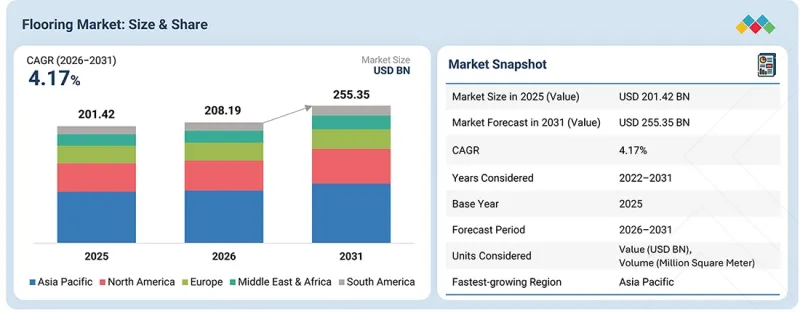
The flooring market is projected to reach USD 255.35 billion by 2031 from USD 208.19 billion in 2026, at a CAGR of 4.17% from 2026 to 2031.
| Scope of the Report | |
|---|---|
| Years Considered for the Study | 2022-2031 |
| Base Year | 2025 |
| Forecast Period | 2026-2032 |
| Units Considered | Value (USD Million) / Volume (Million Square Meters) |
| Segments | Material, Application, End-use Industry, and Region |
| Regions covered | North America, Asia Pacific, Europe, Middle East & Africa, and South America |
Demand for flooring is driven primarily by rapid urbanization, accelerating construction in the residential and commercial sectors, and a growing focus on sustainable, low-emission, durable building materials.
"Carpet & rugs projected to be second-largest segment during forecast period"
The carpet & rugs segment is estimated to account for the second-largest share of the overall flooring market during the forecast period. The segment's growth is supported by the increasing demand for carpets in residential, commercial, and hospitality sectors. Carpets are considered an integral part of interior decor because they provide comfort underfoot, improve acoustics and help define separate spaces in buildings. The trend of using carpets in different areas of residences is based on consumer demand for stylish and comfortable home interiors. The use of carpets in commercial sectors, such as hotels, offices, retail, and education, has also driven demand for products with stylish designs and practical features. The availability of carpets in a variety of materials, designs and colors has allowed sellers to meet demand for different product designs at different prices and budgets. Increasing consumer interest in interior changes contributes to carpet replacements, and the advent of modular carpets has made installation and maintenance easier in commercial spaces.
"Renovation to account for second-largest market share during forecast period"
The renovation segment is projected to account for the second-largest share of the flooring market during the forecast period. The market for this segment is driven by the modernization of existing buildings in the residential, commercial, and institutional sectors. It has become a common practice among house owners to renovate flooring that has become worn out, damaged, or simply outdated to improve the appearance of the interior, as well as to keep the price of the property high and increase the usability of the occupied premises. Flooring renovation is easier and cheaper than completely reconstructing an area. The need for renovations in developed countries is driven by the existing housing stock, which increases demand for flooring systems. Moreover, advancements in installation methods and the availability of products compatible with existing surfaces simplify certain refurbishment projects. These factors are expected to sustain renovation-related flooring demand and support its projected position as the second-largest application segment.
"Non-residential segment to account for second-largest share during forecast period"
The non-residential segment is projected to account for the second-largest share of the flooring market during the forecast period. The market for this segment is driven by the sustained investment in commercial real estate, institutional structures, and industrial developments. Flooring must meet specific demands for robustness, durability, aesthetics, safety, and ease of maintenance in offices, shops, hotels, hospitals, schools, and government offices. Growing activity in developing commercial real estate and upgrading existing buildings drives the demand for carpets, ceramic tiles, luxury vinyl tiles, and resilient flooring, among others. High-traffic areas have the highest requirements for slip and wear resistance, as well as ease of cleaning, which increases the use of flooring systems designed specifically for these applications. Periodic renovations of offices, hotels, clinics, and stores drive repeat replacement purchases. The increased focus on interior design and functional interior layout further influences flooring selection for commercial projects.
"North America projected to be the second-largest segment, in terms of value, during forecast period"
North America is projected to account for the second-largest share of the flooring market during the forecast period, supported by longstanding construction activity, substantial residential building stock and ongoing investment in updating commercial properties. In the US, new projects and renovation of existing buildings drive demand. Residential applications play a significant role in driving market growth. Demand for luxury vinyl tiles, engineered wood, laminate, ceramic tiles, and carpets is driven by varying consumer needs and the availability of products across price ranges. In commercial settings, flooring must deliver the right aesthetics while remaining durable and requiring minimal maintenance. Well-established distribution channels, retail outlets, and a wide range of flooring products are expected to sustain North America's strong market position throughout the forecast period.
By Company Type: Tier 1: 25%, Tier 2: 42%, and Tier 3: 33%
By Designation: C-level Executives: 20%, Directors: 30%, and Other Designations: 50%
By Region: North America: 20%, Europe: 10%, Asia Pacific: 40%, South America: 10%, and Middle East & Africa 20%
Notes: Other designations include sales, marketing, and product managers.
Tier 1: >USD 1 Billion; Tier 2: USD 500 million-1 Billion; and Tier 3: <USD 500 million
Companies Covered: Mohawk Industries, Inc. (US), Tarkett (France), Forbo Holding AG (Switzerland), Shaw Industries Group, Inc. (US), Interface, Inc. (US), TOLI Corporation (Japan), Beaulieu International Group (Belgium), Milliken & Company (US), Gerflor (France), and Kajaria Ceramics Limited (India), among others, are covered in the report.
The study includes an in-depth competitive analysis of these key players, including their company profiles, recent developments, and key market strategies.
Research Coverage
This research report categorizes the flooring market based on material (Carpet & Rugs, Resilient Flooring, Non-Resilient Flooring), application (New Construction, Renovation, Maintenance/Repair), end-use industry (Residential, Non-Residential), and region (North America, Europe, Asia Pacific, Middle East & Africa, and South America). The report's scope covers detailed information regarding the drivers, restraints, challenges, and opportunities influencing the growth of the flooring market. A detailed analysis of the key industry players has been done to provide insights into their business overview, products offered, and key strategies, such as partnerships, collaborations, product launches, expansions, and acquisitions, associated with the flooring market. This report covers a competitive analysis of upcoming startups in the flooring market ecosystem.
Reasons to Buy the Report
The report will offer market leaders/new entrants information on the closest approximations of the revenue numbers for the overall flooring market and the subsegments. This report will help stakeholders understand the competitive landscape, gain more insights into positioning their businesses better, and plan suitable go-to-market strategies. The report will help stakeholders understand the pulse of the market and provide them with information on key market drivers, restraints, challenges, and opportunities.
The report provides insights into the following points:
Analysis of key drivers (Increasing global construction expenditure, Renovation and replacement of existing flooring, Increasing flooring requirements in healthcare and educational infrastructure), restraints (Volatility in PVC, wood, and other flooring raw material costs, High logistics costs relative to product value), opportunities (Recycled and circular flooring systems, Bio-based and low-emission flooring materials, Modular and rapid-installation flooring solutions), and challenges (Meeting diverse regional building and environmental standards, High share of flooring replacement costs attributable to installation).
- Product Development/Innovation: Detailed insights into upcoming technologies, research & development activities, and product & service launches in the flooring market
- Market Development: Comprehensive information about profitable markets - the report analyzes the flooring market across varied regions.
Market Diversification: Exhaustive information about new products & services, untapped geographies, recent developments, and investments in the flooring market
- Competitive Assessment: In-depth assessment of market shares, growth strategies, and service offerings of leading players, such as Mohawk Industries, Inc. (US), Tarkett (France), Forbo Holding AG (Switzerland), Shaw Industries Group, Inc. (US), Interface, Inc. (US), TOLI Corporation (Japan), Beaulieu International Group (Belgium), Milliken & Company (US), Gerflor (France), and Kajaria Ceramics Limited (India)
TABLE OF CONTENTS
1 INTRODUCTION
- 1.1 STUDY OBJECTIVES
- 1.2 MARKET DEFINITION
- 1.3 STUDY SCOPE
- 1.3.1 MARKETS COVERED & REGIONAL SCOPE
- 1.3.2 INCLUSIONS & EXCLUSIONS
- 1.3.3 YEARS CONSIDERED
- 1.3.4 CURRENCY CONSIDERED
- 1.3.5 UNIT CONSIDERED
- 1.3.6 STAKEHOLDERS
- 1.4 SUMMARY OF STRATEGIC CHANGES
2 EXECUTIVE SUMMARY
- 2.1 KEY INSIGHTS AND MARKET HIGHLIGHTS
- 2.2 KEY MARKET PARTICIPANTS: SHARE INSIGHTS AND STRATEGIC DEVELOPMENTS
- 2.3 DISRUPTIVE TRENDS SHAPING MARKET
- 2.4 HIGH-GROWTH SEGMENTS AND EMERGING FRONTIERS
- 2.5 SNAPSHOT: GLOBAL MARKET SIZE, GROWTH RATE, AND FORECAST
3 PREMIUM INSIGHTS
- 3.1 ATTRACTIVE OPPORTUNITIES FOR PLAYERS IN FLOORING MARKET
- 3.2 FLOORING MARKET, BY MATERIAL AND APPLICATION
- 3.3 FLOORING MARKET, BY COUNTRY
4 MARKET OVERVIEW
- 4.1 INTRODUCTION
- 4.2 MARKET DYNAMICS
- 4.2.1 DRIVERS
- 4.2.1.1 Increasing global construction expenditure
- 4.2.1.2 Renovation and replacement of existing flooring
- 4.2.1.3 Increasing flooring requirements in healthcare and educational infrastructure
- 4.2.2 RESTRAINTS
- 4.2.2.1 Volatility in PVC, wood, and other flooring raw material costs
- 4.2.2.2 High logistics costs relative to product value
- 4.2.3 OPPORTUNITIES
- 4.2.3.1 Recycled and circular flooring systems
- 4.2.3.2 Bio-based and low-emission flooring materials
- 4.2.3.3 Modular and rapid-installation flooring solutions
- 4.2.4 CHALLENGES
- 4.2.4.1 Meeting diverse regional building and environmental standards
- 4.2.4.2 High installation costs increase total cost of flooring replacement
- 4.2.1 DRIVERS
- 4.3 UNMET NEEDS AND WHITE SPACES
- 4.3.1 UNMET NEEDS
- 4.3.1.1 High-durability flooring with localized repairability and extended service life
- 4.3.1.2 Reliable flooring installation over variable substrates without extensive preparation
- 4.3.2 WHITE SPACES
- 4.3.2.1 Sensor-integrated flooring for occupancy monitoring and infrastructure condition assessment
- 4.3.2.2 Fully circular flooring systems designed for multiple installation and material-recovery cycles
- 4.3.1 UNMET NEEDS
- 4.4 INTERCONNECTED MARKETS AND CROSS-SECTOR OPPORTUNITIES
- 4.4.1 INTERCONNECTED MARKETS
- 4.4.2 CROSS-SECTOR OPPORTUNITIES
- 4.5 STRATEGIC MOVES BY TIER 1/2/3 PLAYERS
5 INDUSTRY TRENDS
- 5.1 PORTER'S FIVE FORCES ANALYSIS
- 5.1.1 THREAT OF NEW ENTRANTS
- 5.1.2 THREAT OF SUBSTITUTES
- 5.1.3 BARGAINING POWER OF SUPPLIERS
- 5.1.4 BARGAINING POWER OF BUYERS
- 5.1.5 INTENSITY OF COMPETITIVE RIVALRY
- 5.2 MACROECONOMIC ANALYSIS
- 5.2.1 INTRODUCTION
- 5.2.2 GDP TRENDS AND FORECASTS
- 5.2.3 TRENDS IN GLOBAL CONSTRUCTION INDUSTRY
- 5.3 VALUE CHAIN ANALYSIS
- 5.4 ECOSYSTEM ANALYSIS
- 5.5 PRICING ANALYSIS
- 5.5.1 AVERAGE SELLING PRICE TREND, BY MATERIAL, 2025
- 5.5.2 AVERAGE SELLING PRICE TREND, BY REGION, 2021-2025
- 5.6 TRADE ANALYSIS
- 5.6.1 EXPORT DATA FOR HS CODE 690100
- 5.6.2 IMPORT DATA FOR HS CODE 690100
- 5.6.3 EXPORT DATA FOR HS CODE 5703
- 5.6.4 IMPORT DATA FOR HS CODE 5703
- 5.7 KEY CONFERENCES AND EVENTS, 2026-2027
- 5.8 TRENDS AND DISRUPTIONS IMPACTING CUSTOMER BUSINESS
- 5.9 INVESTMENT AND FUNDING SCENARIO
- 5.10 CASE STUDY ANALYSIS
- 5.10.1 MOHAWK INDUSTRIES, INC.: NATIONAL BUILDING MUSEUM, WASHINGTON, D.C., US
- 5.10.2 FORBO FLOORING SYSTEMS AT HSBC OFFICES, INDIA
- 5.10.3 TARKETT SPORTS: CHANNEL ISLANDS HIGH SCHOOL, CALIFORNIA, US
- 5.11 IMPACT OF 2025 US TARIFF ON FLOORING MARKET
- 5.11.1 INTRODUCTION
- 5.11.2 PRICE IMPACT ANALYSIS
- 5.11.3 KEY IMPACT ON VARIOUS REGIONS
- 5.11.3.1 US
- 5.11.3.2 Europe
- 5.11.3.3 Asia Pacific
- 5.11.4 END-USE SECTOR IMPACT
6 STRATEGIC DISRUPTION THROUGH TECHNOLOGY, PATENTS, DIGITAL, AND AI ADOPTIONS
- 6.1 KEY EMERGING TECHNOLOGIES
- 6.1.1 RIGID CORE SPC FLOORING TECHNOLOGY
- 6.1.2 CLICK-LOCK FLOORING INSTALLATION TECHNOLOGY
- 6.1.3 UV-CURED SURFACE COATING TECHNOLOGY
- 6.2 COMPLEMENTARY TECHNOLOGIES
- 6.2.1 UNDERFLOOR HEATING SYSTEMS
- 6.2.2 MOISTURE BARRIER SYSTEMS
- 6.3 ADJACENT TECHNOLOGIES
- 6.3.1 BUILDING INFORMATION MODELING (BIM)
- 6.3.2 DIGITAL TWIN TECHNOLOGY FOR BUILDINGS
- 6.4 TECHNOLOGY/PRODUCT ROADMAP
- 6.4.1 SHORT-TERM (2025-2027): PERFORMANCE OPTIMIZATION & INSTALLATION EFFICIENCY PHASE
- 6.4.2 MID-TERM (2027-2030): MATERIAL CIRCULARITY & INTEGRATED FLOORING SYSTEMS PHASE
- 6.4.3 LONG-TERM (2030-2035+): INTELLIGENT & CIRCULAR FLOORING ECOSYSTEM PHASE
- 6.5 PATENT ANALYSIS
- 6.5.1 INTRODUCTION
- 6.5.2 APPROACH
- 6.5.3 TOP APPLICANTS
- 6.5.4 JURISDICTION ANALYSIS
- 6.6 FUTURE APPLICATIONS
- 6.6.1 TRIBOELECTRIC ENERGY-GENERATING FLOORING
- 6.6.2 SELF-HEALING MINERAL FLOORING
- 6.6.3 PHOTOCATALYTIC AIR-PURIFYING FLOORING
- 6.6.4 ELECTRICALLY RESPONSIVE FLOORING FOR DYNAMIC VISUAL GUIDANCE
- 6.6.5 MECHANICALLY ADAPTIVE IMPACT-ABSORBING FLOORING
- 6.7 IMPACT OF AI/GEN AI ON FLOORING MARKET
- 6.7.1 TOP USE CASES AND MARKET POTENTIAL
- 6.7.2 BEST PRACTICES FOLLOWED BY MANUFACTURERS/OEMS IN FLOORING
- 6.7.3 CASE STUDIES OF AI IMPLEMENTATION IN FLOORING MARKET
- 6.7.4 INTERCONNECTED ECOSYSTEM AND IMPACT ON MARKET PLAYERS
- 6.7.5 CLIENTS' READINESS TO ADAPT AI-INTEGRATED FLOORING
7 SUSTAINABILITY AND REGULATORY LANDSCAPE
- 7.1 REGIONAL REGULATIONS AND COMPLIANCE
- 7.1.1 REGULATORY BODIES, GOVERNMENT AGENCIES, AND OTHER ORGANIZATIONS
- 7.1.2 INDUSTRY STANDARDS
- 7.1.3 ECO APPLICATIONS IN FLOORING
- 7.1.3.1 Circular Flooring Systems for Commercial Refurbishment
- 7.1.3.2 Bio-Based Flooring for Low-Impact Interior Spaces
- 7.1.3.3 Recycled Content in Carpet Tiles and Resilient Flooring
- 7.2 IMPACT OF REGULATORY POLICIES ON SUSTAINABILITY INITIATIVES
- 7.3 CERTIFICATIONS, LABELING, ECO-STANDARDS
8 CUSTOMER LANDSCAPE AND BUYER BEHAVIOR
- 8.1 DECISION-MAKING PROCESS
- 8.2 KEY STAKEHOLDERS INVOLVED IN BUYING PROCESS AND THEIR EVALUATION CRITERIA
- 8.2.1 KEY STAKEHOLDERS IN BUYING PROCESS
- 8.2.2 BUYING CRITERIA
- 8.3 ADOPTION BARRIERS & INTERNAL CHALLENGES
- 8.4 UNMET NEEDS FROM VARIOUS APPLICATIONS
- 8.5 MARKET PROFITABILITY
- 8.5.1 REVENUE POTENTIAL
- 8.5.2 COST DYNAMICS
- 8.6 MARGIN OPPORTUNITIES, BY END-USE INDUSTRY
- 8.6.1 RESIDENTIAL
- 8.6.2 NON-RESIDENTIAL
9 FLOORING MARKET, BY MATERIAL
- 9.1 INTRODUCTION
- 9.2 CARPETS AND RUGS
- 9.2.1 CARPETS & RUGS RETAIN STRATEGIC RELEVANCE THROUGH COMFORT, ACOUSTIC PERFORMANCE, AND INTERIOR RENOVATION DEMAND
- 9.3 RESILIENT FLOORING
- 9.3.1 VINYL
- 9.3.2 OTHER RESILIENT FLOORING TYPES (CORK, LINOLEUM, RUBBER, AND RESIN)
- 9.4 NON-RESILIENT FLOORING
- 9.4.1 CERAMIC TILES
- 9.4.2 WOOD
- 9.4.3 LAMINATE
- 9.4.4 STONE
- 9.4.5 OTHER NON-RESILIENT FLOORING TYPES (BAMBOO, TERRAZZO)
10 FLOORING MARKET, BY APPLICATION
- 10.1 INTRODUCTION
- 10.2 NEW CONSTRUCTION
- 10.2.1 NEW CONSTRUCTION EXPANDS FLOORING DEMAND ACROSS RESIDENTIAL AND COMMERCIAL BUILDING PROJECTS
- 10.3 RENOVATION
- 10.3.1 RENOVATION EXPANDS FLOORING DEMAND THROUGH MODERNIZATION AND REPLACEMENT OF EXISTING SURFACES
- 10.4 MAINTENANCE/REPAIR
- 10.4.1 MAINTENANCE AND REPAIR SUSTAIN FLOORING DEMAND THROUGH TARGETED RESTORATION AND SERVICE LIFE EXTENSION
11 FLOORING MARKET, BY END-USE INDUSTRY
- 11.1 INTRODUCTION
- 11.2 RESIDENTIAL
- 11.2.1 RESIDENTIAL FLOORING DEMAND STRENGTHENS THROUGH HOUSING DEVELOPMENT AND HOME MODERNIZATION
- 11.3 NON-RESIDENTIAL
- 11.3.1 NON-RESIDENTIAL FLOORING DEMAND ADVANCES THROUGH SPECIALIZED PERFORMANCE REQUIREMENTS ACROSS COMMERCIAL AND INSTITUTIONAL BUILDINGS
12 FLOORING MARKET, BY REGION
- 12.1 INTRODUCTION
- 12.2 ASIA PACIFIC
- 12.2.1 CHINA
- 12.2.1.1 China's flooring market faces contrasting trends in infrastructure upgrades and building construction
- 12.2.2 INDIA
- 12.2.2.1 India's flooring market gains support from infrastructure spending and large-scale housing development
- 12.2.3 JAPAN
- 12.2.3.1 Japan's flooring market gains support from public works investment and residential stabilization
- 12.2.4 SOUTH KOREA
- 12.2.4.1 South Korea's flooring market reflects diverging housing supply and regional construction conditions
- 12.2.5 AUSTRALIA
- 12.2.5.1 Australia's flooring market benefits from construction growth and residential building activity
- 12.2.6 REST OF ASIA PACIFIC
- 12.2.1 CHINA
- 12.3 NORTH AMERICA
- 12.3.1 US
- 12.3.1.1 US flooring market benefits from broad construction growth and residential recovery
- 12.3.2 CANADA
- 12.3.2.1 Canada's flooring market gains support from residential construction and commercial investment
- 12.3.3 MEXICO
- 12.3.3.1 Mexico's flooring market gains momentum from housing and industrial construction
- 12.3.1 US
- 12.4 EUROPE
- 12.4.1 GERMANY
- 12.4.1.1 Germany's flooring market gains future momentum from rising housing approvals and residential development
- 12.4.2 UK
- 12.4.2.1 The UK flooring market gains support from construction investment and infrastructure development
- 12.4.3 FRANCE
- 12.4.3.1 France's flooring market gains support from housing stock and green industrial investment
- 12.4.4 RUSSIA
- 12.4.4.1 Russia's flooring market gains support from construction growth and individual housing development
- 12.4.5 SPAIN
- 12.4.5.1 Spain's flooring market gains momentum from housing development and energy-efficient renovation
- 12.4.6 NETHERLANDS
- 12.4.6.1 The Netherlands' flooring market benefits from construction growth and commercial building investment
- 12.4.7 REST OF EUROPE
- 12.4.1 GERMANY
- 12.5 MIDDLE EAST & AFRICA
- 12.5.1 GCC COUNTRIES
- 12.5.2 SAUDI ARABIA
- 12.5.2.1 Saudi Arabia's flooring market benefits from public investment and hospitality development
- 12.5.3 UAE
- 12.5.3.1 UAE flooring market benefits from construction growth and high-density development
- 12.5.4 REST OF GCC COUNTRIES
- 12.5.5 TURKEY
- 12.5.5.1 Turkey's flooring market gains momentum from reconstruction spending and housing development
- 12.5.6 SOUTH AFRICA
- 12.5.6.1 South Africa's flooring market gains support from building approvals and construction completions
- 12.5.7 REST OF MIDDLE EAST & AFRICA
- 12.6 SOUTH AMERICA
- 12.6.1 BRAZIL
- 12.6.1.1 Brazil's flooring market benefits from affordable housing expansion and construction sector growth
- 12.6.2 ARGENTINA
- 12.6.2.1 Argentina's flooring market draws support from construction activity and residential development
- 12.6.3 REST OF SOUTH AMERICA
- 12.6.1 BRAZIL
13 COMPETITIVE LANDSCAPE
- 13.1 OVERVIEW
- 13.2 KEY PLAYER STRATEGIES/RIGHT TO WIN
- 13.3 REVENUE ANALYSIS, 2021-2025
- 13.4 MARKET RANKING ANALYSIS, 2025
- 13.5 BRAND COMPARISON
- 13.6 COMPANY EVALUATION MATRIX: KEY PLAYERS, 2025
- 13.6.1 STARS
- 13.6.2 EMERGING LEADERS
- 13.6.3 PERVASIVE PLAYERS
- 13.6.4 PARTICIPANTS
- 13.6.5 COMPANY FOOTPRINT: KEY PLAYERS, 2025
- 13.6.5.1 Company footprint
- 13.6.5.2 Region footprint
- 13.6.5.3 Material footprint
- 13.6.5.4 Application footprint
- 13.6.5.5 End-use industry footprint
- 13.7 COMPANY EVALUATION MATRIX: STARTUPS/SMES, 2025
- 13.7.1 PROGRESSIVE COMPANIES
- 13.7.2 RESPONSIVE COMPANIES
- 13.7.3 DYNAMIC COMPANIES
- 13.7.4 STARTING BLOCKS
- 13.7.5 COMPETITIVE BENCHMARKING: STARTUPS/SMES, 2025
- 13.7.5.1 List of key startups/SMEs
- 13.7.5.2 Competitive benchmarking of key startups/SMEs
- 13.8 COMPANY VALUATION AND FINANCIAL METRICS
- 13.8.1 COMPANY VALUATION
- 13.9 FINANCIAL METRICS
- 13.10 COMPETITIVE SCENARIO
- 13.10.1 DEALS
- 13.10.2 EXPANSIONS
14 COMPANY PROFILES
- 14.1 KEY PLAYERS
- 14.1.1 MOHAWK INDUSTRIES, INC.
- 14.1.1.1 Business overview
- 14.1.1.2 Products/Solutions/Services offered
- 14.1.1.3 Recent developments
- 14.1.1.3.1 Product launches
- 14.1.1.3.2 Deals
- 14.1.1.3.3 Expansions
- 14.1.1.4 MnM view
- 14.1.1.4.1 Right to win
- 14.1.1.4.2 Strategic choices
- 14.1.1.4.3 Weakness and competitive threats
- 14.1.2 TARKETT
- 14.1.2.1 Business overview
- 14.1.2.2 Products/Solutions/Services offered
- 14.1.2.3 Recent developments
- 14.1.2.3.1 Product launches
- 14.1.2.3.2 Deals
- 14.1.2.4 MnM view
- 14.1.2.4.1 Right to win
- 14.1.2.4.2 Strategic choices
- 14.1.2.4.3 Weaknesses and competitive threats
- 14.1.3 FORBO HOLDING AG
- 14.1.3.1 Business overview
- 14.1.3.2 Products/Solutions/Services offered
- 14.1.3.3 Recent developments
- 14.1.3.3.1 Product launches
- 14.1.3.3.2 Deals
- 14.1.3.3.3 Expansions
- 14.1.3.4 MnM view
- 14.1.3.4.1 Right to win
- 14.1.3.4.2 Strategic choices
- 14.1.3.4.3 Weaknesses and competitive threats
- 14.1.4 SHAW INDUSTRIES GROUP, INC.
- 14.1.4.1 Business overview
- 14.1.4.2 Products/Solutions/Services offered
- 14.1.4.3 Recent developments
- 14.1.4.3.1 Product launches
- 14.1.4.3.2 Deals
- 14.1.4.3.3 Expansions
- 14.1.4.4 MnM view
- 14.1.4.4.1 Right to win
- 14.1.4.4.2 Strategic choices
- 14.1.4.4.3 Weaknesses & competitive threats
- 14.1.5 INTERFACE, INC.
- 14.1.5.1 Business overview
- 14.1.5.2 Products/Solutions/Services offered
- 14.1.5.3 Recent developments
- 14.1.5.3.1 Product launches
- 14.1.5.3.2 Expansions
- 14.1.5.4 MnM view
- 14.1.5.4.1 Right to win
- 14.1.5.4.2 Strategic choices
- 14.1.5.4.3 Weaknesses and competitive threats
- 14.1.6 TOLI CORPORATION
- 14.1.6.1 Business overview
- 14.1.6.2 Products/Solutions/Services offered
- 14.1.6.3 Recent developments
- 14.1.6.3.1 Product launches
- 14.1.6.3.2 Deals
- 14.1.6.3.3 Expansions
- 14.1.6.4 MnM view
- 14.1.7 BEAULIEU INTERNATIONAL GROUP
- 14.1.7.1 Business overview
- 14.1.7.2 Products/Solutions/Services offered
- 14.1.7.3 Recent developments
- 14.1.7.3.1 Product launches
- 14.1.7.3.2 Deals
- 14.1.7.3.3 Expansions
- 14.1.7.4 MnM view
- 14.1.8 MILLIKEN & COMPANY
- 14.1.8.1 Business overview
- 14.1.8.2 Products/Solutions/Services offered
- 14.1.8.3 Recent developments
- 14.1.8.3.1 Product launches
- 14.1.8.3.2 Deals
- 14.1.8.4 MnM view
- 14.1.9 GERFLOR
- 14.1.9.1 Business overview
- 14.1.9.2 Products/Solutions/Services offered
- 14.1.9.3 Recent developments
- 14.1.9.3.1 Product launches
- 14.1.9.3.2 Deals
- 14.1.9.3.3 Expansions
- 14.1.9.4 MnM view
- 14.1.10 KAJARIA CERAMICS LIMITED
- 14.1.10.1 Business overview
- 14.1.10.2 Products/Solutions/Services offered
- 14.1.10.3 Recent developments
- 14.1.10.3.1 Deals
- 14.1.10.3.2 Expansions
- 14.1.10.4 MnM view
- 14.1.1 MOHAWK INDUSTRIES, INC.
- 14.2 OTHER PLAYERS
- 14.2.1 JAMES HALSTEAD PLC
- 14.2.2 DIXIE GROUP, INC.
- 14.2.3 VICTORIA PLC
- 14.2.4 LX HAUSYS, LTD.
- 14.2.5 CFL FLOORING
- 14.2.6 MANNINGTON MILLS, INC.
- 14.2.7 SWISS KRONO GROUP
- 14.2.8 KAHRS GROUP
- 14.2.9 AHF PRODUCTS
- 14.2.10 INVISTA
- 14.2.11 ORIENTAL WEAVERS
- 14.2.12 NOX CORPORATION
- 14.2.13 FRITZ EGGER GMBH & CO. OG
- 14.2.14 WELSPUN FLOORING
- 14.2.15 HAMBERGER FLOORING GMBH & CO. KG
15 RESEARCH METHODOLOGY
- 15.1 RESEARCH DATA
- 15.1.1 SECONDARY DATA
- 15.1.1.1 Key data from secondary sources
- 15.1.2 PRIMARY DATA
- 15.1.2.1 Key data from primary sources
- 15.1.3 KEY INDUSTRY INSIGHTS
- 15.1.4 BREAKDOWN OF INTERVIEWS WITH EXPERTS
- 15.1.1 SECONDARY DATA
- 15.2 MARKET SIZE ESTIMATION
- 15.3 GROWTH FORECAST
- 15.4 DATA TRIANGULATION
- 15.5 RESEARCH ASSUMPTIONS
- 15.6 RISK ASSESSMENT
- 15.7 FACTOR ANALYSIS
- 15.8 RESEARCH LIMITATIONS
16 APPENDIX
- 16.1 DISCUSSION GUIDE
- 16.2 KNOWLEDGESTORE: MARKETSANDMARKETS' SUBSCRIPTION PORTAL
- 16.3 CUSTOMIZATION OPTIONS
- 16.4 RELATED REPORTS
- 16.5 AUTHOR DETAILS
List of Tables
- TABLE 1 FLOORING NEW INSTALLATION VS. RENOVATION EFFICIENCY ANALYSIS
- TABLE 2 INTERCONNECTED MARKETS AND APPLICATIONS IN FLOORING MARKET
- TABLE 3 CROSS-SECTOR OPPORTUNITIES
- TABLE 4 STRATEGIC MOVES BY TIER 1/2/3 PLAYERS: KEY MOVES AND STRATEGIC FOCUS
- TABLE 5 PORTER'S FIVE FORCES ANALYSIS
- TABLE 6 WORLD REAL GDP (ANNUAL PERCENTAGE CHANGE) OF DIFFERENT REGIONS, 2024-2026
- TABLE 7 WORLD REAL GDP (ANNUAL PERCENTAGE CHANGE) OF TOP COUNTRIES, 2024-2026
- TABLE 8 ROLES OF COMPANIES IN FLOORING ECOSYSTEM
- TABLE 9 AVERAGE SELLING PRICE TREND, BY MATERIAL, 2025 (USD/SQUARE METER)
- TABLE 10 AVERAGE SELLING PRICE TREND OF FLOORING, BY REGION, 2021-2025 (USD/SQUARE METER)
- TABLE 11 EXPORT DATA FOR HS CODE 690100, BY COUNTRY, 2021-2025 (USD THOUSAND)
- TABLE 12 IMPORT DATA FOR HS CODE 690100, BY COUNTRY, 2021-2025 (USD THOUSAND)
- TABLE 13 EXPORT DATA FOR HS CODE 5703, BY COUNTRY, 2021-2025 (USD THOUSAND)
- TABLE 14 IMPORT DATA FOR HS CODE 5703, BY COUNTRY, 2021-2025 (USD THOUSAND)
- TABLE 15 FLOORING: KEY CONFERENCES AND EVENTS, 2026-2027
- TABLE 16 US TARIFF TABLE - FLOORING
- TABLE 17 END-USE INDUSTRY IMPACT
- TABLE 18 FLOORING KEY PATENTS, 2025
- TABLE 19 TOP USE CASES AND MARKET POTENTIAL
- TABLE 20 BEST PRACTICES: COMPANIES IMPLEMENTING USE CASES
- TABLE 21 FLOORING MARKET: CASE STUDIES RELATED TO GEN AI IMPLEMENTATION
- TABLE 22 NORTH AMERICA: LIST OF REGULATORY BODIES, GOVERNMENT AGENCIES, AND OTHER ORGANIZATIONS
- TABLE 23 EUROPE: LIST OF REGULATORY BODIES, GOVERNMENT AGENCIES, AND OTHER ORGANIZATIONS
- TABLE 24 ASIA PACIFIC: LIST OF REGULATORY BODIES, GOVERNMENT AGENCIES, AND OTHER ORGANIZATIONS
- TABLE 25 SOUTH AMERICA: LIST OF REGULATORY BODIES, GOVERNMENT AGENCIES, AND OTHER ORGANIZATIONS
- TABLE 26 MIDDLE EAST & AFRICA: LIST OF REGULATORY BODIES, GOVERNMENT AGENCIES, AND OTHER ORGANIZATIONS
- TABLE 27 GLOBAL INDUSTRY STANDARDS IN FLOORING MARKET
- TABLE 28 CERTIFICATIONS, LABELING, ECO-STANDARDS IN FLOORING MARKET
- TABLE 29 INFLUENCE OF STAKEHOLDERS ON BUYING PROCESS FOR END-USE INDUSTRIES
- TABLE 30 KEY BUYING CRITERIA FOR END-USE INDUSTRIES
- TABLE 31 UNMET NEEDS IN FLOORING MARKET BY APPLICATIONS
- TABLE 32 FLOORING MARKET, BY MATERIAL, 2021-2024 (USD MILLION)
- TABLE 33 FLOORING MARKET, BY MATERIAL, 2025-2031 (USD MILLION)
- TABLE 34 FLOORING MARKET, BY MATERIAL, 2021-2024 (MILLION SQUARE METERS)
- TABLE 35 FLOORING MARKET, BY MATERIAL, 2025-2031 (MILLION SQUARE METERS)
- TABLE 36 FLOORING MARKET, BY APPLICATION, 2021-2024 (USD MILLION)
- TABLE 37 FLOORING MARKET, BY APPLICATION, 2025-2031 (USD MILLION)
- TABLE 38 FLOORING MARKET, BY APPLICATION, 2021-2024 (MILLION SQUARE METERS)
- TABLE 39 FLOORING MARKET, BY APPLICATION, 2025-2031 (MILLION SQUARE METERS)
- TABLE 40 FLOORING MARKET, BY END-USE INDUSTRY, 2021-2024 (USD MILLION)
- TABLE 41 FLOORING MARKET, BY END-USE INDUSTRY, 2025-2031 (USD MILLION)
- TABLE 42 FLOORING MARKET, BY END-USE INDUSTRY, 2021-2024 (MILLION SQUARE METERS)
- TABLE 43 FLOORING MARKET, BY END-USE INDUSTRY, 2025-2031 (MILLION SQUARE METERS)
- TABLE 44 FLOORING MARKET, BY REGION, 2021-2024 (USD MILLION)
- TABLE 45 FLOORING MARKET, BY REGION, 2025-2031 (USD MILLION)
- TABLE 46 FLOORING MARKET, BY REGION, 2021-2024 (MILLION SQUARE METERS)
- TABLE 47 FLOORING MARKET, BY REGION, 2025-2031 (MILLION SQUARE METERS)
- TABLE 48 ASIA PACIFIC: FLOORING MARKET, BY COUNTRY, 2021-2024 (USD MILLION)
- TABLE 49 ASIA PACIFIC: FLOORING MARKET, BY COUNTRY, 2025-2031 (USD MILLION)
- TABLE 50 ASIA PACIFIC: FLOORING MARKET, BY COUNTRY, 2021-2024 (MILLION SQUARE METERS)
- TABLE 51 ASIA PACIFIC: FLOORING MARKET, BY COUNTRY, 2025-2031 (MILLION SQUARE METERS)
- TABLE 52 ASIA PACIFIC: FLOORING MARKET, BY MATERIAL, 2021-2024 (USD MILLION)
- TABLE 53 ASIA PACIFIC: FLOORING MARKET, BY MATERIAL, 2025-2031 (USD MILLION)
- TABLE 54 ASIA PACIFIC: FLOORING MARKET, BY MATERIAL, 2021-2024 (MILLION SQUARE METERS)
- TABLE 55 ASIA PACIFIC: FLOORING MARKET, BY MATERIAL, 2025-2031 (MILLION SQUARE METERS)
- TABLE 56 ASIA PACIFIC: FLOORING MARKET, BY END-USE INDUSTRY, 2021-2024 (USD MILLION)
- TABLE 57 ASIA PACIFIC: FLOORING MARKET, BY END-USE INDUSTRY, 2025-2031 (USD MILLION)
- TABLE 58 ASIA PACIFIC: FLOORING MARKET, BY END-USE INDUSTRY, 2021-2024 (MILLION SQUARE METERS)
- TABLE 59 ASIA PACIFIC: FLOORING MARKET, BY END-USE INDUSTRY, 2025-2031 (MILLION SQUARE METERS)
- TABLE 60 CHINA: FLOORING MARKET, BY MATERIAL, 2021-2024 (USD MILLION)
- TABLE 61 CHINA: FLOORING MARKET, BY MATERIAL, 2025-2031 (USD MILLION)
- TABLE 62 CHINA: FLOORING MARKET, BY MATERIAL, 2021-2024 (MILLION SQUARE METERS)
- TABLE 63 CHINA: FLOORING MARKET, BY MATERIAL, 2025-2031 (MILLION SQUARE METERS)
- TABLE 64 CHINA: FLOORING MARKET, BY END-USE INDUSTRY, 2021-2024 (USD MILLION)
- TABLE 65 CHINA: FLOORING MARKET, BY END-USE INDUSTRY, 2025-2031 (USD MILLION)
- TABLE 66 CHINA: FLOORING MARKET, BY END-USE INDUSTRY, 2021-2024 (MILLION SQUARE METERS)
- TABLE 67 CHINA: FLOORING MARKET, BY END-USE INDUSTRY, 2025-2031 (MILLION SQUARE METERS)
- TABLE 68 INDIA: FLOORING MARKET, BY MATERIAL, 2021-2024 (USD MILLION)
- TABLE 69 INDIA: FLOORING MARKET, BY MATERIAL, 2025-2031 (USD MILLION)
- TABLE 70 INDIA: FLOORING MARKET, BY MATERIAL, 2021-2024 (MILLION SQUARE METERS)
- TABLE 71 INDIA: FLOORING MARKET, BY MATERIAL, 2025-2031 (MILLION SQUARE METERS)
- TABLE 72 INDIA: FLOORING MARKET, BY END-USE INDUSTRY, 2021-2024 (USD MILLION)
- TABLE 73 INDIA: FLOORING MARKET, BY END-USE INDUSTRY, 2025-2031 (USD MILLION)
- TABLE 74 INDIA: FLOORING MARKET, BY END-USE INDUSTRY, 2021-2024 (MILLION SQUARE METERS)
- TABLE 75 INDIA: FLOORING MARKET, BY END-USE INDUSTRY, 2025-2031 (MILLION SQUARE METERS)
- TABLE 76 JAPAN: FLOORING MARKET, BY MATERIAL, 2021-2024 (USD MILLION)
- TABLE 77 JAPAN: FLOORING MARKET, BY MATERIAL, 2025-2031 (USD MILLION)
- TABLE 78 JAPAN: FLOORING MARKET, BY MATERIAL, 2021-2024 (MILLION SQUARE METERS)
- TABLE 79 JAPAN: FLOORING MARKET, BY MATERIAL, 2025-2031 (MILLION SQUARE METERS)
- TABLE 80 JAPAN: FLOORING MARKET, BY END-USE INDUSTRY, 2021-2024 (USD MILLION)
- TABLE 81 JAPAN: FLOORING MARKET, BY END-USE INDUSTRY, 2025-2031 (USD MILLION)
- TABLE 82 JAPAN: FLOORING MARKET, BY END-USE INDUSTRY, 2021-2024 (MILLION SQUARE METERS)
- TABLE 83 JAPAN: FLOORING MARKET, BY END-USE INDUSTRY, 2025-2031 (MILLION SQUARE METERS)
- TABLE 84 SOUTH KOREA: FLOORING MARKET, BY MATERIAL, 2021-2024 (USD MILLION)
- TABLE 85 SOUTH KOREA: FLOORING MARKET, BY MATERIAL, 2025-2031 (USD MILLION)
- TABLE 86 SOUTH KOREA: FLOORING MARKET, BY MATERIAL, 2021-2024 (MILLION SQUARE METERS)
- TABLE 87 SOUTH KOREA: FLOORING MARKET, BY MATERIAL, 2025-2031 (MILLION SQUARE METERS)
- TABLE 88 SOUTH KOREA: FLOORING MARKET, BY END-USE INDUSTRY, 2021-2024 (USD MILLION)
- TABLE 89 SOUTH KOREA: FLOORING MARKET, BY END-USE INDUSTRY, 2025-2031 (USD MILLION)
- TABLE 90 SOUTH KOREA: FLOORING MARKET, BY END-USE INDUSTRY, 2021-2024 (MILLION SQUARE METERS)
- TABLE 91 SOUTH KOREA: FLOORING MARKET, BY END-USE INDUSTRY, 2025-2031 (MILLION SQUARE METERS)
- TABLE 92 AUSTRALIA: FLOORING MARKET, BY MATERIAL, 2021-2024 (USD MILLION)
- TABLE 93 AUSTRALIA: FLOORING MARKET, BY MATERIAL, 2025-2031 (USD MILLION)
- TABLE 94 AUSTRALIA: FLOORING MARKET, BY MATERIAL, 2021-2024 (MILLION SQUARE METERS)
- TABLE 95 AUSTRALIA: FLOORING MARKET, BY MATERIAL, 2025-2031 (MILLION SQUARE METERS)
- TABLE 96 AUSTRALIA: FLOORING MARKET, BY END-USE INDUSTRY, 2021-2024 (USD MILLION)
- TABLE 97 AUSTRALIA: FLOORING MARKET, BY END-USE INDUSTRY, 2025-2031 (USD MILLION)
- TABLE 98 AUSTRALIA: FLOORING MARKET, BY END-USE INDUSTRY, 2021-2024 (MILLION SQUARE METERS)
- TABLE 99 AUSTRALIA: FLOORING MARKET, BY END-USE INDUSTRY, 2025-2031 (MILLION SQUARE METERS)
- TABLE 100 REST OF ASIA PACIFIC: FLOORING MARKET, BY MATERIAL, 2021-2024 (USD MILLION)
- TABLE 101 REST OF ASIA PACIFIC: FLOORING MARKET, BY MATERIAL, 2025-2031 (USD MILLION)
- TABLE 102 REST OF ASIA PACIFIC: FLOORING MARKET, BY MATERIAL, 2021-2024 (MILLION SQUARE METERS)
- TABLE 103 REST OF ASIA PACIFIC: FLOORING MARKET, BY MATERIAL, 2025-2031 (MILLION SQUARE METERS)
- TABLE 104 REST OF ASIA PACIFIC: FLOORING MARKET, BY END-USE INDUSTRY, 2021-2024 (USD MILLION)
- TABLE 105 REST OF ASIA PACIFIC: FLOORING MARKET, BY END-USE INDUSTRY, 2025-2031 (USD MILLION)
- TABLE 106 REST OF ASIA PACIFIC: FLOORING MARKET, BY END-USE INDUSTRY, 2021-2024 (MILLION SQUARE METERS)
- TABLE 107 REST OF ASIA PACIFIC: FLOORING MARKET, BY END-USE INDUSTRY, 2025-2031 (MILLION SQUARE METERS)
- TABLE 108 NORTH AMERICA: FLOORING MARKET, BY COUNTRY, 2021-2024 (USD MILLION)
- TABLE 109 NORTH AMERICA: FLOORING MARKET, BY COUNTRY, 2025-2031 (USD MILLION)
- TABLE 110 NORTH AMERICA: FLOORING MARKET, BY COUNTRY, 2021-2024 (MILLION SQUARE METERS)
- TABLE 111 NORTH AMERICA: FLOORING MARKET, BY COUNTRY, 2025-2031 (MILLION SQUARE METERS)
- TABLE 112 NORTH AMERICA: FLOORING MARKET, BY MATERIAL, 2021-2024 (USD MILLION)
- TABLE 113 NORTH AMERICA: FLOORING MARKET, BY MATERIAL, 2025-2031 (USD MILLION)
- TABLE 114 NORTH AMERICA: FLOORING MARKET, BY MATERIAL, 2021-2024 (MILLION SQUARE METERS)
- TABLE 115 NORTH AMERICA: FLOORING MARKET, BY MATERIAL, 2025-2031 (MILLION SQUARE METERS)
- TABLE 116 NORTH AMERICA: FLOORING MARKET, BY END-USE INDUSTRY, 2021-2024 (USD MILLION)
- TABLE 117 NORTH AMERICA: FLOORING MARKET, BY END-USE INDUSTRY, 2025-2031 (USD MILLION)
- TABLE 118 NORTH AMERICA: FLOORING MARKET, BY END-USE INDUSTRY, 2021-2024 (MILLION SQUARE METERS)
- TABLE 119 NORTH AMERICA: FLOORING MARKET, BY END-USE INDUSTRY, 2025-2031 (MILLION SQUARE METERS)
- TABLE 120 US: FLOORING MARKET, BY MATERIAL, 2021-2024 (USD MILLION)
- TABLE 121 US: FLOORING MARKET, BY MATERIAL, 2025-2031 (USD MILLION)
- TABLE 122 US: FLOORING MARKET, BY MATERIAL, 2021-2024 (MILLION SQUARE METERS)
- TABLE 123 US: FLOORING MARKET, BY MATERIAL, 2025-2031 (MILLION SQUARE METERS)
- TABLE 124 US: FLOORING MARKET, BY END-USE INDUSTRY, 2021-2024 (USD MILLION)
- TABLE 125 US: FLOORING MARKET, BY END-USE INDUSTRY, 2025-2031 (USD MILLION)
- TABLE 126 US: FLOORING MARKET, BY END-USE INDUSTRY, 2021-2024 (MILLION SQUARE METERS)
- TABLE 127 US: FLOORING MARKET, BY END-USE INDUSTRY, 2025-2031 (MILLION SQUARE METERS)
- TABLE 128 CANADA: FLOORING MARKET, BY MATERIAL, 2021-2024 (USD MILLION)
- TABLE 129 CANADA: FLOORING MARKET, BY MATERIAL, 2025-2031 (USD MILLION)
- TABLE 130 CANADA: FLOORING MARKET, BY MATERIAL, 2021-2024 (MILLION SQUARE METERS)
- TABLE 131 CANADA: FLOORING MARKET, BY MATERIAL, 2025-2031 (MILLION SQUARE METERS)
- TABLE 132 CANADA: FLOORING MARKET, BY END-USE INDUSTRY, 2021-2024 (USD MILLION)
- TABLE 133 CANADA: FLOORING MARKET, BY END-USE INDUSTRY, 2025-2031 (USD MILLION)
- TABLE 134 CANADA: FLOORING MARKET, BY END-USE INDUSTRY, 2021-2024 (MILLION SQUARE METERS)
- TABLE 135 CANADA: FLOORING MARKET, BY END-USE INDUSTRY, 2025-2031 (MILLION SQUARE METERS)
- TABLE 136 MEXICO: FLOORING MARKET, BY MATERIAL, 2021-2024 (USD MILLION)
- TABLE 137 MEXICO: FLOORING MARKET, BY MATERIAL, 2025-2031 (USD MILLION)
- TABLE 138 MEXICO: FLOORING MARKET, BY MATERIAL, 2021-2024 (MILLION SQUARE METERS)
- TABLE 139 MEXICO: FLOORING MARKET, BY MATERIAL, 2025-2031 (MILLION SQUARE METERS)
- TABLE 140 MEXICO: FLOORING MARKET, BY END-USE INDUSTRY, 2021-2024 (USD MILLION)
- TABLE 141 MEXICO: FLOORING MARKET, BY END-USE INDUSTRY, 2025-2031 (USD MILLION)
- TABLE 142 MEXICO: FLOORING MARKET, BY END-USE INDUSTRY, 2021-2024 (MILLION SQUARE METERS)
- TABLE 143 MEXICO: FLOORING MARKET, BY END-USE INDUSTRY, 2025-2031 (MILLION SQUARE METERS)
- TABLE 144 EUROPE: FLOORING MARKET, BY COUNTRY, 2021-2024 (USD MILLION)
- TABLE 145 EUROPE: FLOORING MARKET, BY COUNTRY, 2025-2031 (USD MILLION)
- TABLE 146 EUROPE: FLOORING MARKET, BY COUNTRY, 2021-2024 (MILLION SQUARE METERS)
- TABLE 147 EUROPE: FLOORING MARKET, BY COUNTRY, 2025-2031 (MILLION SQUARE METERS)
- TABLE 148 EUROPE: FLOORING MARKET, BY MATERIAL, 2021-2024 (USD MILLION)
- TABLE 149 EUROPE: FLOORING MARKET, BY MATERIAL, 2025-2031 (USD MILLION)
- TABLE 150 EUROPE: FLOORING MARKET, BY MATERIAL, 2021-2024 (MILLION SQUARE METERS)
- TABLE 151 EUROPE: FLOORING MARKET, BY MATERIAL, 2025-2031 (MILLION SQUARE METERS)
- TABLE 152 EUROPE: FLOORING MARKET, BY END-USE INDUSTRY, 2021-2024 (USD MILLION)
- TABLE 153 EUROPE: FLOORING MARKET, BY END-USE INDUSTRY, 2025-2031 (USD MILLION)
- TABLE 154 EUROPE: FLOORING MARKET, BY END-USE INDUSTRY, 2021-2024 (MILLION SQUARE METERS)
- TABLE 155 EUROPE: FLOORING MARKET, BY END-USE INDUSTRY, 2025-2031 (MILLION SQUARE METERS)
- TABLE 156 GERMANY: FLOORING MARKET, BY MATERIAL, 2021-2024 (USD MILLION)
- TABLE 157 GERMANY: FLOORING MARKET, BY MATERIAL, 2025-2031 (USD MILLION)
- TABLE 158 GERMANY: FLOORING MARKET, BY MATERIAL, 2021-2024 (MILLION SQUARE METERS)
- TABLE 159 GERMANY: FLOORING MARKET, BY MATERIAL, 2025-2031 (MILLION SQUARE METERS)
- TABLE 160 GERMANY: FLOORING MARKET, BY END-USE INDUSTRY, 2021-2024 (USD MILLION)
- TABLE 161 GERMANY: FLOORING MARKET, BY END-USE INDUSTRY, 2025-2031 (USD MILLION)
- TABLE 162 GERMANY: FLOORING MARKET, BY END-USE INDUSTRY, 2021-2024 (MILLION SQUARE METERS)
- TABLE 163 GERMANY: FLOORING MARKET, BY END-USE INDUSTRY, 2025-2031 (MILLION SQUARE METERS)
- TABLE 164 UK: FLOORING MARKET, BY MATERIAL, 2021-2024 (USD MILLION)
- TABLE 165 UK: FLOORING MARKET, BY MATERIAL, 2025-2031 (USD MILLION)
- TABLE 166 UK: FLOORING MARKET, BY MATERIAL, 2021-2024 (MILLION SQUARE METERS)
- TABLE 167 UK: FLOORING MARKET, BY MATERIAL, 2025-2031 (MILLION SQUARE METERS)
- TABLE 168 UK: FLOORING MARKET, BY END-USE INDUSTRY, 2021-2024 (USD MILLION)
- TABLE 169 UK: FLOORING MARKET, BY END-USE INDUSTRY, 2025-2031 (USD MILLION)
- TABLE 170 UK: FLOORING MARKET, BY END-USE INDUSTRY, 2021-2024 (MILLION SQUARE METERS)
- TABLE 171 UK: FLOORING MARKET, BY END-USE INDUSTRY, 2025-2031 (MILLION SQUARE METERS)
- TABLE 172 FRANCE: FLOORING MARKET, BY MATERIAL, 2021-2024 (USD MILLION)
- TABLE 173 FRANCE: FLOORING MARKET, BY MATERIAL, 2025-2031 (USD MILLION)
- TABLE 174 FRANCE: FLOORING MARKET, BY MATERIAL, 2021-2024 (MILLION SQUARE METERS)
- TABLE 175 FRANCE: FLOORING MARKET, BY MATERIAL, 2025-2031 (MILLION SQUARE METERS)
- TABLE 176 FRANCE: FLOORING MARKET, BY END-USE INDUSTRY, 2021-2024 (USD MILLION)
- TABLE 177 FRANCE: FLOORING MARKET, BY END-USE INDUSTRY, 2025-2031 (USD MILLION)
- TABLE 178 FRANCE: FLOORING MARKET, BY END-USE INDUSTRY, 2021-2024 (MILLION SQUARE METERS)
- TABLE 179 FRANCE: FLOORING MARKET, BY END-USE INDUSTRY, 2025-2031 (MILLION SQUARE METERS)
- TABLE 180 RUSSIA: FLOORING MARKET, BY MATERIAL, 2021-2024 (USD MILLION)
- TABLE 181 RUSSIA: FLOORING MARKET, BY MATERIAL, 2025-2031 (USD MILLION)
- TABLE 182 RUSSIA: FLOORING MARKET, BY MATERIAL, 2021-2024 (MILLION SQUARE METERS)
- TABLE 183 RUSSIA: FLOORING MARKET, BY MATERIAL, 2025-2031 (MILLION SQUARE METERS)
- TABLE 184 RUSSIA: FLOORING MARKET, BY END-USE INDUSTRY, 2021-2024 (USD MILLION)
- TABLE 185 RUSSIA: FLOORING MARKET, BY END-USE INDUSTRY, 2025-2031 (USD MILLION)
- TABLE 186 RUSSIA: FLOORING MARKET, BY END-USE INDUSTRY, 2021-2024 (MILLION SQUARE METERS)
- TABLE 187 RUSSIA: FLOORING MARKET, BY END-USE INDUSTRY, 2025-2031 (MILLION SQUARE METERS)
- TABLE 188 SPAIN: FLOORING MARKET, BY MATERIAL, 2021-2024 (USD MILLION)
- TABLE 189 SPAIN: FLOORING MARKET, BY MATERIAL, 2025-2031 (USD MILLION)
- TABLE 190 SPAIN: FLOORING MARKET, BY MATERIAL, 2021-2024 (MILLION SQUARE METERS)
- TABLE 191 SPAIN: FLOORING MARKET, BY MATERIAL, 2025-2031 (MILLION SQUARE METERS)
- TABLE 192 SPAIN: FLOORING MARKET, BY END-USE INDUSTRY, 2021-2024 (USD MILLION)
- TABLE 193 SPAIN: FLOORING MARKET, BY END-USE INDUSTRY, 2025-2031 (USD MILLION)
- TABLE 194 SPAIN: FLOORING MARKET, BY END-USE INDUSTRY, 2021-2024 (MILLION SQUARE METERS)
- TABLE 195 SPAIN: FLOORING MARKET, BY END-USE INDUSTRY, 2025-2031 (MILLION SQUARE METERS)
- TABLE 196 NETHERLANDS: FLOORING MARKET, BY MATERIAL, 2021-2024 (USD MILLION)
- TABLE 197 NETHERLANDS: FLOORING MARKET, BY MATERIAL, 2025-2031 (USD MILLION)
- TABLE 198 NETHERLANDS: FLOORING MARKET, BY MATERIAL, 2021-2024 (MILLION SQUARE METERS)
- TABLE 199 NETHERLANDS: FLOORING MARKET, BY MATERIAL, 2025-2031 (MILLION SQUARE METERS)
- TABLE 200 NETHERLANDS: FLOORING MARKET, BY END-USE INDUSTRY, 2021-2024 (USD MILLION)
- TABLE 201 NETHERLANDS: FLOORING MARKET, BY END-USE INDUSTRY, 2025-2031 (USD MILLION)
- TABLE 202 NETHERLANDS: FLOORING MARKET, BY END-USE INDUSTRY, 2021-2024 (MILLION SQUARE METERS)
- TABLE 203 NETHERLANDS: FLOORING MARKET, BY END-USE INDUSTRY, 2025-2031 (MILLION SQUARE METERS)
- TABLE 204 REST OF EUROPE: FLOORING MARKET, BY MATERIAL, 2021-2024 (USD MILLION)
- TABLE 205 REST OF EUROPE: FLOORING MARKET, BY MATERIAL, 2025-2031 (USD MILLION)
- TABLE 206 REST OF EUROPE: FLOORING MARKET, BY MATERIAL, 2021-2024 (MILLION SQUARE METERS)
- TABLE 207 REST OF EUROPE: FLOORING MARKET, BY MATERIAL, 2025-2031 (MILLION SQUARE METERS)
- TABLE 208 REST OF EUROPE: FLOORING MARKET, BY END-USE INDUSTRY, 2021-2024 (USD MILLION)
- TABLE 209 REST OF EUROPE: FLOORING MARKET, BY END-USE INDUSTRY, 2025-2031 (USD MILLION)
- TABLE 210 REST OF EUROPE: FLOORING MARKET, BY END-USE INDUSTRY, 2021-2024 (MILLION SQUARE METERS)
- TABLE 211 REST OF EUROPE: FLOORING MARKET, BY END-USE INDUSTRY, 2025-2031 (MILLION SQUARE METERS)
- TABLE 212 MIDDLE EAST & AFRICA: FLOORING MARKET, BY COUNTRY, 2021-2024 (USD MILLION)
- TABLE 213 MIDDLE EAST & AFRICA: FLOORING MARKET, BY COUNTRY, 2025-2031 (USD MILLION)
- TABLE 214 MIDDLE EAST & AFRICA: FLOORING MARKET, BY COUNTRY, 2021-2024 (MILLION SQUARE METERS)
- TABLE 215 MIDDLE EAST & AFRICA: FLOORING MARKET, BY COUNTRY, 2025-2031 (MILLION SQUARE METERS)
- TABLE 216 MIDDLE EAST & AFRICA: FLOORING MARKET, BY MATERIAL, 2021-2024 (USD MILLION)
- TABLE 217 MIDDLE EAST & AFRICA: FLOORING MARKET, BY MATERIAL, 2025-2031 (USD MILLION)
- TABLE 218 MIDDLE EAST & AFRICA: FLOORING MARKET, BY MATERIAL, 2021-2024 (MILLION SQUARE METERS)
- TABLE 219 MIDDLE EAST & AFRICA: FLOORING MARKET, BY MATERIAL, 2025-2031 (MILLION SQUARE METERS)
- TABLE 220 MIDDLE EAST & AFRICA: FLOORING MARKET, BY END-USE INDUSTRY, 2021-2024 (USD MILLION)
- TABLE 221 MIDDLE EAST & AFRICA: FLOORING MARKET, BY END-USE INDUSTRY, 2025-2031 (USD MILLION)
- TABLE 222 MIDDLE EAST & AFRICA: FLOORING MARKET, BY END-USE INDUSTRY, 2021-2024 (MILLION SQUARE METERS)
- TABLE 223 MIDDLE EAST & AFRICA: FLOORING MARKET, BY END-USE INDUSTRY, 2025-2031 (MILLION SQUARE METERS)
- TABLE 224 GCC COUNTRIES: FLOORING MARKET, BY MATERIAL, 2021-2024 (USD MILLION)
- TABLE 225 GCC COUNTRIES: FLOORING MARKET, BY MATERIAL, 2025-2031 (USD MILLION)
- TABLE 226 GCC COUNTRIES: FLOORING MARKET, BY MATERIAL, 2021-2024 (MILLION SQUARE METERS)
- TABLE 227 GCC COUNTRIES: FLOORING MARKET, BY MATERIAL, 2025-2031 (MILLION SQUARE METERS)
- TABLE 228 GCC COUNTRIES: FLOORING MARKET, BY END-USE INDUSTRY, 2021-2024 (USD MILLION)
- TABLE 229 GCC COUNTRIES: FLOORING MARKET, BY END-USE INDUSTRY, 2025-2031 (USD MILLION)
- TABLE 230 GCC COUNTRIES: FLOORING MARKET, BY END-USE INDUSTRY, 2021-2024 (MILLION SQUARE METERS)
- TABLE 231 GCC COUNTRIES: FLOORING MARKET, BY END-USE INDUSTRY, 2025-2031 (MILLION SQUARE METERS)
- TABLE 232 SAUDI ARABIA: FLOORING MARKET, BY MATERIAL, 2021-2024 (USD MILLION)
- TABLE 233 SAUDI ARABIA: FLOORING MARKET, BY MATERIAL, 2025-2031 (USD MILLION)
- TABLE 234 SAUDI ARABIA: FLOORING MARKET, BY MATERIAL, 2021-2024 (MILLION SQUARE METERS)
- TABLE 235 SAUDI ARABIA: FLOORING MARKET, BY MATERIAL, 2025-2031 (MILLION SQUARE METERS)
- TABLE 236 SAUDI ARABIA: FLOORING MARKET, BY END-USE INDUSTRY, 2021-2024 (USD MILLION)
- TABLE 237 SAUDI ARABIA: FLOORING MARKET, BY END-USE INDUSTRY, 2025-2031 (USD MILLION)
- TABLE 238 SAUDI ARABIA: FLOORING MARKET, BY END-USE INDUSTRY, 2021-2024 (MILLION SQUARE METERS)
- TABLE 239 SAUDI ARABIA: FLOORING MARKET, BY END-USE INDUSTRY, 2025-2031 (MILLION SQUARE METERS)
- TABLE 240 UAE: FLOORING MARKET, BY MATERIAL, 2021-2024 (USD MILLION)
- TABLE 241 UAE: FLOORING MARKET, BY MATERIAL, 2025-2031 (USD MILLION)
- TABLE 242 UAE: FLOORING MARKET, BY MATERIAL, 2021-2024 (MILLION SQUARE METERS)
- TABLE 243 UAE: FLOORING MARKET, BY MATERIAL, 2025-2031 (MILLION SQUARE METERS)
- TABLE 244 UAE: FLOORING MARKET, BY END-USE INDUSTRY, 2021-2024 (USD MILLION)
- TABLE 245 UAE: FLOORING MARKET, BY END-USE INDUSTRY, 2025-2031 (USD MILLION)
- TABLE 246 UAE: FLOORING MARKET, BY END-USE INDUSTRY, 2021-2024 (MILLION SQUARE METERS)
- TABLE 247 UAE: FLOORING MARKET, BY END-USE INDUSTRY, 2025-2031 (MILLION SQUARE METERS)
- TABLE 248 REST OF GCC COUNTRIES: FLOORING MARKET, BY MATERIAL, 2021-2024 (USD MILLION)
- TABLE 249 REST OF GCC COUNTRIES: FLOORING MARKET, BY MATERIAL, 2025-2031 (USD MILLION)
- TABLE 250 REST OF GCC COUNTRIES: FLOORING MARKET, BY MATERIAL, 2021-2024 (MILLION SQUARE METERS)
- TABLE 251 REST OF GCC COUNTRIES: FLOORING MARKET, BY MATERIAL, 2025-2031 (MILLION SQUARE METERS)
- TABLE 252 REST OF GCC COUNTRIES: FLOORING MARKET, BY END-USE INDUSTRY, 2021-2024 (USD MILLION)
- TABLE 253 REST OF GCC COUNTRIES: FLOORING MARKET, BY END-USE INDUSTRY, 2025-2031 (USD MILLION)
- TABLE 254 REST OF GCC COUNTRIES: FLOORING MARKET, BY END-USE INDUSTRY, 2021-2024 (MILLION SQUARE METERS)
- TABLE 255 REST OF GCC COUNTRIES: FLOORING MARKET, BY END-USE INDUSTRY, 2025-2031 (MILLION SQUARE METERS)
- TABLE 256 TURKEY: FLOORING MARKET, BY MATERIAL, 2021-2024 (USD MILLION)
- TABLE 257 TURKEY: FLOORING MARKET, BY MATERIAL, 2025-2031 (USD MILLION)
- TABLE 258 TURKEY: FLOORING MARKET, BY MATERIAL, 2021-2024 (MILLION SQUARE METERS)
- TABLE 259 TURKEY: FLOORING MARKET, BY MATERIAL, 2025-2031 (MILLION SQUARE METERS)
- TABLE 260 TURKEY: FLOORING MARKET, BY END-USE INDUSTRY, 2021-2024 (USD MILLION)
- TABLE 261 TURKEY: FLOORING MARKET, BY END-USE INDUSTRY, 2025-2031 (USD MILLION)
- TABLE 262 TURKEY: FLOORING MARKET, BY END-USE INDUSTRY, 2021-2024 (MILLION SQUARE METERS)
- TABLE 263 TURKEY: FLOORING MARKET, BY END-USE INDUSTRY, 2025-2031 (MILLION SQUARE METERS)
- TABLE 264 SOUTH AFRICA: FLOORING MARKET, BY MATERIAL, 2021-2024 (USD MILLION)
- TABLE 265 SOUTH AFRICA: FLOORING MARKET, BY MATERIAL, 2025-2031 (USD MILLION)
- TABLE 266 SOUTH AFRICA: FLOORING MARKET, BY MATERIAL, 2021-2024 (MILLION SQUARE METERS)
- TABLE 267 SOUTH AFRICA: FLOORING MARKET, BY MATERIAL, 2025-2031 (MILLION SQUARE METERS)
- TABLE 268 SOUTH AFRICA: FLOORING MARKET, BY END-USE INDUSTRY, 2021-2024 (USD MILLION)
- TABLE 269 SOUTH AFRICA: FLOORING MARKET, BY END-USE INDUSTRY, 2025-2031 (USD MILLION)
- TABLE 270 SOUTH AFRICA: FLOORING MARKET, BY END-USE INDUSTRY, 2021-2024 (MILLION SQUARE METERS)
- TABLE 271 SOUTH AFRICA: FLOORING MARKET, BY END-USE INDUSTRY, 2025-2031 (MILLION SQUARE METERS)
- TABLE 272 REST OF MIDDLE EAST & AFRICA: FLOORING MARKET, BY MATERIAL, 2021-2024 (USD MILLION)
- TABLE 273 REST OF MIDDLE EAST & AFRICA: FLOORING MARKET, BY MATERIAL, 2025-2031 (USD MILLION)
- TABLE 274 REST OF MIDDLE EAST & AFRICA: FLOORING MARKET, BY MATERIAL, 2021-2024 (MILLION SQUARE METERS)
- TABLE 275 REST OF MIDDLE EAST & AFRICA: FLOORING MARKET, BY MATERIAL, 2025-2031 (MILLION SQUARE METERS)
- TABLE 276 REST OF MIDDLE EAST & AFRICA: FLOORING MARKET, BY END-USE INDUSTRY, 2021-2024 (USD MILLION)
- TABLE 277 REST OF MIDDLE EAST & AFRICA: FLOORING MARKET, BY END-USE INDUSTRY, 2025-2031 (USD MILLION)
- TABLE 278 REST OF MIDDLE EAST & AFRICA: FLOORING MARKET, BY END-USE INDUSTRY, 2021-2024 (MILLION SQUARE METERS)
- TABLE 279 REST OF MIDDLE EAST & AFRICA: FLOORING MARKET, BY END-USE INDUSTRY, 2025-2031 (MILLION SQUARE METERS)
- TABLE 280 SOUTH AMERICA: FLOORING MARKET, BY COUNTRY, 2021-2024 (USD MILLION)
- TABLE 281 SOUTH AMERICA: FLOORING MARKET, BY COUNTRY, 2025-2031 (USD MILLION)
- TABLE 282 SOUTH AMERICA: FLOORING MARKET, BY COUNTRY, 2021-2024 (MILLION SQUARE METERS)
- TABLE 283 SOUTH AMERICA: FLOORING MARKET, BY COUNTRY, 2025-2031 (MILLION SQUARE METERS)
- TABLE 284 SOUTH AMERICA: FLOORING MARKET, BY MATERIAL, 2021-2024 (USD MILLION)
- TABLE 285 SOUTH AMERICA: FLOORING MARKET, BY MATERIAL, 2025-2031 (USD MILLION)
- TABLE 286 SOUTH AMERICA: FLOORING MARKET, BY MATERIAL, 2021-2024 (MILLION SQUARE METERS)
- TABLE 287 SOUTH AMERICA: FLOORING MARKET, BY MATERIAL, 2025-2031 (MILLION SQUARE METERS)
- TABLE 288 SOUTH AMERICA: FLOORING MARKET, BY END-USE INDUSTRY, 2021-2024 (USD MILLION)
- TABLE 289 SOUTH AMERICA: FLOORING MARKET, BY END-USE INDUSTRY, 2025-2031 (USD MILLION)
- TABLE 290 SOUTH AMERICA: FLOORING MARKET, BY END-USE INDUSTRY, 2021-2024 (MILLION SQUARE METERS)
- TABLE 291 SOUTH AMERICA: FLOORING MARKET, BY END-USE INDUSTRY, 2025-2031 (MILLION SQUARE METERS)
- TABLE 292 BRAZIL: FLOORING MARKET, BY MATERIAL, 2021-2024 (USD MILLION)
- TABLE 293 BRAZIL: FLOORING MARKET, BY MATERIAL, 2025-2031 (USD MILLION)
- TABLE 294 BRAZIL: FLOORING MARKET, BY MATERIAL, 2021-2024 (MILLION SQUARE METERS)
- TABLE 295 BRAZIL: FLOORING MARKET, BY MATERIAL, 2025-2031 (MILLION SQUARE METERS)
- TABLE 296 BRAZIL: FLOORING MARKET, BY END-USE INDUSTRY, 2021-2024 (USD MILLION)
- TABLE 297 BRAZIL: FLOORING MARKET, BY END-USE INDUSTRY, 2025-2031 (USD MILLION)
- TABLE 298 BRAZIL: FLOORING MARKET, BY END-USE INDUSTRY, 2021-2024 (MILLION SQUARE METERS)
- TABLE 299 BRAZIL: FLOORING MARKET, BY END-USE INDUSTRY, 2025-2031 (MILLION SQUARE METERS)
- TABLE 300 ARGENTINA: FLOORING MARKET, BY MATERIAL, 2021-2024 (USD MILLION)
- TABLE 301 ARGENTINA: FLOORING MARKET, BY MATERIAL, 2025-2031 (USD MILLION)
- TABLE 302 ARGENTINA: FLOORING MARKET, BY MATERIAL, 2021-2024 (MILLION SQUARE METERS)
- TABLE 303 ARGENTINA: FLOORING MARKET, BY MATERIAL, 2025-2031 (MILLION SQUARE METERS)
- TABLE 304 ARGENTINA: FLOORING MARKET, BY END-USE INDUSTRY, 2021-2024 (USD MILLION)
- TABLE 305 ARGENTINA: FLOORING MARKET, BY END-USE INDUSTRY, 2025-2031 (USD MILLION)
- TABLE 306 ARGENTINA: FLOORING MARKET, BY END-USE INDUSTRY, 2021-2024 (MILLION SQUARE METERS)
- TABLE 307 ARGENTINA: FLOORING MARKET, BY END-USE INDUSTRY, 2025-2031 (MILLION SQUARE METERS)
- TABLE 308 REST OF SOUTH AMERICA: FLOORING MARKET, BY MATERIAL, 2021-2024 (USD MILLION)
- TABLE 309 REST OF SOUTH AMERICA: FLOORING MARKET, BY MATERIAL, 2025-2031 (USD MILLION)
- TABLE 310 REST OF SOUTH AMERICA: FLOORING MARKET, BY MATERIAL, 2021-2024 (MILLION SQUARE METERS)
- TABLE 311 REST OF SOUTH AMERICA: FLOORING MARKET, BY MATERIAL, 2025-2031 (MILLION SQUARE METERS)
- TABLE 312 REST OF SOUTH AMERICA: FLOORING MARKET, BY END-USE INDUSTRY, 2021-2024 (USD MILLION)
- TABLE 313 REST OF SOUTH AMERICA: FLOORING MARKET, BY END-USE INDUSTRY, 2025-2031 (USD MILLION)
- TABLE 314 REST OF SOUTH AMERICA: FLOORING MARKET, BY END-USE INDUSTRY, 2021-2024 (MILLION SQUARE METERS)
- TABLE 315 REST OF SOUTH AMERICA: FLOORING MARKET, BY END-USE INDUSTRY, 2025-2031 (MILLION SQUARE METERS)
- TABLE 316 FLOORING MARKET: OVERVIEW OF STRATEGIES ADOPTED BY MARKET PLAYERS, JANUARY 2022-SEPTEMBER 2026
- TABLE 317 FLOORING MARKET: REGION FOOTPRINT
- TABLE 318 FLOORING MARKET: MATERIAL FOOTPRINT
- TABLE 319 FLOORING MARKET: APPLICATION FOOTPRINT
- TABLE 320 FLOORING MARKET: END-USE INDUSTRY FOOTPRINT
- TABLE 321 FLOORING MARKET: KEY STARTUPS/SMES
- TABLE 322 FLOORING MARKET: COMPETITIVE BENCHMARKING OF KEY STARTUPS/SMES
- TABLE 323 FLOORING MARKET: PRODUCT LAUNCHES, JANUARY 2022-SEPTEMBER 2026
- TABLE 324 FLOORING MARKET: DEALS, JANUARY 2022-SEPTEMBER 2026
- TABLE 325 FLOORING MARKET: EXPANSIONS, JANUARY 2022-SEPTEMBER 2026
- TABLE 326 MOHAWK INDUSTRIES, INC.: COMPANY OVERVIEW
- TABLE 327 MOHAWK INDUSTRIES, INC.: PRODUCTS/SOLUTIONS/SERVICES OFFERED
- TABLE 328 MOHAWK INDUSTRIES, INC.: PRODUCT LAUNCHES, JANUARY 2022-SEPTEMBER 2026
- TABLE 329 MOHAWK INDUSTRIES, INC.: DEALS, JANUARY 2022-SEPTEMBER 2026
- TABLE 330 MOHAWK INDUSTRIES, INC.: EXPANSIONS, JANUARY 2022-SEPTEMBER 2026
- TABLE 331 TARKETT: COMPANY OVERVIEW
- TABLE 332 TARKETT: PRODUCTS/SOLUTIONS/SERVICES OFFERED
- TABLE 333 TARKETT: PRODUCT LAUNCHES, JANUARY 2022-SEPTEMBER 2026
- TABLE 334 TARKETT: DEALS, JANUARY 2022-SEPTEMBER 2026
- TABLE 335 FORBO HOLDING AG: COMPANY OVERVIEW
- TABLE 336 FORBO HOLDING AG: PRODUCTS/SOLUTIONS/SERVICES OFFERED
- TABLE 337 FORBO HOLDING AG: PRODUCT LAUNCHES, JANUARY 2022-SEPTEMBER 2026
- TABLE 338 FORBO HOLDING AG: DEALS, JANUARY 2022-SEPTEMBER 2026
- TABLE 339 FORBO HOLDING AG: EXPANSIONS, JANUARY 2022-SEPTEMBER 2026
- TABLE 340 SHAW INDUSTRIES GROUP, INC.: COMPANY OVERVIEW
- TABLE 341 SHAW INDUSTRIES GROUP, INC.: PRODUCTS/SOLUTIONS/SERVICES OFFERED
- TABLE 342 SHAW INDUSTRIES GROUP, INC.: PRODUCT LAUNCHES, JANUARY 2022-SEPTEMBER 2026
- TABLE 343 SHAW INDUSTRIES GROUP, INC.: DEALS, JANUARY 2022-SEPTEMBER 2026
- TABLE 344 SHAW INDUSTRIES GROUP, INC.: EXPANSIONS, JANUARY 2022-SEPTEMBER 2026
- TABLE 345 INTERFACE, INC.: COMPANY OVERVIEW
- TABLE 346 INTERFACE, INC.: PRODUCTS/SOLUTIONS/SERVICES OFFERED
- TABLE 347 INTERFACE, INC.: PRODUCT LAUNCHES, JANUARY 2022-SEPTEMBER 2026
- TABLE 348 INTERFACE, INC.: EXPANSIONS, JANUARY 2022-SEPTEMBER 2026
- TABLE 349 TOLI CORPORATION: COMPANY OVERVIEW
- TABLE 350 TOLI CORPORATION: PRODUCTS/SOLUTIONS/SERVICES OFFERED
- TABLE 351 TOLI CORPORATION: PRODUCT LAUNCHES, JANUARY 2022-SEPTEMBER 2026
- TABLE 352 TOLI CORPORATION: DEALS, JANUARY 2022-SEPTEMBER 2026
- TABLE 353 TOLI CORPORATION: EXPANSIONS, JANUARY 2022-SEPTEMBER 2026
- TABLE 354 BEAULIEU INTERNATIONAL GROUP: COMPANY OVERVIEW
- TABLE 355 BEAULIEU INTERNATIONAL GROUP: PRODUCTS/SOLUTIONS/SERVICES OFFERED
- TABLE 356 BEAULIEU INTERNATIONAL GROUP: PRODUCT LAUNCHES, JANUARY 2022-SEPTEMBER 2026
- TABLE 357 BEAULIEU INTERNATIONAL GROUP: DEALS, JANUARY 2022-SEPTEMBER 2026
- TABLE 358 BEAULIEU INTERNATIONAL GROUP: EXPANSIONS, JANUARY 2022-SEPTEMBER 2026
- TABLE 359 MILLIKEN & COMPANY: COMPANY OVERVIEW
- TABLE 360 MILLIKEN & COMPANY: PRODUCTS/SOLUTIONS/SERVICES OFFERED
- TABLE 361 MILLIKEN & COMPANY: PRODUCT LAUNCHES, JANUARY 2022-SEPTEMBER 2026
- TABLE 362 MILLIKEN & COMPANY: DEALS, JANUARY 2022-SEPTEMBER 2026
- TABLE 363 GERFLOR: COMPANY OVERVIEW
- TABLE 364 GERFLOR: PRODUCTS/SOLUTIONS/SERVICES OFFERED
- TABLE 365 GERFLOR: PRODUCT LAUNCHES, JANUARY 2022-SEPTEMBER 2026
- TABLE 366 GERFLOR: DEALS, JANUARY 2022-SEPTEMBER 2026
- TABLE 367 GERFLOR: EXPANSIONS, JANUARY 2022-SEPTEMBER 2026
- TABLE 368 KAJARIA CERAMICS LIMITED: COMPANY OVERVIEW
- TABLE 369 KAJARIA CERAMICS LIMITED: PRODUCTS/SOLUTIONS/SERVICES OFFERED
- TABLE 370 KAJARIA CERAMICS LIMITED: DEALS, JANUARY 2021-DECEMBER 2025
- TABLE 371 KAJARIA CERAMICS LIMITED: EXPANSIONS, JANUARY 2021-DECEMBER 2025
- TABLE 372 JAMES HALSTEAD PLC: COMPANY OVERVIEW
- TABLE 373 DIXIE GROUP, INC.: COMPANY OVERVIEW
- TABLE 374 VICTORIA PLC: COMPANY OVERVIEW
- TABLE 375 LX HAUSYS, LTD.: COMPANY OVERVIEW
- TABLE 376 CFL FLOORING: COMPANY OVERVIEW
- TABLE 377 MANNINGTON MILLS, INC.: COMPANY OVERVIEW
- TABLE 378 SWISS KRONO GROUP: COMPANY OVERVIEW
- TABLE 379 KAHRS GROUP: COMPANY OVERVIEW
- TABLE 380 AHF PRODUCTS: COMPANY OVERVIEW
- TABLE 381 INVISTA: COMPANY OVERVIEW
- TABLE 382 ORIENTAL WEAVERS: COMPANY OVERVIEW
- TABLE 383 NOX CORPORATION: COMPANY OVERVIEW
- TABLE 384 FRITZ EGGER GMBH & CO. OG: COMPANY OVERVIEW
- TABLE 385 WELSPUN FLOORING: COMPANY OVERVIEW
- TABLE 386 HAMBERGER FLOORING GMBH & CO. KG: COMPANY OVERVIEW
List of Figures
- FIGURE 1 FLOORING MARKET SEGMENTATION & REGIONAL SCOPE
- FIGURE 2 KEY INSIGHTS AND MARKET HIGHLIGHTS
- FIGURE 3 GLOBAL FLOORING MARKET, 2021-2031
- FIGURE 4 MAJOR STRATEGIES ADOPTED BY KEY PLAYERS IN FLOORING MARKET (2021-2025)
- FIGURE 5 DISRUPTIVE TRENDS IMPACTING GROWTH OF FLOORING MARKET DURING FORECAST PERIOD
- FIGURE 6 HIGH-GROWTH SEGMENTS AND EMERGING FRONTIERS IN FLOORING MARKET, 2026-2031
- FIGURE 7 ASIA PACIFIC TO BE LARGEST MARKET DURING FORECAST PERIOD
- FIGURE 8 HIGH DEMAND FOR FLOORING TO CREATE LUCRATIVE OPPORTUNITIES FOR MARKET PLAYERS
- FIGURE 9 NON-RESILIENT FLOORING SEGMENT AND NEW CONSTRUCTION SEGMENT ACCOUNTED FOR LARGEST MARKET SHARES IN 2025
- FIGURE 10 INDIA TO REGISTER HIGHEST CAGR DURING FORECAST PERIOD
- FIGURE 11 FLOORING MARKET: DRIVERS, RESTRAINTS, OPPORTUNITIES, AND CHALLENGES
- FIGURE 12 CONSTRUCTION MARKET TREND (% VARIATION AGAINST PREVIOUS YEAR)
- FIGURE 13 FLOORING MARKET: PORTER'S FIVE FORCES ANALYSIS
- FIGURE 14 GLOBAL CONSTRUCTION OUTPUT 2015-2025 (TRILLION USD)
- FIGURE 15 FLOORING VALUE CHAIN
- FIGURE 16 FLOORING ECOSYSTEM
- FIGURE 17 AVERAGE SELLING PRICE TREND, BY MATERIAL, 2025
- FIGURE 18 AVERAGE SELLING PRICE TREND OF FLOORING, BY REGION, 2021-2025
- FIGURE 19 EXPORT DATA FOR HS CODE 690100, BY COUNTRY, 2021-2025 (USD THOUSAND)
- FIGURE 20 IMPORT DATA FOR HS CODE 690100, BY COUNTRY, 2021-2025 (USD THOUSAND)
- FIGURE 21 EXPORT DATA FOR HS CODE 5703, BY COUNTRY, 2021-2025 (USD THOUSAND)
- FIGURE 22 IMPORT DATA FOR HS CODE 5703, BY COUNTRY, 2021-2025 (USD THOUSAND)
- FIGURE 23 TRENDS AND DISRUPTIONS IMPACTING CUSTOMER BUSINESS
- FIGURE 24 INVESTMENT AND FUNDING SCENARIO, 2021-2025
- FIGURE 25 LIST OF MAJOR PATENTS RELATED TO FLOORING, 2016-2025
- FIGURE 26 JURISDICTION OF US REGISTERED HIGHEST PERCENTAGE OF PATENTS, 2016-2025
- FIGURE 27 FLOORING MARKET: DECISION-MAKING FACTORS
- FIGURE 28 INFLUENCE OF STAKEHOLDERS ON BUYING PROCESS FOR END-USE INDUSTRIES
- FIGURE 29 KEY BUYING CRITERIA FOR END-USE INDUSTRIES
- FIGURE 30 ADOPTION BARRIERS & INTERNAL CHALLENGES
- FIGURE 31 NON-RESILIENT FLOORING SEGMENT TO ACCOUNT FOR LARGEST SHARE DURING FORECAST PERIOD
- FIGURE 32 RENOVATION TO BE LARGEST APPLICATION SEGMENT DURING FORECAST PERIOD
- FIGURE 33 RESIDENTIAL TO BE LARGEST PRODUCT SEGMENT DURING FORECAST PERIOD
- FIGURE 34 INDIA TO BE FASTEST-GROWING MARKET DURING FORECAST PERIOD
- FIGURE 35 ASIA PACIFIC TO LEAD FLOORING MARKET DURING FORECAST PERIOD
- FIGURE 36 ASIA PACIFIC: FLOORING MARKET SNAPSHOT
- FIGURE 37 NORTH AMERICA: FLOORING MARKET SNAPSHOT
- FIGURE 38 FLOORING MARKET: REVENUE ANALYSIS OF KEY PLAYERS, 2021-2025 (USD BILLION)
- FIGURE 39 FLOORING MARKET RANKING ANALYSIS, 2025
- FIGURE 40 FLOORING MARKET: BRAND COMPARISON
- FIGURE 41 FLOORING MARKET: COMPANY EVALUATION MATRIX (KEY PLAYERS), 2025
- FIGURE 42 FLOORING MARKET: COMPANY FOOTPRINT, 2025
- FIGURE 43 FLOORING MARKET: COMPANY EVALUATION MATRIX (STARTUPS/SMES), 2025
- FIGURE 44 COMPANY VALUATION (USD BILLION), 2026
- FIGURE 45 FINANCIAL METRICS: EV/EBITDA RATIO, 2026
- FIGURE 46 YEAR-TO-DATE PRICE AND FIVE-YEAR STOCK BETA, 2026
- FIGURE 47 MOHAWK INDUSTRIES, INC.: COMPANY SNAPSHOT
- FIGURE 48 FORBO HOLDING AG: COMPANY SNAPSHOT
- FIGURE 49 INTERFACE, INC.: COMPANY SNAPSHOT
- FIGURE 50 TOLI CORPORATION: COMPANY SNAPSHOT
- FIGURE 51 KAJARIA CERAMICS LIMITED: COMPANY SNAPSHOT
- FIGURE 52 FLOORING MARKET: RESEARCH DESIGN
- FIGURE 53 MARKET SIZE ESTIMATION: BOTTOM-UP APPROACH
- FIGURE 54 MARKET SIZE ESTIMATION: TOP-DOWN APPROACH
- FIGURE 55 MARKET SIZE ESTIMATION: SUPPLY SIDE
- FIGURE 56 FLOORING MARKET: DATA TRIANGULATION

