PUBLISHER: MarketsandMarkets | PRODUCT CODE: 2195586

PUBLISHER: MarketsandMarkets | PRODUCT CODE: 2195586
Space Cybersecurity Market Size, Share and Trends by Offering (Solutions, Services), Platform, End User, Application, and Region - Global Forecast to 2031
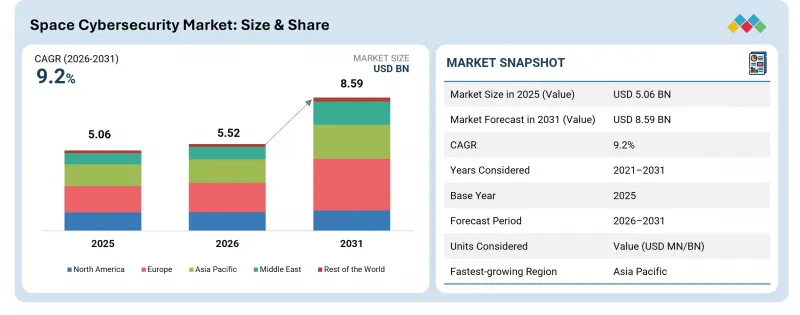
The space cybersecurity market is projected to grow from USD 5.52 billion in 2026 to USD 8.59 billion by 2031, at a CAGR of 9.2% during the forecast period. The market is expanding as defense organizations, commercial satellite operators, and government agencies increase investments in protecting satellites, launch vehicles, ground stations, communication networks, and mission-critical space infrastructure. Demand is supported by increasing satellite deployments, growing dependence on space-based services, and the need for secure communication and mission continuity.
| Scope of the Report | |
|---|---|
| Years Considered for the Study | 2021-2031 |
| Base Year | 2025 |
| Forecast Period | 2026-2031 |
| Units Considered | Value (USD Billion) |
| Segments | By Application, Type and Region |
| Regions covered | North America, Europe, APAC, RoW |
Advances in encryption, identity and access management, threat detection, secure software architectures, and cybersecurity monitoring are improving protection against unauthorized access and cyberattacks. The European Space Agency (ESA) is developing secure onboard computing, satellite communication encryption, and cybersecurity technologies through its General Support Technology Programme.
"By offering, the services segment is projected to register a higher CAGR than the solution segment during the forecast period"
The services segment is expected to grow at a higher rate than the solution segment as satellite operators, defense organizations, and space agencies increase their reliance on continuous cybersecurity monitoring, vulnerability assessments, incident response, system integration, and managed security services. Growing satellite constellations and interconnected ground infrastructure require ongoing security management throughout their operational lifecycle. Professional services support security architecture design, cybersecurity testing, and system deployment, while managed security services provide continuous threat detection and response. ESA's Cyber Security Operations Centre, inaugurated in May 2025, illustrates the increasing use of centralized cybersecurity monitoring, threat intelligence, and incident management to protect satellites, ground stations, and mission control systems.
"By asset type, the satellite segment is projected to register the highest CAGR during the forecast period"
The satellite segment is expected to grow at the fastest rate as defense and commercial operators expand satellite constellations and introduce cybersecurity capabilities into onboard computers, payload systems, communication links, and satellite command interfaces. Increasing adoption of software-defined satellites and remotely configurable systems is creating demand for secure software updates, encryption, authentication, and onboard threat detection. Satellites operating in LEO, MEO, and GEO require cybersecurity protection according to their communication architecture and mission requirements. ESA's General Support Technology Programme is supporting secure reprogrammable satellite computing, post-quantum cryptography, and secure application isolation technologies through projects involving OHB SE, Airbus SE, and CYSEC
"By region, Asia Pacific is projected to register the highest CAGR during the forecast period"
The Asia Pacific space cybersecurity market is expected to register the fastest growth as countries increase investments in satellite infrastructure, secure communication networks, commercial space activities, and national cybersecurity capabilities. China, India, Japan, South Korea, and Australia are expanding space programs and strengthening protection of satellite networks, ground systems, and mission-critical data. India, for example, released its Cyber Security Framework and Guidelines for Space, including Satellite Communication, in February 2026 through CERT-In and SIA-India. The guidelines address cybersecurity requirements for government agencies, satellite operators, ground-station providers, and equipment manufacturers. Japan has also established cybersecurity guidelines for commercial space systems, supporting security risk management and protection of space infrastructure. These initiatives are contributing to demand for encryption, identity and access management, cybersecurity assessments, and managed security services across the region.
The breakdown of profiles for primary participants in the space cybersecurity market is provided below:
- By Company Type: Tier 1 - 40%, Tier 2 - 35%, and Tier 3 - 25%
- By Designation: C-level - 25%, Director-level - 35%, and Others - 40%
- By Region: North America - 35%, Europe - 30%, Asia Pacific - 25%, Middle East - 5%, Rest of the World - 5%
Research Coverage:
This market study covers the space cybersecurity market across various segments and subsegments. It aims to estimate the size and growth potential of this market across different parts and regions. This study also includes an in-depth competitive analysis of the key players in the market, their company profiles, key observations related to their products and business offerings, recent developments, and key market strategies they adopted.
Reasons to Buy this Report:
The report will help market leaders/new entrants with information on the closest approximations of the revenue numbers for the overall space cybersecurity market. It will also help stakeholders understand the competitive landscape and gain more insights to position their businesses better and plan suitable go-to-market strategies. The report will also help stakeholders understand the market pulse and will provide information on key market drivers, restraints, challenges, and opportunities.
The report provides insights into the following pointers:
- Market Drivers (Increasing Frequency and Sophistication of Cyberattacks Targeting Space Infrastructure; Growing Dependence on Space-Based Services for Defense and Critical Infrastructure Operations; Expansion of Commercial Satellite Fleets and Digitally Connected Space Infrastructure); Restraints (Limited Upgradeability of Legacy and Already-Deployed Space Systems; High Cost of Implementing and Qualifying Cybersecurity Solutions for Space Environments; Onboard Power, Processing, Memory, and Payload Constraints Limiting Security Implementation); Opportunities (Integration of Cybersecurity-by-Design into Next-Generation Satellites and Ground Systems; Deployment of AI-Enabled Automated Threat Detection and Response Capabilities; Adoption of Next-Generation Cryptography and Zero-Trust Security Architectures); Challenges (Securing Interfaces Across Multi-Operator, Multi-Vendor, and Hybrid Space Networks; Maintaining Effective Cybersecurity Across Long Space-System Lifecycles as Threats and Technologies Evolve; Managing Cybersecurity Exposure Across Complex Space Supply Chains and Third-Party Components).
- Market Penetration: Comprehensive information on space cybersecurity offered by the top players in the market
- Product Development/Innovation: Detailed insights on upcoming technologies, research & development activities, and product launches in the space cybersecurity market
- Market Development: Comprehensive information about lucrative markets across varied regions
- Market Diversification: Exhaustive information about new products, untapped geographies, recent developments, and investments in the space cybersecurity market
- Competitive Assessment: In-depth assessment of market share, growth strategies, products, and manufacturing capabilities of leading players in the space cybersecurity market
TABLE OF CONTENTS
1 INTRODUCTION
- 1.1 STUDY OBJECTIVES
- 1.2 MARKET DEFINITION
- 1.3 STUDY SCOPE
- 1.3.1 MARKET SEGMENTATION & REGIONAL SNAPSHOT
- 1.3.2 INCLUSIONS AND EXCLUSIONS
- 1.4 YEARS CONSIDERED
- 1.5 CURRENCY CONSIDERED
- 1.6 STAKEHOLDERS
- 1.7 SUMMARY OF CHANGES
2 EXECUTIVE SUMMARY
- 2.1 KEY INSIGHTS & MARKET HIGHLIGHTS
- 2.2 KEY MARKET PARTICIPANTS: MAPPING OF STRATEGIC DEVELOPMENTS
- 2.3 HIGH GROWTH SEGMENTS
- 2.4 DISRUPTIVE TRENDS SHAPING MARKET
- 2.5 REGIONAL SNAPSHOT: MARKET SIZE, GROWTH RATE, AND FORECAST
3 PREMIUM INSIGHTS
- 3.1 ATTRACTIVE OPPORTUNITIES FOR PLAYERS IN SPACE CYBERSECURITY MARKET
- 3.2 SPACE CYBERSECURITY MARKET, BY OFFERING
- 3.3 SPACE CYBERSECURITY MARKET, BY ASSET TYPE
- 3.4 SPACE CYBERSECURITY MARKET, BY END USER
- 3.5 SPACE CYBERSECURITY MARKET, BY APPLICATION
4 MARKET OVERVIEW
- 4.1 INTRODUCTION
- 4.2 MARKET DYNAMICS
- 4.2.1 DRIVERS
- 4.2.1.1 Increasing frequency and sophistication of cyberattacks targeting space infrastructure
- 4.2.1.2 Growing dependence on space-based services for defense and critical infrastructure operations
- 4.2.1.3 Expansion of commercial satellite fleets and digitally connected space infrastructure
- 4.2.2 RESTRAINTS
- 4.2.2.1 Limited upgradeability of legacy and already-deployed space systems
- 4.2.2.2 High cost of implementing and qualifying cybersecurity solutions for space environments
- 4.2.2.3 Onboard power, processing, memory, and payload constraints limiting security implementation
- 4.2.3 OPPORTUNITIES
- 4.2.3.1 Integration of cybersecurity-by-design into next-generation satellites and ground systems
- 4.2.3.2 Deployment of AI-enabled automated threat detection and response capabilities
- 4.2.3.3 Adoption of next-generation cryptography and zero-trust security architectures
- 4.2.4 CHALLENGES
- 4.2.4.1 Securing interfaces across multi-operator, multi-vendor, and hybrid space networks
- 4.2.4.2 Maintaining effective cybersecurity across long space-system lifecycles as threats and technologies evolve
- 4.2.4.3 Managing cybersecurity exposure across complex space supply chains and third-party components
- 4.2.1 DRIVERS
- 4.3 UNMET NEEDS AND WHITE SPACES
- 4.3.1 UPDATABLE CYBERSECURITY FOR LONG-LIFE AND ALREADY-DEPLOYED SPACE SYSTEMS
- 4.3.2 SPACE-SPECIFIC ONBOARD THREAT DETECTION AND RESPONSE
- 4.3.3 COMMON MODULAR SECURITY ARCHITECTURE ACROSS SPACE, GROUND, AND USER SEGMENTS
- 4.3.4 BETTER SUPPLY-CHAIN VISIBILITY FOR SPACE HARDWARE AND SOFTWARE
- 4.4 INTERCONNECTED MARKETS AND CROSS-SECTOR OPPORTUNITIES
- 4.4.1 CLOUD SECURITY AND SECURE GROUND-SEGMENT INFRASTRUCTURE
- 4.4.2 AI-BASED CYBERSECURITY AND SECURITY OPERATIONS
- 4.4.3 ZERO-TRUST IDENTITY AND ACCESS MANAGEMENT
- 4.4.4 POST-QUANTUM CRYPTOGRAPHY AND SECURE COMMUNICATIONS
- 4.5 STRATEGIC MOVES BY TIER-1/2/3 PLAYERS
5 INDUSTRY TRENDS
- 5.1 ECOSYSTEM ANALYSIS
- 5.1.1 PROMINENT COMPANIES
- 5.1.2 STARTUPS AND SMES
- 5.1.3 END USERS
- 5.2 VALUE CHAIN ANALYSIS
- 5.3 TRADE ANALYSIS
- 5.3.1 IMPORT SCENARIO (HS CODE 847330)
- 5.3.2 EXPORT SCENARIO (HS CODE 847330)
- 5.4 CASE STUDY ANALYSIS
- 5.5 VIASAT - SPACE-BASED ENCRYPTION FOR US SPACE FORCE
- 5.6 CGI - CYBERSECURITY FOR ESA MULTI-MISSION DATA PLATFORM
- 5.7 THALES - CYBERSECURITY FOR GALILEO SECOND GENERATION
- 5.8 KEY CONFERENCES AND EVENTS (2026-2027)
- 5.9 INVESTMENT AND FUNDING SCENARIO
- 5.10 TRENDS/DISRUPTIONS IMPACTING CUSTOMERS' BUSINESS
- 5.11 MACROECONOMIC OUTLOOK
- 5.11.1 INTRODUCTION
- 5.11.2 GDP TRENDS AND FORECAST
- 5.11.3 TRENDS IN THE GLOBAL SPACE CYBERSECURITY INDUSTRY
- 5.11.4 TRENDS IN THE GLOBAL DEFENSE INDUSTRY
- 5.12 PRICING ANALYSIS
- 5.12.1 INDICATIVE PRICING ANALYSIS FOR SPACE CYBERSECURITY OFFERINGS, 2025
- 5.12.2 INDICATIVE PRICING ANALYSIS OF KEY PLAYERS, 2025
- 5.13 OPERATIONAL DATA
- 5.14 BUSINESS MODELS
- 5.15 CYBERSECURITY PRODUCTS & SOFTWARE LICENSING
- 5.16 PROJECT-BASED CYBERSECURITY ENGINEERING & SYSTEM INTEGRATION
- 5.17 MANAGED CYBERSECURITY & SECURITY-AS-A-SERVICE
- 5.18 IMPACT OF 2025 US TARIFFS
- 5.18.1 INTRODUCTION
- 5.18.2 KEY TARIFF RATES
- 5.18.3 PRICE IMPACT ANALYSIS
- 5.18.4 IMPACT ON COUNTRY/REGION
- 5.18.4.1 North America
- 5.18.4.2 Europe
- 5.18.4.3 Asia Pacific
- 5.18.5 IMPACT ON END-USE INDUSTRIES
6 TECHNOLOGICAL ADVANCEMENTS, AI-DRIVEN IMPACT, PATENTS, INNOVATIONS, AND FUTURE APPLICATIONS
- 6.1 KEY TECHNOLOGIES
- 6.1.1 ZERO TRUST ARCHITECTURE
- 6.1.2 ENCRYPTION & CRYPTOGRAPHIC SECURITY
- 6.1.3 SECURITY ANALYTICS & THREAT DETECTION
- 6.2 COMPLEMENTARY TECHNOLOGIES
- 6.2.1 ARTIFICIAL INTELLIGENCE & MACHINE LEARNING
- 6.2.2 DIGITAL TWIN & CYBER SIMULATION
- 6.2.3 CLOUD & EDGE COMPUTING
- 6.3 ADJACENT TECHNOLOGIES
- 6.3.1 SOFTWARE-DEFINED SATELLITES
- 6.3.2 OPTICAL & LASER COMMUNICATIONS
- 6.3.3 QUANTUM COMMUNICATIONS & QUANTUM KEY DISTRIBUTION
- 6.4 TECHNOLOGY ROADMAP
- 6.5 PATENT ANALYSIS
- 6.6 FUTURE APPLICATIONS
- 6.6.1 IMPACT OF AI/GENERATIVE AI
- 6.6.2 IMPLEMENTATION OF AI IN SPACE CYBERSECURITY MARKET: TOP USE CASES AND MARKET POTENTIAL
- 6.6.3 IMPLEMENTATION OF AI IN SPACE CYBERSECURITY MARKET: CASE STUDIES
- 6.6.4 INTERCONNECTED ECOSYSTEM AND IMPACT ON MARKET PLAYERS
- 6.6.5 CLIENTS' READINESS TO ADOPT AI/GENERATIVE AI
7 CUSTOMER LANDSCAPE & BUYER BEHAVIOR
- 7.1 DECISION-MAKING PROCESS
- 7.2 BUYER STAKEHOLDERS AND BUYING EVALUATION CRITERIA
- 7.2.1 BUYING EVALUATION CRITERIA
- 7.2.2 BUYING CRITERIA
- 7.3 ADOPTION BARRIERS & INTERNAL CHALLENGES
- 7.4 UNMET NEEDS OF VARIOUS END USERS
8 SUSTAINABILITY AND REGULATORY LANDSCAPE
- 8.1 REGIONAL REGULATIONS AND COMPLIANCE
- 8.1.1 REGULATORY BODIES, GOVERNMENT AGENCIES, AND OTHER ORGANIZATIONS
- 8.1.2 KEY REGULATIONS
- 8.1.3 INDUSTRY STANDARDS
- 8.2 SUSTAINABILITY INITIATIVES
- 8.2.1 SECURE-BY-DESIGN & LIFECYCLE CYBERSECURITY
- 8.2.2 SOFTWARE-DEFINED SECURITY & REMOTE UPDATEABILITY
- 8.2.3 CRYPTO-AGILITY & POST-QUANTUM MIGRATION
- 8.2.4 REUSABLE & INTEROPERABLE SECURITY ARCHITECTURES
- 8.2.5 CYBER RANGES, SIMULATION & DIGITAL TESTING
- 8.3 CERTIFICATIONS, LABELING, AND ECO-STANDARDS
9 SPACE CYBERSECURITY MARKET, BY OFFERING
- 9.1 INTRODUCTION
- 9.2 SOLUTIONS
- 9.2.1 EXPANSION OF CONNECTED SPACE AND GROUND INFRASTRUCTURE TO DRIVE LAYERED CYBERSECURITY SOLUTIONS
- 9.2.2 NETWORK SECURITY
- 9.2.2.1 Network firewall
- 9.2.2.2 Intrusion detection & prevention systems
- 9.2.2.3 Virtual private network
- 9.2.2.4 Network access control
- 9.2.2.5 Other network security solutions
- 9.2.3 ENDPOINT & IOT SECURITY
- 9.2.3.1 Antivirus & anti-malware
- 9.2.3.2 Endpoint detection & response
- 9.2.3.3 Patch management
- 9.2.3.4 Others
- 9.2.4 CLOUD SECURITY
- 9.2.4.1 Cloud access security broker
- 9.2.4.2 Security posture management
- 9.2.5 APPLICATION SECURITY
- 9.2.5.1 Secure development tools
- 9.2.5.2 Web application firewall
- 9.2.5.3 Others
- 9.2.6 IDENTITY & ACCESS MANAGEMENT
- 9.2.7 CRYPTOGRAPHY & KEY MANAGEMENT
- 9.2.8 LOG MANAGEMENT & SECURITY INFORMATION AND EVENT MANAGEMENT SIEM
- 9.2.9 DATA BACKUP & RECOVERY
- 9.2.10 OTHERS
- 9.3 SERVICES
- 9.3.1 COMPLEXITY OF SECURING END-TO-END SPACE MISSIONS TO DRIVE CYBERSECURITY SERVICES
- 9.3.2 PROFESSIONAL SERVICES
- 9.3.2.1 Design, consulting & implementation
- 9.3.2.2 Risk & threat management
- 9.3.2.3 Support & maintenance
- 9.3.2.4 Training & education
- 9.3.3 MANAGED SECURITY SERVICES
10 SPACE CYBERSECURITY MARKET, BY ASSET TYPE
- 10.1 INTRODUCTION
- 10.2 SATELLITES
- 10.2.1 GREATER ONBOARD COMPUTING AND REMOTE RECONFIGURATION TO DRIVE SATELLITE CYBERSECURITY
- 10.2.2 LEO
- 10.2.3 MEO
- 10.2.4 GEO
- 10.3 LAUNCH VEHICLES
- 10.3.1 DIGITALLY CONTROLLED LAUNCH OPERATIONS TO DRIVE CYBERSECURITY ACROSS LAUNCH VEHICLES
- 10.3.2 SMALL LIFT LAUNCH VEHICLES
- 10.3.3 MEDIUM & HEAVY VEHICLES
- 10.4 GROUND STATIONS
- 10.4.1 DISTRIBUTED SATELLITE CONNECTIVITY AND TERRESTRIAL NETWORK INTEGRATION TO DRIVE GROUND STATION CYBERSECURITY
- 10.5 SPACEPORTS & LAUNCH FACILITIES
- 10.5.1 DIGITIZATION OF LAUNCH INFRASTRUCTURE TO DRIVE SPACEPORT AND LAUNCH FACILITY CYBERSECURITY
- 10.6 COMMAND & CONTROL CENTERS
- 10.6.1 HIGHER DEPENDENCE ON SOFTWARE-BASED MISSION OPERATIONS TO DRIVE COMMAND & CONTROL CENTER CYBERSECURITY
- 10.7 OTHERS
11 SPACE CYBERSECURITY MARKET, BY END USER
- 11.1 INTRODUCTION
- 11.2 DEFENSE
- 11.2.1 MILITARY SPACE OPERATIONS TO DRIVE DEFENSE SPACE CYBERSECURITY
- 11.3 COMMERCIAL
- 11.3.1 EXPANSION OF COMMERCIAL SATELLITE SERVICES TO DRIVE OPERATOR CYBERSECURITY SPENDING
- 11.4 GOVERNMENT
- 11.4.1 WIDER USE OF SPACE-ENABLED PUBLIC SERVICES TO DRIVE GOVERNMENT SPACE CYBERSECURITY
12 SPACE CYBERSECURITY MARKET, BY APPLICATION
- 12.1 INTRODUCTION
- 12.1.1 SATELLITE COMMUNICATION SECURITY
- 12.1.1.1 Integration of satellite and terrestrial networks to drive satellite communication security
- 12.1.2 EARTH OBSERVATION & REMOTE SENSING SECURITY
- 12.1.2.1 Reliance on trusted geospatial intelligence to drive Earth observation & remote sensing security
- 12.1.3 NAVIGATION, POSITIONING & TIMING SECURITY
- 12.1.3.1 Rising spoofing exposure and critical timing dependence to drive navigation, positioning & timing security
- 12.1.4 SPACE SITUATIONAL AWARENESS & SPACE TRAFFIC MANAGEMENT SECURITY
- 12.1.4.1 Higher orbital density and automated coordination to drive segmental growth
- 12.1.5 MISSION PLANNING & CONTROL SECURITY
- 12.1.5.1 Digital command authority and remote spacecraft operations to drive mission planning & control security
- 12.1.6 DATA PROCESSING & DISTRIBUTION SECURITY
- 12.1.6.1 Higher data volumes and distributed processing to drive data processing & distribution security
- 12.1.1 SATELLITE COMMUNICATION SECURITY
13 SPACE CYBERSECURITY MARKET, BY REGION
- 13.1 INTRODUCTION
- 13.2 NORTH AMERICA
- 13.2.1 US
- 13.2.1.1 Satellite-control protection and dedicated cyber forces to drive market
- 13.2.2 CANADA
- 13.2.2.1 Satellite-security testing and hybrid networks to drive market
- 13.2.1 US
- 13.3 ASIA PACIFIC
- 13.3.1 JAPAN
- 13.3.1.1 Integration of space capabilities with command networks to drive market
- 13.3.2 INDIA
- 13.3.2.1 Increasing numbers of satellites and ground interfaces to drive market
- 13.3.3 AUSTRALIA
- 13.3.3.1 Defense requirements for secure military communications to drive market
- 13.3.4 MALAYSIA
- 13.3.4.1 Space-data infrastructure and information protection to drive market
- 13.3.5 REST OF ASIA PACIFIC
- 13.3.1 JAPAN
- 13.4 EUROPE
- 13.4.1 UK
- 13.4.1.1 Greater integration of government and commercial space systems to drive market
- 13.4.2 GERMANY
- 13.4.2.1 Mission-control protection reinforces Germany's space cybersecurity market
- 13.4.3 FRANCE
- 13.4.3.1 Growing software content of orbital systems to drive market
- 13.4.4 ITALY
- 13.4.4.1 Dedicated cyber operations infrastructure to drive market
- 13.4.5 REST OF EUROPE
- 13.4.1 UK
- 13.5 MIDDLE EAST
- 13.5.1 GCC
- 13.5.1.1 Increased integration between satellite and terrestrial networks to drive market
- 13.5.1.2 UAE
- 13.5.1.3 Saudi Arabia
- 13.5.2 ISRAEL
- 13.5.2.1 Integrated defense-space operations to drive market
- 13.5.1 GCC
- 13.6 REST OF THE WORLD
- 13.6.1 LATIN AMERICA
- 13.6.1.1 Growing use of space infrastructure for public services to drive market
- 13.6.1.2 Brazil
- 13.6.1.3 Mexico
- 13.6.2 AFRICA
- 13.6.2.1 Development of sovereign satellite and communications programs to drive market
- 13.6.2.2 South Africa
- 13.6.1 LATIN AMERICA
14 COMPETITIVE LANDSCAPE
- 14.1 INTRODUCTION
- 14.2 KEY PLAYER STRATEGIES/RIGHT TO WIN, 2021-2025
- 14.3 REVENUE ANALYSIS, 2021-2025
- 14.4 MARKET SHARE ANALYSIS, 2025
- 14.5 BRAND/PRODUCT COMPARISON
- 14.6 COMPANY VALUATION AND FINANCIAL METRICS
- 14.7 COMPANY EVALUATION MATRIX: KEY PLAYERS, 2025
- 14.7.1 STARS
- 14.7.2 EMERGING LEADERS
- 14.7.3 PERVASIVE PLAYERS
- 14.7.4 PARTICIPANTS
- 14.7.5 COMPANY FOOTPRINT
- 14.7.5.1 Company footprint
- 14.7.5.2 Region footprint
- 14.7.5.3 Offering footprint
- 14.7.5.4 Asset type footprint
- 14.7.5.5 End user footprint
- 14.8 COMPANY EVALUATION MATRIX: STARTUPS/SMES, 2025
- 14.8.1 PROGRESSIVE COMPANIES
- 14.8.2 RESPONSIVE COMPANIES
- 14.8.3 DYNAMIC COMPANIES
- 14.8.4 STARTING BLOCKS
- 14.8.5 COMPETITIVE BENCHMARKING
- 14.8.5.1 List of startups/SMEs
- 14.8.5.2 Competitive benchmarking of startups/SMEs
- 14.9 COMPETITIVE SCENARIO
- 14.9.1 DEALS
- 14.9.2 OTHER DEVELOPMENTS
15 COMPANY PROFILES
- 15.1 KEY PLAYERS
- 15.1.1 THALES
- 15.1.1.1 Business overview
- 15.1.1.2 Products/Solutions/Services offered
- 15.1.1.3 Recent developments
- 15.1.1.3.1 Deals
- 15.1.1.3.2 Other developments
- 15.1.1.4 MnM view
- 15.1.1.4.1 Right to win
- 15.1.1.4.2 Strategic choices
- 15.1.1.4.3 Weaknesses and competitive threats
- 15.1.2 GENERAL DYNAMICS CORPORATION
- 15.1.2.1 Business overview
- 15.1.2.2 Products/Solutions/Services offered
- 15.1.2.3 Recent developments
- 15.1.2.3.1 Deals
- 15.1.2.3.2 Other developments
- 15.1.2.4 MnM view
- 15.1.2.4.1 Right to win
- 15.1.2.4.2 Strategic choices
- 15.1.2.4.3 Weaknesses and competitive threats
- 15.1.3 VIASAT, INC.
- 15.1.3.1 Business overview
- 15.1.3.2 Products/Solutions/Services offered
- 15.1.3.3 Recent developments
- 15.1.3.3.1 Deals
- 15.1.3.4 MnM view
- 15.1.3.4.1 Right to win
- 15.1.3.4.2 Strategic choices
- 15.1.3.4.3 Weaknesses and competitive threats
- 15.1.4 LEONARDO S.P.A.
- 15.1.4.1 Business overview
- 15.1.4.2 Products/Solutions/Services offered
- 15.1.4.3 Recent developments
- 15.1.4.3.1 Deals
- 15.1.4.3.2 Other developments
- 15.1.4.4 MnM view
- 15.1.4.4.1 Right to win
- 15.1.4.4.2 Strategic choices
- 15.1.4.4.3 Weaknesses and competitive threats
- 15.1.5 BOOZ ALLEN HAMILTON INC.
- 15.1.5.1 Business overview
- 15.1.5.2 Products/Solutions/Services offered
- 15.1.5.3 Recent developments
- 15.1.5.3.1 Deals
- 15.1.5.3.2 Other developments
- 15.1.5.4 MnM view
- 15.1.5.4.1 Right to win
- 15.1.5.4.2 Strategic choices
- 15.1.5.4.3 Weaknesses and competitive threats
- 15.1.6 LOCKHEED MARTIN CORPORATION
- 15.1.6.1 Business overview
- 15.1.6.2 Products/Solutions/Services offered
- 15.1.6.3 Recent developments
- 15.1.6.3.1 Deals
- 15.1.6.3.2 Other developments
- 15.1.7 SPACEX
- 15.1.7.1 Business overview
- 15.1.7.2 Products/Solutions/Services offered
- 15.1.7.3 Recent developments
- 15.1.7.3.1 Other developments
- 15.1.8 NORTHROP GRUMMAN
- 15.1.8.1 Business overview
- 15.1.8.2 Products/Solutions/Services offered
- 15.1.8.3 Recent developments
- 15.1.8.3.1 Deals
- 15.1.8.3.2 Other developments
- 15.1.9 AIRBUS
- 15.1.9.1 Business overview
- 15.1.9.2 Products/Solutions/Services offered
- 15.1.9.3 Recent developments
- 15.1.9.3.1 Deals
- 15.1.9.3.2 Other developments
- 15.1.10 BAE SYSTEMS
- 15.1.10.1 Business overview
- 15.1.10.2 Products/Solutions/Services offered
- 15.1.10.3 Recent developments
- 15.1.10.3.1 Deals
- 15.1.11 OHB SE
- 15.1.11.1 Business overview
- 15.1.11.2 Products/Solutions/Services offered
- 15.1.11.3 Recent developments
- 15.1.11.3.1 Deals
- 15.1.11.3.2 Other developments
- 15.1.12 LEIDOS
- 15.1.12.1 Business overview
- 15.1.12.2 Products/Solutions/Services offered
- 15.1.12.3 Recent developments
- 15.1.12.3.1 Other developments
- 15.1.13 L3HARRIS TECHNOLOGIES, INC.
- 15.1.13.1 Business overview
- 15.1.13.2 Products/Solutions/Services offered
- 15.1.13.3 Recent developments
- 15.1.13.3.1 Other developments
- 15.1.14 KRATOS DEFENSE & SECURITY SOLUTIONS, INC.
- 15.1.14.1 Business overview
- 15.1.14.2 Products/Solutions/Services offered
- 15.1.14.3 Recent developments
- 15.1.14.3.1 Deals
- 15.1.15 CGI INC.
- 15.1.15.1 Business overview
- 15.1.15.2 Products/Solutions/Services offered
- 15.1.15.3 Recent developments
- 15.1.15.3.1 Other developments
- 15.1.1 THALES
- 15.2 STARTUPS/SMES
- 15.2.1 XAGE SECURITY, INC.
- 15.2.2 NIGHTWING
- 15.2.3 CYSEC
- 15.2.4 GLOBALS INC.
- 15.2.5 ID QUANTIQUE
- 15.2.6 KONGSBERG DEFENSE AND AEROSPACE
- 15.2.7 SPIDEROAK INC.
- 15.2.8 GMV INNOVATING SOLUTIONS, S.L.
- 15.2.9 RHEA GROUP
- 15.2.10 SPACEIT
- 15.2.11 QUSECURE, INC.
16 RESEARCH METHODOLOGY
- 16.1 RESEARCH DATA
- 16.1.1 SECONDARY DATA
- 16.1.1.1 Key data from secondary sources
- 16.1.2 PRIMARY DATA
- 16.1.2.1 Primary sources
- 16.1.2.2 Key data from primary sources
- 16.1.3 BREAKDOWN OF PRIMARY INTERVIEWS
- 16.1.1 SECONDARY DATA
- 16.2 FACTOR ANALYSIS
- 16.2.1 INTRODUCTION
- 16.2.2 DEMAND-SIDE INDICATORS
- 16.2.3 SUPPLY-SIDE INDICATORS
- 16.3 MARKET SIZE ESTIMATION
- 16.3.1 BOTTOM-UP APPROACH
- 16.3.1.1 Market size estimation methodology (demand side)
- 16.3.1.2 Market size estimation methodology (supply side)
- 16.3.2 TOP-DOWN APPROACH
- 16.3.1 BOTTOM-UP APPROACH
- 16.4 DATA TRIANGULATION
- 16.5 RESEARCH ASSUMPTIONS
- 16.6 RESEARCH LIMITATIONS
- 16.7 RISK ASSESSMENT
17 APPENDIX
- 17.1 DISCUSSION GUIDE
- 17.2 KNOWLEDGESTORE: MARKETSANDMARKETS' SUBSCRIPTION PORTAL
- 17.3 CUSTOMIZATION OPTIONS
- 17.4 RELATED REPORTS
- 17.5 AUTHOR DETAILS
List of Tables
- TABLE 1 USD EXCHANGE RATES, 2021-2025
- TABLE 2 UNMET NEEDS AND WHITE SPACES
- TABLE 3 CROSS-SECTOR OPPORTUNITIES
- TABLE 4 STRATEGIC MOVES BY TIER-1/2/3 PLAYERS
- TABLE 5 ROLE OF COMPANIES IN ECOSYSTEM
- TABLE 6 IMPORT DATA FOR HS CODE 847330-COMPLIANT PRODUCTS, BY COUNTRY, 2021-2025 (USD THOUSAND)
- TABLE 7 EXPORT DATA FOR HS CODE 847330-COMPLIANT PRODUCTS, BY COUNTRY, 2021-2025 (USD THOUSAND)
- TABLE 8 KEY CONFERENCES AND EVENTS, 2026-2027
- TABLE 9 GDP PERCENTAGE CHANGE, BY COUNTRY, 2021-2030
- TABLE 10 INDICATIVE PRICING ANALYSIS FOR SPACE CYBERSECURITY OFFERINGS, 2025
- TABLE 11 INDICATIVE PRICING ANALYSIS OF KEY PLAYERS, 2025
- TABLE 12 OPERATIONAL DATA, BY ORBIT TYPE, 2021-2025
- TABLE 13 US-ADJUSTED RECIPROCAL TARIFF RATES
- TABLE 14 EVOLUTION AND ROADMAP FOR SPACE CYBERSECURITY MARKET
- TABLE 15 KEY PATENTS, 2021-2024
- TABLE 16 AUTONOMOUS ONBOARD THREAT DETECTION & RESPONSE
- TABLE 17 SECURE SOFTWARE-DEFINED & RECONFIGURABLE SPACE SYSTEMS
- TABLE 18 IMPLEMENTATION OF AI IN SPACE CYBERSECURITY MARKET: TOP USE CASES AND MARKET POTENTIAL
- TABLE 19 IMPLEMENTATION OF AI IN SPACE CYBERSECURITY MARKET: CASE STUDIES
- TABLE 20 INTERCONNECTED ECOSYSTEM AND IMPACT ON MARKET PLAYERS
- TABLE 21 INFLUENCE OF STAKEHOLDERS ON BUYING PROCESS, BY END USER
- TABLE 22 KEY BUYING CRITERIA, BY END USER
- TABLE 23 UNMET NEEDS IN SPACE CYBERSECURITY MARKET, BY END USER
- TABLE 24 NORTH AMERICA: REGULATORY BODIES, GOVERNMENT AGENCIES, AND OTHER ORGANIZATIONS
- TABLE 25 EUROPE: REGULATORY BODIES, GOVERNMENT AGENCIES, AND OTHER ORGANIZATIONS
- TABLE 26 ASIA PACIFIC: REGULATORY BODIES, GOVERNMENT AGENCIES, AND OTHER ORGANIZATIONS
- TABLE 27 MIDDLE EAST: REGULATORY BODIES, GOVERNMENT AGENCIES, AND OTHER ORGANIZATIONS
- TABLE 28 REST OF THE WORLD: REGULATORY BODIES, GOVERNMENT AGENCIES, AND OTHER ORGANIZATIONS
- TABLE 29 MAJOR REGULATIONS
- TABLE 30 INDUSTRY STANDARDS IN SPACE CYBERSECURITY MARKET
- TABLE 31 SUSTAINABILITY INITIATIVES IN SPACE CYBERSECURITY MARKET
- TABLE 32 CERTIFICATIONS, LABELING, AND ECO-STANDARDS
- TABLE 33 SPACE CYBERSECURITY MARKET, BY OFFERING, 2021-2025 (USD MILLION)
- TABLE 34 SPACE CYBERSECURITY MARKET, BY OFFERING, 2026-2031 (USD MILLION)
- TABLE 35 SPACE CYBERSECURITY MARKET, BY SOLUTION, 2021-2025 (USD MILLION)
- TABLE 36 SPACE CYBERSECURITY MARKET, BY SOLUTION, 2026-2031 (USD MILLION)
- TABLE 37 SPACE CYBERSECURITY MARKET, BY NETWORK SECURITY, 2021-2025 (USD MILLION)
- TABLE 38 SPACE CYBERSECURITY MARKET, BY NETWORK SECURITY, 2026-2031 (USD MILLION)
- TABLE 39 SPACE CYBERSECURITY MARKET, BY ENDPOINT & IOT SECURITY, 2021-2025 (USD MILLION)
- TABLE 40 SPACE CYBERSECURITY MARKET, BY ENDPOINT & IOT SECURITY, 2026-2031 (USD MILLION)
- TABLE 41 SPACE CYBERSECURITY MARKET, BY CLOUD SECURITY, 2021-2025 (USD MILLION)
- TABLE 42 SPACE CYBERSECURITY MARKET, BY CLOUD SECURITY, 2026-2031 (USD MILLION)
- TABLE 43 SPACE CYBERSECURITY MARKET, BY APPLICATION SECURITY, 2021-2025 (USD MILLION)
- TABLE 44 SPACE CYBERSECURITY MARKET, BY APPLICATION SECURITY, 2026-2031 (USD MILLION)
- TABLE 45 SPACE CYBERSECURITY MARKET, BY SERVICES, 2021-2025 (USD MILLION)
- TABLE 46 SPACE CYBERSECURITY MARKET, BY SERVICES, 2026-2031 (USD MILLION)
- TABLE 47 SPACE CYBERSECURITY MARKET, BY PROFESSIONAL SERVICES, 2021-2025 (USD MILLION)
- TABLE 48 SPACE CYBERSECURITY MARKET, BY PROFESSIONAL SERVICES, 2026-2031 (USD MILLION)
- TABLE 49 SPACE CYBERSECURITY MARKET, BY ASSET TYPE, 2021-2025 (USD MILLION)
- TABLE 50 SPACE CYBERSECURITY MARKET, BY ASSET TYPE, 2026-2031 (USD MILLION)
- TABLE 51 SPACE CYBERSECURITY MARKET, BY SATELLITE ASSET TYPE, 2021-2025 (USD MILLION)
- TABLE 52 SPACE CYBERSECURITY MARKET, BY SATELLITE ASSET TYPE, 2026-2031 (USD MILLION)
- TABLE 53 SPACE CYBERSECURITY MARKET, BY LAUNCH VEHICLE, 2021-2025 (USD MILLION)
- TABLE 54 SPACE CYBERSECURITY MARKET, BY LAUNCH VEHICLE, 2026-2031 (USD MILLION)
- TABLE 55 SPACE CYBERSECURITY MARKET, BY END USER, 2021-2025 (USD MILLION)
- TABLE 56 SPACE CYBERSECURITY MARKET, BY END USER, 2026-2031 (USD MILLION)
- TABLE 57 SPACE CYBERSECURITY MARKET, BY APPLICATION, 2021-2025 (USD MILLION)
- TABLE 58 SPACE CYBERSECURITY MARKET, BY APPLICATION, 2026-2031 (USD MILLION)
- TABLE 59 SPACE CYBERSECURITY MARKET, BY REGION, 2021-2025 (USD MILLION)
- TABLE 60 SPACE CYBERSECURITY MARKET, BY REGION, 2026-2031 (USD MILLION)
- TABLE 61 NORTH AMERICA: SPACE CYBERSECURITY MARKET, BY COUNTRY, 2021-2025 (USD MILLION)
- TABLE 62 NORTH AMERICA: SPACE CYBERSECURITY MARKET, BY COUNTRY, 2026-2031 (USD MILLION)
- TABLE 63 NORTH AMERICA: SPACE CYBERSECURITY MARKET, BY OFFERING, 2021-2025 (USD MILLION)
- TABLE 64 NORTH AMERICA: SPACE CYBERSECURITY MARKET, BY OFFERING, 2026-2031 (USD MILLION)
- TABLE 65 NORTH AMERICA: SPACE CYBERSECURITY MARKET, BY SOLUTION OFFERING, 2021-2025 (USD MILLION)
- TABLE 66 NORTH AMERICA: SPACE CYBERSECURITY MARKET, BY SOLUTION OFFERING, 2026-2031 (USD MILLION)
- TABLE 67 NORTH AMERICA: SPACE CYBERSECURITY MARKET, BY SERVICES, 2021-2025 (USD MILLION)
- TABLE 68 NORTH AMERICA: SPACE CYBERSECURITY MARKET, BY SERVICES, 2026-2031 (USD MILLION)
- TABLE 69 NORTH AMERICA: SPACE CYBERSECURITY MARKET, BY ASSET TYPE, 2021-2025 (USD MILLION)
- TABLE 70 NORTH AMERICA: SPACE CYBERSECURITY MARKET, BY ASSET TYPE, 2026-2031 (USD MILLION)
- TABLE 71 NORTH AMERICA: SPACE CYBERSECURITY MARKET, BY SATELLITE, 2021-2025 (USD MILLION)
- TABLE 72 NORTH AMERICA: SPACE CYBERSECURITY MARKET, BY SATELLITE, 2026-2031 (USD MILLION)
- TABLE 73 NORTH AMERICA: SPACE CYBERSECURITY MARKET, BY LAUNCH VEHICLE, 2021-2025 (USD MILLION)
- TABLE 74 NORTH AMERICA: SPACE CYBERSECURITY MARKET, BY LAUNCH VEHICLE, 2026-2031 (USD MILLION)
- TABLE 75 NORTH AMERICA: SPACE CYBERSECURITY MARKET, BY END USER, 2021-2025 (USD MILLION)
- TABLE 76 NORTH AMERICA: SPACE CYBERSECURITY MARKET, BY END USER, 2026-2031 (USD MILLION)
- TABLE 77 NORTH AMERICA: SPACE CYBERSECURITY MARKET, BY APPLICATION, 2021-2025 (USD MILLION)
- TABLE 78 NORTH AMERICA: SPACE CYBERSECURITY MARKET, BY APPLICATION, 2026-2031 (USD MILLION)
- TABLE 79 US: SPACE CYBERSECURITY MARKET, BY OFFERING, 2021-2025 (USD MILLION)
- TABLE 80 US: SPACE CYBERSECURITY MARKET, BY OFFERING, 2026-2031 (USD MILLION)
- TABLE 81 US: SPACE CYBERSECURITY MARKET, BY SOLUTION OFFERING, 2021-2025 (USD MILLION)
- TABLE 82 US: SPACE CYBERSECURITY MARKET, BY SOLUTION OFFERING, 2026-2031 (USD MILLION)
- TABLE 83 US: SPACE CYBERSECURITY MARKET, BY SERVICES, 2021-2025 (USD MILLION)
- TABLE 84 US: SPACE CYBERSECURITY MARKET, BY SERVICES, 2026-2031 (USD MILLION)
- TABLE 85 US: SPACE CYBERSECURITY MARKET, BY ASSET TYPE, 2021-2025 (USD MILLION)
- TABLE 86 US: SPACE CYBERSECURITY MARKET, BY ASSET TYPE, 2026-2031 (USD MILLION)
- TABLE 87 US: SPACE CYBERSECURITY MARKET, BY END USER, 2021-2025 (USD MILLION)
- TABLE 88 US: SPACE CYBERSECURITY MARKET, BY END USER, 2026-2031 (USD MILLION)
- TABLE 89 CANADA: SPACE CYBERSECURITY MARKET, BY OFFERING, 2021-2025 (USD MILLION)
- TABLE 90 CANADA: SPACE CYBERSECURITY MARKET, BY OFFERING, 2026-2031 (USD MILLION)
- TABLE 91 CANADA: SPACE CYBERSECURITY MARKET, BY SOLUTION OFFERING, 2021-2025 (USD MILLION)
- TABLE 92 CANADA: SPACE CYBERSECURITY MARKET, BY SOLUTION OFFERING, 2026-2031 (USD MILLION)
- TABLE 93 CANADA: SPACE CYBERSECURITY MARKET, BY SERVICES, 2021-2025 (USD MILLION)
- TABLE 94 CANADA: SPACE CYBERSECURITY MARKET, BY SERVICES, 2026-2031 (USD MILLION)
- TABLE 95 CANADA: SPACE CYBERSECURITY MARKET, BY ASSET TYPE, 2021-2025 (USD MILLION)
- TABLE 96 CANADA: SPACE CYBERSECURITY MARKET, BY ASSET TYPE, 2026-2031 (USD MILLION)
- TABLE 97 CANADA: SPACE CYBERSECURITY MARKET, BY END USER, 2021-2025 (USD MILLION)
- TABLE 98 CANADA: SPACE CYBERSECURITY MARKET, BY END USER, 2026-2031 (USD MILLION)
- TABLE 99 ASIA PACIFIC: SPACE CYBERSECURITY MARKET, BY COUNTRY, 2021-2025 (USD MILLION)
- TABLE 100 ASIA PACIFIC: SPACE CYBERSECURITY MARKET, BY COUNTRY, 2026-2031 (USD MILLION)
- TABLE 101 ASIA PACIFIC: SPACE CYBERSECURITY MARKET, BY OFFERING, 2021-2025 (USD MILLION)
- TABLE 102 ASIA PACIFIC: SPACE CYBERSECURITY MARKET, BY OFFERING, 2026-2031 (USD MILLION)
- TABLE 103 ASIA PACIFIC: SPACE CYBERSECURITY MARKET, BY SOLUTION OFFERING, 2021-2025 (USD MILLION)
- TABLE 104 ASIA PACIFIC: SPACE CYBERSECURITY MARKET, BY SOLUTION OFFERING, 2026-2031 (USD MILLION)
- TABLE 105 ASIA PACIFIC: SPACE CYBERSECURITY MARKET, BY SERVICES, 2021-2025 (USD MILLION)
- TABLE 106 ASIA PACIFIC: SPACE CYBERSECURITY MARKET, BY SERVICES, 2026-2031 (USD MILLION)
- TABLE 107 ASIA PACIFIC: SPACE CYBERSECURITY MARKET, BY ASSET TYPE, 2021-2025 (USD MILLION)
- TABLE 108 ASIA PACIFIC: SPACE CYBERSECURITY MARKET, BY ASSET TYPE, 2026-2031 (USD MILLION)
- TABLE 109 ASIA PACIFIC: SPACE CYBERSECURITY MARKET, BY SATELLITE, 2021-2025 (USD MILLION)
- TABLE 110 ASIA PACIFIC: SPACE CYBERSECURITY MARKET, BY SATELLITE, 2026-2031 (USD MILLION)
- TABLE 111 ASIA PACIFIC: SPACE CYBERSECURITY MARKET, BY LAUNCH VEHICLE, 2021-2025 (USD MILLION)
- TABLE 112 ASIA PACIFIC: SPACE CYBERSECURITY MARKET, BY LAUNCH VEHICLE, 2026-2031 (USD MILLION)
- TABLE 113 ASIA PACIFIC: SPACE CYBERSECURITY MARKET, BY END USER, 2021-2025 (USD MILLION)
- TABLE 114 ASIA PACIFIC: SPACE CYBERSECURITY MARKET, BY END USER, 2026-2031 (USD MILLION)
- TABLE 115 ASIA PACIFIC: SPACE CYBERSECURITY MARKET, BY APPLICATION, 2021-2025 (USD MILLION)
- TABLE 116 ASIA PACIFIC: SPACE CYBERSECURITY MARKET, BY APPLICATION, 2026-2031 (USD MILLION)
- TABLE 117 JAPAN: SPACE CYBERSECURITY MARKET, BY OFFERING, 2021-2025 (USD MILLION)
- TABLE 118 JAPAN: SPACE CYBERSECURITY MARKET, BY OFFERING, 2026-2031 (USD MILLION)
- TABLE 119 JAPAN: SPACE CYBERSECURITY MARKET, BY SOLUTION OFFERING, 2021-2025 (USD MILLION)
- TABLE 120 JAPAN: SPACE CYBERSECURITY MARKET, BY SOLUTION OFFERING, 2026-2031 (USD MILLION)
- TABLE 121 JAPAN: SPACE CYBERSECURITY MARKET, BY SERVICES, 2021-2025 (USD MILLION)
- TABLE 122 JAPAN: SPACE CYBERSECURITY MARKET, BY SERVICES, 2026-2031 (USD MILLION)
- TABLE 123 JAPAN: SPACE CYBERSECURITY MARKET, BY ASSET TYPE, 2021-2025 (USD MILLION)
- TABLE 124 JAPAN: SPACE CYBERSECURITY MARKET, BY ASSET TYPE, 2026-2031 (USD MILLION)
- TABLE 125 JAPAN: SPACE CYBERSECURITY MARKET, BY END USER, 2021-2025 (USD MILLION)
- TABLE 126 JAPAN: SPACE CYBERSECURITY MARKET, BY END USER, 2026-2031 (USD MILLION)
- TABLE 127 INDIA: SPACE CYBERSECURITY MARKET, BY OFFERING, 2021-2025 (USD MILLION)
- TABLE 128 INDIA: SPACE CYBERSECURITY MARKET, BY OFFERING, 2026-2031 (USD MILLION)
- TABLE 129 INDIA: SPACE CYBERSECURITY MARKET, BY SOLUTION OFFERING, 2021-2025 (USD MILLION)
- TABLE 130 INDIA: SPACE CYBERSECURITY MARKET, BY SOLUTION OFFERING, 2026-2031 (USD MILLION)
- TABLE 131 INDIA: SPACE CYBERSECURITY MARKET, BY SERVICES, 2021-2025 (USD MILLION)
- TABLE 132 INDIA: SPACE CYBERSECURITY MARKET, BY SERVICES, 2026-2031 (USD MILLION)
- TABLE 133 INDIA: SPACE CYBERSECURITY MARKET, BY ASSET TYPE, 2021-2025 (USD MILLION)
- TABLE 134 INDIA: SPACE CYBERSECURITY MARKET, BY ASSET TYPE, 2026-2031 (USD MILLION)
- TABLE 135 INDIA: SPACE CYBERSECURITY MARKET, BY END USER, 2021-2025 (USD MILLION)
- TABLE 136 INDIA: SPACE CYBERSECURITY MARKET, BY END USER, 2026-2031 (USD MILLION)
- TABLE 137 AUSTRALIA: SPACE CYBERSECURITY MARKET, BY OFFERING, 2021-2025 (USD MILLION)
- TABLE 138 AUSTRALIA: SPACE CYBERSECURITY MARKET, BY OFFERING, 2026-2031 (USD MILLION)
- TABLE 139 AUSTRALIA: SPACE CYBERSECURITY MARKET, BY SOLUTION OFFERING, 2021-2025 (USD MILLION)
- TABLE 140 AUSTRALIA: SPACE CYBERSECURITY MARKET, BY SOLUTION OFFERING, 2026-2031 (USD MILLION)
- TABLE 141 AUSTRALIA: SPACE CYBERSECURITY MARKET, BY SERVICES, 2021-2025 (USD MILLION)
- TABLE 142 AUSTRALIA: SPACE CYBERSECURITY MARKET, BY SERVICES, 2026-2031 (USD MILLION)
- TABLE 143 AUSTRALIA: SPACE CYBERSECURITY MARKET, BY ASSET TYPE, 2021-2025 (USD MILLION)
- TABLE 144 AUSTRALIA: SPACE CYBERSECURITY MARKET, BY ASSET TYPE, 2026-2031 (USD MILLION)
- TABLE 145 AUSTRALIA: SPACE CYBERSECURITY MARKET, BY END USER, 2021-2025 (USD MILLION)
- TABLE 146 AUSTRALIA: SPACE CYBERSECURITY MARKET, BY END USER, 2026-2031 (USD MILLION)
- TABLE 147 MALAYSIA: SPACE CYBERSECURITY MARKET, BY OFFERING, 2021-2025 (USD MILLION)
- TABLE 148 MALAYSIA: SPACE CYBERSECURITY MARKET, BY OFFERING, 2026-2031 (USD MILLION)
- TABLE 149 MALAYSIA: SPACE CYBERSECURITY MARKET, BY SOLUTION OFFERING, 2021-2025 (USD MILLION)
- TABLE 150 MALAYSIA: SPACE CYBERSECURITY MARKET, BY SOLUTION OFFERING, 2026-2031 (USD MILLION)
- TABLE 151 MALAYSIA: SPACE CYBERSECURITY MARKET, BY SERVICES, 2021-2025 (USD MILLION)
- TABLE 152 MALAYSIA: SPACE CYBERSECURITY MARKET, BY SERVICES, 2026-2031 (USD MILLION)
- TABLE 153 MALAYSIA: SPACE CYBERSECURITY MARKET, BY ASSET TYPE, 2021-2025 (USD MILLION)
- TABLE 154 MALAYSIA: SPACE CYBERSECURITY MARKET, BY ASSET TYPE, 2026-2031 (USD MILLION)
- TABLE 155 MALAYSIA: SPACE CYBERSECURITY MARKET, BY END USER, 2021-2025 (USD MILLION)
- TABLE 156 MALAYSIA: SPACE CYBERSECURITY MARKET, BY END USER, 2026-2031 (USD MILLION)
- TABLE 157 REST OF ASIA PACIFIC: SPACE CYBERSECURITY MARKET, BY OFFERING, 2021-2025 (USD MILLION)
- TABLE 158 REST OF ASIA PACIFIC: SPACE CYBERSECURITY MARKET, BY OFFERING, 2026-2031 (USD MILLION)
- TABLE 159 REST OF ASIA PACIFIC: SPACE CYBERSECURITY MARKET, BY SOLUTION OFFERING, 2021-2025 (USD MILLION)
- TABLE 160 REST OF ASIA PACIFIC: SPACE CYBERSECURITY MARKET, BY SOLUTION OFFERING, 2026-2031 (USD MILLION)
- TABLE 161 REST OF ASIA PACIFIC: SPACE CYBERSECURITY MARKET, BY SERVICES, 2021-2025 (USD MILLION)
- TABLE 162 REST OF ASIA PACIFIC: SPACE CYBERSECURITY MARKET, BY SERVICES, 2026-2031 (USD MILLION)
- TABLE 163 REST OF ASIA PACIFIC: SPACE CYBERSECURITY MARKET, BY ASSET TYPE, 2021-2025 (USD MILLION)
- TABLE 164 REST OF ASIA PACIFIC: SPACE CYBERSECURITY MARKET, BY ASSET TYPE, 2026-2031 (USD MILLION)
- TABLE 165 REST OF ASIA PACIFIC: SPACE CYBERSECURITY MARKET, BY END USER, 2021-2025 (USD MILLION)
- TABLE 166 REST OF ASIA PACIFIC: SPACE CYBERSECURITY MARKET, BY END USER, 2026-2031 (USD MILLION)
- TABLE 167 EUROPE: SPACE CYBERSECURITY MARKET, BY COUNTRY, 2021-2025 (USD MILLION)
- TABLE 168 EUROPE: SPACE CYBERSECURITY MARKET, BY COUNTRY, 2026-2031 (USD MILLION)
- TABLE 169 EUROPE: SPACE CYBERSECURITY MARKET, BY OFFERING, 2021-2025 (USD MILLION)
- TABLE 170 EUROPE: SPACE CYBERSECURITY MARKET, BY OFFERING, 2026-2031 (USD MILLION)
- TABLE 171 EUROPE: SPACE CYBERSECURITY MARKET, BY SOLUTION OFFERING, 2021-2025 (USD MILLION)
- TABLE 172 EUROPE: SPACE CYBERSECURITY MARKET, BY SOLUTION OFFERING, 2026-2031 (USD MILLION)
- TABLE 173 EUROPE: SPACE CYBERSECURITY MARKET, BY SERVICES, 2021-2025 (USD MILLION)
- TABLE 174 EUROPE: SPACE CYBERSECURITY MARKET, BY SERVICES, 2026-2031 (USD MILLION)
- TABLE 175 EUROPE: SPACE CYBERSECURITY MARKET, BY ASSET TYPE, 2021-2025 (USD MILLION)
- TABLE 176 EUROPE: SPACE CYBERSECURITY MARKET, BY ASSET TYPE, 2026-2031 (USD MILLION)
- TABLE 177 EUROPE: SPACE CYBERSECURITY MARKET, BY SATELLITE, 2021-2025 (USD MILLION)
- TABLE 178 EUROPE: SPACE CYBERSECURITY MARKET, BY SATELLITE, 2026-2031 (USD MILLION)
- TABLE 179 EUROPE: SPACE CYBERSECURITY MARKET, BY LAUNCH VEHICLE, 2021-2025 (USD MILLION)
- TABLE 180 EUROPE: SPACE CYBERSECURITY MARKET, BY LAUNCH VEHICLE, 2026-2031 (USD MILLION)
- TABLE 181 EUROPE: SPACE CYBERSECURITY MARKET, BY END USER, 2021-2025 (USD MILLION)
- TABLE 182 EUROPE: SPACE CYBERSECURITY MARKET, BY END USER, 2026-2031 (USD MILLION)
- TABLE 183 EUROPE: SPACE CYBERSECURITY MARKET, BY APPLICATION, 2021-2025 (USD MILLION)
- TABLE 184 EUROPE: SPACE CYBERSECURITY MARKET, BY APPLICATION, 2026-2031 (USD MILLION)
- TABLE 185 UK: SPACE CYBERSECURITY MARKET, BY OFFERING, 2021-2025 (USD MILLION)
- TABLE 186 UK: SPACE CYBERSECURITY MARKET, BY OFFERING, 2026-2031 (USD MILLION)
- TABLE 187 UK: SPACE CYBERSECURITY MARKET, BY SOLUTION OFFERING, 2021-2025 (USD MILLION)
- TABLE 188 UK: SPACE CYBERSECURITY MARKET, BY SOLUTION OFFERING, 2026-2031 (USD MILLION)
- TABLE 189 UK: SPACE CYBERSECURITY MARKET, BY SERVICES, 2021-2025 (USD MILLION)
- TABLE 190 UK: SPACE CYBERSECURITY MARKET, BY SERVICES, 2026-2031 (USD MILLION)
- TABLE 191 UK: SPACE CYBERSECURITY MARKET, BY ASSET TYPE, 2021-2025 (USD MILLION)
- TABLE 192 UK: SPACE CYBERSECURITY MARKET, BY ASSET TYPE, 2026-2031 (USD MILLION)
- TABLE 193 UK: SPACE CYBERSECURITY MARKET, BY END USER, 2021-2025 (USD MILLION)
- TABLE 194 UK: SPACE CYBERSECURITY MARKET, BY END USER, 2026-2031 (USD MILLION)
- TABLE 195 GERMANY: SPACE CYBERSECURITY MARKET, BY OFFERING, 2021-2025 (USD MILLION)
- TABLE 196 GERMANY: SPACE CYBERSECURITY MARKET, BY OFFERING, 2026-2031 (USD MILLION)
- TABLE 197 GERMANY: SPACE CYBERSECURITY MARKET, BY SOLUTION OFFERING, 2021-2025 (USD MILLION)
- TABLE 198 GERMANY: SPACE CYBERSECURITY MARKET, BY SOLUTION OFFERING, 2026-2031 (USD MILLION)
- TABLE 199 GERMANY: SPACE CYBERSECURITY MARKET, BY SERVICES, 2021-2025 (USD MILLION)
- TABLE 200 GERMANY: SPACE CYBERSECURITY MARKET, BY SERVICES, 2026-2031 (USD MILLION)
- TABLE 201 GERMANY: SPACE CYBERSECURITY MARKET, BY ASSET TYPE, 2021-2025 (USD MILLION)
- TABLE 202 GERMANY: SPACE CYBERSECURITY MARKET, BY ASSET TYPE, 2026-2031 (USD MILLION)
- TABLE 203 GERMANY: SPACE CYBERSECURITY MARKET, BY END USER, 2021-2025 (USD MILLION)
- TABLE 204 GERMANY: SPACE CYBERSECURITY MARKET, BY END USER, 2026-2031 (USD MILLION)
- TABLE 205 FRANCE: SPACE CYBERSECURITY MARKET, BY OFFERING, 2021-2025 (USD MILLION)
- TABLE 206 FRANCE: SPACE CYBERSECURITY MARKET, BY OFFERING, 2026-2031 (USD MILLION)
- TABLE 207 FRANCE: SPACE CYBERSECURITY MARKET, BY SOLUTION OFFERING, 2021-2025 (USD MILLION)
- TABLE 208 FRANCE: SPACE CYBERSECURITY MARKET, BY SOLUTION OFFERING, 2026-2031 (USD MILLION)
- TABLE 209 FRANCE: SPACE CYBERSECURITY MARKET, BY SERVICES, 2021-2025 (USD MILLION)
- TABLE 210 FRANCE: SPACE CYBERSECURITY MARKET, BY SERVICES, 2026-2031 (USD MILLION)
- TABLE 211 FRANCE: SPACE CYBERSECURITY MARKET, BY ASSET TYPE, 2021-2025 (USD MILLION)
- TABLE 212 FRANCE: SPACE CYBERSECURITY MARKET, BY ASSET TYPE, 2026-2031 (USD MILLION)
- TABLE 213 FRANCE: SPACE CYBERSECURITY MARKET, BY END USER, 2021-2025 (USD MILLION)
- TABLE 214 FRANCE: SPACE CYBERSECURITY MARKET, BY END USER, 2026-2031 (USD MILLION)
- TABLE 215 ITALY: SPACE CYBERSECURITY MARKET, BY OFFERING, 2021-2025 (USD MILLION)
- TABLE 216 ITALY: SPACE CYBERSECURITY MARKET, BY OFFERING, 2026-2031 (USD MILLION)
- TABLE 217 ITALY: SPACE CYBERSECURITY MARKET, BY SOLUTION OFFERING, 2021-2025 (USD MILLION)
- TABLE 218 ITALY: SPACE CYBERSECURITY MARKET, BY SOLUTION OFFERING, 2026-2031 (USD MILLION)
- TABLE 219 ITALY: SPACE CYBERSECURITY MARKET, BY SERVICES, 2021-2025 (USD MILLION)
- TABLE 220 ITALY: SPACE CYBERSECURITY MARKET, BY SERVICES, 2026-2031 (USD MILLION)
- TABLE 221 ITALY: SPACE CYBERSECURITY MARKET, BY ASSET TYPE, 2021-2025 (USD MILLION)
- TABLE 222 ITALY: SPACE CYBERSECURITY MARKET, BY ASSET TYPE, 2026-2031 (USD MILLION)
- TABLE 223 ITALY: SPACE CYBERSECURITY MARKET, BY END USER, 2021-2025 (USD MILLION)
- TABLE 224 ITALY: SPACE CYBERSECURITY MARKET, BY END USER, 2026-2031 (USD MILLION)
- TABLE 225 REST OF EUROPE: SPACE CYBERSECURITY MARKET, BY OFFERING, 2021-2025 (USD MILLION)
- TABLE 226 REST OF EUROPE: SPACE CYBERSECURITY MARKET, BY OFFERING, 2026-2031 (USD MILLION)
- TABLE 227 REST OF EUROPE: SPACE CYBERSECURITY MARKET, BY SOLUTION OFFERING, 2021-2025 (USD MILLION)
- TABLE 228 REST OF EUROPE: SPACE CYBERSECURITY MARKET, BY SOLUTION OFFERING, 2026-2031 (USD MILLION)
- TABLE 229 REST OF EUROPE: SPACE CYBERSECURITY MARKET, BY SERVICES, 2021-2025 (USD MILLION)
- TABLE 230 REST OF EUROPE: SPACE CYBERSECURITY MARKET, BY SERVICES, 2026-2031 (USD MILLION)
- TABLE 231 REST OF EUROPE: SPACE CYBERSECURITY MARKET, BY ASSET TYPE, 2021-2025 (USD MILLION)
- TABLE 232 REST OF EUROPE: SPACE CYBERSECURITY MARKET, BY ASSET TYPE, 2026-2031 (USD MILLION)
- TABLE 233 REST OF EUROPE: SPACE CYBERSECURITY MARKET, BY END USER, 2021-2025 (USD MILLION)
- TABLE 234 REST OF EUROPE: SPACE CYBERSECURITY MARKET, BY END USER, 2026-2031 (USD MILLION)
- TABLE 235 MIDDLE EAST: SPACE CYBERSECURITY MARKET, BY COUNTRY, 2021-2025 (USD MILLION)
- TABLE 236 MIDDLE EAST: SPACE CYBERSECURITY MARKET, BY COUNTRY, 2026-2031 (USD MILLION)
- TABLE 237 MIDDLE EAST: SPACE CYBERSECURITY MARKET, BY OFFERING, 2021-2025 (USD MILLION)
- TABLE 238 MIDDLE EAST: SPACE CYBERSECURITY MARKET, BY OFFERING, 2026-2031 (USD MILLION)
- TABLE 239 MIDDLE EAST: SPACE CYBERSECURITY MARKET, BY SOLUTION OFFERING, 2021-2025 (USD MILLION)
- TABLE 240 MIDDLE EAST: SPACE CYBERSECURITY MARKET, BY SOLUTION OFFERING, 2026-2031 (USD MILLION)
- TABLE 241 MIDDLE EAST: SPACE CYBERSECURITY MARKET, BY SERVICES, 2021-2025 (USD MILLION)
- TABLE 242 MIDDLE EAST: SPACE CYBERSECURITY MARKET, BY SERVICES, 2026-2031 (USD MILLION)
- TABLE 243 MIDDLE EAST: SPACE CYBERSECURITY MARKET, BY ASSET TYPE, 2021-2025 (USD MILLION)
- TABLE 244 MIDDLE EAST: SPACE CYBERSECURITY MARKET, BY ASSET TYPE, 2026-2031 (USD MILLION)
- TABLE 245 MIDDLE EAST: SPACE CYBERSECURITY MARKET, BY SATELLITE, 2021-2025 (USD MILLION)
- TABLE 246 MIDDLE EAST: SPACE CYBERSECURITY MARKET, BY SATELLITE, 2026-2031 (USD MILLION)
- TABLE 247 MIDDLE EAST: SPACE CYBERSECURITY MARKET, BY LAUNCH VEHICLE, 2021-2025 (USD MILLION)
- TABLE 248 MIDDLE EAST: SPACE CYBERSECURITY MARKET, BY LAUNCH VEHICLE, 2026-2031 (USD MILLION)
- TABLE 249 MIDDLE EAST: SPACE CYBERSECURITY MARKET, BY END USER, 2021-2025 (USD MILLION)
- TABLE 250 MIDDLE EAST: SPACE CYBERSECURITY MARKET, BY END USER, 2026-2031 (USD MILLION)
- TABLE 251 MIDDLE EAST: SPACE CYBERSECURITY MARKET, BY APPLICATION, 2021-2025 (USD MILLION)
- TABLE 252 MIDDLE EAST: SPACE CYBERSECURITY MARKET, BY APPLICATION, 2026-2031 (USD MILLION)
- TABLE 253 UAE: SPACE CYBERSECURITY MARKET, BY OFFERING, 2021-2025 (USD MILLION)
- TABLE 254 UAE: SPACE CYBERSECURITY MARKET, BY OFFERING, 2026-2031 (USD MILLION)
- TABLE 255 UAE: SPACE CYBERSECURITY MARKET, BY SOLUTION OFFERING, 2021-2025 (USD MILLION)
- TABLE 256 UAE: SPACE CYBERSECURITY MARKET, BY SOLUTION OFFERING, 2026-2031 (USD MILLION)
- TABLE 257 UAE: SPACE CYBERSECURITY MARKET, BY SERVICES, 2021-2025 (USD MILLION)
- TABLE 258 UAE: SPACE CYBERSECURITY MARKET, BY SERVICES, 2026-2031 (USD MILLION)
- TABLE 259 UAE: SPACE CYBERSECURITY MARKET, BY ASSET TYPE, 2021-2025 (USD MILLION)
- TABLE 260 UAE: SPACE CYBERSECURITY MARKET, BY ASSET TYPE, 2026-2031 (USD MILLION)
- TABLE 261 UAE: SPACE CYBERSECURITY MARKET, BY END USER, 2021-2025 (USD MILLION)
- TABLE 262 UAE: SPACE CYBERSECURITY MARKET, BY END USER, 2026-2031 (USD MILLION)
- TABLE 263 SAUDI ARABIA: SPACE CYBERSECURITY MARKET, BY OFFERING, 2021-2025 (USD MILLION)
- TABLE 264 SAUDI ARABIA: SPACE CYBERSECURITY MARKET, BY OFFERING, 2026-2031 (USD MILLION)
- TABLE 265 SAUDI ARABIA: SPACE CYBERSECURITY MARKET, BY SOLUTION OFFERING, 2021-2025 (USD MILLION)
- TABLE 266 SAUDI ARABIA: SPACE CYBERSECURITY MARKET, BY SOLUTION OFFERING, 2026-2031 (USD MILLION)
- TABLE 267 SAUDI ARABIA: SPACE CYBERSECURITY MARKET, BY SERVICES, 2021-2025 (USD MILLION)
- TABLE 268 SAUDI ARABIA: SPACE CYBERSECURITY MARKET, BY SERVICES, 2026-2031 (USD MILLION)
- TABLE 269 SAUDI ARABIA: SPACE CYBERSECURITY MARKET, BY ASSET TYPE, 2021-2025 (USD MILLION)
- TABLE 270 SAUDI ARABIA: SPACE CYBERSECURITY MARKET, BY ASSET TYPE, 2026-2031 (USD MILLION)
- TABLE 271 SAUDI ARABIA: SPACE CYBERSECURITY MARKET, BY END USER, 2021-2025 (USD MILLION)
- TABLE 272 SAUDI ARABIA: SPACE CYBERSECURITY MARKET, BY END USER, 2026-2031 (USD MILLION)
- TABLE 273 ISRAEL: SPACE CYBERSECURITY MARKET, BY OFFERING, 2021-2025 (USD MILLION)
- TABLE 274 ISRAEL: SPACE CYBERSECURITY MARKET, BY OFFERING, 2026-2031 (USD MILLION)
- TABLE 275 ISRAEL: SPACE CYBERSECURITY MARKET, BY SOLUTION OFFERING, 2021-2025 (USD MILLION)
- TABLE 276 ISRAEL: SPACE CYBERSECURITY MARKET, BY SOLUTION OFFERING, 2026-2031 (USD MILLION)
- TABLE 277 ISRAEL: SPACE CYBERSECURITY MARKET, BY SERVICES, 2021-2025 (USD MILLION)
- TABLE 278 ISRAEL: SPACE CYBERSECURITY MARKET, BY SERVICES, 2026-2031 (USD MILLION)
- TABLE 279 ISRAEL: SPACE CYBERSECURITY MARKET, BY ASSET TYPE, 2021-2025 (USD MILLION)
- TABLE 280 ISRAEL: SPACE CYBERSECURITY MARKET, BY ASSET TYPE, 2026-2031 (USD MILLION)
- TABLE 281 ISRAEL: SPACE CYBERSECURITY MARKET, BY END USER, 2021-2025 (USD MILLION)
- TABLE 282 ISRAEL: SPACE CYBERSECURITY MARKET, BY END USER, 2026-2031 (USD MILLION)
- TABLE 283 REST OF THE WORLD: SPACE CYBERSECURITY MARKET, BY REGION, 2021-2025 (USD MILLION)
- TABLE 284 REST OF THE WORLD: SPACE CYBERSECURITY MARKET, BY REGION, 2026-2031 (USD MILLION)
- TABLE 285 REST OF THE WORLD: SPACE CYBERSECURITY MARKET, BY OFFERING, 2021-2025 (USD MILLION)
- TABLE 286 REST OF THE WORLD: SPACE CYBERSECURITY MARKET, BY OFFERING, 2026-2031 (USD MILLION)
- TABLE 287 REST OF THE WORLD: SPACE CYBERSECURITY MARKET, BY SOLUTION OFFERING, 2021-2025 (USD MILLION)
- TABLE 288 REST OF THE WORLD: SPACE CYBERSECURITY MARKET, BY SOLUTION OFFERING, 2026-2031 (USD MILLION)
- TABLE 289 REST OF THE WORLD: SPACE CYBERSECURITY MARKET, BY SERVICES, 2021-2025 (USD MILLION)
- TABLE 290 REST OF THE WORLD: SPACE CYBERSECURITY MARKET, BY SERVICES, 2026-2031 (USD MILLION)
- TABLE 291 REST OF THE WORLD: SPACE CYBERSECURITY MARKET, BY ASSET TYPE, 2021-2025 (USD MILLION)
- TABLE 292 REST OF THE WORLD: SPACE CYBERSECURITY MARKET, BY ASSET TYPE, 2026-2031 (USD MILLION)
- TABLE 293 REST OF THE WORLD: SPACE CYBERSECURITY MARKET, BY SATELLITE, 2021-2025 (USD MILLION)
- TABLE 294 REST OF THE WORLD: SPACE CYBERSECURITY MARKET, BY SATELLITE, 2026-2031 (USD MILLION)
- TABLE 295 REST OF THE WORLD: SPACE CYBERSECURITY MARKET, BY LAUNCH VEHICLE, 2021-2025 (USD MILLION)
- TABLE 296 REST OF THE WORLD: SPACE CYBERSECURITY MARKET, BY LAUNCH VEHICLE, 2026-2031 (USD MILLION)
- TABLE 297 REST OF THE WORLD: SPACE CYBERSECURITY MARKET, BY END USER, 2021-2025 (USD MILLION)
- TABLE 298 REST OF THE WORLD: SPACE CYBERSECURITY MARKET, BY END USER, 2026-2031 (USD MILLION)
- TABLE 299 REST OF THE WORLD: SPACE CYBERSECURITY MARKET, BY APPLICATION, 2021-2025 (USD MILLION)
- TABLE 300 REST OF THE WORLD: SPACE CYBERSECURITY MARKET, BY APPLICATION, 2026-2031 (USD MILLION)
- TABLE 301 LATIN AMERICA: SPACE CYBERSECURITY MARKET, BY OFFERING, 2021-2025 (USD MILLION)
- TABLE 302 LATIN AMERICA: SPACE CYBERSECURITY MARKET, BY OFFERING, 2026-2031 (USD MILLION)
- TABLE 303 LATIN AMERICA: SPACE CYBERSECURITY MARKET, BY SOLUTION OFFERING, 2021-2025 (USD MILLION)
- TABLE 304 LATIN AMERICA: SPACE CYBERSECURITY MARKET, BY SOLUTION OFFERING, 2026-2031 (USD MILLION)
- TABLE 305 LATIN AMERICA: SPACE CYBERSECURITY MARKET, BY SERVICES, 2021-2025 (USD MILLION)
- TABLE 306 LATIN AMERICA: SPACE CYBERSECURITY MARKET, BY SERVICES, 2026-2031 (USD MILLION)
- TABLE 307 LATIN AMERICA: SPACE CYBERSECURITY MARKET, BY ASSET TYPE, 2021-2025 (USD MILLION)
- TABLE 308 LATIN AMERICA: SPACE CYBERSECURITY MARKET, BY ASSET TYPE, 2026-2031 (USD MILLION)
- TABLE 309 LATIN AMERICA: SPACE CYBERSECURITY MARKET, BY END USER, 2021-2025 (USD MILLION)
- TABLE 310 LATIN AMERICA: SPACE CYBERSECURITY MARKET, BY END USER, 2026-2031 (USD MILLION)
- TABLE 311 AFRICA: SPACE CYBERSECURITY MARKET, BY OFFERING, 2021-2025 (USD MILLION)
- TABLE 312 AFRICA: SPACE CYBERSECURITY MARKET, BY OFFERING, 2026-2031 (USD MILLION)
- TABLE 313 AFRICA: SPACE CYBERSECURITY MARKET, BY SOLUTION OFFERING, 2021-2025 (USD MILLION)
- TABLE 314 AFRICA: SPACE CYBERSECURITY MARKET, BY SOLUTION OFFERING, 2026-2031 (USD MILLION)
- TABLE 315 AFRICA: SPACE CYBERSECURITY MARKET, BY SERVICES, 2021-2025 (USD MILLION)
- TABLE 316 AFRICA: SPACE CYBERSECURITY MARKET, BY SERVICES, 2026-2031 (USD MILLION)
- TABLE 317 AFRICA: SPACE CYBERSECURITY MARKET, BY ASSET TYPE, 2021-2025 (USD MILLION)
- TABLE 318 AFRICA: SPACE CYBERSECURITY MARKET, BY ASSET TYPE, 2026-2031 (USD MILLION)
- TABLE 319 AFRICA: SPACE CYBERSECURITY MARKET, BY END USER, 2021-2025 (USD MILLION)
- TABLE 320 AFRICA: SPACE CYBERSECURITY MARKET, BY END USER, 2026-2031 (USD MILLION)
- TABLE 321 KEY PLAYER STRATEGIES/RIGHT TO WIN, 2021-2025
- TABLE 322 SPACE CYBERSECURITY MARKET: DEGREE OF COMPETITION
- TABLE 323 REGION FOOTPRINT
- TABLE 324 OFFERING FOOTPRINT
- TABLE 325 ASSET TYPE FOOTPRINT
- TABLE 326 END USER FOOTPRINT
- TABLE 327 LIST OF STARTUPS/SMES
- TABLE 328 COMPETITIVE BENCHMARKING OF STARTUPS/SMES
- TABLE 329 SPACE CYBERSECURITY MARKET: DEALS, JANUARY 2021-JUNE 2026
- TABLE 330 SPACE CYBERSECURITY MARKET: OTHER DEVELOPMENTS, JANUARY 2021-AUGUST 2026
- TABLE 331 THALES: COMPANY OVERVIEW
- TABLE 332 THALES: PRODUCTS/SOLUTIONS/SERVICES OFFERED
- TABLE 333 THALES: DEALS
- TABLE 334 THALES: OTHER DEVELOPMENTS
- TABLE 335 GENERAL DYNAMICS CORPORATION: COMPANY OVERVIEW
- TABLE 336 GENERAL DYNAMICS CORPORATION: PRODUCTS/SOLUTIONS/SERVICES OFFERED
- TABLE 337 GENERAL DYNAMICS CORPORATION: DEALS
- TABLE 338 GENERAL DYNAMICS CORPORATION: OTHER DEVELOPMENTS
- TABLE 339 VIASAT, INC.: COMPANY OVERVIEW
- TABLE 340 VIASAT, INC.: PRODUCTS/SOLUTIONS/SERVICES OFFERED
- TABLE 341 VIASAT, INC.: DEALS
- TABLE 342 LEONARDO S.P.A.: COMPANY OVERVIEW
- TABLE 343 LEONARDO S.P.A.: PRODUCTS/SOLUTIONS/SERVICES OFFERED
- TABLE 344 LEONARDO S.P.A.: DEALS
- TABLE 345 LEONARDO S.P.A.: OTHER DEVELOPMENTS
- TABLE 346 BOOZ ALLEN HAMILTON INC.: COMPANY OVERVIEW
- TABLE 347 BOOZ ALLEN HAMILTON INC.: PRODUCTS/SOLUTIONS/SERVICES OFFERED
- TABLE 348 BOOZ ALLEN HAMILTON INC.: DEALS
- TABLE 349 BOOZ ALLEN HAMILTON INC.: OTHER DEVELOPMENTS
- TABLE 350 LOCKHEED MARTIN CORPORATION: COMPANY OVERVIEW
- TABLE 351 LOCKHEED MARTIN CORPORATION: PRODUCTS/SOLUTIONS/SERVICES OFFERED
- TABLE 352 LOCKHEED MARTIN CORPORATION: DEALS
- TABLE 353 LOCKHEED MARTIN CORPORATION: OTHER DEVELOPMENTS
- TABLE 354 SPACEX: COMPANY OVERVIEW
- TABLE 355 SPACEX: PRODUCTS/SOLUTIONS/SERVICES OFFERED
- TABLE 356 SPACEX: OTHER DEVELOPMENTS
- TABLE 357 NORTHROP GRUMMAN: COMPANY OVERVIEW
- TABLE 358 NORTHROP GRUMMAN: PRODUCTS/SOLUTIONS/SERVICES OFFERED
- TABLE 359 NORTHROP GRUMMAN: DEALS
- TABLE 360 NORTHROP GRUMMAN: OTHER DEVELOPMENTS
- TABLE 361 AIRBUS: COMPANY OVERVIEW
- TABLE 362 AIRBUS: PRODUCTS/SOLUTIONS/SERVICES OFFERED
- TABLE 363 AIRBUS: DEALS
- TABLE 364 AIRBUS: OTHER DEVELOPMENTS
- TABLE 365 BAE SYSTEMS: COMPANY OVERVIEW
- TABLE 366 BAE SYSTEMS: PRODUCTS/SOLUTIONS/SERVICES OFFERED
- TABLE 367 BAE SYSTEMS: DEALS
- TABLE 368 OHB SE: COMPANY OVERVIEW
- TABLE 369 OHB SE: PRODUCTS/SOLUTIONS/SERVICES OFFERED
- TABLE 370 OHB SE: DEALS
- TABLE 371 OHB SE: OTHER DEVELOPMENTS
- TABLE 372 LEIDOS: COMPANY OVERVIEW
- TABLE 373 LEIDOS: PRODUCTS/SOLUTIONS/SERVICES OFFERED
- TABLE 374 LEIDOS: OTHER DEVELOPMENTS
- TABLE 375 L3HARRIS TECHNOLOGIES, INC.: COMPANY OVERVIEW
- TABLE 376 L3HARRIS TECHNOLOGIES, INC.: PRODUCTS/SOLUTIONS/SERVICES OFFERED
- TABLE 377 L3HARRIS TECHNOLOGIES, INC.: OTHER DEVELOPMENTS
- TABLE 378 KRATOS DEFENSE & SECURITY SOLUTIONS, INC.: COMPANY OVERVIEW
- TABLE 379 KRATOS DEFENSE & SECURITY SOLUTIONS, INC.: PRODUCTS/SOLUTIONS/SERVICES OFFERED
- TABLE 380 KRATOS DEFENSE & SECURITY SOLUTIONS, INC.: DEALS
- TABLE 381 CGI INC.: COMPANY OVERVIEW
- TABLE 382 CGI INC.: PRODUCTS/SOLUTIONS/SERVICES OFFERED
- TABLE 383 CGI INC.: OTHER DEVELOPMENTS
- TABLE 384 XAGE SECURITY, INC.: COMPANY OVERVIEW
- TABLE 385 NIGHTWING: COMPANY OVERVIEW
- TABLE 386 CYSEC: COMPANY OVERVIEW
- TABLE 387 GLOBALS INC.: COMPANY OVERVIEW
- TABLE 388 ID QUANTIQUE: COMPANY OVERVIEW
- TABLE 389 KONGSBERG DEFENSE AND AEROSPACE: COMPANY OVERVIEW
- TABLE 390 SPIDEROAK INC.: COMPANY OVERVIEW
- TABLE 391 GMV INNOVATING SOLUTIONS, S.L.: COMPANY OVERVIEW
- TABLE 392 RHEA GROUP: COMPANY OVERVIEW
- TABLE 393 SPACEIT: COMPANY OVERVIEW
- TABLE 394 QUSECURE, INC.: COMPANY OVERVIEW
List of Figures
- FIGURE 1 MARKET SCENARIO
- FIGURE 2 SPACE CYBERSECURITY MARKET, 2021-2031
- FIGURE 3 MAJOR STRATEGIES ADOPTED BY KEY PLAYERS IN SPACE CYBERSECURITY MARKET
- FIGURE 4 HIGH-GROWTH SEGMENTS IN SPACE CYBERSECURITY MARKET
- FIGURE 5 ADVANCED THREAT DETECTION, ZERO-TRUST ARCHITECTURES, AND SECURE SATELLITE COMMUNICATIONS ARE SHAPING SPACE CYBERSECURITY MARKET
- FIGURE 6 ASIA PACIFIC TO BE FASTEST-GROWING REGIONAL MARKET DURING FORECAST PERIOD
- FIGURE 7 RISING INVESTMENTS IN SPACE INFRASTRUCTURE AND CYBERSECURITY SOLUTIONS TO DRIVE MARKET
- FIGURE 8 SOLUTIONS SEGMENT TO ACCOUNT FOR DOMINANT MARKET SHARE DURING FORECAST PERIOD
- FIGURE 9 SATELLITES SEGMENT TO EXHIBIT HIGHEST GROWTH DURING FORECAST PERIOD
- FIGURE 10 DEFENSE SEGMENT TO ACCOUNT FOR LARGEST MARKET SHARE IN 2026
- FIGURE 11 SPACE SITUATIONAL AWARENESS & SPACE TRAFFIC MANAGEMENT SECURITY SEGMENT TO ACCOUNT FOR HIGHEST GROWTH DURING FORECAST PERIOD
- FIGURE 12 SPACE CYBERSECURITY MARKET: DRIVERS, RESTRAINTS, OPPORTUNITIES, AND CHALLENGES
- FIGURE 13 ECOSYSTEM ANALYSIS
- FIGURE 14 VALUE CHAIN ANALYSIS
- FIGURE 15 IMPORT DATA FOR HS CODE 847330-COMPLIANT PRODUCTS, BY COUNTRY, 2021-2025 (USD THOUSAND)
- FIGURE 16 EXPORT DATA FOR HS CODE 847330-COMPLIANT PRODUCTS, BY COUNTRY, 2021-2025 (USD THOUSAND)
- FIGURE 17 INVESTMENT AND FUNDING SCENARIO, 2021-2025 (USD MILLION)
- FIGURE 18 TRENDS/DISRUPTIONS IMPACTING CUSTOMERS' BUSINESS
- FIGURE 19 TECHNOLOGY ROADMAP FOR SPACE CYBERSECURITY MARKET
- FIGURE 20 PATENT ANALYSIS, 2016-2026
- FIGURE 21 FUTURE APPLICATIONS
- FIGURE 22 IMPACT OF AI/GENERATIVE AI
- FIGURE 23 SPACE CYBERSECURITY MARKET: DECISION-MAKING FACTORS
- FIGURE 24 INFLUENCE OF STAKEHOLDERS ON BUYING PROCESS, BY END USER
- FIGURE 25 KEY BUYING CRITERIA, BY END USER
- FIGURE 26 ADOPTION BARRIERS & INTERNAL CHALLENGES
- FIGURE 27 SPACE CYBERSECURITY MARKET, BY OFFERING, 2026-2031 (USD MILLION)
- FIGURE 28 SPACE CYBERSECURITY MARKET, BY ASSET TYPE, 2026-2031 (USD MILLION)
- FIGURE 29 SPACE CYBERSECURITY MARKET, BY END USER, 2026-2031 (USD MILLION)
- FIGURE 30 SPACE CYBERSECURITY MARKET, BY APPLICATION, 2026-2031 (USD MILLION)
- FIGURE 31 NORTH AMERICA TO ACCOUNT FOR LARGEST MARKET SHARE IN 2026
- FIGURE 32 NORTH AMERICA: SPACE CYBERSECURITY MARKET SNAPSHOT
- FIGURE 33 ASIA PACIFIC: SPACE CYBERSECURITY MARKET SNAPSHOT
- FIGURE 34 EUROPE: SPACE CYBERSECURITY MARKET SNAPSHOT
- FIGURE 35 MIDDLE EAST: SPACE CYBERSECURITY MARKET SNAPSHOT
- FIGURE 36 REST OF THE WORLD: SPACE CYBERSECURITY MARKET SNAPSHOT
- FIGURE 37 REVENUE ANALYSIS OF TOP 5 PLAYERS, 2021-2025
- FIGURE 38 MARKET SHARE ANALYSIS, 2025
- FIGURE 39 BRAND/PRODUCT COMPARISON
- FIGURE 40 FINANCIAL METRICS OF PROMINENT PLAYERS, 2026
- FIGURE 41 COMPANY VALUATION OF PROMINENT PLAYERS, 2026
- FIGURE 42 SPACE CYBERSECURITY MARKET: COMPANY EVALUATION MATRIX (KEY PLAYERS), 2025
- FIGURE 43 COMPANY FOOTPRINT
- FIGURE 44 COMPANY EVALUATION MATRIX (STARTUPS/SMES), 2025
- FIGURE 45 THALES: COMPANY SNAPSHOT
- FIGURE 46 GENERAL DYNAMICS CORPORATION: COMPANY SNAPSHOT
- FIGURE 47 VIASAT, INC.: COMPANY SNAPSHOT
- FIGURE 48 LEONARDO S.P.A.: COMPANY SNAPSHOT
- FIGURE 49 BOOZ ALLEN HAMILTON INC.: COMPANY SNAPSHOT
- FIGURE 50 LOCKHEED MARTIN CORPORATION: COMPANY SNAPSHOT
- FIGURE 51 NORTHROP GRUMMAN: COMPANY SNAPSHOT
- FIGURE 52 AIRBUS: COMPANY SNAPSHOT
- FIGURE 53 BAE SYSTEMS: COMPANY SNAPSHOT
- FIGURE 54 OHB SE: COMPANY SNAPSHOT
- FIGURE 55 LEIDOS: COMPANY SNAPSHOT
- FIGURE 56 L3HARRIS TECHNOLOGIES, INC.: COMPANY SNAPSHOT
- FIGURE 57 KRATOS DEFENSE & SECURITY SOLUTIONS, INC.: COMPANY SNAPSHOT
- FIGURE 58 CGI INC.: COMPANY SNAPSHOT
- FIGURE 59 RESEARCH DESIGN MODEL
- FIGURE 60 RESEARCH DESIGN
- FIGURE 61 BOTTOM-UP APPROACH
- FIGURE 62 TOP-DOWN APPROACH
- FIGURE 63 DATA TRIANGULATION

