PUBLISHER: Mordor Intelligence | PRODUCT CODE: 2122329

PUBLISHER: Mordor Intelligence | PRODUCT CODE: 2122329
Lithium-ion Battery - Market Share Analysis, Industry Trends & Statistics, Growth Forecasts (2026 - 2031)
According to Mordor Intelligence, the lithium-ion battery market size is expected to increase from USD 113.61 billion in 2025 to USD 136.28 billion in 2026 and reach USD 366.82 billion by 2031, growing at a CAGR of 21.90% over 2026-2031.
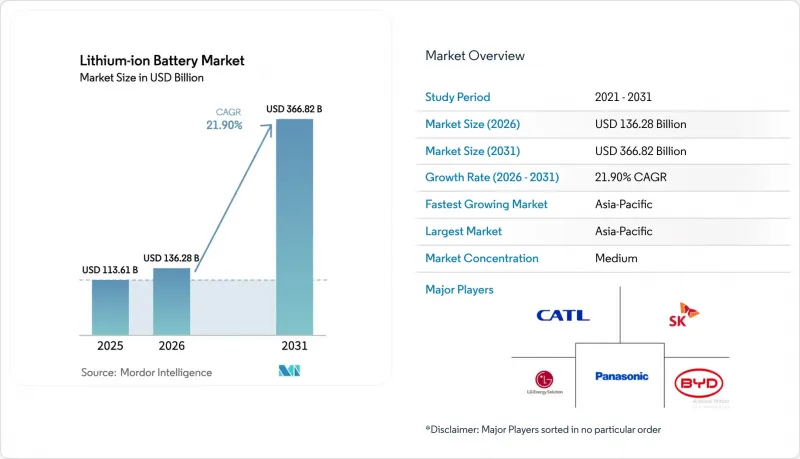
This report is Segmented by Product Type (LCO, LFP, NMC, NCA, LMO, LTO), Form Factor (Cylindrical, Prismatic, Pouch), Power Capacity (Up To 3, 000 MAh, 3, 000 To 10, 000 MAh, 10, 000 To 60, 000 MAh, Above 60, 000 MAh), End-Use Industry (Automotive, Consumer Electronics, Industrial, Stationary Storage, Aerospace, Marine), and Geography (North America, Europe, Asia-Pacific, South America, Middle East and Africa).
Global Lithium-ion Battery Market Trends and Insights
Surging Demand for High-Energy-Density Batteries in Long-Range EV Platforms
Automakers competing in the premium segment now specify packs between 75 kWh and 120 kWh to guarantee 400-mile driving ranges or better, a threshold proven by prototypes such as Mercedes-Benz EQXX and commercial models like the Lucid Air. Nickel content above 90% pushes energy density past 250 Wh/kg but also heightens thermal-runaway risk, steering parallel investment toward solid-state electrolytes and ceramic separators. Supply security is tightening: original equipment manufacturers are locking multi-year offtake agreements directly with cell producers, bypassing traditional Tier-1 suppliers to align chemistry roadmaps with 2028-2030 model cycles. As a result, the lithium-ion battery market sees heightened vertical integration that redistributes bargaining power upstream. This move amplifies capital intensity but shortens development cycles, compressing the window for smaller entrants to catch up.
China's Industrial Policy "Made in China 2025" Accelerating Domestic Li-ion Gigafactory Build-Out
Beijing targets 1,200 GWh of domestic capacity by 2030 under "Made in China 2025" and provincial incentives ranging from land grants to cut-rate electricity underpin cost structures foreign rivals struggle to match. CATL alone commissioned 70 GWh across Luoyuan and Luoyang between 2025 and 2026, while BYD added 25 GWh of LFP output in Shenzhen. The policy's mandatory technology-transfer clauses let local firms absorb NCA and silicon-anode know-how from Korean and Japanese partners, broadening competitive depth. Concurrent investments in Indonesia and Thailand extend China's ecosystem offshore to secure nickel laterite feedstock and to pre-empt potential trade barriers.
Graphite Anode Supply Tightness Owing to Chinese Environmental Curtailments
China controls 65% of mined natural graphite and 95% of spherical processing, and environmental inspections that shuttered 30% of Inner Mongolia and Heilongjiang capacity during 2024 tightened global supply. Revised wastewater and particulate standards raised processing costs by up to USD 1,200 per tonne, while December 2023 export licensing favors domestic cell makers. Non-Chinese projects such as Syrah's Vidalia and Nouveau Monde's Quebec lines will cover less than 5% of 2030 demand. Silicon-blend anodes lower the graphite needs but remain early-stage.
Other drivers and restraints analyzed in the detailed report include:
- Rapid Roll-Out of Utility-Scale Battery Energy Storage Procurements in the United States
- Stationary Data-Center Back-Up Migration from VRLA to Lithium-Ion in Nordic Countries
- High-Voltage Electrolyte Additive Cost Inflation Post-Ukraine Conflict
For complete list of drivers and restraints, kindly check the Table Of Contents.
Segment Analysis
Lithium iron phosphate commanded 50% of 2025 cell shipments, overtaking nickel-rich chemistries on the strength of a USD 47 per kWh advantage that shields manufacturers from lithium carbonate swings. The lithium-ion battery market size for LFP cells is projected to expand at 23.5% through 2031 as entry-level EVs in China, India, and Southeast Asia favor its thermal stability. Automakers are widening chemistry menus: Tesla reintroduced LFP in standard-range U.S. models, while General Motors added LFP modules to commercial variants of its Ultium platform. Concurrently, CATL's cell-to-pack Qilin 3.0 lifts LFP energy density to 255 Wh/kg, narrowing the gap with NMC and attracting mid-range vehicles that previously insisted on nickel-rich chemistries.
NMC remains indispensable in luxury and long-range platforms that target 250-plus Wh/kg, but its share slid to 44.5% in 2025. NCA and solid-state prototypes push density even higher, yet cost and cobalt constraints restrain wide adoption. Lithium cobalt oxide continues to retreat in smartphones as handset capacities crest 5,000 mAh; meanwhile, lithium manganese oxide and lithium titanate remain confined to power tools and high-cycle buses. The lithium-ion battery market maintains portfolio diversity, but value is gravitating toward chemistries that balance cost, safety, and supply security.
Cylindrical cells retained a 49.3% share in 2025, anchored by Tesla's 4680 and a legacy base of 18650s and 21700s in electronics. Yet pouch formats are slated for a 22.7% CAGR through 2031 as automakers adopt cell-to-pack architectures that integrate aluminum-laminate cells directly into vehicle chassis. Pouch flexibility improves volumetric efficiency by up to 60% and eliminates intermediate modules, trimming 15% pack mass. The lithium-ion battery market size for pouch cells, therefore, grows faster than any rival form factor.
Prismatic designs dominate Chinese OEM preferences and evolve toward load-bearing cell-to-body concepts that cut vehicle weight by 5% to 8%. Thermal strategies differ: cylindrical arrays require immersion or dedicated coolant channels, whereas pouch and prismatic stacks share cooling plates, reducing resistance. LG Energy Solution's P5 system removes 40% of pack components via this approach. Manufacturing yields currently favor cylindrical lines, but module-free trends tilt capital toward pouch and large prismatic tooling over the forecast horizon.
Complete Report Scope:
- By Product Type
- Lithium Cobalt Oxide (LCO)
- Lithium Iron Phosphate (LFP)
- Lithium Nickel Manganese Cobalt (NMC)
- Lithium Nickel Cobalt Aluminium (NCA)
- Lithium Manganese Oxide (LMO)
- Lithium Titanate (LTO)
- By Form Factor
- Cylindrical
- Prismatic
- Pouch
- By Power Capacity
- 0 to 3,000 mAh
- 3,000 to 10,000 mAh
- 10,000 to 60,000 mAh
- Above 60,000 mAh
- By End-use Industry
- Automotive (EV, HEV, PHEV)
- Consumer Electronics
- Industrial and Power Tools
- Stationary Energy Storage
- Aerospace and Defense
- Marine
- By Geography
- North America
- United States
- Canada
- Mexico
- Europe
- United Kingdom
- Germany
- France
- Spain
- Nordic Countries
- Russia
- Rest of Europe
- Asia-Pacific
- China
- India
- Japan
- South Korea
- Malaysia
- Thailand
- Indonesia
- Vietnam
- Australia
- Rest of Asia-Pacific
- South America
- Brazil
- Argentina
- Colombia
- Rest of South America
- Middle East and Africa
- United Arab Emirates
- Saudi Arabia
- South Africa
- Egypt
- Rest of Middle East and Africa
- North America
Geography Analysis
Asia-Pacific commanded 55.7% of the 2025 value and is forecast to expand at 30.8% through 2031 as China, India, and Southeast Asia hurry to localize cathode, anode, and cell assembly. China alone commissioned 150 GWh of new capacity by early 2026, sustaining scale economies that ripple across ASEAN through joint ventures in Indonesia and Thailand. India's incentive scheme earmarks INR 181 billion for advanced-chemistry cell plants, anchoring 50 GWh of prospective LFP lines by 2028 and drawing collaborations among Reliance, Panasonic, and CATL. Japan and South Korea continue to lead high-nickel NMC and silicon-anode research; Panasonic's 4680 tie-up with Tesla in Kansas underscores that edge.
North America's share is rising as the Inflation Reduction Act requires 50% local battery components in 2024, escalating to 100% by 2029. Announced investments from General Motors, Ford, and Stellantis total USD 73 billion toward a 500 GWh regional footprint by 2030. Canada's hydro-powered provinces attract cathode and precursor plants from BASF and Northvolt, while Mexico leverages USMCA rules and lower labor costs for pack assembly lines in Nuevo Leon and Jalisco. The lithium-ion battery market thus becomes tri-polar across Asia, North America, and Europe.
Europe is reshaping supply through the Battery Regulation that enforces carbon-footprint declarations from February 2025 and minimum recycled-content thresholds by 2031. Northvolt's Skelleftea plant runs on renewable hydro and wind, cutting carbon intensity below 10 kg CO2/kWh, yet construction overruns led to a 2025 Chapter 11 filing in the United States, highlighting capital risk. Germany's ACC consortium is delayed to late 2026, while France, Italy, and Spain race to capture the impending demand. South America and the Middle East-Africa are nascent but signal early ambition, with Saudi Arabia's NEOM planning a 10 GWh plant with Envision AESC for a 2028 start-up.
- Contemporary Amperex Technology Co., Ltd. (CATL)
- BYD Company Limited
- LG Energy Solution Ltd.
- Panasonic Holdings Corp.
- Samsung SDI Co., Ltd.
- SK On Co., Ltd.
- AESC (Envision AESC Group)
- CALB Co., Ltd.
- Gotion High-Tech Co., Ltd.
- EVE Energy Co., Ltd.
- Farasis Energy Inc.
- Sunwoda Electronic Co., Ltd.
- Murata Manufacturing Co., Ltd.
- VARTA AG
- Toshiba Corporation
- Saft Groupe SAS
- Northvolt AB
- Microvast Holdings, Inc.
- A123 Systems LLC
- Hitachi Energy Ltd.
- Lithium Werks BV
- Tesla Inc. (Battery Division)
Additional Benefits:
- The market estimate (ME) sheet in Excel format
- 3 months of analyst support
TABLE OF CONTENTS
1 Introduction
- 1.1 Study Assumptions & Market Definition
- 1.2 Scope of the Study
2 Research Methodology
3 Executive Summary
4 Market Landscape
- 4.1 Market Overview
- 4.2 Market Drivers
- 4.2.1 Surging Demand for High-Energy-Density Batteries in Long-Range EV Platforms
- 4.2.2 China's Industrial Policy ("Made in China 2025") Accelerating Domestic Li-ion Gigafactory Build-out
- 4.2.3 Rapid Roll-out of Utility-Scale Battery Energy Storage Procurements in the United States
- 4.2.4 Stationary Data-centre Back-up Migration from VRLA to Lithium-ion in Nordic Countries
- 4.2.5 Maritime IMO GHG targets Driving Marine-Grade Li-ion Adoption in Europe
- 4.2.6 OEM Shift to LFP Chemistry for Cost-Sensitive Entry-Level EVs in India
- 4.3 Market Restraints
- 4.3.1 Graphite Anode Supply Tightness Owing to Chinese Environmental Curtailments
- 4.3.2 High-Voltage Electrolyte Additive Cost Inflation Post-Ukraine Conflict
- 4.3.3 US-EU Trade Barriers on Critical Minerals Undermining Trans-Atlantic Supply Chains
- 4.3.4 Recycling Infrastructure Lag Delaying Circular Material Flows in Oceania
- 4.4 Supply-Chain Analysis
- 4.5 Recent Trends & Developments
- 4.6 Regulatory Outlook
- 4.7 Technology Outlook
- 4.8 Price Trend Analysis
- 4.9 Porter's Five Forces
- 4.9.1 Bargaining Power of Suppliers
- 4.9.2 Bargaining Power of Buyers
- 4.9.3 Threat of New Entrants
- 4.9.4 Threat of Substitutes
- 4.9.5 Intensity of Competitive Rivalry
5 Market Size & Growth Forecasts
- 5.1 By Product Type
- 5.1.1 Lithium Cobalt Oxide (LCO)
- 5.1.2 Lithium Iron Phosphate (LFP)
- 5.1.3 Lithium Nickel Manganese Cobalt (NMC)
- 5.1.4 Lithium Nickel Cobalt Aluminium (NCA)
- 5.1.5 Lithium Manganese Oxide (LMO)
- 5.1.6 Lithium Titanate (LTO)
- 5.2 By Form Factor
- 5.2.1 Cylindrical
- 5.2.2 Prismatic
- 5.2.3 Pouch
- 5.3 By Power Capacity
- 5.3.1 0 to 3,000 mAh
- 5.3.2 3,000 to 10,000 mAh
- 5.3.3 10,000 to 60,000 mAh
- 5.3.4 Above 60,000 mAh
- 5.4 By End-use Industry
- 5.4.1 Automotive (EV, HEV, PHEV)
- 5.4.2 Consumer Electronics
- 5.4.3 Industrial and Power Tools
- 5.4.4 Stationary Energy Storage
- 5.4.5 Aerospace and Defense
- 5.4.6 Marine
- 5.5 By Geography
- 5.5.1 North America
- 5.5.1.1 United States
- 5.5.1.2 Canada
- 5.5.1.3 Mexico
- 5.5.2 Europe
- 5.5.2.1 United Kingdom
- 5.5.2.2 Germany
- 5.5.2.3 France
- 5.5.2.4 Spain
- 5.5.2.5 Nordic Countries
- 5.5.2.6 Russia
- 5.5.2.7 Rest of Europe
- 5.5.3 Asia-Pacific
- 5.5.3.1 China
- 5.5.3.2 India
- 5.5.3.3 Japan
- 5.5.3.4 South Korea
- 5.5.3.5 Malaysia
- 5.5.3.6 Thailand
- 5.5.3.7 Indonesia
- 5.5.3.8 Vietnam
- 5.5.3.9 Australia
- 5.5.3.10 Rest of Asia-Pacific
- 5.5.4 South America
- 5.5.4.1 Brazil
- 5.5.4.2 Argentina
- 5.5.4.3 Colombia
- 5.5.4.4 Rest of South America
- 5.5.5 Middle East and Africa
- 5.5.5.1 United Arab Emirates
- 5.5.5.2 Saudi Arabia
- 5.5.5.3 South Africa
- 5.5.5.4 Egypt
- 5.5.5.5 Rest of Middle East and Africa
- 5.5.1 North America
6 Competitive Landscape
- 6.1 Market Concentration
- 6.2 Strategic Moves (M&A, Partnerships, PPAs)
- 6.3 Market Share Analysis (Market Rank/Share for key companies)
- 6.4 Company Profiles (includes Global level Overview, Market level overview, Core Segments, Financials as available, Strategic Information, Products & Services, and Recent Developments)
- 6.4.1 Contemporary Amperex Technology Co., Ltd. (CATL)
- 6.4.2 BYD Company Limited
- 6.4.3 LG Energy Solution Ltd.
- 6.4.4 Panasonic Holdings Corp.
- 6.4.5 Samsung SDI Co., Ltd.
- 6.4.6 SK On Co., Ltd.
- 6.4.7 AESC (Envision AESC Group)
- 6.4.8 CALB Co., Ltd.
- 6.4.9 Gotion High-Tech Co., Ltd.
- 6.4.10 EVE Energy Co., Ltd.
- 6.4.11 Farasis Energy Inc.
- 6.4.12 Sunwoda Electronic Co., Ltd.
- 6.4.13 Murata Manufacturing Co., Ltd.
- 6.4.14 VARTA AG
- 6.4.15 Toshiba Corporation
- 6.4.16 Saft Groupe SAS
- 6.4.17 Northvolt AB
- 6.4.18 Microvast Holdings, Inc.
- 6.4.19 A123 Systems LLC
- 6.4.20 Hitachi Energy Ltd.
- 6.4.21 Lithium Werks BV
- 6.4.22 Tesla Inc. (Battery Division)
7 Market Opportunities & Future Outlook
- 7.1 White-space & Unmet-Need Assessment

