PUBLISHER: Mordor Intelligence | PRODUCT CODE: 2124457

PUBLISHER: Mordor Intelligence | PRODUCT CODE: 2124457
NATO Ammunition - Market Share Analysis, Industry Trends & Statistics, Growth Forecasts (2026 - 2031)
According to Mordor Intelligence, the NATO ammunition market size is expected to grow from USD 8.7 billion in 2025 to USD 9.06 billion in 2026 and is forecasted to reach USD 11.23 billion by 2031 at a 4.4% CAGR over 2026-2031.
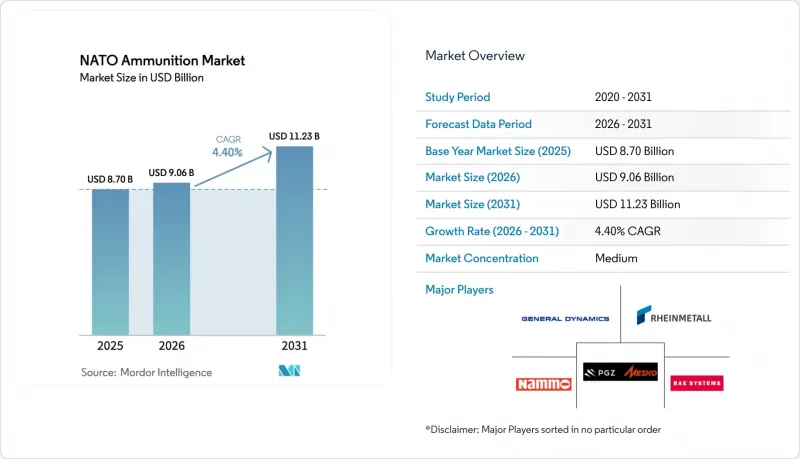
This report is Segmented by Caliber (Small, Medium, Large, and Others), Product (Bullets and Cartridges, Artillery Shells and Mortars, and Aerial Bombs and Grenades), Guidance (Guided and Unguided), End-User (Military, Law-Enforcement, and More), Platform (Land, Naval, and Airborne), and Geography (United States, Canada, United Kingdom, and More). The Market Forecasts are Provided in Terms of Value (USD).
NATO Ammunition Market Trends and Insights
Heightened NATO Defense-Spending Commitments
Member-state budgets are increasing at the fastest rate since the end of the Cold War. In 2024, twenty-three out of thirty-two allies met the 2% of GDP defense spending benchmark, a significant rise from just six a decade earlier. European defense expenditures grew by 18% in 2024, with artillery, small arms, and air-defense munitions receiving a substantial share of the additional funds. Discussions around a potential 5% GDP target by 2035 could unlock a further EUR 100 billion (USD 117.22 billion) annually, with 15-20% of this likely allocated to ammunition procurement. Poland's 4.7% of GDP defense spending highlights this trend, with significant investments in 155 mm and small-caliber ammunition production. Meanwhile, southern-flank members remain focused on naval priorities, creating regional demand disparities that suppliers must address when planning NATO ammunition production runs.
Inventory Replenishment After Ukraine Conflict
Transfers to Kyiv have significantly depleted alliance stockpiles, falling below planned levels. By mid-2024, the US had shipped over 2 million 155 mm rounds, prompting a surge plan to produce 100,000 shells per month by the end of 2024. Germany's stockpile dropped below 30,000 rounds, leading to an EUR 8.5 billion (USD 9.96 billion) contract with Rheinmetall for 220,000 shells and a 700,000-round annual baseline starting in 2026. Allies are shifting away from just-in-time inventory models in favor of maintaining 90-180 day reserves, a move expected to increase baseline demand by approximately 40% through 2027. This replenishment effort is accelerating the adoption of advanced technologies, as governments prioritize refilling stockpiles with insensitive or programmable rounds, despite their 20-30% higher costs compared to legacy munitions.
Press-Powder and Primer Feed-Stock Shortages
The global supply of nitrocellulose and antimony remains constrained. China accounts for 70% of antimony exports, and periodic export restrictions have driven primer prices up by 40-60% since 2022. In the West, only a limited number of plants produce propellant powder, and establishing new capacity requires 3-5 years for environmental permitting. General Dynamics allocated USD 50 million in 2024 to expand propellant production, but full operational capacity is not expected until 2027. Producers are prioritizing allocations, focusing on 155 mm shells over small-arms training rounds, which has tightened the NATO ammunition market in the short term.
Other drivers and restraints analyzed in the detailed report include:
- Multiyear Framework Contracts for 155 mm Rounds
- Allied Call-Off Options for Smart Cartridge Fuzes
- Range-Environmental Restrictions on Lead Propellants
For complete list of drivers and restraints, kindly check the Table Of Contents.
Segment Analysis
Large-caliber rounds are projected to grow at a 6.10% CAGR through 2031, surpassing growth in other caliber categories as 155 mm fire support regains doctrinal importance. The NATO ammunition market for large-caliber munitions is bolstered by the US Army's plan to sustain production of 100,000 shells per month, significantly exceeding historical peaks. Small-caliber ammunition, while maintaining a 44.87% market share in 2025, faces margin pressures due to mandatory transitions to lead-free cartridges.
Unit cost differences influence budgeting priorities. Conventional ball rounds cost less than USD 1.50, while high-explosive 155 mm shells range from USD 3,000 to USD 8,000, and Excalibur precision-guided variants exceed USD 68,000. Despite these costs, the lethality of large-caliber rounds at a 40 km range remains critical in contested maneuver corridors. Mid-caliber growth is uneven, driven by vehicle upgrade cycles such as the Puma IFV and Bradley A4 cannon enhancements.
Artillery shells and mortars are expected to grow at a 5.90% CAGR from 2026 to 2031, supported by multi-year contracts from Germany, the US, and Poland that secure minimum production volumes. Bullets and cartridges continue to generate the highest throughput, accounting for 45.93% of 2025 revenue. However, environmental compliance costs and surplus stock sell-offs are flattening demand trends.
Supply chain structures vary significantly. Small-caliber ammunition is produced in vertically integrated facilities, such as Lake City, whereas artillery cases, fills, and fuzes rely on a three-tier network that is susceptible to bottlenecks. US 155 mm indefinite-delivery contracts worth USD 961 million in 2024 demonstrate risk pooling, enabling the Army to adjust production without the need for renegotiation.
Complete Report Scope:
- By Caliber
- Small Caliber
- Medium Caliber
- Large Caliber
- Others
- By Product
- Bullets and Cartridges
- Artillery Shells and Mortars
- Aerial Bombs and Grenades
- By Guidance
- Guided
- Unguided
- By End-User
- Military
- Law-Enforcement
- Civil and Sport Shooting
- By Platform
- Land Platform
- Naval Platform
- Airborne Platform
- By Geography
- United States
- Canada
- United Kingdom
- France
- Germany
- Italy
- Poland
- Spain
- Turkey
- Rest of NATO Countries
List of Companies Covered in this Report:
- Rheinmetall AG
- BAE Systems plc
- General Dynamics Corporation
- Nammo AS
- Winchester Ammunition (Olin Corporation)
- CBC Global Ammunition
- MESKO S.A.
- KNDS N.V.
- Northrop Grumman Corporation
- Global Ordnance LLC
- FN HERSTAL
- The Kinetic Group
- Elbit Systems Ltd.
- Saab AB
- Makine ve Kimya Endustrisi A.S.
- Sellier & Bellot a.s. (Colt CZ Group SE)
Additional Benefits:
- The market estimate (ME) sheet in Excel format
- 3 months of analyst support
TABLE OF CONTENTS
1 INTRODUCTION
- 1.1 Study Assumptions and Market Definition
- 1.2 Scope of the Study
- 1.3 Research Methodology
2 EXECUTIVE SUMMARY
3 KEY INDUSTRY TRENDS
4 MARKET LANDSCAPE
- 4.1 Market Overview
- 4.2 Market Drivers
- 4.2.1 Heightened NATO defense-spending commitments
- 4.2.2 Inventory replenishment after Ukraine conflict
- 4.2.3 Multiyear framework contracts for 155 mm rounds
- 4.2.4 Allied call-off options for smart cartridge fuzes
- 4.2.5 Accelerated NSPA procurement processes
- 4.2.6 Shift toward insensitive-munition fillers
- 4.3 Market Restraints
- 4.3.1 Press-powder and primer feed-stock shortages
- 4.3.2 Ageing case-line tooling at legacy factories
- 4.3.3 Tightened ITAR/export-control bottlenecks
- 4.3.4 Range-environmental restrictions on lead propellants
- 4.4 Value Chain Analysis
- 4.5 Regulatory Landscape
- 4.6 Technological Outlook
- 4.7 Porter's Five Forces Analysis
- 4.7.1 Threat of New Entrants
- 4.7.2 Bargaining Power of Suppliers
- 4.7.3 Bargaining Power of Buyers
- 4.7.4 Threat of Substitutes
- 4.7.5 Intensity of Competitive Rivalry
5 MARKET SIZE AND GROWTH FORECASTS (VALUE)
- 5.1 By Caliber
- 5.1.1 Small Caliber
- 5.1.2 Medium Caliber
- 5.1.3 Large Caliber
- 5.1.4 Others
- 5.2 By Product
- 5.2.1 Bullets and Cartridges
- 5.2.2 Artillery Shells and Mortars
- 5.2.3 Aerial Bombs and Grenades
- 5.3 By Guidance
- 5.3.1 Guided
- 5.3.2 Unguided
- 5.4 By End-User
- 5.4.1 Military
- 5.4.2 Law-Enforcement
- 5.4.3 Civil and Sport Shooting
- 5.5 By Platform
- 5.5.1 Land Platform
- 5.5.2 Naval Platform
- 5.5.3 Airborne Platform
- 5.6 By Geography
- 5.6.1 United States
- 5.6.2 Canada
- 5.6.3 United Kingdom
- 5.6.4 France
- 5.6.5 Germany
- 5.6.6 Italy
- 5.6.7 Poland
- 5.6.8 Spain
- 5.6.9 Turkey
- 5.6.10 Rest of NATO Countries
6 COMPETITIVE LANDSCAPE
- 6.1 Strategic Moves
- 6.2 Market Share Analysis
- 6.3 Company Profiles (includes Global level Overview, Market level overview, Core Segments, Financials as available, Strategic Information, Market Rank/Share for key companies, Products and Services, and Recent Developments)
- 6.3.1 Rheinmetall AG
- 6.3.2 BAE Systems plc
- 6.3.3 General Dynamics Corporation
- 6.3.4 Nammo AS
- 6.3.5 Winchester Ammunition (Olin Corporation)
- 6.3.6 CBC Global Ammunition
- 6.3.7 MESKO S.A.
- 6.3.8 KNDS N.V.
- 6.3.9 Northrop Grumman Corporation
- 6.3.10 Global Ordnance LLC
- 6.3.11 FN HERSTAL
- 6.3.12 The Kinetic Group
- 6.3.13 Elbit Systems Ltd.
- 6.3.14 Saab AB
- 6.3.15 Makine ve Kimya Endustrisi A.S.
- 6.3.16 Sellier & Bellot a.s. (Colt CZ Group SE)
7 MARKET OPPORTUNITIES AND FUTURE OUTLOOK
- 7.1 Key Strategic Questions for Satellite CEOs

