PUBLISHER: Mordor Intelligence | PRODUCT CODE: 2121601

PUBLISHER: Mordor Intelligence | PRODUCT CODE: 2121601
Smart Wearable - Market Share Analysis, Industry Trends & Statistics, Growth Forecasts (2026 - 2031)
According to Mordor Intelligence, the smart wearable market size is expected to grow from USD 99.36 billion in 2025 to USD 118.89 billion in 2026 and is forecast to reach USD 254.31 billion by 2031 at 16.42% CAGR over 2026-2031.
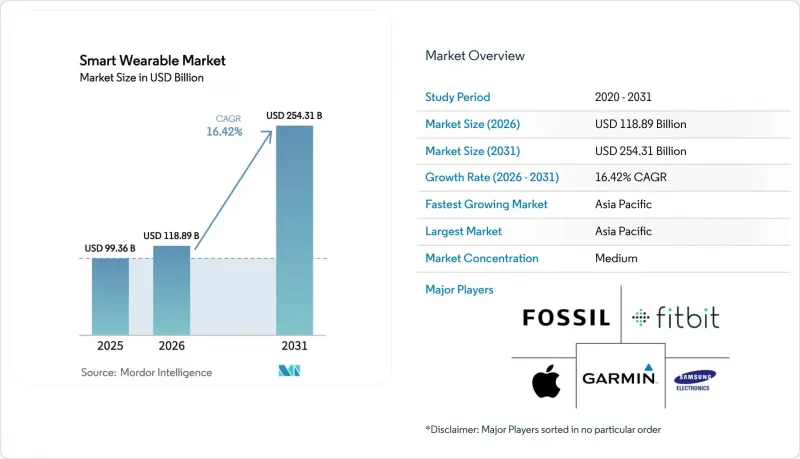
This report is Segmented by Product (Smartwatches, Hearables, Fitness Trackers, Head-Mounted Displays, Smart Clothing, Body-Worn Cameras, Smart Rings, and More), Component (Hardware, Software, and Services), Connectivity (Bluetooth, Cellular, and More), Application (Consumer, Healthcare, and More), Distribution (Online, and Offline), and Geography. Market Forecasts are Provided in Terms of Value (USD).
Global Smart Wearable Market Trends and Insights
Rising Health and Fitness Consciousness Among Consumers
Daily step counts, heart-rate variability, and sleep-stage scores have become routine metrics, transforming wearables into accountability companions. Apple disclosed that 70% of 2025 Watch Series 9 buyers ranked health tools as the main reason for purchase, up 12 percentage points from 2022. Garmin's running and cycling portfolio expanded 18% year over year in 2025, boosted by links to Strava and Training Peaks that turn casual joggers into data-driven athletes. Samsung added body-composition analysis to Galaxy Watch 6, offering muscle and body-fat insights previously confined to clinic scales. These medical-grade sensors wrapped in gamified software are sustaining double-digit unit growth even as smartphone replacement cycles lengthen.
Insurance-Approved Wearables for Cardiac Remote Monitoring
Centers for Medicare and Medicaid Services began reimbursing clinician review of wearable-derived electrocardiogram data in 2024, paying USD 50-USD 65 per patient each month. Omron's HeartGuide watch, the first FDA-cleared oscillometric blood-pressure wearable, gained coverage from UnitedHealthcare and Anthem in 2025, lowering member costs from USD 499 to under USD 100. Withings' ScanWatch 2 earned FDA clearance for atrial-fibrillation detection, and more than 40 accountable-care organizations embedded its data into Epic and Cerner records by mid-2025. Reimbursement is therefore repositioning wearables from wellness extras to billable diagnostic endpoints.
Data-Residency Mandates Limiting Cloud Companion Apps in Europe
Following the Schrems II judgment, EU regulators intensified enforcement in 2025, forcing vendors to host health data within European borders. Apple spent an estimated USD 200 million migrating iCloud Health workloads to German and Irish facilities. Fitbit was fined EUR 8 million for routing user data through U.S. servers without consent, highlighting the financial risk of non-compliance. Smaller brands lacking capital for localized infrastructure face exit decisions or margin-eroding partnerships with regional clouds, raising customer acquisition costs.
Other drivers and restraints analyzed in the detailed report include:
- China's Dual-Use Smartwatch Subsidies Under Healthy China 2030
- AI-On-Chip Wearables Enable Needle-Free Glucose Monitoring
- High-Density Battery Thermal Runaway Concerns
For complete list of drivers and restraints, kindly check the Table Of Contents.
Segment Analysis
Smartwatches delivered 60.39% of 2025 revenue, placing the category at the center of the smart wearable market size, as Apple, Samsung, and Garmin leveraged ecosystem lock-ins and multisport GPS accuracy to defend share. Hearables supplied 18% of shipments, riding Apple AirPods Pro 2's over-the-counter hearing-aid approval to serve 30 million Americans with mild hearing loss. Fitness bands tapered to 12% as consumers gravitated toward full-stack watches that fuse payments, cellular calls, and health dashboards.
Momentum is shifting toward discreet form factors. Smart rings, led by Oura's USD 500 million annual subscription run rate and Samsung's Galaxy Ring, are rising at a 17.05% CAGR, the fastest of any product line in the smart wearable market. Head-mounted displays held 5% share, but Meta's Quest 3S price drop hints at future volume plays. Niche frontiers in smart clothing, medical patches, and powered exoskeletons contributed a combined 5% yet hold white-space potential, evidenced by Ekso Bionics shipping 120 EVO exoskeletons to the U.S. Army in fiscal 2025.
Hardware retained 71.22% of 2025 revenue, but the services layer is expanding at a 16.94% CAGR to 2031, repositioning revenue streams inside the smart wearable market. Apple's services unit topped USD 96 billion in fiscal 2025, with roughly 8% linked to Fitness Plus and iCloud Health storage. WHOOP's no-upfront-hardware model achieved 1.2 million subscribers at USD 30 monthly, illustrating the valuation upside in annuity cash flows.
Software and companion apps, representing 8% share, underpin hardware utility and open developer ecosystems. Garmin processed more than 50 million Connect IQ downloads in 2025, while Xiaomi's decision to open-source its HyperOS wearable SDK in March 2025 boosted third-party submissions 150% within six months. Consequently, subscription-centric vendors in the smart wearable industry now trade at 8-12X revenue multiples, compared with 2-4X for hardware-only peers.
Complete Report Scope:
- By Product
- Smartwatches
- Hearables (Ear-Worn, Smart Earbuds)
- Fitness and Activity Trackers
- Head-Mounted Displays (AR, VR, MR)
- Smart Clothing and Textiles
- Body-Worn Cameras
- Smart Rings and Jewelry
- Medical Wearable Patches and Biosensors
- Powered Exoskeletons
- By Component
- Hardware
- Software and Apps
- Services and Subscriptions
- By Connectivity Technology
- Bluetooth, BLE
- Cellular (3G, 4G, LTE-M)
- 5G Stand-Alone
- NFC, RFID
- Wi-Fi, WLAN
- Others Connectivity Technology (UWB, ANT+)
- By End-Use
- Consumer Electronics and Lifestyle
- Healthcare and Medical
- Fitness and Sports
- Industrial and Enterprise Safety
- Military and Defense
- By Distribution Channel
- Online (Brand E-Store, Marketplaces)
- Offline (Consumer Electronics Stores, Specialty, Clinics)
- By Geography
- North America
- United States
- Canada
- Mexico
- Europe
- Germany
- United Kingdom
- France
- Italy
- Spain
- Rest of Europe
- Asia Pacific
- China
- Japan
- South Korea
- India
- South-East Asia
- Rest of Asia Pacific
- South America
- Brazil
- Rest of South America
- Middle East
- United Arab Emirates
- Saudi Arabia
- Rest of Middle East
- Africa
- South Africa
- Rest of Africa
- North America
Geography Analysis
Asia Pacific led with 34.91% revenue in 2025 and is projected to register a 17.31% CAGR to 2031, the quickest regional pace. China's regulator cleared 47 dual-use smartwatch models in 2025, a 56% jump from 2024, and subsidies of up to CNY 500 (USD 71.4) per unit fostered a volume surge for Huawei, Xiaomi, and Oppo. India's unit shipments climbed 68%, allowing domestic brands Noise, Fire-Boltt, and boAt to command over 60% share via sub-USD 50 pricing and vernacular apps. Japan expanded reimbursement for wearable-sourced blood-pressure data in April 2025, lifting Omron's HeartGuide volumes 34% in a single quarter.
North America generated 32% revenue in 2025, anchored by Medicare codes and enterprise wellness budgets. Apple Watch Series 10, released in September 2024 with FDA-cleared sleep-apnea detection, drew an 18% sales mix from users over 50. Provinces in Canada distributed 25,000 subsidized smartwatches for chronic-disease pilots, while Mexico's market grew 41% on imported stock despite higher tariffs on Chinese devices.
Europe supplied 22% revenue but faces the heaviest compliance drag. Germany's Federal Office for Information Security now demands explicit consent for any cross-border transfer of biometric information, adding as much as three months to launch timelines. The United Kingdom integrated wearable data into the NHS App in 2025, enabling 12 million citizens to share metrics with doctors. South America and Middle East and Africa each represented 6% revenue, with Brazil driving volume yet limited by low ARPU and the United Arab Emirates propelling luxury smartwatch demand.
- Apple Inc.
- Samsung Electronics Co. Ltd.
- Alphabet Inc. (Fitbit, Google Pixel)
- Garmin Ltd.
- Huawei Technologies Co. Ltd.
- Xiaomi Corporation
- Meta Platforms Inc. (Oculus)
- Sony Group Corporation
- Microsoft Corp.
- Withings SA
- Huami Corp. (Zepp Health)
- GoPro Inc.
- Fossil Group Inc.
- Omron Healthcare Inc.
- Ekso Bionics Holdings Inc.
- Cyberdyne Inc.
- Nuheara Ltd.
- Bragi GmbH
- Sensoria Inc.
- AIQ Smart Clothing Inc.
- Polar Electro Oy
- Coros Wearables Inc.
- Oura Health Ltd.
- WHOOP Inc.
Additional Benefits:
- The market estimate (ME) sheet in Excel format
- 3 months of analyst support
TABLE OF CONTENTS
1 INTRODUCTION
- 1.1 Study Assumptions and Market Definition
- 1.2 Scope of the Study
2 RESEARCH METHODOLOGY
3 EXECUTIVE SUMMARY
4 MARKET LANDSCAPE
- 4.1 Market Overview
- 4.2 Market Drivers
- 4.2.1 Rising Health-and-Fitness Consciousness Among Consumers
- 4.2.2 Enterprise Digital-Wellness Programs Boosting Device Subsidies
- 4.2.3 Insurance-Approved Wearables for Cardiac Remote Monitoring in North America
- 4.2.4 China's Dual-Use (Consumer + Medical) Smartwatch Subsidies Through Healthy China 2030
- 4.2.5 Rise of AI-on-Chip Wearables Enabling Continuous Glucose Monitoring Without Needles
- 4.2.6 Defense Exoskeleton Procurements Under United States Soldier Lethality Program
- 4.3 Market Restraints
- 4.3.1 Data-Residency Mandates Limiting Cloud Companion Apps in Europe
- 4.3.2 High-Density Battery Thermal Runaway Concerns in Ultra-Slim Smartwatches
- 4.3.3 Patent-Licensing Litigation Costs for Gesture-Based Smart Rings
- 4.3.4 Low ARPU in South America Limiting 5G Stand-Alone Wearable Roll-outs
- 4.4 Industry Value-Chain Analysis
- 4.5 Regulatory Landscape
- 4.6 Technological Outlook
- 4.7 Impact of Macroeconomic Factors on the Market
- 4.8 Porter's Five Forces Analysis
- 4.8.1 Bargaining Power of Suppliers
- 4.8.2 Bargaining Power of Buyers
- 4.8.3 Threat of New Entrants
- 4.8.4 Threat of Substitute Products
- 4.8.5 Intensity of Competitive Rivalry
- 4.9 Investment and Funding Analysis
5 MARKET SIZE AND GROWTH FORECASTS (VALUES)
- 5.1 By Product
- 5.1.1 Smartwatches
- 5.1.2 Hearables (Ear-Worn, Smart Earbuds)
- 5.1.3 Fitness and Activity Trackers
- 5.1.4 Head-Mounted Displays (AR, VR, MR)
- 5.1.5 Smart Clothing and Textiles
- 5.1.6 Body-Worn Cameras
- 5.1.7 Smart Rings and Jewelry
- 5.1.8 Medical Wearable Patches and Biosensors
- 5.1.9 Powered Exoskeletons
- 5.2 By Component
- 5.2.1 Hardware
- 5.2.2 Software and Apps
- 5.2.3 Services and Subscriptions
- 5.3 By Connectivity Technology
- 5.3.1 Bluetooth, BLE
- 5.3.2 Cellular (3G, 4G, LTE-M)
- 5.3.3 5G Stand-Alone
- 5.3.4 NFC, RFID
- 5.3.5 Wi-Fi, WLAN
- 5.3.6 Others Connectivity Technology (UWB, ANT+)
- 5.4 By End-Use
- 5.4.1 Consumer Electronics and Lifestyle
- 5.4.2 Healthcare and Medical
- 5.4.3 Fitness and Sports
- 5.4.4 Industrial and Enterprise Safety
- 5.4.5 Military and Defense
- 5.5 By Distribution Channel
- 5.5.1 Online (Brand E-Store, Marketplaces)
- 5.5.2 Offline (Consumer Electronics Stores, Specialty, Clinics)
- 5.6 By Geography
- 5.6.1 North America
- 5.6.1.1 United States
- 5.6.1.2 Canada
- 5.6.1.3 Mexico
- 5.6.2 Europe
- 5.6.2.1 Germany
- 5.6.2.2 United Kingdom
- 5.6.2.3 France
- 5.6.2.4 Italy
- 5.6.2.5 Spain
- 5.6.2.6 Rest of Europe
- 5.6.3 Asia Pacific
- 5.6.3.1 China
- 5.6.3.2 Japan
- 5.6.3.3 South Korea
- 5.6.3.4 India
- 5.6.3.5 South-East Asia
- 5.6.3.6 Rest of Asia Pacific
- 5.6.4 South America
- 5.6.4.1 Brazil
- 5.6.4.2 Rest of South America
- 5.6.5 Middle East
- 5.6.5.1 United Arab Emirates
- 5.6.5.2 Saudi Arabia
- 5.6.5.3 Rest of Middle East
- 5.6.6 Africa
- 5.6.6.1 South Africa
- 5.6.6.2 Rest of Africa
- 5.6.1 North America
6 COMPETITIVE LANDSCAPE
- 6.1 Market Concentration
- 6.2 Strategic Moves
- 6.3 Market Share Analysis
- 6.4 Company Profiles (includes Global Level Overview, Market Level Overview, Core Segments, Financials as Available, Strategic Information, Market Rank/Share for Key Companies, Products and Services, and Recent Developments)
- 6.4.1 Apple Inc.
- 6.4.2 Samsung Electronics Co. Ltd.
- 6.4.3 Alphabet Inc. (Fitbit, Google Pixel)
- 6.4.4 Garmin Ltd.
- 6.4.5 Huawei Technologies Co. Ltd.
- 6.4.6 Xiaomi Corporation
- 6.4.7 Meta Platforms Inc. (Oculus)
- 6.4.8 Sony Group Corporation
- 6.4.9 Microsoft Corp.
- 6.4.10 Withings SA
- 6.4.11 Huami Corp. (Zepp Health)
- 6.4.12 GoPro Inc.
- 6.4.13 Fossil Group Inc.
- 6.4.14 Omron Healthcare Inc.
- 6.4.15 Ekso Bionics Holdings Inc.
- 6.4.16 Cyberdyne Inc.
- 6.4.17 Nuheara Ltd.
- 6.4.18 Bragi GmbH
- 6.4.19 Sensoria Inc.
- 6.4.20 AIQ Smart Clothing Inc.
- 6.4.21 Polar Electro Oy
- 6.4.22 Coros Wearables Inc.
- 6.4.23 Oura Health Ltd.
- 6.4.24 WHOOP Inc.
7 MARKET OPPORTUNITIES AND FUTURE OUTLOOK
- 7.1 White-Space and Unmet-Need Assessment

