PUBLISHER: Mordor Intelligence | PRODUCT CODE: 2124777

PUBLISHER: Mordor Intelligence | PRODUCT CODE: 2124777
Europe Cookware - Market Share Analysis, Industry Trends & Statistics, Growth Forecasts (2026 - 2031)
According to Mordor Intelligence, the european cookware market size is expected to grow from USD 7.66 billion in 2025 to USD 7.94 billion in 2026 and is forecast to reach USD 9.48 billion by 2031 at 3.62% CAGR over 2026-2031.
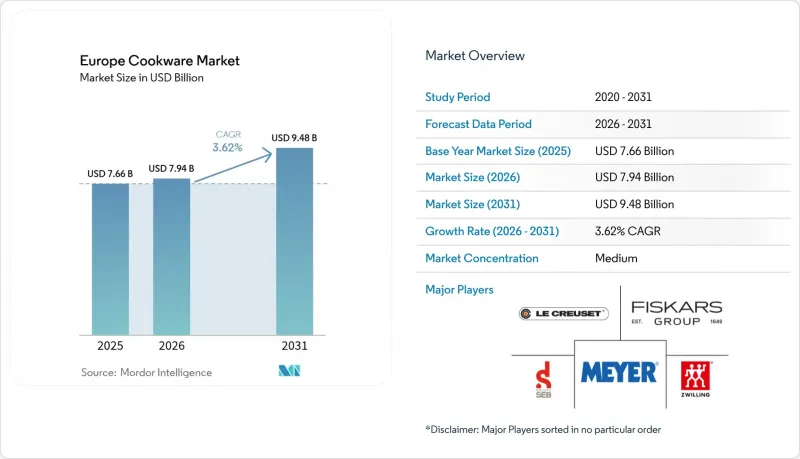
This report is Segmented by Product Type (Core Cookware, Specialized Cookware, Accessories), Material (Stainless Steel, Aluminium, Cast Iron, Carbon Steel, Copper, Ceramic/Glass, Silicone, Other Coated Substrates), End User (Residential, Commercial), Distribution Channel (Offline Retail, Online, B2B/Direct Sales), and Geography. The Market Forecasts are Provided in Terms of Value (USD).
Europe Cookware Market Trends and Insights
Rising popularity of ceramic & PTFE-free non-stick cookware
Manufacturers race to bring fluorine-free coatings to market as the European Chemicals Agency evaluates a potential PFAS phase-out that could reach cookware in the next regulatory wave. Fraunhofer IFAM's PLASLON(R) process shows that cold-plasma ceramic layers can replicate PTFE slipperiness while surviving dishwashers, giving brand owners a ready alternative. Groupe SEB already commercializes the RENEW line featuring 100% recycled aluminum bodies and bio-sourced Inoceram(R) surfaces to capture health-conscious households willing to pay pricing premiums. Consumer confusion persists after France opted to exempt cookware from its own PFAS ban, yet that carve-out merely delays rather than removes demand for safer chemistries. As a result, premium suppliers gain margin headroom, whereas low-cost importers scramble to validate coating safety claims under stricter "green-claim" rules.
Home-cooking boom sustained post-COVID
Hybrid work models keep Europeans in their kitchens for lunch and early-evening meals even after restaurants fully reopened in 2024. McKinsey reports that food inflation slowed to 2.4% in 2024, freeing household budgets for durable upgrades rather than emergency pantry stocking. Specialized pieces such as Dutch ovens or fermentation crocks therefore outsell expectations because social-media tutorials nudge amateur chefs toward category-specific gear that promises professional results. Brands bundle multi-piece starter sets to catch these upgrade cycles without forcing shoppers into ultra-premium price tiers. Nevertheless, bifurcation remains: high-income consumers embrace €500 cast-iron sets, but price-sensitive segments stretch legacy aluminum pans until performance visibly dips.
Volatility in aluminium & stainless-steel prices
Euro-area aluminum producer-price indices slid from 140.2 in May 2022 to 114.4 in April 2024 but still swing quarter-to-quarter, complicating margin forecasting for pot manufacturers that lock tooling schedules six months ahead. Stainless markets add a geopolitical overlay: Scandinavian demand firms while Central European auto slowdowns crimp mill orderbooks, whipsawing surcharge formulas. Energy cost spikes-electricity futures rose 38% in Italy during 2024-further inflate smelter overheads and roll through to billet pricing. The 2026 Carbon Border Adjustment Mechanism will assign CO2 costs to imported metals, raising landed prices for Asian inputs and potentially favoring intra-EU sourcing. Firms hedge exposure via long-term supply contracts and sharpen product-mix toward high-margin specialty lines where raw-material cost share is lower.
Other drivers and restraints analyzed in the detailed report include:
- Expansion of e-commerce kitchenware retail
- Premiumisation fuelled by rising disposable incomes
- Mature replacement market limiting unit growth
For complete list of drivers and restraints, kindly check the Table Of Contents.
Segment Analysis
Specialized items accounted for only 26.42% of 2025 sales but will add USD 668 million by 2031 as home chefs seek tools that mirror restaurant technique. The European cookware market recognizes that a Japanese carbon-steel wok or a French madeleine tin solves a distinct culinary challenge unmet by generic pots, so manufacturers fill shelves with purpose-built forms in multiple diameters. Social-media creators broadcast sourdough timelines and tataki searing tips, each post quietly prescribing new hardware and raising category awareness. Retailers curate seasonal "theme corners"-Nordic baking in December, Mediterranean grilling in June-to cross-sell spice mixes and small electrics alongside niche pans. As a result, specialized lines grow volume 1.3 times faster than core sets, cushioning overall revenue when base-level replacements flatten.
Core cookware still posts the lion's share, yet differentiation shifts from count of pieces to ergonomic refinements such as rivetless interiors that simplify cleanup or stay-cool composite handles rated for 250 °C oven use. Tri-ply stainless variants suppress hot spots on induction tops, justifying price points 40% above mono-material rivals. Stackable set designs reduce cabinet footprint, answering the urban-living pain point common in Paris or Amsterdam apartments. Energy labeling gains relevance: hangtags now display time-to-boil metrics validated under EU test protocol EN 12983, guiding eco-minded shoppers. Together, these features preserve pricing power even as base volumes mature, ensuring the European cookware market continues monetizing core lines.
Stainless products hold 34.92% revenue share due to scratch resistance, dishwasher safety, and aesthetic fit with modern appliances. Multi-layer clad builds marry stainless durability with aluminum heat diffusion, appealing to cooks upgrading from thin-gauge entry pieces. The European cookware market size for ceramic-coated aluminum, however, is forecast to grow 3.68% annually, spotlighting health-first shoppers and regulators targeting fluoropolymer risk. Technology convergence helps: sol-gel ceramic top-coats now achieve 50,000 abrasion cycles, extending lifespan closer to PTFE norms. Manufacturers combine recycled post-consumer beverage-can alloy with these coatings, checking both sustainability and safety boxes.
Cast iron enjoys a renaissance among hobby bakers chasing perfect crust or steakhouse-style sear. Enamel layers remove seasoning effort, making the category friendlier for first-time buyers. Carbon steel travels the opposite direction-lighter than cast iron yet still pan-to-oven capable-winning favor in professional kitchens and spilling into prosumer channels. Glass roaster sales rise where consumers trust visibility to manage browning without lid lifts, a small but growing niche. Meanwhile, copper settles into ultra-premium status, buoyed by television chefs but limited by maintenance and price; a 28 cm tin-lined pan can top USD 400, confining demand to enthusiasts.
Complete Report Scope:
- By Product Type (Value)
- Core Cookware
- Pans (Fry/Saute, Grill, Wok/Kadhai, Crepe)
- Pots (Sauce, Stock, Dutch Oven)
- Pressure Cookers & Steamers
- Cookware Sets
- Specialized Cookware
- Dutch Ovens & Casseroles
- Specialty Cookware (Idli, Appam, BBQ Grill Pan, etc.)
- Bakeware (Ovenware, Muffin trays, Cake tins, etc.)
- Accessories (Lids, Handles)
- Core Cookware
- By Material (Value)
- Stainless Steel
- Aluminium
- Cast Iron
- Carbon Steel
- Copper
- Ceramic/Glass
- Silicone
- Other Coated Substrates
- By End User (Value)
- Residential
- Commercial (HoReCa, Institutional, Catering)
- By Distribution Channel (Value)
- Offline Retail
- Super/Hypermarkets
- Department Stores
- Specialty Stores
- Online
- E-commerce Marketplaces
- Brand Webshops
- B2B / Direct Sales
- Offline Retail
- By Country
- United Kingdom
- Germany
- France
- Spain
- Italy
- BENELUX (Belgium, Netherlands, and Luxembourg)
- NORDICS (Denmark, Finland, Iceland, Norway, and Sweden)
- Rest of Europe
List of Companies Covered in this Report:
- Groupe SEB
- Meyer Group Ltd.
- Fissler GmbH
- Zwilling J.A. Henckels AG
- Fiskars Group
- Le Creuset Group AG
- BergHOFF Worldwide
- De Buyer Industries
- ProCook Ltd.
- Kuhn Rikon AG
- Scanpan A/S
- Moneta (Aluflon SpA)
- Cristel SAS
- Staub SAS
- Ballarini SpA
- Smeg S.p.A.
- Tefal (Brand)
- IKEA Group
- KitchenAid (Whirlpool)
- Samuel Groves & Co. Ltd.
Additional Benefits:
- The market estimate (ME) sheet in Excel format
- 3 months of analyst support
TABLE OF CONTENTS
1 Introduction
- 1.1 Study Assumptions & Market Definition
- 1.2 Scope of the Study
2 Research Methodology
3 Executive Summary
4 Market Landscape
- 4.1 Market Overview
- 4.2 Market Drivers
- 4.2.1 Rising Popularity Of Ceramic & PTFE-Free Non-Stick Cookware
- 4.2.2 Home-Cooking Boom Sustained Post-Covid
- 4.2.3 Expansion of E-Commerce Kitchenware Retail
- 4.2.4 Premiumisation Fuelled By Rising Disposable Incomes
- 4.2.5 EU Eco-Design Push For Induction-Ready Cookware (Under-Reported)
- 4.2.6 Residential Electrification Programmes Boosting All-Electric Cookware Sets (Under-Reported)
- 4.3 Market Restraints
- 4.3.1 Volatility in Aluminium & Stainless-Steel Prices
- 4.3.2 Mature Replacement Market Limiting Unit Growth
- 4.3.3 Price Pressure From Asian Private-Label Imports
- 4.3.4 Stricter EU "Green-Claims" Rules On Pfas Coatings (Under-Reported)
- 4.4 Value / Supply-Chain Analysis
- 4.5 Regulatory Landscape
- 4.6 Technological Outlook
- 4.7 Porter's Five Forces
- 4.7.1 Bargaining Power of Suppliers
- 4.7.2 Bargaining Power of Buyers
- 4.7.3 Threat of New Entrants
- 4.7.4 Threat of Substitutes
- 4.7.5 Competitive Rivalry
5 Market Size & Growth Forecasts
- 5.1 By Product Type (Value)
- 5.1.1 Core Cookware
- 5.1.1.1 Pans (Fry/Saute, Grill, Wok/Kadhai, Crepe)
- 5.1.1.2 Pots (Sauce, Stock, Dutch Oven)
- 5.1.1.3 Pressure Cookers & Steamers
- 5.1.1.4 Cookware Sets
- 5.1.2 Specialized Cookware
- 5.1.2.1 Dutch Ovens & Casseroles
- 5.1.2.2 Specialty Cookware (Idli, Appam, BBQ Grill Pan, etc.)
- 5.1.2.3 Bakeware (Ovenware, Muffin trays, Cake tins, etc.)
- 5.1.3 Accessories (Lids, Handles)
- 5.1.1 Core Cookware
- 5.2 By Material (Value)
- 5.2.1 Stainless Steel
- 5.2.2 Aluminium
- 5.2.3 Cast Iron
- 5.2.4 Carbon Steel
- 5.2.5 Copper
- 5.2.6 Ceramic/Glass
- 5.2.7 Silicone
- 5.2.8 Other Coated Substrates
- 5.3 By End User (Value)
- 5.3.1 Residential
- 5.3.2 Commercial (HoReCa, Institutional, Catering)
- 5.4 By Distribution Channel (Value)
- 5.4.1 Offline Retail
- 5.4.1.1 Super/Hypermarkets
- 5.4.1.2 Department Stores
- 5.4.1.3 Specialty Stores
- 5.4.2 Online
- 5.4.2.1 E-commerce Marketplaces
- 5.4.2.2 Brand Webshops
- 5.4.3 B2B / Direct Sales
- 5.4.1 Offline Retail
- 5.5 By Country
- 5.5.1 United Kingdom
- 5.5.2 Germany
- 5.5.3 France
- 5.5.4 Spain
- 5.5.5 Italy
- 5.5.6 BENELUX (Belgium, Netherlands, and Luxembourg)
- 5.5.7 NORDICS (Denmark, Finland, Iceland, Norway, and Sweden)
- 5.5.8 Rest of Europe
6 Competitive Landscape
- 6.1 Market Concentration
- 6.2 Strategic Moves
- 6.3 Market Share Analysis
- 6.4 Company Profiles (includes Global level Overview, Market level overview, Core Segments, Financials as available, Strategic Information, Market Rank/Share for key companies, Products & Services, and Recent Developments)
- 6.4.1 Groupe SEB
- 6.4.2 Meyer Group Ltd.
- 6.4.3 Fissler GmbH
- 6.4.4 Zwilling J.A. Henckels AG
- 6.4.5 Fiskars Group
- 6.4.6 Le Creuset Group AG
- 6.4.7 BergHOFF Worldwide
- 6.4.8 De Buyer Industries
- 6.4.9 ProCook Ltd.
- 6.4.10 Kuhn Rikon AG
- 6.4.11 Scanpan A/S
- 6.4.12 Moneta (Aluflon SpA)
- 6.4.13 Cristel SAS
- 6.4.14 Staub SAS
- 6.4.15 Ballarini SpA
- 6.4.16 Smeg S.p.A.
- 6.4.17 Tefal (Brand)
- 6.4.18 IKEA Group
- 6.4.19 KitchenAid (Whirlpool)
- 6.4.20 Samuel Groves & Co. Ltd.
7 Market Opportunities & Future Outlook
- 7.1 Revival of Traditional Cookware (Dutch Ovens, Casseroles, Copper)
- 7.2 Smaller Household Sizes Driving Compact & Multi-Purpose Cookware

