PUBLISHER: Mordor Intelligence | PRODUCT CODE: 2073492

PUBLISHER: Mordor Intelligence | PRODUCT CODE: 2073492
Indonesia Frozen Food - Market Share Analysis, Industry Trends & Statistics, Growth Forecasts (2026 - 2031)
According to Mordor Intelligence, the indonesian frozen food market size is expected to grow from USD 3.38 billion in 2025 to USD 3.61 billion in 2026 and is forecast to reach USD 5.01 billion by 2031 at 6.78% CAGR over 2026-2031.
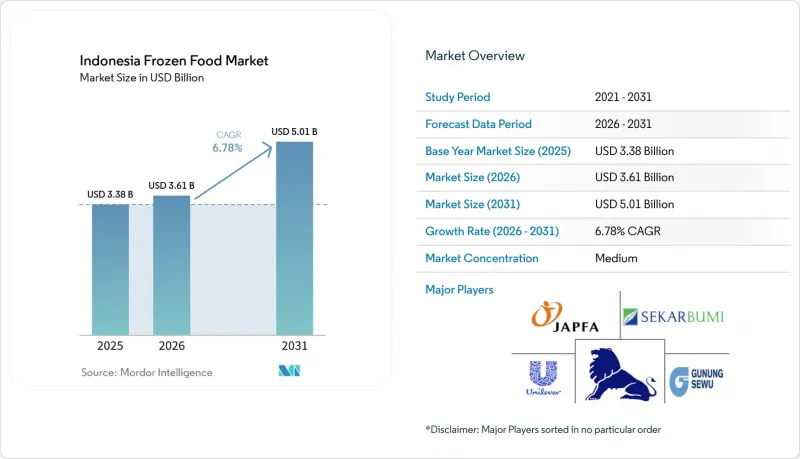
This report is Segmented by Product Category (Ready-To-Eat, Ready-To-Cook), Product Type (Frozen Fruits and Vegetables, Frozen Meat and Seafood, and More), Distribution Channel (On-Trade, Off-Trade [Supermarkets/Hypermarkets, Convenience Stores, Online Retail Store, Other Off-Trade Channels]), and Geography (Indonesia). The Market Forecasts are Provided in Terms of Both Value (USD) and Volume (Units),
Indonesia Frozen Food Market Trends and Insights
Popularity of Convenient Food Products
Indonesia's consumption landscape is evolving, fueled by a growing demand for convenient food products. Ready-to-eat and ready-to-cook frozen foods have become essential household items, offering a wide range of options from both local and international cuisines. These products meet consumer preferences for nutrition, variety, and time efficiency, driving the frozen ready meal segment to lead the market. Urbanization and the increase in dual-income households have amplified the dependence on these convenient food solutions, particularly in major metropolitan areas like Jakarta and Surabaya. According to Statistics Indonesia, 46.61% of urban expenditure in Indonesia was allocated to food in 2024. This shift is further supported by the rise of modern retail formats and the rapid growth of e-commerce, which together enhance product accessibility and variety. Companies are increasingly utilizing digital platforms to connect with younger, time-constrained consumers. For instance, GoFood reported a 30% year-on-year increase in online orders for frozen and ready meals in 2024. As Indonesia's middle class continues to grow and urban lifestyles become more demanding, this trend is expected to persist.
Expansion of cold-chain logistics
Indonesia's frozen food market depends heavily on cold-chain infrastructure, which remains significantly underdeveloped. In 2024, Pelindo's modernization program reduced berth times for non-containerized vessels by 30% and increased reefer plug availability at Tanjung Priok, leading to a 17% rise in chilled cargo throughput. Thirteen smart ports now utilize technologies such as optical character recognition, IoT, and automated gates, enabling cold chain operators to monitor container temperatures efficiently from ship to warehouse. Advanced refrigeration and cold transport reduce spoilage during transit and distribution, ensuring high standards of food safety and quality. This logistical efficiency reassures consumers and addresses concerns about product degradation and contamination. In May 2025, the collaboration between Dalian Bingshan and Thermo Asri Makmur to develop new cold chain facilities highlights a shift toward modern logistics solutions. These advancements are expected to create new growth opportunities, particularly for off-trade and e-commerce sectors that require integrated temperature control and effective last-mile delivery.
High electricity and refrigeration costs
Indonesia's frozen food sector faces significant challenges due to high electricity and refrigeration costs, particularly in areas outside major urban centers. The fragmented power grid and elevated energy tariffs substantially increase cold storage and logistics expenses, which, in turn, compress profit margins for producers and distributors. This issue is especially pronounced in eastern Indonesia, where infrastructure deficiencies persist despite government efforts to encourage private-sector investment through various incentives. Although the adoption of energy-efficient technologies and renewable energy sources is gradually helping to optimize cost structures, the sector is unlikely to experience widespread benefits until the medium term.
Other drivers and restraints analyzed in the detailed report include:
- Plant-based and functional frozen meal innovation
- Social media and influencer marketing
- Competition from fresh and chilled food alternatives
For complete list of drivers and restraints, kindly check the Table Of Contents.
Segment Analysis
The Ready-to-Cook segment commanded 61.12% of the Indonesian frozen food market share in 2025. With brands increasingly developing regional spice blends tailored to Sundanese and Balinese preferences, this segment is expected to grow steadily. Consumers appreciate the flexibility to adjust final seasonings, making these kits a practical balance between traditional cooking and convenience. Manufacturers are leveraging this trend by introducing family-size packs, which lower per-serving costs and enhance freezer-fill rates in modern retail outlets. Meanwhile, Ready-to-Eat meals are anticipated to grow at a strong 7.34% CAGR through 2031, fueled by the rise in single-person households. Products such as microwaveable rice bowls, Korean-style dumplings, and protein-enriched porridges appeal to students and professionals living in rented accommodations. Additionally, cross-promotions on ride-hailing super-apps encourage impulse purchases, embedding Ready-to-Eat meals into daily routines and strengthening their role in Indonesia's growing frozen food market.
Global suppliers are increasingly collaborating with local partners to align taste and texture with Indonesian preferences. Automated portioning lines ensure consistent quality, while modified-atmosphere packaging extends shelf life to over 18 months. This operational precision supports export goals to neighboring ASEAN markets and establishes the foundation for economies of scale. This enables suppliers to sustain aggressive promotional pricing without compromising margins. Consequently, the combined growth of the Ready-to-Cook and Ready-to-Eat segments strengthens Indonesia's frozen food market, providing resilience against fluctuations in raw material costs.
Complete Report Scope:
- By Product Category
- Ready-to-Eat
- Ready-to-Cook
- By Product Type
- Frozen Fruits and Vegetables
- Frozen Meat and Seafood
- Frozen Ready Meals
- Frozen Snacks and Bakery
- Frozen Desserts
- Other Product Types
- By Distribution Channel
- On-Trade
- Off-Trade
- Supermarkets/Hypermarkets
- Convenience Stores
- Online Retail Store
- Other Off-Trade Channels
List of Companies Covered in this Report:
- PT Charoen Pokphand Indonesia Tbk
- Gunung Sewu Group (Belfoods Indonesia)
- PT Sekar Bumi Tbk
- JAPFA Ltd (PT So Good Food)
- Unilever PLC (Walls, Bango)
- Aice Group Holdings
- General Mills Inc.
- McCain Foods Ltd
- Ezaki Glico Co. Ltd
- Pronas Indonesia
- PT Mayora Indah Tbk
- Nestle SA
- PT Indofood CBP Sukses Makmur Tbk
- Campina Ice Cream
- PT Macroprima Panganutama (Champ)
- Gunung Sewu Group
- PT Estika Tata Tiara Tbk
- PT Bumi Menara Internusa
- Raka Ice Cream
- Kirana Food International
Additional Benefits:
- The market estimate (ME) sheet in Excel format
- 3 months of analyst support
TABLE OF CONTENTS
1 INTRODUCTION
- 1.1 Study Assumptions and Market Definition
- 1.2 Scope of the Study
2 RESEARCH METHODOLOGY
3 EXECUTIVE SUMMARY
4 MARKET LANDSCAPE
- 4.1 Market Overview
- 4.2 Market Drivers
- 4.2.1 Popularity of convenient food products
- 4.2.2 Expansion of cold-chain logistics
- 4.2.3 Plant-based and functional frozen meal innovation
- 4.2.4 Popularity of frozen processed meat and seafood products
- 4.2.5 Social media and influencer marketing
- 4.2.6 Increasing health consciousness and demand for quality
- 4.3 Market Restraints
- 4.3.1 High electricity and refrigeration costs
- 4.3.2 Competition from fresh and chilled food alternatives
- 4.3.3 Limited consumer awareness and trust in some regions
- 4.3.4 Concerns over food safety and quality
- 4.4 Consumer Behaviour Analysis
- 4.5 Regulatory Landscape
- 4.6 Technological Outlook
- 4.7 Porter's Five Forces
- 4.7.1 Threat of New Entrants
- 4.7.2 Bargaining Power of Buyers
- 4.7.3 Bargaining Power of Suppliers
- 4.7.4 Threat of Substitutes
- 4.7.5 Competitive Rivalry
5 MARKET SIZE AND GROWTH FORECASTS (VALUE AND VOLUME)
- 5.1 By Product Category
- 5.1.1 Ready-to-Eat
- 5.1.2 Ready-to-Cook
- 5.2 By Product Type
- 5.2.1 Frozen Fruits and Vegetables
- 5.2.2 Frozen Meat and Seafood
- 5.2.3 Frozen Ready Meals
- 5.2.4 Frozen Snacks and Bakery
- 5.2.5 Frozen Desserts
- 5.2.6 Other Product Types
- 5.3 By Distribution Channel
- 5.3.1 On-Trade
- 5.3.2 Off-Trade
- 5.3.2.1 Supermarkets/Hypermarkets
- 5.3.2.2 Convenience Stores
- 5.3.2.3 Online Retail Store
- 5.3.2.4 Other Off-Trade Channels
6 COMPETITIVE LANDSCAPE
- 6.1 Market Concentration
- 6.2 Strategic Moves
- 6.3 Market Share Analysis
- 6.4 Company Profiles (includes Global level Overview, Market level overview, Core Segments, Financials as available, Strategic Information, Market Rank/Share for key companies, Products and Services, and Recent Developments)
- 6.4.1 PT Charoen Pokphand Indonesia Tbk
- 6.4.2 Gunung Sewu Group (Belfoods Indonesia)
- 6.4.3 PT Sekar Bumi Tbk
- 6.4.4 JAPFA Ltd (PT So Good Food)
- 6.4.5 Unilever PLC (Walls, Bango)
- 6.4.6 Aice Group Holdings
- 6.4.7 General Mills Inc.
- 6.4.8 McCain Foods Ltd
- 6.4.9 Ezaki Glico Co. Ltd
- 6.4.10 Pronas Indonesia
- 6.4.11 PT Mayora Indah Tbk
- 6.4.12 Nestle SA
- 6.4.13 PT Indofood CBP Sukses Makmur Tbk
- 6.4.14 Campina Ice Cream
- 6.4.15 PT Macroprima Panganutama (Champ)
- 6.4.16 Gunung Sewu Group
- 6.4.17 PT Estika Tata Tiara Tbk
- 6.4.18 PT Bumi Menara Internusa
- 6.4.19 Raka Ice Cream
- 6.4.20 Kirana Food International
7 MARKET OPPORTUNITIES AND FUTURE OUTLOOK

