
PUBLISHER: Mordor Intelligence | PRODUCT CODE: 1906980

PUBLISHER: Mordor Intelligence | PRODUCT CODE: 1906980
Europe Automated Guided Vehicle (AGV) - Market Share Analysis, Industry Trends & Statistics, Growth Forecasts (2026 - 2031)
European AGV market size in 2026 is estimated at USD 1.87 billion, growing from 2025 value of USD 1.69 billion with 2031 projections showing USD 3.12 billion, growing at 10.8% CAGR over 2026-2031.
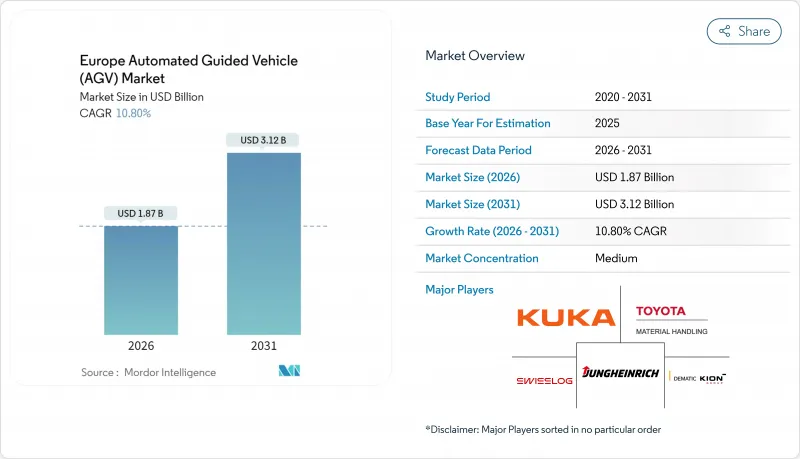
Growth is driven by flexible manufacturing initiatives in the automotive sector, large-scale port automation programs, and sustained e-commerce expansion that demands high-throughput intralogistics. Lithium-ion powertrains, 5G-enabled fleet orchestration, and AI-based traffic management platforms are converging to raise overall equipment productivity while meeting EU decarbonization targets. Germany's automation leadership, the Netherlands' port projects, and the United Kingdom's response to acute labor shortages serve as powerful adoption catalysts, whereas fragmented RF spectrum and high integration costs still moderate deployment velocity.
Europe Automated Guided Vehicle (AGV) Market Trends and Insights
E-commerce fulfilment centres' surge across urban Europe
Rapid growth in urban fulfilment hubs is resetting AGV design priorities toward compact footprints and 24/7 availability. REWE Group's EUR 250 million logistics hub in Magdeburg automates 50% of intralogistics and handles 286,000 packages per day, proving the scale advantages of AGV-centric layouts. Specialty retailers follow suit; Dr. Max's new Italian warehouse uses mobile robots to sustain 55% online-sales growth. Combined with stabilizing logistics-real-estate vacancies, retailers now negotiate for automation-ready space that supports rapid AGV charging infrastructure.
Industry 4.0-enabled flexible manufacturing lines in German automotive plants
German automakers are dismantling rigid conveyor lines in favor of matrix production orchestrated by AGV fleets. Mercedes-Benz's body-in-white operations run nearly 100 KUKA vehicles that autonomously synchronize component flows in real time. BMW's factory implementations rely on AI fleet control software to adapt transport routes to model-mix changes without downtime. Purpose-built paint-shop AGVs such as Durr's EcoProFleet expand the concept to finishing lines, allowing multiple vehicle types to run on shared resources.
High up-front system integration & customisation costs for SMEs
Many SMEs confront integration quotations exceeding EUR 49,000 for a modest two-AGV installation, stalling broader market penetration. Although payback can arrive within eight months in optimized layouts, limited in-house expertise and low awareness of subsidy programs leave uptake uneven. OECD surveys show 72% of European SMEs understand digital benefits, yet only 18% actively deploy advanced automation due to skills and funding gaps.
Other drivers and restraints analyzed in the detailed report include:
- Labour-cost inflation & demographic shortages in Western Europe's logistics workforce
- EU Green Deal incentives for low-emission intralogistics equipment
- Fragmented European RF spectrum causing network latency in dense warehouses
For complete list of drivers and restraints, kindly check the Table Of Contents.
Segment Analysis
Automated forklifts captured 37.60% of the European AGV market share in 2025, underpinned by drop-in compatibility with existing pallet workflows and mature safety certifications. Tow tractors and tug vehicles remain staples in large manufacturing campuses, whereas assembly line platforms support just-in-time automotive sequencing. Unit-load carriers, propelled by e-commerce fulfilment needs, are forecast to grow at a 12.6% CAGR, increasing their contribution to the European AGV market size through 2031.
Technical evolution blurs legacy categories: KION's KAnIS project demonstrates 5G-linked outdoor forklifts that coordinate with indoor fleets, extending automated coverage to yard areas. Toyota's alliance with Gideon blends forklift heritage with AI-driven AMRs, revealing how suppliers reposition toward adaptable multi-purpose platforms.
Laser guidance commanded 41.40% share in 2025 thanks to proven precision in structured aisles. Vision-guided vehicles, growing at 13.9% CAGR, leverage SLAM and sensor fusion to self-map unpredictable environments, reducing infrastructure retrofits. Magnetic and inductive paths persist in critical path-following use cases such as cold-chain tunnels. Free-navigation research at Fraunhofer IPA shows how hybrid vision-laser stacks eliminate fixed reflectors while preserving millimetric accuracy. Innok Robotics extends this model outdoors with LiDAR plus motion-tracker fusion for rough terrain.
The European AGV Market Report is Segmented by Vehicle Type (Automated Forklift, Unit-Load Carrier, and More), Navigation Technology (Laser Guided, Magnetic/Inductive Guided, and More), Battery Type (Lead-Acid, Lithium-Ion, Nickel-Metal Hydride, and More), Mode of Operation (Manual Override, Hybrid/Dual-Mode, and More), Application, End-User Industry, and Geography. The Market Forecasts are Provided in Terms of Value (USD).
List of Companies Covered in this Report:
- Swisslog Holding AG
- KUKA AG
- Jungheinrich AG
- Toyota Material Handling Europe AB
- Dematic (KION Group)
- SSI Schaefer AG
- Murata Machinery Ltd
- ABB Ltd
- Seegrid Corporation
- AGILOX Services GmbH
- Balyo SA
- Elettric 80 SpA
- Linde Material Handling GmbH
- STILL GmbH
- Mobile Industrial Robots (MiR)
- Fives Intralogistics SAS
- Euroimpianti SpA
- Oceaneering International (AGV Systems)
- Transbotics Corporation
- Amerden Inc.
Additional Benefits:
- The market estimate (ME) sheet in Excel format
- 3 months of analyst support
TABLE OF CONTENTS
1 INTRODUCTION
- 1.1 Study Assumptions and Market Definition
- 1.2 Scope of the Study
2 RESEARCH METHODOLOGY
3 EXECUTIVE SUMMARY
4 MARKET LANDSCAPE
- 4.1 Market Overview
- 4.2 Market Drivers
- 4.2.1 E-commerce Fulfilment Centres Surge Across Urban Europe
- 4.2.2 Industry 4.0 Enabled Flexible Manufacturing Lines in German Automotive Plants
- 4.2.3 Labour-Cost Inflation and Demographic Shortages in Western Europes Logistics Workforce
- 4.2.4 EU Green Deal Incentives for Low-Emission Intralogistics Equipment
- 4.2.5 Port Automation Projects in Rotterdam and Antwerp Boosting Maritime AGV Adoption
- 4.2.6 Horizon Europe Funding for Next-Gen Swarm Navigation Algorithms
- 4.3 Market Restraints
- 4.3.1 High Up-front System Integration and Customisation Costs for SMEs
- 4.3.2 Fragmented European RF Spectrum Causing Network Latency in Dense Warehouses
- 4.3.3 Lengthy CE-Mark and ISO 3691-4 Safety Certification Lead-Times
- 4.3.4 Limited Availability of Skilled AGV Systems Integrators
- 4.4 Value / Supply-Chain Analysis
- 4.5 Regulatory and Technological Outlook
- 4.6 Porter's Five Forces Analysis
- 4.6.1 Bargaining Power of Suppliers
- 4.6.2 Bargaining Power of Buyers
- 4.6.3 Threat of New Entrants
- 4.6.4 Threat of Substitutes
- 4.6.5 Intensity of Competitive Rivalry
- 4.7 Industry Value-Chain Analysis
5 MARKET SIZE AND GROWTH FORECASTS (VALUE)
- 5.1 By Vehicle Type
- 5.1.1 Automated Forklift
- 5.1.2 Tow / Tractor / Tug
- 5.1.3 Unit-Load Carrier
- 5.1.4 Assembly Line Vehicle
- 5.1.5 Special-Purpose / Custom
- 5.2 By Navigation Technology
- 5.2.1 Laser Guided
- 5.2.2 Magnetic / Inductive Guided
- 5.2.3 Vision Guided
- 5.2.4 Natural Feature / SLAM
- 5.3 By Battery Type
- 5.3.1 Lead-acid
- 5.3.2 Lithium-ion
- 5.3.3 Nickel-Metal Hydride
- 5.3.4 Super-capacitor / Fast-Charge
- 5.4 By Mode of Operation
- 5.4.1 Manual Override
- 5.4.2 Hybrid / Dual-Mode
- 5.4.3 Fully Autonomous
- 5.5 By Application
- 5.5.1 Transportation and Distribution
- 5.5.2 Storage and Retrieval
- 5.5.3 Assembly and Kitting
- 5.5.4 Packaging and Palletising
- 5.6 By End-User Industry
- 5.6.1 Automotive
- 5.6.2 Food and Beverage
- 5.6.3 Retail and E-commerce
- 5.6.4 Electronics and Electrical
- 5.6.5 General Manufacturing
- 5.6.6 Pharmaceuticals
- 5.6.7 Aerospace and Defence
- 5.7 By Country
- 5.7.1 Germany
- 5.7.2 United Kingdom
- 5.7.3 France
- 5.7.4 Italy
- 5.7.5 Spain
- 5.7.6 Netherlands
- 5.7.7 Rest of Europe
6 COMPETITIVE LANDSCAPE
- 6.1 Market Concentration
- 6.2 Strategic Moves
- 6.3 Market Share Analysis
- 6.4 Company Profiles (includes Global Level Overview, Market Level Overview, Core Segments, Financials as available, Strategic Information, Market Rank/Share for key companies, Products and Services, and Recent Developments)
- 6.4.1 Swisslog Holding AG
- 6.4.2 KUKA AG
- 6.4.3 Jungheinrich AG
- 6.4.4 Toyota Material Handling Europe AB
- 6.4.5 Dematic (KION Group)
- 6.4.6 SSI Schaefer AG
- 6.4.7 Murata Machinery Ltd
- 6.4.8 ABB Ltd
- 6.4.9 Seegrid Corporation
- 6.4.10 AGILOX Services GmbH
- 6.4.11 Balyo SA
- 6.4.12 Elettric 80 SpA
- 6.4.13 Linde Material Handling GmbH
- 6.4.14 STILL GmbH
- 6.4.15 Mobile Industrial Robots (MiR)
- 6.4.16 Fives Intralogistics SAS
- 6.4.17 Euroimpianti SpA
- 6.4.18 Oceaneering International (AGV Systems)
- 6.4.19 Transbotics Corporation
- 6.4.20 Amerden Inc.
7 MARKET OPPORTUNITIES AND FUTURE OUTLOOK
- 7.1 White-Space and Unmet-Need Assessment

