PUBLISHER: Mordor Intelligence | PRODUCT CODE: 2121413

PUBLISHER: Mordor Intelligence | PRODUCT CODE: 2121413
Electrical Enclosures - Market Share Analysis, Industry Trends & Statistics, Growth Forecasts (2026 - 2031)
According to Mordor Intelligence, the electrical enclosures market size is expected to increase from USD 8.11 billion in 2025 to USD 8.61 billion in 2026 and reach USD 11.58 billion by 2031, growing at a CAGR of 6.11% over 2026-2031.
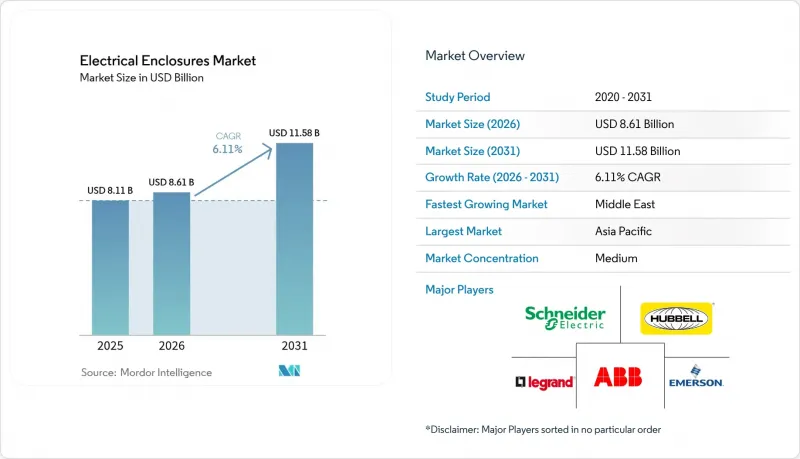
This report is Segmented by Material (Metallic, and Non-Metallic), Mounting Type (Wall-Mounted, Pole-Mounted), Form Factor (Small (Below 10 L), Compact (10-50 L), and More), End-User Industry (Oil and Gas, Industrial Manufacturing and Robotics, Transportation, Data Centres and Telecom, Food and Beverage, Pharmaceuticals, and More), and Geography. The Market Forecasts are Provided in Terms of Value (USD).
Global Electrical Enclosures Market Trends and Insights
Accelerating Renewable-Energy Build-Out
Utility-scale solar and offshore wind projects specify IP65 or higher combiner boxes, inverter housings, and transformer kiosks that withstand corrosive spray, ultraviolet radiation, and temperature swings for 25 years. Stainless-steel 316L dominates North Sea farms, while powder-coated aluminum with passive louvers protects equipment in the Arabian Peninsula's 50 °C heat. Battery-energy-storage systems co-located with solar arrays add a fire-test layer, as UL 9540A certification becomes non-negotiable for bankability. Because renewable capacity is deployed across thousands of micro-sites rather than a few centralized stations, logisticians must orchestrate just-in-time deliveries of smaller, varied enclosure SKUs, pressuring traditional build-to-order plants to embrace modular production.
Industrial Automation and Industry 4.0 Expansion
Factory digitalization programs funded by Germany's EUR 2 billion (USD 2.26 billion) 2024 grant scheme subsidize sensor networks that each consume five to twenty cabinets per cell. Automotive lines in China and Mexico mount collaborative-robot controllers inside IP65 stainless enclosures that prevent electromagnetic interference from servo drives. Food processors prefer sloped-roof, continuous-hinge designs that comply with FDA sanitary codes, while pharmaceutical clean rooms specify polycarbonate windows to enable visual checks without breaching sterile zones. As operational technology integrates with information technology, NEMA TS-2 and IEC 62443 locks, tamper sensors, and intrusion alarms migrate from data centers to plant floors, cementing the electrical enclosures market as a cybersecurity stakeholder.
Raw-Material Price Volatility
London Metal Exchange aluminum contracts fluctuated 10% intra-year during 2024, eroding margins for enclosure makers that operate on 8-12% net spreads. Chinese cold-rolled steel soared when blast-furnace curbs coincided with unexpected iron-ore outages, forcing contract renegotiations or losses for fabricators tied to fixed-price purchase orders. Stainless-steel surcharges linked to nickel and molybdenum spiked 15-20%, stalling offshore wind substation awards. Buyers now write commodity-index clauses into tenders, but the administrative burden complicates procurement and forecasting in the electrical enclosures industry.
Other drivers and restraints analyzed in the detailed report include:
- Grid-Modernization and Substation Retrofits
- Stricter Global Safety and Ingress-Protection Codes
- Cyber-Attack Risk in Connected Enclosures
For complete list of drivers and restraints, kindly check the Table Of Contents.
Segment Analysis
Metallic units accounted for 63.78% of the electrical enclosures market share in 2025, reflecting cold-rolled steel's price advantage and aluminum's weight savings for pole-top gear. Non-metallic cabinets are expected to grow 6.57% annually through 2031 as offshore wind, coastal substations, and chemical plants shift toward fiberglass-reinforced polyester, which shows no rust after 3,000 hours of ASTM B117 salt spray testing. Polycarbonate lids dominate clean rooms where technicians need visual confirmation without breaking the sterile boundary.
Hybrid designs are multiplying: steel frames with polycarbonate doors or aluminum backplates balance cost, grounding, and corrosion resistance. Stainless-steel 316L still owns hazardous zones, meeting NEMA 4X and IP66 while resisting acid and chlorine attack. Meanwhile, carbon steel with epoxy coatings remains the indoor workhorse, but as composite costs fall and flame-retardant ratings reach UL 94 V-0, even factories are questioning legacy metal spend. The electrical enclosures market thus moves toward a mixed-material toolkit tailored to the environment and lifecycle economics.
Wall-mounted boxes delivered 43.67% of 2025 shipments, anchoring control rooms and machine cells where vertical real estate is cheap. Pole-mounted designs are forecast to expand 6.88% through 2031 as telecom operators add tens of thousands of 5G small cells, each requiring IP65-rated housings for rectifiers, splice trays, and backup batteries. Distribution utilities also retrofit auto-reclosers and fault indicators on overhead feeders, cutting rural outage minutes by 40%.
Pad-mounted and underground units serve urban aesthetics and public-safety rules, hiding transformers out of view while resisting soil moisture and rodent ingress. Floor-standing cabinets remain in heavy-industry motor centers and server rooms where cable depth matters. The outward shift in generation, sensing, and compute power is pushing the electrical enclosures market toward smaller, resilient pole-top shells that must withstand wind and lightning, while wall-mounts will persist in climatized interiors.
Complete Report Scope:
- By Material
- Metallic
- Non-Metallic
- By Mounting Type
- Wall-Mounted
- Floor-Mounted / Free-Standing
- Underground / Pad-Mounted
- Pole-Mounted
- By Form Factor
- Small (Below 10 L)
- Compact (10-50 L)
- Free-Size / Full-Size (Above 50 L)
- Modular / Configurable Systems
- By End-User Industry
- Energy and Power
- Oil and Gas
- Industrial Manufacturing and Robotics
- Metals and Mining
- Transportation
- Data Centres and Telecom
- Food and Beverage
- Pharmaceuticals
- By Geography
- North America
- United States
- Canada
- South America
- Brazil
- Argentina
- Rest of South America
- Europe
- Germany
- United Kingdom
- France
- Italy
- Spain
- Rest of Europe
- Asia Pacific
- China
- Japan
- India
- South Korea
- Rest of Asia Pacific
- Middle East and Africa
- Middle East
- United Arab Emirates
- Saudi Arabia
- Turkey
- Rest of Middle East
- Africa
- South Africa
- Egypt
- Rest of Africa
- Middle East
- North America
Geography Analysis
Asia Pacific generated 35.67% of 2025 revenue, buoyed by China's CNY 520 billion (USD 73 billion) grid spend that deployed 1.8 million smart meters and 12,000 automated feeder switches, all nestled inside dust-tight housings. India's INR 300 billion (USD 3.6 billion) revamp funds tamper-proof polycarbonate meter boxes resilient against monsoon splash. Japan and South Korea retrofit nuclear and coal controls into seismic-rated cabinets that sustain magnitude-7 shocks. Southeast Asian data-center approvals in Singapore reached 400 MW in 2024, translating to roughly 18,000 rack enclosures with rear-door heat exchangers. The electrical enclosures market thus tracks the region's dual energy and digital build-out.
The Middle East is projected to grow 7.13% through 2031. Saudi Arabia's NEOM program alone will need about 80,000 inverter and transformer housings suited for 50 °C air laden with sand. The UAE's Barakah plant specified 12,000 stainless cabinets with arc venting, setting a high bar for nuclear projects. Qatar's North Field LNG expansion ordered 5,000 explosion-proof shells for Zone 1. Across the Persian Gulf, desert resilience drives stainless or powder-coated aluminum spend, stretching average order values in the electrical enclosures market.
North America and Europe together hold roughly 45% of global sales. The U.S. Grid Resilience program finances NEMA 3R outdoor cabinets with solid-state coolers to mitigate the impacts of wildfires and hurricanes. Europe's Energiewende funnels EUR 1.8 billion (USD 2.03 billion) into IP67 subsea junction and converter housings for offshore wind. Replacement cycles lengthen in these mature zones, but stricter arc-flash and cybersecurity standards sustain a steady retrofit cadence. Consequently, while growth moderates, specification complexity keeps margins healthy for established vendors in the electrical enclosures market.
- Schneider Electric SE
- ABB Ltd.
- Eaton Corporation plc
- nVent Electric plc
- Rittal GmbH and Co. KG
- Emerson Electric Company
- Hubbell Incorporated
- Pentair plc
- Legrand SA
- Hammond Manufacturing Ltd.
- AZZ Inc.
- Scott Fetzer Company
- Allied Moulded Products Inc.
- Fibox Oy Ab
- Eldon Holding AB
- Siemens AG
- General Electric Company
- Saginaw Control and Engineering
- BOXCO Co. Ltd.
- Nitto Kogyo Corp.
- Socomec Group SA
- Bison ProFab Inc.
- Integra Enclosures Inc.
- Austin Electrical Enclosures
Additional Benefits:
- The market estimate (ME) sheet in Excel format
- 3 months of analyst support
TABLE OF CONTENTS
1 INTRODUCTION
- 1.1 Study Assumptions and Market Definition
- 1.2 Scope of the Study
2 RESEARCH METHODOLOGY
3 EXECUTIVE SUMMARY
4 MARKET LANDSCAPE
- 4.1 Market Overview
- 4.2 Market Drivers
- 4.2.1 Accelerating Renewable-Energy Build-Out
- 4.2.2 Industrial Automation and Industry 4.0 Expansion
- 4.2.3 Grid-Modernization and Substation Retrofits
- 4.2.4 Stricter Global Safety and Ingress-Protection Codes
- 4.2.5 Outdoor 5G Small-Cell Rollout Needing IP-Rated Housings
- 4.2.6 Smart IoT-Enabled Enclosures for Predictive Maintenance
- 4.3 Market Restraints
- 4.3.1 Raw-Material Price Volatility (Steel, Aluminium)
- 4.3.2 Seal-Integrity and Thermal-Management Failures
- 4.3.3 Cyber-Attack Risk in Connected Enclosures
- 4.3.4 Skilled-Labour Shortage for Custom Fabrication
- 4.4 Industry Value Chain Analysis
- 4.5 Regulatory Landscape
- 4.6 Technological Outlook
- 4.7 Impact of Macroeconomic Factors on the Market
- 4.8 Porter's Five Forces Analysis
- 4.8.1 Threat of New Entrants
- 4.8.2 Bargaining Power of Buyers
- 4.8.3 Bargaining Power of Suppliers
- 4.8.4 Threat of Substitute Products
- 4.8.5 Intensity of Competitive Rivalry
5 MARKET SIZE AND GROWTH FORECASTS (VALUE)
- 5.1 By Material
- 5.1.1 Metallic
- 5.1.2 Non-Metallic
- 5.2 By Mounting Type
- 5.2.1 Wall-Mounted
- 5.2.2 Floor-Mounted / Free-Standing
- 5.2.3 Underground / Pad-Mounted
- 5.2.4 Pole-Mounted
- 5.3 By Form Factor
- 5.3.1 Small (Below 10 L)
- 5.3.2 Compact (10-50 L)
- 5.3.3 Free-Size / Full-Size (Above 50 L)
- 5.3.4 Modular / Configurable Systems
- 5.4 By End-User Industry
- 5.4.1 Energy and Power
- 5.4.2 Oil and Gas
- 5.4.3 Industrial Manufacturing and Robotics
- 5.4.4 Metals and Mining
- 5.4.5 Transportation
- 5.4.6 Data Centres and Telecom
- 5.4.7 Food and Beverage
- 5.4.8 Pharmaceuticals
- 5.5 By Geography
- 5.5.1 North America
- 5.5.1.1 United States
- 5.5.1.2 Canada
- 5.5.2 South America
- 5.5.2.1 Brazil
- 5.5.2.2 Argentina
- 5.5.2.3 Rest of South America
- 5.5.3 Europe
- 5.5.3.1 Germany
- 5.5.3.2 United Kingdom
- 5.5.3.3 France
- 5.5.3.4 Italy
- 5.5.3.5 Spain
- 5.5.3.6 Rest of Europe
- 5.5.4 Asia Pacific
- 5.5.4.1 China
- 5.5.4.2 Japan
- 5.5.4.3 India
- 5.5.4.4 South Korea
- 5.5.4.5 Rest of Asia Pacific
- 5.5.5 Middle East and Africa
- 5.5.5.1 Middle East
- 5.5.5.1.1 United Arab Emirates
- 5.5.5.1.2 Saudi Arabia
- 5.5.5.1.3 Turkey
- 5.5.5.1.4 Rest of Middle East
- 5.5.5.2 Africa
- 5.5.5.2.1 South Africa
- 5.5.5.2.2 Egypt
- 5.5.5.2.3 Rest of Africa
- 5.5.5.1 Middle East
- 5.5.1 North America
6 COMPETITIVE LANDSCAPE
- 6.1 Market Concentration
- 6.2 Strategic Moves
- 6.3 Market Share Analysis
- 6.4 Company Profiles (includes Global Level Overview, Market Level Overview, Core Segments, Financials as Available, Strategic Information, Market Rank/Share for Key Companies, Products and Services, and Recent Developments)
- 6.4.1 Schneider Electric SE
- 6.4.2 ABB Ltd.
- 6.4.3 Eaton Corporation plc
- 6.4.4 nVent Electric plc
- 6.4.5 Rittal GmbH and Co. KG
- 6.4.6 Emerson Electric Company
- 6.4.7 Hubbell Incorporated
- 6.4.8 Pentair plc
- 6.4.9 Legrand SA
- 6.4.10 Hammond Manufacturing Ltd.
- 6.4.11 AZZ Inc.
- 6.4.12 Scott Fetzer Company
- 6.4.13 Allied Moulded Products Inc.
- 6.4.14 Fibox Oy Ab
- 6.4.15 Eldon Holding AB
- 6.4.16 Siemens AG
- 6.4.17 General Electric Company
- 6.4.18 Saginaw Control and Engineering
- 6.4.19 BOXCO Co. Ltd.
- 6.4.20 Nitto Kogyo Corp.
- 6.4.21 Socomec Group SA
- 6.4.22 Bison ProFab Inc.
- 6.4.23 Integra Enclosures Inc.
- 6.4.24 Austin Electrical Enclosures
7 MARKET OPPORTUNITIES AND FUTURE OUTLOOK
- 7.1 White-Space and Unmet-Need Assessment

