PUBLISHER: Mordor Intelligence | PRODUCT CODE: 1907269

PUBLISHER: Mordor Intelligence | PRODUCT CODE: 1907269
Paints And Coatings - Market Share Analysis, Industry Trends & Statistics, Growth Forecasts (2026 - 2031)
Paints And Coatings Market size in 2026 is estimated at USD 192.46 billion, growing from 2025 value of USD 185.74 billion with 2031 projections showing USD 229.9 billion, growing at 3.62% CAGR over 2026-2031.
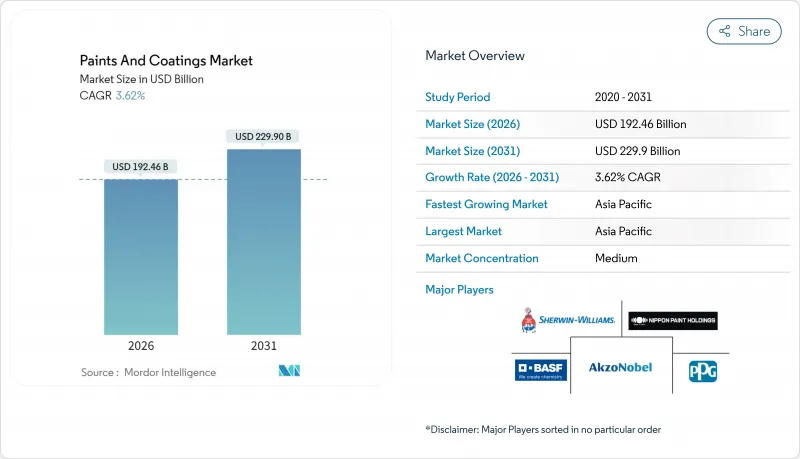
Steady demand from residential construction, infrastructure upgrades and sustainable product innovation underpins this moderate expansion even as raw-material costs swing sharply and environmental regulations tighten. Asia-Pacific holds structural advantages, rapid urban migration, large-scale capital projects and expanding industrial output, that collectively fuel regional consumption at a noticeably faster rate than mature economies. Across technologies, the migration to low-VOC water-borne chemistries remains the single most influential trend, reinforced by government emission caps and customer preference for greener specifications. Simultaneously, producers are digitizing color-matching, plant scheduling and quality-control workflows to mitigate labor shortages and compress time-to-market. Competitive intensity is rising as the top dozen suppliers pursue targeted acquisitions and divestitures that create leaner portfolios and unlock scale efficiencies in the global paints and coatings industry.
Global Paints And Coatings Market Trends and Insights
Surge in Global Residential Construction Activity
North American legislation such as the Infrastructure Investment and Jobs Act is funneling capital toward roads, bridges and utilities, lifting demand for protective and decorative coatings on both new and renovated assets. In parallel, Asia-Pacific governments continue to prioritize affordable housing programs that stimulate fresh residential starts and interior repaint cycles. Historically low mortgage rates in several economies have revived remodeling budgets, channeling incremental gallons into premium zero-VOC wall finishes that qualify for green-building credits. Suppliers are responding with fast-dry water-borne lines that meet stringent indoor-air benchmarks without sacrificing application speed. Combined, these factors reinforce a stable base of volume for the paints and coatings industry during the forecast window.
Expanding Automotive Production Volumes
Light-vehicle output rebounded in 2024 and is projected to regain its pre-pandemic trajectory by 2026, with China, India and Southeast Asia capturing the lion's share of incremental capacity additions. Modern body shops increasingly specify water-borne basecoats and low-temperature bake clearcoats to cut cycle times and VOC emissions, strengthening technology convergence between OEM and refinish lines. Strategic partnerships among resin formulators, spray-booth makers and carmakers are accelerating the adoption of integrated coating platforms that lower energy use per unit sprayed. This ongoing production expansion delivers a meaningful uplift to industrial consumption boosts the paints and coatings market trends.
Stringent Global VOC Regulations
California's South Coast Air Quality Management District periodically tightens Rule 1113, forcing reformulation or withdrawal of non-compliant products and raising research and development costs for smaller suppliers. Europe's upcoming CLP amendments add endocrine-disruptor labeling, obliging producers to review raw-material portfolios and update safety data sheets. China's proposed unified architectural standard will extend VOC limits to auxiliary materials such as primers and sealers, broadening compliance complexity. Collectively, these regulations compress margins in the paints and coatings industry and elevate the importance of agile product-development pipelines.
Other drivers and restraints analyzed in the detailed report include:
- Rapid Urban Population Growth in APAC
- Government Incentives for Green Building (Low-VOC)
- Longer Drying/Curing Times for Water-Borne Systems
For complete list of drivers and restraints, kindly check the Table Of Contents.
Segment Analysis
Acrylic chemistries delivered 35.78% paints and coatings industry share in 2025 and are projected to post a 3.98% CAGR through 2031, underpinned by proven weatherability, color retention and low-VOC credentials that meet architectural and light-industrial demands. Formulators continue to refine cross-linked structures that boost scrub resistance and stain blocking, giving do-it-yourself and professional painters longer service intervals. Growth momentum stems from emerging market urbanization where acrylic emulsion paints dominate new housing interiors. Producers are scaling regional reactor capacity to shorten lead times and localize color assortments, a strategy that enhances competitiveness against solvent-borne rivals.
The resin landscape is gradually consolidating as multinationals streamline portfolios toward high-margin acrylic dispersion platforms. Alkyds maintain niche relevance in metal and wood finishes but face margin pressure from soybean-oil price fluctuations. Epoxy demand remains steady in heavy-duty maintenance; however, price stability achieved in 2025 reflects balanced capacity rather than a structural upswing. Polyurethane and polyester systems occupy specialized performance niches, abrasion-resistant floors and powder coatings respectively, yet lack the broad-based volume of acrylics. Overall, acrylics will continue to anchor formulators' growth strategies across the paints and coatings market.
The Paints and Coatings Report is Segmented by Resin (Acrylic, Alkyd, Polyurethane, Epoxy, and More), Technology (Water-Borne, Solvent-Borne, Powder Coating, and UV-Cured Coating), End-User Industry (Architectural, Automotive, Wood, Protective Coating, and More), and Geography (Asia-Pacific, North America, Europe, South America, Middle-East, and Africa). The Market Forecasts are Provided in Terms of Value (USD).
Geography Analysis
Asia-Pacific contributed 46.21% of worldwide sales in 2025 and is tracking a robust 4.91% CAGR to 2031. The region's paints and coatings market size benefits from ongoing megacity development, industrial reshoring and sustained public infrastructure outlays that collectively require ever larger volumes of protective and decorative finishes.
North America is buoyed by federally funded transport corridors and an accelerating residential remodeling cycle boosted by stable mortgage rates. The push for ESG-aligned assets cats up adoption of certified low-emission interior paints, positioning water-borne suppliers for incremental share gains in the paints and coatings industry. Europe shows a measured recovery as major economies work through housing shortages and energy-retrofit pipelines tied to the EU's Green Deal; however, tightening labeling frameworks under the updated CLP regulation add costs across supply chains.
South America provides selective upside, headlined by Brazil where Sherwin-Williams' purchase of BASF's decorative unit instantly enlarges store footprints and gives contractors easier access to branded formulations. The Middle-East and Africa offer early-stage growth premised on mega-projects and resource-driven infrastructure, yet political risk and financing limitations restrain volume relative to Asia-Pacific. Harsh desert and coastal climates underpin specification of high-performance polysiloxane and fluoropolymer topcoats that protect capital assets.
- Akzo Nobel N.V.
- Asian Paints
- Axalta Coating Systems Ltd.
- BASF
- Beckers Group
- Benjamin Moore & Co.
- Berger Paints India
- Chugoku Marine Paints, Ltd.
- DAW SE
- Hempel A/S
- Jazeera Paints
- Jotun
- Kansai Paint Co. Ltd
- Masco Corporation
- NATIONAL PAINTS FACTORIES CO. LTD.
- Nippon Paint Holdings Co., Ltd.
- NOROO Paint & Coatings co.,Ltd.
- PPG Industries, Inc.
- RPM International Inc.
- Russian Paints Company
- SK Kaken Co. Ltd
- The Sherwin-Williams Company
Additional Benefits:
- The market estimate (ME) sheet in Excel format
- 3 months of analyst support
TABLE OF CONTENTS
1 Introduction
- 1.1 Study Assumptions
- 1.2 Scope of the Study
2 Research Methodology
3 Executive Summary
4 Market Landscape
- 4.1 Market Overview
- 4.2 Market Drivers
- 4.2.1 Surge in Global Residential Construction Activity
- 4.2.2 Expanding Automotive Production Volumes
- 4.2.3 Rapid Urban Population Growth in APAC
- 4.2.4 Government Incentives for Green Building (Low-VOC)
- 4.2.5 Emergence of AI-Driven Colour-Matching Platforms
- 4.3 Market Restraints
- 4.3.1 Stringent Global VOC Regulations
- 4.3.2 Volatility in Titanium-Dioxide Feedstock Prices
- 4.3.3 Longer Drying/Curing Times for Water-Borne Systems
- 4.4 Value Chain Analysis
- 4.5 Porter's Five Forces
- 4.5.1 Bargaining Power of Suppliers
- 4.5.2 Bargaining Power of Buyers
- 4.5.3 Threat of New Entrants
- 4.5.4 Threat of Substitutes
- 4.5.5 Degree of Competition
5 Market Size and Growth Forecasts (Value)
- 5.1 Resin
- 5.1.1 Acrylic
- 5.1.2 Alkyd
- 5.1.3 Polyurethane
- 5.1.4 Epoxy
- 5.1.5 Polyester
- 5.1.6 Other Resin Types
- 5.2 Technology
- 5.2.1 Water-borne
- 5.2.2 Solvent-borne
- 5.2.3 Powder Coating
- 5.2.4 UV-cured Coating
- 5.3 End-user Industry
- 5.3.1 Architectural
- 5.3.2 Automotive
- 5.3.3 Wood
- 5.3.4 Protective Coating
- 5.3.5 General Industrial
- 5.3.6 Transportation
- 5.3.7 Packaging
- 5.4 Geography
- 5.4.1 Asia-Pacific
- 5.4.1.1 China (Including Taiwan)
- 5.4.1.2 India
- 5.4.1.3 Japan
- 5.4.1.4 Indonesia
- 5.4.1.5 Australia and New Zealand
- 5.4.1.6 South Korea
- 5.4.1.7 Thailand
- 5.4.1.8 Malaysia
- 5.4.1.9 Philippines
- 5.4.1.10 Bangladesh
- 5.4.1.11 Vietnam
- 5.4.1.12 Singapore
- 5.4.1.13 Sri Lanka
- 5.4.1.14 Rest of Asia-Pacific
- 5.4.2 North America
- 5.4.2.1 United States
- 5.4.2.2 Canada
- 5.4.2.3 Mexico
- 5.4.3 Europe
- 5.4.3.1 Germany
- 5.4.3.2 United Kingdom
- 5.4.3.3 France
- 5.4.3.4 Italy
- 5.4.3.5 Benelux
- 5.4.3.6 Russia
- 5.4.3.7 Turkey
- 5.4.3.8 Switzerland
- 5.4.3.9 Scandinavian Countries
- 5.4.3.10 Poland
- 5.4.3.11 Portugal
- 5.4.3.12 Spain
- 5.4.3.13 Rest of Europe
- 5.4.4 South America
- 5.4.4.1 Brazil
- 5.4.4.2 Argentina
- 5.4.4.3 Colombia
- 5.4.4.4 Chile
- 5.4.4.5 Rest of South America
- 5.4.5 Middle-East
- 5.4.5.1 Saudi Arabia
- 5.4.5.2 Qatar
- 5.4.5.3 United Arab Emirates
- 5.4.5.4 Kuwait
- 5.4.5.5 Egypt
- 5.4.5.6 Rest of Middle East
- 5.4.6 Africa
- 5.4.6.1 South Africa
- 5.4.6.2 Nigeria
- 5.4.6.3 Algeria
- 5.4.6.4 Morocco
- 5.4.6.5 Rest of Africa
- 5.4.1 Asia-Pacific
6 Competitive Landscape
- 6.1 Market Concentration
- 6.2 Strategic Moves
- 6.3 Market Share (%)/Ranking Analysis
- 6.4 Company Profiles (includes Global-level Overview, Market-level Overview, Core Segments, Financials, Strategic Information, Market Rank/Share, Products and Services, Recent Developments)
- 6.4.1 Akzo Nobel N.V.
- 6.4.2 Asian Paints
- 6.4.3 Axalta Coating Systems Ltd.
- 6.4.4 BASF
- 6.4.5 Beckers Group
- 6.4.6 Benjamin Moore & Co.
- 6.4.7 Berger Paints India
- 6.4.8 Chugoku Marine Paints, Ltd.
- 6.4.9 DAW SE
- 6.4.10 Hempel A/S
- 6.4.11 Jazeera Paints
- 6.4.12 Jotun
- 6.4.13 Kansai Paint Co. Ltd
- 6.4.14 Masco Corporation
- 6.4.15 NATIONAL PAINTS FACTORIES CO. LTD.
- 6.4.16 Nippon Paint Holdings Co., Ltd.
- 6.4.17 NOROO Paint & Coatings co.,Ltd.
- 6.4.18 PPG Industries, Inc.
- 6.4.19 RPM International Inc.
- 6.4.20 Russian Paints Company
- 6.4.21 SK Kaken Co. Ltd
- 6.4.22 The Sherwin-Williams Company
7 Market Opportunities and Future Outlook
- 7.1 White-space and Unmet-Need Assessment

