
PUBLISHER: Mordor Intelligence | PRODUCT CODE: 1910591

PUBLISHER: Mordor Intelligence | PRODUCT CODE: 1910591
Lithium-ion Battery Separator - Market Share Analysis, Industry Trends & Statistics, Growth Forecasts (2026 - 2031)
The Lithium-ion Battery Separator Market is expected to grow from USD 10.13 billion in 2025 to USD 11.61 billion in 2026 and is forecast to reach USD 22.97 billion by 2031 at 14.62% CAGR over 2026-2031.
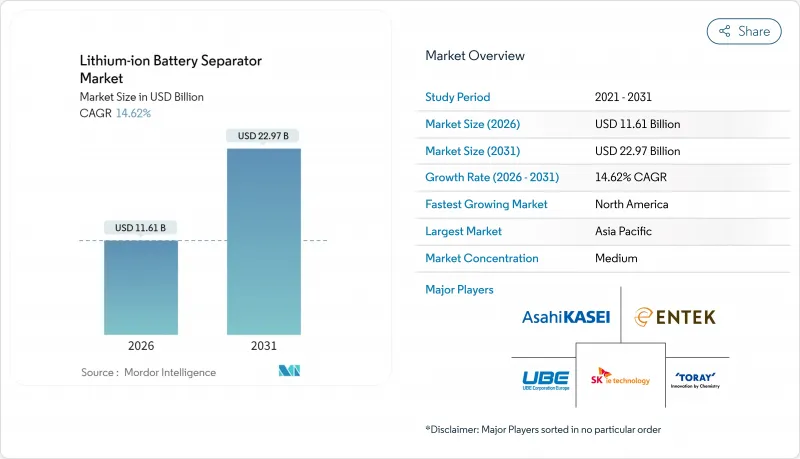
New demand stems from electric vehicles and utility-scale storage, which increasingly specify ultra-thin, ceramic-coated membranes that tolerate high-nickel chemistries and aggressive fast-charge profiles. Wet-process polyolefin separators still dominate, yet coated variants are growing rapidly as automakers elevate thermal-propagation safeguards. Capital is flowing to regions with domestic-content mandates; Asahi Kasei's CAD 1.56 billion Ontario complex exemplifies the first-mover incentives now reshaping the supply map. Meanwhile, North American tax credits, Europe's Battery Regulation, and China's gigafactory build-out are fragmenting global trade flows and rewarding suppliers that certify regional provenance while mastering cost-effective resin integration.
Global Lithium-ion Battery Separator Market Trends and Insights
Declining Lithium-Ion Battery Prices
Pack prices dipped below USD 100 kWh in 2024, aided by lower lithium carbonate costs and Chinese cell overcapacity. Price elasticity widens EV adoption in emerging markets, elevating separator square-meter demand in lockstep. Coated films gain share because cell makers outsource that step for in-line efficiency, supporting 20% margin targets at new integrated plants. Cost deflation also shortens technology refresh cycles, encouraging thinner membranes without sacrificing durability.
Accelerating Global EV Adoption
Global EV sales topped 17 million in 2024, consuming about 2.1 billion m2 of separator material. Nickel-rich cathodes intensify heat generation, forcing the adoption of ceramic-coated or aramid-reinforced separators stable above 200 °C. Automaker electrification pledges, such as Honda's post-2040 roadmap, lock multi-year separator contracts and mitigate market volatility.
Polyolefin Resin Supply-Demand Imbalance
Ultra-high-molecular-weight polyethylene capacity lags demand by eight points since 2022, inflating resin prices and squeezing non-integrated producers. Asahi Kasei's internal resin streams cushion volatility and double line speed relative to spot-resin competitors. North American shortages force startups to import resin or adopt alternative polymers such as Sepion's aramid blends.
Other drivers and restraints analyzed in the detailed report include:
- Rapid Growth in Stationary Energy-Storage Projects
- Government Incentives for Domestic Battery Supply Chains
- Stringent Safety & Quality Certification Timelines
For complete list of drivers and restraints, kindly check the Table Of Contents.
Segment Analysis
Wet-process polyolefin held 60.05% lithium ion battery separator market share in 2025, a position built on uniform porosity and sub-1 µm pore control. Ceramic-coated variants, however, are pacing at 22.05% CAGR, capturing automotive contracts that demand shutdown temperatures above 175 °C. Inline coating integrates formation and slurry application, cutting yield loss to below 2% and boosting margins by 5-7 points.
Uncoated polyolefin still serves cost-sensitive devices, yet its grip is loosening as even smartphones migrate to thinner, coated separators. Functional polymer overlays, such as PVDF-HFP blends, deliver electrolyte contact angles under 5°, trimming formation time by 40% and hinting at a third technology frontier.
Polypropylene's 48.02% share reflects mature extrusion lines and low resin cost. Polyethylene continues to dominate wet-process formulations thanks to its 130 °C melt-point shutdown feature, but multilayer PP/PE/PP stacks now constitute one-third of automotive shipments. Non-woven aramid nanofiber membranes maintain dimensional stability at 300 °C and tensile strengths above 200 MPa, albeit at USD 15-25 kg pricing.
Cost breakthroughs via low-temperature polycondensation could halve aramid pricing within three years, widening adoption in premium EVs and aerospace. Recycling challenges persist: polyolefin films can downcycle, whereas aramid lacks pathways, a liability in Europe's 2027 mandate window.
The Lithium-Ion Battery Separator Market Report is Segmented by Separator Type (Wet-Process, Dry-Process, and Ceramic-Coated), Material (Polypropylene, Non-Woven and Others, and More), Thickness (Up To 15 Mm, 16 To 20 Mm, and More), Form Factor (Pouch, Cylindrical, and Prismatic), Coating (Uncoated Polyolefin, In-Line Ceramic, and More), Application (Automotive EV, and More), and Geography (North America, Asia-Pacific, and More).
Geography Analysis
Asia-Pacific controlled 49.75% of the lithium-ion battery separator market in 2025, led by China's 75% global capacity. Chinese firms lowered separator costs 30-40% below Japanese peers through resin integration and labor advantages. Japan's share slid from 35% in 2018 to 20% in 2021 as Toray and Sumitomo exited commodity grades for solid-state niches. Korea's SK IE Technology holds 47.5 GWh of European battery capacity but logged a 291 billion won loss in 2024, signaling margin pressure.
North America is the fastest-growing region at 21.43% CAGR, buoyed by Inflation Reduction Act incentives and more than USD 5 billion in announced separator investments. Asahi Kasei's Ontario site aims for 700 million m2 annual output and a 30% regional share by 2027, while Microporous and Sepion add capacity in Virginia and California, respectively. Policy stability remains critical; a repeal of credits could strand assets.
Europe's market is shaped by carbon-footprint and recycled-content rules that favor local production. SK IE Technology's Polish plants add 340 million m2 capacity, yet the firm's financial strain clouds longer-term supply. European cell makers Northvolt, ACC, and Verkor pursue in-house separators, further pressuring incumbents. South America and MEA remain minor, but Brazil's 150,000 EVs in 2024 and Saudi industrial policies may spur modest local capacity post-2027.
- Asahi Kasei Corporation
- Toray Industries Inc.
- SK IE Technology Co. Ltd
- Entek International LLC
- Ube Corporation
- Sumitomo Chemical Co. Ltd
- Celgard LLC (Polypore)
- W-Scope Corporation
- Shenzhen Senior Technology
- Cangzhou Mingzhu Plastic
- Suzhou GreenPower
- Sinoma Science & Tech
- Dreamweaver International
- Gellec Co. Ltd
- Zhongke Science & Tech
- Mitsubishi Paper Mills
- Foshan Jinhui Hi-Tech
- Freudenberg Performance Materials
- Xiangyang Xingyuan
- Teijin Ltd
- Others (validated niche players)
Additional Benefits:
- The market estimate (ME) sheet in Excel format
- 3 months of analyst support
TABLE OF CONTENTS
1 Introduction
- 1.1 Study Assumptions & Market Definition
- 1.2 Scope of the Study
2 Research Methodology
3 Executive Summary
4 Market Landscape
- 4.1 Market Overview
- 4.2 Market Drivers
- 4.2.1 Declining lithium-ion battery prices
- 4.2.2 Accelerating global EV adoption
- 4.2.3 Rapid growth in stationary energy-storage projects
- 4.2.4 Government incentives for domestic battery supply chains
- 4.2.5 OEM push for ultra-thin separators for high-Ni cathodes
- 4.2.6 Localization mandates driving regional separator gigafactories
- 4.3 Market Restraints
- 4.3.1 Polyolefin resin supply-demand imbalance
- 4.3.2 Stringent safety & quality certification timelines
- 4.3.3 Solvent-recovery cost challenges in wet-process lines
- 4.3.4 Limited recyclability pathways for spent separators
- 4.4 Supply-Chain Analysis
- 4.5 Regulatory Landscape
- 4.6 Technological Outlook
- 4.7 Porter's Five Forces
- 4.7.1 Bargaining Power of Suppliers
- 4.7.2 Bargaining Power of Buyers
- 4.7.3 Threat of New Entrants
- 4.7.4 Threat of Substitutes
- 4.7.5 Intensity of Competitive Rivalry
5 Market Size & Growth Forecasts
- 5.1 By Separator Type
- 5.1.1 Wet-Process Polyolefin
- 5.1.2 Dry-Process Polyolefin
- 5.1.3 Ceramic-Coated
- 5.2 By Material
- 5.2.1 Polypropylene (PP)
- 5.2.2 Polyethylene (PE)
- 5.2.3 Multilayer PP/PE/PP
- 5.2.4 Non-woven and Others
- 5.3 By Thickness
- 5.3.1 Up to 15 µm
- 5.3.2 16 to 20 µm
- 5.3.3 21 to 25 µm
- 5.3.4 Above 25 µm
- 5.4 By Battery Form Factor
- 5.4.1 Pouch Cells
- 5.4.2 Cylindrical Cells
- 5.4.3 Prismatic Cells
- 5.5 By Coating Technology
- 5.5.1 In-line Ceramic Coating
- 5.5.2 Offline Ceramic Coating
- 5.5.3 Functional Polymer Coatings
- 5.5.4 Uncoated Polyolefin
- 5.6 By Application
- 5.6.1 Automotive EV
- 5.6.2 Consumer Electronics
- 5.6.3 Stationary Energy Storage
- 5.6.4 Industrial and Power Tools
- 5.7 By Geography
- 5.7.1 North America
- 5.7.1.1 United States
- 5.7.1.2 Canada
- 5.7.1.3 Mexico
- 5.7.2 Europe
- 5.7.2.1 Germany
- 5.7.2.2 United Kingdom
- 5.7.2.3 France
- 5.7.2.4 Italy
- 5.7.2.5 Spain
- 5.7.2.6 Netherlands
- 5.7.2.7 NORDIC Countries
- 5.7.2.8 Russia
- 5.7.2.9 Rest of Europe
- 5.7.3 Asia-Pacific
- 5.7.3.1 China
- 5.7.3.2 India
- 5.7.3.3 Japan
- 5.7.3.4 South Korea
- 5.7.3.5 ASEAN Countries
- 5.7.3.6 Australia and New Zealand
- 5.7.3.7 Rest of Asia Pacific
- 5.7.4 South America
- 5.7.4.1 Brazil
- 5.7.4.2 Argentina
- 5.7.4.3 Rest of South America
- 5.7.5 Middle East and Africa
- 5.7.5.1 Saudi Arabia
- 5.7.5.2 South Africa
- 5.7.5.3 Rest of Middle East and Africa
- 5.7.1 North America
6 Competitive Landscape
- 6.1 Market Concentration
- 6.2 Strategic Moves (M&A, Partnerships, PPAs)
- 6.3 Market Share Analysis (Market Rank/Share for key companies)
- 6.4 Company Profiles (includes Global level Overview, Market level overview, Core Segments, Financials as available, Strategic Information, Products & Services, and Recent Developments)
- 6.4.1 Asahi Kasei Corporation
- 6.4.2 Toray Industries Inc.
- 6.4.3 SK IE Technology Co. Ltd
- 6.4.4 Entek International LLC
- 6.4.5 Ube Corporation
- 6.4.6 Sumitomo Chemical Co. Ltd
- 6.4.7 Celgard LLC (Polypore)
- 6.4.8 W-Scope Corporation
- 6.4.9 Shenzhen Senior Technology
- 6.4.10 Cangzhou Mingzhu Plastic
- 6.4.11 Suzhou GreenPower
- 6.4.12 Sinoma Science & Tech
- 6.4.13 Dreamweaver International
- 6.4.14 Gellec Co. Ltd
- 6.4.15 Zhongke Science & Tech
- 6.4.16 Mitsubishi Paper Mills
- 6.4.17 Foshan Jinhui Hi-Tech
- 6.4.18 Freudenberg Performance Materials
- 6.4.19 Xiangyang Xingyuan
- 6.4.20 Teijin Ltd
- 6.4.21 Others (validated niche players)
7 Market Opportunities & Future Outlook
- 7.1 White-space & Unmet-Need Assessment

