PUBLISHER: Mordor Intelligence | PRODUCT CODE: 1910665

PUBLISHER: Mordor Intelligence | PRODUCT CODE: 1910665
Thailand Residential Real Estate - Market Share Analysis, Industry Trends & Statistics, Growth Forecasts (2026 - 2031)
Thailand residential real estate market size in 2026 is estimated at USD 31.71 billion, growing from 2025 value of USD 30.17 billion with 2031 projections showing USD 40.68 billion, growing at 5.11% CAGR over 2026-2031.
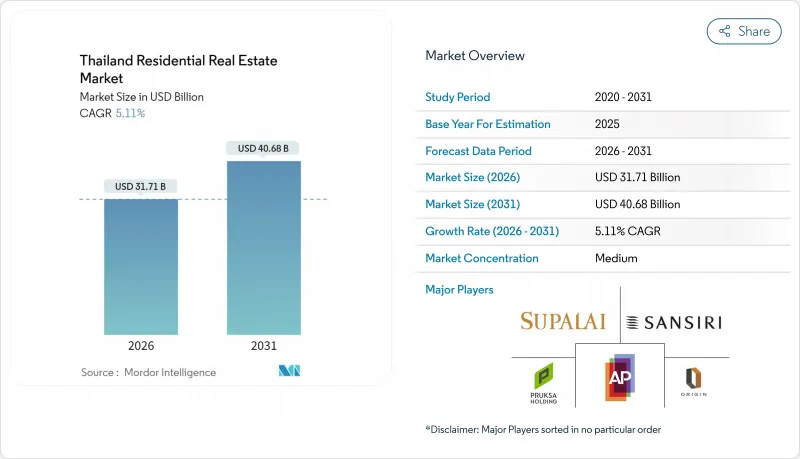
Several powerful forces are shaping this trajectory. Structural urbanization keeps Bangkok and emerging provincial corridors in constant demand, while mortgage subsidies and sharply reduced transfer fees encourage first-time buyers despite a national household-debt ratio of 91.3% of GDP. Developers have responded by redirecting supply toward premium, low-volume projects, leaning on stronger pricing to offset rising construction costs. A rebound in tourism and a liberalized social climate, including same-sex marriage, is lifting rental yields in resort destinations. At the same time, stricter bank underwriting, condominium oversupply in secondary city sub-markets, and regulatory uncertainty around long-term leases for foreigners temper near-term expansion.
Thailand Residential Real Estate Market Trends and Insights
Urbanization and migration into Bangkok and major cities boosting housing demand
Urbanization and migration trends are significantly influencing housing demand in Bangkok and other major cities in Thailand. As Thailand's primate city, Bangkok attracts a significant influx of rural-to-urban migrants. This trend bolsters the city's ability to absorb new housing units, even in times of national economic softening. Investments in mass-transit lines, notably the Yellow Line, are unlocking peripheral lands. This has enabled luxury projects in Bangna-Trad to command unit prices exceeding USD 555,000. Meanwhile, secondary corridors like Khon Kaen and Nakhon Ratchasima are witnessing quicker per-capita GDP growth, suggesting a slow but steady spread of capital. Developers with a national presence are strategically acquiring land along rail extensions, positioning themselves for this expanding multi-nodal landscape.
Growing middle-class population driving demand for condominiums and townhouses
The growing middle-class population in Thailand is significantly influencing the demand for condominiums and townhouses. Even as Thailand's GDP growth eased to 2.0% in 2025, surveys reveal the nation's burgeoning middle class remains steadfast in its urban ownership aspirations. In response, developers are rolling out mid-to-upper-mid projects, seamlessly blending retail, co-working spaces, and health amenities. A prime example is Central Pattana's ambitious USD 417 million mixed-use pipeline. The allure of proximity to quality education is evident, with Four Seasons Private Residences securing a notable USD 111 million in sales, predominantly from families hailing from China. However, a prevailing debt overhang is straining affordability. In a bid to navigate this challenge, developers are forging partnerships, offering innovative solutions like bundled deferred down-payments and rent-to-own options.
Oversupply in condominium markets leading to slower absorption rates
The condominium market is currently grappling with an oversupply, leading to slower absorption rates and market challenges. In Q2 2025, new condominium launches plummeted to just 373 units, marking a staggering 94.2% decline and the lowest point in 16 years. This sharp drop underscores a significant pullback by developers. Meanwhile, unsold inventory has surged to about 74,000 units, predominantly located in Bangkok's suburban areas. To move this stock, sellers are resorting to steep discounts and offering rent guarantees. While financially robust players are seizing the opportunity to acquire distressed properties at attractive prices, the market still anticipates a sluggish absorption period of up to 24 months. As the market seeks to rebalance, price increases are expected to remain muted, squeezing profit margins and pushing back the timeline for new developments.
Other drivers and restraints analyzed in the detailed report include:
- Tourism and expatriate inflows creating demand for second homes and rental properties
- Government incentives and mortgage programs supporting homeownership
- High household debt levels limiting affordability for some buyers
For complete list of drivers and restraints, kindly check the Table Of Contents.
Segment Analysis
Sales transactions commanded 68.35% of the Thailand residential real estate market share in 2025, reflecting enduring cultural preferences for ownership and the influence of mortgage incentives. New-build promotions, reduced transfer fees, and tax deductions kept transaction pipelines active even as macro uncertainty persisted. However, rental income prospects in central Bangkok and resort zones are strengthening as expatriate headcounts recover. The rental subsector is forecast to expand at a 5.58% CAGR, underpinned by flexible-living demand and asset-light tendencies among younger professionals. Institutional landlords are scaling portfolios, and developers such as Central Pattana are introducing branded co-living towers that extract premium rents through amenity bundles.
The Thailand residential real estate market continues to evolve toward hybrid tenure models. Developers market rent-to-own pathways that convert leases into down-payments, bridging affordability gaps created by high household debt. Prop-tech platforms simplify tenant screening and yield analytics, enticing family offices to allocate capital to build-to-rent strategies. Regulatory support, including fast-track visa renewals for high-skilled expatriates, further enlarges the occupier base. Sales volumes will likely remain dominant, but recurring cash-flow projects are poised to supply a growing share of developers' earnings.
Apartments and condominiums made up 63.25% of the Thailand residential real estate market size in 2025 thanks to land scarcity in metropolitan Bangkok and well-established finance channels. High-rise projects continue to debut along new transit nodes, offering buyers secure entry prices and extensive facilities. Some developers retrofit ageing towers with energy-management systems to stay competitive. Meanwhile, villas and landed houses, though smaller in base, are projected to grow fastest at a 6.44% CAGR. The pandemic catalyzed demand for larger floorplates and outdoor space, trends still resonating in 2025.
Villa pipelines are heaviest in suburban Bangkok districts such as Ratchaphruek and in tourism-centered provinces like Phuket. Magnolia Quality Development Corporation's USD 3.5 billion Forestias highlights how integrated master plans can blend low-density housing, senior living, and forest conservation for premium positioning. Condominium builders respond by adding villa-style features-private gardens, duplex layouts, and touch-less access systems-within vertical envelopes. Environmental and wellness certifications double as marketing levers and future-proof valuations against tightening building codes.
The Thailand Residential Real Estate Market Report is Segmented by Business Model (Sales and Rental), by Property Type (Apartments & Condominiums and Villas & Landed Houses), by Price Band (Affordable, Mid-Market and Luxury), by Mode of Sale (Primary, Secondary), and by Cities (Bangkok, Phuket, Pattaya, Chiang Mai and the Rest of Thailand). The Market Forecasts are Provided in Terms of Value (USD).
List of Companies Covered in this Report:
- Pruksa Real Estate
- Supalai
- Sansiri
- AP Thai
- Origin Property
- SC Asset
- Noble Development
- Land & Houses PLC
- Central Pattana Residence
- Ananda Development
- MQDC
- Sena Development
- LH Bank Home Service
- Fraser Property Thailand
- Raimon Land
- AssetWise
- Country Group Development
- Habitat Group
- Property Perfect
- Chewathai
Additional Benefits:
- The market estimate (ME) sheet in Excel format
- 3 months of analyst support
TABLE OF CONTENTS
1 Introduction
- 1.1 Study Assumptions & Market Definition
- 1.2 Scope of the Study
2 Research Methodology
3 Executive Summary
4 Market Insights and Dynamics
- 4.1 Market Overview
- 4.2 Residential Real Estate Buying Trends - Socio-economic & Demographic Insights
- 4.3 Rental Yield Analysis
- 4.4 Regulatory Outlook
- 4.5 Technological Outlook
- 4.6 Insights Into Affordable Housing Support Provided by Government and Public-private Partnerships
- 4.7 Insights into Existing and Upcoming Projects
- 4.8 Market Drivers
- 4.8.1 Urbanization and migration into Bangkok and major cities boosting housing demand
- 4.8.2 Government incentives and mortgage programs supporting homeownership
- 4.8.3 Growing middle-class population driving demand for condominiums and townhouses
- 4.8.4 Tourism and expatriate inflows creating demand for second homes and rental properties
- 4.8.5 Shift toward vertical housing and integrated communities in high-density areas
- 4.9 Market Restraints
- 4.9.1 Oversupply in condominium markets leading to slower absorption rates
- 4.9.2 High household debt levels limiting affordability for some buyers
- 4.9.3 Regulatory restrictions on foreign ownership affecting demand in select segments
- 4.10 Value / Supply-Chain Analysis
- 4.10.1 Overview
- 4.10.2 Real Estate Developers and Contractors - Key Quantitative and Qualitative Insights
- 4.10.3 Real Estate Brokers and Agents - Key Quantitative and Qualitative Insights
- 4.10.4 Property Management Companies - Key Quantitative and Qualitative Insights
- 4.10.5 Insights on Valuation Advisory and Other Real Estate Services
- 4.10.6 State of the Building Materials Industry and Partnerships with Key Developers
- 4.10.7 Insights on Key Strategic Real Estate Investors/Buyers in the Market
- 4.11 Porter's Five Forces
- 4.11.1 Threat of New Entrants
- 4.11.2 Bargaining Power of Buyers
- 4.11.3 Bargaining Power of Suppliers
- 4.11.4 Threat of Substitutes
- 4.11.5 Competitive Rivalry Intensity
5 Residential Real Estate Market Size & Growth Forecasts (Value USD billion)
- 5.1 By Business Model
- 5.1.1 Sales
- 5.1.2 Rental
6 Residential Real Estate Market (Sales Model) Size & Growth Forecasts (Value USD billion)
- 6.1 By Property Type
- 6.1.1 Apartments & Condominiums
- 6.1.2 Villas & Landed Houses
- 6.2 By Price Band
- 6.2.1 Affordable
- 6.2.2 Mid-Market
- 6.2.3 Luxury
- 6.3 By Mode of Sale
- 6.3.1 Primary (New-Build)
- 6.3.2 Secondary (Existing-Home Resale)
- 6.4 By Cities
- 6.4.1 Bangkok
- 6.4.2 Phuket
- 6.4.3 Pattaya
- 6.4.4 Chiang Mai
- 6.4.5 Rest of Thailand
7 Competitive Landscape
- 7.1 Market Concentration
- 7.2 Strategic Moves (M&A, Joint Ventures, etc)
- 7.3 Company Profiles {(includes Global level Overview, Market level overview, Core Segments, Financials as available, Strategic Information, Products & Services, Recent Developments)}
- 7.3.1 Pruksa Real Estate
- 7.3.2 Supalai
- 7.3.3 Sansiri
- 7.3.4 AP Thai
- 7.3.5 Origin Property
- 7.3.6 SC Asset
- 7.3.7 Noble Development
- 7.3.8 Land & Houses PLC
- 7.3.9 Central Pattana Residence
- 7.3.10 Ananda Development
- 7.3.11 MQDC
- 7.3.12 Sena Development
- 7.3.13 LH Bank Home Service
- 7.3.14 Fraser Property Thailand
- 7.3.15 Raimon Land
- 7.3.16 AssetWise
- 7.3.17 Country Group Development
- 7.3.18 Habitat Group
- 7.3.19 Property Perfect
- 7.3.20 Chewathai
8 Market Opportunities & Future Outlook
- 8.1 White-Space & Unmet-Need Assessment

