PUBLISHER: Mordor Intelligence | PRODUCT CODE: 1910700

PUBLISHER: Mordor Intelligence | PRODUCT CODE: 1910700
Germany Furniture - Market Share Analysis, Industry Trends & Statistics, Growth Forecasts (2026 - 2031)
Germany furniture market size in 2026 is estimated at USD 22.29 billion, growing from 2025 value of USD 21.22 billion with 2031 projections showing USD 28.47 billion, growing at 5.02% CAGR over 2026-2031.
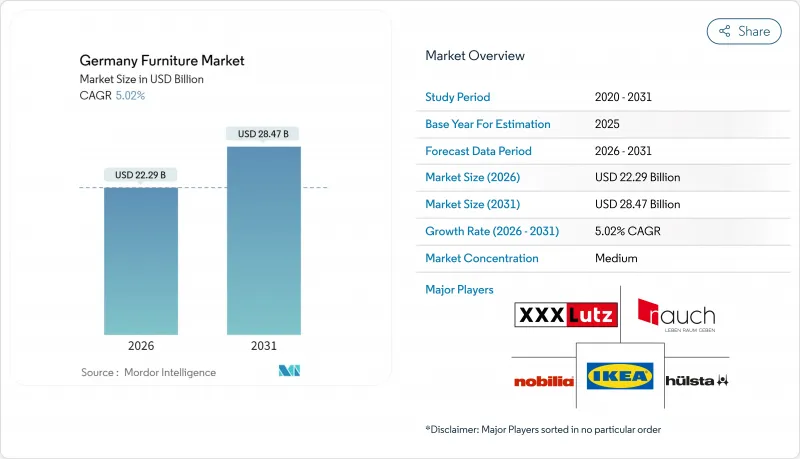
Germany's furniture market grapples with sluggish sales, a reflection of dampened consumer sentiment and persistent economic uncertainties. Households, pinched by high inflation and soaring living costs, are tightening their belts on discretionary spending. This shift has notably affected demand, especially in the mid to lower-end segments. Yet, there is a glimmer of hope for 2025: a potential easing of inflation coupled with rising real wages could herald a modest recovery. Notable growth sectors include online retail, healthcare furniture, and modular solutions, all spurred by urbanization and an aging population. Regulatory pressure from the EU Ecodesign for Sustainable Products Regulation (ESPR) is steering producers toward circular designs, while hybrid work keeps home-office demand elevated.
Germany Furniture Market Trends and Insights
Demand for Sustainable and Circular Furniture Solutions Driven by German Environmental Regulations
The Ecodesign for Sustainable Products Regulation (ESPR), in force since July 2024, obliges manufacturers to embed durability, repairability, and recyclability at the design stage, where most environmental impact is locked in . COR's CORever program already collects returned sofas and chairs, refurbishes them, and resells them at full warranty, proving that circularity generates repeat revenue . A surge in design-for-disassembly has cut raw-material waste and trimmed unit costs, raising competitiveness. Take-back schemes now cover 28% of branded output, and recycled material usage has climbed to 37%, easing pressure from timber price volatility. Over the medium term, compliance costs are forecast to be moderate as shared recycling infrastructure scales.
Growth of Home Office Adoption Following Permanent Hybrid Work Policies in German Corporations
In Germany, employees can claim a tax deduction of up to EUR 1,260 each year for expenses related to their dedicated workspace. This includes costs for home office furniture, such as ergonomic chairs and desks. These tax incentives, designed to bolster remote work, are detailed in the German Income Tax Act. By allowing deductions for eligible expenses, the act effectively reduces the taxable income, thereby making furniture purchases more affordable for employees. This incentive favors complete home-office bundles that meet ergonomics guidelines and double as video-conference backdrops. Manufacturers have rolled out integrated desks, chairs, and storage solutions in coordinated finishes that blend with living areas. For instance, Wilkhahn's Confair folding table and Timetable Lift epitomize adaptable design-wheels and gas-lift mechanisms allow swift reconfiguration between focused solo work and collaborative sessions. Urban apartments in Berlin and Munich, where rooms are compact, drive demand for space-saving, multi-functional pieces. The short-term boost is expected to normalize but will leave a structurally higher baseline for task chairs, sit-stand desks, and modular shelving.
Volatile Timber Prices
Climate-related bark-beetle damage has curbed the roundwood supply, sending log prices on double-digit swings . Small producers lack the capital to lock long-term contracts or stockpile inventory and therefore cut shifts when prices spike, ceding shelf space to larger rivals. Wood accounts for 64% of the Germany furniture market in 2025, magnifying exposure. To hedge, manufacturers blend reclaimed beams and fast-growing hardwoods, invest in CNC nesting to reduce off-cuts, and simulate woodgrain finishes on recycled polymer boards. Some pioneers combine FSC-certified veneers with aluminum frames, lowering total timber use without sacrificing look and feel.
Other drivers and restraints analyzed in the detailed report include:
- Recovering Disposable Income Fueling Premium Segment Purchases
- Increasing Construction and Renovation Activities
- Lengthy Building Permit Processes Delaying Commercial Fit-Out Projects
For complete list of drivers and restraints, kindly check the Table Of Contents.
Segment Analysis
The healthcare segment is advancing at a 6.08% CAGR, the fastest among all uses. Demand is anchored in hospital extensions, geriatric clinics, and assisted-living overhauls that require bariatric seating, height-adjustable over-bed tables, and wipe-clean recliners. Procurement teams weigh infection control and life-cycle costs more heavily than design aesthetics, driving preference for steel frames with replaceable upholstery.
Home furniture remains the cornerstone with a 54.70% revenue share in 2025. Nevertheless, its sheer volume keeps it pivotal for scale efficiencies. Kitchen upgrades stay robust because German dwellings average only 93 m2, prompting owners to optimize multifunctional layouts. Office furniture, transitioning from cubicles to agile zones, sees revenues shift from bulk desks to flexible pods that accommodate hot-desking and touch-down collaboration. Hospitality and education segments show uneven trajectories: hotels continue post-pandemic refurbishments, whereas schools sustain double-digit ICT budgets that divert spend from physical furnishings.
Wood-based products contribute 63.20% of the Germany furniture market. Volatility in timber pricing has nudged manufacturers toward veneered panels over solid planks, enabling the same warm aesthetic with less raw wood. Plastic and polymer furniture is the fastest-growing cluster at a 5.79% CAGR as recycled polypropylene and bio-based PET gain consumer acceptance. The Germany furniture market is helped by UV-stabilized and fiber-reinforced compounds that extend durability.
Metal furniture retains its niche in healthcare and high-traffic offices where cleanability trumps tactile warmth. Powder-coated steel frames paired with oak veneered tops bridge the material divide and meet ESPR requirements for disassembly. Composite innovations-hemp fiber panels, mycelium-bonded boards, and aluminum-wood hybrids-are emerging but remain under 3% penetration. As recycling targets tighten, adoption of mono-material substrates is set to rise because they simplify end-of-life recovery.
The Germany Furniture Market Report is Segmented by Application (Home Furniture, Office Furniture, Hospitality Furniture, and More), Material (Wood, Metal, Plastic & Polymer, and Other Materials), Price Range (Economy, Mid-Range, and Premium), Distribution Channel (B2C/Retail, and B2B /Project) and Geography ( Southern Germany, Western Germany, and More). The Market Forecasts are Provided in Terms of Value (USD).
List of Companies Covered in this Report:
- Hulsta-Werke Huls GmbH
- Rauch Mobelwerke GmbH
- Nolte Mobel GmbH & Co. KG
- Rolf Benz AG & Co. KG
- Polipol Holding GmbH
- HIMolla Polstermobel GmbH
- Wilkhahn Wilkening + Hahne GmbH & Co. KG
- Interstuhl Buromobel GmbH & Co. KG
- Schmidt Kuchen GmbH & Co. KG
- Bulthaup GmbH & Co. KG
- Nobilia AB
- Mobel Martin GmbH & Co. KG
- Segmuller Polstermobelfabrik GmbH & Co. KG
- Roller GmbH & Co. KG
- Porta Mobel Handels GmbH & Co. KG
- SieMatic
- Dedon
- IKEA
- Vitra International
- Steelcase Inc.
- MillerKnoll, Inc.
- Haworth Inc.
- XXXLutz KG
Additional Benefits:
- The market estimate (ME) sheet in Excel format
- 3 months of analyst support
TABLE OF CONTENTS
1 Introduction
- 1.1 Study Assumptions & Market Definition
- 1.2 Scope of the Study
2 Research Methodology
3 Executive Summary
4 Market Landscape
- 4.1 Market Overview
- 4.2 Market Drivers
- 4.2.1 Demand for Sustainable and Circular Furniture Solutions Driven by German Environmental Regulations
- 4.2.2 Growth of Home Office Adoption Following Permanent Hybrid Work Policies in German Corporations
- 4.2.3 Recovering Disposable Income Boosting Premium Furniture Demand
- 4.2.4 Growing Demand for Eco-Friendly and Sustainable Furniture
- 4.2.5 Increasing Construction and Renovation Activities
- 4.3 Market Restraints
- 4.3.1 Volatile Timber Prices
- 4.3.2 Lengthy Building Permit Processes Delaying Commercial Fit-Out Projects
- 4.3.3 Intensifying Competition from Low-Cost Eastern European Imports
- 4.4 Industry Value Chain Analysis
- 4.5 Porter's Five Forces Analysis
- 4.5.1 Threat of New Entrants
- 4.5.2 Bargaining Power of Suppliers
- 4.5.3 Bargaining Power of Buyers
- 4.5.4 Threat of Substitutes
- 4.5.5 Competitive Rivalry
- 4.6 Insights into the Latest Trends and Innovations in the Market
- 4.7 Insights on Recent Developments (New Product Launches, Strategic Initiatives, Investments, Partnerships, JVs, Expansion, M&As, etc.) in the Market
5 Market Size & Growth Forecasts (Value)
- 5.1 By Application
- 5.1.1 Home Furniture
- 5.1.1.1 Chairs
- 5.1.1.2 Tables (side tables, coffee tables, dressing tables, etc.)
- 5.1.1.3 Beds
- 5.1.1.4 Wardrobes
- 5.1.1.5 Sofas
- 5.1.1.6 Dining Tables/Dining Sets
- 5.1.1.7 Kitchen Cabinets
- 5.1.1.8 Other Home Furniture (bathroom furniture, outdoor furniture, etc.)
- 5.1.2 Office Furniture
- 5.1.2.1 Chairs
- 5.1.2.2 Tables
- 5.1.2.3 Storage Cabinets
- 5.1.2.4 Desks
- 5.1.2.5 Sofas and Other Soft Seating
- 5.1.2.6 Other Office Furniture
- 5.1.3 Hospitality Furniture
- 5.1.4 Educational Furniture
- 5.1.5 Healthcare Furniture
- 5.1.6 Other Applications (public places, retail malls, government offices, etc.)
- 5.1.1 Home Furniture
- 5.2 By Material
- 5.2.1 Wood
- 5.2.2 Metal
- 5.2.3 Plastic & Polymer
- 5.2.4 Other Materials
- 5.3 By Price Range
- 5.3.1 Economy
- 5.3.2 Mid-Range
- 5.3.3 Premium
- 5.4 By Distribution Channel
- 5.4.1 B2C/Retail
- 5.4.1.1 Home Centers
- 5.4.1.2 Specialty Furniture Stores
- 5.4.1.3 Online
- 5.4.1.4 Other Distribution Channels
- 5.4.2 B2B /Project
- 5.4.1 B2C/Retail
- 5.5 By Geography
- 5.5.1 Southern Germany
- 5.5.2 Western Germany
- 5.5.3 Northern Germany
- 5.5.4 Eastern Germany
6 Competitive Landscape
- 6.1 Market Concentration
- 6.2 Strategic Moves
- 6.3 Market Share Analysis
- 6.4 Company Profiles (includes Global level Overview, Market level overview, Core Segments, Financials as available, Strategic Information, Market Rank/Share for key companies, Products & Services, and Recent Developments)
- 6.4.1 Hulsta-Werke Huls GmbH
- 6.4.2 Rauch Mobelwerke GmbH
- 6.4.3 Nolte Mobel GmbH & Co. KG
- 6.4.4 Rolf Benz AG & Co. KG
- 6.4.5 Polipol Holding GmbH
- 6.4.6 HIMolla Polstermobel GmbH
- 6.4.7 Wilkhahn Wilkening + Hahne GmbH & Co. KG
- 6.4.8 Interstuhl Buromobel GmbH & Co. KG
- 6.4.9 Schmidt Kuchen GmbH & Co. KG
- 6.4.10 Bulthaup GmbH & Co. KG
- 6.4.11 Nobilia AB
- 6.4.12 Mobel Martin GmbH & Co. KG
- 6.4.13 Segmuller Polstermobelfabrik GmbH & Co. KG
- 6.4.14 Roller GmbH & Co. KG
- 6.4.15 Porta Mobel Handels GmbH & Co. KG
- 6.4.16 SieMatic
- 6.4.17 Dedon
- 6.4.18 IKEA
- 6.4.19 Vitra International
- 6.4.20 Steelcase Inc.
- 6.4.21 MillerKnoll, Inc.
- 6.4.22 Haworth Inc.
- 6.4.23 XXXLutz KG
7 Market Opportunities & Future Outlook
- 7.1 Integration of Smart Technology in Furniture Design
- 7.2 Customers Prioritizing Eco-friendly and Sustainable Furniture
- 7.3 Growth in Contract and Office Furniture Segments

