
PUBLISHER: Mordor Intelligence | PRODUCT CODE: 1911473

PUBLISHER: Mordor Intelligence | PRODUCT CODE: 1911473
Indonesia Car Rental - Market Share Analysis, Industry Trends & Statistics, Growth Forecasts (2026 - 2031)
The Indonesian car rental market size in 2026 is estimated at USD 1.0 billion, growing from 2025 value of USD 0.86 billion with 2031 projections showing USD 2.1 billion, growing at 16.08% CAGR over 2026-2031.
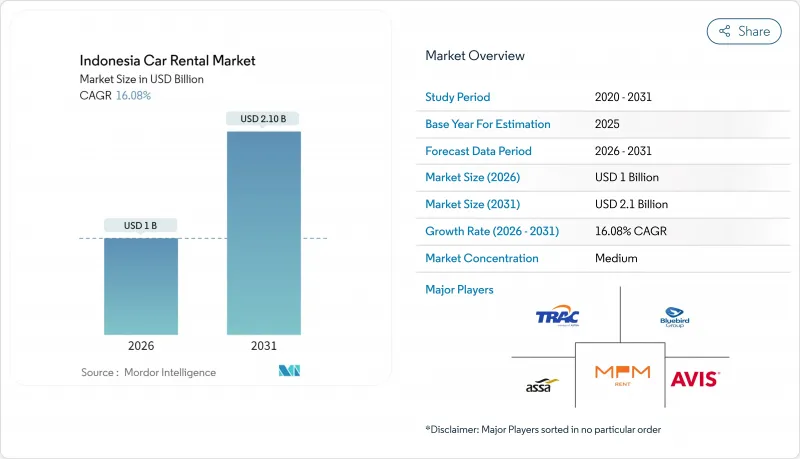
Over the next five years, rising disposable incomes, expanding middle-class travel budgets, and widespread smartphone adoption set a favorable backdrop for sustained double-digit growth. The government's target of welcoming between 14.6 and 16 million foreign visitors in 2025, up from 13.9 million in 2024, signals resilient tourism demand even as business travel rebounds on the back of Indonesia's 5.05% GDP growth in 2024. Online platforms are redefining customer expectations around transparency, on-demand availability, and digital payments, while new incentives for battery-electric vehicles (BEVs) position electrification as a future profit pool. Competitive pressure intensifies as app-based mobility ecosystems blur the line between ride-hailing and daily rentals, prompting traditional operators to accelerate fleet modernization and data-driven pricing strategies.
Indonesia Car Rental Market Trends and Insights
Rising International and Domestic Tourist Arrivals
In 2024, Indonesia welcomed around 13.9 million international visitors and recorded over 1 billion domestic journeys, marking a swift rebound in its tourism sector following the easing of border restrictions. The Ministry of Tourism projects inbound visitors will rise to between 14.6 and 16 million in 2025, supported by visa-on-arrival expansion and marketing of the "10 New Balis" destinations. Significant capital investment in Komodo, Lombok, and other regional airports increases seat capacity and disperses travel flows beyond Java. The World Travel & Tourism Council projects the sector will contribute 4.6% to GDP in 2025. A larger tourist base directly lifts self-drive rentals and chauffeured packages, particularly in islands where public transport is limited.
Surge in Digital-First Booking Platforms
In 2024, Indonesia's digital economy hit the USD 90 billion mark, buoyed by a surge in e-commerce transactions, with projections indicating further growth. Online rental bookings accounted for a substantial share of the overall transactions in 2024 and are growing significantly annually as consumers gravitate to super-apps offering instant price comparison, cashless payments, and loyalty rewards. Partnerships like Blue Bird taxis integrating with Gojek allow legacy fleets to unlock a nationwide customer base while cutting acquisition costs. Aggregators use rich data to fine-tune dynamic pricing, optimize fleet utilization, and upsell insurance or ancillary services in real time.
Ride-Hailing Super-Apps Cannibalizing Short-Term Rentals
Grab and Gojek processed a significant number of on-demand rides in Indonesia during 2024. A proposed Grab-GoTo tie-up could deepen network effects, bundling deliveries, payments, and ride-sharing into a single wallet. Urban consumers prefer door-to-door rides over self-drive rentals to avoid congestion fees and parking scarcity. Corporate travelers also book ride-hailing through expense-management dashboards, bypassing traditional airport pickup counters. To stay relevant, rental firms are exploring hourly packages, loyalty linkage with airlines, and premium SUVs to serve niches less exposed to app-based commoditization.
Other drivers and restraints analyzed in the detailed report include:
- Growing Corporate Demand for Long-Term Operational Leasing
- Government EV Roadmap Accelerating Fleet Electrification
- Intensifying Price-Led Competition Among Incumbents
For complete list of drivers and restraints, kindly check the Table Of Contents.
Segment Analysis
Online channels generated 68.84% of the Indonesian car rental market revenue in 2025, climbing at a 16.85% CAGR. The dominance reflects deep smartphone penetration, a cashless payment boom, and consumer comfort with super-apps integrating trip planning, mapping, and digital wallets. Indonesia's car rental market size, attributed to offline travel-agency counters, remained at significant revenue in 2025 but is losing share as small operators list fleets on aggregator portals to reach price-sensitive tourists.
Super-app ecosystems combine ride-hailing, food delivery, and digital banking, encouraging cross-selling day-long rental packages. Legacy brands adopt cloud-based reservation engines, push-notification discounts, and AI-enabled customer-service chatbots to match the user experience of tech platforms. Data captured online allows segmentation by nationality, trip purpose, and spend, enabling operators to A/B test mileage caps or bundle Wi-Fi routers for incremental revenue.
Short-term bookings, defined as rentals lasting 1-30 days, held a 57.88% share in the Indonesian car rental market in 2025 due to seasonal tourism peaks. Long-term contracts surpassed the noteworthy revenue i the Indonesian car rental market in 2025 and are projected to expand at a 17.12% CAGR. Corporations adopt operating leases to preserve capital and shift maintenance responsibilities to service providers.
Long-term packages typically include driver salaries, periodic servicing, and full insurance, insulating clients from residual-value swings. Fleet managers deploy telematics to monitor fuel consumption and preventive maintenance, reducing downtime. The trend also anchors used-vehicle disposal channels, where cars aged three to five years are auctioned or sold to ride-hailing drivers, recouping capital faster than private resales.
Tourism accounted for 63.74% of revenue in 2025; however, business mobility is on course to become the next growth engine, expanding at an 17.62% CAGR. Indonesia's investment-grade rating and quick licensing approvals spur multinational relocations, raising demand for executive transfers, project-site shuttles, and expatriate family transport. Daily commuting packages for factory staff and shared vans for BPO workers also widen addressable volumes.
Tourism bookings concentrate in Bali, Yogyakarta, and Lombok, where self-drive packages include itinerary curation and GPS navigation in multiple languages. Car rental firms tailor airport meet-and-greet services, fast-track SIM card kits, and 24/7 roadside assistance, leveraging Indonesia's archipelagic geography and limited inter-city rail. In parallel, corporate contracts diversify income, cushioning seasonality and yielding predictable fleet-utilization ratios.
The Indonesia Car Rental Market Report is Segmented by Booking Type (Online and Offline), Rental Duration (Short-Term, Medium-Term and Long-Term), Application (Tourism and Leisure, Daily Commuting, and More), Vehicle Type (Economy/Hatchback and More), Fuel Type (ICE-Petrol, ICE-Diesel, and More), End-User (Corporate and Individual), Rental Channel, and Region. The Market Forecasts are Provided in Terms of Value (USD).
List of Companies Covered in this Report:
- Blue Bird Group
- TRAC Astra Rent A Car
- Adi Sarana Armada (ASSA Rent)
- Mitra Pinasthika Mustika Rent
- The Hertz Corporation
- Avis Budget Group
- Europcar Indonesia
- Indorent (PT Indomobil Multi Jasa)
- Globe Rent a Car
- Otomo
- Grab Rentals
- GoCar Rental (Gojek)
- DOcar
- Movic
- Easyrent
- Tiket.com Car Rental
- Traveloka Car Rental
Additional Benefits:
- The market estimate (ME) sheet in Excel format
- 3 months of analyst support
TABLE OF CONTENTS
1 Introduction
- 1.1 Study Assumptions & Market Definition
- 1.2 Scope of the Study
2 Research Methodology
3 Executive Summary
4 Market Landscape
- 4.1 Market Overview
- 4.2 Market Drivers
- 4.2.1 Rising International and Domestic Tourist Arrivals
- 4.2.2 Surge in Digital-First Booking Platforms
- 4.2.3 Growing Corporate Demand for Long-Term Operational Leasing
- 4.2.4 Government EV Roadmap Accelerating Fleet Electrification
- 4.2.5 Halal-Friendly Tourism Packages Boosting Niche Rentals
- 4.2.6 Rapid Expansion of Secondary-Airport Connectivity
- 4.3 Market Restraints
- 4.3.1 Ride-Hailing Super-Apps Cannibalizing Short-Term Rentals
- 4.3.2 Intensifying Price-Led Competition Among Incumbents
- 4.3.3 Urban Congestion and Parking Scarcity Deterring Self-Drive
- 4.3.4 Fragmented Regional Licensing and Tax Compliance Burden
- 4.4 Value / Supply-Chain Analysis
- 4.5 Regulatory Landscape
- 4.6 Technological Outlook
- 4.7 Porter's Five Forces
- 4.7.1 Bargaining Power of Suppliers
- 4.7.2 Bargaining Power of Buyers/Consumers
- 4.7.3 Threat of New Entrants
- 4.7.4 Threat of Substitute Products
- 4.7.5 Intensity of Competitive Rivalry
5 Market Size & Growth Forecasts (Value, USD)
- 5.1 By Booking Type
- 5.1.1 Online
- 5.1.2 Offline
- 5.2 By Rental Duration
- 5.2.1 Short-term (Less than/Equals 30 days)
- 5.2.2 Medium-term (1 to 12 months)
- 5.2.3 Long-term (Above 12 months)
- 5.3 By Application
- 5.3.1 Tourism and Leisure
- 5.3.2 Daily Commuting
- 5.3.3 Corporate Fleet / Business Mobility
- 5.3.4 Airport Transfer
- 5.4 By Vehicle Type
- 5.4.1 Economy / Hatchback
- 5.4.2 Multi-Purpose Vehicle (MPV)
- 5.4.3 Sports Utility Vehicle (SUV)
- 5.4.4 Luxury / Executive
- 5.5 By Fuel Type
- 5.5.1 ICE - Petrol
- 5.5.2 ICE - Diesel
- 5.5.3 Hybrid-Electric
- 5.5.4 Battery-Electric (BEV)
- 5.6 By End-user
- 5.6.1 Corporate
- 5.6.2 Individual
- 5.7 By Rental Channel
- 5.7.1 Aggregator Platforms
- 5.7.2 Direct-to-Consumer (Rental Co.)
- 5.7.3 Super-App-Based Bundles
- 5.8 By Region
- 5.8.1 Java
- 5.8.1.1 Greater Jakarta (Jabodetabek)
- 5.8.1.2 West Java (ex-Jakarta)
- 5.8.1.3 Central and East Java
- 5.8.2 Bali and Nusa Tenggara
- 5.8.3 Sumatra
- 5.8.4 Kalimantan
- 5.8.5 Sulawesi
- 5.8.6 Papua and Maluku
- 5.8.1 Java
6 Competitive Landscape
- 6.1 Market Concentration
- 6.2 Strategic Moves
- 6.3 Market Share Analysis
- 6.4 Company Profiles (includes Global Level Overview, Market Level Overview, Core Segments, Financials as Available, Strategic Information, Market Rank/Share for Key Companies, Products and Services, SWOT Analysis, and Recent Developments)
- 6.4.1 Blue Bird Group
- 6.4.2 TRAC Astra Rent A Car
- 6.4.3 Adi Sarana Armada (ASSA Rent)
- 6.4.4 Mitra Pinasthika Mustika Rent
- 6.4.5 The Hertz Corporation
- 6.4.6 Avis Budget Group
- 6.4.7 Europcar Indonesia
- 6.4.8 Indorent (PT Indomobil Multi Jasa)
- 6.4.9 Globe Rent a Car
- 6.4.10 Otomo
- 6.4.11 Grab Rentals
- 6.4.12 GoCar Rental (Gojek)
- 6.4.13 DOcar
- 6.4.14 Movic
- 6.4.15 Easyrent
- 6.4.16 Tiket.com Car Rental
- 6.4.17 Traveloka Car Rental
7 Market Opportunities & Future Outlook
- 7.1 White-space & Unmet-Need Assessment

