
PUBLISHER: Mordor Intelligence | PRODUCT CODE: 1934618

PUBLISHER: Mordor Intelligence | PRODUCT CODE: 1934618
United States Cashew - Market Share Analysis, Industry Trends & Statistics, Growth Forecasts (2026 - 2031)
The United States cashew market is expected to grow from USD 1.32 billion in 2025 to USD 1.39 billion in 2026 and is forecast to reach USD 1.77 billion by 2031 at 4.99% CAGR over 2026-2031.
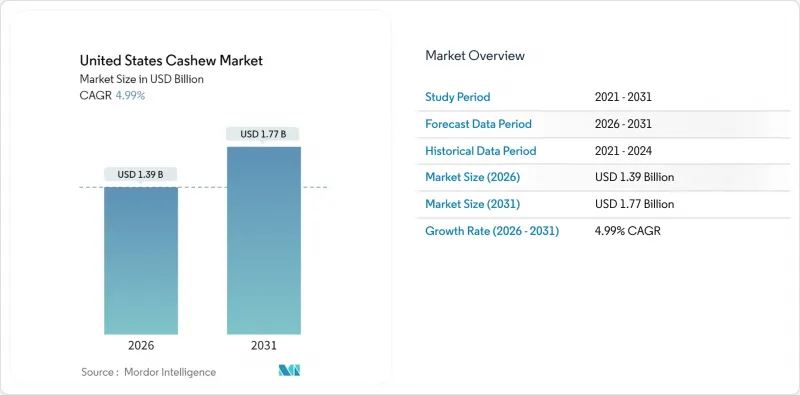
The market growth is driven by increasing demand for plant-based protein, sustained premium snack consumption, and foodservice sector expansion, despite challenges from tariffs and logistics disruptions. As domestic production remains minimal, the market relies heavily on imports. According to the ITC Trade Map, shelled cashew nut imports increased from 148,050 metric tons in 2020 to 176,426 metric tons in 2024. Processors are diversifying supply sources beyond Vietnam and optimizing port operations to manage tariff impacts. The industry is addressing labor shortages through automation in shelling and roasting operations, while retailers are developing private-label cashew products to meet health-conscious consumer demand. Additionally, sustainability initiatives by retailers and consumer-packaged goods companies are strengthening direct relationships between growers and the United States buyers through regenerative agroforestry practices.
United States Cashew Market Trends and Insights
Rising Per-Capita Intake of Cashew Nuts
Tree nut consumption per capita in the United States has increased over the last ten years, with cashews gaining market share as consumers shifted from traditional salty snacks to nutritious alternatives. The Food and Drug Administration's health guidance highlighting nuts' cardiovascular benefits has increased household consumption and encouraged retailers to promote cashew snack multipacks. The aging baby boomer population's higher disposable income has driven premium cashew product sales, particularly roasted and seasoned varieties. Health and wellness discussions on social media have normalized regular nut consumption, establishing a sustained growth pattern in the United States cashew market. The combination of cashews with dried fruits and dark chocolate in mixed snack packs has generated significant sales growth in club stores across the country. These consumption patterns have established a strong market foundation beyond demographic expansion.
Surge in Plant-Based Protein Demand
The United States cashew market is experiencing growth driven by multiple factors. Coffee chains are transitioning from almond to cashew-based beverages due to cashew milk's creamier texture and lower allergen risk. The vegan cheese segment is expanding, with specialty supermarkets increasing shelf space for cashew-based shredded and spreadable alternatives. Additionally, United States start-ups are incorporating cashew protein isolates into nutrition bars. Food manufacturers prefer cashews for their neutral flavor profile, which reduces masking requirements compared to pea or soy proteins, maintaining cost competitiveness despite raw material price fluctuations. The market stability is further enhanced by long-term agreements between plant-based food companies and supply-chain financiers, which establish consistent kernel quality specifications. The growing meat-alternative segment benefits from flexible toll-roasting arrangements, optimizing processor capacity utilization.
Climatic Constraints in Key Growing Regions
Temperature extremes and irregular rainfall patterns in Vietnam and West Africa reduce cashew yields and kernel sizes, leading to increases in raw nut prices that affect United States import costs. The limited domestic cashew cultivation in the United States provides minimal protection against global supply disruptions. While the industry expands into South American markets, new cashew trees require over 5 years to mature, delaying significant production volumes. Drought conditions increase aflatoxin contamination risks in crops, reducing the available kernel supply and increasing Food and Drug Administration rejection rates at ports. Processors need to maintain larger inventory reserves, which increases working capital requirements and reduces profitability. The persistent nature of climate-related challenges requires investments in agricultural improvements and insurance coverage, increasing operational costs in the United States cashew market.
Other drivers and restraints analyzed in the detailed report include:
- Government Specialty-Crop Block-Grant Incentives
- Expansion of Foodservice and Snacking Formats
- Chronic Labor Shortages in Shelling Lines
For complete list of drivers and restraints, kindly check the Table Of Contents.
Segment Analysis
Shelled cashews accounted for 71.50% of the United States cashew market share in 2025. This dominance stems from their widespread use by foodservice operators, plant-based dairies, and snack packagers who require consistent, ready-to-use kernels for efficient production. The segment's growth is supported by technological advancements, including modified-atmosphere pouches that extend shelf life to 14 months and nitrogen-flush jars designed for club stores. The large-scale operations enable processors to secure freight discounts, enhancing price competitiveness. The integration of continuous dry-roast systems with seasoning drums allows quick flavor adaptations to meet retail demands for seasonal offerings. These factors collectively contribute to the expansion of the United States' cashew market size.
In-shell cashews represent a growing niche segment, projected to achieve a 5.0% CAGR through 2031. This growth is driven by specialty grocers, e-commerce platforms, and farmers' markets that focus on premium freshness and traditional cracking experiences. Artisanal roasters offer single-origin products and specialized spice blends, commanding price premiums of up to 28% above shelled cashews. The segment's expansion is further supported by increasing consumer interest in backyard roasting kits and subscription-based direct-to-consumer sales. The format has also gained traction in upscale dining establishments offering tableside cracking experiences. Despite lower throughput, the higher margins enable profitable small-batch operations, diversifying the United States cashew market offerings
The United States Cashew Market Report is Segmented by Form (Shelled and In-Shell) and by Geography (Production Analysis (Volume), Consumption Analysis (Volume and Value), Import Analysis (Volume and Value), Export Analysis (Volume and Value), and Price Trend Analysis). The Market Forecasts are Provided in Terms of Value (USD) and Volume (Metric Tons).
List of Companies Covered in this Report:
- Market Overview
- Market Drivers
- Market Restraints
- Regulatory Landscape
- Technological Outlook
- Value Chain/Supply Chain Analysis
- PESTLE Analysis
- List of Stakeholders
Additional Benefits:
- The market estimate (ME) sheet in Excel format
- 3 months of analyst support
TABLE OF CONTENTS
1 Introduction
- 1.1 Study Assumptions and Market Definition
- 1.2 Scope of the Study
2 Research Methodology
3 Executive Summary
4 Market Landscape
- 4.1 Market Overview
- 4.2 Market Drivers
- 4.2.1 Rising Per-Capita Intake of Cashew Nuts
- 4.2.2 Surge in Plant-Based Protein Demand
- 4.2.3 Government Specialty-Crop Block-Grant Incentives
- 4.2.4 Expansion of Foodservice and Snacking Formats
- 4.2.5 Mature Domestic Shelling and Roasting Infrastructure
- 4.2.6 Shift Toward Regenerative Cashew Agro-Forestry
- 4.3 Market Restraints
- 4.3.1 Climatic Constraints in Key Growing Regions
- 4.3.2 Chronic Labor Shortages in Shelling Lines
- 4.3.3 Container-Space Competition with Higher-Value Nuts
- 4.3.4 Limited Research and Development in Small-Scale Mechanized Shellers
- 4.4 Regulatory Landscape
- 4.5 Technological Outlook
- 4.6 Value Chain/Supply Chain Analysis
- 4.7 PESTLE Analysis
5 Market Size and Growth Forecasts
- 5.1 By Form (Value)
- 5.1.1 Shelled
- 5.1.2 In-Shell
- 5.2 By Geography
- 5.2.1 Production Analysis (Volume)
- 5.2.2 Consumption Analysis (Value and Volume)
- 5.2.3 Imports Analysis (Value and Volume)
- 5.2.4 Exports Analysis (Value and Volume)
- 5.2.5 Price Trend Analysis
6 Competitive Landscape
- 6.1 List of Stakeholders
- 6.1.1 Olam Food Ingredients, Inc.
- 6.1.2 Red River Foods, Inc.
- 6.1.3 John B. Sanfilippo & Son, Inc.
- 6.1.4 Superior Nut Company, Inc.(The Wonderful Company)
- 6.1.5 Hampton Farms, LLC (Meherrin Ag)
- 6.1.6 MWT Foods LLC
- 6.1.7 Nutsco, Inc.
- 6.1.8 Bergin Fruit and Nut Company
- 6.1.9 SunTree Snack Foods, LLC
- 6.1.10 South Georgia Pecan Company
- 6.1.11 International Foodsource L.L.C.
- 6.1.12 Sunco & Frenchie, LLC
- 6.1.13 Century Snacks, LLC
- 6.1.14 Bedford Candies
- 6.1.15 Old World Gourmet Nuts
7 Market Opportunities and Future Outlook

