
PUBLISHER: Mordor Intelligence | PRODUCT CODE: 1937267

PUBLISHER: Mordor Intelligence | PRODUCT CODE: 1937267
Africa Cashew - Market Share Analysis, Industry Trends & Statistics, Growth Forecasts (2026 - 2031)
The Africa Cashew market was valued at USD 3.3 billion in 2025 and estimated to grow from USD 3.54 billion in 2026 to reach USD 5.02 billion by 2031, at a CAGR of 7.25% during the forecast period (2026-2031).
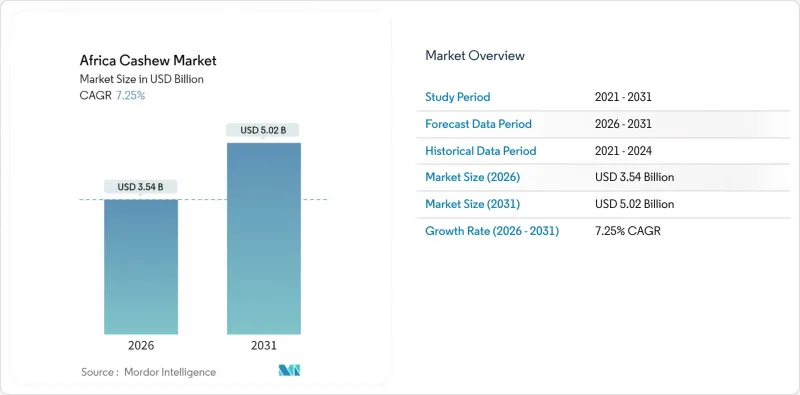
The market growth is driven by a transition from raw-nut exports to value-added kernel processing, supported by government incentives and European sustainability requirements. Increased farm-gate prices, traceability systems yielding 8-10% retail premiums, and climate-resilient cultivars encourage processors to enhance capacity and obtain certifications for premium market access. Ivory Coast (Cote d'Ivoire) is Africa's largest cashew-producing country and the global leader in raw cashew nut production and exports. According to the Food and Agriculture Organization (FAO), Cote d'Ivoire's cashew nut production increased from 1,028,172 metric tons in 2022 to 1,044,449.95 metric tons in 2023. Cashew plants begin fruit production four to five years after planting and maintain optimal productivity for approximately 15 years. In Cote d'Ivoire, more than 10% of cashew trees are less than ten years old, resulting in higher yields. The country continues to expand its cashew acreage annually with improved varieties, strengthening its position as Africa's primary cashew exporter.
Africa Cashew Market Trends and Insights
Higher Demand For African Cashews from European Healthy-Snack Brands
European healthy-snack brands are turning to African cashews to supply plant-based, low-sugar product lines that attract consumers seeking sustainable ingredients. Import volumes have surged in Nordic markets and Germany, where traceable organic kernels sell at sizable premiums, motivating African processors to secure certifications and direct-trade agreements that bypass commodity intermediaries Processing firms now tailor safety protocols to BRCGS (British Retail Consortium Global Standards) standards, enabling consistent quality that satisfies European retailers. Investment priorities across West African plants increasingly favor HACCP (Hazard Analysis and Critical Control Points) programs and allergen-control systems that support premium positioning. These upgrades consolidate long-term contracts that stabilize processor cash flows and underpin continued expansion of the Africa Cashew market.
Government Processing Incentives Across West Africa
West African governments are launching five-year tax holidays, duty-free machinery imports, and preferential land leases to spur domestic kernel production. The Cotton and Cashew Council in Cote d'Ivoire orchestrates sector policies that taper export levies on processed nuts, while Sierra Leone's Finance Act 2025 exempts qualifying processors from corporate income tax and customs duties. Burkina Faso's outright export ban on raw nuts redirects 200,000 metric tons to domestic factories, providing reliable throughput that justifies further plant investments. These coordinated measures reduce reliance on Asian processing centers, keeping more value inside Africa and reinforcing the growth trajectory of the African cashew market.
Limited Domestic Processing Capacity
Africa still processes only 15-20% of its crop, forfeiting kernel-level margins to Asian plants. Tanzania illustrates the shortfall: despite an annual production of roughly 200,000-250,000 metric tons, domestic factories treat as little as 5-15%, forcing exporters to ship raw nuts that attract lower prices. Ghana exports more than 80% of its 180,000 metric tons of unprocessed, even though kernels would earn multiple times the raw-nut price. High interest rates and unreliable electricity raise operating costs, while scale disadvantages keep per-unit costs above those of mature Asian competitors. Such constraints slow the transition toward value-added activities that would otherwise accelerate the Africa Cashew market.
Other drivers and restraints analyzed in the detailed report include:
- Climate-Resilient Cashew Cultivars Boosting Yields
- Blockchain-Based Traceability Commanding Price Premiums
- Quality Losses From Inadequate Post-Harvest Handling
For complete list of drivers and restraints, kindly check the Table Of Contents.
Segment Analysis
In-shell cashews dominated with a 63.30% share in 2025, mirroring the historic emphasis on raw-nut exports to Asia, where kernel splitting is concentrated. The segment is slowly ceding ground as African factories gain scale. The Africa Cashew market size for in-shell nuts is likely to plateau as more volume is diverted to domestic processors.
Shelled kernels represent the fastest-growing form at an 10.83% CAGR through 2031, spurred by domestic incentives, concessional financing, and sustainability-linked premiums. New facilities, such as Burkina Faso's USD 11.5 million plant in Peni that processes 5,000 metric tons annually and creates 1,000 jobs, exemplify the shift. Kernel processors increasingly seek organic and BRCGS (Brand Reputation through Compliance Global Standards) certification, enabling direct sales into European snack channels that prize traceable supply chains. The African Cashew Alliance's Quality and Sustainability Seal further reduces buyer risk and accelerates contract commitments. Growing kernel output is therefore set to capture a larger slice of the African cashew market share over the outlook period.
The Africa Cashew Market is Segmented by Form (In-Shell and Shelled) and by Geography (Nigeria, Cote Dl'voire, Benin, Tanzania, Burundi and More). The Report Includes Production Analysis (Volume), Consumption Analysis (Value and Volume), Export Analysis (Value and Volume), Import Analysis (Value and Volume), and Price Trend Analysis. The Market Forecasts are Provided in Terms of Value (USD) and Volume (Metric Tons).
List of Companies Covered in this Report:
- Market Overview
- Market Drivers
- Market Restraints
- Regulatory Landscape
- Technological Outlook
- Value / Supply-Chain Analysis
- PESTLE Analysis
- List of Key Stakeholders
Additional Benefits:
- The market estimate (ME) sheet in Excel format
- 3 months of analyst support
TABLE OF CONTENTS
1 Introduction
- 1.1 Study Assumptions and Market Definition
- 1.2 Scope of the Study
2 Research Methodology
3 Executive Summary
4 Market Landscape
- 4.1 Market Overview
- 4.2 Market Drivers
- 4.2.1 Higher demand for African cashews from European healthy-snack brands
- 4.2.2 Rising farm-gate prices spurring farmland expansion
- 4.2.3 Government processing incentives across West Africa
- 4.2.4 Climate-resilient cashew cultivars boosting yields
- 4.2.5 Blockchain-based traceability commanding price premiums
- 4.2.6 European Union and United States sustainability sourcing mandates
- 4.3 Market Restraints
- 4.3.1 Limited domestic processing capacity
- 4.3.2 Persistent price disparity from farm-gate to retail
- 4.3.3 Quality losses from inadequate post-harvest handling
- 4.3.4 Port-side logistics bottlenecks and container shortages
- 4.4 Regulatory Landscape
- 4.5 Technological Outlook
- 4.6 Value / Supply-Chain Analysis
- 4.7 PESTLE Analysis
5 Market Size and Growth Forecasts
- 5.1 By Country (Production Analysis (Volume), Consumption Analysis (Volume and Value), Import Analysis (Volume and Value), Export Analysis (Volume and Value), and Price Trend Analysis)
- 5.1.1 Nigeria
- 5.1.2 Cote d'Ivoire
- 5.1.3 Benin
- 5.1.4 Tanzania
- 5.1.5 Burundi
- 5.1.6 Ghana
- 5.1.7 Guinea-Bissau
- 5.1.8 Burkina Faso
- 5.2 By Form (Value)
- 5.2.1 In-shell
- 5.2.2 Shelled (Kernels)
6 Competitive Landscape
- 6.1 List of Key Stakeholders
- 6.1.1 African Cashew Alliance (ACA)
- 6.1.2 Olam International
- 6.1.3 Export Trading Group (ETG)
- 6.1.4 Tolaro Global
- 6.1.5 Mim Cashew and Agricultural Products
- 6.1.6 Cashew Coast
- 6.1.7 Societe Ivoirienne de Traitement d'Anacarde (SITA)
- 6.1.8 Fludor Benin (TGI Group)
- 6.1.9 Red River Foods
- 6.1.10 Valency International (Valency Agro)
- 6.1.11 Conseil du Coton et de l'Anacarde (CCA)
- 6.1.12 National Cashew Association of Nigeria (NCAN)
- 6.1.13 Cashew Board of Tanzania (CBT)
- 6.1.14 National Council of Benin Cashew (CNFA)
- 6.1.15 MOVE-ComCashew (GIZ)
7 Market Opportunities and Future Outlook

