
PUBLISHER: Mordor Intelligence | PRODUCT CODE: 1934652

PUBLISHER: Mordor Intelligence | PRODUCT CODE: 1934652
Africa Orange - Market Share Analysis, Industry Trends & Statistics, Growth Forecasts (2026 - 2031)
The Africa orange market is expected to grow from USD 1.52 billion in 2025 to USD 1.57 billion in 2026 and is forecast to reach USD 1.81 billion by 2031 at 3.0% CAGR over 2026-2031.
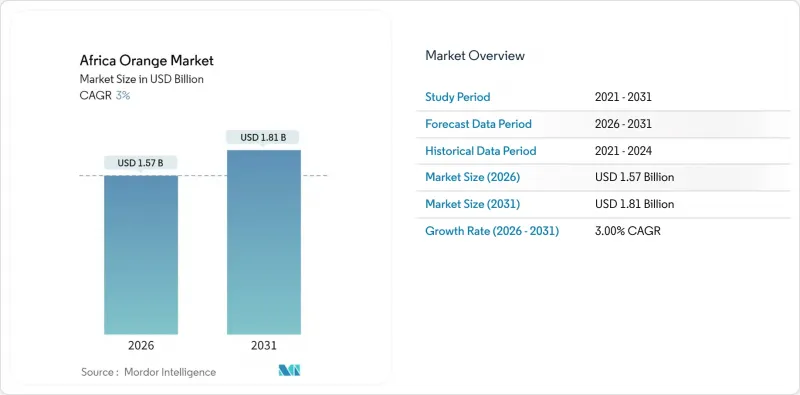
Robust export demand, rising urban health awareness, and record juice prices are widening farm-gate margins, encouraging investments in climate-smart irrigation and solar-powered cold storage. Egypt's scale advantages, Morocco's trans-Atlantic logistics, and South Africa's cold-chain know-how collectively anchor regional competitiveness, while pan-African commodity exchanges are improving price discovery for smallholders. The intensification of phytosanitary rules in the European Union (EU) and China is accelerating the adoption of traceability systems, even as the spread of citrus greening disease and volatility in the cold chain temper growth prospects.
Africa Orange Market Trends and Insights
Climate-smart irrigation scale-up
Solar-powered drip systems are replacing flood irrigation across the Nile Delta and Souss-Massa, reducing water use by 47.4% and lifting citrus yields 47.6% in arid zones. Precision platforms that pair Internet of Things (IoT) sensors with machine learning are shrinking water use 20-30% and boosting nutrient efficiency up to 87%, enabling growers to meet EU carbon benchmarks without sacrificing output. Morocco's Green Generation 2030 program is pairing drip grants with zero-interest loans for solar pumps. South African exporters are integrating telemetry-driven moisture probes to offset erratic rainfall, anchoring cold-chain reliability in the face of grid stress.
Record-high global orange-juice prices lifting farm-gate margins
Brazil's 24% crop shortfall and Florida's decades-long decline slashed global supply, sending frozen concentrated orange juice prices to all-time highs in 2024-25. African shippers timed exports to coincide with price spikes, lifting Egypt's agricultural export receipts year on year. Elevated margins financed on-farm packhouses and climate-proof irrigation in the Nile Delta and Souss-Massa valleys. Moroccan growers leveraged Atlantic shipping lanes to capture U.S. demand as processors explored fruit blends to tame costs.
Greening spread beyond Limpopo
'Candidatus Liberibacter africanus' has moved from South Africa's Limpopo province into Angola, Ghana, and coastal provinces, forcing growers to uproot infected trees and intensify psyllid control. The absence of cures means full orchard resets, increasing capital payback periods, and deterring smallholder expansion. Biosecurity zones and systemic insecticides raise costs in the short term while stoking research into tolerant rootstocks. Cross-border surveillance under the Southern African Development Community (SADC) is improving early detection, yet limited diagnostic labs in West Africa prolong response times, heightening contagion risk.
Other drivers and restraints analyzed in the detailed report include:
- New China-Africa cold-treatment protocol
- Adoption of high-yield Valencia late cultivars
- EU CBS (citrus black-spot) phytosanitary barrier
For complete list of drivers and restraints, kindly check the Table Of Contents.
Segment Analysis
The Africa Orange Market Report is Segmented by Geography (Egypt, Morocco, and South Africa). The Report Includes Production Analysis (Volume), Consumption Analysis (Value and Volume), Export Analysis (Value and Volume), Import Analysis (Value and Volume), and Price Trend Analysis. The Market Forecasts are Provided in Terms of Value (USD) and Volume (Metric Tons).
List of Companies Covered in this Report:
- Market Overview
- Market Drivers
- Market Restraints
- Regulatory Landscape
- Technological Outlook
- Value / Supply Chain Analysis
- PESTLE Analysis
- List of Stakeholders
Additional Benefits:
- The market estimate (ME) sheet in Excel format
- 3 months of analyst support
TABLE OF CONTENTS
1 Introduction
- 1.1 Study Assumptions and Market Definition
- 1.2 Scope of the Study
2 Research Methodology
3 Executive Summary
4 Market Landscape
- 4.1 Market Overview
- 4.2 Market Drivers
- 4.2.1 Climate-smart irrigation scale-up
- 4.2.2 Record-high global orange-juice prices lifting farm-gate margins
- 4.2.3 New China-Africa cold-treatment protocol
- 4.2.4 Emergence of pan-African commodity exchanges
- 4.2.5 Adoption of high-yield Valencia late cultivars
- 4.2.6 On-farm solar micro-grids reducing post-harvest losses
- 4.3 Market Restraints
- 4.3.1 Greening spread beyond Limpopo
- 4.3.2 Fertilizer-price pass-through on grower margins
- 4.3.3 EU CBS (citrus black-spot) phytosanitary barrier
- 4.3.4 Cold-chain power-supply volatility
- 4.4 Regulatory Landscape
- 4.5 Technological Outlook
- 4.6 Value / Supply Chain Analysis
- 4.7 PESTLE Analysis
5 Market Size and Growth Forecasts (Production Analysis (Volume), Consumption Analysis (Volume and Value), Import Analysis (Volume and Value), Export Analysis (Volume and Value), and Price Trend Analysis)
- 5.1 By Geography
- 5.1.1 Egypt
- 5.1.2 Morocco
- 5.1.3 South Africa
6 Competitive Landscape
- 6.1 List of Stakeholders
- 6.1.1 Capespan Group
- 6.1.2 Sundays River Citrus Company (Pty) Ltd
- 6.1.3 Elwadi Export CO.
- 6.1.4 Magrabi Agriculture
- 6.1.5 Afrifresh Group
- 6.1.6 Delecta Fruits
- 6.1.7 ALG Global Citrus
- 6.1.8 Moroccancitrus
- 6.1.9 Mouton Citrus(Pty) Ltd
- 6.1.10 Fruitone
7 Market Opportunities and Future Outlook

