PUBLISHER: Mordor Intelligence | PRODUCT CODE: 2125479

PUBLISHER: Mordor Intelligence | PRODUCT CODE: 2125479
Beverage - Market Share Analysis, Industry Trends & Statistics, Growth Forecasts (2026 - 2031)
According to Mordor Intelligence, beverage market size in 2026 is estimated at USD 2.03 trillion, growing from 2025 value of USD 1.92 trillion with 2031 projections showing USD 2.67 trillion, growing at 5.65% CAGR over 2026-2031.
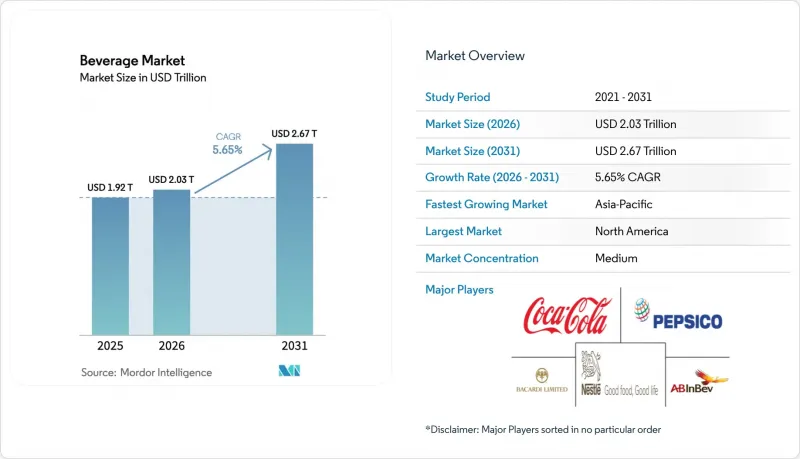
This report is Segmented by Product Type (Alcoholic Beverages and Non-Alcoholic Beverages), Packaging Type (PET Bottles, Cans and More), Application (Nutritional and Functional Support and More), Distribution Channel (On-Trade and Off-Trade), and Geography (North America, Europe, Asia-Pacific, South America, and Middle East and Africa). The Market Forecasts are Provided in Terms of Value (USD).
Global Beverage Market Trends and Insights
Social consumption trends are driving demand for experiential beverages
Social consumption trends are boosting demand for unique beverage experiences, driving the growth of the global beverage market. Younger generations, like Millennials and Gen Z, want more than just a drink; they seek unique flavors, indulgence, and social experiences. For example, a survey by Alcohol Org in July 2025 found that 47% of men and 40% of women binge drank to celebrate the New Year. Similarly, men and women over the age of 20 reported drinking an average of at least two drinks on Halloween. Innovations like unusual flavor combinations (such as chocolate, chili pepper, and botanicals) are attracting adventurous consumers. Ready-to-drink (RTD) cocktails and low or no-alcohol beverages are also becoming more popular as people look for options that fit their lifestyle and health goals. These trends highlight a shift toward beverages that offer new flavors, health benefits, and social enjoyment, making experiential consumption a key factor in the beverage market growth.
Urban lifestyles are increasing demand for ready-to-drink formats
Urban lifestyles, influenced by busy work schedules, long commutes, and more dual-income households, are driving higher demand for ready-to-drink (RTD) beverages. As of 2024, the World Bank reported that 57.3% of the global population lived in urban areas, showing a growing number of consumers looking for convenient drink options. These fast-paced routines are increasing the popularity of pre-mixed, grab-and-go beverages that are both functional and flavorful. For example, in 2024, Mas+ by Messi was launched as a functional RTD drink with electrolytes, vitamins, and antioxidants. This product is designed as a low-calorie, performance-enhancing option, catering to health-conscious urban consumers who need quick and effective hydration to keep up with their busy lifestyles. Such products are becoming increasingly popular as they align with the needs of modern urban living in the beverage market.
Increasing Sugar tax and health regulations
Rising sugar taxes and stricter health regulations are creating significant challenges for the beverages market. For example, in India, sugary carbonated drinks face a high tax rate of 40 percent, which is slowing down innovation and market growth, according to the Indian Council for Research on International Economic Relations as of September 2024. These taxes are part of broader efforts to reduce sugar consumption and address health concerns like obesity and diabetes. As a result, beverage companies are being forced to adapt by either increasing prices, reformulating products to reduce sugar content, or shifting their focus to healthier alternatives. While these changes aim to meet consumer demand for healthier options, they also increase operational costs and create hurdles for companies trying to maintain profitability in a competitive market within the beverage market.
Other drivers and restraints analyzed in the detailed report include:
- Health consciousness is boosting demand for functional and low-sugar beverages
- Sustainability concerns are reshaping packaging choices
- Labeling and transparency regulations
For complete list of drivers and restraints, kindly check the Table Of Contents.
Segment Analysis
Alcoholic beverages made up 63.78% of the global beverage market share in 2025, driven by the strong demand for popular beer and spirits. These products continue to lead in bars and pubs due to their widespread availability and loyal customer base. Premium and craft options are becoming more popular as disposable incomes rise and social drinking gains traction in emerging markets. Seasonal promotions, celebrity endorsements, and convenient packaging formats like cans and mini bottles are also boosting the growth of this category in the beverage market.
The non-alcoholic segment is expected to grow faster, with a projected CAGR of 6.05% through 2031, surpassing the slower growth of alcoholic beverages. This growth is fueled by increasing demand for healthier options, with products like Ready-toDrink (RTD) tea and coffee and juices gaining popularity among younger, health-conscious consumers. These beverages align with the "sober-curious" trend, which encourages moderation. Functional waters, adaptogenic drinks, and prebiotic sodas are becoming favorites for their added health benefits, such as hydration and gut health. Their convenient packaging and premium positioning allow companies to meet changing consumer preferences while achieving higher profit margins.
PET bottles made up 61.60% of the global beverage market share in 2025, driven by their lightweight design, affordability, and versatility across various beverage categories like water, juices, and soft drinks. Their ease of storage and transportation makes them a preferred choice for manufacturers and consumers alike. Increasing regulations requiring 25% recycled content by 2025 are pushing companies to adopt recycled PET (rPET), promoting sustainability and reducing environmental impact. This shift is encouraging the development of more eco-friendly production practices in the industry.
Cans are growing at a CAGR of 5.75%, gaining popularity due to their recyclability, convenience, and appeal in categories like energy drinks and alcoholic beverages. Their durable and portable nature makes them ideal for on-the-go consumption, while sleek designs and modern packaging enhance their attractiveness to consumers. Although glass packaging holds a smaller share of the market, it continues to grow in value because of its premium image. Glass is widely used in high-end and craft beverage segments, where it is associated with quality and sophistication, making it a preferred choice for premium branding.
Complete Report Scope:
- By Product Type
- Alcoholic Beverages
- Beer
- Wine
- Spirits
- Ready-to-Drink (RTD) Cocktails
- Hard Seltzers
- Non-Alcoholic Beverages
- Carbonated Soft Drinks
- Bottled Water
- Juices and Nectars
- Energy and Sports Drinks
- Ready-to-Drink (RTD) Tea and Coffee
- Dairy and Plant-based Drinks
- Other Non-Alcoholic Beverages
- Alcoholic Beverages
- By Packaging Type
- PET Bottles
- Glass Bottles
- Cans
- Others
- By Application
- Energy Boost
- Nutritional and Functional Support
- Others
- By Distribution Channel
- On-trade
- Off-trade
- Supermarkets/Hypermarkets
- Convenience Stores
- Online Retailers
- Specialty Stores
- By Geography
- North America
- United States
- Canada
- Mexico
- Rest of North America
- South America
- Brazil
- Colombia
- Chile
- Peru
- Argentina
- Rest of South America
- Europe
- United Kingdom
- Germany
- France
- Italy
- Spain
- Russia
- Poland
- Belgium
- Sweden
- Rest of Europe
- Asia-Pacific
- China
- Japan
- India
- Australia
- Indonesia
- South Korea
- Thailand
- Singapore
- Rest of Asia-Pacific
- Middle East and Africa
- South Africa
- Saudi Arabia
- United Arab Emirates
- Nigeria
- Egypt
- Morocco
- Turkey
- Rest of Middle East and Africa
- North America
Geography Analysis
North America leads the market with a 38.75% share in 2025, supported by its extensive distribution networks and established brands. Consumers in this region readily purchase premium and functional beverages, showing strong purchasing power. The Food and Drug Administration's (FDA) new labeling rules for added sugars have increased transparency and consumer trust. Major companies like PepsiCo and Keurig Dr Pepper are focusing on health-conscious products, launching drinks like Gatorade Fit and Bai antioxidant beverages. While large-scale production helps maintain profits, various challenges exist, including sugar taxes in Philadelphia and bottle deposit requirements in California. These factors require careful management to maintain profitable operations.
Asia-Pacific shows the highest growth rate at 5.90% through 2031, driven by rapid urbanization and rising consumer incomes. This growth is changing beverage preferences across the region, with consumers seeking more diverse drink options. Chinese company Nongfu Spring is meeting demand with low-sugar teas and vitamin-enhanced water, while Coca-Cola expands in India with Kinley water. Japan continues to innovate in the ready-to-drink coffee segment, with companies like Suntory and Asahi introducing convenient cold brew options. The region's varied retail landscapes and tax systems require companies to develop market-specific strategies for pricing and packaging.
Europe maintains steady growth while balancing sustainability requirements and premium product demand. The European Union's new regulation requiring 25% recycled content in plastic bottles by 2025 is changing how companies approach packaging. Major brands like Danone and Nestle are responding by introducing recycled PET bottles across their European operations. Tourism recovery in Southern Europe is boosting sales of traditional drinks like Aperol spritz and sangria. Northern European markets are seeing significant growth in plant-based beverages, with brands like Oatly gaining popularity. These regional differences highlight the need for customized market approaches within Europe.
- The Coca-Cola Company
- PepsiCo Inc.
- Anheuser-Busch InBev
- Nestle S.A.
- Heineken N.V.
- Diageo plc
- Suntory Holdings Limited
- Constellation Brands
- Red Bull GmbH
- Keurig Dr Pepper
- Molson Coors
- Monster Beverage Corp.
- Nirvana Water Sciences Corp. (Nirvana)
- Danone SA
- Carlsberg Group
- Castel Freres S.A.S.
- Nordaq AB
- Pernod Ricard
- Bacardi Limited
- Bisleri International Pvt. Ltd.
Additional Benefits:
- The market estimate (ME) sheet in Excel format
- 3 months of analyst support
TABLE OF CONTENTS
1 INTRODUCTION
- 1.1 Study Assumptions and Market Definition
- 1.2 Scope of the Study
2 RESEARCH METHODOLOGY
3 EXECUTIVE SUMMARY
4 MARKET LANDSCAPE
- 4.1 Market Overview
- 4.2 Market Drivers
- 4.2.1 Rapid urban-on-the-go consumption culture
- 4.2.2 Premiumisation in alcoholic and functional drinks
- 4.2.3 Social consumption trends are driving demand for experiential beverages
- 4.2.4 Health consciousness is boosting demand for functional and low-sugar beverages.
- 4.2.5 Sustainability concerns are reshaping packaging choices
- 4.2.6 Urban lifestyles are increasing demand for ready-to-drink formats
- 4.3 Market Restraints
- 4.3.1 Increasing sugar tax and health regulations
- 4.3.2 Fluctuating raw material prices
- 4.3.3 Stringent alcohol regulations
- 4.3.4 Labeling and transparency regulations
- 4.4 Supply Chain Analysis
- 4.5 Regulatory Outlook
- 4.6 Technological Outlook
- 4.7 Porter's Five Forces
- 4.7.1 Threat of New Entrants
- 4.7.2 Bargaining Power of Buyers/Consumers
- 4.7.3 Bargaining Power of Suppliers
- 4.7.4 Threat of Substitute Products
- 4.7.5 Intensity of Competitive Rivalry
5 MARKET SIZE AND GROWTH FORECASTS (VALUE)
- 5.1 By Product Type
- 5.1.1 Alcoholic Beverages
- 5.1.1.1 Beer
- 5.1.1.2 Wine
- 5.1.1.3 Spirits
- 5.1.1.4 Ready-to-Drink (RTD) Cocktails
- 5.1.1.5 Hard Seltzers
- 5.1.2 Non-Alcoholic Beverages
- 5.1.2.1 Carbonated Soft Drinks
- 5.1.2.2 Bottled Water
- 5.1.2.3 Juices and Nectars
- 5.1.2.4 Energy and Sports Drinks
- 5.1.2.5 Ready-to-Drink (RTD) Tea and Coffee
- 5.1.2.6 Dairy and Plant-based Drinks
- 5.1.2.7 Other Non-Alcoholic Beverages
- 5.1.1 Alcoholic Beverages
- 5.2 By Packaging Type
- 5.2.1 PET Bottles
- 5.2.2 Glass Bottles
- 5.2.3 Cans
- 5.2.4 Others
- 5.3 By Application
- 5.3.1 Energy Boost
- 5.3.2 Nutritional and Functional Support
- 5.3.3 Others
- 5.4 By Distribution Channel
- 5.4.1 On-trade
- 5.4.2 Off-trade
- 5.4.2.1 Supermarkets/Hypermarkets
- 5.4.2.2 Convenience Stores
- 5.4.2.3 Online Retailers
- 5.4.2.4 Specialty Stores
- 5.5 By Geography
- 5.5.1 North America
- 5.5.1.1 United States
- 5.5.1.2 Canada
- 5.5.1.3 Mexico
- 5.5.1.4 Rest of North America
- 5.5.2 South America
- 5.5.2.1 Brazil
- 5.5.2.2 Colombia
- 5.5.2.3 Chile
- 5.5.2.4 Peru
- 5.5.2.5 Argentina
- 5.5.2.6 Rest of South America
- 5.5.3 Europe
- 5.5.3.1 United Kingdom
- 5.5.3.2 Germany
- 5.5.3.3 France
- 5.5.3.4 Italy
- 5.5.3.5 Spain
- 5.5.3.6 Russia
- 5.5.3.7 Poland
- 5.5.3.8 Belgium
- 5.5.3.9 Sweden
- 5.5.3.10 Rest of Europe
- 5.5.4 Asia-Pacific
- 5.5.4.1 China
- 5.5.4.2 Japan
- 5.5.4.3 India
- 5.5.4.4 Australia
- 5.5.4.5 Indonesia
- 5.5.4.6 South Korea
- 5.5.4.7 Thailand
- 5.5.4.8 Singapore
- 5.5.4.9 Rest of Asia-Pacific
- 5.5.5 Middle East and Africa
- 5.5.5.1 South Africa
- 5.5.5.2 Saudi Arabia
- 5.5.5.3 United Arab Emirates
- 5.5.5.4 Nigeria
- 5.5.5.5 Egypt
- 5.5.5.6 Morocco
- 5.5.5.7 Turkey
- 5.5.5.8 Rest of Middle East and Africa
- 5.5.1 North America
6 COMPETITIVE LANDSCAPE
- 6.1 Market Concentration
- 6.2 Strategic Moves
- 6.3 Market Share Analysis
- 6.4 Company Profiles (includes Global-level Overview, Market-level Overview, Core Segments, Financials (if available), Strategic Information, Market Rank/Share, Products and Services, Recent Developments)
- 6.4.1 The Coca-Cola Company
- 6.4.2 PepsiCo Inc.
- 6.4.3 Anheuser-Busch InBev
- 6.4.4 Nestle S.A.
- 6.4.5 Heineken N.V.
- 6.4.6 Diageo plc
- 6.4.7 Suntory Holdings Limited
- 6.4.8 Constellation Brands
- 6.4.9 Red Bull GmbH
- 6.4.10 Keurig Dr Pepper
- 6.4.11 Molson Coors
- 6.4.12 Monster Beverage Corp.
- 6.4.13 Nirvana Water Sciences Corp. (Nirvana)
- 6.4.14 Danone SA
- 6.4.15 Carlsberg Group
- 6.4.16 Castel Freres S.A.S.
- 6.4.17 Nordaq AB
- 6.4.18 Pernod Ricard
- 6.4.19 Bacardi Limited
- 6.4.20 Bisleri International Pvt. Ltd.
7 MARKET OPPORTUNITIES AND FUTURE OUTLOOK

