PUBLISHER: Mordor Intelligence | PRODUCT CODE: 1934817

PUBLISHER: Mordor Intelligence | PRODUCT CODE: 1934817
Archery Equipment - Market Share Analysis, Industry Trends & Statistics, Growth Forecasts (2026 - 2031)
The archery equipment market was valued at USD 2.35 billion in 2025 and estimated to grow from USD 2.47 billion in 2026 to reach USD 3.19 billion by 2031, at a CAGR of 5.21% during the forecast period (2026-2031).
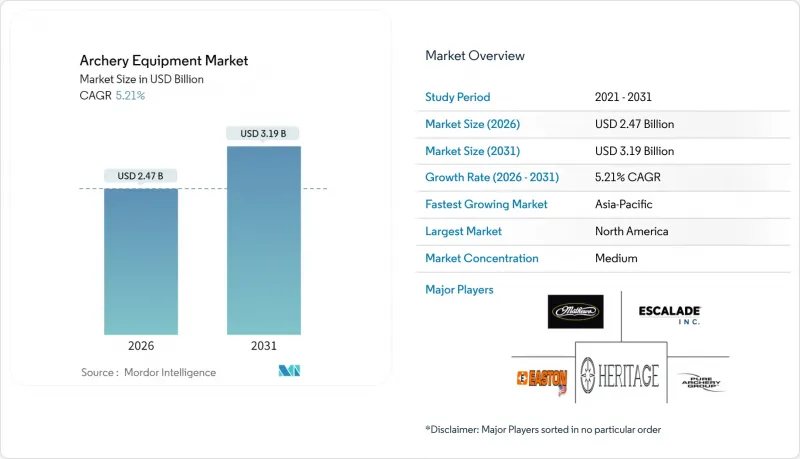
This growth is driven by several key factors, including the increased visibility expected from compound archery's debut at the 2028 Los Angeles Olympics, sustained investments in youth-focused programs, and continuous advancements in product innovation. North America remains the dominant revenue contributor, while the Asia-Pacific region is emerging as the fastest-growing market, fueled by significant government investments in sports infrastructure development. To capitalize on these opportunities, companies are expanding their direct-to-consumer channels and enhancing their flagship models to target premium segments and improve profit margins. Despite this, price-sensitive consumers continue to favor mass-market kits, which are widely distributed through school and range programs. Additionally, the market is diversifying as therapeutic applications of archery, documented by rehabilitation researchers, gain traction. These applications are expanding the market's scope beyond traditional uses such as hunting, recreation, and competitive sports, further solidifying the market's growth potential.
Global Archery Equipment Market Trends and Insights
Resurgent interest in traditional sports and activities
Traditional archery is witnessing a resurgence as communities increasingly seek meaningful cultural experiences and skill-based activities that foster a connection to historical heritage. The Hong Kong Archery Association's 2024 competition schedule, highlighted by the Hong Kong Cup Archery Competition in June, exemplifies the region's dedication to preserving traditional archery techniques while seamlessly incorporating modern competitive elements. On a global scale, traditional archery has evolved from its origins as an ancient hunting tool to a contemporary practice with therapeutic and recreational benefits. Structured training programs have demonstrated measurable improvements in performance, further enhancing its appeal. Facilities such as the Darrington Archery Range in Washington, established in 1979 and recognized for being the first handicapped-accessible outdoor range in the United States, play a pivotal role in supporting traditional archery across diverse populations. This renewed interest reflects broader societal trends emphasizing mindfulness, skill development, and activities that deliver tangible personal achievements, offering a refreshing alternative to the increasingly digital-centric lifestyle.
Technological advancements in archery equipment
Innovation in archery equipment design continues to progress, as highlighted by the U.S. Patent Office's records of advancements in bow limb configurations, cam systems, and materials engineering. These developments aim to enhance performance while simultaneously reducing user fatigue, showcasing the industry's focus on both functionality and user comfort. The 20th Asian Games Aichi-Nagoya 2026 master plan emphasizes the strategic procurement of sports equipment through advanced specifications, developed in collaboration with international federations. This approach reflects a growing institutional recognition of the critical role technological advancements play in modern sports. Vista Outdoor exemplifies the industry's dedication to innovation, with its extensive portfolio of over 1,700 patents. The company's FY23 annual report identifies innovation as a key driver of its competitive advantage, underlining the importance of intellectual property in maintaining market leadership. Furthermore, technological advancements extend beyond physical equipment to include electronic scoring systems and digital training aids. These innovations significantly enhance the user experience and improve performance measurement capabilities, demonstrating the industry's commitment to integrating technology into all aspects of archery.
High equipment costs
Entry-level archery instruction programs reveal significant financial challenges for new participants, which can deter sustained engagement. For example, 1UP Recreation in Seattle charges USD 55 per session, including equipment rental, making regular participation costly for beginners. Similarly, the Springfield-Greene County Park Board's fee structure, ranging from USD 3 to USD 40 for various classes and sessions, demonstrates how costs related to instruction, equipment rental, and facility access accumulate, restricting market penetration among price-sensitive groups. At the Texas Archery Club, participants pay USD 10 for range access with personal equipment or USD 20 for "discover archery" sessions that include loaner equipment. This pricing model highlights the recurring expenses that discourage casual participation. Beyond these initial costs, participants face ongoing financial commitments, such as equipment maintenance, arrow replacement, and advanced instruction fees, which collectively create substantial barriers to long-term involvement in the sport.
Other drivers and restraints analyzed in the detailed report include:
- Influence of high-profile sporting events and media exposure
- Expansion of archery training academies and school programs
- Seasonality and weather dependence
For complete list of drivers and restraints, kindly check the Table Of Contents.
Segment Analysis
In 2025, bows capture a commanding 42.93% share of the market, underscoring their pivotal role as the primary value driver in archery equipment and the epicenter of industry technological advancements. This segment thrives on ongoing patent innovations, with the U.S. Patent Office highlighting advancements in bow limb configurations and cam systems that not only boost performance but also prioritize user convenience. Vista Outdoor, boasting an impressive portfolio of over 1,700 patents, underscores the industry's deep commitment to bow technology evolution. Notably, about 43% of Vista Outdoor Inc.'s external sales stem from its outdoor products segment, predominantly in bow and related equipment manufacturing. The bow segment's preeminence is evident, as it significantly influences shooting accuracy, user comfort, and the overall archery experience, making it the top choice for both recreational and competitive archers.
Growing at a brisk 5.61% CAGR through 2031, the targets segment outpaces equipment replacement cycles, driven by expanding facilities catering to rising participation. Infrastructure investments, like the Darrington Archery Range's four permanent courses with 28 targets each, exemplify the momentum in the targets segment. Similarly, the Springfield-Greene County Park Board's archery complex, featuring both indoor and outdoor ranges with specialized 3D targets, highlights the diverse needs across various archery disciplines. As archery ranges, educational programs, and competitive venues proliferate, the targets segment's growth is further fueled by the necessity for regular target replacements, worn from the barrage of repeated arrow impacts.
In 2025, mass market products dominate with a 70.86% market share, acting as the gateway for newcomers and bolstering widespread adoption via educational initiatives and recreational venues. The National Archery in Schools Program, with its standardized equipment mandates across 39 states, underscores the mass market's pivotal role in implementing programs systematically. These programs utilize cost-effective, dependable equipment tailored for educational settings. Similarly, government initiatives like the Springfield-Greene County Park Board's archery program harness mass market tools, ensuring accessible training for varied age groups and skill levels, all while upholding program sustainability. The mass market's supremacy highlights a crucial need: affordable, standardized equipment that democratizes participation without hefty financial strains.
Meanwhile, premium segments are on an upswing, boasting a 6.19% CAGR. This growth mirrors the journey of dedicated archers, who, as their skills sharpen and competitive goals heighten, naturally gravitate towards upgraded equipment. Escalade Inc.'s Bear Archery brand is at the forefront, channeling efforts into product innovation and strategic acquisitions to bolster its premium segment growth. Notably, the company's 2023 SEC filing spotlights archery equipment as a cornerstone of its sporting goods lineup. Furthermore, while the premium segment reaps the rewards of cutting-edge innovations, these advancements eventually trickle down to the mass market. This ensures a dynamic product evolution across price brackets, with premium offerings standing out due to superior materials, meticulous engineering, and optimized performance features.
The Archery Equipment Market Report is Segmented by Product Type (Bows, Arrows, Targets, and Accessories), End User (Adult and Kids), Category (Mass and Premium), Distribution Channel (Offline Retail Stores and Online Retail Stores) and Geography (North America, Europe, Asia-Pacific, South America, and Middle East and Africa). The Market Forecasts are Provided in Terms of Value (USD).
Geography Analysis
In 2025, North America commands a dominant 34.27% share of the global archery equipment market. This stronghold is bolstered by deep-rooted hunting traditions, robust competitive programs, and a well-established institutional framework that nurtures growing participation. Data from the Sports and Fitness Industry Association highlights that bow hunting, a key segment of archery in the U.S., saw its participant numbers swell to roughly five million in 2024, up from 4.9 million the year prior. USA Archery, based in Colorado Springs since 1879, plays a pivotal role in this landscape, sanctioning over 350 events annually, including national championships, thereby championing competitive excellence and the sport's domestic growth. The region's advantage is further amplified by the presence of major equipment manufacturers and well-entrenched distribution networks. However, signs of industry consolidation hint at a maturing market, with players striving for enhanced efficiency.
Asia-Pacific is on a rapid ascent, projected to grow at a 7.12% CAGR through 2031. This surge is fueled by targeted government investments in sports infrastructure and a burgeoning middle class increasingly engaging in recreational activities. China's government is actively bolstering the sports industry, emphasizing the need for enhanced facilities for both athletes and spectators. Such initiatives lay a robust foundation for archery's infrastructure and a surge in equipment demand. The 2025 Hyundai Archery World Cup, set to unfold in Shanghai, not only underscores China's rising stature in the competitive archery arena but also amplifies local equipment demand. Meanwhile, Japan is gearing up for the 20th Asian Games in Aichi-Nagoya in 2026, where archery will be spotlighted among 41 sports, drawing an anticipated 15,000 delegates. This underscores the region's commitment to advancing archery and meticulously planning equipment procurement.
Europe enjoys consistent growth, anchored by the stability provided by World Archery's Lausanne headquarters in Switzerland and the continent's rich Olympic traditions. Major international events, like the 2025 World Cup stage in Antalya, Turkey, bolster the region's visibility and competitive infrastructure, fueling equipment demand. Furthermore, European clinical research underscores archery's therapeutic benefits, especially in rehabilitation medicine, unveiling fresh market avenues for specialized healthcare equipment. While South America, the Middle East, and Africa showcase burgeoning potential, their growth is tempered by infrastructural challenges and the high costs of equipment. Yet, with rising sports participation and governmental investments in recreational facilities, these regions eye promising long-term expansion.
- Escalade, Inc.
- Pure Archery Group
- Easton Technical Products, Inc.
- Heritage Outdoor Group (PSE Archery)
- Mathews Archery Inc.
- Bearpaw Products GmbH
- Good Sportsman Marketing, LLC
- Axion Archery
- The Bohning Co. Ltd.
- Darton Archery LLC
- Merlin Archery Limited
- Sanlida Archery
- Grace Engineering Corp.(Prime Archery)
- Martin Archery, Inc.
- The Outdoor Group, LLC (Elite Archery)
- Samick Sports Co., Ltd.
- Win & Win Archery
- APA Innovations, Inc. (APA Archery)
- Xpedition Archery
- Great Plains Traditional Bows
Additional Benefits:
- The market estimate (ME) sheet in Excel format
- 3 months of analyst support
TABLE OF CONTENTS
1 INTRODUCTION
- 1.1 Study Assumptions and Market Definition
- 1.2 Scope of the Study
2 RESEARCH METHODOLOGY
3 EXECUTIVE SUMMARY
4 MARKET LANDSCAPE
- 4.1 Market Overview
- 4.2 Market Drivers
- 4.2.1 Resurgent interest in traditional sports and activities
- 4.2.2 Technological advancements in archery equipment
- 4.2.3 Influence of high-profile sporting events and media exposure
- 4.2.4 Expansion of archery training academies and school programs
- 4.2.5 Increasing popularity of archery as a competitive and recreational sport
- 4.2.6 Growing health and fitness consciousness
- 4.3 Market Restraints
- 4.3.1 High equipment costs
- 4.3.2 Seasonality and weather dependence
- 4.3.3 Limited awareness in emerging markets
- 4.3.4 Limited accessibility to archery ranges
- 4.4 Consumer Behaviour Analysis
- 4.5 Regulatory Outlook
- 4.6 Porter's Five Forces Analysis
- 4.6.1 Bargaining Power of Suppliers
- 4.6.2 Bargaining Power of Buyers
- 4.6.3 Threat of New Entrants
- 4.6.4 Threat of Substitutes
- 4.6.5 Degree of Competition
5 MARKET SIZE AND GROWTH FORECASTS (VALUE)
- 5.1 By Product Type
- 5.1.1 Bows
- 5.1.2 Arrows
- 5.1.3 Targets
- 5.1.4 Accessories
- 5.2 By End User
- 5.2.1 Adult
- 5.2.2 Kids
- 5.3 By Category
- 5.3.1 Mass
- 5.3.2 Premium
- 5.4 By Distribution Channel
- 5.4.1 Offline Retail Stores
- 5.4.2 Online Retail Stores
- 5.5 By Geography
- 5.5.1 North America
- 5.5.1.1 United States
- 5.5.1.2 Canada
- 5.5.1.3 Mexico
- 5.5.1.4 Rest of North America
- 5.5.2 Europe
- 5.5.2.1 Germany
- 5.5.2.2 United Kingdom
- 5.5.2.3 Italy
- 5.5.2.4 France
- 5.5.2.5 Spain
- 5.5.2.6 Netherlands
- 5.5.2.7 Poland
- 5.5.2.8 Belgium
- 5.5.2.9 Sweden
- 5.5.2.10 Rest of Europe
- 5.5.3 Asia-Pacific
- 5.5.3.1 China
- 5.5.3.2 India
- 5.5.3.3 Japan
- 5.5.3.4 Australia
- 5.5.3.5 Indonesia
- 5.5.3.6 South Korea
- 5.5.3.7 Thailand
- 5.5.3.8 Singapore
- 5.5.3.9 Rest of Asia-Pacific
- 5.5.4 South America
- 5.5.4.1 Brazil
- 5.5.4.2 Argentina
- 5.5.4.3 Colombia
- 5.5.4.4 Chile
- 5.5.4.5 Peru
- 5.5.4.6 Rest of South America
- 5.5.5 Middle East and Africa
- 5.5.5.1 South Africa
- 5.5.5.2 Saudi Arabia
- 5.5.5.3 United Arab Emirates
- 5.5.5.4 Nigeria
- 5.5.5.5 Egypt
- 5.5.5.6 Morocco
- 5.5.5.7 Turkey
- 5.5.5.8 Rest of Middle East and Africa
- 5.5.1 North America
6 COMPETITIVE LANDSCAPE
- 6.1 Market Concentration
- 6.2 Strategic Moves
- 6.3 Market Share Analysis
- 6.4 Company Profiles (Includes Global-level Overview, Market-level Overview, Core Segments, Financials (if available), Strategic Info, Market Rank/Share, Products and Services, Recent Developments)
- 6.4.1 Escalade, Inc.
- 6.4.2 Pure Archery Group
- 6.4.3 Easton Technical Products, Inc.
- 6.4.4 Heritage Outdoor Group (PSE Archery)
- 6.4.5 Mathews Archery Inc.
- 6.4.6 Bearpaw Products GmbH
- 6.4.7 Good Sportsman Marketing, LLC
- 6.4.8 Axion Archery
- 6.4.9 The Bohning Co. Ltd.
- 6.4.10 Darton Archery LLC
- 6.4.11 Merlin Archery Limited
- 6.4.12 Sanlida Archery
- 6.4.13 Grace Engineering Corp.(Prime Archery)
- 6.4.14 Martin Archery, Inc.
- 6.4.15 The Outdoor Group, LLC (Elite Archery)
- 6.4.16 Samick Sports Co., Ltd.
- 6.4.17 Win & Win Archery
- 6.4.18 APA Innovations, Inc. (APA Archery)
- 6.4.19 Xpedition Archery
- 6.4.20 Great Plains Traditional Bows
7 MARKET OPPORTUNITIES AND FUTURE OUTLOOK

