PUBLISHER: Mordor Intelligence | PRODUCT CODE: 1934888

PUBLISHER: Mordor Intelligence | PRODUCT CODE: 1934888
Dental Services - Market Share Analysis, Industry Trends & Statistics, Growth Forecasts (2026 - 2031)
The dental services market is expected to grow from USD 672.09 billion in 2025 to USD 704.35 billion in 2026 and is forecast to reach USD 890.99 billion by 2031 at 4.8% CAGR over 2026-2031.
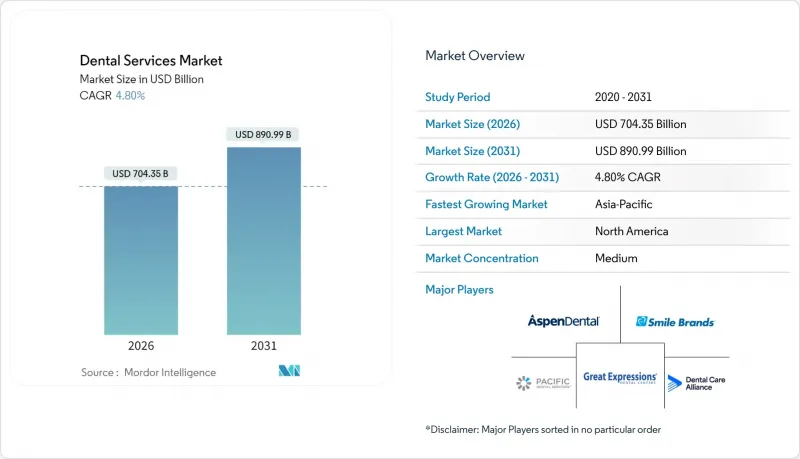
This trajectory highlights the sector's resilience as aging populations demand complex restorative care, social media elevates aesthetic expectations, and Dental Service Organizations (DSOs) optimize practice operations to unlock scale efficiencies. Wider insurance coverage, investments in AI-enabled diagnostics, and a steady rise in discretionary income in emerging economies further reinforce growth momentum. Meanwhile, consolidation activity worth more than USD 9 billion in 2024 reshaped competitive dynamics, allowing large groups to negotiate stronger payer contracts and accelerate technology adoption. Regulatory pushes for preventive care and seamless teledentistry integration are also broadening access, ensuring the dental services market remains on a steady expansion path.
Global Dental Services Market Trends and Insights
Rising prevalence of dental diseases
Oral ailments affect over 3.5 billion people, positioning caries and periodontal disease as the most common non-communicable conditions worldwide. Direct treatment costs reached USD 356.80 billion in 2019 and continue to climb as urban diets favor sugar-rich foods, particularly in developing regions lacking widespread water fluoridation. Accelerated disease burden sustains patient traffic even during economic slowdowns, while AI-powered diagnostics expand early-stage detection and enlarge the addressable pool for intervention.
Aging population demanding restorative care
Individuals aged 65+ now represent the fastest-growing cohort requiring complex treatments, with 86.5% of elderly patients in developed markets managing multiple comorbidities that complicate dental planning. Preference for tooth preservation drives uptake of root canals, implants, and regenerative periodontal therapies, spurring geriatric-focused clinics to integrate oral care within holistic senior-health programs.
Limited reimbursement in developing regions
Only 27% of low-income countries include oral care in national coverage, leaving patients to fund treatment out-of-pocket and capping service uptake. Dentist density averages 0.51 per 10,000 population, far below WHO guidelines, perpetuating a two-tier system where affluent urbanites access modern care while rural residents depend on emergency extractions.
Other drivers and restraints analyzed in the detailed report include:
- Growing appetite for aesthetic dentistry
- Rapid uptake of the DSO practice model
- High cost of advanced equipment
For complete list of drivers and restraints, kindly check the Table Of Contents.
Segment Analysis
Endodontics accounted for 23.35% of the dental services market share in 2025, underscoring the shift toward root preservation over extraction. Modern techniques using rotary instrumentation and bioceramic sealers improve success rates and shorten chair time. Cosmetic dentistry, backed by digital smile design, records the fastest 5.21% CAGR, reflecting heightened aesthetic awareness and affordability of minimally invasive veneers. Orthodontics grows steadily as clear aligners draw adult patients seeking discreet correction, while periodontics benefits from links between gum health and systemic diseases, prompting preventive therapies. Dentures decline in developed markets but remain relevant for bone-density-challenged seniors, whereas oral surgery and pediatric subspecialties expand as clinicians tailor care for complex or age-specific needs.
Advances in biocompatible materials, such as hydroxyapatite-enhanced sealers, reduce postoperative discomfort and foster repeat referrals. Clinics leverage chairside CAD/CAM systems to deliver same-day crowns, lifting patient satisfaction and boosting the dental services market. Meanwhile, implantology driven by aging cohorts with high restorative expectations spills into the "Others" category, adding revenue streams for clinics equipped with cone-beam CT and guided surgery tools.
Adults aged 17-65 generated USD 362.7 billion, or 53.95% of dental services market share, in 2025, reflecting their capacity to fund comprehensive treatment plans. Employers widen dental benefits, and flexible financing options smooth high-ticket procedures such as full-mouth reconstructions, sustaining robust spending. Pediatric services grow quickest at 5.52% CAGR as preventive-focused health systems endorse early intervention, fluoride varnish programs, and sealants that save future costs. Teledentistry connects parents with specialists for real-time guidance, widening reach in rural regions.
Geriatric demand rises alongside life expectancy. Mobile clinics and sedation dentistry address mobility and anxiety challenges common among seniors. Integrated medical-dental records help practitioners manage polypharmacy risks, reinforcing safety. Together, these shifts keep the dental services market growing evenly across life stages while highlighting untapped pediatric and geriatric niches ripe for specialized offerings.
The Dental Services Market Report is Segmented by Service Type (Dental Implants, Endodontics, and More), Patient Age Group (Up To 17 and More), Provider Model (Independent and More), Service Provider (Hospitals, Dental Clinics, Others), Payment Method (Private Insurance, Public Insurance, Out-Of-Pocket), and Geography (North America, Europe, Asia-Pacific, and More). The Market Forecasts are Provided in Terms of Value (USD).
Geography Analysis
North America generated USD 236.6 billion in 2025, representing the largest regional slice of the dental services market. High per-capita expenditure, robust private insurance, and advanced DSO ecosystems underpin steady 4.83% CAGR growth. U.S. consolidation continued with Patient Square Capital's USD 4.1 billion purchase of Patterson Companies, signaling investor conviction in supply-chain synergies and distribution strength. Canada's federal dental coverage rollout broadens access, though dentist supply constraints temper near-term procedure volumes.
Europe posts a 4.79% CAGR to 2031 amid diverse reimbursement models. The U.K.'s NHS capacity crunch shifts patients to private clinics, while Germany and France maintain balanced hybrid funding that sustains preventive orientation. Clear aligner adoption and AI diagnostics gain traction as EU regulators encourage digital health innovation. Eastern member states allocate structural funds toward rural dental infrastructure, slowly narrowing urban-rural gaps.
Asia-Pacific advances fastest at 5.39% CAGR as a burgeoning middle class prioritizes oral aesthetics. China's children's oral care segment rose 12.5% in 2023, reflecting parents' readiness to invest in preventive treatments. Japan faces clinic closures due to aging dentists and high overhead, opening merger opportunities for DSOs equipped to modernize operations. India leverages medical tourism and expanding corporate insurance to draw regional patients, though rural access still hinges on outreach programs and mobile clinics.
- 32 Dental
- Abano Healthcare Group Limited
- Alliance Dental Care Limited
- Aspen Dental Management, Inc.
- Bangkok International Dental Center
- Bupa Dental Care
- Clove Dental
- Coast Dental
- Colosseum Dental Group
- Dental Care Alliance
- Dental Corporation (Australia)
- Dental Service Group
- Gentle Dental
- Great Expressions Dental Centers
- Heartland Dental
- Integrated Dental Holdings (mydentist UK)
- InterDent
- Klinik Pergigian Dentalife
- Pacific Dental Services
- Q&M Dental Group
- Sabka Dentist
- Smile 360
- Smile Brands Inc.
- Smile Doctors
- Sonrava Health
Additional Benefits:
- The market estimate (ME) sheet in Excel format
- 3 months of analyst support
TABLE OF CONTENTS
1 Introduction
- 1.1 Study Assumptions & Market Definition
- 1.2 Scope of the Study
2 Research Methodology
3 Executive Summary
4 Market Landscape
- 4.1 Market Overview
- 4.2 Market Drivers
- 4.2.1 Increasing Prevalence of Dental Disease Rate
- 4.2.2 Aging Population Driving Restorative Procedures
- 4.2.3 Growing Demand for Aesthetic & Cosmetic Dentistry
- 4.2.4 Increasing Awareness of Dental Health
- 4.2.5 Rapid Expansion of Dental Service Organization (DSO) Model
- 4.2.6 AI-Enabled Teledentistry & Preventive Analytics Adoption
- 4.3 Market Restraints
- 4.3.1 Limited Reimbursement in Developing Regions
- 4.3.2 High Cost of Advanced Procedures & Equipment
- 4.3.3 Skilled Workforce Shortages Across Clinics
- 4.3.4 Cyber-Security Risks in Digital Dentistry Platforms
- 4.4 Supply Chain Analysis
- 4.5 Regulatory Landscape
- 4.6 Porter's Five Forces Analysis
- 4.6.1 Threat of New Entrants
- 4.6.2 Bargaining Power of Buyers
- 4.6.3 Bargaining Power of Suppliers
- 4.6.4 Threat of Substitutes
- 4.6.5 Intensity of Competitive Rivalry
5 Market Size & Growth Forecasts (Value)
- 5.1 By Service Type
- 5.1.1 Dental Implants
- 5.1.2 Endodontics
- 5.1.3 Periodontics
- 5.1.4 Orthodontics
- 5.1.5 Dentures
- 5.1.6 Cosmetic Dentistry
- 5.1.7 Others
- 5.2 By Patient Age Group
- 5.2.1 Up to 17
- 5.2.2 Above 17 - Up to 65
- 5.2.3 Above 65
- 5.3 By Provider Model
- 5.3.1 Independent
- 5.3.2 Dental Service Organizations
- 5.3.3 Public
- 5.4 By Service Provider
- 5.4.1 Hospitals
- 5.4.2 Dental Clinics
- 5.4.3 Others
- 5.5 By Payment Method
- 5.5.1 Private Insurance
- 5.5.2 Public Insurance
- 5.5.3 Out-of-Pocket
- 5.6 By Geography
- 5.6.1 North America
- 5.6.1.1 United States
- 5.6.1.2 Canada
- 5.6.1.3 Mexico
- 5.6.2 Europe
- 5.6.2.1 Germany
- 5.6.2.2 United Kingdom
- 5.6.2.3 France
- 5.6.2.4 Italy
- 5.6.2.5 Spain
- 5.6.2.6 Rest of Europe
- 5.6.3 Asia-Pacific
- 5.6.3.1 China
- 5.6.3.2 Japan
- 5.6.3.3 India
- 5.6.3.4 Australia
- 5.6.3.5 South Korea
- 5.6.3.6 Rest of Asia-Pacific
- 5.6.4 Middle East and Africa
- 5.6.4.1 GCC
- 5.6.4.2 South Africa
- 5.6.4.3 Rest of Middle East and Africa
- 5.6.5 South America
- 5.6.5.1 Brazil
- 5.6.5.2 Argentina
- 5.6.5.3 Rest of South America
- 5.6.1 North America
6 Competitive Landscape
- 6.1 Market Concentration
- 6.2 Competitive Benchmarking
- 6.3 Market Share Analysis
- 6.4 Company Profiles (includes Global level Overview, Market level overview, Core Segments, Financials as available, Strategic Information, Market Rank/Share for key companies, Products & Services, and Recent Developments)
- 6.4.1 32 Dental
- 6.4.2 Abano Healthcare Group Limited
- 6.4.3 Alliance Dental Care Limited
- 6.4.4 Aspen Dental Management, Inc.
- 6.4.5 Bangkok International Dental Center
- 6.4.6 Bupa Dental Care
- 6.4.7 Clove Dental
- 6.4.8 Coast Dental
- 6.4.9 Colosseum Dental Group
- 6.4.10 Dental Care Alliance
- 6.4.11 Dental Corporation (Australia)
- 6.4.12 Dental Service Group
- 6.4.13 Gentle Dental
- 6.4.14 Great Expressions Dental Centers
- 6.4.15 Heartland Dental
- 6.4.16 Integrated Dental Holdings (mydentist UK)
- 6.4.17 InterDent
- 6.4.18 Klinik Pergigian Dentalife
- 6.4.19 Pacific Dental Services
- 6.4.20 Q&M Dental Group
- 6.4.21 Sabka Dentist
- 6.4.22 Smile 360
- 6.4.23 Smile Brands Inc.
- 6.4.24 Smile Doctors
- 6.4.25 Sonrava Health
7 Market Opportunities & Future Outlook
- 7.1 White-space & Unmet-need Assessment

