PUBLISHER: Mordor Intelligence | PRODUCT CODE: 1934893

PUBLISHER: Mordor Intelligence | PRODUCT CODE: 1934893
Singapore Data Center Construction - Market Share Analysis, Industry Trends & Statistics, Growth Forecasts (2026 - 2031)
The Singapore data center construction market is expected to grow from USD 4.56 billion in 2025 to USD 4.77 billion in 2026 and is forecast to reach USD 6.01 billion by 2031 at 4.70% CAGR over 2026-2031.
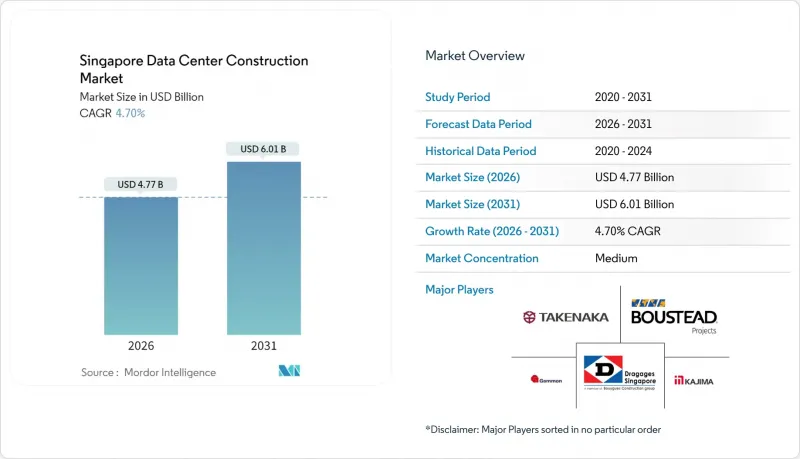
Singapore's tightly managed power-allocation policy, robust subsea connectivity, and status as a financial hub anchor sustained investment even as operators confront land scarcity and high build costs. Regulatory momentum under the Green Data Centre Roadmap encourages designs that achieve Power Usage Effectiveness (PUE) of 1.3 or better, reshaping tender specifications and equipment choices. Hyperscalers continue to deploy GPU-dense infrastructure that pushes average rack power beyond 50 kW, accelerating demand for advanced switchgear, liquid cooling, and modular prefabrication. Meanwhile, the twin-hub strategy that links Singapore with Johor mitigates local constraints by allowing capacity spill-over while preserving sub-5 ms latency to core workloads. Investor appetite for data-center REITs supports a healthy project finance pipeline, helping developers offset the city-state's premium land and labor costs.
Singapore Data Center Construction Market Trends and Insights
Power-Allocation Release Under Green DC Roadmap
Singapore's revised Green Data Centre Roadmap commits at least 300 MW of new IT load on the condition that facilities demonstrate PUE of 1.3 or lower, pivoting the Singapore data center construction market toward highly efficient designs. Two-thirds of the quota rewards projects that integrate renewables or alternative backup fuels, prompting developers to specify hydrogen-ready generators and heat-recovery chillers. Early movers have implemented AI-driven cooling control to reduce energy use by up to 30%. Competitive bidding for scarce megawatts intensifies, raising design consultancy demand and favoring firms with a proven sustainability track record. Over the medium term, the policy accelerates the market's migration toward liquid cooling and on-site solar plus energy-storage hybrids. These elements together enlarge the addressable opportunity for specialist contractors and equipment vendors within the Singapore data center construction market.
Surge in AI/GPU-Dense Workloads Requiring New Build Specs
The generative-AI wave lifts rack densities above 50 kW, forcing mechanical and electrical packages in the Singapore data center construction market to pivot toward immersion and direct-to-chip cooling. A major campus upgrade showcases this shift, featuring chilled-water and liquid-cooling loops designed for 27 °C set-points. High-density deployment elongates cable runs and upsizes busways, which increases bill-of-materials value yet lengthens commissioning time by 15-20%. Developers respond by adopting rear-door heat exchangers and medium-voltage (22 kV) power distribution to reduce copper usage. As AI inferencing proliferates across finance, healthcare, and public-sector workloads, construction pipelines increasingly bundle specialized white space for GPU pods, helping the Singapore data center construction market sustain double-digit project count growth despite the national power cap.
Tight 300 MW Annual Power Quota and Moratorium Legacy
Singapore's power-allocation ceiling, reinstated in 2024 after a three-year moratorium, falls below regional demand growth, stalling many planned hyperscale builds. Developers must compete in a Call-for-Application process whose scoring heavily weights PUE and carbon intensity, inflating pre-construction consultancy fees. The scarcity of megawatts drove some operators to shift incremental capacity to Batam or Johor, dampening the full revenue potential of the Singapore data center construction market. Long-term uncertainty also complicates transformer and generator ordering cycles, with lead times already stretched by global supply constraints. Together, these factors shave an estimated 1.4 percentage points from forecast CAGR.
Other drivers and restraints analyzed in the detailed report include:
- Hyperscaler "Singapore-plus-Johor" Twin-Hub Build Strategies
- Accelerating Sovereign-Cloud and MAS FSI Localization Rules
- Highest APAC Construction Cost and Premium Power Tariffs
For complete list of drivers and restraints, kindly check the Table Of Contents.
Segment Analysis
The electrical package accounted for 37.38% of overall spend within the Singapore data center construction market in 2025, reflecting hyperscaler preference for 22 kV feeds, intelligent switchgear, and high-capacity busways designed for GPU racks running at 50 kW and above. Liquid-based cooling, though still a subset of mechanical infrastructure, is the fastest-growing line item and will contribute USD 628.5 million to the Singapore data center construction market size by 2031. Adoption of immersion tanks and rear-door heat exchangers reduces white-space real estate per rack, enabling higher revenue density for colocation operators. Services such as design-build integration and commissioning enjoy premium billing rates because owners demand turnkey validation of PUE targets. Over the forecast window, integration between electrics and controls will deepen as AI-driven optimization platforms require real-time telemetry from both power and cooling loops. This convergence elevates the strategic value of firms that can span electrical and mechanical scopes in a single contract, cementing their competitive position within the Singapore data center construction market.
The mechanical segment is evolving from traditional chillers toward pumped refrigerant and dielectric immersion systems capable of dissipating 1,200 W per chip. A joint program cut cooling energy by 29%, saving roughly USD 25,000 per rack annually and setting a cost-avoidance benchmark other operators now target. General construction remains a steady contributor driven by multi-story shells, seismic reinforcement, and blast-resistant facades required under Singapore's stringent codes. IT infrastructure-racks, network fabric, and cable management-captures incremental spend as high-density layouts demand thicker fiber trunks and AI-optimized topologies. Collectively, these shifts underscore how rising workload complexity expands wallet share for specialized subcontractors in the Singapore data center construction market.
Tier III facilities delivered 53.22% of the Singapore data center construction market share in 2025 thanks to their balanced cost-reliability proposition and 99.982% uptime guarantee. Enterprises and cloud providers value concurrently maintainable infrastructure that supports live upgrades without the doubled capex of 2N systems. Nevertheless, Tier IV pipelines are expanding at 5.03% CAGR, fueled by fintech, trading desks, and sovereign-cloud workloads that demand 99.995% availability. These fault-tolerant sites typically deploy 2N UPS, dual fuel farms, and independent chilled-water plants, doubling MEP scope relative to Tier III and lifting the Singapore data center construction market size for high-tier builds.
Iron Mountain's Singapore facility typifies Tier IV attributes with three geographically diverse meet-me-rooms and bio-protected access corridors. Although Tier I and II projects persist in edge or telco applications, their contribution to revenue remains marginal. Over time, regulatory and customer pressure for resilience is expected to pull Tier III specifications closer to Tier IV, blurring distinctions and increasing the baseline spend per megawatt across the Singapore data center construction market.
The Singapore Data Center Construction Market is Segmented by Infrastructure (Electrical Infrastructure, Mechanical Infrastructure, and More), Tier Standard (Tier I and II, Tier III, and More), Data Center Type (Colocation, Hyperscale, and More), End User Industry (Banking, Financial Services, Insurance, IT and Telecommunications, and More). The Market Forecasts are Provided in Terms of Value (USD).
List of Companies Covered in this Report:
- Boustead Projects
- Dragages Singapore (Bouygues)
- Takenaka Corp.
- Gammon Pte Ltd (Balfour Beatty)
- Sato Kogyo
- Kajima Overseas Asia
- Woh Hup (Private) Ltd
- China Construction (South Pacific) Dev.
- SsangYong Engineering and Construction
- Hyundai Engineering and Construction
- Obayashi Singapore
- Lendlease Singapore
- Keppel Data Centre Development
- ST Telemedia Global DC
- Equinix Construction Services
- Digital Realty (Digital Singapore)
- AIMS APAC REIT (DC builder arm)
- NTT Global DC Singapore
- M1 Net / Keppel DC and M1 JV
- AirTrunk (Blackstone)
- EdgeConneX
- Princeton Digital Group
- Microsoft (self-build campus)
- Amazon Web Services - Construction Ops
- Google Singapore DC Projects
Additional Benefits:
- The market estimate (ME) sheet in Excel format
- 3 months of analyst support
TABLE OF CONTENTS
1 INTRODUCTION
- 1.1 Study Assumptions and Market Definition
- 1.2 Scope of the Study
2 RESEARCH METHODOLOGY
3 EXECUTIVE SUMMARY
4 MARKET LANDSCAPE
- 4.1 Market Overview
- 4.2 Market Drivers
- 4.2.1 Power-allocation release under Green DC Roadmap (2024-)
- 4.2.2 Surge in AI / GPU-dense workloads requiring new build specs
- 4.2.3 Hyperscaler "Singapore-plus-Johor" twin-hub build strategies
- 4.2.4 Accelerating sovereign-cloud and MAS FSI localization rules
- 4.2.5 Investor appetite for DC-REIT conversions (Keppel DC, NTT DC REIT)
- 4.2.6 Modular prefabrication to compress build-times amid land caps
- 4.3 Market Restraints
- 4.3.1 Tight 300 MW annual power quota and moratorium legacy
- 4.3.2 Highest APAC construction cost US USD 11.7 m/MW and 19¢/kWh tariffs
- 4.3.3 Scarce brown-field plots; feasibility of underground / high-rise still unproven
- 4.3.4 Skilled MEP labour crunch inflating project timelines
- 4.4 Value / Supply-Chain Analysis
- 4.5 Regulatory Landscape
- 4.6 Technological Outlook
- 4.7 Porter's Five Forces
- 4.7.1 Bargaining Power of Suppliers
- 4.7.2 Bargaining Power of Buyers
- 4.7.3 Threat of New Entrants
- 4.7.4 Threat of Substitutes
- 4.7.5 Intensity of Competitive Rivalry
- 4.8 Key Singapore Data-Center Construction Statistics
- 4.8.1 Data Centers Total Installed Capacity (MW) in the Singapore , 2023 and 2024
- 4.8.2 Total IT Load Under Construction in the Singapore, MW, 2025 - 2030
- 4.8.3 Average Capex and Opex for the Singapore Data Center Construction
- 4.8.4 Top Capex Spenders on Data Center Infrastructure in the Singapore
5 MARKET SIZE AND GROWTH FORECASTS
- 5.1 By Infrastructure
- 5.1.1 Electrical Infrastructure
- 5.1.1.1 Power Distribution Solutions
- 5.1.1.1.1 Power Distribution Units
- 5.1.1.1.2 Switchgears
- 5.1.1.1.3 Others
- 5.1.1.2 Power Backup Solutions
- 5.1.1.2.1 UPS
- 5.1.1.2.2 Generators
- 5.1.1.1 Power Distribution Solutions
- 5.1.2 Mechanical Infrastructure
- 5.1.2.1 Cooling Systems
- 5.1.2.1.1 Liquid-based Cooling
- 5.1.2.1.2 Air-based Cooling
- 5.1.2.2 Racks and Cabinets
- 5.1.2.3 Other Mechanical Infrastructure
- 5.1.2.1 Cooling Systems
- 5.1.3 IT Infrastructure
- 5.1.3.1 Servers
- 5.1.3.2 Storage
- 5.1.3.3 Other IT Infrastructure
- 5.1.4 General Construction
- 5.1.5 Services
- 5.1.5.1 Design and Consulting
- 5.1.5.2 Integration
- 5.1.5.3 Support and Maintenance
- 5.1.1 Electrical Infrastructure
- 5.2 By Tier Standard
- 5.2.1 Tier I and II
- 5.2.2 Tier III
- 5.2.3 Tier IV
- 5.3 By End-User Industry
- 5.3.1 Banking, Financial Services and Insurance
- 5.3.2 IT and Telecommunications
- 5.3.3 Government and Defense
- 5.3.4 Healthcare
- 5.3.5 Other End Users
- 5.4 By Data Center Type
- 5.4.1 Colocation Facilities
- 5.4.2 Hyperscale / Self-built
- 5.4.3 Enterprise / Edge / Modular
6 COMPETITIVE LANDSCAPE
- 6.1 Market Share Analysis
- 6.2 Company Profiles (includes Global-level Overview, Market-level Overview, Core Segments, Financials as available, Strategic Information, Market Rank/Share for key companies, Products and Services, and Recent Developments)
- 6.2.1 Boustead Projects
- 6.2.2 Dragages Singapore (Bouygues)
- 6.2.3 Takenaka Corp.
- 6.2.4 Gammon Pte Ltd (Balfour Beatty)
- 6.2.5 Sato Kogyo
- 6.2.6 Kajima Overseas Asia
- 6.2.7 Woh Hup (Private) Ltd
- 6.2.8 China Construction (South Pacific) Dev.
- 6.2.9 SsangYong Engineering and Construction
- 6.2.10 Hyundai Engineering and Construction
- 6.2.11 Obayashi Singapore
- 6.2.12 Lendlease Singapore
- 6.2.13 Keppel Data Centre Development
- 6.2.14 ST Telemedia Global DC
- 6.2.15 Equinix Construction Services
- 6.2.16 Digital Realty (Digital Singapore)
- 6.2.17 AIMS APAC REIT (DC builder arm)
- 6.2.18 NTT Global DC Singapore
- 6.2.19 M1 Net / Keppel DC and M1 JV
- 6.2.20 AirTrunk (Blackstone)
- 6.2.21 EdgeConneX
- 6.2.22 Princeton Digital Group
- 6.2.23 Microsoft (self-build campus)
- 6.2.24 Amazon Web Services - Construction Ops
- 6.2.25 Google Singapore DC Projects
7 MARKET OPPORTUNITIES AND FUTURE OUTLOOK
- 7.1 White-space and Unmet-Need Assessment

