PUBLISHER: Mordor Intelligence | PRODUCT CODE: 2120707

PUBLISHER: Mordor Intelligence | PRODUCT CODE: 2120707
Asia-Pacific Beer - Market Share Analysis, Industry Trends & Statistics, Growth Forecasts (2026 - 2031)
According to Mordor Intelligence, the Asia-Pacific beer market size is expected to grow from USD 240.9 billion in 2025 to USD 253.44 billion in 2026 and is forecast to reach USD 326.86 billion by 2031 at a 5.22% CAGR over 2026-2031.
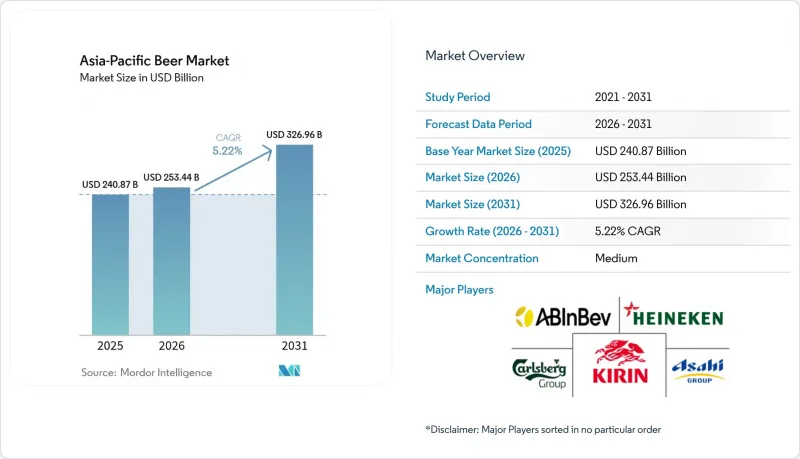
This report is Segmented by Product Type (Ale, Lager, Non/Low-Alcohol Beer, Other Beer Types), Category (Standard, Premium), Packaging Type (Bottles, Cans, Others), Distribution Channel (On-Trade, Off-Trade), and Geography (China, India, Japan, South Korea, Australia, Indonesia, Thailand, and More). The Market Forecasts are Provided in Terms of Value (USD) and Volume (Liters).
Asia-Pacific Beer Market Trends and Insights
Brewery and craft-beer expansion across Asia-Pacific
India now boasts over 500 microbreweries, a tenfold increase since 2015. However, new entrants face 28 distinct state regulations, often encountering licensing delays of 12 to 18 months. In a pivotal move on June 23, 2025, India's Food Safety and Standards Authority (FSSAI) rolled out new regulations. These regulations acknowledged categories like nitro craft beer, ready-to-drink alcoholic beverages (with an alcohol by volume of 0.5-15%), mead, and country liquors. Meanwhile, in Vietnam, as domestic craft production gains momentum, the value of imported crafts has dwindled from USD 650 million in 2022 to USD 549 million in 2024. This shift comes as on-premise demand realigns under Decree 100. In China, as urbanization intensifies, tier-2 and tier-3 cities are seeing a surge in new brewpubs. Yet, U.S. craft exports to China, hampered by tariff frictions, only reached USD 19.49 million in 2024. Local players adept at navigating permitting and distribution are seizing market share, outpacing global giants hindered by corporate compliance timelines. Furthermore, joint-venture and contract-brewing models are emerging as a strategic, low-risk avenue for scaling production near demand hubs.
Premiumization driven by rising middle-class incomes
In 2025, Anheuser-Busch InBev raised its revenue per hectoliter in China by 4.8%, even as volumes dipped by 8.6%. This move underscores a successful strategy prioritizing margins over sheer volume. Forecasts indicate that India's beer market, valued at USD 9.2 billion in 2023, is set to surge to USD 14.6 billion by 2027. This growth is attributed to an expanding middle class shifting its consumption from traditional strong spirits. Meanwhile, Vietnam's beer production is projected to jump from 4,233.5 million liters in 2023 to 6,409.6 million liters by 2028, buoyed by rising disposable incomes and a thriving tourism sector. To counteract the pinch from raw-material inflation and escalating excise duties, global brewers are turning to premium SKUs, especially as urban consumers increasingly associate higher prices with superior quality. This trend positions premium offerings as both a shield and a weapon in the margin game. The beer market's evolution reflects changing consumer preferences and economic dynamics across regions.
Stringent taxation and advertising regulations
By 2030, Vietnam plans to raise its special-consumption tax on certain goods from 65% in 2025 to 80% in 2026, eventually hitting 100%. This move is set to squeeze profit margins and challenge the price sensitivity of consumers. In India, a hefty 100% import duty on beer, combined with state taxes that claim 60-75% of the retail price, has resulted in a fragmented market divided into 28 regulatory segments. Australia imposes one of the world's highest excise taxes on beer, set at AUD 2.26 per liter, translating to roughly USD 1.45. Meanwhile, Japan's gradual consolidation of liquor taxes diminishes the historical cost advantage of happoshu, a light beer, and could steer consumers towards more value-oriented beers. In Thailand, the Alcoholic Beverage Control Act tightens promotional activities, diminishing the elasticity of on-trade sales and complicating efforts to build brand recognition.
Other drivers and restraints analyzed in the detailed report include:
- Product innovation in flavor and low or no alcohol
- Tourism and hospitality channel growth
- Health-driven moderation and abstinence trends
For complete list of drivers and restraints, kindly check the Table Of Contents.
Segment Analysis
Lager, accounting for 45.68% of the total share in 2025, remains the dominant segment in the Asia-Pacific beer market. Its supremacy is attributed to efficient production, cost-effectiveness, and a flavor profile tailored to the region's warm climates. While established international and local brands enjoy sustained loyalty, demand has begun to stabilize in more mature markets. In response to shifting consumer preferences, brewers like Heineken are rolling out lower-calorie options, such as Tiger Crystal. Such strategic innovations, albeit measured, ensure that lager retains its pivotal position in the region's beer landscape, even amidst a deceleration in growth. Additionally, the segment benefits from strong distribution networks that ensure widespread availability across urban and rural areas.
Non- and low-alcohol beer is rapidly gaining traction, with projections indicating a robust 7.92% CAGR through 2031. This surge can be attributed to heightened health consciousness and stringent zero-alcohol driving laws. Retailers are bolstering this trend by dedicating more shelf space to functional and alcohol-free products. Both regional players and global brewers are seizing the opportunity, diversifying their portfolios with premium zero-proof lines to enhance profit margins. This evolution underscores a market split: while mass-market lagers drive volume, premium non-alcoholic variants are the key to profitability. Furthermore, advancements in brewing technology are enabling producers to improve the taste and quality of non-alcoholic offerings, further driving consumer acceptance.
In 2025, standard beer dominated the Asia-Pacific beer market, accounting for 65.05% of total revenue. This segment's stronghold is bolstered by extensive distribution networks, competitive pricing, and a robust presence in rural and semi-urban areas. While its growth has slowed, standard beer remains pivotal for brewers, ensuring both scale and supply-chain efficiency across varied markets. These standard lines not only anchor brand portfolios but also safeguard market reach in economies sensitive to pricing. Yet, brewers face a hurdle: rising material and tax costs threaten to squeeze margins in this foundational category.
Premium beer is on a rapid ascent, with projections indicating a 7.18% CAGR through 2031, outpacing the regional average of 5.22%. This surge is largely fueled by urban hubs in India, Vietnam, and Indonesia, where affluent consumers are increasingly opting for quality and brand prestige. To capitalize on this premiumization trend, brewers are rolling out imported and limited-edition variants, justifying their elevated prices while countering input cost pressures. Notably, companies like Carlsberg are bolstering regional capacities, with a pronounced focus on premium lines at their brewery in India. Consequently, as premium beer carves out a larger market share, its profitability is set to rise, steadily closing the gap with standard offerings.
Complete Report Scope:
- By Product Type
- Ale
- Lager
- Non/Low-Alcohol Beer
- Other Beer Types
- By Category
- Standard
- Premium
- By Packaging Type
- Bottles
- Cans
- Others
- By Distribution Channel
- On-Trade
- Off-Trade
- Specialty/Liquor Stores
- Other Off-Trade Channels
- By Geography
- China
- India
- Japan
- South Korea
- Australia
- Indonesia
- Thailand
- Vietnam
- Philippines
- Malaysia
- Singapore
- New Zealand
- Rest of Asia-Pacific
List of Companies Covered in this Report:
- Anheuser-Busch InBev
- China Resources Holdings (CR Beer)
- Tsingtao Brewery
- Asahi Group Holdings, Ltd.
- Kirin Holdings Company
- Heineken NV
- Carlsberg Group
- Beijing Enterprises Holdings Limited
- Chip Mong Group (Khmer Beverages)
- Sapporo Holdings Ltd.
- Thai Beverage
- Kingdom Breweries
- San Miguel Corporation
- Vattanac Group
- BrewDog plc
- Guangzhou Zhujiang Brewery Co., Ltd.
- Alive Brewing Co.
- Boon Rawd Brewery Co. Ltd.
- Suntory Holding Ltd.
- Constellation Brands Inc.
Additional Benefits:
- The market estimate (ME) sheet in Excel format
- 3 months of analyst support
TABLE OF CONTENTS
1 INTRODUCTION
- 1.1 Study Assumptions and Market Definition
- 1.2 Scope of the Study
2 RESEARCH METHODOLOGY
3 EXECUTIVE SUMMARY
4 MARKET LANDSCAPE
- 4.1 Market Overview
- 4.2 Market Drivers
- 4.2.1 Brewery and craft-beer expansion across Asia-Pacific
- 4.2.2 Premiumization driven by rising middle-class incomes
- 4.2.3 Product innovation (flavor, low/no-alc, functional)
- 4.2.4 Tourism and hospitality channel growth
- 4.2.5 AI-enabled supply-chain and demand forecasting
- 4.2.6 Govt-led barley/hops modernization programs
- 4.3 Market Restraints
- 4.3.1 Stringent taxation and advertising regulations
- 4.3.2 Health-driven moderation and abstinence trends
- 4.3.3 Climate-driven barley/hops supply shocks
- 4.3.4 Rising RTD and hard-seltzer competition
- 4.4 Regulatory Outlook
- 4.5 Consumer Behaviour Analysis
- 4.6 Porter's Five Forces
- 4.6.1 Threat of New Entrants
- 4.6.2 Bargaining Power of Buyers
- 4.6.3 Bargaining Power of Suppliers
- 4.6.4 Threat of Substitute Products
- 4.6.5 Intensity of Competitive Rivalry
5 MARKET SIZE AND GROWTH FORECASTS (VALUE AND VOLUME)
- 5.1 By Product Type
- 5.1.1 Ale
- 5.1.2 Lager
- 5.1.3 Non/Low-Alcohol Beer
- 5.1.4 Other Beer Types
- 5.2 By Category
- 5.2.1 Standard
- 5.2.2 Premium
- 5.3 By Packaging Type
- 5.3.1 Bottles
- 5.3.2 Cans
- 5.3.3 Others
- 5.4 By Distribution Channel
- 5.4.1 On-Trade
- 5.4.2 Off-Trade
- 5.4.2.1 Specialty/Liquor Stores
- 5.4.2.2 Other Off-Trade Channels
- 5.5 By Geography
- 5.5.1 China
- 5.5.2 India
- 5.5.3 Japan
- 5.5.4 South Korea
- 5.5.5 Australia
- 5.5.6 Indonesia
- 5.5.7 Thailand
- 5.5.8 Vietnam
- 5.5.9 Philippines
- 5.5.10 Malaysia
- 5.5.11 Singapore
- 5.5.12 New Zealand
- 5.5.13 Rest of Asia-Pacific
6 COMPETITIVE LANDSCAPE
- 6.1 Market Concentration
- 6.2 Strategic Moves
- 6.3 Market Share Analysis
- 6.4 Company Profiles (includes Global-level Overview, Market-level Overview, Core Segments, Financials (if available), Strategic Information, Market Rank/Share, Products and Services, Recent Developments)
- 6.4.1 Anheuser-Busch InBev
- 6.4.2 China Resources Holdings (CR Beer)
- 6.4.3 Tsingtao Brewery
- 6.4.4 Asahi Group Holdings, Ltd.
- 6.4.5 Kirin Holdings Company
- 6.4.6 Heineken NV
- 6.4.7 Carlsberg Group
- 6.4.8 Beijing Enterprises Holdings Limited
- 6.4.9 Chip Mong Group (Khmer Beverages)
- 6.4.10 Sapporo Holdings Ltd.
- 6.4.11 Thai Beverage
- 6.4.12 Kingdom Breweries
- 6.4.13 San Miguel Corporation
- 6.4.14 Vattanac Group
- 6.4.15 BrewDog plc
- 6.4.16 Guangzhou Zhujiang Brewery Co., Ltd.
- 6.4.17 Alive Brewing Co.
- 6.4.18 Boon Rawd Brewery Co. Ltd.
- 6.4.19 Suntory Holding Ltd.
- 6.4.20 Constellation Brands Inc.
7 MARKET OPPORTUNITIES AND FUTURE OUTLOOK

